
The content on this page has been converted from PDF to HTML format using an artificial intelligence (AI) tool as part of our ongoing efforts to improve accessibility and usability of our publications. Note:
- No human verification has been conducted of the converted content.
- While we strive for accuracy errors or omissions may exist.
- This content is provided for informational purposes only and should not be relied upon as a definitive or authoritative source.
- For the official and verified version of the publication, refer to the original PDF document.
If you identify any inaccuracies or have concerns about the content, please contact us at [email protected].
Annual Review of Corporate Reporting 2025/26
The FRC does not accept any liability to any party for any loss, damage or costs, howsoever arising, whether directly or indirectly, whether in contract, tort or otherwise from any action or decision taken (or not taken) as a result of any person relying on or otherwise using this document or arising from any omission from it.
© The Financial Reporting Council Limited 2026
The Financial Reporting Council Limited is a company limited by guarantee.
Registered in England number 2486368. Registered Office:
13th Floor, 1 Harbour Exchange Square, London, E14 9GE
- Foreword from the Executive Director of Supervision
- How to use this report
- Highlights
- 1. Executive summary
- 2. Our monitoring activities and outcomes: At a glance
- 3. Our findings: At a glance
- 4. Our key expectations for annual reports and accounts
- Our findings in greater depth
- 5. Top five issues
- 6. Selected other issues
- 7. Thematic and other reviews
- 8. Complaints
- Appendices
Foreword from the Executive Director of Supervision
High-quality corporate reporting is fundamental to well-functioning capital markets and sits at the heart of the FRC's regulatory model. Corporate reporting plays a vital role in helping companies tell their story. It enables investors and other stakeholders to understand an organisation's business model, strategy, risks, and financial resilience, while facilitating essential dialogue between companies and their shareholders. Through effective supervision, we help build investor confidence in UK businesses, and support informed investment decisions that contribute to economic growth and the long-term success of the UK economy.
The work of the FRC is central to achieving these outcomes and we've been pleased to see quality maintained across the FTSE 350, and improvements in reporting quality for companies outside this segment. Through our reviews of reports and accounts, selected using a risk-based approach, we seek to promote continuous improvement in corporate reporting – identifying areas where reporting can be enhanced and challenging poor practice where necessary. Our work supports companies as they navigate new and complex reporting challenges by sharing insights and promoting examples of good practice that others can learn from, including through focused thematic reviews.
We are guided by three strategic priorities that shape how we regulate. First, we aspire to be an engaged regulator, recognising that sustainable improvements in reporting can only be achieved through constructive dialogue with both preparers and users of corporate reports. By developing a deeper understanding of the challenges companies face, particularly in areas of evolving reporting practice, we can ensure our work remains relevant, responsive and impactful.
Second, we seek to be proportionate and practical in our approach. Our focus is to help companies meet reporting requirements effectively and prioritise information that is most useful to primary users, including investors. Our targeted, risk-based approach is designed to avoid unnecessary burdens on preparers, while maximising utility for their stakeholders.
Finally, we are committed to an integrated model of regulation. By working closely across the FRC's Supervision, Regulatory Standards and Enforcement Divisions, as well as with the UK Endorsement Board (UKEB), we can better identify emerging issues, share insights and deliver meaningful outcomes that add value across the corporate reporting ecosystem.
Together, these underpin our mission to promote high-quality corporate reporting, strengthen confidence in UK markets and support sustainable economic growth.

Anthony Barrett
Executive Director of Supervision
The FRC supports the Government's ambition to modernise corporate reporting and recognises the complexities present in the current legal and reporting framework. The FRC welcomes the Government's recently published consultation and supports efforts to engage with UK preparers, users and other stakeholders to ensure that UK corporate reporting remains proportionate, effective and fit for the future.
How to use this report
This report provides information that is relevant to preparers and auditors of financial statements, investors and other users of corporate reports and accounts, and wider FRC stakeholders. It has been structured to help readers focus on the content most relevant to them.
The Highlights section provides an overview of our activities and findings in 2025/26, our expectations for 2026/27 reports, and key reporting developments, which we consider to be relevant to all stakeholders. This section outlines current key corporate reporting issues with links to more detailed material elsewhere in the report.
Our findings in greater depth contains further detail illustrating and explaining the reporting issues. We consider this content to be most relevant to those directly involved in the preparation, audit or analysis of annual reports and accounts.
The Appendices include detailed data providing transparency on our monitoring activities and outcomes, detailed findings from one of our thematic reviews, and an overview of the scope of our reviews.
Example disclosures represent good quality application of reporting requirements that companies should consider when preparing their annual reports and accounts. The examples will not be relevant for all companies or all circumstances.
Highlighting aspects of reporting by a particular company should not be considered an evaluation of that company's reporting as a whole. The accuracy of the underlying information in these examples has not been verified by our review.
Good practice disclosures, as referred to in our thematic review reports, are those that represent good quality application of reporting requirements that companies should consider when preparing their annual reports and accounts.
Highlights
1. Executive summary
- Continued fall in the proportion of our reviews resulting in substantive enquiries
- Quality of reporting by the FTSE 350 maintained
- Some evidence of a reduction in the gap in quality between FTSE 350 and other companies
The FRC applies a proportionate approach when considering whether to engage with a company, following our review of its annual reports and accounts, as described on page 8. We uphold high standards of corporate reporting, which are important for maintaining investors' confidence and underpinning UK companies' access to the capital they need to scale and grow. Our casework and publications, including focused thematic reviews, seek to support companies and drive up the quality of reporting where necessary. This report sets out the findings from our review work in our 2025/26 monitoring cycle and our expectations for the coming reporting season.
We are pleased to observe that the proportion of our reviews that resulted in substantive queries has fallen now for two consecutive years, with this in part attributable to an improvement in the quality of reporting, based upon the reports and accounts selected for review. This is likely also reflective of a continued stable platform of accounting standards over recent years.
We are also pleased that our reviews of FTSE 350 companies in 2025/26 indicate that the quality of corporate reporting in this category has been maintained.
There is also some evidence of a reduction in the gap in quality between FTSE 350 and other companies. We are encouraged to see this given our work over recent years to support companies outside the FTSE 350. This has included our thematic reviews covering Reporting by the UK's smaller listed companies and Reporting by the UK's largest private companies as well as setting out our key expectations in previous annual reviews.
This year we undertook a higher number of thematic reviews, where our scope is limited to focus on specific aspects of a company's reporting, compared to our routine reviews. Historically these are less likely to result in substantive queries being raised, particularly for companies within the FTSE 350.
The FRC's formal powers relating to the review of reports and accounts are derived from the Companies Act 2006 and other relevant legislation. Our remit covers the annual report and accounts and interim reports of companies included on the Financial Conduct Authority's (FCA) Official List, and the annual reports and accounts of UK-incorporated public companies (including those listed on AIM), large private companies (as defined under the Companies Act 2006), and Limited Liability Partnerships (LLPs).
Our statutory powers relate to assessing compliance with legal requirements and relevant accounting standards in the strategic report, the directors' report, and the financial statements. This work is undertaken by the Corporate Reporting Review (CRR) team. Further details on our approach, powers and remit are included in Appendix 3.
While the top three matters raised most frequently with companies remain similar to recent years, cash flow statements returns to the top of the list for the first time in four years. The proportion of reviews that led to substantive questions reduced in all three areas, but notably less so for cash flow statements. The most common issues identified continue to relate to classification within the cash flow statement. This also remained the most common issue to result in a restatement from our reviews.
Fair value measurement features in the top five for the first time this year. This is partly driven by our 2025 thematic review on Investment trusts, venture capital trusts and similar closed-ended entities, which accounted for nearly half of the queries raised on this topic.
The number of restatements prompted by our reviews has fallen for the second year in a row, consistent with the reduction in the proportion of our reviews that resulted in substantive queries. However, four of these restatements affected profit this year (2024/25: one). The majority of restatements continue to arise in companies outside the FTSE 350.
We apply a risk-based approach in selecting reports and accounts to review and we welcome intelligence indicating that there may be a reason to review a particular company’s reporting. The number of complaints about specific corporate reporting matters we have received this year has doubled year-on-year. While we cannot attribute this to any specific factor, we observe that it has coincided with the increased use of AI generally and several of the complaints received in the year appear to have been drafted using AI. See section 8 for further details of the complaints process and the key questions to consider when submitting a complaint.
Looking forward
For the majority of companies the reporting requirements for the coming season remain mostly unchanged. We do, however, encourage companies to consider our key expectations set out in section 4 when preparing their next annual report and accounts.
Changes to International Financial Reporting Standards (IFRS) in the current 2026/27 period are relatively minor. More extensive changes are coming with the implementation of IFRS 18, ‘Presentation and Disclosure in Financial Statements’, for periods beginning on or after 1 January 2027, and companies should be well advanced in their planning for the effects these changes will have on their reporting, including the retrospective restatement of comparatives.
The UK Corporate Governance Code (the Code) provision 29, which requires boards, on a comply or explain basis, to make a declaration in relation to the effectiveness of their material internal controls, applies for the first time to periods beginning on or after 1 January 2026.
For companies reporting under FRS 102, 'The Financial Reporting Standard applicable in the UK and Republic of Ireland', the coming reporting season will likely be the first applying the revisions aligning the accounting for revenue and leases under FRS 102 with IFRS principles. These apply for the first time for periods beginning on or after 1 January 2026, and so companies to which this is relevant should already be well progressed in assessing the effects this will have on their reporting.
We recently published research on the use of AI in corporate reporting. We will continue to monitor the extent of its use in the preparation of reports and accounts and whether this has any impact on the quality of reporting. When using AI, preparers are reminded that it is companies, and their directors, that remain accountable for the report and accounts.
The relevant reporting requirements – how much is enough?
The financial reporting framework in the UK is principles-based and requires the application of judgement. Preparers must consider the following overarching requirements in determining which information requires disclosure in their annual report and accounts:
- the financial statements must present a true and fair view [s393 Companies Act 2006; IAS 1, 'Presentation of Financial Statements', paragraph 15]
- the annual report and accounts, taken as a whole, should be fair, balanced and understandable [UK Corporate Governance Code Principle N, where applicable]
- the strategic report must be fair, balanced and comprehensive [s414C Companies Act 2006]
- specific disclosures required by accounting standards need not be provided if the information resulting from that disclosure is not material [IAS 1.31]
- companies are required to consider whether to provide additional disclosures if the specific requirements of IFRS accounting standards are insufficient to enable users to understand the impact of particular transactions, other events and conditions on the entity's financial position, financial performance and cash flows [IAS 1.17(c), 31 and 112(c)]
We do not expect companies to go beyond what is necessary to comply with these requirements and note that good quality reporting does not necessarily require a greater volume of disclosure.
Our proportionate approach to corporate reporting review
This report sets out the areas where we most frequently challenge companies on their reporting by asking the directors for further information or explanations about their annual reports and accounts. We only ask companies a substantive question when it appears that there is, or may be, a material breach of the relevant reporting requirements.
We may also raise observations in the appendices to our letters. These can be an effective tool for driving improvements in corporate reporting, while placing a lower burden on companies than requiring a response to a substantive question.
We principally engage with companies on a voluntary basis. We rarely resort to the use of our formal powers and have not done so in the year under review. Further information about our approach, powers and remit is set out in our Operating Procedures for Corporate Reporting Review. Further details are also included in Appendix 3.
Proportionality and materiality are carefully considered at every stage of our review work. We are mindful of our duties to support UK economic growth and protect stakeholders in the public interest, by promoting high standards in corporate reporting while avoiding disproportionate impact on those we regulate.
In assessing materiality, companies may find it helpful to consider the insights set out in the FRC's Applying materiality in corporate reporting publication.
2. Our monitoring activities and outcomes: At a glance
Reviews performed
| 2025/26 | 2024/25 | 2023/24 |
|---|---|---|
| 248 | 222 | 243 |
| FTSE 350 (% of reviews) | ||
| 46% | 38% | 40% |
We performed more reviews this year, in part because a higher proportion of our reviews were thematic reviews, which are less resource-intensive than full scope reviews.
Reviews of FTSE 350 companies, which are selected over a five-year cycle, made up slightly less than 50% of our reviews. This proportion has increased; the topics of the thematic reviews completed this year meant that the selections for these included a higher proportion of FTSE 350 companies compared to the previous two years, which more heavily focused on AIM and large private companies.
Substantive letter write-rate - % of reviews
| 2025/26 | 2024/25 | 2023/24 |
|---|---|---|
| 28% | 37% | 47% |
| Of which: FTSE 350 | ||
| 20% | 26% | 28% |
| Other companies | ||
| 35% | 44% | 61% |
We are pleased that the 'substantive letter write-rate', as a percentage of reviews performed, has further decreased this year. We write 'substantive letters' to companies when we need additional information or further explanations to help us understand their reporting more fully. This reduction is in part attributable to an improvement in the quality of reporting based upon the companies reviewed, with other factors affecting this discussed further in Appendix 1.
It is encouraging to see a continued reduction in the gap between the FTSE 350 and other companies, both at a headline level, as well as when only routine (as opposed to thematic) reviews are analysed. We have aimed to support other (smaller listed and private) companies over recent years, producing a number of specific resources, and are keen to see whether this trend is sustained going forwards.
To provide transparency over our findings, we continue to publish case summaries for reviews that resulted in substantive enquiries. This process is explained further in Appendix 1, together with more detailed information about our activities, outcomes and required references.
Required references to the FRC's review
| 2025/26 | 2024/25 | 2023/24 |
|---|---|---|
| 14 | 18 | 26 |
We ask companies to refer to our review in their next annual report and accounts when more significant changes are made as a result of our enquiries, typically when the company restates comparative information in primary financial statements. We were pleased to again see a reduction in the number of required references. While the majority again relate to cash flow reclassifications and other presentational matters, there were four (2024/25: one) affecting profit this year. Further details and analysis of these are included in Appendix 1.
3. Our findings: At a glance
Top five and selected other issues
Top five issues
The top five areas where we asked companies substantive questions in 2025/26 are summarised below.
| Ranking 25/26 | Ranking 24/25 | Topic | % of total reviews where issue raised 25/26 | % of total reviews where issue raised 24/25 |
|---|---|---|---|---|
| 1 | 2 | Cash flow statements (see note) | 7% | 9% |
| 2 | 3 | Financial instruments (see note) | 6% | 9% |
| 3 | 1 | Impairment of assets | 4% | 10% |
| 4 | - | Fair value measurement | 4% | 1% |
| 5 | 5 | Revenue (see note) | 3% | 5% |
A full description of the nature of the top five issues we identified, including our detailed expectations for future reporting periods, is included in the section Our findings in greater depth.
Our headline expectations for the coming reporting season, and how to avoid these most common areas of challenge, are summarised in section 4.
Note relating to Top 5 issues table: Restatements of a company's financial statements and a reference to our review were required in these topic areas. Appendix 1 includes a complete list of such references.
Selected other issues
We have historically reported our top ten issues. In recent years these have remained reasonably consistent year on year. This is not unexpected given their nature, complexity and the degree of judgement in these matters. This year, following stakeholder feedback, we are instead reporting our top five issues, allowing us to also highlight useful insights on issues that may fall outside the top ten. These additional issues are presented in section 6, and the topics include, but are not limited to, provisions and contingencies, assessment of control over other entities, and sustainability.
Thematic reviews
Performing focused thematic work allows us to assess the quality of reporting on specific topics or sectors, set out clear expectations, and provide companies with guidance and good practice examples. Reports reviewed as part of a thematic review represented a higher proportion (30%) of our casework this year (2024/25: 16%).
The findings of substantive enquiries arising from thematic reviews are incorporated in our top five and selected other issues in the year the review is performed and therefore include the thematic reviews we published last autumn covering Reporting by the UK's smaller listed companies, Investment trusts, venture capital trusts and similar closed-ended entities, Share-based payments, Supplier finance arrangement disclosures and Review of disclosures of a pension accounting surplus. Further information on the thematic reviews we will publish this year, as well as other reviews covering corporate governance and structured digital reporting, can be seen in section 7.
4. Our key expectations for annual reports and accounts
The FRC seeks to support companies in complying with the relevant reporting requirements, and providing high-quality information, in their annual reports and accounts. Below we set out how to avoid a few of the most common areas of challenge, as well as our headline expectations for the coming reporting season, covering the annual report and accounts as a whole. In all cases, we expect directors to apply careful judgement in the preparation of the annual report and accounts. We only ask companies a substantive question when it appears that there is, or may be, a material breach of the relevant reporting requirements.
Considering the annual report and accounts, as a whole, companies should ensure that
- there is a sufficiently robust review process in place to identify common technical compliance issues
- effective oversight and control is maintained when AI is used in the corporate reporting process
- the annual report and accounts, as a whole, tell a consistent and coherent story throughout the narrative reporting and financial statements as well as being clear, concise and understandable
- accounting policies disclosed are sufficiently company-specific, including all material and relevant information
- the strategic report includes a fair, balanced and comprehensive review of the company's development, position, performance and future prospects
- findings from our thematic review reports are considered, to the extent they are relevant to a company's business activities or sector
- sufficient assessment and preparation is undertaken for any upcoming changes in reporting standards
Within section 5 we explain some of the detailed questions we have asked companies during the last year on each of the top five issues. We encourage companies to review this detail to ensure that their own reporting satisfactorily covers these matters, where material and relevant. We have also highlighted below a few of the broader and more widely applicable topics.
We regularly identify issues with cash flow statements and, as we have highlighted previously, companies should carefully review the classification of cash flows to ensure they comply with the relevant definitions and criteria in the standard as set out in section 5.1.
Where impairment testing is required, we see some good examples of impairment disclosures, but in other cases this remains a common area of challenge and companies should ensure that sufficient disclosures are provided about the key inputs and assumptions as explained in section 5.3.
Given the fundamental importance of revenue to many companies' performance, it is a frequent area of focus in our reviews and remains a top five issue we raise with companies. Companies should ensure that sufficient information is provided for all material and relevant revenue streams as outlined in section 5.5.
Our findings in greater depth
5. Top five issues
This section explores the most common topics on which we raised substantive questions with companies in our 2025/26 monitoring cycle. It covers case reviews opened between 1 April 2025 and 31 March 2026, generally companies with year-ends between December 2024 and November 2025. The topics are ranked in order of the number of companies involved and for each, we outline the more significant or common issues that arose as a result of our reviews.
The issues we highlight in these summaries are not a complete list of possible errors for each accounting topic, but they do provide insights into common areas for improvement. We encourage preparers to read the summaries and related thematic review reports and consider whether the matters raised are relevant to their own reports and accounts.
Additional information about specific cases is available in case summaries, which detail our findings in relation to closed cases that involved substantive queries. This is explained further in Appendix 1.
The "Companies should ensure that" sections represent key points to consider when preparing annual reports and accounts. The word 'should' is used in this report to describe accounting applications or disclosures that are required if material and relevant.
| Rank | Topic | % of total reviews where issue raised |
|---|---|---|
| 1 | Cash flow statements (see note) | 7% |
| 2 | Financial instruments (see note) | 6% |
| 3 | Impairment of assets | 4% |
| 4 | Fair value measurement | 4% |
| 5 | Revenue (see note) | 3% |
Note relating to Top 5 issues table: Restatements of a company's financial statements and a reference to our review were required in these topic areas. A complete list of such references can be found in Appendix 1.
5.1 Top five issues: Cash flow statements
Cash flow statement errors continue to be the most common reason for companies making a prior year restatement as a result of our enquiries, although the number of companies restating their cash flow statement fell to seven, compared to twelve last year. The main issues continue to relate to the classification of cash flows, followed by inconsistencies between amounts or descriptions in the cash flow statement and other information in the report and accounts. In many cases, our questions could have been avoided by clearer explanations of transactions and the rationale for the treatment of the related cash flows. Given the number of issues we raise on this topic we are pleased to see that, in January 2026, the International Accounting Standards Board (IASB) added the Statement of Cash Flows and Related Matters project to its standard-setting work plan.
Classification of cash flows
We sought clarification of the classification of several cash flows, including:
- loans made to group undertakings, and the repayments of such loans, classified as operating or financing, rather than investing
- the repayment of loans received from group undertakings, classified as operating, rather than financing
- dividend payments classified as investing, rather than financing or operating
- the settlement of borrowings of an acquiree on or shortly after the acquisition classified as investing
- the purchase of non-controlling interests classified as investing, rather than financing
- the payment of contingent consideration for a prior year acquisition of a subsidiary, up to the value of the consideration liability initially recognised on acquisition, presented as operating
- payments for internally generated and capitalised intangible assets presented as a non-cash adjustment in operating activities, rather than an outflow in investing activities
Reported cash flows
We questioned companies when:
- there appeared to be material inconsistencies between the cash flow statement and other disclosures, for example being unable to locate cash flows relating to the disposal of a material intangible asset that was described in the notes to the accounts
- it was unclear how certain cash flows reconciled to movements in the balance sheet, specifically working capital adjustments included within operating cash flows, as well as cash inflows and outflows in respect of related party loans
- non-cash transactions appeared to have been included in the cash flow statement, for example, non-cash interest and fees associated with a factoring arrangement, additions to property, plant and equipment that were described in the notes as non-cash in nature, and non-cash amounts related to lease liabilities
- cash flows appeared to have been inappropriately netted, for example interest payments and receipts
- it was unclear how Research and Development Expenditure Credit income had been considered in the determination of cash flows from operating activities
Cash and cash equivalents
We requested more information about:
- a cash and cash equivalents balance, where the attribution of a single bank account to participating companies resulted in a balance for the parent company exceeding the amount reported on consolidation
- a cash and cash equivalents balance which differed from the amount shown in the notes, because it did not include short-term deposits that met the definition of cash equivalents
Disclosures
We sought further information about the disposal of a subsidiary during the period, for which the associated cash flows, including the consideration received, were unclear.
We asked for more information where we could not link items in the reconciliation of changes in liabilities from financing activities to the cash flow statement.
Companies should ensure that
- the classification of cash flows, as well as cash and cash equivalents, complies with relevant definitions and criteria in the standard [IAS 7, 'Statement of Cash Flows', paragraph 6]
- amounts and descriptions of cash flows are consistent with those reported elsewhere in the report and accounts
- cash flows from interest and dividends received and paid are disclosed separately [IAS 7.31]
- non-cash investing and financing transactions are excluded from the statement and disclosed elsewhere if material (non-cash operating transactions will normally be disclosed as adjustments in deriving cash flows from operating activities) [IAS 7.43; IAS 7.18(b)]
- sufficient disclosures are made in relation to changes in ownership interests in subsidiaries and other businesses [IAS 7.39-40]
Further guidance is available in our 2020 thematic review of Cash flow and liquidity disclosures, which includes a list of the consistency checks our reviewers perform, as well as our 2025 thematic review of Reporting by the UK's smaller listed companies and 2024 thematic review of Offsetting in the financial statements.
5.2 Top five issues: Financial instruments
The number of substantive questions raised in relation to financial instruments has decreased this year (6% of companies reviewed, 2024/25: 9%). However, the subject remains high in our list of top issues and three companies restated their primary statements as a result of these enquiries (2024/25: three), with two of these relating to the inappropriate application of the offsetting requirements for financial instruments.
The types of questions we raised are similar to previous years, and many could have been avoided by companies including more complete and specific disclosure of relevant accounting policies and financial risks. The majority of our questions arose from non-financial services entities. This is an area that will be considered further in our 2026/27 thematic review report of Financial instruments reporting by corporates, which will focus on hedge accounting, expected credit losses (ECLs) and debt factoring arrangements.
Scope, recognition and derecognition
We asked companies for further information about:
- the classification of redeemable shares as equity, despite the holders appearing to have redemption rights
- the recognition of a financial liability in addition to a financial asset, for warrants received over listed securities of another entity
- the recognition of a financial liability for a divestment fee, given that the fee appeared to depend on the future disposals of investments, for which no exit plan was in place
- the basis for derecognising trade receivables under a factoring arrangement, given the apparent retention of significant risks and rewards
- differing accounting treatment applied to two apparently similar share buyback agreements
- the basis for determining the initial fair value and effective interest rate of related party loan arrangements
Measurement
We sought clarification of:
- the transaction price, and resulting recognition of a significant gain, in an exchange of financial assets held at fair value through profit or loss
- the basis for measuring financial assets at amortised cost, despite:
- an expectation to sell the assets
- the existence of an equity conversion feature, which suggested the contractual cash flows were not solely payments of principal and interest
Offsetting
We requested more information when companies had offset cash and overdraft balances but it was unclear whether the qualifying criteria for offsetting had been met.
ECL provisions and credit risk
We requested more information about the key assumptions and estimates for the ECL measurement, relating to amounts owed by group undertakings in parent standalone accounts, including the assessment of a significant increase in credit risk.
We also sought clarification from a bank, in relation to:
- changes to the definition of default and the impact on ECL staging
- the basis and approach for the release of ECL provisions to profit or loss when loans were written off
Companies should ensure that
- sufficient information is given to explain all material financial instruments, including company-specific accounting policies [IAS 1, paragraph 117]
- the nature and extent of material risks arising from financial instruments and related risk management are sufficiently disclosed, particularly in relation to material exposure to credit risk [IFRS 7, ‘Financial Instruments: Disclosures’, paragraphs 31-42]
- the approach and significant assumptions applied in the measurement of ECLs are appropriate, including in the parent company financial statements where relevant [IFRS 9, ‘Financial Instruments’, paragraph 5.5.17]
- cash and overdraft balances have been offset only when the qualifying criteria have been met. Balances that are part of a cash-pooling arrangement that includes a legal right of offset may only be offset in the balance sheet when there is also an intention either to settle on a net basis, or to realise the asset and settle the liability simultaneously [IAS 32, 'Financial Instruments: Presentation', paragraph 42]. Our 2024 thematic review of Offsetting in the financial statements sets out more information in this area
- contractual terms of the instrument are fully considered in assessing the classification of financial assets [IFRS 9, paragraphs 4.1.1-4.1.5]
- the terms of factoring arrangements are appropriately assessed to determine whether derecognition of receivables is appropriate, including whether significant risks and rewards have been transferred [IFRS 9, paragraphs 3.2.6-3.2.20]
5.3 Top five issues: Impairment of assets
We raised fewer impairment-related queries with companies this year (4% of companies reviewed, 2024/25: 10%), and our enquiries have not resulted in any restatements in this area for two years now. However, impairment of assets continues to feature in our top issues and the types of issues raised were largely unchanged from last year. Many of our queries could have been avoided by clearer, more comprehensive impairment disclosures, or better connectivity between these disclosures and other areas of the annual report and accounts.
Key inputs and assumptions
We asked companies for further information when:
- it was unclear how key assumptions, such as growth rates, were determined and whether they reflected past experience and external information
- the rationale for making certain adjustments to cash flow projections, in relation to an intercompany loan and excess cash, was not clear
- sensitivity disclosures, or the amount by which a key assumption must change in order to reduce headroom to nil, appeared to be required, but had only been partially given
We sought clarification of the discount rates used in the value in use (VIU) calculations, specifically:
- when it was not evident whether the discount rates disclosed were on a pre-tax or post-tax basis
- the basis on which the company was satisfied that applying a post-tax discount rate did not give rise to materially different amounts to those that would be determined using a pre-tax discount rate
Impairment method
We questioned companies when:
- it was not evident how goodwill had been allocated to cash-generating units (CGUs), or the level at which the company performed its goodwill impairment testing had changed but was not explained
- there was no explanation of how certain assets, which appeared to fall outside of the identified CGUs, were assessed for impairment
- there was insufficient clarity about the extent to which directly held investments had been aggregated for impairment testing purposes
- it was unclear whether cash flows relating to online sales revenue, together with associated costs, had been allocated to individual store CGUs
Events and circumstances
We sought explanations of the events and circumstances that led to:
- the reversal of impairment charges during the year
- the recognition of an impairment of investments in subsidiaries in the parent company balance sheet, following the acquisition of a subsidiary and a subsequent hive up of assets
Impairment indicators
We sought clarification of:
- whether a significantly lower valuation, implied by the subsequent acquisition of an additional interest in the same underlying assets, represented an indicator of impairment of the previously recognised carrying amount
- the appropriateness of recognising no impairment of the investment in subsidiaries balance in the parent company accounts, given large impairments of goodwill in the group accounts in recent years
- the basis for concluding that no indicator of a reversal of a previous impairment of an investment in an associate existed, despite a recovery in the share price of the listed investment
Companies should ensure that
- they provide sufficient disclosures about the key inputs and assumptions used in their impairment testing [IAS 36 'Impairment of Assets', paragraph 134; IAS 1.125]
- the effect of tax is consistently reflected in the discount rates and projected cash flows used in VIU calculations [IAS 36.51]
- the events and circumstances that led to the recognition or reversal of the impairment loss during the period are disclosed [IAS 36.130(a); IAS 36.131(b)]
- impairment reviews and related disclosures appropriately reflect information elsewhere in the report and accounts about events or circumstances that are indicators of potential impairment, as well as information about the company's business operations and principal risks. We challenge companies when we identify potentially material inconsistencies about the fact pattern or management's assumptions
- they explain the sensitivity of recoverable amounts to reasonably possible changes in assumptions, and the amount by which a key assumption must change in order to eliminate headroom, where required [IAS 1.129; IAS 36.134(f)]
Further guidance is available in our 2019 thematic review of Impairment of non-financial assets and our 2022 review of Discount rates.
5.4 Top five issues: Fair value measurement
We raised more substantive queries in relation to fair value measurement this year (4% of reviews, 2024/25: 1%). This is partly driven by our 2025 thematic review of Investment trusts, venture capital trusts and similar closed-ended entities, which accounted for nearly half of the fair value measurement queries raised during the year. Such entities predominantly use fair value accounting. Given the focus of this thematic work, and the selection of the companies involved, it is not surprising that we raised more queries on this issue. While we have seen examples of missing disclosures, most of our queries arose because companies had not clearly explained how they had applied the requirements of the standard to their fair value measurements and the valuation techniques they had used.
Significant unobservable inputs
We asked three companies for additional information about significant unobservable inputs for measurements within Level 3 of the fair value hierarchy, where insufficient qualitative or quantitative information was provided.
We also requested further information about the key assumptions used to determine the fair value of an investment on initial recognition as an associate, following loss of control as a subsidiary.
Other matters
We sought explanations in relation to:
- information in the annual report that appeared to contradict the categorisation within the fair value hierarchy, for example a valuation technique used for a Level 2 measurement appeared to include significant unobservable inputs, indicating that it should have been classified as Level 3
- a lack of disclosure of the fair value measurement methodology for apparently material balances
- the basis for the amounts recognised on acquiring additional interests in a joint operation, where the consideration paid and resulting valuations differed significantly from those reflected in earlier acquisitions of similar interests
Companies should ensure that
- explanations of valuation techniques and the inputs used are clear and specific to the company's circumstances [IFRS 13, 'Fair Value Measurement', paragraph 93(d)]
- sufficient quantitative detail of unobservable inputs and of the sensitivity of fair values to reasonably possible alternative assumptions is disclosed to provide meaningful information to readers [IFRS 13.93(g),(h)]
Further guidance is available in our 2023 IFRS 13 thematic review report.
5.5 Top five issues: Revenue
We raised fewer substantive queries on revenue in 2025/26 (3% of companies reviewed, 2024/25: 5%). However, revenue continues to rank in the top five topics in which we ask substantive questions to companies. It remains an area of focus, with the inclusion of a significant number of observations on this topic in the appendices to our letters, as detailed in section 6.6. In addition, one company restated its primary statements as a result of our enquiry (2024/25: nil). Our queries most commonly related to the clarity of accounting policies and the significant judgements applied. In most cases, companies addressed our enquiries by providing additional explanation and agreeing to enhance future disclosures.
IFRS 15 'Revenue from Contracts with Customers' accounting policies
We sought further details in relation to:
- the nature of performance-based revenue arrangements and how the related variable consideration was estimated and constrained
- the basis for recognising a set percentage of revenue at the start of the contract
- the accounting policy and disclosures for vehicles sold with repurchase arrangements
- whether the company was acting as a principal or agent, and the basis for determining this
- freight amounts included in revenue and any related performance obligations
We also challenged a company on the appropriateness of accounting for certain hardware as costs to fulfil a contract under paragraph 95 of IFRS 15, or whether this instead fell within the scope of IAS 16, 'Property, Plant and Equipment'.
Other issues
We questioned companies about:
- revenue streams described in the strategic report that were not clearly reflected in the financial statement disclosures
- the nature of customer incentives that had been capitalised, the related revenue streams, and the basis for their capitalisation
Companies should ensure that ...
- sufficient information is provided for all significant revenue streams, including [IAS 1.117-117E; IFRS 15.110]:
- specific accounting policies
- the methodology used to estimate variable consideration
- the timing of revenue recognition
- principal versus agent considerations
- significant judgements made in relation to revenue recognition are disclosed [IFRS 15.123]
More guidance on this topic is available in our 2019 thematic review of IFRS 15 Disclosures and our 2020 follow up report, as well as our 2025 thematic review of Reporting by the UK's smaller listed companies and 2024 thematic review of Reporting by the UK's largest private companies.
6. Selected other issues
We have historically reported our 'top ten' issues, which have been the most common topics on which we raised substantive questions with companies in the monitoring cycle. This year, following stakeholder feedback, we are instead reporting our top five issues. This enables us to also highlight useful insights on selected other issues that can enhance the quality and clarity of reporting, even though they may fall outside the top ten.
6.1 Provisions and contingencies
Provisions and contingencies fell outside our previously reported top ten issues for the past two years. This year, however, issues in this area have significantly increased making it an area of renewed interest. Three companies restated their primary statements as a result of our queries on this topic this year (2024/25: one).
Recognition and measurement
We asked companies for further information when:
- a provision had been recognised for equipment upgrades, which appeared to represent costs that needed to be incurred to operate in the future
- there was an apparent inconsistency in the discount rate used for a provision, in the notes to the accounts and the accounting policy
- it was not evident whether self-insurance provisions were accounted for under IAS 37, ‘Provisions, Contingent Liabilities and Contingent Assets’, or IFRS 17, 'Insurance Contracts'
We sought clarification in relation to decommissioning and restoration obligations, specifically:
- whether IFRIC 51 had been appropriately applied to a decommissioning fund, particularly where recognised assets appeared to exceed the associated asset retirement liabilities
- why a reduction in an asset retirement obligation was recognised in other income, rather than against oil and gas properties2
Disclosures and presentation
Three queries were prompted by information in the annual report (or elsewhere) that indicated there were unrecognised provisions or undisclosed contingent liabilities.
We sought clarification of an accounting policy which indicated that reimbursement assets were offset against the related provisions.
Companies should ensure that ...
- provisions are only recognised for a present obligation resulting from a past event [IAS 37.17-18]
- the disclosures are reviewed to identify, and explain where relevant, apparent inconsistencies with other information disclosed in the annual report and accounts
- reimbursement assets are treated as a separate asset and do not exceed the amount of the provision [IAS 37.53]
- discount rates reflect the risks specific to the liability, but not risks for which the future cash flow estimates have been adjusted [IAS 37.47]
Further guidance is available in our 2022 Discount Rates and 2021 IAS 37 thematic review reports.
6.2 Control
We have sometimes challenged a company's assessment of whether it either has:
- control of another entity, under IFRS 10, ‘Consolidated Financial Statements’, paragraphs 5 to 9;
- joint control of an arrangement, under IFRS 11, 'Joint Arrangements', paragraphs 4 to 19; or
- significant influence over another entity, under IAS 28, ‘Investments in Associates and Joint Ventures’, paragraphs 3, and 5 to 9.
Such challenges arise infrequently, and therefore this has not featured in our top five issues. However, these assessments can have a pervasive effect on the financial statements, because they determine whether an entity is consolidated, accounted for using the equity method, or accounted for as a financial asset. This year, one company restated its primary statements as a result of our enquiries (2024/25: nil). Below we have outlined examples of when, on recent reviews, we have written to companies in relation to this.
Control of another entity
We requested further details of the basis on which it was determined an entity was controlled, where the parent held less than half of the voting rights.
We queried whether a company had control, over a joint venture, given that it was the sole provider of shareholder finance to the entity.
Significant influence over an associate
We asked companies that concluded they had significant influence over an entity, rather than control, to explain the basis for their conclusion where:
- there were significant cross directorships between the entities
- the company was a main provider of finance to the entity
- the company appeared to have the ability to control the board of the entity
- there appeared to be inconsistencies in how certain restrictions imposed following the acquisition of entities were considered when determining whether the acquirer controlled the entities
- it was unclear how potential voting rights arising from a buy-out option had been considered in determining that the entity did not control an investment
Companies should ensure that ...
- they disclose, in sufficient detail, information about significant judgements and assumptions they have made (and changes to those judgements and assumptions), in determining that they have control of another entity, or joint control of an arrangement, or significant influence over an entity [IFRS 12, 'Disclosure of Interests in Other Entities', paragraph 7].
6.3 Sustainability
We have continued to see a fall in substantive queries in respect of Task Force on Climate-related Financial Disclosures (TCFD), Climate-related Financial Disclosures (CFD), Streamlined Energy and Carbon Reporting (SECR) and climate-related narrative reporting in 2025/26 (1% of reviews, 2024/25: 2%), indicating that companies are becoming accustomed to these reporting frameworks. This year's substantive queries related solely to the Companies Act 2006 CFD requirements, for which many companies are in their second year of reporting.
However, we also raise a notable number of observations in the appendices to our letters as detailed in section 6.6. These cover a range of matters relating to TCFD, CFD and SECR reporting. For both TCFD and CFD, we raised the most observations in relation to the metrics and targets pillar, including:
- in TCFD disclosures, insufficient explanation of performance against targets and the basis for not disclosing material Scope 3 emissions
- for CFD reporting, a lack of clarity over which emissions were covered by targets, and limited descriptions of the climate-related key performance indicators, including the basis for calculation
The UK Sustainability Reporting Standards, UK SRS S1 and UK SRS S2, were issued in February 2026. The FCA consulted earlier this year on replacing its current TCFD-aligned listing rules with requirements for in-scope listed companies to report against these standards. The FCA is currently reviewing the feedback and aims to publish a Policy Statement later this year.
We welcome the IASB's examples in relation to Disclosures about Uncertainties in the Financial Statements. These provide insights into the application of existing disclosure requirements in IFRS accounting standards and are consistent with our expectations, set out in our previous thematic reviews, on reporting on climate in the financial statements. The examples apply not only to uncertainties arising from climate-related risks but to uncertainties in general.
We continue to review the extent to which material information about the effects of climate change is reflected in the financial statements and is consistent with narrative reporting. We are pleased to not have identified any substantive issues in this area for the past two review years.
Companies in scope of the relevant requirements should ensure that ...
- disclosures are clear, concise and entity-specific
- all CFD disclosure requirements are provided in the strategic report. Unlike the FCA listing rule for TCFD, cross-referring to information presented outside the annual report and accounts does not comply with the requirements of the Companies Act 2006. CFD disclosures are also mandatory and are not given on a comply-or-explain basis, although certain exemptions are available.
Further information about our findings on TCFD, CFD and SECR reporting is available in our 2021, 2022, 2023 and 2025 thematic review reports.
6.4 Alternative performance measures (APMs)
We have been pleased with the improved quality of reporting for APMs over recent years, with no substantive queries raised this year compared to it historically being the driver of a significant number of substantive queries. However, as detailed in section 6.6, this remains a common matter for which we raise appendix points with companies, particularly in relation to the prominence, labelling and reconciliation of APMs. We anticipate this matter will come under renewed focus with the implementation of IFRS 18, which introduces requirements on management-defined performance measures (MPMs).
Companies should ensure that APMs are ...
- reconciled to the closest line items, subtotals or totals presented in the financial statements
- not presented in ways that give them greater prominence than amounts stemming from the financial statements
Further detail is available in our 2021 APM thematic review report.
6.5 Classification of assets and liabilities in the balance sheet
We requested further information from six companies regarding the classification of assets and liabilities as current or non-current in the balance sheet. Four of these enquiries related to intercompany amounts presented in the parent company financial statements.
Companies should ensure that ...
- the classification of assets and liabilities, as current or non-current in the balance sheet, complies with the requirements in IAS 1 [paragraphs 66 to 76B]
6.6 Appendix points
Appendix points convey less significant matters where the company may not have complied with the relevant legal, accounting or reporting requirements. We bring these points to the company's attention so that they can be addressed in the company's future reporting, if the matters are material and relevant. These can be an effective tool for driving improvements in corporate reporting, while placing a lower burden on companies than requiring a response to a substantive question.
As may be expected, our top five substantive issues are also some of the most common matters that give rise to appendix points. In particular, we included appendix points relating to financial instruments for 26% of companies reviewed during 2025/26 and revenue for 20% of companies reviewed. Our expectations on these matters are explained in sections 5.2 and 5.5.
For some other topics that do not feature in our top five, we still raise appendix points with a notable percentage of companies. For example, we included points relating to APMs for 21% of companies reviewed and sustainability for 16% of companies reviewed. As such, companies should review the detail set out in sections 6.3 and 6.4 to ensure that their own reporting satisfactorily covers these matters, where material and relevant.
7. Thematic and other reviews
This section summarises our thematic reviews undertaken since the publication of our Annual Review of Corporate Reporting 2024/25 in September 2025. The latter three thematic review reports detailed below are due for publication this autumn.
Thematic reviews
- Covenant disclosures - Appendix 2 sets out the findings from our review of a selection of annual accounts for compliance with the covenant disclosure requirements introduced by amendments to IAS 1 in October 2022.
- Construction and Housebuilding – Constructors and housebuilders are currently operating in a challenging environment. This thematic review focuses on a selection of private and listed constructors and housebuilders. It considers some of the more difficult and judgemental areas of financial reporting, whether due to current market conditions or the nature of the sectors' activities.
- Financial instruments reporting by corporates – This thematic review assesses the quality of financial instruments reporting by non-financial services entities reporting under IFRS, focusing on three areas in which we continue to identify scope for improvement in the quality and transparency of reporting: hedge accounting, ECLs and debt factoring arrangements.
- Reporting intangible value drivers – Intangible assets are currently an area of focus for both the IASB and the UKEB, reflecting stakeholders' views on their growing role in business models and investors' need for better information. Our thematic review explores possible ways of bridging the information gap under the existing accounting and reporting requirements, with a particular focus on the requirements of the strategic report.
During the year we held several outreach meetings with investors to help inform the scope and focus for both our thematic reviews of Construction and Housebuilding as well as Financial instruments reporting by corporates.
Other reviews
We have embedded our monitoring of UK Corporate Governance Code (the Code) reporting into our routine reviews, working with the Corporate Governance and Stewardship (CG&S) team.
In 2025/26 we reviewed the corporate governance disclosures of 25 (2024/25: 25) companies focusing on the adequacy of explanations for departures from the Code and the quality of disclosures around the application of the principles. No substantive queries were raised from these reviews (2024/25: none) although we did raise a small number of points in the appendix of our letters to draw companies' attention to matters where there was scope to improve their reporting against the Code.
During 2025/26 we worked with the Digital Reporting & Taxonomies (DRT) team for the first time to coordinate a selection of our routine reviews with their review of annual reports in a structured digital format (iXBRL). The DRT team carried out detailed assessments of 30 UK-listed companies' annual reports during the period with 25 of these in collaboration with our reviews. One substantive query was raised from these reviews in addition to a number of points in the appendix of our letters to draw companies' attention to matters where their structured digital reporting could be improved. Further information is provided in section 7.1.
7.1 Structured digital reporting
Objectives and approach
During 2025/26 we reviewed a sample of the tagging of listed company annual reports. Since 2021, listed companies have been required to prepare their annual financial reports in a structured digital format (iXBRL), allowing the information to be machine readable.
The reviews identified that tagging is now firmly embedded within the UK reporting framework, enhancing the accessibility, comparability and analysis of financial data; however, there are some remaining issues evident which limit the usefulness and comparability of structured data. These issues are often avoidable and highlight the need for stronger governance, clearer ownership of tagging decisions and more robust review processes.
Areas for improvement
The FRC's review identified the following areas for improvement:
- Inconsistent tagging – disclosures are not always fully or appropriately tagged, particularly where multiple concepts are included within a single note.
- Use of custom extensions – extensions are sometimes used unnecessarily where suitable standard taxonomy elements exist, fragmenting information and reducing comparability across entities.
- Accounting meaning – tags do not always reflect the underlying accounting substance, with selections sometimes based on label wording rather than meaning.
- Anchoring of extensions – where extensions are used, they are not always anchored to the most appropriate or sufficiently precise base elements, limiting their interpretability.
- Earnings per share (EPS) scaling errors – EPS continues to be a common source of error, typically due to incorrect scaling, which can materially distort reported figures.
- Errors and warnings not addressed – technical errors and unresolved validation warnings persist and are not always adequately investigated.
- Website availability and accessibility – delays in publication, limited accessibility on company websites and lack of user friendly or viewer ready formats continue to reduce the usefulness of reports.
- Filing process and timeliness issues – some companies have filed late or fail to ensure successful publication on the National Storage Mechanism, interrupting access and creating compliance risks.
- UK specific tagging requirements – mandatory UK specific tags are missing or incorrectly applied in some UK Single Electronic Format (UKSEF) filers reducing completeness of reporting.
A fuller explanation of these issues is available in the full review.
Looking ahead
In June 2026, the government confirmed that Companies House will introduce significant changes to accounts filing from April 2028, including a requirement for all companies to submit accounts using commercial software in iXBRL format. We expect this may lead to changes in companies' tagging processes.
As the UK moves toward fully digital, machine-readable reporting, this further underlines the importance of high-quality structured data as a core component of the corporate reporting framework. The FRC will therefore continue its work to improve the quality, consistency and usability of structured digital reporting.
8. Complaints
The FRC applies a risk-based approach when selecting reports and accounts for review. Full details of our selection and review processes are outlined on our website.
We welcome specific information that may give us reason to review a particular company's report and accounts. Over the past year we have seen a significant increase in the number of complaints about potential breaches of reporting requirements. This increase is across the board, rather than relating to any specific type of entity or matter. We are carefully monitoring this trend and how we can make best use of the increased intelligence we are receiving from complainants. We also note that over the last year AI has become much more widely used and some of the complaints appear to have been drafted with the use of AI.
| Details | 2025/26 | 2024/25 | 2023/24 |
|---|---|---|---|
| Total number of complaints received | 65 | 30 | 32 |
| Approach made to company or being analysed as at 31 March | 22 | 11 | 17 |
The complaints come from a diverse range of parties including private individuals and investors, relating to companies ranging from private and small AIM companies to those in the FTSE 100.
Some of the complaints we receive include a clear and specific explanation of how the company's annual report and accounts is in breach of the requirements. We can effectively pursue these complaints. However, other complaints do not include sufficiently clear information for us to pursue the matter, relate to immaterial amounts or to matters outside our remit. Below we provide some questions and guidance highlighting what complainants should consider to enable us to effectively pursue the matters they raise.
The complaints process
- If you would like to make a complaint about a company's report and accounts, please complete the complaints form on our website.
- When we receive a complaint about a company's report and accounts we carefully consider whether there is evidence of a material breach of a reporting requirement which it would be proportionate for us to pursue.
- If we consider there is, we will write to the company to seek further information and explanations. We do not tell the company that the matter has come to our attention from a complaint.
- If we conclude that there has been a material breach of reporting requirements, we request undertakings from the company to remedy the deficiency, which most often results in corrected or improved disclosure in future reports.
- In line with our Operating Procedures we will publish on our website the findings of our review, provided the company gives us permission to do so.
- At the end of the process we write to the complainant to explain the outcome.
Complaints are handled in accordance with the FRC's complaints policy. More information on how we address complaints and referrals is available on our website. Section 11 of the FRC Annual Report and Financial Statements discusses the actions taken during the year in relation to complaints.
We can pursue complaints where the entity and matter are within our remit and we have received clear explanation and evidence of a material breach of reporting requirements. Below we set out four key questions to consider when submitting a complaint to the FRC.
1. Is the entity within our remit?
As explained in section 1, the FRC's remit relating to corporate reporting review covers the annual report and accounts and interim reports of companies included on the FCA's Official List, the annual reports and accounts of UK-incorporated public companies (including those listed on AIM), large private companies (as defined under the Companies Act 2006) and LLPs. We do not have responsibility for other reports and accounts. We normally focus on the most recent report and accounts since those will be the ones more relevant for users.
2. Is the matter within our remit?
We have powers in relation to the strategic report, directors' report and the accounts. We do not have powers over the corporate governance statement and the directors' remuneration report. However, we may occasionally still pursue disclosure errors and omissions within these statements, despite these lack of powers, but only where there is a clear breach of reporting requirements.
We would restrict any work to the disclosures within these other statements. The form and substance of the corporate governance arrangements and remuneration policies themselves are a matter for the company and its shareholders and these arrangements and related policies are not within our remit.
3. Is there clear explanation and evidence of a material breach?
We are more likely to be able to pursue matters when there is a clear explanation of the potential breach of reporting requirements with supporting evidence.
Proportionality is carefully considered in all our work, including our approach to complaints. We also consider whether the potential breach is material – i.e. whether it could reasonably be expected to influence the decisions of primary users. These matters are inherently judgemental.
We sometimes receive complaints about an issue that clearly has a personal impact on the complainant, for example perhaps involving an employee dispute or a local planning application and is therefore clearly serious from their perspective. However, we will not pursue the matter if it cannot also be reasonably expected to influence the decisions of primary users of reports and accounts.
4. Is the FRC the appropriate body to pursue?
Our decision on whether to pursue a matter is based upon the financial reporting merits of the case. However, sometimes an alternative body may be better placed to pursue the underlying grievance, and this may impact our approach.
For example, we sometimes receive complaints from employees related to employment grievances and from leaseholders disputing service charges. These types of claims may potentially have financial reporting implications (requiring provisions and/or disclosure in the accounts). With such employment or contractual disputes, we normally allow the relevant legal process (through tribunals or the courts) to conclude before assessing whether there is a financial reporting issue for us to consider, unless there is clearly a much broader public interest in the matter.
In other cases, we may refer the complainant to another organisation better placed to deal with the complaint, such as the FCA or the Serious Fraud Office (SFO).
Appendices
Appendix 1: Monitoring activities: Review activities for the year
Number of reviews
We performed 248 reviews in 2025/26, which represents a 12% increase against the number performed in the prior year. We performed more reviews this year in part because a higher proportion of our reviews were thematic reviews, which are less resource-intensive than full scope reviews. Routine reviews below include full scope reviews and companies to which we wrote in relation to complaints. Consistent with previous years, the thematic reviews included below are based on the year the review is performed. As such these incorporate the cases from the thematic reviews reported in the 2024/25 annual review of corporate reporting, rather than those in section 7, which will be included in next year's report.
| Reviews | 2025/26 | 2025/26 | 2025/26 | 2025/26 | 2024/25 | 2024/25 | 2024/25 | 2024/25 | 2023/24 | 2023/24 | 2023/24 | 2023/24 |
|---|---|---|---|---|---|---|---|---|---|---|---|---|
| FTSE 100 | FTSE 250 | Other | Total | FTSE 100 | FTSE 250 | Other | Total | FTSE 100 | FTSE 250 | Other | Total | |
| Routine reviews | 24 | 52 | 97 | 173 | 29 | 48 | 109 | 186 | 21 | 59 | 114 | 194 |
| Thematic reviews | 20 | 19 | 36 | 75 | 6 | 1 | 29 | 36 | 12 | 6 | 31 | 49 |
| Total | 44 | 71 | 133 | 248 | 35 | 49 | 138 | 222 | 33 | 65 | 145 | 243 |
The 'other' category in the table above includes 65 (24/25: 44; 23/24: 51) listed companies outside the FTSE 350 on the FCA's Official List, 33 (24/25: 51; 23/24: 49) companies listed on AIM and 35 (24/25: 43; 23/24: 45) private companies (including LLPs).
Queries raised with companies
We wrote to 70 companies requesting a response to substantive queries. The overall 'write-rate' (substantive letters as a percentage of cases opened in the year) of 28% has decreased compared with prior years. We consider each case on its own merits, having careful regard to proportionality, and do not have a target rate for writing to companies. The reduction in the overall write-rate for companies indicates an improvement in the quality of reporting. However, we note that other factors such as the mix of case types and nature of the thematics also affect the write-rate.
| Queries | 2025/26 | 2025/26 | 2025/26 | 2025/26 | 2025/26 | 2025/26 | 2024/25 | 2024/25 | 2024/25 | 2024/25 | 2024/25 | 2024/25 | 2023/24 | 2023/24 | 2023/24 | 2023/24 | 2023/24 | 2023/24 |
|---|---|---|---|---|---|---|---|---|---|---|---|---|---|---|---|---|---|---|
| FTSE 350 No. | FTSE 350 % | Other No. | Other % | Total No. | Total % | FTSE 350 No. | FTSE 350 % | Other No. | Other % | Total No. | Total % | FTSE 350 No. | FTSE 350 % | Other No. | Other % | Total No. | Total % | |
| Substantive | 23 | 20% | 47 | 35% | 70 | 28% | 22 | 26% | 61 | 44% | 83 | 37% | 27 | 28% | 88 | 61% | 115 | 47% |
| Appendix | 40 | 35% | 65 | 49% | 105 | 42% | 36 | 43% | 67 | 49% | 103 | 47% | 51 | 52% | 46 | 31% | 97 | 40% |
| No issues | 52 | 45% | 21 | 16% | 73 | 30% | 26 | 31% | 10 | 7% | 36 | 16% | 20 | 20% | 11 | 8% | 31 | 13% |
| Total | 115 | 133 | 248 | 84 | 138 | 222 | 98 | 145 | 243 |
Historically thematic reviews are less likely to result in substantive queries being raised, particularly for companies within the FTSE 350. When routine reviews are analysed the write-rate for FTSE 350 companies this year is reasonably consistent with the prior year.
We are encouraged to see that there is some evidence of a reduction in the gap in quality between FTSE 350 and other companies, both at a headline level, as well as when just routine reviews are analysed. We have been supporting companies outside the FTSE 350 in recent years, including our thematic reviews covering Reporting by the UK's smaller listed companies and Reporting by the UK's largest private companies. Across the wider FRC, the Innovation and Improvement Hub have also been running the Simplifying Annual Reporting Sandbox.
Reviews by market
We aim to undertake at least one full-scope review of each FTSE 350 company's annual report and accounts, and at least one limited-scope review, every five years.
| Details | 2025/26 | 2024/25 | 2023/24 |
|---|---|---|---|
| FTSE 350, as percentage of total reviews | 46% | 38% | 40% |
FTSE 350 companies this year accounted for a larger proportion of our reviews than they have in recent years. Our cyclical review expectation for these companies drives a similar number of reviews each year, and so the main factor for this was our 2025/26 thematic reviews principally involving more companies within the FTSE 350, given the nature of the topics considered.
Response times and case closures
We ask companies to respond to our queries within 28 days of our letter, so that potential matters are addressed promptly. Reasonable requests for extensions are granted; we prefer companies to take more time, where necessary, to produce a high-quality, well-considered response that, preferably, has been discussed with their auditors. Considerable time can be wasted if an initial response is subsequently found to be inaccurate or incomplete. Appendix 3 provides a link to our guidance on responding to our queries.
We aim to respond to companies' letters within 28 days, as set out in our guidance on communicating and interacting with CRR on our website. The response time may be longer on more complex cases. Our average response times have been 24 days or fewer over the past three years.
| Year | Companies' average response time (days) | CRR average response time (days) |
|---|---|---|
| 2025/26 | 29 | 22 |
| 2024/25 | 28 | 21 |
| 2023/24 | 29 | 24 |
We aim to close our correspondence with companies in time for agreed improvements to be reflected in their next annual report and accounts, ensuring that appropriate, more accurate information is in the public domain at the earliest opportunity. 97% of cases in this cycle (2024/25: 95%; 2023/24: 92%) were completed before the next annual reports and accounts were published.
Appendix 1: Monitoring activities: Publication of FRC interaction
Case summaries
We publish summaries of our findings in relation to closed cases that resulted in substantive enquiries.
As we are currently subject to legal restrictions on disclosing confidential information received from companies, summaries can only be disclosed with their consent. When consent to publication is not given, we disclose that fact. We are pleased to note that, as at the date of this report, consent has been given in 96% of cases since we started publishing summaries in March 2021.
Our case summaries can be accessed on our website.
Required references
We may ask a company to refer to its discussions with us in the report and accounts in which it makes a change to a significant aspect of its reporting following our enquiries. We typically seek such 'required references' in relation to the correction of a material error affecting the primary statements but can also do so where there is an omission of disclosure with a material impact, multiple omissions of relevant information, or the provision of poor-quality information.
| Details | 2025/26 | 2024/25 | 2023/24 |
|---|---|---|---|
| Number of companies restating their financial statements | 143 | 184 | 265 |
| % of total cases: | |||
| FTSE 350 companies | 2% | 2% | 5% |
| Other companies | 9% | 12% | 14% |
| Total | 6% | 8% | 11% |
The proportion of cases resulting in required references has fallen for the second year in a row, consistent with the reduction in the proportion of our reviews that resulted in substantive queries. The majority of restatements continue to arise in companies outside the FTSE 350.
The reasons for the required references published in 2025/26 are set out on the following pages. Links to the relevant case summaries, which include further detail, are given (where published). In some instances, this information has been anonymised.
A list of all case summaries published to date that include a required reference is available on our website.
Cash flow statements
Top five ranking: 1
These continue to be an area of frequent restatement, with seven companies making cash flow restatements this year (2024/25: 12; 2023/24: 16). Some companies are included more than once in the following tables because their financial statements include a required reference that covers multiple matters. The following companies agreed to reclassify cash flows:
| Company | Nature of cash flows | Original classification | Revised classification |
|---|---|---|---|
| STV Group plc | Cash flows relating to the purchase of additional shares in subsidiary undertakings, that did not result in a change of control | Investing | Financing |
| Card Factory plc (parent) | Cash flows in respect of dividend payments | Investing | Financing |
| Vanquis Banking Group plc | Cash flows relating to internally generated intangible assets | Operating | Investing |
| Dechra Topco Limited | Cash flows relating to the disposal of a product portfolio | Operating | Investing |
Companies also agreed to restate their cash flow statements, or cash and cash equivalent balances, for the following reasons:
| Company | Reason for restatement |
|---|---|
| Vanquis Banking Group plc | Cash flows from interest received and interest paid not separately disclosed |
| OCS Group Topco Limited | Non-cash interest and fees associated with a debt factoring arrangement were included in the cash flow statement |
| Northumbrian Water Group Limited | Cash and cash equivalents in the statement of financial position did not include short-term deposits, which met the definition of cash equivalents, and had been treated as such in the statement of cash flows |
| Headlam Group plc (parent) | The parent company's cash and cash equivalents balance had been based on its notional position in a single bank account in which multiple group companies participate, rather than the actual amount of cash held in the account |
Other required references
Eight companies (2024/25: ten; 2023/24: 13) revised other aspects of their reporting including the presentation of primary statements other than the cash flow statement in the year. The below matters are grouped by topics that align with sections 5 and 6. Again, some companies are included more than once in the following tables because their financial statements include a required reference that covers multiple matters.
| Company | Reason for restatement |
|---|---|
| Financial instruments | Top five ranking: 2 |
| Judges Scientific plc Northumbrian Water Group Limited |
Cash and overdrafts were incorrectly presented net, where there was a right of offset against an overdraft liability but no intention of net settlement of the year-end balances |
| Company name withheld | Terms of a loan provided did not meet the solely payments of principal and interest (SPPI) condition and consequently was restated to measure the loan at fair value through profit or loss rather than amortised cost |
| Revenue | Top five ranking: 5 |
| Quartix Technologies plc | Certain hardware, that met the definition of property, plant and equipment, had instead been accounted for as costs to fulfil a contract, and inventory |
| Provisions and contingencies | |
| Quartix Technologies plc | A provision had been recognised which represented costs that needed to be incurred to operate in the future |
| UK Oil & Gas Plc | The risk-adjusted discount rate used to calculate the decommissioning provision was higher than the risk-free rate, which resulted in an understatement of the provision liability |
| Cennox Group Limited | A provision had not been recognised in the accounts of the company's subsidiary in relation to an employment tribunal claim |
| Control | |
| Company name withheld | The company re-assessed its control conclusion for an entity previously treated as an associate and concluded it had control and agreed to restate the comparative figures to consolidate the entity |
| Other matters | |
| The Law Debenture Corporation p.l.c. | A liability was incorrectly recognised for an interim dividend which had not been paid until after the year end |
| Optima Health PLC (parent) | Certain transfers of investments in subsidiaries made in previous years had been recorded incorrectly in the parent company financial statements |
Appendix 1: Monitoring activities: Post-review survey
We aim for continuous improvement in our own practices. In accordance with the Regulators' Code (2014), we seek to provide simple and straightforward ways to engage with those we regulate and to hear their views.
We collect anonymous feedback from company directors and key staff on their experience of an enquiry through an online survey. We analyse the responses to identify potential improvements to our processes and approach. The feedback received in the year covers a significant proportion of the full scope reviews completed in 2025/26.
We ask the Chair, CFO, Audit Committee Chair, and anyone else with primary responsibility for responding to our letters, five key questions.
We continuously challenge ourselves as to whether our enquiries are relevant to the company's circumstances and proportionate, having regard to the needs of the users of financial statements as well as the views of those we regulate.
Subject to resource constraints, we aim to write to companies well before the next balance sheet date, to allow sufficient time for changes to be reflected in the next annual report and accounts.
We also ask for respondents' views about the usefulness of our main publications. The responses indicate that our annual review and thematic reviews are well received, with 85% rating them as 'very' or 'somewhat' useful (2024/25: 89%; 2023/24: 85%).
We invite comments on the survey questions and consider them carefully alongside the standard responses. When respondents choose to identify themselves, we may engage with them directly to understand their views further.
Did you consider the matters raised to be clear and understandable?
| Year | Yes % |
|---|---|
| 2025/26 | 97% |
| 2024/25 | 100% |
| 2023/24 | 99% |
Were the matters raised in our review relevant to your company?
| Year | Yes % |
|---|---|
| 2025/26 | 99% |
| 2024/25 | 99% |
| 2023/24 | 94% |
Were the outcomes of our review proportionate?
| Year | Yes % |
|---|---|
| 2025/26 | 95% |
| 2024/25 | 98% |
| 2023/24 | 95% |
Has the quality of your corporate reporting improved as a result of our review?6
| Year | Yes % |
|---|---|
| 2025/26 | 91% |
| 2024/25 | 91% |
| 2023/24 | 93% |
Did our review take place early enough in your reporting cycle to factor any issues raised into your subsequent annual report?
| Year | Yes % |
|---|---|
| 2025/26 | 95% |
| 2024/25 | 97% |
| 2023/24 | 98% |
The above covers responses received between 1 April 2025 and 31 March 2026.
Appendix 2: Covenant disclosures
Background
In October 2022 the IASB amended IAS 17 to clarify the effect of covenants on classifying a liability as current or non-current. This clarifies that only covenants with which a company is required to comply on or before the reporting date affect the classification. It requires companies to disclose information about covenants to enable users to understand the risk that a liability classified as non-current could become repayable within twelve months of the reporting date.
We have previously provided guidance and examples of better practice related to covenant disclosures in our thematic reviews: Viability and Going Concern and Cash flow and liquidity, which includes a review of the liquidity risk disclosures required by IFRS 7.
Scope
This year, we conducted a limited scope review of the banking covenant disclosures of ten UK companies for compliance with the new disclosure requirements.
Companies were chosen from a variety of industries including real estate, travel and leisure, industrials and consumer services. We used key-word searches to identify companies with non-current liabilities for which the disclosure requirements were relevant.
In applying paragraphs 69-75, an entity might classify liabilities arising from loan arrangements as non-current when the entity's right to defer settlement of those liabilities is subject to the entity complying with covenants within twelve months after the reporting period (see paragraph 72B(b)). In such situations, the entity shall disclose information in the notes that enables users of financial statements to understand the risk that liabilities could become repayable within twelve months after the reporting period, including:
- information about the covenants (including the nature of the covenants and when the entity is required to comply with them) and the carrying amount of related liabilities.
- facts and circumstances, if any, that indicate the entity may have difficulty complying with the covenants – for example, the entity having acted during or after the reporting period to avoid or mitigate a potential breach. Such facts and circumstances could also include the fact that the entity would not have complied with the covenants if they were to be assessed for compliance based on the entity's circumstances at the end of the reporting period.
[Paragraph 76ZA of IAS 1]
We have provided some examples of the better disclosures that we identified from our reviews, as well as a hypothetical example; companies will need to consider the materiality of these matters based on their own facts and circumstances in determining what information, and in how much detail, to disclose. The examples should be considered in this context.
Findings
All companies in our selection provided information about the nature of their covenants. Several companies confirmed compliance with the covenants during the year and/or disclosed the covenant level achieved together with the thresholds that applied.
The timing of covenant testing was not always disclosed. The extent to which the covenants applied to all non-current borrowings was not always clear.
Where a potential difficulty in complying with covenants was identified, detail about the associated risk was included in the going concern disclosures, but most companies did not cross refer to the relevant note. A minority mentioned amendments to loan agreements (including a reset or relaxation of covenants) elsewhere in the accounts without explicitly explaining whether such actions were taken during the year to mitigate a potential covenant breach.
Examples of better disclosures provided to meet the disclosure requirements of IAS 1:
- Described the basis for calculating the covenants and specified the thresholds that applied.
- Specified the frequency of testing (for example, quarterly or bi-annually) and stated the carrying value of the related loan arrangement.
- Focused disclosure on the key covenant requirements where multiple covenants applied.
Key recommendations
When drafting their upcoming annual reports, we encourage companies to consider our key recommendations:
- Specify when covenants are required to be complied with and disclose the carrying amount of the liabilities subject to covenants.
- Clearly explain any actions (for example, a refinancing, covenant resets or waivers) that have been taken during the year or after the reporting period to specifically mitigate a potential covenant breach related to non-current loan arrangements.8
- If a potential difficulty in complying with covenants is identified and related details are provided in the going concern disclosures, provide sufficient information about the potential timing of a breach to enable users to understand the risk that the liabilities may become repayable within 12 months of the reporting period.
Our thematic review of Viability and Going Concern (September 2021) includes better practice examples and sets expectations related to providing information about covenants. This guidance serves a different purpose to the IAS 1 amendments and is therefore unaffected by them. Accordingly, we continue to expect companies to consider the extent to which additional information about covenants beyond that required by the IAS 1 amendments is material for the purposes of reporting on going concern, viability and liquidity risk. Determining the appropriate amount of information to disclose is judgemental and depends upon both the consequence and likelihood of a breach occurring. A company facing greater uncertainty related to compliance with covenants may provide more detailed disclosure (for example, covenant headroom and/or sensitivity information) than one without such challenges.
Breedon Group plc, Annual Report and Accounts 2025 (extract)
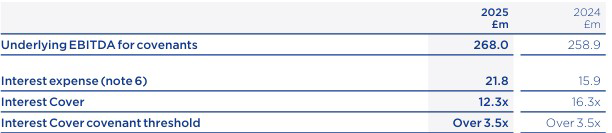
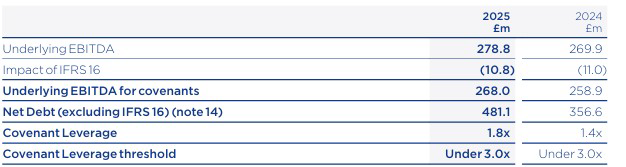
Breedon Group plc, Annual Report and Accounts 2025, p198-199
The company uses a tabular format to concisely show how each covenant is calculated, the covenant requirement and the position at the year end.
The company cross refers to the notes to show how the covenants are calculated with reference to amounts used in the accounts.
SEGRO plc, Annual Report & Accounts 2025 (extract)**
Financial covenants relating to £4,951 million of borrowings as at 31 December 2025 include maximum limits to the Group's gearing ratio, minimum limits to permitted interest cover, minimum limits to the Group's unencumbered asset ratio and maximum limits to subsidiary or secured borrowings. Depending on the instrument, financial covenants are tested for compliance either annually or semi-annually. The gearing ratio of the Group as at 31 December 2025 as defined within the principal debt funding arrangements was 39 per cent and significantly lower than the Group's tightest financial gearing covenant within these debt facilities of 160 per cent. The interest cover covenant requires net interest before capitalisation be covered at least 1.25 times by net property rental income and the ratio for 2025 was 4.2 times. Financial covenants are discussed in more detail in the 'Gearing and financial covenants' section in the Financial review on page 40 and there are no indications that the Group would have difficulty complying with the covenants.
SEGRO plc, Annual Report & Accounts 2025, p157
The company discloses the nature of the covenants, frequency of testing and carrying value of the related liabilities in a single note, aiding understandability.
The company describes the covenants and compares the key covenants calculated for the gearing ratio and interest cover with the covenant requirements.
None of the companies in our selection disclosed that they would have breached a future covenant test based on their circumstances at the end of the reporting period.
Consequently, we have included this hypothetical example to illustrate good aspects of disclosure where a potential difficulty in complying with covenants is identified. It is summarised to illustrate certain aspects of disclosure required by IAS 1 and should not be viewed as a complete example.
Borrowings (extract)
The company's loan of £100m (repayable on 31 December 2028) includes a financial covenant to maintain net debt to Adjusted EBITDA leverage ratio below certain thresholds over the term of the loan as set out below.
| Covenant | 30 June / 31 December 2025 | 31 March / 30 June 2026 | 30 September 2026 onwards |
|---|---|---|---|
| Net debt to Adjusted EBITDA ratio | < 6 times | < 5.5 times | < 5 times |
The company complied with the covenant during the year ended 31 December 2025, with a ratio of 5.2x and 5.6x as of 30 June 2025 and 31 December 2025, respectively. From 2026 onwards, the covenant will be tested on a quarterly basis. The covenant requirements that apply for 2026 would be breached if assessed based on the company's circumstances as of 31 December 2025.
However, as set out in note 1, under the base case scenario, the company is expected to comply with the covenant during the going concern period to 30 April 2027. Under the severe but plausible downside scenario (prior to mitigating actions), the company would breach the covenant tested for the quarter ending 30 September 2026. As explained further in note 1, mitigating actions can be taken by management to avoid the breach, including seeking to agree a prospective waiver of the covenant with the lender. At the time that these financial statements were authorised for issue, the company has met its expected sales target under the base case scenario, and the ratio was 5.3 times as of 31 March 2026.
The disclosure shows how the covenant levels change over time. It explains that the future covenant requirement would be breached based on the company's circumstances at the end of the reporting period.
The company cross refers to the going concern disclosures, where it provides further detail about the related assumptions made. The disclosure clarifies that the potential breach may occur within 12 months after the reporting period (which is relevant for the IAS 1 requirement) as well as within the longer going concern period which covers the 16 months to 30 April 2027.
The company explains the potential actions it could take to mitigate the potential breach.
Appendix 3: Scope of CRR's work and interacting with our team
CRR undertakes the day-to-day work relating to the FRC's responsibility to monitor and improve the quality of corporate reporting in the UK. Its remit covers the annual report and accounts and interim reports of companies included on the FCA's Official List, and the annual reports and accounts of UK-incorporated public companies, large private companies, and Limited Liability Partnerships.
Our statutory function is assessing compliance with legal requirements and relevant accounting standards in:
- the strategic report, including the Section 172 statement and the non-financial and sustainability information statement
- the directors' report
- the annual accounts (financial statements)
The vast majority of companies voluntarily provide information in response to our enquiries and we rarely need to invoke our statutory powers to obtain information. We have not used these powers during the past year.
Our letters provide no assurance that a company's annual report and accounts are correct in all material respects; the FRC's role is not to verify the information provided to it but to consider compliance with reporting requirements.
Our work is part of an integrated model of regulation within the FRC's Supervision Division, which also works closely with colleagues across the Regulatory Standards and Enforcement Divisions. As discussed in section 7, we have embedded the monitoring of corporate governance disclosures and structured digital reporting (iXBRL) into our routine review work.
Outside of the FRC we work with a range of other bodies including the FCA, UKEB as well as other regulators and government bodies on matters related to our respective remits, where relevant.
Further information about our reviews is available on our website:
- How CRR selects and reviews annual reports and accounts and interim reports
- The FRC's operating procedures for reviewing corporate reporting
- CRR Information Sheet
- How to deal with a query from CRR
- How CRR works with other bodies
Financial Reporting Council
London office:
13th Floor, 1 Harbour
Exchange Square,
London, E14 9GE
Birmingham office:
5th Floor, 3 Arena
Central, Bridge Street,
Birmingham, B1 2AX
+44 (0)20 7492 2300
Follow us on LinkedIn
Footnotes
-
IFRIC 5, 'Rights to Interests arising from Decommissioning, Restoration and Environmental Rehabilitation Funds', paragraphs 7 to 9 ↩
-
IFRIC 1, 'Changes in Existing Decommissioning, Restoration and Similar Liabilities', paragraphs 4 to 5 ↩
-
Includes one case in relation to 2024/25 finalised in 2025/26. ↩
-
Includes four cases in relation to 2023/24 finalised in 2024/25. ↩
-
Includes two cases in relation to 2022/23 finalised in 2023/24. ↩
-
'Yes' includes respondents who indicated either 'significant' or 'some' improvement in the quality of their corporate reporting. ↩
-
Effective for periods commencing on or after 1 January 2024. The relevant requirements are carried over to paragraphs B99 to B106 of IFRS 18, effective for periods commencing on or after 1 January 2027, with the related disclosure requirements in paragraph B106. ↩
-
We remind companies of the requirements to provide information about defaults during the reporting period (paragraph 18 of IFRS 7) and actions taken subsequent to the reporting date in relation to liabilities classified as current, including rectification of a breach, the granting of a period of grace or/and refinancing of loan arrangements (paragraph 76 of IAS 1). ↩