
The content on this page has been converted from PDF to HTML format using an artificial intelligence (AI) tool as part of our ongoing efforts to improve accessibility and usability of our publications. Note:
- No human verification has been conducted of the converted content.
- While we strive for accuracy errors or omissions may exist.
- This content is provided for informational purposes only and should not be relied upon as a definitive or authoritative source.
- For the official and verified version of the publication, refer to the original PDF document.
If you identify any inaccuracies or have concerns about the content, please contact us at [email protected].
Our Approach to Regulation: The FRC and the Regulators’ Code (2026)
The FRC does not accept any liability to any party for any loss, damage or costs howsoever arising, whether directly or indirectly, whether in contract, tort or otherwise from any action or decision taken (or not taken) as a result of any person relying on or otherwise using this document or arising from any omission from it.
© The Financial Reporting Council Limited 2026
The Financial Reporting Council Limited is a company limited by guarantee. Registered in England number 2486368. Registered Office: 13th Floor, 1 Harbour Exchange Square, London, E14 9GE
- Our Approach to Regulation
- Our compliance with the Regulators' Code
- Principle 1: Regulators should carry out their activities in a way that supports those they regulate to comply and grow
- Principle 2: Regulators should provide simple and straightforward ways to engage with those they regulate and hear their views
- Principle 3: Regulators should base their regulatory activities on risk
- Principle 4: Regulators should share information about compliance and risk
- Principle 5: Regulators should ensure clear information, guidance and advice is available to help those they regulate meet their responsibilities to comply
- Principle 6: Regulators should ensure that their approach to their regulatory activities is transparent
- How we operate
- Our governance
Our Approach to Regulation
The UK's regulatory framework is a national and strategic asset. At its best, regulation protects stakeholders and supports the UK's reputation as a place to do business. It does this by providing confidence: the confidence to invest, deploy capital and take responsible risks within a reliable, predictable and fair system.
The Financial Reporting Council's purpose is to serve the public interest and support UK economic growth by upholding high standards of corporate governance, corporate reporting, audit and actuarial work. High standards and accountability remain essential, but how we deliver them must evolve to ensure they work effectively in practice.
Trust and confidence are the bedrock of our approach. We focus on giving investors, businesses and the public confidence in the markets we oversee, while ensuring regulatory burdens are imposed only when necessary. We intend to be agile, adapting to changes in the markets and professions we regulate.
What good regulation means to the FRC:
1. Enabling growth
It is businesses, not regulators, that generate growth and wealth. Our role is to create the right conditions for businesses to thrive. This means maintaining high standards of corporate governance, reporting and audit that command public confidence, while avoiding unnecessary burdens that could constrain growth.
2. Proportionate and practical regulation
Regulation must reflect the size, complexity and risk profile of those we oversee. We favour principles-based regulation that allows for flexibility and professional judgement, rather than a one- size-fits-all approach. This reduces unnecessary burden while maintaining the high standards that underpin public trust. It also supports businesses and investors to make informed decisions, take responsible risks and allocate capital effectively.
3. An integrated model
Regulation works best when its tools function together coherently. We bring a joined-up approach to standard setting, supervision and enforcement, helping us identify risks earlier, act quickly and ensure learning is shared across the system. Our supervision is risk-based and targeted, supporting firms to embed quality and improve in practice, while our enforcement is firm and fair. We use a flexible range of tools that enable us to resolve issues faster, hold those we regulate to account and reinforce standards where needed. The results of our supervision and enforcement work enable us to enhance codes, standards and guidance.
4. An engaged regulator
Regulation cannot be designed at a distance. We prioritise engagement and data to understand how markets operate in practice. This allows us to challenge our assumptions, identify where regulation creates unnecessary friction and adapt our approach accordingly.
Looking ahead, we will continue to evolve and enhance our regulatory approach to meet the needs of our stakeholders and enhance trust in UK markets. By embracing innovation, strengthening collaboration with stakeholders and harnessing data and insight, we aim to deliver a regulatory framework fit for the future.
Our compliance with the Regulators' Code
At the FRC, we believe our strategy, objectives and regulatory approach embody the principles set out in the Regulators' Code. The Regulators' Code provides an important framework for our delivery against the public interest. It sets out the characteristics of good regulation— proportionality, consistency, accountability and transparency delivered through targeted regulatory activities and reinforces the need for regulators to act as part of the system to support those they regulate to meet the expectations of their own stakeholders and comply with regulatory requirements. For the FRC, the Code supports us to challenge ourselves and question how we are delivering effective, evidence-based regulation.
This document sets out how we approach, and comply with, the principles of the Regulators' Code. It provides transparency across our regulatory approach, demonstrating how we embed the Code's expectations in our decision making and day-to-day activities. In doing so, it offers our stakeholders clear insight into how we ensure our regulation is proportionate, accountable and evidence-based, while also identifying areas where we continue to reflect and improve our practices.
We remain committed to delivering high-quality, effective regulation that serves the public interest and supports confidence in the UK's corporate environment. By adhering to the principles of the Regulators' Code and continuing to refine our approach, we aim to foster a collaborative and transparent regulatory landscape. Through ongoing engagement, proportionate oversight and a strong focus on outcomes, we will continue to support those we regulate and help deliver UK economic growth.
Principle 1: Regulators should carry out their activities in a way that supports those they regulate to comply and grow
The FRC applies scalable standards that are tailored to the size and complexity of regulated entities, while supporting flexible, principles-based approaches that enable organisations to meet regulatory requirements proportionately to their circumstances. We complement this by providing guidance to facilitate the consistent and proportionate application of standards across the market. The FRC's supervisory approach is focused on driving continuous improvement through Systems of Quality Management (SoQMs), risk-based inspections and thematic reviews, while our enforcement framework incorporates a range of enforcement routes to deliver timely and proportionate outcomes. To promote transparency and shared learning, the FRC publishes annual reviews covering audit, corporate reporting, enforcement and governance, which provide stakeholders with clear insight into regulatory findings and areas for improvement.
In delivering its remit, the FRC acts in accordance with its statutory duty to support economic growth and is developing a Growth Duty Toolkit to help FRC staff assess regulatory activities against this objective. The organisation also leverages market intelligence, research and analytical capabilities to develop evidence-based insights that inform and target regulatory interventions. Through impact assessments, the FRC evaluates the effectiveness of new and ongoing regulatory programmes against the intended outcomes of those programmes. Meanwhile, our expertise in conducting market studies enables us to explore emerging issues and areas of interest identified through stakeholder engagement. The FRC's Innovation and Improvement Hub further supports regulated entities by encouraging innovation and helping them navigate an evolving regulatory environment, alongside a range of initiatives—including regulatory sandboxes and capability- building programmes— designed to enhance quality, resilience and regulatory certainty.
The FRC's ability to deliver effective regulation is underpinned by a highly skilled workforce comprising professionally qualified and experienced specialists, including accountants, auditors, lawyers and actuaries. Our recruitment approach ensures expertise across priority disciplines such as economics, data analytics, law, project management, governance, stewardship and regulation. The organisation is committed to continuous professional development, ensuring that staff maintain the skills, knowledge and experience required to deliver high-quality regulatory outcomes and engage constructively with market participants. Supporting this culture, the FRC's organisational values and expected behaviours align closely with the principles of good regulation set out in The Regulators' Code. All staff are required to complete mandatory training to ensure these principles are consistently understood and applied throughout the organisation.
Principle 2: Regulators should provide simple and straightforward ways to engage with those they regulate and hear their views
The FRC engages with a broad range of stakeholders, including investors, companies and their boards, audit and actuarial professionals, regulators, government bodies and the wider public. Engagement is supported through a dedicated stakeholder engagement function, which coordinates activity across our organisation in line with the FRC's strategic objectives. This includes: undertaking formal consultations on proposed standards, codes and policy changes; convening roundtables and hosting forums such as the Stakeholder Insight Group, and conducting targeted outreach to understand emerging issues, challenges and opportunities across the sectors we regulate.
The FRC is committed to maintaining transparent two-way dialogue with stakeholders. This is achieved through clear communication of findings, decisions and the rationale behind regulatory actions, alongside regular engagement activities. To reach different audiences effectively, the FRC uses a variety of communication channels, including consultations, feedback statements, short- and long-form publications, direct email communications, webinars, podcasts, social media and engagement with media outlets. Our Approach to Audit Supervision sets out our engagement with regulated entities to explain supervisory activities and address instances of non-compliance, while Our Approach to Audit Enforcement explains the FRC's decision making processes and the engagement that takes place throughout enforcement proceedings. We also maintain clear and accessible policies and procedures, which are publicly available on our website.
The FRC provides stakeholders with appropriate opportunities to challenge and seek review of regulatory decisions. Routes of appeal are available across a number of regulatory activities, including under the PIE Auditor Registration Regulations, through the FRC's enforcement procedures and via formal reconsideration processes relating to Audit Quality Review findings. The FRC communicates clearly and promptly regarding appeals in accordance with our published policies and procedures and operates a robust complaints process. This includes both internal and external review mechanisms.
To support effective regulation and identify emerging risks, the FRC undertakes routine engagement and horizon-scanning activities across its stakeholder community. These include Executive Committee-led bilateral meetings, supervision engagement framework meetings involving FRC Audit Firm and Recognised Supervisory Body supervisors, and ongoing engagement with members of the FRC's advisory groups. The FRC also seeks structured feedback from stakeholders through a bi-annual stakeholder perception survey, helping to inform continuous improvement in our regulatory and engagement activities.
Principle 3: Regulators should base their regulatory activities on risk
The FRC adopts a risk-based approach to regulation, focusing our resources and regulatory activity on areas where the potential harm to investors, markets and wider stakeholders is greatest. Intelligence, data and market insights are used to identify, assess and prioritise risks, enabling us to tailor our regulatory interventions according to the nature and significance of those risks. In assessing risk, the FRC considers factors such as the size and complexity of regulated entities, their systemic importance and the market segments in which they operate. The FRC also develops and monitors a range of market health indicators that provide insight into the overall health of the governance, corporate reporting, audit and actuarial ecosystems.
The FRC's risk-based regulatory decisions are supported by transparent and robust governance arrangements. Oversight is provided by the FRC Board, Committees and Executive, which collectively ensure that regulatory activities are delivered in a proportionate, cost-effective and risk- based manner. The FRC's risk management framework has been developed in line with HM Treasury's Orange Book guidance and is reviewed annually. An assessment of the framework, together with a review of the FRC's principal risks, is published each year within the FRC's Annual Report and Accounts.
The FRC's supervisory activities are also grounded in a risk-based approach. Firms and other regulated entities are assessed to determine their level of impact and to inform proportionate baseline supervision arrangements. Through a supervisor-led model, the FRC develops a detailed understanding of the entities it regulates, enabling effective risk assessment and targeted engagement. Assessments are conducted using a consistent and evidence-based methodology, with quality and resilience risk ratings determined by the FRC's confidence in the effectiveness of firms' SoQMs. Enforcement activity is subject to appropriate governance and oversight. Decisions relating to enforcement action, including whether to open formal investigations, are recommended bv the FRC's Delegated Officer (the Executive Director of Supervision) and considered by the FRC's Conduct Committee to ensure that intervention is proportionate and directed towards matters of greatest regulatory concern. This approach supports consistent decision making and helps ensure that regulatory powers are exercised appropriately.
Stakeholder engagement is a central feature of the FRC's regulatory approach. The FRC actively consults with stakeholders when designing and developing our regulatory activities, including the evolution of our Audit Supervision Approach. To promote transparency and accountability, the FRC issues regular reports on Corporate Reporting, Audit Quality, Corporate Governance and Enforcement. These publications provide insight into regulatory findings and, where appropriate, incorporate stakeholder feedback.
The FRC also places significant emphasis on assessing the effectiveness and impact of our regulatory activities. Regulatory impact assessments form a core part of the design and implementation of regulatory interventions. Where post-implementation evaluation is undertaken, the FRC uses analytical approaches based on HM Treasury's Magenta Book guidance and evaluation best practice. In addition, the FRC supports Department for Business, Innovation, Science and Trade teams in conducting periodic post-implementation reviews of the legislation from which we derive our roles and responsibilities, helping to ensure that the regulatory framework remains effective and proportionate over time.
Principle 4: Regulators should share information about compliance and risk
The FRC collects information only when it is necessary to support our regulatory activities and minimise unnecessary or duplicative requests to regulated entities. We share information internally in accordance with established data privacy procedures, as set out on the privacy page of the FRC website. To ensure that information is collected, stored and shared in a legal, efficient and effective manner, the FRC maintains appropriate technological controls and data governance safeguards. The FRC is committed to modern data and information management practices and seeks, where appropriate, to introduce automation and streamlined workflows into our data-gathering activities. All data is maintained securely and in accordance with GDPR principles.
Where statutory information gateways do not exist or do not provide adequate provision, the FRC has Memoranda of Understanding in place with other regulators to facilitate the sharing of information. These information-sharing arrangements are reviewed periodically to ensure they remain appropriate and effective. The FRC also maintains strong and well-established relationships with other regulators, meeting regularly to discuss the interaction between respective regulatory remits and activities and to identify the most effective ways of achieving shared regulatory outcomes.
Principle 5: Regulators should ensure clear information, guidance and advice is available to help those they regulate meet their responsibilities to comply
The FRC seeks to ensure that guidance is proportionate and practical, supporting compliance without imposing unnecessary regulatory burdens. We take a proactive and consultative approach to developing guidance and providing advice, working closely with stakeholders to ensure our outputs are practical, relevant and aligned with market needs. Our non-mandatory guidance clearly distinguishes between the application of regulatory requirements and examples of good practice, helping to improve the quality of reporting and governance by supporting boards, preparers and auditors in understanding what effective practice looks like in real-world situations. The FRC is also able to respond quickly to emerging issues, providing timely clarification and support without the need for immediate formal consultation on standards.
This approach is supported by the use of web-based guidance, including for the UK Corporate Governance Code and Stewardship Code, which enables content to be updated in real time and presented in a more accessible format. The FRC also uses a range of formal and informal engagement channels, including bilateral meetings, webinars and roundtables, to consult with stakeholders and communicate developments.
In addition, the FRC facilitates ongoing dialogue with regulated entities through initiatives such as the ScaleBox SoQM Programme and the Simplifying Annual Reporting Sandbox. These initiatives provide opportunities to discuss practical regulatory and reporting challenges, while supporting innovation and the sharing of good practice. Through these channels, the FRC seeks to foster a culture in which firms can openly share challenges, lessons learned and emerging issues without the immediate concern that such disclosures will trigger formal enforcement action.
The FRC also maintains strong relationships across the UK Regulators Network, sharing information where appropriate and permitted by applicable legislative frameworks. This collaborative approach supports effective regulatory coordination and helps ensure that relevant activity remains proportionate, informed and responsive to developments across the market.
Principle 6: Regulators should ensure that their approach to their regulatory activities is transparent
The FRC tailors its regulatory approach to meet the needs of the broad range of stakeholders it regulates, ensuring that its activities are proportionate, transparent and effective. To support this approach, the FRC publishes clear and accessible processes, operating procedures and regulatory frameworks that explain how we carry out our regulatory responsibilities and what stakeholders can expect from our work. This includes detailed descriptions of key approaches such as the Framework and Process for the Development of Standards, Codes and Guidance, Our Approach to Audit Supervision and Our Approach to Audit Enforcement. In addition, all information required under the Regulators' Code is made available in an accessible format through a dedicated section of the FRC's website, helping stakeholders easily find and understand relevant information.
The FRC exercises our powers in accordance with these established processes and seeks to act proportionately at all times, ensuring a fair and balanced approach to regulation. We expect all colleagues to act consistently with the organisation's Values and Behaviours and to engage with stakeholders in a professional, respectful and appropriate manner. The FRC also actively seeks feedback on our performance and service delivery through bi-annual stakeholder surveys, annual consultation on the Plan and Budget, and other formal consultation activities, ensuring that stakeholder views inform continuous improvement.
To maintain high standards of regulatory delivery, the FRC regularly reviews compliance with our operating procedures, policies and applicable service standards. Where opportunities for improvement are identified, appropriate actions are implemented and monitored through to completion. Performance against key regulatory objectives is reported through the Operational Performance Measures included within the FRC's Plan and Budget, while the Annual Enforcement Review provides additional transparency by reporting performance against service-level KPIs for enforcement activity. Together, these measures support accountability, drive continuous improvement and reinforce confidence in the FRC's regulatory approach.
How we operate
Our functions and powers
The FRC's functions derive from several sources. A full list of our functions and the basis on which our powers are exercised can be found on our website.
The FRC's functions can broadly be broken down into the following:
- UK statutory audit – The FRC is the UK 'Competent Authority for audit'. We set and maintain the UK's auditing standards, International Standards on Auditing (UK) and the FRC's Ethical Standard for Auditors. These standards are based on those set at an international level, centring on the principle of international alignment. Additionally, the FRC monitors and supervises the application of those standards, registers firms and individuals who wish to audit Public Interest Entities (PIEs) (the largest and most systemically important companies in the UK) and takes action to hold firms and individuals to account where they fall short of our expectations. The FRC also operates a regime to recognise the status of supervisory and/or qualifying bodies and provides oversight of activities that the FRC delegates these bodies to act as supervisors of non- PIE audit, and as providers of audit education and professional qualifications.
- Third Country audit – The FRC maintains the registration regime for Third Country Auditors (TCAs) that audit companies listed in the UK. The TCA regime ensures that non-UK auditors of non-UK companies listed on UK regulated markets meet the required standards of audit quality. This typically applies to companies listed on the Main Market of the London Stock Exchange.
- Auditors General – The FRC acts as the Independent Supervisor of Auditors General (auditors assigned by Parliament to audit public sector accounts) in respect of the audits they carry out under the Companies Act 2006, as well as their disciplinary arrangements.
- Crown Dependency audit – The FRC maintains a Memorandum of Understanding with relevant Crown Dependency regulatory authorities. Through this, the FRC monitor audits of entities incorporated in Jersey, Guernsey or the Isle of Man whose securities are traded on a regulated market in the UK or European Economic Area (Crown Dependency inspections). The FRC also determines sanctions on entities where failures have been found during Crown Dependency inspections.
- Accounting – The FRC is responsible for the contractual monitoring and enforcement arrangements with the accountancy profession, issuing UK Generally Accepted Accounting Practice (GAAP) accounting standards and upholding good practice. As supervisor, the FRC also provides oversight of regulation by the professional accountancy bodies and monitors compliance with accounting requirements. To uphold good practice, we provide independent investigation and discipline schemes for matters relating to accountancy firms and members of professional bodies.
- Corporate reporting - The FRC's work on corporate reporting covers a wide range of activities, including regular reviews to ensure that the provision of financial reporting complies with the Companies Act 2006 and accounting standards, issuing guidance on all aspects of corporate reporting, and influencing and collaborating with other regulators and standard setters.
- Actuarial - The FRC is responsible for setting and maintaining Technical Actuarial Standards and providing independent oversight and voluntary monitoring of the application of these standards. We operate through a Memorandum of Understanding with the Institute and Faculty of Actuaries, providing independent investigation and disciplinary schemes for matters relating to members of the actuarial profession.
- Corporate governance and stewardship – The FRC promotes high standards of behaviour by boards and investors by setting the framework for corporate governance and investor stewardship. This involves maintaining the UK Stewardship Code and the UK Corporate Governance Code, and all associated guidance, monitoring and reporting on compliance and good practice.
The FRC's functions are supported by statutory obligations on third parties, such as other regulators, to meet our requirements and/or participate in arrangements provided by the FRC. Although some of our functions have no statutory backing at present, they derive their authority from widespread support through voluntary arrangements with our stakeholders, as well as a united belief in the FRC's work to serve the public interest.
Our governance
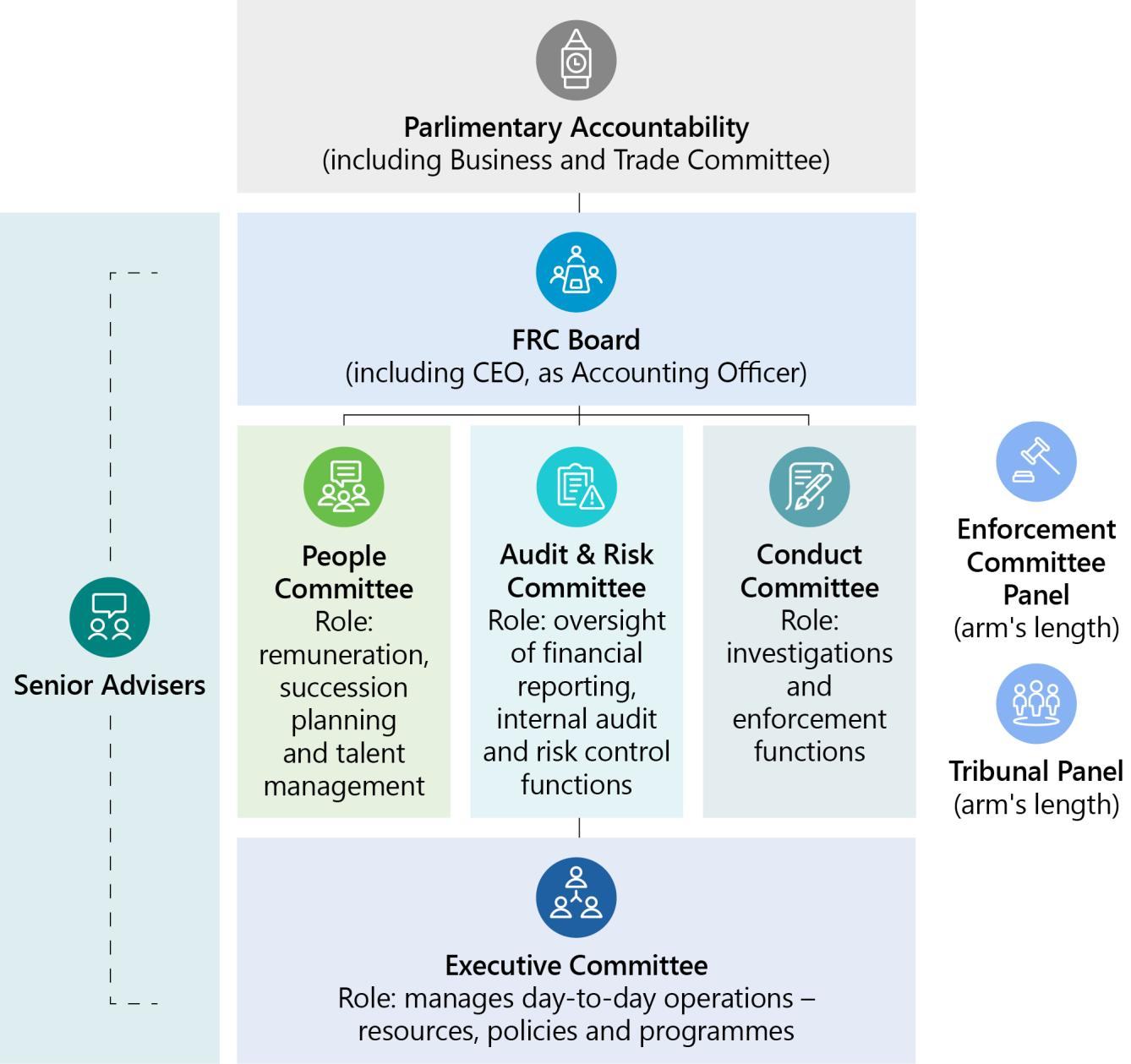
Our Governance structure is designed to support effective executive decision making and non- executive oversight. The FRC is headed by the Board, which is comprised of non-executive and Chief Executive Officer. The Board is collectively responsible for the long-term success of the FRC. Its role includes, but is not limited to:
- Providing strategic leadership of the FRC within a framework of prudent and effective controls which enables risk to be assessed and managed.
- Setting the FRC's strategic aims, ensuring that the necessary financial and human resources are in place for the FRC to meet our objectives, and reviews management performance.
- Setting the FRC's values and culture.
- Ensuring that the FRC's obligations to our stakeholders and others are understood and met.
The Board has established committees to support its functions and is also supported by a capable Executive management team and Executive Committee, which run the day-to day operations of the organisation.
The Board and Executive are also supported by Senior Advisers and an Advisory Panel who are subject matter experts and provide technical advice. A Tribunal Panel and an Enforcement Committee Panel are constituted to consider enforcement cases and matters under the FRC's conduct procedures.
The Board is supported by two governance committees (People Committee and Audit and Risk Committee) and by one regulatory committee (the Conduct Committee). The Board is also supported by the FRC's Chief Executive and Accounting Officer (CEO), who manages the day-to-day operations of the FRC, including resources, policies and programmes.
Our funding
The FRC's funding comes from a number of sources. Our main funding groups are the following:
- The audit and accountancy professional bodies, which fund the costs of Audit Quality Review (AQR), Audit Market Supervision (AMS), Audit Firm Supervision (AFS), audit and accountancy enforcement activities, and audit and accountancy standards-setting and professional oversight.
- Listed companies and other specified groups of accounts preparers, which pay a non-statutory 'preparers levy'. This funds the FRC's work on corporate governance and reporting, including setting codes and standards, influencing international standards and the corporate reporting review. (The specified groups are AIM companies, large private companies and public sector organisations.)
- Insurance companies and pension schemes, which each contribute 45% of the annual cost of actuarial regulation. The Actuarial Profession contributes the other 10%.
Every year, the FRC consults stakeholders on its Plan and Budget. The annual funding requirement is set to recover the cost of regulatory activities and overheads. The FRC allocates the funding requirement to our funding groups in line with our regulatory priorities and the size of each group.
The following table summarises the funding sources. These are raised on a statutory basis (as UK Competent Authority for audit) and through either contractual or voluntary routes:
| Ref. | FRC funding sources | Status |
|---|---|---|
| Audit professional bodies | ||
| (I) | RSB contribution to AQR funding | Statutory; actual costs recovered |
| (III) | CCAB contribution to audit standards/ oversight | Statutory |
| (V) | Contribution to enforcement case costs | Statutory; actual costs recovered |
| (VI) | Contribution to AMS | Statutory; actual costs recovered |
| (VI) | Contribution to AFS | Statutory; actual costs recovered |
| Total statutory – audit regulation | Statutory | |
| (III) | CCAB contribution to accountancy oversight | Voluntary contribution |
| (IV) | CIMA contribution | Voluntary contribution |
| Preparers Levy | ||
| (VII) | Accounts preparers (listed) | Voluntary levies |
| (VII) | Accounts preparers (non-listed) | Voluntary levies |
| Actuarial funding groups | ||
| (VIII) | Insurance companies | Voluntary levy; collected by FCA |
| (IX) | Pension schemes | Voluntary levies; collected by agent (Adetiq) |
| (X) | IFoA | Voluntary contribution |
| Total voluntary | ||
| (II) | NAO, Crown Dependencies and health authorities audits contribution to AQR funding | Contractual |
| (XII) | Publications, FRC Taxonomies and TCA registration fees | Contractual |
Accountancy and audit
The accountancy profession is funded by the contributions of the Consultative Committee of Accountancy Bodies (CCAB), the members of which are ICAEW, ICAS, ACCA and CAI. CIMA, which is not a member of the CCAB, also contributes to the FRC's funding requirement under the terms of a separate arrangement.
The ICAEW, ICAS, ACCA and CAI are Recognised Supervisory Bodies (RSB). The ICAEW raise funding by invoicing the audit and accounting professional bodies for the relevant amounts. The FRC provide a figure for the following year's budget to the ICAEW following early budget meetings. At the end of the financial year, the FRC can calculate an estimate of the surplus funding received for audit and accounting activities, and the following year's budgeted funding requirement is reduced by that surplus and spread over 12 months.
Preparers levy
The FRC is funded partly through a preparer's levy on the following organisations that are subject to, or have regard to, FRC regulatory requirements in preparing their accounts:
- Companies listed on the London Stock Exchange, and UK AIM and Aquis Exchange group companies with an equity share listing.
- Large private entities with a turnover of £500m or more. Subsidiaries of UK listed companies with a turnover of £500m or more are invoiced on the same invoice as their parent company.
- Standard Global Depository Receipt companies.
- Government departments and other public sector organisations that publish accounts.
Once the overall funding requirement is identified during the plan and budget consultation process, we calculate the percentage increase/decrease in the preparer's levy rate we should apply to secure the requirement. This can depend on several factors, such as the population that we will be invoicing, the most recent collection rate from each funding group, and the percentage increase/decrease in the tariff data. In addition to the FRC funding requirement, we also collect the UK contribution to the funding of the International Accounting Standards Board as part of the preparer's levy.
Insurance levy
The insurance levy is charged to insurance companies and invoiced by the Financial Conduct Authority (FCA). The FRC sets a levy equivalent to a percentage of the fees charged by the FCA and Prudential Regulation Authority (PRA) for their categories. The insurance levy is imposed on insurance companies under two FCA-defined categories or 'fee blocks':
- AF03 - Insurers – General.
- AF04 - Insurers – Life.
Pension levy
The FRC pension levy applies to all Defined Benefit and Defined Contribution schemes with 5,000 members or more, at a pension levy rate based on the number of members. During the preparation of the draft 3-Year Plan, the target funding requirement from pension schemes is calculated and we consult on the pension levy rate for the following year. The levy rate to be applied to individual schemes is also based on the latest available data on scheme membership provided by The Pensions Regulator (TPR).
Actuarial funding
The annual budget for all actuarial regulatory activities (including enforcement cases) is met through contributions from the actuarial profession (IFoA), insurance companies and pension schemes with more than 5,000 members. There is no government contribution. All three funding groups contribute to the cost of public interest disciplinary cases involving actuaries. Due to the unpredictability of disciplinary cases, a fund is maintained through contributions from the annual budget, which can be used to manage the impact of a big case.
During the preparation of the draft budget in November/December, the target funding requirement from the IFoA is calculated and we consult on the amount.
Third country auditors
A Third Country Auditor seeking registration in the UK must pay a fee to the FRC upon application and an annual fee thereafter for renewal of its registration in accordance with the Third Country Auditors (Fees) instrument. This fee is based upon our anticipated costs to administer the regime.
Financial Reporting Council
London office:
13th Floor, 1 Harbour
Exchange Square,
London, E14 9GE
Birmingham office:
5th Floor, 3 Arena
Central, Bridge Street,
Birmingham, B1 2AX
+44 (0)20 7492 2300
Follow us on LinkedIn