
Key Facts and Trends is produced annually by the FRC to provide helpful statistical data on the accountancy profession, and provide contexts to its work.
Introduction
In this section:
Overview
1This is the twenty-fourth edition of Key Facts and Trends in the Accountancy Profession (KFAT). This report provides statistical information and trends on members and students in the accountancy profession, and audit firms responsible for auditing Public Interest Entities (PIEs)[1]. The FRC uses this information to inform various activities including policy development, supervisory engagement, market analysis, and research.
2The information is obtained from the following eight accountancy bodies (which includes six UK chartered accountancy bodies and two professional bodies):
- the Association of Chartered Certified Accountants (ACCA)
- the Chartered Accountants Ireland (CAI)
- the Chartered Institute of Management Accountants (CIMA)
- the Chartered Institute of Public Finance and Accountancy (CIPFA)
- the Institute of Chartered Accountants of Scotland (ICAS)
- the Institute of Chartered Accountants in England and Wales (ICAEW)
- the Association of International Accountants (AIA)
- the Association of Accounting Technicians (AAT).
3In the UK there are four Recognised Supervisory Bodies (RSBs), which register and supervise statutory auditors and audit firms. These are ACCA, CAI, ICAEW and ICAS. There are five Recognised Qualifying Bodies (RQBs) that can offer the Audit Qualification. These are ACCA, ICAEW, CAI, ICAS and AIA.
4CIMA is a UK-based professional management accounting body; CIPFA is a UK-based professional accounting body focused on the public sector, while AAT is a UK-based professional body for accounting technicians.
5In this edition, all eight accountancy bodies and 30 PIE Audit Firms (out of 33 PIE Audit Firms contacted) participated, compared with 31 out of 34 PIE Audit firms for last year’s publication. This steady response rate continues to allow visibility into the audit and accounting industry and highlights the key trends shaping the industry today. As always, we are grateful to those who take the time to complete our questionnaire that feeds into compiling KFAT and those who provide feedback on how we can continue to improve this publication.
How to use this report
6This report provides information for students, academics and those who work within the accountancy industry to help them understand the landscape of the profession in the UK in 2025. The report should be used in combination with the statistical data in the accompanying Excel data file.
7The Highlights section provides an overview of key facts and trends for the UK – combined with the Republic of Ireland (ROI), where relevant – and worldwide data where available, that we consider relevant to all stakeholders. For further information, please refer to the accompanying data file.
8The content of this publication is for general information purposes only. Where appropriate, we highlight significant trends and explain possible limitations of the data; however, it is important to note that we do not check the accuracy of the information provided. We stress that it is often difficult to make comparisons between the different accountancy bodies, or between the PIE audit firms, given the differences in the way data is classified by those bodies and firms, and because of different regulatory arrangements in the UK, ROI and rest of the world.
9Appendix 1 includes details on the methodology, points to note and the Financial Reporting Council’s (FRC’s) responsibilities in respect of the supervision of the professional bodies and UK statutory auditors.
10If you want to provide feedback on this year’s publication, please submit your comments.
Excel file
File download
The underlying statistical data accompanying this report is available to download.
Key Facts and Trends in the Accountancy Profession 2026 (Excel)
Footnotes
-
[1]
Public Interest Entities (PIEs) are: (a) an issuer whose transferable securities are admitted to trading on a UK regulated market; (b) a credit institution within the meaning of Article 4(1)(1) of Regulation (EU) No 575/2013 of the European Parliament and of the Council, which is a CRR firm within the meaning of Article 4(1)(2A) of that Regulation; or (c) a person who would be an insurance undertaking as defined in Article 2(1) of Council Directive 91/674/EEC of 19 December 1991 of the European Parliament and of the Council on the annual accounts and consolidated accounts of insurance undertakings as that Article had effect immediately before IP completion day, were the United Kingdom a Member State (IP completion day was 31 December 2020).
Section One - Main Highlights
In this section:
Accountancy Bodies
12In 2025, there were over 156,000 students in the UK and ROI, and about 584,000 students worldwide. Between 2024 and 2025, student numbers in the UK and ROI increased by 0.9% but decreased by 0.1% worldwide.
13The total number of students who became members worldwide increased by 4.9% in 2025, compared with an increase of 12.3% in 2024 and a decrease of 5.9% in 2023.
PIE Audit Firms
15In 2025, the Big Four UK firms recorded only modest increases in total fee income (0.6%) and audit fee income (1.9%), while fees from non-audit work to audit clients decreased by 5.6%.
16Firms outside the Big Four continued to grow more strongly, with total fee income rising by 5.8% and audit fee income by 9.7%.
17The Big Four’s average audit fee income per Responsible Individual (RI) increased by 28.2% across firms with PIE clients.
18In 2025, the largest non-Big Four firms audited 13.6% of FTSE 250 companies compared with 13.2% in 2024. In 2025, the Big Four audited 81.2% of FTSE 250 companies compared with 81.6% in 2024.
Section Two - Accountancy bodies: members, students, resources
In this section:
Registered members and students in the UK and ROI
19This section presents the number of members and students reported by the accountancy bodies in the UK, ROI, and worldwide, and the bodies’ resources. The figures referenced can also be found in the accompanying Excel data file.
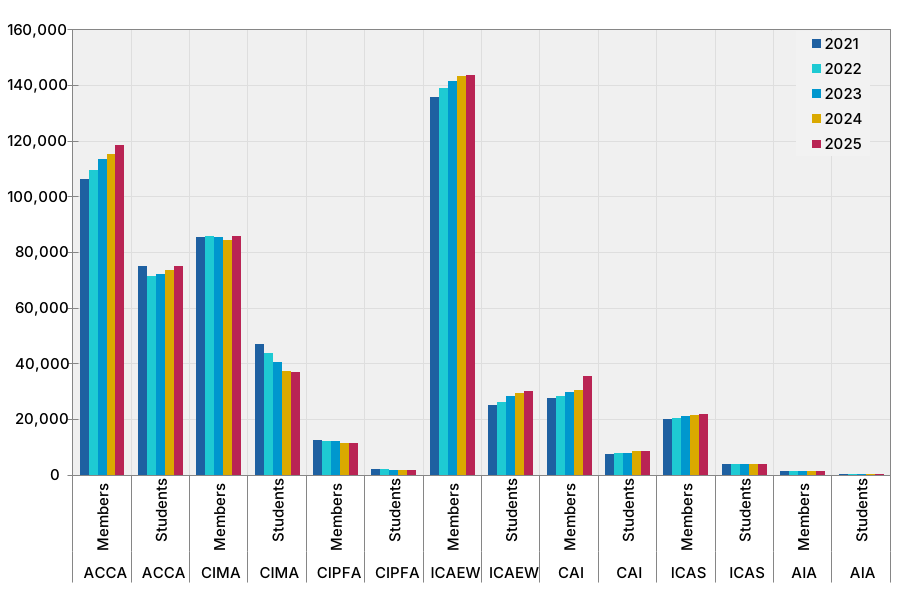
20The data shows that the total number of members in the UK and ROI increased by 2.5% from 408,700 in 2024 to 418,986 in 2025. Over the period from 2021 to 2025, total members increased by 7.6% from 389,330 to 418,986 (Figure 1).
21Between 2024 and 2025, CAI recorded the largest percentage increase in members, increasing by 16.2%. This increase reflects new members post amalgamation with Certified Public Accountants in Ireland (CPA Ireland) in September 2024. The number of members also increased at ACCA by 3.0%, ICAS by 2.3%, CIMA by 1.4%, and ICAEW 0.2%, and decreased at CIPFA by 0.4% and AIA by 4.6% (Figure 1).
22The total number of students in the UK and ROI combined increased by 0.9% from 154,905 in 2024 to 156,367 in 2025. Over the period from 2021 to 2025, the total number of students decreased from 161,337 to 156,367, representing a 3.1% reduction (Figure 1).
23Between 2024 and 2025, ICAEW student numbers increased by 2.5%, AIA by 2.0%, ACCA by 1.8%, ICAS by 1.3%, while CAI decreased by 1.1%, CIMA by 0.8%, and CIPFA by 14.4% (Figure 1).
24Figure 1: Members and students in the UK and ROI
Registered members and students Worldwide
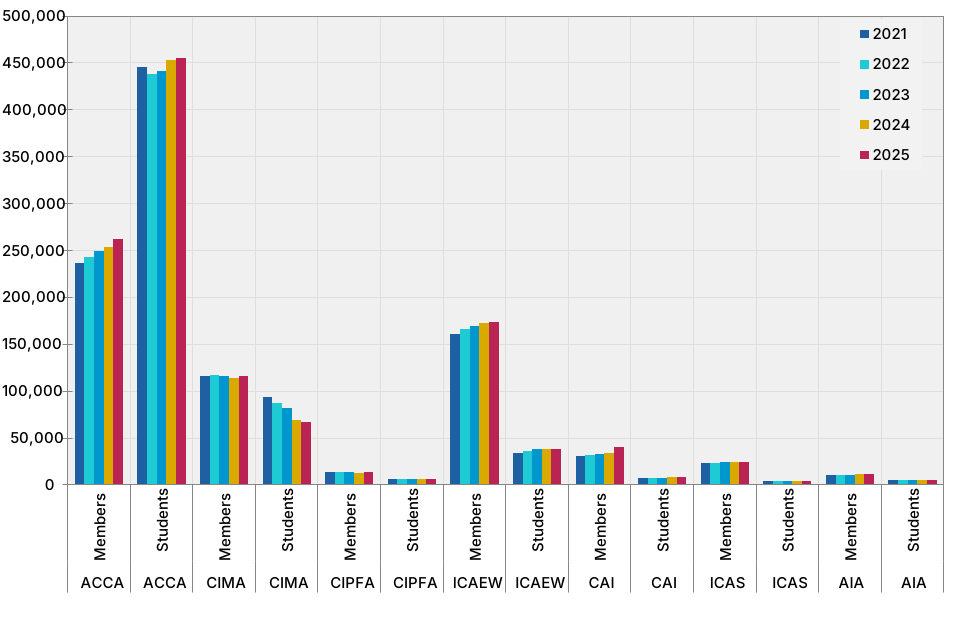
25The total number of members worldwide increased by 2.9% from 623,324 in 2024 to 641,474 in 2025. Over the period from 2021 to 2025, total worldwide membership increased by 8.3% from 592,466 to 641,474.
26The total number of students worldwide was 584,158 in 2025, compared with 584,751 in 2024, representing a 0.1% decrease. Over the period from 2021 to 2025, total worldwide student numbers decreased by 2.2% from 597,106 to 584,158.
27Between 2024 and 2025, worldwide members increased at CAI by 17.0%, ACCA by 3.2%, CIMA by 1.8%, ICAS by 1.5%, AIA by 1.0%, ICAEW by 1.0%, and CIPFA by 0.7%. The CAI increase in members is the result of CAI’s amalgamation with CPA Ireland.
28Between 2024 and 2025, student numbers increased for AIA (1.3%), CIPFA (1.1%), ACCA (0.5%) and ICAS (0.3%), and decreased for CIMA (3.4%), ICAEW (1%) and CAI (1%).
29The worldwide totals are based on registered addresses supplied to accountancy bodies, which may reflect either place of employment or place of residence.
30Figure 2: Members and students worldwide
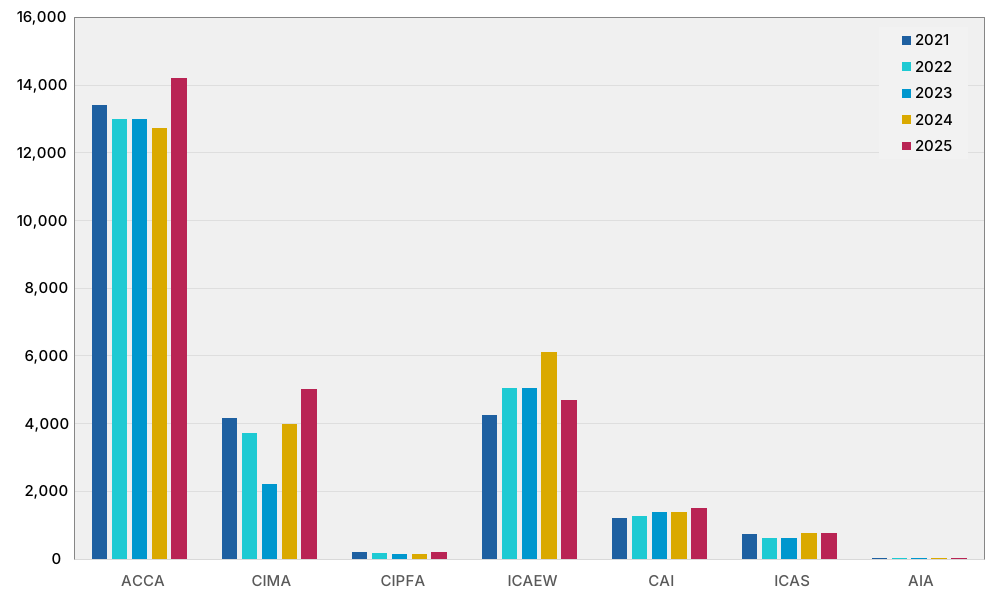
31The total number of students becoming members increased by 4.9% from 25,191 in 2024 to 26,434 in 2025. The total in 2025 was also higher than the figures reported in 2021, 2022 and 2023 (figure 3).
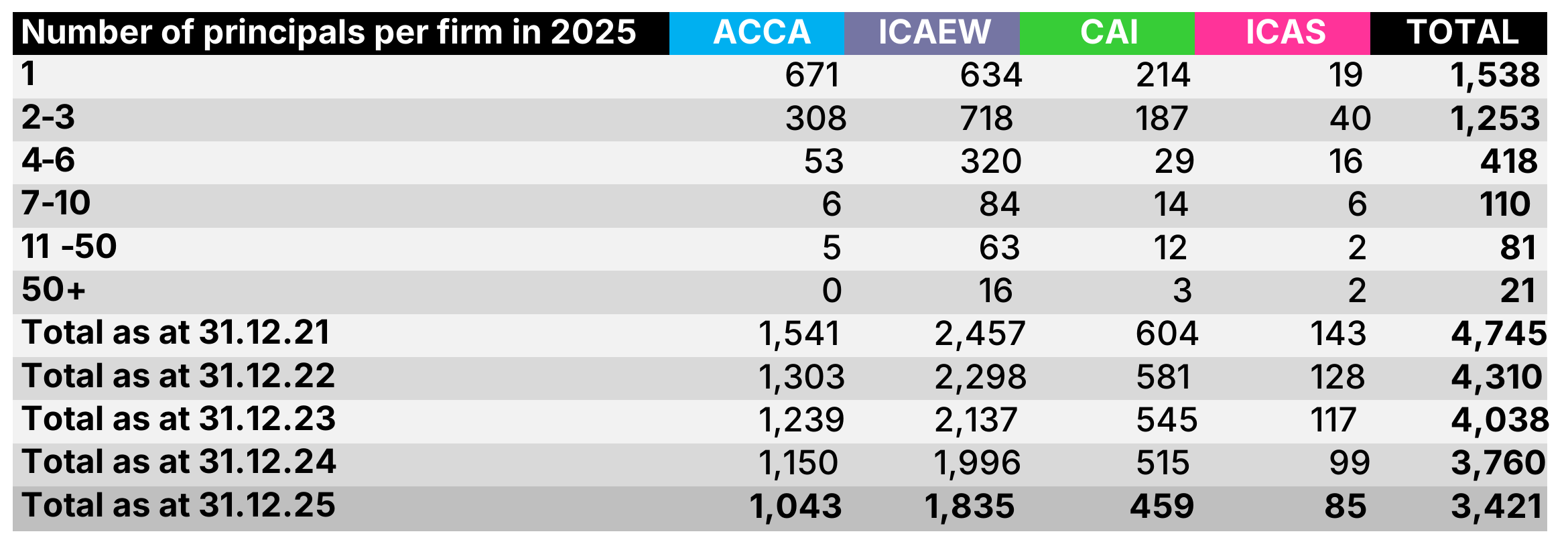
32Figure 3: Students to members worldwide, 2021 to 2025
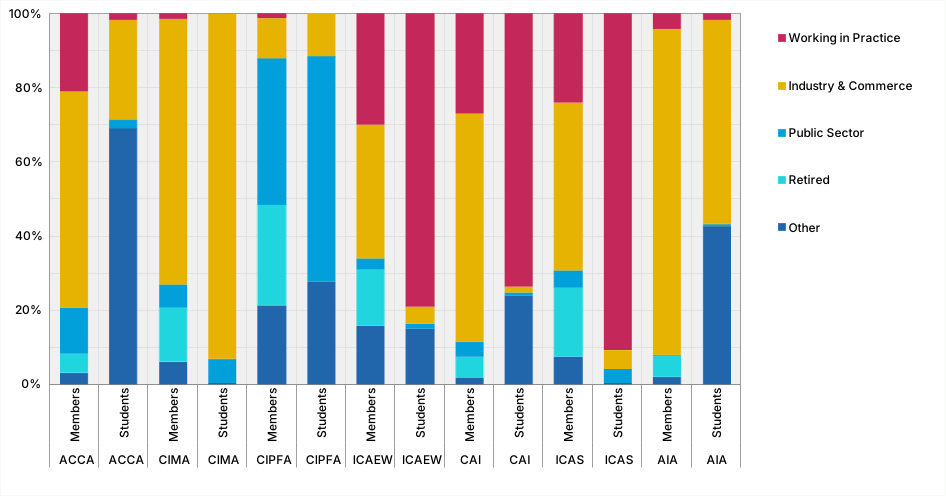
33In 2025, the Industry and Commerce sector employed the highest average percentage of members (54%), and captured the highest percentage of students for CIMA (93%). ICAS, ICAEW and CAI had the highest percentages of students Working in Practice: 91%, 79% and 74% respectively.
34Figure 4: Sectoral employment worldwide, 2025
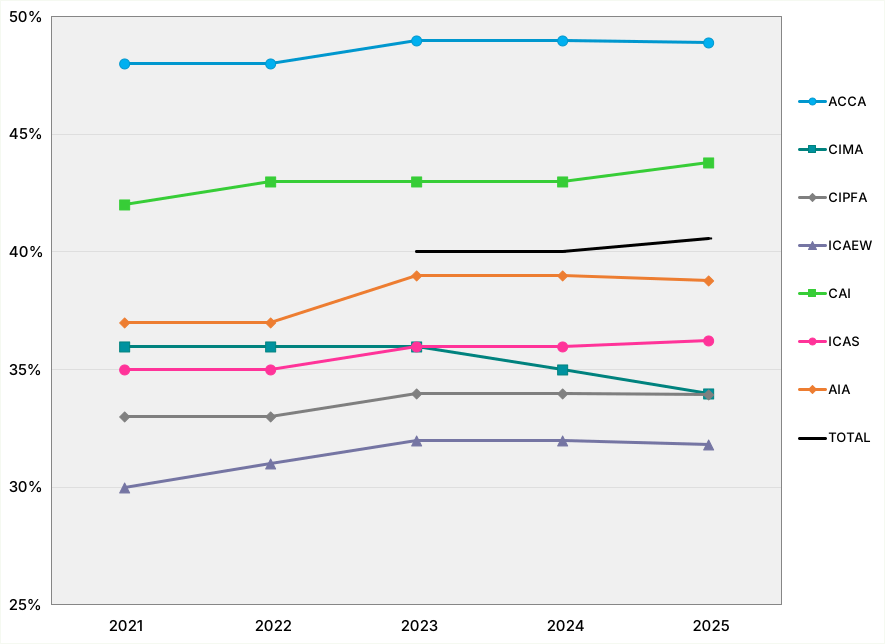
35Between 2024 and 2025, the overall proportion of female members increased from 40% to 41%, with CAI being the only body to record an increase (1%). ACCA continued to have the highest percentage (49%) of female members of all the accountancy bodies.
36Figure 5: Female members worldwide, 2021 to 2025
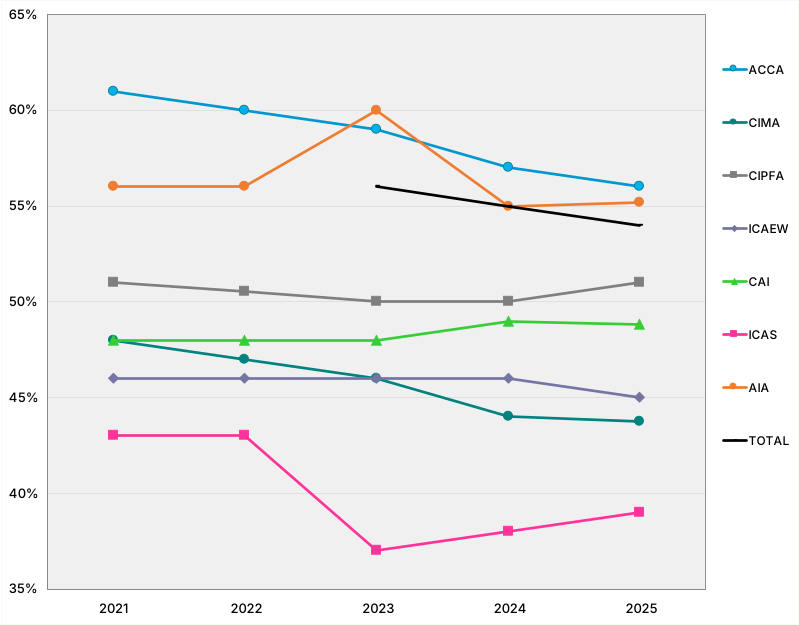
37Between 2024 and 2025, the proportion of female students decreased from 55% to 54% overall, while ICAS saw a 1% increase. ACCA continued to have the highest percentage (56%) of female students of all the accountancy bodies.
38Figure 6: Female students worldwide, 2021 to 2025
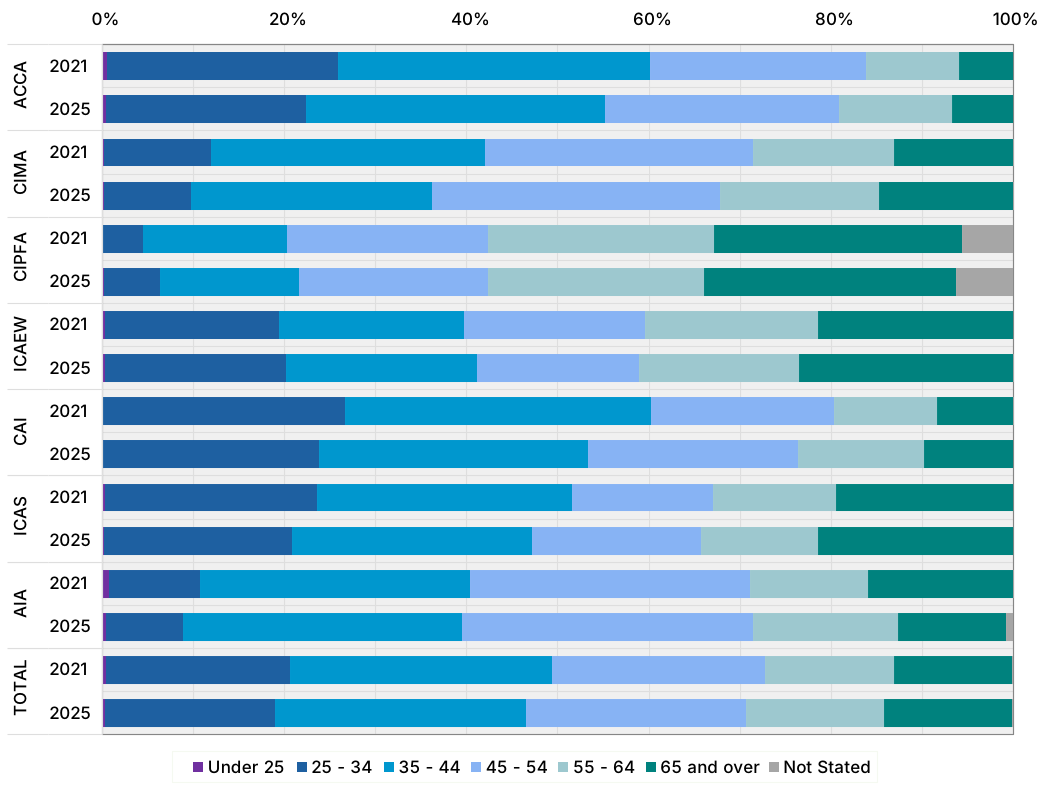
39The proportion of worldwide members aged 55 and over has increased since 2021. Members aged between 35 to 44 and 45 to 54 continue to account for the largest proportion of worldwide members – 28% and 24% of the total population respectively. There are now more members aged 55 and over (29%) than in 2021 (27%). This trend differs for CIPFA and ICAEW who have seen increases in their proportions of members aged under 35.
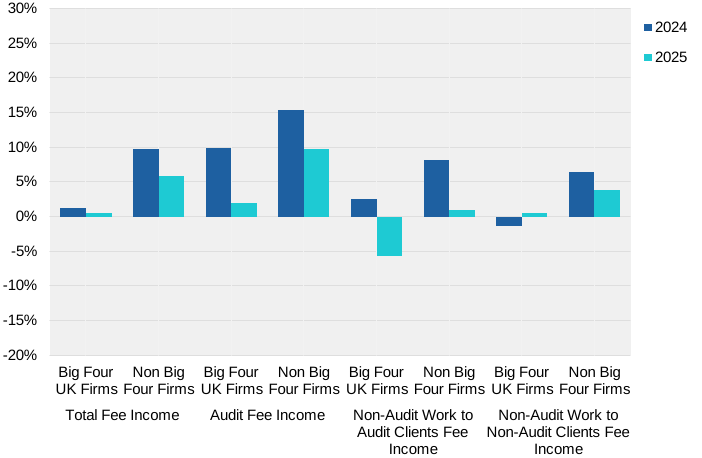
40Figure 7: Age of members worldwide, 2021 and 2025
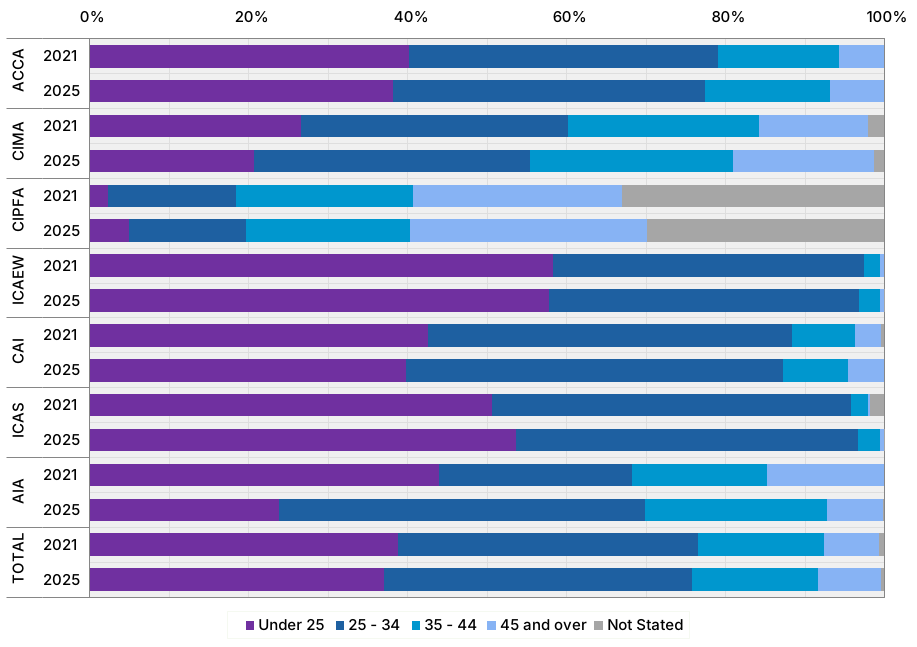
41In 2025, 76% of all students from the seven accountancy bodies were aged 34 or under compared with 77% in 2021. In 2025, students aged between 25 to 34 accounted for the largest proportion of students worldwide (39%). By contrast, in 2021, students under 25 accounted for the largest proportion of students worldwide (also 39%).
42Figure 8: Age of students worldwide, 2021 and 2025
43We ask all bodies whether they collect data on the protected characteristics recognised under the Equality Act 2010, and on the socio-economic background of their members and students. In 2025, seven of the nine protected characteristics under the Equality Act 2010, were used by at least one of the bodies to record data on members and students.
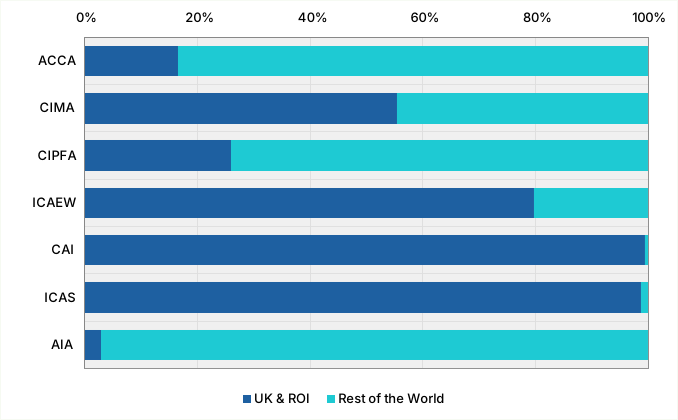
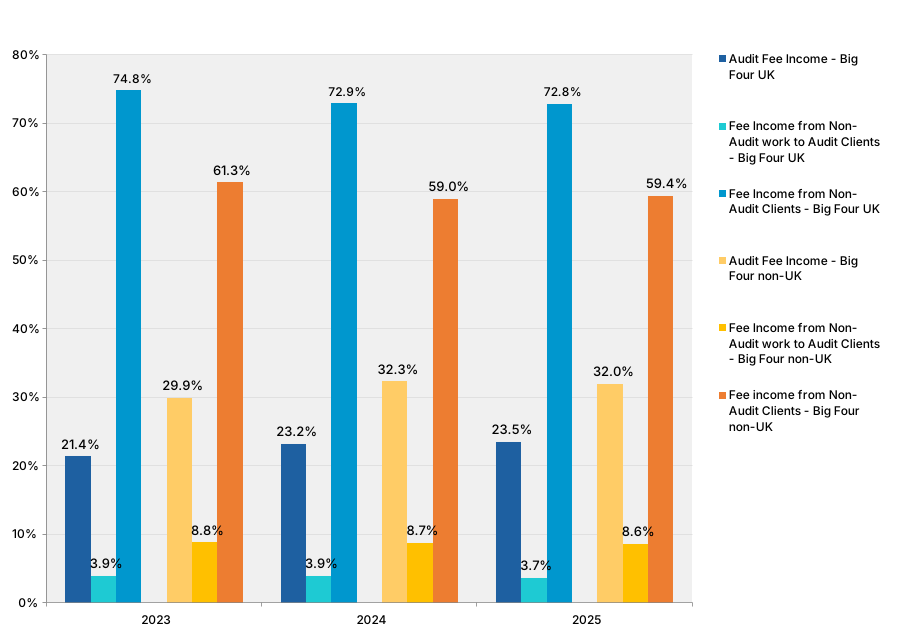
44In 2025, 27% of students across the accountancy bodies were studying in the UK and ROI compared to 26% in 2024. This increase was driven by a higher proportion of students based in the UK and ROI among CIMA, ICAEW and ICAS students. CIPFA saw a 5-percentage point decrease in the proportion of students studying in the UK and ROI, decreasing from 31% to 26% in 2025.
45Figure 10: Location of students, 2025
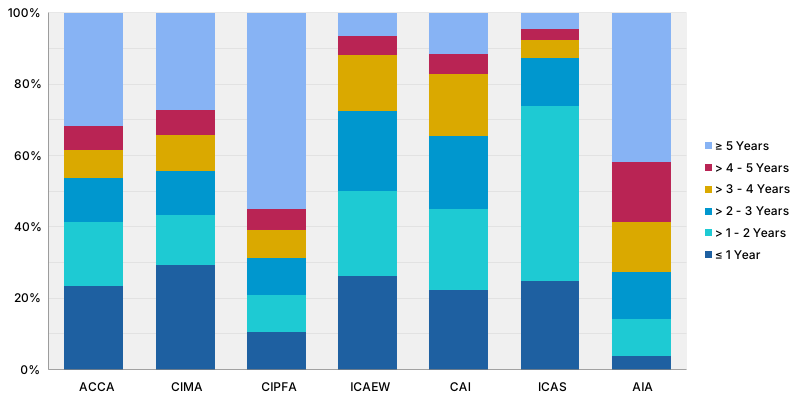
47Figure 11: Profile of students worldwide, 2025
Resource Information on the Accountancy Bodies
48Total income for the accountancy bodies was £592.8m in 2025. All but one body saw an increase in income over the 12 months. CIPFA saw a decline in income from £27.4m to £26.1m (figure 16). CAI and ICAS had the highest average income per member and student in 2025, £698 and £776 respectively (figure 17). Fees and subscriptions, taken together with education and exam fees from members and students, were the main sources of income for each of the bodies with the exception of CIPFA and ICAEW. CIPFA’s main source of income is from commercial activities (63%) and ICAEW derived most of its income from income within the Fees and subscriptions, and Regulation & Discipline categories (65%) (figure 18).
49Total staffing across the professional accountancy bodies increased by 2.2% from 3,286 in 2024 to 3,359 in 2025. Between 2021 and 2025, total staffing increased by 10.5% from 3,039 to 3,359 (figure 19). In 2025, there were 9,875 approved training offices in the UK and ROI, an increase of 3% since 2024. This was driven by increases in offices from ICAEW (7%) and ICAS (6%) (figure 32).
Audit Qualification
50Of the three bodies – ICAEW, CAI and AIA - that provide information on students following the audit route or eligible for the Audit Qualification, there were 26,372 of these students in 2025. This is a decrease of 4% year on year (figure 31). At the same time 2025 saw an increase[2] in the number of members awarded the Audit Qualification, mainly driven by an ICAS project to review and approve a large number of outstanding audit qualification applications following the introduction of a revised review process in 2024.
The Association of Accounting Technicians (AAT)
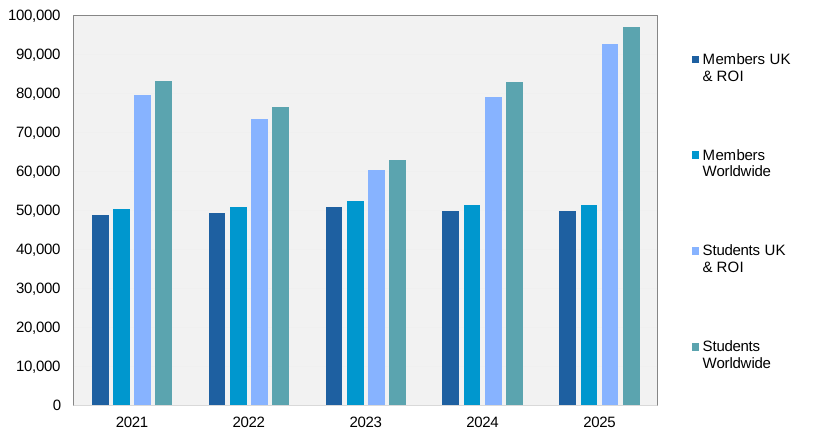
51AAT is used as an entry-level qualification by some of the chartered accountancy bodies included in this publication and has its own Accounting Technicians and Bookkeeper membership. The number of AAT members in 2025 in the UK and ROI, and worldwide remained about the same as 2024. This is in contrast with strong increase in the number of students by 17% in the UK and ROI, and 17% worldwide (figure 13).
52Figure 13: AAT members and students, 2021 to 2025
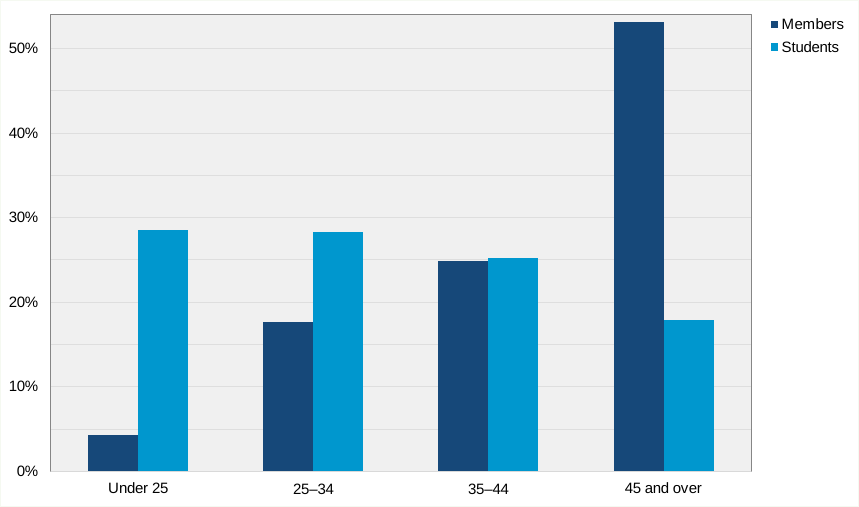
53The AAT age profile shows that 53% of members were aged 45 and over, while the largest student groups were under 25 and 25–34, each accounting for around 28% of students (figure 14).
54Figure 14: AAT age of members and students worldwide, 2025
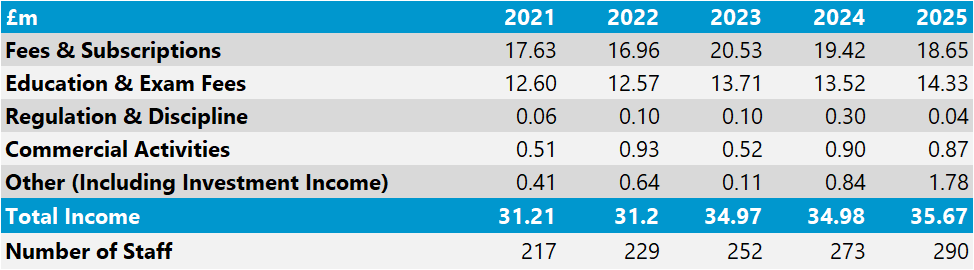
55AAT total income was £35.7m in 2025, compared with £35.0m in 2024. AAT staff numbers increased from 273 in 2024 to 290 in 2025. Fees and subscriptions, alongside education and exam fees from members and students, made up 93% of AAT’s income in 2025 (figure 15).
56Figure 15: AAT resource information, 2021 to 2025
Footnotes
-
[1]
There is no common basis between the accountancy bodies for determining the length of time between registering as a student and achieving the requirements for membership. It is therefore difficult to draw comparisons across the accountancy bodies as they offer different types of qualifications
-
[2]
The Audit Qualifications of some members may be counted twice; firstly, by the body awarding the qualification, and then again if they become a member of another body while retaining their initial qualification.
Section Three - Supervision of audit regulation
57This section presents the supervisory activities at the FRC and RSBs. The figures referenced can be found in the accompanying Excel data file.
58In 2025, the number of audit firms registered to carry out statutory audit work in the UK and ROI by the RSBs decreased by 9% to 3,421. The number of registered audit firms decreased by 7% in 2024 (to 3,760).
59ICAEW's share of all registered firms increased from 53% in 2024 to 54% in 2025. The other bodies each accounted for a smaller proportion of the total in 2025 than in 2024 (Figure 21).
60In 2025, the RSBs received 115 requests from new applicants to become a registered statutory audit firm – a 33% decrease from the 172 requests received in 2024. Between 2023 and 2024, there was a 26% increase in these requests (figure 22).
61Last year, one new firm with more than 50 principals became a registered firm, a result of established firms consolidating. This is despite most firms (82%) having between 1-3 principals.
62Figure 21: Total registered audit firms by number of principals, 2021 to 2025
63In 2025/26, the FRC’s Audit Quality Review team (AQR) reviewed 139 audits, including 126 private sector audits. In 2024/25 the numbers were 142 and 125 respectively (figure 23).
64The RSBs conducted monitoring visits on 21% of the registered audit firms at each RSB in 2025 compared to 20% in 2024 (figure 24). Cyclical visits were the most common reason for monitoring for most RSBs except for ICAS which prioritised more visits based on its ongoing risk assessment. (figure 25).
65The RSBs handled 170 audit-related complaints in 2025, an increase of 16% from 2024. 42 cases were passed to the Committee (a decrease of 26%) and 147 cases were closed in the year (an increase of 13%) (figure 30).
Section Four - PIE audit firms
66After total fee income for the Big Four[1] UK audit firms increased by 11.1% in 2023 and 11.9% in 2022, it increased by 1.2% in 2024 and 0.6% in 2025. For firms outside of the Big Four, the total fee income increased by 5.8% in 2025 compared to increases of 9.8% in 2024 and 13.2% in 2023 (Figure 36).
67Audit fee income for the Big Four UK firms increased by 1.9% in 2024 compared with a 9.9% and 19.5% increase in 2024 and 2023 respectively. Audit fee income for audit firms outside the Big Four increased by 9.7% in 2025, compared with 15.4% in 2024 and 23.2% in 2023 (Figure 36).
68In 2025, fees for non-audit work to audit clients decreased by 5.6% for the Big Four UK firms, compared with an increase of 2.5% in 2024. For non-Big Four firms there was a 1.0% increase in these fees in 2025, compared with an increase of 8.2% in 2024. (Figure 36).
69Figure 36: growth of fee income, 2024 and 2025
70For the Big Four non-UK[2] firms, audit fee income as a proportion of total fee income decreased slightly from 32.3% in 2024 to 32% in 2025, while fee income from non-audit work to audit clients as a proportion of total fee income fell marginally from 8.7% in 2024 to 8.6% in 2025. Fee income from non-audit clients as a proportion of total fee income increased slightly from 59% in 2024 to 59.4% in 2025 (Figure 34).
71Figure 34: Proportion of total fee income from audit and non-audit work for the Big Four firms, 2023 to 2025
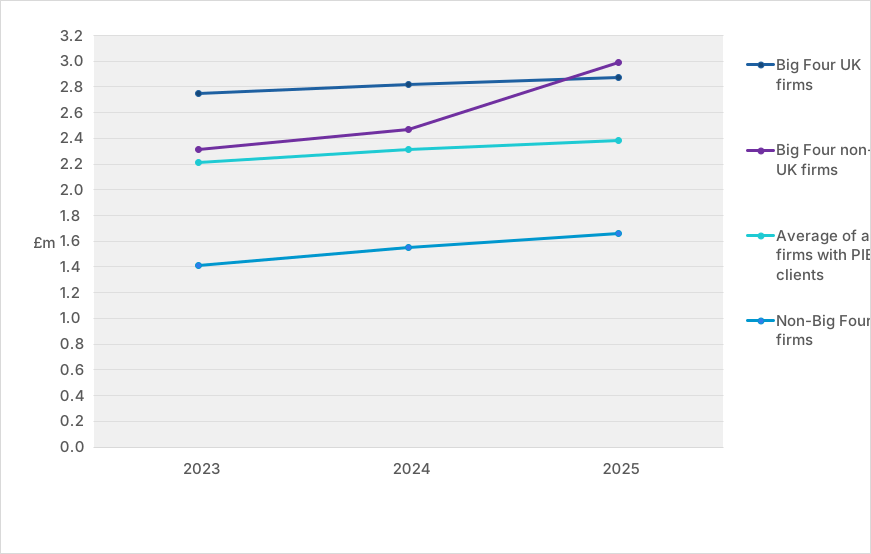
72The average audit fee income per Statutory Auditor/Responsible Individual (RI) for the Big Four UK firms in 2025 was £2.87m compared with £2.99m for the Big Four non-UK firms and £1.66m for non-Big Four firms. The average for all firms with PIE clients was £2.38m, an increase of £0.07m (3.1%) compared with 2024 (Figure 37).
73Figure 37: Average audit fee income per RI, 2023 to 2025
74In 2025, the five largest[3] audit firms (by number of listed audit clients) outside of the Big Four firms audited 17.6% (42) of the FTSE 250 companies; in 2024 this was 13.2% (33). Firms outside these five (and the Big Four), audited 5.9% (14) of the FTSE 250 companies in 2025, compared with 5.2% (13) of the FTSE 250 companies in 2024 (Figure 38).
75Regarding diversity at audit firms, our survey questions focused on senior management at each of the 30 PIE Audit Firms, highlighting those managers, directors and partners who are female, from Black, Asian and minority ethnic backgrounds, have a disability, or identify as LGBTQ+. Figures 40 to 47 in the Excel data file show the diversity information provided by audit firms.
Footnotes
Appendix 1: Methodology, points to note and FRC’s responsibilities
In this section:
Methodology and points to note
76The Highlights section (Section One) refers to data for the UK and the ROI combined, as well as worldwide data. We aggregated the UK and ROI data for certain figures. This is because some auditors and audit firms are registered in both jurisdictions and in some cases, it is difficult for bodies to separate the data. The Irish Auditing and Accounting Supervisory Authority (IAASA) publishes information relating specifically to the ROI accountancy bodies, which can be found at https://iaasa.ie
77Care is needed if making comparisons between firms using the information in this report as firm composition can – and often does – vary from year to year. Moreover, not all accountancy firms have PIE audit clients and, those without are not approached to provide information for this publication.
78Fee income for PIE Audit Firms is broken down in this report by audit fee income, fee income from non-audit work to audit clients and fee income from non-audit clients. Firms are also asked to provide audit fee income from PIE and non-PIE clients. This is to give an overview of revenue streams.
FRC’s responsibilities
79The Statutory Auditors and Third Country Auditors Regulation 2016 (SATCAR) designates the FRC as the competent authority responsible for the public supervision of statutory auditors[1]. Our responsibilities as the Competent Authority are set out in regulation 3 of SATCAR 2016, which permits the FRC to delegate some of the tasks required to fulfil its responsibilities. The FRC also has functions and powers regarding statutory auditors, RQBs and RSBs, under Part 42 of the Companies Act 2006, which were delegated to us by the Secretary of State.
80The FRC’s statutory responsibilities for supervising the regulation of statutory auditors include, but are not limited to:
- Supervising the regulation of statutory auditors by RSBs, the award of the statutory audit qualification by RQBs and assessing annually whether the RSBs and RQBs continue to meet the requirements for recognition.
- Assessing whether each RSB carries out the Regulatory Tasks[2] delegated to it by the FRC in accordance with the requirements of the Delegation Agreements between the FRC and the four RSBs. The tasks include the registration of audit firms and individuals, audit firm monitoring, CPD and enforcement.
81The FRC has a range of regulatory powers (delegated from the Secretary of State) that it may use in cases where an RSB or RQB fails to meet its statutory responsibilities.
82The FRC’s Audit Quality Review team (AQR) monitors the quality of the audit work of statutory auditors and audit firms in the UK that conduct statutory audits of PIEs and certain other entities within the scope retained by the FRC (these currently include large AIM listed entities/ Lloyd’s Syndicates/ Listed Non-UK entities)[3].
Footnotes
-
[1]
SATCAR 2016 implemented obligations in assimilated Regulation 537/2014 (the Audit Regulation) as amended and in EU Directive 2006/43/EC as amended. SATCAR was amended to reflect the UK’s withdrawal from the EU. As amended, SATCAR and the Audit Regulation continue to apply in the UK as domestic legislation.
-
[2]
This term is defined in the Delegation Agreements between the FRC and each RSB.
-
[3]
Further details are available at AQR Scope of Retained Inspection - September 2022.
Appendix 2: Glossary
83This glossary provides definitions of many of the acronyms, abbreviations and some key terms used within the Key Facts and Trends publication and data file:
| Term | Definition |
|---|---|
|
AAT |
Association of Accounting Technicians. |
|
ACCA |
Association of Chartered Certified Accountants. |
|
AIA |
Association of International Accountants. |
|
AIM |
Alternative Investment Market. This is the London Stock Exchange's market for small and medium sized growth companies. |
|
AQR |
Audit Quality Review team, which is part of the FRC. |
|
Audit Qualification |
The statutory audit qualification may be provided by an RQB to its members under Part 42 of, and Schedule 11 to, the Companies Act 2006. |
|
Audit services |
These are:
extended audit work that is authorised by those charged with governance performed on financial information and/or financial controls where this work is integrated with the audit work and is performed on the same principal terms and conditions. |
|
BAME |
Black, Asian and minority ethnic (used to refer to communities other than White British). |
|
Big Four |
The four largest UK audit firms: PricewaterhouseCoopers, KPMG, Deloitte, and EY. |
|
CIMA |
Chartered Institute of Management Accountants. |
|
CIPFA |
Chartered Institute of Public Finance and Accountancy. |
|
CPD |
Continuing Professional Development. |
|
Crown Dependencies |
Territories that are not part of the United Kingdom, but are self-governing dependencies of the British Crown, and consist of the Bailiwicks of Jersey and Guernsey, and the Isle of Man. |
|
FRC |
The Financial Reporting Council Limited. |
|
FTSE 100 |
An index composed of the 100 largest companies listed on the London Stock Exchange. |
|
FTSE 250 |
An index containing the 101st to 350th largest companies by market capitalisation on the London Stock Exchange. |
|
IAASA |
Irish Auditing and Accounting Supervisory Authority. |
|
ICAEW |
Institute of Chartered Accountants in England and Wales. |
|
CAI |
Institute of Chartered Accountants Ireland. |
|
ICAS |
Institute of Chartered Accountants of Scotland. |
|
LGBTQ+ |
Lesbian, gay, bisexual, trans, queer/questioning and other identities. |
|
LSE |
London Stock Exchange. |
|
Non-audit services |
Non-audit services comprise any engagement in which an audit firm, or a member of its network, provides professional services to:
Non-audit services may also comprise any engagement in which a firm or a member of its network, provides professional services to another entity where the subject matter of the engagement includes the audited entity and/or its significant affiliates. Consideration may be given to such factors as the nature of the service, the ultimate beneficiary, the fee and the perspective of an objective, reasonable and informed third party. |
|
Non-UK firms |
EY Ireland, KPMG Ireland, KPMG in the Crown Dependencies. |
|
Next five |
The five largest audit firms outside the Big Four UK firms (based on number of listed audit clients) are BDO, Forvis Mazars (formerly Mazars), PKF Littlejohn, Johnston Carmichael, and MHA Audit Services. |
|
PIEs |
Public Interest Entities, which means: (a) an issuer whose transferable securities are admitted to trading on a UK regulated market; (b) a credit institution within the meaning of Article 4(1)(1) of Regulation (EU) No 575/2013 of the European Parliament and of the Council, which is a CRR firm within the meaning of Article 4(1)(2A) of that Regulation; (c) a person who would be an insurance undertaking as defined in Article 2(1) of Council Directive 91/674/EEC of 19 December 1991 of the European Parliament and of the Council on the annual accounts and consolidated accounts of insurance undertakings as that Article had effect immediately before IP completion day (31 December 2020), were the United Kingdom a Member State. |
|
PIE Audit Firm |
A UK statutory audit firm that undertakes statutory audits of PIEs and is registered on the FRC’s PIE Auditor Register established and maintained in accordance with the Public Interest Entity Auditor Registration Regulations. |
|
Principal |
An individual in a sole practice (where the firm is a sole practice), a person who is a partner (including both salaried and equity partners where the firm is a partnership), a member of a limited liability partnership (where the firm is a limited liability partnership), a director (where the firm is a corporate practice) or any individual who is held out as being a company director, partner, or member. |
|
PSED |
Public Sector Equality Duty introduced by the Equality Act 2010. The duty covers age, disability, sex, gender. reassignment, pregnancy and maternity, race, religion or belief, and sexual orientation. |
|
RI |
Responsible Individual – a natural person who is a Principal or employee (but not a subcontractor or a consultant) of a Statutory Audit Firm and is registered with an RSB as a Statutory Auditor. |
|
ROI |
Republic of Ireland. |
|
RQB |
Recognised Qualifying Body – bodies in the UK recognised to offer the Audit Qualification, in line with the requirements of Schedule 11 to the Companies Act 2006. |
|
RSB |
Recognised Supervisory Body – bodies in the UK that can register and supervise statutory audit firms, in accordance with the requirements of Schedule 10 to the Companies Act 2006. |
|
SATCAR 2016 |
The Statutory Auditors and Third Country Auditors Regulations 2016. |
|
UK |
United Kingdom. |
|
UK GAAP |
Generally Accepted Accounting Practice in the UK. |
|
UK Regulated Market |
Has the meaning given in section 1261 of the Companies Act 2006. |
|
Year end |
An accounting procedure undertaken at the end of the year to close out business from the previous year and carry forward balances from the previous year. |
| Name | Key Facts and Trends in the Accountancy Profession 2026 (Webpage content in PDF Format) |
|---|---|
| Publication date | 5 October 2026 |
| Format | PDF, 433.2 KB |
© The Financial Reporting Council Limited 2026
The Financial Reporting Council Limited is a company limited by guarantee.
Registered in England number 2486368. Registered Office:
13th Floor, 1 Harbour Exchange Square, London, E14 9GE