
The content on this page has been converted from PDF to HTML format using an artificial intelligence (AI) tool as part of our ongoing efforts to improve accessibility and usability of our publications. Note:
- No human verification has been conducted of the converted content.
- While we strive for accuracy errors or omissions may exist.
- This content is provided for informational purposes only and should not be relied upon as a definitive or authoritative source.
- For the official and verified version of the publication, refer to the original PDF document.
If you identify any inaccuracies or have concerns about the content, please contact us at [email protected].
Construction and Housebuilding
The FRC does not accept any liability to any party for any loss, damage or costs howsoever arising, whether directly or indirectly, whether in contract, tort or otherwise from any action or decision taken (or not taken) as a result of any person relying on or otherwise using this document or arising from any omission from it.
© The Financial Reporting Council Limited 2026
Financial Reporting Council
13th Floor
1 Harbour Exchange Square
London
E14 9GE
- 1. Executive summary
- 2. Scope and how to use this publication
- 3. Revenue - accounting policies
- 4. Revenue - recognition
- 5. Revenue - variable consideration
- 6. Revenue - disclosures
- 7. Revenue - sector-specific matters
- 8. Significant judgements
- 9. Significant estimates
- 10. Provisions
- 11. Inventories
- 12. Key expectations
1. Executive summary
Introduction
The construction and materials sector, which includes constructors and housebuilders, plays a vital role in the UK economy and employs a significant number of people. It delivers the homes, infrastructure and commercial developments that support economic growth, investment and productivity.
This thematic review focuses on a selection of private and listed constructors and housebuilders. It considers some of the areas of financial reporting that we consider particularly important, judgemental or involving estimation uncertainty:
- revenue;
- significant judgements and estimates;
- provisions; and
- inventories.
Several of these financial reporting areas have been the subject of previous FRC thematic reviews: IFRS 15 'Revenue from Contracts with Customers' A follow up thematic review, IFRS 15 Thematic Review: Review of Disclosures in the First Year of Application, Judgements and Estimates: Update and IAS 37, Provisions, Contingent Liabilities and Contingent Assets. However, the purpose of this report is to consider reporting requirements within the context of the accounting issues that are specific to constructors and housebuilders.
To help inform our scope and identify the areas on which to focus, we conducted outreach activities with audit firms, preparers and other stakeholder groups. In addition, we considered the findings of the FRC's Corporate Reporting Review (CRR) routine reviews of this sector.
We recognise that certain parts of the sector are subject to heightened pressures. However, this thematic did not consider disclosures in relation to liquidity or going concern and viability. These requirements have been covered in detail in our Cash Flow and Liquidity Disclosures and Viability and Going Concern thematic reviews. For further information on covenant requirements please refer to our Annual Review of Corporate Reporting 2025/26.
The findings in this report are intended to assist companies in the sector to prepare clear, transparent and informative annual reports and accounts. We encourage preparers, audit committees and auditors to consider the observations and examples of good practice included in this publication. By doing so, companies can help users to better understand the risks, uncertainties, judgements and estimates inherent in the sector, and how those matters specifically affect the company's financial position, performance and prospects.
Key observations
Overall, we observed examples of good quality reporting across the sector. Many companies provided entity-specific disclosures that gave users meaningful insight into the nature of their activities and the judgements and estimates applied in preparing their financial statements. However, our review also identified areas where reporting could be improved:
Revenue
- Constructors and housebuilders should consider the most informative way to present revenue accounting policy disclosures, ensuring that they sufficiently reflect the nature and complexity of their revenue arrangements. In some cases, accounting policies lacked sufficient entity-specific details and did not always address all revenue streams or explain whether certain contracts contained multiple performance obligations. Further, policies should be consistent with related disclosures elsewhere in the annual reports and accounts and clearly explain the nature of performance obligations and when they are satisfied (Accounting policies).
- Disclosures in relation to variable consideration generally fell short of our expectations. We expect constructors and housebuilders to explain the nature of variable consideration (milestone bonuses, gain share, unpriced variation orders, deposit/mortgage contributions etc.) and how each material element of variable consideration is estimated. Disclosures should also set out the criteria used to determine that the highly probable threshold for revenue recognition is met (Estimating variable consideration).
Significant judgements and estimates
- The housebuilders in our selection provided sufficient detail about the nature of the assumptions and the various aspects of estimation uncertainty related to the recognition of revenues and associated costs. In contrast, most of the constructors' disclosures in this area could have benefitted from additional information (Whether revenue and cost estimates are significant estimates). Not all revenue and cost estimates are in the scope of IAS 1, 'Presentation of Financial Statements', paragraph 125. For estimates that are within scope, companies should explore meaningful ways of presenting sensitivity analysis and/or range of possible outcome disclosures (Sensitivities or ranges of outcomes).
Provisions
- Most companies did not sufficiently describe the uncertainties affecting the amount and timing of expected outflows (The nature of provisions and timing of cash flows) or the key assumptions made in measuring the provisions (Assumptions and uncertainties). One area where disclosures were generally stronger was building safety provisions. Careful consideration should also be given when determining whether provisions should be aggregated. Aggregation should not obscure material information about the nature of an obligation, the expected amount and timing of economic outflows, and any associated uncertainties (Aggregation and completeness of provisions).
Inventories
- We encourage housebuilders to enhance their inventory disclosures by explaining the impact of infrastructure costs, developer contributions, overage payments and land options on inventory cost and net realisable value (Accounting policies and cost formula). In addition, across both constructors and housebuilders, certain disclosures were often omitted, including inventories recognised as an expense, and inventory write-downs. These disclosures should be provided where material and relevant (Inventories recognised as an expense and write-downs).
2. Scope and how to use this publication
Scope and selection
We performed limited-scope desktop reviews of the annual reports and accounts of 15 companies:
| Type | Constructors | Housebuilders | Total |
|---|---|---|---|
| IFRS - listed | 4 | 4 | 8 |
| IFRS - private | 2 | 2 | 4 |
| FRS 101 - private | 3 | 0 | 3 |
| Total | 9 | 6 | 15 |
Our proportionate approach to principles-based corporate reporting in the UK
The UK's financial reporting framework is principles-based, requiring preparers to exercise judgement to ensure the financial statements provide a true and fair view. The FRC adopts a proportionate approach to its corporate reporting review work, raising substantive questions only where it appears that there is, or may be, a material breach of the relevant requirements.
This approach reflects the FRC's commitment to maintaining high standards in corporate reporting while supporting UK economic growth and competitiveness, which is explained further on page 8 of the FRC's Annual Review of Corporate Reporting 2025/26.
Using this publication
Instances of good practice and opportunities for improvement are identified in the report as follows:
- A characteristic of good quality application of reporting requirements.
- An opportunity for improvement by companies to move them towards good quality application of reporting requirements.
- An omission of required disclosure or other issue companies should avoid in their annual reports and accounts.
Example disclosures represent good quality application of reporting requirements that companies should consider when preparing their annual reports and accounts. The examples will not be relevant for all companies or all circumstances. Highlighting aspects of reporting by a particular company should not be considered an evaluation of that company's reporting as a whole. The accuracy and consistency of the underlying information in these examples has not been verified by our review.
The word 'should' is used in this report to describe legal and accounting applications and disclosures that are required if material and relevant.
3. Revenue - accounting policies
Accounting policies
Revenue is a key performance metric in the sector. Revenue recognition can involve a high degree of judgement and estimation uncertainty, particularly in relation to long-term contract arrangements. Accordingly, clear and transparent financial reporting is essential.
An entity shall disclose information about its performance obligations in contracts with customers, including a description of all of the following:
(a) when the entity typically satisfies its performance obligations ...; (b) the significant payment terms...; and (c) the nature of the goods or services that the entity has promised to transfer...
[IFRS 15, paragraph 119]
An exemption from presenting this information is available to qualifying entities1 preparing their accounts under FRS 101.
Revenue accounting policies should be tailored to the company's specific circumstances and aligned with information presented elsewhere in the annual reports and accounts. Disclosures should identify material revenue streams, and for each stream explain how revenue is generated, specify the related performance obligations and describe the point at which or period over which revenue is recognised.
Given the variety and complexity of contractual arrangements across the sector, companies should consider how best to present revenue accounting policies to provide a clear and informative explanation of their revenue recognition approach.
Good practice
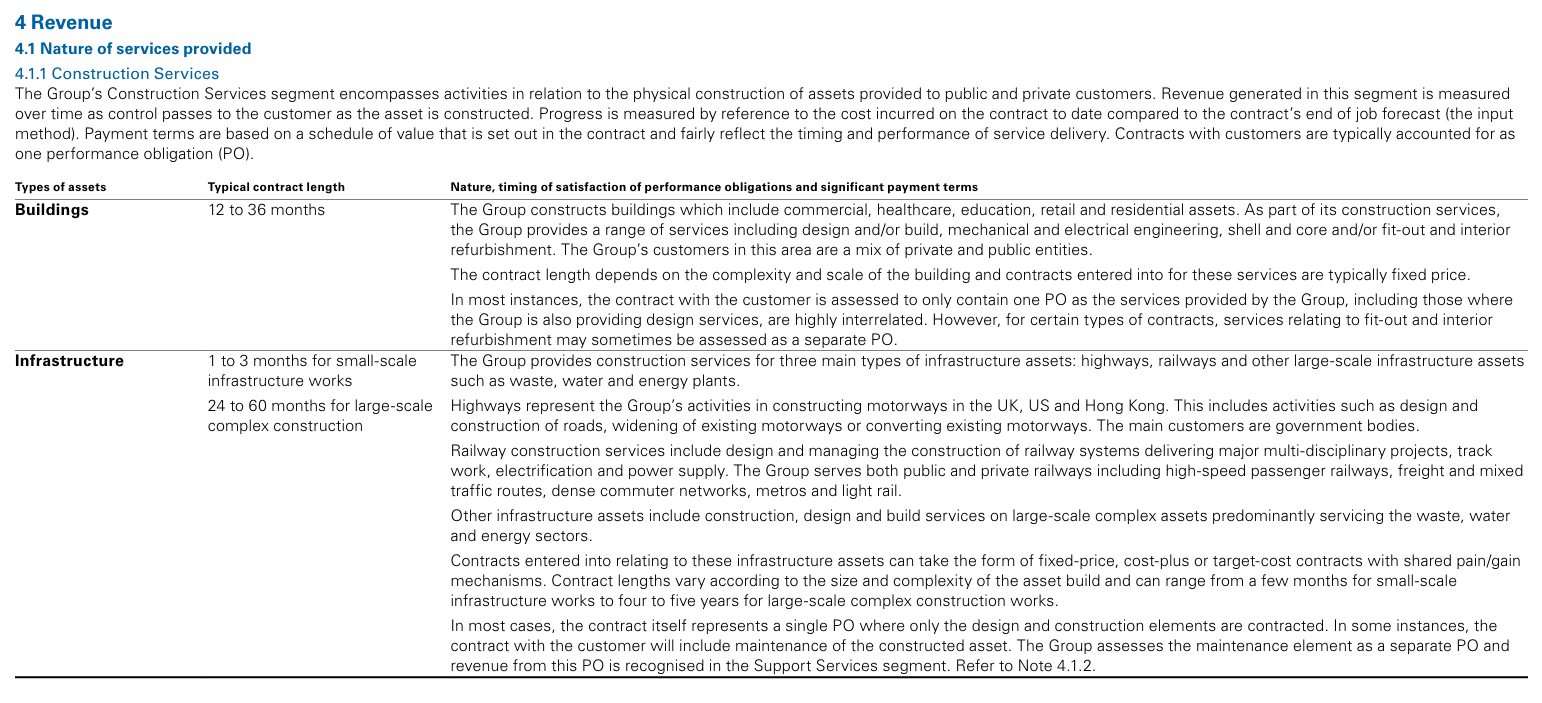
One constructor used a tabular format, including information on contract length and asset type, which clearly explained how revenue was generated and recognised. See Good Quality Example 1: Balfour Beatty plc.
In many cases, revenue accounting policies omitted key information which limited the users' ability to understand their application.
Issue
- Accounting policies did not always cover all material revenue streams.
- It was not always clear which revenue streams were covered by the accounting policies disclosed.
- Disclosures did not always explain the nature of performance obligations for all material revenue streams, and in some cases, it was unclear whether contracts contained multiple performance obligations.
- For housebuilders, revenue recognition disclosures did not always clearly identify the precise point or period over which revenue was recognised for each performance obligation.
Opportunity
- One constructor offered delivery of goods with installation and/or post-delivery services but did not explain why they were treated as a single performance obligation.
- We also noted inconsistency between revenue accounting policies and information presented elsewhere in the annual reports and accounts. For instance, one constructor listed multiple revenue streams in the revenue disaggregation note, but the accounting policy did not refer to these revenue streams.
Good Quality Example 1: Balfour Beatty plc
- The title of the revenue stream is consistent with the revenue accounting policy and the strategic report information.
- States the typical contract length.
- The way in which revenue is recognised and measured is clearly disclosed.
- Discloses the type of asset constructed.
- Detailed descriptions of the nature of services are provided.
- The nature of the performance obligation is disclosed for each revenue stream identified.
4. Revenue - recognition
Over time revenue recognition
For performance obligations that an entity satisfies over time, an entity shall disclose...:
(a) the methods used to recognise revenue (for example, a description of the output methods or input methods used and how those methods are applied).
[IFRS 15, paragraph 124]
An exemption from presenting this information is available to qualifying entities2 preparing their accounts under FRS 101.
Almost all companies stated whether an input or output method was used and provided a description of these methods.
There was a broadly even split between companies using input methods and those using output methods to recognise revenue over time. Some companies applied different methods depending on the characteristics of individual contracts. The most common input method was costs incurred relative to total expected costs. Output methods included surveys/valuations of work performed and units produced.
Issue
Two constructors stated that progress was measured on a 'units of production' output method. It was not clear how this aligned to the nature of goods or services transferred as 'units' were not defined.
Point in time revenue recognition
An entity shall disclose information about its performance obligations in contracts with customers including a description of... when the entity typically satisfies its performance obligations...
[IFRS 15, paragraph 119]
Most companies described the nature of performance obligations satisfied at a point in time and clearly articulated, for material revenue streams, when control is passed to the customer, for example, at legal completion, or on delivery. However, we identified some opportunities for improvement:
Issue
One constructor referred to old IAS 18, 'Revenue' terminology and stated that point-in-time revenue was recognised when risks and rewards, rather than control, were passed to the customer.
One housebuilder stated that revenue for certain material ancillary revenue streams was recognised when control transferred to the customer but did not specify when transfer occurred.
5. Revenue - variable consideration
Variable consideration
Clear, entity-specific disclosures in respect of estimating and constraining variable consideration are important, given its significance in the sector, particularly for constructors, and the inherent uncertainty involved in its estimation.
The quality of reporting in this area generally fell short of our expectations. In seeking to enhance disclosures, companies should consider the findings of this review alongside those set out in 'IFRS 15 'Revenue from Contracts with Customers' A follow-up thematic review', published in September 2020.
Good practice
Good quality variable consideration disclosures:
- explain the nature of the variable consideration (e.g. performance bonus, pain/gain share, deposit contributions) and identify the related revenue stream;
- describe the method used to estimate variable consideration;
- explain when contract modifications are considered approved;
- explain the way in which the 'highly probable' constraint is applied; and
- identify any significant judgements applied in estimating or constraining variable consideration.
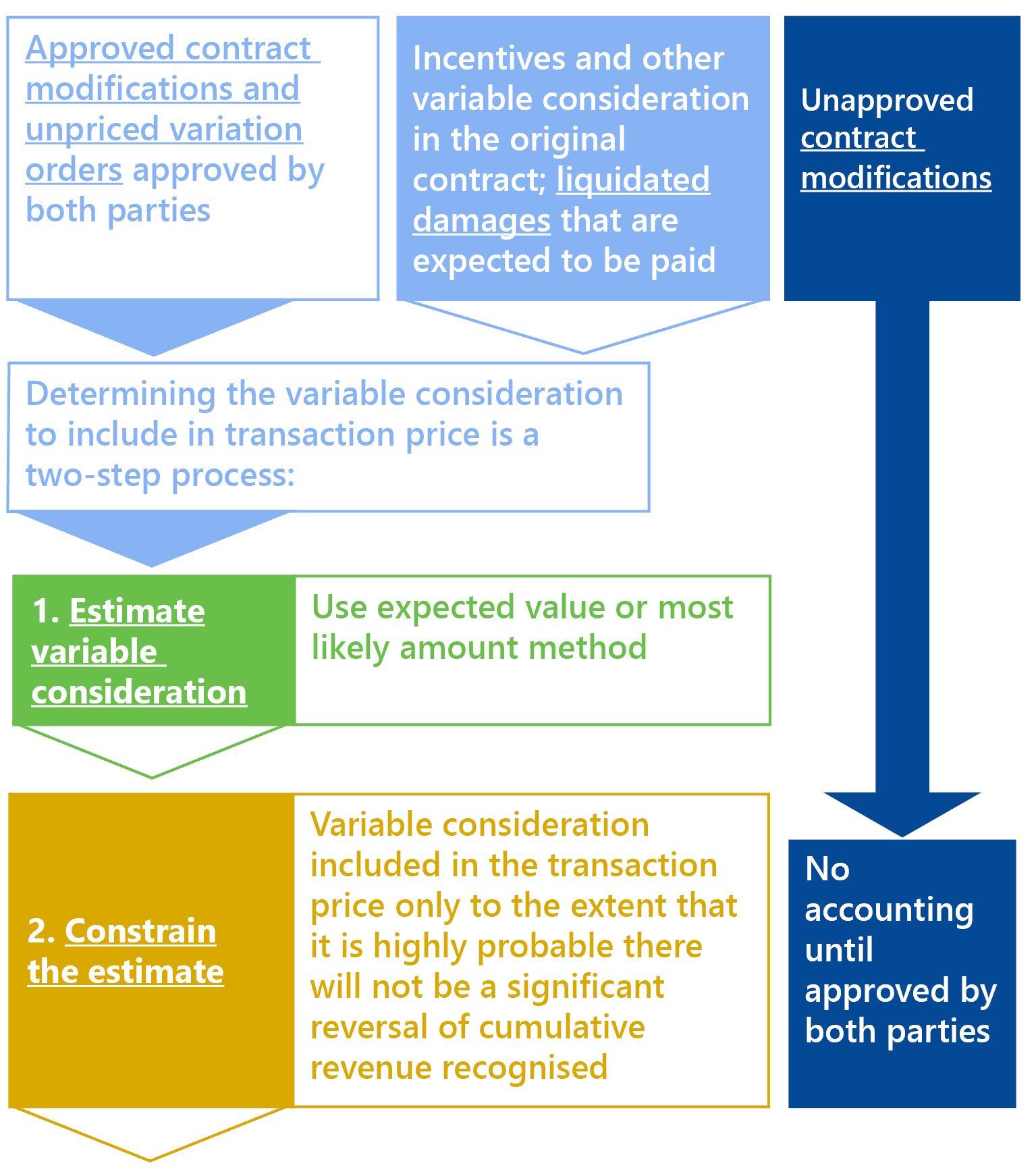
The following diagram illustrates the process required to determine the variable consideration to include in the transaction price:
Estimating variable consideration
An entity shall disclose information about the methods, inputs and assumptions used for:
(a) determining the transaction price, which includes but is not limited to, estimating variable consideration...; (b) assessing whether an estimate of variable consideration is constrained.
[IFRS 15, paragraph 126]
An exemption from presenting this information is available to qualifying entities3 preparing their accounts under FRS 101.
Almost all companies in the selection referred to variable consideration.
Issue
The companies in our selection generally provided limited information about the methods, inputs and assumptions used in estimating variable consideration. In particular, it was not always clear whether the estimate reflected a most likely amount or an expected value approach.
Opportunity
Few companies explained the nature of the variable consideration, for example, claims, variations, deposit/mortgage contributions, performance bonuses or pain/gain shares.
Disclosures could be improved to better explain the way in which variable consideration affects the transaction price. For instance, where the term ‘claim’ was used, it was often unclear whether this referred to amounts claimed from customers, which would increase the transaction price, or amounts claimed against the constructor, which would reduce the transaction price.
Constraining estimated variable consideration
An entity shall include in the transaction price some or all of an amount of variable consideration estimated... only to the extent it is highly probable that a significant reversal in the amount of cumulative revenue recognised will not occur when the uncertainty associated with the variable consideration is subsequently resolved.
[IFRS 15, paragraph 56]
Many companies explained that variable consideration was only included in the transaction price to the extent it was highly probable not to reverse.
Opportunity
Often, details of the criteria against which the highly probable threshold was assessed were not provided. Disclosures could be enhanced by describing the criteria and any judgements applied in making the assessment.
Good Quality Example 2: Illustrative example
- States the nature of the variable consideration.
- Discloses the methods used to recognise different types of variable consideration.
- Sets out the criteria used to assess whether the highly probable threshold is met.
- Distinguishes claims between those that increase and those that decrease the transaction price.
Construction contracts may include variable consideration that increases the transaction price, including variations, claims against the customer and performance-related incentive payments. Variations and claims are estimated using the expected value method reflecting management's assessment of the range of possible outcomes and their associated probabilities. Performance bonuses are generally estimated using the most likely amount method due to the binary nature of the relevant performance conditions. The estimated amount is included in the transaction price only to the extent that it is highly probable that a significant reversal in the amount of cumulative revenue recognised will not occur when the associated uncertainty is resolved (the variable consideration constraint).
Subject in all cases to satisfying this constraint, variable consideration that increases the transaction price may be included in revenue where:
- the customer has accepted the Group's entitlement to payment and the amount has been agreed or certified for payment;
- the customer has provided a written instruction or approval for a change in the scope of work and the amount payable can be determined by applying rates or other pricing mechanisms specified in the contract;
- the customer has made a substantive written settlement offer or provided another written acknowledgement of the Group's entitlement that specifies the amount offered and any conditions attached to it; or
- amounts have been paid by the customer against the relevant variation or claim and the Group concludes, based on the contractual terms and other available evidence, that it is entitled to retain the amount.
The transaction price may also be reduced by liquidated damages, customer claims, or other contractual deductions. The amount of any reduction is estimated after considering the contractual terms, the circumstances giving rise to the claim or deduction, the causes of any delay, the Group's entitlement to extensions of time or other rights under the contract, and the status of discussions with the customer.
Illustrative example
Liquidated damages
Liquidated damages can arise where contractual performance obligations, such as completion milestones, are not met. Liquidated damages are pre-agreed financial amounts payable to a customer and are accounted for as variable consideration under IFRS 15. The accounting can be particularly judgemental since there can be complexity in assessing whether liquidated damages will eventually be payable.
Issue
Despite the prevalence of liquidated damages in the sector, only five constructors in our selection referred to them. To the extent that liquidated damages are material, a relevant accounting policy should be disclosed.
Good Quality Example 3: Morgan Sindall Group plc
- Explains the accounting policy applied to liquidated damages and when commercial resolutions are included in the transaction price.
- States that the variable consideration constraint is applied.
Where delays to the programme of works are anticipated and liquidated damages would be contractually due, the estimated total contract price is reduced accordingly. This is only mitigated by expected extensions of time or commercial resolution being achieved where it is highly probable that this will not lead to a significant reversal in the future.
Unpriced contract modifications
If the parties to a contract have approved a change in the scope of the contract but have not yet determined the corresponding change in price, an entity shall estimate the change to the transaction price arising from the modification in accordance with paragraphs 50-54 on estimating variable consideration and paragraphs 56-58 on constraining estimates of variable consideration.
[IFRS 15, paragraph 19]
In construction, there may be delays between changes in scope being approved and the related change in price being agreed. Approved but unpriced contract modifications must be estimated and the impact reflected in the transaction price to the extent that it is highly probable there will not be a significant reversal of cumulative revenue recognised.
Issue
One company stated that scope changes were included in the transaction price when approval was highly probable, rather than when the scope change was approved.
Good practice
Good disclosures identified the point contract modifications were considered approved and the circumstances in which approved modifications were included in transaction price.
Good Quality Example 4: Morgan Sindall Group plc
- Explains the circumstances under which variations are included in the transaction price.
Variations are not included in the estimated total contract price until the customer has agreed the revised scope of work. Where the scope has been agreed but the corresponding change in price has not yet been agreed, only the amount that is considered highly probable not to reverse in the future is included in the estimated total contract price.
6. Revenue - disclosures
Disaggregation disclosures
An entity shall disaggregate revenue recognised from contracts with customers into categories that depict how the nature, amount, timing and uncertainty of revenue and cash flows are affected by economic factors.
[IFRS 15, paragraph 114]
An exemption from presenting this information is available to qualifying entities4 preparing their accounts under FRS 101.
The quality of revenue disaggregation disclosures was generally good across the constructors and housebuilders in our selection. All the companies that were required to present the disclosures did so. However, we identified opportunities to enhance disclosures among some of the housebuilders.
Good practice
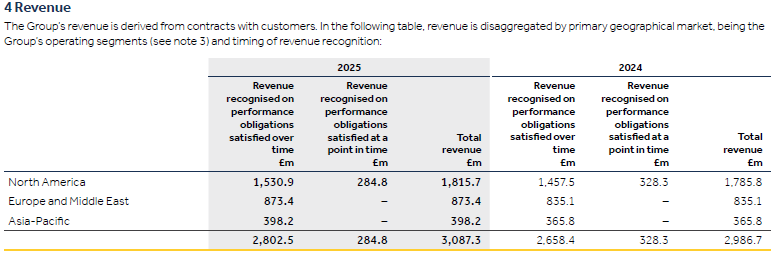
Three constructors presented, for each disaggregated revenue category, the revenue recognised at a point in time and over time during the year. These disclosures were informative in illustrating the way in which economic factors may affect business performance.
Opportunity
Two housebuilders did not separately disclose total revenue recognised over time and total revenue recognised at a point in time where such disclosures appeared relevant.
None of the housebuilders that disaggregated revenue between amounts recognised over time and at a point in time did so for every revenue category. Doing so, particularly in respect of sales to affordable housing providers (see examples in Housebuilders - transferring land before construction completion), would improve transparency over the nature of revenue and the timing of its recognition.
Good Quality Example 5: Keller Group plc
- Revenue recognised over time and at a point in time is disclosed for each disaggregated revenue category presented.
- Categorises revenue based on geographical markets and in a way which is consistent with revenue information in other parts of the annual reports and accounts.
Contract balance reconciliations
An entity shall disclose all of the following:
(a) the opening and closing balances of receivables, contract assets and contract liabilities... [IFRS 15, paragraph 116]
An entity shall provide an explanation of the significant changes in the contract asset and contract liability balances during the reporting period. [IFRS 15, paragraph 118]
An exemption from preparing the disclosures required by IFRS 15, paragraph 118 is available for qualifying entities preparing accounts under FRS 101.
Almost all companies disclosed opening and closing contract balances. Constructors provided explanations of the significant changes in contract balances. However, housebuilders often omitted such disclosures.
Good practice
Good disclosure presented movements in tabular format, reconciling opening balances to closing balances and quantifying movements in the year. We found numerical reconciliations were clearer than narrative descriptions.
Revenue recognised in the reporting period
An entity shall disclose all of the following:
...(b) revenue recognised in the reporting period that was included in the contract liability balance at the beginning of the period; and (c) revenue recognised in the reporting period from performance obligations satisfied (or partially satisfied) in previous periods...
[IFRS 15, paragraph 116]
Most of the constructors in our selection disclosed the amount of revenue recognised in the period that was included in the contract liability balance at the start of the period. However, most of the housebuilders did not present this disclosure.
Opportunity
None of the housebuilders and few constructors disclosed the revenue recognised in the year from performance obligations satisfied in previous periods, despite almost all companies referring to variable consideration. It was unclear if this was because the amounts were immaterial.
Typical timing of payment
An entity shall explain how the timing of satisfaction of its performance obligations... relates to the typical timing of payment... and the effect that those factors have on the contract asset and the contract liability balances.
[IFRS 15, paragraph 117]
The constructors presented clear descriptions setting out how the timing of satisfaction of their performance obligations related to the timing of payments.
In contrast, few housebuilders explained the relationship between the timing of revenue recognition and the timing of payments. We acknowledge that a housebuilder's primary revenue stream is usually housing units sold at a point in time with revenue recognised in line with cash receipts. However, all of the housebuilders disclosed revenue recognised over time for certain revenue streams. In these circumstances, the disclosure requirements in IFRS 15, paragraphs 116-118 apply, to the extent the information is relevant and material.
7. Revenue - sector-specific matters
Constructors - costs to obtain a contract
An entity shall describe both of the following:
(a) the judgements made in determining the amount of the costs incurred to obtain or fulfil a contract with a customer...; and (b) the method it uses to determine the amortisation for each reporting period.
[IFRS 15, paragraph 127]
An entity shall disclose all of the following:
(a) the closing balances of assets recognised from costs incurred to obtain or fulfil a contract with a customer... by main category of asset (for example, costs to obtain contracts with customers, pre-contract costs and setup costs); and (b) the amount of amortisation and any impairment losses recognised in the reporting period.
[IFRS 15, paragraph 128]
Exemptions from presenting the information listed in paragraph 127 are available for qualifying entities applying FRS 1016.
Costs to obtain a contract (also referred to as pre-contract, bid or tender costs) were incurred by most constructors. Many constructors could improve the quality of disclosure in this area.
Opportunity
A significant number did not quantify the asset recognised, the amortisation charge, and/or, where required, the amortisation method. It was unclear whether the required disclosures were absent because the amounts involved were immaterial.
Where costs capitalised in respect of obtaining a contract are not material, the inclusion of an accounting policy and related disclosures may not be necessary.
Good practice
One constructor disclosed that where such costs are not material, they are expensed as incurred.
The point in the bidding cycle that costs to obtain a contract met the criteria for asset recognition was disclosed by one constructor.
Issue
Another constructor capitalised costs to obtain a contract within inventories. However, it was unclear how such costs met the IAS 2, 'Inventories', paragraph 6 definition.
Good Quality Example 6: Balfour Beatty plc
- Identifies the point from which costs to obtain a contract are capitalised.
Pre-contract bid costs and recoveries
Pre-contract costs are expensed as incurred until preferred bidder status is awarded at which point further costs are capitalised as there is a high probability that the Group would be able to recover these costs. Amounts subsequently recovered in respect of pre-contract costs that have been written off before preferred bidder status was awarded are recognised in full in the income statement when they are received in cash.
Housebuilders - part-exchange
Housebuilders often offer part-exchange schemes. In these arrangements, a housebuilder purchases a customer's existing property and the value of that property is deducted from the price of a new build.
There is diversity in practice in regard to the presentation of income and expenses arising from the sale of properties acquired by housebuilders through part-exchange schemes. Consequently, it is important that financial statements include an explanation of the accounting treatment.
Six housebuilders in our selection had part-exchange schemes. One company recognised part-exchange sales within revenue and five recognised part-exchange sales within other income.
Good practice
All six companies included an accounting policy in respect of part-exchange schemes.
Reasons for the classification of income received from the sale of part-exchange properties were well explained.
Opportunity
Two companies did not explain where the costs in relation to part-exchange properties had been recorded.
Issue
IAS 1, 'Presentation of Financial Statements', paragraph 32, prohibits entities from offsetting income and expenses unless required or permitted by an IFRS. One company netted income and expenses in relation to part-exchange sales on the face of the income statement.
Good Quality Example 7: Maison Holdco Limited
- Explanation as to why the income and expenses in relation to part-exchange property are included in other operating income and expenses.
Where a property is accepted in part consideration for a sale of a new home, the original sale of the new home is recorded at the fair value of the part-exchanged property plus the cash received. The fair value for the part-exchange property is assessed by independent valuers and is reduced for the estimated costs to sell. The subsequent sale of the part-exchange property is recognised at the fair value of the consideration received. As it is not considered a principal activity of the Group, the income and expenses associated with such transactions are recognised in other operating income and other operating expenses. Part exchange properties are held within inventories at net realisable value until subsequent sale.
Maison Holdco Limited, Annual Report and Financial Statements for the year ended 31 October 2025, p59
Housebuilders - transferring land before construction completion
Most housebuilders entered into revenue contracts involving the transfer of control of land to customers prior to the completion of the associated housing units. Typically, these arrangements involve bulk sales of housing units to providers of affordable housing, although the customer was not identified by some housebuilders in our selection. Given the variation in contractual terms across the sector, companies should provide sufficiently detailed, entity-specific accounting policies for these arrangements.
We identified instances where accounting policies were inadequately described:
Issue:
- Some companies did not clearly describe the nature of the performance obligations identified, for example, provision of a house with land, provision of a house, or provision of land.
- Where contracts included more than one performance obligation, the basis for allocating consideration to those obligations was not always disclosed.
In determining an appropriate accounting policy, housebuilders should consider the March 2018 IFRS Interpretations Committee agenda decisions 'Revenue recognition in a real estate contract (IFRS 15 Revenue from Contracts with Customers)—Agenda Paper 2C' and 'Revenue recognition in a real estate contract that includes the transfer of land (IFRS 15 Revenue from Contracts with Customers)—Agenda Paper 2D'.
We observed diversity in the accounting policies applied to these arrangements, likely reflecting the differences in contractual terms:
- Some companies identified separate performance obligations for land transfer and housing construction, recognising revenue at a point in time and over time, respectively.
- Other companies disclosed that revenue was recognised over time for the whole contract. One of these companies explained that the transfer of land and residential property constituted a single performance obligation, and another identified the point from which revenue was recognised over time.
Given the diversity observed, we draw attention to the requirement in IFRS 15, paragraph 123, to disclose the judgements made in applying the standard. Clear disclosure of judgements enables users to understand how the requirements of IFRS 15 have been applied.
Good practice
Two housebuilders, and one constructor entering similar arrangements, disclosed that judgement had been applied in determining an appropriate accounting policy.
Good Quality Example 8: Maison Holdco Limited
- Identifies the customer.
- Clearly explains the basis on which revenue is recognised over time.
- Method used to recognise revenue over time is clearly described.
- Explanation of the performance obligations in the contract.
Partner development contracts revenue
The Group enters into contracts for the construction and sale of social housing to Registered Providers and undertakes development activities under contract with partners.
The Group recognises revenue over time for such contracts as the Group is restricted from redirecting the properties or development works to another customer and has an enforceable right to payment for work done. Revenue is recognised by reference to the stage of completion of the contract at the balance sheet date. This is normally measured by either:
- Where a development has multiple customers, assessing the input costs to date by reference to the estimated proportion of total costs incurred, through a measurement of the stage of completion of units under the contract, relative to the forecast total cost of construction of those units; or
- Where a development has a single customer, the stage of completion of the contract is measured by reference to the actual costs incurred, including where relevant any land costs, compared with the estimate of the total costs to satisfy the contractual obligation.
The Directors consider the provision of land and residential properties to represent a single performance obligation.
Maison Holdco Limited, Annual Report and Financial Statements for the year ended 31 October 2025, p59
Good Quality Example 9: Morgan Sindall Group plc
- Explains the specific area where judgement is applied.
- Lists the factors considered in forming the judgement.
Revenue recognition – mixed-use schemes7 (judgement)
The Group acts as developer and/or contractor on a number of mixed-use schemes. In some instances, judgement is required to determine whether the revenue on a particular element of the scheme should be recognised as work progresses (recognised over time) or upon legal completion (recognised at a point in time). A detailed assessment is performed of the contractual agreements with the customer as well as the substance of the transaction to determine whether performance obligations have been satisfied. Relevant factors that are considered include the point at which legal ownership of the land passes to the customer, the degree to which the customer can specify the major structural elements of the design prior to construction work commencing and the degree to which the customer can specify modifications to the major structural elements of the building during construction.
8. Significant judgements
Significant judgements
As set out in our Thematic review: Judgements and Estimates: Update, judgements in the scope of IAS 1, paragraph 1228 should be clearly differentiated from judgements relating to estimation uncertainty, as the disclosure requirements vary. Companies should provide sufficiently detailed descriptions of the specific, material judgements made and ensure consistency with disclosures elsewhere in the annual reports and accounts.
An entity shall disclose, along with material accounting policy information or other notes, the judgements, apart from those involving estimations (see paragraph 125), that management has made in the process of applying the entity's accounting policies and that have the most significant effect on the amounts recognised in the financial statements.
[IAS 1, paragraph 122]
Issue
- We saw examples of good practice. However, some constructors did not clearly separate significant judgements from estimates. One appeared to have made judgements in scope of IAS 1, paragraph 122, but these were presented as estimates.
- One housebuilder disclosed several items subject to significant judgement but the precise nature of each judgement, such as how judgement was involved in identifying performance obligations, was not explained.
Opportunity
One housebuilder's Audit Committee Report referred to judgement involved in classifying items as non-underlying. However, the company did not disclose non-underlying items as an IAS 1, paragraph 122 judgement.
Joint arrangements
Within the construction and housebuilding sector it is common for entities to structure their operations through joint arrangements. Such arrangements enable companies to share risk, resources and expertise.
An entity shall disclose information about significant judgements and assumptions it has made (and changes to those judgements and assumptions) in determining:
...(b) that it has joint control of an arrangement or significant influence over another entity; and (c) the type of joint arrangement (ie joint operation or joint venture) when the arrangement has been structured through a separate vehicle.
[IFRS 12, 'Disclosure of Interests in Other Entities', paragraph 7]
No companies presented significant judgements in respect of joint arrangements. However, disclosures suggesting that significant judgements have been applied may lead to an FRC enquiry. For example:
Issue
- One company held a 15% interest in a material joint venture with no voting rights but did not explain how it concluded it had joint control.
- One company disclosed joint ventures in which it held a 60% ordinary ownership interest but did not explain why these entities were accounted for as joint ventures rather than subsidiaries. It was unclear whether the joint ventures were material as no quantitative disclosures were provided.
9. Significant estimates
Revenue and cost estimates
Revenue recognition for both constructors and housebuilders is dependent on estimates of total contract or site revenues, total contract or site costs, or both.
Constructors
Constructors most commonly recognised revenue using an input method based on costs incurred relative to total estimated contract costs (see Revenue - recognition). Under this approach, revisions to estimated contract costs directly affect the measure of progress, and consequently, the amount of revenue recognised in a reporting period. Constructors also estimate variable consideration (see Revenue - variable consideration).
In forming these estimates, various assumptions are made in respect of labour and materials costs, subcontractor performance, project schedules, risk contingencies, claims to customers and variations. Uncertainty can arise from potential cost overruns, delays, inflationary pressures or supply chain disruption.
Housebuilders
Housebuilders make estimates to allocate site-wide costs between units completed and those expected to be constructed in the future. The estimates required depend on the transaction:
- For housing unit sales where revenue is recognised at a point in time, the transaction price for individual housing unit sales is known. However, housebuilders typically estimate expected total site revenue, including revenue from future sales, together with total site costs to determine the site margin and the costs recognised on each individual unit sale.
- Where revenue is recognised over time using an input method based on costs incurred, recognised revenue and costs depend on estimates of total site costs.
- Where revenue is recognised over time using an output method, the cost of sales recognised for each unit sold is typically determined using site-wide expected margins which requires both total costs and total revenue, including where relevant any variable consideration, to be estimated.
For housebuilders, forecast costs and revenue depend on estimates of the future effects of inflation, labour and material cost increases, and macroeconomic conditions affecting future selling prices.
Forecasting is inherently complex and subject to uncertainty. Consequently, revisions of underlying assumptions can have a significant effect on amounts recognised in the financial statements. Consistent with this, almost all companies identified revenue and cost estimates as significant estimates or 'other' estimates.
Whether revenue and cost estimates are significant estimates
An entity shall disclose information about the assumptions it makes about the future, and other major sources of estimation uncertainty at the end of the reporting period, that have a significant risk of resulting in a material adjustment to the carrying amounts of assets and liabilities within the next financial year.
[IAS 1, paragraph 125]
As explained in our Thematic review: Judgements and Estimates: Update, we recognise that companies may disclose 'other' estimates where these provide material, relevant information. However, these should be clearly distinguished from significant estimates, with the reason for disclosure explained.
Eight companies identified revenue and cost estimation as a significant estimate. Five disclosed revenue and cost estimation within 'other' estimates, not in scope of IAS 1, paragraph 125. Only two of these companies provided a reason for the 'other' estimate classification.
Issue
One constructor stated that key judgements and estimates were involved in the accounting for construction contracts in progress. However, no further information was provided.
As discussed in Revenue - variable consideration, variable consideration should be constrained to the extent that it is highly probable there will not be a significant reversal of cumulative revenue recognised. Where the constraint has been appropriately applied, the resulting uncertainty may not represent a significant source of estimation uncertainty under IAS 1, paragraph 125. However, material estimates of variable consideration are subject to the disclosure requirements of IFRS 15, paragraph 126.
The nature of the assumption or other estimation uncertainty
IAS 1, paragraph 129, explains that the nature and extent of the information to be provided under paragraph 125 vary according to the nature of the assumption. Due to the complexity involved in estimations of revenue and cost, as described in Revenue and cost estimates, we expect constructors and housebuilders to provide sufficient details of the nature of assumptions used and of any inherent uncertainties.
Opportunity
The disclosures provided by the constructors in our selection varied. Many disclosures could have benefitted from additional information for users to understand the judgements made about the future.
Housebuilders provided sufficient disclosures in this area.
Good practice
Good disclosures for constructors:
- explain the judgements involved in assessing total contract costs; and
- discuss the complexities of cost forecasting.
For information on improving disclosures in relation to variable consideration, see Revenue - variable consideration.
Good disclosures for housebuilders:
- articulate the complexities of forecasting by providing examples of the inherent uncertainties, such as inflation and future market conditions;
- specify the nature of the key assumptions, such as future selling prices, future development costs and infrastructure costs; and
- explain how the estimates affect amounts in the financial statements.
Good Quality Example 10: Berkeley Group Holdings plc
- Clearly explains that forecast costs are split between current and future years.
- Provides examples of the input assumptions to the estimation.
- Refers to internal controls.
- Explains how the estimate affects cost of sales and inventory.
As residential development is largely speculative in nature, not all inventories are covered by forward sales contracts. Furthermore, due to the nature of the group's activity and in particular, the scale of its developments and the length of the development cycle, the group has to allocate site-wide development costs between units being built and/or completed in the current year and those for future years. It also has to forecast the costs to complete on such developments.
In making such assessments and allocations in determining each development's site margin which is used to estimate cost of sales when revenue is recognised for each unit, there is a degree of inherent estimation uncertainty. In particular this is due to the need to take account of future direct input costs, sales prices and the need to allocate all site-wide costs on an appropriate basis to reflect the overall level of development risk, including planning risk. The group has established internal controls designed to effectively assess and centrally review inventory carrying values and ensure the appropriateness of the estimates made. These assessments and allocations evolve over the life of the development in line with the risk profile, and accordingly the margin recognised reflects these evolving estimates. Similarly, these estimates impact the carrying value of inventory at each reporting date as this is a function of costs incurred in the year and the allocation of inventory to costs of sales on each property sold.
Berkeley Group Holdings plc, 2026 Annual Report, pp205-206
(Not in selection)
Carrying amount of assets and liabilities
Where estimates in relation to revenue and cost estimation are in scope of IAS 1, paragraph 125, the carrying amount of the assets and liabilities at significant risk of a material adjustment in the next financial year should be disclosed.
Issue
- Of the five constructors that presented revenue and cost estimates as a significant estimate, only four quantified the carrying amounts of assets and/or liabilities. (e.g. contract assets/liabilities, trade receivables and inventories).
- None of the three housebuilders with revenue and cost estimates in scope of paragraph 125 of IAS 1 disclosed the nature or carrying amount of the assets and/or liabilities with a significant risk of a material adjustment in the next financial year.
Sensitivities or ranges of outcomes
An entity presents the disclosures in paragraph 125 in a manner that helps users of financial statements to understand the judgements that management makes about the future and about other sources of estimation uncertainty... Examples of the types of disclosures an entity makes are:
...(b) the sensitivity of carrying amounts to the methods, assumptions and estimates underlying their calculation, including the reasons for the sensitivity; (c) the expected resolution of an uncertainty and the range of reasonably possible outcomes within the next financial year in respect of the carrying amounts of the assets and liabilities affected.
[IAS 1, paragraph 129]
Of the five constructors that stated that their revenue and cost estimates were significant, only two provided a sensitivity or range of outcomes disclosure. This range of outcomes disclosure presented a potential gain or loss in the profit or loss account rather than the impact on assets and/or liabilities.
Similarly, the sensitivities provided by the three housebuilders with significant estimates in respect of revenue and cost estimates highlighted potential movements in the profit and loss account. For example, one company presented the effect on gross margin of a 1% reduction in revenue and of a 1% reduction in forecast costs.
Issue
Changes in assumptions for revenue and cost estimates can affect multiple balance sheet line items. Consequently, constructors and housebuilders commonly present profit and loss sensitivities as these are helpful in illustrating the impact of estimation uncertainty on earnings. We encourage such disclosures. However, where possible, companies should also sensitise the carrying amounts of the assets and/or liabilities that have a significant risk of a material adjustment within the next financial year.
Opportunity
The provision of meaningful sensitivity disclosures enables users to understand a company's potential exposure and provide decision-useful information to users. Meaningful sensitivities are based on inputs that reflect management's assessment of plausible scenarios rather than generic/nominal percentage changes. For further observations on this matter see page 25.
Good Quality Example 11: Berkeley Group Holdings plc
- Clarifies that the sensitivity represents a reasonably possible scenario and explains its limitations.
- Sensitises an asset balance.
An increase or decrease to estimated costs recognised in the year, by virtue of a 1% change to forecast development margin, would lead to a change in cost of sales and inventory of £17.4 million in the current financial year (2025: £17.6 million). This sensitivity is based on a reasonably possible scenario and is provided in the absence of a change to any other factor affecting future gross margins on the group's developments, such as a change in future sales prices.
Berkeley Group Holdings plc, 2026 Annual Report, p206
(Not in selection)
One constructor stated that it was impractical to provide a sensitivity for their construction contract portfolio. No sensitivity or range of outcomes disclosure was provided as permitted by IAS 1, paragraph 131.
Opportunity
Constructors can find it difficult to provide meaningful sensitivities under IAS 1, paragraph 129. This is because they have large contract portfolios. While it is relatively straightforward to sensitise one or two contracts, it is more difficult to sensitise multiple projects effectively. However, it is likely that certain contracts within construction portfolios are subject to higher uncertainty or have a material impact either individually or in aggregate. Consequently, we consider that many companies will be able to provide sensitivity disclosures over particular aspects of their portfolios.
Where sensitivity analyses relate to only a subset of a portfolio, additional contextual information about both the sensitised subset and the overall portfolio may assist users in understanding the significance of the disclosure.
Good Quality Example 12: Balfour Beatty plc
- Context is given about the contracts for which a range of outcomes has been provided.
- A range of outcomes is provided for a limited number of long-term contracts.
Within this portfolio, there are a limited number of long-term contracts where the Group has incorporated significant estimates over contractual entitlements relating to recoveries of claim income from customers, suppliers and liquidated damages levied by the customer. This is in the Construction Services segment. These recoveries have been recognised at the amount that is considered highly probable not to significantly reverse. However, there are a host of factors affecting potential outcomes in respect of these entitlements which could result in a range of reasonably possible outcomes on these contracts in the following financial year, ranging from a gain of £82m to a loss of £44m. The Directors have assessed the range of reasonably possible outcomes on these limited number of contracts based on facts and circumstances that were present and known at the balance sheet date. As with any contract applying long-term contract accounting, these contracts are also affected by a variety of uncertainties that depend on future events, and so often need to be revised as contracts progress.
Building safety provisions
The Building Safety Act 2022 ('Building Safety Act') has increased remediation obligations for contractors and housebuilders by strengthening accountability for identifying, funding and rectifying historical building safety defects that give rise to fire safety risks.
Seven companies had provisions in relation to building safety, six of which were disclosed as significant estimates. This is in line with our expectations given the level of uncertainty attached to these provisions.
Assessing the quantum of a building safety provision involves the estimation of several factors. This includes the number of buildings or sites affected, the costs to investigate any potential safety issues and the costs to rectify these issues. The effects of discounting and inflation should also be considered when the outflows to settle a provision are not expected for several years.
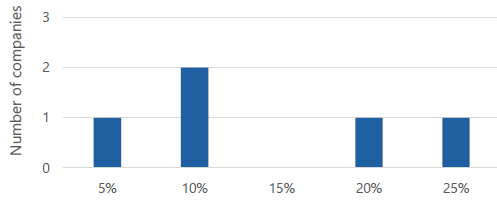
Building safety provisions are often highly material amounts. Consequently, we expect meaningful sensitivities and/or range of reasonably possible outcome disclosures to enable users to understand a company's potential exposure, as described in Carrying amount of assets and liabilities. However, we note that estimates in relation to building safety provisions are highly uncertain and percentage changes may be the only practical analysis available. This was reflected in our selection where five of the six companies presented information setting out the effect on the provision of percentage movements in remediation costs.
Remediation costs: percentage change
Opportunity
We observed a significant range in the percentages used to sensitise these costs, from 5% to 25%. It was unclear why there was such a discrepancy across companies since no explanations were provided for the percentages used.
The sixth company explained that the estimate of the Group's spend on fire safety remedial works was affected by a range of factors and provided sensitivities for three key assumptions. However, nominal percentage changes were again used with no disclosure to explain why the movements represented reasonably possible movements in the provision.
Good practice
Helpful disclosures gave detailed qualitative disclosures of the uncertainty involved. For example, one company explained that the potential quantity and timing of further rectification costs could not be readily determined until additional Building Safety Act claims were made. Another expected the provision to change over time as the interpretation of fire safety regulations further evolves.
10. Provisions
The nature of provisions and timing of cash flows
The financial statements of constructors and housebuilders often include significant provision balances. Common provisions in the sector include those for defects and warranties, legal provisions, onerous contracts and completed site provisions. Additionally, in recent years, significant amounts have been recognised as a result of the Building Safety Act (see Building safety provisions).
An entity shall disclose the following for each class of provision:
(a) a brief description of the nature of the obligation and the expected timing of any resulting outflows of economic benefits.
[IAS 37, paragraph 85]
The majority of the constructors and housebuilders in our selection adequately described the nature of their provisions.
Issue
However, for some provisions, disclosure of the timing of cash outflows was either omitted completely or only provided for a portion of the provision.
Good practice
One company presented the expected timing of cash outflows in a tabular format. This approach was informative as the cash flows were clearly set out across defined time bands, enabling users to better understand the profile of future expenditure.
Good Quality Example 13: Illustrative example
- Expected cash outflows disclosed in clearly defined time bands.
- Expected cash outflows are disclosed for each provision class and cover the whole provisions balance.
2025
| Due within | Defects and warranties £m | Onerous contracts £m | Legal £m | Total £m |
|---|---|---|---|---|
| 1 year | 77 | 3 | 6 | 86 |
| 1 < 2 years | 109 | 2 | 7 | 118 |
| 2 < 5 years | 68 | - | 13 | 81 |
| 5+ years | 37 | - | 5 | 42 |
| 291 | 5 | 31 | 327 |
Illustrative example
Aggregation and completeness of provisions
In determining which provisions or contingent liabilities may be aggregated to form a class, it is necessary to consider whether the nature of the items is sufficiently similar for a single statement about them to fulfil the requirements of paragraphs 85(a) and (b) and 86(a) and (b).
[IAS 37, paragraph 87]
The basis on which constructors and housebuilders aggregate provisions into classes warrants careful consideration when preparing IAS 37 disclosures. Where insufficient disaggregation is applied, information in respect of the nature of the underlying obligation, the expected cash outflows, the assumptions applied in measuring the provision, and any uncertainties inherent in those estimates may be obscured for each provision type.
Issue
Four companies disclosed a material ‘other' provision category. Material provisions should either be separately disclosed or aggregated with provisions of a similar nature.
Good practice
Where 'other' provision categories comprise a number of immaterial dissimilar items, clarification of that fact together with information about the nature of those items is useful to users of the accounts and will become increasingly relevant on implementation of IFRS 18, ‘Presentation and Disclosure in Financial Statements', given the application guidance in paragraph B26(b).
Issue
Some constructors aggregated onerous contract provisions with remediation, defect or warranty provisions, and one company disclosed a building safety provision within a broader class of provisions.
Opportunity
When contractors did not separately disclose an onerous contract provision, it was not always clear if this was because onerous contracts were not applicable or because potentially material amounts were aggregated within other contract provisions.
Three housebuilders did not disclose a provision for warranties, remedial works, other contract-related costs or costs still to be incurred on completed sites. This appeared unusual given the nature of the sector.
One company that had signed the Building Safety Repairs Pledge did not recognise a provision or disclose in the annual report and accounts the basis for this judgement.
Good practice
Where provisions that are typically recognised by peers are absent, disclosures explaining why no such provision has been recognised improve transparency and reduce the risk of an enquiry from the FRC.
Assumptions and uncertainties
An entity shall disclose the following for each class of provision:
...(b) an indication of the uncertainties about the amount or timing of those outflows. Where necessary to provide adequate information, an entity shall disclose the major assumptions made concerning future events...
[IAS 37, paragraph 85]
Except for building safety provisions, which arise in both constructors and housebuilders, the quality of assumption and uncertainty disclosures for provisions could be improved. Most companies did not describe sufficiently the uncertainties affecting the amount and timing of expected outflows or the key assumptions made in measuring the provisions.
Good practice
Good uncertainty disclosures should: * describe the nature of the uncertainty including whether it relates to the amount or timing of cashflows or both; * explain the source of the uncertainty (e.g. unpredictable timing in a legal process); * identify the key assumptions and explain how they have been derived (for example, from experience or industry guidelines); * where relevant, quantify the values assigned to key assumptions; and * quantify and explain any significant changes in estimates from the prior year.
Companies should consider the findings of our Thematic Review: IAS 37, Provisions, Contingent Liabilities and Contingent Assets. Disclosures should enable users to understand the potential financial effect of additional (or reduced) costs and/or earlier (or later) timing of outflows, rather than simply stating that uncertainty exists.
Overall, disclosures in relation to the Building Safety Act were of good quality. Most companies explained the assumptions on which the provision was based and highlighted any associated uncertainties.
Good practice
Good disclosures in relation to building safety:
- detail the quantum of developments subject to remediation work;
- summarise the status of remediation activities and any progress made during the reporting period;
- clearly describe the nature of the uncertainties; and
- explain the basis on which the provision has been estimated.
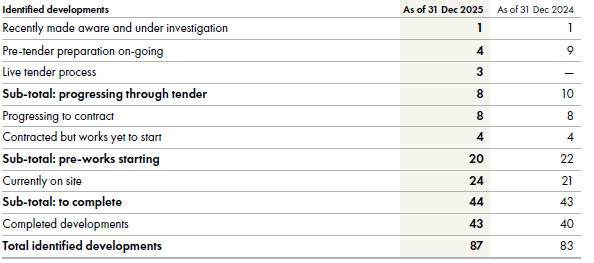
One housebuilder set out, in tabular format with comparative information, the status of fire remediation works for each affected development. This approach illustrated progress made and provided insight into the changes in the level of estimation applied in measuring the provision.
Good Quality Example 14: Persimmon Plc
- Explains the basis on which the provision is estimated.
- Identifies the areas where the estimate may change.
- Provides a detailed status of remediation works for each development.
- Comparatives presented which provides transparency with respect to year-on-year progress.
23 Legacy buildings provision
[…]
The assessment of the provision remains a highly complex area with judgements and estimates in respect of the cost of the remedial works, with investigative surveys on-going to determine the full extent of those required works. Where remediation works have not yet been fully tendered, we have estimated the likely scope and costs of such works based on experience of other similar sites. Whilst we have exercised our best judgement of these matters, there remains the potential for variations to this estimate from multiple factors such as material, energy and labour cost inflation, limited qualified contractor availability and abnormal works identified on intrusive surveys. Should a 20% variation in the costs of uncontracted projects occur then the overall provision would vary by +/- £17.2m.
The financial statements have been prepared on the latest available information; however, there remains the possibility that, despite management's endeavours to identify all such properties, including those constructed by acquired entities well before acquisition, further developments requiring remediation may emerge.
The company has no provisions.
Reimbursements
An entity shall disclose the following for each class of provision:
...(c) the amount of any expected reimbursement, stating the amount of any asset that has been recognised for that expected reimbursement.
[IAS 37, paragraph 85]
In some cases, for example, warranties and defects, companies may expect to recover part of the costs associated with recognised provisions from insurers, subcontractors or other third parties.
Except for building safety provisions where the quality of disclosures was good, disclosures in respect of reimbursements were limited.
Opportunity
Consequently, it was often unclear whether potential reimbursements were immaterial, whether the criteria for recognition of a reimbursement asset had not been met, or whether there was no potential for reimbursement.
Good practice
Almost all companies that recorded a building safety provision explained there was a possibility of reimbursement from third parties. Most explained that such reimbursements were recognised when it was considered virtually certain they would be received.
Issue
One company indicated that building safety provisions were reduced by recoveries secured from subcontractors. This appears inconsistent with the requirement in IAS 37, paragraph 53, to recognise reimbursements as separate assets.
Good Quality Example 15: Keller Group plc
- Disclosure sets out the circumstances in which a reimbursement asset is recognised, and where in the financial statements it is recorded.
A provision is recognised when it is judged likely that a legal claim will result in a payment to the claimant and the amount of the claim can be reliably estimated. Provisions are utilised as insurance or other legal claims are settled, which may take a number of years. A separate insurance receivable is recognised to the extent that confirmed third-party insurance is expected to cover any element of an estimated claim value and is virtually certain to be recovered. The asset is recognised within other non-current assets (refer to note 18) and trade and other receivables (refer to note 20). Management considers that there are no instances of reimbursable assets which are probable in nature.
11. Inventories
Reporting on inventories is important in the sector, particularly for housebuilders. Different types of inventory carry different risks and trends in inventory can provide insight into a company's performance and potential future profitability.
Accounting policies and cost formula
The financial statements shall disclose:
(a) the accounting policies adopted in measuring inventories, including the cost formula used.
[IAS 2, paragraph 36]
As explained in Revenue and cost estimates for housebuilders, the valuation of land and development inventory relies on assumptions about future selling prices, and costs to complete including site-wide infrastructure costs and developer contributions. Therefore, housebuilders should clearly explain the key factors affecting cost and net realisable value.
Opportunity
Most housebuilders disclosed the impact estimating costs had on determining costs of sales but often did not explain how those estimates affected inventory measurement.
Issue
None of the housebuilders in our selection stated whether site-wide infrastructure and developer contribution costs were included in inventories. The accounting policy applied to such costs should be disclosed, particularly when they are referenced in other parts of the annual reports and accounts.
Good practice
Two housebuilders clarified that the cost of land inventory included expected overage payments and one of these defined overage. This information was useful in understanding the components of cost.
One housebuilder quantified the carrying value of inventories held at net realisable value. This provided insight into the way in which changes in anticipated revenue and cost estimates have affected the valuation of inventory.
Good Quality Example 16: Persimmon Plc
- Inventories held at net realisable value disclosed.
The key judgements in estimating the future net realisable value of a site were the estimation of likely sales prices, house types and costs to complete the developments. Sales prices and costs to complete were estimated on a site-by-site basis based upon existing market conditions. If the UK housing market were to improve or deteriorate in the future then further adjustments to the carrying value of land and work in progress may be required. Following the 2025 review, £37.0m (2024: £26.4m) of inventories are valued at net realisable value rather than at historical cost.
Good Quality Example 17: Barratt Redrow plc
- Explains that overhead costs include infrastructure costs, and developer contributions and that these costs are capitalised in inventory as 'construction work in progress'.
- Explains that site-wide costs are allocated between the current and future years and identifies that this allocation involves estimation. Quantifies the land options included within inventories.
[…] Cost of construction work in progress comprises direct materials, direct labour costs and those overheads that have been incurred in bringing the inventories to their present location and condition. Overhead costs include, but are not limited to, roads and other infrastructure costs required for a site and local contributions and physical works contributions required under planning permissions granted for our developments. […] Due to the scale of the Group's developments, the Group allocates site-wide development costs between homes built in the current year and in future years. It also has to estimate costs to complete on such developments. In making these assessments, there is a degree of inherent uncertainty. The Group has developed internal controls to assess and review carrying values and the appropriateness of estimates made. Further information is included in the margin recognition section of note 3.
Land held for development includes £114.6m of costs incurred in respect of options to purchase land (2025: £113.4m).
Barratt Redrow plc, Annual Report and Accounts 2026, pp184-185
(Not in selection)
Inventory classification
The financial statements shall disclose:
...(b) The total carrying amount of inventories and the carrying amount in classifications appropriate to the entity.
[IAS 2, paragraph 36]
Most constructors presented inventories in appropriate classifications which included raw materials and consumables, work in progress, and finished goods. However, we identified opportunities for further disaggregation in the two constructors which also had housebuilding operations.
Opportunity
For example, one of these constructors combined development and housing land, and work in progress into a single class. Disaggregating development and housing land and work in progress may have provided more useful information and would have been consistent with the disclosures observed among housebuilders.
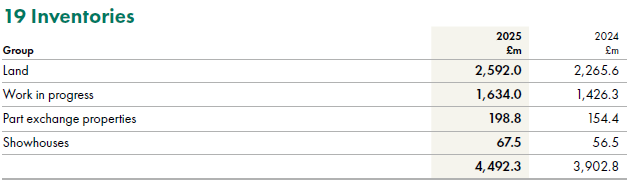
Most housebuilders in the selection classified inventory appropriately and used captions such as land, work in progress/development costs and part exchange properties.
Issue
However, one housebuilder presented a material classification of 'land and other'. The nature and quantum of the 'other' inventory was not provided. Individually material inventory balances should be presented separately and given labels which provide insight into their nature.
Opportunity
Another housebuilder which offered part-exchange schemes did not present part-exchange inventory separately.
Good practice
Two housebuilders disclosed completed units/show homes as a separate category. We found this information useful in understanding the components of inventory.
Good Quality Example 18: Persimmon Plc
- Inventories classified in captions appropriate to the entity.
Opportunity
One housebuilder explained that build leases, under which a landowner grants a housebuilder the right to develop land, are recognised in inventory as right of use assets. The right of use assets were appropriately classified as inventory in line with the requirement in IFRS 16, 'Leases', paragraph 47(a), to present leased assets in the same line item within which they would be presented if they were owned. Where such arrangements are material, companies should disclose their nature, the accounting policy applied and quantify their impact.
Options to acquire land
All housebuilders explained that they entered into options to acquire land. Generally, such contracts in the sector are not in scope of IFRS 9, 'Financial Instruments', as they cannot be settled net in cash and are settled by physical delivery of land rather than of a financial asset or exchange of financial instruments. When exercised, the options form part of the cost of land used in the production of housing units for sale and therefore meet the definition of inventories in IAS 2, paragraph 6.
No housebuilders in our selection quantified the carrying value of land options recorded in inventory. (See Good Quality Example 17: Barratt Redrow plc for a good practice example). Such disclosure provides insight into the costs of these arrangements.
Good practice
Most housebuilders explained that the initial payment for the option was recognised in inventory at cost and regularly reviewed for write-down. Further, many listed the factors considered in determining whether the carrying value requires write-down.
Issue
One housebuilder explained that land options were initially recognised at cost within inventories and written-down on a straight-line basis over the life of the option. It was not clear why this accounting policy was appropriate. Where land options are material, entities should explain the basis on which the option's net realisable value has been determined.
Good Quality Example 19: Maison Holdco Limited
- Explains the accounting policy applied to land options and identifies the information considered in determining whether the cost should be written-down.
Expenditure relating to forward land, including options and pre-contract expenditure, is held at cost. Regular reviews are carried out to identify any impairment in the value of these costs and provision made accordingly to reflect any loss of value. The impairment reviews consider the remaining life of the option and the likelihood of the land being viable to proceed to development, including the likelihood of securing residential planning consent.
Maison Holdco Limited, Annual Report and Financial Statements for the year ended 31 October 2025, p61
Inventories recognised as an expense and write-downs
The financial statements shall disclose:
...(d) the amount of inventories recognised as an expense during the period; (e) the amount of any write-downs of inventories recognised as an expense in the period...; and (f) the amount of any reversal of any write-down that is recognised as a reduction in the amount of inventories recognised as expense in the period...
[IAS 2, paragraph 36]
Issue
Three constructors and one housebuilder did not disclose inventories expensed in the period.
The disclosures required by IAS 2, paragraph 36(d) and (e) are particularly important for housebuilders. Inventory recognised as an expense reflects the significant estimates involved in determining the costs to allocate to units sold, including site-wide development costs. Inventory write-downs provide insight into management's assumptions regarding future selling prices, development costs and expected margins, and may indicate changes in anticipated profitability. Together, these disclosures help users assess the accuracy of management's forecasting and potential profitability of the remaining inventory balance.
Issue
Two housebuilders did not disclose the amount of inventory write-downs in the period. Another presented a reconciliation of the opening to closing inventory provision balance. However, only a net movement comprising write-downs and write-down reversals was disclosed.
12. Key expectations
We encourage constructors and housebuilders to consider our findings and the examples of good disclosure included in this publication when drafting their upcoming annual reports and accounts. We expect constructors and housebuilders to:
- Consider the most informative way to present revenue accounting policy disclosures. Disclosures should address all material revenue streams, identify performance obligations, and clearly explain their nature and the point in time or period over which they are satisfied.
- Explain the nature of variable consideration (milestone bonuses, gain share, unpriced variation orders, deposit/mortgage contributions etc). Companies should disclose the methods, inputs and assumptions used in its estimation, and the criteria used to determine that the highly probable threshold for revenue recognition is met.
- Provide details of the nature of assumptions used and of any inherent uncertainties in estimates of contract revenue and/or costs that are in scope of IAS 1, paragraph 125. Companies should explore meaningful ways of presenting sensitivity analysis and/or range of possible outcome disclosures.
- Carefully consider the basis on which provisions are aggregated into classes so as not to obscure material information about obligations. For each provision, adequately describe the uncertainties that would affect the amount and timing of economic outflows.
- Ensure all material inventory disclosures are provided such as the amount of inventories recognised as an expense, and any write-downs of inventories in the period.
We expect housebuilders to:
- Explain the key factors affecting inventory cost and net realisable value, including, where relevant, the impact of infrastructure costs, developer contributions, overage payments and land options.
Financial Reporting Council
London office:
13th Floor
1 Harbour Exchange Square
London
E14 9GE
Birmingham office:
5th Floor, 3 Arena Central
Bridge Street
Birmingham
B1 2AX
+44 (0)20 7492 2300
Follow us on LinkedIn.
Footnotes
-
As defined in the glossary to FRS 101. ↩
-
As defined in the glossary to FRS 101. ↩
-
As defined in the glossary to FRS 101. ↩
-
As defined in the glossary to FRS 101. ↩
-
As defined in the glossary to FRS 101. ↩
-
As defined in the glossary to FRS 101. ↩
-
Regeneration projects which may involve construction of affordable homes. ↩
-
This paragraph will be moved to IAS 8, 'Accounting Policies, Changes in Accounting Estimates and Errors', on introduction of IFRS 18, 'Presentation and Disclosure in Financial Statements'. ↩