
The content on this page has been converted from PDF to HTML format using an artificial intelligence (AI) tool as part of our ongoing efforts to improve accessibility and usability of our publications. Note:
- No human verification has been conducted of the converted content.
- While we strive for accuracy errors or omissions may exist.
- This content is provided for informational purposes only and should not be relied upon as a definitive or authoritative source.
- For the official and verified version of the publication, refer to the original PDF document.
If you identify any inaccuracies or have concerns about the content, please contact us at [email protected].
UK Stewardship Code 2026 Review of Reporting
The FRC does not accept any liability to any party for any loss, damage or costs however arising, whether directly or indirectly, whether in contract, tort or otherwise from action or decision taken (or not taken) as a result of any person relying on or otherwise using this document or arising from any omission from it.
© The Financial Reporting Council Limited 2026
The Financial Reporting Council Limited is a company limited by guarantee. Registered in England number 2486368. Registered Office: 13th Floor, 1 Harbour Exchange Square, London E14 9GE
Foreword
The UK Stewardship Code plays an important role in raising expectations for stewardship and strengthening transparency across the investment chain. The Code's success is reflected not simply in the number and diversity of its signatories, but in the growing focus on how stewardship contributes to the long-term interests of clients and beneficiaries and supports well-functioning markets.
The 2026 Code is the product of a thorough, constructive consultation during which we listened carefully to asset owners, asset managers, service providers and other stakeholders. The revised Code reflects the strong engagement and practical insight we received. It retains high standards while offering greater flexibility, clearer expectations and a more proportionate and focused reporting model. The first reports under the new Code show that signatories have embraced that opportunity, producing reporting that is more concise, accessible and better suited to their organisations and audiences.
Publishing the Code is not the end of the process - effective implementation is critical to its success. Our responsibility is to ensure the Code operates effectively in practice, to listen to experience, identify where further support is needed and promote continued improvement in both stewardship and reporting. This review is part of that commitment. It shares examples of effective reporting, explains what we have learned from the first year of application of the revised Code and provides practical guidance for future applications.
The Financial Reporting Council (FRC) is an improvement regulator acting in the public interest. We are not seeking to catch signatories out through our assessment process. Rather, we are here to uphold the standards and integrity of the Code, while working constructively to support signatories to produce useful, transparent reporting. Our outreach and feedback during this transition year have been an important part of that approach, and we will continue that dialogue as the 2026 Code is embedded.
I would like to thank all signatories and stakeholders who contributed to the consultation, engaged with us during implementation and continue to demonstrate their commitment to effective stewardship.
Mark Babington
Executive Director, Regulatory Standards
Executive Summary
This review is intended to help signatories understand how to align disclosures with the Code, explain their stewardship activities and outcomes clearly, and meet the information needs of clients and beneficiaries. It highlights high-quality, transparent stewardship reporting.
The flexibility of the Code means the 290 organisations that are signatories to it vary widely by their roles in the investment chain, assets under management (AUM) and business models. The strongest reporting is proportionate, specific and connected. It explains the organisation's context, shows what actions have been taken during the year and gives readers clear evidence of the progress, outcomes and decisions that followed.
Headline findings from the first reports against the 2026 Code
- More engaging, streamlined reporting: Reports were more reader-friendly and easier to navigate. Approximately 70% of reports were shorter than the previous year, with an average reduction in length of 20%. Signatories were able to report in a range of formats, including separate or combined reports and different narrative structures as best suited them and their stakeholders.
- Strongest reporting: The most informative disclosures connected organisational context to the stewardship undertaken, resulting in coherent reporting overall. Engagement reporting continues to be an area of strength, with insightful case studies covering signatories' activity, with the rationale, contribution, progress and outcomes of engagements disclosed. For those with external managers, examples were most useful when they made the signatory's own role clear, rather than describing only the actions of others.
- Areas for improvement: Reporting should continue to focus on reflecting a signatory's AUM, for example, how their stewardship might differ across strategies or asset classes. Reporting on oversight of managers and stewardship service providers could be enhanced across the cohort, particularly by using examples to demonstrate policies and processes in action.
As the 2026 Code was a significant revision, the FRC treated 2026 as a transition year. Existing signatories remained on the signatory list provided they submitted a report, while new signatories underwent a rigorous first-time assessment. We undertook a significant programme of outreach and feedback with signatories. This was positively received and will inform continued dialogue as stewardship reporting evolves.
Key takeaways for reporting well
Policy and Context Disclosures
- Disclosure A: Explain the organisation, investment approach, client base and AUM clearly enough to put stewardship activities in context.
- Disclosure B: Descriptions of governance, responsibilities, resources, skills and experience should show how these support effective stewardship in practice.
- Disclosure C: Summarise key stewardship policies and processes, including how often they are reviewed and who approves them. Only including a link to a policy is not sufficiently informative.
- Disclosure D: Explain how stewardship-related conflicts are identified, assessed, escalated and managed in the interests of clients and beneficiaries.
- Disclosure E: Describe methods used for meaningful two-way dialogue with clients and beneficiaries, including how feedback, or its absence, informed the approach.
Principles for Asset Owners and Asset Managers
- Principle 3: Explain engagement objectives, methods, progress and outcomes, using representative examples that show the signatory's role and contribution.
- Principle 4: Show how rights and responsibilities were exercised across relevant asset classes, connecting decisions to engagement, policies and follow-up action.
- Principle 5: Focus on how the signatory selected, monitored, challenged and held external managers to account, rather than only describing managers' activities.
- Principle 6: Demonstrate how service providers have contributed to stewardship activities and, using examples where possible, how those services have been monitored.
Principles for Service Providers
- Principle 1: Make the connection between client dialogue, their needs, and the services provided to support their stewardship.
- Principle 2: Explain how the provider ensures the quality of its research, including examples of engaging with stakeholders to develop recommendations where necessary.
- Principle 3: Show how consideration of market-wide and systemic risks has connected to the services and advice provided to clients.
- Principle 4: Report engagement objectives, methods, the provider's contribution, progress, outcomes and lessons learned.
1. Introduction
The 2026 Code introduced a new reporting model that distinguishes reporting on policies from reporting on activities, alongside tailored Principles for different types of signatories.
This review highlights practical examples that demonstrate how signatories can report clear, evidence-based stewardship activities and outcomes transparently against the Code as signatories prepare to report in 2027.
We were delighted not only with the high quality of reporting, but also with the way in which signatories embraced the opportunity to refresh their stewardship reporting. We found reports were more engaging and easier to read this year, bringing out the individual approaches of our signatories.
In this first year of reporting, around a quarter of signatories who reported in the Spring submission window used the option to separate Policy and Context Disclosures from Activities and Outcomes Reports, while others submitted a single document. The majority of signatories reported against each Disclosure and Principle in sequence, while the rest chose a narrative structure that addressed the relevant elements of the Code in their own reporting format and order. We have seen informative and engaging reporting, which meets the requirements of the Code, in all these different ways.
We were pleased to see that many organisations were able to streamline their reporting, with an average reduction in length of 20%, demonstrating effective use of the flexibility offered by the 2026 Code.
We also undertook additional outreach with signatories to discuss specific aspects of their reports. This was positively received, and we intend to build on this dialogue in future. We aim to speak with each signatory on a three-year rolling basis.
About the 2026 Code
The 2026 Code sets out Principles of effective stewardship for asset owners, asset managers, and service providers, supported by reporting requirements designed to promote transparency and accountability. The 2026 Code introduced a two-part reporting structure:
- Policy and Context Disclosure (submitted every fourth year), which provides background on an organisation's governance, resources, and stewardship policies.
- Activities and Outcomes Report (submitted annually), which demonstrates how the organisation has applied the Principles in practice over the reporting period.
The Code operates an 'apply and explain' approach, allowing flexibility for signatories to report in a way that reflects their business model and investment approach.
For details on how this works in practice, read below and see our website and the Reporting Guidance for more information.
2. Policy and Context Disclosure
This section of our review offers insights on how to report well and examples of good quality reporting for Policy and Context Disclosures.
Policy and Context Disclosures provide background information readers need to understand the annual Activities and Outcomes Report. The Code's flexibility recognises that signatories vary in size, business model, asset classes and investment strategy. High-quality Policy and Context Disclosures explain these differences, enabling readers to assess the stewardship activities reported for the year.
The Policy and Context Disclosure explains the scale and nature of a signatory's business, its stewardship priorities and places its stewardship activities in this context. This gives readers the foundation to understand what is distinctive about the approach and activities reported.
Key messages
- Purpose: Policy and Context Disclosures give readers the background needed to interpret the annual Activities and Outcomes Report.
- Flexibility: Signatories can structure reporting to suit their own style and purpose, with the ability to report only every fourth year.
- Disclosure A: Explain the organisation, investment approach, client base and AUM clearly enough to put stewardship activities in context.
- Disclosure B: Descriptions of governance, responsibilities, resources, skills and experience should show how these support effective stewardship in practice.
- Disclosure C: Summarise key stewardship policies and processes, including how often they are reviewed and who approves them. Only including a link to a policy is not sufficiently informative.
- Disclosure D: Explain how stewardship-related conflicts are identified, assessed, escalated and managed in the interests of clients and beneficiaries.
- Disclosure E: Describe methods used for meaningful two-way dialogue with clients and beneficiaries, including if feedback informed the approach to stewardship.
Disclosure A: Organisation, investment beliefs and stewardship approach
Signatories explain their organisation, investment approach and client base. Because this context is specific to each signatory, effective reporting can take many forms.
Asset owners and managers are asked to provide an approximate breakdown of their AUM, including by asset class and geography. This gives readers the context needed to assess whether the stewardship activities reported are reflective of how the signatory is invested. The Code asks for an approximate breakdown, recognising allocations may change slightly year on year; the purpose is to provide a clear overall picture of the asset classes held. Signatories could include updated AUM figures in their Activities and Outcomes Report if not submitting a Policy and Context Disclosure.
AUM by asset class was generally reported clearly. Reporting was less clear and consistent on geographical exposure, and on differences between investment strategies that affect how stewardship is undertaken. For example, including an approximate breakdown of listed equity AUM across quantitative, index-based and actively managed strategies can support readers to understand how stewardship is exercised throughout the rest of a report.
The approximate proportion of AUM invested through external managers was generally under-reported, even where signatories reported well on their oversight of those managers.
We would like to see this reported more clearly, because this information helps readers assess whether the scale of oversight activity is proportionate to the assets managed externally and understand how the signatory has resourced that oversight.
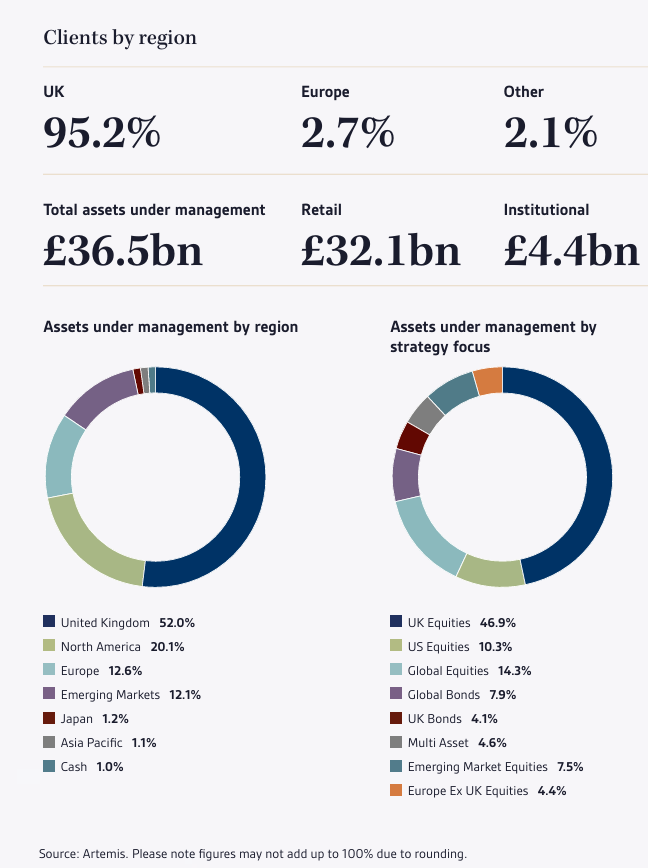
Artemis, Stewardship Report, page 6
Asset Manager
Features of reporting: This example shows a clear and easy-to-read graphic of the signatory's AUM, broken down by asset class and region as well as clients by region and type.
Disclosure B: Governance and resources
Signatories explain how their governance and resources support effective stewardship. Good reporting clearly described governance structures, decision-making responsibilities and processes, often using organisation charts to show how oversight and accountability operate in practice. Signatories are also asked to explain the level of resource devoted to stewardship; the teams and roles responsible; and how they maintain the skills, diversity and experience needed to respond to stewardship-related developments. Better reporting goes beyond describing resources to explain why the resourcing model is appropriate to the signatory's role and circumstances, and how it supports effective stewardship.
Sands Capital Management LLC, Stewardship Report, page 18
Asset Manager
Features of reporting: This signatory outlines their approach to on-boarding and ongoing training for staff, including what stewardship-related topics are covered for all investment team hires.
Training
At Sands Capital, we embrace a culture of continuous learning and development, understanding that there are always ways we can improve. We aim to stay current with industry developments and encourage creative thinking and problem-solving.
New hires at Sands Capital undergo a series of orientations from human resources, compliance, and other teams to help integrate them efficiently into the firm. After integration, staff members engage in ongoing training throughout their tenure on topics such as new rules being implemented by the U.S. Securities and Exchange Commission (SEC) and how to maintain Equal Employment Opportunity compliance and uphold a respectful workplace for all.
In 2025, we enhanced our stewardship training onboarding curriculum for all new investment team hires, reinforcing the central role stewardship plays in our investment philosophy. The program establishes clear expectations for new research analysts and associates, covering ESG integration, company engagement, proxy voting, and our internal research and documentation standards. This structured approach helps ensure every new hire is equipped to uphold the discipline, rigor, and accountability that define our stewardship practice.
Disclosure B also covers any systems or technology used to undertake stewardship activities. Several signatories explained how they use AI to extract data or to track engagements. However, there has been very limited reporting on the use of AI in the preparation of stewardship reports. We are aware that several signatories use AI to assist with drafting text, organising information or summarising case studies.
We welcome the efficiencies that AI can bring to the reporting process, allowing signatories to devote more time to the practice of stewardship. However, it is important that AI is used as a tool, rather than as a substitute for human judgement, and that there is appropriate human oversight at each stage of the process. Stewardship reports should give a fair, balanced and understandable view of a signatory's stewardship activities during the year. They must also be reviewed and approved by the applicant's governing body and signed off by the Chair, Chief Executive, or Chief Investment Officer.
We would encourage signatories to explain if, and how, AI has been used in the preparation of their stewardship report.
Railpen, Stewardship Report 2026, page 4
Asset Owner
Features of reporting: This example is transparent about the extent to which a signatory has used AI when drafting their report, explaining how the technology was used and the oversight mechanisms in place.
How we've used artificial intelligence (AI) in this report
We've used Microsoft Copilot throughout the drafting process to help structure the report and articulate our case studies more efficiently. It supported us in talking about our engagement activities, clarifying actions and outcomes, and ensuring consistency in tone and style across the report. Copilot also accelerated the production of early drafts so that we could focus our time on verifying the underlying evidence, refining key messages, and strengthening the narrative around stewardship impact. We did not use Copilot to generate any data or underlying evidence. There has been oversight from the Sustainable Ownership (SO) team at key stages in the drafting process, and the report in its entirety has been signed off by senior stakeholders.
Disclosure C: Policies, processes and review
Signatories are asked to explain their stewardship policies and processes, and how these are reviewed.
Signatories used the Code's flexibility in different ways. Some set out their policies and processes in full in this Disclosure, while others explained them alongside relevant case studies in their Activities and Outcomes Report. We saw both approaches used effectively. In either format, reporting should give readers a clear understanding of the organisation's approach and the key features of its policies and processes, with links to full policies on the signatory's website where appropriate. A standalone Policy and Context Disclosure can provide enough detail to remain useful over several years, as long as signatories ensure it is still accurate over time and aligned with the activities reported on annually.
Disclosure C explains how often policies are reviewed and who is responsible for reviewing and approving them. Better reporting used specific timeframes, such as “annually”, rather than vaguer terms such as "periodically".
Jupiter Asset Management, Policy and Context Report, page 11
Asset Manager
Features of reporting: This example includes a description of the signatory's policy review process, which includes specific timeframes.
Jupiter's stewardship policies are reviewed regularly to ensure they remain effective, current and aligned with client, regulatory and market expectations. Each policy is formally reviewed and approved on an annual basis by the relevant governance committees: the Investment Oversight Committee for the Responsible Investment and Voting and Company Dialogue Policies, and the Strategy and Management Committee for the Corporate Sustainability Policy, with oversight from the Board. Updates may also be made in response to developments in best practice, investor experience, organisational change or new regulatory requirements.
Disclosure D: Conflicts of interest
Signatories explain how they identify and manage stewardship-related conflicts of interest so that the interests of clients and beneficiaries remain their priority. Conflicts may arise from relationships with clients, beneficiaries, issuers, external managers or service providers, or where the interests of different clients diverge.
Good reporting used clear examples of real or potential conflicts and explained how conflicts are identified, assessed and escalated, as well as who is responsible for this oversight and how decisions are documented and reviewed.
Some signatories chose to include a link to a publicly available conflicts policy to support a summary of their approach. The summary should remain sufficiently detailed to help readers understand the safeguards and decision-making arrangements relevant to stewardship, rather than relying on the policy link alone.
M&G Investments, Policy and Context Disclosure, page 24
Asset Manager
Features of reporting: This reporting on a signatory's potential conflict of interest is specific to their circumstances.
Examples of real or potential conflicts of interest
The important aspect to keep in mind is that it's quite normal for a large organisation like ours to encounter conflicts of interest, as set out in the examples below. We provide products and services to a wide range of customers, clients and policyholders, each of whom have their own needs and objectives.
Conflicts arising from M&G plc's dual role as asset owner and asset manager
An aspect of this relationship where conflicts could arise comes in M&G Investments managing the assets of M&G plc's asset owner, the Prudential Assurance Company (PAC). M&G Investments has obligations to treat all customers fairly, while PAC must place its funds where it will achieve the best value for its policyholders.
This dynamic requires careful management to ensure both entities' interests are balanced and conflicts are mitigated effectively. To manage this, both entities operate as separate businesses with independent governance structures. Information flow is tightly controlled to ensure that decisions are made solely in the best interests of M&G Investments' clients, with no preferential treatment. Information sharing is permitted only for the specific investment portfolios that M&G Investments manages on PAC's behalf. Any broader collaboration, such as discussions on investment principles, takes place strictly in generic or hypothetical terms to avoid influencing portfolio-specific decisions.
Operational separation is maintained across governance, oversight, and investment decision-making. All inherent conflicts are managed in line with the Conflicts of Interest Policy, and any concerns are escalated and recorded through established conflict-management channels.
Disclosure E: Dialogue with clients and/or beneficiaries
Unlike Disclosures A-D which apply to all signatory types including Service Providers, this Disclosure applies to asset owners and asset managers only. It asks them to explain how they maintain dialogue with clients and beneficiaries. It helps readers understand how signatories communicate their stewardship approach, listen to the views of those they serve and take those views into account.
Many Disclosures focused mainly on information sent to clients or beneficiaries. Better reporting linked how the approach taken in sharing information meets client or beneficiaries' needs.
Effective reporting gave a sense of two-way communication between the signatory and their clients: not only the information shared but the channels used to seek views, the feedback received from clients and beneficiaries and how the signatory responded. Clients and beneficiaries will not always respond to outreach or provide detailed feedback. Better reporting acknowledged this and explained the methods used to encourage participation and what the signatory learned about the effectiveness of different approaches.
This Disclosure also asks whether feedback led to changes in stewardship activities or approach. Better reporting gave specific examples of changes made and, where feedback was limited or absent, explained how this informed the signatory's approach to future engagement with clients or beneficiaries.
Pension Insurance Corporation Plc, Stewardship Report, Policy and Context, page 18
Asset Owner
Features of reporting: This signatory describes the ways in which they have sought views from their policyholders and responded to feedback.
Our customers tell us that being a PIC policyholder means so much more than simply seeing their pension payments in their bank account. One of the areas that is commonly remarked upon is the benefit of being able to hear directly from PIC and meet fellow policyholders at one of our dedicated, free events, to which we have welcomed more than 30,000 people since 2011. As a result of this feedback we increased the number of events from seven to 11 in 2025, to better cater for the changing geography of our growing policyholder base. In addition, we created an online video series, 'PIC on Demand', for policyholders, including those who are less able to travel.
PIC gathers beneficiaries' views and feedback at its policyholder events, through surveys, and directly asking policyholders for feedback. Through these methods we learn what matters to them. Policyholders care that their pensions are secure and delivered on time, that communications are transparent and easy to understand, that PIC maintains great customer service and customer outcomes, and that our investments that back their pensions are socially valuable. Taking this information on board, we have ensured that we continue to prioritise our strong customer service as well as communicate the socially beneficial impact of our investment portfolio via our Annual and Sustainability reports, on our website and within the presentations at Policyholder events.
Lazard Asset Management, Investment Stewardship Report page 50
Asset Manager
Features of reporting: The signatory describes their framework for maintaining dialogue with clients and using the feedback to inform stewardship, covering the overall aims of their dialogue along with the specific components.
Collaboration With Our Clients
We take a structured, transparent, and collaborative approach to building long term partnerships with all clients. Our objective is to maintain an ongoing dialogue, ensure alignment on strategy and investment stewardship priorities, and create a robust feedback loop that continually improves the service we provide. To achieve this, we like to apply the following partnership framework:
1. Regular Review Meetings and Investment Stewardship Updates
We hold regular review meetings that bring together portfolio managers, stewardship specialists, and sector analysts to update clients on portfolio positioning, performance, engagement activity, and sustainability developments. Alongside these discussions, we provide quarterly and annual stewardship reporting when requested, including engagement summaries, voting highlights, and progress against sustainability objectives, in addition to publicly available business unit- and portfolio-level reporting. These interactions serve as an important forum for two way feedback, which we use to refine engagement priorities and evolve our stewardship focus.
2. Access to Firmwide Expertise
Clients benefit from direct access to the full breadth of Lazard's global insights and capabilities, including:
-
Macroeconomic and Geopolitical Research
Clients receive timely updates and briefings on global macroeconomic trends and geopolitical developments from our Lazard Geopolitical Advisory team. These experts can provide clients with structured analysis and additional context to understand the forces shaping markets, supporting more informed strategic decision making.
-
Expert Forums
We host periodic forums featuring external thought leaders and senior asset owners, providing clients with access to emerging themes, research, and industry wide perspectives on key investment topics. These initiatives are here to help clients also understand views from peers, gain early insight into evolving risks and opportunities.
-
Global Sector Specialists
Our sector analysts provide clients as requested with insights from research and corporate engagement across global developed and emerging markets. This gives clients a transparent view of the drivers of stewardship activity and the sustainability factors influencing portfolio companies and how some of the actions taken can support long term value creation.
3. Servicing
Each client relationship is supported by a relationship lead responsible for day to day coordination, supported by the rest of the servicing team to ensure continuity, responsiveness, and strategic alignment. Our client first culture is built on transparency, agility, and proactive communication, ensuring we deliver a scalable, adaptable solution that evolves with our clients' needs over time.
3. Principles for Asset Owners and Asset Managers
The Policy and Context Disclosure sets out a signatory's engagement policies and processes; while the annual Activities and Outcomes Report shows how these were applied in practice during the reporting period.
This section of our review focuses on reporting against Principles 3–6 for asset owners and asset managers because they cover areas on which signatories have most sought feedback on their reporting or have had more significant changes in the 2026 Code.
Key messages
- Purpose: The Activities and Outcomes Report shows how signatories applied their stewardship approach during the reporting period and what progress or outcomes resulted.
- Flexibility: Reporting can be structured around the signatory's activities, asset classes and stewardship approach, provided the relevant Principles are addressed clearly. There is no 'one size fits all' and signatories can report in a way that reflects their organisation and priorities.
- Principle 3: Explain engagement objectives, methods, progress and outcomes, using representative examples that show the signatory's role and contribution.
- Principle 4: Show how rights and responsibilities were exercised across relevant asset classes, connecting decisions to engagement, policies and follow-up action.
- Principle 5: Focus on how the signatory selected, monitored, challenged and held external managers to account, rather than only describing managers' activities.
- Principle 6: Demonstrate how service providers have contributed to stewardship activities and, using examples where possible, how those services have been monitored.
Principle 3: Engagement
Principle 3 of the 2026 Code brings engagement, collaboration and escalation together under a single Principle. This recognises that collaboration and escalation may be used at different stages of an engagement, rather than reported as separate activities. In the first window of reporting against the 2026 Code, signatories generally explained these connections clearly and concisely.
Better reporting shows a signatory's stewardship approach and priorities in action, explaining the engagement objectives, methods used and rationale. It combines summary statistics with focused case studies, giving readers both the breadth of the engagement programme and insight into how it operates in practice.
Examples across asset classes help readers assess whether the engagements reported are representative of the signatory's investment and stewardship approach. A balanced selection reflects the asset classes held, and the stewardship activities undertaken during the reporting period.
Useful case studies show how stewardship priorities, policies and processes informed the engagements undertaken during the reporting period.
Case studies
Effective engagement reporting does more than list the details of individual engagements. It uses case studies to show how the signatory's stewardship approach operates in practice and connects coherently with the wider report.
Good case studies explain the issue and reason for engagement, the objectives set, the methods used, progress and outcomes achieved, and any lessons learned.
The Code does not prescribe a set number of case studies because signatories vary in their asset classes, AUM, business models and position in the investment chain. Signatories should instead select a range of examples that is representative of their asset classes, geographies and engagement strategies.
Engagement methods
Good reporting explains the circumstances of the engagement, the methods selected and why they were appropriate to the issue, issuer and objectives.
Carmignac Gestion, 2025 Stewardship Report, page 55
Asset Manager
Features of reporting: This signatory provides a comprehensive description of their engagement, including context about the company, as well as their engagement objectives, activity undertaken during the reporting period, outcomes and next steps.
Company: Anta Sports Sector: Textiles, Apparel & Luxury Goods Region: China Carmignac holding: Carmignac is an equity investor in the company across several emerging markets funds.
Engagement objective: Recent regulatory changes across the EU and US have significantly tightened restrictions on the use of per and polyfluoroalkyl substances (PFAS) in consumer products, particularly in textiles and cosmetics. With France and Denmark phasing out PFAS use between 2026–2028, California banning PFAS in textiles from 2025 (AB 1817), and additional REACH restrictions expected to follow, companies face rising operational, legal, and reputational risks. Against this backdrop, Carmignac launched a thematic engagement with apparel and cosmetics holdings— including Anta Sports—to assess their exposure to PFAS, encourage proactive risk mitigation, and promote alignment with evolving regulatory and stakeholder expectations. Our objectives were to ensure that portfolio companies:
- Identify PFAS use across their product portfolios.
- Implement credible, time bound phase out strategies.
- Ensure product safety through improved input stream chemical controls.
- Enhance transparency around PFAS management and disclosures.
Engagement method: Between February and April 2025, Carmignac initiated a structured dialogue with Anta Sports. This engagement was conducted through an email based exchange, as the company was in a blackout period for earnings related communications and could not hold a call.
Engagement summary: Anta Sports acknowledged that the topic of PFAS had been on its radar for several years and confirmed it had developed a strategic plan to manage associated risks. Key information provided by the company included:
- Regulatory positioning: Anta noted that China currently restricts only long chain PFAS such as PFOA/PFOS (C8), while short chain PFAS remain compliant. Despite this, Anta committed to aligning with stricter international expectations.
- PFAS phase out commitment: The company committed to phasing out PFAS from all product types starting 1 July 2026, ahead of domestic regulatory requirements.
- Technical challenges: Anta highlighted functional performance gaps in PFAS free alternatives— particularly reduced durability of water repellent and weaker oil repellent characteristics—but confirmed R&D efforts were underway to balance performance and safety.
- Supply chain chemical controls: As a ZDHC signatory, Anta has shifted from end product testing to input stream management, implementing ZDHC tools to prevent chemical contamination early in the manufacturing process.
Engagement outcome and next steps: Anta formally confirmed a full PFAS phase out across all product lines, marking a strong alignment with global regulatory trajectories. In August 2025, Anta publicly announced the launch of AEROVENT ZERO, a PFAS free high performance waterproof breathable material—representing a significant innovation milestone for the global PFAS free textile sector. This demonstrates a meaningful shift toward safer chemical use and improved long term product resilience. We will continue monitor the company's progress towards their targets.
Role and contribution within collaboration
If reporting on collaborative engagement, it is important that signatories make clear their individual role and contribution they have made alongside others, distinguish the activity undertaken and progress made during the reporting period from earlier actions, and demonstrate outcomes and next steps.
Allianz Global Investors, Sustainable Investing and Stewardship Report 2025, page 61
Asset Manager
Features of reporting: This signatory explains their role in a collaborative endeavour, giving readers an understanding of their specific contribution. The case study also explains the progress over time, detailing the continued engagement and interactions with the investee company.
Co-filing at McDonald's general meeting
We co-filed a shareholder resolution at McDonald's in 2023 concerning supply chain water risk assessment, with Dutch investor PGGM as lead filer. Based on our research, we believed the company could benefit from enhancing its assessment of risks related to water-intensive agriculture commodities such as potatoes, beef and pork.
McDonald's demonstrated focus on the issues right from the outset, contributing to a constructive and productive series of collective engagement calls with all filers. The resolution was withdrawn following this engagement process, which included the company's commitment to continue to engage towards achieving the requested improvement.
Since then, we've had periodic engagement meetings with the company to monitor its progress. In September 2025, McDonald's reported the completion of a water risk assessment across its operations and supply chain, which confirmed its high-risk exposure. The results will be used to inform the buildup of its water resilience strategies, and we'll continue our dialogue to ensure implementation.
Reporting on progress and outcomes over time
An engagement does not need to begin or conclude during the reporting period for its outcome to be relevant.
Outcomes may include a better understanding of management decision-making, stronger long-term relationships, or voting and investment decisions, including decisions to buy, sell or hold. Where an engagement has not progressed as intended, setbacks and lessons learned can also provide useful evidence. Balanced reporting explains the engagement's purpose, progress and outcomes, what it informed, and how the signatory assessed progress against its objectives.
Northern Trust Asset Management, Stewardship Report 2025, page 56
Asset Manager
Features of reporting: This signatory explains their engagement with an investee company ahead of an AGM, and how this has informed their voting decision.
The challenge: Apple, Inc, headquartered in the U.S., designs and manufactures consumer electronics. At the 2025 AGM, Apple received a shareholder proposal requesting that it publish a report analyzing the risks of data usage when training AI. As a leading global technology hardware firm, Apple works to manage many complex sustainability issues that could impact shareholder value. This includes AI strategy, geopolitical dynamics, and data privacy practices. When considering the company's product offerings, which handle and store a large volume of customer personal data, we recognize Apple's need to have preeminent cybersecurity and data privacy practices. This is particularly true as the company ramps up efforts around AI.
What we did: Ahead of the AGM vote, NTAM discussed data privacy with the company, a key pillar of its strategy. Specifically, we asked for details about how this data privacy applies to the partnerships it takes on, particularly with OpenAI, and internally built AI capabilities being integrated into new devices. During our engagement, Apple demonstrated the safety of its first-party platform and confirmed that it does not share user information with OpenAI. While the company is taking a thorough approach to implementing guardrails around user data, there are inherent and unprecedented risks in the rapidly evolving AI sector that require ongoing monitoring. Apple has provided public disclosure detailing how it protects user data when training AI models, including the creation of Responsible AI principles, which support its approach to further developing the architecture of Apple Intelligence.
The outcome: Apple gave us confidence that its current policies and procedures on data privacy sufficiently address the issues raised in the shareholder proposal. This being the case, NTAM voted against the shareholder proposal which ultimately received just under 12% shareholder support. As Apple continues to build on its AI strategy and releases new features, NTAM will continue to monitor and engage with Apple on the company's data privacy and security approach and AI Responsible Principles.
Principle 4: Exercising Rights and Responsibilities
This Principle covers how signatories exercise their rights and responsibilities across the assets they manage. The first reports under the new Code generally addressed this Principle well.
Effective reporting demonstrates how the exercise of rights and responsibilities connects with different asset classes the signatory may be invested in and their wider stewardship approach. For those managing listed equities, a voting decision may follow engagement with an issuer, demonstrate a voting policy in practice or lead to further engagement. In fixed income, investors may instead show how engagement influenced the terms or structure of a new bond issuance.
Good reporting explains the background to a resolution, the signatory's voting decision and rationale, the result of the vote, and any follow-up action or outcome. Signatories generally reported the background and rationale well but often omitted the result or what happened next. Where a vote followed engagement with the issuer, reporting can explain how that engagement informed the decision and whether the vote led to further action.
Voting
Signatories that vote directly are asked to provide a working link to their voting records. Individual case studies provide greater depth in explanation of the reasoning behind decisions, while the full record allows readers to understand the voting approach across the breadth of a portfolio.
Signatories are also asked to disclose the proportion of eligible votes exercised during the year. An absolute figure does not show the coverage of the voting programme unless readers also know how many resolutions are eligible. It is more insightful therefore, to give both the number of votes exercised and the proportion of eligible votes this represents, for example, "we voted on 8,000 resolutions which represents 98% of eligible votes". This allows readers to assess the extent to which the signatory exercised its voting rights.
Aberdeen Group plc, Stewardship report 2025, page 63
Asset Manager
Features of reporting: This signatory clearly sets out a voting decision and the result of the vote, along with the rationale for their vote, related engagement and how this vote has informed their investment decision-making.
Voting Case Study: AS ONE Corp Country: Japan AGM: June 2025 Topic: Capital Allocation Resolution: Elect Directors x9 (Management Proposals) Aberdeen Investment Vote: Against (x9) Result: All Passed
Voting details: Inputs
- At the company's AGM, the entire board was up for re-election.
- We had engaged with the company previously on its capital allocation policies and considered escalation to be appropriate.
Engagements
- We had previously engaged with the company at meetings and in writing to express our views on the company's approach to capital allocation and to emphasise our expectation of improved capital efficiency.
- We had been disappointed with the company's response and their stance on continuing to hold stocks for capital gains purposes, which leads to depressed Return on Equity.
Outputs
- We voted against all board members at the AGM to emphasise our views.
- All directors were re-appointed following majority shareholder support.
- Following our votes, we reviewed our conviction on the stock.
The same example may be used to illustrate both engagement under Principle 3 and voting under Principle 4, provided the reporting makes each stage and its contribution clear.
Voting case studies need not focus only on decisions to oppose management. Examples of votes both for and against management can be informative when they explain the issue considered, the signatory's rationale and how the decision reflected its stewardship approach.
Aviva Investors, Sustainability Review 2025, page 112
Asset Manager
Features of reporting: This signatory reports their rationale for voting on a specific resolution and how that aligns with their stewardship approach.
Issue
Concerns over the attractiveness of the UK's capital markets have grown, with several companies delisting in recent years citing low valuations and poor liquidity. In 2025, this risk resurfaced with significant proposals affecting two FTSE 100 blue-chip companies: AstraZeneca and Rio Tinto. At AstraZeneca's General Meeting in November 2025, the company proposed a new Harmonised Listing Structure across the LSE, Nasdaq Stockholm, and NYSE.
Action
After detailed discussions, we supported the resolution. We gained comfort that an additional US listing would enhance access to capital in a key growth market without altering AstraZeneca's UK incorporation, tax residency, headquarters, or FTSE 100 inclusion.
Outcome
The resolution passed with 99.1% shareholder support, reflecting strong confidence in the company's engagement and strategy. The harmonised structure will provide greater flexibility to attract capital as AstraZeneca expands in high-growth regions.
Linking a voting example to the relevant voting policy can show how the Policy and Context Disclosure operates in practice. This is particularly informative where the signatory departed from its usual voting position, provided it explains the circumstances, rationale and decision taken.
Proxy adviser research and recommendations can support informed voting decisions, but signatories remain responsible for reaching their own conclusions.
Similarly, disclosure on voting may be linked to conflicts of interest, so reporting under Principle 4 where relevant could also show how the conflicts policy described in the Policy and Context Disclosure operated during the year. Where a voting-related conflict arose, better reporting explains the nature of the conflict, how it was identified and managed, who made the decision, and the resulting vote.
Mirabaud Asset Management, Activities and Outcomes Report, page 51
Asset Manager
Features of reporting: This signatory reports on the multiple information inputs considered in determining their voting decision.
Company profile
A leading Swiss-listed multinational operating in the inspection, verification, and certification sector.
Meeting type
Annual General Meeting.
Resolution
Proposal to change the location of the company's registered headquarters to a different Swiss canton
ISS recommendation
ISS supported the proposed relocation, in line with its standard assessment of operational and administrative considerations put forward by management.
MAM rationale
MAM chose to abstain from this resolution, diverging from ISS's recommendation. We considered the proposed headquarters relocation to be a particularly sensitive matter in the context of the company's identity and longstanding institutional heritage. Relocating the registered seat of a prominent, historically rooted Swiss company carries reputational and symbolic significance that, in our view, warranted a more cautious stance. Rather than opposing the proposal outright, we elected to abstain, reflecting our reservations while acknowledging that the operational rationale presented by management may have merit. Furthermore, as a Geneva-based institution, we were mindful that our proximity to the matter could introduce an element of bias into our assessment and felt that abstaining was the most measured and transparent expression of our position.
Asset owners that delegate all voting to external managers are not required to include voting case studies but may wish to include examples from their managers. To make these examples meaningful, asset owners can explain what the example shows about its oversight of their manager; the extent to which it discussed the voting decision with the manager and how the example aligns with its stewardship priorities and approach. This keeps the focus on the asset owner's role rather than presenting the manager's activity without context.
Exercising rights and responsibilities across asset classes
The exercise of rights and responsibilities is not limited to listed equity or to voting. Depending on the asset class, signatories may influence issuers, investee companies or other parties through contractual rights, governance arrangements, consent processes, engagement on financing terms or other forms of intervention. Effective reporting reflects the range of asset classes held and explains how the relevant rights were used during the reporting period.
The following excerpts illustrate how signatories exercised rights and responsibilities in non-listed equity asset classes, and how reporting can explain the form, rationale and effect of those activities.
Private equity
Private equity firms may not consider it appropriate to disclose votes at unlisted companies because of confidentiality concerns. However, investors in private markets often hold rights that can influence strategy, governance, risk management, sustainability initiatives, executive remuneration and capital allocation. Reporting identifies the rights used, explains why they were relevant and describes what influence or progress resulted.
Foresight Group LLP, Activities and Outcomes Report, page 40
Asset Manager
Features of reporting: This signatory's reporting on exercising rights associated with a private equity investment describes the situation, their actions and the outcome.
Division: Private Equity
Background: Functional Gut Group (Functional Gut) is a provider of high-quality diagnostic testing services for patients suffering from pervasive conditions such as Irritable Bowel Syndrome (“IBS”), which affects one in five people in the UK. Foresight Group invested £5.75 million into Functional Gut in March 2025 to support geographic expansion and team growth.
Objective: To actively exercise ownership rights to address weaknesses in insurance reimbursement arrangements and enhance the value and resilience of the investment.
Stewardship Activity: As a private equity investor, Foresight holds ownership rights that enable it to influence key commercial and contractual decisions post-investment. Following completion, and drawing on learnings from during due diligence, Foresight exercised these rights by initiating an early review of the company's insurance reimbursement arrangements. Using its ownership influence, Foresight prioritised this issue immediately after acquisition, requiring management to review their contractual terms to ensure reimbursement structures more accurately reflected commercial reality.
Outcome: As a direct outcome of this intervention, the revised arrangements delivered a 7–8% increase in reimbursement fees, strengthening the company's financial position and improving resilience and demonstrating Foresight's role in influencing its investments for long-term value.
Fixed income
Formal exercise of rights for fixed income investors generally arises when an issuer seeks bondholder approval to amend debt terms or implement a restructuring, while influence may also be exercised before investment through engagement on proposed terms and structures. Clear reporting distinguishes the stage at which the activity took place, the terms or issues addressed, the investor's contribution and the resulting change or outcome.
Columbia Threadneedle Investments, Stewardship Report, page 14
Asset Manager
Features of reporting: This signatory describes their engagement with an issuer on the terms of bonds, setting out the background, their activity and the outcome.
Background: Our Social Bonds team has engaged extensively with the treasury and investor relations teams at NatWest on its labelled bond issuances – in particular on reporting and use of proceeds. We engaged the bank on its gender-focused bond issued in March 2023, which aimed to support women-owned and women-led businesses in the UK, both before and after the bond's issuance. A key focus of the engagement was improving the quality of reporting on impact by incorporating the community voice: direct feedback from the bond's beneficiaries. Following up in March 2024, the team engaged with NatWest before the release of its impact report. This engagement proved successful in April 2024 when the report was released, containing survey examples and detailed case studies as requested. This demonstrates best practices in social bond reporting. We continue to hold the NatWest gender bond.
Action: In the first half of 2025, the Social Bond team engaged with members of the Sustainable Debt desk at NatWest to ask them to allocate proceeds from their future bonds to new loans (rather than refinancing existing loans), thus improving the additionality of the bonds. Higher additionality leads to a higher social intensity score in our social bond funds' proprietary social methodology, which in turn informs position sizing where, all else equal, we will target increased allocation to bonds with higher social scores.
Outcome: NatWest noted our request and came to the primary market to issue a bond supporting loans to affordable housing, with 15% of the proceeds earmarked towards new loans. This met our engagement objectives and led to a higher social intensity score, contributing to our decision to buy these bonds. The team has since met with the NatWest debt team who confirmed their intention to implement this approach to additionality across future bond issuances. We will continue to monitor/engage with NatWest on additionality through their bonds and we will use this as an example to take to other issuers.
Principle 5: Selection and Oversight of Managers
This Principle introduces a distinct focus on how signatories select and oversee external managers. By separating manager oversight from the monitoring of other service providers, it recognises that delegating investment management does not delegate stewardship responsibility. It shifts the emphasis from describing what external managers have done to explaining how the signatory sets expectations, assesses performance, influences practice and holds managers to account.
Reporting demonstrates how stewardship is integrated throughout the manager relationship, from tendering, due diligence and mandate design to appointment, monitoring, review and renewal. It explains the stewardship expectations and assessment criteria used, how performance is evaluated against them, and how engagement or escalation is used where expectations are not met.
Disclosure A in the Policy and Context Disclosure indicates whether external managers are used and the approximate proportion of assets managed externally. This context helps readers assess the relevance of Principle 5, the scale of the signatory's oversight responsibilities and whether the activities reported are proportionate to its externally managed assets.
Many reports included case studies describing activities undertaken by external managers. These examples are most useful when they demonstrate the signatory's own oversight, including the information it reviewed, the questions or challenge it raised, the manager's response and any resulting action. Better reporting places manager activity within the context of the signatory's stewardship priorities and explains what the example shows about the effectiveness of its oversight.
Better reporting connects the manager's activity to the signatory's own expectations, monitoring and decisions. It explains why the activity was relevant to the signatory's stewardship approach, how the signatory assessed the manager's performance, and whether the evidence led to further engagement, revised expectations or another oversight action. This allows readers to understand both what the manager did and what the signatory did with that information.
Mineworkers' Pension Scheme, Activities and Outcomes Report, pages 6-7
Asset Owner
Features of reporting: This signatory includes their own view of engagement undertaken by an external manager along with their reporting on the manager's stewardship activity.
Healthcare Manager – BridgeBio Pharma – Governance (Executive Remuneration)
Rationale: The manager engaged with BridgeBio following significant shareholder opposition to executive pay at the AGM, reflecting concerns around pay levels, incentive design and alignment with company size and long-term shareholder value.
Manager Actions: The manager engaged with the company after the AGM to express support for clearer performance-linked pay structures, stronger long-term incentives and more appropriate peer benchmarking. The manager encouraged changes that better align management rewards with sustained performance and shareholder interests.
Outcomes and Next Steps: The company responded positively by introducing performance-based share awards, moderating CEO pay increases and confirming it does not expect to grant a one-off equity award in the current year.
CPTI View: CPTI views this as a positive example of shareholder engagement leading to improved governance practices. Ongoing monitoring will continue ahead of future proxy seasons to ensure changes are embedded.
Why this matters for members: Helping ensure senior pay is linked to long-term performance supports better governance and protects members' investments from poorly aligned incentives.
Tendering, design and award of mandates
While we recognise that there may not be new mandates awarded every year, where there is occasion to report on these, good reporting explained how stewardship considerations influenced tendering, due diligence, mandate design and appointment decisions. Useful evidence included the questions asked of prospective managers, the stewardship capabilities assessed, the expectations or objectives included in mandates, and how the assessment affected the selection or terms of appointment. Where stewardship considerations did not alter the decision, reporting can still explain how the signatory satisfied itself that the manager's approach was aligned with its expectations.
Now: pensions, UK Stewardship Code 2026 submission, page 50
Asset Owner
Features of reporting: This signatory's reporting offers insight on how they have considered the needs and objectives of their beneficiaries when appointing a manager to support their stewardship approach.
A third-party manager appointment for the scheme involved appointing a manager to deliver a Shariah-compliant fund to be made available to certain members in line with their religious beliefs.
The third-party manager was assessed to have good stewardship policies but this appointment involved an active discussion by the Trustee regarding the priority themes in the case of this investment.
It was decided that in this case it was in these members' interests to provide an option compliant with their religious beliefs and this would take precedence over the priority themes that are applied more broadly to other investments.
The third-party manager is still expected to engage with the businesses to manage financial risks, climate risks and other ESG risks.
Engagement and Escalation
The inclusion of engagement and escalation in Principle 5 reflects the active role expected of signatories after a manager has been appointed. Useful reporting explains the issue, the expectation communicated to the manager, the evidence considered and the response received. Where concerns persisted, reporting can describe the escalation method used, why it was proportionate and what changed as a result, including any revised expectations, action plans, mandate terms, allocation decisions or decisions to retain or replace the manager.
Patria, Stewardship Report, pages 25-26
Asset Manager
Features of reporting: This signatory describes how they have escalated engagement with an external manager, including the progress made.
Case study: Climate-related reporting (side letter)
Overview: European mid-market buyout manager; co-investment.
Context: The manager had agreed to provide quarterly climate reporting against a defined set of sustainability metrics for underlying portfolio companies, supplementing detailed annual reporting. During 2025, reporting was not consistently received. Consistent and timely reporting was necessary for Patria GPMS's stewardship and for our oversight responsibilities to clients.
Objectives: Receive timely quarterly climate reporting and understand the root cause of non - delivery.
Actions and escalation: Following an informal follow-up in the preceding quarter, we raised the issue with the manager, referencing the specific side-letter provisions and the agreed reporting schedule.
Essex Pension Fund, Stewardship Code Submission, page 59
Asset Owner
Features of reporting: This signatory reports on how they undertook oversight of a manager and escalated concerns.
The Fund monitors its investment managers ESG integration and engagement activities through regular reports and discussions and expects its investment managers to take appropriate action when engaging in stewardship activities of its behalf, including actions to escalate when appropriate.
Mandate: Timberland
Background: As part of the ESG and Climate metrics report put together ahead of the engagement meeting with the Timberland manager, it was noted that one of the underlying managers appointed by the Timberland manager had a low Policy, Governance and Strategy PRI Score.
Activity: The O&A [Officers and Advisers] engaged directly with the Timberland manager to understand:
- The rationale for the low score and whether, in the managers view, this represented a material concern
- What engagement had taken place to improve the score
- What escalation would take place should there be no improvement and it was viewed as a financially material concern.
During the discussion, the Timberland manager highlighted that these concerns had been identified and engagement had taken place with the underlying manager. In recent discussions, the manager noted that insufficient progress was being made and subsequently decided to find exit options giving the limited willingness from the manager to make changes, highlighting the escalation policy of the manager.
Outcome: The O&A were satisfied that the Timberland manager was integrating ESG into the investment process and had escalated though divestment given no improvement had been seen.
Outcome logged: Follow up on whether divestment has taken place at the next annual engagement meeting.
Principle 6: Monitoring service providers
Signatories explain how they use and oversee stewardship service providers, particularly proxy advisers, investment consultants and engagement providers. This Principle recognises that using external expertise does not remove the signatory's responsibility to understand, challenge and assess the services supporting its stewardship. Insightful reporting focuses on the expectations that have been set, the evidence reviewed, the engagement undertaken and the decisions made in response.
Engaging with proxy advisors
Signatories took a range of approaches to reporting on their use and monitoring of proxy advisors. The most informative reporting moved beyond general descriptions of meetings and processes to explain a specific issue that had been considered, the engagement with the advisor, the advisor's response and any resulting action. This enables readers to assess how signatories monitor service quality and use the information provided without relying on it uncritically.
Reporting on oversight need not be onerous. A concise example can identify the service reviewed, the matter discussed, the signatory's assessment and any follow-up action.
The example below shows how a short description can demonstrate both engagement with a proxy advisor and ongoing oversight of the service provided.
Fidelity, Sustainability and Stewardship Report, page 30
Asset Manager
Features of reporting: This signatory's reporting sets out an example of activity undertaken during the year to understand how a proxy advisor reached their position on a specific report.
For example, in July 2025, we wrote to our main proxy advisor to notify them about a material proposed change to a company's governance arrangements which had been omitted from the advisor's proxy report on that company. The change in question was an extension of the sunset clause for the holders of the company's non-listed shares with enhanced voting rights, which had been included amongst various other changes in new articles of incorporation which were being proposed in conjunction with the company's change of domicile. This change meant that one of the company's co-founders would maintain effective control over the company's voting rights for an extended period. We also asked whether this proposed change had been considered in the advisor's proxy recommendation. Three days later, a newspaper published an article in which one of the company's other co-founders criticised the proposed sunset extension. Two days after the publication of that article, the proxy advisor updated their report to include information on the proposed change to the sunset provision.
Examples of oversight do not need to focus only on concerns or requests for change. Effective reporting may also explain how the signatory assessed a proxy advisor's work and concluded that the service met its expectations. In either case, reporting can identify the basis for the signatory's assessment, so that readers can understand how service quality was evaluated during the reporting period.
Janus Henderson Investors, 2025 Stewardship report, page 59
Asset Manager
Features of reporting: This signatory explains how it oversees its proxy advisor, which makes recommendations based on the asset manager's own voting policy, including the oversight undertaken during the year and any decisions resulting from it.
The Janus Henderson PVC is responsible for ensuring sufficient oversight of our proxy-voting service provider through periodic review of voting decisions, operational issues and conflicts of interest.
Periodic due diligence is undertaken to ensure: the adequacy and quality of the Proxy-Voting Service's staffing, personnel, and/or technology; disclosure from the Proxy-Voting Service regarding its methodologies in formulating voting recommendations; and whether the Proxy-Voting Service has adequate policies and procedures to identify, disclose, and address actual and potential conflicts of interest. Several members of the PVC attended a meeting to conduct an annual review of the proxy-voting service provider in November 2025. Based on the review of written material, discussion with ISS personnel and, experience over the preceding year they confirmed back to the PVC that in their view the proxy-voting service provider remains qualified to continue serving as Janus Henderson's proxy-voting vendor.
Oversight of Investment Consultants
Better reporting explained the stewardship expectations and objectives agreed between asset owner and consultant, how advice and delivery were assessed, the questions or challenge raised, the consultant's response and any resulting change. This may include agreed workplans, performance measures, regular review meetings, reporting on feedback received provided to consultants, any changes to advice or further action where expectations were not met.
Parliamentary Contributory Pension Fund, UK Stewardship report, page 50
Asset Owner
Features of reporting: This reporting describes how the signatory monitors their consultant, agrees workplans, assesses performance against objectives and uses regular reviews to provide feedback. The reporting provides the overall process, along with more specific information on how this was undertaken in the year.
Hymans Robertson, the Fund's investment consultant, create and update workplans to translate strategic objectives set by the Trustees into short-term and mid-term tasks and milestones. These workplans are taken to each investment focused Trustee meeting for discussion and approval. As part of ongoing assessment, the Secretariat ensure that Trustees' feedback, outcome of the discussion, and agreed actions are documented and agreed by all parties. The Trustees adopt an evidence-based approach when assessing their investment consultant's performance against objectives. Progress made against the workplans forms the basis of ongoing evaluation. In addition, Hymans Robertson are asked to provide evidence with example measures of success alongside each objective to assist annual assessment. [...] The Trustees provide regular feedback to their investment consultant about the services they deliver and are vocal about any potential areas for improvement. The Trustees are committed to having open dialogue with their investment consultant. In-person review meetings are held with a senior partner at Hymans Robertson twice a year, where feedback on their services is shared. At the last meeting held in November 2025, the Secretariat shared positive overall feedback and a few minor areas for improvement. While there is a formal policy for escalation, the Trustees have been able to address any minor issues through their regular engagement with Hymans Robertson and any feedback provided has been acted upon quickly.
4. Principles for Service Providers
This section of our review offers insights on how to report well and examples of good quality reporting for Service Providers' Activity and Outcomes reporting.
Service Providers support effective stewardship. All service provider signatories report against Principle 1 on communication with clients. Principles 2, 3 and 4 apply according to the services provided, covering proxy advisory, investment consultancy and engagement services respectively. Reporting should make clear which Principles apply and why, so that readers can understand the scope of the organisation's stewardship services.
In their Activities and Outcomes Report, Service Providers are asked to explain how their activities supported clients' stewardship during the reporting period. Clear reporting identifies the service provider's contribution, the reason for the activity and its relevance to clients' stewardship, rather than repeating standing policies or standard service descriptions. It explains the progress, outcome or lesson that resulted, including any changes to advice, research, services or internal processes, and any agreed next steps.
Key messages
- Purpose: The Activities and Outcomes Report shows how service providers' work during the reporting period supported clients' stewardship and contributed to progress or outcomes.
- Flexibility: Signatories determine which Principles (in addition to Principle 1) reflect the services they provide to clients, and report to those.
- Principle 1: Make the connection between client dialogue, their needs, and the services provided to support their stewardship.
- Principle 2: Explain how the provider ensures the quality of research, including examples of engaging with stakeholders to develop recommendations where necessary.
- Principle 3: Show how consideration of market-wide and systemic risks has connected to the services and advice provided to clients.
- Principle 4: Report engagement objectives, methods, the provider's contribution, progress, outcomes and lessons learned.
Principle 1: Communicating with clients
Signatories explain how they understand clients' needs and use that understanding in delivering their services. We saw good examples of dialogue informing research and advice, but the most informative reporting went further. It explained the client's need that had been identified or the feedback the client had provided, how the signatory responded, and how this supported the client's stewardship.
Gallagher Benefit Services UK, UK Stewardship, Sustainability and Impact Report, page 15
Investment Consultant
Features of reporting: This signatory provides an overview of the service they provide assisting with manager selection, along with a case study explaining a specific situation where they worked with a client to understand their responsible investment priorities and incorporate them into the evaluation of potential managers to work with.
Assisting with manager selection.
We help clients choose the most appropriate manager(s) for their assets. We provide any number of services in this respect, ranging from helping clients design questions for their RFP, to selecting a short list of names to requestion a proposal, to evaluating those proposals and assisting the client with selection. We also undertake follow up, by evaluating managers on an on-going basis, to ensure they are meeting the clients' expectations, including for stewardship and sustainability.
Case study: Assisting a charity client with manager selection
In the summer of 2025, we assisted a charity client with manager selection for its assets. The client wanted to avoid additional fees by investing in a fund of fund (FoF) pooled vehicle(s) but wanted to ensure that any third-party managers were required to meet the same stewardship thresholds as the asset managers themselves. We assisted the client with formulating questions for the Request for Proposal and provided a short list of asset managers that met the charity's general criteria across a number of areas, including for stewardship. We then evaluated the RFP responses and helped the client choose its asset manager(s). As a result, the charity was able to invest with manager(s) that met both its screening criteria and fee requirements. The client's manager(s) also provide the kind of ESG reporting that the group needs for its members.
Principle 2: Proxy advisor services
Signatories are asked to demonstrate how they maintain the quality, accuracy and consistency of the research, recommendations and voting services on which clients rely. Descriptions of quality-control arrangements provide useful context, but stronger reporting shows how those arrangements operated in practice during the reporting period, particularly where new information, questions or challenge required the provider to review its work. This may include the checks undertaken, the information considered, the issue identified and the people involved in reaching or reviewing a conclusion.
Better examples included cases where an issuer or client identified a potential factual issue, questioned an assessment or supplied further information. Good quality reporting explained the issue raised, the information reviewed, the conclusion reached and whether the research or recommendation changed. An amendment is not required for the review to produce a meaningful outcome. Where the provider retained its original conclusion, explaining the basis for that decision demonstrated the robustness of the review and the consistent application of its methodology.
The Investment Association Services Limited trading as Institutional Voting Information Service (IVIS), Stewardship Report 2025 – Activities and Outcomes report, page 10
Proxy Research Provider
Features of reporting: This signatory reports on the actions they have undertaken to ensure the quality and accuracy of the research provided, with both a more general description of their approach, supported by a specific example of their process in action.
All companies receive IVIS reports following publication (prior to publication in case of red topped reports). IVIS does not charge companies for a copy of their IVIS report. Companies are encouraged to highlight any factual inaccuracies, provide comments or further information which may be helpful. We will update our report if any factual errors exist, or a company has provided additional rationale or clarification, subject to the company confirming that such information can be included in the IVIS report. In some cases, this leads to a change in the colour top, and IVIS clients receive an alert with an update. The example below, from Forterra's 2025 AGM shows the IVIS approach when the company provided additional information after the publication of our report – the report was initially published on a red top as the company had not confirmed in its notice of meeting or provided an assurance that it would follow the shareholder protections in the Pre-emption Group's Statement of Principles. Following publication, the company confirmed that they would provide an assurance to follow the shareholder protections, so the report was updated to a green top to indicate the red top issue had been resolved.
When IVIS sends reports to companies, we often receive requests to change our assessment or colour coding of issues, particularly regarding material disclosures in areas like board succession and evaluation. Companies may argue their disclosures are material, prompting us to review their annual reports and arguments. However, we apply a consistent methodology across all companies so our members can accurately identify which ones require further analysis. If, after review, our assessment remains unchanged, IVIS will explain to the company why its disclosures do not meet our materiality threshold and outline what the company would need to include for recognition as a material disclosure. Feedback from companies gives us an indication of quality of our research and if there are any issues with our report writing or checking process or the quality of individual analysts' reports. In addition, company advisors, who also subscribe to IVIS would review the reports and may challenge our assessment. This may lead to a further review and engagement to obtain clarifications, which serves as another means of assessing the quality and accuracy of our reports.
Principle 3: Investment consultant services
Investment consultant signatories are asked to explain which market-wide and systemic risks they identified, why those risks were relevant to clients, and how their insights informed investment and stewardship advice. Depending on the issue, evidence may include research, scenario analysis, changes to advice, dialogue with clients or managers, or participation in industry and policy discussions.
Rather than reporting on general research on risks, better reporting includes specific activities undertaken during the reporting period, the effect on the consultant's advice or services and makes the consultant's contribution to client decision-making clear. Reporting can include an explanation of the impact of this activity, any progress achieved, lessons learned and the next steps planned.
Howden, Stewardship Report, Activities and Outcomes, page 9
Investment Consultant
Features of reporting: This reporting is specific to the situation and service undertaken where a consultant has supported a client with regard to considering a systemic risk.
Systemic risks from AI
The field of AI has made rapid advancements in recent years. It is influencing all parts of life and has powered much of the growth in equity markets since the beginning of 2023. It has been a research area of focus for us over recent years, including being a key feature of our Megatrend research, as well as the subject matter of a blog in 2024.
Whilst AI provides significant opportunity for investors, its integration into all parts of society also presents significant risks, that could be systemic to investors. Over the period, we have been working with investors, asset managers, and other industry stakeholders to help understand and mitigate such risks. We have used two client case studies below to illustrate some of the work we have been undertaking.
Client 2 example
What was the issue: A pension scheme client was keen to consider the risks (both systemic and idiosyncratic) and opportunities associated with AI, both indirectly and directly, on its investment portfolio and wider funding objectives.
What did we do: We provided a training session to the Trustee Board on AI. In particular, we covered the following areas:
- AI overview: what is AI and what are the key debates around the use of AI.
- Framing long term investment thinking: how AI impacts the risks and opportunities within a long-term investment portfolio.
- Real world implications: Considerations included: AI as a megatrend, the impact on the planetary boundaries (including climate change and water usage), and societal and economic impacts.
- Investment implications: Consideration of the upstream, midstream and downstream stages of the AI investable universe, and how an asset owner could both mitigate associated risks but also capture opportunities.
How did we help: The client benefited from us highlighting risks that were relevant to what they are trying to achieve (from their funding objectives, through to their sustainability objectives), allowing the client to consider AI as a systemic risk that could be factored into future decision making.
Principle 4: Engagement provider services
Engagement service providers are asked to explain the work undertaken on clients' behalf and how it supported their stewardship.
Effective reporting may include the provider's role or contribution within the engagement / activities undertaken. The client need or objective and the relevance of the activity for the client (particularly where the engagement was conducted for several clients). The purpose and objectives of the engagement. The methods used and rationale for doing so (for example involving board members, reaching a wider group of investors, coordinating clients or escalating a longstanding concern). Whether the approach changed as the engagement developed. Progress during the reporting period. The outcome or next steps.
These aspects of reporting give readers a clear account of what the provider did in the year and how the activity supported clients' stewardship. Reporting should make the provider's particular role visible. This may include developing research, coordinating clients' views, agreeing shared objectives, leading discussions or communicating results. Where client expectations differed, better reporting explained how the provider managed those differences and how they affected the objectives, methods or outcomes of the engagement.
Many engagements extend over several years. It is clearer when reporting distinguishes context or past activities from actions undertaken during the reporting period. This allows readers to understand what changed during the year and what remains to be done.
Engagement objectives do not need to have been achieved in order to report outcomes for the reporting period. Reporting engagement outcomes may include new information gained, improved dialogue, an issuer commitment, partial progress, a change in approach, or a clearer understanding of barriers to progress. Setbacks are also relevant where the provider explains their significance, the lessons learned and how these will inform the next stage of the engagement.
EOS at Federated Hermes, Activities & Outcomes Report 2025, page 22
Engagement Provider
Features of reporting: This signatory reports on an engagement they have undertaken, explaining the context, previous interactions with the company, their objectives, outcomes to date and next steps.
Engagement theme: CEO shareholding requirement
ServiceNow is a leading enterprise software company, with a market cap exceeding $170bn. We began engaging with the company in 2022 to strengthen its executiveompensation framework, specifically advocating for an increase in the CEO shareholding requirement, which had remained at three times base salary – below market norms.
Our objective was to promote stronger alignment between leadership incentives and long-term shareholder interests. Research shows that higher executive shareholding requirements can be financially material, as they reduce short-term risk-taking, enhance accountability, and signal commitment to sustainable value creation.
In Q2 2023 and Q2 2024, we reiterated our request during proxy discussions, including with the lead independent director, emphasising that a more robust shareholding requirement would better reflect governance best practices and investor expectations. The company acknowledged our feedback.
Changes, potential outcomes and next steps:
In 2024, the company introduced a long-term incentive plan with a three-year cliff vesting structure, marking a shift toward longer-term alignment. We acknowledged this and continued to encourage an increase in the CEO shareholding requirement. The company's 2025 proxy included an increase in the CEO shareholding requirement from three times base salary to six times. During Q2 2025 engagement, the company confirmed that the new policy was intended to further align leadership interests with those of its shareholders and to reflect market and best practice. The company also recognised EOS's role in its compensation journey.
The increase in CEO shareholding requirement to six times base salary strengthens long- term alignment between executive incentives and shareholder value. In turn, this should drive positive outcomes including reduced short term risk-taking, enhance accountability, and better align management actions to sustainable value creation in the interests of long-term shareholders.
Moving forward, we plan to continue engaging on broader adoption of long-term alignment mechanisms, including in performance-based equity. Additionally, we will advocate for a further increase in the CEO shareholding requirement to eight-ten times base salary, in line with leading governance standards.
Financial Reporting Council
London office:
13th Floor,
1 Harbour Exchange Square,
London, E14 9GE
Birmingham office:
5th Floor,
3 Arena Central, Bridge Street,
Birmingham, B1 2AX
+44 (0)20 7492 2300
Follow us on LinkedIn