
The content on this page has been converted from PDF to HTML format using an artificial intelligence (AI) tool as part of our ongoing efforts to improve accessibility and usability of our publications. Note:
- No human verification has been conducted of the converted content.
- While we strive for accuracy errors or omissions may exist.
- This content is provided for informational purposes only and should not be relied upon as a definitive or authoritative source.
- For the official and verified version of the publication, refer to the original PDF document.
If you identify any inaccuracies or have concerns about the content, please contact us at [email protected].
Financial Instruments Reporting by Corporates
1. Executive summary
This report sets out the findings of our limited-scope desktop reviews of the annual reports and accounts of 20 listed companies other than banks and insurers (corporates) reporting under UK-adopted IFRS Accounting Standards. It focuses on three areas in which we continue to identify scope for improvement in the quality and transparency of reporting: hedge accounting, expected credit losses (ECLs) and debt factoring.
These areas can have a material effect on companies' reported performance, financial position and future cash flows. In the 2025/26 Annual Review of Corporate Reporting, financial instruments was the second most frequently raised topic, with the majority of queries relating to corporates. Our previous thematic work on IFRS 9, 'Financial Instruments', largely focused on banks; this review addresses the issues most relevant to corporates.
We were pleased that we did not need to write to any company in our sample about issues under IFRS 9 that had a material effect on amounts recognised in the financial statements. However, we believe there are significant opportunities to improve the clarity and usefulness of the financial instrument disclosures provided under IFRS 7, 'Financial Instruments: Disclosures', and we wrote to most companies in our sample with observations in that regard.
This report is intended to help preparers produce high-quality financial reporting that users can understand. Many of its messages are principles-based, consistent with the messages in our 2022 publication ‘What Makes a Good Annual Report and Accounts'.
The report is not a detailed guide to the technicalities of financial instruments accounting or to the reporting requirements applicable to the three areas we examined. Instead, it highlights examples that we considered particularly helpful to users, and signposts areas where reporting could be improved.
For many companies, the greatest opportunity for improvement lies in taking a principles-based approach that focuses on the disclosure objective in paragraph 1 of IFRS 7 (which requires entities to provide disclosures that enable users to evaluate the significance of their financial instruments, as well as the risks arising from the instruments and how they are managed). Companies that do so can be more confident in reducing the overall volume of disclosures provided and cutting clutter.
Materiality is a key consideration in financial instruments reporting. This is particularly relevant to hedge accounting, where market risk exposures can be significant despite a limited net accounting impact when hedges are effective; hedge accounting disclosures should enable users to understand the extent of those exposures and how they are managed through the entity's risk management strategy.
Further guidance on the assessment and application of materiality can be found in our publication 'Applying materiality in corporate reporting', which provides practical insights for boards, preparers and investors.
Hedge accounting (section 3):
- The most effective hedge accounting disclosures focused on meeting the disclosure objective of IFRS 7, enabling users to understand how risks arise, how they are managed and how hedge accounting reflects the company's risk management strategy.
- The better annual reports enabled users to understand and trace the effect of hedge accounting on financial position, performance and future cash flows. However, some companies omitted key quantitative information, making it difficult to assess hedge ineffectiveness, the scale of the exposures managed and the financial effect of hedging.
- Most companies provided clear accounting policies tailored to their hedging activities. However, in some cases, policies were boilerplate or inconsistent with other disclosures, and additional explanation was needed to help users understand the eligibility and classification of hedged items in more complex arrangements.
- Fragmented disclosures across multiple locations and unnecessary detail sometimes obscured key messages, and in other cases relevant information was omitted. Lack of connectivity between related disclosures, and differences between amounts reported indifferent sections, also made hedging disclosures harder to understand.
ECLs (section 4):
- Most companies provided clear accounting policies, explaining that lifetime ECLs had been recognised on trade receivables and contract assets using the simplified approach, and a provision matrix. However, where ECLs were identified as a significant source of estimation uncertainty, quantitative sensitivity analyses or ranges of reasonably possible outcomes were sometimes omitted.
- The most helpful disclosures explained how ECLs were estimated, including how forward-looking information was incorporated. We were pleased to see disclosures that explained the basis for changes in the loss rates applied in estimating lifetime ECLs.
- We also observed useful disclosures explaining indicators of default and non-recoverability, how companies pursue recovery of amounts written-off and the use of credit enhancements such as bank guarantees and credit insurance.
- We continue to remind companies that the ECL requirements of IFRS9 also apply to other financial assets measured at amortised cost such as intra-group loans and loans to joint ventures, as well as to financial guarantee contracts not accounted for as insurance contracts in a parent company's separate financial statements.
Debt factoring (section 5):
- The nine companies in our sample with debt factoring arrangements all appeared to apply the IFRS 9 derecognition requirements appropriately. Most factoring arrangements resulted in transfers of receivables that qualified for derecognition.
- Some companies referred to trade receivables being subject to master or revolving factoring arrangements but did not explain how the related receivables were classified.
- Given the limited IFRS guidance on cash flow presentation and diversity in practice, companies should provide clear, entity-specific disclosures explaining the presentation adopted and any judgements applied.
2. Scope and how to use this publication
Scope and selection
We performed a limited-scope desktop review of the annual reports and accounts of 20 listed corporates reporting under UK-adopted IFRS Accounting Standards,1 focusing on the clarity, transparency and decision-usefulness of their financial instruments reporting. We selected companies with significant hedge accounting relationships under IFRS 92 (14), potentially material ECL disclosures (14) or debt factoring arrangements (9); some companies were selected for more than one topic. The sample covered a range of industries, with year-ends between December 2025 and March 2026.
Our proportionate approach to principles-based corporate reporting
The UK's financial reporting framework is principles-based, requiring preparers to exercise judgement to ensure that the financial statements provide a true and fair view. The Financial Reporting Council (FRC) adopts a proportionate approach to its corporate reporting review work, raising substantive questions where there is, or appears to be, a material breach of the relevant requirements. This approach reflects the FRC's commitment to maintaining high standards in corporate reporting while supporting UK economic growth and competitiveness, which is explained further in the FRC's 2025/26 Annual Review of Corporate Reporting.
The word 'should' is used in this report to describe legal and accounting applications and disclosures that are required if material and relevant.
Using this publication
Instances of good practice and opportunities for improvement are identified in the report as follows:
- A characteristic of good quality application of reporting requirements.
- An opportunity for improvement by companies to move them towards good quality application of reporting requirements.
- An omission of required disclosure or other issue companies should avoid in their annual reports and accounts.
Example disclosures represent good quality application of reporting requirements that companies should consider when preparing their annual reports and accounts. The examples will not be relevant for all companies or circumstances. Where appropriate, we have used examples from outside the thematic review sample, as well as hypothetical illustrations based on good disclosure encountered in our routine casework. These have been summarised to highlight key disclosure considerations and should not be regarded as complete examples.
Highlighting aspects of reporting by a particular company should not be considered an evaluation of that company's reporting as a whole. The accuracy and consistency of the underlying information in these examples has not been verified by our review.
3. Hedge accounting
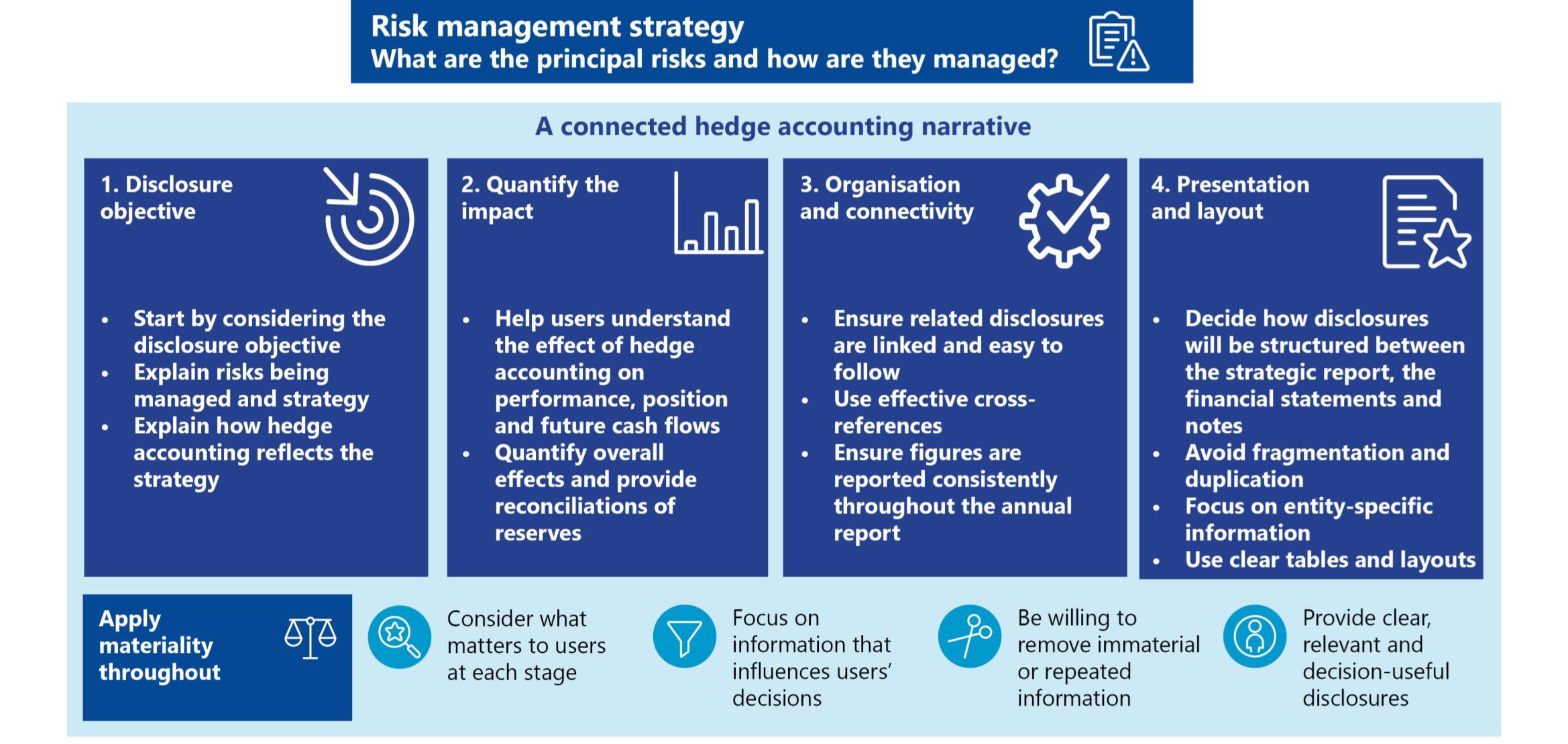
Good hedge accounting disclosures tell a coherent story, linking the risk being managed, the risk management strategy and the related disclosures through a clear focus on disclosure objectives and communication principles. The diagram below provides a holistic view of the key considerations for achieving clear, connected and decision-useful disclosures, and shows the broader risk management context within which hedge accounting requirements and related disclosures apply. Sections 3.1 to 3.4 then examine the reporting practices we identified during our thematic review in this context.
3.1 Disclosure objective
Paragraph 1 of IFRS 7 sets out the disclosure objective of the standard. It requires entities to provide disclosures that enable users to evaluate the significance of financial instruments for the entity's financial position and performance, as well as the risks arising from those instruments and how those risks are managed.
Paragraph 31 of IFRS 7 develops the disclosure objective in paragraph 1 by focusing on risks arising from financial instruments and how those risks are managed. It requires entities to disclose information that enables users of the financial statements to evaluate the nature and extent of risks arising from financial instruments to which the entity is exposed at the end of the reporting period.
Paragraph 21A further develops the disclosure objective in paragraph 1 by focusing on hedge accounting and requires entities to disclose information about their risk management strategy, the effect of hedging activities on future cash flows, along with the effect of hedge accounting on the financial statements (paragraphs 22A to 24F). These requirements apply to risk exposures designated in hedge accounting relationships.
Providing the individual hedge accounting disclosures in IFRS 7 does not necessarily mean the disclosure objective has been met. Companies should consider whether their disclosures, taken as a whole, clearly explain how hedge accounting reflects their risk management strategy.
This section focuses on the requirement of paragraph 22A of IFRS 7, which requires an entity to explain its risk management strategy for each category of risk exposure that it decides to hedge and for which hedge accounting is applied. The disclosure should enable users of financial statements to evaluate how each risk arises, how it is managed, and the extent of risk exposures managed.
The disclosure requirements in paragraphs 23A to 23F and 24A to 24F support this objective. Section 3.2 considers these requirements in more detail. Paragraphs 23A to 23F require disclosure of information about how hedging activities may affect the amount, timing and uncertainty of future cash flows. Paragraphs 24A to 24F require disclosure of the effect of hedge accounting on the entity's statement of financial position, statement of comprehensive income and statement of changes in equity.
Sources of risk
The 14 companies in our sample selected for this topic applied hedge accounting in respect of exposures to foreign exchange risk, interest rate risk and commodity price risk. Where risk exposures subject to hedge accounting were identified as principal risks, these were discussed consistently in both the hedge accounting disclosures and the strategic report.
Good practice
We were pleased that several companies in our sample provided clear disclosure of:
- the risks arising from their business models;
- the exposures resulting from those risks; and
- the hedging strategies used to manage them.
The example below identifies how one company explained the effect of hedging on performance in its strategic report.
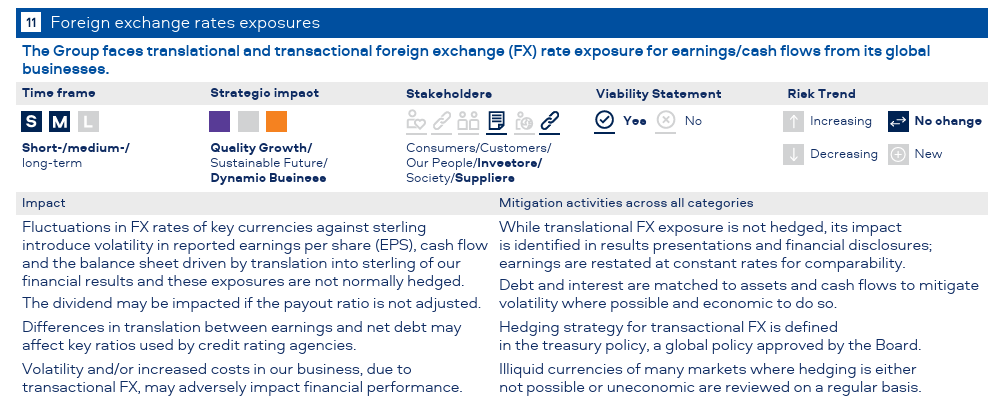
Good Quality Example 1: BAT
- Links the identified risk to the business model.
- Describes the effect of the risk exposure on volatility in earnings, cash flows and the balance sheet as well as key metrics.
- Identifies the nature of the risk exposures – translational foreign exchange risk (translation of foreign operations) and transactional foreign exchange risk (foreign currency transactions).
- Narrative, read alongside other disclosures, identifies which exposures are hedged and which are unhedged.
- Hedging transactional FX exposures is consistent with the hedge accounting disclosures in the financial statements.
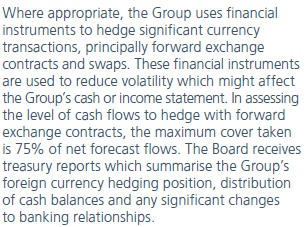
Good Quality Example 2: Rotork
- The company provides a clear and concise explanation of the purpose of entering into hedges and how they impact its reported results.
Risk management strategy
The disclosure of how an entity manages each risk is supported by requirements to explain: (a) the hedging instruments used (and how they are used) to hedge risk exposures; (b) how the entity determines the economic relationship between the hedged item and the hedging instrument when assessing hedge effectiveness; and (c) how it establishes the hedge ratio.
Good practice
The majority of companies in our sample provided clear descriptions of the hedging instrument used to hedge risk exposures.
Better practice examples of descriptions of hedging instruments used to hedge risk exposures included tailored narrative explaining the key terms and features of complex instruments designated as hedging instruments, providing sufficient context for users to understand the arrangement.
Issues
One company designated foreign exchange forward contracts as hedging instruments in cash flow hedges of highly probable forecast sales for multiple currency pairs. However, it was unclear how these currency pairs related to the functional currencies of group entities and the currency mix of sales.
Several companies in our sample did not disclose how they determined the economic relationship between the hedged item and the hedging instrument for the purpose of assessing hedge effectiveness.
Opportunity
Where companies engage in more complex hedging strategies, clear disclosures are particularly important. This includes disclosures explaining how hedge accounting relationships have been designated and how the economic relationship between the hedged item and the hedging instrument has been determined for the purpose of assessing hedge effectiveness.
Extent of risk exposures that the entity manages
The majority of companies provided sufficient information to enable users of financial statements to evaluate the extent of risk exposures that they had decided to hedge and for which hedge accounting was applied.
Often, this information was provided through disclosure of the nominal amounts of hedging instruments – for example, the nominal amounts of foreign currency contracts designated as hedging instruments in cash flow hedges of highly probable forecast sales or purchases.
Issue
We identified cases where it was difficult to determine the extent of exposure to foreign exchange risk the entities managed by applying net investment hedge accounting as the carrying amounts of foreign-currency denominated borrowings designated as hedging instruments were not disclosed (paragraph 24A of IFRS 7).
Opportunity
For net investment hedges, this information can often be provided through cross-references to relevant disclosures presented elsewhere in the annual report and accounts and therefore does not need to be repeated in the hedging note for the disclosure to be complete.
Good practice
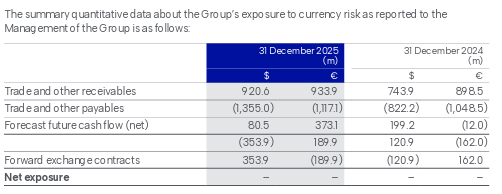
One company in our sample provided insight into how management monitors and manages foreign currency risk, including the impact of hedging activities on its exposures.
Good Quality Example 3: Computacenter plc
- The table shows foreign currency risk exposures as monitored by management.
Risk management strategy and how it is applied to manage risk
Good practice
The following examples illustrate how two companies effectively articulate their risk management strategies and how they are applied.
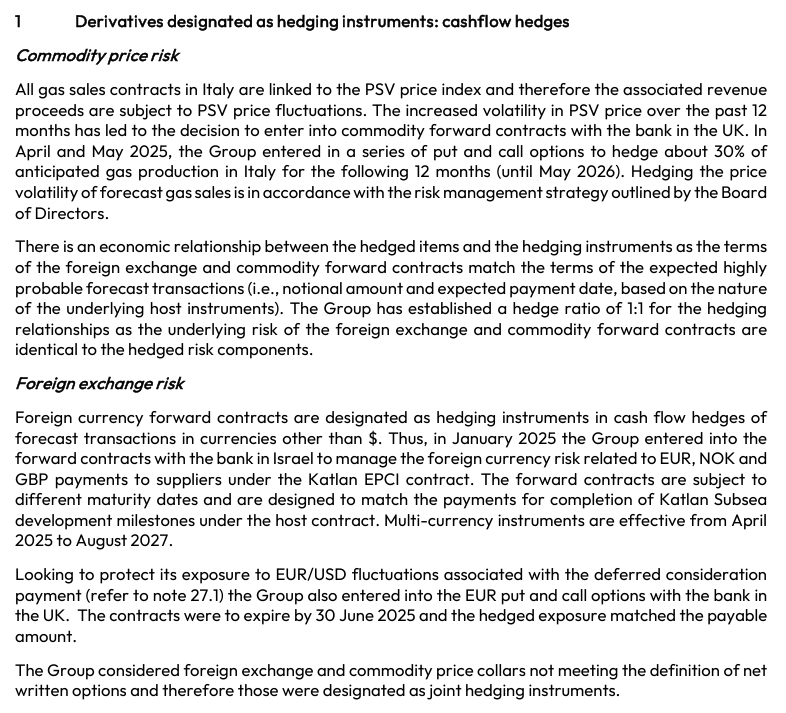
Good Quality Example 4: Energean plc
- The narrative clearly explains the company's hedging activities and their purpose.
- The disclosure links the instruments used to hedge specific exposures with useful context which enhances understanding and avoids boilerplate disclosures.
- The company explains its basis for concluding that foreign exchange and commodity price collars can be designated as hedging instruments.
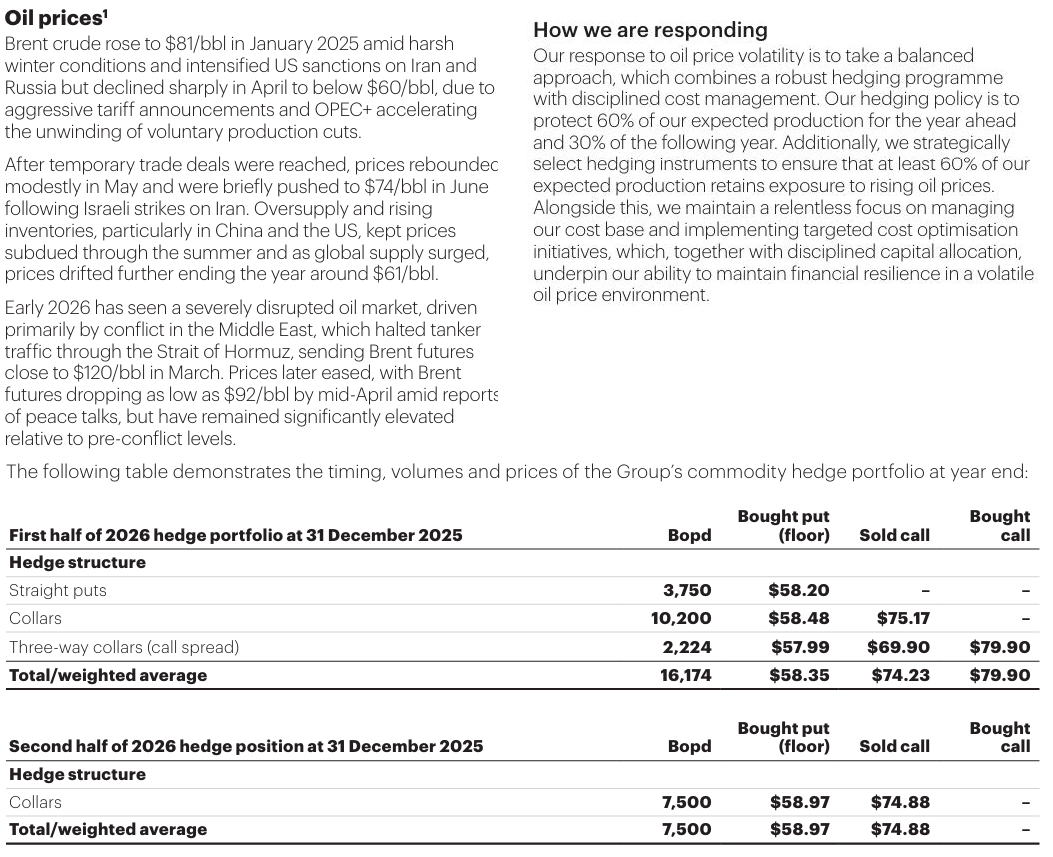
Good Quality Example 5: Tullow Oil plc
- The narrative, in the strategic report, explains the company's exposure to commodity price risk and how the entity responds to changes in this risk.
- The table, in the notes to the accounts, explains the hedging instruments used to hedge the company's exposure to commodity price risk and the extent of risk exposures that the company manages at the balance sheet date.
- The disclosure can be linked to the strategic report.
3.2 Understanding the effect of hedging
The amount, timing and uncertainty of future cash flows
Paragraph 21A(b) of IFRS 7 requires entities to disclose information about how their hedging activities may affect the amount, timing and uncertainty of their future cash flows (paragraphs 23A to 23F).
Quantitative disclosures required to meet the disclosure objective are set out in paragraphs 23A and 23B of IFRS 7. Paragraph 23B requires entities to provide a breakdown of the timing profile of the nominal amount of the hedging instrument and, if applicable, its average price or rate (for example, strike or forward prices).
This disclosure helps users understand how the company's hedging strategy affects the timing of its future cash flows.
Issue
We identified instances where companies did not provide breakdowns of the average prices or rates of their hedging instruments, where applicable.
Opportunity
One company included a significant volume of transaction-level data that could be aggregated to provide more useful information to users. We encourage companies to consider the appropriate level of granularity in their disclosures (see section 3.4).
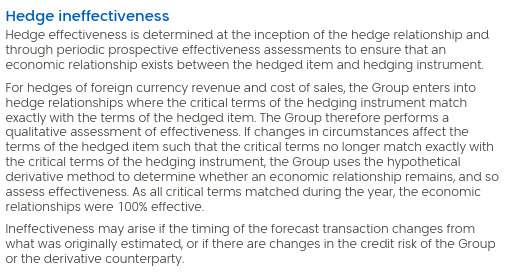
Paragraphs 23D and 23E of IFRS 7 require entities to disclose, by risk category, a description of the sources of hedge ineffectiveness that are expected to affect the hedging relationship during its term and, if other sources of ineffectiveness emerge, to explain the resulting hedge ineffectiveness.
Opportunity
Several companies in our sample did not disclose the sources of hedge ineffectiveness despite features of the hedging relationship indicating potential sources of ineffectiveness. Where such features materially affect hedge effectiveness, company-specific explanation may be helpful.
Good Quality Example 6: The Weir Group PLC
- The following disclosure illustrates how one company provided a clear, company-specific narrative.
The effect of hedge accounting on financial position and performance
Paragraph 21A(c) of IFRS 7 requires entities to disclose information about the effect that hedge accounting has had on the entity's statement of financial position, statement of comprehensive income and statement of changes in equity (paragraphs 24A to 24F).
Paragraphs 24A to 24F of IFRS 7 set out disclosure requirements to support companies in meeting the hedge accounting disclosure objective. Paragraphs 24A and 24B require entities to disclose, in a tabular format, quantitative information related to hedging instruments, hedged items and types of hedges separately by risk category.
In a minority of cases, companies did not disclose either the carrying amount of the hedging instrument or the nominal amounts (including quantities such as tonnes or cubic metres). These omissions generally related to non-derivative foreign currency borrowings designated as the hedging instrument in a net investment hedge.
Issue
One company disclosed the designation of foreign currency-denominated borrowings as the hedging instrument in a net investment hedge; however, its analysis of borrowings by foreign currency did not include any borrowings in the relevant currency and this apparent inconsistency was not explained.
Five companies did not disclose the change in fair value of the hedging instrument, the change in value of the hedged item used as the basis for recognising hedge ineffectiveness for the period, or both. However, where hedge ineffectiveness was minimal, omission of one of these amounts may have reflected a judgement that the information was not material to users.
In other cases, there were apparent errors in the amounts disclosed.
Issue
We identified an apparent inconsistency where the change in fair value of the hedging instrument and the change in value of the hedged item (paragraphs 24A(c) and 24B(b)(i) of IFRS 7) used as the basis for recognising hedge ineffectiveness were reported as nil, despite other hedge accounting disclosures indicating otherwise.
Opportunity
We observed inconsistencies in disclosures in hedge accounting tables, figures that were difficult to interpret and, in some cases, we could not trace the financial effect of hedge accounting through the primary statements. We encourage companies to ensure disclosures are consistent and connected throughout the annual report, and to be more targeted in their disclosures while keeping the disclosure objective in mind.
We discuss materiality and cutting clutter further in section 3.4.
Good Quality Example 7: hypothetical example
The following hypothetical example illustrates a clear and comprehensive tabular disclosure about the effect that fair value hedge accounting has had on a company's statement of financial position and statement of comprehensive income.
- Identification of the line items in the primary statements that include the hedging instrument, hedged items and the recognised hedge ineffectiveness.
- Disclosure of relevant amounts for hedging instruments is provided alongside relevant amounts for hedged items.
- The table details the nominal amounts and terms of the hedging instruments.
The Group borrows at fixed rates but holds financial assets that earn interest at floating rates. To align the interest profile of its borrowings with that of its financial assets and to reduce variability in its net interest cost, the Group has entered into interest rate swaps under which it receives fixed interest and pays interest at floating rates. The swaps are designated as fair value hedges and their effects on the Group's financial position and performance are set out below.
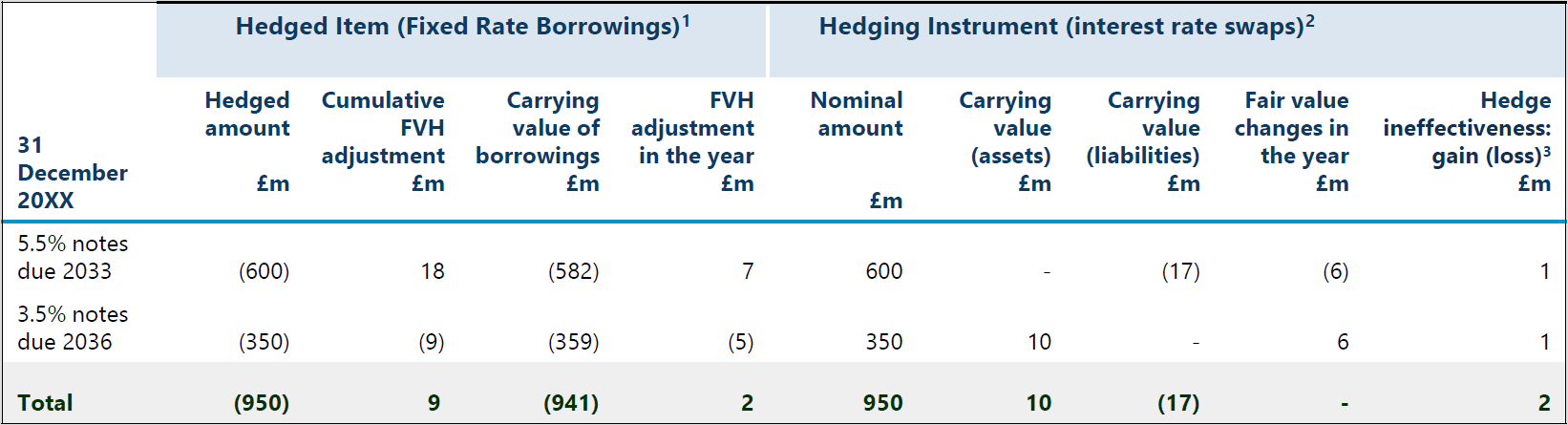
1 Hedged items are included in borrowings in the balance sheet
2 Hedging instruments are included in other financial assets or liabilities in the balance sheet
3 Hedge ineffectiveness is included in finance income or expense in the income statement
Good Quality Example 8: hypothetical example
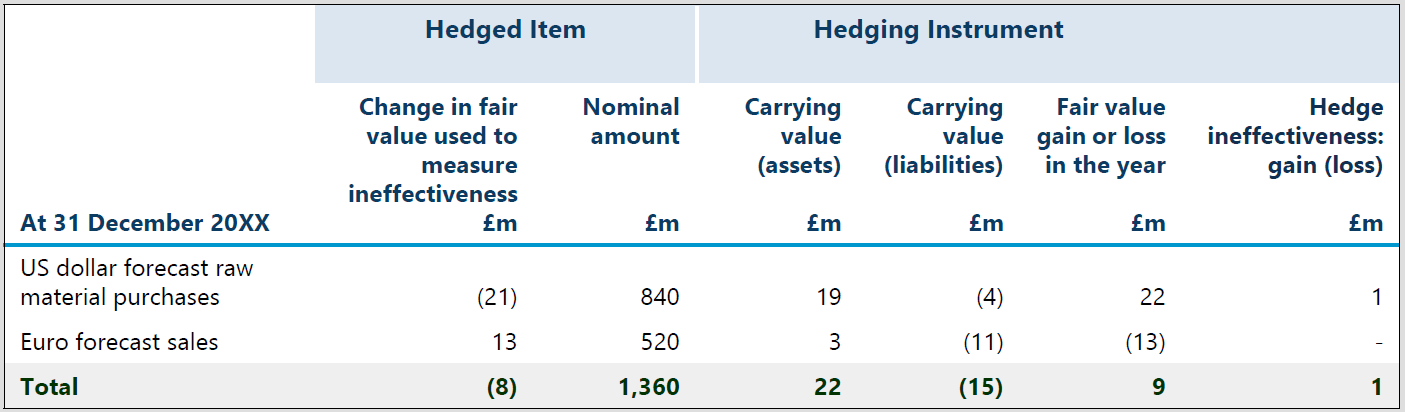
The following hypothetical example illustrates how a company may provide a similar tabular presentation of amounts for cash flow hedge accounting within the same section of its annual report and accounts that can be easily reconciled to the primary statements.
- The columns are clearly labelled, and the table is divided into distinct columns.
- The note clearly links the amounts disclosed to the related amounts reported in the statement of comprehensive income and statement of changes in equity.
The Group hedges highly probable forecast purchases of raw materials denominated in US dollars and highly probable forecast sales denominated in euros using forward foreign exchange contracts designated as cash flow hedges. The tables below set out details of the hedged items and hedging instruments together with their effect on the financial statements.
(a) Hedged items, hedging instruments and hedge ineffectiveness
(b) Movements in cash flow hedge reserve

Good Quality Example 9: Tullow Oil plc
The following example illustrates how one company provides useful information to enable users to trace the effect of hedge accounting through the primary statements.
- The line items in the statement of comprehensive income are clear and reconcile with the note.

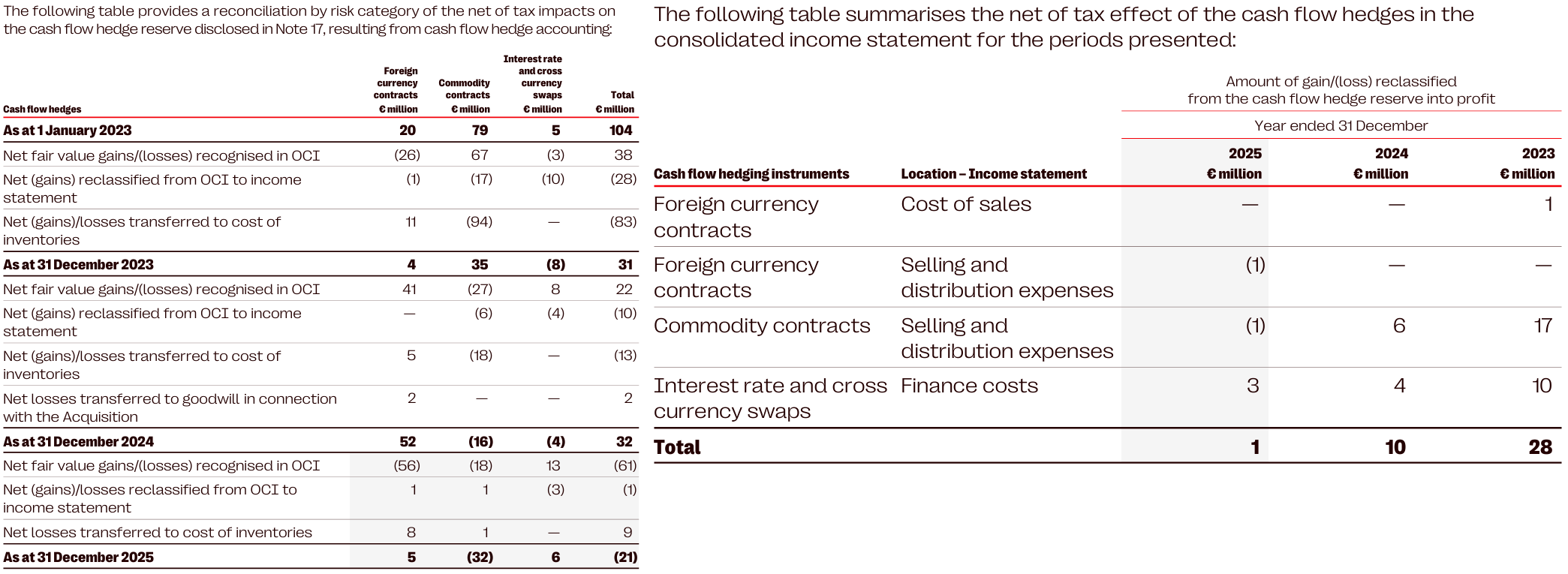
Paragraph 24E of IFRS 7 requires entities to provide a reconciliation of each component of equity and an analysis of other comprehensive income. Paragraph 24F requires this information to be disclosed separately by risk category and it may be provided in the notes to the financial statements.
Good Quality Example 10: CCEP plc
We were pleased that most companies in our sample provided a clear reconciliation. The following example is from a company that was not part of the sample for this thematic review but was identified as an example of better disclosure as part of our routine review work.
- The reconciliation of the cash flow hedge reserve is clear, with appropriately named line items.
- The company clearly identifies the amounts reclassified from the cash flow hedge reserve during the year and where they are recognised.
- The finance costs note elsewhere in the annual report and accounts clearly shows which line items include the income and expenses relating to fair value and cash flow hedges.
Cost of hedging
Paragraphs 6.2.4(a) and (b) of IFRS 9 permit entities to exclude certain components of a hedging instrument from the hedge designation, including the time value of options, the forward element of forward contracts and foreign currency basis spreads.
Paragraphs 6.5.15 and 6.5.16 of IFRS 9 set out the accounting for these excluded components, commonly referred to as the 'cost of hedging' approach. Where this approach is used, entities account for changes in the excluded component through other comprehensive income (OCI), reducing potential volatility in profit or loss.
Six companies in our sample did not designate certain qualifying instruments in their entirety and instead applied the cost of hedging approach.
Most of these companies clearly explained the accounting treatment applied; however, in a minority of cases the explanation was inconsistent with information provided elsewhere in the financial statements.
Issue
One company stated that only the spot elements of forward contracts were designated as the hedging instruments, with the forward elements recognised in OCI and accumulated in a separate component of equity; however, no such component was clearly identifiable in the financial statements.
Good practice
Good practice examples clearly disclosed the effect of cost of hedging on financial position and performance, with the narrative positioning it within companies' risk management strategies.
Paragraphs 24E(b) and (c) of IFRS 7 require that the reconciliation of each component of equity and analysis of other comprehensive income, taken together, should differentiate between the time value of options, the forward element of forward contracts and foreign currency basis spreads accounted for under paragraphs 6.5.15 and 6.5.16 of IFRS 9 that hedge transaction-related and time-period related hedged items.
Half of the companies that applied the cost of hedging approach clearly presented the movement in the cost of hedging reserve.
Good practice
The better examples made clear when and how amounts would be reclassified to profit or loss.
Good Quality Example 11: United Utilities Group PLC
- The company clearly explains that the foreign currency basis spread is excluded from the designation of the cross-currency swap and links this to its effect on the statement of changes in equity.
The group recognises the cost of hedging reserve as a component of equity. This reserve reflects accumulated fair value movements on cross-currency swaps resulting from changes in the foreign currency basis spread, which represents a liquidity charge inherent in foreign exchange contracts for exchanging currencies and is excluded from the designation of cross-currency swaps as hedging instruments.
3.3 Accounting policies
Accounting policies for hedge accounting
Good practice
We were pleased that the majority of companies in our sample provided clear accounting policy disclosures that explained their hedging activities.
In a minority of cases, the accounting policies were not consistent with other information presented in the notes to the financial statements.
Issue
We identified inconsistencies in hedge accounting disclosures, with some cash flow hedges described as hedges of firm commitments in one part of the annual report and accounts, and as hedges of highly probable forecast transactions elsewhere.
For most companies, the eligibility of hedged items was clear. However, additional explanation may be needed in more complex situations, particularly where it is not apparent that items are 'highly probable' or expose the entity to the risk being hedged.
Issue
We observed disclosures in which intercompany services were designated as the hedged item in a cash flow hedge involving foreign exchange forward contracts. However, it was unclear how those services met the qualifying criteria for hedge accounting (paragraph 6.3.6 of IFRS 9).
Opportunity
We observed that some companies included accounting policies that were not company-specific, instead repeating the principles of the accounting standard. For example, one company referred to fair value hedges despite appearing not to have any, while another included a policy relating to basis adjustments, even though its hedged forecast transactions would not give rise to non-financial assets.
In our publication 'What Makes a Good Annual Report and Accounts', we refer to corporate reporting and effective communication principles that preparers should take account of when producing a high-quality annual report and accounts. We recommend that accounting policies should be clear, company-specific and consistent with other information in the annual report and accounts.
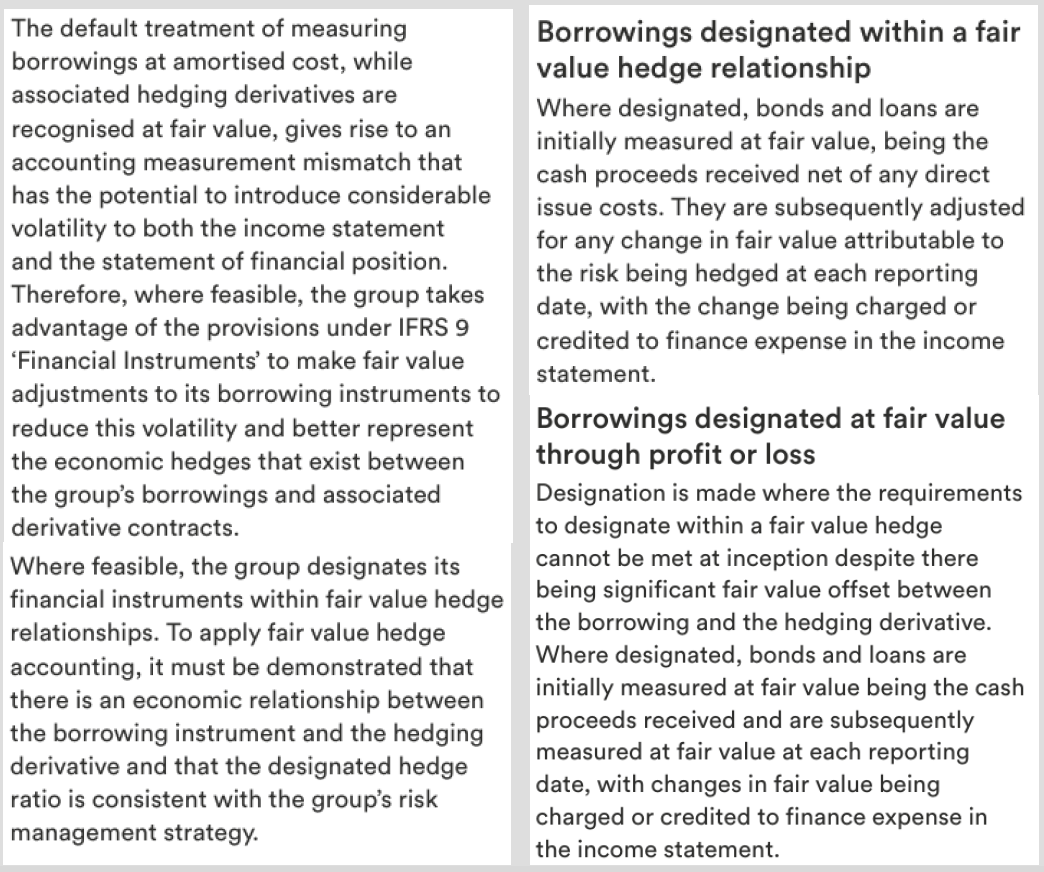
Good Quality Example 12: United Utilities Group PLC
The following example illustrates how one company provides a clear, concise and company-specific accounting policy that explains the purpose and effect of entering into a fair value hedge.
- Explains the original measurement basis for borrowings.
- Provides context for the company’s use of fair value hedge accounting and, in certain circumstances, the designation of borrowings at fair value through profit or loss.
- Clearly sets out the conditions that must be met to apply hedge accounting.
- Flows logically into a description of the resulting accounting treatment.
- Describes the alternative approach of designating borrowings at fair value through profit or loss where hedge accounting cannot be applied at inception.
3.4 Characteristics of good reporting
Location
Paragraph 21B of IFRS 7 requires entities to present the disclosures required by paragraphs 22A to 24F in a single note or separate section of their financial statements.
Paragraph 21B of IFRS 7 emphasises that an entity need not duplicate information presented elsewhere, provided that it is incorporated by cross-reference from the financial statements to another statement available to users of the financial statements on the same terms and at the same time.
The companies in our sample provided hedge accounting disclosures in up to four separate locations in their financial statements, resulting in varying degrees of fragmentation.
Opportunities
Where companies presented disclosures in multiple locations, disclosure quality was affected by several factors:
- In some cases, key details were spread across several locations that were not fully internally consistent, making the hedge accounting narrative difficult to follow. We expect hedge accounting disclosures to explain how hedge accounting reflects a company's risk management strategy. For this narrative to be coherent, the disclosures should be connected and consistent.
- One company presented a detailed table explaining the timing, volumes and prices of its hedge portfolio. However, the same table was repeated elsewhere in the report.
- We observed an opportunity for one company to rationalise its hedge accounting disclosures, including its accounting policy. Irrelevant information and boilerplate wording were repeated across several locations and could be consolidated and streamlined, whilst retaining company-specific information.
As detailed in our publication 'What Makes a Good Annual Report and Accounts', only relevant information capable of influencing users' decisions should be included in a high-quality annual report and accounts. Irrelevant material obscures the important information users need to make informed decisions and judgements.
Companies should consider materiality in determining what information is relevant to include (see Materiality and hedge accounting disclosures).
Good practice
One company presented its hedge accounting disclosures in a coherent manner, with all relevant information, including accounting policies, contained within a single note.
Materiality and hedge accounting disclosures
To meet the disclosure objective for hedge accounting, paragraph 21D of IFRS 7 requires entities to determine how much detail to disclose, how much emphasis to place on different aspects of the disclosure requirements, the appropriate level of aggregation or disaggregation, and whether users of financial statements need additional explanations to evaluate the quantitative information disclosed.
Companies should consider materiality when determining the amount and granularity of information to include.
Information is material if omitting, misstating or obscuring it could influence the decisions and assessments of users of the annual report and accounts.
Opportunity
One company disclosed a significant volume of transaction-level data for its hedging instruments that, while potentially relevant, could be aggregated (for example by currency or maturity) to provide a clearer overview of how the instruments were used to manage risk. Companies should apply materiality to relevant information when determining what to disclose; otherwise, key information may be obscured by distracting detail.
Materiality is a complex issue for hedge accounting. The amounts recognised in a company's financial statements can be volatile, changing from year to year due to market factors outside its control. Whether an issue is 'material' is not simply a matter of comparing the amounts recognised in the financial statements with a materiality benchmark. Consideration should also be given to factors such as the size of the exposure being hedged, the duration of the hedge relationship and the nature of the underlying risk, as these may affect the significance of the hedge and the related disclosures.
Some companies in our sample applied materiality effectively to filter non-decision-useful information from hedge accounting disclosures. For example, where the effect of hedge accounting appeared immaterial, some companies avoided providing boilerplate or extensive accounting policy disclosures, indicating that materiality had been considered when drafting those disclosures.
However, in some cases, information that appeared relevant to understanding hedge activities was not disclosed.
Issue
For example, some companies did not disclose the nominal values of their hedging instruments, thereby potentially limiting users' ability to understand the scale and effect of those activities and assess the outcomes of hedge accounting.
Opportunity
Many companies provided a complete set of hedge accounting disclosures. Although completeness is an overarching qualitative characteristic of a good annual report and accounts, it is not a tick-box exercise, and materiality should still be applied when determining what to disclose. We would encourage companies to be more targeted in their disclosures, keeping the disclosure objective in mind.
Further guidance on the assessment and application of materiality can be found in the FRC's publication 'Applying materiality in corporate reporting', which provides practical insights for boards, preparers and investors.
4. Expected credit losses (ECLs)
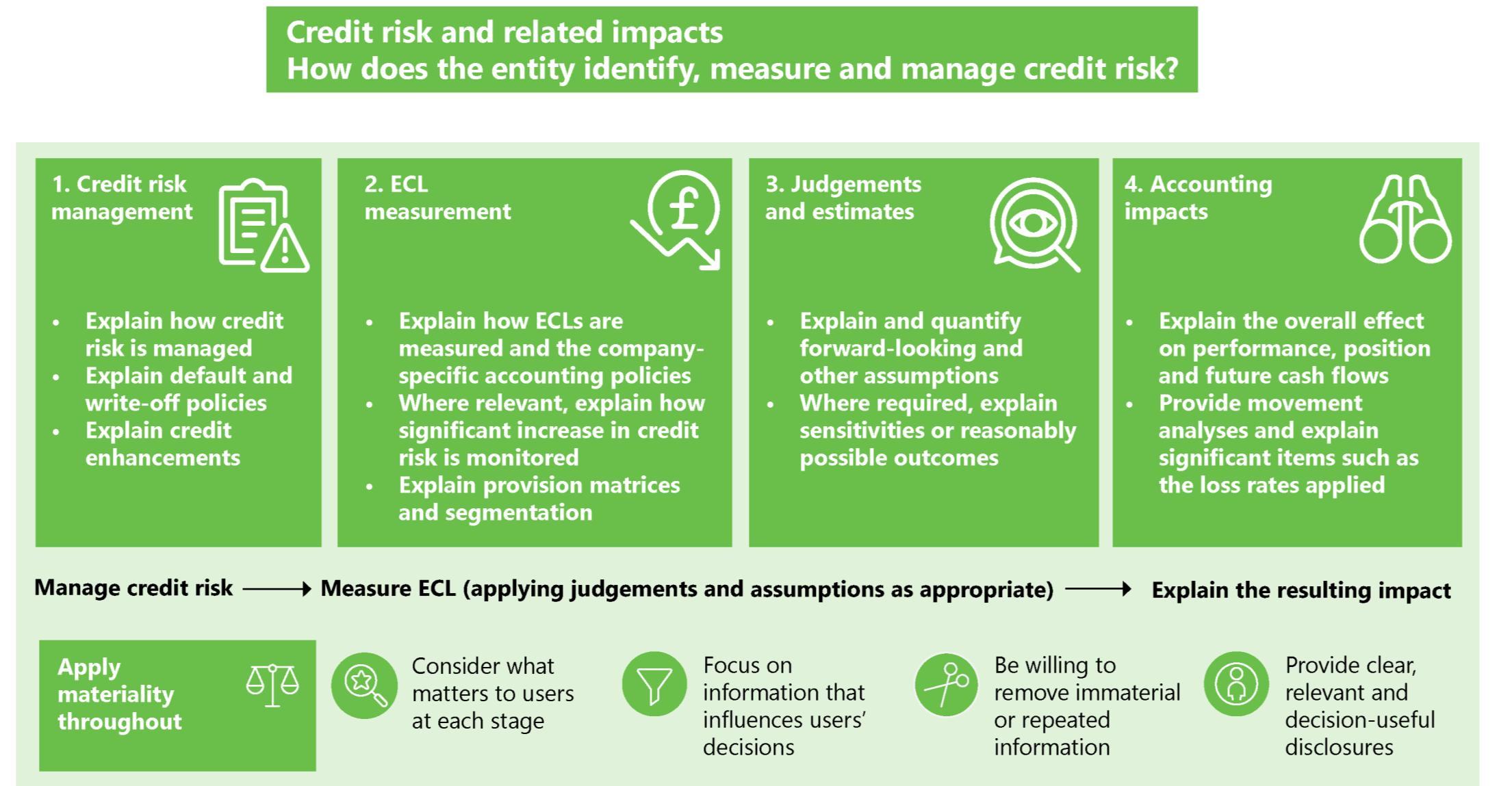
Good expected credit loss disclosures link the credit risk being managed, the judgements underpinning the amounts recognised and the related disclosures. The diagram below provides a holistic view of the key considerations for providing clear, connected and decision-useful ECL information. Sections 4.1 to 4.4 then examine the reporting practices identified in our thematic review of selected companies in this context.
4.1 Accounting policies, judgements and estimates
Accounting policies for ECLs
Paragraph 117 of IAS 1, 'Presentation of Financial Statements', requires an entity to disclose material accounting policy information.3 Paragraph 21 of IFRS 7 states that information about the measurement bases for financial instruments used in preparing financial statements is expected to be material accounting policy information.
Most of the companies in our sample disclosed an accounting policy that addressed recognition and measurement of lifetime ECLs on trade receivables and contract assets, applying the simplified approach in paragraph 5.5.15 of IFRS 9. Additionally, most accounting policies clearly mentioned the use of a provision matrix for estimating ECLs.
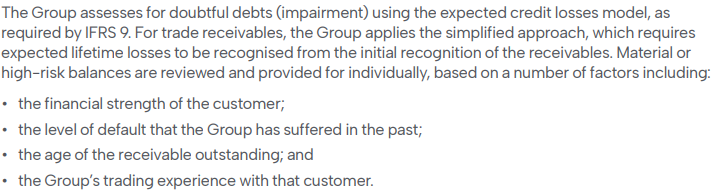
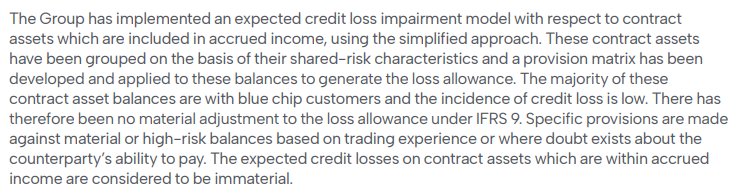
Good Quality Example 13: Computacenter plc
Good accounting policies made reference to the use of a provision matrix, including ECL rates and segmentation /grouping of trade receivables and contract assets, using relevant criteria such as risk profile, in relation to ECL measurement.
- Policy covers measurement of lifetime ECLs; use of the simplified approach; addresses specific/individual ECL provisions against material and high-risk balances and lists the key factors considered for grouping.
- Disclosure mentions ECLs on contract assets as well as grouping based on shared-risk characteristics for the purpose of ECL measurement.
- Explains why the incidence of credit loss is low.
Judgements and estimates for ECLs
As highlighted in our Annual Review of Corporate Reporting 2025/26, and the 2022 thematic report on Judgements and Estimates, paragraph 125 of IAS 1 requires disclosures of key sources of estimation uncertainty to be clearly distinguished from other estimates and contain sufficient company-specific information. Additionally, paragraph 129 requires that sufficient information is provided for users to understand significant estimates, for example disclosure of sensitivities and the range of reasonably possible outcomes.4
Good practice
We were pleased to see a clear distinction between the required disclosures under paragraph 125 of IAS 1 (i.e. assumptions and other major sources of estimation uncertainty with a significant risk of resulting in a material adjustment to the carrying amount of assets and liabilities within the next 12 months) and additional disclosures of other uncertainties (i.e. those carrying lower risk, having a smaller impact or crystallising over a longer timeframe).
Opportunity
Where companies disclose that ECLs are a significant source of estimation uncertainty, we would expect disclosure of quantitative sensitivity analysis or the range of reasonably possible outcomes.
Issue
We may challenge companies where they disclose that ECLs are a significant source of estimation uncertainty but do not provide any quantitative information on sensitivities and possible outcomes.
Good Quality Example 14: Morgan Advanced Materials plc
- Disclosure shows credit risk, including ECL estimation, as an area of lower risk of material adjustment to the carrying amount of assets and liabilities within 12 months.

4.2 Disclosure of ECLs
ECL movement tables and provision matrices
Paragraph 35H(b)(iii) of IFRS 7 requires entities to provide, by class of financial instrument, a reconciliation from the opening balance to the closing balance of the ECL allowance, in a table, showing separately the changes during the period for trade receivables, contract assets or lease receivables for which loss allowances are measured using the simplified approach.
Most of the companies in our sample disclosed a provision matrix showing ECL allowances by categories based on the number of days past due and the applicable expected credit loss rates. We did not identify companies that used alternative methods to provide these disclosures.
Similarly, an ECL movement table was disclosed by all companies in our sample except where the ECL allowance was below materiality. Most ECL movement tables disclosed useful information including amounts of receivables written-off and recovered.
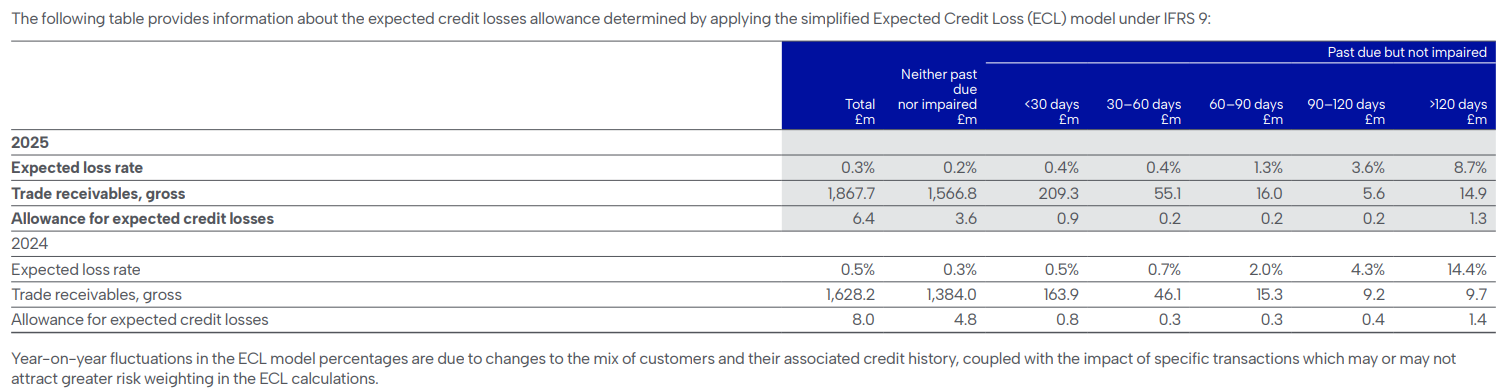
Good Quality Example 15: Computacenter plc
We were pleased to see a company that disclosed information that included the basis for the year-to-year changes in the loss rates applied, relating to the requirement in paragraph 35B(b) of IFRS 7.
- Describes the basis for the year-to-year changes in the loss rates applied.
Paragraph 35M of IFRS 7 requires disclosure of the gross carrying amount of financial assets, among other requirements, to enable users of financial statements to assess credit risk exposure and understand significant credit risk concentrations. Paragraph 35N explains that, for trade receivables, contract assets and lease receivables to which the simplified approach is applied, this information may be based on a provision matrix.
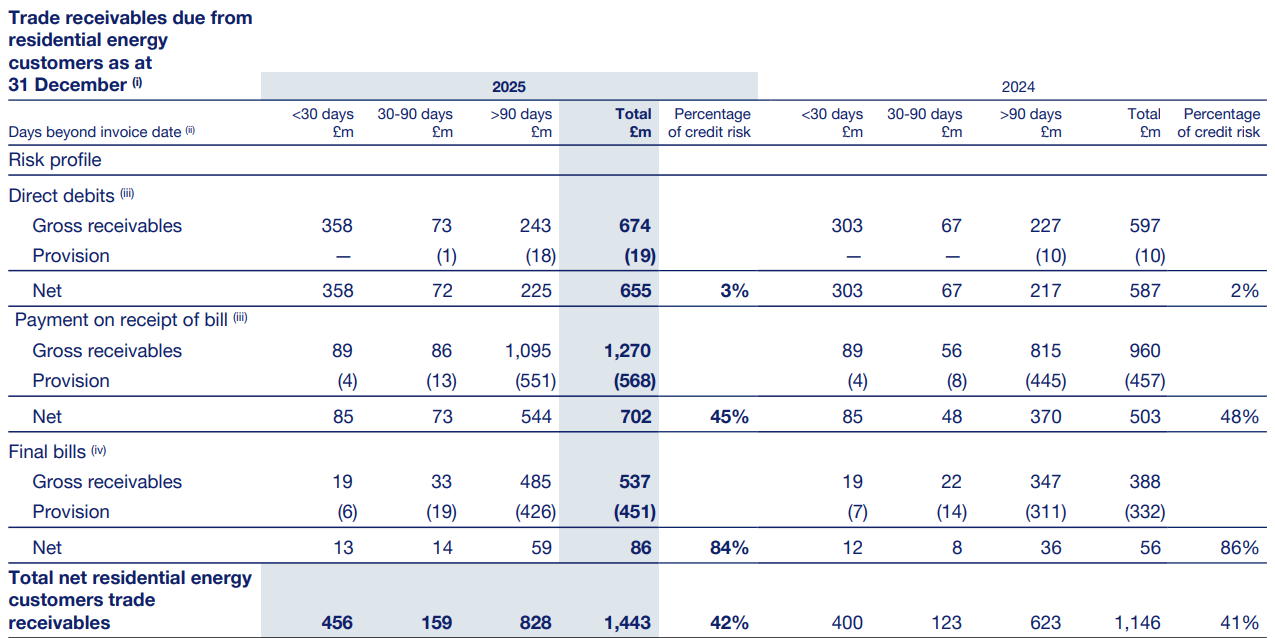
Good Quality Example 16: Centrica plc
The following example shows a provision matrix analysed by customer segment and risk profile, which may be helpful to users to better understand where credit risk originates or is concentrated.
- Discloses ECL provision by customer segments and risk profile including residential energy customers, direct debits, payment on receipt of bills and final bills.
- Discloses the percentage of credit risk/ECL loss rates by customer segment and risk profile.
Forward-looking information in ECL measurement
Paragraph 35G(b) of IFRS 7 requires an entity to disclose how forward-looking information has been incorporated into the determination of ECLs, including the use of macroeconomic information.
Most of the companies in our sample disclosed that they had considered forward-looking information in their ECL estimation.
Opportunity
Incorporating forward-looking information, including the use of macroeconomic factors, is one of the key distinguishing features of the expected credit loss model under IFRS 9. Therefore, where an ECL provision is material, companies should consider disclosing forward-looking, company-specific information.
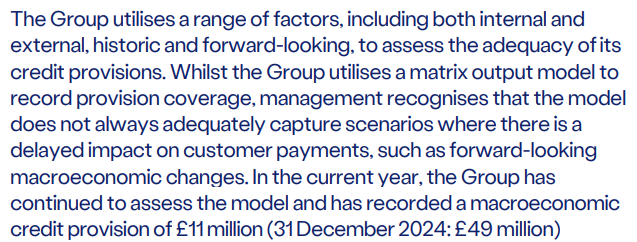
Good Quality Example 17: Centrica plc
Good practice disclosures identified the specific macroeconomic factors considered such as unemployment figures, inflation and interest rates in ECL measurement. We were also pleased to see one company explain and quantify the impact of the forward-looking macroeconomic adjustments made to its ECL provision.
- Discloses a forward-looking macroeconomic adjustment to ECL provision and quantifies the impact.
4.3 Credit risk management and ECLs
Credit risk management practices
Paragraph 35F of IFRS 7 requires entities to explain their credit risk management practices and how they relate to the recognition and measurement of ECLs including (i) how the instruments were grouped if expected credit losses were measured on a collective basis; (ii) the write-off policy, including the indicators that there is no reasonable expectation of recovery; and (iii) information about the policy for financial assets that are written-off but are still subject to enforcement activity.
Good practice
We were pleased to see helpful disclosures such as:
- specific factors considered for receivables to be deemed in default – for example, the number of days past due from the date of issuance of a final bill to a customer.
- application of different definitions of default to different groups of customers.
- specific indicators for lack of recoverability in respect of write-offs.
- policies for recovery of receivables after write-offs such as legal and enforcement activities.
- disclosure of the use of bank guarantees and credit insurance in respect of past due debtor balances.
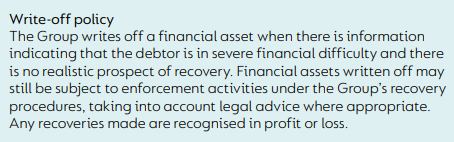
Good Quality Example 18: TP ICAP GROUP PLC
- Explains the factors considered for a financial asset to be written-off, such as financial difficulty of the debtor.
- Explains the company's policy for recovery of financial assets written-off including enforcement activities.
Good Quality Example 19: Centrica plc
- The footnotes to the ECL movement table disclose the gross carrying value of write-offs related to trade receivables where enforcement activity is ongoing.

4.4 ECLs in separate financial statements
ECL accounting in parent company's separate financial statements
We continue to remind companies that the ECL requirements of IFRS 9 also apply to other financial assets measured at amortised cost such as intra-group loans and loans to joint ventures, as well as to financial guarantee contracts not accounted for as insurance contracts in a parent company's separate financial statements. While most of our review focused on trade receivables, these balances can sometimes be significant for separate financial statements, as we often observe in our routine reviews.
Good practice
We were pleased to see disclosures of accounting policies on ECLs, in relation to loans to subsidiaries and financial guarantee contracts not accounted for as insurance contracts, in the parent company's separate financial statements in line with IAS 1. One company mentioned the use of the general model in estimating ECL on loans to subsidiaries, in line with paragraphs 5.5.1 to 5.5.12 of IFRS 9. Another company disclosed that ECLs were a source of estimation uncertainty that could lead to a material adjustment to the intercompany receivables' carrying amount within 12 months; the company also disclosed a relevant quantitative sensitivity analysis.
Opportunity
Where intra-group loans or guarantees are material, we would expect companies to explain the basis of their ECL assessment under IFRS 9, including, where relevant, key judgements and any sources of estimation uncertainty. Entity-specific disclosures are particularly important where recoverability depends on the future performance and funding capacity of the subsidiary.
Issue
We may write to companies that disclose material amounts owed by subsidiaries to the parent in the separate financial statements without disclosing an accounting policy for ECLs.
FRS 101 Reduced Disclosure Framework
The majority of the companies in our sample applied FRS 101, 'Reduced Disclosure Framework', to the parent company's individual financial statements and took advantage of the disclosure exemptions in paragraphs 7A to 9 of the standard. Nonetheless, we observed that some of the entities disclosed information about ECLs on intra-group loans and guarantees, especially when the balances were material.
We also remind companies that, when applying FRS 101 exemptions in respect of IFRS 7 to the parent company's separate financial statements, the requirements of paragraph 18 of IAS 24, ‘Related Party Disclosures', should be considered unless a company has taken advantage of the exemption in paragraph 8(k) of FRS 101, which permits entities not to disclose related party transactions with wholly owned subsidiaries.
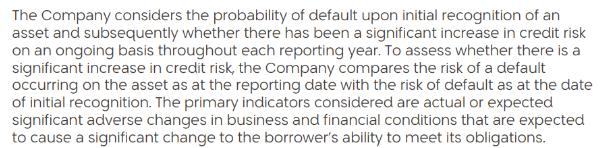
Good Quality Example 20: The Weir Group PLC
- Explains the approach for measuring ECLs on amounts owed by subsidiaries including the basis for determining if there has been a significant increase in credit risk.
5. Debt factoring
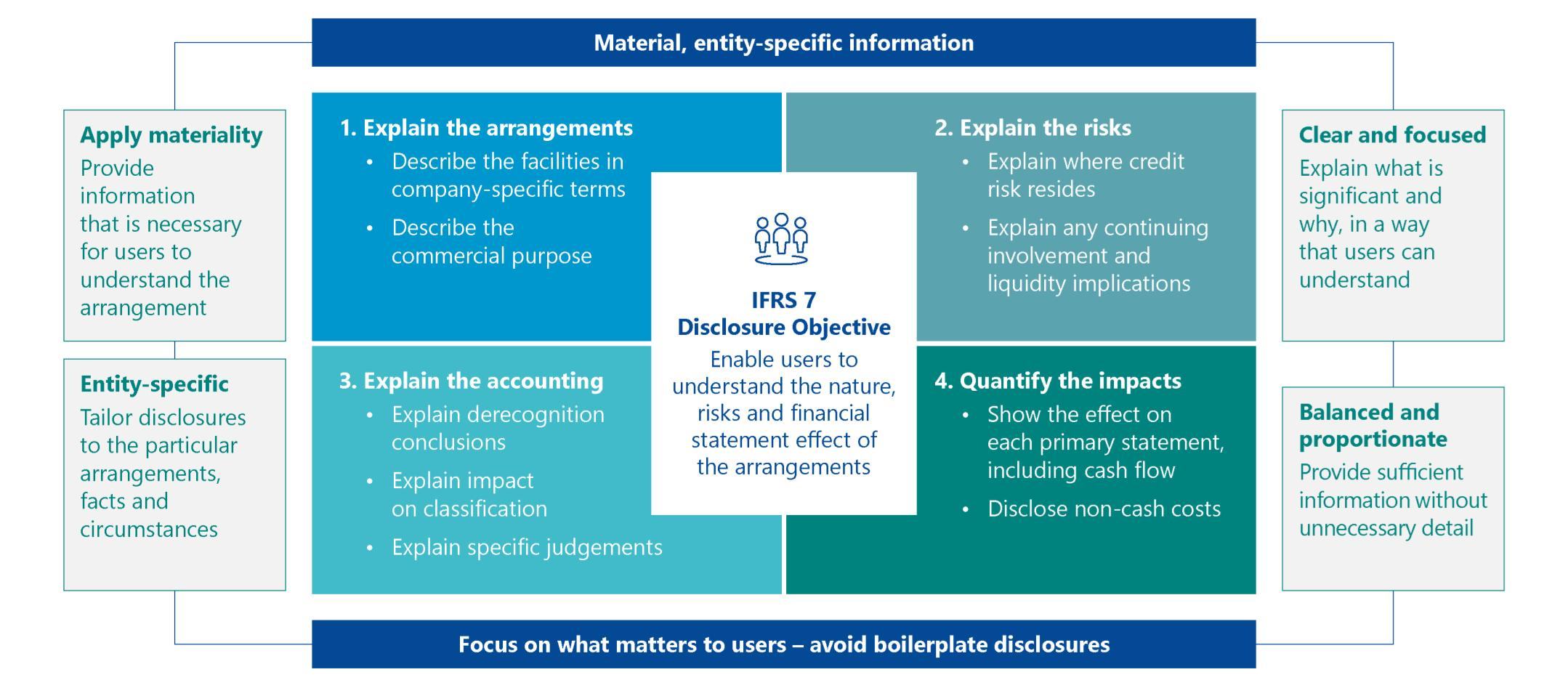
Good reporting in this area enables users to understand the commercial purpose of these arrangements, any accounting judgements involved and their effect on the financial statements. The diagram below, organised around the IFRS 7 disclosure objective, provides a holistic view of the key considerations for presenting clear, connected and decision-useful information about debt factoring arrangements. Sections 5.1 to 5.4 then examine the reporting practices identified in our thematic review of selected companies in this context.
5.1 Qualitative disclosures
Qualitative disclosures
There are limited specific disclosure requirements in IFRS for debt factoring arrangements. Entities therefore need to consider the overarching disclosure objective of paragraph 31 of IFRS 7.
Paragraph 31 of IFRS 7 requires entities to disclose information that enables users of their financial statements to evaluate the nature and extent of risks arising from financial instruments to which they are exposed at the end of the reporting period.
Debt factoring arrangements are used by corporates to accelerate cash collection from trade receivables and, in some cases, to mitigate exposure to credit risk. This section considers the factoring of trade receivables; it does not address supplier finance (reverse factoring) arrangements, which were considered in Appendix 2 to our 2024/25 Annual Review of Corporate Reporting.
These arrangements can be complex, with varying recourse features, degrees of risk and reward transfer and cash flow mechanics. Different features can lead to different accounting outcomes and applying the IFRS principles can be challenging; entities often need to develop accounting policies and apply significant judgement.
The majority of companies in our sample clearly explained the nature and purpose of their debt factoring arrangements, including the key contractual terms relevant to understanding the accounting treatment applied.
Good practice
The better examples explained recourse features, whether the company acted as a collection agent for the factor, and the relationship between the customer, factor and company, including who initiated the arrangement and bore the cost. This enabled a clearer understanding of the commercial rationale and how it was reflected in the accounting treatment.
Good Quality Example 21: BAT
- The company enters into several factoring arrangements with different features and distinguishes those where it acts as a collection agent for the factor from those where it does not.
Typically in these arrangements, the Group also acts as a collection agent for the bank. At 31 December 2025, the value of trade receivables derecognised through the factoring arrangements where the Group acts as a collection agent was £629 million (2024: £535 million) and where the Group does not act as a collection agent was £14 million (2024: £7 million).
5.2 Primary statements and related disclosures
Balance sheet and related disclosures
Paragraphs 3.2.1 to 3.2.9 of IFRS 9 set out the conditions to either derecognise a financial asset, continue to recognise the financial asset or recognise a continuing involvement in a financial asset.
Good practice
All nine of the companies in our sample with debt factoring arrangements appeared to apply the derecognition conditions appropriately.
Most debt factoring arrangements entered into by companies in our sample resulted in transfers of receivables that qualified for derecognition.
Some companies referred to master or revolving debt factoring arrangements affecting trade receivables. In such cases, companies may need to consider the business model applicable to those receivables, as this could affect their classification and subsequent measurement under IFRS 9 and the assessment may involve judgement. We did not identify this as a material issue in any of the companies in our sample.
Opportunity
Companies should consider whether disclosing the classification of these trade receivables would provide material and relevant information.
Good Quality Example 22: GSK
This example illustrates how one company has considered the classification of trade receivables subject to debt factoring.
- The company has segmented receivables into separate portfolios with different business models. Note - A fair value through other comprehensive income (FVTOCI) portfolio arises where receivables subject to factoring arrangements that result in derecognition cannot be subdivided between those expected to be factored or retained.
Trade receivables
Trade receivables are measured in accordance with the business model under which each portfolio of trade receivables is held. The Group has portfolios in each of the three business models under IFRS 9: to collect the contractual cash flows where there is no factoring agreement in place (measured at amortised cost); to sell the contractual cash flows where the trade receivables will be sold under a factoring agreement (measured at FVTPL); and both to collect and to sell the contractual cash flows where the trade receivables may be sold under a factoring arrangement (measured at FVTOCI). Trade receivables measured at amortised cost are carried at the original invoice amount less allowances for expected credit losses.
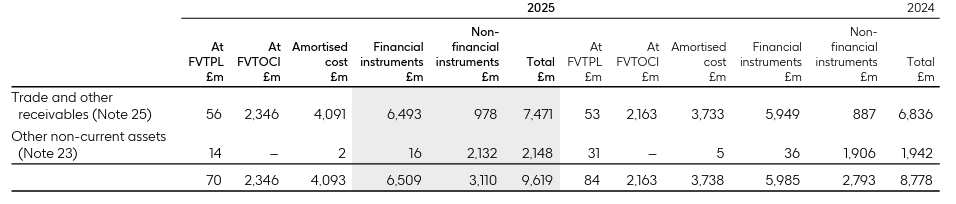
Trade and other receivables include trade receivables of £5,913 million (2024: £5,563 million). The Group has portfolios in each of the three business models under IFRS 9: £41 million (2024: £51 million), measured at FVTPL, is held to sell the contractual cash flows as the receivables will be sold under a factoring arrangement, £2,346 million (2024: £2,163 million), measured at FVTOCI, is held to either collect or sell the contractual cash flows as the receivables may be sold under a factoring agreement, and £3,526 million (2024: £3,349 million), measured at amortised cost, is held to collect the contractual cash flows and there is no factoring agreement in place.
Income statement and related disclosures
Paragraph 20A of IFRS 7 requires entities to disclose an analysis of the gain or loss recognised in the statement of comprehensive income arising from the derecognition of financial assets measured at amortised cost, showing separately gains and losses arising from derecognition of those financial assets. This disclosure shall include the reasons for derecognising those financial assets.
Where the terms of the factoring arrangement resulted in derecognition of the relevant receivables in their entirety, one company quantified the loss on sale.
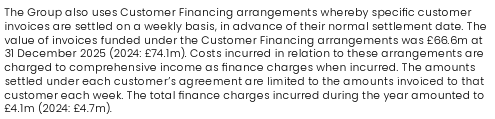
Unlike derecognised receivables, the accounting standards do not contain a specific disclosure requirement to identify the financing costs associated with factoring arrangements that do not result in derecognition. However, disclosure of such costs may be necessary where material to an understanding of the arrangement and its effect on the financial statements.
Good Quality Example 23: Staffline Group PLC
- The company quantifies the finance charges.
Good Quality Example 24: Empresaria Group plc
The following example identifies the line item in which invoice financing interest charges are recorded and signposts the finance costs note where they are quantified.
- Explains the accounting treatment applied and links the balance sheet effect to the corresponding effect on the income statement.

Cash flow statement and related disclosures
Issue
Several companies did not clearly explain the presentation of cash flows arising from factoring arrangements.
Opportunity
Limited IFRS guidance on the presentation of cash flows arising from factoring arrangements has led to diversity in practice. Presentation outcomes may differ depending on whether the arrangement results in derecognition of receivables and how cash is collected and transferred between customers, the company and the factor. Clear entity-specific disclosures about the presentation adopted are therefore the most effective way of meeting users' needs.
5.3 Accounting policies and significant judgements
Accounting policies and significant judgements
Most of the companies in our sample provided accounting policies with a level of detail proportionate to the complexity of the debt factoring arrangements they had entered into.
Issue
We observed boilerplate wording in an accounting policy describing circumstances in which the derecognition criteria would or would not be met. However, the disclosure did not specify which treatment applied to the entity's own debt factoring arrangement.
Good practice
The better accounting policies were complete, company-specific and clearly linked the terms of the debt factoring arrangements to the IFRS 9 derecognition principles. They also provided clear signposts to the effect of the arrangement on the financial statements, enabling a user to trace that effect.
None of the companies in our sample disclosed significant judgements relating to debt factoring arrangements. However, in some instances, it appeared that judgement may have been involved in determining the accounting treatment applied. For example, there may have been judgements related to the classification of trade receivables subject to master or revolving debt factoring arrangements and in assessing whether the company or factoring counterparty was acting as a principal or agent.
Good Quality Example 25: SIG
- The company explicitly addresses the treatment of the associated credit insurance when determining whether the significant risks and rewards of the receivables have been substantially transferred to the factor, which might otherwise be unclear.

5.4 IFRS 7 disclosures and other reporting matters
IFRS 7 disclosures – credit and liquidity risk
For each type of risk arising from financial instruments, paragraph 33 of IFRS 7 requires entities to disclose their exposures to risk and how they arise, their objectives, policies and processes for managing the risk and the methods used to measure the risk and any changes in these compared with the previous period.
Most of the companies in our sample clearly described the effect of the debt factoring arrangements on credit risk and indicated where that risk resided following the transfer.
The effect of debt factoring arrangements on liquidity risk, including the extent of reliance on them as a source of funding, was also generally clear.
Good practice
The majority of companies provided disclosures relevant to an understanding of the scale of the factoring arrangements and their impact on reported cash flows (for example, the amount of any committed facilities provided by factoring companies, utilisation of those facilities at the year end, and the extent to which they were used during the year).
Opportunity
One company disclosed the average utilisation of a factoring programme during the year and explained that the year-end working capital improvement reflected higher utilisation of its recourse factoring programme. Where a company attributes a working capital improvement to increased use of a factoring programme, it would be helpful to disclose the amount outstanding under the programme at the year end.
Other reporting matters
Good practice
We were pleased that the majority of companies in our sample reported debt factoring arrangements consistently across the financial statements and narrative reporting.
Good Quality Example 26: Synthomer plc
- The strategic report positions receivables funding arrangements within the company's broader funding strategy, explaining why they are used.
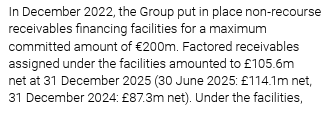
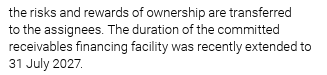
Paragraphs 42B to 42H of IFRS 7 include supplementary disclosure requirements relating to transfers of financial assets.
These disclosure requirements mainly apply where a company continues to recognise an asset for part of the original financial asset or due to continuing involvement following the transfer. For the companies in our sample, this arose where trade receivables were sold to a factor but the company retained exposure to initial credit losses via a reserve balance.
Issue
We may challenge companies that fail to include sufficient information to enable users to understand the nature of, and risks associated with, their continuing involvement in the assets sold.
6. Key expectations
We expect companies to consider the examples provided of better disclosure and opportunities for improvement identified in this report, and to incorporate them in their future financial instruments reporting, where relevant and material. In particular, companies should:
- Describe how hedge accounting supports their risk management strategy, including the risks being managed, the hedging instruments used and the extent of exposures being hedged.
- Provide information that enables users to understand the effect of hedge accounting on financial performance, financial position and future cash flows.
- Ensure that accounting policies for hedge accounting are company-specific and avoid repeating accounting standard requirements that are not relevant to their facts and circumstances.
- Disclose a quantitative sensitivity analysis or the range of reasonably possible outcomes, where ECLs are a key source of estimation uncertainty.
- Ensure that the ECL requirements of IFRS 9 are also applied to other financial assets measured at amortised cost such as intra-group loans and loans to joint ventures, as well as to financial guarantee contracts not accounted for as insurance contracts in a parent company's separate financial statements.
- Consider whether disclosing the classification of trade receivables subject to master or revolving debt factoring agreements would provide material and relevant information.
- Provide clear, entity-specific disclosures about the cash flow presentation adopted for factoring arrangements, including any significant judgements made in accordance with paragraph 122 of IAS 1 in assessing whether the company or the factoring counterparty is acting as a principal or agent.
- Apply materiality to financial instruments disclosures, providing clear, connected information that meets the disclosure objective.
Financial Reporting Council
London office:
13th Floor, 1 Harbour Exchange Square,
London, E14 9GE
Birmingham office:
5th Floor, 3 Arena Central, Bridge Street,
Birmingham, B1 2AX
+44 (0)20 7492 2300
Follow us on LinkedIn.
Footnotes
-
This review does not consider the presentational changes which will be required under IFRS 18, 'Presentation and Disclosure in Financial Statements'. ↩
-
While this review does not consider hedge accounting under IAS 39, 'Financial Instruments: Recognition and Measurement', the observations on IFRS 7 disclosure requirements also apply to entities applying the IAS 39 hedge accounting model. ↩
-
Paragraph 27A of IAS 8, 'Basis of Preparation of Financial Statements', after IFRS 18, 'Presentation and Disclosure in Financial Statements', is effective. ↩
-
Paragraphs 31A and 31E of IAS 8, 'Basis of Preparation of Financial Statements', after IFRS 18, 'Presentation and Disclosure in Financial Statements', is effective. ↩
-
GSK was not part of the sample for this thematic review but was identified as an example of better disclosure as part of our routine review work. ↩