
The content on this page has been converted from PDF to HTML format using an artificial intelligence (AI) tool as part of our ongoing efforts to improve accessibility and usability of our publications. Note:
- No human verification has been conducted of the converted content.
- While we strive for accuracy errors or omissions may exist.
- This content is provided for informational purposes only and should not be relied upon as a definitive or authoritative source.
- For the official and verified version of the publication, refer to the original PDF document.
If you identify any inaccuracies or have concerns about the content, please contact us at [email protected].
Consultation on AS TM1 v5.3 (October 2026)
The FRC does not accept any liability to any party for any loss, damage or costs howsoever arising, whether directly or indirectly, whether in contract, tort or otherwise from any action or decision taken (or not taken) as a result of any person relying on or otherwise using this document or arising from any omission from it. © The Financial Reporting Council Limited 2026 The Financial Reporting Council Limited is a company limited by guarantee. Registered in England number 2486368. Registered Office: 13th Floor, 1 Harbour Exchange Square, London, E14 9GE
1. Introduction
Background
1.1The purpose of the Financial Reporting Council (“FRC") is to serve the public interest and support UK economic growth by upholding high standards of corporate governance, corporate reporting, audit and actuarial work. The FRC is the UK's independent regulator responsible for issuing and maintaining technical actuarial standards.
1.2Since 6 April 2003 money purchase pension arrangements have been required to provide members with Statutory Money Purchase Illustrations (“SMPIs”). These illustrations are governed by the Occupational and Personal Pension Schemes (Disclosure of Information) Regulations 20131 as amended. Legislation requires that statutory illustrations are produced in accordance with guidance prepared by a prescribed body approved by the Secretary of State for Work and Pensions and by the Department for Social Development in Northern Ireland.
1.3The FRC has been the prescribed body since 6 April 2007 and fulfils its obligations through the publication of Actuarial Standard Technical Memorandum 1: Statutory Money Purchase Illustrations ("AS TM1”). AS TM1 specifies the assumptions and methods to be used in the calculation of statutory illustrations of money purchase pensions, also known as defined contribution ("DC") pensions. The FRC reviews AS TM1 regularly.
1.4AS TM1 v5.0 was published in October 2022. As set out in the accompanying feedback statement2, the FRC reviews the appropriateness of accumulation rate assumptions and volatility group boundaries annually based on 30 September data and conducts a one-month consultation in November on proposed changes if necessary. This timing allows the FRC to aim to publish any changes to AS TM1 by 15 February for application in the following financial year.
1.5Following a review of market conditions at 30 September 2023, the FRC consulted on changes to the accumulation rate assumptions in AS TM1. Following that consultation, an updated AS TM1 v5.1 was issued on 9 February 2024 effective for SMPIs based on calculations performed on or after 6 April 2024. Following last year's review of market conditions as at 30 September 2025, the FRC made no changes to the actuarial assumptions in AS TM1 but published AS TM1 v5.2 (effective from 6 April 2026) containing only minor wording amendments relating to fund volatility calculation dates to clarify the FRC's policy intention.
1.6The FRC is also currently carrying out a post implementation review of AS TM1 to ensure the standard continues to be fit for purpose. The wider review covers areas beyond this annual review of the accumulation rate assumptions and volatility group boundaries and follows a separate timeline. To support the post implementation review, the FRC intends to publish a call for feedback in due course.
Aims and audience of this paper
1.7The aim of this paper is to consult on proposed changes to AS TM1 v5.2, focusing on the assumptions in relation to accumulation rates. We are not proposing any other changes to AS TM1 v5.2 at this time.
1.8This paper has been written for anyone with an interest in SMPIs including those responsible for providing SMPIs (trustees, insurers, wealth managers and administrators) and the pension scheme members and policyholders who receive SMPIs or access the pensions dashboards, as well as organisations which represent and advise these groups.
How to Respond
1.9Comments on the questions set out in this consultation document are requested by 27 November 2026. Responses should be sent by email to [email protected].
1.10Information that is provided in response to this consultation, including personal information, may be disclosed in accordance with UK legislation (the Freedom of Information Act 2000, the Data Protection Act 2018 and the Environmental Information Regulations 2004).
1.11The FRC's policy3 is to make responses received to its consultations publicly available. If you want the information you provide to be treated as confidential, please tell us, but be aware that the FRC cannot guarantee confidentiality in all circumstances (e.g. as part of a request under Freedom of Information Act 2000). An automatic confidentiality disclaimer generated by your IT system will not be regarded by us as a confidentiality request. The FRC will process your personal data in accordance with all applicable data protection laws. Please see the FRC's privacy policy4.
2. Accumulation rates
2.1AS TM1 v5.2 paragraphs C.2.3 to C.2.6 specify the method and assumptions to be used to determine the accumulation rate that is used in SMPIs. The rates in AS TM1 v5.0 were set based on market conditions at 31 August 2021 and these rates were updated in AS TM1 v5.1 based on market conditions at 30 September 2023, noting in particular that there was evidence of a more sustained move to a higher interest rate environment.
2.2Following last year's annual review based on market conditions at 30 September 2025, although there had been some further increase in long-dated interest rates, the FRC considered at that time that there was insufficient evidence of a sustained change in rates to support a further change to the accumulation rate assumptions.
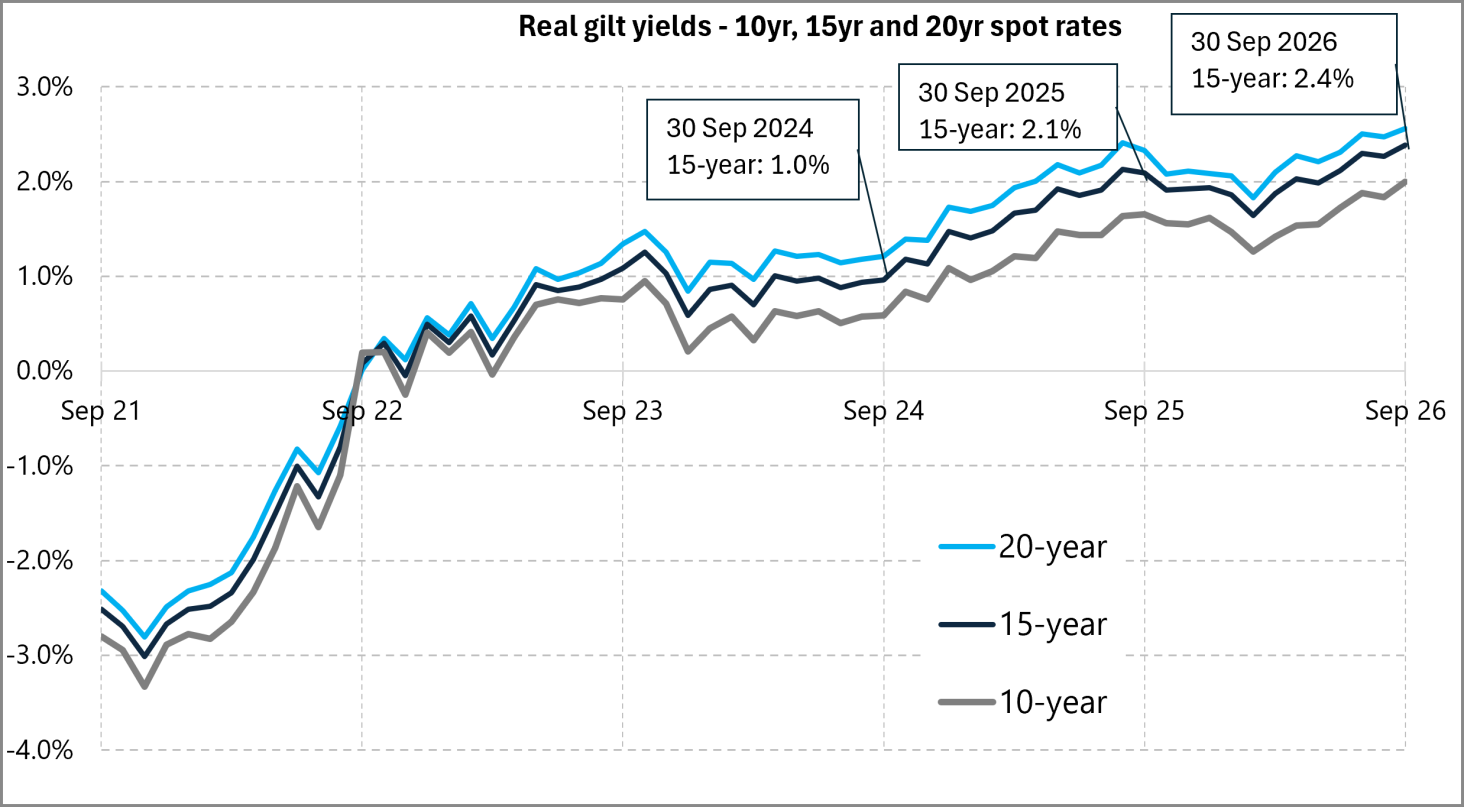
2.3Since 30 September 2025 the increase in the real yields on long-dated gilts has been sustained (at over 2%, compared to c-2.5% at 31 August 2021 and c1% at 30 September 2023, when the accumulation rates in AS TM1 were last amended). These yields could be considered an indicator of risk-free returns that can be achieved in excess of inflation and therefore a relevant benchmark for the FRC to consider when setting accumulation rates for lower risk asset types.
Source: Bank of England
2.4The FRC now considers that in the environment of sustained long-dated real gilt yields of around 2% for the past year, the current accumulation rates for volatility groups 1 and 2 of 2% and 4%, i.e. real rates of -0.5% and 1.5%5, are no longer appropriate. This is particularly the case given volatility group 2 is expected to include some funds taking a certain level of risk, including corporate bond funds and some lower risk multi-asset funds.
2.5The FRC proposes to increase the accumulation rate assumptions for volatility groups 1 and 2 by 1%, to 3% and 5% respectively, i.e. real rates of 0.5% and 2.5%. The real accumulation rate assumption of 0.5% for volatility group 1 would still be below the real gilt yield, to make some allowance for prudence in the assumption. Accumulation rate assumptions of 3% and 5% for volatility groups 1 and 2 respectively would also be more consistent with the assumptions for lower risk investments in third-party capital assumption pricing models, where these have been made available to us.
2.6We do not propose to make a similar increase to the accumulation rates for volatility groups 3 and 4 at this time, as our analysis does not show a significant increase in the long-term returns observed on higher risk asset types which are expected to fall in these volatility groups. In addition, the views of external market commentators and third-party capital models (where these are available to us) suggest that adopting a higher accumulation rate for these volatility groups might result in overly optimistic projections of some DC funds.
2.7Further details on the underlying technical analysis can be found in the technical analysis paper.
2.8We have considered the sequencing of the post implementation review of AS TM1 (see paragraph 1.6) against this proposed change, particularly whether this proposed change should be deferred until the post implementation review is completed. Given that potential changes to the standard, if any, following the post implementation review are unlikely to be effected for at least two years from now, we consider it reasonable to proceed now with updating the AS TM1 accumulation rates to reflect the sustained increases in interest rates.
2.9In summary, the FRC proposes to revise the accumulation rate assumed for each volatility group as follows:
| Volatility Group | Volatility group (as set out in C.2.11 of AS TM 1) | AS TM1v5.2 accumulation rate assumptions | Proposed accumulation rate assumptions |
|---|---|---|---|
| 1 | 0% - 5% | 2% | 3% |
| 2 | 5% - 10% | 4% | 5% |
| 3 | 10% - 15% | 6% | 6% |
| 4 | Above 15% | 7% | 7% |
2.10The FRC intends for the proposed changes to the AS TM1 to be effective for statutory illustrations with an illustration date on or after 6 April 2027.
Question 1:
Do you agree with the proposed change to accumulation rates for volatility groups 1 and 2 from 2% and 4% to 3% and 5% respectively? If not, what alternative accumulation rate do you think would be appropriate for these groups? Please provide supporting evidence for any alternative view.
Question 2:
Do you agree with not amending the accumulation rate for volatility groups 3 and 4? If not, what alternative accumulation rates do you think would be appropriate for these groups? Please provide supporting evidence for any alternative view.
Question 3:
Do you have any other comments on the proposed accumulation rates as set out above?
3. Other assumptions
Volatility Group
3.1AS TM1 v5.2 paragraphs C2.7 to C2.15 specify how the volatility group is determined for each investment. In particular, C.2.11 specifies that the volatility must be used to assign the investment to a volatility group calculated in the following table (subject to requirements set out in paragraph C.2.12):
| Volatility Group | Volatility |
|---|---|
| 1 | 0% - 5% |
| 2 | 5% - 10% |
| 3 | 10% - 15% |
| 4 | Above 15% |
3.2Overall we observed relatively little change in overall market volatility since 30 September 2025, though there have been changes in volatility for certain fund types, for example a small reduction in volatility for many bond funds and an increase in volatility for some equity funds. Further details on the underlying technical analysis can be found in the technical analysis paper.
3.3The FRC does not consider these movements to warrant a change in the volatility group boundaries and considers the current boundaries to continue to be appropriate. We therefore propose for these assumptions to remain unchanged.
Inflation assumption
3.4The inflation assumption is used to discount the accumulated fund from retirement age to today's purchasing power, and therefore needs to be suitable for long-term periods. This is currently specified to be 2.5% per annum.
3.5As at 30 September 2026, the market implied long-dated breakeven inflation was around 3.4% p.a., a small increase from the rate of 3.2% p.a. from the time of our last review at 30 September 2025. This is expected to contain a margin for the differences between RPI and CPI (which will exist until 2030) and an allowance for an inflation risk premium. The HM Treasury comparison of independent forecasts for the UK economy published in September 2026 shows the average forecast of CPI inflation for 2026 to be 3.4%, falling to 2.3% in 2027.
3.6The FRC notes that the inflation assumption is of second order to the accumulation rate assumption (net of inflation) which is one of the key drivers of the size of the accumulated fund expressed in real terms. Given the indicators described above, we consider that the current long-term inflation assumption of 2.5% continues to be reasonable and should remain unchanged.
Other assumptions
3.7The FRC has conducted a review of the other assumptions in AS TM1 v5.2 and has determined that they continue to remain appropriate. Therefore, the FRC proposes no amendments to any of the other assumptions in AS TM1 beyond what is set out in section 2 above.
Question 4:
Do you agree with the FRC's proposal not to amend any of the non-accumulation rate assumptions? If you think they should change, what changes do you consider appropriate? Please provide supporting evidence for any alternative view including whether you consider adopting alternative assumptions will incur substantial adminstrative costs.
4. Impact Assessment
4.1The proposed change is to two parameters within calculation systems of providers of money purchase pensions. As set out in AS TM1 v5.0 and the feedback statement published in October 2022, the FRC expects these parameters will be reviewed annually and may be expected to change periodically.
Benefits
4.2The proposed change ensures the accumulation rate assumptions in AS TM1 continue to remain up-to-date given latest economic conditions and outlook. This in turn will ensure SMPIs and ERI illustrations on future pensions dashboards remain appropriate.
Costs
4.3Amending the accumulation rate assumptions as proposed is expected to result in minimal costs to providers relating to:
- updating parameters within SMPI calculation systems, and testing of these updated parameters
- updating accompanying communications to SMPI users.
4.4At the time of finalising AS TM1 v5.0 in October 2022, the FRC stated our intention to carry out an annual review of accumulation rates and volatility boundaries, and AS TM1 v5.0 states that the methods and assumptions used may be changed as a result of regular reviews of the standard. We therefore anticipate providers will have developed systems in such a way to enable these parameters to be updated annually.
4.5As a result, the FRC anticipate the cost of any system changes to be relatively low and outweighed by the above benefits to users.
Question 5:
Do you agree with our impact assessment? Please give reasons for your response, and estimates of costs where possible.
Financial Reporting Council
London office:
13th Floor, 1 Harbour
Exchange Square,
London, E14 9GE
Birmingham office:
5th Floor, 3 Arena
Central, Bridge Street,
Birmingham, B1 2AX
+44 (0)20 7492 2300
Follow us on LinkedIn
Footnotes
-
in paragraphs 1.16 and 1.17: https://www.frc.org.uk/documents/460/AS_TM1_Statutory_Money_Purchases_Illustrations__Feedback_Statement_and_Impact_Assessment.pdf ↩
-
https://www.frc.org.uk/about-us/policies-and-procedures/consultation-responses-policy/ ↩
-
https://www.frc.org.uk/about-us/policies-and-procedures/privacy/ ↩
-
relative to the AS TM1 inflation assumption of 2.5% ↩
-
20 year spot rate from the Bank of England implied inflation spot curve. ↩