
The content on this page has been converted from PDF to HTML format using an artificial intelligence (AI) tool as part of our ongoing efforts to improve accessibility and usability of our publications. Note:
- No human verification has been conducted of the converted content.
- While we strive for accuracy errors or omissions may exist.
- This content is provided for informational purposes only and should not be relied upon as a definitive or authoritative source.
- For the official and verified version of the publication, refer to the original PDF document.
If you identify any inaccuracies or have concerns about the content, please contact us at [email protected].
Annual Enforcement Review 2026
The FRC does not accept any liability to any party for any loss, damage or costs however arising, whether directly or indirectly, whether in contract, tort or otherwise from action or decision taken (or not taken) as a result of any person relying on or otherwise using this document or arising from any omission from it.
© The Financial Reporting Council Limited 2026
The Financial Reporting Council Limited is a company limited by guarantee.
Registered in England number 2486368.
Registered Office: 13th Floor, 1 Harbour Exchange Square, London, E14 9GE
1. Overview by Executive Counsel

Penrose Foss
FRC Executive Counsel
I joined the FRC as Executive Counsel and Director of Investigations and Enforcement in late 2025. This is my first presentation of the FRC's Annual Enforcement Review. The Annual Enforcement Review affords an opportunity to reflect on our contribution throughout the year to the FRC's purpose: to serve the public interest and support UK economic growth by upholding high standards of corporate governance, corporate reporting, audit and actuarial work.
Our investigation and enforcement work is a critical pillar in the confidence which drives the UK's capital markets. In that context, the year saw us holding firms and individuals to account, deterring improper conduct and poor practice, and educating our stakeholders.
Our teams of subject matter experts, forensic accountants and lawyers have worked closely with our Supervision Division and Regulatory Standards Division to ensure effective regulation across the entirety of the FRC's remit: sharing emerging themes and technical learning, addressing concerns identified through inspection activities, and informing work on relevant standards.
We continue to leverage our strong relationships with other regulators and agencies, both in the UK and abroad, to inform our investigations.
In 2025/2026:
- Seven investigations were opened into auditors and accountants
- Eleven cases were resolved through settlement or the Tribunal
- Three cases were closed with no further action
- Financial sanctions were levied in the sum of £18.2 million
In this report, we spotlight certain of the cases we have resolved which engaged:
- Serious and significant audit failures
- Firm failures in oversight and supervision
- Misconduct in the form of non-cooperation which seeks to undermine the FRC's oversight integrity
- Misconduct by Members in Business in their preparation of financial information.
In that last regard, we present the final chapter of the FRC's investigations and enforcement activity arising out of the collapse of Carillion plc. We settled proceedings under the Accountancy Scheme against five senior accountants in Carillion in relation to their misconduct in the preparation of financial information. That case demonstrates the vital importance of integrity on the part of those responsible for preparing such information. We are committed, within the powers available to us, to the scrutiny of work across the full arc of the preparation, audit and reporting of financial information.
We are committed to innovation and agility in our own operations, reviewing and adapting our methods to ensure proportionate investigations which deliver evidentially robust and fair outcomes as timeously and effectively as possible.
Our ability to progress investigations efficiently depends in large part on the cooperation of investigation subjects, both in the production of relevant information and in the adoption of an open and constructive approach throughout the investigation process. This report addresses specifically the linked themes of cooperation and information gathering in that context.
Our audit enforcement work in the year has taken place against the evolution of new routes to resolution under a comprehensive end-to-end (E2E) review of our enforcement processes.1 With effect from 1 July 2026, in appropriate cases under the Audit Enforcement Procedure, the Accelerated Procedure and the Early Admissions Process will enable swifter investigations and resolution while maintaining the requisite quality and rigour to justify public confidence in our enforcement work. To those ends, successful use of the new routes to resolution will rest to a significant extent on firms and individuals being prepared to engage with us on a fully open and energetic basis.
We are witnessing a rapidly changing landscape for financial reporting, audit and actuarial work, fired by the development and use of AI. We anticipate extensive scrutiny by us in the year ahead of the use of AI in those contexts. Investigation subjects must be ready to identify, explain and justify their use of AI. Mindful of the risks and uncertainties of AI, users must continue to place human judgment front and centre of their work. Professional accountability rests with individuals.
2. The year2 at a glance
(Comparator text for the year to 31 March 2025 is shown in brackets)
- 25 (32) current investigations.
- 7 (8) investigations were opened into auditors and accountants3 in the year.
- 11 (12) cases were concluded satisfactorily through Constructive Engagement.
- 11 (9) cases were resolved through settlement or Tribunal.
- Financial sanctions of £18.2 million (£14.5 million) (before settlement discount).
- 3 (3) cases were closed with no further action.
- 50% (90%) of cases met the two-year 50% key performance indicator4.
- 100% (87%) of cases met the three-year 80% key performance indicator5.
- Achieved with a headcount reduction of three to a team size of 61 (64).
- Recurring themes in concluded audit investigations: lack of scepticism, compliance with ethical requirements, risk of fraud, revenue and revenue recognition and insufficient audit evidence.
3. Themes: Cooperation and information gathering
Introduction
This chapter and the chapter that follows introduce two closely linked aspects of effective enforcement: cooperation and information gathering. Each is fundamental to the FRC's ability to investigate matters and to achieve timely and evidentially robust outcomes in the public interest.
3.1 Theme: Cooperation
The FRC expects a high degree of cooperation from firms and individuals under investigation, that is to say, that they should comply fully and promptly with what is required of them under our investigatory procedures, displaying a high degree of professionalism in all their dealings with us.
An exceptional degree of cooperation is required to be regarded as mitigative and to attract a discount to any financial sanction.6 Examples of exceptional cooperation are volunteering self-reviews or root cause analyses which materially assist an investigation, anticipating requests for, and volunteering, evidence, making clear, substantive early admissions, or self-reporting any additional matter identified by the investigation subject during the investigation.
Failure to cooperate may be seen as an aggravating factor and result in an increase in the sum of any financial sanction, or even constitute a basis for separate investigation and sanction. Cases concluded in the year encompassed examples of each of these issues.
Examples of exceptional cooperation include self-reviews and root cause analyses which materially assist an investigation.
Exceptional cooperation
Exceptional cooperation was recognised in two cases under the Audit Enforcement Procedure (AEP)7 where breaches of Relevant Requirements were admitted.
In the case of KPMG/N Brown plc8 a discount of 12.5% was applied to the financial sanction to recognise the firm's cooperation. This included the preparation of two self-reviews in which a number of the breaches of Relevant Requirements were identified and admitted, and remedial action was undertaken to prevent recurrence.
In the case of PwC/Babcock9 a 12.5% reduction was applied to the financial sanctions imposed on both the firm and the engagement partner in recognition of exceptional cooperation demonstrated by the following:
- Disclosure by the firm of the findings of two separate critical self-reviews of different areas of the two audits;
- Disclosure of the findings of a Root Cause Analysis to identify the underlying causes of the audit failings;
- Full participation by the engagement partner in the self-reviews and Root Cause Analysis.
In both cases the cooperation provided enabled efficient investigation progress, and afforded a commensurate saving in cost.
Failure to cooperate
Two cases under the Accountancy Scheme involved failures to cooperate by individuals under investigation.
In the first case,10 a former partner of BDO accepted that he had committed Misconduct through his failure to supervise a number of audits where he was the engagement partner. The financial sanction was increased by 5% to reflect his lack of cooperation, which included the provision of inaccurate and incomplete information in response to a Notice served under Rule 14(2) of the Scheme.
In the second case,11 a former Finance Director of a UK private company failed to cooperate with an investigation opened in June 2023. The Formal Complaint alleged breaches in his duty to cooperate by failing to respond to a number of communications and by failing to comply with a notice requiring him to arrange to attend an interview. The Tribunal found the allegations proved and imposed a sanction of exclusion as a Member of the Chartered Institute of Management Accountants for a recommended period of five years.
In explaining the seriousness of a failure to cooperate the Tribunal observed:
'An individual who has obtained a professional certification, qualification or registration is accorded a certain privileged status as a person whom members of the public may trust to exercise their professional skills to the requisite standard and whom the public may reasonably expect will be called to account if that standard is breached. It is for that reason that, hard-won though that privilege may be, it brings obligations, including an enduring obligation to submit to, and cooperate with, investigations by their professional body.'
Cooperation under new processes
Full cooperation by both firms and individuals in enforcement investigations continues to be crucial to our ability to progress cases efficiently and proportionately.
The introduction of new routes to resolution under the AEP will provide opportunities for early, structured cooperation and greater benefits for firms and individuals, including the availability of greater discounts to financial sanctions.
New routes under the AEP provide opportunity for greater discounts through structured cooperation.
3.2 Theme: Information gathering
Introduction
The purpose of our investigations, whether under the AEP12 or the Accountancy and Actuarial Schemes (Schemes), is to establish whether there have been breaches of relevant standards or, in the case of the Schemes, whether there has been Misconduct, and whether such breaches or Misconduct are serious or significant.
When our investigations do identify such failures, we take appropriate enforcement action to uphold standards, maintain public confidence and, above all, to protect the public and the wider public interest. The integrity of the enforcement process relies on fair and evidentially robust investigation which rests, in part, on scrutiny of all relevant material and information, presented to us accurately and efficiently.
Data landscape
In all investigations under the AEP, we obtain, under our statutory powers, the relevant audit files. However, we commonly see material which is directly relevant to the audit opinion within the following additional data repositories:
- Electronic communications both between the audit team and the audit entity, and within the audit team (this includes emails, text messages, WhatsApp messages and Microsoft Teams communications).
- Draft workpapers and internal technical and risk consultations.
- Internal quality reviews or investigation reports.
- Shared network drives.
- Hard copy documents and notes.
- Audit manuals and internal guidance.
Every investigation is different and there is no 'one size fits all' approach. However, it is notable that during the past 12 months we have obtained relevant information across an increasing number of our cases from non-email electronic communications, including instant messages and Microsoft Teams. We now regularly see audit team communications related to the audit which have been sent through these channels. Such communications may evidence potential breaches of standards. However, the alternative is also the case; we find material in these communications which explains and supports the decisions taken by the audit teams. This material is critical to our investigations.
A more bespoke approach is required for investigations under the Schemes given the FRC's more limited information gathering powers in this context, as compared to those under the AEP. Requests for information and material are generally made of the audited entity, which may comply voluntarily. Our powers of compulsion can only be exercised against Members and Member Firms of the relevant professional bodies.
Non-email electronic communication material is critical to our investigations.
Timeliness and proportionality
Our investigations do not seek to reperform the audit, nor do they assess every aspect of the audit work. Shortly after the commencement of an investigation, we hold a meeting with the investigation subjects where we explain the specific issues and areas under current focus (noting that the scope and focus of investigations may develop over time).
We adopt a tailored and targeted approach to information gathering. When requesting electronic communications from audit team members, we do not make blanket requests for material. We attempt to reduce the scale of potentially responsive data in a number of ways, including by selective requests for:
- The communication data of key audit individuals (rather than those of the whole audit team).
- Communications within specific time periods which we consider are most likely to be relevant.
- Communications which include search terms which we consider are applicable to the current scope and focus of the investigation.
We work collaboratively with audit firms to refine our information requests, as appropriate. Although this approach assists in reducing the volume of material responsive to our requests, given the size and complexity of many of our investigations, the resulting data counts can still be significant.
For this process to work effectively, it is essential for audit firms to devote sufficient time and resource to respond to our information requests, and to apply care and attention throughout the process. We encourage clear and open dialogue with the audit firms to resolve any queries or technical issues and are keen to work together with the firms to find solutions. This can involve the use of both established forensic technology techniques and emerging technologies, such as AI.
We often make sequenced requests for information, which can be more manageable for the firms to comply with. This also enables us to review material more quickly and efficiently. Ultimately, we wish to avoid a significant time lag between our requests for information and the resulting production of material. This is critical to timely investigation.
Interviews of witnesses or subjects constitute a valuable source of information in an investigation. The decision as to whom to interview, and when, is made on a case-by-case basis. Interviews may assist in filling gaps in contemporaneous records. Importantly, they are an opportunity for individuals to offer their own account of the issues under consideration.
In advance of an interview, we provide attendees with document bundles in good time to ensure interviewees have a fair opportunity to prepare. We conduct interviews to accommodate, so far as practicable, the needs and concerns of interview subjects and to enable their full participation.
Sufficient audit firm time and resource should be assigned to responding to our information requests.
Problems encountered
This year we have experienced the following issues which have prolonged or disrupted the information gathering process:
| Issue identified | How firms can assist |
|---|---|
| Technical and human error: The provision of inaccurate or incomplete information by the firms, including duplicated email counts, errors in technical processing or human review, the incorrect application of search logic and incomplete material and metadata. |
|
| Non-retention of material: Some firms do not routinely retain non-email electronic communications used for the audit. It is concerning that in one case, a firm deleted potentially substantial amounts of emails generated by the audit team, after our investigation had started. These should have been preserved and made available to us, however no adequate explanation was given as to how the data came to be deleted. |
|
| Privilege and confidentiality reviews: We cannot compel the production of material subject to legal professional privilege. Nor can we obtain material that relates not to the audit in question but to other clients. It is often necessary for the firms to carry out lengthy privilege and confidentiality reviews before producing material. Wherever possible, we seek to obtain limited waivers of privilege from those parties in whom privilege vests to expedite matters. |
|
| Powers: As referred to above, our powers to compel the production of material under the Schemes are limited to Members and Member Firms. In these investigations there may be relevant material held by the audited entity. We cannot compel the production of such material. Instead, we engage with the audited entity to resolve upon an appropriate framework in which relevant material might be provided to us. |
|
Quality of data issues can significantly delay investigations.
The above issues can cause significant delays in the gathering of material. We can incur considerable time and costs in engaging with firms to identify and resolve these problems. These issues inevitably postpone data reviews by our case teams, and substantially delay an investigation, with an attendant increase in investigation costs.
Many of these issues could be addressed by firms paying proper attention to our requests, committing sufficient resources and planning to responding to our requests, working to avoid errors, notifying us of errors as soon as they are identified by the firms, and, where errors do occur, moving swiftly and transparently to respond and resolve them.
We will continue to exercise a collaborative approach to dealing with delays in, and obstacles to, information gathering. We require the firms to provide the highest level of cooperation in addressing any problems which arise. We share a common interest with the subjects of our investigations, as well as all our stakeholders, to ensure that our work is carried out in a timely and proportionate way, and that rests, in part, on the efficient provision of information to us. In appropriate cases, we will consider whether deficiencies in the provision of information to us by the firm constitute noncooperation.
Strong data governance and a collaborative approach support timely enforcement outcomes.
4. Review of the year
4.1 Case Assessment13
Case Assessment (CA) is responsible for undertaking enquiries to enable a decision as to whether a matter should be referred to the Conduct Committee. In 2025/26, cases could be referred to the Conduct Committee for investigation and Constructive Engagement, and in certain circumstances the Case Examiner also had the ability to decide to undertake Constructive Engagement or take no further action. With effect from 1 July 2026, the role of Case Examiner was replaced with that of the Designated Officer, who retains the ability to decide to take no further action in respect of a matter but cannot decide to undertake Constructive Engagement. The range of options available to the Conduct Committee was also expanded to include Published Constructive Engagement and use of the Accelerated Procedure.
If Constructive Engagement is considered to be the appropriate response, the case is transferred to the Supervisor team within Audit Firm Supervision (AFS), which conducts and manages the Constructive Engagement process.
The table below summarises the number of cases opened and closed by CA in 2025/26 and the preceding two years.
| Cases | 2023/24 | 2024/25 | 2025/26 |
|---|---|---|---|
| Open at the start of the year | 40 | 20 | 16 |
| Opened in the year | 40 | 40 | 44 |
| Closed in the year | (60) | (44) | (41) |
| Open at the end of the year | 20 | 16 | 19 |
44 cases opened by CA during the year.
Cases opened in the year14 15
Cases opened by source
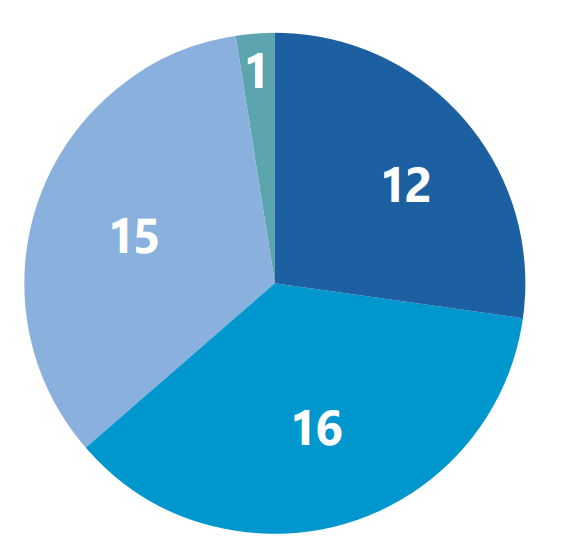
- Horizon scanning: 16 cases
- FRC teams: 15 cases
- Complaints: 12 cases
- External referrals: 1 case
| Year | Cases opened |
|---|---|
| 2025/26 | 44 |
| 2024/25 | 40 |
| 2023/24 | 40 |
A total of 44 cases were opened in the year, a slight increase on 2024/25.
Referrals from other FRC teams constitute the largest source of CA cases and most of the 16 seen this year arose from Audit Quality Review (AQR) inspections. There was a significant increase in complaint cases which was the second largest source of CA cases this year. Horizon scanning also remains a significant source of CA cases.
Consistent with the previous year, most cases opened were related to the conduct of audit (75% compared with 90% last year). There were fewer cases concerning accountants in business. This reflects, in part, the higher threshold for opening investigations under the Accountancy Scheme than under the AEP.
As at 31 March 2026, 19 cases remained open, compared with 16 at 31 March 2025. Of the 19 cases currently open, four are older than six months.16
75% of cases opened in the year were related to the conduct of an audit.
Outcome of CA cases17
Cases closed by outcome
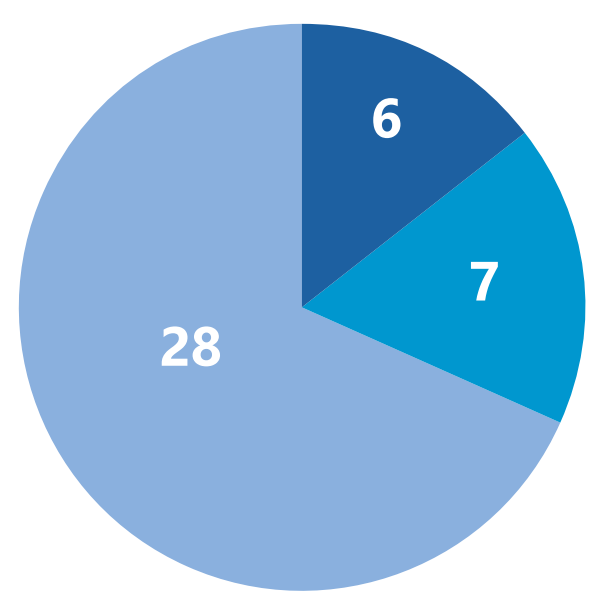
- No further action: 28 cases (majority)
- Referred for investigation by the Conduct Committee: 7 cases
- Constructive Engagement: 6 cases
| Year | Number of cases |
|---|---|
| 2025/26 | 41 |
| 2024/25 | 44 |
| 2023/24 | 60 |
During the year, 41 cases were closed by CA, a slight reduction on 44 the previous year. The table on page 12 summarises the number of cases opened and closed by CA in the current and preceding two years. Of the cases closed:
- Seven (nine in 2024/25) were referred by the Conduct Committee to Executive Counsel for investigation.
- Six (seven in 2024/25) were transferred to the Supervisor team to resolve through Constructive Engagement.
- A total of 28 (also 28 in 2024/25) resulted in no further action18 by the Case Examiner.
68% of cases concluded in the year were closed with no further action.
More details of the cases in each category are set out in the subsections below.
Referrals to the Conduct Committee to consider opening an investigation
The cases referred to the Conduct Committee for potential investigation, and its decisions in the year, are shown below:
| Scheme | Investigations opened or extended under the AEP or the Schemes | Returned for Constructive Engagement or no further action | Total19 |
|---|---|---|---|
| AEP | 4 | 2 | 6 |
| Accountancy | 3 | 2 | 5 |
| Actuarial | 0 | 0 | 0 |
| Total | 7 | 4 | 11 |
In seven cases, the Conduct Committee decided to open an investigation and referred the case to Enforcement (under the AEP or the Schemes). Details of these new investigations opened (to the extent that details may be given) are included later in this section.
While the number of cases referred to the Conduct Committee for potential investigation is consistent with the previous year, there has been a decrease in the number where investigations were opened (seven versus nine).
The KPI for referral of a matter from CA to the Conduct Committee is six months. This was met in 82% of instances, compared with 55% last year. The time taken to refer a case to the Conduct Committee depends on the specific circumstances of each matter, including the amount of material considered by CA. The average time taken from opening to referring a matter to the Conduct Committee for potential investigation was four months, compared with just over 10 months in 2024/25. Timeliness was impacted in 2024/25 by delays in obtaining relevant material, such as investigation reports, which was partly due to the need to agree legal privilege waivers.
In addition to cases where an investigation was recommended by CA, the Conduct Committee considered 10 Referral Cases20 in the period. Of these, six were transferred to the Supervisor team for Constructive Engagement and four led to no further action.
Constructive Engagement
During the year, we continued our focus on further developing the Constructive Engagement process for qualifying cases21 as an effective and efficient alternative to investigation.
Once the decision has been made to resolve a case through Constructive Engagement, it is transferred to the Supervisor team, which conducts the process. Six CA cases were transferred and the Constructive Engagement process was concluded in the year for 11 cases (12 in 2024/25).
11 cases were resolved through Constructive Engagement.
| Constructive Engagement cases | 2025/26 |
|---|---|
| Brought forward at 1 April 2025 | 10 |
| Transferred for Constructive Engagement in the year | 6 |
| Concluded in the year | (11) |
| Constructive Engagement ongoing at 31 March 2026 | 5 |
In respect of the 11 cases where Constructive Engagement was concluded, we engaged with 10 separate statutory audit firms. Three cases involved firms which are part of the group of 12 largest Public Interest Entity (PIE) audit firms, and the remainder involved other audit firms registered to audit PIEs.
All Constructive Engagement cases concluded in the year include potential breaches of auditing standards identified through AQR inspections.
Timely intervention through Constructive Engagement enables the audit firm to take remedial action for subsequent years' audits and improves the firm's overall audit quality control procedures.
On average, Constructive Engagement was concluded with firms in 17 months (13 months in 2024/25) after the corresponding CA case had been opened. A number of Constructive Engagement cases were kept open until quality improvements had been sufficiently demonstrated by firms in subsequent audits or remedial actions had been implemented and assessed for effectiveness.
Across the 11 cases where Constructive Engagement was concluded, the most common audit and accounting areas where weaknesses were identified were:
- Quality control procedures (nine cases): Including insufficient and / or late senior oversight, unclear or inconsistently applied methodology, and inadequate review of key audit judgements. Files often lacked evidence of robust challenge of management or tailored responses to identified risks, indicating gaps in supervision and documentation.
-
Journal entry testing (seven cases): Including limited or poorly targeted testing of journals, insufficient focus on fraud risks, and outdated or misapplied testing tools. Audit teams often failed to investigate unusual entries or high-risk areas, reflecting inadequate scepticism and weak compliance with ISA (UK) 240 requirements.
-
Revenue recognition (four cases): Including insufficient substantive testing where controls were not relied on, particularly in judgemental revenue streams. Weaknesses included inadequate testing of occurrence and cut-off, and insufficient evaluation of component auditor work. Evidence obtained was often not enough to support management's assertions.
Other audit and accounting areas where findings arose included impairment assessments, valuation of insurance contract liabilities, expected credit losses, investment property valuation and valuation of unquoted investments, with each occurring in three or fewer cases. These areas continued to highlight challenges in auditing complex, judgement-heavy estimates, where clearer evaluation of key assumptions, more robust challenge of management's methodologies and better consideration of sensitivities were expected.
The most common issues were:22
- Lack of guidance, methodology and training (eight cases): Firms often lacked sufficiently robust or up-to-date methodologies, tools and training, leading to inconsistent audit approaches, weak risk assessment and gaps in documentation.
- Insufficient challenge and professional scepticism (seven cases): Frequently audit teams did not probe management's assumptions, relied too heavily on prior-year approaches, or failed to pursue contradictory evidence, especially in judgement-heavy areas such as provisions, impairment and journal testing.
- Insufficient documentation (four cases): In these cases, audit files lacked adequate records of judgements, risk assessments, or review activities, making it difficult to evidence compliance with auditing standards and contributing to recurring issues across significant audit areas.
Remedial actions undertaken through the Constructive Engagement process in 2025/26 primarily focused on strengthening firms' audit methodologies, improving documentation quality, and enhancing training and guidance in areas where inspection findings had highlighted recurring weaknesses. Many firms were required to demonstrate clearer alignment between identified risks, the audit procedures performed, and the evidence documented on file.
Examples of remedial actions included:
- Introducing strengthened risk-assessment procedures, including clearer guidance on identifying significant risks earlier in the audit cycle and linking them more explicitly to planned audit responses.
- Enhancing supervision and review expectations, such as requiring earlier and more frequent involvement of senior team members to ensure timely challenge of key judgements.
- Rolling out upgraded data-analytics tools to support more targeted testing in areas such as revenue, journals and loan balances, accompanied by focused training on appropriate use.
- Implementing firm-wide monitoring activities, including targeted hot reviews and post-implementation assessments to evaluate whether new guidance, templates and training were being applied effectively in practice.
Overall, these measures aimed to address case-specific findings while supporting more consistent, higher-quality audit execution across future audit cycles.
Remedial action in Constructive Engagement included a requirement to improve documentation quality and enhance training and guidance.
While each case is considered on its own merits, to illustrate the type of Constructive Engagement activity undertaken, two anonymised examples are set out below.
Case A
An AQR inspection of the FY2021 audit identified significant weaknesses in the audit work performed across expected credit loss provisions, along with insufficient procedures performed and evidence obtained for going concern testing, journal entry testing, and other testing relating to financial instruments accounted for under IFRS 9. The firm's root cause analysis identified insufficient expertise and experience within the audit team as well as inadequate firm guidance, as the principal causes for these weaknesses.
As part of the approach to Constructive Engagement, the Supervisor team reviewed the firm's root cause analysis and a sample of working papers from its FY2022, FY2023 and FY2024 audits.
The Constructive Engagement process resulted in:
- The firm improving the quality of its audit procedures and evidence obtained in several areas, including in those that drove the key findings.
- The release and enhancement of several templates and guidance, including in the areas of IFRS 9, IT general controls and engagement quality review.
- Establishing a firm-wide specialist group to support audit teams in the audit of IFRS 9.
- The implementation and enhancement of an IFRS 9 methodology.
The firm established a firm-wide specialist group to support audit teams in the audit of IFRS 9.
Case B
An AQR inspection on a firm's FY2023 audit identified inadequate procedures performed in relation to the valuation of investment properties and journals testing. Its root cause analysis identified an overreliance on previous judgements, a lack of professional scepticism and inadequate template workpapers as the principal causes.
During Constructive Engagement, the Supervisor team reviewed the root cause analysis and focused on remediation through firm-wide improvements. This resulted in:
- The release and enhancement of several templates and guidance, including on the areas of acceptance and continuance processes, the use of experts by the audit team, journals risk assessment and testing, and the involvement of the engagement quality reviewer.
- Training provided to the audit function in the areas of AQR's key findings, incorporating further FRC feedback.
- The firm committing to performing thematic reviews and other monitoring activities to assess the effectiveness of the updated templates, guidance and training.
Certain actions agreed as part of the Constructive Engagement process, which are designed to improve audit quality, are similar to the non-financial sanctions imposed at the conclusion of enforcement action. While Constructive Engagement outcomes do not amount to a sanction, and are not individually published, they can result in significant additional requirements for audit firms.
The process requires full and open cooperation by audit firms. During the year, we were generally satisfied with the level of cooperation and the timeliness of responses.
The value of Constructive Engagement also depends on the extent to which new measures are appropriately followed by audit teams. This is monitored by a firm's dedicated audit firm Supervisor within the AFS team. Where appropriate, Supervisors work with the FRC's AQR team to conduct follow-up activity.
CA also monitors where similar matters are identified in audits conducted by the same firms. Recurring issues are taken into account when deciding whether to refer a matter to the Conduct Committee to consider opening an investigation, and from 1 July 2026 to consider undertaking Published Constructive Engagement, or using the Accelerated Procedure.
Constructive Engagement requires full and open cooperation.
No further action
There were 28 cases closed in the year with no further action.
Of these, 23 involved statutory audit firms and statutory auditors that were considered under the AEP. All matters are considered carefully to determine whether there may be underlying issues relevant to the work conducted by the statutory auditors. However, the information we examined did not support further enquiry into the audit. The reasons for this included one or more of the following:
- We did not identify issues of concern such as financial reporting errors or misstatements in the entity's financial statements.
- We did not identify a question of a potential breach of auditing standards, or the matter was not considered to be sufficiently significant to warrant further action.
- There was ongoing supervisory work with the firm to address the issue.
The remaining five cases (all Scheme cases) were closed with no further action as there was insufficient evidence to demonstrate reasonable grounds to suspect Misconduct by the auditors, accountants or actuaries.
Where matters raised were outside the FRC's remit, we directed complainants to other bodies that may have an interest. This year, the recipients of these referrals included the relevant Recognised Supervisory Bodies.
4.2 Investigations and Enforcement23
An effective regulator should take enforcement action where it has identified serious or significant failures by those it regulates. The public interest demands accountability for such conduct and that appropriate sanctions are imposed. At the same time, it is right that prompt decisions are taken to close investigations where the evidence does not establish breaches of standards. In all cases, it is important that the FRC takes independent, evidenced-based and proportionate decisions when exercising its functions.
The investigations detailed below illustrate this approach in action. Where we have identified particularly poor conduct we have imposed some of the most serious sanctions available. We are also prepared to pursue contested matters to an independent Disciplinary Tribunal where it is in the public interest to do so.
At the other end of the scale, we are ready to close investigations where the conduct in question does not warrant enforcement action. In fact, just under a quarter of our concluded investigations this year were closed with no further action taken.
Regarding the opening of investigations in the year, although the majority relate to statutory audit, we are also examining the conduct of preparers of financial statements.
Auditor Regulatory Sanctions Procedure24 and the Crown Dependencies' Recognised Auditor Sanctions Procedure25 are not included in this Review as matters under these procedures are handled by the FRC's Enforcement Committee and its AQR team. On 31 March 2026 there were no open cases.
Investigations opened
| Type | 2023/24 | 2024/25 | 2025/26 |
|---|---|---|---|
| Investigations opened in the year | 6 | 8 | 7 |
| Preliminary enquiries opened in the year | - | - | 126 |
In the 12 months to 31 March 2026, the Conduct Committee opened five new audit investigations, four under the AEP and one under the Accountancy Scheme. Two opened under the Accountancy Scheme were investigations into accountants in respect of non-audit matters.
7 investigations opened in the year.
AEP investigations
The four AEP audit investigations concern a range of potential issues, including professional scepticism, audit planning, audit evidence and documentation, revenue and revenue recognition, group audits, non-audit services, the use of experts, investments, risk of fraud, take-on procedures, ISQC (UK) 1/ISQM (UK) 1 (including firm wide policies and procedures), compliance with the FRC's Ethical Standard and compliance with laws and regulations. For the second, consecutive year, none of the investigations followed referrals to the Case Examiner from the FRC's AQR team.27
In line with the FRC's Publication Policies28, not all investigations are announced at the outset, although if the case leads to enforcement action and the imposition of sanctions, the outcome will be published. The Conduct Committee determines whether to announce the opening of investigations on a case-by-case basis. It will decide to make an announcement if it considers that publication is necessary in all the circumstances and that any potential prejudice to the subject in announcing an investigation is outweighed by the factors in favour of publication.
All AEP investigations opened in the year have been announced.29
Accountancy Scheme investigations
Three investigations were opened under the Accountancy Scheme in 2025/26. One related to the unauthorised issuance of auditor's reports to audited entities and two related to Members in Business. All of these investigations have been announced.
Actuarial Scheme investigations
No investigations were opened under the Actuarial Scheme in 2025/26.
Preliminary enquiries
If the Conduct Committee considers that it does not have sufficient information to decide whether to open an investigation under the Schemes, it can direct Executive Counsel to conduct preliminary enquiries. One new preliminary enquiry was opened by the Conduct Committee under the Schemes in 2025/26.
Concluded cases
Outcome of investigations
| Year | Closed with no further action | Closed with findings of Misconduct/ breaches and sanctions - Settlement | Closed with findings of Misconduct/ breaches and sanctions - Independent Tribunal | Total |
|---|---|---|---|---|
| 2025/26 | 3 | 10 | 1 | 14 |
| 2024/25 | 2 | 9 | - | 11 |
| 2023/24 | 1 | 8 | - | 9 |
11 concluded investigations resulting in sanctions.
Fourteen cases were concluded in the 12 months to 31 March 2026. For the fifth consecutive year, concluded cases exceeded the number opened in the same period, with a decrease in the number of open investigations.
One preliminary enquiry was concluded during the year and this resulted in an investigation, which remains open.30
Cases concluded with sanctions
The FRC concluded nine investigations that resulted in sanctions being imposed on audit firms and individuals.
| Audit firm | Audited entity | Audit of the financial statements | Date case opened | Date of sanction |
|---|---|---|---|---|
| KPMG | N Brown Group plc | Period ended 26 February 2022 | 2 May 2023 | 11 June 2025 |
| BDO | Various | Various audits with years ending 2012 to 2019 | 14 July 2020 | 3 September 2025 |
| King & King | Liberty Speciality Steels Ltd | Year ended 31 March 2019 | 22 February 2022 | 17 December 2025 |
| King & King | Liberty Performance Steels Ltd | Year ended 31 March 2020 | 22 February 2022 | 17 December 2025 |
| King & King | Alvance British Aluminium Ltd | Year ended 31 March 2019 | 22 February 2022 | 17 December 2025 |
| King & King | Liberty Steel Newport Ltd | Year ended 31 March 2019 | 22 February 2022 | 17 December 2025 |
| BDO | NMCN plc | Year ended 31 December 2019 | 14 September 2021 | 7 January 2026 |
| PwC | Babcock International Group plc | Years ended 31 March 2019 and 2020 | 14 December 2021 | 23 March 2026 |
| Forvis Mazars | Studio Retail Group plc | Period ended 26 March 2021 | 16 September 2022 | 31 March 2026 |
The FRC concluded two investigations that resulted in sanctions being imposed on Members in Business.
| Members in Business | Entity | Year of the financial statements | Date case opened | Date of sanction |
|---|---|---|---|---|
| Accountant | Carillion plc | Preparation and approval of the financial statements for the years ended 31 December 2013, 2014, 2015 and 2016; and the six months ended 30 June 2017; and the preparation and reporting of other financial information during the period 2014-2017 | 13 March 2018 | 31 December 2025 |
| Accountant | UK subsidiary of a US-listed company | Preparation and provision of financial information for the years ended 31 December 2017 to 31 December 2021 | 22 June 2023 | 5 November 2025 |
3 investigations followed AQR referrals.
We published five Final Settlement Decision Notices (FSDNs) in respect of eight31 AEP investigations. Four concerned audits of main market listed companies and the other related to audits of non-PIE companies within the Gupta Family Group alliance.
There were also findings in three investigations commenced under the Accountancy Scheme. We published two Particulars of Fact and Acts of Misconduct in respect of the Carillion investigation, three Formal Complaints and Settlement Agreements in respect of BDO and two former audit engagement partners, and one Tribunal report in respect of a Member in Business.
These AEP and Accountancy Scheme investigations were referred to the Conduct Committee from different sources. Three were opened following a referral from the FRC's AQR team. One was opened following a self-report by the relevant audit firm of breaches of the FRC's Ethical Standard. One was opened following referral from another regulator. There was a further referral from the parent company of the entity involved, which led to the opening of a case under the Accountancy Scheme. The remaining case was referred to the Conduct Committee following the FRC's horizon-scanning activities.
It is also notable that four of the investigations followed some form of insolvency proceedings.
A variety of subject matters was examined. In addition to the audit of going concern, which is addressed immediately below, our AEP investigations included findings of breaches of standards in the audit of impairment, long term contract accounting and expected credit losses as well as breaches of the independence and objectivity provisions of the FRC's Ethical Standard.
Three of the investigations which concluded with sanctions identified serious and significant breaches of Relevant Requirements in respect of the audit of going concern. This was identified as a current and future area of focus in the Annual Enforcement Review 2022, particularly in light of the heightened uncertainties arising from Covid-19, Brexit and climate change. These factors reinforce the need for auditors to present appropriate and focused challenge to management's assessment of going concern. The necessary audit work is challenging and reflects the level of risk involved when assessing events or conditions which might cast doubt on an entity's ability to continue as a going concern. The breaches of standards across these cases demonstrate some common themes, including a lack of rigorous challenge to management's assumptions, inadequate evaluation of contradictory audit evidence, and the exercise of insufficient professional scepticism.
Closed cases
Three investigations under the AEP were closed without enforcement action, when it became apparent the threshold for taking enforcement action was not met.
3 investigations closed without enforcement action.
Spotlight on BDO & Ors including quality control requirements
The outcome in BDO & Ors, a Scheme matter which was fully resolved during the year, provides a salutary reminder of the importance of a firm's system of quality control in providing reasonable assurance that the firm and its personnel comply with professional standards and that its audit reports can be relied upon.
This spotlight considers the key facts and findings in this highly unusual case and explain why breaches of the International Standard on Quality Control (UK) 1 (ISQC1) were so fundamental. From 2022 ISQC1 was superseded by the International System on Quality Management (UK) 1. The matter also included breaches of the Institute of Chartered Accountants in England and Wales' (ICAEW) Code of Ethics and a number of ISAs (UK).
Senior Manager Misconduct – forging audit reports and more
In November 2024, the FRC published the outcome of the case against a BDO senior manager, who had pursued a dishonest course of conduct in relation to numerous audits over many years. This included the creation of false audit evidence and inserting copies of the audit engagement partners' signatures into auditor's reports without their approval, many of which were subsequently filed at Companies House.32
An obvious question raised by this course of events was how such serious and extensive Misconduct could have occurred, and gone undetected, within one of the UK's largest audit firms over so many years. Much of the answer can be found in the settlement outcome published in 2025 in relation to BDO and two audit engagement partners.33
Engagement partner failures in oversight and supervision
BDO's own investigation found that over the period 2012 to 2019, the senior manager inserted a copy of the audit engagement partner's signature into 39 auditors' reports without the partners' authorisation or knowledge. There were many more audits on which the senior manager worked where the audit evidence retained on the audit files was deficient despite the audits having been signed off by the relevant engagement partners. In some instances, the deficiencies were serious and fundamental.
Two BDO partners, who were the audit engagement partners for most of these audits, admitted in their Formal Complaints that in respect of multiple audits across successive years on which they nominally held this role, they had no or limited involvement and provided no, or inadequate, supervision. In some cases, there was no evidence they performed any work at all on the relevant audits. In other cases they were involved in certain aspects of the audit but failed to identify that the audit work had not been completed or that they had not signed the auditor's report. They accepted that this approach amounted to a fundamental abrogation of their responsibilities.
BDO and ISQC1 breaches
Significantly, our investigation found that these failures in supervision were reflective of, and facilitated by, serious inadequacies in BDO's policies and procedures for ensuring that engagement partners took responsibility for, and adequately supervised, their audit portfolio.
Taken collectively, we found that BDO's policies and procedures failed to ensure that audit engagement partners were aware of all the audits in their portfolio and were adequately involved in the audits for which they were responsible.34 BDO did not have a specific system or procedure for informing engagement partners of audits for which they were responsible, or for alerting or reminding RIs of audit milestones, or for storing such information for partners to access. Without such specific procedures and policies in place, BDO was reliant on other systems and procedures to ensure engagement partners' awareness of the audits for which they were responsible.
Numerous failures were found including the following:
- BDO's client records did not allow engagement partners to confirm the audits to which they had been allocated.
- Electronic audit files could be created, completed and archived without the engagement partner's knowledge or involvement.
- Clients could be billed and time written off without the engagement partner's knowledge or involvement.
- BDO's systems did not ensure that electronic signatures were held securely or that employees were prevented from accessing and applying an engagement partner's electronic signature to an auditor's report without the engagement partner's authorisation.
- There were no policies governing the handover of portfolios by an engagement partner who was leaving the firm, which meant that engagement partners were allocated audits without being informed.
- The firm did not monitor audits to assess whether the engagement partners were adequately supervising them.
These deficiencies represented serious breaches of ISQC1 and meant that the firm could not, and did not, obtain the necessary assurance required, particularly in relation to the adequate involvement and supervision of audits by engagement partners and overall audit quality. In this case, these failings were starkly exposed.
Additionally, even when a partner discovered that an auditor's report had been filed at Companies House containing an unauthorised copy of their signature, no steps were taken to investigate the senior manager's conduct, or to ensure that they were adequately supervised. Between that discovery in May 2019 and their suspension in December 2019, the senior manager inserted, without authorisation, an electronic copy of the relevant engagement partner's signature and provided the signed auditor's report to the client.
Remediation
BDO has since worked to remediate and strengthen its relevant systems and controls and, as part of the sanctions imposed in this matter, the firm will report to the FRC every six months for a period of two years (up to 30 November 2027) on the effectiveness of these measures.
Policies and procedures failed to ensure that audit engagement partners were aware of all audits in their portfolio.
Spotlight on Carillion plc
The FRC has statutory responsibility for the public oversight of statutory audit and is also the independent disciplinary body for accountants and accountancy firms who are Members of the accountancy professional bodies participating in the Accountancy Scheme.
The announcement of our findings in this investigation under the Accountancy Scheme in respect of five former senior Carillion accountants,35 marks the conclusion of the FRC's investigations arising out of the collapse of Carillion plc, one of the biggest corporate failures in UK history.
This investigation followed previous enforcement action by the FRC under the AEP against KPMG and two partners for their failings in respect of KMPG's audits of Carillion's financial statements for 2013 to 2016,36 and separate enforcement action under the Accountancy Scheme, following a 2022 Tribunal hearing, against members of KMPG's audit team relating to the provision by them of false and misleading information to the FRC in connection with KPMG's audits of Carillion's 2016 financial statements.37
Our action in this case against the five former senior Carillion accountants, including the former Group Finance Director, and his successor in that role,38 reflects our commitment to taking robust action against those who fail in their fundamental duty to act with integrity in their preparation of financial information.
The five individuals in this case admitted acting recklessly, as they were aware of the risk that the information they prepared or caused to be prepared was misleading, and they unreasonably took that risk. Their conduct was extremely serious because it risked materially misleading Carillion's board of directors, auditors and the users of its financial statements. By way of example: Carillion's 2016 financial statements were in fact based on profit and loss forecasts for three construction contracts which exceeded the forecasts produced by construction site team personnel by over £200 million.
Under the terms of settlement with the FRC, each of the sanctioned individuals was excluded from their professional body and required to pay a substantial financial sanction. The sanctions imposed against all of the individuals, including a 15-year exclusion from the accountancy profession imposed against the individual who was the Group Finance Director for the substantial majority of the period under investigation, reflect the gravity of the Misconduct in question by those responsible for preparing the relevant financial information.
Although the former Group Finance Directors had multiple opportunities to provide KPMG, as auditors, with information which would have helped KPMG to understand the true financial position of the construction contracts, they failed to take adequate steps to ensure that the audit team received that information.
The Misconduct of two former Group Finance Directors was especially serious because of their seniority; during their respective periods in the role of Group Finance Director, they led the Carillion finance function and approved the company's financial statements on behalf of Carillion's board. Their actions contributed to the risk of less senior Carillion staff committing similar Misconduct.
Moreover, their Misconduct was not confined to matters relating to the presentation of information relating to construction contracts but extended to two other areas of Carillion's business: specific transactions with an outsourcing provider that led to substantial overstatements of the company's profit and net assets in 2013 and 2016; and a supply chain facility with related large and increasing liabilities to banks, which were not appropriately presented in Carilion's financial statements, with the result that those financial statements did not provide a true and fair view of Carillion's financial position.
Our initial investigation into the conduct of the former Group Finance Directors was expanded to examine the conduct of the other three former senior accountants. This indicates our commitment to pursuing wider investigations into additional subjects, where appropriate.
Our investigations took place in parallel with concurrent investigations by the Insolvency Service and the Financial Conduct Authority. Each investigation examined the actions of different groups of multiple individuals, consistent with the relevant bodies' respective remits. Close cooperation was required to ensure, among other things, that each investigation had access to relevant evidence.
Taken together, the FRC's Carillion enforcement activity illustrates serious and ongoing failures across the preparation, auditing and reporting of financial information. Since Carillion's collapse, the FRC has contributed to significant changes in accounting and auditing standards with the aim of minimising the likelihood of any repetition.
The FRC is committed to robust action against those who fail to act with integrity in their preparation of financial information.
Failed to take adequate steps to ensure the audit team received accurate financial information.
Spotlight on the Accountancy Scheme case against a Member
The Accountancy Scheme requires the subject of an investigation to cooperate, and failure to do so can itself give rise to disciplinary action. In carrying out our investigations, we liaise with other authorities with an interest in the matter, whether in the UK or abroad. Throughout an investigation, we keep under review the question of whether it continues to be proportionate and reasonable to pursue the matter and we will close the case if disciplinary action is no longer in the public interest. Where disciplinary action is pursued
and we are unable to agree the outcome with the subject, the case is decided by an independent Tribunal, ensuring that the subject's rights are respected.
The case below is an illustration of a Scheme case against a Member.
The investigation
In June 2023, the Conduct Committee decided to open an investigation in response to serious allegations of accounting irregularities arising from a Member's role as Finance Director of a UK subsidiary of a US-listed company. While the Committee's decision indicated the significant public interest in investigating the allegations, it decided not to announce the investigation. Under the FRC's relevant Publications Policy, the Conduct Committee only announces an investigation if it is necessary in all the circumstances, and any potential prejudice to the investigation subject is outweighed by the factors in favour of publication.
At the start of the investigation, the case team attempted to contact the Member to establish his position in respect of the allegations and his willingness to make admissions. Even where the subject of an investigation does not admit allegations, dialogue between a Member and the case team to agree the factual position and narrow the issues in dispute, can save significant time and cost. This is one of the reasons why cooperation by investigation subjects is so important and is mandatory under the Scheme.
The Member failed to respond to the case team's attempts to contact him by email, telephone and a signed-for letter sent to his home address. In the absence of his cooperation, the case team pursued other avenues to attempt to establish the facts. This included liaising with the US Securities and Exchange Commission (SEC), which was carrying out its own investigation of the accounting irregularities, in light of their impact on the US parent company.
By June 2024 the case team had progressed its enquiries as far as practicable and attempted to contact the Member again, with a view to arranging a formal interview. A written notice was served on the Member personally at his home address for this purpose. Although he returned the attached questionnaire providing background information, he declined to provide details of his availability to attend an interview.
As a result, the case team initiated disciplinary action for breach of the cooperation requirements in the Scheme. A Proposed Formal Complaint setting out the details of the alleged failures to cooperate was served on the Member in September 2024 and, in the absence of a substantive response from him, a Formal Complaint was delivered to the Conduct Committee and a Tribunal was convened.
The Tribunal
A Tribunal hearing took place over two days in May 2025. The Member did not attend and did not send any substantive response to the allegations of failure to cooperate.
First, the Tribunal considered whether the Member was entitled to funded legal representation as part of his right to a fair trial under Article 6 of the European Convention on Human Rights. The Tribunal concluded that there would be no infringement of the Member's rights if he were not given funded representation. It then considered whether to proceed with the hearing of the allegations in the Member's absence and decided to do so. In respect of both issues, the Tribunal reached its decisions after close scrutiny of the relevant case law and after giving the Member every opportunity to attend or to send written representations.
The Tribunal went on to hear the evidence in respect of the allegations of failure to cooperate, which included hearing testimony from the FRC lawyer leading the case team and questioning him. The Tribunal reserved its decision on the allegations to a later date.
The hearing resumed in July 2025, when the Tribunal indicated that it found the allegations of failure to cooperate proved. It then heard submissions from the FRC on the appropriate sanctions and any order for costs. Again, the Member did not attend and did not make written representations, although he had been notified in advance of the Tribunal's findings. The Tribunal deferred its decision on sanctions and costs, to be delivered in writing.
The Tribunal delivered its decision at the end of September 2025. After detailed consideration of the Scheme Sanctions Guidance and relevant past cases, it imposed a sanction of exclusion from membership of the relevant professional body for a recommended minimum period of five years.39 It noted that the failures to cooperate were deliberate, prolonged and without good reason: stressed the importance of the obligation to cooperate; and said that the Member's breaches of the requirement could damage the reputation of the profession and undermine public confidence in the regulatory regime.
The Tribunal also ordered the Member to pay just over £70,000 in respect of the costs of the FRC and the Tribunal itself.
The conclusion of the case
In January 2026 we published the Tribunal's report setting out its decisions and reasons. At the same time, we announced that we had decided to close the investigation of the underlying allegations of Misconduct on the part of the Member.
This decision was taken on the bases that the Member had already been excluded from his professional body, and that the SEC was pursuing legal proceedings against him in the US in respect of the underlying allegations.
It was not considered reasonable or proportionate for the FRC to devote further resources to the matter.
SEC proceedings against the Member in the US concluded on 23 December 2025. The court awarded judgment in favour of the SEC and made a range of orders against the Member, including a prohibition on his carrying out professional activities in respect of US companies, disgorgement of financial benefit, civil financial penalties and costs.
Between the FRC's Tribunal proceedings for the failure to cooperate and the SEC's US court proceedings, the public interest in ensuring that the Member was held to account has been met.
The Member failed to respond to the case team's attempts to contact him.
Failures to cooperate were deliberate, prolonged and without good reason.
Failure to cooperate can damage the profession and undermine public confidence in the regulatory regime.
Spotlight on Independence and Self Interest
In 2018, King & King was a small accounting and audit firm with six partners and annual total income of approximately £3.4 million. Between 2018 and 2020, the firm was appointed to audit 144 entities associated with the Gupta Family Group alliance (GFG Alliance). The GFG Alliance consists of an unconsolidated group of companies under common ownership, operating in a number of industries, including the production and trading of steel and aluminium, renewable power generation and financial services. For all 144 audits the same individual was the Senior Statutory Auditor and engagement partner. In 2019, he signed audit reports for 19 entities associated with the GFG Alliance; in 2020 that number increased to 63.
The FRC's Final Decision Notice, agreed in December 2025, relates to the audits of four entities that were part of Liberty House Group (LHG), a group of companies that formed part of the GFG Alliance. While these entities were not PIEs, they formed part of a large international group with a significant presence in the UK and it was therefore determined to be in the public interest for the FRC to investigate these audits.
The FRC's Ethical Standard
The FRC's Ethical Standard requires audit firms and engagement partners to act with integrity, objectivity and independence. It sets out overarching principles and supporting ethical provisions, together with specific requirements relevant to certain circumstances that may arise in audit engagements. The standard requires that firms and engagement partners must remain independent and free from conditions or relationships that would make it probable that an objective, reasonable and informed third party would conclude that their independence is compromised. The Ethical Standard also requires that firms and individuals identify threats to their independence, eliminate such threats or reduce them to an acceptable level by applying safeguards, and potentially to withdraw from the relevant engagement.
The level of fees can give rise to an obvious 'self-interest' threat to the objectivity and independence of an auditor: concern about losing the entity as a client might inhibit the firm's willingness to challenge management robustly. The threat is particularly acute where a firm or individual derives a significant proportion of their income from a single entity or group of connected entities.
During the relevant period, King & King derived a substantial proportion of its fee income from entities associated with the GFG Alliance. King & King's income from GFG Alliance entities represented 32.6% of the firm's revenue in FY20 and 40.9% in FY21. The engagement partner received significant personal remuneration from his role in the GFG Alliance audits. All of the profits which flowed from work for GFG Alliance entities was allocated to the engagement partner for all GFG Alliance audits, who was responsible for bringing GFG Alliance work to the firm. This amounted to personal remuneration before tax of £414,202 for FY20 and £463,265 for FY21.
The level of fees for the firm and remuneration for the engagement partner gave rise to substantial threats to their respective independence and objectivity.
Both the firm's and the engagement partner's consideration of their independence recorded that the fee from each individual audit engagement did not exceed 10% of the firm's annual fee income, and they concluded that there was no self-interest threat, no threat to their objectivity and independence, and consequently that no safeguards were necessary to address those threats.
The assessment of fee dependence on an individual engagement basis was obviously flawed, given the interconnectedness of all the relevant entities. To determine whether there was a self-interest threat it was necessary to consider the firm's total fee income, and the engagement partner's total remuneration, from all the engagements involving GFG Alliance entities. Had that approach been taken it would have been obvious that a third party was likely to view the level and significance of fees received from the GFG Alliance entities as compromising their independence.
The inappropriate approach to considering independence resulted in breaches of the FRC's Ethical Standard by King & King and the engagement partner in that:
- they failed to act with objectivity in their overall approach to the assessment of threats to their independence resulting from the level of fees; and
- in relation to each audit engagement, they did not ensure that they were free from conditions and relationships which made it probable that an objective, reasonable and informed third party would conclude their independence was compromised.
This case highlights the importance of auditors carrying out a robust assessment of whether the total and relative level of fees might amount to fee dependence and give rise to a self-interest threat. In particular, firms and individuals must ensure that their assessments reflect the spirit as well as the letter of the FRC's Ethical Standard.
The FRC's Ethical Standard requires audit firms and engagement partners to act with integrity, objectivity and independence.
Ongoing cases at 31 March 2026
As of 31 March 2026, there were 25 open investigations.40 Twenty concern audit and five concern professional accountants working in business. This compares with 32 open at 31 March 2025 with the reduction resulting from our ongoing focus on timely conclusion of investigations, combined with a lower than average number of investigations opened during the year.41
Of the 20 audit investigations, two are under the Accountancy Scheme and the remaining 18 are under the AEP. Eighteen have been announced and are included in the list of current enforcement cases on the FRC’s website.42 These cover a wide range of financial statement areas and audit issues, including:
| Financial statement areas | Audit issues |
|---|---|
| Going concern | Understanding the control environment |
| Presentation and disclosure | Audit planning |
| Costs and liabilities | Application of professional scepticism and judgement |
| Provisions | Group audits – including oversight of component auditors |
| Investments and financial assets | Compliance with the RSBs’ Codes of Ethics and the FRC’s Ethical Standard |
| Related party transactions | Audit documentation |
| Revenue recognition | Use of experts |
| Onerous contracts | Compliance with laws and regulations |
| Risk of fraud |
Two of the five open Accountancy Scheme investigations concerning professional accountants working in business are linked to concluded audit investigations, so feature many of the same issues. Of these, four have been announced and can be found in the list of current enforcement cases on the FRC’s website.43
5. Sanctions
Introduction
In this section we report on the sanctions which were imposed in Enforcement cases concluded during the year. Sanctions continue to be imposed in accordance with our published Sanctions Policy and Guidance.44
Sanctions summary for FY2025/26
Sanctions were imposed in 11 concluded cases, nine of which were audit matters. Eight of these were pursued under the AEP, while one was dealt with under the Accountancy Scheme. The two non-audit cases related to Members who were professional accountants in business. One was resolved through settlement and the other was heard by an independent Disciplinary Tribunal.
Sanctions imposed of £18.2m (£12.9m after settlement discounts).
Total financial sanctions
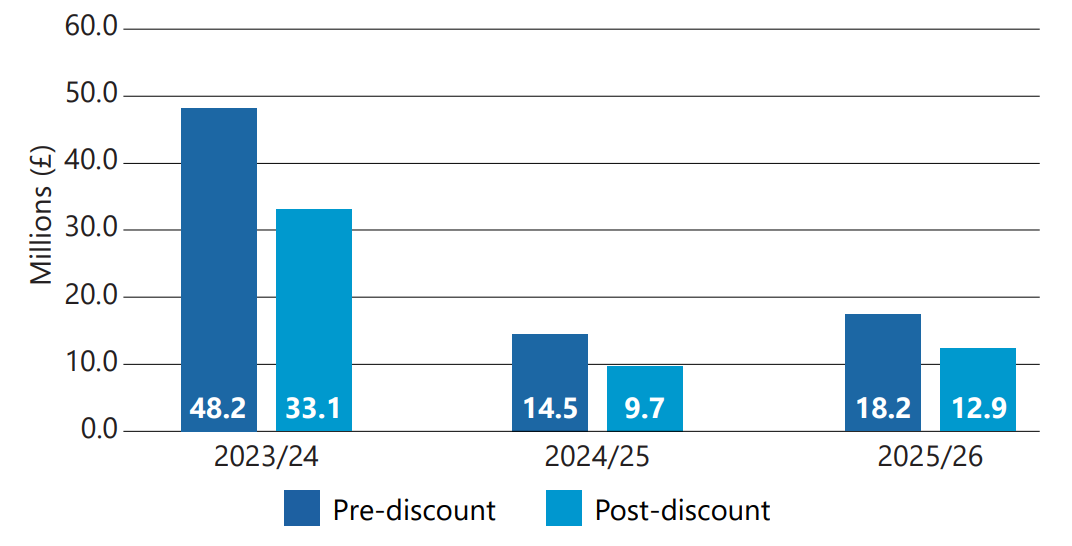
| Year | Pre-discount (£M) | Post-discount (£M) |
|---|---|---|
| 2023/24 | 48.2 | 33.1 |
| 2024/25 | 14.5 | 9.7 |
| 2025/26 | 18.2 | 12.9 |
| Total financial sanctions imposed: | 2023/24 | 2024/25 | 2025/26 |
|---|---|---|---|
| Pre-discount | £48.2m | £14.5m | £18.2m |
| Post-discount | £33.1m | £9.7m | £12.9m |
| Number of financial sanctions imposed | 17 | 11 | 18 |
| Number of non-financial sanctions imposed | 40 | 32 | 46 |
| Of which: | |||
| Exclusions | 2 | 2 | 6 |
| Requirements and undertakings | 6 | 7 | 10 |
The largest financial sanction in any one matter this year was imposed on BDO and two engagement partners following their admissions of Misconduct in a Scheme case (BDO & Ors). This case revealed serious deficiencies in both the firm's systems and controls for ensuring adequate audit supervision by engagement partners over an extended period, and failures of supervision and oversight by the partners in relation to multiple specific audits (£6.8 million adjusted to £6.1 million after settlement discount).
Substantial financial sanctions were also imposed on PwC and a former engagement partner in relation to serious and numerous failures identified in the firm's audits of Babcock International Group Plc for FY2019 and FY2020 (£5.6 million adjusted to £3.3 million after settlement discount). Together, these matters accounted for a significant proportion of the total value of fines for the year, both before and after the application of settlement discounts (£12.4 million and £9.4 million against overall FY2025/26 figures of £18.2 million and £12.9 million respectively).
The other audit matters sanctioned during the year were in respect of:
- KPMG's audit of N Brown Group plc (FY2022), in which a financial sanction of £1.34 million was imposed on KPMG and the engagement partner (adjusted to £762,125 after settlement discount).
- King & King's audits of four entities that form part of the GFG Alliance (FY2019 and FY2020), where a financial sanction of £408,684 was imposed on King & King and the engagement partner (adjusted to £378,684 after settlement discount).45
- BDO's audit of NMCN plc (FY2019), in which a financial sanction of £2.075 million was imposed on BDO and the engagement partner (adjusted to £1.380 million after settlement discount).
- Mazars' audit of Studio Retail Group plc (FY2021), in which a fine of £1.01 million was imposed on Mazars and the engagement partner (adjusted to £610,537 after settlement discount).
The level of discounts awarded in accordance with the Sanctions Policy (AEP) in settled audit cases ranged from 25% to 43%,46 reflecting differences in the timing of admissions and the extent of mitigation (including cooperation). Severe Reprimands were imposed on all audit firms and engagement partners sanctioned this year. In one case, the starting point for the financial sanction was increased by 5% prior to settlement discount to reflect a lack of cooperation by the subject in failing to provide complete and accurate information during the investigation.47
In relation to Members who were professional accountants in business, sanctions were imposed in respect of the following matters in the year to 31 March 2026:
- The conduct of five Members in relation to the preparation and approval of the financial statements of Carillion plc for FY2014 - 2016 and the six months
- ended 30 June 2017 and the preparation and reporting of other financial information during the period 2014-2017. In aggregate, financial sanctions imposed on the five individuals totalled £925,000 (adjusted to £379,747 after settlement discounts and reduced to take account of fines imposed by the FCA on two of the individuals in respect of related events) together with recommended exclusions from their professional bodies for periods ranging from two to 15 years.
- The failure of a Member to cooperate with an enforcement investigation into his conduct as Finance Director of a UK private company. A Tribunal found that the deliberate and prolonged nature of the breaches, which included failures to respond to a number of FRC communications and to comply with a notice requiring the Member to arrange to attend an interview, rendered them intrinsically serious.48 The Tribunal recommended that the Member should be excluded from their professional body for a period of five years and he was also ordered to pay the FRC's costs and those of the Tribunal, amounting to £70,207.
£16.3m financial sanctions imposed on audit firms.
Financial sanctions imposed against audit firms
Six financial sanctions were imposed against audit firms in respect of nine audit cases, totalling £16.3 million (£11.8 million after settlement discounts and/or mitigation).
Financial sanctions – audit firms
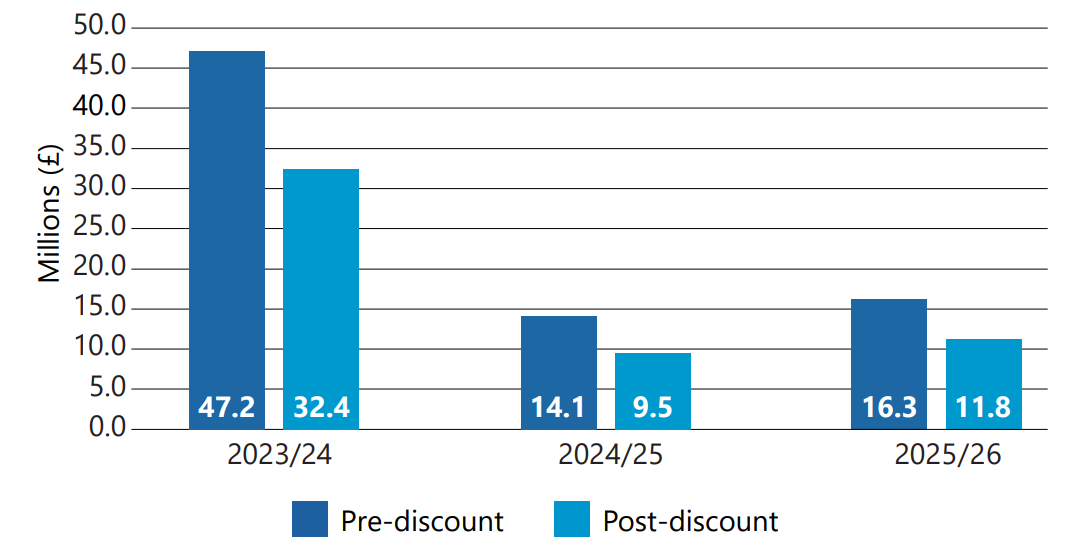
| Year | Pre-discount (£M) | Post-discount (£M) |
|---|---|---|
| 2023/24 | 47.2 | 32.4 |
| 2024/25 | 14.1 | 9.5 |
| 2025/26 | 16.3 | 11.8 |
| Description | 2023/24 | 2024/25 | 2025/26 |
|---|---|---|---|
| Number of financial sanctions against audit partners | 8 | 6 | 6 |
As noted above, the highest financial sanction in the year was imposed against BDO (audit firm sanction of £6.5 million adjusted to £5.85 million after settlement discount). Details of this matter can be found on page 26. The sanctions took into account BDO's liability for the conduct of both the senior manager, and two senior engagement partners who failed to adequately supervise multiple audits.
PwC's audit of Babcock International Group financial statements for the years ended 31 March 2019 and 2020 attracted a sanction against the firm of £5.5 million (adjusted to £3.2 million after settlement discount).49
Financial sanctions imposed against audit partners
Total financial sanctions imposed against audit partners in the period to 31 March 2026 amounted to £0.96 million (£0.80 million after settlement discounts and/or mitigation).
Financial sanctions – audit partners
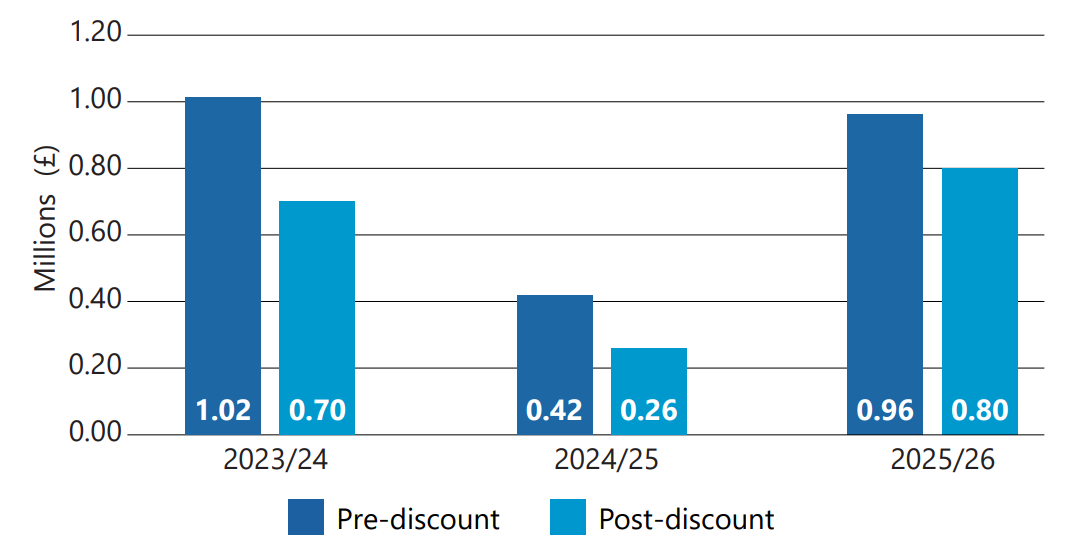
| Year | Pre-discount (£M) | Post-discount (£M) |
|---|---|---|
| 2023/24 | 1.02 | 0.70 |
| 2024/25 | 0.42 | 0.26 |
| 2025/26 | 0.96 | 0.80 |
| Description | 2023/24 | 2024/25 | 2025/26 |
|---|---|---|---|
| Number of financial sanctions against audit partners | 9 | 5 | 7 |
Financial sanctions imposed against audit partners take into account a number of factors, including the seriousness of the breaches and the individual's financial resources.
Sanctions against firms and accountants in respect of non-audit matters
Sanctions were imposed against six Members who were professional accountants in business in the year to 31 March 2026. These included financial sanctions ranging from £40,000 to £550,000 (pre settlement discount and other adjustments). Recommended periods of exclusion imposed on five individuals in relation to Carillion matter referred to above (and in more detail in the spotlight at page 28), ranged from two to 15 years. A recommended five-year exclusion together with an order for costs was imposed on an individual whom a Disciplinary Tribunal found had failed to cooperate with the FRC's investigation (also referred to above and on page 29).
Non-financial sanctions
These remain a key part of the enforcement toolkit. This year a number of sanctions included the implementation of measures designed to prevent repetition of the Misconduct or breaches that occurred, reflecting our role as a forward-looking, improvement regulator. Exclusions of six individuals were also imposed to fulfil the objectives of our sanctioning regime, including protection of the public and maintaining public confidence in the auditing and accounting professions.
6 exclusions imposed on individuals.
Non-financial sanctions
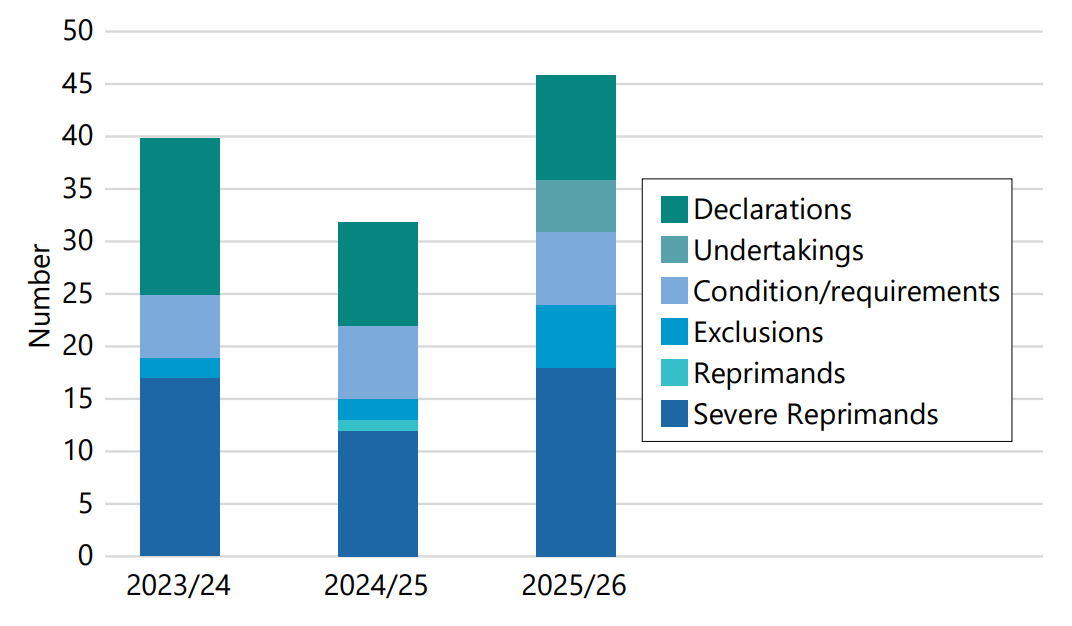
| Number of non-financial sanctions | 2023/24 | 2024/25 | 2025/26 |
|---|---|---|---|
| Severe Reprimands | 17 | 12 | 18 |
| Reprimands | - | 1 | 2 |
| Exclusions | 2 | 2 | 6 |
| Conditions/requirements | 6 | 7 | 7 |
| Undertakings | - | - | 5 |
| Declarations | 15 | 10 | 10 |
| Total | 40 | 32 | 46 |
| Number of cases resolved with findings50 | 8 | 9 | 11 |
| Number of parties sanctioned51 | 18 | 12 | 19 |
More specifically, non-financial sanctions published in the year included:52
- A requirement that BDO report to the FRC every six months, for a period of two years, on the implementation and effectiveness of various measures designed to prevent recurrence of the serious failings identified in the investigation.
- Conditions that two BDO audit partners should not perform any audit work (including, but not limited to, the signing of any auditor's report expressing an opinion on a reporting entity's financial statements) for periods of three and six years.
- Exclusion as a Member of the Chartered Institute of Management Accountants (CIMA), for a recommended period of five years imposed on the Member who failed to cooperate with an FRC investigation.
- Exclusions from the ICAEW for recommended periods of 10 and 15 years, and from CIMA for recommended periods of two, five and eight years imposed on the professional accountants in business who were found to have committed Misconduct in the Carillion matter.
- An order that an audit firm, King & King: (i) shall not seek to obtain registration on the PIE Audit Register for a period of five years (ii) shall not accept any new appointment as auditor to any private company which meets the definition of a "high turnover company" for a period of two years (iii) shall implement firm wide training on ethical compliance; and (iv) shall submit to an audit monitoring review to be carried out by the ICAEW.
- An order requiring PwC to (i) develop and trial additional measures to ensure that there is more formalised ongoing central monitoring of indicators of increasing audit risk, and mitigation of that risk where this is required (ii) report to the FRC on the outcome of the trial, including any enhancements to the measures to be adopted and (iii) report to the FRC
- on the effectiveness of the measures in place within the firm to mitigate the risks arising where there is a change of engagement leader on an ongoing audit, and on any enhancements to the measures needed as a result of the effectiveness assessment.
- An order requiring Mazars to report on the remedial steps taken to reduce the risk of recurrence of certain deficiencies identified in the relevant audit and the effectiveness of the same.
- An order that Mazars implement training for an engagement partner in certain audit areas where deficiencies had been identified during the relevant audit.
As set out above, the overall number of non-financial sanctions rose this year reflecting, in part, the increased number of subjects against whom sanctions were imposed.
6. Timeliness
Timeliness continues to be a priority for us and, as in previous years, we report on our performance as measured against our two KPIs:
1Two-year KPI: A period of two years between notification of the commencement of an investigation and service of either the Proposed Formal Complaint (PFC) or Investigation Report (IR) (or closure or settlement if sooner) in 50% of cases in a financial reporting period (1 April to 31 March). In 2025/26, we achieved this in 50% of applicable cases, so met the KPI.
2Three-year KPI: A period of three years between notification of the commencement of investigation and service of either the PFC or IR (or closure or settlement if sooner) in 80% of cases in a financial reporting period (1 April to 31 March). In 2025/26, we achieved this in 100% of cases, so exceeded the KPI.53
KPI reporting
Two-year KPI
Six cases were opened between 1 April 2023 and 31 March 2024 and were subject to the two-year KPI. Three met the KPI, however it was missed in the three remaining cases. In one instance, it was missed by only four weeks and in a second case, the need to broaden the scope of the investigation to cover an additional audit year prevented us from meeting the KPI. In a third case, the delay resulted from several factors, including the availability of Counsel and internal resources, as well as the requirement to obtain further information from the Respondents at a late stage in the investigation.
The table below sets out our performance against this KPI over the past three years. Given the small pool of cases to which the KPI applied this year, particular caution should be exercised in seeking to draw any firm conclusions or discern any meaningful trends from these results.
| Financial year KPI falls due | 2023/24 | 2024/25 | 2025/26 |
|---|---|---|---|
| Percentage of cases meeting the two-year KPI | 53% | 90% | 50% |
Three-year KPI
Ten cases were opened between 1 April 2022 and 31 March 2023 and were subject to the three-year KPI. This year every applicable case met the three-year KPI. The table below sets out our performance over the past three years and shows that we have significantly exceeded the KPI in each of these.
| Financial year KPI falls due | 2023/24 | 2024/25 | 2025/26 |
|---|---|---|---|
| Percentage of cases meeting the three-year KPI | 88% | 87% | 100% |
Average time to service of PFC or IR (or closure or settlement if earlier)
The average length of time for cases reaching this milestone during the year is shown below.
| Description | 2023/24 | 2024/25 | 2025/26 |
|---|---|---|---|
| Number of cases where PFC/IR issued (or settled/closed, if earlier) | 10 | 19 | 6 |
| Average length of time to issuance of PFC/IR (or settlement/closure, if earlier) (in months) | 25 | 28 | 21 |
Time to complete a case
The table below shows the average length of cases that concluded this year and in the previous two years.
| Description | 2023/24 | 2024/25 | 2025/26 |
|---|---|---|---|
| Average length of cases referred to Tribunal (months) | - | - | 28 |
| (Number of cases) | (-) | (-) | (1) |
| Average length of all cases concluded as a result of settlement or service of undisputed Decision Notice (months) | 42 | 45 | 50 |
| (Number of cases) | (8) | (9) | (10) |
| Average length of cases closed with no further action (months) | 9 | 27 | 11 |
| (Number of cases) | (1) | (2) | (3) |
1 case concluded through Tribunal proceedings.
As indicated in the first row, one case was concluded through referral to the Tribunal. The average length of all cases concluded through settlement or service of an undisputed Decision Notice was 50 months. This was significantly inflated by two particularly large and complex matters which were settled during the year, BDO & Ors (see page 26) and sanctions in the Carillion matter (see page 28).
The final row of the table relates to three matters which were closed following Executive Counsel's decision that no enforcement action should be taken.
Average age of cases open at year end
The table below sets out the number and average age of cases that remain open at the year end.
| Description | 2023/24 | 2024/25 | 2025/26 |
|---|---|---|---|
| Number of cases open at year end | 35 | 32 | 25 |
| Number of cases opened in year | 6 | 8 | 7 |
| Average age of cases open at year end (in months) | 28.8 | 29.0 | 29.1 |
The data below shows the age profile of cases open at year end, compared with the same period in 2024/25. It shows a net reduction of seven cases over the course of the year. The investigation which opened in 2017/18 remains on hold pending resolution of parallel proceedings.
Year investigation opened (to 31 March)
| Description | 2018 | 2019 | 2021 | 2022 | 2023 | 2024 | 2025 | 2026 | Total |
|---|---|---|---|---|---|---|---|---|---|
| Cases open at 1 April 2025 | 1 | 1 | 3 | 9 | 6 | 4 | 8 | 32 | |
| Cases closed in year | 1 | 1 | 6 | 1 | 2 | 3 | - | 14 | |
| Cases open at 31 March 2026 | - | 1 | 2 | 3 | 5 | 2 | 5 | 7 | 25 |
The FRC does not accept any liability to any party for any loss, damage or costs, however arising, whether directly or indirectly, whether in contract, tort or otherwise from action or decision taken (or not taken) as a result of any person relying on or otherwise using this document or arising from any omission from it.
© The Financial Reporting Council Limited 2026
The Financial Reporting Council Limited is a company limited by guarantee.
Registered in England number 2486368.
Registered Office: 13th Floor, 1 Harbour Exchange Square, London, E14 9GE
Financial Reporting Council
London office:
13th Floor, 1 Harbour
Exchange Square,
London, E14 9GE
Birmingham office:
5th Floor, 3 Arena
Central, Bridge Street,
Birmingham, B1 2AX
+44 (0)20 7492 2300
www.frc.org.uk
Follow us on LinkedIn
Footnotes
-
Press Notice: FRC modernises enforcement to deliver faster outcomes and earlier learnings for the UK audit market. ↩
-
Year ended 31 March 2026. ↩
-
No investigations into actuaries were opened during the year. ↩
-
A period of two years between the notification of an investigation and service of either the Proposed Formal Complaint or Investigation Report (or closure or settlement if sooner). Further details can be found in Chapter 6 of this Review. ↩
-
A period of three years between the notification an investigation and service of either the Proposed Formal Complaint or Investigation Report (or closure or settlement if sooner). Further details can be found in Chapter 6 of this Review. ↩
-
The Sanctions Policy and Guidance in effect in 2025/26 did not provide any assistance on the appropriate level of discount for exceptional co-operation. In 2017, an independent review of FRC sanctions suggested that a discount of up to 15% may be appropriate. The practice of the FRC has been to regard that as a maximum, with the discount applied in any particular case reflecting the level of co-operation provided. This approach was formalised in the new version of the AEP Sanctions Policy which came into effect in July 2026 (with an enhanced discount of up to 25% available under the new Accelerated Procedure and Early Admissions Process). ↩
-
Reference is made to the Audit Enforcement Procedure in force at the time of this investigation. ↩
-
Press notice: Sanctions against KPMG LLP and an audit engagement partner. ↩
-
Press notice: Sanctions against PwC LLP and an audit engagement partner. ↩
-
Press notice: FRC imposes sanctions against BDO LLP and two audit engagement partners. ↩
-
Press notice: Sanctions against a Member for failure to co-operate with an investigation by the Financial Reporting Council. ↩
-
Reference is made to the Audit Enforcement Procedure in force in 2025/26. ↩
-
Overview of Case Assessment: Sources of Enquiry and Outcomes of Enquiry. ↩
-
The enquiries and outcomes data comprises all cases passing through the CA process, including all audit matters dealt with under the AEP, and all Scheme matters referred to the Conduct Committee. ↩
-
The source category refers to how a matter first came to the FRC's attention. It may be that matters we identify through horizon scanning activities are also subsequently the subject of complaints or external referrals. ↩
-
The time and progression of the matter is dependent on third party information. ↩
-
CA cases are closed when (i) they are referred for investigation by the Conduct Committee or (ii) the decision is taken by the Case Examiner (or by the Conduct Committee for Referral Cases) that the matter should be resolved through Constructive Engagement or no further enquiry work needs to be undertaken. Individual CA outcomes are not published, except where they lead to the opening of investigations and in accordance with the Publication Policies, it is considered appropriate to announce that investigation. ↩
-
No further action means no further enforcement action. It includes, where appropriate, CA passing relevant information to other areas of the FRC, such as the Supervisor of a particular firm, to consider further supervisory action outside of enforcement and of the Constructive Engagement process. ↩
-
This figure includes one matter that was referred to the Conduct Committee for potential preliminary enquiry. ↩
-
Referral Cases were cases in which the Case Examiner considered that Constructive Engagement should be undertaken or no further action should be taken, but was required to refer the matter to the Conduct Committee for a decision under guidance then in force. ↩
-
In 2025/26, Guidance for the Case Examiner (AEP), paragraphs 13 to 15 outline where a case may be suitable for Constructive Engagement. From 1 July 2026, paragraph 29 of the new Case Assessment and Allocation Policy outlines where a case may be suitable for Constructive Engagement. ↩
-
There may be multiple underlying issues connected to a single case. ↩
-
Overview of Enforcement: who the FRC investigates and acts against and its enforcement regimes. Further details of the FRC's remit and powers can be found in the enforcement regimes and information gathering powers on the FRC's website. ↩
-
The Auditor Regulatory Sanctions Procedure covers failures to comply with the Regulatory Framework for Auditing of major local audits. These are principally local authorities and health bodies other than NHS Foundation Trusts. Sanctions imposed under the Auditor Regulatory Sanctions Procedure. ↩
-
Under the Crown Dependencies' Recognised Auditor Regulatory Sanctions Procedure, AQR team has inspected a Recognised Auditor registered in one of the Crown Dependencies of Guernsey, the Isle of Man and Jersey. ↩
-
One preliminary enquiry was concluded during the year and resulted in the opening of an investigation that remains open. ↩
-
In 2023/24, two investigations were opened following AQR referrals; in 2022/23, three investigations were opened following AQR referrals. ↩
-
Publication Policy (Accountancy and Actuarial Schemes), Publication Policy (Audit Enforcement Procedure). ↩
-
Investigations that have been announced can be found at FRC Enforcement Cases. ↩
-
No preliminary enquiries were open or concluded in the 12 months to 31 March 2024 or 31 March 2025. ↩
-
In one matter, sanctions were imposed in respect of four audit investigations. ↩
-
Sanctions against a BDO Senior Manager. ↩
-
FRC imposes sanctions against BDO LLP and two audit engagement partners. ↩
-
The FRC also made other findings against BDO, including that the firm failed to respond adequately to internal reports which raised or should have raised concerns as to the Senior Manager's honesty and integrity. ↩
-
Press notice: Findings in relation to two Members, and confirming enforcement action against three further individuals. ↩
-
Press notice: Sanctions against KPMG LLP, KPMG Audit plc and two former partners. ↩
-
Press notice: Sanctions against KPMG and others in connection with Regenersis & Carillion audits. ↩
-
The FRC's Conduct Committee decided not to name the other three individuals against whom the FRC took action, or to publish full details of their Misconduct, having taken into account certain specific and exceptional circumstances of a confidential nature that affected their cases. ↩
-
Press notice: Sanctions against a Member for failure to cooperate with an investigation by the Financial Reporting Council. ↩
-
An investigation will comprise one of the following: (1) an audit investigation into an audit firm and/or audit partner(s) (under the Accountancy Scheme or the AEP); (2) an investigation into professional accountant(s) working in business (under the Accountancy Scheme); (3) a non-audit investigation into professional accountant(s) and accountancy firms (under the Accountancy Scheme); or (4) an investigation into actuaries (under the Actuarial Scheme). Each investigation may include multiple subjects, and an investigation is not considered closed until concluded against all subjects. ↩
-
Seven investigations were opened in the year to 31 March 2026. An average of 11 investigations per year were opened over the last eight years. ↩
-
Links to the sanctions policies: Sanctions Policy (Audit Enforcement Procedure) (effective from January 2022); Accountancy Scheme Sanctions Guidance (March 2021); Actuarial Scheme Sanctions Guidance (March 2021). ↩
-
Sanctions were imposed in respect of four audit investigations. ↩
-
The maximum adjustment awarded for mitigation was % and the maximum discount for admissions and early disposal was 35%. As the early disposal discount was applied to the figure after mitigation, the overall maximum discount amounted to 43%. ↩
-
One of the engagement partners in the BDO & Ors matter referred to above. ↩
-
In light of the sanction of Exclusion and the fact that the Member was at that time the subject of legal proceedings by the Securities and Exchange Commission in the USA in respect of the underlying allegations of Misconduct, Executive Counsel decided that it was no longer in the public interest to continue with the FRC investigation of those allegations. Accordingly, the investigation was closed with no further disciplinary action. ↩
-
In 2024/25 the largest audit firm sanction was £6.5 million (adjusted to £4.9 million after settlement discount); sanctions were imposed in six audit firm cases in the year. In 2023/24 the highest financial sanction on an audit firm was £30.0 million (adjusted to £21.0 million after settlement discount); sanctions were imposed in eight audit firm cases in the year. ↩
-
Excludes cases resolved with no further action. ↩
-
Count of firms and individuals sanctioned. Where a subject is sanctioned in more than one case, each instance of sanction is counted separately. ↩
-
In addition to Severe Reprimands and Declarations that certain audit reports did not satisfy certain Relevant Requirements. ↩
-
The three-year KPI is set at 80% in recognition that not all cases can be completed within three years, whether because, for example, the case is of exceptional size or complexity, or for reasons beyond our control, such as where there are parallel criminal proceedings. ↩