
The content on this page has been converted from PDF to HTML format using an artificial intelligence (AI) tool as part of our ongoing efforts to improve accessibility and usability of our publications. Note:
- No human verification has been conducted of the converted content.
- While we strive for accuracy errors or omissions may exist.
- This content is provided for informational purposes only and should not be relied upon as a definitive or authoritative source.
- For the official and verified version of the publication, refer to the original PDF document.
If you identify any inaccuracies or have concerns about the content, please contact us at [email protected].
Governance Handbook
- 1. FRC Governance Handbook
- 2. Schedule of Matters Reserved to the Board
- People Committee - terms of reference
- Schedule of responsibilities and delegated tasks
- Audit and Risk Committee - terms of reference
- Schedule of responsibilities and delegated tasks
- Conduct Committee - terms of reference
- Schedule of responsibilities and delegated tasks
- General Terms that apply to all FRC Board Committees
- Articles of Association of The Financial Reporting Council Limited
- Part 1 – Interpretation and Limitation of Liability
- Part 2 - Directors
- 4. Board composition
- 5. Appointment of directors
- 6. Retirement, vacation and removal of directors
- 7. Directors to take decisions collectively
- 8. Common decisions
- 9. Calling a directors' meeting
- 10. Participation in directors' meetings
- 11. Quorum for directors' meetings
- 12. Chairing of directors' meetings
- 13. Casting vote
- 14. Directors' general authority and reporting requirements
- 15. Delegation of powers and functions
- 16. Committees
- 17. Continuity of operations
- 18. Authorisation
- 19. Matters not requiring an Authorisation
- 20. Participation in decision-making
- 21. No obligation to account
- 22. General
- 23. Records of decisions to be kept
- 24. Directors' discretion to make further rules
- 25. Directors' remuneration
- 26. Directors' expenses
- Part 3 - Members
- 27. Members of the Company
- 28. Written Resolutions
- Part 4 - Administrative Arrangements
- 29. Means of communication to be used
- 30. Notices to members
- 31. Secretary
- 32. No right to inspect accounts and other records
- 33. Provision for employees on cessation of business
- 34. Indemnity and Insurance
1. FRC Governance Handbook
Governance Overview
The Financial Reporting Council (FRC) is governed by its Board, which is comprised of the non-executive directors and the CEO.
The Board is collectively responsible for the long-term success of the FRC. Its role includes, but is not limited to:
- providing strategic leadership of the FRC within a framework of prudent and effective controls which enables risk to be assessed and managed.
- setting the FRC's strategic aims, ensures that the necessary financial and human resources are in place for the FRC to meet its objectives, and reviews management performance.
- setting the FRC's values and culture, and
- ensuring that its obligations to its stakeholders and others are understood and met.
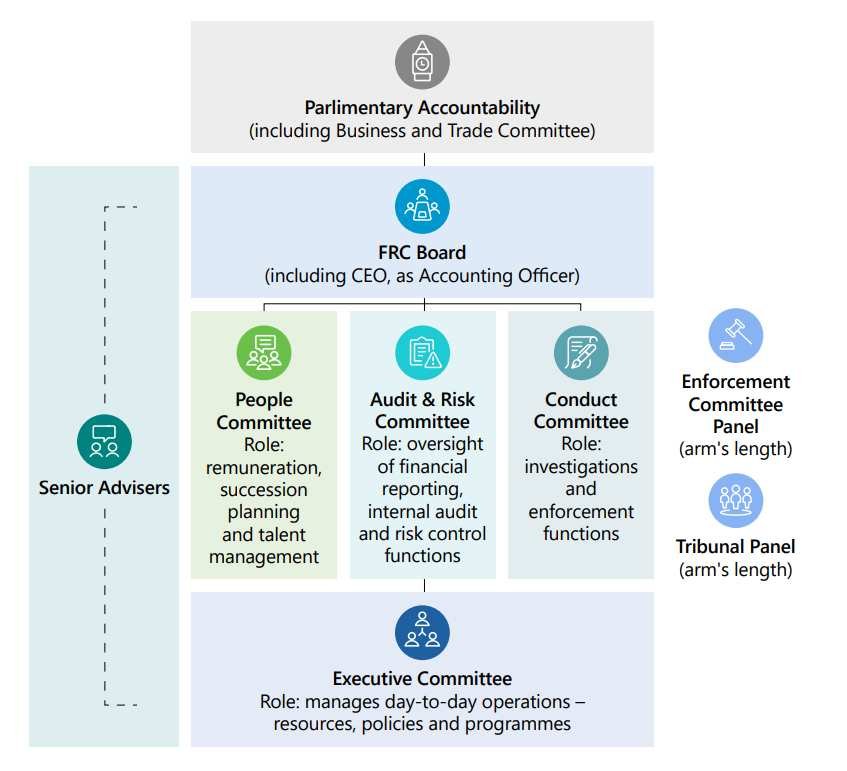
The Board has established committees to support its functions and is also supported by a capable Executive management team and Executive Committee who run the day-to day operations of the organisation.
The Board and Executive are also supported by Senior Advisers and an Advisory Panel who are subject matter experts and provide technical advice.
A Tribunal Panel and an Enforcement Committee Panel are also constituted to consider enforcement cases and enforcement matters under the FRC's conduct procedures.
A diagram of the FRC's governance structure can be found below.
2. Schedule of Matters Reserved to the Board
Board – terms of reference and reserved matters
1. Role and responsibilities
1.1The Board of the Financial Reporting Council (FRC) is responsible for the long-term success of the FRC.
1.2The Board's role is to:
- provide strategic leadership of the FRC within a framework of prudent and effective controls which enable risk to be assessed and managed;
- set the FRC's strategic aims, ensure that the necessary financial and human resources are in place for the FRC to meet its objectives and review management performance; and
- set the FRC's values and culture and ensure that its obligations to its stakeholders and others are understood and met.
1.3All Board directors must act in what they consider to be the best interests of the FRC, consistent with their statutory duties.
1.4The Board is supported by two governance committees (People Committee and Audit and Risk Committee) and by one regulatory committee (the Conduct Committee) (together, Board Committees). The Board is also supported by the FRC's Chief Executive and Accounting Officer (CEO), who manages the day-to-day operations of the FRC, including resources, policies and programmes. The CEO has convened a committee in accordance with Article 15.21 (the Executive Committee) to advise and support them in the fulfilment of their responsibilities.
1.5Matters which the Board considers suitable for delegation are delegated to the CEO or to the Board Committees. Matters which are delegated to the Board Committees are detailed in the terms of reference of the relevant Board Committee. In accordance with Article 15.4, the Board may revoke any delegation in whole or in part, or alter a delegation's terms and conditions. Where the Board proposes to revoke or alter any delegation, it will notify the relevant delegate in writing of the matter(s) whose delegation it intends to revoke or alter and, if appropriate, the reasons for so doing.
1.6Matters which the Board considers are not suitable for delegation and which are reserved to the Board are addressed at paragraph 6 of, and the Schedule to, these terms of reference.
2. Membership
2.1The Board shall comprise the FRC's Chair, the CEO and any other non-executive directors appointed in accordance with the FRC's Articles of Association.
3. Meetings
3.1Meetings of the Board shall take place not less than six times per annum and shall otherwise be held in accordance with the FRC's Articles of Association.
4. Agenda
4.1The agenda for Board meetings will be set by the Chair in consultation with the CEO and with the support of the company secretary.
5. Conflicts with the Articles
5.1These terms of reference should be read alongside the FRC's Articles of Association and, to the extent there is any conflict, the Articles of Association shall take precedence.
6. Matters reserved to the FRC Board
6.1The schedule to these terms of reference sets out the decisions and matters which are (or which the Board considers to be) unsuitable for delegation and are therefore reserved to the Board.
6.2Matters which the Board considers to be suitable for delegation are contained in the terms of reference of the Board Committees or are delegated to the CEO. In delegating matters to the CEO, the Board is mindful that Article 15 of the FRC's Articles of Association permits the CEO to convene a committee of senior Executives to advise and support them in the fulfilment of their responsibilities. The Board also authorises the further delegation of matters delegated to the CEO in accordance with Article 15.3 of the FRC's Articles of Association, subject to Article 15.4.
6.3In undertaking the matters set out below, the Board will support the CEO (including in the CEO's capacity as Accounting Officer), in the fulfilment of their responsibilities and in ensuring compliance with relevant HM Treasury guidance, Managing Public Money and any applicable Cabinet Office Controls.
| No. | Board reserved matters | Reference |
|---|---|---|
| 1. | Strategy and management | |
| 1.1 | Assume responsibility for overall leadership of the FRC. | |
| 1.2 | Establish the FRC's values and culture. | |
| 1.3 | Approve the FRC's purpose, strategic aims and objectives. | |
| 1.4 | Monitor operational performance and deliverables in the Annual Plan. | |
| 1.5 | Approve annual levy proposals. | |
| 1.6 | Approve and regularly review the FRC's strategy, operational plans and annual budget. | |
| 1.7 | Approve and regularly review the FRC's regulatory approach including any extension of the FRC's activities into new regulatory or geographic areas. | |
| 1.8 | Approve the operating Framework Document with the FRC's sponsoring government department. | FRC-DBT Framework Document May 2022 |
| 1.9 | Consider significant matters affecting the FRC's reputation. | |
| 1.10 | Oversee the strategy for stakeholder engagement and the discharge of the Board's responsibilities under s.172 of the Companies Act 2006 (CA2006). | s 172 CA 2006 |
| 1.11 | In conjunction with the FRC's sponsoring government department, take any decisions to cease to operate all or any material part of the FRC's activities. | |
| 1.12 | Approve any Statutory Instruments that are made by the FRC (and amendments thereto). | |
| 2. | Financial management and reporting | |
| 2.1 | Approve the annual report and accounts and confirm that, taken as a whole, they present a fair, balanced and understandable assessment of the FRC's position and prospects and provide the information necessary to assess the FRC's performance, business model and strategy. | ss414A to 419, CA2006 and Article 13 of the Articles of Association |
| 2.2 | Review and monitor financial performance including progress against agreed budget and any reforecasting exercises. | |
| 2.3 | Approve any significant changes in accounting policies or practices. | |
| 2.4 | Consider significant financial reporting issues and judgements having regard to the matters communicated by the auditors. | |
| 2.5 | Ensure financial policies and systems are in line with the principles of Managing Public Money. | Managing Public Money |
| 3. | Internal controls and risk management | |
| 3.1 | Consider the nature and extent of the key risks to the FRC's strategic objectives. | |
| 3.2 | Receive annual assurance from the Audit and Risk Committee on the effectiveness of the FRC's internal control and risk management systems. | |
| 3.3 | Consider Executive recommendations on risk appetite and on the FRC's internal controls and risk management framework and any changes thereto. | |
| 3.4 | Determine the FRC's risk appetite and undertake an annual assessment of the effectiveness of the FRC's risk management system. | |
| 3.5 | Monitor the Executive's identification and management of the principal risks and oversee the maintenance of a sound system of internal control and risk management including financial controls. | |
| 3.6 | Monitor the FRC's central complaints processes and procedures and receive bi-annual updates on the number and nature of complaints made to the FRC. | |
| 4. | Appointment of external auditor | |
| 4.1 | As members of FRC Limited, approve the appointment or removal of the FRC's external auditor. | |
| 5. | Structure and major decisions | |
| 5.1 | Approve major changes to the FRC's corporate structure including the entering into of material joint venture agreements. | |
| 5.2 | Approve significant changes to the FRC's management and control structure. | |
| 5.3 | Approve contracts, the value of which (including VAT) is in excess of £1 million and/or which may have a significant reputational risk to the organisation. The Accounting Officer may refer any other expenditure to the Board for approval below this amount or which may have a significant reputational risk to the organisation. | |
| 5.4 | Approve any proposed lease with a term exceeding five years. | |
| 5.5 | Approve the commencement, defence or settlement of litigation involving a value in excess of £1 million or being otherwise materially significant to the FRC (not including matters that have been delegated to the Conduct Committee and are to be pursued under the Accountancy or Actuarial Schemes, Crown Dependencies Recognised Auditor Sanctions Procedure, Auditor Regulatory Sanctions Procedure, Auditor General Disciplinary Rules or Audit Enforcement Procedure). | |
| 6. | People and culture | |
| 6.1 | Approve appointments, reappointments and removal of members of the Board Committees. | |
| 6.2 | Provide advice to the FRC's sponsoring government department in relation to the structure, size and composition of the Board and in relation to Board succession planning. | |
| 6.3 | Approve the Board Diversity Policy. | |
| 6.4 | Approve the Board terms of appointment. | |
| 6.5 | Approve the CEO's objectives based on the FRC's strategy and support the Chair of the Board in the performance review of the CEO. | |
| 6.6 | Approve the FRC's Modern Slavery Statement. | |
| 6.7 | On the recommendation of the CEO, approve the appointment and/or removal of the Company Secretary and the Executive Counsel. | |
| 6.8 | CEO to consult with the Board on any proposed removal or appointment of a member of the Executive Committee and, in the case of appointments, at least one member of the Board shall sit on the relevant recruitment panel. | |
| 7. | Governance matters and delegations | |
| 7.1 | Regularly evaluate its own performance and that of its Committees. | |
| 7.2 | Approve its own terms of reference (including reserved matters) and those of its Committees (including delegated matters). | |
| 7.4 | Approve any significant changes to the FRC's Committees and non-executive advisory structure. | |
| 7.5 | Approve the published statement on the Roles and Responsibilities of the Board, Chair and Chief Executive. | |
| 7.6 | Commission an annual performance review of the Board and its Committees and ensure the Board and Committee performance review is facilitated externally at least once every three years. | Corporate Governance Code |
| 7.7 | Report to the Secretary of State on the discharge of the FRC's statutory duties in such manner and with such frequency as shall be agreed with the Secretary of State from time to time. | Article 13.4 of the Articles of Association |
| 8. | Regulatory standards and code | |
| 8.1 | Oversee the development and maintenance of regulatory standards and codes within the FRC's remit. | Including under reg 3(1)(c) of the Statutory Auditors and Third Country Auditors Regulations 2016 (SATCAR 2016) |
| 8.2 | Approve the issuance of consultation documents relating to the substantive development or maintenance of regulatory standards and codes. | |
| 8.3 | Approve the issuance of regulatory standards and codes for publication. | Including under reg 3(1)(c) SATCAR 2016 |
| 8.4 | Approve policy and major projects which support the FRC's competition strategy. | Article 27 of the Audit Regulation |
| 8.5 | Approve the recognition of bodies making Statements of Recommended Practice (SORPs). | Including reg 16(9)(a)(iii) Charities (Accounts and Reports) Regulations 2008 |
| 9. | Supervision – Professional Body Supervision | |
| 9.1 | Exercise the FRC's functions as the designated Competent Authority for Audit under SATCAR 2016, including the delegation, removal or retention of tasks to the Recognised Supervisory Bodies (RSB). | SATCAR 2016 Delegation Agreements |
| 9.2 | Approve the publication of the annual report containing a summary of the results of inspections conducted under regulation 9 of SATCAR 20162 at the same time as the information to be published under Article 28(d) of the Audit Regulation is published. | SATCAR 2016, reg 9(11) Article 28(d) Regulation (EU) 537/2014 of 16 April 2014 as assimilated (Audit Regulation) |
| 9.3 | Exercise the functions transferred to the FRC by the Secretary of State under Part 42 of the CA 2006 as follows: a. the continued recognition of an RSB to supervise auditors; and b. the continued recognition of qualifying bodies (RQB) to offer a recognised audit qualification. | Part 42, CA2006 and Schedules 10 and 11 to CA20063 |
| 9.4 | Approve: a. the imposition of a direction or penalty on an RSB or RQB; b. applications to the court for an Order to require a RSB or RQB to meet its statutory obligations. | ss1225-1225G, CA2006 |
| 9.5 | Oversee, and receive bi-annual reports on: * The Executive's monitoring of the RSBs' performance of Regulatory Tasks delegated to them and the RSBs' compliance with the conditions of the agreed Delegation Agreements under SATCAR 16; and * Each RSB and RQB's compliance with the requirements of Schedules 10 and 11 of the CA 2006. | |
| 9.6 | Approve the publication of the FRC's annual report to the Secretary of State on its public oversight functions in relation to the Audit, Accountancy and Actuarial professions, known as the Professional Oversight Report. | s1252(10), and para 10(3) Schedule 13, CA2006. |
| 10. | Supervision - Independent Supervisor of Comptroller and Auditor General | |
| 10.1 | Oversee the effective discharge of the FRC's functions in its capacity as the appointed Independent Supervisor of the Comptroller and Auditor General. | s1228 and s1229, CA20064 |
| 10.2 | Approve the publication of an annual report to Parliament on the discharge of the FRC's Independent Supervisor functions (known as the Independent Supervisor's Report). | s1231 CA2006 |
| 11. | Supervision - Corporate Reporting Review | |
| 11.1 | Approve the publication of the Annual Review of Corporate Reporting. | |
| 11.2 | Consider and respond to the Executive's requests to the Board to approve the exercise of the FRC's powers to: a. Require the provision of information and explanation from entities or individuals; and b. Apply to court to require an entity to prepare revised accounts or reports. | Part 15, Chapter 11, CA2006 |
| 11.3 | Keep under review periodic accounts and reports that are produced by issuers of transferable securities and are required to comply with any accounting requirements imposed by the Financial Conduct Authority, and where appropriate, inform the Financial Conduct Authority of any conclusions reached in relation to any such accounts or report. | s14(2) of the Companies (Audit, Investigations and Community Enterprise) Act 2004 (CAICE 2004) |
| 12. | Supervision and enforcement – statutory auditor registration, appointment, monitoring and enforcement | |
| 12.1 | Receive reports from the Executive on the exercise of the FRC's responsibilities relating to statutory auditor independence requirements5. | Article 28, Audit Regulation and SATCAR 2016 |
| 12.2 | Approve any application to court made by the Executive for an order to remove a statutory auditor from office. | s511A, CA2006 |
| 12.3 | Approve any amendments to the Eligibility Criteria for appointment as statutory auditors. | Article 3(1)(f), SATCAR 2016 |
| 12.4 | Approve any amendments to the Public Interest Entity Auditor Registration Regulations 2022. | paras 7 to 9, Schedule 13, CA2006. |
| 12.5 | Approve the making of applications to the court to enforce compliance with a notice to provide information in connection with the inspection or investigation of statutory audit work. | para 2, Schedule 2, SATCAR 2016 |
| 12.6 | Approve the making of applications to court to enforce sanctions. | reg 7, SATCAR 2016 |
| 12.7 | Approve for publication the Annual Enforcement Review. | |
| 13. | Local audit | |
| 13.1 | Receive regular updates from the Executive Director of Supervision on the Executive's exercise of the FRC's regulatory functions, including Major Local Audit monitoring, under the Local Audit and Accountability Act 2014 (LAAA2014). | LAAA2014 |
| 13.2 | Approve the publication of an annual audit quality inspection report on Major Local Audits. | |
| 14. | Supervision - third country auditors | |
| 14.1 | Oversee the process and procedures for the registration or deregistration of third country auditors. | Statutory Auditors and Third Country Auditors Regulations 2013 |
| 14.2 | Make regulations prescribing third country auditor fees, with the approval of the Secretary of State. | s1251(2) CA2006 and the Third Country Auditors (Fees) Instrument 2021 |
| 14.3 | Make or approve amendments to directions concerning the application of certain requirements to the registration of certain third country auditors (Third Country Auditors Directions). | ss1239(7) and 1242(4) CA2006 |
| 14.4 | Approve the sending of notices requiring third country auditors to notify the FRC of specific matters or to provide requested information or verification of information. | s1243 and s1244, CA2006 |
| 14.5 | Approve the making of applications for Court Orders to secure a third country auditor's compliance with its statutory obligations. | s1245, CA2006 |
| 14.6 | Take decisions regarding the mandatory or discretionary removal of a third country auditor from the third country auditor register. | ss1246 and 1239, CA2006 SATCAR 2013 |
| 14.7 | Approve, vary, revoke or withdraw third country qualification declarations. | s1221, CA2006 |
| 14.8 | Where so requested, approve adequacy and equivalence reports to the Secretary of State. | regs 7 and 12 SATCAR 2020 |
| 15. | Crown Dependencies | |
| 15.1 | Approve the annual report to the Crown Dependencies on the discharge of the FRC's audit supervision duties in accordance with MoU between the FRC, the Institute of Chartered Accountants of England and Wales (ICAEW), the Committee for Economic Development in Guernsey, The Jersey Financial Services Commission and the Financial Supervision Commission of the Isle of Man (known as the Crown Dependencies Report). | MoU with Crown Dependencies and ICAEW |
| 16. | UK Endorsement Board (UKEB) | |
| 16.1 | Oversee the UKEB's operational resources, governance and compliance with due process in accordance with arrangements agreed with the Secretary of State and UKEB including by providing constructive challenge and recommendations to the UK Endorsement Board regarding its: (a) due process handbook; (b) compliance with its operating and governance procedures; (c) independence; and (d) strategy, and (e) effectiveness. | MoU with UKEB and Secretary of State |
| 16.2 | Ensure that the provision of operational resources to support the UK Endorsement Board's activities is appropriate, including establishing and maintaining appropriate funding arrangements whilst maintaining the independence of the UK Endorsement Board in technical decision making. | MoU with UKEB and Secretary of State |
Approved by the Board with effect from 1 November 2025
People Committee - terms of reference
1. Role and responsibilities
1.1The purpose of the People Committee (Committee) is to:
- support the Executive in providing strategic oversight on people and workforce related matters.
- provide strategic direction on succession planning, remuneration, talent management, staff welfare, and training and development, and
- perform the specific functions set out in the schedule to these terms of reference.
1.2In addition to these terms of reference, members of the Committee must adhere to the General Committee Terms contained in the FRC Governance Handbook.
2. Membership
2.1The Committee shall comprise exclusively of all non-executive members of the FRC's Board (Board).
3. Meetings
3.1The Committee shall meet at least twice a year.
Schedule of responsibilities and delegated tasks
| No. | Responsibility |
|---|---|
| 1. | Appointments and Remuneration |
| 1.1 | Support the Chair of the Board and the Department of Business and Trade (DBT) (or its successor) in the recruitment and appointment of non-executive members to the Board, including the development of job specifications. |
| 1.2 | Approve (re)appointments, removal, and terms of appointment of
|
| 1.3 | Set the remuneration of:7
|
| 1.4 | Approve amendments to the Tribunal and Appeal Panel Terms of Appointment. |
| 1.5 | Keep under review, and make recommendations to DBT on the remuneration paid to the:
|
| 1.6 | Approve annually the total individual remuneration package of the Executive Director members of the Executive Committee (excluding the CEO), subject to any approvals required under the public sector pay controls. |
| 1.7 | Monitor the submission of the annual staff remuneration review to DBT. |
| 2. | People Policy and Talent Management |
| 2.1 | Consider annually the succession plans of the Executive Committee and non-executive members to the Board. |
| 2.2 | Receive updates from the Chief People Officer regarding people matters, including the FRC's Diversity and Inclusion Strategy and consideration of the annual people survey results and any action plans. |
| 2.3 | Appoint a non-executive member of the Board to lead the Board's ongoing engagement with staff. |
| 3. | Conflict management |
| 3.1 | Review bi-annually the gifts and hospitality register. |
| 3.2 | Approve amendments to the FRC's Conflict of Interest Policy. |
| 3.3 | Approve the quarterly publication of the expenses claimed by members of the Executive Committee and the Board. |
| 3.4 | Review bi-annually the disclosed interests and external appointments of the non-executive members of the Board, the members of the Executive Committee and Senior Advisors, and consider whether those interests and/or external appointments may impede the impartiality, objectivity or commitment of those individuals in carrying out their respective FRC roles. |
| 3.5 | Refer any conflict of interest concerns in respect of members of the Board to DBT, if appropriate. |
| 3.6 | Receive notification if any member of the Board becomes the subject of a disciplinary sanction by any professional or other body or tribunal, or is found guilty of an offence by any court, declared bankrupt, enters into an arrangement with creditors, or is disqualified from acting as a director. |
| 4. | Other responsibilities |
| 4.1 | Review and approve recommendations for any major changes to the FRC's Pension arrangements. |
| 4.2 | Approve any significant changes to the staff benefits package. |
Approved by the Board with effect from 1 November 2025
Audit and Risk Committee - terms of reference
1. Role and responsibilities
1.1The Audit and Risk Committee (Committee), a governance committee of the FRC's Board (Board), has the following roles and responsibilities:
- the maintenance of appropriate and adequate audit processes and the governance of the FRC's internal and external audit programme.
- oversight of the FRC's:
- financial reporting process;
- use of public funds;
- corporate governance;
- system of internal controls;
- identification and management of significant risks; and
- compliance with laws and regulations.
- the provision of support and advice to the FRC's Chief Executive and Accounting Officer (CEO) and Board on the matters within the Committee's remit.
- the matters set out in the schedule to these terms of reference.
1.2In addition to these terms of reference, members of the Committee must adhere to the General Committee Terms contained in the FRC Governance Handbook.
2. Membership
2.1At least one member of the Committee shall have recent and relevant financial experience. 2.2All members of the Committee are expected to have and maintain a good understanding of:
- financial matters; and
- accepted good practice in the areas of risk and controls.
2.3The Committee, collectively, shall have a good range of skills and competence in the areas of accounting, audit, risk management, financial governance and technical issues, as relevant to the FRC.
3. Meetings
3.1The Committee shall meet at least four times per year.
Schedule of responsibilities and delegated tasks
| No. | Responsibility |
|---|---|
| 1. | Financial Reporting |
| 1.1 | Review the integrity of the FRC's financial statements, including its annual report and any other formal announcement relating to its financial performance. |
| 1.2 | Report to the Board on significant financial reporting issues and judgments, having regard to the matters communicated to it by the auditors. |
| 1.3 | Review and advise the Board and the CEO on standards and propriety in the FRC and the FRC's achievement of value for money, in line with the principles of Managing Public Money. |
| 1.4 | Recommend to the Board any significant changes in accounting policies or practices. |
| 1.5 | Review and (where necessary) challenge:
|
| 2. | Narrative Reporting |
| 2.1 | The Committee shall review the content of the annual report and accounts and advise the Board in respect of whether the Committee considers that, taken as a whole:
|
| 3. | Internal audit |
| 3.1 | Approve the appointment, re-appointment and/or removal of:
|
| 3.2 | Ensure the FRC's internal audit function has adequate resources and appropriate access to information to enable it to perform its function effectively and in accordance with the relevant professional standards. |
| 3.3 | Annually approve the internal audit programme, including the budget for it. |
| 3.4 | Consider the major findings of internal audit reviews and review and monitor the adequacy of management's response to the findings. Where accepted by management, ensure internal audit review recommendations are implemented. |
| 3.5 | Periodically monitor and review the independence and effectiveness of the FRC's internal audit function. |
| 3.6 | Meet with the Head of the FRC's internal audit function at least once in each year, without any members of staff present, to discuss the internal audit remit and any issues arising from the internal audits carried out. |
| 3.7 | Ensure the Head of the FRC's internal audit function has a right of direct and confidential access to the Chair of the Board, CEO and Chair of the Committee. |
| 3.8 | Approve the Memorandum of Understanding & Audit Charter of the FRC's Internal Audit function. |
| 3.9 | Approve the remuneration for the FRC's internal audit function including ensuring that fees are appropriate to enable an adequate internal audit to be conducted. |
| 4. | Internal controls, risk management systems and governance |
| 4.1 | Keep under review the effectiveness of the FRC's internal control and risk management systems, including the financial controls, and report to the Board at least on an annual basis. |
| 4.2 | In relation to risk management, review:
|
| 4.3 | Receive an annual report from the internal auditor, including their opinion of the FRC's risk management and internal control framework, summarising the work performed, key issues emerging, management responses to audit recommendations and any resourcing issues affecting the delivery of the objectives of the internal audit. |
| 4.4 | Provide assurance to the Board on the disclosures included in the annual report in relation to internal control and risk management. |
| 4.5 | Provide the Board with advice on the continued appropriateness of the risk management approach and risk appetite in light of the FRC's purpose, values, corporate strategy and strategic objectives. |
| 4.6 | Annually review and recommend proposed material changes to the FRC's risk management framework for the Board's consideration and approval. |
| 4.7 | Promptly notify the Board and CEO of actual or likely material breaches of risk appetite. |
| 4.8 | Challenge whether executive management has a sound understanding of the FRC's principal and emerging risks. |
| 5. | External audit |
| 5.1 | Make recommendations to the Board in relation to the appointment, re-appointment and/or removal of the FRC's external auditor. |
| 5.2 | If either the internal or external auditor resigns, investigate the issues leading to this and decide whether any action is required. |
| 5.3 | Oversee the relationship with the external auditor, on behalf of the Board, including (but not limited to):
|
| 5.4 | Review and approve the annual external audit plan, including the budget, and ensure that it is consistent with the scope of the audit engagement. |
| 5.5 | Review the findings of the audit with the external auditor, including but not limited to:
|
| 5.6 | Review the management letter responding to the external auditor's findings and recommendations. |
| 5.7 | Ensure that the external auditor is not engaged to provide any non-audit services and that any audit-related services are provided in a manner consistent with the FRC's own guidance and applicable standards. |
| 5.8 | Ensure that external auditor rotation and/or re-tendering is undertaken in a manner consistent with the FRC's own guidance and applicable standards. |
| 5.9 | Meet with the external auditor at least once a year, without staff present, to discuss the external auditor's remit and any issues arising from the audit. |
| 5.10 | Oversee the coordination of the internal and external auditors. |
| 6. | Whistleblowing and fraud |
| 6.1 | Review the FRC's arrangements in relation to possible improprieties in financial reporting and/or whistleblowing matters; and approve updates to the whistleblowing policy. |
| 6.2 | Review the FRC's procedures for detecting, responding to and preventing fraud and acts of bribery, including reviewing the management of these risks and any non-compliance. |
| 7. | UKEB responsibilities |
| 7.1 | Review and approve the FRC's annual UK Endorsement Board Public Oversight Report to the Secretary of State noting that, where any oversight recommendations are to be made these are to be approved by the Board. |
| 8. | Reporting Responsibilities |
| 8.1 | Report on any unresolved issues between the Board and/or the CEO and the Committee in the Annual Report. |
| 8.2 | Review the Annual Compliance Report which sets out the FRC's annual compliance with its key legal, regulatory, contractual and policy obligations. |
Approved by the Board with effect from 1 November 2025
Conduct Committee - terms of reference
1. Role and responsibilities
1.1The Conduct Committee (Committee) has responsibility for:
- oversight of the FRC's enquiries, investigations and enforcement functions
- ensuring that appropriate cases are investigated
- ensuring that cases are conducted fairly, in the public interest, in a timely manner and in accordance with due process, and
- the matters set out in the schedule to these terms of reference.
1.2In addition to these terms of reference, members of the Committee must adhere to the General Committee Terms contained in the FRC Governance Handbook.
2. Membership
2.1The Committee shall have a majority of members who are not practising accountants, auditors and/or actuaries. 2.2No former audit partner shall serve as Chair of the Committee and no member shall be:
- a practising auditor or an individual who has during the previous five years 8:
- carried out statutory audits;
- held voting rights in an auditing firm;
- been a member of an administrative management or supervisory body of an audit firm; or
- been a partner, employee or otherwise contracted by an audit firm;
- an officer or employee of any of the accountancy or actuarial professional bodies.
2.3Members of the Committee may not participate in any decisions relating to firms or companies for which they have worked in the previous ten years.
3. Meetings
3.1The Committee shall meet at least six times a year.
Schedule of responsibilities and delegated tasks
| No. | Responsibility | Reference |
|---|---|---|
| 1. | Accountancy and Actuarial Schemes (Schemes) | |
| 1.1 | Subject to a Board decision to reclaim any matter from the Committee or a decision of the Committee Chair to raise a matter to the Board, exercise the Board's powers under paragraph 3(iii) of the Schemes and the Board's functions and decisions under paragraphs 5, 6 and 7 of the Accountancy Scheme and paragraphs 5, 6, 7 and 8 of the Actuarial Scheme including those referenced below. Exercise the Board's powers under paragraph 3(iv) of the Schemes until 28 February 2026. |
Accountancy Scheme and Actuarial Scheme (Schemes), paragraph 3(v) |
| 1.2 | Exercise the functions and powers that are expressly ascribed to it under the Schemes. | Schemes |
| 1.3 | Determine whether a Member or Member Firm9 is liable for investigation under the Schemes by applying the criteria at paragraph 5(1) and considering the factors at paragraphs 5(2) and 5(3) of the Schemes. | Schemes, paragraphs 5(1) to (3) |
| 1.4 | If the Committee considers that it has insufficient information to determine liability to investigate, direct the FRC's Executive Counsel to make preliminary enquiries and inform the relevant Participant of that direction. | Schemes, paragraphs 6(10) |
| 1.5 | Consider referrals from Participants regarding the potential Misconduct of a Member or Member Firm and determine whether to accept the referral. | Schemes, paragraphs 6(3) and (4) and paragraphs 7(2) and (3) |
| 1.6 | Consider whether a matter relating to the conduct of a Member or Member Firm which may be the subject of an investigation by a Participant, or which the Committee may otherwise become aware of, meets the threshold for investigation by Executive Counsel and should be dealt with by the FRC in accordance with one of the Schemes. | Schemes, paragraphs 6(8) and (9) |
| 1.7 | Determine the scope of investigations and any amendment thereto in accordance with the Schemes. | Schemes, paragraphs 6(6), 7(8) and (9) |
| 1.8 | Authorise a Tribunal to employ any person whose services may reasonably be required to assist the Tribunal. | Schemes, paragraph 3(iii) |
| 2. | Audit Enforcement Procedures (AEP) | |
| 2.1 | Subject to a Board decision to reclaim any matter from the Committee or a decision of the Committee Chair to raise a matter to the Board, exercise the Board's powers and functions under the AEP including those referenced below. | AEP, Rule 2 |
| 2.2 | Consider information presented to it by the Case Examiner10 to determine whether:
|
Guidance on the opening of investigations under the Audit Enforcement Procedure |
| 2.3 | Determine and amend the scope of investigations in accordance with the ΑΕΡ. | AEP, Rules 9(a), 12 and 13 |
| 2.4 | Where the Committee decides to open an investigation, send the Executive Counsel and Respondent(s) a Notice of Investigation (which will be copied to the relevant RSB) stating the scope of the investigation and whether the investigation has been delegated to a RSB. | AEP, Rule 11 |
| 2.5 | If relevant criteria have been met, decide whether to reconsider a previous decision of the Committee or Case Examiner to take no further action or to undertake Constructive Engagement. | AEP, Part 8 (Rules 131 to 134) |
| 3. | Auditor Regulatory Sanctions Procedure (ARSP) and Crown Dependencies Recognised Auditor Sanctions Procedure (CDRASP) | |
| 3.1 | Subject to a Board decision to reclaim any matter from the Committee or a decision of the Committee Chair to raise a matter to the Board, exercise the Board's responsibilities and decisions under paragraph 6.4 of the ARSP and CDRASP and to issue terms of reference for the Enforcement Committee as envisaged in those procedures. | ARSP and CDRASP, paragraphs 2 (definition of Enforcement Committee), 3.1(d) and 6.4 |
| 3.2 | Exercise the functions and powers that are expressly ascribed to it under the ARSP and CDRASP including those referenced below. | ARSP and CDRASP |
| 3.3 | Receive reports from AQR where the Enforcement Committee Panel or Independent Sanctions Tribunal accepts written undertakings from a Recognised Auditor; and refer such matters to the Enforcement Committee | ARSP, paragraph 8.5, 8.6 and 13.11 CDRASP, paragraph 8.5, 8.6 and 13.1 |
| 3.4 | Panel Chair and Independent Sanctions Tribunal where there has been a failure to comply with the undertakings. In relation to matters referred to the Enforcement Committee Panel Chair, the Committee shall receive reports following the Enforcement Committee Panel's consideration of the matter. |
ARSP, paragraph 10.2 CDRASP, paragraph 10.2 |
| 3.5 | Receive any final reports issued by the Enforcement Committee or Independent Sanctions Tribunal under the ARSP or CDRASP. In the case of Independent Sanctions Tribunal reports, the Committee shall send the report to the Registered/Recognised Auditor, relevant RSB and (in the case of the CDRASP) the relevant Registrar. | ARSP, paragraph 13.6 and 13.7 CDRASP, paragraph 13.6 and 13.7 |
| 3.6 | Make a direction to the relevant RSB requiring it to take the necessary steps to implement a sanction determined by the Independent Sanctions Tribunal; and where a sanction has been determined by the Independent Sanctions Tribunal, publish the determination of such sanction as soon as practicable and in such manner as it thinks fit unless, it would not, in the opinion of the Committee, be in the public interest. | ARSP, paragraph 13.9, CD RASP paragraph 13.9 |
| 4. | Auditor General Disciplinary Rules (AGDR) | |
| 4.1 | Subject to a Board decision to reclaim any matter from the Committee or a decision of the Committee Chair to raise a matter to the Board, maintain and exercise the Board's powers, responsibilities and decisions under the AGDR. | AGDR, Rule 29 |
| 4.2 | Receive notifications when the Registrar determines that the conduct of the Auditor General shall be referred to an Investigating Committee. | AGDR, Rule 4(3) |
| 4.3 | Constitute an Investigating Committee from members of the Enforcement Committee. | AGDR, Rule 5 |
| 4.4 | Receive notifications of the Investigation Committee's decisions and, if necessary, inform the Chair of the Public Accounts Commission of that decision. | AGDR, Rule 9(2) |
| 4.5 | Approve the publication of information relating to Disciplinary Hearings and Orders, as required. | AGDR, Rule 27 |
| 5. | Disciplinary Procedures – General | |
| 5.1 | Oversee the work of the Case Assessment Team, including receipt of regular updates on the nature and number of cases being opened and closed by the Case Examiner. | |
| 5.2 | Review and approve budgets for investigations11 and enforcement action. | |
| 5.3 | Direct Notices to be sent to Respondents / Members or Member Firms, Executive Counsel, the Convener and the relevant RSB / Participant as required. | |
| 5.4 | Oversee the progress of investigations handled by the Enforcement Division against agreed internal milestones and published Key Performance Indicators. | |
| 5.5 | Receive notifications as investigations progress, including of:
|
|
| 5.6 | Receive reports from the relevant RSB on the progress of investigations which the Committee has directed are to be delegated to the RSBs. | |
| 5.7 | Receive notification from the Case Examiner of any reclamation from an RSB of one or more delegated cases in respect of which the Case Examiner is assessing or has assessed whether the case(s) raise questions of breach(es) of Relevant Requirements. | Clause 3.4(a) of the Delegation Agreements with RSBs. |
| 5.8 | Determine matters relating to enforcement announcements in accordance with the applicable enforcement procedures and publication policies. | Including: Publication Policy (AEP). SATCAR 2016, Publication Policy (Schemes). |
| 5.9 | Approve the removal – or any extensions to the default period for the publication - of outcomes in disciplinary matters on the FRC's website. | Publication Policy (AEP). Publication Policy (Schemes). |
5. Disciplinary Procedures – General
| Item | Description | Reference |
|---|---|---|
| 5.10 | Commission internal reviews and public consultations on any proposed amendments to the Schemes, AEP, CDRASP, ARSP and AGDR. | |
| 5.11 | Approve any amendments to the Schemes, AEP, CDRASP, ARSP and AGDR. | |
| 5.12 | Approve amendments to sanctions Policies, Publication Policies and other guidance and policies in respect of the exercise of the FRC's Schemes, AΕΡ, CDRASP, ARSP and AGDR.. | |
| 5.13 | Approve amendments to the Enforcement Committee's Terms of Reference. |
6. Other Responsibilities
| Item | Description | Reference |
|---|---|---|
| 6.1 | Insofar as it relates to enforcement activity, advise the Board on the exercise of its functions as the designated Competent Authority under the Statutory Auditors and Third Country Auditors Regulations 2016 ("SATCAR 2016”). | SATCAR 2016 |
| 6.2 | Review, and make recommendations to the Board as to, any key publications (outside of those matters referenced at Item 5.8) relating to the FRC's investigations and enforcement activities, including the Annual Enforcement Review (or any successor report). | |
| 6.3 | Receive updates on the activities of the Enforcement Division and the contribution of these activities to the objectives of the FRC. | |
| 6.4 | Monitor the key risks in relation to the FRC's investigations and enforcement work. | |
| 6.5 | Approve the appointment, reappointment or removal of the Tribunal's Secretary. |
Approved by the FRC Board with effect from 1 November 2025
General Terms that apply to all FRC Board Committees
1. Introduction
1.1The following terms apply to each of the FRC Board's Governance and Regulatory Committees (each a Committee), being:
- the People Committee (a Governance Committee);
- the Audit & Risk Committee (a Governance Committee); and
- the Conduct Committee (a Regulatory Committee).
2. Authority
2.1Each Committee is authorised to:
- investigate any matter within its terms of reference;
- obtain, at the FRC's expense and within the budgetary constraints imposed by the Board, independent professional advice on any matter within its terms of reference;
- seek any information it requires to perform its duties;
- request any employee of the FRC to attend a meeting, as and when required; and
- access training and information to keep up to date with relevant developments, laws, regulations and best practice.
2.2Each Committee shall comply, with the principles and provisions of the Regulators' Code, where applicable.
2.3Each Committee Chair may raise to the Board any item delegated to it.
2.4Each Committee may perform such other functions as shall be determined by the Board from time to time.
3. Annual Review
3.1Each Committee shall review its own performance and its terms of reference annually and shall implement and/or recommend any necessary changes to the Board.
4. Membership
4.1The membership of each Committee shall comprise exclusively of non-executive members of the Board.
4.2Committees shall comprise no fewer than three members, including a Committee Chair.
4.3All Board Committee memberships will be reviewed annually, led by the Chair of the Board.
4.4Appointments are for periods of up to three (3) years and may be extended for up to two (2) additional terms.
4.5Each Committee may be supported by Senior Advisors to provide technical advice and support.
4.6Termination of a Committee member's term on the Board will result in the termination of their membership of the Committee(s).
5. Secretary
5.1The Company Secretary or their nominee (the “Secretary”) shall act as Secretary of each Committee. The Secretary is responsible for delivering papers, providing advice in a timely manner to enable the Committee to conduct a full and proper consideration of the issues, and preparing minutes of the meeting.
6. Quorum and Voting
6.1The quorum for each Committee is a majority of its members.
6.2Attendance is defined as the ability of each Committee member to hear, speak and vote at the same time.
6.3Decisions of the Committees will be taken by majority. In the case of equal votes, the Chair of the Committee will have a casting vote.
7. Notice of Meetings
7.1Meetings of the Committee shall be convened by the Secretary at the request of the Chair.
7.2Unless otherwise agreed, notice of each meeting confirming the venue/electronic platform, time and date, together with an agenda of items to be discussed and supporting papers shall be circulated by the Secretary to members and attendees, as appropriate, of the Committee, no later than five (5) working days before the date of the meeting.
8. Minutes of Meetings
8.1The Secretary shall minute the activities and resolutions of all meetings of the Committee, which shall include a record of the names of those in attendance.
8.2The Committee may consider and decide urgent matters through written resolution. Information relating to those matters will be circulated to all the Committee's members electronically and a decision will be passed when it has been considered and confirmed by the majority of members to the Secretary. Any decisions made outside of formal meetings will also be noted at the next formal Committee meeting.
9. Attendance
9.1The Committee Chair, when unable to attend, may nominate another member of the Committee to chair the meeting.
9.2Only Committee members have the right to attend Committee meetings. Other post-holders, Senior Advisors, members of the Advisory Panel, external advisors and members of the Executive Committee may be invited by the Chair to attend all or part of any meeting, as and when appropriate, but are not members and do not form part of any quorum.
9.3Observers may be invited to meetings on agreement from the Chair.
9.4The Chair may ask any or all of those who normally attend but who are not members to withdraw to facilitate open and frank discussion of particular matters.
10. Information Security and Confidentiality
10.1All information is provided is on a strictly confidential basis and is subject to the confidentiality obligations in the FRC's Conflicts of Interest Policy and other FRC Information Management Policies.
Approved by the FRC Board with effect from 1 June 2024
Articles of Association of The Financial Reporting Council Limited
(Adopted by Written Resolution with effect from 1 June 2024)
- 1. FRC Governance Handbook
- 2. Schedule of Matters Reserved to the Board
- People Committee - terms of reference
- Schedule of responsibilities and delegated tasks
- Audit and Risk Committee - terms of reference
- Schedule of responsibilities and delegated tasks
- Conduct Committee - terms of reference
- Schedule of responsibilities and delegated tasks
- General Terms that apply to all FRC Board Committees
- Articles of Association of The Financial Reporting Council Limited
- Part 1 – Interpretation and Limitation of Liability
- Part 2 - Directors
- 4. Board composition
- 5. Appointment of directors
- 6. Retirement, vacation and removal of directors
- 7. Directors to take decisions collectively
- 8. Common decisions
- 9. Calling a directors' meeting
- 10. Participation in directors' meetings
- 11. Quorum for directors' meetings
- 12. Chairing of directors' meetings
- 13. Casting vote
- 14. Directors' general authority and reporting requirements
- 15. Delegation of powers and functions
- 16. Committees
- 17. Continuity of operations
- 18. Authorisation
- 19. Matters not requiring an Authorisation
- 20. Participation in decision-making
- 21. No obligation to account
- 22. General
- 23. Records of decisions to be kept
- 24. Directors' discretion to make further rules
- 25. Directors' remuneration
- 26. Directors' expenses
- Part 3 - Members
- 27. Members of the Company
- 28. Written Resolutions
- Part 4 - Administrative Arrangements
- 29. Means of communication to be used
- 30. Notices to members
- 31. Secretary
- 32. No right to inspect accounts and other records
- 33. Provision for employees on cessation of business
- 34. Indemnity and Insurance
Part 1 – Interpretation and Limitation of Liability
1. Defined terms
1.1.In these Articles, unless the context requires otherwise:
"Articles" means the Company's Articles of Association for the time being in force;
"Board" means the Board of directors of the Company from time to time (and references to decisions of, or approvals by, the Board shall be to a decision of the directors made in accordance with Articles 7 and 8) and references in these Articles to "the directors" shall be deemed to be references to the Board;
"Board meeting” means a duly convened meeting of the Board;
"Chair" means any director of the Company appointed Chair pursuant to Article 5.1;
“Chief Executive” means the person appointed by the Secretary of State for the time being to be chief executive of the Company and a director of the Company;
"Companies Acts" means the Companies Acts (as defined in section 2 of the Companies Act 2006), in so far as they apply to the Company;
"Company" means The Financial Reporting Council Limited, a private company limited by guarantee and incorporated in England (company number 02486368);
"director" means a director of the Company, and includes any person occupying the position of director, by whatever name called;
"document" includes, unless otherwise specified, any document sent or supplied in electronic form;
"electronic form" has the meaning given in section 1168 of the Companies Act 2006;
"electronic means" has the meaning given in section 1168 of the Companies Act 2006;
"member" has the meaning given in section 112 of the Companies Act 2006;
"non-executive director" means any director of the Company who does not have a management, operational or organisational role within the Company;
"ordinary resolution” has the meaning given in section 282 of the Companies Act 2006;
"participate", in relation to a directors' meeting, has the meaning given in Article 10;
"Secretary of State" means the Secretary of State for Business and Trade;
"special resolution” has the meaning given in section 283 of the Companies Act 2006;
"United Kingdom” means Great Britain and Northern Ireland; and
"writing" means the representation or reproduction of words, symbols or other information in a visible form by any method or combination of methods, whether sent or supplied in electronic form or otherwise.
1.2.Unless the context otherwise requires, other words or expressions contained in these Articles bear the same meaning as in the Companies Act 2006 as in force on the date when these Articles become binding on the Company, words importing the singular number include the plural number and vice versa, words importing one gender include the other genders and words importing persons include corporations.
1.3.No regulations or Articles set out in any statute, or in any statutory instrument or other subordinate legislation made under any statute, concerning companies (including the model Articles for private companies limited by guarantee as set out at Schedule 2 of The Companies (Model Articles) Regulations 2008 (SI 2008/3229)) shall apply as the Articles of the Company.
1.4.Subject to Article 1.2, references to any provision of any enactment or of any subordinate legislation (as defined by section 21(1) of the Interpretation Act 1978) include any modification or re-enactment of that provision for the time being in force.
1.5.Headings are inserted for convenience only and do not affect the construction of these Articles.
2. Liability of members
2.1.The liability of each member is limited to £1, being the amount that each member undertakes to contribute to the assets of the Company in the event of its being wound up while they are a member or within one year after they cease to be a member, for:
- payment of the Company's debts and liabilities contracted before they cease to be a member;
- payment of the costs, charges and expenses of winding up; and adjustment of the rights of the contributories among themselves.
3. Company's objects
3.1.The Company's objects are:
- to promote and maintain investor, market and public confidence in the integrity, competence and transparency of corporate governance and corporate reporting systems and in the auditing, accounting and actuarial professions in the United Kingdom;
- to perform and discharge any and all functions and powers delegated to or conferred upon the Company or any part of the Company from time to time pursuant to any statutory provision or any modification or re-enactment thereof;
- without prejudice to the generality of paragraphs (a) and (b) above to carry on, oversee or direct any activity concerned with the following:
Competent Authority
- the exercise of the functions of competent authority under The Statutory Auditors and Third Country Auditors Regulations 201612 and Regulation (EU) 537/2014 of the European Parliament and of the Council of 16 April 2014 on specific requirements regarding statutory audit of public-interest entities (as assimilated);
- delegation of those functions in accordance with The Statutory Auditors and Third Country Auditors Regulations 201613 and Regulation (EU) 537/2014 of the European Parliament and of the Council of 16 April 2014 (as assimilated);
- the exercise of the functions of the Secretary of State under Part 42 of the Companies Act 2006;
- the exercise of the functions of the Independent Supervisor appointed under Chapter 3 of Part 42 of the Companies Act 2006;
- the exercise of the functions of the Secretary of State under Part 42 of the Companies Act 2006 as it applies to local audits (pursuant to the Local Audit and Accountability Act 2014);
- the independent oversight of the regulation of the accounting profession and of the actuarial profession;
- the issuing and maintenance of codes and/or standards for corporate governance, stewardship, corporate reporting, accounting, auditing, assurance services and actuarial work;
- the promulgation of such codes and/or standards;
- the exercise of the functions of the Secretary of State under section 457 of the Companies Act 2006 and section 14(2) of the Companies (Audit, Investigations and Community Enterprise) Act 2004;
- the establishment and exercise of arrangements within paragraph 1 of Schedule 12 to the Companies Act 2006;
- the independent monitoring of the performance of audit functions by means of inspections pursuant to any other statutory provision or voluntary arrangement (including in respect of major local audits and Crown Dependencies);
- the establishment and exercise of arrangements within paragraph 2 of Schedule 12 to the Companies Act 2006;
- the adoption, amendment and operation of disciplinary schemes providing for:
- the investigation of, and the bringing of disciplinary proceedings against, accountancy members and member firms and actuarial members; and
- the charging of costs, levying of fines and imposition of any other sanctions in accordance with such proceedings; and
- the participation in arrangements for the determination of sanctions:
- against members of a recognised supervisory body pursuant to failures in the conduct of major local audits; and
- pursuant to failures identified during Crown Dependency inspections.
- to perform any other function incidental to the objects referred to in this Article 3 which in the opinion of the directors of the Company can be conveniently performed in conjunction with and without prejudice to the proper performance or discharge of any of the said objects.
Part 2 - Directors
4. Board composition
4.1.The Board shall comprise:
- the Chair;
- the Chief Executive;
- and other non-executive directors appointed in accordance with Article 5.
5. Appointment of directors
Appointment to the Board
5.1.The Secretary of State or their duly authorised representative may at any time:
- appoint or reappoint any person to the office of director either to fill a casual vacancy or as an addition to the existing Board; and
- appoint or re-appoint any director as the Chair, or Chief Executive, whether or not for a specified period; and
- remove any person so appointed.
5.2.The Secretary of State shall, when making any appointment pursuant to Article 5.1 above, have regard to the desirability of such person in the interests of the Company and their powers shall be limited so that:
- the majority of directors so appointed may not be individuals who in the five years prior to such appointment have:
- been practising accountants or actuaries; or
- held voting rights in an accountancy or actuarial firm; or
- been employees of an accountancy or actuarial firm, members of the administrative or management body of an accountancy or actuarial firm.
- no director so appointed may be an individual who in the three years prior to such appointment has:
- been a practising auditor; or
- held voting rights in an audit firm; or
- been an employee of, partner of or otherwise contracted by an audit firm, a member of the administrative, management or supervisory body of an audit firm or an office holder of an audit body; and
- no director so appointed may be an office holder of an accountancy or actuarial body.
5.3.Any appointment, re-appointment or removal made under Article 5.1 shall be notified in writing to the Company at its registered office and shall be signed by the duly authorised representative of the Secretary of State.
5.4.Each such notice shall specify the date from which it is to take effect and, in the case of an appointment or re-appointment, shall be accompanied by the appointee's written consent to act.
5.5.The remuneration of directors appointed under Article 5.1, including any director appointed to hold employment or executive office as the Chief Executive, shall be fixed by the Secretary of State from time to time.
Executive appointments
5.6.Subject to the provisions of the Companies Acts and to any the appointment by the Secretary of State under Article 5.1, the Board may agree the terms of employment of the Chief Executive with the Company.
5.7.A director appointed as Chief Executive shall automatically cease to hold that office if they cease to be a director but without prejudice to any claim for damages for breach of any contract of service between that director and the Company.
6. Retirement, vacation and removal of directors
6.1.A director of the Company shall retire from office upon the expiry of the period specified in the most recent notice of their appointment or reappointment received by the Company pursuant to Article 5.1 above or, if no period is specified therein, upon the third anniversary of such appointment or reappointment.
6.2.The office of director shall be vacated if the director:
- is removed from office pursuant to the provisions of Articles 5.1 above;
- resigns their office by notice in writing received at the registered office of the Company;
- ceases to be a member of the Company;
- ceases to be a director by virtue of any provision of the Companies Acts or otherwise becomes prohibited by law from being a director; or
- in the case of the Chief Executive, ceases to hold that position.
7. Directors to take decisions collectively
7.1.The general rule about decision-making by directors is that any decision of the directors must be either a majority decision at a meeting or a decision taken in accordance with Article 8.
7.2.If:
- the Company only has one director; and
- no provision of these Articles requires it to have more than one director,
the general rule does not apply, and the director may take decisions without regard to any of the provisions of these Articles relating to directors' decision-making.
8. Common decisions
8.1.A decision of the directors is taken in accordance with this Article when a majority of the total number of eligible directors holding office at that relevant time indicate to each other by any means where each such indication is capable of being readily reproduced in hard copy form that they share a common view on a matter.
8.2.Such a decision may take the form of a resolution in writing, copies of which have been signed by a majority of the total number of eligible directors holding office at that relevant time or to which a majority of the total number of eligible directors holding office at that relevant time has otherwise indicated agreement in writing.
8.3.References in this Article to eligible directors are to directors who would have been entitled to vote on the matter had it been proposed as a resolution at a directors' meeting but excluding any director whose vote is not to be counted in respect of the particular matter.
8.4.A decision may not be taken in accordance with this Article if the eligible directors making such decision would not have formed a quorum at such a meeting.
9. Calling a directors' meeting
9.1.Any director may call a directors' meeting by giving notice of the meeting to the directors or by authorising the company secretary (if any) to give such notice.
9.2.Meetings of the Board shall take place not less than six times per annum.
9.3.Notice of any directors' meeting must indicate:
- its proposed date and time;
- where it is to take place; and
- if it is anticipated that directors participating in the meeting will not be in the same place, how it is proposed that they should communicate with each other during the meeting.
9.4.Notice of a directors' meeting must be given to each director, but need not be in writing.
9.5.Notice of a directors' meeting need not be given to directors who waive their entitlement to notice of that meeting, by giving notice to that effect to the Company at any time before the meeting or up to 7 days after the date on which the meeting is held. Where such notice is given after the meeting has been held, that does not affect the validity of the meeting, or of any business conducted at it.
10. Participation in directors' meetings
10.1.Subject to these Articles, directors participate in a directors' meeting, or part of a directors' meeting, when:
- the meeting has been called and takes place in accordance with these Articles; and
- they can each communicate to the others any information or opinions they have on any particular item of the business of the meeting.
10.2.Any director who is not able to be present in person may participate in a directors' meeting by means of a conference telephone, video conferencing facility or similar communications equipment which allows all persons participating in the meeting to hear each other. A person so participating shall be deemed to be present in person at such meeting and shall be entitled to vote and be counted in the quorum. Such a directors' meeting shall be deemed to take place where the largest group of those participating is assembled, or, if there is no such group, where the Chair is located.
11. Quorum for directors' meetings
11.1.At a directors' meeting, unless a quorum is participating, no proposal is to be voted on, except a proposal to call another meeting.
11.2.The quorum for directors' meetings may be fixed from time to time by a decision of the directors, but it must never be less than two, and unless otherwise fixed it is two.
12. Chairing of directors' meetings
12.1.The Chair shall preside at every meeting of the Board at which they are present. If the Chair is not present at any meeting 15 minutes after the time appointed for the meeting or is not willing to preside, the directors present may appoint one of their number to be Chair of the meeting.
13. Casting vote
13.1.If the numbers of votes for and against a proposal are equal, the Chair or other director chairing the meeting has a casting vote.
13.2.But this does not apply if, in accordance with the Articles, the Chair or other director is not to be counted as participating in the decision-making process for quorum or voting purposes.
14. Directors' general authority and reporting requirements
14.1.Subject to these Articles, the directors are responsible for the management of the Company's business, for which purpose they may perform any function and exercise any power of the Company which is required by law to be performed or exercised by them.
14.2.For the avoidance of doubt, the functions which may be performed and the powers which may be exercised by the directors in accordance with Article 14.1 shall not include any statutory functions or powers which are conferred directly on a committee of the Board from time to time.
14.3.The directors shall be responsible for preparing and publishing an annual directors' report in accordance with sections 415 to 419 of the Companies Act 2006 which shall be available to the public and which shall:
- assess and review whether the Company has met its objectives over the past year; and
- include such other information and commentary as the directors may decide from time to time.
14.4.The directors shall report to the Secretary of State on the discharge of the Company's statutory duties in such manner and with such frequency as shall be agreed with the Secretary of State from time to time.
15. Delegation of powers and functions
15.1.Subject to these Articles, save as prohibited by law, the directors may delegate any such powers or functions of the Company to such person (including any director holding any executive office) or committee as they think fit.
15.2.The Chief Executive may convene a committee of senior Executives to advise and support them in the fulfilment of their responsibilities.
15.3.If the directors so specify, any delegation under this article may authorise further delegation of the directors' powers by any person to whom they are delegated.
15.4.The directors may revoke any delegation in whole or part, or alter its terms and conditions.
16. Committees
16.1.Committees to which the directors delegate any of their powers must follow procedures which are based as far as they are applicable on those provisions of these Articles which govern the taking of decisions by directors.
16.2.The composition and membership of any committee shall be determined by the Board from time to time and the Board may co-opt onto any such committee persons other than directors, who may enjoy voting rights in the committee.
16.3.The directors may make rules of procedure or terms of reference for all or any committees from time to time, which prevail over rules derived from these Articles if they are not consistent with them. The rules of procedure or terms of reference agreed by the Board from time to time of any committee may include the right to constitute sub-committees and to co-opt onto any such sub-committee persons other than directors who may enjoy voting rights in the sub-committee.
17. Continuity of operations
17.1.The validity of anything done by the Company (acting by itself or through an operating board or a committee of the Company) or by a subsidiary of the Company immediately prior to the adoption of these Articles or immediately prior to the adoption of the previous articles of association of the Company (including without limitation any standards, guidance, rules, practice statements, strategy documents, policy documents and anything analogous to such documents which has been adopted by any such body or any action or decision taken or pending) shall not be affected by the adoption of these Articles and shall remain valid and subsisting notwithstanding that the function of that operating board, committee or subsidiary is now carried out as successor by the Board or by a new committee of the Board.
18. Authorisation
18.1.The Board shall have power and shall be enabled, subject to and in accordance with this Article 18.1, to authorise (an “Authorisation") any matter which would or might constitute or give rise to any breach of the duty of a director under section 175 of the Companies Act 2006 to avoid a situation in which the director has, or can have, a direct or indirect interest that conflicts, or possibly may conflict, with the interests of the Company.
18.2.An Authorisation may be proposed by any director or member, and may be resolved upon by the Board in such manner as the Board deems in its absolute discretion to be appropriate (subject to the provisions of these Articles and the Companies Acts).
18.3.An Authorisation may be given subject to such terms and conditions as the Board may determine in its absolute discretion, and the relevant director shall comply with all such terms and conditions.
18.4.The Board may revoke or vary an Authorisation at any time, but this shall not affect anything previously done or omitted to be done by the relevant director in accordance with the terms of the Authorisation.
18.5.A director shall not be in breach of the general duties they owe to the Company under the Companies Acts by virtue of the fact that, pursuant to the terms of an Authorisation, they:
- absent themself from Board meetings or other proceedings of the Board at which matters relating to the conflict of interest or possible conflict of interest will or may be discussed; or
- make arrangements not to receive, or refrain from considering, any documents relating to the conflict of interest or possible conflict of interest, or make arrangements for a professional adviser to receive any such documents on their behalf,
for so long as they reasonably believe the matter to which the Authorisation relates subsists.
18.6.The Company may by ordinary resolution suspend or relax the provisions of this Article 17 to any extent. Subject to the Companies Acts, the Company may by ordinary resolution ratify any transaction or arrangement not properly authorised by reason of a contravention of this Article 18.
19. Matters not requiring an Authorisation
19.1.Subject to the provisions of the Companies Acts and the terms of reference adopted in respect of any committees of the Company from time to time, and provided that they have disclosed (by notice in writing to the Company or at a Board meeting) the nature and extent of any material interest of theirs, a director notwithstanding their office may act as a director of a company or body from which the Company derives funding in the form of a levy or other financial contribution.
19.2.Save as may be specifically provided by any contrary resolution of the Board or the Company, that director shall not be required to seek or obtain an Authorisation in respect of a matter or situation to the extent that such matter or situation is permitted by Article 19.1.
20. Participation in decision-making
20.1.If a director has an interest in a proposed decision of the Board which is required to be declared to the other directors pursuant to section 177(1) of the Companies Act 2006, that director shall (provided that such interest has been declared in accordance with, and the director has otherwise complied with, section 177 of the Companies Act 2006) be entitled notwithstanding such interest to participate fully in the decision-making process for quorum and voting purposes. However, any terms or conditions with respect to participation in decision-making given in connection with an Authorisation shall prevail over and to the exclusion of this paragraph where applicable.
21. No obligation to account
21.1.A director shall not (save as may otherwise be agreed by them or may be determined by the Board in connection with an Authorisation) be liable to account to the Company for any remuneration, profit or other benefit resulting from any interest to which an Authorisation relates or which is otherwise permitted under this Article 21.1 or in respect of which the director has complied with the requirements of sections 177 or 182 of the Companies Act 2006, and no contract shall be liable to be avoided on the grounds of any such profit or benefit, nor shall the receipt of any such remuneration, profit or other benefit constitute a breach of section 176 of the Companies Act 2006.
22. General
22.1.For the purposes of Articles 18 to 21 (inclusive), references to proposed decisions and decision-making processes include any directors' meeting or part of a directors' meeting.
22.2.Subject to Article 22.3, if a question arises at a meeting of directors or of a committee of directors as to the right of a director to participate in the meeting (or part of the meeting) for voting or quorum purposes, the question may, before the conclusion of the meeting, be referred to the relevant Chair whose ruling in relation to any director other than the Chair is to be final and conclusive.
22.3.If any question as to the right to participate in the meeting (or part of the meeting) should arise in respect of the Chair, the question is to be decided by a decision of the directors at that meeting, for which purpose the Chair is not to be counted as participating in the meeting (or that part of the meeting) for voting or quorum purposes.
23. Records of decisions to be kept
23.1.The directors shall cause minutes to be made in records provided for the purpose:
- of all appointments and termination of appointments of officers;
- of the names of the persons present at each meeting of the directors and of any committee; and
- of all resolutions and proceedings at all meetings of the Company, and of the directors, and of committees.
23.2.In respect of any committees the directors shall cause minutes to be made in records provided for the purpose of all appointments and termination of appointments of the committee members.
24. Directors' discretion to make further rules
24.1.Subject to these Articles, the directors may make any rule which they think fit about how they take decisions, and about how such rules are to be recorded or communicated to directors.
25. Directors' remuneration
25.1.Directors are entitled to such remuneration as the Secretary of State determines for their services to the Company as directors.
25.2.Subject to these Articles, a director's remuneration may take any form and include any arrangements in connection with the payment of a pension, allowance or gratuity, or benefits, to or in respect of that director.
26. Directors' expenses
26.1.The Company may pay any reasonable expenses which the directors or any secretary properly incur in connection with their attendance at:
- meetings of directors or committees of directors; or
- otherwise in connection with the exercise of their powers and the discharge of their responsibilities in relation to the Company.
Part 3 - Members
27. Members of the Company
27.1.The members of the Company shall be any person who is appointed a director of the Company from time to time in accordance with these Articles.
27.2.No other person may become a member of the Company.
27.3.Membership of the Company shall not be transferable or transmissible.
27.4.Membership of the Company shall cease:
- upon a member ceasing (for whatever reason) to be a director of the Company; or
- upon a member delivering to the Company's registered office written notice of the termination of his membership.
28. Written Resolutions
28.1.For the purposes of section 297(1)(a) of the Companies Act 2006, a proposed written resolution of the Company's members shall lapse if it is not passed before the end of the period of 28 days beginning with the circulation date.
Part 4 - Administrative Arrangements
29. Means of communication to be used
29.1.Subject to these Articles, anything sent or supplied by or to the Company under these Articles may be sent or supplied in any way in which the Companies Act 2006 provides for documents or information which are authorised or required by any provision of that Act to be sent or supplied by or to the Company.
29.2.Subject to these Articles, any notice or document to be sent or supplied to a director in connection with the taking of decisions by directors may also be sent or supplied by the means by which that director has asked to be sent or supplied with such notices or documents for the time being.
29.3.A director may agree with the Company that notices or documents sent to that director in a particular way are to be deemed to have been received within a specified time of their being sent, and for the specified time to be less than 48 hours. Each director agrees for the purposes of this Article that any notice of a directors' meeting (or any adjournment thereof) given to that director by electronic means is deemed to have been received by him one hour after it was sent.
30. Notices to members
30.1.A notice may be given by the Company to any member either personally or by sending it by post to them or to their registered address, or (if they have no registered address within the United Kingdom) to the address, if any, within the United Kingdom supplied by them to the Company for this purpose or by sending it by electronic communication to such address, if any, supplied by them to the Company for this purpose.
Notice by post
30.2.Where a notice is sent by post, service of the notice shall be deemed to be effected by properly addressing, prepaying and posting a letter containing the notice, and to have been effected in the case of a notice of a meeting at the expiration of twenty-four hours after the letter containing the same is posted, and in any other case twenty-four hours when sent by first-class post, and forty-eight hours when sent by second-class post.
Notice by electronic communication
30.3.If notice is sent in electronic form by the Company, service of the notice shall be deemed to be effected 24 hours after it is sent provided that in sending the electronic communication containing the notice the Company complied with all applicable legal requirements, and the person entitled to receive such notice must have agreed that the notice can be sent to them in that way and not revoked that agreement.
The directors may, from time-to-time issue, endorse or adopt terms and conditions relating to the use of electronic communications for the sending of notices and other documents by the Company to members.
31. Secretary
31.1.The directors shall appoint as secretary (including as an assistant or joint secretary) any person who is willing to act, and shall be entitled to determine the term of such appointment, the remuneration (if any) to be paid and any other conditions as the directors may think fit, and may from time to time remove any such person.
32. No right to inspect accounts and other records
32.1.Except as provided by law or authorised by the directors or an ordinary resolution of the Company, no person is entitled to inspect any of the Company's accounting or other records or documents merely by virtue of being a member.
33. Provision for employees on cessation of business
33.1.The directors may decide to make provision for the benefit of persons employed or formerly employed by the Company or any of its subsidiaries (other than a director or former director or shadow director) in connection with the cessation or transfer to any person of the whole or part of the undertaking of the Company.
34. Indemnity and Insurance
34.1.In this Article:
- "relevant person" means every director, secretary, member of any of the committees, councils, tribunals or panels or other officer of the Company appointed by the Company and every former director, former secretary, former member of any of the committees, councils, tribunals or panels or other former officer of the Company; and
- "relevant loss" means any loss or liability which has been or may be incurred by a relevant person in connection with that director's duties or powers in relation to the Company.
34.2.Subject to Article 34.3, every relevant person shall be indemnified out of the Company's assets against:
- any liability incurred by that person in connection with any negligence, default, breach of duty or breach of trust in relation to the Company;
- any liability incurred by that person in connection with the activities of the Company in its capacity as a trustee of an occupational pension scheme (as defined in section 235(6) of the Companies Act 2006); and/or
- any other liability incurred by that person as an officer of the Company.
34.3.Article 34.2 does not authorise any indemnity which would be prohibited or rendered void by any provision of the Companies Acts or by any other provision of law.
34.4.The directors may decide to purchase and maintain insurance, at the expense of the Company, for the benefit of any relevant person in respect of any relevant loss.
-
References to 'Article(s)' are, unless otherwise stated, references to the FRC's Articles of Association or any particular Article(s) thereof. ↩
-
This report is currently referred to as the "Annual Review of Audit Quality" report. ↩
-
See also Statutory Auditors (Amendment of Companies Act 2006 and Delegation of Functions etc.) Order 2012. ↩
-
See footnote above. ↩
-
These responsibilities include those set out in the Audit Regulation (article 4(2) (exemptions to the cap on non-audit services fees); article 17(6) (extensions beyond the maximum tenure of a statutory audit); article 17(7) (appropriate gradual rotation of key audit partners); and article 17(8) (start date for an audit engagement period in cases of uncertainty)). ↩
-
Senior Advisors, 1 ↩
-
Set the remuneration of: 2 ↩
-
Regulation 3(14) of SATCAR requires minimum period of three years since employment at a firm or a Recognised Supervisory Body ('RSB'). The Board has extended this to five years for Conduct Committee membership (non-Chair) to align it with its policy on staff involvement in matters relating to their former firms. ↩
-
Defined terms used in the Schemes section of this schedule have the meanings given to them in the Schemes. ↩
-
Defined terms used in the AEP section of this schedule have the meanings given to them in the AEP. ↩
-
Following review from Senior Advisors in relation to investigation budgets. ↩
-
as amended by The Statutory Auditors and Third Country Auditors (Amendment) (EU Exit) Regulations 2019 ↩
-
as amended by The Statutory Auditors and Third Country Auditors (Amendment) (EU Exit) Regulations 2019 ↩