
The content on this page has been converted from PDF to HTML format using an artificial intelligence (AI) tool as part of our ongoing efforts to improve accessibility and usability of our publications. Note:
- No human verification has been conducted of the converted content.
- While we strive for accuracy errors or omissions may exist.
- This content is provided for informational purposes only and should not be relied upon as a definitive or authoritative source.
- For the official and verified version of the publication, refer to the original PDF document.
If you identify any inaccuracies or have concerns about the content, please contact us at [email protected].
Annual Review of Corporate Reporting 2024/2025
How to use this report
This report provides information that is relevant to preparers and auditors of financial statements, investors and other users of corporate reports and accounts, and wider FRC stakeholders. It has been structured to help readers focus on the content best suited to their needs.
The Highlights section provides an overview of our activities and findings in 2024/25, our expectations for 2025/26 reports, and reporting developments, which we consider to be relevant to all stakeholders. This section outlines current key corporate reporting issues with links to more detailed material elsewhere in the report.
Our findings in greater depth contains further detail illustrating and explaining the reporting issues. We consider this content to be most relevant to those directly involved in the preparation, audit or analysis of annual reports and accounts.
The Appendices include detailed data providing transparency on our monitoring activities and outcomes, detailed findings from some of our thematic reviews, a summary of the upcoming changes to reporting requirements, and an overview of the scope of our reviews.
Example disclosures, in grey boxes, represent good quality application of reporting requirements that companies should consider when preparing their annual reports and accounts. The examples will not be relevant for all companies or all circumstances.
Highlighting aspects of reporting by a particular company should not be considered an evaluation of that company's reporting as a whole. The accuracy of the underlying information in these examples has not been verified by our review.
The FRC does not accept any liability to any party for any loss, damage or costs, howsoever arising, whether directly or indirectly, whether in contract, tort or otherwise from any action or decision taken (or not taken) as a result of any person relying on or otherwise using this document or arising from any omission from it.
© The Financial Reporting Council Limited 2025 The Financial Reporting Council Limited is a company limited by guarantee. Registered in England number
- Registered Office: 13th Floor, 1 Harbour Exchange Square, London, E14 9GE
- How to use this report
- Highlights
- 1. Executive summary
- 2. Our monitoring activities and outcomes: At a glance
- 3. Our findings: At a glance
- 4. Our key expectations for annual reports and accounts
- Our findings in greater depth
- 5. Top ten issues
- 5.1 Impairment of assets
- 5.2 Cash flow statements
- 5.3 Financial instruments
- 5.4 Presentation of financial statements and related disclosures
- 5.5 Revenue
- 5.6 Strategic report and other Companies Act 2006 matters
- 5.7 Judgements and estimates
- 5.8 Income taxes
- 5.9 Consolidated financial statements
- 5.10 TCFD, CFD and climate-related narrative reporting
- 6. Thematic and other reviews
- Thematic reviews
- Other reviews
- Digital reporting
- 6.1 Thematic review: Reporting by the UK's smaller listed companies
- 6.2 Thematic review: Share-based payments
- 6.3 Thematic review: Investment trusts, venture capital trusts and similar closed-ended entities
- 6.4 Thematic reviews: Other
- 6.5 Digital reporting
- Appendices
- Appendix 1: CRR monitoring activities: Review activities for the year
- Appendix 1: CRR monitoring activities: Publication of CRR interaction
- Appendix 1: CRR monitoring activities: Post-review survey
- Did you consider the matters raised to be clear and understandable?
- Were the matters raised in our review relevant to your company?
- Were the outcomes of our review proportionate?
- Has the quality of your corporate reporting improved as a result of our review?
- Did our review take place early enough in your reporting cycle to factor any issues raised into your subsequent annual report?
- Appendix 1: CRR monitoring activities: Engagement
- Appendix 2: Supplier finance arrangement disclosures
- Appendix 3: Review of disclosures of a pension accounting surplus
- Appendix 4: Developments in corporate reporting
- Appendix 5: Scope of CRR's work and interacting with our team
Highlights
1. Executive summary
- Quality of reporting by the FTSE 350 maintained
- Key areas for improvement are impairment, cash flow statements and explanations of key assumptions
- A lower proportion of our reviews resulted in substantive enquiry letters and restatements
- Lack of internal consistency within the annual report and accounts continues to be a significant driver of queries The Financial Reporting Council (FRC) applies a proportionate approach when considering whether company annual reports and accounts comply with the relevant reporting requirements, as described on page
- The Corporate Reporting Review (CRR) team upholds high standards of corporate reporting, which are important for maintaining investors' confidence and underpinning UK companies' access to the capital they need to scale and grow. Through our publications, including focused thematic reviews on complex and emerging reporting areas, we seek to support companies and drive up the quality of reporting. This report sets out the findings from our review work in our 2024/25 monitoring cycle and our expectations for the coming reporting season.
The quality of corporate reporting across the FTSE 350 companies reviewed in 2024/25 has been maintained. We are pleased to note that a lower proportion of our reviews this year resulted in substantive queries compared to previous years, with some reduction being evidenced for both companies within and outside the FTSE 350.
Overall, the number of restatements prompted by our reviews has fallen this year compared to the previous three years. There has also been a reduction in the number of these restatements that affect profit.
There remains a quality gap between companies in the FTSE 350 and other companies. We note that the majority of restatements continue to arise in companies outside the FTSE 350. We are undertaking a thematic review to look further into reporting by UK smaller listed companies, see section 6.1 for further detail.
Our most frequently raised issues remain consistent with recent years. Impairment tops the list for the third successive year, although we were pleased that we identified no matters requiring a restatement this year. However, we are disappointed by the continuing number of cash flow restatements resulting from our reviews. These were mainly classification errors by companies outside the FTSE 350, and this has been selected as an area of focus in the thematic review noted above.
Inconsistency of information and explanations between the financial statements and other sections of the report and accounts remains a key theme that resulted in our writing to companies.
As we have highlighted previously, in many cases our most common areas of challenge could have been identified by a sufficiently robust pre-issuance review. This remains one of our key expectations, which we ask those with oversight of the reporting process to consider.
The explanation of significant judgements and estimates, including disclosure of the key inputs and assumptions, remains an area for improvement in relation to several of the topics in our top ten including impairment testing, financial instruments and revenue.
There remain global political and economic risks, such as those relating to trade tariffs and ongoing international conflicts, that can contribute to increased uncertainty in these estimates and assumptions used by companies in preparing their annual report and accounts.
Developments in corporate reporting
Changes to IFRS accounting standards for the coming reporting season are relatively minor. With more extensive changes expected in future, such as the implementation of IFRS 18, 1 companies may wish to start considering the effects these will have on their reporting. Further information on developments in corporate reporting is set out in Appendix 4.
There are also new standards and guidance issued by the FRC applicable for the current reporting period including:
- The 2024 UK Corporate Governance Code (the Code) is applicable for periods beginning on or after 1 January 2025, with targeted revisions made compared to the previous Code. Provision 29, which asks boards to make a declaration in relation to the effectiveness of their material internal controls, applies to periods beginning on or after 1 January 2026.
- Additional disclosures required under FRS 102 2 for 'Supplier Finance Arrangements'.
Wider revisions, which align the accounting for revenue and leases under FRS 102 with IFRS principles, will apply for periods beginning on or after 1 January 2026.
The UK Government recently consulted on making UK Sustainability Reporting Standards (UK SRS), available for voluntary use in the UK, see Appendix 4. Subject to feedback, the Financial Conduct Authority (FCA) and the Government will then consult separately on introducing any mandatory disclosure requirements against these standards.
2025/26 reporting focus
With a stable set of reporting requirements and similar recurring themes in the matters raised with companies, our expectations for the coming reporting season remain consistent with those highlighted in recent years. We encourage companies to consider the matters set out in section 4 when preparing their next annual report and accounts.
The relevant reporting requirements – how much is enough?
The financial reporting framework in the UK is principles-based and requires the application of judgement. Preparers must consider the following overarching requirements in determining which information requires disclosure in their annual report and accounts:
- the financial statements must present a true and fair view [s393 Companies Act 2006; IAS 1.15 3]
- the annual report and accounts, taken as a whole, should be fair, balanced and understandable [UK Corporate Governance Code Principle N, where applicable]
- the strategic report must be fair, balanced and comprehensive [s414C Companies Act 2006]
- specific disclosures required by accounting standards need not be provided if the information resulting from that disclosure is not material [IAS 1.31]
- companies are required to consider whether to provide additional disclosures if the specific requirements of IFRS accounting standards are insufficient to enable users to understand the impact of particular transactions, other events and conditions on the entity's financial position, financial performance and cash flows [IAS 1.17(c), 31 and 112(c)]
We do not expect companies to go beyond what is necessary to comply with these requirements and note that good quality reporting does not necessarily require a greater volume of disclosure.
Our proportionate approach to corporate reporting review
Our formal powers relating to corporate reporting review are derived from the Companies Act 2006 and other relevant legislation.
This report sets out the areas where we most frequently challenge companies on their reporting by asking the directors for further information or explanations about their annual reports and accounts. We only ask companies a substantive question when it appears that there is, or may be, a material breach of the relevant reporting requirements.
We principally engage with companies on a voluntary basis. We rarely resort to the use of our formal powers and have not done so in the year under review. Further information about our approach, powers and remit is set out in our Operating Procedures for Corporate Reporting Review. Further details are also included in Appendix 5.
Proportionality and materiality are carefully considered at every stage of our review work. We are mindful of our duties to support UK economic growth and protect stakeholders in the public interest, by promoting high standards in corporate reporting while avoiding disproportionate impact on those we regulate.
This year we have continued to challenge ourselves on the application of proportionality. We have assessed the effectiveness of raising observations in the appendices to our letters in driving improvements in companies’ reporting. This approach can reduce the burden of responding to a substantive enquiry. See Appendix 1 for further information.
2. Our monitoring activities and outcomes: At a glance
Reviews performed * 2024/25: 222 * 2023/24: 243 * 2022/23: 263
We performed fewer reviews this year, partly impacted by longer recruitment timescales for specialist reviewers with the required technical expertise, although these roles have now been successfully filled. In addition, a higher proportion of our reviews this year were full scope reviews, which are more resource-intensive than thematic reviews. In such circumstances we postpone lower risk reviews. We expect this to increase back to the 240-260 range in 2025/26.
FTSE 350 (% of reviews) * 2024/25: 38% * 2023/24: 40% * 2022/23: 59%
Reviews of FTSE 350 companies, which are selected over a five-year cycle, made up less than 50% of our reviews again this year. The nature of the thematic reviews completed during the last two years meant that the selections for these included a higher proportion of AIM and large private companies.
Substantive letter write-rate - % of reviews * 2024/25: 37% * 2023/24: 47% * 2022/23: 43% * Of which: FTSE 350 * 2024/25: 26% * 2023/24: 28% * 2022/23: 36% * Other companies * 2024/25: 44% * 2023/24: 61% * 2022/23: 52%
We write 'substantive letters' to companies when we need additional information or further explanations to help us understand their reporting more fully. We are pleased that the 'substantive letter write-rate', as a percentage of reviews performed, has decreased this year for both companies within and outside the FTSE 350. This reduction is in part attributable to an improvement in the quality of reporting of the companies reviewed, with other factors affecting this discussed further in Appendix 1.
Although less pronounced than the prior year, we note there remains a gap between the FTSE 350 and other companies. There are a number of factors other than quality that affect this statistic and these are set out in Appendix 1. We are undertaking a thematic review to look further into reporting by UK smaller listed companies, see section 6.1 for further detail.
To provide transparency over our findings, we continue to publish case summaries for reviews that resulted in substantive enquiries. This process is explained further in Appendix 1, together with more detailed information about our activities and outcomes, required references, and how we collaborate with other public bodies as well as across the FRC.
Required references to the FRC's review * 2024/25: 18 * 2023/24: 26 * 2022/23: 25
We ask companies to refer to our review in their next annual report and accounts when more significant changes are made as a result of our enquiries, typically when the company restates comparative information in primary financial statements.
We were pleased to see a reduction in the number of required references. The majority relate to cash flow reclassifications and other presentational matters, with only one (2023/24: five) affecting profit.
3. Our findings: At a glance
The top ten areas where we asked companies substantive questions in 2024/25 are summarised below.
| Ranking 24/25 | Ranking 23/24 | Topic | Percentage of reviews where issue identified 24/25 | Percentage of reviews where issue identified 23/24 |
|---|---|---|---|---|
| 1 | 1 | Impairment of assets | 10% | 12% |
| 2 | 2 | Cash flow statements | 9% ! | 11% |
| 3 | 3 | Financial instruments | 9% ! | 10% |
| 4 | 5 | Presentation of financial statements | 5% ! | 6% |
| 5 | 4 | Revenue | 5% | 9% |
| 6 | 6 | Strategic report and Companies Act 2006 | 4% | 5% |
| 7 | 7= | Judgements and estimates | 3% | 5% |
| 8= | 7= | Income taxes | 2% ! | 5% |
| 8= | - | Consolidated financial statements | 2% | 1% |
| 10 | 9= | TCFD4, CFD5 and climate-related narrative reporting | 2% | 4% |
Our headline expectations for the coming reporting season, and how to avoid these most common areas of challenge, are summarised in section 4.
A full description of the nature of the top ten issues we identified, including our detailed expectations for future reporting periods, is included in the section Our findings in greater depth.
! Restatements of a company's financial statements and a reference to our review were required in these topic areas. Appendix 1 includes a complete list of such references.
Thematic and sector-focused reviews
Performing focused thematic work allows us to assess the quality of reporting on emerging or complex areas, set out clear expectations, and provide companies with guidance and good practice examples. Reports reviewed as part of a thematic review represented a lower proportion (16%) of our casework this year. The findings of substantive enquiries arising from thematic reviews are incorporated in our top ten issues in the year the review is performed.
Supplier finance arrangement disclosures
IFRS accounting standards have been amended to include specific disclosure requirements for supplier finance arrangements. We conducted a limited scope review of the reporting for a selection of companies that provided these disclosures. Appendix 2
Share-based payments
The thematic review will focus on listed companies with significant share-based payment arrangements, and will clarify expectations on recognition, measurement and classification of such arrangements. Section 6.2
Good practice disclosures, as referred to in our thematic review reports, are those that represent good quality application of reporting requirements that companies should consider when preparing their annual reports and accounts.
Structured digital reporting
During the year the FRC launched its CODEx tools including the free, publicly available, UK iXBRL viewer designed to make structured financial data more accessible and usable. The FRC also published its 2024/25 insights on structured digital reporting in April
- See section 6.5.
Reporting by the UK's smaller listed companies
We will look more closely at the quality gap between FTSE 350 companies and other companies that has been highlighted in this and previous annual reviews. Following on from our thematic review on reporting by the UK's largest private companies, this thematic review will focus on the reporting by listed companies ranked outside of the FTSE 350 and those listed on AIM. Section 6.1
Investment trusts, venture capital trusts and similar closed-ended entities
Investment companies typically hold a portfolio of investments, providing investors with a broad range of exposure through a single investment. They make up a meaningful proportion of the FTSE 350. The thematic review focuses on a number of reporting topics, including fair value measurement disclosures, which have been identified from recent casework and reviews of a selection of such companies. Section 6.3
Review of disclosures of a pension accounting surplus
In recent years we have observed that many companies have reported a pensions accounting surplus. We reviewed the disclosures made by a selection of companies that have recognised such an asset in their most recent financial statements. Appendix 3
4. Our key expectations for annual reports and accounts
The FRC seeks to support companies in complying with the relevant reporting requirements, and providing high-quality information, in their annual reports and accounts. Our headline expectations for the coming reporting season, and how to avoid the most common areas of challenge, are set out below. In all cases, we expect directors to apply careful judgement in the preparation of the annual report and accounts. We only ask companies a substantive question when it appears that there is, or may be, a material breach of the relevant reporting requirements.
Pre-issuance checks
Ensure the company has a sufficiently robust review process in place to identify common technical compliance issues.
Many questions, corrections and restatements could be avoided by reviewing against the top ten issues we challenge, including ensuring that clear, company-specific accounting policies are included for key matters such as revenue recognition.
Judgements, risks and uncertainties
Ensure clear and consistent disclosures about judgements, uncertainty and risk are provided that are sufficient for users to understand the positions taken in the financial statements.
We frequently ask companies to enhance their disclosures when they fail to comply with requirements in these areas.
Narrative reporting
Ensure the strategic report includes a fair, balanced and comprehensive review of the company's development, position, performance and future prospects.
Take care to comply with the applicable climate-related reporting requirements,6 ensuring disclosures are concise and that material information is not obscured.
These are the areas the FRC identified as common challenges: * 1. Impairment * 2. Cash flow statements * 3. Financial instruments * 4. Presentation of financial statements * 5. Revenue * 6. Strategic report and Companies Act 2006 * 7. Judgements and estimates * 8= Income taxes * 8= Consolidated financial statements * 10. TCFD, CFD and climate-related narrative reporting
Take a step back and consider whether the annual report and accounts as a whole
- tells a consistent and coherent story throughout the narrative reporting and financial statements
- is clear, concise and understandable
- includes all material and relevant information, including information not specifically required by standards, where it is necessary for users' understanding 7
- includes only material and relevant information 7 – good quality reporting does not necessarily require a greater volume of disclosure
Our findings in greater depth
5. Top ten issues
This section explores the most common topics on which we raised substantive questions with companies in our 2024/25 monitoring cycle. It covers case reviews opened between 1 April 2024 and 31 March 2025, generally companies with year-ends between December 2023 and November
- The topics are ranked in order of the number of companies involved and for each, we outline the more significant or common issues that arose as a result of our reviews.
The issues we highlight in these summaries are not a complete list of possible errors for each accounting topic, but they do provide insights into common areas for improvement. We encourage preparers to read the summaries and related thematic review reports and consider whether the matters raised are relevant to their own reports and accounts.
Additional information about specific cases is available in case summaries, which detail our findings in relation to closed cases that involved substantive queries. This is explained further in Appendix 1.
| Rank | % of cases | Topic |
|---|---|---|
| 1 | 10% | Impairment of assets |
| 2 | 9% | Cash flow statements ! |
| 3 | 9% | Financial instruments ! |
| 4 | 5% | Presentation of financial statements ! |
| 5 | 5% | Revenue |
| 6 | 4% | Strategic report and Companies Act 2006 |
| 7 | 3% | Judgements and estimates |
| 8= | 2% | Income taxes ! |
| 8= | 2% | Consolidated financial statements |
| 10 | 2% | TCFD, CFD and climate-related narrative reporting |
Represents key points to consider when preparing annual reports and accounts. The word 'should' is used in this report to describe accounting applications or disclosures that are required if material and relevant.
! Restatements of a company's financial statements and a reference to our review were required in these topic areas. A complete list of such references can be found in Appendix 1.
5.1 Impairment of assets
For the third consecutive year, impairment of assets is the issue that resulted in the most substantive enquiries (10% of companies reviewed, 2023/24: 12%). However, this year our enquiries did not result in any restatements (2023/24: four companies restated their parent company financial statements to recognise an impairment of their investments in subsidiaries).
The issues involved in our questions remained largely unchanged from last year. Many of our queries could have been avoided by clearer, more comprehensive impairment disclosures, or better connectivity between these disclosures and other areas of the financial statements.
Key inputs and assumptions
We asked companies for further information when:
- assumptions appeared to be inconsistent with those used elsewhere in annual reports, such as viability statements
- it was not clear how key assumptions, such as growth rates, were calculated and whether they reflected past experience and external information
- it appeared that cash flows used to estimate value in use (VIU) included those arising from the enhancement of assets
- disclosure of sensitivities, or the amount by which a key assumption must change in order to reduce headroom to nil, appeared to be required by IAS 36, 'Impairment of Assets', or IAS 1 but had not been given
- it was unclear whether the effect of tax was consistently reflected in the discount rates and projected cash flows
- a single discount rate was used for all cash-generating units (CGUs), despite their different risk profiles
Impairment method
We questioned companies when:
- it was unclear how CGUs had been determined, or goodwill had been allocated to CGUS
- goodwill appeared to have been allocated to a CGU larger than an operating segment
- it was not clear how cashflows relating to online sales revenue had been allocated to CGUs
- liabilities had been deducted from the carrying amount of CGUs
Recoverability of investments in subsidiaries
We sought clarification when:
- the net assets of the parent company significantly exceeded its market capitalisation but there was no evidence that this had been considered as an indicator of impairment
- it was unclear whether the parent company's impairment testing had considered the subsidiaries' liabilities, including amounts owed to the parent company
Companies should ensure that ...
- they provide adequate disclosures about the key inputs and assumptions used in their impairment testing, including justifying the use of financial budgets/forecasts for periods longer than five years [IAS 36.134; IAS 1.125]
- the effect of tax is consistently reflected in the discount rates and projected cash flows used in VIU calculations [IAS 36.51], discount rates used are consistent with how the market would assess the specific risks associated with the asset's estimated cash flows [IAS 36.56], and the forecasts used for VIU calculations reflect the asset in its current condition [IAS 36.44]
- for impairment testing, goodwill acquired in a business combination is not allocated to a CGU or group of CGUs that is larger than an operating segment as defined by IFRS 8, 'Operating Segments', before aggregation [IAS 36.80(b)]
- impairment reviews and related disclosures appropriately reflect information elsewhere in the report and accounts about events or circumstances that are indicators of potential impairment, as well as information about the company's business operations and principal risks. We challenge companies when we identify potentially material inconsistencies about the fact pattern or management's assumptions
- they explain the sensitivity of recoverable amounts to reasonably possible changes in assumptions, or the amount by which a key assumption must change in order to reduce headroom to nil, where required [IAS 36.134(f); IAS 1.129]
Further guidance is available in our previous thematic reviews on impairment of non-financial assets and discount rates.
Companies should ensure that ...
- they provide adequate disclosures about the key inputs and assumptions used in their impairment testing, including justifying the use of financial budgets/forecasts for periods longer than five years [IAS 36.134; IAS 1.125]
- the effect of tax is consistently reflected in the discount rates and projected cash flows used in VIU calculations [IAS 36.51], discount rates used are consistent with how the market would assess the specific risks associated with the asset's estimated cash flows [IAS 36.56], and the forecasts used for VIU calculations reflect the asset in its current condition [IAS 36.44]
- for impairment testing, goodwill acquired in a business combination is not allocated to a CGU or group of CGUs that is larger than an operating segment as defined by IFRS 8, 'Operating Segments', before aggregation [IAS 36.80(b)]
- impairment reviews and related disclosures appropriately reflect information elsewhere in the report and accounts about events or circumstances that are indicators of potential impairment, as well as information about the company's business operations and principal risks. We challenge companies when we identify potentially material inconsistencies about the fact pattern or management's assumptions
- they explain the sensitivity of recoverable amounts to reasonably possible changes in assumptions, or the amount by which a key assumption must change in order to reduce headroom to nil, where required [IAS 36.134(f); IAS 1.129]
Further guidance is available in our previous thematic reviews on impairment of non-financial assets and discount rates.
5.2 Cash flow statements
Similar to last year, cash flow statements resulted in the second highest number of substantive queries (9% of companies reviewed, 2023/24: 11%). It also continues to be one of the most common reasons for companies making a prior year restatement as a result of our enquiries, although the number of companies restating their cash flow statement fell to 12 compared to 16 last year. The main issues identified related to classification of cash flows by companies outside the FTSE 350, an area that is being considered as part of our 2024/25 Reporting by the UK's smaller listed companies thematic review. In other cases, we found inconsistencies between amounts or descriptions in the cash flow statement and other information in the report and accounts. In many cases, our questions could have been avoided by clearer explanations of transactions and the rationale for the treatment of the related cash flows. The International Accounting Standards Board (IASB) is currently undertaking a research project on the cash flow statement as this was rated as a high priority by the users they consulted.
Classification of cash flows
We sought clarification of the classification of several material cash flows, including: !
- the purchase or sale of non-controlling interests classified as investing, rather than financing, activities
- the settlement of borrowings of an acquiree on or shortly after acquisition classified as an investing cash flow
- the payment of deferred consideration for prior year acquisitions of subsidiaries presented as an operating, rather than investing, cash flow
- the repayment of loans to group undertakings classified as operating or financing, rather than investing, cash flows
- payments to acquire assets held for rental to others and subsequently held for sale classified as investing, rather than operating activities
- reclassification of interest on wholesale borrowings from financing activities to operating activities during the year
We also challenged a company when deferred consideration paid in relation to an acquisition of a subsidiary was classified inconsistently in the consolidated and parent company statements of cash flows.
Reported cash flows
We questioned companies when: !
- there appeared to be material inconsistencies between amounts or descriptions in the cash flow statement and other information in the report and accounts, for example when cash flows in relation to purchases of property, plant and equipment were significantly different from the additions amount reported in the notes to the accounts
- it was not clear how working capital adjustments included within operating cash flows related to movements in the corresponding statement of financial position line items
- it appeared that non-cash transactions were included in the cash flow statement, for example when dividends payable were settled through netting arrangements but presented as cash outflows from financing activities or operating cash flows were not adjusted for a non-cash tax expense
- cash flows appeared to have been inappropriately aggregated, for example on purchases of intangible assets and property, plant and equipment
Cash and cash equivalents
We requested more information when:
- the cash and cash equivalents amount presented in the statement of cash flows was materially inconsistent with the corresponding amount presented in the statement of financial position
- a term deposit with a maturity of more than three months from the date of acquisition was included within cash and cash equivalents !
Disclosures
We queried a company that did not present a reconciliation of changes in liabilities from financing activities.
We asked a company for further information about the consideration received for the issue of share capital and settled intercompany loans. The consideration appeared to be non-cash, but no disclosure of non-cash transactions had been provided. !
Companies should ensure that ...
- the classification of cash flows, as well as cash and cash equivalents, complies with relevant definitions and criteria in the standard [IAS 7, 'Statement of Cash Flows', paragraph 6]
- amounts and descriptions of cash flows are consistent with those reported elsewhere in the report and accounts
- cash flows are not inappropriately netted in both the group and (where applicable) parent company cash flow statement [IAS 7.21]
- non-cash investing and financing transactions are excluded from the statement and disclosed elsewhere if material [IAS 7.43]
- materially dissimilar classes of cash flows are presented separately [IAS 1.29; IAS 7.21]
Further guidance is available in our previous thematic review of cash flow and liquidity disclosures, which includes a list of the consistency checks our reviewers perform, and our 2024 thematic review of offsetting in the financial statements.
5.3 Financial instruments
The number of substantive questions raised in relation to financial instruments was similar to last year (9% of companies reviewed, 2023/24: 10%), and the subject remains at third place in our top ten issues. In 2024/25, three companies restated their primary statements as a result of these enquiries (2023/24: nil). All restatements related to inappropriate application of the offsetting requirements for financial instruments. The type of questions we raised is similar to previous years, although a number of our queries in 2024/25 related to relatively unusual or more complex transactions. Our questions could often have been avoided by companies including more complete and specific disclosure of relevant accounting policies and financial risks.
Scope, recognition, derecognition and measurement
We asked companies for further information when:
- obligations to repurchase the company's own shares were disclosed, but not recognised, and it was unclear whether such commitments could be avoided
- warrants issued as consideration in a business combination were classified as equity instruments but there appeared to be variability in the number of shares to be issued
- the accounting policies did not make clear how significant items, such as royalty arrangements, had been determined to be within the scope of IFRS 9, ‘Financial Instruments', or how contracts to buy or sell a non-financial item, which the company typically settled net in cash, qualified for the own-use exemption
- the accounting treatment applied to embedded derivatives in the financial statements did not appear to be consistent with the related accounting policy or was not clear
- financial instruments were measured initially at face value, which did not appear to represent fair value
- it was not clear whether the repeated extension of a related party loan receivable constituted a modification
Offsetting
We requested more information when companies had offset cash and overdraft balances but it was unclear whether the qualifying criteria for offset had been met. !
Expected credit loss (ECL) provisions and credit risk
We asked companies to explain:
- how the ECL requirements of IFRS 9 had been applied to material amounts owed by group companies in parent company financial statements
- the omission of credit risk disclosures when other disclosures implied a material risk existed or when ECLs were disclosed as a key source of estimation uncertainty
- apparent inconsistencies between the narrative around forward-looking conditions and a reduction in the ECL rate
Other disclosures
We questioned companies that had significant investments in unquoted companies but had not provided quantitative disclosures about their exposure to market risk, for example information about the valuation techniques and assumptions used by the company.
Companies should ensure that
- sufficient information is given to explain all material financial instruments, including company-specific accounting policies [IAS 1.117]
- the nature and extent of material risks arising from financial instruments and related risk management are adequately disclosed, particularly in relation to material exposure to credit risk [IFRS 7, ‘Financial Instruments: Disclosures', paragraphs 31-42]
- the approach and significant assumptions applied in the measurement of ECLs are appropriate, and concentrations of risks, when material, have been considered, including in the parent company financial statements where relevant [IFRS 9.5.5.17]
- the financial risk assumptions and disclosures reflect the risks and circumstances disclosed elsewhere in the financial statements
- cash and overdraft balances have been offset only when the qualifying criteria have been met. Balances that are part of a cash-pooling arrangement that includes a legal right of offset may only be offset in the balance sheet when there is also an intention either to settle on a net basis, or to realise the asset and settle the liability simultaneously [IAS 32, 'Financial Instruments: Presentation', paragraph 42]. Our 2024 thematic review of offsetting in the financial statements sets out more information in this area.
5.4 Presentation of financial statements and related disclosures
We raised fewer substantive questions in this area as a proportion of companies reviewed in 2024/25 (5% of companies reviewed, 2023/24: 6%). However, nine (2023/24: ten) companies restated their primary statements, either as a direct result of these enquiries or as a result of enquiries in other areas that resulted in presentational restatements.
Presentation of primary statements
We challenged companies when:
- the classification of amounts due from subsidiaries as current or non-current appeared to be inconsistent with other information
- material impairment losses in relation to financial assets (including trade receivables) were not presented separately on the face of the income statement !
- an adjusted measure of revenue was presented on the face of the income statement, and the statutory measure was omitted !
- the notes appeared to include immaterial information that reduced the understandability of the financial statements by obscuring material information
Disclosures and other matters
We wrote to companies when:
- the accounting policy for a material transaction or amount was either not included, or not explained in sufficient detail for readers to understand its substance
- material balances were not separately disclosed in the notes to the financial statements or on the face of a primary statement !
- there appeared to be discrepancies between the reported amounts of material balances disclosed in different notes
- insufficient information was disclosed in relation to the nature of an unusual or complex transaction
Company responses to some of our substantive queries in other areas also resulted in changes to the disclosure of material accounting policies.
Companies should ensure that ...
- company-specific material accounting policy information is clearly disclosed [IAS 1.117]
- sufficient information is disclosed in the notes to allow users to understand unusual or complex transactions and how these are reflected in the accounts and information is reported consistently across the financial statements [IAS 1.17; 112]
- the financial statements are reviewed carefully to avoid common areas of non-compliance with IAS 1, including the classification of receivables as current or non-current [IAS 1.66] and the presentation of material impairment losses in relation to financial assets on the face of the income statement [IAS 1.82(ba)]
5.5 Revenue
We raised comparatively fewer substantive queries on revenue recognition and related disclosures in 2024/25 (5% of companies reviewed, 2023/24: 9%). This is partly due to revenue being an area considered as part of our 2023/24 Reporting by the UK's largest private companies thematic review, which led to an increased number of queries last year. Our queries often related to the clarity of related accounting policy and significant judgement disclosures. Companies were generally able to address our enquiries by providing more explanation and agreeing to enhance their future disclosures.
IFRS 15 accounting policies
We questioned accounting policies that:
- were unclear about the rationale for recognising revenue over time and the methods for measuring progress towards satisfaction
- implied that fees charged by external finance houses, for companies offering interest-free credit, had been offset against revenue, rather than classified as an expense
- were unclear about how the transaction price had been determined, including how the effect of variable consideration had been considered
- did not explain whether the company was acting as principal or agent, the basis for determining this, and whether this involved significant judgement
- did not explain the nature of, and accounting policies applied to, a significant revenue stream
We also challenged companies when:
- it appeared that revenue was recognised prior to the performance obligation being satisfied
- revenue was recognised on a contract under IFRS 15, ‘Revenue from Contracts from Customers', even though one of the criteria in paragraph 9 of IFRS 15 – namely, that collection of consideration from the customer is probable – did not appear to be met
- contract liabilities appeared to have been inappropriately netted with other amounts
Other issues
We requested more information when companies had not provided disclosures on:
- the transaction price allocated to the remaining performance obligations when the exemption in paragraph 121 of IFRS 15 did not appear to apply
- contract balances, as required by paragraph 116 of IFRS 15
- turnover by class of business (for UK GAAP preparers) and it was not clear why it was considered seriously prejudicial to the interests of the company
Companies should ensure that ...
- sufficient information is provided for all significant revenue streams, including [IAS 1.117-117E; IFRS 15.110]:
- specific accounting policies
- the timing of revenue recognition
- the basis for recognising any revenue over time
- the methodology applied
- significant judgements made in relation to revenue recognition are disclosed [IFRS 15.123]
More guidance on this topic is available in our 2019 thematic review of IFRS 15 Disclosures and our 2020 follow up report, as well as our 2023/24 thematic review of Reporting by the UK's largest private companies.
5.6 Strategic report and other Companies Act 2006 matters
We raised fewer substantive questions in this area than in the prior year (4% of companies reviewed, 2023/24: 5%). The most common Companies Act 2006 matter we raised with companies continues to be compliance with distributable profits requirements when paying dividends. We also continue to challenge companies where it is unclear whether the strategic report meets the requirement to be fair, balanced and comprehensive.
Distributable profits and other Companies Act 2006 issues
We queried the lawfulness of dividends that were not supported by the company's last audited accounts, and the interim accounts had not been filed at Companies House, as required by section 838(6) of the Companies Act 2006 for public companies.
We also asked questions in relation to:
- significant differences between the share premium balance disclosed in the consolidated and parent company financial statements
- unrealised profits in respect of intercompany transactions included in the profit and loss account for companies preparing accounts under UK GAAP
- the timing of the recognition of a distribution
Fair, balanced and comprehensive
We asked companies for more information when the description of the business model and strategy in the strategic report disclosure was unclear.
We also challenged a parent company that headed a large group taking advantage of the small companies' exemption from presenting a strategic report.
Companies should ensure that ...
- the strategic report provides a fair, balanced and comprehensive review of the company's development, position, performance and future prospects. Further guidance is available in the FRC's Guidance on the Strategic Report (June 2022). This guidance explains that the review should include an unbiased discussion of positive and negative aspects of performance and, where appropriate, include references to, and additional explanations of, amounts included in the financial statements [s414C(2)(a), (3) and (12) Companies Act 2006].
- in the case of a quoted company, the strategic report should include a clear description of the company's strategy and business model [s414C(8)(a) and (b)]
- all statutory requirements for the payment of dividends have been met [Part 23 Companies Act 2006]
5.7 Judgements and estimates
The frequency of substantive queries on significant judgements and estimates decreased from last year (3% of companies reviewed, 2023/24: 5%). Providing high quality disclosures in this area continues to be important. In the current climate, where ongoing conflicts and trade disputes increase economic and geopolitical uncertainty, such disclosures are vital to enable users to appreciate the effects of these uncertainties on the financial statements.
Key sources of estimation uncertainty
We challenged companies when:
- disclosures of estimation uncertainty did not include sufficient information about key assumptions, or the sensitivities to changes in those assumptions or ranges of potential outcomes
- significant estimates were disclosed but did not appear to have a significant risk of resulting in a material adjustment to the carrying amount of assets and liabilities within the next financial year
Significant accounting judgements
We questioned companies when:
- the information provided did not cover all aspects of the factors that the directors would have been reasonably expected to consider in making a judgement
- other disclosures suggested that a significant judgement had been made but no disclosures required by IAS 1 had been given
In some cases, responses to other queries on particular accounting treatments indicated that significant judgements had been made that had not been disclosed.
Companies should ensure that ...
- all significant judgements have been described in appropriate detail, including explanations of the uncertainties involved [IAS 1.122]
- disclosures of key sources of estimation uncertainty are clearly distinguished from other estimates, and contain sufficient company-specific information. A list of uncertainties is not sufficient [IAS 1.125]
- sufficient information is provided in order for users to understand significant estimates, for example disclosure of sensitivities and the range of possible outcomes [IAS 1.129]
Our 2022 thematic review of judgements and estimates provides further guidance on this topic.
5.8 Income taxes
Fewer substantive questions were raised in this area this year (2% of companies reviewed, 2023/24: 5%), although one company restated its primary statements as a result of our enquiries (2023/24: two) and the topic remains firmly in our top ten. Details of this restatement are included in Appendix 1. Clarification of the calculation and presentation of deferred tax, linkages with the effective tax rate reconciliation and support for the recoverability of deferred tax assets were the most common aspects we queried.
Recoverability of deferred tax assets (DTAs)
We challenged the recoverability of DTAs when:
- companies with a recent history of losses had not disclosed details of the evidence supporting their recognition, as required by IAS 12, 'Income Taxes'
- a company recognised significant deferred tax assets in relation to share-based payment deductions, but it was not clear how the timing of exercise of options, as well as the forecast taxable profits, had been considered in the assessment of when these deductions would be utilised
Recognition of deferred tax assets and liabilities
We raised a query with a company in relation to the measurement basis of the deferred tax liability associated with a retirement benefit surplus.
Other issues
We asked companies to explain:
- apparent inconsistencies between information in the tax reconciliation and information elsewhere in the financial statements
- the rationale for recognising movements in deferred tax balances in other comprehensive income or directly in equity !
Companies should ensure that
- the evidence supporting recognition of deferred tax assets and related uncertainties is disclosed in sufficient detail to provide useful information to users [IAS 12.82; IAS 1.122, 125]
- transparent and informative tax disclosures are provided [IAS 12.79-85]
- the disclosures relating to Pillar Two income taxes are given when applicable [IAS 12.4A; IAS 12.88A-D]
- disclosures and assumptions are consistent with those disclosed elsewhere in the annual report and accounts
Further guidance can be found in our previous thematic review reports on deferred tax assets and more general tax matters.
5.9 Consolidated financial statements
This is the first time in recent years that consolidated financial statements has appeared in our top ten. Substantive queries were raised in 2% (2023/24: 1%) of reviews. Many of our queries arose because of inconsistencies between the significant judgements disclosures on control and disclosures in other areas of the financial statements. In other cases, our queries related to unusual or complex transactions where companies had not explained clearly enough how they had applied the requirements of IFRS 10, ‘Consolidated Financial Statements'.
Control
We challenged a company's conclusion that it did not control, and so did not consolidate, an investee.
We asked for more information from companies that:
- did not appear to consider the presence of significant financing provided by the company in determining that it exercised joint, rather than sole, control over an investee
- treated a 49% equity holding in an investee as an investment in a subsidiary but had not disclosed any judgements or assumptions made in reaching this conclusion and did not include any amounts for non-controlling interests
Loss of control
We questioned companies when:
- the accounting treatment applied to transactions that changed a parent company's ownership interest in a subsidiary, but did not result in loss of control, was not clear
- it was not clear how a gain on partial disposal of an investment in a mining asset had been calculated
Companies should ensure that ...
- significant judgements made in assessing whether an investor controls an investee disclose the factors considered in making this assessment and address each of the requirements of paragraph 7 of IFRS 10, and the relevant supporting paragraphs [IFRS 10.7, IAS 1.122]
- disclosures on the investors' relationship with the investee that affect the control assessment are reported consistently throughout the annual report and accounts
5.10 TCFD, CFD and climate-related narrative reporting
We continue to work closely with the FCA in relation to TCFD reporting in line with the supervisory strategy explained in Primary Market Bulletin 36. This year, we have reviewed the extent of compliance with the new Companies Act 2006 CFD requirements for the first time. In addition, we continue to review the extent to which material information about the effects of climate change is incorporated into the financial statements, and the consistency with the degree of emphasis placed on climate-related risks and uncertainties identified in companies' narrative reporting.
We have had fewer substantive queries in respect of TCFD, CFD and climate-related narrative reporting in 2024/25 (2% of reviews, 2023/24: 4%). This is the third year of reporting against the TCFD framework for most listed companies and the frequency of substantive queries on TCFD is lower than it has been in preceding years. This is consistent with companies becoming more familiar with reporting in accordance with this framework. This year, our questions were almost all in respect of CFD and these arose mainly as a result of our 2025 thematic review of Climate-related Financial Disclosures by AIM and Large Private Companies.
Climate-related Financial Disclosures (CFD)
We questioned companies that did not provide a qualitative or a quantitative analysis of the resilience of the company's business model and strategy considering different climate-related scenarios.
We also challenged a parent company that headed a large group that incorrectly applied the small companies' exemption from presenting a strategic report (including the CFD disclosures).
Taskforce for Climate-related Financial Disclosures (TCFD)
We asked a company to explain an apparent inconsistency between the reporting boundary used for its principal greenhouse gas (GHG) emissions target disclosed under the TCFD framework, and that for GHG data reported elsewhere in the annual report and accounts, and to confirm the basis of calculation of this target.
Companies in scope of the relevant requirements should ensure that ...
- disclosures are clear, concise and entity-specific
- it is clear how any material financial impact of climate change has been reflected in the financial statements
- all CFD disclosure requirements are provided in the annual report and accounts. Unlike the FCA listing rule for TCFD, cross-referring to information presented outside the annual report and accounts does not comply with the requirements of the Companies Act 2006. CFD disclosures are also mandatory and are not given on a comply-or-explain basis.
Further information about our findings on TCFD and CFD reporting is available in our 2022, 2023 and 2025 thematic review reports.
6. Thematic and other reviews
This section summarises the key findings of our thematic reviews undertaken since the publication of our Annual Review of Corporate Reporting 2023/24 in September 2024.
Thematic reviews
| Reporting by the UK's smaller listed companies (due in autumn 2025) | Investment trusts, venture capital trusts and similar closed-ended entities (due in autumn 2025) |
|---|---|
| Share-based payments (due in autumn 2025) | Review of disclosures of a pension accounting surplus |
| Supplier finance arrangement disclosures |
During the year we held several outreach meetings with investors to help inform the scope and focus of our thematic reviews of investment trusts, venture capital trusts and similar closed-ended entities as well as reporting by the UK's smaller listed companies.
Other reviews
We have embedded our monitoring of Directors' Remuneration Report (DRR) and UK Corporate Governance Code (the Code) reporting into our routine reviews.
In 2024/25 we reviewed the DRR disclosures of 10 (2023/24: 10) companies against the requirements of Schedule 8 to the Large and Medium-sized Companies and Groups (Accounts and Reports) Regulations 2008.
We also reviewed the corporate governance disclosures of 25 (2023/24: 25) companies focusing on the quality of disclosures around the application of the principles and the adequacy of explanations for departures from the Code.
A key feature of the Code's flexibility is its 'comply or explain' approach. This means companies can depart from a provision when circumstances warrant it, provided they offer a high-quality explanation of why their chosen approach constitutes good governance.
No substantive queries were raised from these reviews (2023/2024: one in relation to DRR) although we did raise a small number of points in the appendix of our letters to draw companies' attention to matters where there was scope to improve their reporting against the Code or DRR requirements.
Digital reporting
Working with the FCA, the FRC published its 2024/25 insights on structured digital reporting in April
- This included a review of 25 annual reports in a structured digital format (iXBRL) filed in 2024. Further information is provided in section 6.5 along with details of how CRR will be incorporating this into a selection of our reviews going forward.
6.1 Thematic review: Reporting by the UK's smaller listed companies
As noted earlier in this report, and in previous years, companies outside the FTSE 350 are significantly more likely to receive a substantive letter as a result of our reviews, and our enquiries are more likely to result in a restatement of a primary financial statement. Although the number of restatements affecting consolidated profit remain relatively low, there appear to be areas of presentation and disclosure where smaller listed companies' reporting is of lower quality than their larger counterparts. Companies in this market segment are often engines of growth in the economy. Their annual reports are particularly valued by investors given the reduced analyst coverage and other reliable publicly available data. Good quality corporate reporting may lead to improved access to, and lower cost of, capital.
The thematic review will provide further information to smaller listed companies on the areas where we have identified non-compliance and provide expanded guidance on our expectations in relation to these areas.
Focus of review
The thematic review will focus on the areas where we have most frequently asked substantive questions of smaller listed companies as part of our routine monitoring work in recent years, which are also areas to which investors pay particular attention:
- impairment of non-financial assets
- revenue recognition
- financial instruments
- cash flow statement and related notes
We also intend to explain our approach to proportionality and provide insights into how we review companies' accounts and identify potential issues we might query with the companies.
Companies to be reviewed
- We will perform a desktop review of around 20 companies that are either listed outside of the FTSE 350 or on AIM. Our selection will be based upon the annual reports and accounts of companies that have year ends between September 2024 and April 2025. Our selection will cover companies from a variety of sectors.
- We will also draw on the findings of our routine reviews of companies within this market segment.
Publication
- Our review is currently ongoing and we expect to publish our final report before the end of 2025.
6.2 Thematic review: Share-based payments
We expect to publish a thematic review on IFRS 2, ‘Share-based Payments', shortly. Its focus will be on listed companies with significant share-based payment (SBP) arrangements, and will seek to clarify expectations on recognition, measurement and classification of such arrangements. Our reporting on this subject will identify good examples of proportionate disclosures and highlight the more common pitfalls to avoid, to drive continuous improvement in the quality of corporate reporting.
Our report will be of particular use to those companies with material share-based payment arrangements.
Key focus areas
Some of the areas we will be commenting on and providing guidance on include:
- Completeness and conciseness of IFRS 2 disclosures – if a company has several arrangements this can lead to many pages of disclosure. We will highlight how companies have provided clear and informative disclosures in a concise manner.
- Accounting for SBP arrangements where there is a choice of settlement – the recognition and measurement requirements of an award vary depending on how they are settled, and whether there is a choice by the company or employee. We will consider how companies have addressed these requirements.
- Accounting for arrangements with net settlement features linked to employee taxes – a common feature of UK awards is that companies facilitate the payment of employee income taxes. We understand there may be some diversity in the accounting for these arrangements, and we will review the treatments identified.
- How parent companies have accounted for group-wide SBP arrangements – awards will often involve employees of the parent's subsidiaries. There are different arrangements in place, and we will review how parent companies account for these.
- Accounting for employee benefit trusts and treasury shares – companies often settle awards through delivering their own shares and there are various mechanisms for doing this. We will examine how companies explain how they do this.
6.3 Thematic review: Investment trusts, venture capital trusts and similar closed-ended entities
Investment trusts make up a meaningful proportion of the FTSE 350 and, while the accounts for these companies are generally relatively straightforward, a number of common issues in these annual reports have been identified over time.
Our thematic review collates the findings of a review of the accounts of a selection of companies in this industry, coupled with the results of CRR's regular casework over the last five years. It focuses on the requirements under both IFRS and FRS 102 for areas where we find more frequent application issues, with a particular focus on the disclosures about fair value measurement of Level 3 financial investments.8 Our report will highlight examples of good practice reporting in the areas examined, and aspects where we believe reporting could better meet the disclosure requirements of the applicable standards.
Our key observations include:
Fair value measurement
- The significant unobservable inputs, or significant assumptions, used in determining Level 3 fair value measurements should be clearly disclosed. It is helpful to include weighted averages when input ranges are wide.
- Where reasonably possible changes in unobservable inputs would significantly affect the valuation of financial instruments, IFRS reporters should disclose the impact. Sensitivity analysis may also be required to satisfy the disclosure requirements for estimation uncertainty under FRS 102.
- Valuation techniques should be clearly disclosed.
Significant judgements
- The basis for determining whether the IFRS 10 investment entity definition is met (which results in subsidiaries being measured at fair value rather than consolidated) should be clearly explained, when this involves significant judgement.
Strategic report and alternative performance measures (APMs)
- Strategic reports should provide a fair, balanced and comprehensive analysis, including key movements in Net Asset Value during the year.
- APMs should be clearly defined, labelled, and reconciled to the closest GAAP equivalent to support transparency and comparability. The basis for calculating ratios, such as ongoing charges, should also be clearly disclosed. In addition, APMs should not be given undue prominence over GAAP measures.
6.4 Thematic reviews: Other
Supplier finance arrangement disclosures
Disclosure of supply chain finance (SCF) arrangements has been an area of focus for the FRC for some time, with investors previously calling for transparent disclosure of the use of such arrangements to allow a better understanding of the risks faced by companies. We conducted a limited scope review of the supplier finance arrangement disclosures of ten UK companies, following the new IAS 7 disclosure requirements.
We were pleased to find that the companies in our selection provided information about the use of supplier finance arrangements to meet the new disclosure objectives in IAS 7. We were also pleased to note that almost all companies reviewed provided disclosure of the use of supplier finance arrangements in the prior year, showing there was already a good standard of transparency and disclosure in this area, supporting user needs and confidence in UK companies.
The findings of this review are set out in Appendix 2.
Key recommendations
When drafting their upcoming annual reports, we encourage companies to consider our key recommendations:
- Continue to provide high quality disclosures of the use of SCF arrangements, proportionate to the risks faced;
- Explain how SCF impacts the liabilities and cash flows of the company, including disclosing any accounting judgements, if relevant; and
- Describe the impact of SCF arrangements on liquidity risk and explain how this is managed.
Review of disclosures of a pension accounting surplus
Over the last few years CRR has observed that many companies have recognised a pensions accounting surplus in their balance sheets. This year, CRR has conducted limited-scope reviews of a selection of annual reports and accounts of companies that have recognised an asset in their balance sheet for a pension surplus. The findings from these reviews are set out in Appendix 3.
Our observations included:
- Where pension scheme trustees have rights to enhance benefits or wind up a scheme without the consent of the company, different approaches to considering whether these rights restrict the recognition of a surplus exist.
- Better disclosure examples explained the company's assessment of its ability to control how the pension surplus is used in future.
- We saw some good examples of disclosures of the surplus or deficit shown by the most recent triennial funding valuation and why the assumptions used for the funding valuation differed from the accounting valuation.
- More informative disclosures about the purchase of bulk annuity policies or insurance transactions entered into by pension schemes described the nature and scale of the transactions and the accounting treatment applied.
Pension surplus disclosures for UK schemes may be of heightened interest to users in the future should it become easier for employers to access a pension surplus following the Government's proposed changes to UK regulations.
6.5 Digital reporting
Objectives and approach
Since 2021 most listed companies have been required to produce their annual financial report in a structured digital format (called iXBRL) under FCA rules, enabling that information to be machine-readable. The Digital Annual Report is therefore now a critical component of the reporting environment that enables investors and other users to access data more quickly and efficiently. This supports investing and lending decisions in the UK and improves market effectiveness. During the year, the FRC's Digital Reporting and Taxonomies (DR&T) team supported by the FCA's Primary Market Oversight and Listing Transactions Departments carried out a review of the quality of digital reporting based on annual reports filed in
- The review focused on a selection of 25 companies from the FTSE 350, selected using a risk-based approach. Companies were chosen based on specific criteria related to tagging, entities operating within FRC priority sectors and a broader selection. Alongside the focused review we also used the FRC's Company and Organisational Data Explorer (CODEX) XBRL toolkit to identify wider market trends across reports. The FRC's CODEx tools (UK Viewer and Toolkit) aim to make structured financial data more accessible and usable for investors, businesses, and regulators. This project enhances transparency and supports data-driven decision-making, ultimately fostering innovation and economic growth in the UK.
The FRC review highlighted six areas for improvement set out below.
- Use of custom extensions – custom tags/extensions are often being created when not necessary.
- Anchoring of extension taxonomy – where extensions are used it is common for them to not be anchored correctly.
- Accounting meaning – there are cases where the accounting meaning of the tags does not correspond to the facts reported or does not reflect the correct standard.
- Incorrect sign or scale – there are cases where amounts are reported with the incorrect sign or scale.
- Missing tags and granularity – there are many cases where some 'mandatory' tags such as 'Principal place of business' or 'Domicile of entity' are not included or where the relevant level of granularity has not been applied.
- Design and usability – design issues can still be a challenge for some filers. Many companies are also failing to put the file on their website or limit its value by delaying publication or not providing the tags in a viewable format.
A more detailed description of the issues and how to tackle them can be found within the full review and in the factsheet.
For 2025/26 CRR will be working with DR&T to coordinate a selection of our routine reviews with their review of structured digital reporting. We will write to companies where we identify opportunities to improve the quality of their structured digital reporting.
Conclusion
While overall, we were pleased to see that a number of basic errors and issues with the digital report that had previously been observed had been resolved, there remain a number of quality issues in more complex areas or where focus by specific companies and management teams would be valuable.
Appendices
Appendix 1: CRR monitoring activities: Review activities for the year
Number of reviews
We performed 222 reviews in 2024/25, which represents a 9% decrease against the number performed in the prior year. We performed fewer reviews this year, partly impacted by longer recruitment timescales for specialist reviewers with the required technical expertise, although these roles have now been successfully filled. In addition, a higher proportion of our reviews this year were full scope reviews, which are more resource-intensive than thematic reviews. In such circumstances we postpone lower risk reviews. We expect this to increase back to the 240-260 range in 2025/26. Routine reviews below include full scope reviews and companies to which we wrote in relation to complaints.
| 2024/25 | 2023/24 | 2022/23 | ||||||||||
|---|---|---|---|---|---|---|---|---|---|---|---|---|
| FTSE 100 | FTSE 250 | Other | Total | FTSE 100 | FTSE 250 | Other | Total | FTSE 100 | FTSE 250 | Other | Total | |
| Routine reviews | 29 | 48 | 109 | 186 | 21 | 59 | 114 | 194 | 22 | 66 | 75 | 163 |
| Thematic reviews | 6 | 1 | 29 | 36 | 12 | 6 | 31 | 49 | 31 | 36 | 33 | 100 |
| Total | 35 | 49 | 138 | 222 | 33 | 65 | 145 | 243 | 53 | 102 | 108 | 263 |
Reviews by market
We aim to undertake at least one full-scope review of a FTSE 350 company's annual report and accounts, and at least one limited-scope review, every five years.
| 2024/25 | 2023/24 | 2022/23 | |
|---|---|---|---|
| FTSE 350, as percentage of total reviews | 38% | 40% | 59% |
FTSE 350 companies again accounted for a smaller proportion of our reviews this year than they have historically. Our cyclical review expectation for these companies drives a similar number of reviews each year, and so the main factor for this was our 2024/25 thematic reviews principally involving companies outside the FTSE 350.
Queries raised with companies
We wrote to 83 companies requesting a response to substantive queries. The overall 'write-rate' (substantive letters as a percentage of cases opened in the year) of 37% has decreased compared with prior years and we are pleased to see a reduction in write-rate for both companies within and outside the FTSE 350. We consider each case on its own merits, having careful regard to proportionality, and do not have a target rate for writing to companies. The reduction in write-rate is consistent with an improvement in the quality of reporting of the companies reviewed. There are also other factors that have fed into this including the nature of the thematic reviews undertaken. During 2024/25, we also had a conscious focus to further challenge whether a substantive letter is the most appropriate option (see below).
| | 2024/25 | | | | | 2023/24 | | | | | 2022/23 | | | | | |:----------|:----------|:----------|:----------|:----------|:----------|:----------|:----------|:----------|:----------|:----------|:----------|:----------|:----------|:----------|:----------|:----------| | | FTSE 350 | | Other | | Total | FTSE 350 | | Other | | Total | FTSE 350 | | Other | | Total | | | No. | % | No. | % | No. | % | No. | % | No. | % | No. | % | No. | % | No. | % | | Substantive | 22 | 26% | 61 | 44% | 83 | 37% | 27 | 28% | 88 | 61% | 115 | 47% | 56 | 36% | 56 | 52% | 112 | 43% | | Appendix | 36 | 43% | 67 | 49% | 103 | 47% | 51 | 52% | 46 | 31% | 97 | 40% | 75 | 48% | 39 | 36% | 114 | 43% | | No issues | 26 | 31% | 10 | 7% | 36 | 16% | 20 | 20% | 11 | 8% | 31 | 13% | 24 | 16% | 13 | 12% | 37 | 14% | | Total | 84 | | 138 | | 222 | | 98 | | 145 | | 243 | | 155 | | 108 | | 263 | |
Although less pronounced than the prior year, we note there remains a gap between the FTSE 350 and other companies. The overall write-rate for companies outside the FTSE 350 has decreased, indicating an improvement in the quality of reporting. However, we note that other factors such as the mix of case types and the nature of thematic reviews also affect the write-rate. Analysis of routine reviews over the past few years indicates that there is consistently a quality gap, and we are still roughly twice as likely to write to these companies compared to those in the FTSE 350. As detailed in section 6.1, we are undertaking a thematic review to look further at the reporting by this population.
Focus on proportionality
This year we have continued to challenge ourselves on the application of proportionality. We completed an exercise showing that, in the majority of cases, companies amend subsequent reports for issues we raise as observations in the appendices to our letters. These can be an effective tool for driving improvements in corporate reporting, while placing a lower burden on companies than requiring a response to a substantive question.
Queries raised with companies (continued)
Appendix points convey less significant matters where the company may not have complied with the relevant legal, accounting or reporting requirements. We bring these points to the company's attention so that changes can be made to the reporting if the matters are material and relevant.
Complaints
When the FRC receives a complaint about a company's report and accounts that falls within CRR's remit, the matter is reviewed by members of our team. We always welcome well-informed complaints, which are carefully considered. When we identify that there is, or may be, a question of whether the report complies with relevant accounting or reporting requirements, we write to the company seeking further information and explanations. Matters not within our remit are shared with other FRC units or other regulators as appropriate.
| 2024/25 | 2023/24 | 2022/23 | |
|---|---|---|---|
| Total number of complaints received | 30 | 32 | 17 |
| Approach made to company or being analysed as at 31 March | 11 | 17 | 9 |
Response times and case closures
We ask companies to respond to our queries within 28 days of our letter, so that potential matters are addressed promptly. Reasonable requests for extensions are granted; we prefer companies to take more time, where necessary, to produce a high-quality, well-considered response that, preferably, has been discussed with their auditors. Considerable time can be wasted if an initial response is subsequently found to be inaccurate or incomplete. Appendix 5 provides a link to our guidance on responding to our queries.
We aim to respond to companies' letters within 28 days, as set out in our guidance on communicating and interacting with CRR on our website. The response time may be longer on more complex cases. Our response times have been 24 days or fewer over the past three years.
Bar chart showing companies' and CRR's average response times over three years.
The chart displays the following data:
| Year | Companies' average response time | CRR average response time |
|---|---|---|
| 2024/25 | 28 days | 21 days |
| 2023/24 | 29 days | 24 days |
| 2022/23 | 31 days | 21 days |
Complaints are handled in accordance with the FRC's complaints policy. More information on how we address complaints and referrals is available on our website. Section 12 of the FRC Annual Report and Financial Statements discusses the actions taken during in the year in relation to complaints.
We aim to close our correspondence with companies in time for agreed improvements to be reflected in their next annual report and accounts, ensuring that appropriate, more accurate information is in the public domain at the earliest opportunity. 95% of cases in this cycle (2023/24: 92%; 2022/23: 94%) were completed before the next annual reports and accounts were published.
Appendix 1: CRR monitoring activities: Publication of CRR interaction
Case summaries
We publish summaries of our findings in relation to closed cases that resulted in substantive enquiries.
As we are currently subject to legal restrictions on disclosing confidential information received from companies, summaries can only be disclosed with their consent. When consent to publication is not given, we disclose that fact. We are pleased to note that, as at the date of this report, consent has been given in 97% of cases since we started publishing summaries in March 2021.
Our case summaries can be accessed on our website.
% of total cases:
| | | |:---------------------------|:----------|:----------|:----------| | FTSE 350 companies | 2% | 5% | 8% | | Other companies | 12% | 14% | 12% | | Total | 8% | 11% | 10% |
The proportion of cases resulting in required references has reduced in 2024/25 and is now more consistent with levels prior to 2021/22. The level of restatements among all companies has fallen this year but is still higher for non-FTSE 350 companies.
The reasons for the required references published in 2024/25 are set out on the following pages. Links to the relevant case summaries, which include further detail, are given (where published). Information that is not yet in the public domain has been anonymised.
A list of all case summaries published to date that include a required reference is available on our website.
Required references
We may ask a company to refer to its discussions with us in the report and accounts in which it makes a change to a significant aspect of its reporting following our enquiries. We typically seek such 'required references' in relation to the correction of a material error affecting the primary statements but can also do so where there is an omission of disclosure with a material impact, multiple omissions of relevant information, or the provision of poor-quality information.
Cash flow statements
Top ten ranking: 2
These continue to be an area of frequent restatement, with 12 companies making cash flow restatements this year (2023/24: 16; 2022/23: seven). Some companies are included more than once in the following tables because their financial statements include a required reference that covers multiple matters. The following companies agreed to reclassify cash flows:
| Company | Nature of cash flows | Original classification | Revised classification |
|---|---|---|---|
| Smart Metering Systems plc | Cash flows on uninstalled meter assets | Operating | Investing |
| TalkTalk Holdings Limited | Deferred consideration for prior year acquisitions | Operating | Investing |
| Games Workshop Group PLC (parent) | Cash flows relating to loans to group companies | Operating | Investing |
| Drilton Limited | Cash flows to the joint venture | Operating | Investing |
| Great Southern Copper plc (parent) | Cash flows relating to long-term loans to its subsidiary | Operating | Investing |
| musicMagpie Plc | Cash flows arising from the acquisition of rental assets | Investing | Operating |
| Springfield Properties PLC (parent) | Payment of deferred consideration relating to a business acquisition – settlement of a loan | Investing | Financing |
| Vedanta Resources Limited | Sale of a non-controlling interest in a subsidiary | Investing | Financing |
| Kelda Eurobond Co Limited | Repayment of loans | Financing | Investing |
Cash flow statements (continued)
Companies also agreed to restate their cash flow statements for the following reasons:
| Company | Reason(s) for restatement |
|---|---|
| Alpha Growth Plc | Cash and cash equivalents balances held by insurance subsidiaries were not reflected in the consolidated statement of cash flows |
| Ricardo plc | Non-cash movement on derivatives incorrectly included as a financing cash outflow |
| Kelda Eurobond Co Limited | Cash flows for interest paid, repayment of loans, borrowings raised and repaid, issuance of shares and payments on derivatives not appropriately disaggregated and classified |
| Drilton Limited | Disaggregation of the cash outflow on purchases of intangible assets from that on purchases of property, plant and equipment |
| Thames Water Utilities Limited | Term deposits were inappropriately excluded from cash and cash equivalents |
| The company restated its cash flow statement to remove non-cash transactions |
Presentation of financial statements
Top ten ranking: 4
Nine companies (2023/24: ten; 2022/23: seven) revised the presentation of a primary statement other than the cash flow statement in the year.
| Company | Reason for restatement |
|---|---|
| Income statement/Statement of comprehensive income/Statement of changes in equity | |
| Central Asia Metals plc | To present the silver purchases made in relation to a silver streaming arrangement as a cost of sale rather than a reduction in revenue |
| Kelda Eurobond Co Limited | To present financial asset impairment charges separately on the face of the income statement |
| Hummingbird Resources Plc | Revenue and costs relating to pre-production gold sales were capitalised, rather than recognised in profit or loss |
| Balance sheet/Statement of financial position | |
| Smart Metering Systems plc | Uninstalled meter assets were incorrectly classified as inventories rather than as property, plant and equipment |
| Alpha Growth Plc | Assets and liabilities of the insurance subsidiaries were not appropriately disaggregated |
| Drilton Limited | A number of balances, including contract loss provisions, had been misclassified as accruals |
| Kier Group plc | To present subsidiary company overdrafts and cash balances in a cash pooling arrangement separately within the consolidated balance sheet |
| Mace Finance Limited | Cash and bank overdrafts for cash pooling arrangements were incorrectly presented net |
| Carclo Plc | Multi-party overdraft facility incorrectly presented net of positive cash balances in the consolidated statement of financial position |
Other matters
| Company | Reason for restatement |
|---|---|
| Share-based payments (2023/22: nil companies; 2022/23: nil) | |
| Central Asia Metals plc | To account for share-based payments as cash-settled rather than equity-settled |
| Income taxes (2023/24: one company; 2022/23: nil) | Top ten ranking: 8 = |
| Chapel Down Group plc | To recognise a deferred tax credit in respect of share-based payments directly in equity rather than as a component of other comprehensive income |
Appendix 1: CRR monitoring activities: Post-review survey
CRR aims for continuous improvement in its own practices. In accordance with the Regulators' Code (2014), we seek to provide simple and straightforward ways to engage with those we regulate and to hear their views.
We collect anonymous feedback from company directors and key staff on their experience of an enquiry through an online survey. The feedback received in the year covers a significant proportion of the full scope reviews completed in 2024/25.
We ask the Chair, CFO, Audit Committee Chair, and anyone else with primary responsibility for responding to our letters, five key questions.
We continuously challenge ourselves as to whether our enquiries are relevant to the company's circumstances and proportionate, having regard to the needs of the users of financial statements as well as the views of those we regulate.
Subject to resource constraints, we aim to write to companies well before the next balance sheet date, to allow sufficient time for changes to be reflected in the next annual report and accounts.
We also ask for respondents' views about the usefulness of our main publications. The responses indicate that our annual review and thematic reviews are well received, with 89% rating them as 'very' or 'somewhat' useful (2023/24: 85%; 2022/23: 86%).
We invite comments on the survey questions and consider them carefully alongside the standard responses. When respondents choose to identify themselves, we may engage with them directly to understand their views and identify potential improvements to our processes and approach.
Did you consider the matters raised to be clear and understandable?
Yes: 100% 2023/24: 99% 2022/23: 99%
Were the matters raised in our review relevant to your company?
Yes: 99% 2023/24: 94% 2022/23: 98%
Were the outcomes of our review proportionate?
Yes: 98% 2023/24: 95% 2022/23: 97%
Has the quality of your corporate reporting improved as a result of our review?
Yes: 91% 2023/24: 93% 2022/23: 93% (from November 22)
Did our review take place early enough in your reporting cycle to factor any issues raised into your subsequent annual report?
Yes: 97% 2023/24: 98% 2022/23: 94%
The above cover responses received between 1 April 2024 and 31 March 2025.
Appendix 1: CRR monitoring activities: Engagement
Working with other parts of the FRC
Audit Quality Review (AQR)
When scheduling allows, we work with colleagues from the FRC's AQR team to identify and consider matters relevant to our reviews. We can also access AQR review documents and make or consider referrals to or from them when there is a significant concern over the quality of financial reporting.
Audit Firm Supervision (AFS)
When we identify a material error in a company's financial statements that may also raise a question as to whether there has been a failure in the audit process, or about the competence or conduct of directors of the business, we refer the matter to the Case Examiner in AFS's Case Assessment function for consideration.
Digital Reporting & Taxonomies (DR&T)
Previously the DR&T team has worked with the FCA to perform reviews of a selection of companies to assess the quality of their structured digital reporting (iXBRL). Details of their most recent review can be seen in section 6.5.
For 2025/26, CRR will be working with DR&T to coordinate a selection of our routine reviews with their review of structured digital reporting. We will write to companies where we identify opportunities to improve the quality of their structured digital reporting.
Corporate Governance and Stewardship (CG&S)
The CG&S team perform annual reviews of companies' reporting on their governance in line with the Principles and Provisions of the UK Corporate Governance Code (the Code). The most recent Review of Corporate Governance Reporting was published in November
- The 2025 report will be published later this year and one area of focus will be the quality of reporting by audit committees in those companies selected that received correspondence from CRR in respect of their previous year's annual report and accounts.12
CRR works with the CG&S team, coordinating a number of our reviews with their annual review of governance disclosures, and writing to companies where we identify opportunities to improve reporting. A key feature of the Code's flexibility is its 'comply or explain' approach. Our focus is on the adequacy of explanations for departures from the Code and the quality of disclosures around the application of the principles, including the reporting on outcomes of governance activities during the year. As discussed in section 6, we have now embedded our monitoring of these disclosures into our routine review work.
Other FRC teams
We provide technical advice, case support and training to other parts of the FRC, including the Enforcement Division, where our knowledge of the corporate reporting requirements, and our practical experience of their application by companies, can support their work.
Working with other bodies
FCA
Regular meetings are held between the FRC and the FCA to share the outcome of our work on regulated companies and discuss ongoing matters of joint interest. All the outcomes of substantive enquiries into Main Market and AIM companies are shared with the FCA on closure.
Under the Companies (Audit, Investigations and Community Enterprise) Act 2004, we also have monitoring duties with respect to interim reporting and the reports of non-UK companies, and we pass our findings to the FCA for further consideration and a decision on whether the use of its enforcement powers is appropriate. The FCA may refer corporate reporting matters to the FRC when it is best suited to investigate further.
We continue to work closely with the FCA, in accordance with a joint supervisory strategy, 13 on the TCFD-aligned climate-related disclosure requirements for listed companies.
UK Endorsement Board (UKEB)
The CRR Technical Director is the FRC's observer on the UKEB, which provides a conduit for issues identified by CRR regarding the application of extant IFRS accounting standards, as well as potential issues relating to any proposed changes to these, to be fed into the UKEB activities. CRR also has a representative with observer status on the UKEB's Sustainability Working Group. For any major proposed changes to IFRS accounting standards, CRR also engages directly with the outreach activities of the IASB staff.
Other bodies
We meet with the Prudential Regulatory Authority (PRA) quarterly and liaise on matters of mutual interest regarding financial institutions. We share all our case outcomes from banking and insurance reviews, and may share further information, for example, on complaints that affect both corporate and prudential reporting.
We discuss developments in corporate reporting with HM Revenue and Customs (HMRC). HMRC may also refer matters within our regulatory scope to us.
We cooperate with the US Securities and Exchange Commission (SEC) in relation to entities with dual UK and US listing when, among other things, the FRC view on an IFRS matter could result in a significant change to the issuer's financial statements. We hold ad hoc meetings with the SEC on matters of mutual interest.
We meet with the European Securities and Markets Authority, along with the FCA, on a biannual basis, to discuss reporting developments and matters of mutual interest.
We also engage with other regulators and government bodies on matters related to our respective remits, where relevant.
Appendix 2: Supplier finance arrangement disclosures
Background
Supplier finance arrangements, also called supply chain finance (SCF), are a type of financing transaction, originated by the purchaser, where the seller is able to factor their receivables to a finance provider to receive cash before the purchaser pays. The FRC Lab report: Disclosures on the sources and uses of cash previously noted that investors had expressed concern over the lack of transparency around the use of supplier finance arrangements and called for disclosure of the use of such arrangements, to allow a better understanding of the risks faced by companies.
The IASB has issued Supplier Finance Arrangements (Amendments to IAS 7 and IFRS 7), effective for periods beginning on or after 1 January 2024, which requires additional disclosures about supplier finance arrangements, complementing an earlier IFRS IC agenda decision.14
The amendments to IAS 7 contain two new disclosure objectives, to provide information to enable users: to assess how supplier finance arrangements affect liabilities and cash flows, and to understand the effect of such arrangements on liquidity risk.
The disclosure objectives are supported by specific disclosure requirements including disclosing the amount of financial liabilities subject to supplier finance arrangements, the amount for which the supplier has already received payment, and the range of payment due dates for both amounts subject to supplier finance arrangements and comparable trade payables not subject to such arrangements.
Disclosure of supplier finance arrangements has been an area of focus for the FRC for some time, with our thematic review of Cash Flow and Liquidity Disclosures (November 2020) providing guidance and examples of better practice. Updated examples of better practice for the new disclosure requirements have been provided in this thematic review.
Scope
We conducted a limited scope review of the supplier finance arrangement disclosures of ten UK companies for compliance with the new IAS 7 and IFRS 7 disclosure requirements.
As our selection was identified through key-word searches of disclosures provided, this review was not able to identify companies that failed to provide any disclosure of SCF arrangements. We therefore remind companies and auditors of the importance of providing high quality disclosures in this area.
We have provided some examples of the better disclosures that we identified from our reviews. Companies will need to consider the materiality of these matters based on their own circumstances in determining what information to disclose, and in how much detail.
Supplier finance arrangements, also called supply chain finance (SCF), are a type of financing transaction, originated by the purchaser, where the seller is able to factor their receivables to a finance provider to receive cash before the purchaser pays. The FRC Lab report: Disclosures on the sources and uses of cash previously noted that investors had expressed concern over the lack of transparency around the use of supplier finance arrangements and called for disclosure of the use of such arrangements, to allow a better understanding of the risks faced by companies.
The IASB has issued Supplier Finance Arrangements (Amendments to IAS 7 and IFRS 7), effective for periods beginning on or after 1 January 2024, which requires additional disclosures about supplier finance arrangements, complementing an earlier IFRS IC agenda decision. 14
The amendments to IAS 7 contain two new disclosure objectives, to provide information to enable users: to assess how supplier finance arrangements affect liabilities and cash flows, and to understand the effect of such arrangements on liquidity risk.
The disclosure objectives are supported by specific disclosure requirements including disclosing the amount of financial liabilities subject to supplier finance arrangements, the amount for which the supplier has already received payment, and the range of payment due dates for both amounts subject to supplier finance arrangements and comparable trade payables not subject to such arrangements.
Disclosure of supplier finance arrangements has been an area of focus for the FRC for some time, with our thematic review of Cash Flow and Liquidity Disclosures (November 2020) providing guidance and examples of better practice. Updated examples of better practice for the new disclosure requirements have been provided in this thematic review.
Scope
We conducted a limited scope review of the supplier finance arrangement disclosures of ten UK companies for compliance with the new IAS 7 and IFRS 7 disclosure requirements.
As our selection was identified through key-word searches of disclosures provided, this review was not able to identify companies that failed to provide any disclosure of SCF arrangements. We therefore remind companies and auditors of the importance of providing high quality disclosures in this area.
We have provided some examples of the better disclosures that we identified from our reviews. Companies will need to consider the materiality of these matters based on their own circumstances in determining what information to disclose, and in how much detail.
Findings
We were pleased to find that of our selection of companies which used SCF, all companies provided information about the use of these arrangements to meet the new disclosure objectives in IAS 7, with the majority of companies providing all required disclosures.
Where particular disclosures were not provided, this appeared to be based on materiality judgements. We recognise that determining the appropriate amount of information to disclose for SCF arrangements may be particularly judgemental, with preparers and users previously stating that information about the use of such arrangements can be material by nature, even if the amounts are not significant. 15
As well as reviewing the current year disclosures for compliance with the IAS 7 and IFRS 7 amendments, we also conducted a comparison of the current year disclosures with the disclosures provided in the prior year, both for our selection and for a further 16 companies.
Examples of better disclosures provided to meet the disclosure objectives of the standard included:
- Descriptions of how and why SCF arrangements are used;
- Clear explanation of the nature and terms of the arrangements, using standardised terminology;
- How the use of such arrangements impacts the cash flows and liquidity position during the period, including the impact on key cash flow metrics; and
- How the use of SCF impacts the liquidity risks of the company and how this is managed.
We were pleased to note that, while the majority of these 26 companies provided additional disclosures to comply with the new disclosure requirements, almost all companies in this extended selection provided disclosure of the use of supplier finance arrangements in the prior year, showing there was already a good standard of transparency and disclosure in this area, supporting user needs and confidence in UK companies.
Key recommendations
When drafting their upcoming annual reports, we encourage companies to consider our key recommendations:
- Continue to provide high quality disclosures of the use of SCF arrangements, proportionate to the risks faced, to meet user needs;
- Explain how SCF impacts the liabilities and cash flows of the company, including disclosing any accounting judgements, if relevant; and
- Describe the impact of SCF arrangements on liquidity risk and explain how this is managed.
Financial review (extract)
Cash flow and net debt
Adjusted operating cash flow³ £591m +12%
Section summarizing cash flow and net debt, highlighting adjusted operating cash flow of £591m, a 12% increase.
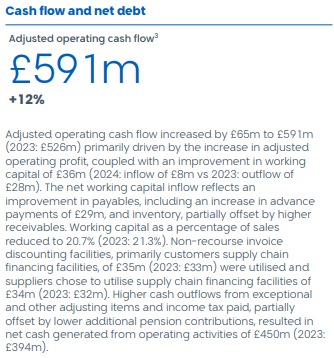
Adjusted operating cash flow increased by £65m to £591m (2023: £526m) primarily driven by the increase in adjusted operating profit, coupled with an improvement in working capital of £36m (2024: inflow of £8m vs 2023: outflow of £28m). The net working capital inflow reflects an improvement in payables, including an increase in advance payments of £29m, and inventory, partially offset by higher receivables. Working capital as a percentage of sales reduced to 20.7% (2023: 21.3%). Non-recourse invoice discounting facilities, primarily customers supply chain financing facilities, of £35m (2023: £33m) were utilised and suppliers chose to utilise supply chain financing facilities of £34m (2023: £32m). Higher cash outflows from exceptional and other adjusting items and income tax paid, partially offset by lower additional pension contributions, resulted in net cash generated from operating activities of £450m (2023: £394m).
The company quantifies the impact of supplier finance arrangements on adjusted operating cash flows.
Weir Group PLC, Annual Report and Accounts 2024, p44
The company provides narrative explanation of the usage of SCF schemes in clear language.
Tabular disclosure is provided for the carrying amount subject to SCF, amounts paid and details of payment due dates.
Narrative is also provided on the impact of other factors such as business combinations, FX and non-cash movements.
2.1. Trade and other payables (extract)
Liabilities under supplier finance arrangements Trade payables includes balances due to suppliers that have signed up to a supply chain financing programme, under which all invoices are settled via a partner bank. Supplier finance arrangements are characterised by one or more finance providers offering to pay amounts that an entity owes its suppliers and the entity agreeing to pay according to the terms and conditions of the arrangements at the same date, or a date later than, when suppliers are paid. These arrangements provide the entity with extended payment terms, or the suppliers with early payment terms, compared to the related invoice payment due date. The value of the liability payable by the Group remains unchanged.
| Range of payment due dates | 2024 |
|---|---|
| Liabilities under supplier finance arrangements | 90-120 days after invoice date |
| Comparable trade payables that are not part of the supplier finance arrangements (same line of business) | 0-90 days after invoice date |
| Carrying amount of liabilities under supplier finance arrangement | £m |
|---|---|
| Liabilities under supplier finance arrangement | 99.6 |
| Of which the supplier has received payment from the finance provider | 34.0 |
There were no material business combinations or foreign exchange differences that would affect the liabilities under supplier finance arrangements in the period. There were no non cash transfers from trade payables to liabilities under the supplier finance arrangements.
Weir Group PLC, Annual Report and Accounts 2024, p200
18. Other financial liabilities – group and company (extract)
(a) During 2024, the Group agreed with certain suppliers to extend the payment periods for certain invoices in respect of property, plant and equipment ("PPE") and smart meter installation services. By virtue of the supplier financing arrangements agreed, the suppliers may choose to receive payment from a bank prior to the due date of the invoices. The arrangement does not introduce any additional collateral, guarantees or security.
Text detailing extended payment periods for PPE and smart meter invoices, and associated financial arrangements.
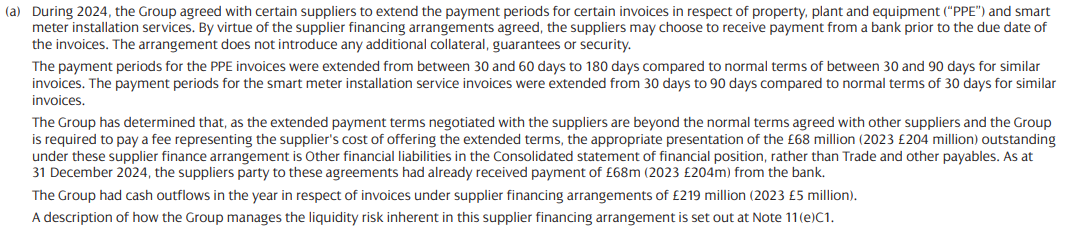
The payment periods for the PPE invoices were extended from between 30 and 60 days to 180 days compared to normal terms of between 30 and 90 days for similar invoices. The payment periods for the smart meter installation service invoices were extended from 30 days to 90 days compared to normal terms of 30 days for similar invoices.
The Group has determined that, as the extended payment terms negotiated with the suppliers are beyond the normal terms agreed with other suppliers and the Group is required to pay a fee representing the supplier's cost of offering the extended terms, the appropriate presentation of the £68 million (2023 £204 million) outstanding under these supplier finance arrangement is Other financial liabilities in the Consolidated statement of financial position, rather than Trade and other payables. As at 31 December 2024, the suppliers party to these agreements had already received payment of £68m (2023 £204m) from the bank.
The Group had cash outflows in the year in respect of invoices under supplier financing arrangements of £219 million (2023 £5 million).
A description of how the Group manages the liquidity risk inherent in this supplier financing arrangement is set out at Note 11(e)C1.
Scottish Power UK PLC, Annual Report 2024, p122
The company provides narrative disclosure of the reasons for the arrangement, the key terms and payment due dates.
An explanation is provided of the company's assessment of the appropriate accounting presentation within liabilities.
Further information is provided about the cash impact in the year, and a cross reference is provided to further disclosures about liquidity risk and how it is managed.
Appendix 3: Review of disclosures of a pension accounting surplus
Background
Over the last few years CRR has observed that many companies have recognised a pensions accounting surplus in their balance sheets. An analysis of the 2024 disclosures of FTSE 100 companies by Lane Clark & Peacock LLP (the LCP Report) found that 80% of FTSE 100 companies with a UK defined benefit pension scheme had a pensions accounting surplus at their 2024 balance sheet date.
Pension surplus disclosures for UK schemes may be of heightened interest to users in the future should it become easier for employers to access a pension surplus following the Government's proposed changes to UK regulations.
This year, CRR has conducted limited-scope reviews of the annual reports and accounts of ten companies that have recognised an asset in their balance sheet for a pension surplus.
We have provided some examples of the better disclosures that we identified from our reviews; companies will need to consider the materiality of these matters based on their own facts and circumstances in determining what information, and in how much detail, to disclose. The examples described in the subsequent pages should be considered in this context.
Recognition of pension surplus in accounts
A net pension asset for the refund of a surplus is recognised either:
- where the company has an unconditional right to a refund of a surplus, such as when all member benefits have been paid; or
- where the company is able to recover the surplus through reduced future contributions. 16
Where pension scheme trustees have rights to enhance benefits or wind up a scheme without the consent of the company, we understand that there are broadly two alternative approaches used to determine whether an unconditional right to a refund exists:
- as the exercise of trustee rights is not within the control of the company any surplus is not recognised; or, alternatively,
- the potential future exercise of trustee rights is not anticipated, and the surplus is recognised.
In 2015 the IASB published proposed amendments to clarify how such rights should be taken into account. In 2022, however, the IASB decided not to finalise these amendments, and the two different approaches remain.
Disclosure examples
Specific basis on which surplus is recognised
Most of the companies we reviewed provided a clear description of the specific basis on which the surplus was recognised. Where schemes are closed to future benefit accrual, the basis used generally assumed a gradual settlement until all members have left the scheme. Good practice disclosure examples explained the company's assessment of its ability to control how the surplus is used.
One company, in disclosing that the surplus is expected to be recovered through a reduction in future service contributions, helpfully explained that the scheme remains open to new members and future service accrual.
23 Pension and Post-Retirement Commitments (extract)
This surplus has been recognised as the Group has concluded it has an unconditional right to a refund of any surplus once all member benefits have been paid. The Group's judgement is based on legal advice that the Trustees would be unable to unconditionally wind up the plan or enhance members' benefits without the Group's consent.
Reckitt Benckiser Group plc, Annual Report and Accounts 2024, p190
22. Post-retirement benefits (extract)
The surplus in the UK scheme is recognised as on an ultimate wind-up when there are no longer any remaining members, any surplus would be returned to the Group, which has the power to prevent the surplus being used for other purposes in advance of this event
Rolls-Royce Holdings plc, Annual Report 2024, p178
Disclosure examples (continued)
Scheme funding requirements
We saw some good examples of disclosures about expected future contributions which explained that, for UK schemes, contribution levels are assessed by reference to the technical actuarial funding valuation rather than any accounting surplus or deficit. Some companies also provided informative details of the surplus or deficit shown by the most recent triennial funding valuation and why the assumptions used for the funding valuation differed from the accounting valuation.
34 Retirement benefit obligations (extract)
The Trustee's triennial valuation is used to determine the contributions required for the Scheme to pay all the benefits due, now and in the future. The Trustee must allow for a level of prudence resulting in these assumptions placing a relatively high value on the Scheme's liabilities. By contrast, IAS 19 ‘Employee Benefits' requires companies to value the liabilities on a ‘best estimate' basis which places a lower value on the liabilities and therefore a more favourable financial position.
J Sainsbury plc, Annual Report and Financial Statements 2025, p194
22. Post-retirement benefits (extract)
The most recent valuation, as at 31 March 2023, agreed by the Trustee in October 2023, showed that the RRUKPF was estimated to be 115% funded on the Technical Provisions basis (estimated to be 119% at 31 December 2024).
Rolls-Royce Holdings plc, Annual Report 2024, p180
Disclosure examples (continued)
Insurance transactions
The LCP Report highlighted that one in six FTSE 100 companies with UK defined benefit pension schemes undertook an insurance transaction of some kind in
- IAS 19 requires disclosure of risks to the company from the scheme and information about the balances recognised in the financial statements arising from its defined benefit plans. 17 We saw some examples of the disclosure of the purchase of bulk annuity policies and insurance contracts. More informative disclosures described the nature and scale of the transactions and the accounting treatment applied.
24. Retirement benefits (extract)
Text detailing the settlement of Shell Pension Plan liabilities in the USA for $5,052 million, involving pension assets and a $101 million gain.

In line with Shell Group's strategic objectives and risk management, on January 30, 2024, the principal defined benefit pension plan in the USA, Shell Pension Plan, entered into a contract with a third-party insurance company to settle $5,052 million of pension liabilities. The settlement price consisted of $4,920 million of pension assets. As a result of this transaction, all legal and constructive obligations for a tranche of benefits provided by the Shell Pension Plan have been eliminated. A gain on settlement of $101 million (after associated adjustment for deferred tax) has been recognised in Shell's Consolidated Statement of Income.
Shell plc, Annual Report and Accounts 2024, p295
Key recommendations
When drafting their upcoming annual reports, we encourage companies to consider, in a manner appropriate to the materiality of their facts and circumstances, our key recommendations:
- Clearly describe the basis on which the pension surplus is recognised (or restricted) explaining the company's assessment of any trustee rights and powers.
- Consider whether disclosures about the technical funding position would be helpful to users' understanding of the amounts recognised in the financial statements and the expected future company contributions.
- Describe the nature and scale of any significant insurance transaction and the accounting treatment applied.
Appendix 4: Developments in corporate reporting
We summarise below the forthcoming changes to financial reporting requirements and the status of UK endorsement at the date of this report.
IFRS financial statements
- Lack of Exchangeability (Amendments to IAS 21) [E]
- Amendments to the Classification and Measurement of Financial Instruments (Amendments to IFRS 9 and IFRS 7) [E]
- Contracts Referencing Nature-dependent Electricity (Amendments to IFRS 9 and IFRS 7) [E]
- Annual Improvements to IFRS – volume 11 (Amendments to IFRSs 1, 7, 9, 10 and IAS 7) [E]
- IFRS 18 'Presentation and Disclosure in Financial Statements' [U]
- IFRS 19 'Subsidiaries without Public Accountability: Disclosures' [U]
UK GAAP financial statements
- Amendments to FRS 101 – 2024/25 cycle
- Periodic Review 2024 amendments (Supplier Finance Arrangements only)
- Periodic Review 2024 amendments (except Supplier Finance Amendments)
Periods beginning on or after 1 January 2025
| 6 April 2025 | 11 May 2025 | 1 January 2026 | 1 January 2027 and later ---
| --- | --- | --- | ---
Narrative and other reporting
- UK Corporate Governance Code 2024 (except Provision 29)
- The Companies (Accounts and Reports) (Amendment and Transitional Provision) Regulations 2024
- The Companies (Directors' Remuneration and Audit) (Amendment) Regulations 2025
- UK Corporate Governance Code 2024 (Provision 29) [P]
- The Companies (Directors' Report) (Payment Reporting) Regulations 2025 (Draft) [P]
- IFRS S1 General Requirements for Disclosure of Sustainability-related Financial Information [C]
- IFRS S2 Climate-related Disclosures [C]
E Endorsed by the UKEB. The latest status of the UK adoption and the UKEB workplan are available on the UKEB website. U Not endorsed in the UK as at September 2025; final effective date subject to endorsement. C The UK Government has consulted on making UK Sustainability Reporting Standards available for use in the UK. Any effective date for application of this Standard will be set out in the relevant legislation or regulation. P Subject to parliamentary approval
Amendments to IFRS accounting standards
| Amendment | Summary of amendment |
|---|---|
| Lack of Exchangeability (Amendments to IAS 21) [E] | Provides guidance on when a currency is exchangeable and how to determine the exchange rate when it is not. |
| Amendments to the Classification and Measurement of Financial Instruments (Amendments to IFRS 9 and IFRS 7) [E] | Clarifies the classification of financial assets with environmental, social and corporate governance and similar features. Also clarifies the date on which a financial asset or financial liability is derecognised when settlement is made via electronic cash transfers. |
| Contracts Referencing Nature-dependent Electricity (Amendments to IFRS 9 and IFRS 7) [E] | Clarifies the application of the 'own-use' requirements for in-scope contracts, amends the designation requirements for a hedged item in a cash flow hedging relationship for in-scope contracts and adds new disclosure requirements. |
| Annual Improvements to IFRSs – volume 11 (Amendments to IFRSs 1, 7, 9, 10 and IAS 7) [E] | Clarifications, simplifications, corrections and changes aimed at improving the consistency of several IFRS accounting standards. |
New IFRS accounting standards
IFRS 18, 'Presentation and Disclosure in Financial Statements' [U]
The IASB issued IFRS 18 on 9 April
- The standard replaces IAS 1 but carries many of its requirements forward unchanged. It introduces:
- three categories for income and expenses and defined subtotals to improve the structure of the income statement
- requirements to disclose explanations of 'management-defined performance measures'
- enhanced guidance about how to organise information and whether to provide it in the primary financial statements or in the notes
Subject to UK endorsement, IFRS 18 will be effective for annual reporting periods beginning on or after 1 January 2027, with early application permitted. We expect companies to disclose the expected effect of applying the new standard on their financial statements, as required by paragraph 30 of IAS 8, ‘Accounting Policies, Changes in Accounting Estimates and Errors'.
IFRS 19, 'Subsidiaries without Public Accountability: Disclosures' [U]
The IASB issued IFRS 19 on 9 May
- The standard enables eligible subsidiaries to use IFRS accounting standards with reduced disclosures. Eligible subsidiaries are those that do not have public accountability and whose parent company applies IFRS accounting standards in their consolidated financial statements. A subsidiary does not have public accountability if it does not have equities or debt listed on a stock exchange and does not hold assets in a fiduciary capacity for a broad group of outsiders.
The objective of IFRS 19 is similar to that of FRS 101, but with a number of differences both in scope and in the disclosure reductions provided.
Subject to UK endorsement, IFRS 19 will be available for adoption in annual reporting periods beginning on or after 1 January 2027, with early application permitted.
UK GAAP
Periodic Review 2024 amendments to FRS 102 and other FRSs
On 27 March 2024, the FRC issued 'Amendments to FRS 102 The Financial Reporting Standard applicable in the UK and Republic of Ireland, and other FRSs – Periodic Review 2024', concluding its second periodic review of these financial reporting standards. Copies of the most recent editions of the standards can be found on our website.
The principal amendments to FRS 102 are in relation to:
- Section 20 'Leases' with the removal of the distinction between operating and finance leases for lessees: more leases will now be recognised with an asset and liability on-balance sheet.
- Section 23 'Revenue from Contracts with Customers' with the introduction of a single comprehensive five-step model for revenue recognition for all contracts with customers. Similar amendments were made to FRS 105 ‘The Financial Reporting Standard applicable to the Micro-entities Regime'.
A range of other incremental improvements and clarifications were made to FRS 102 and other FRSs. The principal effective date for these amendments is periods beginning on or after 1 January
- Early adoption is permitted, and transitional provisions are included.
To support stakeholders with implementation of the Periodic Review 2024 amendments, the FRC issued an updated suite of factsheets for FRS 102 in November 2024.
In addition, the FRC co-hosted a webinar on how the recent amendments to FRS 102 will impact UK charities. The recording and related Explainer document can be found on the FRC website.
Periodic Review 2024 amendments – Supplier Finance Arrangements
New disclosure requirements about supplier finance arrangements where a third-party finance provider pays an entity's supplier, and the entity repays the finance provider were introduced as part of the Periodic Review 2024 amendments to FRS 102.
FRS 102 includes an exemption from the disclosure requirements for qualifying entities, which is conditional on the inclusion of equivalent disclosures in the consolidated financial statements in which the entity is included.
The changes are based on the IASB's May 2023 ‘Supplier Finance Arrangements (Amendments to IAS 7 and IFRS 7)'. The key difference from the IASB's requirements is that Section 7 'Statement of Cash Flows' does not require disclosure of amounts settled by finance providers with suppliers. The effective date of these amendments is accounting periods beginning on or after 1 January
- Early adoption is permitted.
Periodic Review 2024 amendments – Updates to Statements of Recommended Practice (SORPs)
The FRC continues to oversee the accounting SORP-making bodies in accordance with the FRC SORP Policy. The accounting SORP-making bodies have been working on updates to their SORPs and six out of seven SORP consultations have already closed.
Amendments to FRS 102 and FRS 105 – UK company size thresholds
In December 2024, regulations were made in the UK that increased certain monetary thresholds that form part of the criteria for determining the size of an entity for financial years beginning on or after 6 April 2025.
As a result, both FRS 102 and FRS 105 were updated to reflect the increased thresholds.
As these amendments reflect changes in UK company law, they are not expected to introduce changes in financial reporting other than when required by law.
To support stakeholders in meeting their reporting responsibilities, the FRC has updated a suite of relevant publications and issued a summary document outlining the changes. More details can be found on our website.
Amendments to FRS 101 ‘Reduced Disclosure Framework’
The FRC has carried out its annual review of FRS 101 (2024/25 cycle).
The amendments to FRS 101 update the disclosure exemptions in light of IFRS 18, including providing an exemption from the requirements in relation to management-defined performance measures.
The review also confirms that IFRS 19 'Subsidiaries without Public Accountability: Disclosures' and FRS 101 cannot be applied together.
FRED 87 'Draft amendments to FRS 102 The Financial Reporting Standard applicable in the UK and Republic of Ireland: Adapted formats'
FRED 87 is relevant to entities applying FRS 102 which choose to adapt the formats of the balance sheet and/or the profit and loss account in accordance with the relevant provisions in company law.
FRED 87 proposes amendments to FRS 102 to reflect amendments to IAS 1 'Presentation of Financial Statements' in 2020 and 2022, and the subsequent replacement of IAS 1 with IFRS 18 ‘Presentation and Disclosure in Financial Statements'.
The following amendments are proposed:
- to amend the minimum line items for adapted balance sheets and income statements to align with IFRS 18;
- to amend the definition of current liabilities and considerations about covenants based on the 2020 and 2022 amendments to IAS 1; and
- a number of incremental clarifications to aid preparers' understanding.
Entities applying FRS 102 which do not choose to adapt their financial statement formats as permitted by company law will not be impacted by these amendments. The proposed effective date is 1 January 2027, with early adoption permitted.
Comments on FRED 87 are requested by 10 October 2025.
The FRC intends to finalise these amendments for entities in the UK and entities in the Republic of Ireland only if IFRS 18 is adopted in the relevant jurisdiction.
IFRS S1 and IFRS S2
The ISSB issued its inaugural standards, IFRS S1 'General Requirements for Disclosure of Sustainability-related Financial Information' and IFRS S2 'Climate-related Disclosures', on 26 June 2023.
The UK Sustainability Disclosure Technical Advisory Committee (TAC) submitted its recommendations to the Secretary of State for Business and Trade in December 2024 recommending the endorsement of IFRS S1 and IFRS S2 in the UK. The UK Sustainability Disclosure Policy and Implementation Committee (PIC) also provided recommendations. The Government launched a consultation in June 2025 on making UK Sustainability Reporting Standards (UK SRS), based on IFRS S1 and IFRS S2 with minor modifications, available for voluntary use in the UK. Subject to feedback, the FCA and the Government will then consult separately on introducing any mandatory disclosure requirements against these standards.
European sustainability reporting
UK companies with a significant EU presence will also need to consider the requirements of the Corporate Sustainability Reporting Directive (CSRD), which requires companies within its scope to adopt the European Sustainability Reporting Standards (ESRS). ESRS comprise 12 standards. The CSRD is being phased in, depending on company size, from 1 January
- Guidance on CSRD scope and timing has been published by the ICAEW. The CSRD and ESRS are currently under review as a result of the Omnibus package of measures published in February 2025 proposing simplifications and reductions in scoping. The EU Parliament has approved a 'stop-the-clock' mechanism to delay implementation for some companies.
UK Corporate Governance Code 2024
The 2024 version of the UK Corporate Governance Code (the Code) is applicable for periods beginning on or after 1 January 2025, and companies are now preparing to issue the first reports under the new Code. In light of the revisions to the Code, the FRC's expectation is to see a greater focus on outcomes and activities in reporting going forward, and improvements in the quality of explanations for departures from the Code. Provision 29, which asks boards to make a declaration in relation to the effectiveness of their material internal controls, applies to periods beginning on or after 1 January
- The FRC's annual review of corporate governance reporting will this year seek to identify any examples of good practice in terms of reporting on the preparations companies are making in this area.
Other changes in non-financial reporting
In December 2024, the Government published regulations (SI 2024/1303) effective for periods beginning on or after 6 April 2025 which increase company reporting size thresholds by about 50% and remove certain disclosure requirements from the directors' report.
In April 2025, the Government published regulations (SI 2025/439) effective for periods beginning on or after 11 May 2025 which remove certain disclosure requirements from the directors' remuneration report. Further guidance is available online.
In October 2024, the Government announced plans to launch a consultation to explore ways to simplify and modernise existing non-financial reporting requirements and thresholds and support the future integration of UK SRS.
In July 2025, the Government published draft regulations effective for periods beginning on or after 1 January 2026 which introduce additional reporting requirements for large companies to report on their payment practices and performance in the directors' report.
Appendix 5: Scope of CRR's work and interacting with our team
CRR undertakes the day-to-day work relating to the FRC's statutory responsibility to monitor and improve the quality of corporate reporting in the UK. Its remit covers the annual report and accounts and interim reports of companies included on the FCA's Official List, and the annual reports and accounts of UK-incorporated public companies, large private companies, and Limited Liability Partnerships.
CRR's statutory function is assessing compliance with legal requirements and relevant accounting standards in:
- the strategic report, including the Section 172 statement and the non-financial and sustainability information statement
- the directors' report
- the annual accounts (financial statements)
The vast majority of companies voluntarily provide information in response to our enquiries and we rarely need to invoke our statutory powers to obtain information. We have not used this power during the past year.
Our letters provide no assurance that a company's annual report and accounts are correct in all material respects; the FRC's role is not to verify the information provided to it but to consider compliance with reporting requirements.
Further information about our reviews is available on our website:
Financial Reporting Council
London office: 13th Floor, 1 Harbour Exchange Square, London, E14 9GE
Birmingham office: 5th Floor, 3 Arena Central, Bridge Street, Birmingham, B1 2AX +44 (0)20 7492 2300
www.frc.org.uk
Follow us on LinkedIn.
-
IFRS 18, 'Presentation and Disclosure in Financial Statements' ↩
-
FRS 102, 'The Financial Reporting Standard applicable in the UK and Republic of Ireland' ↩
-
IAS 1, 'Presentation of Financial Statements' ↩
-
Taskforce for Climate-related Financial Disclosures (TCFD), as discussed in section 5.10 ↩
-
Climate-related Financial Disclosures (CFD), as discussed in section 5.10 ↩
-
Comply-or-explain TCFD listing rules and mandatory Companies Act 2006 CFD requirements, where relevant. See section 5.10 of this report. ↩
-
IFRS 13 'Fair value measurement', paragraph 86, FRS102 paragraph 34.22 ↩
-
Includes four cases in relation to 2023/24 finalised in 2024/25 ↩
-
Includes two cases in relation to 2022/23 finalised in 2023/24 ↩
-
'Yes' includes respondents who indicated either 'significant' or 'some' improvement in the quality of their corporate reporting ↩
-
Paragraph 81 of the Guidance on Audit Committees April 2016 recommends disclosure of the significant issues considered by the audit committee including the nature and extent of interaction (if any) with the FRC's CRR Team ↩
-
Set out in Primary Market Bulletin 36 ↩
-
IFRS Interpretations Committee Agenda Decision, Supply Chain Financing Arrangements – Reverse Factoring (December 2020) ↩↩
-
Disclosures on sources uses of cash - FRC Financial Reporting Lab Report.pdf ↩
-
IFRIC 14, 'IAS 19 – The Limit on a Defined Benefit Asset, Minimum Funding Requirements and their Interaction', paragraph 11 ↩
-
IAS 19, 'Employee Benefits', paragraph 135 ↩