
The content on this page has been converted from PDF to HTML format using an artificial intelligence (AI) tool as part of our ongoing efforts to improve accessibility and usability of our publications. Note:
- No human verification has been conducted of the converted content.
- While we strive for accuracy errors or omissions may exist.
- This content is provided for informational purposes only and should not be relied upon as a definitive or authoritative source.
- For the official and verified version of the publication, refer to the original PDF document.
If you identify any inaccuracies or have concerns about the content, please contact us at [email protected].
PricewaterhouseCoopers LLP Audit Quality Inspection and Supervision Report 2025
Using this publication
The Financial Reporting Council (FRC) is responsible for the regulation of UK statutory auditors and audit firms. We assess, via a fair evidence-based approach, whether firms are consistently delivering high-quality audits and are resilient.
This report sets out the FRC's findings on key matters relevant to audit quality at PricewaterhouseCoopers LLP (PwC or the firm). It should be used alongside the FRC's Annual Review of Audit Quality, which contains combined results and themes for all firms1 that were inspected this year.
Given our risk-based approach to selecting audits for inspection, it is important that care is taken when extrapolating our findings or assessment of quality to the whole population of audits performed by the firm. Given the sample sizes involved, changes from one year to the next cannot, on their own, be relied upon to provide a complete picture of a firm's performance.
Individual audit and System of Quality Management (SoQM) inspection findings are not the only metrics to assess audit quality. This report also considers other wider measures, such as the results of audit inspections completed by the Institute of Chartered Accountants in England and Wales (ICAEW) and results from the firm's own internal quality reviews. The firm's response to the findings and the actions it plans to take as a result are included on page five and Appendix B.
This report is for general use by interested parties. However, we expect the following:
- PwC to use this report and its peers' reports to facilitate continuous improvement through actions in its Single Quality Plan (SQP).
- Other audit firms of all sizes to use this report for examples of good practice.
- Audit Committees to use this report to help them assess the quality of their audit/auditor and when appropriate as part of the process of appointing a new auditor.
- Investors to use this report in making assessments about the quality of audit, transparency and accountability in the relevant markets.
Throughout this report, the following symbols are used:
- Represents a finding where the firm must take action to improve audit quality.
- Represents an example of good practice we identified in our supervision, and we encourage other firms to consider applying these if appropriate to their circumstances.
- Represents an observation relating to the firm's initiatives to improve audit quality.
Our Supervisory Approach2
The audit supervisory teams in the FRC's Supervision Division work closely together to develop an overall view of the key issues for each firm to improve audit quality. We also collaborate to develop our future supervision work.
Further details on our approach to audit supervision can be found on our website. We also separately publish the findings of our major local audit inspections each year, the latest publication was in July 2025 and can be found on our website.
- Using this publication
- 1. Overview
- PwC – at a glance
- 2. Inspection of individual audits
- 3. Inspection of the firm's system of quality management ISQM (UK) 1 and 2
- 4. Forward-looking supervision
- Appendix A – Firm's internal quality monitoring
- Appendix B – PwC's responses and actions
- Audit strategy and commitment to quality
- Culture, People and Technology
- System of Quality Management
- Continuous Improvement
- Root causes and actions on AQR findings
- a) Improve the audit of inventory
- b) Improve aspects of the audit of goodwill impairment and the carrying value of parent company investments
- Appendix C – ISQM (UK) 1 Glossary
The FRC does not accept any liability to any party for any loss, damage or costs howsoever arising, whether directly or indirectly, whether in contract, tort or otherwise from any action or decision taken (or not taken) as a result of any person relying on or otherwise using this document or arising from any omission from it.
© The Financial Reporting Council Limited 2025 The Financial Reporting Council Limited is a company limited by guarantee. Registered in England number 2486368. Registered Office: 13th Floor, Exchange Tower, 1 Harbour Exchange Square, London, E14 9GE
1. Overview
Overall assessment
PwC continues to focus on delivering high audit quality and has responded positively to our previous findings, including identifying innovative solutions. The firm's Audit Strategy was updated in 2024 and prioritises appropriate key areas such as quality, people, culture and technology. The updated strategy and other communications from leadership set a consistent and strong tone around the importance of audit quality. The firm is making additional enhancements to its effectiveness measures to better determine whether actions achieve the desired results and if further improvements can be made.
Firm's system of quality management
PwC has an established SoQM, with robust governance, processes for identifying and assessing risks and responses, and monitoring activities. The firm should enhance aspects of its monitoring of the operation of certain responses, including responses operated elsewhere in the network to ensure ethical compliance. It should also strengthen aspects of its annual evaluation process, such as improving the extent and evidence of audit inspection findings after the evaluation as-at date.
SoQM inspection approach
We assessed the following aspects of the scoped in areas of the firm's SoQM, with each one building upon the next.
- Do the quality risks appear complete and appropriate?
- Have appropriate responses been identified and described to demonstrate how quality risks can be mitigated?
- Was there adequate monitoring of these responses and other relevant information?
- Have deficiencies been identified and individually assessed?
- Was the aggregate impact of deficiencies assessed?
See good practice points and findings in section 3.
FRC audit quality review inspection results at PwC
% of audits inspected by the FRC requiring no more than limited improvements (Section 2)
| Year | % with no more than limited improvements |
|---|---|
| 2024/25 | 90% |
| 2023/24 | 76% |
| 2022/23 | 82% |
| 2021/22 | 83% |
| 2020/21 | 80% |
0 audits inspected by the FRC in 2024/25 required significant improvements
Other audit quality inspection results at PwC
The overall results profile for inspections by the ICAEW is 100% classified as good or generally acceptable (page 11) and the firm's internal quality monitoring results (Appendix A) show a relatively consistent year-on-year outcome for compliant audits.
Firm and FRC actions
PwC's response
Consistent high-quality audits are core to maintaining public interest. Therefore, we're pleased with both the FRC and ICAEW inspection outcomes this year. We're committed to consistently delivering high quality audits which is reflected in our refreshed Audit Strategy and the high priority areas in our Single Quality Plan (SQP). Our audit quality-focused culture, current and future resourcing models, and the adoption of new and emerging technology, are key enablers in delivering sustainable high-quality audits. We continue to learn from inspection findings and good practice examples from the FRC and ICAEW.
We invest significant resource and effort in our System of Quality Management (SoQM), which is designed to be responsive to changes in quality risks driven by the internal and external environment. We have welcomed the inspection insights from the FRC and continue to evolve our relevant processes and controls.
The common causal factors identified from our Root Cause Analysis (RCA) process in respect of the recurring areas of findings from FRC audit inspections include:
- Inventory - Auditor mindset: Specific aspects of the account balance were considered to be straightforward based on previous experience, and therefore the teams did not sufficiently challenge certain elements of the planned audit approach or oversight and/or review responsibilities.
- Impairment - Auditor stand back: Insufficient consideration of contradictory evidence by the audit team, or a lack of specificity in conclusions relating to certain aspects of impairment models.
Further details are included in Appendix B.
PwC's actions
Our audit-related actions in response to the common causal factors include an update to our significant matter template to include stand back considerations, an engagement leader led focus on the audit of inventory, and a continued emphasis on our refreshed challenge and be open to challenge behaviour.
Our ISQM (UK) 1 actions include certain enhancements to relevant SoQM assessment, monitoring and evaluation procedures, and specific actions responding to findings in respect of Non Audit Service (NAS) approvals for UK audited entities and workload monitoring.
FRC's actions
In response to this year's findings, we will take the following actions:
- Continue our inspection of completed audits and the firm's SoQM, including how the firm is responding to our findings.
- Maintain our supervision of the SQP using it to monitor the actions taken to improve audit quality. This will include audit quality initiatives relating to independence matters (including the approval of non-audit services), culture, people and technology.
- Continue to evaluate the firm's effectiveness measures used in relation to audit initiatives, the SQP and the updated audit strategy.
PwC – at a glance
Audits within the FRC's inspection scope3
| Inspection cycle | FTSE 100 audits | FTSE 250 audits | Total audits in FRC scope | Public Interest Entity (PIE) audits4 | Number of PIE Responsible Individuals4 |
|---|---|---|---|---|---|
| 2025/26 | 28 | 62 | 322 | 282 | 138 |
| 2024/25 | 26 | 67 | 359 | 307 | 136 |
| 2023/24 | 24 | 71 | 385 | 297 | 137 |
Audit fee income5 £m
Bar chart showing Audit Fee Income and PIE Audit Fee Income for 2022, 2023, and 2024.
| Year | Total Audit Fee Income | PIE Audit Fee Income |
|---|---|---|
| 2022 | 818 | 291 |
| 2023 | 965 | 383 |
| 2024 | 1,064 | 410 |
Total Audits6
8,727
Responsible Individuals6
353
Offices6
19
Professional Staff6
23,317
Audits inspected by the FRC7
Visual representation of audits inspected by the FRC.
- 2022-23: 17
- 2023-24: 17
- 2024-25: 20
PwC does not undertake Major Local Audits The FRC's inspections of Major Local Audits are published in a separate annual report. The latest version was published in November 2024 and can be found be found here.
2. Inspection of individual audits
Our assessment of the quality of audits inspected: All
We inspected 20 individual audits this year and assessed 18 (90%) as requiring no more than limited improvements. These results are an improvement on prior years.
Bar chart showing Audit Quality Assessment Trends (All Audits).
| Year | Good or limited improvements required | Improvements required | Significant improvements required | Total Audits |
|---|---|---|---|---|
| 2020/21 | 16 | 4 | 0 | 20 |
| 2021/22 | 15 | 3 | 0 | 18 |
| 2022/23 | 14 | 3 | 0 | 17 |
| 2023/24 | 13 | 4 | 0 | 17 |
| 2024/25 | 18 | 2 | 0 | 20 |
FTSE 350 audits
Of the 10 FTSE 350 audits we inspected this year, we assessed eight (80%) as requiring no more than limited improvements. These results were lower than last year.
Bar chart showing Audit Quality Assessment Trends (FTSE 350 Audits).
| Year | Good or limited improvements required | Improvements required | Significant improvements required | Total Audits |
|---|---|---|---|---|
| 2020/21 | 9 | 1 | 0 | 10 |
| 2021/22 | 8 | 0 | 0 | 8 |
| 2022/23 | 10 | 1 | 0 | 11 |
| 2023/24 | 11 | 0 | 0 | 11 |
| 2024/25 | 8 | 2 | 0 | 10 |
The audits inspected in the 2024/25 cycle had year-ends ranging from June 2023 to March 2024. Changes to the proportion of audits falling within each category reflect a wide range of factors, including the size, complexity and risk of the audits selected for inspection and the individual inspection scope. Our inspections are also informed by the priority sectors and areas of focus. For these reasons, and given the sample sizes involved, changes from one year to the next cannot, on their own, be relied upon to provide a complete picture of a firm's performance and are not necessarily indicative of any overall change in audit quality at the firm. Given our risk-based approach, it is important that care is taken when extrapolating our findings or assessment of quality to the whole population of audits performed by the firm.
Information on how the FRC assesses audit quality and classifies findings between key findings and other findings, on individual inspections is available on our website.
We set out below the findings in areas where, based on our inspections, we believe improvements in audit quality are required. These findings related to key findings on our individual inspections, which impacted our assessment of quality in those audits (as set out on the previous page), as well as other findings in the same areas that occurred frequently.
| Findings | Why it is important |
|---|---|
| Improve the audit of inventory | Auditors should perform appropriate procedures to assess the existence and valuation of inventory especially when significant to an entity's balance sheet. |
| Improve aspects of the audit of goodwill impairment and/or the carrying value of parent company investments | Auditors should adequately assess and challenge management's evaluation of goodwill impairment and the carrying value of parent company investments in subsidiaries as they often involve significant management judgement and can be subject to management bias or error. |
Analysis of areas with findings by significance
Bar chart showing the number of inspections for each area, broken down by key findings, other findings, and no findings.
| Area | Key findings | Other findings | No findings | Total Inspections |
|---|---|---|---|---|
| Inventory | 1 | 3 | 3 | 7 |
| Goodwill impairment and/or carrying value of parent company investments | 1 | 3 | 5 | 9 |
Further details of the above findings, as well as good practice points, are set out on the following pages.
Improve the audit of inventory
We inspected the audit of inventory on seven audits and raised findings on four of them:
- Inventory valuation: One audit team did not perform adequate audit procedures over inventory valuation, as it did not adequately understand and evaluate the work of management's experts and did not perform all of the audit procedures set out in the inventory count instructions provided to those performing the work.
- Inventory existence: One audit team did not obtain sufficient appropriate audit evidence over the existence of inventory at one of the warehouse sites. Another audit team did not reconcile inventory quantities provided by a third-party warehouse operator to management's records.
- Inventory provision: Insufficient procedures were performed on one audit over the accuracy of an overlay adjustment made to the inventory provision.
Improve aspects of the audit of goodwill impairment and/or the carrying value of parent company investments
We inspected the audit of goodwill impairment and/or the carrying value of parent company investments on nine audits and raised findings on four of them:
- Goodwill impairment: There was insufficient evidence of the audit team's assessment and challenge of management over the achievability of the short-term cash flow forecasts on two audits.
- Carrying value of parent company investments: One audit team did not sufficiently assess and challenge the carrying value of the parent company's investment in subsidiary undertakings, in particular the achievability of the revenue forecasts in light of geographic market forecast growth rates. Another audit team did not sufficiently evidence the basis for its judgement that no impairment was required.
We also identified good practice in the audits we inspected, including:
Risk assessment and planning
- General IT controls: Effective general IT control procedures included a thorough assessment of prior year control deficiencies and their impact on the audit approach on one audit. On another audit, the audit team's approach to general IT control testing was supported by a thorough and well-evidenced understanding of the entity's IT processes and controls, including a comprehensive assessment of the homogeneity of these controls across in-scope IT applications.
Execution
- Response to the current economic environment: Extensive audit procedures on the group's brand impairment assessment included analysing market research on customer behaviour. Another audit team's challenge of management's going concern assessment included two going concern panels and discussions with prospective investors. A well-executed integrated approach, including the use of specialists, to the audit of deferred tax by another audit team included extensive challenge of management's forward-looking assumptions.
- Revenue: An effective bespoke substantive analytical review procedure on revenue used data from a third-party report. Another audit team obtained confirmations from the group's customers during the year, providing particularly effective audit evidence for revenue.
- Insurance contracts and adoption of IFRS 17: An audit team demonstrated comprehensive evidence of its evaluation of the risk of management bias in the valuation of insurance contract assets. The audit team also engaged extensively with the other group and successor audit firms to support its conclusions on the IAS 8 disclosures relating to the adoption of IFRS 17. On another audit, the detailed scoping by actuarial specialists and the core audit team enabled procedures to focus on the higher-risk classes of business. On the same audit, relating to the adoption of IFRS 17, the procedures on the opening balance sheet and prior year comparatives were thorough and demonstrated the audit team's challenge of management's key transition judgements.
- Inventory and long-term contracts: Data analytics on inventory provided substantial coverage over standard to actual costing, inventory ageing and net realisable value. Another audit team demonstrated a detailed knowledge of the group's programmes and contracts enabling robust evaluation of management's financial models.
Completion and reporting
- Reporting to the Audit Committee: The quality of reporting to the Audit Committee promoted effective two-way communication on three audits. This included the use of graphics communicating specific insights, an extensive summary of control observations and the involvement of component audit teams in drafting key matters. A detailed IFRS 17 transition report was also prepared on one of these audits.
Monitoring review results by the Quality Assurance Department of ICAEW
ICAEW undertakes independent monitoring of the firm's non-PIE audits, under delegation from the FRC as the Competent Authority. ICAEW's work covers private companies, smaller AIM listed companies, charities and pension schemes. The FRC is responsible for monitoring the firm's firm-wide controls and ICAEW additionally reviews training records for a sample of the firm's staff involved in the audit work within ICAEW remit.
All engagement reviews were graded either good or generally acceptable.
A detailed report summarising the audit file review findings and any follow-up action proposed by the firm will be considered by ICAEW's Audit Registration Committee in July 2025.
Bar chart showing audit quality classifications by ICAEW.
| Year | Significant improvement required | Improvement required | Good/generally acceptable |
|---|---|---|---|
| 2022 | 0 | 1 | 9 |
| 2023 | 0 | 0 | 10 |
| 2024 | 0 | 0 | 10 |
Good practice
ICAEW identified good practice examples within all of the files reviewed, including:
- Comprehensive documentation on involvement of auditors' experts, consideration of management experts and interaction with component audit teams in relation to the audit of the entity's Shared Service Centre.
- Challenge of management on significant accounting estimates, including defined benefit assets and liabilities valuations, share-based payments and contract margins.
- Use of digital resources in fraud risk assessment and digital tools as part of audit work in areas of significant risk.
ICAEW assesses audit quality as 'good', 'generally acceptable', 'improvement required', or 'significant improvement required'. File selection is focused towards higher risk and more complex audits. Given the sample size, changes from one year to the next cannot be relied upon to provide a complete picture of a firm's performance or overall change in audit quality.
3. Inspection of the firm's system of quality management ISQM (UK) 1 and 2
In this section, we set out the findings and good practice identified in our inspection of the firm's SoQM. 2024/25 is the first inspection cycle that we have solely inspected firms under ISQM (UK) 1, as 2023/24 was a transitional cycle from ISQC (UK) 1. In the interests of proportionality, we adopt a rotational approach to inspection, ensuring all components of the SoQM are inspected across a three-year cycle. Details of our ISQM (UK) rotational testing can be found on our website. A glossary of some key ISQM (UK) terms can be found in Appendix C.
Inspection approach in 2024/25 cycle
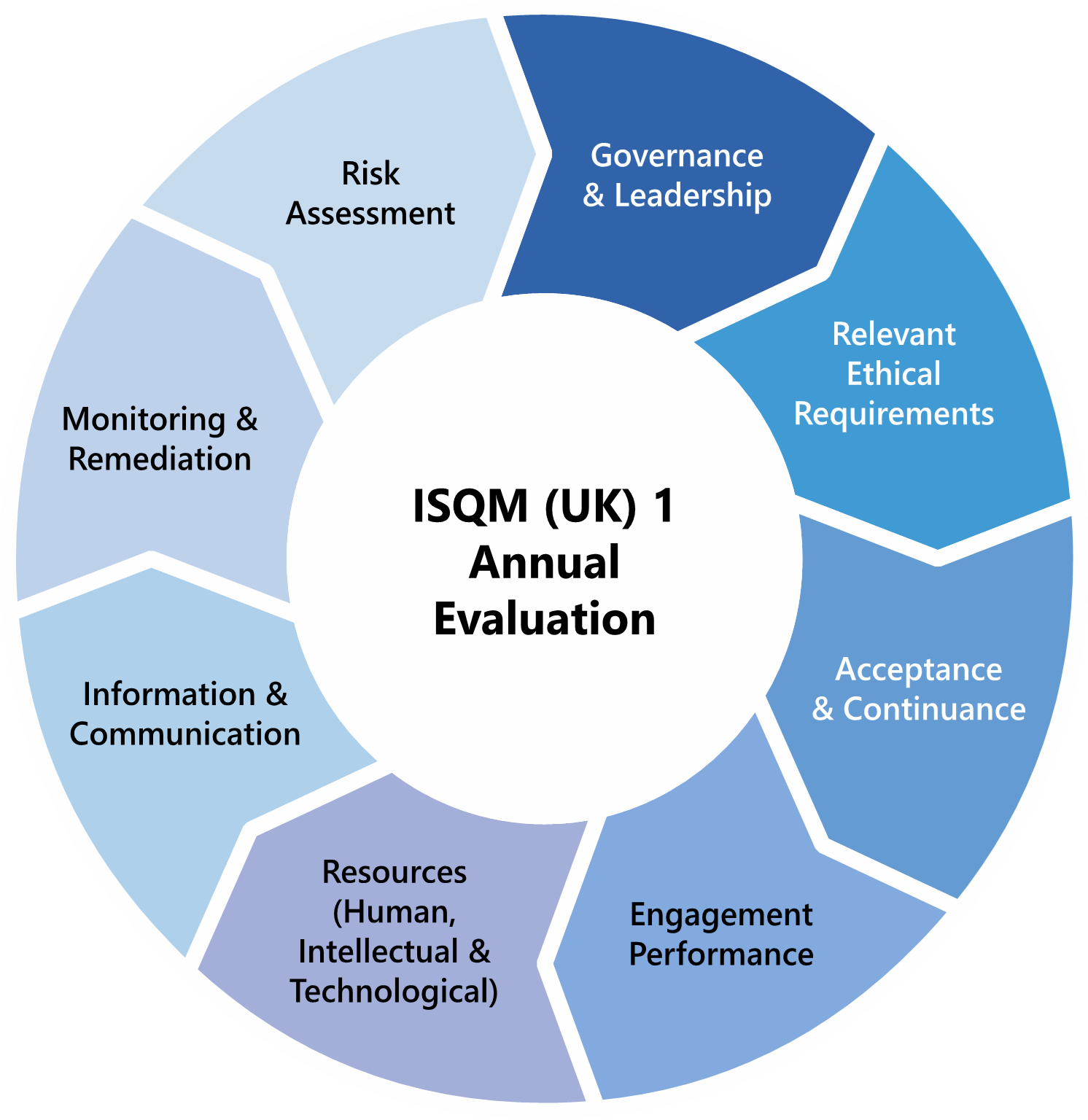
In this inspection cycle, we inspected the firm's SoQM risk assessment and the design and implementation of responses in the Governance and Leadership (G&L), Information and Communication (I&C), Human Resources (HR), and Relevant Ethical Requirements (RER) components of the firm's SoQM.
For each component we also inspected a small sample of the monitoring procedures performed by the firm to assess the operating effectiveness of responses. This sample focused on responses with significant elements of judgement, including management review controls and processes.
We also inspected the process, evidence, and outcome for the firm's annual evaluation of its SoQM as at 31 December 2023. This included how other sources of information on audit quality and the firm's SoQM were considered, and how the aggregated significance of findings and deficiencies were assessed. We did not independently perform, or reperform, this annual evaluation. As ISQM (UK) 1 is focused on how firms achieve continuous improvement, we assessed how the firm has developed its SoQM, including in response to the findings we shared during the inspection period.
We scoped our inspection of each component based on consideration of risk, including the results of previous monitoring and root cause analysis. We focused on high-risk areas in respect of:
| Component | Focus areas |
|---|---|
| G&L (annual review) | Reporting to leadership on the SoQM and the culture of quality |
| I&C (rotational review) | Promoting and driving two-way communication with and between audit personnel |
| HR (rotational review) | Resource management and allocations for audit engagements and SoQM activities |
| RER (annual review) | Approval of non-audit services (NAS), and the length of involvement, on audit engagements, by key audit partners and the firm |
PwC has an established SoQM, with robust governance, processes for identifying and assessing risks and responses, and monitoring activities. The firm should enhance aspects of its monitoring of the operation of certain responses, including responses operated elsewhere in the network to ensure ethical compliance. It should also strengthen aspects of its annual evaluation process, such as improving the extent and evidence of audit inspection findings after the evaluation as-at date.
In this section, we are solely reporting on the specific matters where we have identified that further improvement is needed and areas where we have observed particularly good practice.
Design and implementation of responses to quality risks
- Workload monitoring: The firm did not set consistent thresholds for monitoring workload at an individual level and relied on the business unit resource managers' judgement. It was not clear how this approach enabled the firm to ensure complete identification of individuals where follow up might be required.
- Commencement of NAS by network firms without relevant UK approvals: In the context of a lack of a global integrated finance and service approval system, the UK firm sought to rely on a number of detective controls but did not identify sufficient preventative controls to ensure network firms do not begin NAS prior to obtaining required UK approvals, which increases the risk of a breach of UK independence requirements.
Monitoring procedures
- Monitoring procedures over responses: Within the sample reviewed, the procedures undertaken to monitor the operation of certain responses did not consistently assess if all elements of the responses operated robustly, and in particular, how monitoring reviews were undertaken to identify and follow up concerns, to robustly assess if the relevant risks were sufficiently mitigated.
- Reliance on global monitoring: The UK firm did not sufficiently assess the design, or the extent of assurance provided by the network monitoring programme over network firms' compliance with NAS approval processes intended to mitigate the risk that NAS provided by network firms compromise the UK firm's independence. Furthermore, the firm utilises network-wide technological resources to manage the approval of audit and non-audit services to restricted entities. The firm did not obtain sufficient assurance over standing UK data maintained in one network resource, or over the approval routing within a separate resource.
- Role of cold file reviews: Internal reviews of completed audit files were identified as mitigating multiple RER risks. However, the firm did not sufficiently evidence how these reviews were operated effectively to mitigate relevant RER risks.
Annual evaluation process
- Assessment of themes from root cause analysis and key findings from AQR inspections: The firm did not sufficiently evidence its assessment of whether additional SoQM findings could arise from the root cause analysis themes for audit inspection findings, or from key findings on individual AQR audit inspections finalised between the as-at date for the annual evaluation, and the completion of the annual evaluation process.
Good Practice
- Allocation of resources to engagements: The firm has an innovative tool, utilising a set of predefined business rules and priorities for resources allocation, to initially allocate junior staff to engagements based on capacity, skills, experience, and interests. The firm also implemented a targeted resourcing initiative whereby a larger audit team performs several smaller audit engagements. This provides both consistency in team composition and a better coaching and team experience for the individuals working in these teams. These support the development of stronger audit teams and the better performance of audits.
- Monitoring procedures: The firm had robust templates for first and second line SoQM monitoring procedures, and strong processes for ensuring the independence of the second line monitoring team. This supports complete and timely identification of ineffective SoQM responses.
- Identification of other sources information: The firm evidenced assessment of a wide range of other sources of information when identifying and evaluating SoQM findings in its annual evaluation, which reduces the risk of unidentified weaknesses in the SoQM.
- RER risk descriptions: The firm's quality risks included the identification of granular risk factors. This approach helps ensure that the perspective of an objective, reasonable and informed third party was incorporated into relevant risks.
4. Forward-looking supervision
We adopt a risk-focused, outcome-based, and proportionate approach to supervising firms, which complements our inspection programme. We balance holding firms accountable for promptly addressing quality findings with encouraging proactive improvement behaviours and sharing best practices to facilitate improvements across the firm and audit market. Each firm has a dedicated Supervisor who gathers evidence and risk indicators, identifies and prioritises actions firms must take to serve the public interest by enhancing audit quality and resilience. This includes anticipating future challenges and potential issues. Our observations from this year's work, along with updates on what the firm must do regarding previous observations, are set out below. When we identify findings, we require the firm to include actions in their SQP.
Single Quality Plan and other key quality initiatives
We require the largest PIE audit firms to maintain an SQP to drive measurable improvements in audit quality and resilience, and to demonstrate the effectiveness of actions taken. The SQP ensures action is prioritised in the most critical areas and enables firms to be held to account by us and their non-executives.
Observations
- SQP: The SQP is well established and provides clarity and focus on the firm's audit quality priority areas. The SQP is the responsibility of the Audit Executive, supported by the Continuous Improvement team, with good oversight from the Audit Oversight Body (AOB).
- Audit Strategy: The firm's Audit Strategy was updated in 2024. There is a current focus on cohesion and consistency between the Audit Strategy, the SQP, the Audit Quality Plan and associated firm Audit Quality Indicators and other measures.
- Emerging issues: The firm must continue to develop its processes for identifying emerging issues so that these can be assessed and responded to on a timely basis.
Innovative solutions:
The firm has embedded innovative responses in specific focus areas, including a programme combining resourcing, mentoring, coaching, cultural and relationship building initiatives to improve both the learning experience and understanding of the public interest purpose of audit.
Effectiveness measures:
Further enhancements are required to ensure that effectiveness assessments include an appropriate range of quantitative and qualitative measures with outcome-based targets. This will enable the firm to further assess the effectiveness of key priorities and actions.
Upholding high standards and continuous improvement
We expect firms to take prompt action to address quality findings and to set a tone at the top that prioritises continuous improvement.
Observations
- Tone at the top: The firm remains clear and consistent in its communications around the importance of audit quality. In particular, it has refreshed its focus on acting in the public interest.
- Continuous Improvement (CI) team: The CI team, whose responsibilities include RCA, are experienced and well established. Regular reporting is provided to the Audit Executive and the AOB.
- Remediation: Remedial actions are generally set by the process control owner with oversight from the central Audit Risk and Quality team. The process would benefit from incorporating a further level of independent involvement at an earlier stage.
- Resourcing: Certain resourcing matters were identified as a root cause of poorer-quality audits. The firm must continue to focus on appropriate resource allocation.
- Non-financial sanctions (NFS) and constructive engagement: We have engaged on three NFS in the period since the last report, two of which are ongoing. The firm has responded positively. There are no active constructive engagement cases.
- Ethical culture: The firm has continued to strengthen the collaboration between its Ethics and Culture teams.
Joined-up CI team approach:
The CI team collaborates with both functional and engagement teams to analyse issues and identify root causes, providing a deeper insight. The resulting holistic reports are jointly compiled and presented to governance bodies.
Emerging risks and trends
Our forward-looking supervision aims to aid firms by anticipating challenges and risks from emerging trends before quality issues occur.
Industry trends:
All firms are impacted by emerging risks and trends in the industry related to:
- The use of technology and AI in the audit; and
- Changes to workforce and staff / partner development needs as a result of the above and other drivers.
These are addressed further in the 2025 Annual Review of Audit Quality. We are working with firms to understand how they are responding to these trends whilst safeguarding audit quality.
Observations
- Technology and AI: The firm has a clear focus on adopting AI and a 'digital first mindset' and encouraging an innovative and supportive environment, for example through the use of Digital Accelerators (auditors with specialised training) and Digital Academies.
- Offshore delivery centres (ODCs): The audit strategy incorporates the increased use of alternative delivery models including ODCs. It is important that key UK audit quality initiatives are consistently extended to offshore staff, where appropriate, and that quality control processes continue to evolve to mitigate the risk from its increased use of, and the wider breadth of work undertaken by, offshore staff.
Appendix A – Firm's internal quality monitoring
This appendix sets out information prepared by the firm relating to its internal quality monitoring for individual audit engagements (Engagement Compliance Review, or ECR). We have not verified the accuracy or appropriateness of these results. The appendix should be read together with the firm's Transparency Report for 2024 and its 2025 report (when published) which provide further detail of the firm's internal quality monitoring approach, results, root cause analysis, remediation, and wider system of quality management. Due to differences in how inspections are performed and rated, the results of the firm's internal quality monitoring are not directly comparable to those of other firms or external regulatory inspections.
Results of internal quality monitoring
The results of the firm's FY24 ECR, which comprised internal inspections of 151 individual audits (FY23: 163), are set out below along with the results for the previous two years. Of the audits reviewed, just under half were 31 December 2023 year ends, with the remainder ranging from 30 June 2022 to 31 March 2024.
Bar chart showing Internal Quality Monitoring Results by Fiscal Year.
| Category | FY22 | FY23 | FY24 |
|---|---|---|---|
| Compliant | 87% | 85% | 84% |
| Compliant with Improvements Required | 6% | 9% | 8% |
| Non-Compliant | 7% | 6% | 8% |
Themes arising from internal quality monitoring
There were no grade driving technical themes identified within the Non-Compliant (NC) or Compliant with Improvement Required (CwIR) outcomes. Across all matters raised during the ECR cycle, minor concentrations, including in some recurring areas, were identified in areas including:
- improvements required in testing and consideration of journal attributes;
- improvements required in the documentation of the rationale for the identification of journal entries selected for testing;
- minor inaccuracies within audit opinions; and
- specific standard workplan procedures not utilised on the engagement file.
Across the NC outcomes certain findings were driven by suboptimal engagement leader handovers, which were compounded by key team members performing below expectations. Insufficient challenge of the quality of audited entity deliverables also featured in a small number of NC outcomes.
Good quality outcomes were driven by strong team continuity across phases of the audit and an engaged audited entity.
Appendix B – PwC's responses and actions
Audit strategy and commitment to quality
Our Audit strategy drives our ongoing commitment to quality and this commitment is core to our purpose of building trust in society and solving important problems. We are committed to delivering consistently high-quality audits that meet the needs of investors, the organisations we audit, and wider stakeholders, and serve the public interest.
The Audit Executive has recently developed a suite of refreshed Key Performance Indicators supported by detailed Management Information, which it has started to use to monitor the strategic priorities of the business and support the early identification of potential risks to quality and the SoQM.
Culture, People and Technology
At the heart of our strategy are our people and our culture. Our culture prioritises the delivery of high-quality work and is underpinned by our three Audit Behaviours: Team first; Challenge and be open to challenge; and Take pride. These behaviours are embedded into everything we do, from audit training to audit delivery and the evaluation of our people's performance, both onshore and, increasingly for our offshore teams.
Our Audit Culture team continually assesses our culture, through our Annual Culture Survey supplemented by cultural observations and focus groups, and through the activities of our Culture Champs network. In the last year, we have focused, and will continue to focus, on the importance of strong leadership behaviours, team contracting activities and clarifying expectations under our Audit Behaviours.
Promoting a diverse, inclusive and enjoyable working environment where all of our people can be at their best and have equal opportunity to succeed is crucial to quality.
Our focus on quality shapes everything we do and we appreciate the ongoing dedication of our audit teams in seeking to deliver consistent high quality.
Our audits are powered by technology. We have invested in, and continue to evolve, our audit delivery model that combines emerging technologies and AI, with our onshore and offshore capabilities. We continue to innovate using the latest technology to improve the quality of what we do, the efficiency and effectiveness of our audits, the insights we provide and the working experience of our people.
System of Quality Management
It's part of our public interest commitment to consistently perform quality engagements, and be transparent about our commitment to maintain an effective SoQM.
Our SoQM is designed, implemented and operates on an ongoing basis to achieve our quality objectives. It comprises policies, processes and controls that support the delivery of quality assurance engagements. Our Quality Management for Service Excellence (QMSE) process includes monitoring, assessing, evaluating, reporting and being responsive to changes in quality risks, driven by the internal and external environment. We remain focused on identifying and investing in the changes required to keep our SoQM effective.
Actions in response to firmwide findings and benchmarking insights from FRC inspection activities are incorporated into our SoQM processes. In relation to certain ISQM (UK) 1 findings, as part of the Annual Evaluation for the 2024 SoQM year end, we have made improvements to aspects of SoQM evidence in relation to the assessment of aggregated RCA themes and emerging Audit Quality Review (AQR) findings. We have also enhanced certain monitoring procedures.
In response to Relevant Ethical Requirements findings, we have undertaken an enhanced SoQM assessment of the network resources and monitoring performed by the global network to support the UK SoQM conclusions in relation to NAS approvals for the 2024 SoQM year end. We have already enhanced group auditor instructions to component audit teams, clarified the audit procedure relating to NAS approval reconciliations, and are in the process of implementing controls to monitor system approval routing to UK engagement leaders, data baselining and to further analyse breach consultations.
We have also identified steps to further evolve and improve the consistency of our existing auditor workload monitoring activities undertaken by our Business Unit Resourcing teams.
Continuous Improvement
Our Continuous Improvement (CI) function activities form part of our SoQM, and includes the development of our SQP. Our SQP is a detailed plan which contains the agreed actions we're taking to continually enhance audit quality. It is used by our Audit Leadership team to monitor activities that are fundamental to delivering consistent high quality.
Our key priority areas in the SQP include culture and ethics, personal independence compliance, digitising the audit, and our connected development coaching programme. Whilst we're pleased that this report observes that our SQP is well established, with clarity and focus on our quality priority areas, and the innovative solutions developed in our focus areas, our CI function is enhancing the process to include more granularity in action effectiveness assessments, and in assessing the effectiveness of the type of actions typically deployed in order to support future action development.
Our CI function also undertakes RCA on external audit inspection and internal review findings, and in targeted areas of focus through insight reviews. Our consideration of the aggregated themes from RCA has been further evidenced as part of the 2024 SoQM annual evaluation.
In conducting RCA, our CI function applies a consistent methodology that utilises a range of quantitative and qualitative techniques to identify causal factors impacting audit quality. Actions are then developed in conjunction with the process or control owner, with oversight and challenge from Audit Risk and Quality teams. We're pleased the FRC has identified good practice in relation to the collaborative approach taken to our RCA, and the comprehensive nature of our reporting to leadership and governance.
Whilst our process is well established, following discussions with the FRC, the determination of SoQM related actions are now subject to independent challenge by the Actions Committee.
Root causes and actions on AQR findings
Our CI function has completed RCA activities on all inspection findings within the FRC 2024/25 audit inspection cycle, including seeking to understand what good looks like from the identified examples of good practice. The effectiveness of actions taken previously in respect of recurring audit findings has also been evaluated.
Senior team members setting a positive example, and establishing the appropriate tone from the outset of the audit, drove a high quality culture within the audit team. Prioritisation of review throughout the audit and accountability for timely review also led to recognition of good practice. Engagement leaders, in particular, reflected on the learning from their involvement in the inspection cycle, and noted that they find the sharing of insights from inspections through 'psychologically safe' training events hugely valuable.
Our CI function also identified the use of AI tools to summarise internal discussions and the use of "common mistakes" guidance to support coaching and information sharing within teams. This type of guidance will now be issued in respect of the audit of inventory and impairment.
In addition, and as part of our ongoing refresh of our Audit Behaviours a focused campaign will share examples of findings and good practice from regulatory inspections that support the “Challenge each other by being willing to question the team's approach” expectation.
a) Improve the audit of inventory
The primary causal factor relating to the finding was audit team mindset. Specific aspects of the inventory balance were considered to be straightforward based on previous experience, and therefore the teams did not sufficiently challenge certain elements of the planned audit approach or oversight and/or review responsibilities. On the lower rated engagement, this impacted the team's assessment of the role of management experts in the process, and the approach to testing certain aspects of the experts' report. In all cases, the RCA found that the risk assessment was appropriate, but the audit response was not well executed in certain areas.
In response to the lower grade driving finding, specific guidance has been developed by the industry leader and Audit Methodology to share learnings from the inspection cycle, particularly when there is reliance placed on management experts.
To address this recurring area of audit finding, engagement leaders will be strongly encouraged to increase the focus on the audit of inventory in the next audit cycle. This may include preparing a detailed inventory approach paper outlining identified audit risks and detailed responses, and considering whether it is appropriate for senior team members to undertake additional detailed reviews of underlying workpapers. As part of our existing in-flight review programme, the risk assessment of inventory will be included in the approach workshop, where relevant to the engagement.
b) Improve aspects of the audit of goodwill impairment and the carrying value of parent company investments
The common causal factor relating to the finding was from limited auditor stand back. In some cases this resulted in contradictory evidence not being fully considered by the audit team and/or this consideration not being evidenced. In other examples, there was a lack of specificity in the conclusions relating to certain aspects of impairment models.
Whilst this factor was also present in the lower grade driving finding, there were also specific audit team challenges arising during the execution of the audit, including appropriately managing the impact of delays in audit deliverables from the audited entity. These required the audit team to adapt their planned oversight and review approach, and restricted their ability to effectively carry out stand back evaluation.
We will update our 'significant matter' template used by engagement teams to summarise the audit response to goodwill and parent company investment impairment, to more explicitly require teams to evidence their stand back considerations and overall evaluation. Significant matters are mandated for review by the engagement leader and, when appointed, Engagement Quality Control Reviewer. As with inventory, as part of our existing in-flight review programme, the risk assessment of impairment will be included in the approach workshop, where relevant to the engagement.
In addition, our Chief Auditor and Industry Networks will share examples of high-quality conclusion-led 'stand back' considerations, to drive clear expectations and improved consistency in the evidence recorded on the audit file.
Appendix C – ISQM (UK) 1 Glossary
The following definitions were extracted from ISQM (UK) 19.
| Term | Definition |
|---|---|
| System of quality management (SoQM) | A system designed, implemented and operated by a firm to provide the firm with reasonable assurance that:
A system of quality management under ISQM (UK) 1 addresses the following eight components:
|
| Quality objectives | The desired outcomes in relation to the components of the system of quality management to be achieved by the firm. |
| Quality risk | A risk that has a reasonable possibility of:
|
| Response | Policies or procedures designed and implemented by the firm to address one or more quality risk(s) in relation to its system of quality management:
|
| Findings | Information about the design, implementation and operation of the system of quality management that has been accumulated from the performance of monitoring activities, external inspections and other relevant sources, which indicates that one or more deficiencies may exist. |
| Deficiency | A deficiency in a firm's system of quality management exists when:
|
| Ultimate responsibility | Individual(s) assigned ultimate responsibility and accountability for the firm's SoQM should evaluate the SoQM, on behalf of the firm, and shall conclude, on behalf of the firm, whether or not the SoQM provides the firm with reasonable assurance that the objectives of the SoQM are being achieved, required under ISQM (UK) 1 paragraph 54. |
Financial Reporting Council
London office: 13th Floor, 1 Harbour Exchange Square, London, E14 9GE
Birmingham office: 5th Floor, 3 Arena Central, Bridge Street, Birmingham, B1 2AX +44 (0)20 7492 2300
www.frc.org.uk
Follow us on Linked in.
-
The six annually inspected firms in 2024/25 were: BDO LLP, Deloitte LLP, Ernst & Young LLP, KPMG LLP, Forvis Mazars LLP, and PricewaterhouseCoopers LLP. We have published a separate report for each of these firms along with a cross-firm Annual Review of Audit Quality, which also includes results of firms not inspected annually. ↩
-
We are currently reviewing our future approach to audit supervision. Further details can be found in the Annual Review of Audit Quality. ↩
-
Source - FRC analysis of the firm's PIE audits and other audits included within the Audit Quality Review scope as at 31 December 2024. ↩
-
Source - FRC's PIE Auditor Registration data as at 31 December 2024. There may be timing differences between the collation of this data and the FRC inspection scope data. ↩↩
-
Source - FRC's 2023, 2024 and 2025 editions of Key Facts and Trends in the Accountancy Profession. Audit fee income may be prepared to different reference dates by different firms. ↩
-
Source - ICAEW's 2025 Quality Assurance Department (QAD) Report on the firm. Data has been prepared by different firms using different reference dates and methodologies. The FRC has not validated the methodologies used. ↩↩↩↩
-
Excludes the inspection of local audits. ↩
-
The grading categories used by the firm are: Compliant (C) – audits which comply with relevant standards in all material respects; Compliant with Improvements Required (CwIR) - when the issues identified for improvement are mitigated by other procedures which had been performed in the audit, are not considered to be a significant departure from relevant standards, or where there are audit report (opinion) issues that are more than grammatical/punctuation errors, but which do not mislead the user; Non-compliant (NC) – audits which do not comply with relevant standards in respect of a material matter. ↩
-
https://www.frc.org.uk/documents/4691/ISQM_UK_1_Issued_July_2021 Updated_March_2023_7S8WvVE.pdf ↩