
The content on this page has been converted from PDF to HTML format using an artificial intelligence (AI) tool as part of our ongoing efforts to improve accessibility and usability of our publications. Note:
- No human verification has been conducted of the converted content.
- While we strive for accuracy errors or omissions may exist.
- This content is provided for informational purposes only and should not be relied upon as a definitive or authoritative source.
- For the official and verified version of the publication, refer to the original PDF document.
If you identify any inaccuracies or have concerns about the content, please contact us at [email protected].
Guidance on the Going Concern Basis of Accounting and Related Reporting (including Solvency and Liquidity Risks)
The FRC does not accept any liability to any party for any loss, damage or costs howsoever arising, whether directly or indirectly, whether in contract, tort or otherwise from any action or decision taken (or not taken) as a result of any person relying on or otherwise using this document or arising from any omission from it.
This document contains copyright material of the IFRS® Foundation (Foundation) in respect of which all rights are reserved.
No rights are granted to third parties other than as permitted by the Terms of Use (http://www.frc.org.uk/FRStermsofuse) without the prior written permission of the FRC and the Foundation.
Material issued in respect of the application of Financial Reporting Standards in the UK and the Republic of Ireland has not been prepared or endorsed by the International Accounting Standards Board.
© The Financial Reporting Council Limited 2025
The Financial Reporting Council Limited is a company limited by guarantee. Registered in England number
- Registered Office: 8th Floor, 125 London Wall, London EC2Y 5AS
- 1. Introduction
- 2. Overview and scope
- 3. Going concern basis of accounting and material uncertainties
- 4. Solvency and liquidity risks
- 5. The assessment process
- Forecasts and the timing of cash flows
- Factors to consider
- Products, services and markets
- Inflation
- Geopolitical and economic events
- Financial and operational risk management
- Borrowing facilities
- Alternative sources of finance
- Contingent liabilities
- Acquisitions, disposals and restructuring
- Techniques
- Acquisitions, disposals and restructuring
- Techniques
- 6. Materiality and placement of disclosures
- 7. Group considerations
- 8. Auditor's responsibilities
- Appendix A: Application to other reports
- Appendix B: Code companies
- Basis for Conclusions
- General approach to the Guidance (issued February 2025)
- Scope of the Guidance (issued February 2025)
- Content of the Guidance (issued February 2025)
1. Introduction
Background
1.1.The Financial Reporting Council's (FRC's) purpose is to serve the public interest and support UK economic growth by upholding high standards of corporate governance, corporate reporting, audit and actuarial work.
1.2.Ensuring that a business is able to continue over the longer term involves an assessment of the solvency and liquidity risks that a company faces. Directors must also assess whether the going concern basis of accounting is appropriate. The process should inform reporting that allows investors to understand a company's exposure to and plans to navigate these risks. The Guidance on the Going Concern Basis of Accounting and Related Reporting (including Solvency and Liquidity Risks) (the Guidance) is intended to help companies in performing these assessments and in preparing high-quality and company-specific disclosures about the conclusions and how they were reached.
1.3.The Guidance replaces the FRC's Guidance on the Going Concern Basis of Accounting and Reporting on Solvency and Liquidity Risks, issued in 2016, and this edition provides guidance on the going concern basis of accounting for both companies that apply The UK Corporate Governance Code (the Code, Code companies) and non-Code companies along with guidance on the reporting of solvency and liquidity risks. The previous guidance issued in 2016 is now withdrawn.1
1.4.In recent years, companies have faced a challenging business and corporate reporting environment due to the significant economic and operational uncertainties caused by developments such as the Covid-19 pandemic, geopolitical conflicts and sustainability-related risks. In the UK, there have also been several high-profile corporate collapses. As a result, reporting on the going concern basis of accounting and solvency and liquidity risks has been under focus and reporting practice has evolved. There have also been changes to related accounting standards and auditing standards. This edition of the Guidance incorporates changes to reflect these developments.
Purpose
1.5.The Guidance is non-mandatory and intended to serve as a proportionate and practical guide for directors of all companies2 within its scope to assist them with the application of the applicable legal and regulatory requirements to:
- assess and make disclosures related to the going concern basis of accounting and any material uncertainties in their financial statements; and
1.6.disclose principal risks and uncertainties, which may include risks that might impact solvency and liquidity, within their strategic report.
The Guidance brings together the requirements or provisions of company law, accounting standards, auditing standards, listing rules, the Code and other regulation relating to reporting on the going concern basis of accounting and solvency and liquidity risks. It incorporates recent developments in the corporate reporting framework and auditing standards, evolving reporting practice, and the FRC's continued focus on encouraging high-quality reporting within the annual report.
1.7.In addition, the Guidance:
- encourages directors to take a broader view, over a longer term, of the risks and uncertainties that goes beyond the specific requirements in accounting standards;
- acknowledges that companies have risk management and control processes in place that underpin the assessment and that the degree of formality of these processes and the level of analysis applied depends on the size, complexity, and the particular circumstances of the company;
- acknowledges that the amount of information disclosed should be proportionate to the uncertainties to which the company is exposed and to its financial and liquidity position;
- and
- uses the term 'going concern' only in the context of referring to the going concern basis of accounting for the preparation of financial statements.
Key changes in this edition
1.8.This edition of the Guidance updates the Guidance on the Going Concern Basis of Accounting and Reporting on Solvency and Liquidity Risks, issued in 2016:
- to include companies applying the Code within the scope of the Guidance;
- to reflect changes in accounting standards and auditing standards;
- to provide additional guidance on overarching disclosure requirements, especially in situations when significant judgement was involved in the assessment of the appropriateness of the going concern basis of accounting or the conclusion that there are no material uncertainties; and
- to provide additional guidance on techniques that could support the assessment process.
How to use the Guidance
1.9.The Guidance is structured to include good practice guidance and other suggestions explaining how the requirements might be applied. It also includes highlighted text as follows:
Summary of requirements
This information is intended to summarise important aspects of law, accounting standards, the Code or other regulation that underpin the guidance. It is not intended to be a comprehensive analysis of those requirements.
Example
Practical examples are included. These examples are intended to be illustrative only and may not be appropriate for all companies and circumstances.
1.10.The Guidance uses the following terms to distinguish between mandatory requirements (in law, regulation or standards), and good practice guidance, suggestions or examples:
Terminology
- 'Must' or 'required to' are used to refer to mandatory requirements or provisions derived from law, accounting standards, listing rules, the Code or other regulatory requirements for entities within their scope (as set out in the table in Section 2). Such requirements might be mandatory as a result of the combined effect of different sources of requirements, or only when resulting disclosures would be material.
- 'Should' is used throughout this document to refer to good practice guidance and recommended ways of applying the requirements in law, accounting standards or other regulatory requirements.
- 'Could' or 'may' is generally used when preparers may wish to consider alternative ways to perform assessments and present information, or when providing examples of issues, techniques or disclosures which may be applicable depending on the company's specific circumstances.
1.11.Provisions of the Code apply on a 'comply or explain' basis, but in some cases the UK Listing Rules specify that companies within their scope must comply with certain Provisions. For example, the UK Listing Rules3 require certain listed UK companies to include statements in the annual report containing the information set out in Provisions 30 and 31 of the Code in relation to the going concern basis of accounting and the assessment of prospects.
2. Overview and scope
Overview
2.1.The Guidance considers the related requirements or provisions in:
- accounting standards and the Code which require disclosure in the financial statements on the going concern basis of accounting and any material uncertainties; and
- company law which require disclosure in the strategic report of principal risks and uncertainties, and may include risks that might impact solvency and liquidity.
2.2.A company faces many risks. The principal risks and uncertainties are required to be disclosed in the strategic report. Of these, some may have the potential to threaten the company's ability to continue in operation because of their impact on solvency and liquidity.
2.3.Some solvency and liquidity risks may be so significant that they highlight material uncertainties that may cast significant doubt on a company's ability to continue to adopt the going concern basis of accounting. These material uncertainties must be disclosed in accordance with the requirements or provisions of accounting standards and the Code. In extreme circumstances, such risks may crystallise thus making liquidation of the company inevitable and the going concern basis of accounting inappropriate.
Determining the relevant disclosures
2.4.The process for determining which disclosures are necessary includes:
- identifying risks and uncertainties, including those relating to solvency and liquidity and other potential threats to the company's ability to continue in operation;
- determining which of the identified risks and uncertainties are 'principal' and thereby require disclosure in the strategic report;
- considering whether it is appropriate to adopt the going concern basis of accounting and provide disclosures about the basis adopted in the financial statements;
- considering whether there are material uncertainties that require disclosure in the financial statements; and
- considering whether disclosures additional to those explicitly required by law, regulation or accounting standards are necessary for the financial statements to comply with overarching disclosure requirements (including disclosures about significant judgements made) and to provide a true and fair view.
2.5.The Guidance supports this process by setting out and explaining:
- factors to consider and the assessment periods when determining the appropriateness of the going concern basis of accounting (Section 3) and when assessing solvency and liquidity risks (Section 4);
- summaries of the related reporting requirements (Section 3 and Section 4); and
- guidance on the assessment process (Section 5).
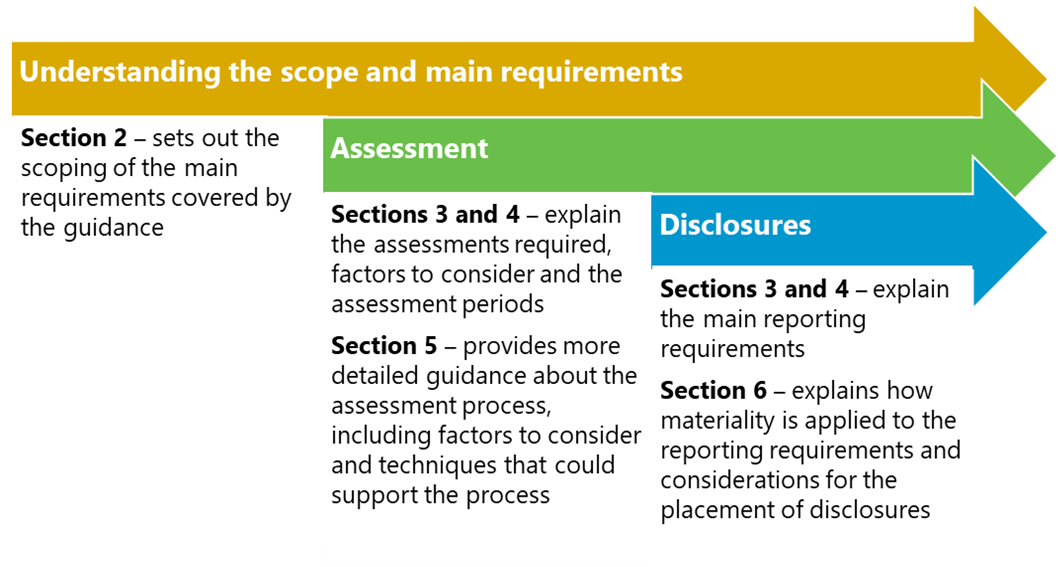
Scope
2.6.The Guidance is intended for all UK companies except small companies and micro-entities. Small companies and micro-entities must assess whether the going concern basis of accounting is appropriate in preparing their financial statements and small companies must also consider certain disclosure requirements in their financial statements. However, they are excluded from the scope of the Guidance as, overall, it has not been written with these companies in mind and some aspects do not apply to them (for example, strategic report requirements and auditing standards, unless they have chosen to obtain an audit).
2.7.The Guidance is relevant to UK companies that are required to or choose voluntarily to apply the Code and those that do not. Code companies are subject to additional Provisions in areas that are related to the going concern basis of accounting and solvency and liquidity risks – for example, requirements for risk management, internal controls and the assessment of prospects (the viability statement). Appendix B provides an overview of some of these areas and includes related references to the Code guidance. This Guidance does not address the application of those Provisions and Code companies should also refer to separate Code guidance.4
2.8.The following table sets out the requirements for each type of company, highlighting the sections of the Guidance that may assist directors in meeting those requirements. For completeness it includes small companies and micro-entities. Directors of small companies and micro-entities may find the specific guidance paragraphs referenced in this table helpful in identifying and applying the requirements applicable to them.
2.9.The Guidance is also likely to be helpful for other types of entities (for example, LLPs). Such entities may have other sources of requirements not listed in this table depending on their legal form and some aspects of the Guidance might not be relevant to them (for example, strategic report requirements).
| Main requirements | Source of requirements | Micro-entity5 | Small company | Large or medium-sized company | Code company | Guidance paragraph reference |
|---|---|---|---|---|---|---|
| Financial statements | ||||||
| Assessment of the appropriateness of the going concern basis of accounting | FRS 1056, 3.3 FRS 1027, 3.8 IAS 18, 25 |
✓ | ✓ | ✓ | ✓ | 3.1 to 3.19 |
| Statement when the financial statements are prepared on a going concern basis | FRS 102, 3.8A9 FRS 102, 1AC.2C The Code, Provision 30 UK Listing Rules, UKLR 6.6.6R(3)(a) |
X | ✓ | ✓ | ✓ | 3.21, 3.23, 3.24 to 3.27 |
| Disclosure of material uncertainties or when the financial statements are not prepared on a going concern basis | FRS 102, 3.9 FRS 102, 1AC.2C IAS 1, 25 The Code, Provision 30 |
X | ✓ | ✓ | ✓ | 3.20, 3.23, 3.28 to 3.30 |
| Disclosure of significant judgements related to the going concern basis of accounting and any material uncertainties | FRS 102, 3.8A and 8.6 FRS 102, 1AC.2C IAS 1, 122 |
X | ✓ | ✓ | ✓ | 3.22, 3.23, 3.31 to 3.35 |
| Main requirements | Source of requirements | Micro-entity5 | Small company | Large or medium-sized company | Code company | Guidance paragraph reference |
|---|---|---|---|---|---|---|
| Financial statements | ||||||
| Additional disclosures may be required to give a true and fair view | Companies Act 2006, s.393 | X5 | ✓10 | ✓ | ✓ | 3.22, 3.36 to 3.40 |
| Other relevant financial statement disclosures | FRS 10211 IFRS 7 IFRS 9 IAS 1 IAS 7 IAS 37 |
X | X | ✓ | ✓ | 4.17 |
| Strategic report | ||||||
| Description of the principal risks and uncertainties facing the company | Companies Act 2006, s.414C(2)(b) The Code, Provision 28 DTR 4.1.8R(2) |
X12 | X12 | ✓ | ✓ | 4.1 to 4.16 |
| Assessment of prospects (viability statement) | The Code, Provision 31 UK Listing Rules, UKLR 6.6.6R(3)(b) |
X | X | X | Not applicable |
3. Going concern basis of accounting and material uncertainties
Assessment
Adoption of the going concern basis of accounting
Summary of requirements
3.1.All companies must assess the appropriateness of the going concern basis of accounting when preparing their financial statements.
3.2.Companies are required to adopt the going concern basis of accounting, except in circumstances when the directors determine at the date of approval of the financial statements either that they intend to liquidate the company or to cease trading or have no realistic alternative to liquidation or cessation of operations.13
3.3.The threshold for departing from the going concern basis of accounting is very high, as there are often realistic alternatives to liquidation or cessation of operations. Such realistic alternatives can exist even if they depend on uncertain future events.
3.4.The assessment process carried out by the directors (see Section 5 for more information) should be proportionate to the size, complexity and the particular circumstances of the company.
3.5.The assessment must take into account all relevant facts and circumstances at the date of approval of the financial statements.14 It is not appropriate to prepare the financial statements using the going concern basis of accounting if the directors determine after the reporting period that they intend to liquidate the company or to cease trading or have no realistic alternative but to do so.15
3.6.When making the assessment, directors might apply significant judgement in:
- the determination of the assumptions used in forecasts or other techniques (see Section 5); and
- the determination of whether the going concern basis of accounting is appropriate and whether there are material uncertainties (see below).
3.7.The assessment should be sufficiently robust and documented in sufficient detail to explain the basis of the directors' conclusion with respect to the going concern basis of accounting at the date of approval of the financial statements. The documentation should include any significant judgements made and assumptions used, which should usually be consistent with those used in other forward-looking parts of the financial statements (such as impairment reviews) unless another accounting standard permits or requires otherwise in specific circumstances.
Material uncertainties
Summary of requirements
3.8.Accounting standards16 require directors to assess the company's ability to continue as a going concern. As part of their assessment, the directors must determine if there are any material uncertainties relating to events or conditions that may cast significant doubt upon the company's ability to continue as a going concern.
3.9.In performing this assessment, the directors must consider all available information about the future.
3.10.Events or conditions could result in the going concern basis of accounting being inappropriate in future reporting periods. In assessing material uncertainties, directors should also consider the realistically possible outcomes of events and changes in conditions, and the realistically possible mitigating actions to such events and conditions that would be available to the directors. Section 5 sets out factors to consider when identifying events or conditions, and techniques that may be used in the assessment, while paragraphs 3.14 to 3.19 cover the assessment period.
3.11.Uncertainties relating to such events or conditions are considered material if their disclosure could reasonably be expected to affect the economic decisions of shareholders and other users of the financial statements. This is a matter of judgement. In making this judgement, the directors should consider the uncertainties arising from their assessment, both individually and in combination with others.
3.12.In determining whether there are material uncertainties, the directors should consider:
- the magnitude of the potential impacts of the uncertain future events or changes in conditions on the company and the likelihood of their occurrence;
- the realistic availability and likely effectiveness of any mitigating actions that the directors could take to avoid, or reduce the impact or likelihood of, the uncertain future events or changes in conditions; and
- whether the uncertain future events or changes in conditions are unusual, rather than occurring with sufficient regularity for the directors to make predictions about them with a high degree of confidence.
3.13.Uncertainties should not usually be considered material if the likelihood that the company will not be able to continue to use the going concern basis of accounting is assessed to be remote, however significant the assessed potential impact is.
The assessment period
Summary of requirements
3.14.Accounting standards and the Code provide for a minimum period that must be reviewed by directors as part of their assessment of the going concern basis of accounting and any material uncertainties:
- FRS 102 requires companies to consider a period of at least 12 months from the date the financial statements are authorised for issue.17
- IFRS Accounting Standards (IFRS) require companies to consider a period of at least 12 months from the end of the reporting period.18
- The Code19 requires companies to consider a period of at least 12 months from the date of approval of the financial statements.
3.15.Additionally, auditing standards20 require auditors in the UK to consider a period of at least 12 months from the date that the financial statements are authorised for issue.
3.16.Consequently, in the UK the minimum period for the going concern assessment is 12 months from the date the financial statements are authorised for issue.
3.17.The minimum period for the going concern assessment does not mean that the outlook should be limited to 12 months. A longer assessment period could be more appropriate, especially if significant events or conditions (such as large debt repayments, debt covenant tests, significant capital commitments or expiry dates for key contracts or licences) are identified beyond that minimum period that may cast significant doubt upon the continuing use of the going concern basis of accounting.
3.18.Determining the appropriate assessment period is a matter of judgement for the directors. Directors must consider all available information about the future when determining the assessment period, which includes the company's principal risks (see Section 4), the company's specific circumstances and factors relevant to the assessment (see Section 5).
3.19.Particularly when a longer assessment period has been selected or when the determination of the assessment period involves significant judgement, companies should clearly identify the period covered by the assessment and the reason for selecting that duration in their going
Footnotes
3.13Uncertainties should not usually be considered material if the likelihood that the company will not be able to continue to use the going concern basis of accounting is assessed to be remote, however significant the assessed potential impact is.
The assessment period
Summary of requirements
3.14Accounting standards and the Code provide for a minimum period that must be reviewed by directors as part of their assessment of the going concern basis of accounting and any material uncertainties:
- FRS 102 requires companies to consider a period of at least 12 months from the date the financial statements are authorised for issue. 17
- IFRS Accounting Standards (IFRS) require companies to consider a period of at least 12 months from the end of the reporting period. 18
- The Code 19 requires companies to consider a period of at least 12 months from the date of approval of the financial statements.
3.15Additionally, auditing standards 20 require auditors in the UK to consider a period of at least 12 months from the date that the financial statements are authorised for issue.
3.16Consequently, in the UK the minimum period for the going concern assessment is 12 months from the date the financial statements are authorised for issue.
3.17The minimum period for the going concern assessment does not mean that the outlook should be limited to 12 months. A longer assessment period could be more appropriate, especially if significant events or conditions (such as large debt repayments, debt covenant tests, significant capital commitments or expiry dates for key contracts or licences) are identified beyond that minimum period that may cast significant doubt upon the continuing use of the going concern basis of accounting.
3.18Determining the appropriate assessment period is a matter of judgement for the directors. Directors must consider all available information about the future when determining the assessment period, which includes the company's principal risks (see Section 4), the company's specific circumstances and factors relevant to the assessment (see Section 5).
3.19Particularly when a longer assessment period has been selected or when the determination of the assessment period involves significant judgement, companies should clearly identify the period covered by the assessment and the reason for selecting that duration in their going concern disclosures. This information provides useful insight into the liquidity factors and risks faced by the company.
Reporting requirements
Summary of requirements
3.20Accounting standards and the Code 21 require disclosure when a company does not prepare financial statements on a going concern basis or when there are material uncertainties related to events or conditions that may cast significant doubt upon the company's ability to continue to adopt the going concern basis of accounting.
3.21FRS 102, 22 the UK Listing Rules 23 and the Code 24 require an explicit statement about the adoption of the going concern basis of accounting.
3.22Additional disclosures may be required to comply with the overarching requirements in accounting standards to disclose significant judgements, assumptions and other sources of estimation uncertainty, or for the financial statements to give a true and fair view.
3.23In the financial statements, four reporting scenarios follow from the directors' assessment of whether the going concern basis of accounting is appropriate and whether there are material uncertainties. These scenarios are summarised in the table below and the disclosure requirements are discussed in further detail in the paragraphs that follow.
| Scenario | Basis of accounting | Disclosure requirements |
|---|---|---|
| Going concern basis of accounting is appropriate and there are no material uncertainties | Going concern basis of accounting | Disclose basis of preparation FRS 102, the UK Listing Rules and the Code require an explicit statement about the adoption of the going concern basis of accounting Consider overarching disclosure requirements and information necessary for a true and fair view |
| Going concern basis of accounting is appropriate and there are no material uncertainties but reaching that conclusion involved significant judgement | Going concern basis of accounting | Disclose basis of preparation FRS 102, the UK Listing Rules and the Code require an explicit statement about the adoption of the going concern basis of accounting Overarching disclosure requirements apply including disclosures about significant judgements, and any assumptions or information necessary for a true and fair view |
| The going concern basis of accounting is appropriate but there are material uncertainties. Reaching that conclusion may or may not involve significant judgement. | Going concern basis of accounting | Disclose basis of preparation FRS 102, the UK Listing Rules and the Code require an explicit statement about the adoption of the going concern basis of accounting Disclose material uncertainties Overarching disclosure requirements apply including disclosures about any significant judgements, assumptions and information necessary for a true and fair view |
| The going concern basis of accounting is not appropriate | Basis other than the going concern basis of accounting | Disclose the fact that the financial statements are not prepared on a going concern basis of accounting and the reasons why Disclose basis of preparation, including the basis of accounting adopted |
Basis of preparation
3.24All financial statements must describe the basis of preparation, 25 including material accounting policy information. This includes the adoption of the going concern basis of accounting or any alternative basis adopted if the going concern basis of accounting is not appropriate.
3.25FRS 102, the UK Listing Rules and the Code explicitly require a statement about the adoption of the going concern basis of accounting and the assessment of material uncertainties. There is no such requirement under IFRS Accounting Standards or FRS 101.
3.26Companies could include a summary of how the directors reached their conclusions, for example, with reference to their profitability, cash flows, liquidity position, available borrowing facilities or other sources of financing including the techniques applied in the analysis. This may be particularly relevant for users at times of greater economic uncertainty. Increased levels of uncertainty or judgement may mean that more comprehensive and prominent disclosures to explain the going concern basis of accounting are considered material information (see Section 6).
3.27The amount of information provided should be proportionate to the uncertainties to which the company is exposed and to its financial and liquidity position. A company facing greater uncertainty and with less financial headroom should provide more detail than one without such challenges, including details about any material uncertainties, significant judgements, assumptions and other sources of estimation uncertainty, as discussed in the following paragraphs. More detailed qualitative and quantitative information about the factors considered and significant assumptions and inputs applied could also be appropriate in such circumstances to help users understand the uncertainties and how they might affect the company's financial and liquidity position.
Material uncertainties
3.28When there are material uncertainties that may cast significant doubt upon the company's ability to continue to adopt the going concern basis of accounting, the financial statements must disclose them. The financial statements should clearly disclose the existence and nature of the material uncertainty, including:
- a description of the principal events or conditions that may cast significant doubt; and
- the directors' plans to deal with these events or conditions.
3.29Disclosures about material uncertainties should be company-specific. For example, companies could identify the specific issue that is considered a material uncertainty and explain when the uncertainty might crystallise, how it could affect the company's financial position and liquidity, and set out the specific mitigating actions available to the company should the material uncertainty crystallise.
3.30Directors may also wish to understand the auditor's responsibility to assess whether material uncertainties are clearly disclosed 26 (see Section 8).
Significant judgements, assumptions and other sources of estimation uncertainty
Summary of requirements
3.31Accounting standards require disclosure of judgements made in applying the company's accounting policies that have the most significant effect on amounts recognised in the financial statements (significant judgements). 27 This applies to situations when significant judgement has been applied in determining whether:
- the going concern basis of accounting is appropriate; or
- a material uncertainty in respect of going concern exists. 28
3.32Disclosures about significant judgements related to going concern assessments should be company-specific and should clearly identify the judgement made. For example, companies could explain the company-specific factors considered (see Section 5) and how they affected the assessment, such as the events or conditions that are subject to significant judgement, or the feasibility and effectiveness of the directors' plans or mitigating actions in response to those events or conditions.
3.33Examples of situations that could involve significant judgement in determining whether the going concern basis of accounting is appropriate or whether a material uncertainty exists (if they have a significant effect on the overall assessment either individually or when considered together with other factors) may include:
- when a significant borrowing facility may need to be restructured or renewed;
- when a waiver of a covenant by a lender of a significant borrowing facility may be needed; or
- if other types of significant business restructuring, asset disposals or cost reductions are planned during the assessment period and these have been assumed in the assessment based on the directors' expectations of achieving them.
Summary of requirements
3.34Accounting standards require disclosure of information about the assumptions made about the future and other sources of estimation uncertainty at the reporting date that have a significant risk of resulting in a material adjustment to the carrying amounts of assets and liabilities within the next financial year. 29 This applies to assumptions made as part of the going concern assessment when relevant.
3.35Disclosures about assumptions should be company-specific and provide sufficient information about the directors' basis for their assessment. This allows users to understand how the company might be affected by changes in factors and to assess whether the assumptions are consistent with those applied in other areas of the financial statements (such as impairment reviews) unless another accounting standard permits or requires otherwise in specific circumstances. For example, companies could provide qualitative and quantitative details about the significant inputs to scenarios considered in the going concern assessment, including how they were determined. If there are material differences between the assumptions used in other related disclosures, then this should be disclosed.
True and fair view
Summary of requirements
3.36The directors are responsible for ensuring that the financial statements give a true and fair view. 30
3.37Directors must consider whether additional disclosures relating to the going concern basis of accounting and any material uncertainties are necessary for the financial statements to present a true and fair view.
3.38This involves considering whether additional company-specific information is necessary to understand the particular circumstances.
3.39In some circumstances there are grounds for disclosure beyond the explicit reporting requirements in accounting standards.
Example
3.40A subsidiary company may be heavily loss-making or have substantial net liabilities. The financial statements of a subsidiary company might therefore give the impression that the company is experiencing significant financial difficulties. However, the existence of ongoing support from its parent may, in some circumstances, mean that no material uncertainty exists. Disclosure of this ongoing support as a key assumption made in the assessment may be necessary to give a true and fair view.
4. Solvency and liquidity risks
Assessment
Summary of requirements
4.1The Companies Act 2006 requires all companies that are not small companies or micro-entities to prepare a strategic report. The strategic report must contain a fair review of the company's business, and a description of the principal risks and uncertainties that it faces. 31
4.2The strategic report, by its nature, has a forward-looking orientation and the directors are encouraged to think broadly about all relevant matters that may pose risks to the company. When making their risk assessment, the directors should identify as principal risks and uncertainties those matters that could significantly affect the development, performance, position and future prospects of the company. The principal risks and uncertainties identified are generally matters that the directors regularly monitor and discuss because of their likelihood, the magnitude of their potential effect on the company, or a combination of the two.
4.3Solvency risk is the risk that a company will be unable to meet its liabilities in full. A company must generate sufficient value that its assets exceed its liabilities. A failure to do so could render it insolvent. The assessment of solvency risk over the longer term involves considering the sustainability of the business model and the maintenance of capital.
4.4Liquidity risk is the risk that a company will be unable to meet its liabilities as they fall due. A company must generate and retain sufficient cash to allow it to meet its liabilities at the time contractual payments are due. The liquidity of an otherwise profitable company can be threatened if it is incapable of converting assets into cash when it is necessary to make such payments. The assessment of liquidity risk may need to take account of potential short-term fluctuations in the company's working capital requirements.
4.5Directors should consider threats to solvency and liquidity as part of their assessment of the principal risks and uncertainties faced by the company. When the directors have concluded that there is no material uncertainty regarding the appropriateness of the going concern basis of accounting, the assessment of principal risks and uncertainties may still identify risks that impact solvency and liquidity.
4.6When making the assessment of principal risks and uncertainties, directors should consider both those business risks that are financial in nature and those that are non-financial. Principal risks and uncertainties that arise from, for example, operational, competitive, market, regulatory, or sustainability-related factors, may affect a company's business model and prospects, and ultimately, the solvency and liquidity position. It is not necessary to label risks as solvency and liquidity risks if other descriptions can more easily set out their nature and potential effects including how they might affect the company's solvency and liquidity position.
Example
4.7The directors of a company that is heavily reliant on a single customer may identify this as a principal risk to the business that could have an impact on its solvency or liquidity. If this customer ceases to purchase the company's products or services, or becomes unable to pay its debts to the company, the company might be unable to meet its liabilities as they fall due. In an extreme case, the loss of the customer might have the potential to render the company insolvent.
4.8In assessing the risks and uncertainties that may affect solvency and liquidity, directors should consider the likelihood and possible effects of those risks materialising.
4.9The extent of the process for assessing the risks and uncertainties and considering their implications should be appropriate to the size, complexity and particular circumstances of the company and is a matter of judgement for the directors. See Section 5 for more information about the assessment process.
The assessment period
4.10The period of the assessment for solvency and liquidity risks in the context of the requirement to disclose principal risks and uncertainties in the strategic report is a matter of judgement for the directors and depends on the facts and circumstances of the company.
4.11The period of assessment for solvency and liquidity risks will usually be longer than 12 months from the date of authorisation for issue of the financial statements, and will often be longer than the going concern assessment period (see Section 3). The length of the period should be determined taking into account a number of factors, including the nature of the business, its stage of development, debt maturities, investment and planning time horizons.
4.12Given the forward-looking nature of this assessment, the level of detail and accuracy of the information available relating to the future will vary. 32
Reporting requirements
Disclosure of principal risks and uncertainties
4.13The strategic report should provide users with information about the development, performance, position and future prospects of the company, proportionate to the size, complexity and the particular circumstances of the company. Principal risks and uncertainties should be described in a clear, concise and understandable way and should include a description of how the principal risks and uncertainties are managed or mitigated.
4.14When the directors identify solvency or liquidity risks as principal risks, they should explain the particular economic or operational conditions that give rise to those principal risks and uncertainties, and the potential impact on specific aspects of the business. Issues that may require disclosure depend on individual facts and circumstances but may include:
- uncertainties about current financing arrangements (whether committed or uncommitted);
- potential changes in financing arrangements such as critical covenants and any need to increase borrowing levels;
- counterparty risks arising from current credit arrangements (including the availability of insurance when relevant) with either customers or suppliers;
- a dependency on key suppliers and/or customers; and
- uncertainties posed by the potential impact of the economic outlook on business activities.
4.15When relevant, the description of the principal risks and uncertainties facing the entity should highlight any linkage with disclosures in the financial statements relating to the going concern basis of accounting, material uncertainties and risks, and any other related disclosures in the annual report (such as impairment reviews or, for Code companies, the viability statement).
Example
4.16A company that is growing rapidly may need to ensure that it is able to access long-term financing to support its future development. The inability of the company to access this financing could result in liquidity risk and in extreme circumstances lead to insolvency. Directors may have actions planned for mitigating this, for example, obtaining a bank loan or raising funds through the issue of shares. The directors should consider disclosing the risk of not raising sufficient financing and the planned actions to mitigate that risk as a principal risk and mitigation in the strategic report. Directors should also consider whether the risk represents a material uncertainty relating to the going concern basis of accounting, or whether significant judgement was involved in the assessment, also requiring disclosure in the financial statements.
Other disclosures
4.17Accounting standards require other disclosures in the financial statements that may be relevant to an understanding of solvency risk and liquidity risk. An overview of the main requirements is set out in the table that follows.
| Disclosure | FRS 102 paragraph number | IFRS 33 paragraph number |
|---|---|---|
| Risks arising from financial instruments | 11.42, 11.48A(f), 34.23 to 34.30 34 | IFRS 7, 31 to 42 |
| Undrawn borrowing facilities and any restrictions on the use of those facilities such as covenant requirements | n/a | IAS 7, 50(a) 35 |
| Defaults and covenant breaches | 11.47 | IFRS 7, 18 to 19 |
| Non-current liabilities with covenants | n/a | IAS 1, 76ZA |
| Changes in net debt / liabilities arising from financing activities | 7.22 | IAS 7, 44A to 44E |
| Supplier finance arrangements | 7.20B to 7.20C 36 | IAS 7, 44F to 44H |
| Significant judgements relating to the application of accounting policies | 8.6 | IAS 1, 122 to 124 |
| Assumptions and other sources of estimation uncertainty about the carrying amounts of assets and liabilities | 8.7 | IAS 1, 125 to 133 |
| Contingent liabilities | 21.15 | IAS 37, 86 to 88 |
5. The assessment process
5.1This section sets out factors to consider and techniques that may be applied in assessing:
- whether the going concern basis of accounting is appropriate or whether there are any material uncertainties that may cast significant doubt that it will continue to be so; and
- in identifying principal risks and uncertainties to disclose in the strategic report, including risks that might impact solvency and liquidity.
5.2For companies that apply the Code, these factors and techniques may also be relevant for the assessment of prospects (viability statement) under the Code and the UK Listing Rules.
5.3As set out in Section 3 and Section 4, the directors must consider all available information about the future in performing these assessments. Examples of internal and external factors to consider are set out in the table after paragraph 5.14.
5.4Directors should assess which factors are likely to be relevant to their company. These factors will vary according to the company's particular circumstances including its business model, sources of finance, industry, and how it is affected by the general economic and wider external environment. Some of these factors will be more relevant to the strategic report assessment of risk whereas others will be more relevant to the assessment of the going concern basis of accounting and financial statement disclosures.
5.5The extent of the directors' assessment process will depend on the size, complexity and particular circumstances of the company. The process is likely to be simpler and less extensive for companies that depend on fewer providers of finance and are readily able to access finance, have more straightforward business activities with a history of profitable and cash-generating operations, and are less affected by the economic and wider external environment. However, it is still important that the assessment is carried out and addresses, to the extent necessary, the directors' plans to manage the company's borrowing requirements, the timing of cash flows and the company's exposure to contingent liabilities.
5.6In contrast, directors of companies with more complex circumstances may need to consider a wide range of factors including those related to current and expected profits and cash flows, debt covenants and maturities, potential alternative sources of finance, potential changes to the business model and various market and other external conditions that could affect the business and its financial and liquidity position.
5.7The level of detail applied in the analysis of these factors will depend on the scale and nature of the risks and uncertainties a company faces and the time horizon over which the analysis is applied. Longer-term assessments, such as those that will inform the disclosures in the strategic report (or the assessment of prospects for Code companies), are likely to be performed at a higher, more aggregated level, reflecting the difficulties in making detailed long-term predictions.
5.8The assessments of solvency and liquidity risks and the going concern basis of accounting (and for Code companies, the assessment of prospects) are an integral process in managing the business. The assessments should be robust and appropriately documented. Appropriate processes should be in place with sufficient time available for the directors to review and approve the assessments and any analysis performed by the management of the company.
5.9The going concern assessment must reflect the effect of events and conditions occurring after the end of the reporting period up to the date that the financial statements are authorised for issue. Directors must review and update preliminary assessments of the appropriateness of using the going concern basis of accounting, the extent of analysis performed and decisions about which disclosures are necessary until the financial statements are authorised for issue. A similar approach should be applied to the assessment of solvency and liquidity risks disclosed in the strategic report, which should reflect the circumstances at the date of approval of the annual report.
Forecasts and the timing of cash flows
5.10Forecasting and budgeting are long-established techniques in business management. For the purposes of assessing whether the going concern basis of accounting is appropriate and in assessing solvency and liquidity risks, directors could prepare a budget, trading estimate, cash flow forecast or other equivalent analysis covering the appropriate assessment periods (as described in Section 3 and Section 4). The directors could also review previous forecasts or other analysis against actual results and make appropriate adjustments to the analysis for the current assessment.
5.11Cash flow forecasts and other financial plans can indicate whether there is an adequate matching (of both the timing and the amount) of projected cash inflows with projected cash outflows, including those for the settlement of liabilities, loan repayments, payment of tax and pension liabilities and other commitments, which is particularly relevant to assessing liquidity risk and the appropriateness of the going concern basis of accounting.
5.12Other types of forecasts and analysis could also be performed to assess expected financial performance and position, which may be relevant to compliance with covenant ratios and the availability of borrowing facilities.
5.13Preparing forecasts often involves significant judgement and various assumptions, which must be reasonable and supportable, reflect conditions at the date of authorisation of the financial statements and should usually be consistent with other forward-looking parts of the annual report such as any impairment reviews, unless another accounting standard permits or requires otherwise in specific circumstances. Both internal and external factors and sources of information are relevant when making these judgements and assumptions. Directors should be aware of their own potential bias when making judgements and assumptions in forecasts, for example, overestimation of positive outcomes and underestimation of negative effects. As discussed in Section 3, significant judgements and some assumptions are required to be disclosed in the financial statements.
Factors to consider
5.14Directors should consider both internal and external factors in the assessment. When evaluating which factors to consider, directors should think broadly of the uncertain future events or conditions most relevant to them. Examples of factors to consider in the assessment include but are not limited to:
| Factors | |
|---|---|
| Expected sales volumes and prices | Working capital risks |
| Raw material, energy, labour, transportation and other costs | Availability of borrowings |
| Inflation rates | Compliance with borrowing covenants |
| Exchange rates | Interest rates |
| Acquisitions, disposals, restructuring or other planned changes to the business model | Alternative sources of finance |
| Technological, sustainability-related or other external developments affecting products and services | Support from government bodies |
| Geopolitical and economic events | Capital commitments |
| A customer or supplier failing (counterparty and supply chain risks) | Penalties or damages from claims or legal judgements (contingent liabilities) |
| Business disruption or systems failure including from digital or cybersecurity threats | Changes in legislation, government policy or public finance |
| Availability of cash balances | Changes in taxation rates |
Products, services and markets
5.15Directors could obtain information about the major aspects of the economic environment within which the company operates, considering the size of the market, competitive landscape, its strength, and their market share, and assess whether there are any economic, political or other factors which may cause the market to change. It may be necessary to do this for each of the main product or service markets when developing assumptions for estimated sales volumes and prices and related costs, including raw material, energy, labour, transportation and other costs.
5.16Directors could assess whether their products or services are compatible with their market projections in terms of market position, quality and expected life. This could involve considering technological, sustainability-related and other external developments that could affect demand for their products and services.
5.17Market conditions impact companies differently. It cannot be assumed that difficult market conditions, affecting many companies, mean that a material uncertainty exists about a specific company's ability to continue as a going concern. Equally, material uncertainties may exist about a company's ability to continue as a going concern in times of relatively benign economic circumstances.
Inflation
5.18Inflation can pose a risk and appropriate inflation rates should be factored into the company's forecasts when relevant to estimating revenues and costs, including raw materials, energy, labour and transportation costs. With higher inflation, the assumptions made in forecasts could be significant sources of estimation uncertainty. Directors could obtain and apply projected inflation rates from reliable external sources in developing their forecasts. Low inflation can also threaten the business performance and liquidity of some businesses.
Geopolitical and economic events
5.19Geopolitical and economic events, such as a war or a pandemic, can cause economic uncertainties and significant disruption to business operations, including restrictions to normal operations and supply chain risks. Directors should identify the specific effects on the company's business and identified risks, and reflect those in their assessments and disclosures, as necessary. It may be appropriate for companies to update their risk assessments and forecasts more frequently in times of heightened uncertainty and volatility.
Financial and operational risk management
5.20There are many types of financial and operational risks facing a company and directors should identify which risks are most significant and have the potential to threaten the going concern basis of accounting, or the solvency or liquidity of the company. In developing forecasts, directors make assumptions about the company-specific effects of such risks and how they will be managed or mitigated.
5.21Counterparty risks may arise from reliance on key suppliers (including service providers) or customers who may themselves be facing financial difficulty or operational challenges.
5.22Significant business disruption or system failures may arise from events beyond the company's control causing restricted access to key infrastructure or disruption in the supply chain; or a digital, cyber or data incident (whether internally or externally caused).
Borrowing facilities
5.23The onus is on the directors to be satisfied that there are likely to be adequate financing arrangements in place. The directors could compare the facilities available to the company (drawn and undrawn) with the entity's expected cash requirements from such facilities, as indicated by cash flow forecasts, budgets or trading estimates. The available headroom in facilities can be an important measure of liquidity risk for directors when considering how much analysis to perform, what techniques to apply and the nature and extent of disclosures about going concern, solvency and liquidity risk assessments.
5.24The availability of borrowing facilities often depends on the company's compliance with specific terms and conditions (covenants). A review of borrowing documentation should be undertaken to ensure that all critical terms and conditions are identified so that the risks to continued compliance can be assessed. Assessing compliance with more subjective conditions, such as material adverse change clauses, may involve more judgement compared to covenants that involve the calculation of financial ratios.
5.25Processes for regular monitoring of expected compliance with covenants could be integrated with the assessments of going concern, solvency and liquidity risks as any expected breach of covenants or other triggers within the assessment period could result in material uncertainties related to going concern, and increased solvency and liquidity risks. Forecasts may need to include other information relevant to covenant tests, such as asset values.
5.26The availability of borrowing facilities is also likely to depend on the lender's assessment of the risks to the solvency and liquidity of the company, amongst other factors. The directors may need to consider the likely outcome of the lender's assessment and how it might impact the continuation or renewal of existing facilities beyond contractual periods.
Alternative sources of finance
5.27When companies rely on alternative sources of financing, such as factoring or reverse factoring (also called supplier finance arrangements), key assumptions may include any restrictions to the continuing availability of the arrangement and the timing of the cash inflows or outflows of the arrangements.
5.28When companies rely on government support schemes, key assumptions may include the continuing availability of such schemes, compliance with any attached conditions, the expected timing of the receipt of funds from the government and whether these may need to be repaid in the future.
Contingent liabilities 37
5.29Directors should consider the company's exposure to contingent liabilities and the likely impact on cash flows. These may include sources of potential cash outflows during the review period relating to legal proceedings, guarantees, margin or other credit support provisions under derivative contracts, environmental costs and product liabilities.
Acquisitions, disposals and restructuring
5.30Forecasts should reflect the impact of acquisitions, disposals and restructuring activities on the business. Key assumptions may include the amount, probability and timing of cash flows for acquisition consideration, disposal proceeds, restructuring costs and any expected synergies. Such transactions will also affect the ongoing cash-generating capacity and the levels of uncertainty of the business, which should be reflected in operating cash flows in forecasts and any other analysis. The nature and extent of analysis performed depends on the size, complexity, probability and levels of uncertainty of the transaction.
Techniques
5.31Directors should consider the company's circumstances when tailoring appropriate analysis to support the assessment. The directors could perform further analysis to test the principal risks and most significant assumptions in forecasts in different scenarios.
5.32For example, directors could develop a severe but plausible downside scenario (in contrast to the base case scenario reflected in the forecasts) with changes to key assumptions, such as expected revenues, and then perform sensitivity analysis or stress testing to identify any potential shortfalls in facilities or breaches of covenants.
5.33Techniques that may assist companies in preparing their assessments include the following:
| Techniques | |
|---|---|
| Sensitivity analysis | * Involves measuring the impact on forecasts of changing individual assumptions * Provides an understanding of the critical assumptions that underlie forecasts |
5.29Directors should consider the company's exposure to contingent liabilities and the likely impact on cash flows. These may include sources of potential cash outflows during the review period relating to legal proceedings, guarantees, margin or other credit support provisions under derivative contracts, environmental costs and product liabilities.
Acquisitions, disposals and restructuring
5.30Forecasts should reflect the impact of acquisitions, disposals and restructuring activities on the business. Key assumptions may include the amount, probability and timing of cash flows for acquisition consideration, disposal proceeds, restructuring costs and any expected synergies. Such transactions will also affect the ongoing cash-generating capacity and the levels of uncertainty of the business, which should be reflected in operating cash flows in forecasts and any other analysis. The nature and extent of analysis performed depends on the size, complexity, probability and levels of uncertainty of the transaction.
Techniques
5.31Directors should consider the company's circumstances when tailoring appropriate analysis to support the assessment. The directors could perform further analysis to test the principal risks and most significant assumptions in forecasts in different scenarios.
5.32For example, directors could develop a severe but plausible downside scenario (in contrast to the base case scenario reflected in the forecasts) with changes to key assumptions, such as expected revenues, and then perform sensitivity analysis or stress testing to identify any potential shortfalls in facilities or breaches of covenants.
5.33Techniques that may assist companies in preparing their assessments include the following:
| Techniques | |
|---|---|
| Sensitivity analysis | • Involves measuring the impact on forecasts of changing individual assumptions |
| • Provides an understanding of the critical assumptions that underlie forecasts | |
| Stress test | • Involves identifying adverse scenarios and understanding their effects on the company |
| • May incorporate sensitivity analysis to consider the effect of a change to a single factor or event in the scenario | |
| • Shows how a company would be affected by certain adverse situations or economic events and allows mitigating actions and plans to be developed | |
| Scenario analysis | • Involves identifying multiple and potentially more complex scenarios involving many assumptions and understanding the outcome if multiple factors in the scenario change at the same time |
| • Allows a company to evaluate the effect of more complex hypothetical future events or scenarios | |
| Reverse stress test | • A type of stress test that typically starts from a situation that causes a business to fail or for a business plan to become unviable (alternatively, the directors could define a different adverse outcome, such as one that results in a material uncertainty related to going concern) |
| • Involves identifying one or more adverse scenarios in which this could occur and assessing the likelihood of these scenarios | |
| • Allows mitigating actions and plans to be developed |
5.34In deciding which key assumptions to sensitise or test, directors could consider the principal risks the company is facing, and provide disclosures that explain the linkage between the principal risks identified and the sensitivity or other analysis performed.
5.35A company facing greater uncertainty or longer-term time horizons could consider the more complex techniques such as scenario analysis and reverse stress testing. Different techniques could be applied in a way that is proportionate to the circumstances. For example, scenario analysis could range from a more simple exercise that considers a limited number of scenarios and assumptions to more complex modelling addressing multiple scenarios, assumptions, time horizons and combinations of changes in circumstances.
5.36Reverse stress testing may be a regulatory requirement for some companies, especially some financial institutions, in which case specific requirements set by regulators apply. However, reverse stress testing may also be a useful technique for other companies to identify adverse scenarios, such as situations in which the company is unable to settle loan repayments or breaches borrowing covenants resulting in a demand for repayment of the borrowings. It can help companies consider scenarios not identified by other forms of stress testing and sensitivity analysis.
6. Materiality and placement of disclosures
Materiality
6.1The assessment of materiality depends on the context of its application.
Summary of requirements
6.2In the context of the financial statements, accounting standards38 39 state that information is material if omitting, misstating or obscuring it could reasonably be expected to influence decisions that the users 40 make on the basis of the financial statements.
6.3Materiality depends on the nature or magnitude of information, or both. An entity assesses whether information, either individually or in combination with other information, is material in the context of its financial statements taken as a whole.
6.4In the context of the strategic report, information is material if its omission or misrepresentation could reasonably be expected to influence the economic decisions shareholders take on the basis of the annual report as a whole. Only information that is material in the context of the strategic report should be included within it.
6.5Conversely, the inclusion of immaterial information can obscure key messages and impair the understandability of information provided in the strategic report. Immaterial information should be excluded from the strategic report.41
6.6For financial statements disclosures related to going concern assessments, solvency and liquidity risk, the amount of information provided should be proportionate to the uncertainties to which the company is exposed and to its financial and liquidity position. For example, a company with a material uncertainty or significant judgement relating to its borrowing facilities, might disclose more detailed information about its levels of drawn and undrawn facilities, repayment terms, covenants, headroom, and whether the company expects any breaches of covenants or waivers of covenants during the going concern assessment period. The greater the uncertainty the company faces, the more likely such information is to be material and relevant to users in understanding how such matters might affect the company's financial and liquidity position.
6.7The principal risks disclosed in the strategic report should be those that are considered, by the directors to be material to a user's understanding of the development, performance, position or future prospects of the business.42
6.8The inclusion of too many risks that are not material to an understanding of the business detracts from the usefulness of the principal risks and uncertainties disclosure; disclosures relating to solvency or liquidity risks should be assessed for their materiality as other risk disclosures are.
Placement of going concern disclosure
6.9Directors should consider the placement of disclosures with a view to facilitating the effective communication of that information.43
6.10In some instances, it may be helpful to group together similar or related disclosure requirements arising from different legal or regulatory requirements that apply to different components of the annual report. This reduces duplication and enables linkages to be highlighted and explained clearly in one place.
6.11Company law and accounting standards set the requirements for disclosures relating to principal risks and uncertainties and the going concern basis of accounting, respectively. This may result in the inclusion of these disclosures in different components of the annual report (for example, the strategic report and the financial statements). The Code and the UK Listing Rules also set the requirement for a viability statement which may be presented within the corporate governance statement or alternatively it may be included in the strategic report.
6.12Cross-referencing is a means by which an item of information, which has been disclosed in one component of an annual report, can be included as an integral part of another component of the annual report. A cross-reference should specifically identify the nature and location of the information to which it relates in order for the disclosure requirements of a component to be met through the information located elsewhere. For example, disclosures in the strategic report that refer to a material uncertainty could briefly indicate the nature of the material uncertainty in addition to the location of more detailed financial statements disclosures. A component is not complete without the information to which it is cross-referenced. Cross-referenced information must be included within the annual report.
6.13The effective use of cross-referencing and signposting can reduce duplication of information across disclosures relating to principal risks and uncertainties and the going concern basis of accounting, and other related disclosures (such as impairment reviews). It can also help to demonstrate the consistency of assumptions and judgements in related assessments or highlight any material differences in specific circumstances when another accounting standard permits or requires a different approach.
6.14When law or regulation specifies the location for a disclosure (for example, the financial statements) and the information is presented outside that specified component of the annual report, cross-referencing must be used in order for the disclosure requirement to be met.
6.15In other cases, it may be helpful to direct users to related information included in different parts of the annual report or outside the annual report. Signposting can be used for this purpose.
6.16Signposting is a means by which a user's attention can be drawn to complementary information that is related to a matter disclosed in a component of the annual report. A component must meet its legal and regulatory requirements without reference to signposted information.
7. Group considerations
Assessment
7.1Directors of subsidiary companies must make their own assessment to support disclosure of the principal risks and uncertainties facing the company in the strategic report and of the subsidiary's ability to continue to adopt the going concern basis of accounting. Directors should take into account the specific facts and circumstances of the subsidiary company, in particular:
- the need for support from the parent company or fellow subsidiaries;
- the ability and intention of the parent company or fellow subsidiaries to provide adequate support over the period covered by the going concern assessment; and
- the risks to the company arising from support that it has undertaken to provide to other members of the group, for example through cross-guarantees or from being part of a group cash pooling arrangement.
7.2The directors could consider the degree of autonomy exercised by the subsidiary company, how the subsidiary's business fits into the group's activities and future plans, and the particular business risks the group faces.
7.3Subsidiary companies that are part of arrangements involving cash pooling or cross-guarantees can be exposed to greater liquidity risk and default risk if another fellow subsidiary is unable to repay its borrowings. As such arrangements can be complex, it is important for directors of subsidiaries to understand the terms of the arrangement and to assess the implications for the going concern assessment and solvency and liquidity risks of the subsidiary company.
7.4The adequacy of the evidence of any parent company or fellow subsidiary support is a matter of judgement for the directors of the subsidiary company. Their judgement usually incorporates their experience of dealing with the parent company or fellow subsidiary company over time, in the context of recent events and current circumstances, and the adequacy of related documentation in place to confirm the parent company or fellow subsidiary company support. This includes considering the development, performance, position and future prospects of the group, and the group's ability and intention to support the subsidiary, taking into account other guarantees made by the parent company and fellow subsidiaries, and the availability of group borrowing facilities.
Disclosures
7.5The reporting requirements and guidance in Section 3 and Section 4 apply to disclosures relating to solvency and liquidity risks and the going concern basis of accounting in group situations.
7.6In particular, the directors of subsidiary companies should provide company-specific disclosures about any significant judgement and key assumptions made in assessing the adequacy of support or guarantees provided by the parent company or fellow subsidiaries. This could include the name of the parent company or fellow subsidiary, the period covered by the support or guarantees, and the basis for assessing the ability and intention of the parent company or fellow subsidiary to provide the support or guarantees.
8. Auditor's responsibilities
8.1The purpose of this section is to help directors understand the responsibilities that the auditor has in connection with the directors' assessment of the company's ability to continue to adopt the going concern basis of accounting and related disclosures in the financial statements or annual report.
The auditor's responsibilities
Summary of requirements
8.2Auditors are required by auditing standards44 to obtain sufficient appropriate audit evidence and conclude on whether it is appropriate for the directors to use the going concern basis of accounting to prepare the financial statements, and whether a material uncertainty related to going concern exists and is appropriately disclosed.
8.3In addition, the auditor has responsibilities for considering, based on the audit work performed, whether the other information included in the annual report is materially misstated or materially inconsistent with the financial statements, and for reporting in relation to such matters. This other information includes the description of the principal risks and uncertainties including those related to solvency and liquidity risks, disclosed in the strategic report.45 Some additional requirements apply to auditors in respect of Code companies.
8.4There are implications for the auditor's report which depend on the auditor's conclusions.
Evaluating the directors' assessment
8.5As part of the auditor's risk assessment procedures, the auditor is required to obtain an understanding of the company and its environment, the applicable financial reporting framework and the company's system of internal control as it relates to going concern. This understanding helps the auditor to identify any events or conditions that, individually or collectively, may cast significant doubt on the company's ability to continue as a going concern and whether or not a material uncertainty related to going concern exists.
8.6The auditor is required to evaluate the directors' going concern assessment and if the assessment has not yet been performed, the auditor must request the directors to make their assessment. In evaluating the directors' going concern assessment, the auditor considers whether the assessment includes all relevant information, including all available information about the future, of which the auditor is aware as a result of the audit.
8.7The auditor covers the same period as the directors used to make their assessment. If the period of the directors' assessment is less than 12 months from the date of approval of the financial statements, the auditor requests the directors to extend their assessment. If the directors do not make or extend their assessment, or do not provide sufficient information about the company's ability to continue as a going concern, there may be implications for the auditor's report.
8.8The auditor is required to challenge and test the directors' going concern assessment. This includes evaluating the appropriateness of the method, the relevance and reliability of the underlying data, the appropriateness and consistency of the assumptions used, the feasibility of plans for future actions and the risk of management bias. The auditor must then stand back and take into account all evidence obtained, whether corroborative or contradictory, before concluding on the appropriateness of the going concern basis of accounting and whether a material uncertainty related to going concern exists.
8.9The auditor also must inquire about events or conditions beyond the period of the directors' assessment that may cast significant doubt on the company's ability to continue as a going concern. When such events or conditions are identified, the auditor requests the directors to evaluate their potential significance on the going concern assessment.
8.10For Code companies, the auditor must also consider whether there is a material inconsistency between the auditor's knowledge obtained through their evaluation of the directors' going concern assessment and other related reporting under the Code, including reporting against Provision 31 of the Code on the prospects of the company (the viability statement).
Disclosures
8.11As part of the audit, the auditor considers any disclosures relating to solvency and liquidity risk, and the going concern basis of accounting made in the annual report. For Code companies, the auditor also considers the related reporting under the Code, including the viability statement.
8.12If the going concern basis of accounting is appropriate but a material uncertainty related to going concern exists, the auditor must determine whether the financial statements appropriately disclose:
- the principal events or conditions that may cast significant doubt on the company's ability to continue to adopt the going concern basis of accounting;
- the directors' plans to deal with those events or conditions; and
- a clear statement that there is a material uncertainty relating to going concern and, therefore, the company may be unable to realise its assets and discharge its liabilities in the normal course of business.
8.13If events or conditions have been identified that may cast significant doubt on the company's ability to continue as a going concern but the auditor concludes that no material uncertainty related to going concern exists, the auditor evaluates whether, in view of the requirements of the applicable financial reporting framework, the financial statements provide appropriate disclosures about these events or conditions, and the significant judgements made by the directors as part of their going concern assessment.
Reporting
Going concern
8.14The implications for the auditor's report depend on the basis of preparation adopted, the disclosures included in the financial statements and the audit evidence obtained. There are some additional audit reporting requirements for certain types of companies, including Code companies.
8.15When the auditor concludes that the use of the going concern basis of accounting is appropriate and no material uncertainty has been identified, the auditor is required to include specific conclusions related to going concern in a separate section of the auditor's report.
8.16For audits of public interest entities, other listed entities, Code companies, or an entity subject to governance requirements of the Large and Medium-sized Companies and Groups (Accounts and Reports) Regulations 2008 (SI 2008/410),46 the auditor's report must explain how the auditor evaluated the directors' going concern assessment and any key observations.
8.17When a material uncertainty exists, the auditor highlights this in a separate section of the auditor's report, provided that the circumstances are appropriately disclosed in the financial statements.
Modified opinions
8.18The auditor expresses a modified audit opinion and explains the reasons for doing so if the auditor disagrees with the basis of preparation adopted, or if inadequate disclosures are included in the financial statements in relation to going concern.
8.19In rare circumstances, the auditor may disclaim their opinion in situations involving multiple material uncertainties that are significant to the financial statements as a whole.
Reporting to regulators
8.20For public interest entities, when the auditor concludes that it may be necessary to include a 'Material uncertainty related to going concern' paragraph in the auditor's report or issue a qualified, adverse or disclaimer of opinion in respect of matters related to going concern, the auditor is required to report to the FRC and other regulators as appropriate.
Other information
8.21The auditor is also required to read the directors' report and the strategic report and to state in the auditor's report whether, based on the work undertaken in the course of the audit:
- the information is consistent with the financial statements;
- the information has been prepared in accordance with applicable legal requirements; and
- the auditor has identified any material misstatements in the information.47
8.22The auditor is also required to report on all other information contained in the annual report as described in paragraph 8.3.
Appendix A: Application to other reports
Half-yearly financial reports
A.1Companies may prepare half-yearly (or other interim) reports to comply with regulatory requirements, such as the Disclosure Guidance and Transparency Rules (DTR)48 or AIM-rules49, or voluntarily.
Assessment
Summary of requirements
A.2In preparing financial statements for inclusion in a half-yearly (or other interim) report directors must consider whether the going concern basis of accounting is appropriate. Accounting standards that could be applied in the preparation of such financial statements for inclusion in a half-yearly (or other interim) report are: IAS 34 Interim Financial Reporting for companies that apply IFRS,50 and FRS 104 Interim Financial Reporting for companies applying FRS 102 The Financial Reporting Standard applicable in the UK and the Republic of Ireland or FRS 101 Reduced Disclosure Framework in their annual financial statements.51
A.3The Code requirement for an explicit statement of whether the directors consider it appropriate to adopt the going concern basis of accounting also applies to interim financial statements.
A.4If a half-yearly report includes principal risks and uncertainties,52 directors must consider whether the risk disclosures in the previous annual report continue to apply.
A.5Directors should exercise judgement about the nature and extent of the procedures that they apply to assess the appropriateness of the going concern basis of accounting and, if disclosed, principal risks and uncertainties at the half-yearly reporting date. They should consider whether new activities, events and circumstances indicate that previous assessments should be changed. Factors which could trigger a change in the assessment of the appropriateness of the going concern basis of accounting, material uncertainties or additional solvency and liquidity risks include:
- a significant adverse variation in operating cash flows between prior budgets and forecasts and the outturn in the first half of the year;
- a significant reduction in revenues or margins forecast for the second half of the year;
- a failure to obtain renewal or extension of bank facilities that had been anticipated;
- a failure to sell assets for their expected amounts or within previously forecast timeframes; and
- a significant adverse event or change in macro-economic conditions which negatively impacts the business.
A.6If any events or conditions have been identified that could cast significant doubt about the appropriateness of the going concern basis of accounting since the authorisation of the last annual financial statements, directors should undertake procedures similar to those that they carried out for the annual financial statements to ensure that all relevant events, conditions and changes in risks have been identified and considered.
A.7If no new events or conditions have been identified that raise questions about the assessment made at the time of authorisation of the last annual financial statements, the directors should consider the appropriate extent of procedures to roll forward the previous budgets and forecasts by a half-yearly period.
The assessment period
Summary of requirements
A.8IAS 34 requires that the same accounting principles be applied to interim financial statements as are applied to annual financial statements. Consequently, the minimum review period requirement in IAS 1 paragraph 26 applies to financial statements for an interim period as described in IAS 34. The minimum period considered must be at least, but not limited to, 12 months from the end of the reporting period.
A.9FRS 10453 requires that the minimum period considered must be at least, but not limited to, 12 months from the date the financial statements are authorised for issue.
A.10Although IAS 34 only specifies a period of at least 12 months from the end of the reporting period, directors should consider a period of at least 12 months from the date the half-yearly financial statements are authorised, consistently with the approach in the UK for the annual financial statements. Directors of all companies must consider all available information about the future at the date of approval of half-yearly financial statements including the information obtained from budgets and forecasts.
A.11Any management report54 included in a half-yearly (or other interim) financial report should have a forward-looking orientation. Although the period of assessment for any disclosure of principal risks and uncertainties is a matter of judgement for the directors dependent on the facts and circumstances of the company, this should cover at least the remaining six months of the annual reporting period 55 but will usually be longer than 12 months.
Reporting requirements
Summary of requirements
A.12IAS 34 and FRS 104 state that entities could elect to provide less information at interim dates, as compared with their annual financial statements, in the interests of timeliness and cost considerations and to avoid repetition of information previously reported. Instead, the focus of half-yearly financial statements is on providing information about new activities, events and circumstances which have not previously been reported.56
A.13However, even if there have been no significant changes, material uncertainties reported at the year-end date that still exist at the interim date must be disclosed in the half-yearly financial statements.
A.14IAS 3457 and FRS 10458 require disclosure in an interim financial report of:
- any material uncertainties that exist; or
- the fact that the interim financial statements are not prepared on a going concern basis, together with the basis on which the interim financial statements are prepared and the reason why the company is not regarded as a going concern.
A.15Code companies must also address the disclosure requirements of Provision 30 in interim financial statements as explained in paragraph A.3 above.
A.16Directors must exercise judgement in determining the disclosures about the appropriateness of the going concern basis of accounting, and solvency and liquidity risks that they include in a set of half-yearly financial statements and interim management reports. New events and circumstances are likely to arise quite often, especially for businesses facing financial difficulties or in periods of greater economic uncertainty, for example as borrowings are renegotiated, assets are sold, and businesses are closed. In these circumstances, it is likely that half-yearly financial statements and interim management reports will include additional disclosures about the going concern basis of accounting and solvency and liquidity risks, to reflect the changes in the interim period, including updated disclosures about significant judgements and assumptions related to going concern assessments.
Auditor's half-yearly review report
A.17The directors could engage the auditor to review the half-yearly financial statements. The FRC's International Standard on Review Engagements (UK) 2410 (Revised) Review of Interim Financial Information Performed by the Independent Auditor of the Entity requires the auditor, among other matters, to inquire whether the directors have changed their assessment of the company's ability to continue to adopt the going concern basis of accounting. If the directors have changed their assessment, the auditor is required to perform additional review procedures in order to conclude that nothing has come to the auditor's attention that causes them to believe that the interim financial information has not been appropriately prepared using the going concern basis of accounting or is otherwise materially misstated or misleading regarding the company's ability to continue to adopt the going concern basis of accounting.
A.18When the auditor becomes aware of events or conditions that may cast significant doubt on the company's ability to continue as a going concern, the auditor is required to inquire of the directors as to their plans for future actions, the feasibility of those plans and whether the directors believe that the outcome of those plans will improve the situation.
A.19When the auditor concludes that the director's use of the going concern basis of accounting is appropriate and no material uncertainty has been identified, the auditor states in the auditor's report that nothing has come to the auditor's attention that causes them to believe that the interim financial information has not been appropriately prepared using the going concern basis of accounting.
A.20When there is a material uncertainty relating to an event or condition that may cast significant doubt on the company's ability to continue as a going concern, the auditor is required to consider the adequacy of the disclosures about such matters in the half-yearly financial statements and, when the disclosures made are adequate, to add a paragraph to the review report titled 'Material Uncertainty Related to Going Concern'. If a material uncertainty exists which is not adequately disclosed, the auditor is required to express a qualified or adverse conclusion.
Preliminary announcements
Disclosure
A.21When a company prepares a preliminary announcement of annual results, it will form one of the focal points for investor interest. Such announcements are voluntary, although when made by certain companies within the scope of the UK Listing Rules their content is subject to minimum requirements.59
A.22Preliminary announcements must include any significant additional information necessary for the purpose of assessing the results being announced. Therefore, a preliminary announcement must contain appropriate disclosures when the directors have determined that the going concern basis of accounting is inappropriate or material uncertainties regarding its appropriateness have been identified. In practice, the full disclosures relating to the going concern assessment might be included, including disclosures about any significant judgements made.
A.23A preliminary statement of annual results must also include disclosure of the nature of any likely modification or emphasis of matter paragraph highlighting that the financial statements have been prepared on a basis other than going concern contained in the auditor's report that is to be included in the annual financial report.60
A.24In the context of going concern, circumstances in which preliminary statements should include disclosures about the auditor's report include (but are not limited to) when the auditor is expecting to include a 'Material uncertainty related to going concern' paragraph; an emphasis of matter paragraph highlighting that the financial statements have been prepared on a basis other than going concern; or to issue a qualified, adverse or disclaimer of opinion in respect of matters related to the going concern basis of accounting, or material uncertainties, or their disclosure.
A.23.A preliminary statement of annual results must also include disclosure of the nature of any likely modification or emphasis of matter paragraph highlighting that the financial statements have been prepared on a basis other than going concern contained in the auditor's report that is to be included in the annual financial report. 60
A.24.In the context of going concern, circumstances in which preliminary statements should include disclosures about the auditor's report include (but are not limited to) when the auditor is expecting to include a 'Material uncertainty related to going concern' paragraph; an emphasis of matter paragraph highlighting that the financial statements have been prepared on a basis other than going concern; or to issue a qualified, adverse or disclaimer of opinion in respect of matters related to the going concern basis of accounting, or material uncertainties, or their disclosure.
Appendix B: Code companies
This table is relevant to Code companies only. It provides references to parts of The Corporate Governance Code 2024 Guidance ('Code guidance'), for areas in which the requirements covered by this Guidance interact with Provisions in the Code. It is not intended to be comprehensive.
| Subject matter | Brief linkage description | Code guidance paragraph reference |
|---|---|---|
| Risk management and the internal control framework | A company's risk management and control framework underpin both the going concern assessment and the assessment of liquidity and solvency risks. | 211-220 |
| Risk assessment and related disclosures – principal and emerging risks | The principal risks and uncertainties identified, including those relating to solvency and liquidity risks, underpin the going concern assessment and judgements made relating to the assessment period, the nature and extent of the assessment process, the techniques applied and the level of disclosures required. The Code also addresses the identification of emerging risks which could also be relevant to the assessment. | 237-247, 301-303 |
| Risk management or mitigation | How the principal risks and uncertainties are managed or mitigated is an important aspect of the going concern assessment and principal risk disclosures. Effective controls underpin risk management by reducing the probability and impact of risks. | 248-253 |
| Declaration of the effectiveness of material controls | Reporting on the effectiveness of material controls could include controls addressing solvency or liquidity risks. | 270-272, 295-300 |
| Assessment of prospects (viability statement) | The assessment of future prospects takes into account the principal risks identified, including solvency and liquidity risks over an assessment period that is usually longer than the going concern assessment period. Consistency in the analysis and assumptions underpinning the viability statement, going concern assessment and other forward-looking statements is important. | 307-318 |
Basis for Conclusions
1.This Basis for Conclusions accompanies, but is not part of, the Guidance on the Going Concern Basis of Accounting and Related Reporting (including Solvency and Liquidity Risks) (the Guidance) and summarises the main issues that have been considered by the FRC in developing the Guidance. The Basis for Conclusions was first included in the edition of the Guidance issued in 2025, but limited explanation of the approach to earlier editions of the guidance is included.
2.Feedback from Exposure Drafts and consultation activities has been considered in the development of the Guidance. Feedback statements to recent consultations are available on the FRC website.
Development of the Guidance
3.The FRC has issued several earlier editions of guidance on the going concern basis of accounting and related reporting. Different editions have applied to different types and sizes of companies.
4.In 2009, the FRC issued Going Concern and Liquidity Risk: Guidance for Directors of UK Companies 2009 addressed at directors of all sizes of companies to supersede earlier guidance addressed at listed companies. Separate guidance addressed at companies applying the Financial Reporting Standard for Smaller Entities was also issued in 2009.
5.In June 2012, the Panel of the Sharman Inquiry published its Final Report and Recommendations on Going Concern and Liquidity Risk. The key elements of the recommendations from the Panel included:
- clarification of the accounting and stewardship purposes of the going concern assessment and disclosure process and the related thresholds for such disclosures;
- encouraging companies to move away from a model where disclosures about going concern risks are only highlighted when there are significant doubts about a company's survival; and
- a review of the FRC's Going Concern and Liquidity Risk: Guidance for Directors of UK Companies 2009 to ensure that the going concern assessment is integrated with the directors' business planning and risk management processes and includes a focus on both solvency and liquidity risks, considering the possible impacts on the business over the longer term.
6.The FRC published two consultation papers 61 seeking views on the implementation of the Sharman recommendations. For those companies within the scope of The UK Corporate Governance Code (the Code), the FRC decided to take forward the implementation of the recommendations of the Sharman Panel as part of its September 2014 update to the Code. It also published supporting Guidance on Risk Management, Internal Control and Related Financial and Business Reporting.
7.In response to the feedback received, the FRC took the decision to issue separate guidance for directors of companies that do not apply the Code. Therefore, the FRC issued Guidance on the Going Concern Basis of Accounting and Reporting on Solvency and Liquidity Risks in April 2016. That guidance excluded small companies and micro-entities from its scope.
8.In 2024 the FRC carried out a periodic review of that guidance. In the intervening time, related matters had been discussed as part of the wider debate on restoring trust in audit and corporate governance that followed several high-profile corporate collapses in the UK. These matters have been taken into account as part of this periodic review of the guidance.
General approach to the Guidance (issued February 2025)
9.The Guidance is framed as good practice guidance that supports preparers in addressing mandatory requirements (in law, regulation or standards) but encourages appropriate judgement in applying and tailoring the approach to the company's specific circumstances. This drives the overall approach to setting guidance that is not authoritative or prescriptive, and reflects the existing requirements relating to reporting on the going concern basis of accounting and solvency and liquidity risks.
10.The Guidance encourages companies to perform assessments and provide disclosures that are proportionate to the company's circumstances. The assessment process should be proportionate to the size, complexity and particular circumstances of the company. The amount of disclosure provided should be proportionate to the uncertainties to which the company is exposed and to its financial and liquidity position. The FRC does not consider that the size of the company or the level of public interest in a company should directly determine the level of disclosures when applying requirements under accounting standards, although such factors might be considered by the directors as part of the assessments performed.
11.Section 5 of the Guidance provides a set of factors that can be considered, if relevant, as part of the assessment process. The Guidance does not aim to provide a comprehensive set of factors, considerations or illustrative examples for applying proportionality. Instead, it encourages the directors to apply their judgement to determine what is relevant and proportionate for the company's circumstances.
12.A limited number of examples are included in the Guidance to illustrate key concepts, when necessary. These examples are not intended to be used as templates for boilerplate disclosures and they should not be seen as extending any mandatory requirements.
Scope of the Guidance (issued February 2025)
Code companies
13.The Guidance replaces the Guidance on the Going Concern Basis of Accounting and Reporting on Solvency and Liquidity Risks, which was issued in 2016 as guidance for directors of companies that do not apply the Code. Guidance on going concern assessments and disclosures for companies that apply the Code was previously included in the Guidance on Risk Management, Internal Control and Related Financial and Business Reporting, issued in 2014. However, following the January 2024 update to the Code, The Corporate Governance Code 2024 Guidance no longer includes that guidance. Therefore, this edition of the Guidance provides guidance on the going concern basis of accounting for both Code and non-Code companies along with guidance on the reporting of solvency and liquidity risks.
14.The underlying requirements for assessing the appropriateness and reporting on the use of the going concern basis of accounting and any material uncertainties in the financial statements originate from accounting standards and apply to both Code and non-Code companies. The Code refers to the same requirements but specifies reporting for Code companies. Therefore, the FRC considers it appropriate and helpful to provide a single source of guidance on this topic that can be useful for both Code and non-Code companies and highlights any differences.
Small companies and micro-entities
15.All UK companies including small companies and micro-entities must assess whether the going concern basis of accounting is appropriate in preparing their financial statements. However, small companies and micro-entities are excluded from the scope of the Guidance because, overall, it has not been written with these companies in mind and some aspects do not apply to them. In particular:
- Micro-entities applying FRS 105 The Financial Reporting Standard applicable to the Micro-entities Regime are not required to provide any disclosures on the going concern basis of accounting, as their financial statements are presumed, in law, to give a true and fair view if the (minimal) legal disclosure requirements are met.
- Small companies applying Section 1A Small Entities of FRS 102 The Financial Reporting Standard applicable in the UK and the Republic of Ireland have not been explicitly required to provide disclosures on the going concern basis of accounting, although their directors have been encouraged to provide such disclosures, when appropriate, in meeting their responsibility to prepare financial statements that give a true and fair view. For periods beginning on or after 1 January 2026, small companies applying Section 1A will be required to provide disclosures related to the going concern basis of accounting. However, small companies are still not required to provide all of the related disclosure requirements in the financial statements.
- Small companies and micro-entities are not required to prepare a strategic report so the guidance about principal risk disclosures is not relevant.
- Small companies and micro-entities are usually not required to have an audit so the guidance about the implications of auditing standards is not relevant unless they choose to obtain an audit.
- Small companies and micro-entities are likely to have less formal risk management and control processes in place to underpin the going concern assessment so the guidance on the assessment process may be less relevant to them.
16.A table has been provided in Section 2 that sets out the requirements and the paragraphs of the Guidance that apply to small companies and micro-entities. Directors of small companies and micro-entities may find it helpful to refer to these parts of the Guidance.
Content of the Guidance (issued February 2025)
The going concern basis of accounting: reporting requirements
17.Previous editions of the Guidance and Code guidance focused on three reporting scenarios that arise from the going concern assessment:
- The going concern basis of accounting is appropriate and there are no material uncertainties.
- The going concern basis of accounting is appropriate but there are material uncertainties related to events or conditions that may cast significant doubt upon the company's ability to continue to adopt the going concern basis of accounting.
- The going concern basis is not appropriate.
18.That guidance also noted that additional disclosures might be required as a result of the Companies Act 2006 requirement for the financial statements to provide a true and fair view.
19.In recent years, there has been an increased focus on the overarching disclosure requirements in accounting standards which require disclosures about significant judgements, and assumptions about the future and other sources of estimation uncertainty. These requirements also apply to disclosures about the assessment of the appropriateness of the going concern basis of accounting and any material uncertainties. When a company faces greater economic uncertainty, companies may need to consider a wider range of factors and apply a greater level of judgement which is likely to make disclosures about the significant judgements, assumptions made and other sources of estimation uncertainty more important to users of the financial statements.
20.This edition of the Guidance extends the reporting scenarios to include a fourth reporting scenario for when the going concern basis of accounting is appropriate and there are no material uncertainties but reaching that conclusion involved significant judgement. The Guidance also notes that the scenario in which there are material uncertainties may or may not involve significant judgement. Any such significant judgement would require disclosure.
21.The Guidance explains the overarching disclosure requirements, and emphasises the importance of identifying, documenting and providing entity-specific disclosures about the significant judgements and assumptions made by the directors in their assessments.
Solvency and liquidity risks
22.Solvency and liquidity risk are both well-established concepts in financial reporting and corporate governance. The Guidance does not intend to give precise definitions of solvency and liquidity risks. Instead, it explains what the FRC means when using these terms in the context of this Guidance. Typically, the assessment of solvency risk involves a longer-term outlook and consideration of the sustainability of the business model and capital maintenance, which may be a more judgemental and qualitative assessment. The assessment of liquidity risk focuses on the shorter term and may be more quantitatively based.
The assessment process
23.The Guidance sets out some of the factors companies may need to consider and the techniques companies could consider using to support their assessments, depending on their circumstances.
24.The use of techniques such as sensitivity analysis, stress tests, scenario analysis and reverse stress tests in going concern, solvency and liquidity risk assessments has evolved. For example, particularly since the Covid-19 pandemic, more companies are performing reverse stress tests.
25.The Guidance draws out some of the differences between these techniques, and how companies could benefit from using such techniques as part of going concern, solvency and liquidity risk assessments. The Guidance does not set general expectations for all companies to perform or disclose the details of reverse stress tests, or other specific techniques. Companies should determine the appropriate level of analysis and disclosures about the techniques applied depending on their circumstances and proportionate to their exposure to risks and uncertainties and their financial and liquidity position.
Financial Reporting Council
8th Floor 125 London Wall London EC2Y 5AS +44 (0)20 7492 2300
www.frc.org.uk
Follow us on Linked in. or X @FRCnews
-
Refer to the FRC corporate governance webpages for the status of previous FRC guidance for Code companies. ↩
-
For simplicity, this guidance uses the terms 'director' and 'company'. The guidance is also likely to be relevant to other entities. ↩
-
UKLR 6.6.6R(3) is effective from 29 July 2024 and applies to companies with a listing in the commercial companies and closed-ended investment funds (UKLR 11.4.1R) listing categories, replacing LR 9.8.6R(3) and LR 15.4.1R which applied to premium-listed companies. ↩
-
Companies applying the Code should also refer to the Corporate Governance Code 2024 Guidance. ↩
-
Companies Act 2006, section 393(1A). The financial statements of micro-entities comprising only micro-entity minimum accounting items are presumed in law to give a true and fair view. ↩↩↩
-
FRS 105 The Financial Reporting Standard applicable to the Micro-entities Regime ↩
-
FRS 102 The Financial Reporting Standard applicable in the UK and Republic of Ireland ↩
-
IAS 1 Presentation of Financial Statements. In April 2024, the International Accounting Standards Board issued IFRS 18 Presentation and Disclosure in Financial Statements to replace IAS 1, effective for periods beginning on or after 1 January 2027. Consequential amendments from IFRS 18 resulted in the transfer of the extant requirements in IAS 1, paragraphs 25 and 26, relating to the going concern basis of accounting (unchanged) to IAS 8 Basis of Preparation of Financial Statements (renamed), paragraphs 6K and 6L. IFRS 18 is yet to be endorsed and adopted by the UK Endorsement Board for use as part of adopted IFRS in the UK. ↩
-
Effective for periods beginning on or after 1 January 2026, FRS 102 (including Section 1A Small Entities) requires an explicit statement when a company prepares its financial statements using the going concern basis of accounting. ↩
-
For periods beginning on or after 1 January 2026, small companies are required to provide the disclosures set out in FRS 102, paragraphs 3.8A and 3.9. For periods until then, there has been no explicit requirement in the Companies Act 2006 or FRS 102 for companies entitled to prepare accounts in accordance with the small companies regime to report on the going concern basis of accounting and any material uncertainties. Directors of small companies are required to make such disclosures as are necessary for the financial statements to provide a true and fair view. Appendix E to Section 1A of FRS 102 encouraged the inclusion of disclosures on material uncertainties to meet this requirement. ↩
-
Disclosure requirements are contained in various sections of FRS 102. More specific references are included in the table in paragraph 4.17. ↩
-
Companies Act 2006, section 414B. There is no requirement for companies that are entitled to prepare accounts in accordance with the small companies regime to prepare a strategic report. ↩↩
-
FRS 102 paragraph 3.8, FRS 105 paragraph 3.3, IAS 1 paragraphs 25-26 ↩
-
FRS 102 paragraph 3.8, FRS 105 paragraph 3.3, IAS 1 paragraphs 25-26 ↩
-
FRS 102 paragraph 32.7A, IAS 10 Events after the Reporting Period paragraph 14 ↩
-
FRS 102 paragraphs 3.8-3.9, IAS 1 paragraphs 25-26 ↩
-
FRS 102 paragraph 3.8 and FRS 105 paragraph 3.3 require that the minimum period considered be at least, but not limited to, 12 months from the date the financial statements are authorised for issue. ↩↩
-
IAS 1 paragraph 26 requires that the minimum period considered be at least, but not limited to, 12 months from the end of the reporting period (this will also apply for entities adopting FRS 101 Reduced Disclosure Framework). ↩↩
-
ISA (UK) 570 (Revised September 2019) Going Concern paragraph 14-1 ↩↩
-
FRS 102 paragraph 3.9, IAS 1 paragraph 25, The Code Provision 30 ↩
-
FRS 102 paragraph 3.8A (effective for periods beginning on or after 1 January 2026) requires an entity that prepares financial statements on a going concern basis to disclose that fact, together with confirmation that management has considered information about the future as set out in FRS 102 paragraph 3.8. ↩
-
UK Listing Rules, UKLR 6.6.6R(3)(a) requires the annual financial report to include a statement by the directors on the appropriateness of adopting the going concern basis of accounting. ↩
-
The Code Provision 30 requires the board to state whether it considers it appropriate to adopt the going concern basis of accounting in preparing the financial statements. ↩
-
FRS 102 paragraph 8.2(a), IAS 1 paragraph 112(a) ↩
-
ISA (UK) 570 paragraphs 19, 22 and 23 ↩
-
FRS 102 paragraph 8.6, IAS 1 paragraph 122 ↩
-
IFRS Interpretations Committee 2014 agenda decision ↩
-
FRS 102 paragraph 8.7, IAS 1 paragraphs 125-133 ↩
-
Companies Act 2006, section 393. The FRC paper True and Fair (June 2014) provides further information. ↩
-
Companies Act 2006, section 414C(2)(b). There is a similar requirement in the FCA's Disclosure Guidance and Transparency Rules, DTR 4.1.8R. Further guidance on the disclosure of principal risks and uncertainties is included in the FRC's Guidance on the Strategic Report. ↩
-
Section 414C(14) of the Companies Act 2006 states that section 414C does not require the disclosure of information about impending developments or matters in the course of negotiation if the disclosure would, in the opinion of the directors, be seriously prejudicial to the interests of the company. ↩
-
Some exemptions from IFRS disclosure requirements are available for companies applying FRS 101. ↩
-
The disclosure requirements in FRS 102 paragraph 11.48A(f) only apply to certain financial instruments at fair value through profit or loss. The requirements in paragraphs 34.23–34.30 apply to financial institutions only, but they are also encouraged for all entities under paragraph 11.42 when risks are particularly significant. ↩
-
This disclosure is encouraged rather than required by IAS 7 as an example of additional information that may be relevant to users in understanding the financial position and liquidity of a company. ↩
-
Effective for periods beginning on or after 1 January 2025. ↩
-
Defined in Appendix 1 to FRS 102 and IAS 37 paragraph 10 as: (a) a possible obligation that arises from past events and whose existence will be confirmed only by the occurrence of one or more uncertain future events not wholly within the control of the entity; or (b) a present obligation that arises from past events but is not recognised because: (i) it is not probable that an outflow of resources embodying economic benefits will be required to settle the obligation; or (ii) the amount of the obligation cannot be measured with sufficient reliability. ↩
-
FRS 102 paragraphs 2.11 and 2.12 (effective for periods beginning on or after 1 January 2026) ↩
-
IAS 1 paragraph 7. A similar description is included in the IFRS Conceptual Framework for Financial Reporting paragraph 2.11. ↩
-
This is users in the FRS 102 definition, but primary users in the IFRS definition. Both include existing and potential investors, lenders, and other creditors. ↩
-
Paragraph 5.1 in Section 5 of the Guidance on the Strategic Report (June 2022) ↩
-
Further guidance is available in Sections 5 and 7 of the Guidance on the Strategic Report (June 2022). ↩
-
Further guidance on this topic, including cross-referencing and signposting, is available in Section 3 of the Guidance on the Strategic Report (June 2022). ↩
-
ISA (UK) 570 (Revised September 2019) Going Concern ↩
-
ISA (UK) 720 (Revised November 2019) The Auditor's Responsibilities Relating to Other Information ↩
-
Schedule 7, Part 8 ↩
-
Companies Act 2006, section 496(1) ↩
-
DTR 4.2.2R requires most issuers of shares and debt admitted to trading on a regulated market to publish half-yearly reports. ↩
-
AIM Rule 18 requires AIM companies to prepare and notify half-yearly reports. ↩
-
IAS 34 paragraph 28 and DTR 4.2.5R(2) require the same accounting policies to be applied in interim financial statements as are applied in the most recent annual financial statements. This would include any conclusion on the going concern basis of accounting. ↩
-
FRS 104 paragraph 4A explicitly requires an assessment of whether the going concern basis of accounting is appropriate. ↩
-
DTR 4.2.7R requires a description of the principal risks and uncertainties for the remaining six months of the financial year. The FCA's UK Listing Authority (UKLA) Technical Note 501.1: Half-yearly and annual reports provides guidance to issuers on the level of disclosure acceptable in the half-yearly reports to meet this requirement. ↩
-
FRS 104 paragraph 4A ↩
-
DTR 4.2.3R(2) requires half yearly financial reports to include an interim management report. ↩
-
DTR 4.2.7R(2) requires half-yearly financial reports to include a description of the principal risks and uncertainties for the remaining six months of the financial year. ↩
-
IAS 34 paragraph 6 and FRS 104 paragraph 6 ↩
-
IAS 1 paragraph 4 states that the requirements in IAS 1 paragraphs 25 and 26 apply to interim financial statements. ↩
-
FRS 104 paragraph 4B ↩
-
UK Listing Rules, UKLR 6.5.1R applies to commercial companies and UKLR 11.4.1R applies to closed-ended investment funds ↩
-
The Implementing the Recommendations of the Sharman Panel – Revised Guidance on Going Concern and revised International Standards on Auditing (UK and Ireland) 2013 and Guidance on the Going Concern Basis of Accounting and Reporting on Solvency and Liquidity Risks ↩