
The content on this page has been converted from PDF to HTML format using an artificial intelligence (AI) tool as part of our ongoing efforts to improve accessibility and usability of our publications. Note:
- No human verification has been conducted of the converted content.
- While we strive for accuracy errors or omissions may exist.
- This content is provided for informational purposes only and should not be relied upon as a definitive or authoritative source.
- For the official and verified version of the publication, refer to the original PDF document.
If you identify any inaccuracies or have concerns about the content, please contact us at [email protected].
TAC Public Meeting December 2024 Paper 2: TAC draft endorsement recommendations
Executive summary
| Date | 05 December 2024 |
|---|---|
| Paper reference | 2024-TAC-029 |
| Project | Technical assessment of IFRS S1 and IFRS S2 |
| Topic | Technical assessment and endorsement recommendations |
Objective of the paper
This paper presents the technical assessment and endorsement recommendations in relation to IFRS S1 General Requirements for Disclosure of Sustainability-related Financial Information (IFRS S1) and IFRS S2 Climate-related Disclosures (IFRS S2).
Decisions for the TAC
The TAC is asked whether the technical assessment in relation to IFRS S1 and IFRS S2 reflects its decisions and key views. The TAC is also asked to vote on the proposed amendments and on the endorsement recommendations in relation to IFRS S1 and IFRS S2.
Appendices
Technical assessment and endorsement recommendations
This paper has been prepared by the Secretariat for the UK Sustainability Disclosure Technical Advisory Committee (TAC) to discuss in a public meeting. This paper does not represent the views of the TAC or any individual TAC member.
This publication contains copyright material of the IFRS Foundation®. All rights reserved. Reproduced and distributed by the FRC in its role as the secretariat for the UK Sustainability Disclosure Technical Advisory Committee with the permission of the IFRS Foundation. Reproduction and use rights are strictly limited. For more information about the IFRS Foundation and rights to use its material please visit www.ifrs.org.
Disclaimer: To the extent permitted by applicable law the International Sustainability Standards Board and the IFRS Foundation expressly disclaims all liability howsoever arising from this publication or any translation thereof whether in contract, tort or otherwise (including, but not limited to, liability for any negligent act or omission) to any person in respect of any claims or losses of any nature including direct, indirect, incidental or consequential loss, punitive damages, penalties or costs.
Information contained in this publication does not constitute advice and should not be substituted for the services of an appropriately qualified professional.
The Foundation has trade marks registered around the world (Trade Marks) including 'IAS®', 'IASB®', ISSB™, 'IFRIC®', 'IFRS®', the IFRS® logo, 'IFRS for SMEs®', IFRS for SMEs® logo, ISSB™, the 'Hexagon Device', 'International Accounting Standards®', 'International Financial Reporting Standards®', and 'SIC®'. Further details of the Foundation's Trade Marks are available from the Licensor on request.
Context
1The commission received from the Secretary of State for Business and Trade (Secretary of State) requires the TAC to provide advice as to whether the endorsement of IFRS S1 and IFRS S2 would be conducive to the long-term public good in the UK. The TAC is expected to provide its advice based upon a rigorous technical analysis of the standards with a target date of the end of 2024.
Technical assessment and endorsement recommendations
2The TAC Secretariat are tabling, for approval in this meeting, a final draft of the technical assessment and endorsement recommendations in relation to IFRS S1 and IFRS S2. Appended to this paper is a copy of the technical assessment and endorsement recommendations.
3The TAC is asked to vote on the proposed amendments and on the endorsement recommendations in relation to IFRS S1 and IFRS S2. The threshold for the vote is a simple majority of members present.
Questions for the TAC
- Does the TAC agree that the technical assessment in Appendices 4 and 6 reflects its decisions and key views, including the recording of those that differ?
- Does the TAC vote to approve the proposed amendments in Appendix 5?
- Does the TAC vote to approve the following statements:
- Overall, the TAC's technical assessment concludes that the endorsement of both IFRS S1 and IFRS S2 for the creation of UK Sustainability Reporting Standards meet the endorsement criteria.
- The TAC is of the opinion that the endorsement of IFRS S1, including the proposed amendments, would be conducive to the long-term public good in the UK.
- The TAC is of the opinion that the endorsement of IFRS S2, including the proposed amendments, would be conducive to the long-term public good in the UK.
Next steps
4If the report on the technical assessment and endorsement recommendations is approved subject to final comments, then the Chair can agree the resolution of those comments.
5If any members do not vote to approve the endorsement recommendations, and therefore dissent, then the members must provide written explanations for why they dissent which will be appended to the report.
6Further proofreading and formatting work will be completed to finalise the report on the technical assessment and endorsement recommendations.
7Finally, the report on the technical assessment and endorsement recommendations will be submitted to the Department for Business and Trade (DBT).
Technical assessment and endorsement recommendations
Executive Summary
1After receiving a commission in May 2024 from Kevin Hollinrake MP, then Minister of State for Enterprise, Markets and Small Business, the UK Sustainability Disclosure Technical Advisory Committee (TAC) initiated its technical assessment of the two inaugural IFRS Sustainability Disclosure Standards issued by the International Sustainability Standards Board (ISSB), namely IFRS S1 General Requirements for Disclosure of Sustainability-related Financial Information (IFRS S1) and IFRS S2 Climate-related Disclosures (IFRS S2). No decisions have been taken as to the scope of entities to which these standards will apply and therefore the TAC was commissioned to provide its assessment by considering UK Public Interest Entities (PIEs) as the expected scope of applicable entities. The completed assessment has been used to provide recommendations to the Secretary of State for Business and Trade (Secretary of State) on whether the endorsement of IFRS S1 and IFRS S2 would be conducive to the long-term public good in the UK. This report provides the TAC's technical assessment and endorsement recommendations.
2Overall, the TAC's technical assessment concludes that the endorsement of both IFRS S1 and IFRS S2 for the creation of UK Sustainability Reporting Standards meet the endorsement criteria. The TAC is of the opinion that:
- the endorsement of IFRS S1, including the proposed amendments, would be conducive to the long-term public good in the UK; and
- the endorsement of IFRS S2, including the proposed amendments, would be conducive to the long-term public good in the UK.
For clarity, the TAC has conducted its technical assessment of both IFRS S1 and IFRS S2 at the same time and has therefore collated its recommendations for both standards within a single report.
3The endorsement criteria for the TAC's technical assessment, including the criteria for amendments, is set out in paragraphs 14–17 and detailed in the TAC's Terms of Reference (ToR). The TAC's application of the endorsement criteria, including the criteria for amendments, is set out in paragraphs 18–20 and Appendix 2.
4To ensure that the technical assessment and endorsement recommendations were delivered to the Secretary of State in a timely manner, the TAC prioritised its work to focus on technical areas in IFRS S1 and IFRS S2 that were considered to be the most important based on views provided by UK stakeholders. The TAC's assessment approach, including the scope and process for assessment and the prioritisation of the technical areas, is set out in Appendix 3.
5The TAC discussed the specific priority technical areas of IFRS S1 and IFRS S2 during its public meetings from May to December 2024. A summary of the TAC's technical assessment and endorsement recommendations is provided in the table below. Further and more detailed information about the TAC's technical assessment, including the reasons for any proposed amendments, is set out in Appendix 4.
| Technical area | Endorsement recommendation |
|---|---|
| International interoperability | N/A as this is an implementation matter. |
| Materiality of sustainability-related financial information | Maintain the requirements without amendment, but note there are differing views on the expected application of materiality. |
| Identifying sustainability-related risks and opportunities | Maintain the requirements without amendment. |
| Sources of guidance | Maintain the requirements without amendment, but note there are differing views. |
| Location and timing of sustainability-related disclosures | Maintain the requirements without amendment. |
| Connectivity and integration | Maintain the requirements without amendment. |
| Commercially sensitive information | Maintain the requirements without amendment. |
| Judgements, uncertainties and errors, including revising comparatives | Maintain the requirements without amendment. |
| Reporting entity boundary and consolidated reporting | Maintain the requirements without amendment. |
| Value chain | Maintain the requirements without amendment. |
| Current and anticipated financial effects | Maintain the requirements without amendment. |
| Greenhouse gas emissions: GHG Protocol and measurement methods | Maintain the requirements without amendment, but note there are differing views. |
| Greenhouse gas emissions: Scope 3 emissions | Maintain the requirements without amendment. |
| Greenhouse gas emissions: financed emissions | Amend the requirement in IFRS S2 relating to the use of Global Industry Classification Standard (GICS) when disaggregating gross financed emissions. Amend both IFRS S1 and IFRS S2 to clarify that the reporting date of investment/gross exposure used to calculate financed emissions might not be the same as the current reporting period for the financial statements, and to introduce an additional disclosure requirement when it is impractical to disclose financed emissions generated during the current reporting period. Note there are differing views. |
| Cross-industry metrics (other than greenhouse gas emissions) | Maintain the requirements without amendment. |
| Resilience and scenario analysis | Maintain the requirements without amendment. |
| Targets | Maintain the requirements without amendment. |
| Transition plans | Maintain the requirements without amendment, but note there are differing views. |
| Proportionality mechanisms and permanent reliefs | Maintain the requirements without amendment. |
| Transition reliefs | Remove the transition relief in IFRS S1 that permits delayed reporting in the first year (IFRS S1 paragraph E4). Extend the 'climate-first' reporting relief in IFRS S1 to two years. Note that there are differing views. |
| Effective date | The TAC defers the decision to the PIC but suggests amended wording for voluntary application of the standards. |
6The TAC has also provided the suggested wording for the proposed amendments to IFRS S1 and IFRS S2, which is presented in track changes in Appendix 5.
7In a letter sent by the Department for Business and Trade (DBT), the TAC was also asked to provide its views and supporting analysis on several issues. The TAC's responses to these requests are provided in Appendix 6.
Introduction
8On 31 May 2024, the UK Sustainability Disclosure Technical Advisory Committee (TAC) initiated its technical analysis of two IFRS Sustainability Disclosure Standards issued by the International Sustainability Standards Board (ISSB): IFRS S1 General Requirements for Disclosure of Sustainability-related Financial Information (IFRS S1) and IFRS S2 Climate-related Disclosures (IFRS S2). This analysis has been used to provide recommendations to the Secretary of State for Business and Trade (Secretary of State) on whether the endorsement of IFRS S1 and IFRS S2 would be conducive to the long-term public good in the UK. This report provides the TAC's technical analysis and endorsement recommendations.
Context
9The Department for Business and Trade (DBT) published the Framework and Terms of Reference for the Development of UK Sustainability Reporting Standards (Framework)1 on 16 May 2024. The Framework explains that:
- The Secretary of State is responsible for endorsing IFRS Sustainability Disclosure Standards to create UK Sustainability Reporting Standards.
- Endorsement refers to the creation of a set of UK Sustainability Reporting Standards that will become available for use by UK companies and will form the basis of any future requirements in, or amendments to, UK legislation and regulation. The term endorsement does not refer to the creation of legal obligations for companies to use UK Sustainability Reporting Standards.
- When making endorsement decisions, the Secretary of State will be supported by recommendations and advice from the TAC and by DBT.
- The Financial Conduct Authority (FCA) holds responsibility for implementation decisions that would apply to UK listed companies, while the UK government holds responsibility for implementation decisions that would apply to UK registered companies.
- Implementation refers to future decisions that might be taken to reference UK Sustainability Reporting Standards in legislation or regulation. This includes future decisions that might be taken to require reporting in accordance with UK Sustainability Reporting Standards or to exempt companies from existing requirements should they choose to use UK Sustainability Reporting Standards voluntarily.
- The UK government has established a UK Sustainability Disclosure Policy and Implementation Committee (PIC), which is responsible for co-ordinating implementation decisions taken by the FCA and DBT.
10The TAC's Terms of Reference (ToR), which are included within the Framework, explain the TAC's function and remit, including the requirements for its technical endorsement recommendations on an IFRS Sustainability Disclosure Standard.
11The TAC's ToR also explain that DBT will submit the TAC's endorsement recommendations to the Secretary of State alongside advice from DBT. After consideration of the recommendations and advice provided by the TAC and DBT, the Secretary of State will decide on a draft UK Sustainability Reporting Standard which will be published for public consultation. DBT will be responsible for the drafting of UK Sustainability Reporting Standards. This consultation will be accompanied by an analysis of the costs and benefits, performed by DBT. A response to this consultation will be published on GOV.UK. Following the public consultation, the Secretary of State will decide whether to create a UK Sustainability Reporting Standard. Before the Secretary of State finalises this decision, the TAC can, if necessary, amend its endorsement recommendations based on new information received during the public consultation on the draft UK Sustainability Reporting Standards. If the TAC decides it is necessary to amend its original endorsement recommendations, a letter will be sent to the Secretary of State.
Commission
12Kevin Hollinrake MP, then Minister of State for Enterprise, Markets and Small Business, DBT, sent a letter, dated 17 May 2024, to Sally Duckworth, Chair of the TAC, to commission the TAC to initiate work to develop endorsement recommendations on IFRS S1 and IFRS S2.
13The ministerial letter states that the TAC is to advise the Secretary of State whether the endorsement of IFRS S1 and IFRS S2 would be conducive to the long-term public good in the UK. The TAC is expected to provide its advice based upon a rigorous technical analysis of the standards with a target date of the end of 2024.
Criteria for the TAC's analysis
Endorsement criteria
14The TAC's ToR state that the TAC's analysis of an IFRS Sustainability Disclosure Standard should be used to provide recommendations to the Secretary of State on whether:
- use of the IFRS Sustainability Disclosure Standard is likely to result in an improvement in the international comparability of sustainability-related reporting in the UK;
- use of the IFRS Sustainability Disclosure Standard is likely to support companies in making disclosures that are understandable, relevant, reliable and comparable;
- use of the IFRS Sustainability Disclosure Standard is likely to improve the quality of corporate reporting within the UK in the long-term; and
- companies are likely to be able to provide the disclosures required by the IFRS Sustainability Disclosure Standard within the timeframes that a company normally reports without undue cost or effort.
15The TAC may also provide recommendations on whether:
- the use of the IFRS Sustainability Disclosure Standard is likely to be conducive to the UK's economic growth and international competitiveness, taking into account the costs and benefits of compliance; and
- the IFRS Sustainability Disclosure Standard is likely to be coherent with, and suitable for inclusion in, UK domestic legislation and regulation.
Criteria for amendments
16The TAC's ToR also state that the TAC may recommend whether, in light of its assessment, amendments are necessary before the IFRS Sustainability Disclosure Standard can be endorsed, or whether amendments to other legislative or regulatory provisions in the UK might be required. The TAC may propose amendments if:
- changes are considered necessary for the effective application of the IFRS Sustainability Disclosure Standard within a UK context; or
- a failure to amend an IFRS Sustainability Disclosure Standard would be of detriment to the long-term public good in the UK, taking into consideration the matters in paragraph 14.
17The TAC may also propose amendments to build upon the material provided within the global baseline provided by an IFRS Sustainability Disclosure Standard upon request from DBT or where UK stakeholders raise a strong need.
Application of criteria
18The objective of the ISSB is to develop sustainability standards that will result in a high-quality, comprehensive global baseline of disclosures that focuses on the needs of primary users and the financial markets. Primary users are existing and potential investors, lenders and other creditors. The ISSB's standard-setting work is subject to due process and oversight procedures that aim to ensure it takes into consideration the views from the full range of stakeholders across multiple jurisdictions. Whilst the ISSB has issued international standards to serve as the 'global baseline', the TAC's technical assessment considered the requirements in the context of the UK and views obtained from UK stakeholders. The TAC considered issues that have been raised by UK stakeholders that are also relevant to the international application of the requirements as they pertain to the UK.
19When applying the criteria in its technical assessment, the TAC was cognisant that satisfying one criterion might compromise another, and there was a balance to be struck. The criteria were assessed individually and in combination to ensure a full assessment was completed. Additionally, where the TAC has recommended amendments to the standards for use in the UK, including insertions and deletions, the TAC determined that those amendments satisfied the endorsement criteria.
20Additional information about the application of the criteria is included in Appendix 2 and further information about the TAC's assessment approach is included in Appendix 3.
Endorsement recommendations
Vote on the endorsement recommendations
21In a public meeting held on 5 December 2024, the TAC voted on the endorsement recommendations, including the proposed amendments to IFRS S1 and IFRS S2 for the creation of the UK Sustainability Reporting Standards. All 15 members of the TAC were present and approved the endorsement recommendations.
Endorsement opinion and technical analysis
22Overall, the TAC's technical assessment concludes that the endorsement of both IFRS S1 and IFRS S2 for the creation of UK Sustainability Reporting Standards meet the endorsement criteria. The TAC is of the opinion that:
- the endorsement of IFRS S1, including the proposed amendments, would be conducive to the long-term public good in the UK; and
- the endorsement of IFRS S2, including the proposed amendments, would be conducive to the long-term public good in the UK.
23The TAC discussed the technical areas of IFRS S1 and IFRS S2 during the public meetings outlined in paragraphs 80–81. A summary of the TAC's technical assessment and endorsement recommendations, including the reasons for the proposed amendments, is provided in Appendix 4. Appendix 5 contains the marked-up versions of the proposed amendments.
24Although overall the TAC is of the opinion that endorsement of IFRS S1 and IFRS S2, including proposed amendments, meet the endorsement criteria and would be conducive to the long-term public good in the UK, there are a number of technical areas where there was significant debate and differing views within the TAC. These include the requirements relating to sources of guidance, references to the GHG Protocol Corporate Standard, the application of materiality, and the requirements relating to transition plans. Additionally, there was significant debate and differing views on the TAC's suggested amendments for financed emissions and transition reliefs. These differing views are described in more detail in Appendix 4.
25In relation to a number of technical areas, the TAC recommends that actions are taken without specifying who will complete these actions. For example, the TAC recommends engagement with the ISSB on specific matters but does not specify in these recommendations who will or should be engaging with the ISSB. Additionally, the TAC recommends continued monitoring of market practice in relation to certain technical areas, but does not specify in these recommendations who will or should be doing that monitoring. Not specifying who will complete these actions is deliberate as it is recognised that it is the responsibility of the UK Government to make these decisions or delegate to an appropriate body. It is anticipated that the Government will consider this as an implementation matter.
26As a general point, the TAC highlights that the application of IFRS Sustainability Disclosure Standards will be an evolutionary process. The TAC recommends that, across the corporate reporting ecosystem, regulators consider ways of supporting stakeholders with the achievement of transparency and with the learning this process will entail. The TAC also recognises the importance of a post-implementation review to monitor practice as it develops and to understand whether any amendments to the standards are required in the future.
Contextual information, implementation issues and other matters to raise with the PIC
27Andrew Death (Chair of the PIC and Deputy Director for Audit and Corporate Reporting, Company Law and Governance Directorate, DBT) sent a letter dated 20 May 2024 to Sally Duckworth (Chair of the TAC) to provide the TAC with contextual information. The TAC has completed its technical assessment of IFRS S1 and IFRS S2 with regard to this contextual information and has also suggested other matters that DBT and the PIC could consider when deliberating on implementation matters.
28The DBT letter states that DBT would appreciate the TAC's view and supporting analysis on the following issues:
- whether definitions in IFRS S1 and IFRS S2 are sufficiently clear and whether any significant incompatibilities are identified with those currently used in UK legislation and regulation.
- whether the existing transition reliefs in IFRS S1 and IFRS S2 should be maintained or extended upon a UK endorsement, including consideration of the level of preparedness of UK companies.
- the timescales involved for Public Interest Entities (PIEs) to have the capacity, skills, and systems to be able to produce reliable Scope 3 emissions disclosures, if they do not do so already, and whether further guidance and data infrastructure would be needed to facilitate Scope 3 emissions reporting.
- companies to meet the disclosure requirements in IFRS S2, including a consideration of conversion factors and guidance.
- how, in practice, companies are likely to interpret and act upon elements within IFRS S1 and IFRS S2 that state that companies 'shall refer to and consider' the SASB materials2, and whether permanent or temporary amendments might be required.
- whether there is need for additional ISSB-issued or UK-specific guidance to be issued to assist with specific disclosure requirements in IFRS S1 or IFRS S2.
- the degree to which disclosures against the proposed UK-endorsed IFRS S1 and IFRS S2 are capable of being assured to a reasonable assurance level.
29As part of this contextual information, the TAC was asked to provide its analysis of IFRS S1 and IFRS S2 using PIEs as the scope in absence of decisions regarding implementation.
30Appendix 6 provides the TAC's view and supporting analysis on these issues, including cross referencing to the section of the technical analysis where the issue has been assessed.
31During its technical assessment, the TAC also noted a number of matters to raise with the PIC. As noted in paragraph 9, the PIC is responsible for co-ordinating implementation decisions taken by the FCA and DBT. These matters relating to implementation of the standards are also listed in Appendix 6.
Appendix 1: Glossary
| Term | Definition |
|---|---|
| CDSB | Climate Disclosure Standards Board |
| DBT | Department for Business and Trade |
| EFRAG | European Financial Reporting Advisory Group, which provides technical advice to the European Commission in the form of draft ESRS |
| ESRS | European Sustainability Reporting Standards |
| ESRS 1 | ESRS 1 General requirements |
| ESRS E1 | ESRS E1 Climate change |
| Framework | Framework and Terms of Reference for the Development of UK Sustainability Reporting Standards |
| FCA | Financial Conduct Authority |
| FRC | Financial Reporting Council |
| GHG | Greenhouse gas |
| GICS | Global Industry Classification Standard |
| GRI | Global Reporting Initiative |
| GWP | Global Warming Potential |
| IFRS S1 | IFRS S1 General Requirements for Disclosure of Sustainability-related Financial Information |
| IFRS S2 | IFRS S2 Climate-related Disclosures |
| ISSB | International Sustainability Standards Board |
| PCAF | Partnership for Carbon Accounting Financials |
| PIC | UK Sustainability Disclosure Policy and Implementation Committee |
| PIEs | Public Interest Entities, which are one of the following: a) entities whose transferable securities are admitted to trading on a UK-regulated market, b) credit institutions, or c) insurance undertakings |
| Term | Definition |
|---|---|
| CDSB | Climate Disclosure Standards Board |
| DBT | Department for Business and Trade |
| EFRAG | European Financial Reporting Advisory Group, which provides technical advice to the European Commission in the form of draft ESRS |
| ESRS | European Sustainability Reporting Standards |
| ESRS 1 | ESRS 1 General requirements |
| ESRS E1 | ESRS E1 Climate change |
| Framework | Framework and Terms of Reference for the Development of UK Sustainability Reporting Standards |
| FCA | Financial Conduct Authority |
| FRC | Financial Reporting Council |
| GHG | Greenhouse gas |
| GICS | Global Industry Classification Standard |
| GRI | Global Reporting Initiative |
| GWP | Global Warming Potential |
| IFRS S1 | IFRS S1 General Requirements for Disclosure of Sustainability-related Financial Information |
| IFRS S2 | IFRS S2 Climate-related Disclosures |
| ISSB | International Sustainability Standards Board |
| PCAF | Partnership for Carbon Accounting Financials |
| PIC | UK Sustainability Disclosure Policy and Implementation Committee |
| PIEs | Public Interest Entities, which are one of the following: a) entities whose transferable securities are admitted to trading on a UK-regulated market, b) credit institutions, or c) insurance undertakings |
| SASB | Sustainability Accounting Standards Board, noting that, in August 2022, the ISSB assumed responsibility for the SASB Standards |
| SECR | Streamlined Energy and Carbon Reporting |
| Secretary of State | Secretary of State for Business and Trade |
| TAC | UK Sustainability Disclosure Technical Advisory Committee |
| TAC's ToR | TAC’s Terms of Reference |
| TCFD | Task Force on Climate-related Financial Disclosures |
| TIG | Transition Implementation Group on IFRS S1 and IFRS S2 (hosted by the IFRS Foundation) |
| TPT | Transition Plan Taskforce |
| UKEB | UK Endorsement Board |
Appendix 2: Application of criteria
Endorsement criteria
32 In its inaugural public meeting on 31 May 2024, the TAC approved the following paragraphs, which provide definitions and further explanations about how the endorsement criteria should be applied in its technical assessment of the IFRS Sustainability Disclosure Standards. These definitions and explanations align with definitions used by the IFRS Foundation, the FRC and the UKEB.
International comparability
33 The TAC is required to assess whether the requirements in the IFRS Sustainability Disclosure Standards are likely to result in an improvement in the international comparability of sustainability-related reporting in the UK.
34 International comparability relates to how disclosures provided by UK entities compare to, and relate to, disclosures provided by entities in other jurisdictions. International comparability can be considered from the entity perspective (i.e. in the preparation of the required information) but also from the primary user perspective (i.e. in using the reported information to assess the performance of different entities).
35 IFRS Sustainability Disclosure Standards are intended to be a 'global baseline' that serve as a foundation for disclosure requirements that are designed to meet the needs of primary users. International comparability can be achieved if all jurisdictions apply the IFRS Sustainability Disclosure Standards without, or with minimal, amendment. Therefore, it is assumed that adoption of the IFRS Sustainability Disclosure Standards in the UK without, or with minimal, amendment is likely to improve international comparability. However, in the technical assessments of the standards the TAC should identify any instances, should they exist, where the requirements are not likely to improve international comparability.
36 Additionally, the TAC should consider whether any suggested amendments to the IFRS Sustainability Disclosure Standards for use in the UK, including insertions and deletions, could negatively affect the international comparability of disclosures.
37 An assessment of international comparability will require an understanding of how jurisdictions will be applying sustainability disclosure requirements in different local contexts. Existing, and upcoming, requirements that are set by individual jurisdictions can make international comparability difficult if these requirements are not predicated on the same conceptual foundations or if the requirements are substantially different. However, the TAC is not expected to conduct a detailed comparative analysis of the use of IFRS Sustainability Disclosure Standards in other jurisdictions, or of any other jurisdictional sustainability reporting requirements. Instead, the TAC should be aware of other jurisdictional developments and may observe specific matters outside the UK that might impact international comparability. The TAC is also not expected to review every possible jurisdictional requirement and will prioritise certain jurisdictions to monitor. These matters should be considered by the TAC when they might have a significant effect on international comparability.
38 In some cases, the discussions that pertain to international comparability focus on the interoperability of different requirements. 'Interoperability' is not when disclosure requirements are the same but is achieved when these disclosure requirements can be applied together in a coherent way to alleviate the burden on entities and to improve the usability of the disclosure for primary users. The TAC is not expected to map all jurisdictional requirements against the IFRS Sustainability Disclosure Standards to assess interoperability.
Understandable, relevant, reliable and comparable
39 The TAC is required to assess whether the requirements in the IFRS Sustainability Disclosure Standards are likely to support entities in making disclosures that are understandable, relevant, reliable and comparable. The criteria 'understandable', 'relevant', 'reliable' and 'comparable' are commonly used when assessing reporting standards, such that the resulting information can be used by primary users in making decisions relating to providing resources to an entity.
40 Sustainability-related information can be ‘understandable’ if it is clear and concise. This includes avoiding generic and boilerplate information, avoiding duplication, and using clear language that is well structured. Information is understandable if it is accessible, easy to navigate and is capable of being comprehended by users. Understandability will depend on the nature of the information and can be achieved through appropriate presentation and communication of information. Some sustainability-related information will be inherently complex and difficult to present in a clear and concise manner. However, the complexity of the information is not a reason to exclude requirements from the standards as it might impact the completeness of disclosure.
41 Sustainability-related information can be ‘relevant’ if it is capable of making a difference in the decision-making of primary users. Information might be relevant and therefore capable of making a difference in a decision, even if some users choose not to take advantage of it. Relevance can be distinguished from materiality, which is entity-specific and based on the nature or magnitude of the information to which it relates.
42 Information can be 'reliable' if it can be depended on by users to faithfully represent what it purports to represent, or could reasonably be expected to represent, and is, unless otherwise stipulated by the reporting entity, complete, neutral and free from material error. Reliable information should be verifiable. That is, information that is supportable, and would support knowledgeable and independent observers to reach consensus that the information is a faithful representation. Ideally, reliable information would also be assurable, but the TAC recognises that the assurance of sustainability-related information is an evolving practice.
43 Information can be 'comparable' if it enables users to identify and understand similarities in, and differences between, two sets of information. Comparability can relate to information from the same entity but across different reporting periods, or comparability between entities in the same reporting period. Information does not have to be prepared in identical ways to be comparable. The use of estimates for example might mean different sources of data for the same disclosures. However, the preparation of the data should be similar enough to allow users to make meaningful comparisons. Comparability is not uniformity. That is, information that is alike should look alike, and different information should look different.
44 The assessment of the characteristics 'understandable', 'relevant', 'reliable' and 'comparable' will be applied to the requirements in the IFRS Sustainability Disclosure Standards, recognising that it is also incumbent on entities to ensure their disclosures meet these characteristics.
Quality of corporate reporting
45 The TAC is required to assess whether the requirements in the IFRS Sustainability Disclosure Standards are likely to improve the quality of corporate reporting within the UK in the long-term.
46 An assessment of the quality of reporting is highly subjective and requires a review of current practice to understand whether the implementation of the IFRS Sustainability Disclosure Standards would be likely to improve reporting. The TAC is not expected to complete a detailed assessment of current reporting practice in the UK but should be cognisant of how entities are currently reporting on sustainability-related risks and opportunities. The TAC may utilise reviews of reporting published by suitable third parties and any research that is readily available.
47 The quality of reporting will be influenced by a number of factors. For example, the enforceability of the requirements will reduce the risk of error or divergent practice, which will increase the quality of reporting. Additionally, improved transparency, better connectivity and improved faithful representation will contribute to an improvement in the quality of reporting over time. The TAC also recognises that an increased quantity of information might not necessarily improve the quality of reporting.
48 The technical assessment will consider whether the application of the IFRS Sustainability Disclosure Standards is likely to enhance the quality of corporate reporting. It is not possible to assess whether the application of the IFRS Sustainability Disclosure Standards will absolutely improve the quality of reporting. However, the TAC should be able to assess whether the application of the standards has the potential to do so.
Undue cost or effort
49 The TAC is required to assess whether entities are likely to be able to provide the disclosures required by the IFRS Sustainability Disclosure Standards within the timeframes that an entity normally reports without undue cost or effort. This includes assessing whether the application of the requirements is technically and practically feasible in the required timeframes.
50 Information is timely if it is available to primary users in time to be capable of influencing their decisions. The TAC should consider whether the cost and effort required by entities to obtain and report information in the timeframes they normally report (i.e. when publishing their annual reports and accounts) is reasonable and proportionate.
51 The introduction of new reporting requirements will undoubtedly include increased efforts and implementation costs. The TAC should focus on whether these costs or efforts can be considered ‘undue’, which will require the TAC to make a judgement as to whether the costs or efforts are greater than believed to be reasonable or proportionate in line with the intended benefits of timely reporting.
52 The assessment of undue cost or effort does not include a detailed analysis of the costs and benefits of application of the IFRS Sustainability Disclosure Standards. However, the TAC should have regard to the cost and benefits of compliance (refer to paragraph 57) when assessing whether the required cost or effort is reasonable and proportionate.
53 The TAC should also have regard to the entities that are likely to be in scope. The TAC has been requested to focus its assessment of IFRS Sustainability Disclosure Standards on the application of the requirements by PIEs. For example, the assessment of whether cost or effort is undue for PIEs will be significantly different from the assessment of whether cost or effort is undue for small or medium-sized entities. The TAC should be cognisant of the size and complexity of entities in scope, and also the public interest and users’ information needs.
Economic growth and international competitiveness
54 The TAC is not required to complete an assessment of, but may provide advice on, whether the application of the IFRS Sustainability Disclosure Standards is likely to be conducive to the UK’s economic growth and international competitiveness. This would require an assessment of the potential impact of introducing the IFRS Sustainability Disclosure Standards on economic growth and competitiveness in the UK.
55 Having regard to economic growth and competitiveness does not necessarily mean requiring less disclosure. Instead, having regard to economic growth and competitiveness will include an assessment of whether the requirements are proportionate and conducive to sustainable growth in the UK’s economy.
56 This criterion overlaps with the other criteria and therefore the TAC may observe matters that might contribute to, or have a negative impact on, economic growth and international competitiveness. For example, when assessing whether the application of the standards is likely to improve the quality of reporting, the TAC may observe that improved quality of reporting will improve primary users’ confidence in that information and enable them to better assess the financial position, financial performance and financial prospects of an entity, which could support economic growth and international competitiveness through increased availability of capital and a reduction in the cost of capital.
Costs and benefits of compliance
57 The TAC is not required to complete a cost-benefit analysis. However, the TAC may provide advice on the costs and benefits of disclosing the information required by the IFRS Sustainability Disclosure Standards. In considering costs and benefits, the TAC should reflect on the balance between the needs of users and the efforts required of entities. The TAC should also have regard to the entities that are likely to be in scope (refer to paragraph 53).
Coherent with, and suitable for inclusion in, UK domestic legislation and regulation
58 The TAC is not required to complete an assessment of whether the IFRS Sustainability Disclosure Standards are likely to be coherent with, and suitable for inclusion in, UK domestic legislation and regulation. However, the TAC may provide advice on how the application of the standards is likely to interact with current UK legislation and regulation, especially when there is an overlap in the requirements and when there might be incompatibilities that impact the other criteria. For example, if the TAC observes incompatibilities between the IFRS Sustainability Disclosure Standards and UK legislation and regulation, this could reduce the quality of corporate reporting or create undue cost or effort.
59 The TAC is not expected to complete a full mapping of the requirements in the IFRS Sustainability Disclosure Standards with the detailed requirements within current UK legislation and regulation.
Criteria for amendments
60 The following paragraphs provide definitions and further explanations about how the criteria for amendments are applied in the technical assessment of the IFRS Sustainability Disclosure Standards.
61 As per the TAC’s ToR, the TAC may, in light of its technical assessment, recommend whether amendments (including insertions and deletions) are necessary before the IFRS Sustainability Disclosure Standards can be endorsed, or whether amendments to other legislative or regulatory provisions in the UK might be required. The TAC may propose amendments if:
changes are considered necessary for the effective application of the IFRS Sustainability Disclosure Standards within a UK context; or
a failure to amend the IFRS Sustainability Disclosure Standards would be of detriment to the long-term public good in the UK, taking into consideration the matters in paragraph 14.
62 The TAC’s technical assessment may also consider whether the IFRS Sustainability Disclosure Standards can be endorsed without amendments to other legislative or regulatory provisions in the UK. The TAC is not, however, required to complete an assessment of whether the standards are likely to be coherent with, and suitable for inclusion in, UK domestic legislation and regulation (refer to paragraph 58).
63 The technical assessment considers the matters in paragraph 14, namely, the endorsement criteria considered under the headings ‘International comparability’, ‘Understandable, relevant, reliable and comparable’, ‘Quality of corporate reporting’ and ‘Undue cost or effort’. If a failure to amend the IFRS Sustainability Disclosure Standards would mean that these criteria are not met, then this would be of detriment to the long-term public good in the UK.
64 The TAC may also propose amendments to build upon the material provided within the global baseline provided by the IFRS Sustainability Disclosure Standards, upon request from DBT or where UK stakeholders raise a strong need. The TAC should consider such requests and whether such a need is evident in its outreach with UK stakeholders.
65 The TAC should also consider the interaction of any suggested amendments to the IFRS Sustainability Disclosure Standards for use in the UK with the endorsement criteria. For example, such amendments could negatively affect the international comparability of disclosures (refer to paragraph 36).
Appendix 3: Assessment approach
Summary scope and process of assessment
66 Figure 1 summarises the scope of content included in the technical assessment and the process used to assess the IFRS Sustainability Disclosure Standards.
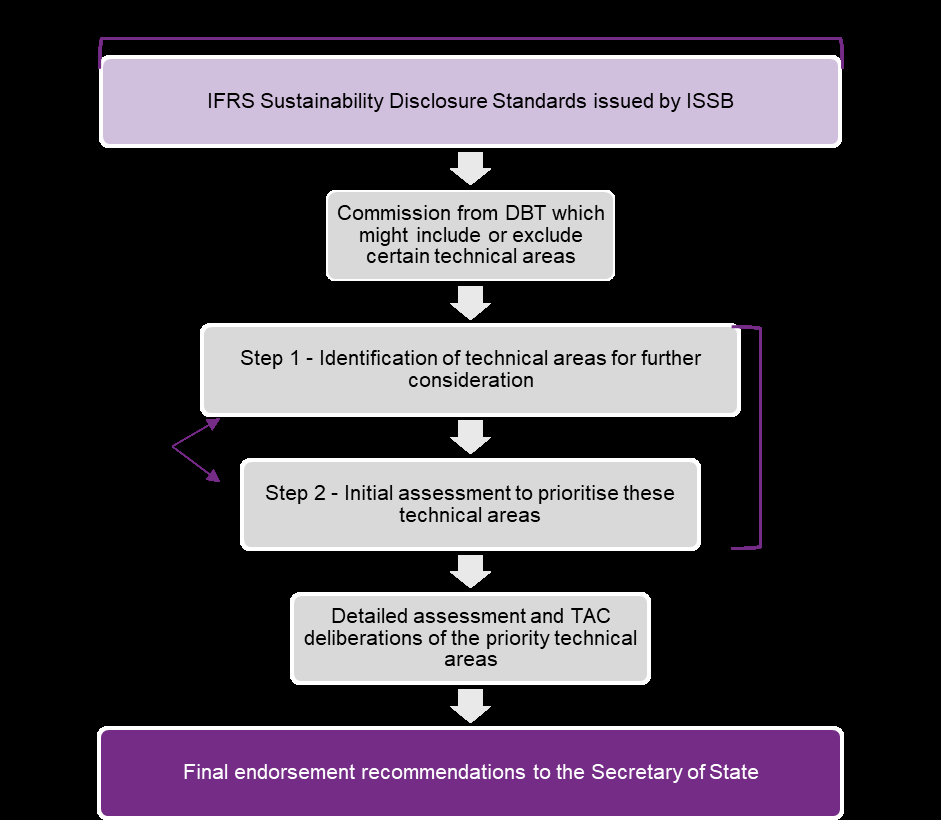
Figure 1 Scope of content and process for the technical assessment of IFRS Sustainability Disclosure Standards.
67 The following paragraphs provide further explanations about how IFRS S1 and IFRS S2 were assessed, including the prioritisation of technical areas and detailed assessment of those areas.
68 The TAC assessed IFRS S1 and IFRS S2 concurrently. Although IFRS S1 and IFRS S2 are separate standards, the ISSB intended that the two standards be applied together. As described in paragraphs BC5–BC6 of IFRS S2 Basis for Conclusions on Climate-related Disclosures, IFRS S2 sets out supplementary requirements to IFRS S1 that relate specifically to climate-related risks and opportunities. When applying IFRS S2, an entity is required to apply the conceptual foundations, general requirements and requirements relating to judgements, uncertainties and errors that are described in IFRS S1. Therefore, the TAC could not assess IFRS S2 in isolation but in the context of the requirements in IFRS S1. However, IFRS S1 goes beyond climate-related risks and opportunities and therefore the TAC also considered IFRS S1 in the context of other sustainability-related topics.
69 IFRS S1 has sometimes been referred to as an overarching standard that establishes the conceptual framework for all other IFRS Sustainability Disclosure Standards, including current and future standards. Whilst IFRS S1 includes conceptual principles, it also includes core content requirements for the disclosure of all sustainability-related information, with or without a particular IFRS Sustainability Disclosure Standard to provide the detailed and more specific topic requirements. The expectation is that the ISSB will, in the future, issue further topic-specific IFRS Sustainability Disclosure Standards like IFRS S2. The TAC’s technical assessment was only on IFRS S1 as issued in June 2023 and did not give detailed consideration to any future IFRS Sustainability Disclosure Standards and how it might be applied to those. However, in its deliberations, the TAC did note some considerations for future IFRS Sustainability Disclosure Standards. If the ISSB amends IFRS S1 and IFRS S2 in the future, it is likely that further assessment of those standards for use in the UK will be required.
70 There are currently no plans in the UK to endorse the materials that accompany the IFRS Sustainability Disclosure Standards. This means that the TAC’s technical assessment only considered the content in the IFRS Sustainability Disclosure Standards, including the appendices that are an integral part of the standards, but not the accompanying documentation. Consequently, the bases for conclusions and accompanying guidance for IFRS S1 and IFRS S2, including the Industry-based Guidance on Implementing IFRS S2, were excluded from this assessment. In performing its technical assessment, the TAC referred to the content in the accompanying documentation to provide context, but was not required to and did not assess this content.
71 Additionally, the IFRS Sustainability Disclosure Standards might refer to content that is published in other standards and frameworks. For example, IFRS S1 refers to other IFRS Sustainability Disclosure Standards, including those issued and those that will be issued in the future, in addition to standards that were published by third-party standard setters such as the Greenhouse Gas (GHG) Protocol, the Sustainability Accounting Standards Board (SASB) and the Climate Disclosure Standards Board (CDSB). The TAC assessed the requirements in IFRS S1 and IFRS S2 that referred to the use of the GHG Protocol Corporate Standard and SASB Standards, but did not assess the content of these standards. The TAC makes some references in its technical assessment to European Sustainability Reporting Standards (ESRS) and the Global Reporting Initiative (GRI) Standards, but did not assess the content of these standards. The TAC could not assess the content of IFRS Sustainability Disclosure Standards that will be issued in the future and was not required to and did not assess the content of any third-party standards or frameworks.
72 As requested by DBT, the TAC conducted its technical assessment considering PIEs as the relevant scope for application of the standards.
Prioritisation of technical areas
73 A two-step prioritisation process was used to establish which technical areas the TAC focused on in its assessment of IFRS S1 and IFRS S2. The prioritisation process involved stakeholder outreach and research activities, including a call for evidence, and involved the identification of technical areas that merited further consideration and an initial assessment of those areas against the endorsement criteria. The work undertaken in the prioritisation process is outlined further in paper 2024-TAC-002.
74 On completion of the prioritisation process, a number of priority technical areas were agreed by the TAC in its meeting on 31 May 2024.
Detailed assessment of priority technical areas
75 Once the priority technical areas were agreed, the TAC commenced a detailed assessment of those areas.
76 In its meetings, the TAC reviewed and deliberated on technical papers, which included: * an outline of the priority technical area, including the requirements and any insight into the ISSB’s decisions; * a summary of UK stakeholder views; * where appropriate, a summary of other jurisdictional approaches; * an analysis of the requirements compared to the endorsement criteria; * suggested endorsement recommendations (including options that were considered but disregarded).
77 The assessment considered whether the views raised by stakeholders were unique to the UK and, if so, whether the standards could be introduced in the UK without amendment, or if this was not possible whether insertions and deletions should be made or whether they required further clarification or guidance. Matters that were not necessarily UK-specific were noted to be fed back to the ISSB by requesting clarification or further guidance or could inform the ISSB’s post-implementation reviews of the standards.
78 The TAC then concluded whether it agreed with the assessment and whether it approved, rejected or amended the suggested endorsement recommendations.
79 The TAC’s decisions in its meetings formed the basis for the endorsement recommendations included in this report.
TAC meetings
80 TAC meetings were held in public and meeting agendas, technical papers and meeting summaries are available on the FRC website3.
81 Certain priority technical areas are pervasive and were covered in a number of technical papers, including the relationship with existing UK requirements and aggregation and disaggregation of information. Specific priority technical areas were assessed in the following meetings:
| Technical area | Meetings(s) and summary minutes | Paper reference(s) |
|---|---|---|
| International interoperability | 05 November 2024 | 2024-TAC-024 |
| Identifying sustainability-related risks and opportunities | 15 July 2024 | 2024-TAC-010 |
| Materiality of sustainability-related financial information | 15 July 2024 | 2024-TAC-009 |
| Sources of guidance | 15 July 2024 | 2024-TAC-011 |
| Location and timing of sustainability-related disclosures | 18 June 2024 | 2024-TAC-005 |
| Connectivity and integration | 05 November 2024 | 2024-TAC-023 |
| Commercially sensitive information | 18 June 2024 | 2024-TAC-006 |
| Judgements, uncertainties and errors, including revising comparatives | 18 June 2024 | 2024-TAC-007 |
| Reporting entity boundary and consolidated reporting | 18 June 2024 | 2024-TAC-008 |
| Value chain | 15 July 2024 | 2024-TAC-012 |
| Current and anticipated financial effects | 08 October 2024 | 2024-TAC-017 |
| Greenhouse gas emissions: GHG Protocol and measurement methods | 03 September 2024 | 2024-TAC-013 |
| Greenhouse gas emissions: Scope 3 emissions | 03 September 2024 | 2024-TAC-014 |
| Greenhouse gas emissions: financed emissions | 03 September 2024 08 October 2024 05 November 2024 15 November 2024 |
2024-TAC-015 2024-TAC-022 2024-TAC-025 |
| Cross-industry metrics (other than greenhouse gas emissions) | 03 September 2024 | 2024-TAC-016 |
| Resilience and scenario analysis | 08 October 2024 | 2024-TAC-018 |
| Targets | 08 October 2024 | 2024-TAC-020 |
| Transition plans | 08 October 2024 | 2024-TAC-019 |
| Proportionality mechanisms and permanent reliefs | 08 October 2024 | 2024-TAC-021 |
| Transition reliefs | 08 October 2024 05 November 2024 |
2024-TAC-021 2024-TAC-026 |
| Effective date | 08 October 2024 05 November 2024 |
2024-TAC-021 2024-TAC-026 |
Appendix 4: Technical assessment and endorsement recommendations
Interoperability
Endorsement recommendation
There are no specific endorsement recommendations in respect of the requirements in IFRS S1 and IFRS S2 and their interoperability with other frameworks and standards as this is an implementation matter.
Additional recommendations and observations
82 Recognising UK stakeholder concerns and the challenges identified relating to interoperability, the TAC recommends that, as an implementation issue, the UK government engages specifically with the ISSB and EFRAG on interoperability challenges and the potential for equivalence.
Technical assessment and deliberations
83 The TAC supports continued efforts towards greater global alignment and interoperability of the IFRS Sustainability Disclosure Standards with other sustainability reporting frameworks and standards, notably with the EU’s Corporate Sustainability Reporting Directive (CSRD) and ESRS. With the range of requirements required by other jurisdictions (some ISSB based, but others using different reporting frameworks or standards), there is a risk that international comparability is compromised and the quality of decision-useful information decreases. Both reporting entities and users of general purpose financial reports will benefit from increased interoperability, and therefore the TAC supports the global baseline and greater alignment between IFRS Sustainability Disclosure Standards and jurisdictional reporting requirements around the world.
84 The TAC has observed specific matters relating to interoperability which are included as part of the technical assessment of other technical areas, including identifying sustainability-related risks and opportunities, materiality, location of disclosures, sources of guidance, reporting entity boundaries, and greenhouse gas emissions.
85 The TAC recognises that one of the key challenges with interoperability is the different approaches to materiality and identifying sustainability-related matters that are taken by different reporting frameworks and standards, notably with ESRS. The TAC recommends that the UK Government engages with the ISSB and EFRAG on the key challenges for UK entities that will be disclosing information in accordance with multiple frameworks with the objective of supporting UK entities in meeting their disclosure obligations.
Identifying sustainability-related risks and opportunities
Endorsement recommendation
The TAC recommends that the requirements in IFRS S1 and IFRS S2 relating to identifying sustainability-related risks and opportunities are maintained without amendment.
Additional recommendations and observations
86 The TAC recommends that the PIC considers, as an implementation matter, developing jurisdictional guidance on how IFRS S1 would be applied in conjunction with the sustainability-related information entities are required to disclose in line with the current UK legal framework.
Technical assessment and deliberations
87 IFRS S1 paragraphs 2–3, 11–13, 30–31, 43–44, B1–12 and E5 set out requirements for a complete set of sustainability-related financial disclosures about all sustainability-related risks and opportunities that could reasonably be expected to affect an entity’s cash flows, its access to finance or cost of capital over the short, medium or long-term. IFRS S2 paragraphs 10–12 set out the requirements for the disclosure of climate-related risks and opportunities in addition to a definition for climate-related risks and opportunities in Appendix A.
88 In response to the TAC’s call for evidence, some UK stakeholders were concerned that the lack of a clear definition for ‘sustainability-related matters’ and specific IFRS Sustainability Disclosure Standards on other sustainability-related information could compromise the quality of reporting. A definition for ‘sustainability-related matters’ already exists in UK law (namely, section 416B(2) of the Financial Services and Markets Act 2000) which could be applied to IFRS S1 as UK entities are already disclosing sustainability-related matters using this definition. However, the TAC is in agreement that this definition should not be inserted into IFRS S1 as it is unnecessary and could compromise the international comparability of disclosures. The TAC recommends that the requirements on identifying sustainability-related risks and opportunities should be maintained without amendment, but cautions that it will be challenging to align reporting under the IFRS Sustainability Disclosure Standards with reporting under existing UK reporting requirements, especially in relation to section 172 of the Companies Act 2006. The TAC recommends that the PIC should consider, as an implementation matter, developing jurisdictional guidance on how IFRS S1 would be applied in conjunction with the sustainability-related information entities are required to disclose in line with the current UK legal framework.
89 The TAC notes that it is more challenging in practice for entities to identify risks and opportunities for non-climate sustainability-related matters that could reasonably be expected to affect the entity’s cash flows, its access to finance or cost of capital over the short, medium or long term, especially those for social-related matters. This is because the necessary data and processes for identifying such sustainability-related risks and opportunities that could be expected to affect an entity’s prospects are less well established.
90 The TAC recommends that the requirements in IFRS S1 paragraph 30(c) and IFRS S2 paragraph 10(d) that require an entity to explain which time horizons it has applied when identifying sustainability-related risks and opportunities should be maintained without amendment and that the UK Sustainability Reporting Standards should not specify what time horizons an entity is required to use. Although UK stakeholders commented on the lack of defined time horizons in IFRS S1 and IFRS S2 while noting that defined time horizons could improve the comparability of disclosures, the flexibility in the requirements allows entities to apply the time horizons that are appropriate in their circumstances. Prescribed time horizons might reduce the relevance of the disclosures if the time horizons used are not appropriate for all entities. Additionally, UK entities that are in scope of ESRS will be required to use the definitions of time horizons in ESRS 1 General requirements (ESRS 1) except in some limited situations4. Therefore, inserting definitions for time horizons in IFRS S1 and IFRS S2 could create undue cost and effort to UK entities applying ESRS and compromise the international comparability of disclosures, if these definitions do not align with those in ESRS 1.
Materiality of sustainability-related financial information
Endorsement recommendation
The TAC recommends that the requirements in IFRS S1 relating to materiality are maintained without amendment. However, there are differing views on the expected application of materiality.
89The TAC notes that it is more challenging in practice for entities to identify risks and opportunities for non-climate sustainability-related matters that could reasonably be expected to affect the entity's cash flows, its access to finance or cost of capital over the short, medium or long term, especially those for social-related matters. This is because the necessary data and processes for identifying such sustainability-related risks and opportunities that could be expected to affect an entity's prospects are less well established.
90The TAC recommends that the requirements in IFRS S1 paragraph 30(c) and IFRS S2 paragraph 10(d) that require an entity to explain which time horizons it has applied when identifying sustainability-related risks and opportunities should be maintained without amendment and that the UK Sustainability Reporting Standards should not specify what time horizons an entity is required to use. Although UK stakeholders commented on the lack of defined time horizons in IFRS S1 and IFRS S2 while noting that defined time horizons could improve the comparability of disclosures, the flexibility in the requirements allows entities to apply the time horizons that are appropriate in their circumstances. Prescribed time horizons might reduce the relevance of the disclosures if the time horizons used are not appropriate for all entities. Additionally, UK entities that are in scope of ESRS will be required to use the definitions of time horizons in ESRS 1 General requirements (ESRS 1) except in some limited situations4. Therefore, inserting definitions for time horizons in IFRS S1 and IFRS S2 could create undue cost and effort to UK entities applying ESRS and compromise the international comparability of disclosures, if these definitions do not align with those in ESRS 1.
Materiality of sustainability-related financial information
Endorsement recommendation
The TAC recommends that the requirements in IFRS S1 relating to materiality are maintained without amendment. However, there are differing views on the expected application of materiality.
Additional recommendations and observations
91The TAC recommends that the development of educational material by the ISSB on materiality is monitored and, if a need for any further educational material is identified, the ISSB is engaged with and encouraged to develop this additional material.
92The TAC recommends that the PIC considers, as an implementation matter, the difference between the approaches to materiality in IFRS S1 and the requirement for climate-related financial disclosures set out in section 414CB of the Companies Act 2006 with regard to disclosures about governance and risk management processes. The PIC might consider how to transition from the current climate-related financial disclosures rules to IFRS Sustainability Disclosure Standards without reducing the quality of disclosure in the UK.
Technical assessment and deliberations
93IFRS S1 paragraphs 17–19, B13–B18 and B19–B28 set out requirements for the disclosure of ‘material information’.
94The TAC recommends that the materiality definitions in IFRS S1 should be maintained without amendment. Overall, UK stakeholders indicated support for the ISSB's decision to align the definition of materiality with that used in financial reporting, focusing on the information needs of users. The TAC notes that aligning the definition of materiality in IFRS S1 with that used in IFRS Accounting Standards might assist practitioners who are already familiar with applicable accounting standards (including the IFRS Foundation's materiality concept) and UK reporting requirements.
95The TAC supports consistency in the definition of materiality across IFRS Standards but cautions that different definitions between the IFRS Sustainability Disclosure Standards and ESRS are likely to cause challenges for entities reporting under both. The ESRS financial materiality definition is aligned with the ISSB's materiality definition, so the two are not incompatible, but UK stakeholders have cited challenges with applying the ESRS's requirement to consider impact materiality.
96The TAC does not agree that a broader definition of materiality should be inserted into IFRS S1. Some UK stakeholders questioned the appropriateness of maintaining the same materiality definition for sustainability-related information as that used for financial information. However, changing the materiality definition in IFRS S1 would diverge both from the current UK legal framework, which is focused on the needs of primary users, and from the global baseline that IFRS Sustainability Disclosure Standards are seeking to establish. This could therefore compromise the international comparability of disclosures. Additionally, IFRS S1 and IFRS S2 have been developed and drafted based on the concept of materiality in IFRS Accounting Standards, and amending the standards to widen this concept would require significant amendments to the standards as a whole. The TAC supports the ISSB's work on interoperability, and agrees that the UK government engages with the ISSB and EFRAG on the key challenges for UK entities that will be disclosing information in accordance with multiple frameworks.
97The TAC stresses the importance of not overly prescribing or defining what information is considered material as there is value in entities assessing and deciding what is material for their primary users. The TAC considered the benefit of requesting additional guidance from the ISSB to support entities in applying the concept of materiality to sustainability-related information and acknowledges the recently published guidance on sustainability-related risks and opportunities and materiality from the ISSB. The TAC has not assessed this guidance. The TAC believes that if a need is identified for further educational material or standard setting on the application of materiality, the ISSB should be encouraged to develop this material.
98The TAC notes that the approach to materiality in IFRS S1 is different from that in the UK's approach to climate-related financial disclosures, which are currently required by the Companies Act 2006 and FCA Listing Rules, both of which are based on the recommendations of the Task Force on Climate-related Financial Disclosures (TCFD). In contrast to the requirement in IFRS S1, the UK's climate disclosure requirements require the disclosure of information regarding climate-related governance and risk management processes regardless of an entity's assessment of its climate-related risks and opportunities. This is because it is assumed that the governance and risk management information is useful to users in understanding the processes used by an entity for identifying and assessing climate-related risks and opportunities, even if the entity has determined that it does not have any significant climate-related risks and opportunities. In contrast, if an entity has not identified any climate-related risks and opportunities, the entity is permitted by IFRS S1 to not disclose any information about climate change, including information about the governance and risk management processes used to determine that climate-related risks and opportunities are not significant. A minority of TAC members believe that this difference could negatively affect the long-term public good in the UK as it might reduce the quality of corporate reporting in the UK. This difference between IFRS S1 and the UK's climate disclosure requirements could be resolved with a general requirement for entities to disclose how they have determined which sustainability-related risks and opportunities are relevant. The TAC recommends that the PIC considers the difference between IFRS S1 and the UK's climate disclosure requirements as an implementation issue. In particular, the PIC might consider how to transition from the current climate-related financial disclosures rules to IFRS Sustainability Disclosure Standards without reducing usefulness of the disclosures for users.
99The TAC is in agreement that UK-specific guidance on materiality is not necessary or appropriate, even though it has been requested by some UK stakeholders. This option is not considered appropriate at this stage as it could compromise the international comparability of disclosures.
Sources of guidance
Endorsement recommendation
The TAC recommends that the requirements in IFRS S1 and IFRS S2 relating to sources of guidance are maintained without amendment. However, there are differing views on this recommendation.
Additional recommendations and observations
100The TAC recommends that UK stakeholders' attention is drawn to the ISSB's assertion that entities are not required to use the SASB materials, but only refer to and consider them.
101The TAC recommends that the FRC considers developing further guidance regarding assurance expectations relating to the extent to which an entity has 'referred to and considered' the SASB materials.
102The TAC recommends that the ISSB is engaged with on the enhancement of the SASB materials.
Technical assessment and deliberations
103IFRS S1 paragraphs 54–59 and IFRS S2 paragraphs 12, 23, 32, 37 and B65(d) include sources of guidance for entities to use or refer to when identifying sustainability-related risks and opportunities, and when identifying applicable disclosures.
104The sources of guidance referenced in IFRS S1 have been the subject of significant debate. UK stakeholders generally welcomed the sources of guidance as a helpful starting point, especially in the absence of a full and comprehensive suite of IFRS Sustainability Disclosure Standards. Some stakeholders considered that the approach taken by the ISSB balances the demand for prescriptive requirements and the need for flexibility in the application of IFRS S1 and IFRS S2. However, other stakeholders raised concerns about references to third-party materials within IFRS S1 and IFRS S2, especially when these materials were not developed using the same conceptual basis and have not been or are not subject to IFRS due process.
105Although there are differing views, the TAC recommends that the instruction in IFRS S1 and IFRS S2 that entities 'shall refer to and consider' the SASB materials should be maintained without amendment. The ISSB has communicated in several materials that entities are required to consider the disclosure topics and metrics in the SASB materials, but entities are not required to use the SASB materials. Feedback from UK stakeholders was mixed, with some believing that the instruction is clear and others commenting on the potential confusion as to whether the instruction leads to mandatory disclosures. Additionally, some stakeholders were concerned that the application of the SASB materials would lead to undue cost or effort, and that the use of the SASB materials could replace an entity-specific materiality assessment.
106A minority of TAC members disagree with the decision to maintain the requirements and are in favour of amending the instruction in IFRS S1 and / or IFRS S2 from ‘shall refer to and consider’ to ‘may refer to and consider’. Some favour amending the instruction in IFRS S1 but not in IFRS S2 due to the greater level of understanding and consensus around climate-related reporting metrics. Amending the instruction for both IFRS S1 and IFRS S2 might reduce the confusion that has been identified by stakeholders, and also allay stakeholder concerns about undue cost or effort and concerns about entity-specific materiality assessment being replaced.
107Overall, the TAC concludes that the criteria for amending the standards have not been met in this instance. The word 'consider' already suggests that entities are not required to use the SASB materials and as such the amendment from "shall' to "may' would not meaningfully change the requirement and so does not meet the threshold for amendment. Additionally, maintaining the instruction could support the international comparability of disclosures. However, the argument that the SASB materials promote international comparability assumes that entities will use the SASB materials to identify sustainability-related risks and opportunities and related disclosure requirements. Given that the intention from the ISSB is that the SASB materials are not required to be used, then international comparability is not necessarily going to be achieved.
108The ISSB has attempted to clarify its position that the use of the SASB materials is not mandatory in several documents. However, confusion about the instruction remains. The TAC recommends that UK stakeholders' attention should be drawn to the ISSB's assertion that entities are not required to use the SASB materials, but only refer to and consider them. The TAC also notes that the instruction 'shall' will have implications for assurance and recommends that the FRC considers developing further guidance regarding assurance expectations. TAC members have mixed views on the SASB materials. Some consider them to provide a useful common starting point in the achievement of a global baseline, whereas others consider them to be overly focused on the US context. The assessment of the content within the SASB materials is outside the scope of this technical assessment, and therefore the TAC does not present concluding views on the usefulness of the SASB materials. However, the TAC suggests that entities approach the SASB materials as guidance rather than as a prescriptive list of material disclosure topics. The TAC also recommends that the ISSB should be engaged with on the enhancement of the SASB materials.
109The TAC recommends that the references to the other sources of guidance, including the GRI Standards and ESRS, should be maintained without amendment. Stakeholders have agreed that these sources of guidance are helpful. As intended by the ISSB, these sources of guidance could support interoperability and international comparability, which will likely improve the quality of reporting if applied in accordance with the objectives of IFRS S1.
Location of sustainability-related disclosures
Endorsement recommendation
The TAC recommends that the requirements in IFRS S1 for the location of sustainability-related financial disclosures are maintained without amendment.
Additional recommendations and observations
110The TAC recommends that the PIC considers how to simplify and streamline the existing rules in the UK relating to the location of sustainability-related disclosures. This includes consideration of the requirements in the Companies Act 2006 and FCA Listing Rules, and the possible implications for future assurance requirements.
111In considering the location of disclosures, the PIC should also consider the interoperability challenges with other jurisdictional requirements, and the availability of safe harbour provisions for information in the strategic report that are currently in the Companies Act 2006.
112Noting that the ultimate decision about the location of disclosures is an implementation issue to be addressed by the PIC, the TAC recommends that the PIC considers whether to also require the disclosure of an index to enable users to navigate and locate the necessary disclosures.
Technical assessment and deliberations
113IFRS S1 paragraphs 60–63, B27 and B45–B47 sets out requirements for the appropriate location of sustainability-related financial disclosures.
114The TAC believes that providing disclosures in a consistent location is very helpful, especially for users of general purpose financial reports. However, the TAC acknowledges that the location of disclosures is also dependent on whether information is determined as material, which might result in different approaches being taken by different entities. It is noted that users would find it helpful if information that is material for primary user decision-making purposes was in the general purpose financial report, whereas information that is not material for primary users should be in a different report.
115The TAC notes that entities that are required to disclose information in accordance with the EU's CSRD, and are required to do so in the management report, might face interoperability challenges in meeting UK requirements. The PIC might wish to consider this as an implementation matter.
116The TAC believes that all material information should be included in the strategic report. Over the years the length of the strategic report has increased significantly as entities can provide more information than is strictly necessary, which can result in difficulty in locating material information. The TAC highlights the benefit of simplifying and streamlining the existing rules in the UK, including in the Companies Act 2006 and FCA Listing Rules, which would greatly assist in the implementation of these standards and would minimise duplication or confusion as to where information should be disclosed. The TAC recommends that the PIC consider the location of sustainability-related disclosures in the context of existing reporting rules. Additionally, the TAC highlights that the provisions in section 463 of the Companies Act 2006 provide safe harbour protections on any information in the strategic report, including sustainability-related information that is reliant on significant estimates. If the PIC suggests that sustainability-related disclosures should be located in the strategic report, this information should already be covered by the provisions in section 463 of the Companies Act 2006.
117Ultimately the decision about the location of disclosures is an implementation issue to be addressed by the PIC. However, TAC recommends that the PIC considers whether also to require the disclosure of an index to enable users to navigate and locate the necessary disclosures.
Timing of reporting
Endorsement recommendation
The TAC recommends that the timing of reporting requirements in IFRS S1 are maintained without amendment.
Additional recommendations and observations
118The TAC observes that entities might experience issues in disclosing certain sustainability-related information at the same time as financial information. Despite these issues, the TAC is in agreement that coterminous reporting is essential and is, to a certain extent, already good practice in the UK. However, concerns about the time lags in collecting data might be transitional in nature, and in circumstances when coterminous reporting is not possible, it is important to emphasise the use of estimates if actual data is not readily available.
119The TAC recommends that the ISSB considers how the principle of IFRS S2 paragraph B19 can be applied to sustainability-related matters other than greenhouse gas emissions. This might be through clarification of the existing requirements or as part of the upcoming research on biodiversity, ecosystems and ecosystem services, and human capital.
120The TAC recommends that practice relating to the use of different reporting periods for sustainability-related disclosures is observed and fed back to the ISSB as part of its post-implementation review.
Technical assessment and deliberations
121IFRS S1 paragraphs 64–69 sets out requirements for the timing of sustainability-related financial disclosures.
122The TAC is in agreement that, to the extent possible, coterminous reporting is essential and to a certain extent already good practice in the UK. In particular, the TAC notes that users would benefit from sustainability-related information being disclosed at the same time as financial information so that the two can be analysed together. Aligning the timing of financial and sustainability-related reporting will assist with international comparability and improve the quality of corporate reporting within the UK in the long term as it will enable connectivity between the two sets of disclosures. However, aligning the timing might give rise to additional cost and effort for entities particularly in the early years of reporting, although this would be expected to improve over time.
123The TAC notes that processes for data collection and internal controls on sustainability-related information are relatively immature and will take time to embed and develop, which means that entities will have a steep learning and application curve. In that regard, the TAC suggests that delays in collecting data might be transitional in nature for certain information. However, the TAC also acknowledges that for some disclosures (e.g. some categories of Scope 3 emissions and in particular for financed emissions) there is likely to always be a delay in acquiring the data from entities in the value chain. The TAC notes that to improve transparency it is important to provide an explanation of the approach used when the timing of sustainability-related information does not align with financial reporting.
124The TAC wishes to highlight that the supporting mechanisms in both IFRS S1 and IFRS S2, including the use of ‘all reasonable and supportable information that is available to the entity at the reporting date without undue cost or effort’ and application guidance, are likely to support entities in providing sustainability-related information in a timely manner. The TAC also recognises the importance of using estimates to report data if actual data is not readily available, while noting that it is not always possible or appropriate to estimate certain information. If an entity uses a different reporting period, or applies a significant number of estimates due to time lags in data collection, the entity should provide disclosures of these approaches in accordance with the requirements in IFRS S1 paragraph 74 relating to the judgements applied in the process of preparing disclosures.
125The TAC also recognises the helpful permission in IFRS S2 paragraph B19 that allows an entity to use information from a different reporting period for greenhouse gas emissions data from entities in its value chain. The TAC recommends that the ISSB considers how this permission can be applied to sustainability-related matters other than greenhouse gas emissions. The TAC recognises that this permission is intended to require entities to use the latest available information, and that IFRS S2 paragraph B42 requires entities to apply judgement as to the inputs used to calculate greenhouse gas emissions, including the trade-offs between timely data and data directly collected from the specific activities in the entity's value chain. However, a minority of TAC members highlight that the requirement in IFRS S2 paragraph B19(b) that only allows this permission to be used on the condition that ‘the length of the reporting periods is the same’ might not fully align with an entity’s need to collect information from the value chain for a longer or shorter period depending on the nature of the information and the activity to which the information represents. As noted in paragraph 123, the TAC recognises the importance of transparency by providing an explanation of the judgements, assumptions and approach used. The TAC recommends that the ISSB provides clarity as to the intention of IFRS S2 paragraph B19(b) and how it is expected to be applied in practice.
Connectivity and integration
Endorsement recommendation
The TAC recommends that the requirements in IFRS S1 that relate to connected information are maintained without amendment.
Additional recommendations and observations
126There are no additional recommendations or observations.
Technical assessment and deliberations
127The TAC welcomes the use of the concept of 'connectivity' in IFRS Sustainability Disclosure Standards but recommends that the ISSB provides further support as to how this concept is to be applied in practice. The TAC welcomes continued efforts by the ISSB and IASB to work together on connectivity matters that seek to provide a comprehensive package of information for users of general purpose financial reports. The TAC has made specific recommendations relating to connectivity which are included as part of the technical assessment of other technical areas, including relating to location of disclosures, timing of reporting, materiality, reporting entity boundaries, current and anticipated financial effects, and judgements, uncertainties and errors.
128Connectivity is the core concept that underpins the integration of information and integrated reporting. In response to the TAC's call for evidence, many stakeholders noted that an integrated approach to reporting sustainability-related information is ideal, especially in relation to the location of information. Additionally, most stakeholders supported the principle of connectivity, noting the importance of sustainability-related information being prepared on a similar basis to how other information in the general purpose financial report is prepared (i.e. following similar principles that underpin the preparation of disclosure). The TAC highlights the value of consistency between sustainability-related reporting and financial reporting, and therefore emphasises that entities should be strongly encouraged to report using the same reporting entity boundary as is used in the financial statements. Further analysis about the reporting entity boundary is provided in paragraphs 147–150.
Commercially sensitive information
Endorsement recommendation
The TAC recommends that the requirements in IFRS S1 relating to commercially sensitive information are maintained without amendment.
Additional recommendations and observations
129The TAC recommends engagement with the ISSB on possible inconsistencies between IFRS S1 and IFRS Accounting Standards.
130The TAC recommends that the PIC considers, as an implementation matter, inconsistencies between IFRS S1 and the UK's legal framework.
Technical assessment and deliberations
131IFRS S1 paragraphs 73 and B34–B37 set out the disclosure exemption that allows entities, in limited circumstances, to omit information about sustainability-related opportunities that are determined as commercially sensitive.
132The TAC recommends that the exemption and requirements in IFRS S1 relating to commercially sensitive information should be maintained without amendment. As noted by the ISSB, the use of the exemption on commercially sensitive information is expected to be rare. Removing the exemption from IFRS S1 could mean that UK entities would not be permitted to omit commercially sensitive information from their sustainability-related disclosure, which could impact the economic growth and international competitiveness of UK entities. However, if UK entities apply the exemption, this could compromise the quality of reporting, especially if its use creates a disconnect and imbalance in the disclosure. On balance, the TAC concludes that the exemption in IFRS S1 is sufficiently narrow in scope to satisfy concerns about the quality of reporting and the economic growth and international competitiveness of UK entities.
133The TAC notes that protections are necessary to prevent the disclosure of information that could be seriously prejudicial. However, information may be exempt from disclosure in accordance with paragraph 92 of IAS 37 Provisions, Contingent Liabilities and Contingent Assets but required to be disclosed in accordance with IFRS S1. The TAC recommends that the ISSB should be engaged with on such inconsistencies.
134There are a number of similarly worded exemptions in the Companies Act 2006, for example, around suppliers and customers. The TAC recommends that the PIC should consider, as an implementation matter, inconsistencies between IFRS S1 and the UK's legal framework but notes that the exemptions in the Companies Act 2006 should not prevent entities from complying with IFRS S1. Although inconsistencies have been identified, the adoption of the requirements in IFRS S1 would still likely be coherent with, and suitable for inclusion in, UK domestic legislation and regulation.
Judgements, uncertainties and errors, including revising comparatives
Endorsement recommendation
The TAC recommends that the requirements in IFRS S1 relating to judgements, measurement uncertainty, errors and revising comparative amounts due to changes in estimates are maintained without amendment.
Additional recommendations and observations
135The TAC recommends that the ISSB develops guidance on the requirements to revise comparatives that would support the application of the standards. This guidance could include information about how entities treat changes in data quality and how to determine whether these changes represent changes in estimates rather than errors. Ideally such guidance would be developed as practice evolves.
136The TAC recommends that the PIC considers, as an implementation matter, alongside other requirements in the Companies Act 2006, the Streamlined Energy and Carbon Reporting (SECR) requirement that the comparative information shall be ‘as disclosed in last year's report’ because this might not meet the requirements for the disclosure of comparative information in IFRS S1.
137The TAC recommends that market practice relating to judgements, measurement uncertainty, errors and revising comparative amounts due to changes in estimate is an area for continued monitoring to provide feedback to the ISSB during its post-implementation review of IFRS S1.
Technical assessment and deliberations
138IFRS S1 sets out requirements for the disclosure and application of judgements and the use of assumptions and estimates in the preparation of an entity's sustainability-related disclosures. IFRS S1 also sets out the requirements for how entities should address errors and changes in estimates in the disclosure of comparative information. The relevant references are IFRS S1 paragraphs 74–76 on judgements, paragraphs 77–82 on measurement uncertainty, paragraphs 83–86 and B55–B59 on errors and paragraphs B49–59 on comparative information.
139The TAC recommends that the requirements in IFRS S1 relating to judgements, measurement uncertainty, errors and revising comparative amounts due to changes in estimate should be maintained without amendment. By maintaining the requirements, the UK Sustainability Reporting Standards are likely to support entities in making disclosures that are understandable, reliable and comparable, and therefore, improve the quality of corporate reporting in the UK. The TAC welcomes the use of these concepts from IFRS Accounting Standards as providing a consistent framework.
140The TAC notes that data quality continues to develop, particularly data from third parties (e.g. customers and suppliers), and that there will be a natural evolution in data quality. Noting these challenges, the TAC recommends that the ISSB develops further guidance on the requirements to revise comparatives that would support the application of the standards. This guidance could include information about how entities treat changes in data quality and how to determine whether these changes represent changes in estimates rather than errors. This guidance could also include the differences between changes in estimates and errors, and the difference between restatements and revisions, and how this might affect an entity's assessment of what information is considered material. The TAC notes that if an entity is required to restate disclosures, including the possible need to reissue its annual report and accounts, this would incur significant costs, including the potential need for obtaining additional assurance. The TAC highlights that providing an explanation for changes in estimation is challenging but important as it is likely to provide information about whether changes are due to a change in information availability, a change in fact, a change in scope, a change in methodology or a change in the business. The TAC also expressed concerns around the requirements to revise or restate data collected from different reporting periods (especially from the value chain) as this information might introduce significant costs for limited decision-useful insight, especially as this information might not be used for strategic decision making and might not be important for users. This collection of data from different reporting periods could be another factor for entities to consider alongside what information might be considered material when restating comparatives.
141The TAC highlights one example, which relates to Scope 3 emissions reporting, where there are particular challenges around the revision of comparative amounts due to changes in estimates. Scope 3 emissions reporting is subject to significant use of estimates as nearly all data is reliant on information received from entities in the value chain. IFRS S1 requires entities to revise comparative amounts unless this would be impracticable or the amounts are not material. It can be difficult to know when revisions have become material when considering small changes across a large number of entities in the value chain, which might not be material in isolation and individually, but are material when collated. Regular revisions of Scope 3 emissions data and other sustainability-related data could impact metrics and targets, including those linked to executive remuneration, especially as data from the value chain is subject to time lags which might lead to continuous need for restatement or revision of the comparatives. Whilst the ISSB's Transition Implementation Group on IFRS S1 and IFRS S2 (TIG) in June 2024 discussed a simple scenario consisting of a change in previously reported estimated greenhouse gas emissions in the value chain for a single issuer and a single loan, further guidance from the ISSB could clarify when entities should undertake revisions and how they should explain their decisions regarding revisions in more complex scenarios.
142The TAC recommends that the PIC should consider, as an implementation matter, alongside other requirements in the Companies Act 2006, the SECR requirements that the comparative information shall be 'as disclosed in last year's report' because this might not meet the requirements for the disclosure of comparative information in IFRS S1.
143Finally, the TAC recommends that market practice relating to judgements, measurement uncertainty, errors and revising comparative amounts due to changes in estimate should be an area for continued monitoring to provide feedback to the ISSB during its post-implementation review of IFRS S1. This would facilitate an understanding of how the requirements are being applied by entities and whether further and more granular requirements or guidance are necessary.
Reporting entity boundary and consolidated reporting
Endorsement recommendation
The TAC recommends that the requirements in IFRS S1 for the reporting entity for which sustainability-related reporting should be disclosed are maintained without amendment.
Additional recommendations and observations
144The TAC recommends that the PIC considers, as an implementation matter, the interaction between the scope of application of IFRS S1 for reporting entities and the current UK legal framework. The TAC also recommends that the PIC considers, as an implementation matter, the introduction of an exemption for certain subsidiaries when the parent company is reporting on an equivalent basis for the consolidated group.
145The TAC observes that an operational control approach is often used for sustainability-related disclosures but recommends that entities should be encouraged to report sustainability-related information using the same reporting boundary approach that is used for financial reporting. Additionally, the ISSB should be strongly encouraged to consider the requirements relating to reporting entity boundaries when updating IFRS S1 and IFRS S2 or developing future topic-specific standards.
Technical assessment and deliberations
146IFRS S1 paragraphs 20 and B38 set out requirements for the entity for which sustainability-related disclosures shall be provided.
147The TAC recommends that the requirements in IFRS S1 for the entity for which sustainability-related financial disclosures shall be provided should be maintained without amendment, noting the disclosures should be for the same reporting entity as the related financial statements to enable connectivity. If reporting entity boundaries are misaligned, then the resulting disclosures might not be as understandable and connected to the related financial information.
148The TAC recommends that the PIC should consider, as an implementation matter, the interaction between the scope of application of IFRS S1 for reporting entities and the current UK legal framework. Existing legislation, which is inconsistent and might have to be updated, includes exemptions in sections 400 and 401 of the Companies Act 2006 and other exemptions, such as those related to the strategic report, including the Non-Financial and Sustainability Information Statement, related to reporting requirements for subsidiaries.
149The TAC also recommends that the PIC considers, as an implementation matter, the introduction of an exemption from compliance with UK Sustainability Reporting Standards for certain subsidiaries when the parent company is reporting on an equivalent basis for the consolidated group, including when the parent company is an overseas company that is subject to different reporting requirements. The TAC highlights that, if introduced in the UK, this exemption should only be available to certain subsidiaries as some subsidiary-level reporting might be useful to users. UK stakeholder views on subsidiary-level reporting are mixed. Some stakeholders have suggested that the quality of UK reporting might be improved overall if subsidiaries are required to provide disclosures, especially for subsidiaries which are raising capital separately from their parent companies. However, other stakeholders have argued that some standalone subsidiary reporting might not be useful or meaningful and is likely to incur undue cost or effort to prepare because the reporting does not reflect how these risks and opportunities are managed within the group. Overall, UK stakeholders seek an exemption for certain subsidiaries when the parent company is reporting on an equivalent basis for the consolidated group which the TAC recommends the PIC consider as an implementation issue. When discussing this matter, the PIC should take into consideration:
- the impact of different subsidiary-level reporting requirements in other jurisdictions which could affect international comparability;
- the impact on economic growth and international competitiveness if the reporting entity boundaries for sustainability-related financial disclosures and financial disclosures are not aligned, which would also lead to a lack of coherence and connectivity in annual reports;
- the challenges and potential duplication of information when disaggregating disclosures at subsidiary level, especially when strategic decisions are made at the group level (e.g. when metrics and targets are set at a group level); and
- the value of subsidiary-level information for users (e.g. primary users find this information particularly useful for subsidiaries which are raising capital separately, are partly owned and do not apply group policies or have specific sustainability-related risks and opportunities that warrant separate disclosure).
150The TAC emphasises the value of consistency between sustainability-related reporting and financial reporting and notes that IFRS S1 and IFRS S2 ask for disclosure of risks and opportunities that could reasonably be expected to have a financial effect on the entity. The TAC therefore is in agreement that entities should be strongly encouraged to report sustainability-related information using the same reporting boundary approach that is used for financial reporting. The TAC also discussed the current flexibility in IFRS S2 that allows entities to select a reporting entity boundary approach when using the GHG Protocol Corporate Standard to measure greenhouse gas emissions. Although the TAC recommends that flexibility is maintained in IFRS S2 for now to allow entities to use an operational control approach for the disclosure of greenhouse gas emissions, the TAC also emphasises that the preferred approach across all reporting would be the same reporting boundary approach that is used for financial reporting as required in IFRS S1, to enable alignment with the approach taken in the disclosure of financial statements. The TAC recommends that UK entities should be strongly encouraged to report sustainability-related information using the same reporting boundary approach that is used for financial reporting as soon as practicable, and that the ISSB should be encouraged to consider the reporting entity boundaries when updating IFRS S1 and IFRS S2 or developing future topic-specific standards.
Value chain
Endorsement recommendation
The TAC recommends that the requirements in IFRS S1 and IFRS S2 relating to value chain are maintained without amendment.
Additional recommendations and observations
151The TAC recommends that the PIC considers, as an implementation matter, appropriate support around value chain disclosures, including the establishment of safe harbour protections for value chain disclosures in initial reporting periods and allow entities to update the value chain boundary as underlying analysis and reporting capabilities mature.
Technical assessment and deliberations
152IFRS S1 paragraphs 2, 32, B6–7, B11–12 and Appendix A and IFRS S2 paragraph 13 and Appendix A set out requirements for the disclosure of sustainability-related risks and opportunities in an entity's value chain. IFRS S1 also includes a definition for 'value chain' and sets out the requirements for how an entity might reassess the scope of its value chain.
153The TAC recommends that the requirements in IFRS S1 and IFRS S2 for entities to disclose information about sustainability-related risks and opportunities in the value chain should be maintained without amendment. The TAC notes that there are significant challenges relating to the quality and collection of data in the value chain. This might cause gaps and inconsistencies in reporting, and challenges around data collection might potentially create lags in reporting. Despite the challenges relating to data collection, most UK stakeholders agree that relevant information about sustainability-related risks and opportunities in the value chain is important to understand the full picture and to improve the quality of sustainability-related disclosures. Additionally, the ISSB allows entities to use
reasonable and supportable information that is available to the entity at the reporting date without undue cost or effort when applying the requirements relating to the value chain. This relief should reduce the anticipated cost and effort for entities.
154UK stakeholders were concerned that the definition of 'value chain' is too broad and that there is insufficient guidance on its application beyond Scope 3 greenhouse gas emissions. However, the TAC concludes that the definition of 'value chain' should be maintained. The TAC notes that there is uncertainty around the scope of value chain reporting and a recognition that the scope of reporting value chain information will evolve. It is understood that the GHG Protocol has been used as a proxy by entities for scoping and collecting information in the value chain beyond greenhouse gas emissions. However, this approach might not align with methods used in consolidated financial reporting which creates questions around how issues like leased assets and financed emissions are treated.
155Finally, the TAC recommends that the requirement for entities to reassess the scope of the sustainability-related risks and opportunities in the value chain on the occurrence of a significant event or change in circumstance should be maintained without amendment. The TAC notes that there is uncertainty around the identification of a 'significant event' with regard to when sustainability-related risks and opportunities in the value chain should be reassessed and that there are practical challenges around reassessment. Although it would be ideal for entities to reassess the risks and opportunities at every reporting date, reassessing the scope of the sustainability-related risks and opportunities in the value chain is likely to require substantial resource and might prevent entities from disclosing information within the timeframes in which they normally report without undue cost or effort.
156The TAC believes that entities will need support in establishing value chain reporting practices. The TAC recommends that the PIC should consider, as an implementation matter, appropriate support around value chain disclosures, including the establishment of safe harbour protections for value chain disclosures in initial reporting periods and allowing entities to update the value chain boundary as underlying analysis and reporting capabilities mature. Further recommendations relating to safe harbour provisions, including the provisions in section 463 of the Companies Act 2006, are discussed in paragraph 116.
Current and anticipated financial effects
Endorsement recommendation
The TAC recommends that the requirements in IFRS S1 and IFRS S2 for the disclosure of current and anticipated financial effects of sustainability-related risks and opportunities are maintained without amendment.
Additional recommendations and observations
157The TAC recommends that the ISSB develops further guidance and worked examples on current and anticipated financial effects, including how to determine when information about the combined financial effects 'would not be useful'.
158The TAC recommends that market practice related to current and anticipated financial effects, including the use of mechanisms to support the application of the requirements, is an area for continued monitoring to provide feedback to the ISSB during its post-implementation review of IFRS S1 and IFRS S2.
Technical assessment and deliberations
159IFRS S1 paragraphs 28–40 and IFRS S2 paragraphs 15–21 set out requirements for the disclosure of current and anticipated financial effects of sustainability-related risks and opportunities.
160The TAC recommends that the requirements in IFRS S1 and IFRS S2 in relation to current and anticipated financial effects should be maintained without amendment. Although there are likely to be challenges in providing these disclosures, connectivity between the sustainability-related financial disclosures and financial statements is necessary to ensuring holistic, comprehensive and coherent general purpose financial reports. These disclosures can contribute to an improvement in the quality of corporate reporting and assist in disclosures being internationally comparable.
161The TAC also agrees that the ISSB should develop further guidance and worked examples on current and anticipated financial effects, including how to determine when information about the combined financial effects 'would not be useful', as required by IFRS S1 paragraph 40(c) and IFRS S2 paragraph 21(c). The implementation of this mechanism in similar circumstances might result in different assessments and conclusions being reached by different entities in making these disclosures. Additional clarity and guidance in this area would ensure that entities apply these mechanisms in a consistent and comparable way. This would support the provision of disclosures that are understandable, relevant, reliable and comparable and would likely improve the quality of corporate reporting within the UK in the long-term.
162Finally, the TAC recommends that the mechanisms in IFRS S1 and IFRS S2 to support the application of the requirements should be maintained. Stakeholders have welcomed these mechanisms; however, it is expected that some of these mechanisms might not be needed beyond the early implementation years. Consideration was given to imposing a time limit on some of these mechanisms for UK implementation; however, recognising the challenges of providing these disclosures and with a view to ensuring international consistency, this option has not been pursued. Instead, the TAC recommends that market practice related to current and anticipated financial effects, including the use of the mechanisms to support the application of the requirements, should be an area for continued monitoring to provide feedback to the ISSB during its post-implementation review of IFRS S1 and IFRS S2. This would facilitate an understanding of how the requirements are being applied by entities including whether they are able to be applied as intended.
Greenhouse gas emissions: GHG Protocol and measurement methods
Endorsement recommendation
The TAC recommends that the requirements in IFRS S2 for the disclosure of greenhouse gas emissions using the GHG Protocol Corporate Standard are maintained without amendment. However, there are differing views on this recommendation.
The TAC recommends that the requirements in IFRS S2 for the disclosure of Scope 2 emissions are maintained without amendment.
Additional recommendations and observations
163The TAC recommends that the ISSB provides further clarification and guidance on the requirement to disaggregate Scope 1 and Scope 2 emissions by consolidated accounting group and other investees. The TAC also recommends that the ISSB and EFRAG are encouraged to resolve discrepancies between their respective climate reporting standards (IFRS S2 and ESRS E1 Climate change (ESRS E1)), especially with regard to the requirements to disaggregate Scope 1 and Scope 2 emissions.
164The TAC recommends that both the ISSB and GHG Protocol are engaged with on the revisions to the GHG Protocol Corporate Standard to seek compatibility with the principles in IFRS S1.
165The TAC recommends that the UK Government reviews the process for updating the greenhouse gas conversion factors, including providing clear rationale as to why the latest Global Warming Potential (GWP) values are not used. The UK Government might also consider the potential opportunity to use government-level emissions data for all corporate reporting processes.
Technical assessment and deliberations
166IFRS S2 paragraphs 29(a) and B19–B37 set out requirements for the disclosure of information about greenhouse gas emissions.
167Although there are differing views, the TAC recommends that the reference to the GHG Protocol Corporate Standard is maintained. UK stakeholders indicated support for the reference to the GHG Protocol Corporate Standard, emphasising that it is internationally recognised and used as standard practice in the market. However, stakeholders also raised concerns about mandating a third-party resource in IFRS S2, noting that the GHG Protocol sits outside the governance and due process of the IFRS Foundation and that it was developed for a different purpose. The TAC acknowledges that there are significant challenges with applying the GHG Protocol Corporate Standard, and some TAC members have strong reservations about the reference to the GHG Protocol Corporate Standard in IFRS S2. Concerns have been raised by stakeholders and the TAC about the reference to the GHG Protocol Corporate Standard, including:
- the limited technical analysis performed by the ISSB on the GHG Protocol Corporate Standard when developing IFRS S2;
- that the GHG Protocol Corporate Standard was not originally designed to operate as a reporting standard;
- that the GHG Protocol Corporate Standard requires a review of its governance processes;
- that the use of the GHG Protocol Corporate Standard does not necessarily result in consistency or comparability due to the different approaches that it allows;
- that the content needs to be reviewed and aligned with current financial reporting standards, especially with regard to the reporting boundaries; and
- the need for clarity on how the ISSB will update the reference in IFRS S2 to the upcoming revised GHG Protocol Corporate Standard from the currently referenced 2004 version.
168However, despite the challenges and concerns with the GHG Protocol Corporate Standard, the majority of TAC members agree that a requirement in IFRS S2 to use a specific calculation method would lead to greater comparability, even if that method is imperfect. This decision is supported by stakeholder feedback that indicated that removing the reference completely from IFRS S2 might undermine efforts towards consistency and comparability. The TAC also notes that entities are already coalescing around the GHG Protocol Corporate Standard, and to suggest another approach was available could impact comparability that already exists in practice and could result in costly changes for entities.
169The TAC notes that the process and principles for considering third-party references in IFRS Sustainability Disclosure Standards and any future update to these references are important. The TAC highlights two concerns about referencing third-party materials in the standards. Firstly, if the future revisions to the GHG Protocol Corporate Standard were considered insufficient to resolve the current concerns, this might mean that the UK Sustainability Reporting Standards are ‘stuck' with the existing reference that is currently in IFRS S2. Secondly, it is not clear how an updated version would be reviewed in the UK, and there is a risk that any delay to reviewing and updating the UK standards could lead to delays in UK entities being able to adopt the newer version(s).
170IFRS S2 paragraph 29(a)(v) sets out requirements for the disclosure of Scope 2 emissions. The TAC believes that market-based Scope 2 emissions data alongside location-based data would be helpful for users. However, the TAC does not recommend amending the standard but to actively encourage entities to use both approaches. The TAC acknowledges that the ISSB's approach is nuanced and appropriate as disclosures on a location-based approach will offer consistency across the data. Current practice in the UK demonstrates that many UK entities are already voluntarily disclosing both approaches (market- and location-based) for Scope 2 emissions. The TAC acknowledges that just because UK entities generally have the maturity and ability to report market-based data this does not mean it needs to be mandated, and entities are likely to continue to disclose this information if it is considered helpful to understand their actions undertaken to mitigate greenhouse gas emissions. The TAC highlights that there might be some usefulness of market-based data to public policy development, and this should be an area of practice to monitor.
171The TAC recommends that the ISSB provides further clarification and guidance in relation to the requirement in IFRS S2 paragraph 29(iv) to disaggregate Scope 1 and Scope 2 emissions between the consolidated accounting group and other investees. In particular, the TAC highlights that the flexibility in reporting boundary approach provided by the GHG Protocol Corporate Standard might not align with the requirement to disaggregate greenhouse gas emissions by associates and joint ventures, especially if the ISSB expects the entity to take the same approach that is used for the preparation of financial statements. The TAC notes that, in line with the general approach set out in IFRS S1 and the model the TAC favours (as described in paragraph 150), the aim of the standards should be to align sustainability-related reporting boundaries with those used for financial reporting. The TAC recommends that ISSB and EFRAG should be encouraged to resolve differences between IFRS S2 and ESRS E1, especially with regard to this requirement.
172The TAC recommends that the UK Government reviews the process for updating the greenhouse gas conversion factors, including providing clear rationale as to why the latest GWP values are not used. The TAC also agrees to recommend the Government looks at the potential opportunity to use government-level emissions data for all corporate reporting processes, noting the potential opportunities associated with the forthcoming Carbon Border Adjustment Mechanism.
Greenhouse gas emissions: Scope 3 greenhouse gas emissions
Endorsement recommendation
The TAC recommends that the requirements in IFRS S2 for the disclosure of Scope 3 emissions are maintained without amendment.
Additional recommendations and observations
173The TAC recommends that the GHG Protocol and ISSB should be encouraged to provide further alignment and guidance, especially focusing on more specific guidance on which Scope 3 categories would be relevant to certain industries (including how leased assets are treated) to improve the quality and consistency of reporting.
174The TAC observes that Scope 3 emissions reporting is complex and difficult, and therefore entities will need significant support to meet these requirements. Guidance on Scope 3 emissions reporting should be clear about the challenges and imperfections of reporting Scope 3 emissions data to support investors in understanding the limitations of Scope 3 emissions reporting. The TAC also recommends that any guidance that is developed on Scope 3 emissions reporting points to the usefulness of narrative reporting to provide additional context and insight to Scope 3 emissions data particularly where the reporting entity considers Scope 3 data to be incomplete or unreliable.
Technical assessment and deliberations
175IFRS S2 paragraphs 29(a), B19, B32–B57 set out requirements for the disclosure of Scope 3 emissions.
176The TAC recognises the significant issue of time lags in collecting and disclosing Scope 3 emissions information, including the challenges with applying the permanent relief in IFRS S2 that permits the use of a different reporting period for greenhouse gas emissions from entities in the value chain. The issue of time lags in Scope 3 emissions reporting is pervasive and is likely to always be a constraint due to data availability and the process of acquiring information from entities in the value chain. Further views on issues related to the timing of reporting are presented in paragraphs 122-125.
177The TAC is in agreement that disaggregating Scope 3 emissions information by Scope 3 category is important, particularly to highlight potential areas to target mitigation action. Disaggregating Scope 3 emissions information by category is also important as the basis for preparation for Scope 3 categories will be different for each category as there will be different methodologies used which are likely to be subject to different measurement uncertainties and estimates. Additionally, in practice, Scope 3 emissions data is aggregated upwards rather than broken down and therefore it is likely that entities are already collecting data by category. Despite the importance of disaggregating Scope 3 emissions information, the TAC does not recommend amending IFRS S2, but instead highlights the guiding principles in IFRS S1 paragraph B29 and B30. These guiding principles indicate that 'information shall not be aggregated if doing so would obscure information that is material', and 'information shall be aggregated if items of information have shared characteristics and shall not be aggregated if they do not have shared characteristics'. Entities might therefore need to disaggregate Scope 3 emissions data by category on this basis, thereby removing any need to amend IFRS S2. The TAC acknowledges that the disaggregation of Scope 3 emissions data by category should follow the principle of materiality in IFRS S1.
178The TAC notes that it would be helpful to encourage more consistency in how Scope 3 emissions are presented within sectors, while allowing entities the flexibility to adapt their reporting based on their own specific contexts. Therefore, the TAC recommends that the GHG Protocol and ISSB should be encouraged to develop further industry-based guidance for Scope 3 emissions reporting, specifically to be more prescriptive about which of the Scope 3 categories might be relevant to different industries and sectors.
179Responding to the request from DBT relating to preparedness for Scope 3 emissions reporting, the TAC concludes that PIEs in the UK should already have the capacity, skills and systems to produce Scope 3 emissions disclosures, while acknowledging that further progress and support is needed to ensure this data is reliable. The TAC notes that Scope 3 reporting is difficult to produce and that entities will need support in producing reliable Scope 3 emissions information. Feedback received from stakeholders suggests that while reporting practice will likely improve over time, some of the challenges with Scope 3 emissions reporting are unlikely to be fully resolved. However, the Scope 3 measurement framework in IFRS S2 could provide helpful guidance that, if applied faithfully, could improve the reliability, consistency and comparability of Scope 3 emissions disclosures. The TAC recommends that any guidance developed about Scope 3 emissions reporting is transparent about the challenges and limitations of Scope 3 emissions information. The TAC also suggests that guidance points to narrative reporting as a useful approach to provide additional context and insight into Scope 3 emissions reporting particularly where the reporting entity considers Scope 3 data to be incomplete or unreliable. 1
180Additionally, in response to DBT's request for views on what, if any, further guidance and data infrastructure would be needed to facilitate Scope 3 emissions reporting, the TAC believes that Scope 3 guidance and data infrastructure should be developed by an international body, that the UK could contribute to, which might be more appropriate than UK-specific actions. The challenges associated with Scope 3 emissions are not unique to the UK, and therefore, it is appropriate for an international body to develop guidance or data infrastructure.
Greenhouse gas emissions: financed emissions
Endorsement recommendation
The TAC recommends that the financed emissions requirements in IFRS S2 are amended so that entities are not required to use GICS when disaggregating gross financed emissions but might use GICS or a different classification system they use for existing regulatory or financial reporting purposes.
The TAC recommends that both IFRS S1 paragraph 64 and IFRS S2 paragraphs B61-B63 are amended to clarify that the reporting date of financed emissions information might not be the same as the current reporting period for the financial statements, and to introduce an additional disclosure requirement when it is impractical to disclose financed emissions generated during the current reporting period.
However, there are differing views on these recommendations.
Additional recommendations and observations
181The TAC observes that entities should use existing guidance provided by established industry standards on the expected level of coverage of emissions included in financed emissions disclosures and suggests to the ISSB that this could be an area that is considered as part of the development of the ISSB's industry-based standards.
182The TAC observes that consistent with IFRS S1 paragraphs B29 and B30 entities should disaggregate their assets under management financed emissions disclosures consistently with the accounting treatment of those assets, e.g. distinguishing between assets that are owned and controlled by the entity and by assets that are not owned or controlled by the entity.
183The TAC notes that UK stakeholders have suggested that the development of global frameworks and standards for the calculation of financed emissions for different financial products should be an area for continued monitoring as practice is established.
184The TAC observes that in accordance with IFRS S2 paragraph 29(a)(iii) entities should disclose appropriate explanation and context as to why disaggregated financed emissions figures are disclosed.
185The TAC observes that comparability and consistency in the calculation of financed emissions for undrawn facilities is likely to be challenging given the divergent practices and current lack of available guidance.
Technical assessment and deliberations
186IFRS S2 paragraphs B58–B63 sets out requirements for the disclosure of financed emissions.
187The TAC broadly supports the requirements related to financed emissions, but notes that this is a nascent area of practice. Although there are differing views, the TAC concludes that two amendments to the financed emissions requirements are necessary for the endorsement of IFRS S2 in the UK. A minority of TAC members do not agree that the criteria for amendment have been met and do not support the decision to amend the standards. The suggested amendments do not change any specific requirements, but, instead, aim to provide clarity.
188Firstly, the TAC recommends that IFRS S2 paragraphs B62 and B63, which require commercial banks and insurers to use the GICS when disaggregating gross financed emissions, should be amended to allow entities to select a more appropriate approach. For example, a classification standard they already use for existing regulatory or financial reporting (e.g. Basel Pillar 3 or ICB). There are several alternative industry classification standards used by UK entities and mandating the use of one specific commercial standard over others might increase costs to entities. Additionally, allowing entities to use an approach that they already use for existing regulatory reporting will improve consistency within entities' own reporting and enable connectivity. Lastly, the use of GICS does not align with the SASB's own classification system, SICS, which is being used by some other initiatives in an attempt to align with the ISSB. The recommended amendment would support more flexibility in the use of classification standards rather than mandating only one. As entities are still in the early stages of reporting in this area, proposing more flexibility in the approach used is not expected to hamper comparability.
189IFRS S1 paragraph 64 states that ‘the entity's sustainability-related financial disclosures shall cover the same reporting period as the related financial statements.' Additionally, IFRS S2 paragraphs 29(a)(i)(3) and B59 require an entity to disclose 'its absolute gross Scope 3 greenhouse gas emissions generated during the reporting period'. As financial institutions calculate the financed emissions for the reporting entity based on the loans and investments as at the reporting date of the closed balance sheet, the process for calculating financed emissions can only take place after the balance sheet at the current reporting date end has been finalised. Therefore, these entities are not always able to comply with IFRS S1 paragraph 64 and IFRS S2 paragraphs 29(a)(i)(3) and B59, and therefore use prior period balance sheet holding percentages as the best information available at the reporting date. The TAC recognises that other provisions within IFRS S1 and IFRS S2 could be used to support entities in providing estimated information, but these provisions might not fully resolve the issue of being able to provide financed emissions information for the current reporting period. Therefore, the TAC recommends that amendments are made to IFRS S1 paragraph 64 and IFRS S2 paragraphs B61–B63 to clarify that the reporting period for financed emissions information used by an entity might not be the same as the current reporting period and, when it is not, to require disclosure of this fact. The objective of the suggested amendment is to increase transparency and to provide clarity to allow entities to comply with the standard rather than promoting a certain practice. The TAC recommends that this amendment should only be available when an entity determines that it is impracticable to provide financed emissions information for the current reporting period, and recommends that the development of practice is monitored and fed back to the ISSB when it conducts its post-implementation review.
190The TAC recognises that in relation to the financed emissions disclosures of assets under management, whether an entity owns or controls another entity should be aligned with the financial accounting treatment. If an entity is included in the financial consolidation as per IFRS 10 Consolidated Financial Statements, then for sustainability reporting purposes that entity would be considered to be controlled by the reporting entity. The TAC also notes that consistent with IFRS S1 paragraph B29 and B30 entities should disaggregate their assets under management financed emissions disclosures consistent with the accounting treatment of those assets. That is, distinguishing between assets that are owned and controlled by the entity and those that are not owned or controlled by the entity.
191There is currently no standardised methodology for the calculation of financed emissions for undrawn facilities and therefore it is expected that there is likely to be diversity in practice which will compromise comparability and consistency. Therefore, the TAC notes the importance of entities disclosing the methodology and assumptions they have used in their calculations to support comparability.
192The TAC notes that the current flexibility in IFRS S2 that allows entities to determine their approach to calculating financed emissions is appropriate. This flexibility allows market practice to develop and new approaches to emerge and innovate. UK stakeholders have referenced the materials from Partnership for Carbon Accounting Financials (PCAF) as a useful framework and some stakeholders have requested that more explicit references to the PCAF guidance be made in IFRS S2. Given the nascent nature of financed emissions disclosure and the continuing development of the PCAF framework, the TAC is in agreement that it is appropriate to retain the flexibility that currently exists in IFRS S2 for financial institutions to use PCAF if they find it useful and appropriate, but also to be able to explore other approaches that might develop over time. The TAC recommends that the development of global frameworks and standards for the calculation of financed emissions for different financial products should be an area for continued monitoring as practice is established.
193IFRS S2 requires the disclosure of financed emissions disaggregated by Scope 1, Scope 2 and Scope 3 emissions. While this breakdown is intended to provide more granular information to investors, if appropriate context and explanation is not provided with the disclosure, it might not be clear that the Scope 1 and Scope 2 figures being disclosed are not the Scope 1 and Scope 2 figures of the reporting entity itself. The TAC notes that in accordance with IFRS S2 paragraph 29(a)(iii) entities should disclose appropriate explanation and context as to why disaggregated financed emissions figures are disclosed. Additionally, further explanation and context about the disclosure would be helpful to users as it is not always possible for this information to be disaggregated if it is not available from entities in the value chain.
Cross-industry metrics (other than greenhouse gas emissions)
Endorsement recommendation
The TAC recommends that the requirements for the disclosure of information relating to the cross-industry metric categories in IFRS S2 paragraphs 29(b)–(g) are maintained without amendment.
Additional recommendations and observations
194The TAC recommends that the ISSB and IASB provide guidance on how entities deal with differences between the information disclosed relating to the cross-industry metrics and the information in the financial statements.
195The TAC recommends that the ISSB should be encouraged to provide clarity as to why IFRS S2 paragraph 29(e) is not subject to the permission to use all reasonable and supportable information that is available to the entity at the reporting date without undue cost or effort.
Technical assessment and deliberations
196IFRS S2 paragraphs 29(b)–(g) and B64–B65 set out requirements for the disclosure of information about cross-industry metric categories, other than greenhouse gas emission requirements.
197The TAC highlights concern that information in the financial statements and cross-industry metrics might be inconsistent which would mean that there is a lack of connectivity between the two sets of information. It is understandable that sustainability-related reporting might use a range of estimates in some cases, whereas reporting of recognised amounts in the primary financial statements requires the disclosure of a single point estimate, and therefore there is an expected difference between sustainability-related information and information in the financial statements. IFRS S1 paragraph B42 already requires entities to disclose where there are differences between sustainability-related information and information in the financial statements. The TAC recommends that the ISSB provide guidance, which could be joint ISSB/IASB guidance, around how entities deal with these differences between the cross-industry metrics and the financial statements. The ISSB could also consider and align with IASB literature, notably IFRS 9 Financial Instruments, where there is existing practice on how to use multiple scenarios.
198The TAC recommends that the ISSB clarifies why IFRS S2 paragraph 29(e) is not subject to the permission to use all reasonable and supportable information that is available to the entity at the reporting date without undue cost or effort. IFRS S2 paragraph 30 permits an entity to use all reasonable and supportable information that is available to the entity at the reporting date without undue cost or effort for the requirements in paragraph 29(b)–(d) only. This relief does not extend to paragraph 29(e) in relation to the disclosure of the amount of capital expenditure, financing or investment deployed towards climate-related risks and opportunities. The ISSB has so far not provided an explanation as to why paragraph 29(e) is not included.
199The TAC does not consider it necessary to request further clarification from the ISSB as to the meaning of the objective of Metrics and Targets in terms of whether certain information is required to be disclosed regardless of an entity's materiality assessment. This concern was raised by a few UK stakeholders as an area that could benefit from further clarification. However, the TAC notes that IFRS S1 paragraph B25 resolves this issue by clarifying that an entity need not disclose information otherwise required by an IFRS Sustainability Disclosure Standard if the information is not material.
200Although there are differing views, the TAC does not believe it is necessary to request that the ISSB provides further clarification or guidance on the terminology used, including the terms ‘vulnerable', 'aligned with' and ‘deployed'. Market practice on how entities interpret these terms will develop, which can be monitored and fed back to the ISSB. Some TAC members, in agreement with some UK stakeholders, believe that further clarity on the terminology might be needed as they are too vague and open to various interpretations. However, other TAC members noted the TIG decision that the definitions of these words are deliberately non-specific so that management can form their own view of what it means within their own risk framework. Prescribing definitions for these terms would be too rigid (e.g. ‘vulnerability' is not just dependent on the sector or industry an entity is in, but also the value chain and geographical footprint) and definitions do not necessarily lead to comparable disclosure (e.g. as evidenced in the application of prescriptive taxonomies). Although leaving these terms open for interpretation could lead to huge amounts of variation within the same industry, which would be unhelpful to users, market convergence on how to interpret them might happen over time. Additionally, entities in the UK will already be assessing climate-related risks and opportunities as part of the requirement for climate-related financial disclosures set out in section 414CB of the Companies Act 2006 and will therefore have already developed their own approaches to assessing risks and opportunities including defining the terms 'vulnerable' and 'aligned with'.
Resilience and scenario analysis
Endorsement recommendation
The TAC recommends that the requirements in IFRS S1 and IFRS S2 for the disclosure of resilience and scenario analysis are maintained without amendment.
Additional recommendations and observations
201The TAC recommends that specific definitions of resilience for future topic-specific standards could be developed by the ISSB for particular sustainability-related matters. This might also include guidance on how scenario analysis can be used to identify sustainability-related opportunities for particular sustainability-related matters.
Technical assessment and deliberations
202IFRS S1 paragraphs 28, 29(e), 41–43, 44(a)(ii) and Appendix A and IFRS S2 paragraphs 8, 9(e), 22–24, 25(a)(ii) (b), Appendix A and B1–B18 set out requirements for the disclosure of resilience and scenario analysis.
203The TAC recommends that the requirements in IFRS S1 and IFRS S2 in relation to resilience and scenario analysis should be maintained without amendment. Although stakeholder feedback identified challenges with the resilience and scenario analysis disclosures, there was support for making the disclosures. As such, maintaining the requirements should improve the quality of corporate reporting within the UK in the long-term and maintain the global baseline.
204The TAC has mixed views about whether the definition of 'resilience' in IFRS S1 should align with the definition of climate resilience in IFRS S2. The TAC notes that the IFRS S1 definition of resilience could be used as the starting point for definitions of resilience in the ISSB's future topic-specific standards and that these definitions could be developed and made more specific for the particular sustainability-related matters of each standard.
205The TAC observes that IFRS S1 does not require the disclosure of whether an entity uses scenario analysis to identify sustainability-related opportunities, whereas IFRS S2 does require such disclosure. However, the TAC is in agreement that the ISSB does not need to clarify why the disclosure regarding whether the entity uses scenario analysis to identify sustainability-related opportunities is not required in IFRS S1 and notes that IFRS S1 does not preclude this disclosure. The TAC also notes that this disclosure could be considered as part of the development of ISSB's future topic-specific standards.
206Finally, the TAC is in agreement that the ISSB does not need to develop further guidance on the use of scenario analysis. Additionally, the TAC does not recommend that the PIC prescribes specific scenarios against which entities could undertake climate-related scenario analysis. The TAC favours flexibility over prescription in the selection and use of scenarios, noting that the process of conducting scenario analysis might not be consistent across entities as scenario analysis is a risk management tool and will be entity specific. However, although the TAC recommends to maintain the flexibility in the standards, it is noted that UK stakeholders have identified this as a technical area that is particularly challenging. The TAC notes that entities might benefit from additional support and guidance on to how to select the appropriate scenarios.
Targets
Endorsement recommendation
The TAC recommends that the requirements in IFRS S1 and IFRS S2 for the disclosure of sustainability-related targets are maintained without amendment.
Additional recommendations and observations
207The TAC recommends that the ISSB clarifies the term 'targets' and the way it differs from other terms, including 'ambitions', 'commitments' and 'milestones'.
208The TAC recommends that market practice related to targets is an area for continued monitoring to provide feedback to the ISSB during its post-implementation review of IFRS S1 and IFRS S2. This includes monitoring the use and disclosure of carbon credits, and the connectivity between targets and identified risks and opportunities.
Technical assessment and deliberations
209IFRS S1 paragraphs 45, 51–53 and B52 and IFRS S2 paragraphs 27, 33–37, Appendix A and B66–B71 set out requirements for the disclosure of sustainability-related targets.
210The TAC recommends that the requirements in IFRS S1 and IFRS S2 in relation to sustainability-related targets should be maintained without amendment. Despite recognising that current reporting practice relating to the disclosure of targets needs improvement, it might not be appropriate to amend the requirements at this stage. It is expected that the requirements in both IFRS S1 and IFRS S2 relating to targets, if applied faithfully, should improve the quality of disclosures as they have the potential to result in more granularity than existing disclosure requirements. If applied fully, the requirements in IFRS S1 and IFRS S2 relating to targets should support entities in providing disclosures that are understandable, relevant, reliable and comparable.
211The TAC also agrees that the ISSB should clarify the term 'targets' and the way it differs from other terms, including 'ambitions', 'commitments' and 'milestones'. The ISSB could develop further guidance and worked examples on these terms. There might also be a link between these terms and time horizons, which the TAC considered in its deliberations on identifying potential sustainability-related risks and opportunities. Additional clarity and guidance in this area could ensure that entities apply these terms in a consistent and comparable way. This could support the provision of disclosures that are understandable, relevant, reliable and comparable and would likely improve the quality of corporate reporting within the UK in the long term.
212The TAC recommends that market practice related to targets should be an area for continued monitoring to provide feedback to the ISSB during its post-implementation review of IFRS S1 and IFRS S2. This includes monitoring the use and disclosure of carbon credits, and the connectivity between targets and identified risks and opportunities to understand whether any amendments to the standards are required in the future.
Transition plans
Endorsement recommendation
The TAC recommends that the requirements in IFRS S2 for the disclosure of transition plans are maintained without amendment. However, there are differing views on this recommendation.
Additional recommendations and observations
213There are no additional recommendations or observations.
Technical assessment and deliberations
214IFRS S2 paragraph 14 and Appendix A set out requirements for the disclosure of transition plans in relation to how entities have responded to, or plan to respond to, climate-related risks and opportunities.
215The TAC notes that, while the disclosure framework from the Transition Plan Taskforce (TPT) suggests that entities should disclose separate standalone transition plans (outside the general purpose financial report), material information about transition plans should be disclosed in the general purpose financial report. This is consistent with the principles in IFRS S1, which requires material information to be disclosed in the general purpose financial report.
216Although there are differing views, the TAC recommends that the requirements in IFRS S2 for the disclosure of transition plans, only if such plans exist, should be maintained without amendment. Other than requesting further application guidance on reporting transition plans, UK stakeholders did not provide significant concerns directly relating to the requirements in IFRS S2.
217A minority of TAC members disagree with this decision in favour of amending IFRS S2 by inserting a reference to the TPT materials. Their view is that further guidance in this area might ensure that entities prepare their transition plans in a consistent and comparable way. This could support the provision of disclosures
218Overall, the TAC believes that the criteria for amending the standards have not been met in this instance, notably that any changes are considered necessary for the effective application within the UK and that failure to amend the standard would be detrimental to the long-term public good. Although some stakeholders have requested further application guidance on reporting transition plans, as well as noting the helpful materials produced by the TPT, it is not considered to be appropriate to add a reference in IFRS S2 to the TPT materials at this time. Given the announcement by the ISSB that it has assumed responsibility for the TPT disclosure-specific material which it will utilise to develop its own educational material, and perhaps in the future application guidance, it is not considered appropriate for the UK to create its own guidance or reference the TPT materials as part of the endorsement of IFRS S2. Additionally, some stakeholders requested that the TPT materials are only maintained as non-mandatory guidance as they believe that entities should have the discretion to select from resources that are currently available to the market or are being developed. The TAC notes that the status of the TPT materials will be considered as an implementation matter and, on balance, the TAC is in agreement with this being considered at the implementation stage.
219The TAC encourages ISSB to move quickly on its intention to use the TPT disclosure-specific materials to develop educational material and enhance the application guidance in IFRS S2 to support entities in disclosing transition plan information. The TAC acknowledges that any respective changes to IFRS S2 would be subject to the IFRS Foundation's due process and the UK's endorsement process.
Proportionality mechanisms and permanent reliefs
Endorsement recommendation
The TAC recommends that the proportionality requirements and permanent reliefs in IFRS S1 and IFRS S2 are maintained without amendment.
Additional recommendations and observations
220The TAC recommends that the application of the proportionality mechanisms is monitored as practice develops, and observations shared with the ISSB during its post-implementation review of IFRS S1 and IFRS S2.
Technical assessment and deliberations
221The relevant requirements relating to the proportionality mechanisms and permanent reliefs are set out in IFRS S1 paragraphs 34–40, 77–82, B6–B10, and IFRS S2 paragraphs 10–11, 15–21, 22, 29(b)–(g), 30, B1, and B6–B7.
222The TAC generally welcomes the proportionality mechanisms and permanent reliefs that are designed to enable entities with different circumstances to be able to apply the requirements in the standards.
223However, the TAC also notes concern that the standards do not always require entities to disclose which mechanisms have been used, which could lead to unexplained gaps or omissions in the disclosures. It would be helpful for users to understand when a mechanism has been applied to explain why a different approach has been taken by an entity. For example, it would be useful for users to understand why an entity only provided qualitative information about the current and anticipated financial effects of sustainability-related information if the entity has applied the permanent reliefs that are available in the standards. The TAC observes that IFRS S1 paragraph 74 requires the disclosure of information about the judgements made in the process of preparing sustainability-related disclosures, which might include information about which of the mechanisms the entity has applied.
224The TAC is satisfied that the use of the mechanisms, and the resulting gaps or omissions in disclosure, are likely to reduce in the future and therefore there is no need to place a time limit on the use of the proportionality mechanisms and permanent reliefs.
225The TAC is in agreement that further guidance is not necessary for the application of the concept of ‘reasonable and supportable information that is available to the entity at the reporting date without undue cost or effort'. Although some UK stakeholders were concerned that inconsistent application of this concept could lead to inconsistent disclosure practice, it might not be appropriate to provide further guidance that is too prescriptive. Instead, practice might be monitored as it develops to understand whether any amendments to the standards are required in the future.
Transition reliefs
Endorsement recommendation
The TAC recommends removing the transition relief in IFRS S1 paragraph E4 that permits an entity to report its annual sustainability-related financial disclosures after it has published the related financial statements in the first year of reporting.
The TAC also recommends amending the transition relief in IFRS S1 to extend the 'climate-first' reporting relief to two years and therefore require disclosure of all sustainability-related risks and opportunities in the third year of reporting.
However, there are differing views on these recommendations.
Additional recommendations and observations
226The TAC recommends that the PIC considers the implication of voluntary reporting of IFRS S1 and IFRS S2 on the entity's ability to apply transition reliefs and assert compliance with the UK Sustainability Reporting Standards.
Technical assessment and deliberations
227The TAC welcomes the transition reliefs in IFRS S1 and IFRS S2, noting that they are proportionate and focused on the areas in the standards that are particularly challenging. However, considering all transition reliefs together the TAC believes that some amendments are necessary to support the application of the standards in the UK.
228The TAC broadly supports removing the timing relief in IFRS S1 paragraph E4 to support connectivity objectives. Allowing entities to disclose sustainability-related information at a later time compromises the principle of connectivity and removes comparability with the financial statements and other narrative reporting that an entity provides in the strategic report. Additionally, this transition relief does not appear to be necessary as UK entities should already be familiar with climate-related reporting as part of their annual reporting, and the application guidance and proportionality mechanisms available in the standards already provide sufficient support to entities on the more challenging areas. However, the TAC also notes that non-PIEs might benefit from this relief, especially if these entities do not have experience with this type of reporting.
229The TAC has differing views as to whether it is necessary to extend the transition reliefs beyond the timeframes in IFRS S1 and IFRS S2. Some TAC members believe that the proportionality mechanisms in the standards would be enough to support the application of the standards. However, UK entities, including large entities that have already disclosed sustainability-related information for several years, are likely to take advantage of at least some of the reliefs available in the standards as the application of IFRS S1 and IFRS S2 would be a significant change compared to current practice and would require additional and more granular data collection. Some stakeholders have requested that some transition reliefs are extended to two years to support implementation. Responding to stakeholder requests for a 'phased approach', the TAC believes that extending transition reliefs is preferable to introducing phased effective dates that would cover the entire standards. While recognising the concerns of investors that delays to reporting are not ideal, the TAC believes that extending one or more of the transition reliefs is a reasonable and balanced approach that will not overly delay user access to sustainability-related financial information.
230The TAC has observed that reporting of non-climate sustainability-related risks and opportunities is nascent and therefore providing more time for entities to prepare these disclosures would be welcomed. The TAC also acknowledges that IFRS S1 is a helpful stepping stone for disclosure of sustainability-related information beyond climate and is likely to improve consistency and comparability to a certain extent. However, in the absence of other IFRS Sustainability Disclosure Standards that provide topic-specific disclosure requirements and guidance, IFRS S1 will not immediately lead to comparable and consistent disclosure.
231The TAC broadly agrees that extending the Scope 3 emissions reporting relief will not improve reporting or reduce the reporting burden but will only delay the challenges associated with Scope 3 reporting from being addressed. Additionally, Scope 3 emissions information from entities in the value chain is required by reporting entities for their own disclosure, and therefore delayed reporting will create further complications for users of that information who themselves need to disclose their greenhouse gas emissions information.
232Although there are differing views, the TAC recommends extending the 'climate first' reporting relief in IFRS S1, which will result in all climate-related disclosures (including Scope 3 emissions) being prioritised before introducing non-climate sustainability-related reporting requirements. This would provide additional time for entities to prepare full disclosures that are compliant with IFRS S1 and IFRS S2.
233The TAC notes that these recommended amendments to the transition reliefs are not considered ‘jurisdictional modifications' by the IFRS Foundation as stated in the inaugural jurisdictional adoption guide. Therefore, if the UK were to extend any of the transition reliefs, this would not be seen as compromising the global baseline.
Effective date
Endorsement recommendation
The TAC recommends removing the effective date in IFRS S1 and IFRS S2. Noting that the effective date for mandatory reporting is for the PIC to decide on, the TAC recommends that it is not necessary to insert a specific date into the standards for voluntary application.
Additional recommendations and observations
234There are no additional recommendations or observations.
Technical assessment and deliberations
235These views on the effective date reflect the TAC's view on when entities might be prepared to apply the UK Sustainability Reporting Standards, rather than providing views on the specific effective date itself. The TAC notes that this view is separate from the decisions that will be taken by DBT and the FCA on the mandatory implementation date for the UK Sustainability Reporting Standards.
236The TAC recognises that the wording in IFRS S1 and IFRS S2 needs to change as the effective date has passed. The TAC believes that, in absence of mandatory reporting requirements, the wording in the UK Sustainability Reporting Standards should reflect that the two standards should be applied at the same time. The TAC has not provided a specific effective date for voluntary adoption, noting that a decision on the effective/implementation date should be a decision for the PIC. Therefore, the TAC recommends that this section in the standards is reworded to ‘Initial application' in the absence of an effective date.
237The TAC emphasises that UK entities are not prohibited from starting to apply IFRS Sustainability Disclosure Standards on a voluntary basis. However, the TAC is of the view that if an entity makes an unequivocal statement of compliance with IFRS Sustainability Disclosure Standards (as issued by the ISSB), it would be inappropriate for the entity to apply the transition reliefs again when they are available in the UK Sustainability Reporting Standards. Therefore, the TAC recommends that the PIC considers the implications of voluntary reporting as an implementation matter. This would also apply to the scenario where an entity applies UK Sustainability Reporting Standards on a voluntary basis and is then required to report on a mandatory basis.
Appendix 5: Marked up versions of the proposed amendments
Based on the decisions made by the TAC to amend specific requirements in IFRS S1 and IFRS S2 (as explained in Appendix 4), the following paragraphs provide the marked up suggested amendments.
Suggested amendments to IFRS S1
64An entity shall report its sustainability-related financial disclosures at the same time as its related financial statements. The entity's sustainability-related financial disclosures shall cover the same reporting period as the related financial statements, unless another IFRS Sustainability Disclosure Standard permits otherwise.
Appendix E
Effective date-Initial application and transition This appendix is an integral part of IFRS S1 and has the same authority as the other parts of the Standard.
Effective date-Initial application
E1An entity shall apply this Standard for annual reporting periods beginning on or after 1 January 2024. Earlier application is permitted. If an entity applies this Standard earlier, it shall disclose that fact and apply IFRS S2 Climate-related Disclosures at the same time.
E2For the purposes of applying paragraphs E3–E6, the date of initial application is the beginning of the annual reporting period in which an entity first applies this Standard.
Transition
E3An entity is not required to provide the disclosures specified in this Standard for any period before the date of initial application. Accordingly, an entity is not required to disclose comparative information in the first annual reporting period in which it applies this Standard.
E4[This paragraph has been removed] In the first annual reporting period in which an entity applies this Standard, the entity is permitted to report its sustainability-related financial disclosures after it publishes its related financial statements. In applying this transition relief, an entity shall report its sustainability-related financial disclosures:
at the same time as its next second-quarter or half-year interim general purpose financial report, if the entity is required to provide such an interim report;at the same time as its next second-quarter or half-year interim general purpose financial report, but within nine months of the end of the annual reporting period in which the entity first applies this Standard, if the entity voluntarily provides such an interim report; orwithin nine months of the end of the annual reporting period in which the entity first applies this Standard, if the entity is not required to and does not voluntarily provide an interim general purpose financial report.
E5In the first two annual reporting periods in which an entity applies this Standard, the entity is permitted to disclose information on only climate-related risks and opportunities (in accordance with IFRS S2) and consequently apply the requirements in this Standard only insofar as they relate to the disclosure of information on climate-related risks and opportunities. If an entity uses this transition relief, it shall disclose that fact.
E6If an entity uses the transition relief in paragraph E5:
- in the first annual reporting period in which the entity applies this Standard, it is not required to disclose comparative information about its climate-related risks and opportunities, but is required to provide this information in the second annual reporting period in which the entity applies this Standard (see paragraph E3); and
- in the
secondthird annual reporting period in which the entity applies this Standard, it is not required to disclose comparative information about its sustainability-related risks and opportunities, other than its climate-related risks and opportunities.
Suggested amendments to IFRS S2
B59Paragraph 29 (a)(i)(3) requires an entity to disclose its absolute gross Scope 3 greenhouse gas emissions generated during the reporting period, including upstream and downstream emissions. An entity that participates in one or more of the following financial activities is required to disclose additional and specific information about its Category 15 emissions or those emissions associated with its investments which is also known as 'financed emissions':
- asset management (see paragraph B61);
- commercial banking (see paragraph B62); and
- insurance (see paragraph B63).
B60An entity shall apply the requirements for disclosing greenhouse gas emissions in accordance with paragraph 29(a) when disclosing information about its financed emissions.
Asset management
B61An entity that participates in asset management activities shall disclose:
- its absolute gross financed emissions, disaggregated by Scope 1, Scope 2 and Scope 3 greenhouse gas emissions.
- for each of the disaggregated items in paragraph B61(a), the total amount of assets under management (AUM) that is included in the financed emissions disclosure, expressed in the presentation currency of the entity's financial statements.
- the percentage of the entity's total AUM included in the financed emissions calculation. If the percentage is less than 100%, the entity shall disclose information that explains the exclusions, including types of assets and associated amount of AUM.
- the methodology used to calculate the financed emissions, including the method of allocation the entity used to attribute its share of emissions in relation to the size of investments and the reporting date of investments used to calculate the financed emissions if the entity determines it is impracticable to use investments for the current reporting period.
Commercial banking
B62An entity that participates in commercial banking activities shall disclose:
- its absolute gross financed emissions, disaggregated by Scope 1, Scope 2 and Scope 3 greenhouse gas emissions for each industry by asset class. When disaggregating by:
- industry—the entity shall use an internationally recognised industry classification system (for example, a classification system that the entity uses for other regulatory or financial reporting purposes). the Global Industry Classification Standard (GICS) 6-digit industry-level code for classifying counterparties, reflecting the latest version of the classification system available at the reporting date.
- asset class—the disclosure shall include loans, project finance, bonds, equity investments and undrawn loan commitments. If the entity calculates and discloses financed emissions for other asset classes, it shall include an explanation of why the inclusion of those additional asset classes provides relevant information to users of general purpose financial reports.
- its gross exposure to each industry by asset class, expressed in the presentation currency of the entity's financial statements. For:
- funded amounts—gross exposure shall be calculated as the funded carrying amounts (before subtracting the loss allowance, when applicable), whether prepared in accordance with IFRS Accounting Standards or other GAAP.
- undrawn loan commitments—the entity shall disclose the full amount of the commitment separately from the drawn portion of loan commitments.
- the percentage of the entity's gross exposure included in the financed emissions calculation. The entity shall:
- if the percentage of the entity's gross exposure included in the financed emissions calculation is less than 100%, disclose information that explains the exclusions, including the type of assets excluded.
- for funded amounts, exclude from gross exposure all impacts of risk mitigants, if applicable.
- disclose separately the percentage of its undrawn loan commitments included in the financed emissions calculation.
- the methodology the entity used to calculate its financed emissions, including the method of allocation the entity used to attribute its share of emissions in relation to the size of its gross exposure and the reporting date of its gross exposure used to calculate the financed emissions if the entity determines it is impracticable to use gross exposure for the current reporting period.
Insurance
B63An entity that participates in financial activities associated with the insurance industry shall disclose:
- its absolute gross financed emissions, disaggregated by Scope 1, Scope 2 and Scope 3 greenhouse gas emissions for each industry by asset class. When disaggregating by:
- industry—the entity shall use an internationally recognised industry classification system (for example, a classification system that the entity uses for other regulatory or financial reporting purposes). the Global Industry Classification Standard (GICS) 6-digit industry-level code for classifying counterparties, reflecting the latest version of the classification system available at the reporting date.
- asset class—the disclosure shall include loans, bonds and equity investments, as well as undrawn loan commitments. If the entity calculates and discloses financed emissions for other asset classes, it shall include an explanation of why the inclusion of those additional asset classes provides relevant information to users of general purpose financial reports.
- the gross exposure for each industry by asset class, expressed in the presentation currency of the entity's financial statements. For:
- funded amounts—gross exposure shall be calculated as the funded carrying amounts (before subtracting the loss allowance, when applicable), whether prepared in accordance with IFRS Accounting Standards or other GAAP.
- undrawn loan commitments—the entity shall disclose the full amount of the commitment separately from the drawn portion of loan commitments.
- the percentage of the entity's gross exposure included in the financed emissions calculation. The entity shall:
- if the percentage of the entity's gross exposure included in the financed emissions calculation is less than 100%, disclose information that explains the exclusions, including type of assets excluded.
- disclose separately the percentage of its undrawn loan commitments included in the financed emissions calculation.
- the methodology the entity used to calculate its financed emissions, including the method of allocation the entity used to attribute its share of emissions in relation to the size of its gross exposure and the reporting date of its gross exposure used to calculate the financed emissions if the entity determines it is impracticable to use gross exposure for the current reporting period.
Appendix C
Effective date-Initial application and transition This appendix is an integral part of IFRS S2 and has the same authority as the other parts of the Standard.
Effective date-Initial application
C1An entity shall apply this Standard for annual reporting periods beginning on or after 1 January 2024. Earlier application is permitted. If an entity applies this Standard earlier, it shall disclose that fact and apply IFRS S1 General Requirements for Disclosure of Sustainability-related Financial Information at the same time.
C2For the purposes of applying paragraphs C3–C5, the date of initial application is the beginning of the annual reporting period in which an entity first applies this Standard.
Transition
C3An entity is not required to provide the disclosures specified in this Standard for any period before the date of initial application. Accordingly, an entity is not required to disclose comparative information in the first annual reporting period in which it applies this Standard.
C4In the first annual reporting period in which an entity applies this Standard, the entity is permitted to use one or both of these reliefs:
- if, in the annual reporting period immediately preceding the date of initial application of this Standard, the entity used a method for measuring its greenhouse gas emissions other than the Greenhouse Gas Protocol: A Corporate Accounting and Reporting Standard (2004), the entity is permitted to continue using that other method; and
- an entity is not required to disclose its Scope 3 greenhouse gas emissions (see paragraph 29(a)) which includes, if the entity participates in asset management, commercial banking or insurance activities, the additional information about its financed emissions (see paragraph 29(a)(vi)(2) and paragraphs B58–B63).
C5If an entity uses the relief in paragraph C4(a) or paragraph C4(b), the entity is permitted to continue to use that relief for the purposes of presenting that information as comparative information in subsequent reporting periods.
Appendix 6: Contextual information, implementation issues and other matters to raise with the PIC
238DBT sent a letter, dated 20 May 2024, to Sally Duckworth to provide the TAC with contextual information. The DBT letter states that DBT would appreciate the TAC's view and supporting analysis on several issues. The TAC has addressed some of these issues when discussing specific technical areas, whereas others have required further consideration. The TAC's view and supporting analysis on the issues are summarised below, but should be read in the context of the TAC's technical assessment in Appendix 4 where further analysis is provided.
TAC's responses to DBT technical assessment requests
Whether definitions in IFRS S1 and IFRS S2 are sufficiently clear and whether any significant incompatibilities are identified with those currently used in UK legislation and regulation.
239The TAC considered the definitions in IFRS S1 and IFRS S2 in relation to each technical area, as relevant. For example, the TAC specifically considered the definitions for:
- materiality;
- sustainability-related matters;
- commercially sensitive information;
- value chain;
- specific words used in relation to the requirements for cross-industry metric categories; and
- resilience.
240Overall, the TAC believes that the definitions in IFRS S1 and IFRS S2 are sufficiently clear. However, there are two areas for the PIC to consider in its deliberations on IFRS S1 and IFRS S2.
241The TAC has some concerns about the lack of specific definition or detailed description for 'sustainability-related' which might compromise the consistency and comparability of disclosures, especially in relation to the application of IFRS S1. However, the TAC notes that IFRS S1 includes a description of 'sustainability' which is adapted from the Integrated Reporting Framework, and the flexibility provided by this description allows entities to determine which sustainability-related risks and opportunities are relevant for the entity. Notably, the TAC highlights that a definition for ‘sustainability-related matters' already exists in section 416B(2) of the Financial Services and Markets Act 2020. The TAC believes that this definition should not be inserted in IFRS S1 as it is considered unnecessary and could compromise the international comparability of disclosures if different to other definitions or descriptions of ‘sustainability'. However, the TAC cautions that it might be challenging for entities to report sustainability-related information under IFRS Sustainability Disclosure Standards and comply with existing UK reporting requirements, and agrees that the PIC should consider developing jurisdictional guidance on how IFRS S1 would be applied in conjunction with the current UK legal framework. The TAC might also consider whether there should be an amendment to existing legal requirements to address when an entity voluntarily applies the IFRS Sustainability Disclosure Standards. It might be determined that the entity satisfies the legal requirements by applying the IFRS Sustainability Disclosure Standards and therefore might not need to comply with both.
242Additionally, the TAC wishes to highlight to the PIC the exemptions in the Companies Act 2006 relating to commercially sensitive information, for example, around suppliers and customers. The TAC believes that the PIC should consider inconsistencies with IFRS S1 and the UK's legal framework but notes that the exemptions in the Companies Act 2006 should not prevent entities from complying with IFRS S1. Although inconsistencies have been identified, the adoption of these requirements would still likely be coherent with, and suitable for inclusion in, UK domestic legislation and regulation.
Whether the existing transition reliefs in IFRS S1 and IFRS S2 should be maintained or extended upon a UK endorsement, including consideration of the level of preparedness of UK companies.
243The TAC considered the existing transition reliefs in IFRS S1 and IFRS S2 in the context of all the support mechanisms available in the standards (e.g. proportionality mechanisms and permanent reliefs).
244The TAC concludes that the transition reliefs in IFRS S1 and IFRS S2 are proportionate and focused on the areas that are considered particularly challenging. However, on balance the TAC believes that some amendments to these reliefs are necessary to support the application of the standards in the UK, although there are differing views on this decision. In particular, the TAC recommends two amendments to IFRS S1, which are to:
- remove the transition relief in IFRS S1 paragraph E4 that permits an entity to report its annual sustainability-related financial disclosures after it has published the related financial statements in the first year of reporting; and
- extend the transition relief in IFRS S1 relating to 'climate-first' reporting to two years and therefore requiring disclosure of all sustainability-related risks and opportunities in the third year of reporting.
245Further description of the TAC's analysis and conclusions relating to transition reliefs is provided in Appendix 4 paragraphs 228–233.
246Further to the request from DBT, the TAC also recommends that the PIC considers the implication of voluntary reporting on an entity's ability to apply transition reliefs and assert compliance with the standards. The TAC is of the view that if an entity makes an unequivocal statement of compliance with IFRS Sustainability Disclosure Standards (as issued by the ISSB) voluntarily, then it would be inappropriate for the entity to apply the transition reliefs again when they are available in the UK Sustainability Reporting Standards. The TAC suggests that the PIC considers this as part of its decisions on implementation matters. This would also apply to the scenario where an entity applies UK Sustainability Reporting Standards on a voluntary basis and is then required to report on a mandatory basis.
The timescales involved for PIEs to have the capacity, skills, and systems to be able to produce reliable Scope 3 disclosures, if they do not do so already, and whether further guidance and data infrastructure would be needed to facilitate Scope 3 emissions reporting.
247In response to DBT's request, the TAC concludes that PIEs in the UK should already have the capacity, skills and systems to produce Scope 3 emissions disclosures, although further progress is needed to ensure this data is reliable. The TAC notes that Scope 3 reporting is difficult to produce and that entities will need significant support in learning how to report reliable Scope 3 information. Further guidance and data infrastructure would be needed to facilitate Scope 3 emissions reporting but, given that the challenges associated with Scope 3 emissions are not unique to the UK, it might be more appropriate to encourage an international body to develop this guidance and data infrastructure. The UK could play a role in such an international action.
248It is also noted that all of the challenges associated with Scope 3 emissions reporting are unlikely to be fully resolved over time, and users should have a clear understanding that there are limits to Scope 3 emissions data. The TAC recommends that any guidance on Scope 3 emissions reporting is transparent about the limitations of Scope 3 emissions data.
249Further description of the TAC's analysis and conclusions relating to Scope 3 emissions reporting is provided in Appendix 4 paragraphs 176–180.
Whether the supporting infrastructure for the disclosure of greenhouse gas emissions, including the availability of necessary data, is sufficient for UK companies to meet the disclosure requirements in IFRS S2, including a consideration of conversion factors and guidance.
250The TAC notes that the availability of reliable data is a pervasive challenge when preparing sustainability-related disclosures. There are a number of global initiatives that exist, or are being developed, to enable better availability of reliable data, including in relation to greenhouse gas emissions as well as the development of metrics in future topic-specific IFRS Sustainability Disclosure Standards. However, the TAC recognises that this is an ongoing challenge that is unlikely to be resolved in the near term.
251The TAC discussed the supporting infrastructure necessary for the disclosure of greenhouse gas emissions in the UK. Specifically, the TAC discussed the UK Government's conversion factors. These conversion factors are often published using data that is out of date, which compromises the timeliness and comparability of greenhouse gas emissions information. The TAC recommends that the UK Government reviews the process for updating its greenhouse gas conversion factors, including providing clear rationale as to why the latest GWP values are not used. The TAC also recommends that the UK Government considers the potential opportunity to use government-level emissions data for all corporate reporting processes.
252Further description of the TAC's analysis and conclusions relating to greenhouse gas emissions reporting, including measurement methods, is provided in Appendix 4 paragraphs 167–172.
How, in practice, companies are likely to interpret and act upon elements within IFRS S1 and IFRS S2 that state that companies 'shall refer to and consider' the SASB materials, and whether permanent or temporary amendments may be required
253There are varying views from TAC members in relation to the instruction in IFRS S1 and IFRS S2 that entities 'shall refer to and consider' the SASB materials. Some TAC members believe that the instruction is clear that entities need not use the SASB materials but only refer to them. Other TAC members are concerned that the instruction could be misunderstood as 'shall' suggests compulsory application and will likely add a burden of proof for entities to prove that they have ‘referred to’and ‘considered' the materials, especially for the purposes of obtaining assurance.
254Despite the differing views, the TAC concludes that the instruction in IFRS S1 and IFRS S2 of ‘shall refer to and consider' regarding the SASB materials should be maintained without amendment. However, the TAC recommends that attention is drawn to the ISSB's assertion that entities are not required to use the SASB materials, but only refer to and consider them. The TAC also recommends that the FRC considers developing further guidance regarding assurance expectations.
255There are differing views on this decision as a minority of TAC members disagree with this decision in favour of amending the instruction in IFRS S1 and / or IFRS S2 from ‘shall refer to and consider' to 'may refer to and consider'.
256Further description of the TAC's analysis and conclusions relating to the references to the SASB materials is provided in Appendix 4 paragraphs 105–108.
Whether there is need for additional ISSB-issued or UK-specific guidance to be issued to assist with specific disclosure requirements in IFRS S1 or IFRS S2
257As a general point, the TAC believes that any guidance produced by the ISSB should focus on interpretation of IFRS S1 and IFRS S2 and any guidance produced by a UK body should focus on implementation of the standards and consistency with UK domestic regulations and legislation.
258Any guidance suggested by the TAC is considered helpful, rather than necessary, for the implementation of IFRS S1 and IFRS S2 in the UK.
259The matters that have been observed by the TAC, including where there might be interpretation challenges or where the ISSB could produce guidance are described in the technical assessment in Appendix 4 and will be raised separately with the ISSB.
260In relation to UK-specific guidance, as noted in paragraph 241, the TAC recommends that the PIC considers developing jurisdictional guidance on how IFRS S1 would be applied in conjunction with the current UK legal framework. This guidance should support entities in complying with IFRS Sustainability Disclosure Standards and existing reporting requirements in the UK.
The degree to which disclosures against the proposed UK-endorsed IFRS S1 and IFRS S2 are capable of being assured to a reasonable assurance level
261During its discussion on certain technical areas, the TAC considered the implications of adopting IFRS S1 and IFRS S2 on assurance. For example, the possible level of assurance required was considered in the technical analysis relating to the location and timing of sustainability-related disclosures.
262Overall, the TAC has concluded that the disclosures made in accordance with IFRS S1 and IFRS S2 are technically capable of being assured. However, the TAC also recognises that there are several barriers to the provision of assurance for sustainability-related information in practice and that this is an evolving field. Some challenges for further consideration, include:
- that limited assurance is likely to be more appropriate than reasonable assurance in the initial years of reporting on a cost and effort basis and allows the market time to develop;
- the location of disclosures might impact the level of work that is necessary in the UK (e.g. if the disclosures are required to be part of the strategic report);
-
the timing of reporting is notably challenging for entities and assurance providers, and entities will need to use significant amounts of estimation to be able to provide their disclosures, which might make the assurance process complex;
-
the instruction 'shall refer to and consider' might impose additional cost and burden on entities which might need to prove to assurance providers that they have referred to and considered the SASB materials;
- the difficulty for entities in providing certain information for the purpose of obtaining assurance, especially forward-looking information (e.g. resilience, scenario analysis, and current and anticipated financial effects) and from the value chain (e.g. Scope 3 emissions);
- the expected additional cost and effort associated with having to assure revisions of information due to changes in estimates which could be substantial; and
- the difficulty of obtaining assurance in relation to areas where methodologies are still being developed (e.g. financed emissions).
263In addition to the assessment of whether IFRS S1 and IFRS S2 are capable of being assured, the TAC has observed some structural issues that might impact the ability of entities to obtain assurance. Some of these matters include:
- the clarity needed around the form of the assurance opinion, particularly in the absence of a corresponding directors' assertion;
- the need to develop a regulatory regime for assurance providers to assist entities with sourcing such providers;
- the preparedness of the assurance market, including whether there are sufficiently qualified and experienced assurance practitioners available to undertake the necessary level of work, particularly within the tight timeframe for publishing sustainability-related information in the annual report and accounts;
- the differences in assuring sustainability information compared to financial information, which mean that a systemic shift will have to occur in assurance frameworks, standards and methodologies and their adoption. The TAC notes that assurance standards will have to develop and acknowledges that the International Auditing and Assurance Standards Board published the International Standard on Sustainability Assurance 5000, General Requirements for Sustainability Assurance Engagements, in November 2024 and is expected to publish further guidance in early 2025; and
- the cost and effort to obtain reasonable, or even limited, assurance on sustainability information, including the high compliance costs and resourcing needs, which could divert resource away from a business in managing its sustainability-related risks and opportunities.
Other matters for the PIC's consideration
264Further to the specific issues requested by DBT and following the commitment by Rachel Reeves MP, the Chancellor of the Exchequer, to consult on economically significant companies disclosing information using future UK Sustainability Reporting Standards in her first Mansion House speech on 14 November 2024, the TAC would also like to raise the following matters with the PIC for its consideration.
265The TAC recognises the challenges that certain UK entities are likely to encounter when complying with both the UK Sustainability Reporting Standards and the EU's CSRD requirements. The PIC should consider these challenges and consider how to provide the necessary support to UK entities.
266The TAC has observed that the implementation of IFRS S1 and IFRS S2 in the UK is an opportune time to simplify and streamline existing reporting rules in the UK which are considered unnecessarily complex and confusing. This includes consideration of requirements in both the Companies Act 2006 and FCA Listing Rules. This also includes consideration of the entities that are in scope of the existing reporting requirements and the exemptions that are available, which are not always internally consistent within the regulations.
267The TAC also recommends that the PIC considers the introduction of an exemption for certain subsidiaries where the parent company is reporting on an equivalent basis for the consolidated group. The TAC further notes the complexities around using the word 'equivalent' in this context and recommends that consideration should be given to ensuring that such an exemption is proportionate and accommodates groups with overseas parents that are subject to different reporting requirements. Further analysis on this issue is provided in Appendix 4 paragraph 149.
268During its discussions, the TAC has observed a number of specific areas where practice should be monitored in terms of compliance with the standards and to observe how practice develops to understand whether any amendments to the standards are required in the future, and feedback be provided to the ISSB when it initiates its post-implementation review of IFRS S1 and IFRS S2. In particular, the TAC highlights that practice in relation to the following areas are specifically monitored, including:
- the timing of reporting, including the use of different reporting periods for sustainability-related disclosures;
- the disclosure of judgements, measurement uncertainty, errors and revising comparative amounts due to changes in estimate;
- the disclosure of current and anticipated financial effects;
- the disclosure of sustainability-related targets, including the use of carbon credits and the connectivity between targets and identified sustainability-related risks and opportunities;
- the application of the proportionality mechanisms and permanent reliefs; and
- when an entity determines that it is impracticable to provide financed emissions information for the current reporting period.
269The TAC has observed that there is a difference between the approach to the application of materiality in IFRS S1 and the application of materiality in the UK's approach to climate-related financial disclosures, which are currently required by the Companies Act 2006 and FCA Listing Rules, both of which are based on the recommendations of the Task Force on Climate-related Financial Disclosures (TCFD). The UK's climate disclosure requirements require the disclosure of governance and risk management information regardless of an entity's application of materiality, as this information provides useful contextual information to users about how the entity identifies and manages climate-related risks and opportunities. In contrast, the application of materiality in IFRS S1 means that entities may omit any information it has if it is determined as not material. On this particular matter, the TAC suggests that the transition from the current UK climate disclosure requirements to IFRS Sustainability Disclosure Standards could lead to reduced reporting in the UK. The TAC recommends that the PIC considers the implications of moving from the current UK climate disclosure requirements to IFRS Sustainability Disclosure Standards. It might also be worth considering the overall framework for the disclosure of governance and risk management information in the UK.
270The TAC defers the decision about the location of reporting to the PIC as part of its implementation decisions. However, the TAC recognises that material sustainability-related information might be best placed in the strategic report (provided that existing reporting rules are streamlined and simplified). In considering the location of disclosures, the PIC should consider possible implications for future assurance requirements, the interoperability challenges with other jurisdictional requirements, and the availability of safe harbour provisions for information in the strategic report that are currently in the Companies Act 2006. Additionally, the TAC recommends that the PIC considers whether also to require the disclosure of an index to enable users to navigate and locate the necessary disclosures.
271In relation to consistency with existing reporting requirements in the UK, the TAC recommends that the PIC considers the current wording in the SECR requirements that requires that comparative information shall be "as disclosed in last year's report". This might not align with the requirements in IFRS S1 that require entities to revise comparative information for a change in estimate.
272The TAC defers the decision about effective date to the PIC as a matter of implementation. However, the TAC also notes that an effective date is not necessary for voluntary application of the standards and emphasises that an effective date should not create a barrier for voluntary application.
-
The TAC notes that the responses to the call for evidence on Scope 3 reporting issued by the Department for Energy Security and Net Zero (DESNZ) were published in November 2024. Due to the timing of this publication, the TAC was unable to use the responses when considering its advice to the Secretary of State. ↩↩
-
The requirements in IFRS S1 and IFRS S2 refer to either the SASB Standards or the Industry-based Guidance on Implementing IFRS S2 (which is derived from the SASB Standards). For the purposes of this report, when both documents are discussed together they will be referred to collectively as the SASB materials. ↩
-
TAC meeting agendas, papers and summaries are available at https://www.frc.org.uk/library/external-groups/uk-sustainability-disclosure-tac/uk-sustainability-disclosure-tac-meetings-and-summaries/#main-content ↩
-
The TAC notes that ESRS 1 paragraph 80 permits the use of a different definition of medium- and/or long-term time horizons when the use of the prescribed time horizons result in non-relevant information. In this circumstance, entities can use a different definition for medium- and/or long-term time horizons to align with (i) its processes of identification and management of material impacts, risks and opportunities or (ii) the definition of its actions and setting targets. ↩↩