The content on this page has been converted from PDF to HTML format using an artificial intelligence (AI) tool as part of our ongoing efforts to improve accessibility and usability of our publications. Note:
- No human verification has been conducted of the converted content.
- While we strive for accuracy errors or omissions may exist.
- This content is provided for informational purposes only and should not be relied upon as a definitive or authoritative source.
- For the official and verified version of the publication, refer to the original PDF document.
If you identify any inaccuracies or have concerns about the content, please contact us at [email protected].
Signed statement of arrangement and MOU
Introduction
1 From 6 April 2008, the Comptroller and Auditor General ("C&AG") will be eligible for appointment as statutory auditor pursuant to section 1226 Companies Act 2006 ("the Act"). From 2 July 2012 the Financial Reporting Council ("FRC") is appointed the Independent Supervisor of the C&AG in respect of the exercise of his functions as statutory auditor pursuant to section 1228 of the Act in the place of the Professional Oversight Board.
2 In this Statement of Arrangements "statutory audit" means statutory audit carried out under the Act.
3 Section 1229 of the Act requires the Independent Supervisor to discharge the supervision function by entering into arrangements in relation to the following:
- The determination of ethical and technical standards to be applied by the C&AG in statutory audit work;
- The monitoring of the performance of statutory audits carried out by the C&AG
- The investigation and disciplinary proceedings in relation to any matter arising from the performance by the C&AG of a statutory audit.
4 This document sets out the arrangements entered into pursuant to the above provisions and between the Independent Supervisor and the C&AG.
5 These Supervision Arrangements shall take effect on 8 April 2008.
6 The C&AG shall cooperate with the Independent Supervisor as set out in these Arrangements and generally in relation to the supervision of statutory audit and shall take reasonable steps to ensure that his staff cooperate with the Independent Supervisor.
Audit Standards
7 Section 1229 of the Act provides that supervision arrangements shall include arrangements for the determining of
- Standards relating to professional integrity and independence which must be applied by a C&AG in statutory audit work and the
- Technical standards which must be applied by a C&AG in statutory audit work and the manner in which those standards are to be applied in practice.
8 The FRC shall ensure that the C&AG is listed in the Joint Audit Register.
9 The C&AG Audit Regulations issued by the Professional Oversight Board on 8 April 2008 and adopted by the FRC shall apply from 8 April 2008 and are set out at Annex A.
10 The FRC shall periodically review the C&AG Audit Regulations and issue amended Regulations where it considers that amendments are required.
11 The C&AG shall adhere to the Audit Regulations in performing or overseeing any statutory audit.
Monitoring
12 Section 1229 of the Act provides that supervision arrangements shall include arrangements for the monitoring of the performance of statutory audits carried out by a C&AG.
13 The Independent Supervisor's monitoring responsibilities shall be undertaken by its Conduct Division's Audit Quality Team.
14 The FRC and the C&AG shall agree detailed terms of engagement for the monitoring arrangements but the aim of the arrangements will be for the FRC's Audit Quality Team to review both the quality of the systems operating within the National Audit Office ("NAO") in respect of statutory audit work and the quality of individual statutory audits. The detailed terms of engagement shall provide for the FRC producing a report of the Audit Quality Team's findings and recommendations which will be disclosed to the NAO and to the Independent Supervisor.
15 The C&AG shall cooperate with the FRC and shall, on an annual basis, provide the FRC with a list of the statutory audits undertaken in the previous year together with details of the members of staff who have been responsible for those audits
16 The C&AG shall ensure that it is a condition of the appointment of any staff employed by the National Audit Office and assisting the C&AG in the performance of statutory audit work that they cooperate with the FRC.
Disciplinary Issues
17 Section 1229 of the Act provides that supervision arrangements shall include arrangements for
- Investigating any matter arising from the performance by a C&AG of a statutory audit
- Holding disciplinary hearings in respect of a C&AG which appear to be desirable following the conclusion of such investigations
- Deciding whether (and, if so, what) disciplinary action should be taken against a C&AG to whom such a hearing related.
18 The Auditor General Disciplinary Procedure Rules ("the Rules") approved and issued by the POB on 8 April 2008 and amended by the FRC with effect from 2 July 2012 pursuant to the above provision are set out at Annex B. The liability of the C&AG to disciplinary action is as set out in the Rules.
19 The C&AG agrees that he is subject to the Rules and shall be bound by the decision of any Disciplinary Committee.
20 The C&AG shall also ensure that it is a condition of the appointment of any staff assisting the C&AG in the performance of statutory audit work that they cooperate with the FRC in relation to any investigation and/or disciplinary proceedings instituted pursuant to the Rules.
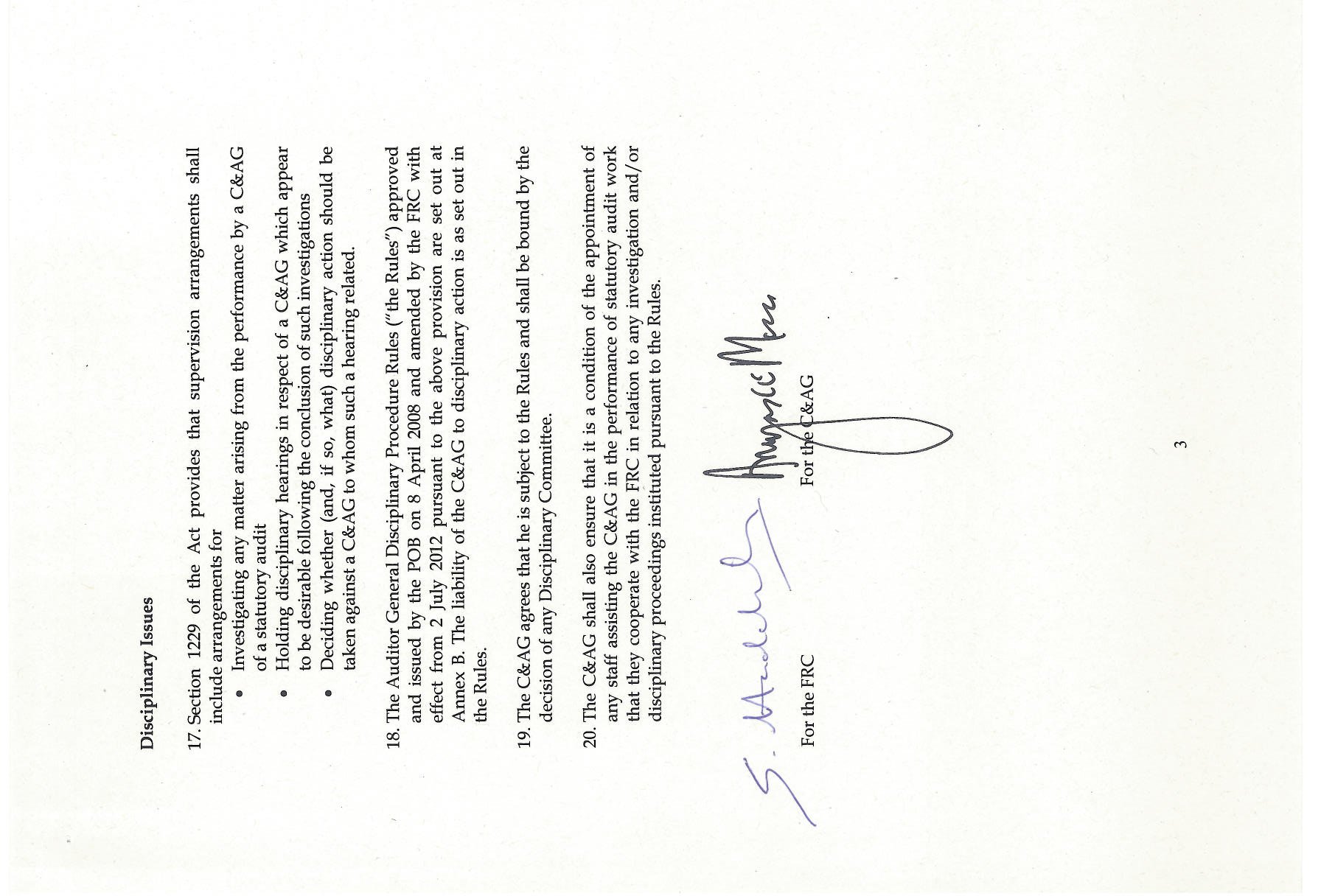
For the FRC For the C&AG
Annex A
The C&AG Audit Regulations 2008
Introduction
The C&AG Audit Regulations 2008, issued by the Professional Oversight Board on 8 April 2008 and adopted by the Financial Reporting Council with effect from 2 July 2012, shall apply from 8 April 2008 in accordance with the Supervision Arrangements agreed between the Independent Supervisor and the C&AG.
Obligations of the C&AG
1 The C&AG will ensure either that he has professional indemnity insurance or other appropriate arrangements as agreed with the Independent Supervisor, or that he has the benefit of a statutory indemnity.
2 The C&AG shall appoint a senior employee as the audit compliance principal whose name shall be given to the Independent Supervisor. The audit compliance principal may be any employee.
3 The C&AG shall designate responsible individuals in accordance with regulation 21.
4 The C&AG must make arrangements so that all staff assisting in the performance of statutory audit work are, and continue to be, competent to carry out the work for which they are responsible and/or employed.
5 The C&AG must make arrangements so that anyone the C&AG employs to perform or assist in the performance of statutory audit work is, and continues to be, a fit and proper person as defined by the Institute of which that person is a Member.
6 The C&AG must make sure all employees involved in audit work are aware of and assist in the compliance of these Regulations, the Act, any relevant rules and regulations issued under the Act and any procedures established by the C&AG.
Independence and Integrity
7 The C&AG must not accept an appointment or continue as an auditor if the C&AG has any interest likely to conflict with the proper conduct of the audit.
8 The C&AG must act in accordance with the fundamental principles set out in the Code of Ethics issued by Council of the Institute of Chartered Accountants in England and Wales and the ethical standards issued by the International Federation of Accountants (IFAC).
9 The C&AG must not accept or continue an audit appointment of an entity where:
- there exists between the C&AG and the entity a relationship where the law prohibits the C&AG auditing that entity;
- the entity has the ability to influence the affairs of the C&AG or
- the C&AG is in a position to exercise influence over the entity. The carrying out of the C&AG's statutory responsibilities will not of itself constitute the exercise of influence by the C&AG.
10 The C&AG must always conduct audit work properly and with integrity.
11 The C&AG must consider his independence and ability to perform the audit properly and record this before he accepts appointment or reappointment as auditor.
12 The C&AG must make arrangements to prevent anyone who is not a responsible individual from having any influence which would be likely to affect the independence or integrity of the audit.
Technical Standards
13 The C&AG must comply with any statutory requirements set out in the Companies Act 2006 in relation to audits carried out under the Act.
14 The C&AG must comply with the requirements of the Auditing Standards (UK and Ireland) and the Quality Control Standards issued by the Auditing Practices Board.
15 When the C&AG ceases to hold an audit appointment in relation to any entity and another Registered Auditor (the 'successor') is appointed, the C&AG must, if requested in writing by the successor, allow the successor access to all relevant information held by the C&AG in respect of the last audit report signed by the C&AG. Relevant information is the information in the audit working papers compiled to comply with auditing standards. Any information obtained by the successor is for the purposes of its audit and must not be disclosed to a third party unless required to do so by a legal or professional obligation.
16 The C&AG must keep all audit working papers which auditing standards require for an audit for a period of at least six years. The period starts with the end of the accounting period to which the papers relate.
17 The C&AG must make arrangements so that if any of his audit work is carried out by another firm, then:
- the audit working papers created by that firm are returned to the C&AG or
- the other firm agrees to keep those papers as required by regulation 16 and allows the C&AG unrestricted access to the papers for whatever reason.
18 In the case of a group audit where part of the group is audited by a firm from a non-EEA member state, the C&AG must make arrangements so that, if requested by a monitoring unit, he can obtain from that firm all the audit working papers necessary for a review of that firm's audit work.
19 If the C&AG receives a request for audit working papers or other documents from the equivalent of an RSB or oversight body of a country that is not an EEA member state, the C&AG shall consider that request and consult the FRC. If appropriate, and where the FRC has raised no objections, the C&AG must provide that body with a copy of his audit working papers compiled to comply with auditing standards within 30 working days of receipt of that request.
Audit Report
20 Save as otherwise authorised by legislation in force at the time of signing the audit report, any audit report for a financial period beginning on or after 1 April 2008 must:
- state the name of the responsible individual who was in charge of the audit as it appears in the Joint Audit Register and be signed by that person in his own name;
- state that the signatory is signing 'for and on behalf of the Comptroller and Auditor General'; and
- include the words 'Statutory Auditor' after the title of the C&AG.
Responsible Individuals
21 Subject to regulations 22 and regulation 25 the C&AG may designate as responsible individuals any of the C&AG's employees who:
- have an appropriate qualification; and
- are competent to conduct audit work.
22 Before an employee can be designated as a responsible individual, the individual must be eligible for appointment as a statutory auditor under Part 42 of the Companies Act 2006.
23 Consultants and sub-contractors cannot be designated as responsible individuals
24 Only responsible individuals can be responsible for an audit and sign an audit report.
25 Any designation in accordance with regulation 21 shall not be effective until the employee is included in the Joint Audit Register and approval from the Independent Supervisor has been granted.
26 The C&AG must ensure that the Responsible individuals maintain an appropriate level of competence in the conduct of audits.
27 Responsible individual designation by the C&AG will cease if:
- the individual ceases to be an employee of the C&AG or
- an event occurs under which the responsible individual ceases to be eligible for appointment as an auditor under Part 42 of the Companies Act 2006; or
- the Registration Committee of the relevant Institute withdraws responsible individual status.
28 In the event that an individual ceases to be designated a responsible individual in accordance with Regulation 27 the audit compliance principal shall notify the Registration Committee of the relevant Institute that the individual is no longer a responsible individual.
Monitoring
29 The C&AG must monitor, at least once a year, how effectively it is complying with these Regulations and take action to deal with any issues found and communicate any changes in procedures to employees on a prompt basis.
Matters to be notified to the Independent Supervisor
30 The C&AG must inform the Independent Supervisor in writing as soon as practicable, but not later than ten business days after the event:
- of any matter, whether relating to the C&AG or to any of its employees, which could mean that the C&AG is no longer fit and proper to be appointed as statutory auditor;
- of any other changes which might affect the C&AG's ability to conduct audit work;
- of any change in:
- the addresses of the C&AG's offices;
- the names of any of the C&AG's responsible individuals including new responsible individuals;
- the details of any other audit registration that any responsible individual has in another country, the name of the registering body and any registration number; or
- the name or address of the audit compliance principal;
- if a responsible individual leaves the C&AG's employment or ceases to be a responsible individual;
- of any change in the website address of the C&AG
31 If the C&AG ceases to meet one or more of the requirements of these Regulations or if he considers that it is impossible or impractical to comply with any other Regulations, he must notify the Independent Supervisor in writing. The notification must be within ten business days of the situation arising and must say what has happened and the action which the C&AG proposes to take.
32 The Independent Supervisor will review the information provided under regulation 31 and consider whether to grant a dispensation from the requirement to comply with any Regulation or whether to exercise any of its powers under the Act.
Annex B
Auditor General Disciplinary Procedure Rules 2012
Introduction
Citation and commencement
1 The Auditor General Disciplinary Procedure Rules 2012 are made by the FRC pursuant to the requirements of section 1229 of the Act and amend the Auditor General Disciplinary Procedure Rules 2008 made by the Professional Oversight Board, a former operating Board of the FRC. The amended Rules shall take effect from 2 July 2012.
Interpretation
2 (1) In these Rules, unless the context otherwise requires -
"the Act" means the Companies Act 2006;
"Allegation" means an allegation that an Auditor General may be guilty of Relevant Conduct;
"Auditor General" means the Comptroller and Auditor General;
"the Case Management Committee" means the Case Management Committee of the FRC established by the Conduct Committee;
"a Committee" means an Investigating Committee or a Disciplinary Committee;
"the Conduct Committee" means the Conduct Committee of the FRC established under the articles of association of the FRC;
"Disciplinary Order" means any one or more of the following:
- a Fine of an amount specified by the Disciplinary Committee,
- a Reprimand, or
- a recommendation to the Independent Supervisor to consider issuing a Suspension Notice pursuant to section 1234 of the Act; or
- a report to the Independent Supervisor that the Auditor General has failed to comply with an obligation imposed on him by or by virtue of Part 42 of the Act.
"Facts of the Allegation" means the particulars of the Allegation of Relevant Conduct;
"FRC" means the Financial Reporting Council Ltd, a company limited by guarantee incorporated in England and Wales, number 2486368 and any other body which takes over functions of the FRC;
"Independent Supervisor" means the Independent Supervisor appointed pursuant to section 1228 of the Act;
"the Presenter" means the person appointed by the Conduct Committee to present a case before a Disciplinary Committee;
"the Public Accounts Commission" means the Public Accounts Commission appointed by the House of Commons in accordance with Section 2 of the National Audit Act 1983;
"the Registrar" means the person appointed for the time being by the Conduct Committee to act as the Registrar. The Registrar may or may not be an employee of the Financial Reporting Council;
"Relevant Conduct" means conduct in the course of the performance by an Auditor General of his functions as a statutory auditor and which
- demonstrates a level of competence which falls short of that expected of an Auditor General taking into account the relevant circumstances, or
- which falls short of the standard expected of an Auditor General;
"statutory auditor" means statutory auditor as defined in section 1210(1) of the Act.
2 (2) In these Rules, unless the contrary intention appears, words in the singular include the plural and, words in the plural include the singular.
2 (3) In these Rules, unless the contrary intention appears, references to
- numbered sub-paragraphs and paragraphs are references to the Rule in which they appear; and
- numbered Rules are references to the Rules set out in these Rules.
Investigating Committee
Preliminary
3 (1) Subject to paragraphs (2) to (4), an Investigating Committee shall investigate all cases referred to the Conduct Committee in which it is alleged that, or where it appears to the Conduct Committee that, an Auditor General may be guilty of Relevant Conduct.
3 (2) Before making a reference of a case to an Investigating Committee, the Registrar shall determine whether the information received by the Conduct Committee amounts to an Allegation which should be referred to an Investigating Committee.
3 (3) For the purposes of establishing whether any information received is capable of amounting to an Allegation, the Registrar may make such preliminary enquiries as he considers necessary in the circumstances.
3 (4) Where the Registrar determines that the information does not amount to an Allegation, the Registrar shall inform the provider of the information that no further action will be taken and that the matter will be closed. The Registrar may also notify the Auditor General of the decision that no further action will be taken and that the matter will be closed.
Notices
4 (1) Where the Registrar determines that an Allegation should be referred to an Investigating Committee, the Registrar shall send a Notice of Investigation to the Auditor General by first class post or recorded delivery.
4 (2) The Notice of Investigation shall -
- set out the matters which amount to an Allegation, enclosing copies of relevant documentation in its possession;
- inform the Auditor General of the date the Investigating Committee is to meet to consider the case and of the identity of the Members of that Committee;
- invite the Auditor General to make written representations regarding the matters referred to in sub-paragraph (a) and (b) and provide, normally within 28 days from receipt of the Notice of Investigation, any evidence which the Auditor General wishes to provide; and
- have annexed to it a copy of these Rules.
4 (3) The Registrar shall send a copy of the Notice of Investigation to the Conduct Committee.
Constitution
5 (1) On receipt of a copy of the Notice of Investigation, an Investigating Committee shall be constituted by the Conduct Committee from among the members of the Case Management Committee.
5 (2) An Investigating Committee shall consist of 3 or 5 Members.
5 (3) An Investigating Committee shall elect one of its Members to act as the Chair.
5 (4) Where a Member of an Investigating Committee dies, resigns, or is unable to remain a Member in the course of the Committee's consideration of a case, the Chair may, after consulting with the other Members of the Committee, appoint, in that person's place, such other Member of the Case Management Committee as the Chair considers fit, who has not participated in the consideration of the case; but the replacement Member shall not sit until that person is fully acquainted with all previous documents before the Committee.
5 (5) Where a member of the Case Management Committee has been appointed to an Investigating Committee immediately before the expiration of his term of appointment, the Investigating Committee Member shall, subject to paragraph (4), continue to be treated as if he or she were a member of the Case Management Committee for the duration of the consideration of that case by that Investigating Committee.
Meetings
6 (1) A duly constituted Investigating Committee shall be convened by the Registrar to investigate a case at such time and place as the Registrar considers appropriate by sending appropriate notices to the Members of the Committee.
6 (2) The meetings of an Investigating Committee shall be held in private.
Proceedings
7 (1) Subject to paragraphs (2) to (5) and to Rule 8, the Chair shall, at his or her discretion, determine the procedure.
7 (2) An Investigating Committee may at any stage require further enquiries to be conducted by the Registrar.
7 (3) An Investigating Committee may at any stage adjourn consideration of the case.
7 (4) A Registrar requested by an Investigating Committee to undertake further enquiries under paragraph (2) shall present the results of any such enquiries in writing to the Committee and a copy of the results to the Auditor General who will be allowed an opportunity to comment upon the new evidence, documents or material before the Committee makes a decision.
7 (5) An Investigating Committee shall consider the available evidence, documents or material including any representations and written evidence submitted by the Auditor General.
Voting and decision making
8 Any matter to be decided by an Investigating Committee shall be put in the form of a motion and shall be decided by a majority of votes. No Member in attendance at a meeting of an Investigating Committee may abstain from voting when any question is put to the vote. In the case of an equality of votes in respect of any motion, that motion will not be carried.
Decision
9 (1) An Investigating Committee shall -
- decide that there is no case for the Auditor General to answer,
- decide that there is a case to answer and refer the case to a Disciplinary Committee, or
- decide that the case should be discontinued on other grounds;
and, in the case of sub-paragraphs (a) and (c), the Committee shall give reasons for its decision.
9 (2) The Auditor General and the Conduct Committee shall be informed in writing of the Investigating Committee's decision within 14 days of it reaching that decision.
Disciplinary Committees
Constitution
10 (1) Upon receipt of the notice of the Investigating Committee's Decision in accordance with Rule 8(2), the Conduct Committee shall invite the Chair of the Public Accounts Commission to appoint a Disciplinary Committee from among the Members of the Public Accounts Commission in order to determine the Allegation of Relevant Conduct against an Auditor General.
10 (2) A Committee shall consist of 3 or 5 Members.
10 (3) A Committee shall elect one of its Members to act as the Chair.
10 (4) Where a Committee Member dies, resigns, or is unable to remain a Member in the course of the Disciplinary Committee's hearing of a case, the Chair of the Committee shall, after consulting with the other Members of the Committee, appoint, in that person's place, such other Member of the Public Accounts Commission, as the Chair considers fit, who has not participated in the consideration of the case; but the replacement Member shall not sit until that person is fully acquainted with all the previous documents before the Committee, including the record of the proceedings.
10 (5) Where a Public Accounts Commission Member's tenure of office as a Member of the Public Accounts Commission ceases during the course of the Committee's hearing of a case, the Committee Member shall, subject to paragraph (4), continue to be treated as if he or she were a Member of the Public Accounts Commission for the purposes of membership of the Disciplinary Committee until the Committee has finally determined the case.
Hearings
11 A duly constituted Disciplinary Committee shall be convened by the Registrar to hear a case at such time and place as the Registrar considers appropriate by sending appropriate notices to the Members.
Voting and decision-making
12 Any matter to be decided by a Disciplinary Committee shall be put in the form of a motion and shall be decided by a majority of votes. No Member in attendance at a meeting of an Investigating Committee may abstain from voting when any question is put to the vote. In the case of an equality of votes in respect of any motion, that motion will not be carried.
Notice of Proceedings
13 (1) Where a case has been referred to a Disciplinary Committee by an Investigating Committee, the Registrar shall issue a Notice of Proceedings to the Auditor General by first class post or by recorded delivery.
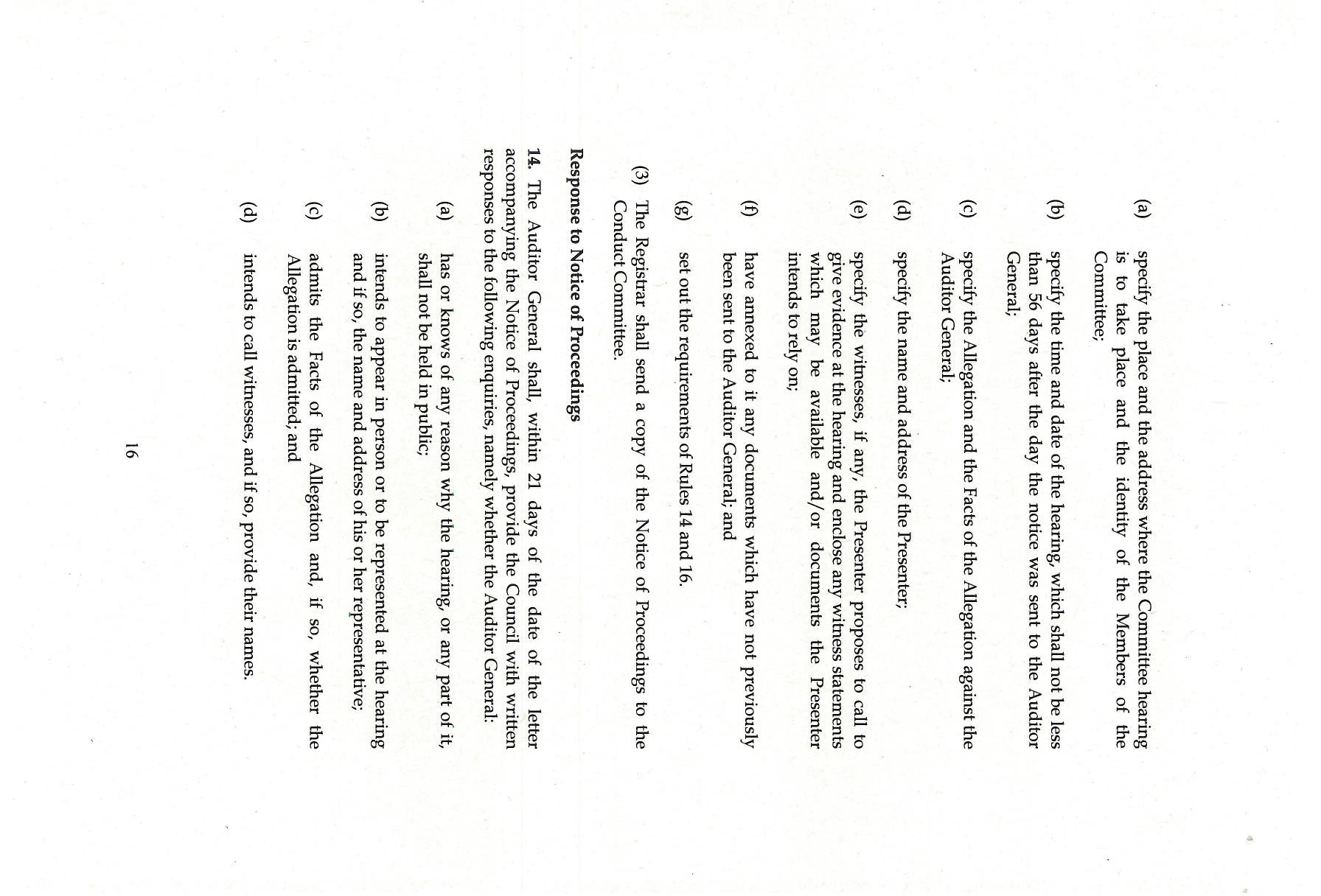
13 (2) The Notice of Proceedings shall -
- specify the place and the address where the Committee hearing is to take place and the identity of the Members of the Committee;
- specify the time and date of the hearing, which shall not be less than 56 days after the day the notice was sent to the Auditor General;
- specify the Allegation and the Facts of the Allegation against the Auditor General;
- specify the name and address of the Presenter;
- specify the witnesses, if any, the Presenter proposes to call to give evidence at the hearing and enclose any witness statements which may be available and/or documents the Presenter intends to rely on;
- have annexed to it any documents which have not previously been sent to the Auditor General; and
- set out the requirements of Rules 14 and 16.
13 (3) The Registrar shall send a copy of the Notice of Proceedings to the Conduct Committee.
Response to Notice of Proceedings
14 The Auditor General shall, within 21 days of the date of the letter accompanying the Notice of Proceedings, provide the Council with written responses to the following enquiries, namely whether the Auditor General:
- has or knows of any reason why the hearing, or any part of it, shall not be held in public;
- intends to appear in person or to be represented at the hearing and if so, the name and address of his or her representative;
- admits the Facts of the Allegation and, if so, whether the Allegation is admitted; and
- intends to call witnesses, and if so, provide their names.
Representations to the Committee
15 (1) The Conduct Committee shall appoint a Presenter to present a case before a Disciplinary Committee.
15 (2) The Auditor General may appear in person or be represented by any person of his or her choice, including a legal representative.
Service and inspection of documents
16 (1) Subject to paragraphs (2) and (3), where the Presenter or the Auditor General wish to rely upon any document, including a witness statement, which was not annexed to or enclosed with the Notice of Proceedings under Rule 13 (2) (e) or (f), they shall submit to the Registrar and the other party to the proceedings, a copy of the document concerned at least 28 days prior to the hearing.
16 (2) The Presenter and the Auditor General or his or her representative shall wherever possible agree a core bundle of relevant documents for the hearing and a copy of this bundle shall be provided to the Registrar at least 14 days prior to the hearing. Where such a bundle is received a copy shall be sent by the Registrar to the Members of the Disciplinary Committee at least 7 days prior to the hearing.
16 (3) Where it has not been possible to agree a bundle of relevant documents in accordance with paragraph (2) the Registrar will at least 7 days prior to the hearing send to the Committee and to the Auditor General and the Presenter a bundle of documents comprising -
- the Notice of Proceedings;
- any documents which an Investigating Committee has considered;
- any additional documents served with the Notice of Proceedings;
- any response from the Auditor General under Rule 14; and
- any further documents submitted under paragraph (1) of this Rule.
16 (4) If either the Auditor General or the Presenter wish to inspect the originals of any documents served in accordance with paragraph (1) or (3) the Registrar shall make suitable arrangements for the inspection of the evidence to take place at least 7 days before the date of the hearing.
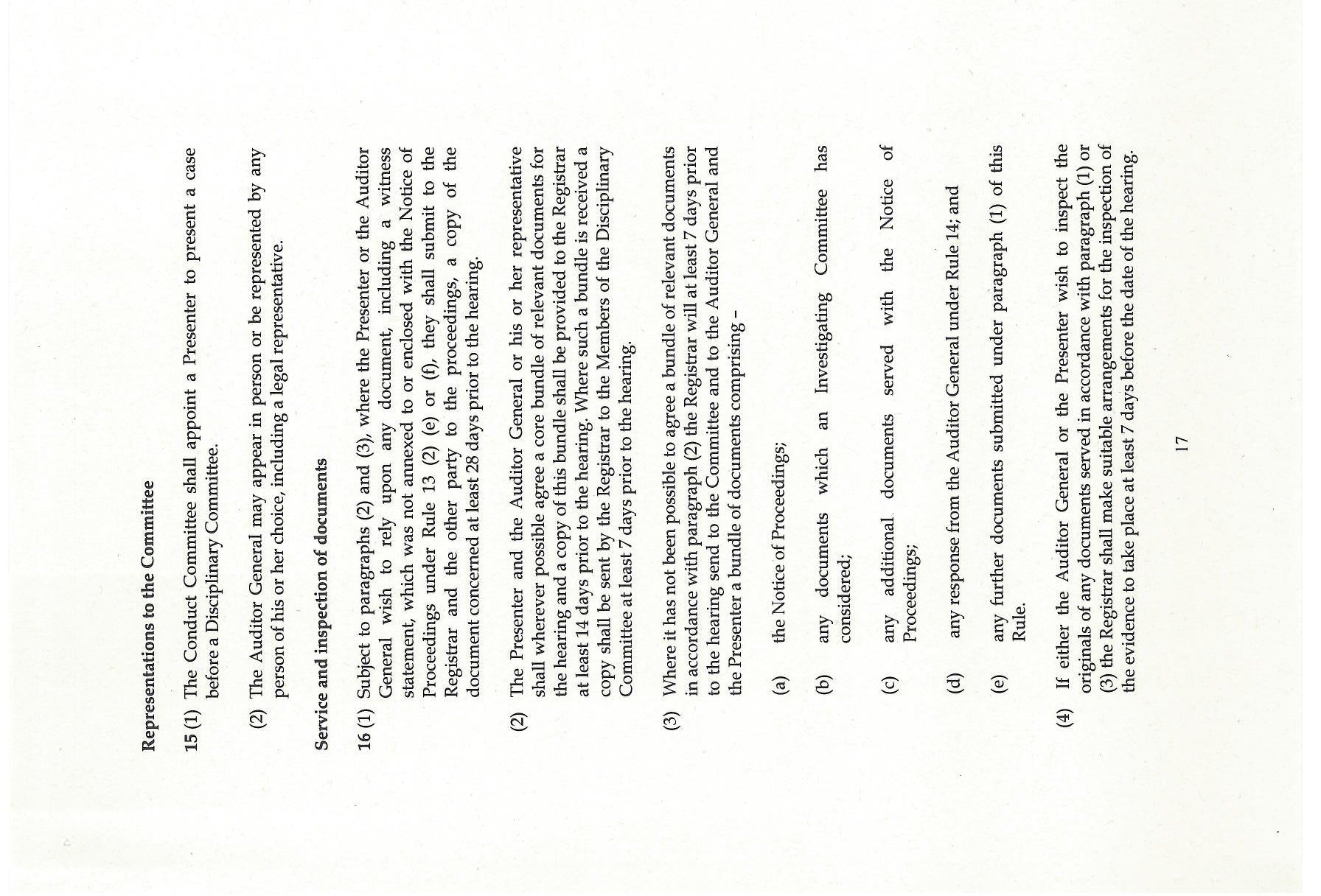
16 (5) If the Auditor General or the Presenter wish to rely at the hearing upon any document not served in accordance with this Rule, then that document may only be admitted at the discretion of the Disciplinary Committee.
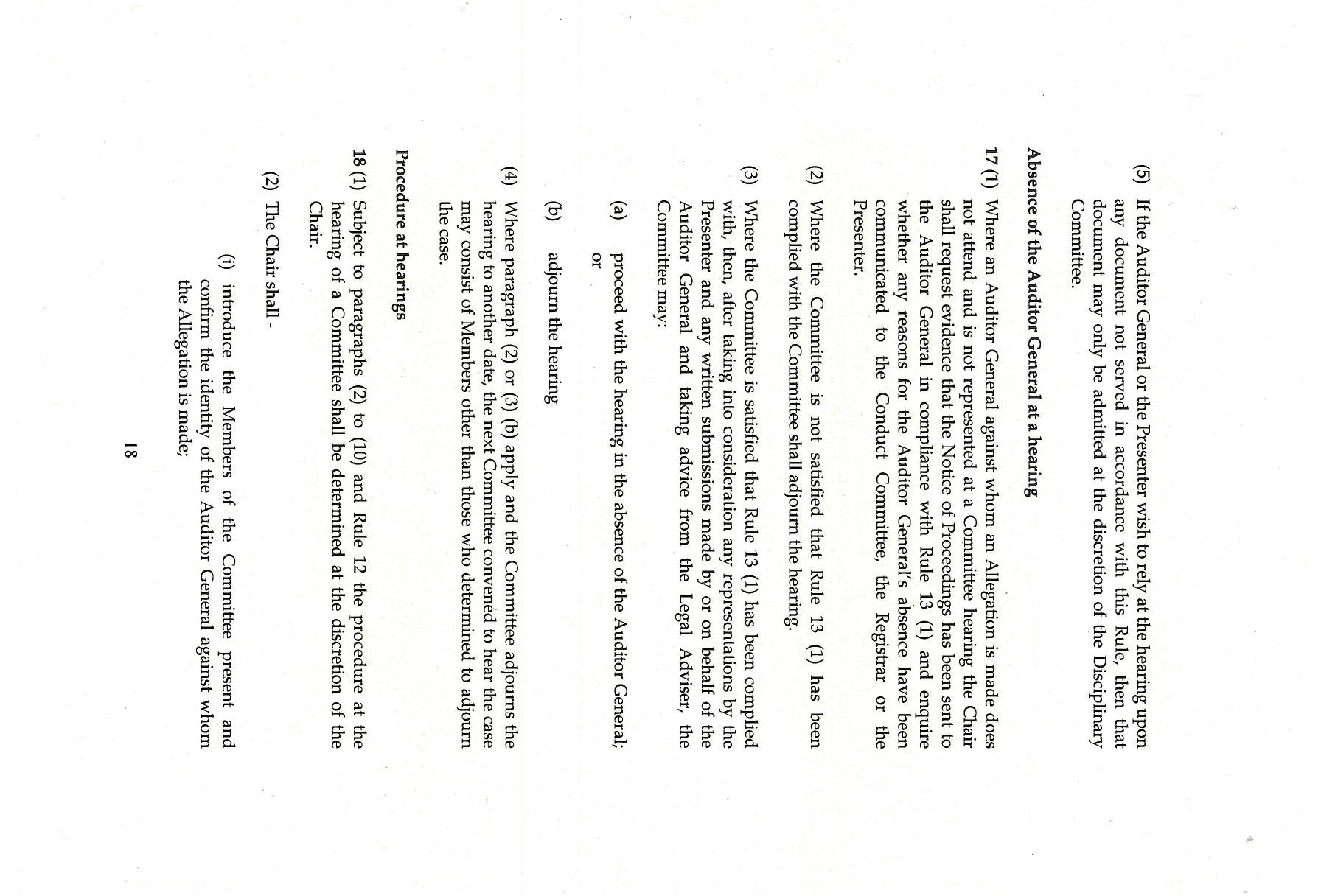
Absence of the Auditor General at a hearing
17 (1) Where an Auditor General against whom an Allegation is made does not attend and is not represented at a Committee hearing the Chair shall request evidence that the Notice of Proceedings has been sent to the Auditor General in compliance with Rule 13 (1) and enquire whether any reasons for the Auditor General's absence have been communicated to the Conduct Committee, the Registrar or the Presenter.
17 (2) Where the Committee is not satisfied that Rule 13 (1) has been complied with the Committee shall adjourn the hearing.
17 (3) Where the Committee is satisfied that Rule 13 (1) has been complied with, then, after taking into consideration any representations by the Presenter and any written submissions made by or on behalf of the Auditor General and taking advice from the Legal Adviser, the Committee may:
- proceed with the hearing in the absence of the Auditor General; or
- adjourn the hearing
17 (4) Where paragraph (2) or (3) (b) apply and the Committee adjourns the hearing to another date, the next Committee convened to hear the case may consist of Members other than those who determined to adjourn the case.
Procedure at hearings
18 (1) Subject to paragraphs (2) to (10) and Rule 12 the procedure at the hearing of a Committee shall be determined at the discretion of the Chair.
18 (2) The Chair shall -
- introduce the Members of the Committee present and confirm the identity of the Auditor General against whom the Allegation is made;
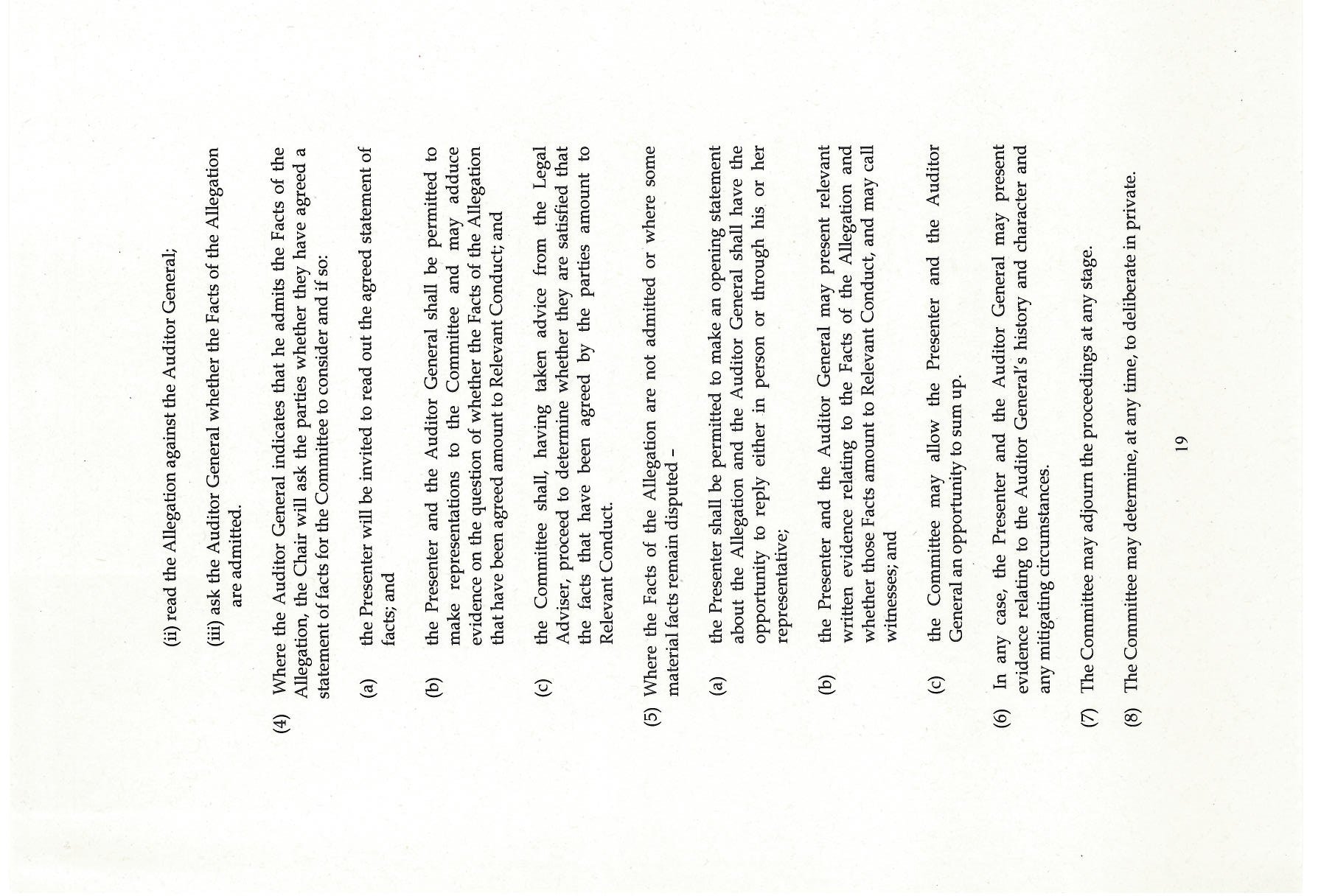
- read the Allegation against the Auditor General;
- ask the Auditor General whether the Facts of the Allegation are admitted.
18 (4) Where the Auditor General indicates that he admits the Facts of the Allegation, the Chair will ask the parties whether they have agreed a statement of facts for the Committee to consider and if so:
- the Presenter will be invited to read out the agreed statement of facts; and
- the Presenter and the Auditor General shall be permitted to make representations to the Committee and may adduce evidence on the question of whether the Facts of the Allegation that have been agreed amount to Relevant Conduct; and
- the Committee shall, having taken advice from the Legal Adviser, proceed to determine whether they are satisfied that the facts that have been agreed by the parties amount to Relevant Conduct.
18 (5) Where the Facts of the Allegation are not admitted or where some material facts remain disputed -
- the Presenter shall be permitted to make an opening statement about the Allegation and the Auditor General shall have the opportunity to reply either in person or through his or her representative;
- the Presenter and the Auditor General may present relevant written evidence relating to the Facts of the Allegation and whether those Facts amount to Relevant Conduct, and may call witnesses; and
- the Committee may allow the Presenter and the Auditor General an opportunity to sum up.
18 (6) In any case, the Presenter and the Auditor General may present evidence relating to the Auditor General's history and character and any mitigating circumstances.
18 (7) The Committee may adjourn the proceedings at any stage.
18 (8) The Committee may determine, at any time, to deliberate in private.
18 (9) Subject to the requirements of a fair hearing, in the interests of justice the Committee may amend the Allegation or the Facts of an Allegation, at any stage prior to making its findings of fact.
18 (10) Before amending an Allegation or the Facts of an Allegation in accordance with paragraph (9), the Committee shall first consider any representations by the Presenter and by the Auditor General, and take advice from the Legal Adviser.
Witnesses
19 (1) Witnesses must take the oath or affirm before giving evidence.
19 (2) The Auditor General, the Presenter and the Members of the Committee may question any witness.
19 (3) Except as may be determined by the Committee, witnesses may not be present at the hearing until they have completed giving evidence and have been formally released by the Chair.
19 (4) Witnesses may be recalled at the discretion of the Committee.
Functions of the Committee at hearings
20 (1) Without prejudice to Rule 18 (6), a Committee shall not, prior to the determination of an Allegation, have available to it, inspect or consider any record of any Disciplinary Order made in relation to the Auditor General.
20 (2) Subject to paragraph (1), in considering whether to make a Disciplinary Order in relation to an Auditor General in respect of whom the Disciplinary Committee has found guilty of Relevant Conduct, the Committee may take into account any Disciplinary Order or orders currently in force made in relation to the Auditor General.
Decision
21 (1) The Committee, in making its decision in accordance with Rule 12 shall
- determine whether the Facts of the Allegation are proved;
- determine whether it is satisfied that the Facts proven amount to Relevant Conduct;
- if the Facts amount to Relevant Conduct -
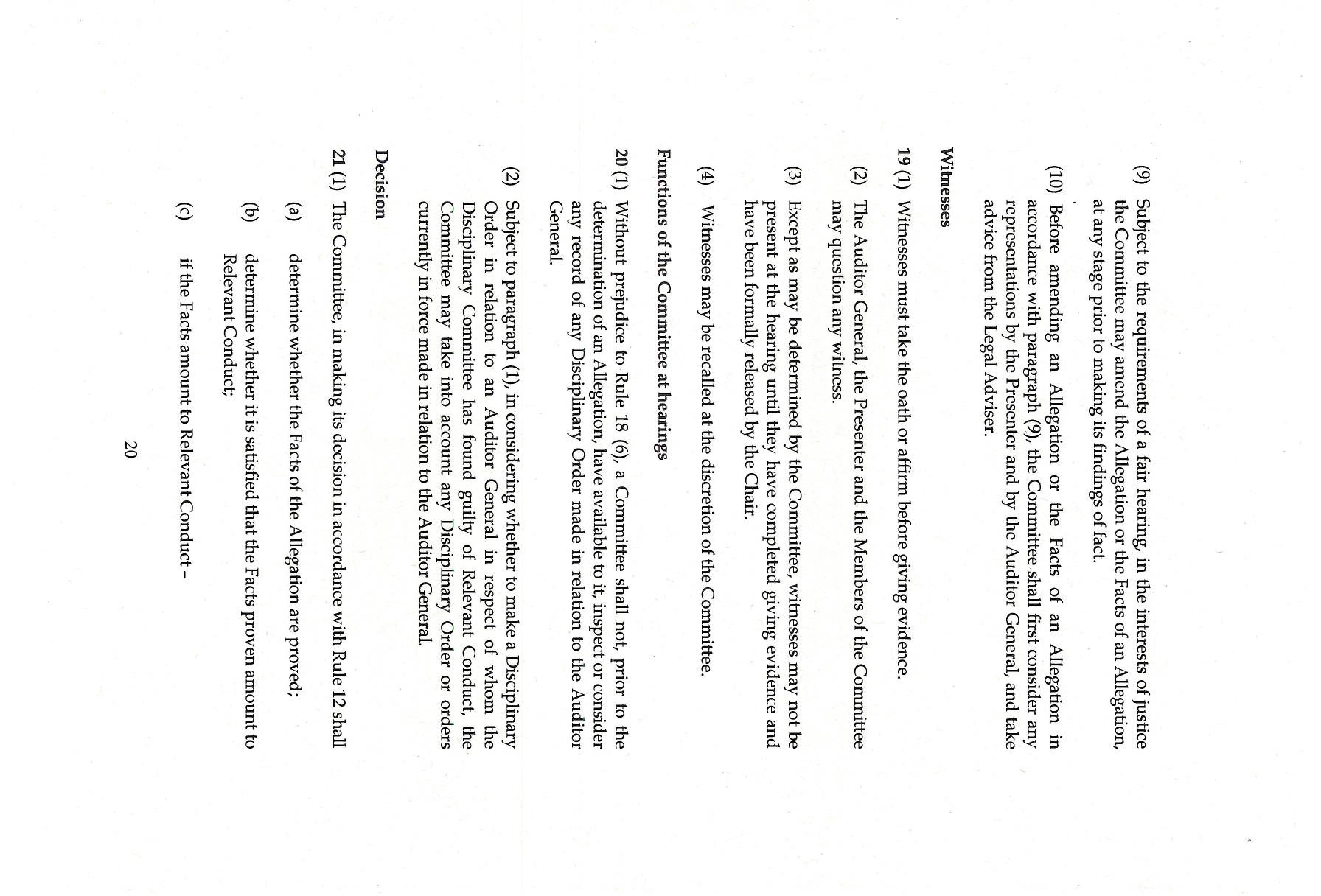
- consider the previous history and character of the Auditor General and any mitigating circumstances;
- determine whether to make a Disciplinary Order against the Auditor General, and
- specify the terms of any Disciplinary Order.
21 (2) The determination of the Committee that an Auditor General has or has not been found guilty of Relevant Conduct, and the determination as to whether to make a Disciplinary Order, together with the terms of such an order, shall be given in public.
21 (3) The Committee may give the reasons for any or all its determinations, or for specifying the terms of any Disciplinary Order, in public.
Notification of decision
22 (1) The Registrar shall serve on the Auditor General:
- Notice of the Disciplinary Order within 7 days of the decision of the Disciplinary Committee;
- the Committee's written decision within 14 days of the decision of the Disciplinary Committee.
22 (2) The written decision shall include -
- the Allegation and the Facts of the Allegation;
- the findings of fact;
- the terms of any Disciplinary Order; and
- the reasons of the Committee.
Adjournment and resumption of hearing
23 (1) Where a Committee adjourns a hearing of a case indefinitely or for a period of more than three months, and determines to resume the hearing, the Registrar shall send to the Auditor General -
- a notice of resumption of proceedings specifying the date of the hearing which shall not be less than 28 days from the date the notice was given; and
- the notes of the evidence of the adjourned hearing.
Miscellaneous
Convening of Committee meetings
24 (1) The Registrar shall convene the meetings of an Investigating Committee or a Disciplinary Committee on behalf of the Conduct Committee in accordance with the provisions of these Rules.
24 (2) Where, before a convened meeting of a Disciplinary Committee sits -
- the Auditor General against whom the Allegation is made submits new or fresh evidence or information to the Registrar, or the Presenter discovers new or fresh evidence or information, and
- it appears to the Registrar that the new or fresh evidence or information is of such a nature that an Investigating Committee ought to consider it rather than a Disciplinary Committee,
the Registrar shall refer the case to an Investigating Committee to investigate the Allegation afresh.
Public or private hearing
25 (1) A Disciplinary Committee may exclude the public from a hearing or part of a hearing
- where it appears to the Committee necessary in the interests of justice to exclude the public; or
- where the Auditor General makes a written request that the hearing should be in private and the Committee do not consider it to be contrary to the public interest to hold the hearing in private.
25 (2) Where an application is made for the hearing to be in private, the Committee shall hear the application in private, but shall announce the decision in public.
25 (3) The outcome of the hearing shall be announced in public.
Legal Adviser
26 (1) The Conduct Committee shall make available to any Committee constituted under these Rules a Legal Adviser.
26 (2) Where a Committee requires and is given legal advice, the Committee shall-
- in the case of a Disciplinary Committee, declare, to the Presenter and the Auditor General, the nature of the advice it sought and received; and
- in the case of an Investigating Committee, make a declaration in relation to the nature of the advice it sought and received in the decision notice given under Rule 9(2);
26 (3) The Legal Adviser shall not be a person who has previously addressed the Committee in a case in relation to which the Committee seeks advice in any capacity other than as a Legal Adviser.
Publication of Disciplinary Orders
27 The Conduct Committee shall publish information relating to Disciplinary Hearings and Orders on the FRC website.
Transitional Provision
28 Any steps taken by the Professional Oversight Board under the Auditor General Disciplinary Procedure Rules 2008 shall be deemed to have been taken by the Conduct Committee under these Rules with effect from 2 July 2012.