
The content on this page has been converted from PDF to HTML format using an artificial intelligence (AI) tool as part of our ongoing efforts to improve accessibility and usability of our publications. Note:
- No human verification has been conducted of the converted content.
- While we strive for accuracy errors or omissions may exist.
- This content is provided for informational purposes only and should not be relied upon as a definitive or authoritative source.
- For the official and verified version of the publication, refer to the original PDF document.
If you identify any inaccuracies or have concerns about the content, please contact us at [email protected].
FRC’s response to IFRS Practice Statement Exposure Draft ED/2021/6 – Management Commentary
Dear Matt/Yulia,
IFRS Practice Statement Exposure Draft ED/2021/6 - Management Commentary
The UK Financial Reporting Council (FRC) supports the International Accounting Standards Board's (Board's) work in revising the Practice Statement and welcomes the opportunity to comment on this exposure draft (ED). We believe that having a coherent international framework for narrative reporting will enhance the provision of consistent and comparable information for investors and creditors and as acknowledged in the Basis for Conclusions (BC), is also likely to be useful to a wider range of stakeholders.
The FRC is responsible for developing the Guidance on the Strategic Report 1. It also has responsibility for monitoring and enforcement of narrative reporting in the UK and the UK adoption of International Auditing and Assurance Standards. We therefore include relevant insights and comments relating to these aspects in our response.
In addition to our detailed comments set out in the appendix we have some general comments as follows:
Connectivity between the work of the IASB and ISSB
In our view, management commentary has an important role to play in bringing together financial and non-financial information. We believe that this Practice Statement will become increasingly important as the ISSB develops its standards. We see management commentary as being similar to the Strategic Report in the UK, as providing the overarching framework for narrative reporting within which key sustainability information would be reported.
As noted in our response to the IFRS Foundation Constitution review 2, we re-iterate the need for joining up the work on Management Commentary with ISSB developments and recommend that the IASB does not finalise the Practice Statement until both Boards have determined how management commentary fits within the planned architecture of ISSB standards.
We are delighted with the establishment of the International Sustainability Standards Board and welcome further opportunities to share our knowledge and expertise in narrative reporting with the IASB and ISSB.
Areas of content
We broadly agree, at a high level, with the areas of content that are set out in the ED as these represent the main areas that would be of interest to users. However, we consider that Part B of the ED could benefit from a review of its structure and be made more concise. There is an opportunity to remove some repetition.
From a UK perspective, at the top level, the IASB's areas of content align with those currently in the Strategic Report which would enable consistency between the UK requirements and the Practice Statement.
Strengthening the link to the information that management actually uses
In our view, information disclosed in management commentary should pass a 'use test' – it should reflect the actual information management uses, analyses and discusses in managing the entity. The effects analysis appears to support this view by observing that "information in management commentary is expected to be derived from information already used by management in managing the business." However, in the draft ED, we believe there are missed opportunities to reinforce the importance of linking disclosures in management commentary to the actual data that management creates, curates, analyses and discusses as part of its management of the business. There are several benefits to strengthening this link:
- It increases the likelihood that the data is entity-specific;
- It provides investors and creditors with an insight into management's perspectives and an understanding of what management spends its time focussed on;
- It reduces the reporting burden as management commentary should simply reflect data that management already has to hand.
We have set out in more detail in the appendix how we propose this management 'lens' be strengthened within the ED.
External assurance
We have a concern with the reference to external assurance set out in the Board's aim in paragraph IN9(b) "sufficient discipline—to facilitate external assurance of management commentary (for example, external audit or other external review), enable local lawmakers and regulators to mandate the Practice Statement and strengthen their ability to enforce compliance with it". In our view, as currently drafted, the ED does not lend itself to external assurance in the same way that financial statements do. Indeed, there are likely to continue to be inherent limitations to the nature of external assurance that can be provided for certain types of information in management commentary such as forward-looking or highly subjective disclosures.
In the UK currently, auditors are only required to state whether, based on the work undertaken in the course of the audit, a strategic report is consistent with the financial statements; has been prepared in accordance with applicable legal requirements; and whether it contains any material misstatements. However. as stakeholders' information needs evolve and the nature of the information included in management commentary evolves, it is likely that there will be increasing demands for external assurance of that information. However, at this time, and consistent with IFRS we would suggest that no explicit reference be made to the facilitation of external assurance in the Practice Statement.
We look forward to continuing to engage with the Board on the development of the new Practice Statement. If you have any queries or would like to discuss our comments in more detail, please do not hesitate to contact Jane O'Doherty at [email protected] or Deepa Raval at [email protected].
Yours sincerely
Mark Babington Executive Director, Regulatory Standards Tel: 020 7492 2323 E-mail: [email protected]
Appendix
Part A—General requirements
Chapter 2 specifies requirements for identifying management commentary and the related financial statements, for authorising management commentary and for including a statement of compliance.
Question 1—The financial statements to which management commentary relates
Paragraph 2.2 proposes that management commentary identify the financial statements to which it relates. That paragraph further proposes that, if the related financial statements are not prepared in accordance with IFRS Standards, the management commentary would disclose the basis on which the financial statements are prepared.
The Exposure Draft does not propose any restrictions on the basis of preparation of the related financial statements (for example, it does not propose a requirement that financial statements be prepared applying concepts similar to those underpinning IFRS Standards).
Paragraphs BC34–BC38 explain the Board's reasoning for these proposals.
- Do you agree that entities should be permitted to state compliance with the revised Practice Statement even if their financial statements are not prepared in accordance with IFRS Standards? Why or why not?
- Do you agree that no restrictions should be set on the basis of preparation of such financial statements? Why or why not? If you disagree, what restrictions do you suggest, and why?
(a) & (b) Although we expect that it is more likely that the Practice Statement will be applied in jurisdictions that use IFRS, we support entities referencing their use of the Practice Statement to prepare management commentaries even if those entities do not prepare financial statements in accordance with IFRS. To facilitate this, the 'defined terms' should acknowledge where IFRS-based definitions have been used and recognise that other definitions may be used by other reporting frameworks.
In our view the Practice Statement will provide high quality guidance for management commentary reporting that does not rely on the use of IFRS concepts of recognition, measurement, presentation or disclosure. As such it can be decoupled from the basis of preparation used for the financial statements.
Question 2—Statement of compliance
(a) Paragraph 2.5 proposes that management commentary that complies with all of the requirements of the Practice Statement include an explicit and unqualified statement of compliance.
Paragraphs BC30–BC32 explain the Board's reasoning for this proposal.
Do you agree? Why or why not?
(b) Paragraph 2.6 proposes that management commentary that complies with some, but not all, of the requirements of the Practice Statement may include a statement of compliance. However, that statement would be qualified, identifying the departures from the requirements of the Practice Statement and giving the reasons for those departures.
Paragraph BC33 explains the Board's reasoning for this proposal.
Do you agree? Why or why not?
We agree with the concept of a statement of compliance.
(a) We agree that management commentary that complies with all the requirements of the Practice Statement should include an explicit and unqualified statement of compliance. In our view, this would provide useful information about the framework against which narrative information has been prepared and is likely to add more rigour to the preparation of management commentary by a company.
(b) We can also see a case for a 'comply or explain' type statement as it may not always be possible for some companies to provide an unqualified statement such as where there is a conflict between the requirements in the Practice Statement and local law or regulations.
Question 3—Objective of management commentary
Paragraph 3.1 proposes that an entity's management commentary provide information that:
- enhances investors and creditors' understanding of the entity's financial performance and financial position reported in its financial statements; and
- provides insight into factors that could affect the entity's ability to create value and generate cash flows across all time horizons, including in the long term.
Paragraph 3.2 proposes that the information required by paragraph 3.1 be provided if it is material. Paragraph 3.2 states that, in the context of management commentary, information is material if omitting, misstating or obscuring it could reasonably be expected to influence decisions that investors and creditors make on the basis of that management commentary and of the related financial statements.
Paragraphs 3.5–3.19 explain aspects of the objective, including the meaning of 'ability to create value'. Paragraphs BC42–BC61 explain the Board's reasoning for these proposals.
Do you agree with the proposed objective of management commentary? Why or why not? If you disagree, what do you suggest instead, and why?
We agree with the proposed objective of management commentary, but we propose that an additional point (c) be included:
(c) provides investors and creditors with insight into how management manages and assesses the entity's performance, prospects and risks across different time frames.
In our view, information disclosed in management commentary should pass a 'use test' – it should reflect the actual information that management uses as well as the subjects and opinions that are discussed in meetings. To the extent that management commentary represents management's perspective, it allows investors and creditors to understand how management views and guides the business. This insight can be gained not just by assessing how management articulates its opinions; but also by understanding for example what data is focussed on and how management assesses the business and the environment it operates in. Adding this additional point (c) to the objective of management commentary should allow investors and creditors to gain insights into the quality of the management of the company.
For example, in setting out the risks that could disrupt the business model, the disclosures made should not just inform investors and creditors about the risks to the business but also whether management has adequately assessed those risks, and is taking action to manage and mitigate them. If the management commentary does not address risks that similar entities address, this may mean that management does not have a clear grasp of the environment in which the entity operates. Insights into the metrics and data reported in management commentary may also indicate implicit and explicit drivers of management behaviour – are they excessively profit-focussed or backward-looking; too short-term in focus; excessively focussed on financials rather than other metrics; lacking in non-financial analysis; does the data focussed on reflect the strategy and vision of the company?
We consider that including an acknowledgement of the role of management commentary in providing an insight into management's performance will ultimately benefit investors and creditors. In our view it will raise the quality of management commentary by allowing stakeholders to exert market discipline on firms that do not make; or are not seen to make adequate disclosures. We also believe that this additional focus will facilitate external assurance by linking management commentary more closely to what management actually focuses on in the performance of its role.
Part B and Appendix B—Areas of content
Chapters 4–11 specify six areas of content for management commentary, and require management commentary to provide information that meets disclosure objectives for each of those areas of content. Those chapters also require management commentary to focus on key matters.
Requirements and guidance proposed in this Exposure Draft would apply to reporting on matters that could affect the entity's long-term prospects, on intangible resources and relationships, and on environmental and social matters. Appendix B provides an overview of requirements and guidance that management is likely to need to consider in deciding what information it needs to provide about such matters.
Question 4—Overall approach
The Exposure Draft proposes an objectives-based approach that:
- specifies an objective for management commentary (see Chapter 3);
- specifies six areas of content for management commentary and, for each area of content, disclosure objectives that information provided in management commentary is required to meet (see Chapters 5–10);
- gives examples of information that management commentary might need to provide to meet the disclosure objectives (see Chapter 15); but
- does not provide a detailed and prescriptive list of information that management commentary must provide.
Paragraphs BC69–BC71 explain the Board's reasoning for proposing this approach.
Do you expect that the Board's proposed approach would be:
- capable of being operationalised—providing a suitable and sufficient basis for management to identify information that investors and creditors need; and
- enforceable—providing a suitable and sufficient basis for auditors and regulators to determine whether an entity has complied with the requirements of the Practice Statement?
If not, what approach do you suggest and why?
We broadly agree at a high level with the areas of content set out in the ED as these represent the main areas that would be of interest to users. However, we consider that Part B of the ED could benefit from a review of its structure and be made more concise. There is an opportunity to remove some repetition.
Potential areas for reducing duplication include:
- Materiality – removing sections on key matters under each content area. In our view, materiality, as set out in IFRS, is an overarching concept and should be considered for any disclosure so we see no need to repeat this for each content area. We suggest moving Chapter 12 on materiality before the areas of content given that it is a pervasive concept.
- There is also repeated text 'Examples of information that might be material' at the end of each chapter relating to an area of content which simply cross-refers to Chapter 15.
- Metrics – We consider that it would be more efficient include Chapter 14 on metrics as an additional chapter in part B after Chapter 10 that covers financial performance and position rather than including them as part of each area of content. The current approach is likely to drive companies towards disclosing metrics for each area separately without forming an overall view of which metrics are key to the business.
- Metrics are also likely to be an area of focus for sustainability standards issued by the ISSB so it would need to be clear how those metrics fit in with the overall framework for management commentary.
- Removal of Chapter 11—this seems to be a summary of the previous sections, repeating content from Chapters 5–10. It may be useful to include this in a Snapshot instead.
(a) Despite the objectives-based approach of the current Practice Statement, the Basis for Conclusions (BC) describes a number of implementation shortcomings that have been identified in practice (BC5). However in proposing revisions that maintain the current objectives-based approach with very minimal prescription, there is a strong risk that these shortcomings will not be resolved. This is because the underlying presumption appears to be that when inadequate disclosures are being made, it is because management has a lack of understanding as to what it should be disclosing. Following this thinking then suggests that providing additional guidance should help to resolve the issue. However in practice the reasons for deficiencies in management commentaries are likely to be more varied and complex than a lack of appropriate guidance:
- There may be concerns by management that certain information is commercially sensitive or confidential and as such should not be disclosed;
- Management may not prioritise the management commentary and as such they may do the minimum necessary preparation by 'rolling over' last year's commentary and reverting to boiler-plate disclosures;
- Management may consider that the less entity-specific detail they provide the less scrutiny they will be subject to;
- Management may not feel comfortable disclosing too much forward-looking data as it is not verifiable and may open them up to criticism if they 'get it wrong';
- Management may see the management commentary as a compliance exercise which requires new content to be created, rather than seeing it as the opportunity to provide management's true perspective and views.
If the shortcomings observed arise due of any of the reasons above, then they will not be resolved by providing additional objectives-based guidance. The flexibility in the draft practice statement will give best practice entities the opportunity to appropriately tailor their management commentaries but it will also give those entities that do not wish to do so the flexibility not to disclose a broad range of relevant information.
For this reason we consider that there should be aspects of prescription in the Practice Statement and a stronger link to the way in which management oversees the business. Providing data and information that management actually uses would provide a useful insight into what management focuses on. For some entities, the management's focus will meet the expectations of investors and creditors but if it doesn't, this in itself is useful information. It would allow stakeholders to hold management to account if they feel that management's focus is not on the key matters. Furthermore, this information is much more amenable to external assurance as it can be verified from documentation circulated and recorded for management meetings.
In conclusion, while we consider that best practice entities would find the draft Practice Statement provides enough guidance to operationally enhance management commentary we are not convinced that, as currently drafted, it will improve on the shortcomings identified.
(b) In our view, there is more work to be done on the Practice Statement before it can provide a basis for facilitating external assurance (for example, external audit or other external review); enabling local lawmakers and regulators to mandate the Practice Statement and strengthening their ability to enforce compliance with it. The Practice Statement is non-mandatory so it would need to be adopted into local laws or regulations for it to be enforceable. There would also need to be clarity within the Practice Statement to distinguish between 'requirements' and 'guidance'.
Question 5—Design of disclosure objectives
The proposed disclosure objectives for the areas of content comprise three components—a headline objective, assessment objectives and specific objectives. Paragraph 4.3 explains the role of each component. Paragraphs 4.4–4.5 set out a process for identifying the information needed to meet the disclosure objectives for the areas of content and to meet the objective of management commentary.
Paragraphs BC72–BC76 explain the Board's reasoning for these proposals.
- Do you agree with the proposed design of the disclosure objectives? Why or why not? If you disagree, what do you suggest instead, and why?
- Do you have general comments on the proposed disclosure objectives that are not covered in your answers to Question 6?
We agree with the proposed design of the disclosure objectives and have no additional comments.
Question 6—Disclosure objectives for the areas of content
Chapters 5–10 propose disclosure objectives for six areas of content. Do you agree with the proposed disclosure objectives for information about:
- the entity's business model;
- management's strategy for sustaining and developing that business model;
- the entity's resources and relationships;
- risks to which the entity is exposed;
- the entity's external environment; and
- the entity's financial performance and financial position?
Why or why not? If you disagree, what do you suggest instead, and why?
We agree with the proposed disclosure objectives.
Question 7—Key matters
Paragraphs 4.7–4.14 explain proposed requirements for management commentary to focus on key matters. Those paragraphs also propose guidance on identifying key matters. Chapters 5–10 propose examples of key matters for each area of content and examples of metrics that management might use to monitor key matters and to measure progress in managing those matters.
Paragraphs BC77–BC79 explain the Board's reasoning for these proposals.
- Do you agree that the Practice Statement should require management commentary to focus on key matters? Why or why not? If you disagree, what do you suggest instead, and why?
- Do you expect that the proposed guidance on identifying key matters, including the examples of key matters, would provide a suitable and sufficient basis for management to identify the key matters on which management commentary should focus? If not, what alternative or additional guidance do you suggest?
- Do you have any other comments on the proposed guidance?
(a) We agree with the focus on key matters as this will encourage entities to focus on disclosure of material information in management commentary.
(b) We are doubtful that, generally, when management commentaries do not focus on key matters, the reason is because management do not know what the key matters are. Notwithstanding we see no disadvantage to clearly articulating what is meant by key matters for the purpose of this Practice Statement.
(c) We believe that some practitioners may consider that when key matters are commercially sensitive, it would not be appropriate, nor would there be on onus on them to disclose these matters. In BC113, we note that following a discussion the Board concluded that it did not intend to propose an exception for commercially sensitive information. In the UK, there is an exemption to the disclosure of information in the strategic report about impending developments or matters in the course of negotiation if the disclosure would, in the opinion of the directors, be seriously prejudicial to the interests of the company 3. However, the directors should still consider whether there is summarised information that is not seriously prejudicial which should be disclosed. We would support a similar exemption for management commentary, but whatever the outcome we would support the policy on disclosing sensitive information to be clearly disclosed in the practice statement so there is no ambiguity.. The FRC's Guidance on the Strategic Report (Section 5: materiality, paragraph 5.15) provides some wording that may be helpful in this regard.
Question 8—Long-term prospects, intangible resources and relationships and ESG matters
Requirements and guidance proposed in this Exposure Draft would apply to reporting on matters that could affect the entity's long-term prospects, on intangible resources and relationships, and on environmental and social matters. Appendix B provides an overview of requirements and guidance that management is likely to need to consider in deciding what information it needs to provide about such matters. Appendix B also provides examples showing how management might consider the requirements and guidance in identifying which matters are key and which information is material in the fact patterns described.
Paragraphs BC82–BC84 explain the Board's reasoning for this approach.
- Do you expect that the requirements and guidance proposed in the Exposure Draft would provide a suitable and sufficient basis for management to identify material information that investors and creditors need about:
- matters that could affect the entity's long-term prospects;
- intangible resources and relationships; and
- environmental and social matters?
Why or why not? If you expect that the proposed requirements and guidance would not provide a suitable or sufficient basis for management to identify that information, what alternative or additional requirements or guidance do you suggest?
- Do you have any other comments on the proposed requirements and guidance that would apply to such matters?
(a) In our view, the requirements and guidance as drafted would be useful in providing insights into the types of disclosures that should be made in relation to long-term prospects; intangible resources and relationships; and ESG matters. However, as noted earlier, in our view the deficiencies in reporting identified in these areas will not all be overcome purely by issuing additional guidance, as the reasons behind poorer practices can be multiple and varied. Notwithstanding, we think the guidance provided will be useful and should be included in the final Practice Statement.
(b) We understand the Board's reasoning for not specifically drawing out ESG matters in a separate section as they are related to other areas of content, nevertheless, it would be helpful for paragraph 4.1 to include a reference to how ESG matters fit within the framework for management commentary.
Question 9—Interaction with the IFRS Foundation Trustees' project on sustainability reporting
Paragraphs BC13–BC14 explain that the Trustees of the IFRS Foundation have published proposals to amend the Foundation's constitution to enable the Foundation to establish a new board for setting sustainability reporting standards. In the future, entities might be able to apply standards issued by that new board to help them identify some information about environmental and social matters that is needed to comply with the Practice Statement.
Are there any matters relating to the Trustees' plans that you think the Board should consider in finalising the Practice Statement?
In our view, management commentary is the ideal vehicle to enable reporting based on sustainability standards. Management commentary's objective to enhance investors and creditors' understanding of the entity's financial performance and financial position is just as relevant in the context of sustainability standards.
The question posed notes that preparers may be able to use sustainability standards to identify some information about environmental and social matters needed to comply with this Practice Statement. This implies a passive role for management commentary whereas we think it should play a much more proactive role in the development of sustainability standards. We see it as a key enabler to implementation; the ideal 'landing pad' for narrative information to support sustainability standards. If it is not, there is a risk that non-financial information relating to key matters will be presented in a disjointed, incoherent and inconsistent way.
We would encourage the IFRS Foundation to ensure the connectivity between the proposed sustainability standards and IFRS Standards and Practice Statements by promoting the use of management commentary as the crucial framework reporting on the key features of the entity's business model and strategy, including relevant sustainability and financial matters. We welcome the reference in the 'General Requirements for Disclosure of Sustainability-related Financial Information Prototype' 4 that sustainability-related financial disclosures can be included in an entity's management commentary.
Question 10—Making materiality judgements
Chapter 12 proposes guidance to help management identify material information.
Paragraphs BC103–BC113 explain the Board's reasoning in developing that proposed guidance.
Do you have any comments on the proposed guidance?
Chapter 12 notes that:
In judging whether a piece of information is material, management considers the entity's specific circumstances, as well as whether investors and creditors need that information and why they need it.
In our view, obliging management to consider whether investors and creditors 'need' information sets a different bar for disclosure than whether 'omitting, misstating or obscuring it could reasonably be expected to influence decisions that investors and creditors make.' Indeed, the two considerations may even contradict each other. For example, the example given in Part B relates to the management of an oil and gas entity that knows expected trends in environmental legislation could cause the company to curtail its operations fundamentally. This is clearly something that could influence decisions by investors and creditors but the question of whether it is something that they 'need' to know is more nuanced. Management could argue that it is too uncertain; too far in the distance (given there are no definitions of long-term); or something that is already in the public domain. This could lead management to conclude that it is not necessary or appropriate to disclose the information at this stage.
As such we suggest the sentence in 12.2 be redrafted as follows:
In judging whether a piece of information is material, management considers the entity's specific circumstances, as well as whether investors and creditors need that information and why they need it would find the information useful in making decisions about providing resources to the entity.
In our view, the concept of 'usefulness' is more aligned to the definition of materiality than the concept of whether investors and creditors 'need information.'
In 12.4(c), in addition to presentations to investors and creditors, management could also consider information provided as part of earnings calls.
Question 11—Completeness, balance, accuracy and other attributes
- Chapter 13 proposes to require information in management commentary to be complete, balanced and accurate and discusses other attributes that can make that information more useful. Chapter 13 also proposes guidance to help management ensure that information in management commentary possesses the required attributes.
Paragraphs BC97–BC102 and BC114–BC116 explain the Board's reasoning for these proposals.
Do you agree with these proposals? Why or why not? If not, what do you suggest instead and why?
- Paragraphs 13.19–13.21 discuss inclusion of information in management commentary by cross-reference to information in other reports published by the entity.
Paragraphs BC117–BC124 explain the Board's reasoning for these proposals.
Do you agree with these proposals? Why or why not? If not, what do you suggest instead and why?
(a) We agree with the majority of attributes as set out in the ED but have some observations on specific areas.
In the BC, the Board notes its intention to include brief descriptions of each attribute of useful information 'using language that is as plain as possible.' However, in our view, the chapter itself is not always clear and concise. One such example relates to the illustrations set out in paragraph 13.4 which include long sentences and do not always use plain language. Similarly, concepts such as 'verifiability' may be familiar to the larger group of individuals preparing management commentary. If the aim of this chapter is to be inclusive of the broader set of individuals involved in the preparation of management commentary, particularly those without a financial or audit background, we think that there is scope to enhance its readability and usefulness.
We disagree with the use of the word 'accurate' as an attribute of useful information. The common understanding of this term is something that is free from error but paragraph 13.12 makes the distinction that for the purposes of the Practice Statement it means free from 'material error.' We find this concerning. For example, factual information could be incorrect but is identified as 'accurate' because it is immaterial.. In our view this creates the potential for a significant expectations gap.
We note that verifiability is a qualitative characteristic in the IASB's Conceptual Framework. As currently drafted, we are not convinced that the attribute of verifiability is appropriate for the majority of information in management commentary which is inherently subjective. The term verifiability implies a level of precision to the information which may be appropriate for certain quantitative information such as metrics but would be difficult to achieve for other qualitative information
We believe that coherence is an overarching principle that should apply to management commentary and the annual report as a whole. We encourage the IASB to consider giving this principle more prominence, upfront in the document, as it will be important in encouraging companies to ensure that management commentary and the financial statements are viewed as a package.
Finally, we suggest that there may also be merit in moving the guidance and requirements on the attributes of useful information to the front of the Practice Statement to set the scene for the more detailed chapters that follow. There is a risk otherwise that it may be missed or seen as an afterthought to the main requirements and guidance.
(b) We agree with concept of cross-referencing but believe that it's articulation in the Practice Statement needs further consideration. In our view, information disclosed in management commentary should be sufficient to meet the objective of that report and meet the disclosure objectives. As set out in the FRC's Guidance on the Strategic Report, we encourage the use of cross-referencing within the annual report and then signposting of complementary information.
In 2020 the FRC published a discussion paper 'The Future of Corporate Reporting' 5 that proposed a new model for the future comprising a network of interconnected reports. Technology, it was proposed, would enhance the connectivity of the reports and allow the existing approach to be unbundled. In our view, cross-referencing of data to other reports is consistent with this concept, but respondents to the FRC discussion paper 6 did flag some potential challenges with this approach. The challenges identified include the potential confusion if different levels of assurance are used for different reports; how to align reports with different reporting dates; and ensuring appropriate connectivity and cohesiveness across the different reports.
We note that the Exposure Draft (ED) does address some of these issues but we think that some challenges may remain. In relation to the blurring of audit lines, although the ED proposes the same level of assurance be in place for cross-referenced documents as exists for management commentary, as noted earlier we are not convinced that as currently drafted, the Practice Statement lends itself to appropriate assurance. Furthermore, management may not feel comfortable providing an explicit and unqualified statement of compliance for other cross-referenced reports particularly if they have not been directly involved in their preparation.
How different reporting dates should be dealt with is also not sufficiently clear in the ED. Paragraph 13.21(d)(ii) states in the case of the cross-referenced report having an earlier reporting date, that the management commentary should "if necessary to meet the requirements of this [draft] Practice Statement, provide further information up to the end of the period covered by the management commentary." In our view this requirement is ambiguously worded and does not provide adequate clarity as to whether updated information is required or not, or the factors to be taken into account in determining whether it is necessary.
When several documents are cross-referenced as part of management commentary, consideration could be given to providing a reference table as an appendix to support the connectivity. The table could set out the requirements of management commentary and include clear references as to where, either within management commentary or in other refenced reports, the relevant information can be found.
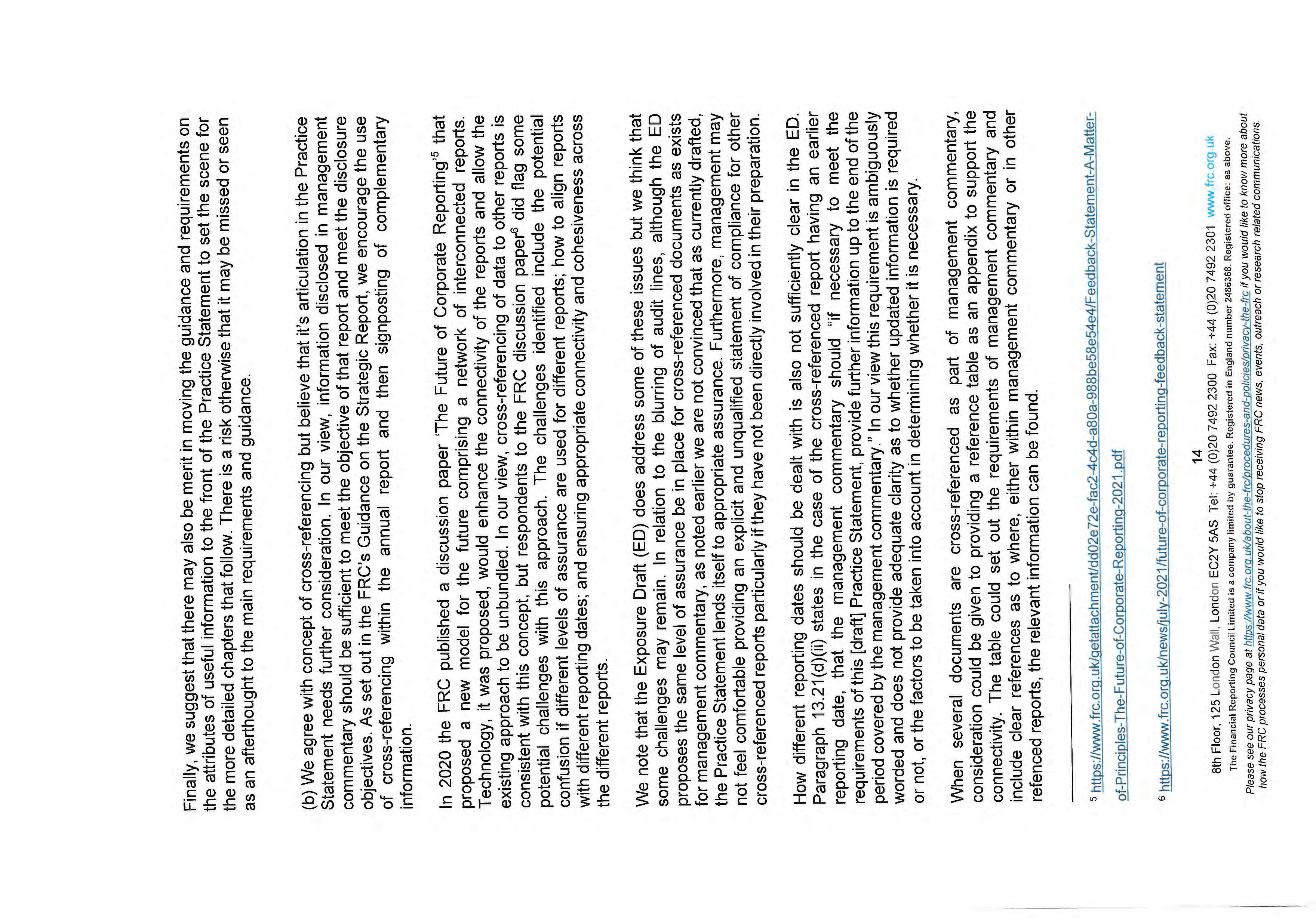
Question 12—Metrics
Chapter 14 proposes requirements that would apply to metrics included in management commentary.
Paragraphs BC125–BC134 explain the Board's reasoning for these proposals.
Do you agree with these proposals? Why or why not? If not, what do you suggest instead and why?
We support the guidance and requirements on metrics. We would like to propose an additional requirement, that management disclose the metrics most frequently reported to management and discussed in management fora. The frequency with which those metrics are reported and the reason why any metrics are introduced or no longer regularly reported over the period should also be disclosed.
Although paragraph 14.3 notes that metrics 'could be derived from metrics that management uses to monitor key matters' we think this should be strengthened. If management are regularly using particular metrics, this gives an important insight into what they consider is important, what they regularly track and what informs their stewardship. If the metrics address material matters they may be disclosed anyway, and if they do not relate to material matters, there is a legitimate question as why management is focussed on these metrics with such scrutiny and regularity. As the adage goes, what gets measured, gets managed, and in our view this disclosure would provide an important insight for investors and creditors. It would also be straightforward to verify.
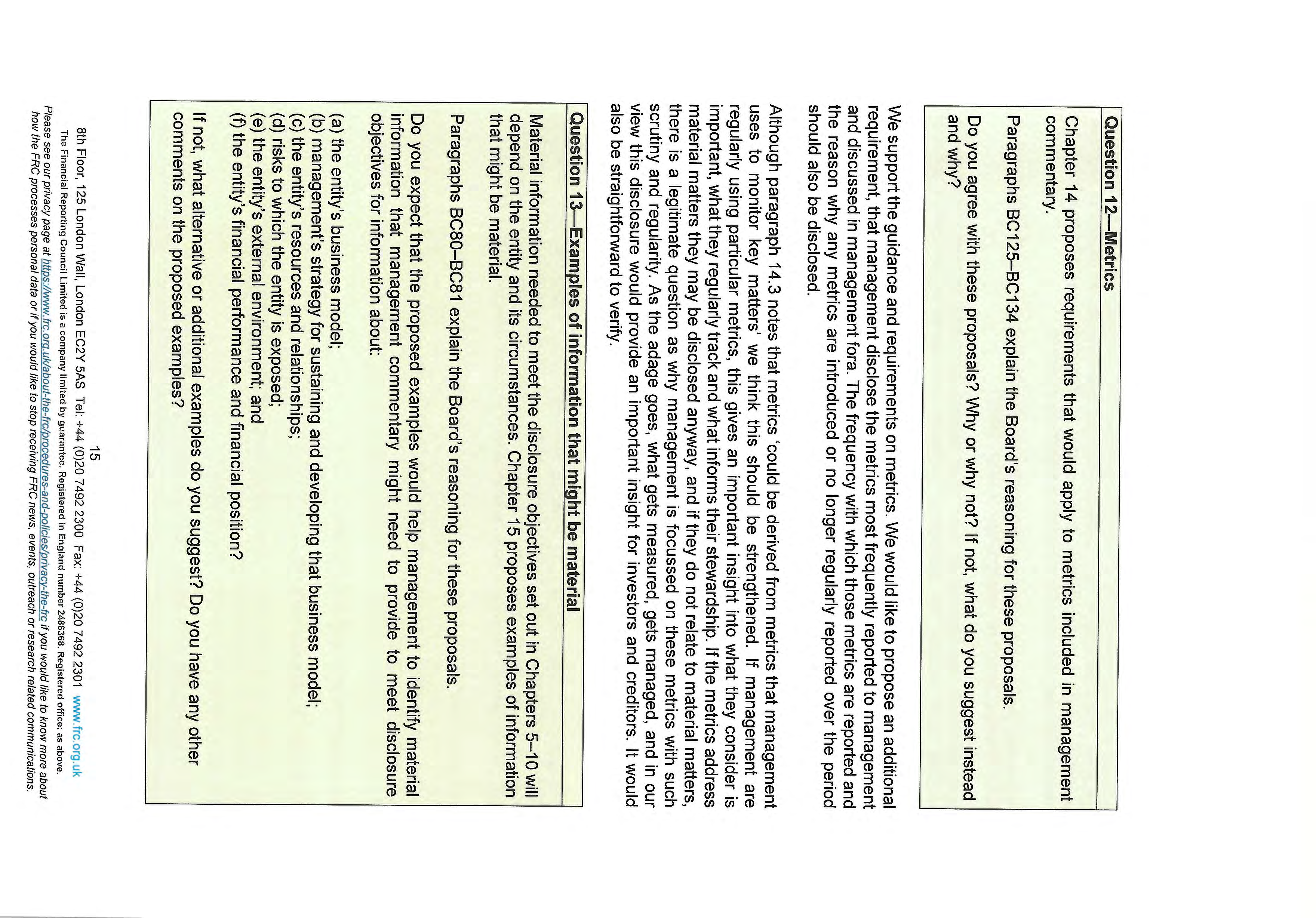
Question 13—Examples of information that might be material
Material information needed to meet the disclosure objectives set out in Chapters 5–10 will depend on the entity and its circumstances. Chapter 15 proposes examples of information that might be material.
Paragraphs BC80–BC81 explain the Board's reasoning for these proposals.
Do you expect that the proposed examples would help management to identify material information that management commentary might need to provide to meet disclosure objectives for information about:
- the entity's business model;
- management's strategy for sustaining and developing that business model;
- the entity's resources and relationships;
- risks to which the entity is exposed;
- the entity's external environment; and
- the entity's financial performance and financial position?
If not, what alternative or additional examples do you suggest? Do you have any other comments on the proposed examples?
Whilst we think the concept of providing examples is likely to be useful to many preparers, we do think that as currently drafted some of the examples may potentially weaken the disclosure objectives. This is because in many cases the example listed repeats the disclosure objective but instead of being a requirement, the example is offered as something that 'could be included.' For example one of the disclosure objectives relates to:
"factors and trends in the external environment that have affected or could affect the business model, strategy, resources, relationships or risks" (IN16).
Paragraph 15.22 proposes that an example of material information to meet this disclosure objective 'could include "an explanation of factors and trends in the entity's external environment that have affected or could affect the entity....." The example is an almost verbatim restatement of the disclosure objective but it is no longer a 'must-have' and instead it is stated as a 'could-have.' There are several other similar examples where it is almost impossible to imagine how the example could not be disclosed but the disclosure objective be met. As such we suggest some of the drafting be reconsidered so that only true 'examples' are included, rather than restatements of the disclosure objectives.
We also consider that there is an opportunity to consider how the examples are presented in the Practice Statement. Chapter 15 includes examples of information that might be material but Table B.1 also includes examples of items that might be material for specified areas. This multi-layered approach makes the document complex and would be difficult to follow for those entities applying the Practice Statement.
Question 14—Effective date
Paragraph 1.6 proposes that the Practice Statement would supersede IFRS Practice Statement 1 Management Commentary (issued in 2010) for annual reporting periods beginning on or after the date of its issue. This means that the Practice Statement would be effective for annual reporting periods ending at least one year after the date of its issue.
Paragraphs BC135–BC137 explain the Board's reasoning for this proposal.
Do you agree with the proposed effective date? Why or why not? If not, what effective date do you suggest and why?
We support the proposed effective date.
Question 15—Effects analysis
- Paragraphs BC139–BC177 of the Basis for Conclusions accompanying the Exposure Draft analyse the expected effects of the proposals in this Exposure Draft.
Do you have any comments on that analysis?
- Paragraphs BC18–BC22 discuss the status of the Practice Statement. They note that it would be for local lawmakers and regulators to decide whether to require entities within their jurisdiction to comply with the Practice Statement.
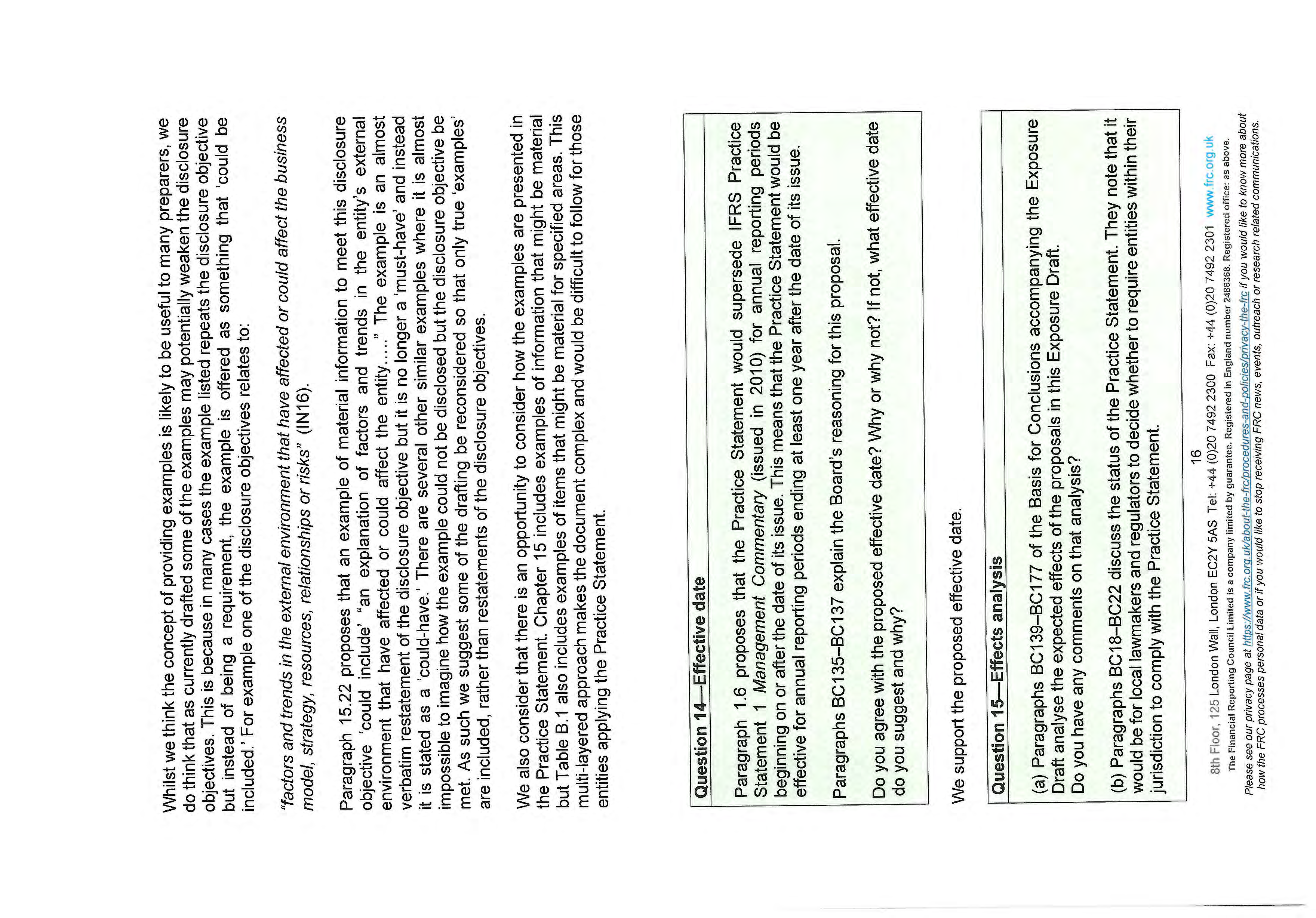
Are you aware of any local legal or regulatory obstacles that would make it difficult for entities to comply with the Practice Statement?
(a) A key assumption included in the effects analysis is that "information in management commentary is expected to be derived from information already used by management in managing the business, so an entity would not need to produce information specifically for management commentary." We wholeheartedly agree with this premise but we suspect that in some cases, management commentary is drafted by preparers creating new content to meet the requirements in the Practice Statement and that management does not always make the link to the data that it uses to manage the business. This 'top-down' approach is likely to be at least one of the contributing factors to 'boiler-plate' type, less relevant and less entity-specific disclosures.
For best-practice entities that provide 'bottom-up' management commentaries that seek to make coherent links between the data they use to manage the business and the information and perspectives they disclose, we agree that the proposals are unlikely to lead to significant costs. However for those entities where the data disclosed in management commentary does not pass the 'use test' and lacks strong connectivity to the information used in managing the business, we consider that there may be more significant costs in meeting the new requirements if they implement the proposals as they are intended.
(b) Some jurisdictions, such as the UK already have a well-developed framework for narrative reporting in the form of the Strategic Report which entities are required to comply with. For countries such as the UK, there may be benefit in demonstrating that the UK framework is consistent with international developments, however, it would be burdensome for companies to also comply with the IASB Practice Statement.
We recommend that one of the next steps for the IASB is to canvas views on whether different jurisdictions intend to use the practice statement – adopt, adapt or take no action. For those that intend to take no action, there may be benefit in working with National Standard Setters to demonstrate how local requirements map to the international standard and thereby enhance comparability of information for users.
Consistent with points made earlier in this response, in our view the ED as currently drafted does not provide a sufficient basis to allow it to be assessed as 'compliant' or not; or to be reliably verified. In our view this is a missed opportunity.
However by more closely articulating the expectation that the information in management commentary is expected to be derived from information already used by management in managing the business we believe the verifiability can be greatly enhanced.
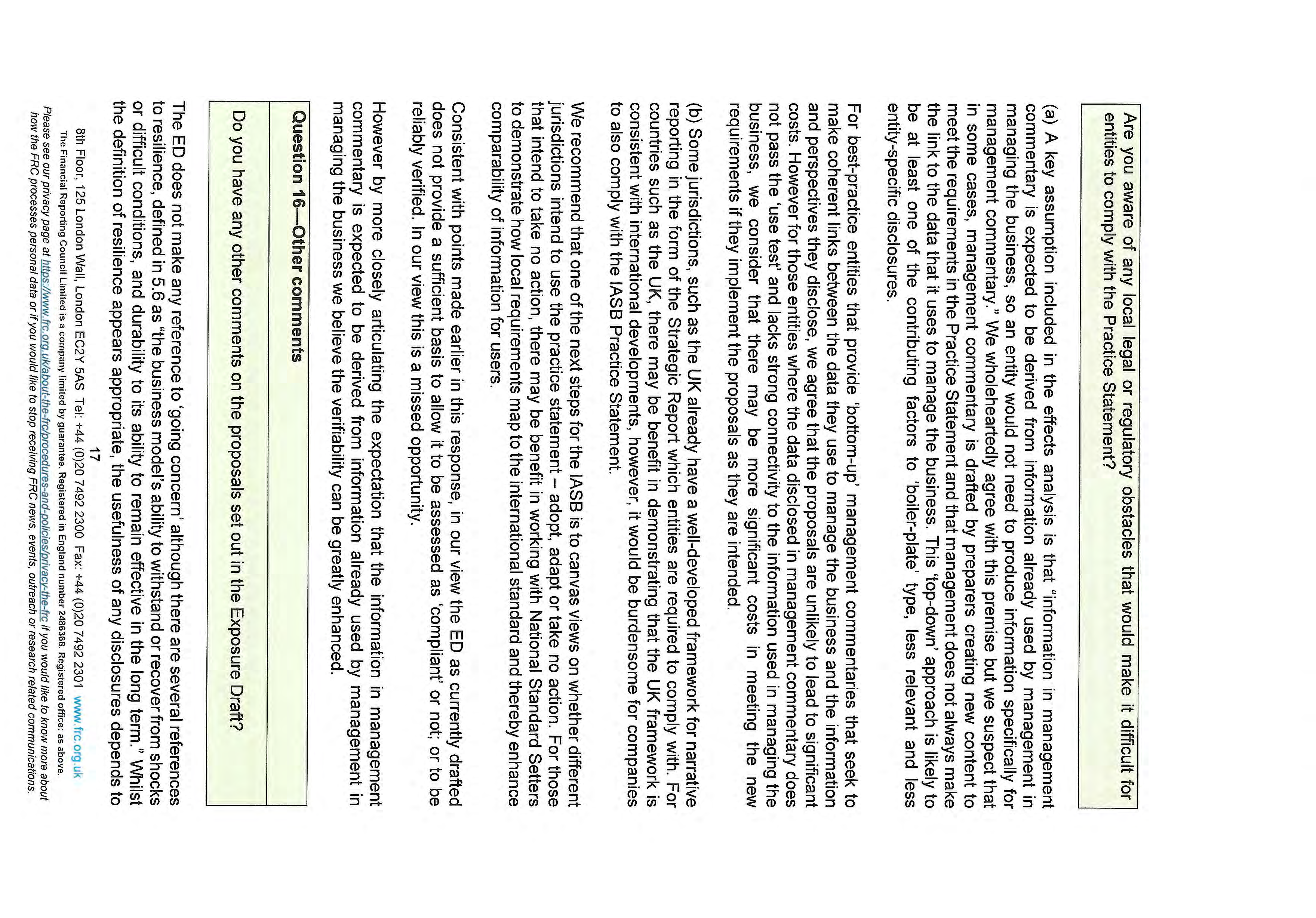
Question 16—Other comments
Do you have any other comments on the proposals set out in the Exposure Draft?
The ED does not make any reference to 'going concern' although there are several references to resilience, defined in 5.6 as "the business model's ability to withstand or recover from shocks or difficult conditions, and durability to its ability to remain effective in the long term." Whilst the definition of resilience appears appropriate, the usefulness of any disclosures depends to a large degree on what timescale entities use when considering the 'long-term.' In declining to "prescribe timescales for periods management might choose to label as, for example, short-term, medium-term or long-term" (paragraph 3.14) or to set out any guidance, there is a real risk that resilience considerations will not consider a long enough horizon to be useful to investors and creditors.
In its recently published 'Annual Review of Corporate Reporting: 2020/2021' 7 the FRC found that in relation to going concern and viability disclosures, the most common viability period selected by companies was three years. In relation to a similar finding a recent UK Government consultation 8 reported that a number of investors have pointed out that a three-year forward-looking horizon "does not cover how a company is planning to survive and thrive through a typical business cycle." Whilst these observations are made in the context of the UK environment, we believe that they are also relevant in other jurisdictions. Indeed one of the shortcomings in current practice identified (paragraph BC5) relates to management commentaries "focusing on short-term matters and providing insufficient discussion of matters, such as systemic risks or strategic challenges, that could affect the entity's long-term prospects."
In light of these findings, we believe that the Practice Statement should provide some guidance and prescription on the timescales that should be used for labels such as 'short-term'; 'medium-term'; and 'long-term.' This is particularly important given the prevalence with which the terms are used – there are over 100 references to 'long-term' in the ED document alone. At an absolute minimum, entities should disclose what their timescales are for these labels to facilitate at least some comparison across entities. However if there is no guidance or prescription as to what 'long-term' means, we remain concerned that the excessive focus on short-term analysis at the expense of true long-term analysis will continue.
8th Floor, 125 London Wall, London EC2Y 5AS Tel: +44 (0)20 7492 2300 Fax: +44 (0)20 7492 2301 www.frc.org.uk The Financial Reporting Council Limited is a company limited by guarantee. Registered in England number 2486368. Registered office: as above. Please see our privacy page at https://www.frc.org.uk/about-the-frc/procedures-and-policies/privacy-the-frc if you would like to know more about how the FRC processes personal data or if you would like to stop receiving FRC news, events, outreach or research related communications.
-
The FRC's Guidance on the Strategic Report is available at https://www.frc.org.uk/getattachment/fb05dd7b-c76c-424e-9daf-4293c9fa2d6a/Guidance-on-the-Strategic-Report-31-7-18.pdf ↩
-
https://www.frc.org.uk/getattachment/678beb52-d7b7-452a-96b6-be125802dd77/FRC-response-to-IFRSF-Constitution-review-Final.pdf ↩
-
Section 414C (14) of the Companies Act 2006. ↩
-
https://www.ifrs.org/content/dam/ifrs/groups/trwg/trwg-general-requirements-prototype.pdf ↩
-
https://www.frc.org.uk/getattachment/dd02e72e-fac2-4c4d-a80a-988be58e54e4/Feedback-Statement-A-Matter-of-Principles-The-Future-of-Corporate-Reporting-2021.pdf ↩
-
https://www.frc.org.uk/news/july-2021/future-of-corporate-reporting-feedback-statement ↩
-
https://www.frc.org.uk/getattachment/8430f391-6f44-4ec3-b1f8-c3d6b00c9a1e/FRC-CRR-Annual-Review_October-2021.pdf ↩
-
Restoring trust in audit and corporate governance, March 2021; https://assets.publishing.service.gov.uk/government/uploads/system/uploads/attachment_data/file/970676/restoring-trust-in-audit-and-corporate-governance-command-paper.pdf ↩