
The content on this page has been converted from PDF to HTML format using an artificial intelligence (AI) tool as part of our ongoing efforts to improve accessibility and usability of our publications. Note:
- No human verification has been conducted of the converted content.
- While we strive for accuracy errors or omissions may exist.
- This content is provided for informational purposes only and should not be relied upon as a definitive or authoritative source.
- For the official and verified version of the publication, refer to the original PDF document.
If you identify any inaccuracies or have concerns about the content, please contact us at [email protected].
What Makes a Good Environment for Speak-Up and Internal Challenge
The FRC does not accept any liability to any party for any loss, damage or costs howsoever arising, whether directly or indirectly, whether in contract, tort or otherwise from any action or decision taken (or not taken) as a result of any person relying on or otherwise using this document or arising from any omission from it.
© The Financial Reporting Council Limited 2024
The Financial Reporting Council Limited is a company limited by guarantee. Registered in England number 2486368. Registered Office: 8th Floor, 125 London Wall, London EC2Y 5AS
1. Foreword
“Reported instances of integrity issues or misconduct matters have a significant impact on trust and confidence in the profession. Ethical conduct must therefore be an intrinsic part of all firms' cultural programmes and the profession must strive to maintain a culture of integrity in which the highest standards of ethical values and professional behaviour are upheld.”
FRC's Overview Public report, July 2023
A good environment for effective challenge and speaking up is imperative in facilitating audit quality and high standards of ethical conduct within audit firms. Having a good speak-up culture underpins the purpose of serving the public interest and maintaining trust in the profession by supporting wider ethical behaviour. It promotes audit quality by facilitating challenge during an audit and through promoting continuous learning and improvement. The absence of a speak-up culture may prevent a firm from identifying and addressing behaviour that may lead to loss and reputational damage, and in turn negatively impact the resilience of the firm and the audit market.
An ethical culture is one where people work together to fulfil their responsibilities to all stakeholders by upholding a set of core values. It ensures a collective understanding of the expected standards of quality and behaviour and supports audit teams and individuals to 'do the right thing'.
A speak-up culture is a workplace culture where people feel safe sharing ideas and concerns, and reporting behaviour that is not aligned to the values of the firm or that is breaching legal and regulatory requirements. In a healthy speak-up culture, people trust that they can ask questions or raise issues about their work or ethical dilemmas they are facing, having confidence that the firm will support them, and that they won't face retaliation for speaking up. They also feel certain that raising their concerns will lead to appropriate corrective action being taken.
Auditors perform their duties within the framework of regulatory standards and guidance which includes the International Standard on Quality Management 1 (“ISQM1”), the FRC's Revised Ethical Standard, 2019 and the Audit Firm Governance Code (“the Code”) issued by the FRC in April 2022, as well as the Codes of Ethics issued by the Recognised Supervisory Bodies. This framework requires audit firms to establish policies and procedures to effectively support an environment where auditors are encouraged to challenge and speak up without fear and to call-out poor behaviour or non-compliance.
This report draws on evidence gathered from a review of the formal policies and processes for whistleblowing and speak-up across the Tier 1 audit firms and from considering their respective approaches to the promotion of wider ethical behaviour. It sets out the key elements of a good speak-up workplace culture and some of the current good practice observed within each of these elements.
2. Overview
In 2022 the FRC published the 'What Makes a Good Environment for Auditor Scepticism and Challenge' report. This report highlighted the importance of fostering a culture that encourages people to speak up and raise challenges internally in order to facilitate a greater level of challenge.
As well as supporting high audit quality within the audit practice, a speak-up culture has a second important benefit for the firm as a whole: to reduce the risk of reputational damage by underpinning a culture of integrity throughout the wider firm.
The diagram below sets out the key elements of a good speak-up workplace culture:
- the processes to equip people with the confidence to speak up as well as facilitate the recording, investigation, and resolution of concerns raised,
- the framework of mechanisms driving accountability and good governance as supported by the policies and procedures in place,
- the culturally accepted norms for tolerance of certain behaviours and the willingness of people to engage in internal challenge and speak-up, and
- the ongoing measurement of the effectiveness of speak-up processes and the overall ethical culture.
Elements of an environment for effective challenge and speak-up
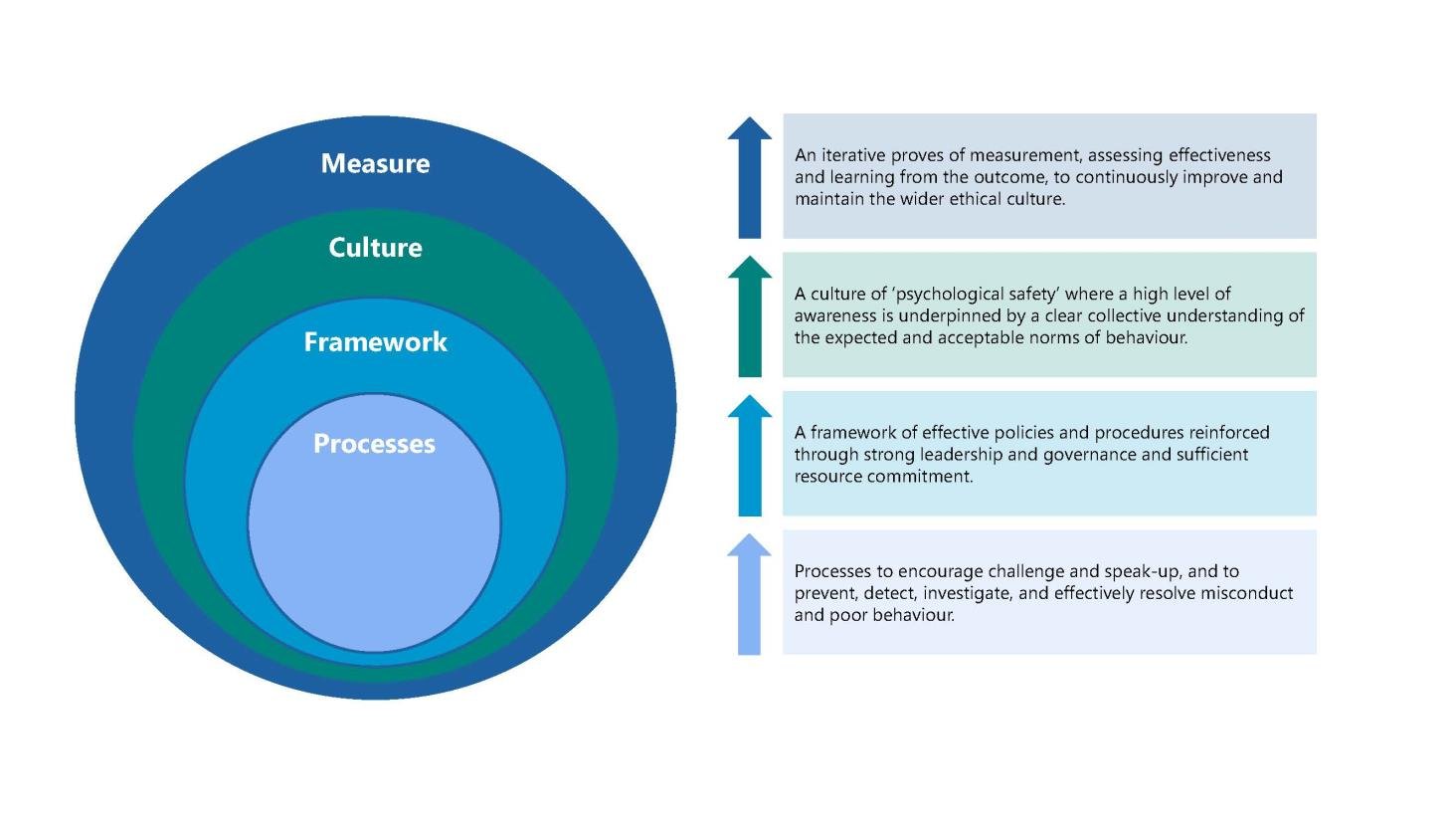
A firm must put in place the policies, processes, and mechanisms to support an environment that empowers and encourages people to exercise challenge both externally and internally, and enable the detection, investigation, and resolution of misconduct that could negatively impact audit quality and reputation.
The processes for detection and effective resolution of misconduct are facilitated through:
- Recording channels that are well communicated and easy to use, providing anonymity and support and underpinning a robust and fair investigation process.
- A firm-wide communication strategy that creates a high level of awareness by regularly referencing speak-up processes and how speaking up has contributed to achieving the firm's objectives of quality, resilience, and serving the public interest.
- Training that focuses on values and expected behaviours as well as what constitutes misconduct, and which is delivered interactively and at regular intervals, and reinforced through continuous storytelling.
- An effective resolution process that provides timely feedback to all parties, and ensures appropriate action is taken with a clear link between behaviour and reward and recognition.
- A good understanding by all about what constitutes retaliation / victimisation, and support and protection for those raising concerns through the implementation of a well-developed retaliation monitoring process.
- Continuous review and analysis of the root cause of misconduct and the appropriate reporting and sharing of lessons learnt and actions taken.
A framework that supports challenge and speaking up includes:
- Commitment from leaders and those in governance positions to foster a speak-up workplace culture through effective oversight and timely response.
- Well-designed policies and procedures that are updated regularly and referenced frequently to create a high level of awareness.
- Sufficient allocation of time and resources to clearly defined and well communicated roles and responsibilities reinforced through a system of accountability.
People are encouraged and empowered to challenge and speak up in a culture where:
- Participation and collaboration are invited, listening is modelled, 'voice' is rewarded, and purpose as well as the interdependence of team members are emphasised, creating an environment where people feel safe to speak up.
- There is agreement on what constitutes misconduct and an understanding of the firm's culturally accepted norms.
Effectiveness in achieving a speak-up culture is measured through:
- Development of measures indicative of desirable outcomes and continual assessment against these measures.
- Designing initiatives that would achieve the desired outcomes and incorporate learnings from measurement activities.
3. Processes
Speak-up arrangements encompass all the processes a firm must put in place to create an environment that is conducive to effective speak-up and challenge and where people are able, willing, and confident to raise concerns or report misconduct. It also includes setting guidance for effectively handling and resolving such concerns raised and reporting the outcomes to those in governance positions while incorporating the learnings back into the processes to ensure continuous improvement.
3.1 Communication
Communication is a key pillar of effective speak-up, and promoting a speak-up culture requires constant work and commitment. Behavioural science research confirms the importance of supplementing compliance-based tools, such as codes of conduct, training and reviews which appeal to logic, with emotion-based triggers in the form of communication strategies which emphasise actions related to culture, critical thinking, courage, and conscience. Firms that do this well work hard to reinforce speak-up messages in a variety of ways, incorporating these messages into everyday business activities. Success also requires the commitment of senior team members who should be seen to incentivise speaking up through acknowledgement and reinforcement of speak-up messages on a regular basis.
Good practice – communication
To emphasise the importance of speaking up, some firms run regular awareness campaigns using a variety of communication channels to acknowledge those who raised concerns, and to share good news stories about how concerns have been resolved, positive experiences, and how victimisation was avoided.
Some firms have developed guidance tools for senior team members to use when engaging in team conversations, to deepen the collective understanding of expected behaviour and to explore what constitutes misconduct and poor behaviour.
In addition, people must feel confident that senior leaders and managers will act, and act appropriately, if a concern is raised. This involves training those who receive and handle concerns, both formally and informally, to equip them with the necessary skills.
Good practice – training
Firms are promoting bystander training to emphasise the importance of speaking up when witnessing misconduct or behaviour not in alignment with the firm's values or policies.
3.3 Recording and investigation
Availability and ease of use are two key requirements driving reliability and completeness of recording. Providing multiple channels for raising concerns gives people options to report in whichever way is most comfortable for them. Appropriate systems and well-documented procedures support the recording and investigation of concerns and must allow for the consistent treatment of formal as well as informal concerns.
A robust triage and investigation process that allows for dialogue and communication with the reporter will provide reassurance and encourage more to come forward. This can create a culture where team members trust those more senior to them to deal with concerns properly and where people do not feel the need to opt for external reporting or public disclosure. It is also important to perform regular reviews of concluded investigation work to identify and action any process improvements needed.
Good practice – recording and investigation
Certain firms are responding to evolving communication preferences by using innovative ideas such as mobile phone applications that increase accessibility to reporting channels and allow people to submit concerns securely and confidentially.
Firms 'test' the consistency and quality of their recording and investigation processes in a variety of ways, through regular review of a sample of cases, and review of long-outstanding cases.
3.4 Resolution and feedback
Speaking up can be difficult and takes courage, so people must feel that it is worth the effort. Failure to take appropriate action on concerns raised undermines trust and potentially leads to increased misconduct rates and an overall decrease in employee morale. A robust and continuous feedback loop is central to an effective investigation process and builds trust, encouraging others to raise concerns, and providing insights for further process improvement.
Good practice – resolution and feedback
Some firms ensure there is a clear link between behaviour and reward and recognition.
Firms obtain feedback from reporters in several ways using follow-up and close-out meetings, confidential questionnaires, and exit surveys and interviews.
3.5 Review and reporting
Regular reviews of speak-up arrangements seek to identify learning, recognise innovation, and support improvement, and ultimately, improve the experience of all team members.
Review and analysis of the concerns reported and the outcomes from the investigation process, inform those in governance positions, and allow leadership to consider themes of poor behaviour and to design initiatives that will bring about the desired change. However, for reporting to be of most value, it is important to draw a link between the information reported and the health of the wider ethical culture, frequently and in sufficient depth.
Good practice – review and reporting
One firm engages independent third parties to benchmark the speak-up process, and to report to those in charge of the firm's risk management on the effectiveness of the operation of its external online speak-up hotline. Recommendations are implemented as part of an annual speak-up action plan.
Some firms have developed extensive ethical health metrics which are presented in a quarterly report to the Executive and Board, and which form the basis for monitoring progress against speak-up action plans.
One firm has introduced formal root cause analysis as part of the investigation process to facilitate a clear understanding of the underlying issues leading to misconduct or poor behaviour, as well as how aspects of culture might be driving this behaviour. Such analysis is then used to design further initiatives and identify lessons learned to incorporate into further training and communications as relevant.
3.6 Support and Protection
The 'fear of reprisal' is a significant barrier preventing team members from raising concerns. Speaking up and challenge is encouraged where people who exhibit such behaviours are protected against adverse repercussion, intimidation, disadvantage, or victimisation. A good understanding amongst all people of what constitutes acts of victimisation / retaliation is key to raise awareness and can be achieved through regular training and team discussion. It is imperative that a policy
against retaliation is complemented with a monitoring process that includes sufficient 'shielding' practices and the importance of confidentiality must be emphasised throughout the whole process.
Good practice – support and protection
Some firms consider the risk of retaliation at the outset of every investigation and proactively monitor for signs of retaliation over a period of up to two years through follow-up meetings and by monitoring key indicators.
All firms offer various sources of support for potential reporters including employee assistance programmes and third-party organisations, and they assess the use and effectiveness of these programmes by actively seeking feedback from reporters and taking appropriate action.
4. Framework
A culture of speaking up and challenge is promoted through governance and leadership commitment and sufficient employment of resources. Effective speak-up arrangements also require a foundation of policies and procedures that are reviewed and refreshed regularly, considering relevant laws, regulation, and best practice.
4.1 Leadership and governance
Ethical leadership inspires a culture of trust, respect, and inclusion, and fosters an environment for ethical conduct and behaviour. An oversight function that is visible to all in speak-up arrangements, investigations, and matters related to victimisation demonstrates the firm's commitment to a wider ethical culture.
Governance is the framework for accountability within which the governing body sets the tone for an ethical culture and ensures that policies and practices align with these objectives.
Good practice – leadership and governance
At some firms, wider ethical conduct is championed by a specific conduct team, in most cases lead from within the ethics team. This team coordinates the firm's internal legal advisors, the employee assistance team, the risk management team, the people and culture team, and relevant subject matter experts, all of whom have also been specifically trained in speak-up matters.
4.2 Policies and procedures
Speak-up policies and procedures support the firm's code of conduct and the firm's commitment to conducting business with integrity and fairness, aligned with the values of the firm. Together, the code and the policies and procedures should empower people to handle ethical dilemmas they encounter in everyday work and to report misconduct witnessed or experienced, giving the firm the opportunity to deal with the concern.
In many instances, compliance policies and codes of conduct, in isolation, do not achieve their aim of triggering team members' sense of duty and moral responsibility to speak up if they see misconduct or behaviour that would lead to poor audit quality. If policies and procedures are not supported by an appropriate culture, they will not inspire people to speak up.
Good practice – policies and procedures
Some firms have detailed guidance alongside their formal policy information to facilitate consistent policy application and add context to the overarching policy framework. Tracking the engagement with these policies and guidance tools provides insight into awareness levels and allows the firm to initiate further awareness campaigns.
4.3 Resource commitment
A speak-up culture is supported through the allocation of sufficiently trained resources covering all aspects of the process. Where individuals involved in driving and supporting a speak-up culture are appropriately skilled and trained, with a clear understanding of their roles, time to perform their duties, and seen to be impartial, independent, and committed to the ethical culture of the firm, speaking up will be encouraged and trust will increase.
Good practice – resource commitment
One firm has appointed a clearly visible network of speak-up champions to promote speaking up and ethical behaviour and to serve as a supportive point of contact for reporters. The network is highly effective in supporting the speak-up environment by disseminating key messages, offering guidance, handling informal concerns, and providing and receiving feedback from engagement observations.
5. Culture
Speak-up culture is an inherent characteristic of an inclusive organisation with a people-centric culture. The extent to which people feel able to raise concerns, contribute ideas, and learn from mistakes, is one of the best indicators of a speak-up workplace culture. Firms with real commitment to encouraging people to speak up are more likely to identify problems early, address them, and so avoid a crisis.
5.1 Culturally accepted norms of behaviour
Firms must ensure a consistent understanding of accepted as well as inappropriate behaviours across the organisation Individuals' perception of misconduct, and tolerance for different levels of behaviour, can vary significantly based on a wide range of factors including upbringing, cultural background, age, and previous experience. It is important to recognise the grey area that exists where inappropriate behaviour is concerned and to define what constitutes misconduct.
Good practice – culturally accepted norms of behaviour
One firm runs in-depth workshops to draw out people's interpretation of the firm's values and the actualisation of these in their day-to-day activities and behaviour, to ensure a common understanding of acceptable norms of behaviour and to raise awareness through partners sharing specific examples and personal experiences.
5.2 Safety and willingness to speak up
"It's quite difficult to challenge a manager.” (Associate / Senior associate)
"A junior will not raise a challenge to someone more senior.” (Junior auditor)
There are several barriers preventing people from speaking up or engaging in challenge, whether with entity management or with other team members. The quotes above, taken from the focus group interviews conducted across the Tier 1 audit firms in April 2022 by Britain Thinks on behalf of the FRC, identified two such barriers as a reluctance to take interpersonal risk and an unwillingness to take action that might lead to increased workload and time pressure.
Interpersonal risk refers to the psychological risk of feeling rejected, scorned, or embarrassed. Within the audit environment this could be the risk of looking ignorant, incompetent, or disruptive during the daily back-and-forth exchanges between team members. Across the audit profession there is also a consistent narrative that feeds a 'culture of busy', and this invariably poses a significant barrier to speaking up and challenging.
Inclusion is another factor which significantly influences the propensity for speaking up. Human behaviour studies explain that the safety to speak up or challenge follows a progression based on the natural sequence of human needs of which inclusion (acceptance) is the first level. Once this is in place people will feel safe to learn and then feel able to contribute. The safety to challenge or speak up can be achieved only after all these aspects are in place.
Good practice – safety and willingness to speak up
Some firms implemented programs to promote a better understanding of the concept of psychological safety to foster effective working relationships, and to contribute towards an environment where individuals feel supported in highlighting poor behaviour.
Some firms have progressed towards implementing a Listen Up culture, placing greater emphasis on creating a safe environment rather than placing the onus on the individual with the concern to speak up.
6. Measurement
Continual review of the speak-up culture and understanding the drivers and barriers to speaking up can identify key themes of poor behaviour as well as indicating areas where there is a risk of such behaviour developing. Firms will be able to respond to these themes and risks with initiatives designed to drive a change in behaviour.
6.1 Continuous assessment
It is imperative to get a holistic view when assessing speak-up culture by using both qualitative and quantitative measurements. For example, before celebrating a low volume of reports as a victory, consideration should be given to the possibility that low report volume can be linked to reporter anxiety and mistrust of the firm's speak-up programme.
Assessing how safe people feel to ask questions, share ideas and concerns, and challenge those more senior to them, is not a straightforward exercise. However, designing methods to collect this evidence will greatly enhance a firm's insight into the psychological safety within teams to speak up and challenge internally. A further benefit of such data would be the indication of typical challenges team members of different levels face which can then be used as input into further training and communication.
Good practice – continuous assessment
Some firms run annual surveys and incorporate questions about speaking up, psychological safety and ethical culture.
Two firms use exit surveys and interviews to test confidence in speak-up arrangements and willingness to challenge or call out poor behaviour, as well as getting more information on where such behaviour was witnessed or experienced.
Some firms have engaged independent third-party providers to gather qualitative data through focus group discussions, and to review components of the firm's ethical business culture. Other firms have added engagement observations and positive root cause analysis to better understand the speak-up culture.
6.2 Learning and improving
A thorough assessment of the speak-up culture gives firms insight into the existing environment and conditions that drive behaviour and enables firms to drive continual improvement, identifying potential areas of skill deficiencies and behavioural 'hot spots' that could negatively impact audit quality or lead to reputational damage.
Whilst concerns raised and misconduct reported give an indication of possible areas of risk, it can be assumed that many issues remain unreported. Firms must therefore remain alert to potential issues reported in the media, raised within other member firms, or observed through continuous horizon scanning.
Good practice – learning and improving
Firms review reported cases to consider themes of misconduct or poor behaviour based on the categories set up for their management reporting.
We have noted several methods of assessing ethical culture risk. These include third party reviews of ethical culture and business components, annual ethical risk assessments addressing ethical culture, conduct, and compliance, and forward-looking assessments considering any ethical issues reported in the media or raised in other member firms. Firms incorporate the findings from these activities into firm-wide rolling 12-month speak-up programmes approved by the Board and embed emerging ethical risks into a risk framework with appropriate activities for mitigation.
7. Appendix 1: Glossary of terms
Throughout this document, the phrases that follow are used regularly and have the following intended meanings:
| Term | How this term should be interpreted |
|---|---|
| Misconduct | Defined under the Accountancy Scheme as an act or omission or series of acts or omissions, by a Member or Member Firm in the course of their professional activities (including as a partner, member, director, consultant, agent, or employee in or of any organisation or as an individual) or otherwise, which falls significantly short of the standards reasonably to be expected of a Member or Member Firm or has brought, or is likely to bring, discredit to the Member or the Member Firm or to the accountancy profession. |
| Desired audit behaviour | The specific behaviours of professional scepticism and the effective challenge of the audited entity's management on which this research is focused. For clarity, the terms 'desired auditor behaviours' and 'the behaviours of professional scepticism and the effective challenge of the audited entity's management' are both used interchangeably throughout this report, to balance context, understanding and brevity |
| Informal channels of recording | Peers, line managers, champion networks, mobile phone apps |
| Formal channels of recording | Employee relations teams, business conduct teams, ethics teams, external online reporting tools, telephone lines |
| Speak-up | A collective term including any concerns raised through all available channels, formal and informal. For this report, when we use the term 'speak-up' it includes internal challenge as defined below. |
| Grievance / complaint | Concerns or complaints raised by an individual about their own personal employment position for example concerns over salary increases and promotion and not included in this report. |
| Internal challenge | The term used where there is healthy challenge within a team, with team members asking questions, raising ideas, and offering different opinions. |
| Psychological safety | "The belief that one will not be punished or humiliated for speaking up with ideas, questions, concerns, or mistakes, and that the team is safe for interpersonal risk-taking” – Amy C. Edmondson |
Recognised Supervisory Bodies
Recognised Supervisory Bodies (RSBs) are those professional accountancy bodies to which the FRC has delegated certain tasks concerning the regulation of statutory audit. At the date of this report the RSBs are:
- Association of Chartered Certified Accountants (ACCA)
- Chartered Accountants Ireland (CAI)
- Institute of Chartered Accountants in England and Wales (ICAEW)
- Institute of Chartered Accountants of Scotland (ICAS)
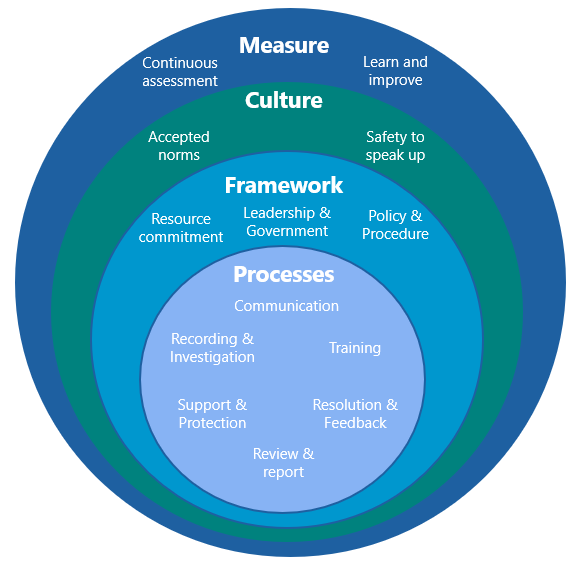
8. Appendix 2: FRC Speak-up Framework
Financial Reporting Council
8th Floor 125 London Wall London EC2Y 5AS +44 (0)20 7492 2300
www.frc.org.uk
Follow us on Linked in or X @FRCnews