
The content on this page has been converted from PDF to HTML format using an artificial intelligence (AI) tool as part of our ongoing efforts to improve accessibility and usability of our publications. Note:
- No human verification has been conducted of the converted content.
- While we strive for accuracy errors or omissions may exist.
- This content is provided for informational purposes only and should not be relied upon as a definitive or authoritative source.
- For the official and verified version of the publication, refer to the original PDF document.
If you identify any inaccuracies or have concerns about the content, please contact us at [email protected].
Key Facts and Trends in the Accountancy Profession 2021
Financial Reporting Council
The Financial Reporting Council (FRC) serves the public interest by setting high standards of corporate governance, reporting and audit and by holding to account those responsible for delivering them.
The FRC sets the UK Corporate Governance and Stewardship Codes and UK standards for accounting and actuarial work; monitors and acts to promote the quality of corporate reporting; and operates independent enforcement arrangements for accountants and actuaries. As the Competent Authority for audit in the UK, the FRC sets auditing and ethical standards and monitors and enforces audit quality. Our work is aimed at investors and others who rely on company reports, audit and high-quality risk management. The FRC is a transparent organisation that consults openly and reports to Parliament.
The content in this publication is provided for general information purposes only. Although the FRC endeavours to ensure the accuracy of the information provided by the accountancy firms and bodies in preparing this publication, the FRC has not performed a detailed review of information supplied. Accordingly, the FRC accepts no responsibility for any reliance others may place upon the information herein and it shall not be liable for any loss or damage arising from the use of the information contained within this publication nor from any action or decision taken as a result of using such information.
The FRC does not accept any liability to any party for any loss, damage or costs howsoever arising, whether directly or indirectly, whether in contract, tort or otherwise from any action or decision taken (or not taken) as a result of any person relying on or otherwise using this document or arising from any omission from it.
The Financial Reporting Council Limited 2021 The Financial Reporting Council Limited is a company limited by guarantee. Registered in England number
- Registered Office: 8th Floor, 125 London Wall, London EC2Y 5AS
- Foreword
- Section One – Main Highlights
- Section Two – Members and students of the Accountancy Bodies
- Registered members and students in the UK and ROI
- Registered members and students worldwide
- Analysis of members and students of the seven Accountancy Bodies
- Students who became members
- Sectoral employment of members and students worldwide
- Gender of members and students worldwide
- Age of members and students worldwide
- Footnotes
- Diversity information on members and students under the Public Sector Equality Duty (PSED)
- The Association of Accounting Technicians (AAT)
- Section Three – Resource information on the Accountancy Bodies
- Section Four – Oversight of audit regulation
- Monitoring of registered Audit Firms by the RSBs
- Complaints about Auditors
- Recognised Qualifying Bodies (RQBs)
- Section Five – Audit Firms
- Figure 33: UK fee income of Audit Firms with PIE audit clients, 2020 (by fee income from audit)
- Table 33: Summary of the firms providing data to the FRC for 2020
- Growth of fee income
- Audit fee income per Responsible Individual (RI)
- Concentration of listed company audits[^51]
- Diversity of senior management at PIE Audit Firms
- Age of workforce at the Audit Firms
- Diversity information collected by the PIE Audit Firms (workforce)
- PIE Audit Firms with a diversity policy
- Section Six – Data tables of the Charts (total figures and percentages)
- Section Six – Data tables of the Charts
- Figure 48: Members and students in the UK and ROI
- Figure 49: Members and students worldwide
- Figure 50: Sectoral employment worldwide, 2020
- Figure 51: Female members worldwide, 2016 to 2020
- Figure 52: Female students worldwide, 2016 to 2020
- Figure 53: Age of Members Worldwide, 2016 and 2020
- Figure 54: Age of students worldwide, 2016 and 2020
- Figure 55: Location of students, 2020
- Figure 56: Profile of students worldwide, 2020
- Figure 57: Graduate entrants worldwide, 2020
- Figure 58: AAT age of members and students worldwide, 2020
- Figure 59: Income worldwide, 2016 to 2020
- Figure 60: Average income from members and students worldwide, 2016 to 2020
- Figure 61: Breakdown of Income, 2020
- Figure 62: Growth of Fee Income, 2018/19 and 2019/20
- Section Seven – Glossary
Foreword
This is the nineteenth edition of Key Facts and Trends in the Accountancy Profession.
1This publication provides statistical information and trends on the members and students in the accountancy profession. Information is obtained from the following accountancy bodies: the six UK Chartered Accountancy bodies, 1 the Association of International Accountants (AIA) ('the accountancy bodies') and the Association of Accounting Technicians (AAT) ('all bodies'). In the sections below, the tables on members show data for the UK and the Republic of Ireland (ROI) combined and worldwide data. We include the UK and ROI figures together, partly because members and firms are entitled to practise in both jurisdictions and partly because in some cases it is difficult for all bodies to separate the data. The Irish Auditing and Accounting Supervisory Authority (IAASA) publishes information relating specifically to the ROI accountancy bodies, which can be found at www.iaasa.ie.
Where appropriate we highlight significant trends and explain possible limitations of the data; however, it is important to note that we do not check the accuracy of the information provided. Where there are notable trends in the data, we do follow this up with all bodies and firms to verify that they are content with the information they provided, but we do not include commentary on the possible reasons for any particular trends. We stress that it is often difficult to make comparisons between the different accountancy bodies, or between the audit firms that audit public interest entities (PIEs), 2 given the differences in the way data is classified by those bodies and firms and because of different regulatory arrangements in the UK, ROI and rest of the world.
In this edition, 26 firms with PIE clients participated compared with 20 firms in last year's publication. Competition between the Big Four audit firms and their competitors remains a major focus. Last year, the five largest firms 3 outside the Big Four audited ten FTSE 350 companies; this year, they audited 19.
Diversity at all bodies and audit firms continues to be high on the FRC's agenda. Consistent with the Public Sector Equality Duty (PSED), the FRC must consider the following objectives in its oversight of all bodies:
- Eliminate unlawful discrimination, harassment, victimisation and any other conduct prohibited by the Act;
- Advance equality of opportunity between people who share a protected characteristic 4 and people who do not share it; and
- Foster good relations between people who share protected characteristics and people who do not share it.
In relation to diversity, we asked the firms to provide information on the following eight diversity indicators: ethnicity, disability, religion/belief, sexual orientation, marital status, school type attended, first generation to attend university and caring responsibilities. We also requested data on gender, ethnicity, disability and sexual orientation in respect of senior management at the PIE audit firms.
Further details can be found in the Diversity section of this publication.
As always, we are grateful to those who took the time to complete our questionnaire on how we can continue to improve this publication, viewable here.
Section One – Main Highlights
The Accountancy Bodies 2016 to 2020
Membership of the accountancy bodies continues to grow. The seven bodies in this report have over 380,000 members in the UK and ROI and over 575,000 members worldwide. The compound annual growth rate from 2016 to 2020 is 2.1% in the UK and ROI and 2.8% worldwide (Figures 1 and 2).
There are over 160,000 students in the UK and ROI and over 580,000 worldwide. Student numbers in the UK and ROI decreased by 2.1% and by 2.7% worldwide from 2019 to 2020 (Figures 1 and 2).
There was a decline in the compound annual growth rate for students between 2016 and 2020 in the UK and ROI (-0.6%) but a 0.5% increase worldwide over the same period. Only CIMA experienced a decline in its compound annual growth rates worldwide between 2016 and 2020 of –5.8% (Figures 1 and 2).
The number of audit firms registered with the Recognised Supervisory Bodies 5 (RSBs) continues to decline. The total number of registered audit firms was 5,007 as at 31 December 2020, compared with 5,127 and 5,394 registered firms as at 31 December 2019 and 2018 respectively. (Figure 21). Since 2016, there has been a consistent increase in the income generated from all members and students for both ACCA and ICAEW. ACCA continues to earn the highest amount out of the seven bodies at £223m in
- ICAS, however, continues to earn the highest average income per members and students population at £695 per individual for 2020 (Figures 16 and 17).
Figure 9 shows that six accountancy bodies collect data on the age, race and gender of their members and students. Four of the bodies collect disability data on their students, while only three of the bodies collect this data from their members. Figure 20 shows the number of bodies that collect diversity data on their workforce in respect of disability, gender, marriage, pregnancy, and race/ethnicity. All the bodies have diversity policies/statements in place.

The Audit Firms 2018 to 2020
Figure 33 shows the fee income for audit and non-audit services for the 26 audit firms with Public Interest Entity (PIE) clients for 2020 year ends that replied to our survey. Firms are listed in order of fee income from audit, rather than total fee income. All data is provided on a voluntary basis to the FRC.
The Big Four firms continued to see an increase (2.7%) in their total fee income. However, the rate of growth has fallen compared with 2018/19 when it was 7.1%. Firms outside the Big Four have also seen an increase in their total fee income in 2019/20 (13.1%) compared with a decrease (0.1%) in 2018/19 (Figure 36).
Fees for non-audit work to audit clients declined by 2.2% for the Big Four while the non-Big Four firms saw an increase of these fees of 5.2% from 2019 to 2020 (Figure 36). Audit fee income for the Big Four firms increased by 7.9% from 2019 to 2020 compared with 6.9% from 2018 to
- Audit fee income for audit firms outside of the Big Four increased by 20.3% from 2019 to 2020 compared with 2.2% from 2018 to 2019 (Figure 36).
The average audit fee income per Statutory Auditor/Responsible Individual (RI) for 2020 for all firms with PIE clients was £1.68m, an increase of £0.07m from 2019 (Figure 37).
Last year, the five largest firms outside the Big Four audited 4.8% (ten) of the FTSE 250 companies; this year they audited 7.6% (19). One firm outside these nine audit firms (the Big Four plus the next largest five) also audited 0.8% (two) of FTSE 250 companies this year compared with 0.4% (one) last year (Figure 39).
With regards to diversity at audit firms, we have focused on senior management, highlighting the percentages of women, Black, Asian and Minority Ethnic (BAME), disabled and LGBTQ+ 6 individuals at each of the 26 reporting PIE audit firms (Figures 40 to 44). We asked the PIE audit firms whether they collect information on the following diversity indicators of their workforce: age, ethnicity, disability, religion/belief, sexual orientation, marital status, school type attended, first generation to attend university and caring responsibilities. The data and the staff completion rates on each indicator are set out in Figure
- The firms were also asked whether they have any diversity policies in place (Figure 47).
Section Two – Members and students of the Accountancy Bodies
Registered members and students in the UK and ROI
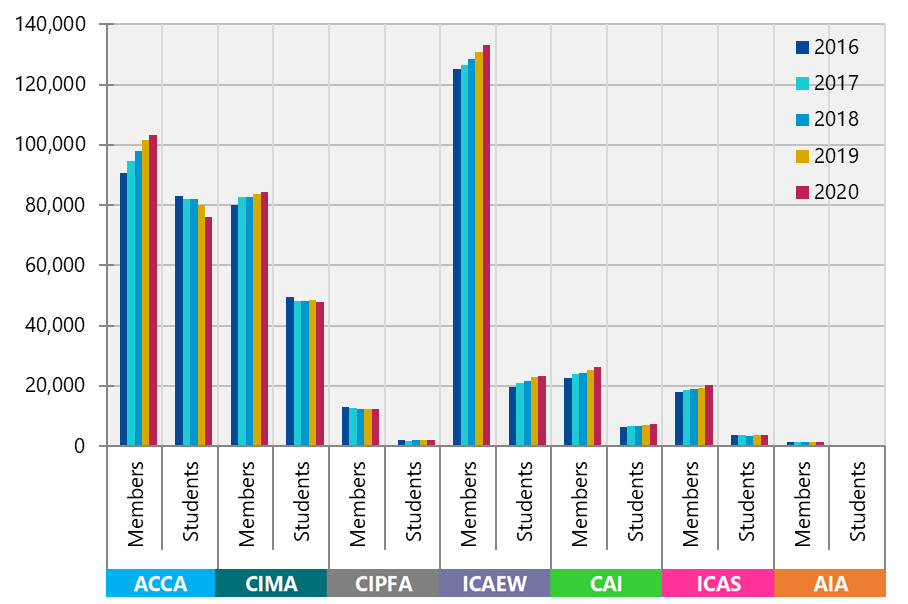
Figure 1 shows growth rates for the five years to 31 December 2020, and the number of members and students in the UK and ROI as at 31 December 2020.
Figure 1: Members and students in the UK and ROI
| Members in the UK & ROI | ACCA | CIMA | CIPFA | ICAEW | CAI | ICAS | AIA | TOTAL |
|---|---|---|---|---|---|---|---|---|
| Total for 2020 | 103,293 | 84,539 | 12,292 | 133,332 | 26,447 | 20,237 | 1,301 | 381,441 |
| % growth (2019-20) | 1.8 | 1.1 | -0.3 | 1.8 | 4.2 | 4.5 | -0.2 | 1.9 |
| % growth (2016-20) | 13.9 | 5.7 | -5.0 | 6.6 | 16.5 | 11.8 | -5.6 | 8.7 |
| % CAGR* (2016-20) | 3.3 | 1.4 | -1.3 | 1.6 | 3.9 | 2.8 | -1.4 | 2.1 |
* Compound Annual Growth Rate
| Students in the UK & ROI | ACCA | CIMA | CIPFA | ICAEW | CAI | ICAS | AIA | TOTAL |
|---|---|---|---|---|---|---|---|---|
| Total for 2020 | 76,208 | 47,904 | 2,113 | 23,309 | 7,351 | 3,839 | 139 | 160,863 |
| % growth (2019-20) | -4.7 | -1.3 | 3.2 | 2.0 | 4.9 | -0.6 | 3.0 | -2.1 |
| % growth (2016-20) | -8.1 | -3.3 | 2.1 | 18.2 | 16.1 | 3.3 | -17.3 | -2.2 |
| % CAGR* (2016-20) | -2.1 | -0.8 | 0.5 | 4.3 | 3.8 | 0.8 | -4.6 | -0.6 |
* Compound Annual Growth Rate
Registered members and students worldwide
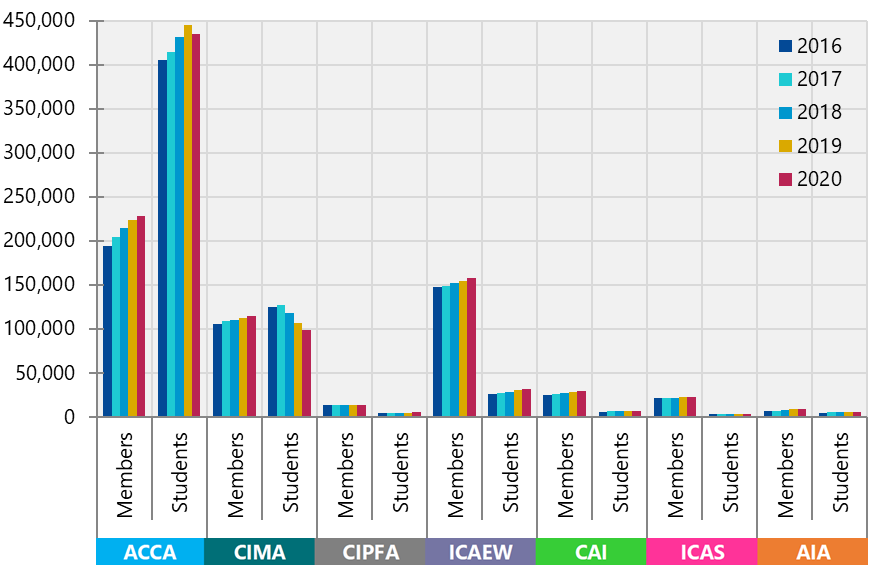
Figure 2 shows growth rates for the five years to 31 December 2020 and the number of worldwide 7 members and students as at 31 December 2020.
Figure 2: Members and students worldwide
| Members Worldwide | ACCA | CIMA | CIPFA | ICAEW | CAI | ICAS | AIA | TOTAL |
|---|---|---|---|---|---|---|---|---|
| Total for 2020 | 228,771 | 114,492 | 13,207 | 157,812 | 29,596 | 23,062 | 9,541 | 576,481 |
| % growth (2019-20) | 2.4 | 1.7 | -1.2 | 2.1 | 3.9 | 2.5 | 9.4 | 2.3 |
| % growth (2016-20) | 17.9 | 7.9 | -7.4 | 7.0 | 16.1 | 9.0 | 40.6 | 11.9 |
| % CAGR* (2016-20) | 4.2 | 1.9 | -1.9 | 1.7 | 3.8 | 2.2 | 8.9 | 2.8 |
* Compound Annual Growth Rate
| Students Worldwide | ACCA | CIMA | CIPFA | ICAEW | CAI | ICAS | AIA | TOTAL |
|---|---|---|---|---|---|---|---|---|
| Total for 2020 | 435,088 | 98,833 | 5,280 | 31,656 | 7,352 | 3,851 | 5,381 | 587,441 |
| % growth (2019-20) | -2.3 | -7.7 | 5.6 | 4.7 | 4.9 | -0.5 | -4.3 | -2.7 |
| % growth (2016-20) | 7.3 | -21.2 | 24.1 | 22.6 | 16.1 | 3.1 | 2.6 | 2.0 |
| % CAGR* (2016-20) | 1.8 | -5.8 | 5.6 | 5.2 | 3.8 | 0.8 | 0.6 | 0.5 |
* Compound Annual Growth Rate
Analysis of members and students of the seven Accountancy Bodies
The total number of members of the seven accountancy bodies in the UK and ROI has continued to grow steadily at a compound annual growth rate of 2.1% for the period 2016 to
-
Total membership rose by 1.9% from 2019 to 2020 compared with 2.2% from 2018 to 2019 (Figure 1). Growth rates of membership vary considerably at each of the individual accountancy bodies in the UK and ROI. ICAEW continues to have the largest number of members in this jurisdiction; however, ACCA and CAI showed the strongest growth at a compound annual rate of 3.3% and 3.9%, respectively, between 2016 and
-
CIPFA and AIA both saw a decline in membership over this period (Figure 1). The total number of students in the UK and ROI has fallen by 2.1% from 2019 to 2020 compared with an increase of 0.1% between 2018 and
-
ACCA has the largest number of students but has seen the largest decrease in numbers between 2019 and 2020 at −4.7% (Figure 1).
The worldwide membership of the accountancy bodies has grown by 2.3% from 2019 to 2020 and at a compound annual growth rate of 2.8% for the period 2016 to 2020 (Figure 2).
Overall, worldwide student numbers decreased by 2.7% from 2019 to 2020; this compares to relatively low, but positive growth of 0.9% between 2018 and 2019, with a compound annual growth rate of 0.5% between 2016 and 2020 (Figure 2).
Qualifications differ across the Recognised Qualifying Bodies (Figure 31). Just over 74% of the total worldwide student membership are training with ACCA for their qualifications (Figure 2). 8
Students who became members
Figure 3 shows the number of students worldwide who became members, as at 31 December for each of the years 2016 to 2020.
Figure 3: Students to members worldwide, 2016 to 2020
| ACCA | CIMA | CIPFA | ICAEW | CAI | ICAS | AIA | TOTAL | |
|---|---|---|---|---|---|---|---|---|
| 2016 | 14,784 | 4,958 | 102 | 3,497 | 990 | 716 | 37 | 25,084 |
| 2017 | 15,533 | 5,147 | 112 | 3,403 | 1,153 | 585 | 12 | 25,945 |
| 2018 | 14,756 | 3,598 | 133 | 4,525 | 996 | 801 | 5 | 24,814 |
| 2019 | 14,683 | 3,798 | 199 | 4,359 | 1,243 | 657 | 3 | 24,942 |
| 2020 | 12,450 | 3,933 | 183 | 4,444 | 1,189 | 794 | 6 | 22,999 |
| % growth (2019-20) | -15.2 | 3.6 | -8.0 | 1.9 | -4.3 | 20.9 | 100.0 | -7.8 |
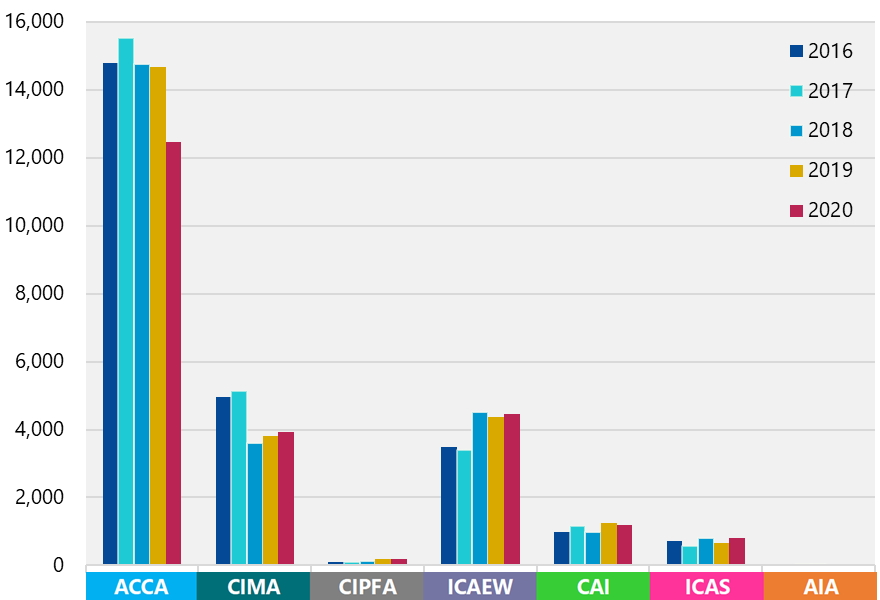 ACCA, CIPFA and CAI have all seen a decline in the number of students becoming members in 2020 compared with
- Overall, the total number of students who became members worldwide has fallen from 2019 to 2020 by 7.8%. This compares with a relatively small increase of 0.5% from 2018 to 2019.
Prior to 2017, CAI reported only on the number of students who became members in the ROI. The 2017 to 2020 figures show the number of students becoming members worldwide.
Sectoral employment of members and students worldwide
Figure 4 shows the percentage of members and students worldwide for each of the seven accountancy bodies, according to their sectoral employment as at 31 December 2020.
Figure 4: Sectoral employment worldwide, 2020
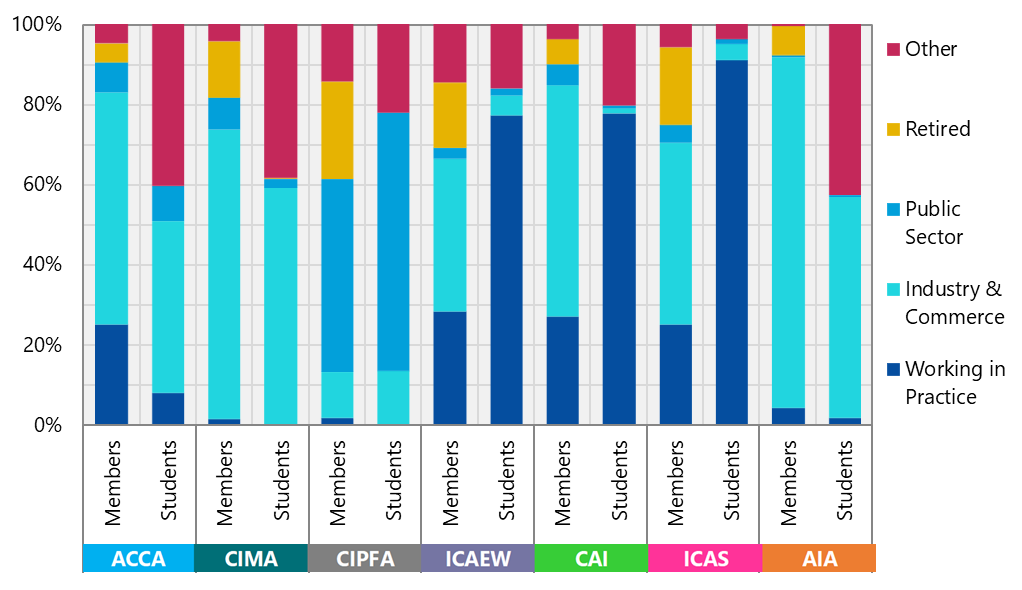
The Industry and Commerce sector employs the highest percentage of members (54%) and students (43%) across the accountancy bodies. CIMA and AIA members in this sector make up 72% and 87% of their respective total memberships.
Over three-quarters of students at ICAEW, CAI and ICAS are in practice (i.e. working at an accountancy firm). In contrast, 2% or less of CIMA, CIPFA and AIA students are employed in practice. 9
Gender of members and students worldwide
Figures 5 and 6 show the percentage of female members and students worldwide, respectively, as at 31 December for each of the years 2016 to 2020.
Figure 5: Female members worldwide, 2016 to 2020
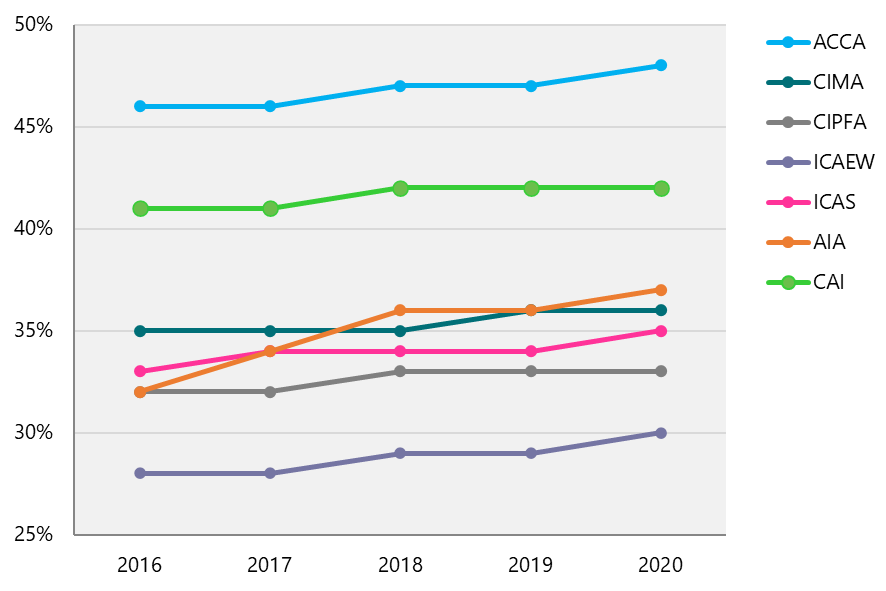
Since 2016, all the accountancy bodies have increased their percentage of female members worldwide. AIA experienced the largest increase of 5% in this period. ACCA continues to have the highest percentage of female members of all the accountancy bodies.
The overall percentage of female members worldwide has increased from 35% in 2016 to 37% in 2020.
Figure 6: Female students worldwide, 2016 to 2020
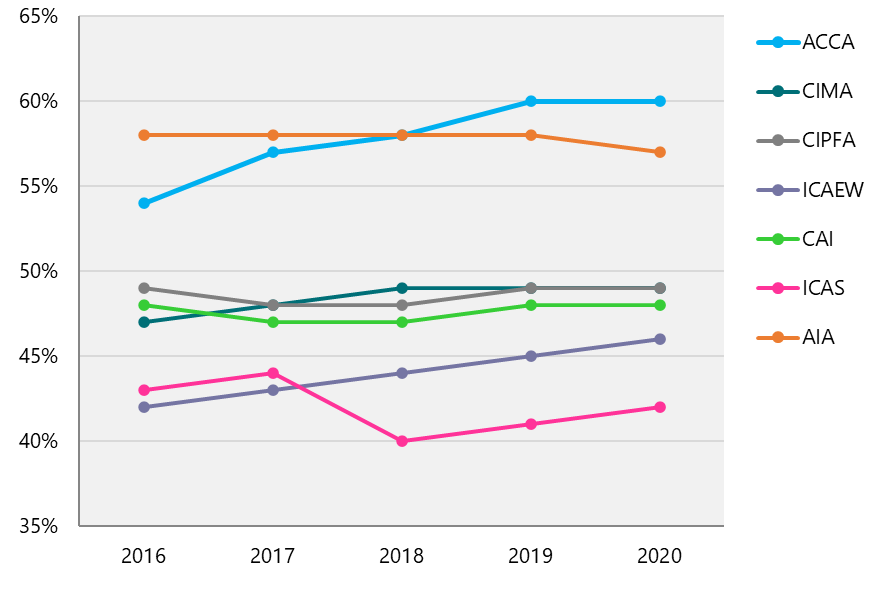
The overall percentage of female students (50%) is greater than the overall percentage of female members (37%).
ACCA had the largest percentage of female students in 2020 at 60%.
For 2017 to 2020, CAI and ICAS figures refer only to the proportion of female students in the student intake, not of the total student population.
Age of members and students worldwide
Figures 7 and 8 compare the age distribution of members and students, as at 31 December 2016 and 2020.
Figure 7: Age of members worldwide, 2016 and 2020
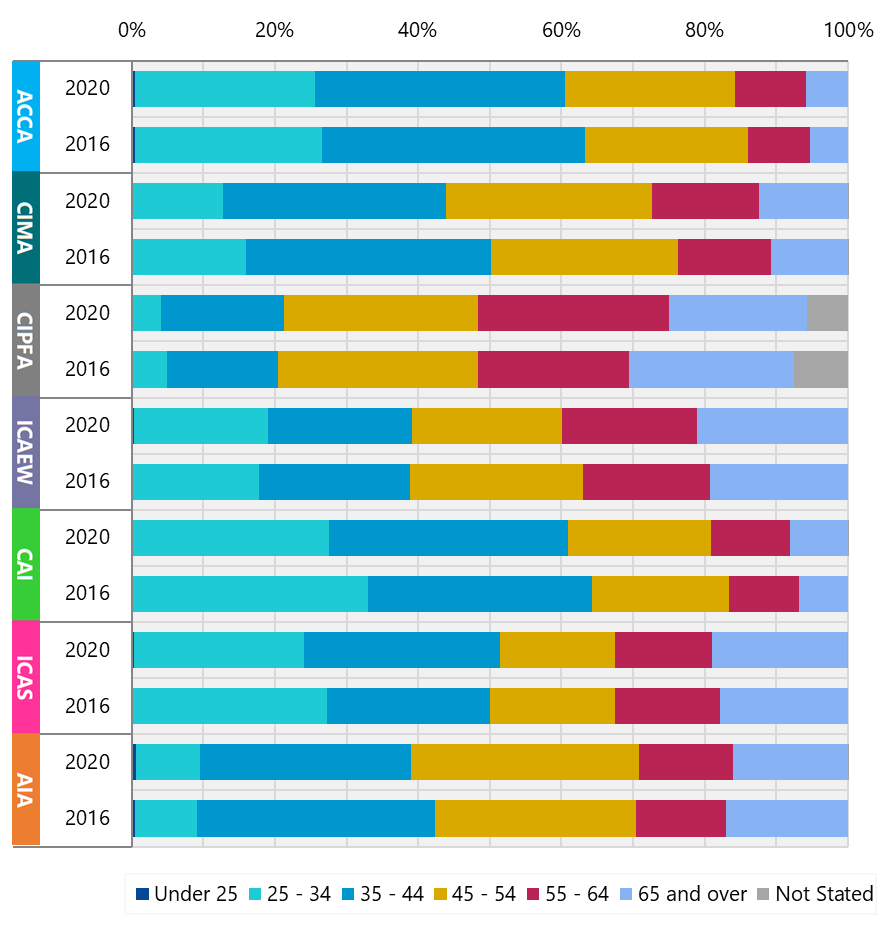 There were significant differences in the age profiles of worldwide members of the seven accountancy bodies in
- CAI, ACCA, and ICAS had the highest proportion of members aged under 35, 28%, 25% and 24% respectively, while CIPFA had the largest percentage of members aged 45 and over at 79%.
Most worldwide members were aged between 35 to 44 in 2020, accounting for 29% of the total population.
Figure 8: Age of students worldwide, 2016 and 2020 10
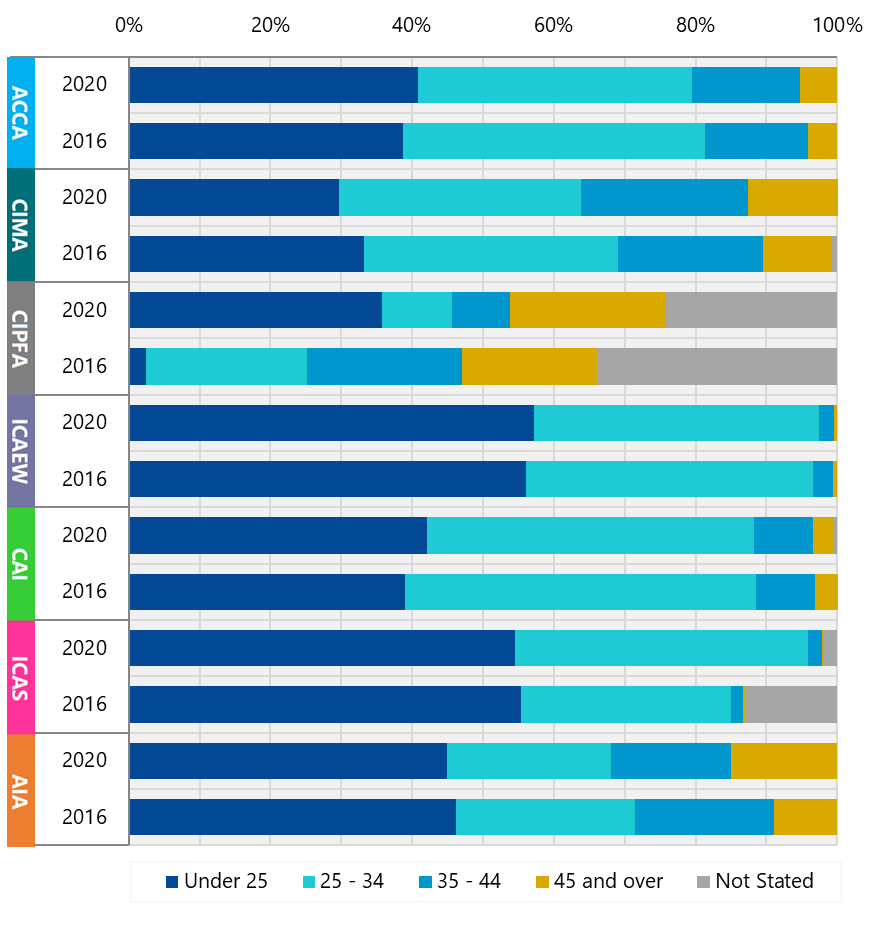
In 2020, 40% of all students from the seven accountancy bodies were under the age of 25 compared with 38% in 2016. ICAEW, ICAS and CAI had the highest percentage of students aged 34 or under at 97%, 96%, and 88%, respectively, in
- In comparison, CIMA had the largest proportion of students aged 35 and over at 36%.
Footnotes
In 2020, 40% of all students from the seven accountancy bodies were under the age of 25 compared with 38% in 2016. ICAEW, ICAS and CAI had the highest percentage of students aged 34 or under at 97%, 96%, and 88%, respectively, in
- In comparison, CIMA had the largest proportion of students aged 35 and over at 36%.
Diversity information on members and students under the Public Sector Equality Duty (PSED)
We asked all bodies, whether they collect data on the protected characteristics recognised under the Equality Act
- Figure 9 shows the number of professional bodies that collect data on these characteristics with respect to their members and students.
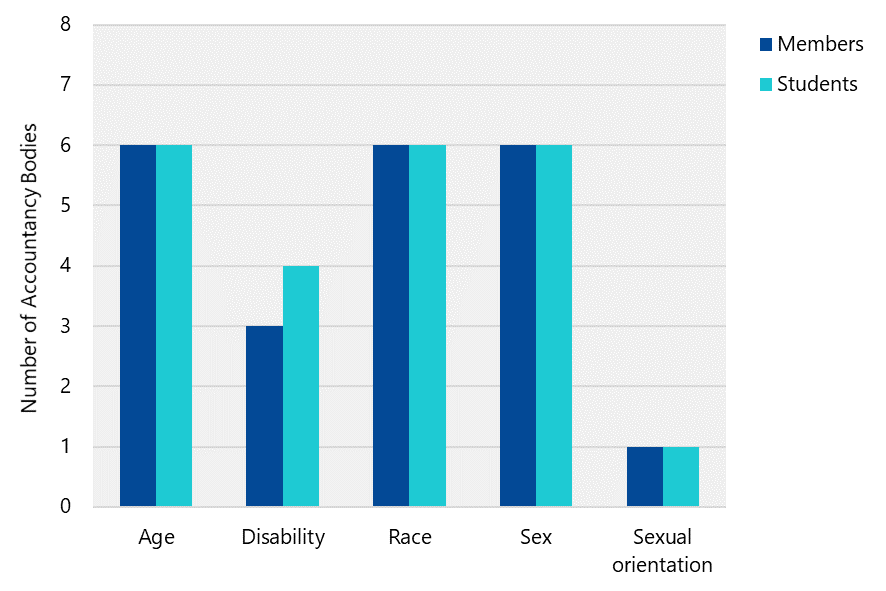
In 2020, five of the nine protected characteristics were used by at least one of the bodies to record data on members and students. The other four Equality Act indicators (Marriage and Civil Partnerships, Religion/Belief, Pregnancy and Maternity, and Gender Reassignment) were not recorded.
Location of students
Figure 10 shows the location11 (UK and ROI, and the rest of the world) of students of the accountancy bodies as at 31 December 2020.
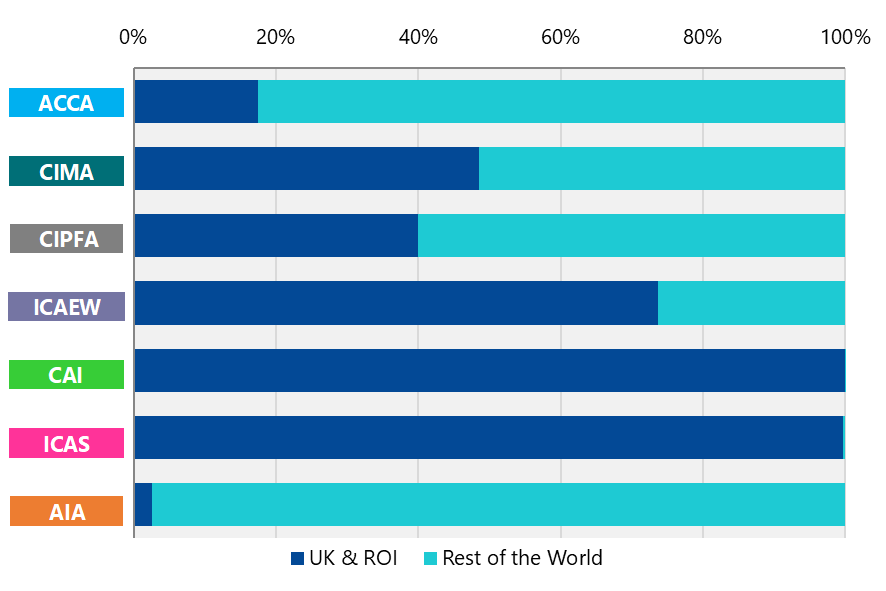
97% of AIA and 83% of ACCA students were based outside the UK and ROI. In contrast, ICAS and CAI had 0.3% or less of students based outside the UK and ROI.
27% of all students from the accountancy bodies were studying in the UK and ROI.
Profile of students of the Accountancy Bodies worldwide
Figure 11 sets out on a worldwide basis the length of time12 that individuals have been registered as students with these accountancy bodies.
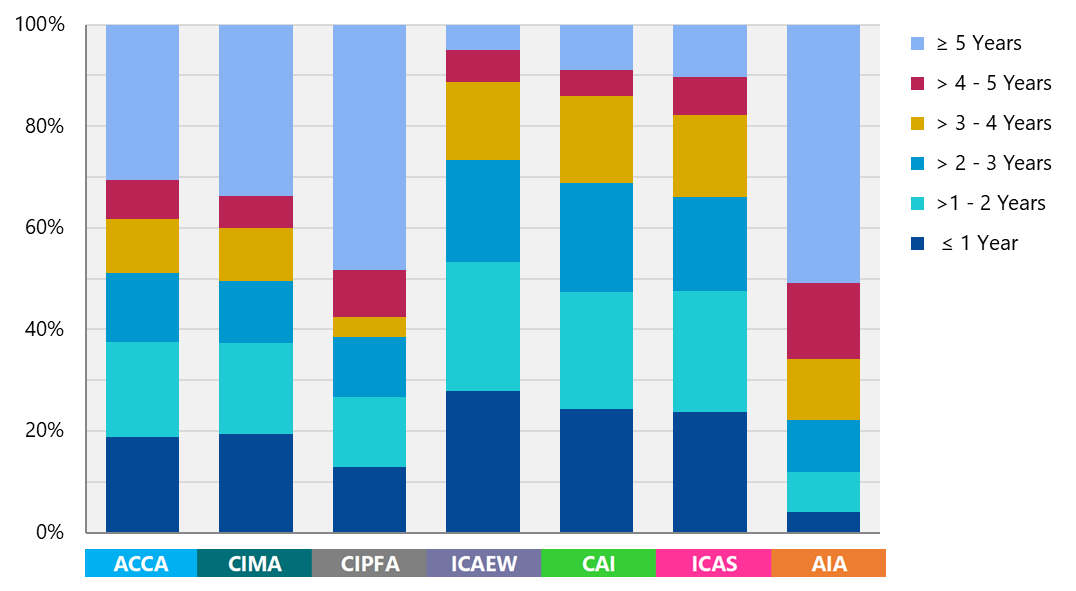
A high percentage of ICAEW, CAI and ICAS students complete their training in four years or less, with 11%, 14% and 18% of their students, respectively, being registered for more than four years as at 31 December 2020.
Graduate entrants to training
Figure 12 shows the percentages of students worldwide of each accountancy body who, at the time of registering as students, were (i) graduates of any discipline and, of those, (ii) graduates who held a 'relevant degree'.13
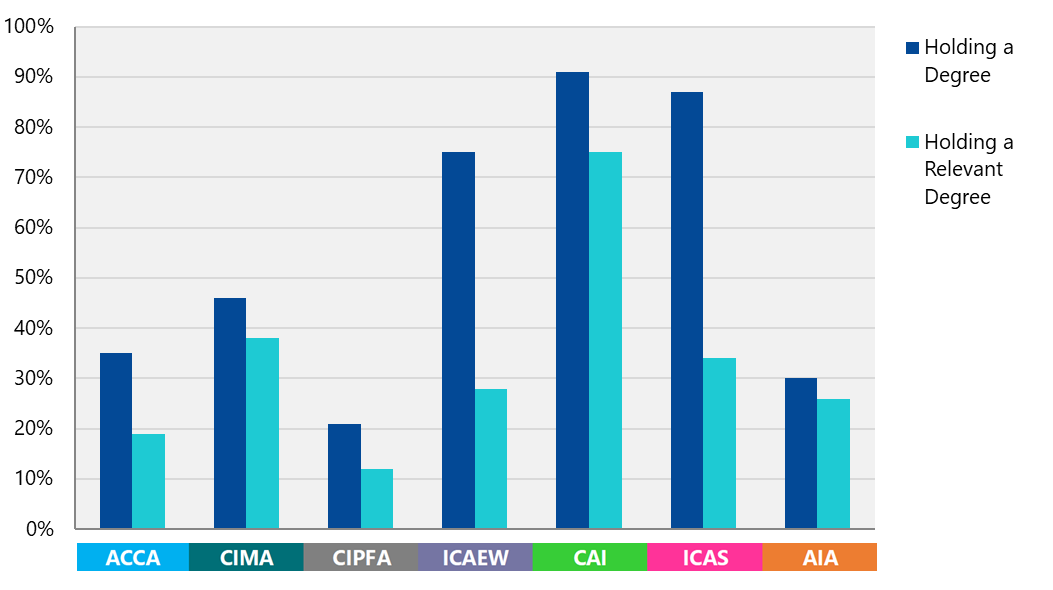
Comparisons of the percentage of students holding 'relevant degrees' are difficult to assess because the accountancy bodies use different definitions of a 'relevant degree'.
The accountancy bodies do not require entrants to hold a university degree and offer a range of entry routes.
ACCA, ICAEW, CAI, ICAS, and CIMA also have apprenticeship schemes intended for non-graduates/ school leavers as an entry route into the accountancy profession.
The Association of Accounting Technicians (AAT)
Members and students in the UK and ROI and worldwide
AAT is used as an entry-level qualification by some of the chartered accountancy bodies included in this publication. Figure 13 shows the number of AAT members and students, and the overall percentage growth from 2016 to 2020.
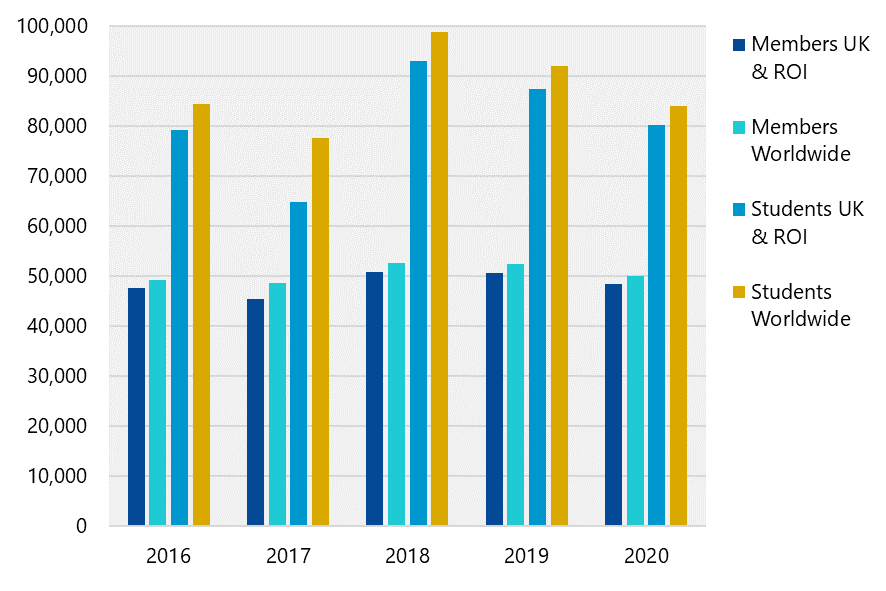
| Year | Members UK & ROI | Members Worldwide | Students UK & ROI | Students Worldwide |
|---|---|---|---|---|
| 2016 | 47,670 | 49,196 | 79,267 | 84,357 |
| 2017 | 45,537 | 48,580 | 64,777 | 77,649 |
| 2018 | 50,745 | 52,584 | 93,068 | 98,897 |
| 2019 | 50,619 | 52,346 | 87,482 | 92,094 |
| 2020 | 48,362 | 50,028 | 80,138 | 83,997 |
| % growth (2019-20) | -4.5 | -4.4 | -8.4 | -8.8 |
| % growth (2016-20) | 1.5 | 1.7 | 1.1 | -0.4 |
The number of members in the UK and ROI, and worldwide, fell by 4.5% and 4.4%, respectively, between 2019 and 2020.
The number of students also decreased by 8.4% in the UK and ROI, and by 8.8% worldwide
Age distribution of members and students
Figure 14 indicates the age distribution of AAT members and students for 2020.
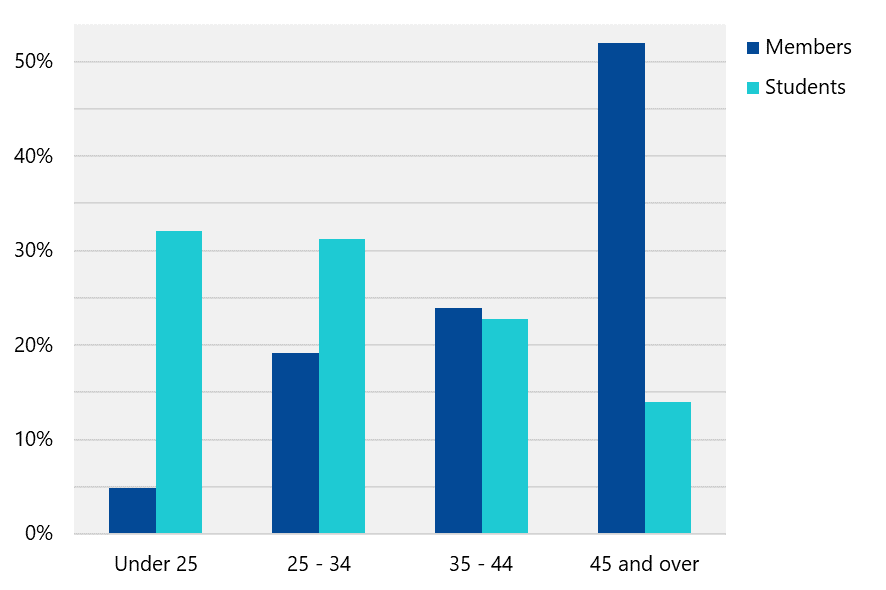
The highest percentage of members (52%) was aged 45 and over while the highest percentage of students (32%) was under the age of 25.
Resource Information
| £m | 2016 | 2017 | 2018 | 2019 | 2020 |
|---|---|---|---|---|---|
| Fees & Subscriptions | 15.60 | 16.10 | 15.97 | 17.23 | 17.69 |
| Education & Exam Fees | 11.65 | 12.26 | 12.25 | 12.68 | 10.39 |
| Regulation & Discipline | 0.03 | 0.03 | 0.05 | 0.07 | 0.05 |
| Commercial Activities | 0.53 | 0.44 | 0.56 | 0.56 | 0.45 |
| Other (Including Investment Income) | 1.16 | 1.13 | 1.30 | 1.09 | 0.91 |
| Total Income | 28.97 | 29.96 | 30.13 | 31.63 | 29.49 |
| Number of Staff | 249 | 256 | 261 | 264 | 225 |
Section Three – Resource information on the Accountancy Bodies
Resource income of the seven Accountancy Bodies
Figures 16 and 17 show the total and average income from worldwide members and students of the accountancy bodies between 2016 and 2020,14 respectively.
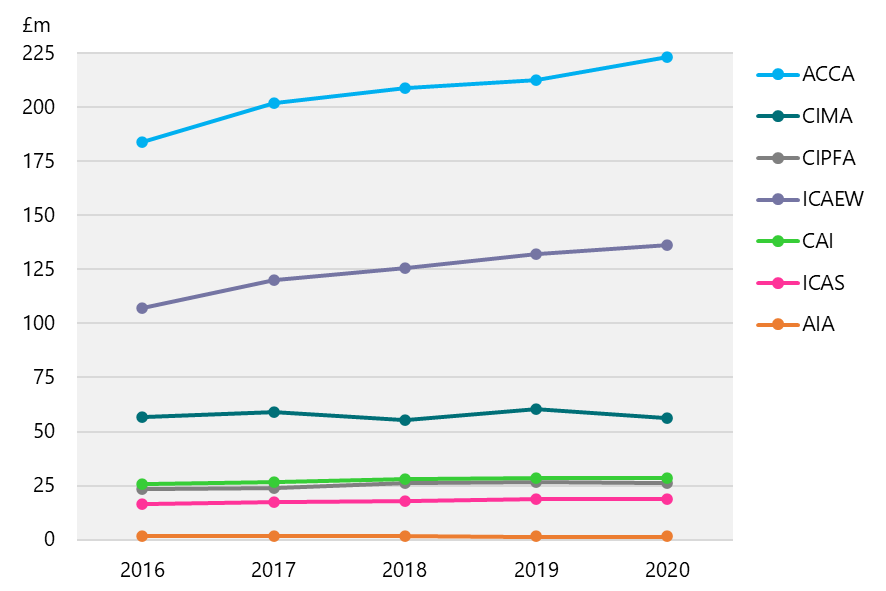
Since 2016, ACCA and ICAEW have experienced a continuous increase in their income, recording the highest income of the seven accountancy bodies at £223m and £136m, respectively, in 2020.
CIMA and AIA saw an overall decrease in their income between 2016 and 2020, down 0.1% and 3.0%, respectively.
Average income per body from members and students
The average income per member and student is calculated by dividing the income of each accountancy body, excluding 'Commercial Activities' and 'Other' (Figure 18), by its total worldwide population of members and students.
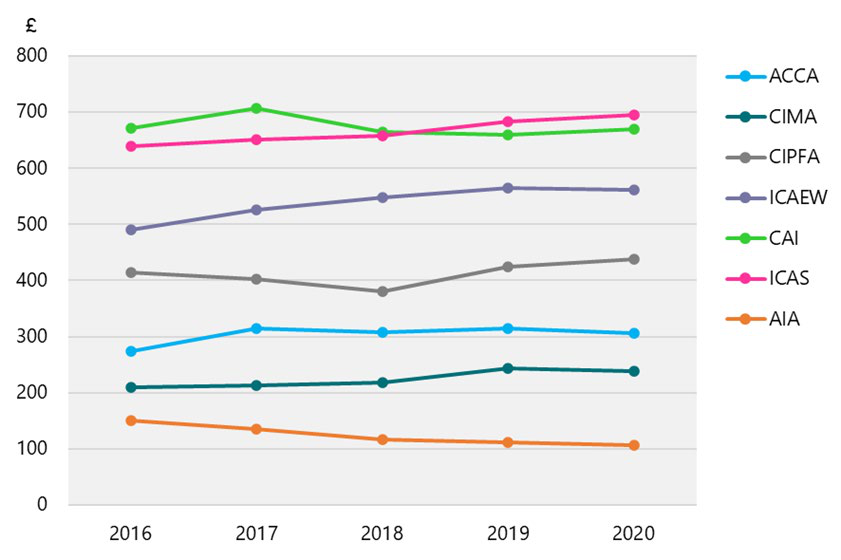
ICAS and CAI had the highest average income per member and student in 2020 with £695 and £669, respectively.
The fluctuation in CAI's average income per member and student since 2016 is partly a result of the exchange rates applied (€1.175 in 2016, €1.127 in 2017, €1.115 in 2018, €1.1405 in 2019 and €1.1250 in 2020).
Breakdown of income
Figure 18 provides an analysis of the streams of income for the accountancy bodies for 2020.
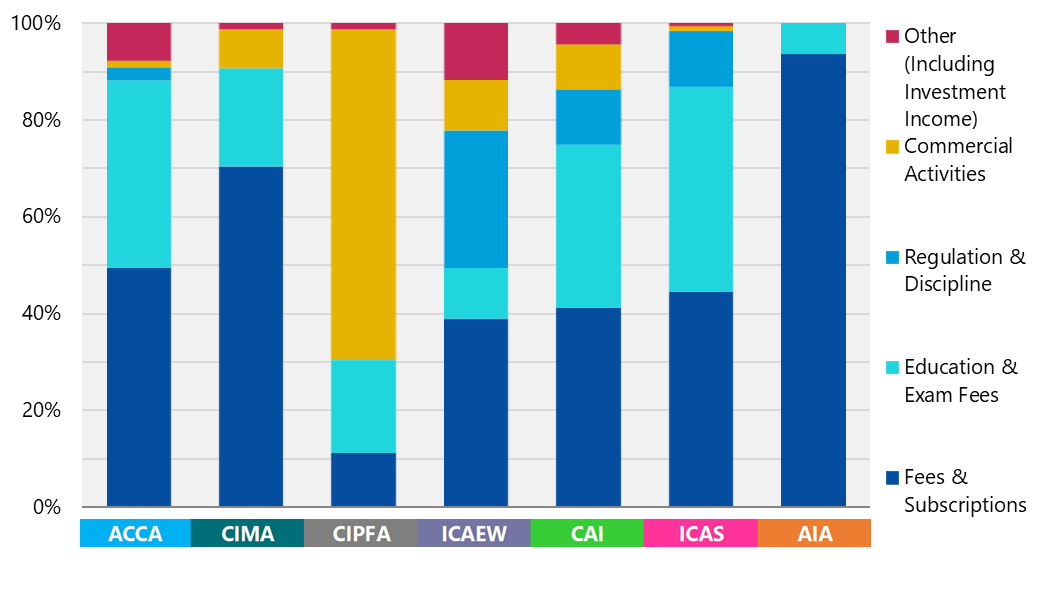
Fees and subscriptions, taken together with education and exam fees from members and students, are the main sources of income for each of the bodies with the exception of CIPFA. CIPFA's main source of income is from commercial activities (70%).15
Fees and subscriptions, education and exam fees make up the entirety of income for AIA.
Staffing of the Accountancy Bodies
Figure 19 shows the number of staff (full-time equivalent) employed worldwide by the seven accountancy bodies from 2016 to 2020.
| Staffing | ACCA | CIMA | CIPFA | ICAEW | CAI | ICAS | AIA | TOTAL |
|---|---|---|---|---|---|---|---|---|
| 2016 | 1,272 | 458 | 275 | 724 | 149 | 143 | 26 | 3,047 |
| 2017 | 1,358 | 198 | 259 | 706 | 149 | 154 | 25 | 2,849 |
| 2018 | 1,362 | 190 | 216 | 741 | 150 | 161 | 23 | 2,843 |
| 2019 | 1,383 | 487 | 211 | 692 | 156 | 146 | 21 | 3,096 |
| 2020 | 1,404 | 383 | 196 | 707 | 161 | 151 | 19 | 3,021 |
| % growth (2019-20) | 1.5 | -21.4 | -7.1 | 2.2 | 3.2 | 3.4 | -9.5 | -2.4 |
| % growth (2016-20) | 10.4 | -16.4 | -28.7 | -2.3 | 8.1 | 5.6 | -26.9 | 1.6 |
| % CAGR* (2016-20) | 2.5 | -4.4 | -8.1 | -0.6 | 2.0 | 1.4 | -7.5 | -0.2 |
In 2017, CIMA amalgamated with the American Institute of Certified Public Accountants (AICPA). Post-merger, in 2017 and 2018, CIMA was able to supply staff numbers for the UK only, rather than for the whole of the new Association; the 2019 and 2020 figures once again include CIMA staff worldwide.
Diversity information on the workforce under the Public Sector Equality Duty (PSED)
We asked the bodies whether they collect information in relation to all the protected characteristics under the Equality Act
- Figure 20 shows the number of bodies that collect this diversity information on their workforce.
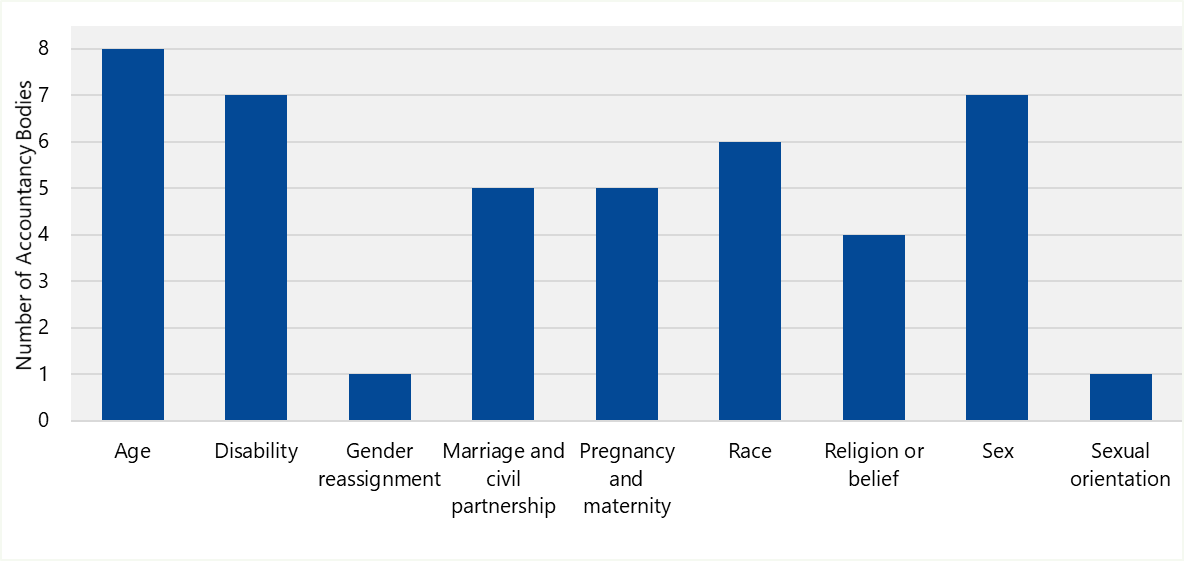
All the bodies confirmed that they have a diversity policy and/or statement in place. The policies cover a range of issues such as equality, inclusion and social mobility for both their workforces and external stakeholders. The policies also extend to dealing with bullying and harassment in the workplace.
All the policies are aimed at improving awareness of diversity and ensuring that no employee or applicant for employment is treated less favourably than another because of their protected characteristic.
There is no requirement for employees to disclose their diversity status to their employer.
Section Four – Oversight of audit regulation
Recognised Supervisory Bodies (RSBs16)
Under the Statutory Audit and Third Country Auditor Regulations (SATCAR) 201617 the FRC is the designated Competent Authority for statutory audit in the UK. SATCAR 2016 sets out the responsibilities of the Competent Authority and permits the FRC to delegate some of the tasks required to fulfil its responsibilities. The FRC retains the task of monitoring the quality of audits for PIEs18 and undertaking enforcement actions against members of the RSBs where there are public interest considerations. These are the 'Retained Tasks'19.
The FRC delegates statutory tasks for the regulation of auditors of non-PIEs to the RSBs, through delegation agreements. The FRC oversees the fulfilment of the 'Delegated Tasks', which include provisions for:
- Registration: The application of the FRC's criteria for determining whether persons are eligible for appointment as statutory auditors, the registration of such persons, keeping the register20 and making it available for inspection;
- Continuing Professional Development: Procedures for maintaining the competence of statutory auditors;
- Audit Monitoring: Monitoring of statutory auditors and the quality of audit work; and
- Enforcement: Except for categories retained by the FRC, investigations and imposing and enforcing sanctions in relation to breaches of relevant requirements by statutory auditors..
The FRC also exercises delegated statutory functions under Part 42 of the Companies Act 2006 for the recognition, supervision and de-recognition of RSBs. The FRC reports annually to the Secretary of State (SoS) on the discharge of these functions.21
Number of firms registered with the RSBs
Figure 21 shows the number of registered audit firms for each RSB split by the number of principals22 at each firm, for each of the three years to 31 December 2020.
| Number of Principals per Firm | ACCA | ICAEW | CAI | ICAS | TOTAL |
|---|---|---|---|---|---|
| 1 | 1,025 | 929 | 350 | 43 | 2,347 |
| 2-3 | 437 | 1,008 | 294 | 69 | 1,808 |
| 4-6 | 87 | 398 | 51 | 32 | 568 |
| 7-10 | 10 | 129 | 14 | 8 | 161 |
| 11-50 | 6 | 82 | 11 | 4 | 103 |
| 50+ | 0 | 15 | 3 | 2 | 20 |
| Total as at 31.12.20 | 1,565 | 2,561 | 723 | 158 | 5,007 |
| Total as at 31.12.19 | 1,577 | 2,636 | 750 | 164 | 5,127 |
| Total as at 31.12.18 | 1,627 | 2,812 | 783 | 172 | 5,394 |
The number of audit firms registered to carry out statutory audit work in the UK and ROI continues to fall. The number of registered audit firms fell by 4.7% in 2017/18 (5,394), 4.9% in 2018/19 (5,127) and 2.3% in 2019/20 (5,007). The number of RSBs with registered audit firms with two to three principals fell from 1,895 in 2019 to 1,808 in
- ACCA was the only RSB that saw an increase in the number of registered audit firms that are sole practitioners.
Statutory Audit Firms
Figure 22 details the number of registrations by firms split by:
- New applications: applications submitted to become a registered statutory audit firm;
- Referred to a committee: applications referred by case managers to a committee to make a decision;
- Approved by committee: committees can approve applications with conditions and restrictions if deemed necessary;
- Voluntarily withdrawn: where a registered statutory audit firm no longer wants to carry out statutory audit work; and
- Withdrawn by the RSB: where an RSB's committee deems a firm unable to carry out statutory audits to the standard required.
| New Applications | Referred to Committee | Approved by Committee | Voluntarily Surrendered | Withdrawn by the RSB | ||
|---|---|---|---|---|---|---|
| ACCA | 82 | 0 | N/A | 168 | 6 | |
| ICAEW | 84 | 0 | N/A | 219 | 1 | |
| 2018 | CAI | 35 | 2 | N/A | 60 | 2 |
| ICAS | 7 | 1 | N/A | 17 | 1 | |
| TOTAL | 208 | 3 | 0 | 464 | 10 | |
| ACCA | 87 | 2 | 2 | 131 | 6 | |
| ICAEW | 116 | 4 | 2 | 261 | 6 | |
| 2019 | CAI | 37 | 4 | 2 | 69 | 1 |
| ICAS | 5 | 1 | 1 | 12 | 1 | |
| TOTAL | 245 | 11 | 7 | 473 | 14 | |
| ACCA | 39 | 2 | 2 | 44 | 7 | |
| ICAEW | 80 | 5 | 4 | 177 | 4 | |
| 2020 | CAI | 27 | 6 | 4 | 52 | 2 |
| ICAS | 4 | 0 | 0 | 10 | 0 | |
| TOTAL | 150 | 13 | 10 | 283 | 13 |
Although the RSBs saw a 17.8% increase in new applicants from 2018 to 2019, there was a 38.8% decrease from 2019 to 2020.
2019 was the first year we started reporting on the number of applications that were referred to registration committees. This year, there was a 77% approval rate overall, with only ACCA having 100%.
Monitoring of registered Audit Firms by the FRC's Audit Quality Review Team
The FRC's Audit Quality Review team (AQR) monitors the quality of the audits of retained audits, and the policies and procedures that underpin audit quality at UK audit firms that perform the audits of these entities. The remainder of audit monitoring is conducted by the RSBs.
Figure 23 below details the number of reviews of audits conducted by the AQR team during the years ended 31 March 2018 to 31 March 2020.23, 24 & 25 More information on work performed by the AQR team can be found in the FRC's Developments in Audit Report at www.frc.org.uk
| Inspection Category | Audit Reviews 2018/19 | Audit Reviews 2019/20 | Audit Reviews 2020/21 |
|---|---|---|---|
| Deloitte LLP | 25 | 17 | 20 |
| EY LLP | 18 | 14 | 19 |
| KPMG LLP/ KPMG Audit Plc | 29 | 18 | 22 |
| PricewaterhouseCoopers LLP | 26 | 17 | 21 |
| Big Four firms | 98 | 66 | 82 |
| BDO LLP | 8 | 8 | 9 |
| Grant Thornton UK LLP | 8 | 9 | 7 |
| Mazars LLP | 5 | 5 | 7 |
| PKF Littlejohn | 0 | 0 | 4 |
| MHA Macintyre Hudson | 0 | 0 | 3 |
| Haysmacintyre | 2 | 0 | 2 |
| BHP LLP | - | - | 1 |
| Crowe U.K. LLP | 2 | 0 | 1 |
| Gerald Edelman | - | - | 1 |
| RSM UK Audit LLP | 0 | 4 | 1 |
| Jeffreys Henry | - | - | 1 |
Figure 23 below details the number of reviews of audits conducted by the AQR team during the years ended 31 March 2018 to 31 March 2020.23, 24 & 25 More information on work performed by the AQR team can be found in the FRC's Developments in Audit Report at www.frc.org.uk.
Figure 23: AQR monitoring, 2018/19 to 2020/21
| Inspection Category | Audit Reviews 2018/19 | Audit Reviews 2019/20 | Audit Reviews 2020/21 |
|---|---|---|---|
| Deloitte LLP | 25 | 17 | 20 |
| EY LLP | 18 | 14 | 19 |
| KPMG LLP/ KPMG Audit Plc | 29 | 18 | 22 |
| PricewaterhouseCoopers LLP | 26 | 17 | 21 |
| Big Four firms | 98 | 66 | 82 |
| BDO LLP | 8 | 8 | 9 |
| Grant Thornton UK LLP | 8 | 9 | 7 |
| Mazars LLP | 5 | 5 | 7 |
| PKF Littlejohn | 0 | 0 | 4 |
| MHA Macintyre Hudson | 0 | 0 | 3 |
| Haysmacintyre | 2 | 0 | 2 |
| BHP LLP | - | - | 1 |
| Crowe U.K. LLP | 2 | 0 | 1 |
| Gerald Edelman | - | - | 1 |
| RSM UK Audit LLP | 0 | 4 | 1 |
| Jeffreys Henry | - | - | 1 |
| Johnston Carmichael | - | - | 1 |
| UHY Hacker Young | 0 | 1 | 1 |
| BSG Valentine | 0 | 1 | 0 |
| Moore Stephens LLP | 3 | 0 | 0 |
| Beever and Struthers | 2 | 0 | 0 |
| Scott-Moncrieff | 1 | 0 | 0 |
| Deloitte (NI) Limited | - | 2 | 0 |
| French Duncan LLP | - | 1 | 0 |
| SBM Associates Limited | - | 1 | 0 |
| 129 | 98 | 121 | |
| Crown Dependency (CD) audit firms | 5 | 5 | 0 |
| 134 | 103 | 121 | |
| Third Country Auditors | 5 | 5 | 1 |
| Private sector audits | 139 | 108 | 122 |
| National Audit Office (NAO) | 7 | 7 | 7 |
| Local Audit | 14 | 15 | 20 |
| Foundation Trusts | - | - | 2 |
| Public Sector audits | 21 | 22 | 29 |
| Total audits inspected | 160 | 130 | 151 |
Monitoring of registered Audit Firms by the RSBs
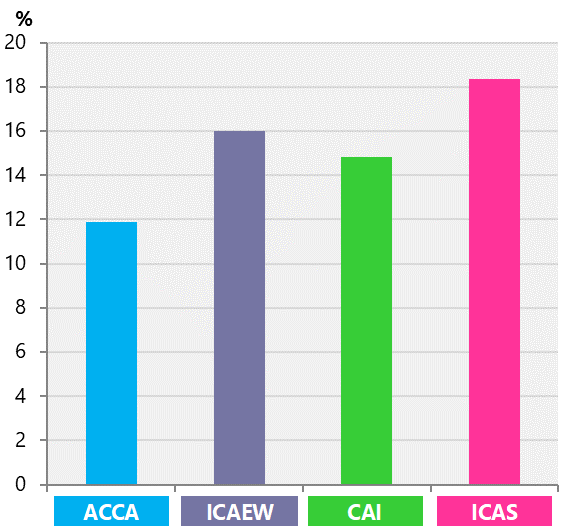
Figure 24 shows the number of monitoring visits conducted by the RSBs during the years ending 31 December 2018 to 31 December 202026 and the number of monitoring visits conducted as a percentage of the total number of registered audit firms at each RSB. There is a statutory requirement that the RSBs should monitor the activities undertaken by each registered audit firm at least once every six years.27
Figure 24: RSB monitoring and percentage of total registered Audit Firms, 2018 to 202028 & 29
| ACCA | ICAEW | CAI | ICAS | TOTAL | |
|---|---|---|---|---|---|
| 2018 | No | 404 | 567 | 100 | 47 |
| % | 24.8 | 20.2 | 12.8 | 27.3 | |
| 2019 | No | 348 | 533 | 107 | 31 |
| % | 22.1 | 20.2 | 14.3 | 18.9 | |
| 2020 | No | 186 | 410 | 107 | 29 |
| % | 11.9 | 16.0 | 14.8 | 18.4 |
Reasons for monitoring visits to registered Audit Firms by RSBs
Figure 25 shows the reasons for the monitoring visits to registered audit firms by the RSBs during the years ended 31 December 2018 to 31 December 2020.30 & 31
Figure 25: Monitoring visit reason, 2018 to 2020
| ACCA | ICAEW | CAI | ICAS | TOTAL | ||
|---|---|---|---|---|---|---|
| Requested by the | 2018 | 15 | 2 | 21 | 2 | 40 |
| registration/licensing | 2019 | 4 | 9 | 35 | 2 | 50 |
| committee | 2020 | 6 | 3 | 14 | 0 | 23 |
| Specifically selected due | 2018 | 108 | 215 | 9 | 31 | 363 |
| to heightened risk | 2019 | 113 | 136 | 12 | 8 | 269 |
| 2020 | 33 | 80 | 33 | 14 | 160 | |
| Cyclical Visits | 2018 | 281 | 350 | 70 | 13 | 714 |
| 2019 | 231 | 388 | 60 | 18 | 697 | |
| 2020 | 147 | 327 | 60 | 15 | 549 | |
| Firms with Public | 2018 | N/A | N/A | N/A | N/A | N/A |
| Interest Entities visited | 2019 | N/A | N/A | N/A | N/A | N/A |
| without AQR | 2020 | N/A | N/A | N/A | N/A | N/A |
| Firms with Public | 2018 | 0 | 0 | 0 | 1 | 1 |
| Interest Entities visited | 2019 | 0 | 0 | 0 | 3 | 3 |
| with AQR involvement | 2020 | 0 | 0 | 0 | 0 | 0 |
Since 17 June 2016, audit firms that audit PIEs are subject to review by the FRC's AQR team. Prior to this date, different arrangements applied where the RSBs were responsible for the monitoring of some of these firms. The RSBs have no involvement in the monitoring of PIE audits, although they may rely on the AQR team's whole firm procedures when monitoring non-PIE audits at those audit firms.
Gradings of monitoring visits to registered Audit Firms by RSBs
Figures 26 to 29 show the grades for the audit monitoring visits to the firms and full audit file reviews conducted by the Association of Chartered Certified Accountants (ACCA), Institute of Chartered Accountants in England & Wales (ICAEW), Chartered Accountants Ireland (CAI) and Institute of Chartered Accountants of Scotland (ICAS) during the years ended 31 December 2018 to 2020.
The RSBs continue to have different systems for grading the quality of firms and full audit files reviewed.
- File grading: ICAEW, CAI and ICAS use the same definitions for grading full audit files. ACCA's definitions are set out below. The percentage of audit files provided in the tables for each of the RSBs is calculated on the basis of the number of files actually graded.
- Firm grading: This grade is given following a review by an RSB's inspection unit. The grades and definitions used are set out below.
- Other types of file review: Ungraded, limited and/or restricted are classifications for reviews conducted but not graded. An ungraded review is when a firm has no audit clients in a particular year. A limited and/or restricted review is a brief review of a specific risk or aspects noted from a previous visit.
File grading
ICAEW, CAI and ICAS:
- 1 (Satisfactory):
- No concerns regarding the sufficiency and quality of audit evidence or the appropriateness of significant audit judgements in the areas reviewed; only limited weakness in documentation of audit work; and any concerns in other areas are limited in nature (both individually and collectively). Note: files with non-compliance with audit regulations cannot be graded '1' although there may be 'minor' matters.
- 2A (Generally Acceptable):
- Only limited concerns regarding the sufficiency or quality of audit evidence or the appropriateness of significant audit judgements in the areas reviewed; and/or weaknesses in documentation of audit work are restricted to a small number of areas; and/or some concerns, assessed as less than significant (individually and collectively), in other areas.
- 2B (Improvement Required):
- Some concerns, assessed as less than significant, regarding the sufficiency or quality of audit evidence or the appropriateness of significant audit judgements in the areas reviewed; and/ or more widespread weaknesses in documentation of audit work; and significant concerns in other areas (individually or collectively).
- 3 (Significant improvements Required):
- Significant concerns regarding the sufficiency or quality of audit evidence or the appropriateness of significant audit judgements in the areas reviewed (not limited to the documentation of the underlying thought processes); and/ or very significant concerns in other areas (individually or collectively).
Association of Chartered Certified Accountants (ACCA):
ACCA uses the following initial grade assessment in determining the overall outcome on audit work.
- A Outcomes:
- The audit work appears appropriate in scope and extent with no significant deficiencies, forming a reasonable basis for the audit opinion.
- B Outcomes:
- Minor deficiencies were noted in the audit work, but these do not result in a significant risk of any material misstatements remaining undetected and the audit opinion is adequately supported by the work recorded.
- C Outcomes:
- There is serious non-compliance with applicable standards and/or deficiencies in the audit evidence recorded such that there is a significant risk that any material misstatements would remain undetected.
Summary of monitoring results by body
Each year a mixture of firms are selected for review. This selection comprises firms randomly selected to meet the six-year monitoring cycle and those deemed at high risk of poorer audit quality. Since the firm selection changes each year, monitoring results are not directly comparable year on year.
Furthermore, the sample of firms monitored each year will often include a disproportionate number of weaker firms selected due to the targeted selection of firms deemed to be high risk. This needs to be taken into account when interpreting the percentage of D outcomes at each body (D outcomes are defined below).
Outcomes reported in the below tables include a number of visits to audit registered firms that have no audit clients. These reviews are done on a desktop basis.
Figure 26: ACCA gradings, 2018 to 2020
| Firm Gradings | 2018 | 2019 | 2020 | File Gradings | 2018 | 2019 | 2020 | ||
|---|---|---|---|---|---|---|---|---|---|
| A & B Outcomes | No. | 289 | 264 | 117 | A Outcomes | No. | 32 | 34 | 7 |
| % | 71 | 76 | 63 | % | 5 | 6 | 3 | ||
| C Outcomes | No. | 71 | 43 | 14 | B Outcomes | No. | 436 | 471 | 208 |
| % | 18 | 12 | 8 | % | 72 | 74 | 76 | ||
| D Outcomes | No. | 44 | 41 | 30 | C Outcomes | No. | 141 | 128 | 58 |
| % | 11 | 12 | 16 | % | 23 | 20 | 21 | ||
| P Outcomes | No. | 0 | 0 | 25 | Ungraded/ Limited/ | No. | 0 | 0 | 0 |
| % | 0 | 0 | 13 | Restricted Review |
Firm grading (ACCA)32 & 33
- A Outcomes: (Good)
- The firm complies with auditing standards, ACCA's Global Practising Regulations (GPRs), and the Code of Ethics and Conduct (CEC) and the Ethical Standards for Auditors (ESA) issued by the FRC.
- B Outcomes: (Satisfactory)
- The firm is eligible for audit registration; it complies with the GPRs, CEC and the ESA and 50% or more of its audit files inspected, including all significant audits, comply substantially with relevant auditing standards.
- C Outcomes: (Unsatisfactory and improvements required)
- The firm is eligible for audit registration and it complies with the GPRs, CEC and ESA but its quality controls over audit work are not effective and either the majority of the firm's audit files, or the significant audit files, inspected do not comply with relevant auditing standards.
- D Outcomes: (Regulatory action required)
- When a firm's work is considered very poor or if a firm has a second or subsequent unsatisfactory visit and there are no mitigating factors the visit is graded D, which indicates that regulatory action is required and will usually result in a referral to a Regulatory Assessor or the Admissions and Licensing Committee (ALC). Regulatory action in this context includes ACCA referring the findings of a monitoring visit to the Assessment Department to consider whether disciplinary action is appropriate. D outcomes do not always result from an inadequate standard of audit work, but could be for failure to meet the eligibility requirements for holding a firm's auditing certificate; they may also indicate a referral to the Assessment Department for other regulation breaches such as non-compliance with client money rules or with the terms of a regulatory order.
- P Outcomes:
- These are visits where the final outcome has not been determined at 31 December. This is a consequence of a process change associated with the introduction of the Audit Monitoring Committee, whereby the outcome is only determined once the firm has submitted its action plan and it has been assessed by ACCA and/or the Committee.
Institute of Chartered Accountants in England & Wales (ICAEW)
Figure 27: ICAEW gradings, 2018 to 2020
| Firm Gradings | 2018 | 2019 | 2020 | File Gradings | 2018 | 2019 | 2020 | ||
|---|---|---|---|---|---|---|---|---|---|
| A & B Outcomes | No. | 333 | 269 | 249 | 1 Outcomes | No. | 252 | 199 | 150 |
| % | 56 | 54 | 58 | % | 25 | 25 | 20 | ||
| C Outcomes | No. | 116 | 88 | 73 | 2A Outcomes | No. | 505 | 395 | 425 |
| % | 20 | 18 | 17 | % | 49 | 49 | 57 | ||
| D Outcomes | No. | 59 | 43 | 33 | 2B Outcomes | No. | 166 | 151 | 115 |
| % | 10 | 9 | 8 | % | 16 | 19 | 16 | ||
| N Outcomes | No. | 85 | 96 | 78 | 3 Outcomes | No. | 102 | 62 | 51 |
| % | 14 | 19 | 18 | % | 10 | 8 | 7 | ||
| Ungraded/ Limited/ | No. | 174 | 154 | 132 | |||||
| Restricited Review |
Firm Grading (ICAEW)
- A Outcomes:
- Where there are no instances of non-compliance with the Audit Regulations and no matters requiring follow-up action.
- B Outcomes:
- Where there are some instances of non-compliance with the Audit Regulations. ICAEW's Quality Assurance Department (QAD) are confident that the firm has the commitment and ability to correct the issue(s) and the firm's responses address the matters raised without the need for follow-up action.
- C Outcomes:
- Where there are instances of non-compliance and follow-up action is required: * Submit information – Additional details or evidence of the firm's actions previously agreed is required to demonstrate its commitment and ability to correct the issue. * Accept withdrawal – non-compliance that would require a follow-up action if the firm had not proposed to withdraw from the audit registration (No need for a report to Audit Registration Committee (ARC)). * Release from conditions and/or restrictions – Some or no instances of non-compliance and confidence that previous conditions and restrictions can be lifted.
- D Outcomes:
- Where instances of non-compliance are likely to be serious or extensive and require a detailed report to ARC that can include three potential outcomes: * Impose conditions and/or restrictions – non-compliance is likely to be serious or extensive and/or the firm's responses may be inadequate and/or raise doubts about the firm's ability/willingness to make the improvements. * Withdrawal - reserved for the most serious situations when the firm's audit registration should be withdrawn. * Committee consideration – to provide information to the committee when no conditions or restrictions have been proposed but the committee is required to consider the results of the visit.
- N Outcomes:
- Used for visits where no statutory audit work has been reviewed. For example, a firm continues with audit registration, but has no audit clients and no audit work has been reviewed; or a firm's withdrawal application is under consideration by QAD. This rating is also applied to Year 2 visits to large firms where no audit files are reviewed.
Chartered Accountants Ireland (CAI)
Figure 28: CAI gradings, 2018 to 2020
| Firm Gradings | 2018 | 2019 | 2020 | File Gradings | 2018 | 2019 | 2020 | ||
|---|---|---|---|---|---|---|---|---|---|
| A & B Outcomes | No. | 57 | 70 | 69 | 1 Outcomes | No. | 49 | 56 | 81 |
| % | 62 | 62 | 79 | % | 28 | 31 | 53 | ||
| C Outcomes | No. | 11 | 10 | 3 | 2A Outcomes | No. | 70 | 74 | 50 |
| % | 12 | 9 | 3 | % | 40 | 41 | 33 | ||
| D Outcomes | No. | 24 | 33 | 15 | 2B Outcomes | No. | 40 | 28 | 16 |
| % | 26 | 29 | 17 | % | 23 | 16 | 11 | ||
| 3 Outcomes | No. | 16 | 21 | 5 | |||||
| % | 9 | 12 | 3 | ||||||
| Ungraded/ Limited/ | No. | 32 | 45 | 38 | |||||
| Restricited Review |
Firm grading (CAI)
- A Outcomes:
- Where no instances of breaches have been recorded.
- B Outcomes:
- Where breaches were noted, and the firm is deemed to have the ability (competence and resources) to address the issue(s) within the stated timescales.
- There will generally be no matters to follow up on firms graded A and/or B.
- C Outcomes:
- Where breaches have been noted and the firm has undertaken actions to address the issues raised. In such instances, the firm is required to provide a written undertaking to cover the volunteered actions. The Quality Assurance Committee (QAC) will not impose conditions or restrictions; however, there is a need for further confirmation/follow-up.
- D Outcomes:
- Where breaches or issues have been identified that require consideration by the Head of Quality Assurance and the QAC. There are four classes of D reports: D1, D2 and D3 reports are determined by the seriousness of the regulatory action, while D4 reports provide information to the QAC.
Institute of Chartered Accountants of Scotland (ICAS)
Figure 29: ICAS gradings, 2018 to 2020
| Firm Gradings | 2018 | 2019 | 2020 | File Gradings | 2018 | 2019 | 2020 | ||
|---|---|---|---|---|---|---|---|---|---|
| A & B Outcomes | No. | 21 | 10 | 8 | 1 Outcomes | No. | 8 | 1 | 4 |
| % | 45 | 32 | 28 | % | 7 | 1 | 5 | ||
| C Outcomes | No. | 23 | 18 | 20 | 2A Outcomes | No. | 73 | 65 | 49 |
| % | 49 | 58 | 69 | % | 59 | 73 | 63 | ||
| D Outcomes | No. | 3 | 3 | 1 | 2B Outcomes | No. | 29 | 17 | 17 |
| % | 6 | 10 | 3 | % | 24 | 19 | 22 | ||
| N Outcomes | No. | 0 | 0 | 0 | 3 Outcomes | No. | 13 | 6 | 8 |
| % | 0 | 0 | 0 | % | 11 | 7 | 10 | ||
| Ungraded/ Limited/ | No. | 51 | 43 | 26 | |||||
| Restricted Review |
Firm grading (ICAS)
Since June 2016, ICAS amended its firm grading approach for all regulatory functions including audit, as shown below.
| Pre June 2016 | Post June 2016 |
|---|---|
| A | A |
| B | B |
| C2 | C+ |
| C1 | C– |
| D3/D2/D1 | D |
Under the delegation agreement A and B graded monitoring reports are cleared by ICAS staff, with C+ reports dealt with by a Nominated Committee Member (NCM) outside the main Authorisation Committee with the C– and D reports going to the Authorisation Committee.
- A Outcomes:
- Where no issues have been identified and no follow-up action is needed.
- B Outcomes:
- Where some regulatory issues were identified; however, these issues have been addressed adequately by the firm's closing meeting responses and no further action is required.
- C Outcomes:
- Where there are regulatory issues and there is a need for the firm to submit evidence of action taken in a restricted area. The C grading is split into a 'C− or C+ grading with C-being more serious, where one or more of the issues identified are considered to be pervasive; whereas C+ is where findings are specific to particular individuals or files and do not indicate systemic problems.
- D Outcomes:
- Where the standard of compliance is such that the Authorisation Committee (AC) needs to consider appropriate follow-up action, such as imposition of conditions and restrictions or withdrawal of registration.
Complaints about Auditors
Figure 30 shows the number of audit-related complaints received by the RSBs from 2018 to 2020 split by (i) number of new complaints, (ii) number of cases passed to the FRC Enforcement Division (iii) number of cases referred to the Committee,34 (iv) number of cases closed in the year and (v) average time taken to close a case.35
Figure 30: Complaints, 2018 to 2020
| ACCA | ICAEW | CAI | ICAS | TOTAL | ||
|---|---|---|---|---|---|---|
| Number of new complaints | 2018 | 8 | 131 | 7 | 9 | 155 |
| 2019 | 10 | 156 | 8 | 7 | 181 | |
| 2020 | 1 | 117 | 11 | 4 | 133 | |
| Number of cases referred to the FRC | 2018 | 0 | 0 | 0 | 0 | 0 |
| 2019 | 0 | 0 | 0 | 0 | 0 | |
| 2020 | 0 | 0 | 0 | 0 | 0 | |
| Number of cases passed to the committee | 2018 | 13 | 14 | 7 | 4 | 33 |
| 2019 | 8 | 40 | 9 | 4 | 58 | |
| 2020 | 3 | 35 | 6 | 4 | 15 | |
| Number of cases closed in the year | 2018 | 14 | 76 | 5 | 6 | 101 |
| 2019 | 8 | 123 | 12 | 7 | 150 | |
| 2020 | 7 | 139 | 10 | 5 | 161 | |
| Average time taken to close a case (in months) | 2018 | 3.7 | 15 | Nil | 4.2 | |
| 2019 | 3.9 | 14 | 6.6 | 4.0 | ||
| 2020 | 4.5 | 17 | 4.0 | 7.8 |
The definition of the average time taken to close a case differs across the accountancy bodies. Some record their data having regard to cases that are opened and closed within a particular year, while other bodies take the total length for a case to be concluded.
Recognised Qualifying Bodies (RQBs)
The FRC also exercises delegated statutory functions under Part 42 of the Companies Act 2006 for the recognition, supervision and de-recognition of those accountancy bodies responsible for offering the audit qualification (RQBs) in line with the requirements of Schedule 11 of the Act. There are five bodies36 in the UK recognised to offer the audit qualification. RQBs must have rules and arrangements in place to register students and track their progress, administer examinations and ensure that appropriate training is given to students in an approved environment. The FRC reports annually to the SoS on the discharge of these functions. Figure 31 shows the number of students registered with each RQB as at 31 December 2018 to
- It also shows the number of members who were awarded the audit qualification and the number of students following the audit route or eligible for the audit qualification.37
Figure 31: RQB students and members, 2018 to 2020
| ACCA | ICAEW | CAI | ICAS | AIA | ||
|---|---|---|---|---|---|---|
| Number of students in the UK and ROI | 2018 | 81,902 | 21,618 | 6,789 | 3,488 | 135 |
| 2019 | 79,937 | 22,842 | 7,009 | 3,862 | 135 | |
| 2020 | 76,208 | 23,309 | 7,351 | 3,839 | 139 | |
| Number of students following the audit route or eligible for the audit qualification | 2018 | N/A | 17,831 | 4,440 | N/A | 3 |
| 2019 | N/A | 18,657 | 3,640 | N/A | 3 | |
| 2020 | N/A | 18,705 | 3,862 | N/A | 3 | |
| The number of members who were awarded the audit qualification | 2018 | 86 | 1,343 | 811 | 18 | 0 |
| 2019 | 58 | 1,219 | 266 | 170 | 0 | |
| 2020 | 100 | 1,082 | 572 | 1,148 | 0 | |
| The number of members who hold the audit qualification | 2018 | 3,052 | 105,766 | 8,608 | 11,327 | 9 |
| 2019 | 2,954 | 105,306 | 8,874 | 11,496 | 9 | |
| 2020 | 2,941 | 104,654 | 9,446 | 12,409 | 9 |
The audit qualifications of some members may be counted twice – firstly by the body awarding the qualification, and then again if they become a member of another body while retaining their initial qualification.
Approved training offices
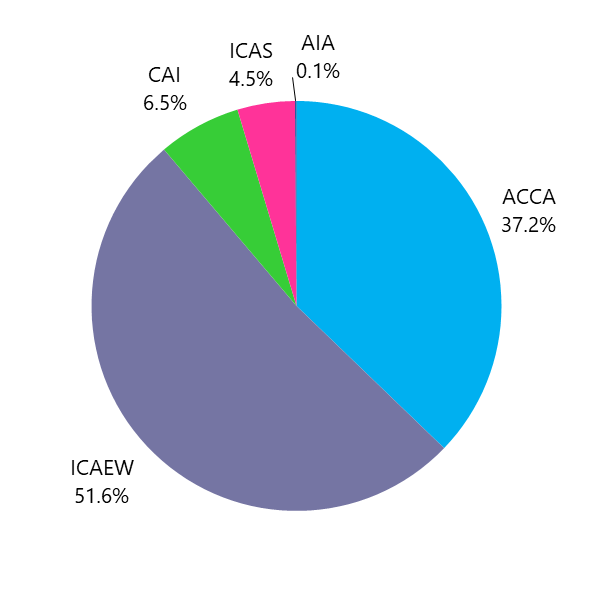
Figure 32 shows the total number of approved training offices38 in the UK and ROI over the period 2018 to
- The pie chart represents the 2020 data in percentages by each body.
Figure 32: UK and ROI training offices, 2018 to 2020, and proportion of total training offices per body 2020
| Number of approved Training Offices in the UK & ROI | ACCA | ICAEW | CAI | ICAS | AIA | |
|---|---|---|---|---|---|---|
| 2018 | 3,576 | 4,372 | 718 | 394 | 10 | |
| 2019 | 3,415 | 4,552 | 697 | 405 | 10 | |
| 2020 | 3,383 | 4,694 | 594 | 413 | 10 |
Section Five – Audit Firms
This section covers Audit Firms with PIE39 clients. The FRC as Competent Authority has ultimate responsibility for the performance and oversight of the audit regulation tasks, as mandated originally by EU Regulation 537/2014 and EU Directive 2006/43/EC (as amended), and applied in the UK.40 The FRC cannot by law delegate the Regulatory Tasks of audit monitoring and enforcement pertaining to PIEs.
The information in this section has been provided on a voluntary basis and we would like to thank all the firms that responded to our requests. Some of this information is publicly available (for example firms that are Limited Liability Partnerships (LLPs) must file accounts at Companies House if they meet the statutory requirements). Figure 33 shows the fee income for audit and non-audit services for the 26 audit firms with PIE audit clients that responded to our request for the year ended
- Firms are listed in order of their audit fee income, rather than by total fee income. This is not a league table. Not all accountancy firms have PIE audit clients, therefore firms without PIE audit clients are not approached to provide information for this publication. It is possible that there are firms not included in this publication that have a higher audit fee income than those that are listed in the tables below.
Care is needed if making detailed comparisons between firms using the information in Figure 33, as some firms do not analyse their fee income this way and have made an informed estimate of the figures. In addition, firms may classify their audit and non-audit income in slightly different ways. Figures 34 and 35 analyse the detailed fee income from Figure 33 for the Big Four firms and for many of the audit firms outside of the Big Four respectively.41
Figure 36 shows the percentage growth of fee income for firms with PIE clients for 2018/19 and 2019/20, while Figure 37 focuses on the audit fee income per responsible individual. Figure 38 shows those audit firms that audit companies listed on the FTSE 100, FTSE 250, other regulated markets and Alternative Investment Market (AIM) as at each firm's financial year-end for
- Figure 39 looks at the concentration of listed companies, split between the Big Four, the next five firms42 and a select number of audit firms that carry out statutory audits as at 31 December for the past five years.
In relation to diversity, we asked the firms to provide information on the following eight diversity indicators: ethnicity, disability, religion/belief, sexual orientation, marital status, school type attended, first generation to attend university and caring responsibilities (Figure 45). We also requested data on gender, ethnicity, disability and sexual orientation in respect of senior management at the PIE audit firms (Figures 40 to 44). A separate analysis of age can be found in Figure 45, which aggregates all the firms' workforces. Of the firms asked, approximately three-quarters have diversity policies in place, with some firms having set diversity targets for their staff, boards and committees (Figure 47).
Figure 33: UK fee income of Audit Firms with PIE audit clients, 2020 (by fee income from audit)
| UK Firm Name | UK Structure | No. of Principals43 | No. of Audit Principals | No. of RIs44 | No. of PIE Audit Clients | Fee Income: Audit45 (£m) | Fee Income: Non-Audit Work46 to Audit Clients (£m) | Fee Income: Non-Audit Clients (£m) | Total Fee Income (£m) |
|---|---|---|---|---|---|---|---|---|---|
| PricewaterhouseCoopers | LLP | 926 | 166 | 325 | 424 | 754 | 225 | 2,499 | 3,478 |
| KPMG | LLP | 592 | 137 | 276 | 279 | 639 | 153 | 1,511 | 2,303 |
| EY UK | LLP | 732 | 120 | 232 | 262 | 544 | 119 | 1,904 | 2,567 |
| Deloitte | LLP | 718 | 113 | 262 | 302 | 508 | 224 | 2,967 | 3,699 |
| BDO | LLP | 349 | 118 | 153 | 171 | 246 | 93 | 322 | 661 |
| Grant Thornton UK | LLP | 186 | 45 | 93 | 27 | 131 | 49 | 317 | 496 |
| RSM UK | LLP | 363 | 102 | 128 | 21 | 87 | 60 | 209 | 356 |
| Mazars | LLP | 131 | 43 | 55 | 31 | 63 | 20 | 121 | 204 |
| Crowe U.K. | LLP | 82 | 39 | 40 | 16 | 37 | 13 | 44 | 94 |
| MHA Macintyre Hudson | LLP | 86 | 39 | 44 | 16 | 24 | 13 | 30 | 67 |
| Haysmacintyre | LLP | 35 | 34 | 30 | 6 | 20 | 6 | 12 | 37 |
| Haines Watts Group | Partnerships, LLPs and Limited Companies | 156 | 64 | 72 | 1 | 13 | 13 | 80 | 106 |
| PKF Littlejohn | LLP | 31 | 17 | 20 | 25 | 13 | 5 | 16 | 34 |
| Johnston Carmichael | LLP | 63 | 14 | 26 | 5 | 9 | 7 | 35 | 51 |
| UHY Hacker Young | LLP | 28 | 12 | 18 | 17 | 7 | 4 | 8 | 19 |
| Gerald Edelman | Partnership | 15 | 7 | 7 | 1 | 6 | 4 | 4 | 14 |
| BHP | LLP | 34 | 14 | 15 | 2 | 6 | 3 | 12 | 20 |
| Beever and Struthers | Partnership | 17 | 10 | 13 | 11 | 5 | 1 | 5 | 11 |
| Hazlewoods | LLP | 26 | 9 | 13 | 5 | 4 | 2 | 24 | 30 |
| Shipleys | LLP | 13 | 9 | 11 | 2 | 3 | 2 | 9 | 14 |
| French Duncan | LLP | 14 | 3 | 4 | 1 | 1 | 0.8 | 10 | 12 |
| Begbies Chartered Accountants | Limited Company and Partnership | 10 | 9 | 9 | 1 | 1 | 0 | 4 | 5 |
| Edwards Accountants (Midlands) | Limited Company | 4 | 4 | 4 | 1 | 0.8 | 0.2 | 2 | 3 |
| BSG Valentine | LLP | 8 | 2 | 4 | 1 | 0.7 | 0.5 | 5 | 7 |
| Watson Buckle | Limited Company | 5 | 4 | 5 | 1 | 0.7 | 0.4 | 2 | 3 |
| F.W. Smith, Riches & Co. | Partnership | 4 | 3 | 3 | 1 | 0.5 | 0.4 | 0.8 | 2 |
Table 33: Summary of the firms providing data to the FRC for 2020
| UK Firm Name | UK Structure | No. of Principals43 | No. of Audit Principals | No. of RIs44 | No. of PIE Audit Clients | Fee Income: Audit45 (£m) | Fee Income: Non-Audit Work46 to Audit Clients (£m) | Fee Income: Non-Audit Clients (£m) | Total Fee Income (£m) |
|---|---|---|---|---|---|---|---|---|---|
| PKF Littlejohn | LLP | 31 | 17 | 20 | 25 | 13 | 5 | 16 | 34 |
| Johnston Carmichael | LLP | 63 | 14 | 26 | 5 | 9 | 7 | 35 | 51 |
| UHY Hacker Young | LLP | 28 | 12 | 18 | 17 | 7 | 4 | 8 | 19 |
| Gerald Edelman | Partnership | 15 | 7 | 7 | 1 | 6 | 4 | 4 | 14 |
| BHP | LLP | 34 | 14 | 15 | 2 | 6 | 3 | 12 | 20 |
| Beever and Struthers | Partnership | 17 | 10 | 13 | 11 | 5 | 1 | 5 | 11 |
| Hazlewoods | LLP | 26 | 9 | 13 | 5 | 4 | 2 | 24 | 30 |
| Shipleys | LLP | 13 | 9 | 11 | 2 | 3 | 2 | 9 | 14 |
| French Duncan | LLP | 14 | 3 | 4 | 1 | 1 | 0.8 | 10 | 12 |
| Begbies Chartered Accountants | Limited Company and Partnership | 10 | 9 | 9 | 1 | 1 | 0 | 4 | 5 |
| Edwards Accountants (Midlands) | Limited Company | 4 | 4 | 4 | 1 | 0.8 | 0.2 | 2 | 3 |
| BSG Valentine | LLP | 8 | 2 | 4 | 1 | 0.7 | 0.5 | 5 | 7 |
| Watson Buckle | Limited Company | 5 | 4 | 5 | 1 | 0.7 | 0.4 | 2 | 3 |
| F.W. Smith, Riches & Co. | Partnership | 4 | 3 | 3 | 1 | 0.5 | 0.4 | 0.8 | 2 |
Figure 34: Proportion of total fee income for the Big Four firms, 2018 to 2020
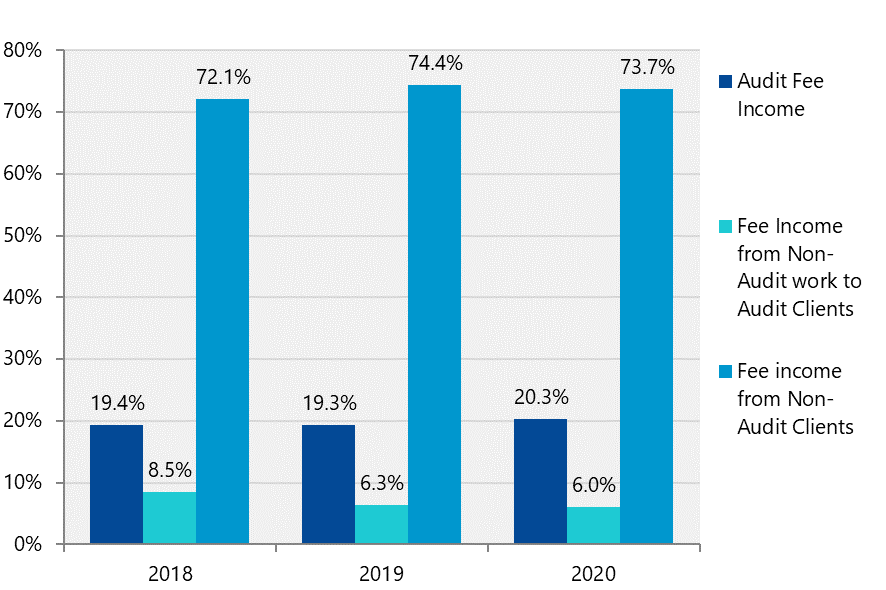
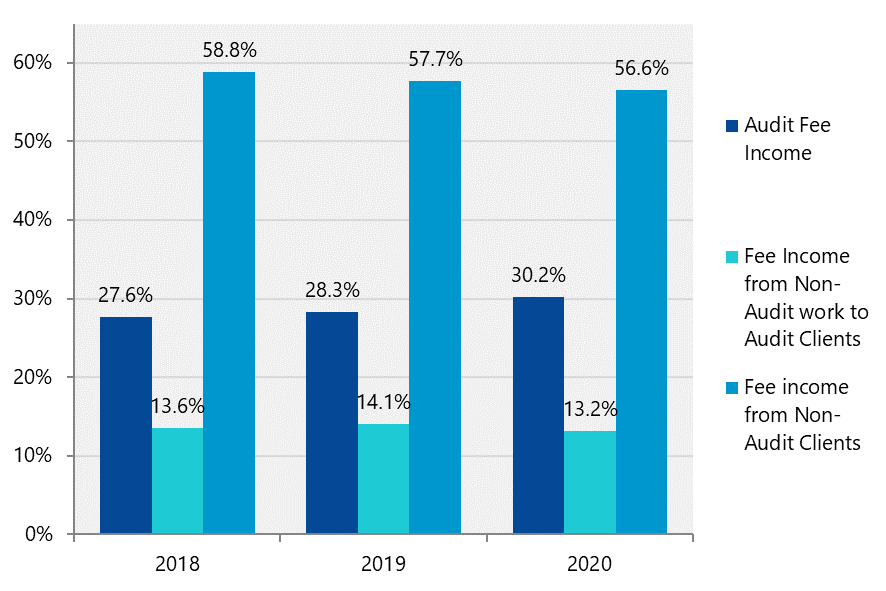
Figure 35: Proportion of total fee income for Audit Firms with PIE audit clients outside the Big Four firms, 2018 to 2020
Growth of fee income
Figure 36[^47] shows the percentage growth rate of fee income for each of the years 2018/19 and 2019/20 for audit firms with PIE clients, split between (i) the Big Four audit firms and audit firms outside the Big Four and (ii) between audit and non-audit income. With six more firms providing data this year than last year, the total income for non-Big Four firms may have been impacted by the increased number of smaller firms participating this year.
Audit firm population changes year-on-year based on those firms with PIE clients.
Figure 36: Growth of fee income, 2018/19 and 2019/20
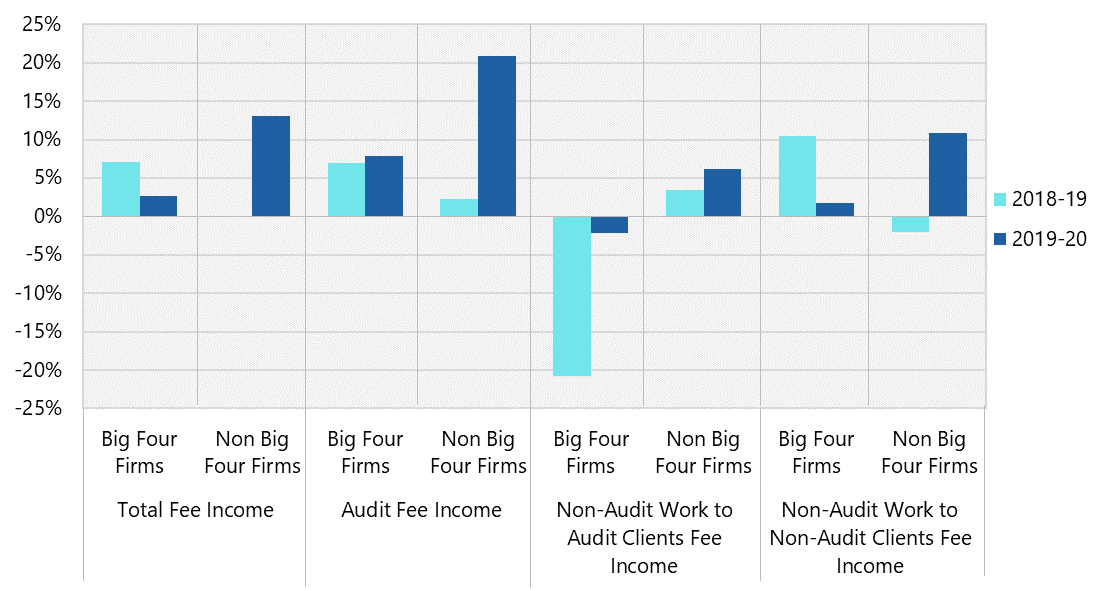
In 2019/20, for all firms with PIE clients, there was an increase in the growth rate of total fee income, with an increase of 13.1% for non-Big Four firms compared with a 2.7% increase for the Big Four firms. Audit fee income for the Big Four increased by 7.9% in 2019/20, whereas non-Big Four firms saw a 20.9% increase.
Fee income for non-audit work to audit clients fell by 2.2% for Big Four firms while it increased by 6.1% for non-Big Four firms in 2019/20.
Fee income for non-audit work to non-audit clients increased by 1.7% for Big Four firms compared with an increase of 10.9% for non-Big Four firms.
Audit fee income per Responsible Individual (RI)
Figure 37 illustrates audit fee generated per RI for 2018 to
- This information is split between the Big Four firms and the audit firms outside the Big Four.
Figure 37: Average audit fee income per RI, 2018 to 2020
| Audit Fee Income Per RI (£m) | 2018 | 2019 | 2020 |
|---|---|---|---|
| Big Four firms | 1.99 | 2.07 | 2.23 |
| Average of all firms with PIE clients | 1.46 | 1.61 | 1.68 |
| Non Big Four firms | 0.72 | 0.85 | 0.89 |
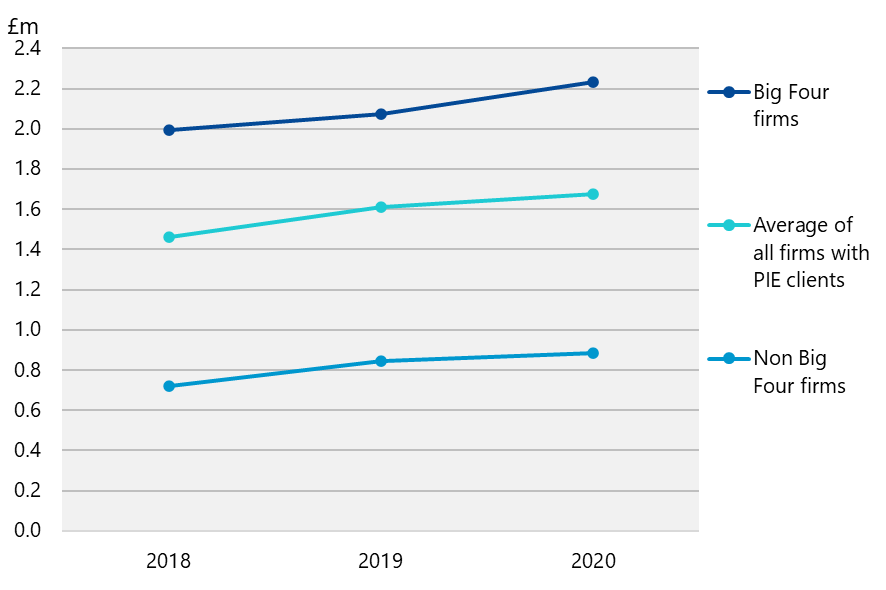
There has been a continual increase in the average income per RI for all firms since 2004, when we began our data collection for this publication.
Figure 38: Concentration of listed company audits, 2020 (by number of listed clients[^48] – FTSE 100, FTSE 250, UK equity listed on regulated markets and the Alternative Investment Market (AIM))
| UK Firm Name | UK Structure | Year End | No of FTSE 100 Audit Clients[^48] | No of FTSE 250 Audit Clients[^48] | Total no of other clients listed on regulated markets[^48] | No of AIM Audit Clients[^48] |
|---|---|---|---|---|---|---|
| KPMG[^49] | LLP | 30 Sep | 25 | 40 | 66 | 31 |
| PricewaterhouseCoopers | LLP | 30 Jun | 24 | 74 | 76 | 90 |
| Deloitte | LLP | 31 May | 22 | 54 | 105 | 30 |
| EY UK | LLP | 03 Jul | 19 | 40 | 76 | 24 |
| BDO | LLP | 03 Jul | 0 | 14 | 149 | 151 |
| Grant Thornton UK | LLP | 31 Dec | 0 | 4 | 11 | 70 |
| MHA Macintyre Hudson | LLP | 31 Mar | 0 | 2 | 1 | 6 |
| RSM UK | LLP | 31 Mar | 0 | 1 | 13 | 57 |
| Crowe U.K. | LLP | 31 Mar | 0 | 0 | 20 | 38 |
| Mazars | LLP | 31 Aug | 0 | 0 | 7 | 16 |
| Hazlewoods | LLP | 30 Apr | 0 | 0 | 5 | 4 |
| PKF Littlejohn | LLP | 31 May | 0 | 0 | 3 | 35 |
| Begbies Chartered Accountants | Limited Company and Partnership | 31 Mar | 0 | 0 | 1 | 0 |
| BSG Valentine | LLP | 30 Sep | 0 | 0 | 1 | 1 |
| F.W. Smith, Riches & Co. | Partnership | 31 Mar | 0 | 0 | 1 | 0 |
| French Duncan | LLP | 30 Apr | 0 | 0 | 1 | 0 |
| Gerald Edelman | Partnership | 31 Mar | 0 | 0 | 1 | 0 |
| Haysmacintyre | LLP | 31 Mar | 0 | 0 | 1 | 12 |
| UHY Hacker Young[^50] | LLP | 31 Apr | 0 | 0 | 0 | 8 |
| Shipleys | LLP | 30 Apr | 0 | 0 | 0 | 6 |
| Johnston Carmichael | LLP | 31 May | 0 | 0 | 0 | 2 |
| Haines Watts Group | Partnerships, LLPs and Limited Companies | 31 Mar | 0 | 0 | 0 | 1 |
| Beever and Struthers | Partnership | 30 Sep | 0 | 0 | 0 | 0 |
| BHP | LLP | 31 Mar | 0 | 0 | 0 | 0 |
| Edwards Accountants (Midlands) | Limited Company | 31 Mar | 0 | 0 | 0 | 0 |
100% of the FTSE 100 audits were conducted by the Big Four audit firms in 2020 and 9.2% of FTSE 250 audits were conducted by four non-Big Four firms.
Concentration of listed company audits[^51]
Figure 39 illustrates the percentage of the audits of UK-listed (equity and debt) companies undertaken by the Big Four firms,[^52] the next five firms (based on the number of listed audit clients) and other audit firms (22), as at 31 December for each of the years 2016 to 2020.
For the purposes of Figure 39, where a listed company is audited by an audit firm from the Crown Dependencies it has been given the same classification as its UK counterparts.
Figure 39: Listed company audits concentrations, 2016 to 2020
| Big Four Firms (%) | Next Five Firms (%) | Other Firms (%) | |||||||||||||
|---|---|---|---|---|---|---|---|---|---|---|---|---|---|---|---|
| 2016 | 2017 | 2018 | 2019 | 2020 | 2016 | 2017 | 2018 | 2019 | 2020 | 2016 | 2017 | 2018 | 2019 | 2020 | |
| FTSE 100 | 99.0 | 99.0 | 100.0 | 100.0 | 100.0 | 1.0 | 1.0 | 0.0 | 0.0 | 0.0 | 0.0 | 0.0 | 0.0 | 0.0 | 0.0 |
| FTSE 250 | 96.4 | 96.8 | 96.0 | 94.8 | 91.2 | 3.6 | 3.2 | 4.0 | 4.8 | 7.6 | 0.0 | 0.0 | 0.0 | 0.4 | 0.8 |
| Other UK Main Market | 74.8 | 74.2 | 77.8 | 73.7 | 67.2 | 18.4 | 16.0 | 15.3 | 16.8 | 22.8 | 6.8 | 9.8 | 6.9 | 9.5 | 10.0 |
| All Main Market | 81.0 | 80.0 | 81.8 | 79.0 | 74.1 | 13.3 | 12.6 | 12.7 | 13.6 | 18.4 | 5.7 | 7.4 | 5.5 | 7.4 | 7.6 |
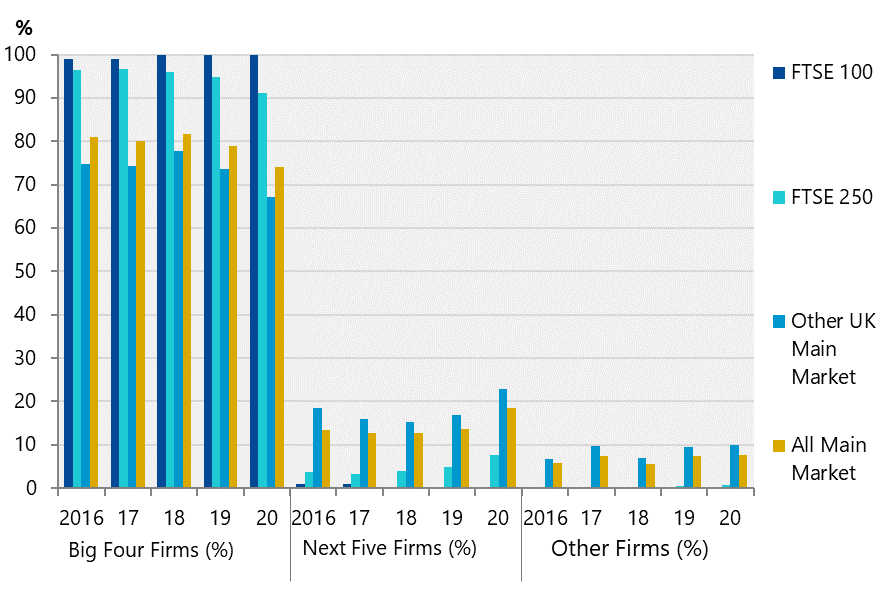
There is now one 'Other' firm auditing two members of the FTSE 250. 'Other UK Main Market' and 'All Main Market' have also increased for the Next Five and Other firms, whereas the Big-Four firms have seen a decrease in these two client categories.
Diversity of senior management at PIE Audit Firms
Figure 40 displays the percentage of female, BAME,[^53] those individuals who have a disability and LGBTQ+[^54] across three levels of seniority at PIE audit firms: managers, directors and partners.
Figures 41, 42, 43 and 44 further break down this information across different sizes of audit firms: firms with under 200 employees; firms with between 200 and 2,000 employees; and firms with over 2,000 employees.
Figure 40: Senior management diversity, 2020
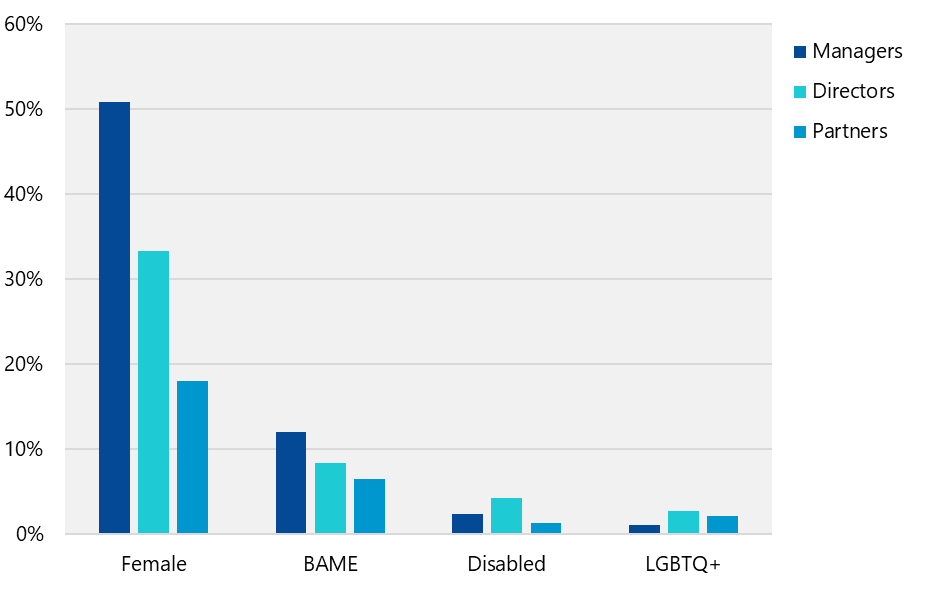
All 26 PIE audit firms taking part provided diversity information on their senior management including in respect of gender, BAME, disability and LGBTQ+ (Figures 42, 43 and 44).
Partners were the least diverse among the senior management levels for gender, BAME, and disability, with managers having the lowest percentage for LGBTQ+.
Figure 41: Senior management, 2020 – Female
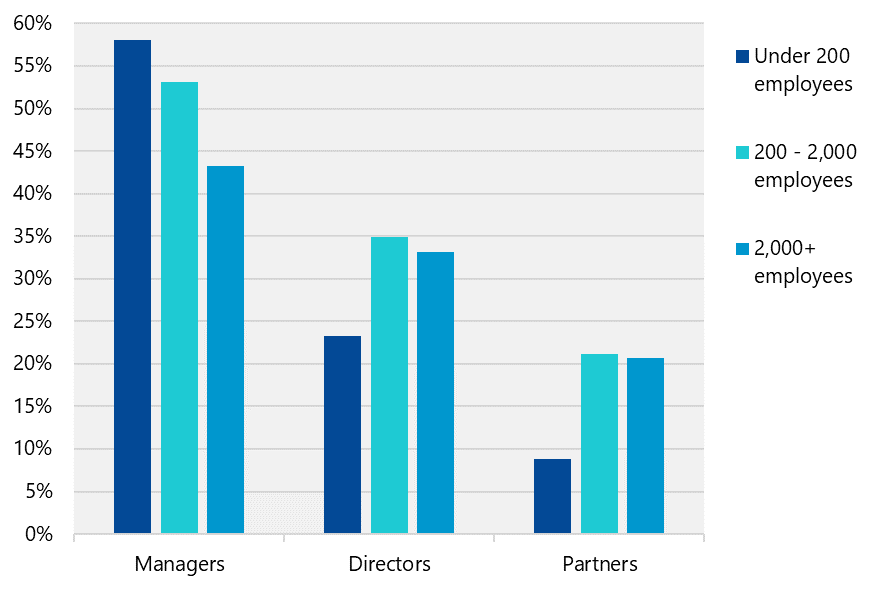
25 firms collect information on the number of female senior leaders. In 2020, the percentage of female senior leaders at firms with under 200 employees was highest at manager level (58%). The proportion was less at director (23.3%) and partner level (8.8%).
Firms with 200 to 2,000 employees had the highest percentage of female senior leaders at Director and partner level with 34.5% and 21.5% respectively.
For all three sizes of firm, the percentage of female senior leaders was the greatest at manager level and lowest at partner level.
Figure 42: Senior management, 2020 – BAME
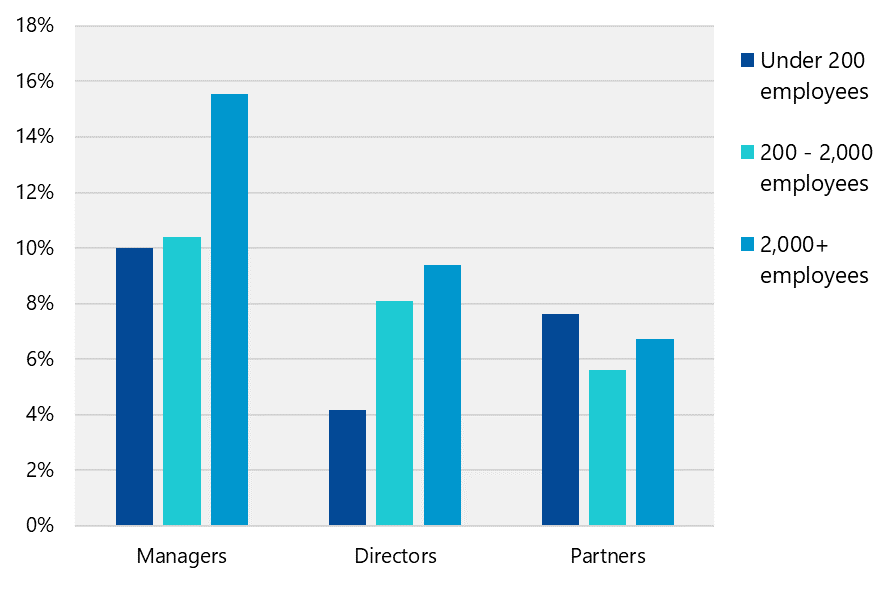
Firms with over 2,000 employees had the highest percentages of BAME individuals at manager and director levels at 15.5% and 9.4%, respectively.
Figure 43: Senior management, 2020[^55] – Disabled
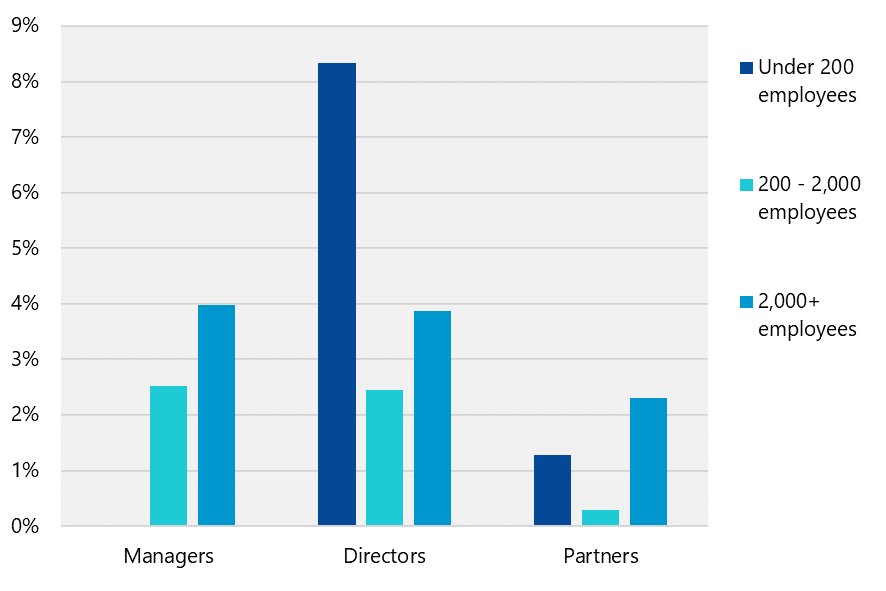
Overall declarations relating to disability are low, with an average of 2.6% of all senior managers declaring a disability. PIE audit firms with over 2,000 employees had the largest number of disability declarations overall. Firms with under 200 employees had no disability declarations at manager level.
Figure 44: Senior management, 2020[^56] – LGBTQ+
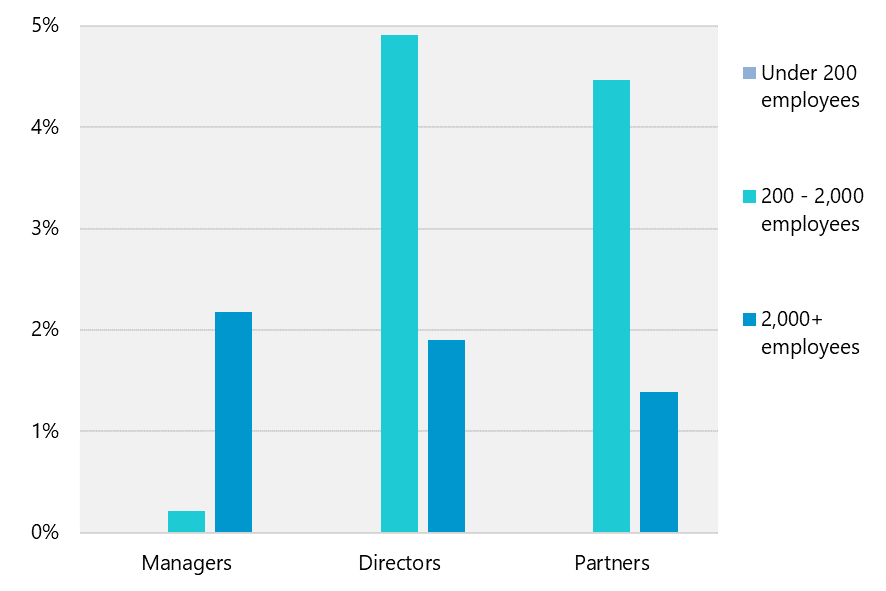
Overall declarations relating to LGBTQ+ are also very low, with an average of 1.9% of all senior managers disclosing that they identified as LGBTQ+. Firms with under 200 employees told us that either they had no LGBTQ+ senior managers or did not collect this information.
Age of workforce at the Audit Firms
Figure 45 shows the number of staff at audit firms in 2020 split into six age categories.
Figure 45: Workforce ages, 2020[^57]
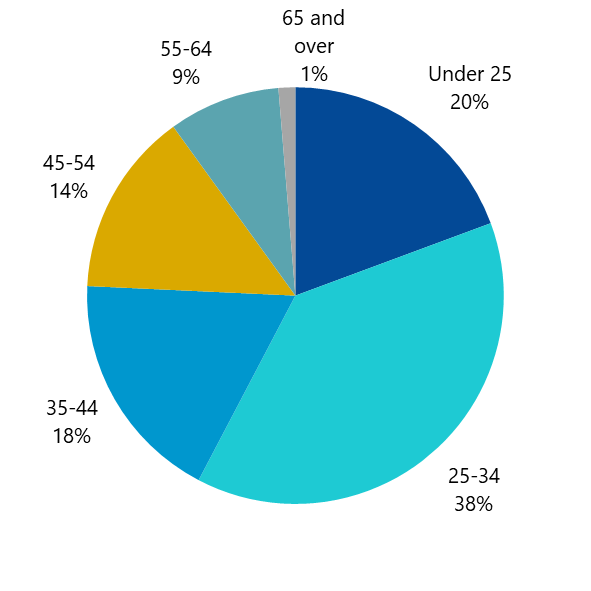
23 out of the 26 firms collect data on the ages of their workforce. The majority of staff employed at audit firms are aged between 25 and 34 on average (38%).
Diversity information collected by the PIE Audit Firms (workforce)
Figure 46 shows the number of audit firms that collect diversity information on their staff (illustrated by the bar chart), and for those that do, the average completion rate [^58] of the relevant diversity indicator (represented via the line graph).
Figure 46: Diversity information on workforce, 2020
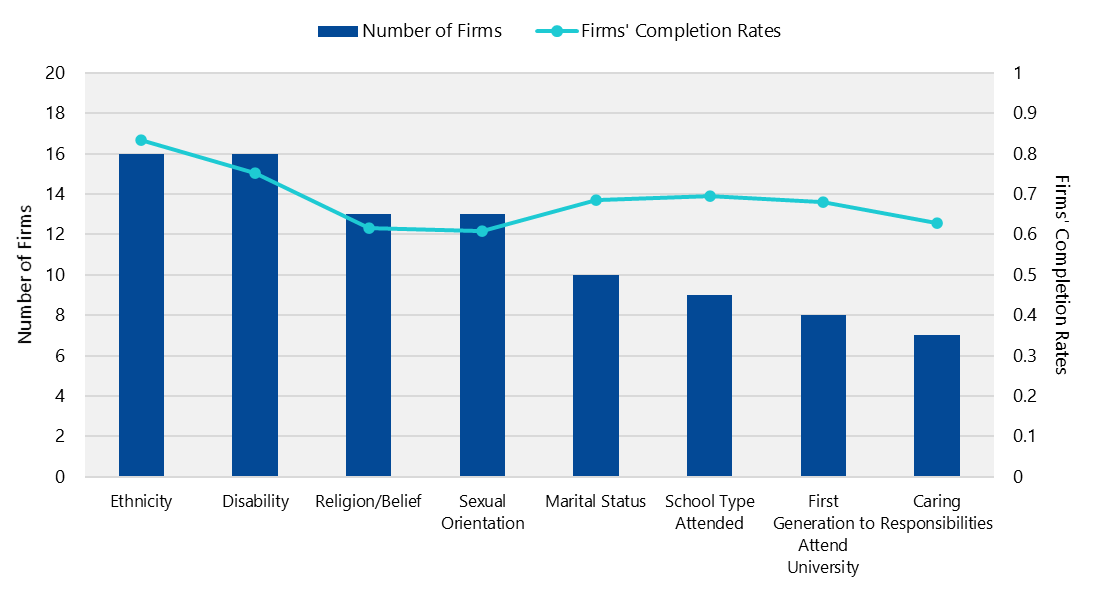
17 firms reported they collect at least one of the above diversity indicators.
Ethnicity and disability are the most collected diversity indicator (16 firms), with ethnicity also having the highest rate of completion of all the indicators (84%).
PIE Audit Firms with a diversity policy
Figure 47 shows the number of audit firms that made returns on whether they have a diversity policy (shown by the bar chart), and the percentage of firms that confirmed having such a policy in place (illustrated via the line graph) in 2019 and 2020.
Figure 47: Diversity policies, 2019 and 2020
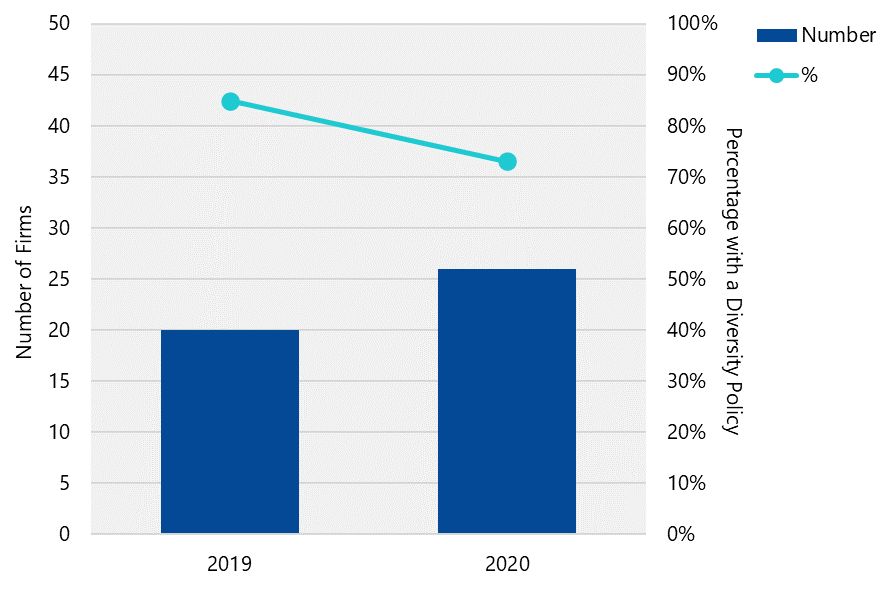
In 2020, 73% of the 26 audit firms questioned had a diversity policy. In 2019, 85% of the 20 firms had diversity policies.
The information received from the firms in respect of their policies includes several aspects of diversity such as social mobility, equal opportunity and respect, and inclusion policies.
Section Six – Data tables of the Charts (total figures and percentages)
The following tables provide the data that is used to create the corresponding figures in this publication.
Figure 48: Members and students in the UK and ROI Corresponds to Figure 1
| ACCA | CIMA | CIPFA | ICAEW | CAI | ICAS | AIA | TOTAL | |
|---|---|---|---|---|---|---|---|---|
| Members in the UK and ROI | ||||||||
| 2016 | 90,697 | 80,007 | 12,944 | 125,087 | 22,696 | 18,103 | 1,378 | 350,912 |
| 2017 | 94,622 | 82,587 | 12,630 | 126,560 | 23,905 | 18,528 | 1,292 | 360,124 |
| 2018 | 98,049 | 82,762 | 12,450 | 128,626 | 24,275 | 18,934 | 1,458 | 366,554 |
| 2019 | 101,476 | 83,657 | 12,327 | 130,928 | 25,374 | 19,366 | 1,304 | 374,432 |
| 2020 | 103,293 | 84,539 | 12,292 | 133,332 | 26,447 | 20,237 | 1,301 | 381,441 |
| % growth (2019-20) | 1.8 | 1.1 | -0.3 | 1.8 | 4.2 | 4.5 | -0.2 | 1.9 |
| % growth (2016-20) | 13.9 | 5.7 | -5.0 | 6.6 | 16.5 | 11.8 | -5.6 | 8.7 |
| % CAGR (2016-20) | 3.3 | 1.4 | -1.3 | 1.6 | 3.9 | 2.8 | -1.4 | 2.1 |
- Compound Annual Growth Rate
| ACCA | CIMA | CIPFA | ICAEW | CAI | ICAS | AIA | TOTAL | |
|---|---|---|---|---|---|---|---|---|
| Students in the UK and ROI | ||||||||
| 2016 | 82,953 | 49,529 | 2,070 | 19,713 | 6,330 | 3,718 | 168 | 164,481 |
| 2017 | 82,124 | 48,263 | 1,857 | 20,946 | 6,655 | 3,837 | 127 | 163,809 |
| 2018 | 81,902 | 48,329 | 1,949 | 21,618 | 6,789 | 3,488 | 135 | 164,210 |
| 2019 | 79,937 | 48,520 | 2,047 | 22,842 | 7,009 | 3,862 | 135 | 164,352 |
| 2020 | 76,208 | 47,904 | 2,113 | 23,309 | 7,351 | 3,839 | 139 | 160,863 |
| % growth (2019-20) | -4.7 | -1.3 | 3.2 | 2.0 | 4.9 | -0.6 | 3.0 | -2.1 |
| % growth (2016-20) | -8.1 | -3.3 | 2.1 | 18.2 | 16.1 | 3.3 | -17.3 | -2.2 |
| % CAGR (2016-20) | -2.1 | -0.8 | 0.5 | 4.3 | 3.8 | 0.8 | -4.6 | -0.6 |
- Compound Annual Growth Rate
Section Six – Data tables of the Charts
The following tables provide the data that is used to create the corresponding figures in this publication.
Figure 48: Members and students in the UK and ROI
Corresponds to Figure 1
| Year | ACCA | CIMA | CIPFA | ICAEW | CAI | ICAS | AIA | TOTAL |
|---|---|---|---|---|---|---|---|---|
| 2016 | 90,697 | 80,007 | 12,944 | 125,087 | 22,696 | 18,103 | 1,378 | 350,912 |
| 2017 | 94,622 | 82,587 | 12,630 | 126,560 | 23,905 | 18,528 | 1,292 | 360,124 |
| 2018 | 98,049 | 82,762 | 12,450 | 128,626 | 24,275 | 18,934 | 1,458 | 366,554 |
| 2019 | 101,476 | 83,657 | 12,327 | 130,928 | 25,374 | 19,366 | 1,304 | 374,432 |
| 2020 | 103,293 | 84,539 | 12,292 | 133,332 | 26,447 | 20,237 | 1,301 | 381,441 |
| % growth (2019-20) | 1.8 | 1.1 | -0.3 | 1.8 | 4.2 | 4.5 | -0.2 | 1.9 |
| % growth (2016-20) | 13.9 | 5.7 | -5.0 | 6.6 | 16.5 | 11.8 | -5.6 | 8.7 |
| % CAGR* (2016-20) | 3.3 | 1.4 | -1.3 | 1.6 | 3.9 | 2.8 | -1.4 | 2.1 |
* Compound Annual Growth Rate
Figure 49: Members and students worldwide
Corresponds to Figure 2
| Number of Members Worldwide | ACCA | CIMA | CIPFA | ICAEW | CAI | ICAS | AIA | TOTAL |
|---|---|---|---|---|---|---|---|---|
| 2016 | 193,976 | 106,095 | 14,266 | 147,538 | 25,496 | 21,152 | 6,786 | 515,309 |
| 2017 | 204,336 | 109,415 | 13,735 | 149,298 | 26,562 | 21,503 | 7,166 | 532,015 |
| 2018 | 214,319 | 110,493 | 13,358 | 151,761 | 27,367 | 22,028 | 8,164 | 547,490 |
| 2019 | 223,454 | 112,617 | 13,362 | 154,531 | 28,479 | 22,495 | 8,718 | 563,656 |
| 2020 | 228,771 | 114,492 | 13,207 | 157,812 | 29,596 | 23,062 | 9,541 | 576,481 |
| % growth (2019-20) | 2.4 | 1.7 | -1.2 | 2.1 | 3.9 | 2.5 | 9.4 | 2.3 |
| % growth (2016-20) | 17.9 | 7.9 | -7.4 | 7.0 | 16.1 | 9.0 | 40.6 | 11.9 |
| % CAGR* (2016-20) | 4.2 | 1.9 | -1.9 | 1.7 | 3.8 | 2.2 | 8.9 | 2.8 |
* Compound Annual Growth Rate
| Number of Students Worldwide | ACCA | CIMA | CIPFA | ICAEW | CAI | ICAS | AIA | TOTAL |
|---|---|---|---|---|---|---|---|---|
| 2016 | 405,376 | 125,380 | 4,254 | 25,822 | 6,334 | 3,735 | 5,244 | 576,145 |
| 2017 | 414,562 | 127,241 | 4,401 | 27,866 | 6,662 | 3,849 | 5,365 | 589,946 |
| 2018 | 431,821 | 117,817 | 4,749 | 28,700 | 6,792 | 3,488 | 5,458 | 598,825 |
| 2019 | 445,186 | 107,049 | 5,001 | 30,241 | 7,011 | 3,872 | 5,624 | 603,984 |
| 2020 | 435,088 | 98,833 | 5,280 | 31,656 | 7,352 | 3,851 | 5,381 | 587,441 |
| % growth (2019-20) | -2.3 | -7.7 | 5.6 | 4.7 | 4.9 | -0.5 | -4.3 | -2.7 |
| % growth (2016-20) | 7.3 | -21.2 | 24.1 | 22.6 | 16.1 | 3.1 | 2.6 | 2.0 |
| % CAGR* (2016-20) | 1.8 | -5.8 | 5.6 | 5.2 | 3.8 | 0.8 | 0.6 | 0.5 |
* Compound Annual Growth Rate
Figure 50: Sectoral employment worldwide, 2020
Corresponds to Figure 4
| No. of members | ACCA | CIMA | CIPFA | ICAEW | CAI | ICAS | AIA | TOTAL |
|---|---|---|---|---|---|---|---|---|
| Working in Practice | 57,673 | 1,908 | 283 | 44,838 | 8,096 | 5,825 | 442 | 119,065 |
| Industry & Commerce | 132,228 | 82,511 | 1,488 | 59,925 | 17,002 | 10,405 | 8,300 | 311,859 |
| Public Sector | 17,224 | 9,259 | 6,339 | 4,546 | 1,528 | 1,035 | 48 | 39,979 |
| Retired | 10,760 | 15,989 | 3,200 | 25,419 | 1,869 | 4,435 | 690 | 62,362 |
| Other | 10,886 | 4,825 | 1,897 | 23,084 | 1,101 | 1,362 | 61 | 43,216 |
| TOTAL | 228,771 | 114,492 | 13,207 | 157,812 | 29,596 | 23,062 | 9,541 | 576,481 |
| No. of students | ACCA | CIMA | CIPFA | ICAEW | CAI | ICAS | AIA | TOTAL |
|---|---|---|---|---|---|---|---|---|
| Working in Practice | 36,305 | 100 | 0 | 24,439 | 5,717 | 3,505 | 104 | 70,170 |
| Industry & Commerce | 185,790 | 58,325 | 731 | 1,623 | 90 | 153 | 2,959 | 249,671 |
| Public Sector | 37,491 | 2,397 | 3,385 | 544 | 46 | 51 | 28 | 43,942 |
| Retired | 0 | 73 | 0 | 0 | 0 | 0 | 0 | 73 |
| Other | 175,502 | 37,938 | 1,164 | 5,050 | 1,499 | 142 | 2,290 | 223,585 |
| TOTAL | 435,088 | 98,833 | 5,280 | 31,656 | 7,352 | 3,851 | 5,381 | 587,441 |
Figure 51: Female members worldwide, 2016 to 2020
Corresponds to Figure 5
| % Female Members Worldwide | ACCA | CIMA | CIPFA | ICAEW | CAI | ICAS | AIA | TOTAL |
|---|---|---|---|---|---|---|---|---|
| 2016 | 46% | 35% | 32% | 28% | 41% | 33% | 32% | 35% |
| 2017 | 46% | 35% | 32% | 28% | 41% | 34% | 34% | 36% |
| 2018 | 47% | 35% | 33% | 29% | 42% | 34% | 36% | 37% |
| 2019 | 47% | 36% | 33% | 29% | 42% | 34% | 36% | 37% |
| 2020 | 48% | 36% | 33% | 30% | 42% | 35% | 37% | 37% |
Figure 52: Female students worldwide, 2016 to 2020
Corresponds to Figure 6
| % Female Students Worldwide | ACCA | CIMA | CIPFA | ICAEW | CAI | ICAS | AIA | TOTAL |
|---|---|---|---|---|---|---|---|---|
| 2016 | 54% | 47% | 49% | 42% | 48% | 43% | 58% | 49% |
| 2017 | 57% | 48% | 48% | 43% | 47% | 44% | 58% | 49% |
| 2018 | 58% | 49% | 48% | 44% | 47% | 40% | 58% | 49% |
| 2019 | 60% | 49% | 49% | 45% | 48% | 41% | 58% | 50% |
| 2020 | 60% | 49% | 49% | 46% | 48% | 42% | 57% | 50% |
Figure 53: Age of Members Worldwide, 2016 and 2020
Corresponds to Figure 7
| 2016 | ACCA | CIMA | CIPFA | ICAEW | CAI | ICAS | AIA | TOTAL |
|---|---|---|---|---|---|---|---|---|
| Under 25 | 998 | 130 | 0 | 251 | 16 | 17 | 29 | 1,441 |
| 25 - 34 | 50,585 | 16,882 | 710 | 25,948 | 8,389 | 5,750 | 588 | 108,852 |
| 35 - 44 | 71,243 | 36,187 | 2,200 | 31,185 | 7,976 | 4,816 | 2,253 | 155,860 |
| 45 - 54 | 43,976 | 27,713 | 3,997 | 35,540 | 4,876 | 3,681 | 1,904 | 121,687 |
| 55 - 64 | 16,791 | 13,754 | 3,003 | 26,282 | 2,483 | 3,106 | 855 | 66,274 |
| 65 and over | 10,383 | 11,411 | 3,291 | 28,332 | 1,756 | 3,782 | 1,157 | 60,112 |
| Not Stated | 0 | 18 | 1,065 | 0 | 0 | 0 | 0 | 1,083 |
| TOTAL | 193,976 | 106,077 | 14,266 | 147,538 | 25,496 | 21,152 | 6,786 | 514,226 |
| 2020 | ACCA | CIMA | CIPFA | ICAEW | CAI | ICAS | AIA | TOTAL |
|---|---|---|---|---|---|---|---|---|
| Under 25 | 931 | 129 | 2 | 431 | ≤ 3 | 70 | 57 | 1,625 |
| 25 - 34 | 57,640 | 14,397 | 468 | 29,593 | 8,159 | 5,483 | 850 | 116,590 |
| 35 - 44 | 79,856 | 35,720 | 1,952 | 31,843 | 9,856 | 6,304 | 2,811 | 168,342 |
| 45 - 54 | 54,419 | 32,986 | 3,073 | 32,868 | 5,927 | 3,696 | 3,044 | 136,013 |
| 55 - 64 | 22,415 | 17,026 | 3,017 | 29,784 | 3,246 | 3,132 | 1,249 | 79,869 |
| 65 and over | 13,510 | 14,217 | 2,185 | 33,293 | 2,397 | 4,352 | 1,526 | 71,480 |
| Not Stated | 0 | 17 | 654 | 0 | 6 | 25 | 4 | 706 |
| TOTAL | 228,771 | 114,492 | 11,351 | 157,812 | 29,596 | 23,062 | 9,541 | 574,625 |
Figure 54: Age of students worldwide, 2016 and 2020 47
Corresponds to Figure 8
| 2016 | ACCA | CIMA | CIPFA | ICAEW | CAI | ICAS | AIA | TOTAL |
|---|---|---|---|---|---|---|---|---|
| Under 25 | 157,193 | 41,560 | 102 | 14,475 | 2,466 | 2,067 | 2,423 | 220,286 |
| 25 - 34 | 172,387 | 45,082 | 966 | 10,460 | 3,141 | 1,106 | 1,327 | 234,469 |
| 35 - 44 | 58,806 | 25,674 | 933 | 726 | 525 | 63 | 1,028 | 87,755 |
| 45 and over | 16,990 | 11,881 | 808 | 161 | 195 | ≤ 3 | 466 | 30,516 |
| Not Stated | 0 | 1,183 | 1,445 | 0 | ≤ 3 | 484 | 0 | 3,119 |
| TOTAL | 405,376 | 125,380 | 4,254 | 25,822 | 6,334 | 3,735 | 5,244 | 576,145 |
| 2020 | ACCA | CIMA | CIPFA | ICAEW | CAI | ICAS | AIA | TOTAL |
|---|---|---|---|---|---|---|---|---|
| Under 25 | 177,565 | 29,342 | 1,884 | 18,125 | 3,095 | 2,098 | 2,421 | 234,530 |
| 25 - 34 | 168,565 | 33,774 | 527 | 12,691 | 3,394 | 1,594 | 1,238 | 221,783 |
| 35 - 44 | 66,189 | 23,284 | 432 | 685 | 614 | 74 | 915 | 92,193 |
| 45 and over | 22,769 | 12,372 | 1,158 | 155 | 218 | 10 | 807 | 37,489 |
| Not Stated | 0 | 61 | 1,279 | 0 | 31 | 75 | 0 | 1,446 |
| TOTAL | 435,088 | 98,833 | 5,280 | 31,656 | 7,352 | 3,851 | 5,381 | 587,441 |
Figure 55: Location of students, 2020 48
Corresponds to Figure 10
| Location of students | ACCA | CIMA | CIPFA | ICAEW | CAI | ICAS | AIA | TOTAL |
|---|---|---|---|---|---|---|---|---|
| UK & ROI | 76,208 | 47,904 | 2,113 | 23,309 | 7,351 | 3,839 | 139 | 160,863 |
| Rest of the World | 358,880 | 50,929 | 3,167 | 8,347 | 1 | 12 | 5,242 | 426,578 |
| TOTAL | 435,088 | 98,833 | 5,280 | 31,656 | 7,352 | 3,851 | 5,381 | 587,441 |
Figure 56: Profile of students worldwide, 2020
Corresponds to Figure 11
| ACCA | CIMA | CIPFA | ICAEW | CAI | ICAS | AIA | TOTAL | |
|---|---|---|---|---|---|---|---|---|
| ≤ 1 Year | 82,039 | 19,230 | 683 | 8,846 | 1,789 | 917 | 215 | 113,719 |
| > 1 - 2 Years | 80,959 | 17,602 | 728 | 7,988 | 1,697 | 911 | 427 | 110,312 |
| > 2 - 3 Years | 58,989 | 12,177 | 626 | 6,393 | 1,575 | 716 | 548 | 81,024 |
| > 3 - 4 Years | 46,744 | 10,177 | 200 | 4,876 | 1,264 | 620 | 646 | 64,527 |
| > 4 - 5 Years | 33,179 | 6,353 | 489 | 1,956 | 367 | 292 | 807 | 43,443 |
| ≥ 5 Years | 133,178 | 33,294 | 2,554 | 1,597 | 660 | 395 | 2,738 | 174,416 |
| TOTAL | 435,088 | 98,833 | 5,280 | 31,656 | 7,352 | 3,851 | 5,381 | 587,441 |
Figure 57: Graduate entrants worldwide, 2020
Corresponds to Figure 12
| ACCA | CIMA | CIPFA | ICAEW | CAI | ICAS | AIA | |
|---|---|---|---|---|---|---|---|
| Holding a Degree | 35% | 46% | 21% | 75% | 91% | 87% | 30% |
| Holding a Relevant Degree | 19% | 38% | 12% | 28% | 75% | 34% | 26% |
Figure 58: AAT age of members and students worldwide, 2020
Corresponds to Figure 14
| Members | No. | % | Students | No. | % |
|---|---|---|---|---|---|
| Under 25 | 2,437 | 5% | Under 25 | 26,965 | 32% |
| 25 - 34 | 9,589 | 19% | 25-34 | 26,201 | 31% |
| 35 - 44 | 11,986 | 24% | 35-44 | 19,096 | 23% |
| 45 and over | 26,016 | 52% | 45 and over | 11,735 | 14% |
| Not Stated | 0 | 0% | Not Stated | 0 | 0% |
| TOTAL | 50,028 | 100% | TOTAL | 83,997 | 100% |
Figure 59: Income worldwide, 2016 to 2020
Corresponds to Figure 16
| £m | ACCA | CIMA | CIPFA | ICAEW | CAI | ICAS | AIA | TOTAL |
|---|---|---|---|---|---|---|---|---|
| 2016 | 184.0 | 56.6 | 23.6 | 107.0 | 25.9 | 16.7 | 1.9 | 415.6 |
| 2017 | 202.0 | 58.9 | 24.1 | 120.0 | 26.8 | 17.5 | 1.8 | 451.1 |
| 2018 | 208.8 | 55.4 | 26.0 | 125.4 | 28.1 | 17.8 | 1.7 | 463.2 |
| 2019 | 212.7 | 60.6 | 26.9 | 132.2 | 28.6 | 18.8 | 1.6 | 481.4 |
| 2020 | 223.4 | 56.2 | 26.4 | 136.2 | 28.6 | 19.0 | 1.6 | 491.4 |
Figure 60: Average income from members and students worldwide, 2016 to 2020
Corresponds to Figure 17
| £ | ACCA | CIMA | CIPFA | ICAEW | CAI | ICAS | AIA | TOTAL |
|---|---|---|---|---|---|---|---|---|
| 2016 | 273 | 210 | 415 | 490 | 671 | 639 | 150 | 315 |
| 2017 | 315 | 214 | 403 | 525 | 707 | 651 | 136 | 345 |
| 2018 | 307 | 218 | 381 | 547 | 664 | 658 | 117 | 345 |
| 2019 | 315 | 244 | 425 | 564 | 660 | 683 | 112 | 359 |
| 2020 | 306 | 239 | 438 | 561 | 669 | 695 | 107 | 354 |
| % growth (2016-20) | 12.0 | 14.1 | 5.7 | 14.3 | -0.4 | 8.8 | -28.3 | 12.4 |
Figure 61: Breakdown of Income, 2020 49
Corresponds to Figure 18
| Fees & Subscriptions | ACCA | CIMA | CIPFA | ICAEW | CAI | ICAS | AIA | TOTAL |
|---|---|---|---|---|---|---|---|---|
| Fees & Subscriptions | 110.7 | 39.6 | 3.0 | 53.3 | 11.8 | 8.5 | 1.5 | 228.4 |
| Education & Exam Fees | 86.3 | 11.4 | 5.1 | 14.2 | 9.7 | 8.0 | 0.1 | 134.8 |
| Regulation & Discipline | 6.1 | 0.0 | 0.0 | 38.7 | 3.2 | 2.2 | 0.0 | 50.2 |
| Commercial Activities | 3.3 | 4.6 | 18.0 | 14.3 | 2.7 | 0.2 | 0.0 | 43.0 |
| Other (Including Investment Income) | 17.0 | 0.6 | 0.3 | 15.7 | 1.2 | 0.1 | 0.0 | 35.0 |
| TOTAL | 223.4 | 56.2 | 26.4 | 136.2 | 28.6 | 19.0 | 1.6 | 491.5 |
Figure 62: Growth of Fee Income, 2018/19 and 2019/20
Corresponds to Figure 36
| Growth Rate % | 2018-19 | 2019-20 | |
|---|---|---|---|
| Total Fee Income | Big Four Firms | 7.1% | 2.7% |
| Non Big Four Firms | -0.1% | 13.1% | |
| Audit Fee Income | Big Four Firms | 6.9% | 7.9% |
| Non Big Four Firms | 2.2% | 20.9% | |
| Non-Audit Work to Audit Clients Fee Income | Big Four Firms | -20.8% | -2.2% |
| Non Big Four Firms | 3.4% | 6.1% | |
| Non-Audit Work to Non-Audit Clients Fee Income | Big Four Firms | 10.5% | 1.7% |
| Non Big Four Firms | -2.0% | 10.9% |
Section Seven – Glossary
This glossary provides definitions of many of the acronyms, abbreviations and some key terms used within the Key Facts and Trends publication:
AAPA Association of Authorised Public Accountants
AAT The Association of Accounting Technicians
ACCA Association of Chartered Certified Accountants
AIA Association of International Accountants
AIM The Alternative Investment Market is the London Stock Exchange's global market for smaller and growing companies
ALC Admissions and Licensing Committee (ACCA term)
ARD Audit Regulation Directive
AQR Audit Quality Review team – part of the FRC
ARC Audit Registration Committee (ICAEW term)
Audit -Qualification The qualification that is provided by an RQB to its members
Audit Services Audit services are: * Reporting required by law or regulation to be provided by the auditor; * Reviews of interim financial information; * Reporting on regulatory returns; * Reporting to a regulator on client assets; * Reporting on government grants; * Reporting on internal financial controls when required by law or * regulation; and * Extended audit work that is authorised by those charged with governance performed on financial information and/or financial controls where this work is integrated with the audit work and is performed on the same principal terms and conditions.
BAME Black, Asian and Minority Ethnic (used to refer to members of non-white communities in the UK).
Big Four The four largest audit firms in the UK: PricewaterhouseCoopers (PwC); KPMG; Deloitte; and EY.
Next Five The five largest audit firms outside the Big Four (based on number of listed audit clients) are: BDO, Grant Thornton, PKF Littlejohn, RSM and Crowe.
ICAI/CAI Institute of Chartered Accountants Ireland
CEC Code of Ethics and Conduct (ACCA term)
CIMA Chartered Institute of Management Accountants
CIPFA Chartered Institute of Public Finance and Accountancy
CPD Continuing Professional Development
Crown Dependencies Territories that are under the sovereignty of the British Crown but do not form part of the UK
FRC Financial Reporting Council
FTSE 100 An index composed of the 100 largest companies listed on the London Stock Exchange (LSE)
FTSE 250 An index containing the 101st to 350th largest companies by market capitalisation on the London Stock Exchange (LSE)
GPRs Global Practising Regulations (ACCA term)
IAASA Irish Auditing and Accounting Supervisory Authority
ICAEW Institute of Chartered Accountants in England and Wales
ICAS Institute of Chartered Accountants of Scotland
LGBTQ+ Lesbian, Gay, Bisexual, Trans, Queer/Questioning + Others
LSE London Stock Exchange
LSE Main Market International market for the admission and trading of equity, debt and other securities.
Non –audit services 'Non-audit services' comprise any engagement in which an audit firm provides professional services to: * An audited entity; * An audited entity's affiliates; or * Another entity in respect of the audited entity; * Other than the audit of financial statements of the audited entity.
Principals Partners or members of an LLP
PIEs On 17 June 2016 the PIE definition included entities governed by the law of a member state whose transferable securities (equity and debt) are admitted to trading on a regulated market in the EEA, credit institutions and insurance undertakings. As of 1 January 2021, the regulated market scope has reduced to UK regulated markets only.
PSED Public Sector Equality Duty introduced by the Equality Act
- The duty covers age, disability, sex, gender reassignment, marriage and civil partnership, pregnancy and maternity, race, religion or belief and sexual orientation.
QAC Quality Assurance Committee (CAI term)
QAD Quality Assurance Directorate (ICAEW term)
RI Responsible Individuals/ statutory auditor have been awarded the recognised professional qualification in audit and hold a practising certificate. An RI can sign an audit report on behalf of his/her firm
ROI Republic of Ireland
RQB Recognised Qualifying Bodies – there are five bodies in the UK recognised to offer the audit qualification in line with the requirements of Schedule 11 to the Companies Act 2006
RSB Recognised Supervisory Bodies – these bodies can register and supervise audit firms in accordance with the requirements of Schedule 10 to the Companies Act 2006
UK United Kingdom
UK GAAP Generally Accepted Accounting Practice in the UK
UK Regulated Market An organised trading venue that operates under Title III of MiFID
Year End An accounting procedure undertaken at the end of the year to close out business from the previous year and carry forward balances from the previous year
Financial Reporting Council 8th Floor 125 London Wall London EC2Y 5AS
+44 (0)20 7492 2300 www.frc.org.uk
Footnotes
-
Association of Chartered Certified Accountants (ACCA), Institute of Chartered Accountants in Ireland (ICAI/CAI), Chartered Institute of Public Finance and Accountancy (CIPFA), Chartered Institute of Management Accountants (CIMA), Institute of Chartered Accountants in England and Wales (ICAEW) and Institute of Chartered Accountants of Scotland (ICAS). ↩
-
Public Interest Entities (PIEs) are:
- ↩
-
The five largest audit firms outside the Big Four (based on number of listed audit clients) are BDO, Grant Thornton, PKF Littlejohn, RSM and Crowe. ↩
-
Protected characteristics under the Equality Act 2010: Age, Disability, Gender Reassignment, Marriage and Civil Partnership, Pregnancy and Maternity, Race (this includes ethnic or national origins, colour or nationality), Religion or Belief (including an absence of religion or belief), Sex, and Sexual Orientation. ↩
-
To be an RSB, the body must satisfy the recognition criteria as set out in Schedule 10 of the Companies Act 2006. Individuals and audit firms that wish to be appointed as a statutory auditor in the UK must be registered with an RSB. There are four RSBS: ACCA, ICAEW, CAI and ICAS. ↩
-
Lesbian, Gay, Bisexual, Trans, Queer/Questioning + Others. ↩
-
The location of members and students is based on the registered address supplied to the accountancy bodies and may be either the place of employment or the place of residence. ↩
-
The statistics for AAT are shown separately on pages 17 and 18. ↩
-
- ↩
-
ICAEW figures relate to the age of the student intake, not the ages of all students. ↩
-
The location of students is based on the registered address supplied to the accountancy body and may be either their place of employment or their place of residence. ↩
-
There is no common basis between the accountancy bodies for determining the length of time between registering as a student and achieving the requirements for membership. It is therefore difficult to draw comparisons across the accountancy bodies as they offer different types of qualifications. ↩
-
The accountancy bodies' definitions of a 'relevant degree' are as follows: * ACCA – Accounting, or Finance. * CIMA – Accountancy, Business Studies, or Business Administration & Finance. * CIPFA – Accountancy. * ICAEW – Accountancy, Accounting, Finance, Accountancy & Finance, or Accounting & Finance. * CAI – Accounting, Business, or Finance. * ICAS – Accountancy, Accounting, Finance, Accountancy & Finance, or Accounting & Finance. * AIA – Accountancy, Accounting, Business, Finance, or Business & Finance. ↩
-
CAI's income has been converted from euros at the Office for National Statistics (ONS) average annual year-end rate. As at 31 December 2020 the rate was €1.1250. ↩
-
CIPFA derives significant income from its trading subsidiary, which has been included within the commercial activities' category. The activities of the trading subsidiary include consultancy, events, publications and training. ↩
-
To be an RSB, the body must satisfy the recognition criteria as set out in Schedule 10 of the Companies Act 2006. Individuals and audit firms that wish to be appointed as a statutory auditor in the UK must be registered with an RSB. There are four RSBS: ACCA, ICAEW, CAI and ICAS. ↩
-
The FRC, as Competent Authority, has ultimate responsibility for the performance and oversight of the audit regulation tasks mandated by EU Regulation 537/2014 and EU Directive 2006/43/EC as amended by SATCAR 2016. ↩
-
PIEs are:
- ↩
-
Audit monitoring of PIE audits is retained by the FRC. In addition, by agreement with the RSBs, audit monitoring in respect of AIM and ISDX listed entities with a market capitalisation of €200m or more and Lloyd's syndicates is retained by the FRC. The same retention criteria applies for Enforcement cases. ↩
-
The RSBs keep a Register of Statutory Auditors (maintained by ICAS), which can be found at: http://www.auditregister.org.uk/Forms/Default.aspx. This register contains information on Statutory Auditors and Audit Firms in the UK and ROI. It is possible to perform searches by RSB, firm, location and/or individual. ↩
-
This is included as an appendix to the FRC's Annual Report and Accounts, which can be found at www.frc.org.uk/. ↩
-
Principals are partners or members of an LLP. Principals in firms may hold their position individually (sole practitioner) or share the responsibilities of serving as principals with other employees. ↩
-
Crown Dependencies (CDs) - Guernsey, Isle of Man and Jersey have delegated power and responsibility for monitoring the performance of audits of major Market Traded Companies (MTCs) to the FRC. An MTC is a company incorporated in one of the CDs with issued securities admitted to trading on a regulated market in the EU. In addition to AQR's monitoring of CD audit firms, a further seven, three and seven audits were inspected at the major audit firms in 2020/21, 2019/20 and 2019/18, respectively. ↩↩
-
National Audit Office (NAO) – The FRC as the Independent Supervisor of the Comptroller and Auditors General carries out monitoring of Companies Act audit work conducted by the NAO. The FRC carries out this function under delegation of the Statutory Auditors (Amendment of Companies Act 2006 and Delegation of Functions) Order 2012. ↩↩
-
Local Audit - As the SoS has delegated powers and responsibilities to the FRC in respect of Local Audit and by virtue of Schedule 5 of the Local Audit and Accountability Act 2014, the FRC is required to report annually on the discharge of its duties. ICAEW and ICAS are the only bodies registered to carry out audits of local public bodies. As at 31 December 2020, ICAS had no audit firms registered with it to conduct local audit. ↩↩
-
Of the 186 firms monitored by ACCA in 2020, 31 were on-site monitoring visits and 155 were on a remote monitoring basis. ↩
-
Audit firms that have only audited entities subject to the small companies' regime in any of the previous five years should be inspected at least every ten years. A risk-based approach to inspections is agreed with the FRC if the audit firm has not carried out a statutory audit in any of the previous five years. ↩
-
ACCA 2019 figure includes 114 desktop reviews undertaken instead of onsite monitoring reviews. ↩
-
The number of monitoring visits conducted by the ACCA and ICAEW was impacted by the Covid-19 pandemic, affecting their ability to conduct site inspections in 2020. ↩
-
From 2017, for C rated firms (see Grading of Monitoring Visits below) that had to submit evidence of improved audit quality after their previous visit, ICAEW started to transition revisiting these firms after three to four years. This replaced and enhanced the previous approach of conducting a mid-cycle desktop review for such cases. ↩
-
The term 'Cyclical Visits' denotes visits that take place within the frequency stated in Schedule 10 of the Companies Act 2006 (as amended). ↩
-
ACCA no longer distinguishes between C+ and C- visit outcomes. As a result, the comparative figures have been amended and the C- visit outcomes reported in 2018 have been incorporated into the figures for C visit outcomes. ↩
-
The 2019 figures have been restated to reflect the final visit outcome following assessment of the firm's action plan by ACCA and/or the Audit Monitoring Committee. ↩
-
Cases referred to the Committee relate to: ACCA's Disciplinary Committee and Consent Orders Committee (2018 and 2019 only); ICAEW's Investigations Committee and referred to the Disciplinary Committee; CAI's Conduct Committee, Disciplinary Committee and Appeals Committee; and ICAS' Investigation Committee. ↩
-
ACCA – The KPI (average time taken to close a case) relates to all complaints closed in the reporting year (not specifically audit cases). It is measured from the date allocated to an investigations officer or the date it is added to the list of files awaiting allocation to an investigating officer, whichever is sooner, to the date the investigation is concluded, minus external deferral periods. ICAEW – The KPI (average time taken to close a case) is measured by the total number of months it takes in total for a case to close. ICAS - The KPI (average time taken to close a case) is measured by the number of cases opened and closed in a calendar year. CAI - In previous years this figure was provided in respect of cases that were opened and closed in the reporting year. ↩
-
ACCA, AIA, ICAEW, CAI and ICAS. ↩
-
Where N/A is stated the information is not collected by the relevant body. ↩
-
ICAS figures include a number of group authorisations. ICAS treats group authorisations as one office. ↩
-
Public Interest Entities (PIEs) are: (a) An issuer whose transferable securities are admitted to trading on a UK regulated market; (b) A credit institution within the meaning of Article 4(1)(1) of Regulation (EU) No 575/2013 of the European Parliament and of the Council, which is a CRR firm within the meaning of Article 4(1)(2A) of that Regulation; (c) A person who would be an insurance undertaking as defined in Article 2(1) of Council Directive 91/674/EEC of 19 December 1991 of the European Parliament and of the Council on the annual accounts and consolidated accounts of insurance undertaking as that Article had effect immediately before exit day, were the United Kingdom a Member State. ↩
-
The legislative framework for the Competent Authority has been amended to reflect the UK's departure from the European Union. This legislation includes the European Union (Withdrawal) ACT 2018; the Statutory Auditors, Third Country Auditors and International Accounting Standards (Amendment) (EU Exit) Regulations 2019 (SI 2019/1392); the International Accounting Standards, Statutory Auditors and Third Country Auditors (Amendment) (EU Exit) Regulations 2020 (SI 2020/335); the Companies and Statutory Auditors etc. (Consequential Amendments) (EU Exit) Regulations 2020 (SI 2020/523); the Statutory Auditors and Third Country Auditors (Amendments) (EU Exit) (No. 2) Regulations 2020 (SI 2020/1247); and the European Grouping of Territorial Cooperation and Limited Liability Partnerships etc (Revocations and Amendments) (EU (Exit) Regulations 2021 (SI 2021/153). ↩
-
Information on fee income by audit for earlier years can be found in previous editions of Key Facts and Trends in the Accountancy Profession, available at www.frc.org.uk - Key Facts and Trends ↩
-
The five largest audit firms outside the Big Four (based on number of listed audit clients) are: BDO, Grant Thornton, PKF Littlejohn, RSM and Crowe. ↩
-
Statutory Auditors/ Responsible Individuals (RIs) are those individuals who are registered to sign audit reports and can include Audit Principals and Employees. ↩↩
-
Figures used for the fee income splits have been rounded to the nearest decimal; accordingly the total fee income is calculated on this basis. ↩↩
-
Paragraph 5.8 of the FRC's Revised Ethical Standard (June 2016) defines 'non-audit services' as comprising any engagement in which a firm, or a member of its network, provides professional services to (1) an audited entity; (2) an audited entity's affiliates; or (3) another entity, where the subject matter of the engagement includes the audited entity and/or its significant affiliates, other than the audit of financial statements of the audited entity. ↩↩
-
In compliance with the General Data Protection Regulation (GDPR), statistics in relation to three individuals or fewer are expressed as ≤ 3 to mitigate the risk of those individuals being identified. ↩
-
The location of students is based on the registered address supplied to the accountancy body and may be either their place of employment or their place of residence. ↩
-
ACCA Other income includes net investment income of dividends, realised gains on investments and unrealised losses on investments. CAI income figures may differ due to rounding errors when converting from euros to pounds. ↩
-
-
-