
The content on this page has been converted from PDF to HTML format using an artificial intelligence (AI) tool as part of our ongoing efforts to improve accessibility and usability of our publications. Note:
- No human verification has been conducted of the converted content.
- While we strive for accuracy errors or omissions may exist.
- This content is provided for informational purposes only and should not be relied upon as a definitive or authoritative source.
- For the official and verified version of the publication, refer to the original PDF document.
If you identify any inaccuracies or have concerns about the content, please contact us at [email protected].
Gender imbalance among UK senior actuaries 2023
The Financial Reporting Council Limited 2023 The Financial Reporting Council Limited is a company limited by guarantee. Registered in England number 2486368. Registered Office: 8th Floor, 125 London Wall, London EC2Y 5AS
No party accepts any liability for any loss damage or costs howsoever arising, whether directly or indirectly, whether in contract, tort or otherwise from any action or decision taken (or not taken) as a result of any person relying on or otherwise using this publication or arising from any omission from it.
- 1. Executive summary
- 2. Background and Methodology
- 3. Current state of gender balance in the actuarial profession in the UK
- 4. Impact of gender entering the actuarial profession and through the route to qualification
- 5. Impact of gender on progression through the actuarial profession
- 6. Impact of gender on culture in the actuarial profession
- 7. What 'good' looks like
- 8. Conclusions
1. Executive summary
1.1 Introduction to the research
The Financial Reporting Council (FRC) commissioned independent research agency Thinks Insight & Strategy to assess the extent and reasons for gender imbalance amongst UK-qualified actuaries, particularly at high levels of seniority. This comes in light of statistics from the Institute and Faculty of Actuaries (IFoA) that show just 35% of members, both in the UK and abroad, are female1 and under 30% of fellows are women2.
This qualitative research interrogates the reasons why there is a gender imbalance in the actuarial profession, particularly at the most senior levels. In the qualitative research, we spoke with 40 actuaries across a range of levels and demographics in 45-minute in-depth interviews and surveyed 30 additional actuaries to explore their experiences. Fieldwork took place between February and May 2023.
1.2 Overview of key findings
The findings presented in this 2023 Report are based on actuaries' perceptions and experiences – both in the past and in the present day. We have made every effort to differentiate where experiences of gender imbalance have occurred in the past, and instances where gender is still felt to be having an impact today. Moreover, actuaries' experiences of the profession vary greatly from firm to firm.
1 While there is a sense that progress has been made in recent years, the structure of the actuarial profession is felt to foster gender imbalance. While Diversity and Inclusion initiatives, particularly within larger firms, are making the profession more accessible to people from a range of backgrounds, there is a perception that the structure of the profession i.e., the lengthy qualification process, and several gendered barriers to progressing through the profession as a woman, have resulted in gender imbalance at the most senior levels.
2 A lack of female representation at the most senior level is cited as contributing to gender imbalance in the profession. This is felt to contribute to the prevalence of unconscious bias in promotion opportunities where senior male actuaries look to promote more junior actuaries who remind them of themselves and a lack of relatable role models for female actuaries to learn from. This is felt to be de-motivating for junior female actuaries and contributes to the drop-off in female actuaries as roles get more senior.
3 A culture that is regarded as inflexible, and unsympathetic to caring commitments outside of work is felt to disproportionately impact women in the profession. Women are more likely to have caring responsibilities outside of work3, making their lives more likely to be incompatible with a culture of long hours, evening networking events, and last-minute business trips. A perceived lack of understanding or policies in place around flexible working are felt to exacerbate this issue.
4 The client side of the industry presents its own set of challenges, with a view that male clients prefer to work with male actuaries. Female actuaries in pensions in particular note that the client side is overwhelmingly older, white, and male. This is felt to impact opportunities female actuaries can access, as well as the feedback received from clients which has a significant impact on promotion opportunities.
5 When looking at examples of best practice, actuaries point to supportive line managers as playing a significant role in their development. Female actuaries in particular find this to be important, as line managers that take an active interest in their growth are key in ensuring they have access to progression opportunities that are otherwise felt to be less transparent.
6 Actuaries who took part in the research also suggest solutions for the future to address some of the more structural challenges with gender imbalance in the profession. Proposals such as changing the appointment system of having a named actuary for pension schemes could be challenging to implement, due to it being a legislative requirement. This legislation guarantees an individual is personally responsible for a given account. As such, this is outside the remit of a particular firm to change. However, the difficulties could be mitigated by better management by the actuarial firms of the process and paperwork around the appointment system to accommodate those returning from maternity leave, or allowing for sharing of client responsibilities among part-time workers.
Throughout the research programme, participants shared and built on examples of best practice to support career progression among female actuaries. The vast and varied range of ideas that emerged can be considered according to four themes. These themes are explored in more detail throughout this 2023 Report:
| Theme | Best practice |
|---|---|
| Cultivation of a supportive work environment | Supportive line managers |
| Mentoring opportunities with senior women in the industry | |
| Fostering a culture where male colleagues understand and appreciate gender | |
| Colleagues being more open about commitments and life outside of work | |
| Recognition and support for better work life balance | Male colleagues feeling able to take advantage of part-time roles and shared parental leave |
| Supportive policies for maternity leave and childcare at different points in one's career | |
| Changes in process | Improving the appointment system for the Scheme Actuary role for pension schemes to accommodate those returning from maternity leave |
| More supportive processes and culture to accommodate part-time roles | |
| Transparency in succession planning and promotion opportunities | |
| Having formalised and sensitive reporting processes in place for harassment | |
| Fostering inclusivity in the profession | Encouraging people from different backgrounds to take an interest in the profession |
| Bringing an intersectional lens onto how inequality is tackled in the profession |
1 Cultivating a culture that supports active line management is an area female actuaries feel has the potential to have a significant impact on gender imbalance. Line managers, both male and female, are credited as having a significant impact on the opportunities their direct reports are able to access within the actuarial profession. A line manager that proactively looks for opportunities can help overcome the challenge of being looked over if you are not the 'loudest' in the room or if you do not display 'alpha-male' qualities.
Additionally, line managers who are able to encourage their direct reports to go for promotions and make them aware of opportunities to further their career are invaluable in a culture where these opportunities are not always visible to everyone.
2 Supporting colleagues to have open conversations on challenging topics, for example imposter syndrome and the challenges of leaving and returning from maternity leave. Establishing mentoring groups for women to explore these further is seen to be helpful in supporting female actuaries to navigate these challenges.
Seeking to include male actuaries in conversations on gender imbalance where appropriate is felt to help to create a culture where colleagues are aware of the unique barriers one another may face and avoid feelings of resentment or 'special treatment'.
Across genders, being open about commitments outside of work can help to improve work-life balance. This shift in acknowledgement of life and responsibilities outside of work needs to come from those senior in the profession, to signal to others that it is okay to acknowledge and be flexible around these responsibilities.
3 There is an opportunity to bring an intersectional lens onto how 'solutions' in the industry are approached. Actuaries shared not only how gender impacts their experience, but also the impacts of class, ethnicity, and religion. It will be important to consider how all of the facets of someone's identity impact their experiences within the profession and to seek to improve the response of the industry across these.
2. Background and Methodology
2.1 Background and objectives
Building on previous research findings from the IFoA, the FRC commissioned this research to assess the extent and reasons for gender imbalance among qualified actuaries in the UK, particularly at the most senior levels.
This research aims to:
- Gather and assess primary evidence on the reasons for gender imbalance among actuaries.
- Assess the barriers to progression, both generally and into more senior positions.
- Identify where good practice has led to progression to senior positions in the actuarial profession.
- Identify what people want to see from the profession going forward to facilitate progression.
2.2 Approach and sample
We conducted a qualitative research approach with interviews, a survey, and a post-task with interviewees. The fieldwork took place between February – May 2023, and the diagram below shows an overview of the fieldwork approach:
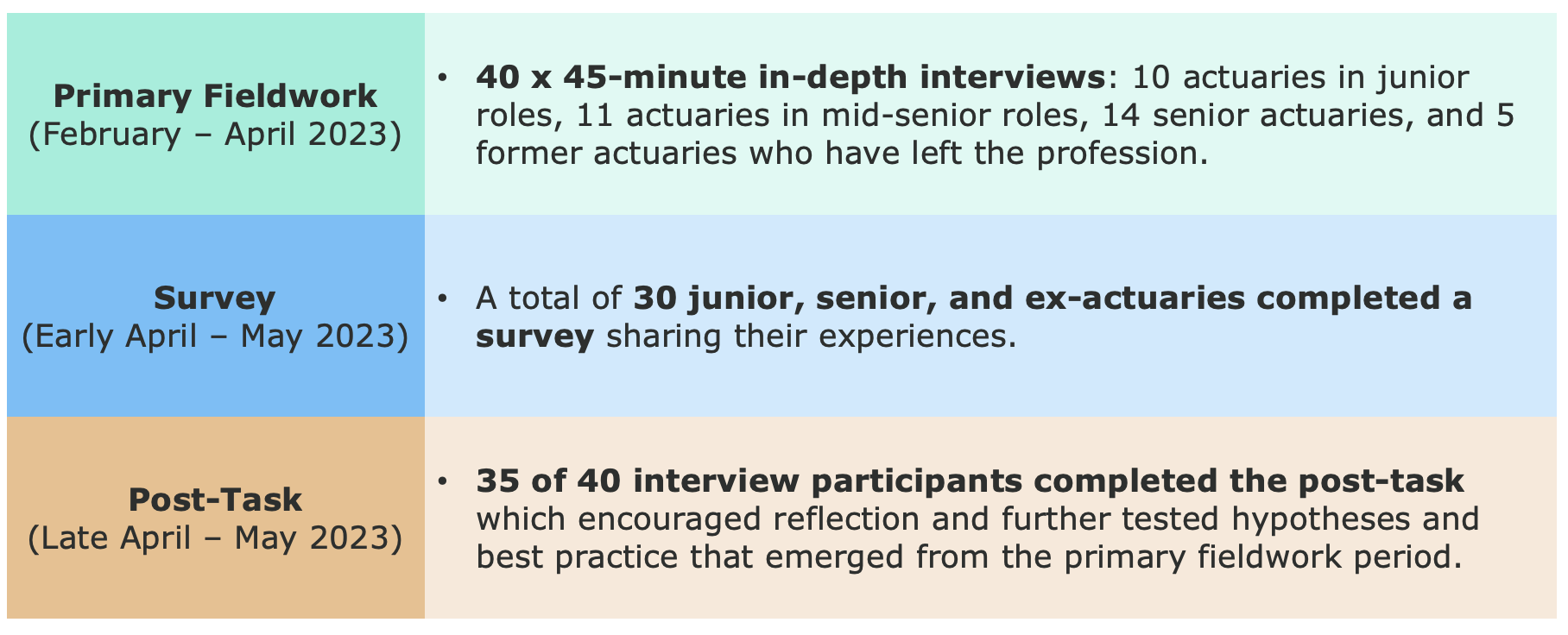
We engaged with a total of 70 junior, senior, and ex-actuaries.
To collect a wide range of views and experiences, the sample was split by level of seniority and gender. Greater emphasis was placed on speaking with senior actuaries and with female actuaries, as these conversations gave a deeper insight into the barriers female actuaries face throughout their careers. We also included male actuaries in the sample, to ensure we captured an understanding of how male colleagues perceive gender imbalance in the profession. For this research, participants were asked their gender and our findings are based on their responses.
To reflect the typical career path of the profession, junior, senior, and ex-actuaries have been categorised and defined during recruitment processes and throughout this report as below.
| Actuary Type | Qualification Status | Experience Level |
|---|---|---|
| Junior Actuaries | Graduates / Students | ≤ 3 years' experience* |
| Junior Actuaries | Part Qualified | 5-11 exams (of 13) completed |
| Junior Actuaries | Nearly Qualified | 11-12 exams (of 13) completed |
| Junior Actuaries | Qualified (Fellowship) | ≤ 2 years ago* |
| Mid-Senior Actuaries | Qualified (Fellowship) | ≥ 2 years ago* but ≤ 15 years ago* |
| Senior Actuaries | Qualified (Fellowship) | ≥ 15 years ago* |
| Ex-Actuaries | Individuals who have left the profession |
* As at the time of interview
The primary fieldwork stage
- For the primary fieldwork stage, we conducted 40 x 45-minute in-depth interviews with trainee, qualified, and ex-actuaries.
- Interviews offer a significant level of anonymity and allow us to collect a breadth of primary evidence.
| Level | Gender | Target | Completed |
|---|---|---|---|
| 1. Junior | 1. Female | 10 | 7 |
| 2. Male | 3 | 3 | |
| 2. Mid-Senior | 1. Female | 8 | 9 |
| 2. Male | 2 | 2 | |
| 3. Senior | 1. Female | 8 | 10 |
| 2. Male | 3 | 4 | |
| 4. Ex-Actuary | 1. Female | 4 | 3 |
| 2. Male | 2 | 2 | |
| Total | 40 | 40 |
- In these interviews, we explored the following areas with participants:
- The gender make-up of their firm and the profession more broadly.
- The impact, if any, of gender on career progression.
- The impact, if any, of gender on the culture in their firm and in the profession more broadly.
- Examples of when gender impacted experiences at work.
- What best practice looks like in terms of supporting women to progress to more senior actuarial positions.
- Of the 30 non-junior actuaries interviewed, their expertise is predominantly in pensions and insurance, with a few working in other sectors.
| Expertise | Sample |
|---|---|
| Pensions | 16 |
| Insurance | 8 |
| Other | 6 |
| 30 |
Survey
- Due to the significant number of participants responding to take part in this research beyond the agreed sample of 40, a survey was developed and shared with actuaries and ex-actuaries who expressed an interest in sharing their experiences, but whom we were not able to interview.
- Taking place after interviews had been conducted, the survey enabled us to build on our insights and probe emerging findings.
- We received responses from a range of seniority levels as broken down in the table below:
| Level | Gender | Completed |
|---|---|---|
| 1. Junior | 1. Female | 4 |
| 2. Male | 3 | |
| 2. Mid-Senior | 1. Female | 8 |
| 2. Male | 2 | |
| 3. Senior | 1. Female | 9 |
| 2. Male | 3 | |
| 4. Ex-Actuary | 1. Female | 0 |
| 2. Male | 1 | |
| Total | 30 |
Post-Task
- All participants who took part in an interview were sent a post-task activity to verify findings.
- Of the 40 interviewees, 35 completed the post-task with a breakdown outlined below:
| Level | Gender | Completed |
|---|---|---|
| 1. Junior | 1. Female | 5 |
| 2. Male | 2 | |
| 2. Mid-Senior | 1. Female | 9 |
| 2. Male | 2 | |
| 3. Senior | 1. Female | 9 |
| 2. Male | 3 | |
| 4. Ex-Actuary | 1. Female | 3 |
| 2. Male | 2 | |
| Total | 35 |
3. Current state of gender balance in the actuarial profession in the UK
Data collected by the IFoA in 2019/20 revealed there is a gender imbalance among actuaries across the profession.4 Prior to this, an IFoA report published in 2015 evidenced that while gender make-up is mixed at graduate level, this drops off during the route to qualification and progression to more senior roles, with many female actuaries leaving the profession in their thirties and forties.5
This 2015 Report revealed that the average age of non-retiree females who have chosen to leave the IFoA in 2014 was 40, compared with the equivalent male age of 53. However, the reasons for women leaving the IFoA earlier than men were not well known. As such, this research illuminates the barriers that prevent women from staying in the profession and progressing to more senior positions.
This chapter will explore actuaries' perceptions of the profession, and how the culture is felt to be changing. The barriers which impede women entering and progressing through the profession will be explored in detail in chapters 4 and 5.
3.1 Wider perceptions of the profession
During the qualitative in-depth interviews, and in the survey, we asked actuaries who participated in the research to describe the profession using three words. This word cloud illustrates how those within the industry view the profession:
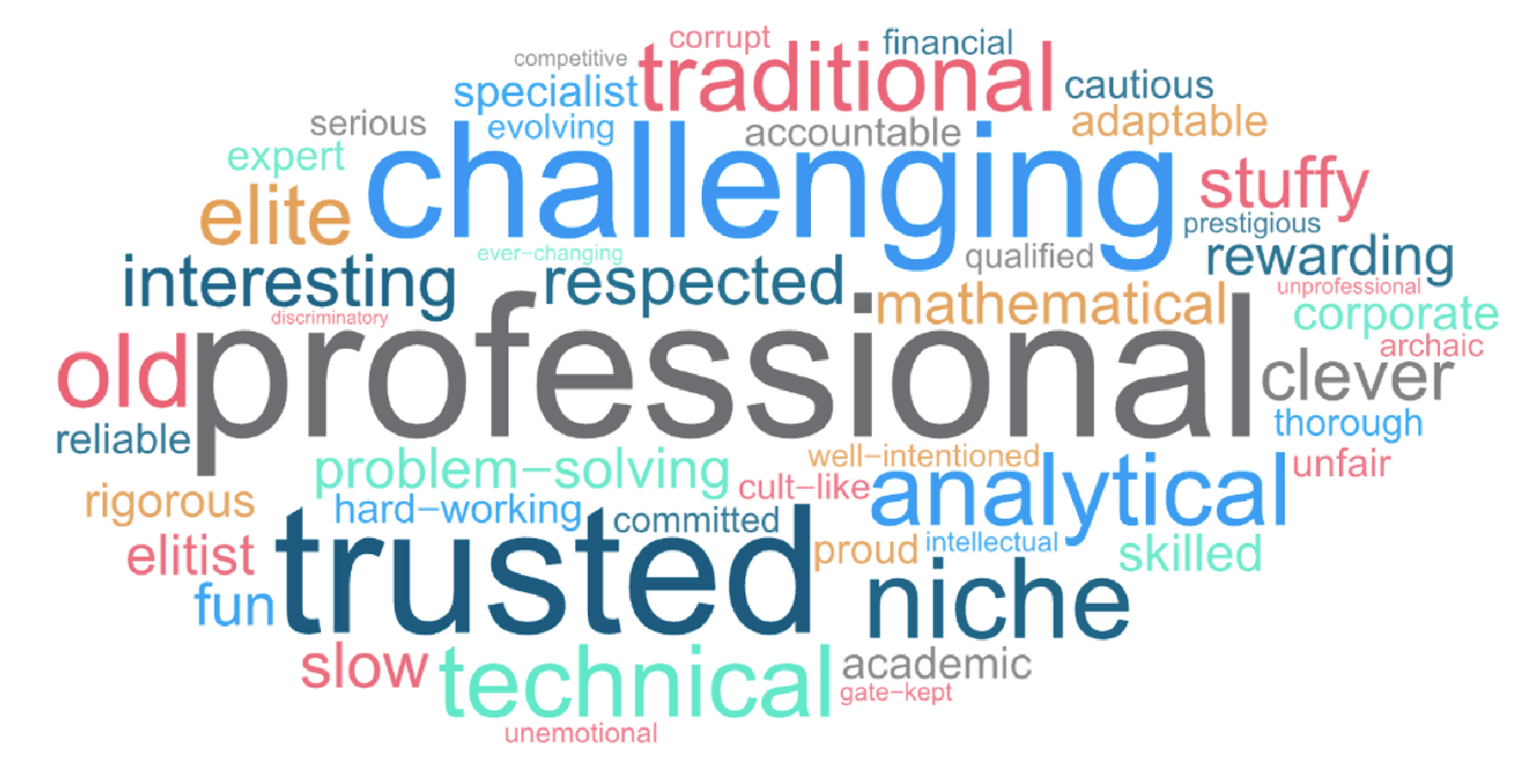 N=32 (participants were asked to describe the actuarial profession using three words, as a result the total number of words included equals more than 32)
Most actuaries who participated in the research describe the profession in positive terms, with the most common words being professional, challenging, and trusted. This suggests that while actuaries acknowledge the work is difficult, they take pride in their ability to carry it out, and in the standards the profession upholds. The more negative responses – traditional, stuffy, old, and slow, point to a culture within the profession which feels resistant to change or modernisation. However, there is the perception that the culture is changing slowly but surely:
-
Conversations on gender imbalance are taking place. In the face of long-standing barriers to female progression through the profession, there is an acknowledgement that some progress has been made in recent years. Senior actuaries view the younger generation as more attuned to these issues and hope this will be reflected in the industry going forward.
> “From what I've seen, it feels like the newly qualified generation might bring a shift to the culture. I think gender balance is in the forefront of their minds.” (Mid-Senior actuary, female)
-
There is a sense among actuaries interviewed that Diversity and Inclusion (D&I) initiatives, particularly in larger firms, are making the industry more accessible to people from a range of backgrounds. As such, they feel that representation of women, and people from ethnic minority backgrounds, is improving with time.
> "I think things are a lot better now, and certainly in the larger firms, where my experience is. These firms have a clear D&I agenda and have a diverse population of colleagues from different backgrounds, not all actuaries, helping them to build more integrated structures.” (Senior actuary, female)
3.2 Gender imbalance in the profession
In 2021, the IFoA conducted a diversity monitoring survey which was sent to all members.6 Although based on a low response rate, and as such not necessarily representative of the membership at large, the findings indicated a marked decline in the proportion of female respondents in higher age bands in the UK, compared with non-UK respondents. This evidence would be consistent with previous research suggesting that women leave the profession mid-career.
A 2015 survey conducted by the IFoA suggests that the presence of women in senior actuarial roles is relatively low, with only 10% of women in the profession surveyed feeling that it is easy to rise up the ranks as actuaries7. Corroborating this, compared with male respondents both in and outside the UK, there are still significantly fewer female actuaries who are Partner or C-level position in 2021.
Several factors are seen as contributing to gender imbalance in the profession. During the in-depth interviews, actuaries who participated in the research identified a range of factors spontaneously. The post-task activity provided an opportunity for participants to rank the factors identified, picking a top three which they felt had the most significant impact on gender imbalance in the profession. The interchanging factors that are felt to contribute to gender imbalance in the profession are explored in greater depth in chapters 4 and 5.
4. Impact of gender entering the actuarial profession and through the route to qualification
During their journey through the actuarial profession, women face a range of gendered barriers, which for the most part, hinder their progression to more senior positions. This section will set out the barriers faced upon entering the profession - starting in school, through the route to qualification, while the following chapter will explore barriers to progression within the profession.
4.1 Entering the profession
Actuaries interviewed describe a range of barriers which impede women's opportunities to enter the profession. These barriers are seen to begin at school, with fewer women opting to study Science, Technology, Engineering, and Maths (STEM) subjects, and continue during the recruitment and entry level stages.
-
A wider gender imbalance in STEM: Among male and female actuaries interviewed, it is felt that gender imbalance in the actuarial profession starts at school, with girls being traditionally less likely to opt for, or be encouraged to take up, STEM subjects. As a result, there is a sense that the pool of women to choose from at the recruitment stage is smaller, because women are less likely to have degrees relevant to the profession.
> "One barrier which comes very early doors is getting women into maths at A-level. As a school governor, we notice that getting girls interested in maths is a challenge, and it comes from a perception that women don't do maths.” (Senior actuary, male)
-
A lack of awareness about the actuarial profession: Participants reflect that most people haven't heard of the actuarial profession, and there is a sense that most become aware of it through word of mouth. Participants describe having initially heard of the profession themselves through friends or family members, who are likely to be male due to the current and historic gender make-up of the profession. As a result, this is more likely to encourage other males to consider the industry and lead to a smaller pool of female candidates at entry level.
> “It's an unusual profession – it's not a well-known role. There is a limited pool of us. It's not something that people have heard about." (Senior actuary, male)
-
Unconscious bias at the recruitment stage: In a predominantly male-dominated profession, male-only interview panels are not uncommon. Unconscious gender bias, unintentional and automatic mental associations based on gender which stem from traditions, cultural norms, values, and experiences, can unfairly advantage men applying for entry level roles.
> "I had an interview where I was talked down to like I was the interviewer's granddaughter. He didn't treat me like a professional, he treated me like a child, calling me 'sweetheart'... I didn't take the job.” (Mid-Senior actuary, female)
Senior women in the profession reflected on experiences of interviews earlier in their careers (in the 1980s and 90s primarily), with some giving accounts of being asked if they were looking to start a family during an interview. While this line of questioning is illegal in our current day, this goes some way to explain the lack of a historical pipeline for senior female appointments.
Case study: Junior actuary, female
Louise* joined the actuarial profession a few years ago, moving from a different industry altogether. She has been working at a consulting firm to gain experience, whilst she studies to progress through the qualification pathway, and hopes to be fully qualified in a few years. Louise had some concerns entering the profession, as friends in similar roles had struggled to juggle the demands of the job with their caring responsibilities at home.
As a working mum, Louise feels like the increased acceptability of remote and flexible working in the wake of the pandemic has helped her manage her competing responsibilities. Being able to spend more time at home, and not being expected to travel last-minute, she feels able to work, study, and care for her children – feeling that this wouldn't have been possible pre-pandemic.
Having a maths background, Louise feels that more girls should be encouraged to opt for STEM subjects at school and university. She feels that addressing the underrepresentation of women in STEM would go some way in improving gender balance and representation of women within the profession.
> "I was more nervous about going into this career as a working mum. Particularly pre-Covid, I had friends in similar roles, and they were expected to travel anywhere at any time and there wasn't a lot of flexibility, so I was nervous going into something where it might not work out with my caring responsibilities. I do think that's changed a lot with remote working now, and different expectations of face-to-face and how people travel. It was a big factor in making that change and feeling like it will work out.”
*All case studies have been given pseudonyms and any identifiers changed to protect the anonymity of participants who have taken part in this research.
4.2 The route to qualification
Actuaries interviewed feel the route to qualification is long and arduous, and that this has a disproportionate impact on women studying to be actuaries. The gendered barriers impeding the route to qualification are outlined below.
-
A lack of flexibility around caring responsibilities: To qualify as an actuary, it is necessary to undergo a rigorous examination process over the course of several years. Women are more likely than men to have caring responsibilities which they must juggle with their studies, which is felt to impact their ability to qualify as quickly as their male peers.
> "Whether we like it or not, women tend to take on more caring responsibilities. With all my friends as well as colleagues – women still do more traditional things in society, and I think that makes it harder. My mother is in a care home with dementia, and I'm the only person who visits her. To do that alongside a demanding job and not feel like you're letting everyone down is difficult – I don't think men feel guilty in the same way.” (Senior actuary, female)
-
Incompatibility with career breaks: Within the profession, the intensity of the exams is felt to make it difficult to start a family during the qualification process. There is an assumption among actuaries who participated in this research that women will wait until after they have qualified to have children – due to taking time off being incompatible with the necessary studies. There is a sense amongst those who participated in this research that this is an outdated structure, and that the qualification system is in need of modernisation.
> "[The] extreme exam system favours those with no social lives or hobbies... very family unfriendly." (Junior actuary, male)
5. Impact of gender on progression through the actuarial profession
Actuaries who participated in this research identified multiple barriers which they felt inhibit women's progression to more senior positions and are not experienced by their male peers. This results in a 'drop off' of women mid-career, or their careers stalling ahead of reaching senior positions. This chapter will explore the barriers to career progression in depth.
5.1 A lack of representation
Lack of representation of women in the industry is identified by actuaries who participated in this research as an inhibitor to opportunities to learn from others and see attainable goals to work towards. This is felt to act as a barrier both within organisations and the actuarial client base.
-
A lack of representation of female actuaries in senior positions: Junior actuaries highlight the importance of having women in senior positions in their organisations that they can look up to and learn from. While senior women noted there are more women in senior positions now than when they entered the profession, this is undoubtedly an area where there is felt to be room for improvement. Additionally, some senior women reflected on a feeling of competitiveness among women `at the top', as there isn't always felt to be room for multiple women to thrive at the senior level of an organisation. Evening out the gender balance in senior positions was identified as a potential lever to help to dispel this feeling.
> "I was championed in my first job, effectively mentored by a senior lady who was a great help to me. I think the more senior women in an organisation, the more younger women can aspire towards those positions.” (Senior actuary, female)
-
A lack of diverse clients: In the in-depth interviews, actuaries in client-facing roles described a predominantly male client base. This is especially the case for trustees in pension schemes, who interviewees perceive as tending to be older, white men. Female actuaries reported that male clients often seem to prefer to work with male actuaries, making it feel more difficult to build trusted relationships with these clients as a woman. In meetings with clients, female actuaries described being talked down to, ignored or a male colleague's point being taken more seriously than their own.
> “I have experienced policyholders not wanting to talk to females because they don't think they will understand technical queries or have the responsibility to deal with complaints.” (Senior actuary, female)
Digging deeper into this perception in the post-task, actuaries described client feedback as a key element of being considered for promotion. Challenges in building these relationships can lead to client feedback which was felt to undervalue the work of female actuaries compared to male actuaries on the same client team.
> "Client feedback is obviously a large indicator of performance, which is the main factor of consideration for promotion. However, male clients can be more dismissive of women's achievements, particularly young women. This can lead to client feedback undervaluing the work of a woman comparative to that of a man, which in turn makes progression harder.” (Junior actuary, female)
5.2 Impact of caring commitments and career breaks
Having a family is felt to have a significant impact on career progression. Caring commitments, extended career breaks such as maternity leave, and flexible or part-time working are all more likely to be taken up by women and not felt to be supported within the current structure of the profession.
-
A lack of understanding of caring commitments outside of work: Across genders, actuaries note that the profession is renowned for having a poor work-life balance. This is felt to have a disproportionate impact on women, who are more likely than men to have caring responsibilities outside of work – such as looking after elderly parents or children. While this is true of the labour market more generally, female actuaries point to long working hours, business calls that happen late at night, and occasional travel at short notice as making it particularly difficult to balance caring commitments with working in the actuarial profession.
> "There are also clearly challenges for anyone who chooses to combine their career with raising a family, and these do influence progression opportunities. Though these challenges affect men making this decision as well as women, it will have a disproportionate impact on women who do the majority of the caring role." (Senior actuary, female)
Senior women in the profession are open about having to rely on their partners to take responsibility for domestic labour and childcare. While this arrangement works for some, others reflect that it makes senior positions feel out of reach for their lifestyle.8
> "It's easier if you have a partner who does a lot of stuff at home – without a supportive partner I wouldn't have been able to do the job I've been able to do.” (Senior actuary, female)
-
The impact of career breaks such as maternity leave on progression: Among both male and female actuaries interviewed, career breaks are felt to significantly impact actuaries' progression through the profession. This has a disproportionate impact on women, who are more likely to take extended career breaks – namely maternity leave. There are some industry-specific reasons why career breaks are felt to have a significant impact on progression opportunities. Examples include:
- Legislation necessitating one named practising certificate holder on an account requires women going on maternity leave to hand over the role of named actuary, often leaving them with no clients to return to.
- The requirement by the IFoA for people to evidence personal and professional development9 each year impacts women who have taken time off for maternity leave. This was particularly the case before 2019, when actuaries were required to evidence two hours' formal learning per year over 36 months in order to apply for a fellowship. Since 2019, actuaries have been required to evidence two hours' formal learning over a period of 12 months in order to apply for a fellowship, minimising this particular barrier.
> "Career breaks are a big barrier. You have to restart convincing people you're worthy of that step up [to a more senior position]. It takes a while to reacclimatise.” (Junior actuary, female)
Female actuaries who had been in this position described returning from a break as feeling like restarting their careers. In most cases, an actuary has handed their portfolio over to a colleague prior to taking an extended period of time off, with no expectation of this portfolio being returned to them when they resume work. Those returning from career breaks are often given 'bottom of the barrel' projects, rather than risk upsetting a client by changing an appointment on an account a second time. This inevitably leads to a lack of opportunities for those returning from breaks such as maternity leave.
As a result, some female actuaries interviewed report delaying starting a family or deciding not to start a family due to the negative impact they feel it will have on their career progression.
> "When you leave a scheme, you have to officially resign from them. When you come back, you have to get new appointment letters signed and people are afraid of it and upsetting the clients." (Senior actuary, female)
Audience box out: Male actuaries
While male employees are able to take advantage of shared parental leave policies, there is not always an organisational culture that supports them in feeling able to take this offer up.
> "Unless there was a widespread shift in the expectation for men to take less time off work, it won't change. With men being given less time off work, that barrier will always exist.” > (Mid-Senior actuary, male)
-
Challenges in flexible and part-time work patterns: When returning from maternity leave or dealing with caring responsibilities, some female actuaries told us about moving to part-time work. This is felt to come with its own challenges, with interviewees describing commonly working outside their contracted hours, needing to be available to clients regardless of their working patterns and being passed over for promotion opportunities due to working less hours than their male colleagues. Attempting to stick to contracted hours is seen as at the detriment of progressing in your career.
> "I work part time, so three days a week. But in practice, I probably end up working four days a week.” (Senior actuary, female)
Additionally, while flexible working and working from home has become more popular since the pandemic, this can be a double-edged sword. While this flexibility is likely to support women who are balancing caring responsibilities, some actuaries identify informal networking opportunities and the building of relationships by coming into the office. There are concerns that by taking advantage of flexible, work-from-home policies, female actuaries may miss out on opportunities to build relationships with senior colleagues and be less likely to be put forward for progression opportunities as a result.
> "Out of the pandemic, work from home policies have helped women with family responsibilities. That was fine when it was needed, but a lot of men have started going back into the office and are able to have those chats and do the self-promotion in the office. There's a danger that women will work from home when they can and not realise it won't help their career progression.” (Senior actuary, female)
Case study: Ex-actuary, female
Grace* left the actuarial profession a few years ago. Grace worked as a pensions actuary and after having a child, came back to work part-time. She had hoped she would be able to pick up where she had left off and continue to progress in her career while working part-time. However, she found that she was given 'easy' tasks that were below her capabilities and less difficult than work she had completed prior to going on maternity leave.
To balance caring for her son, as well as additional caring responsibilities for a family member, Grace requested flexibility to work from home. However, her boss suggested instead she dramatically reduce her hours. Grace felt with this further reduction she would be unable to progress in the industry and didn't feel she had been listened to in terms of what would work best for her in balancing her commitments.
Grace sees these events as directly correlated to her leaving the profession.
> "I came back and it was great, but then within 3 weeks they gave me the easy jobs – almost in people's minds they were placing me on the mum path... People make assumptions on what's best for you without asking, that this is what a mum with a two-year-old wants, or this is what a newly married woman wants."
*All case studies have been given pseudonyms and any identifiers changed to protect the anonymity of participants who have taken part in this research.
5.3 Access to progression opportunities
A lack of transparency and self-belief are identified as hindrances to accessing opportunities for promotion in the actuarial profession. A perception that promotion opportunities are 'handed out' by seniors in the profession to those they have good working relationships with, rather than opportunities you formally apply for, can make it challenging to advocate for oneself.
-
A lack of transparency around progression opportunities: Female actuaries describe a pervasive unconscious bias of male bosses rewarding employees who 'remind them of themselves'. This can lead to letting these employees know about promotion opportunities that have not been formally advertised, or senior colleagues lining up more junior colleagues to take over their role upon retirement. The lack of transparency around these opportunities contributes to an environment where, perhaps unconsciously, senior males in the profession are felt to seek to support those who are most like them.
> “When you get to more senior levels, managers are looking for people similar to them. They tend to be older and are looking for people that behave like them.” (Mid-Senior actuary, female)
-
Internalisation of barriers: In accessing progression opportunities, actuaries reflect that the more senior you become, the more you need to advocate for yourself and proactively seek out opportunities. However, female actuaries describe challenges they and other female colleagues encounter with this. For example, doubting their ability to fulfil the full breadth of requirements of more senior roles, whereas male colleagues are felt to be more likely to apply for the role regardless of whether or not they meet the entirety of the requirements. This is supported by evidence from the wider labour market, which reveals there is a gender gap in self-promotion – which reflects an underlying gender gap in how individuals evaluate their performance10. Women subjectively describe their ability and performance to employers less favourably than equally-performing men.
> "I've seen barriers in asking for promotion, I've seen females struggle to push for that. To be promoted you have to meet certain criteria and tick certain boxes... Women feel like they have to tick every box to put themselves forward, but men maybe only tick two thirds.” (Senior actuary, female)
Audience box out: Male actuaries
In line with their female colleagues, most male actuaries interviewed report that gender has an impact on progression to more senior roles. However, some caveat that some barriers, including women going on maternity leave or taking on more caring responsibilities, are not exclusive to the industry. Additionally, statements about the natural reasons women will take career breaks point to the continued perception that women are the main caregivers for their families and are more likely to take extended career breaks for this reason, than male colleagues.
> "Higher up, I have no idea of the sub-conscious biases, but there certainly is a gender imbalance higher up... There are natural reasons as to why women might step away from a career for childcare, and I assume that is a natural undertaking. I've seen many examples of people taking career breaks for lots of reasons. I think it does impact your career progression. It's a decision to invest in your family rather than your career, and that is a choice that people have to make.” > (Junior actuary, male)
However, some other factors, like the onerous qualification process, and the requirement to have a named individual on an account (and having to hand over the role of named actuary when taking a career break), are felt to be exclusive to the profession:
> “The main area where I see there being a challenge is where law requires you having a named individual.” > (Senior actuary, male)
In response to the survey, the anonymity of respondents gave rise to some more candid responses than the interviews. While one respondent said that there are no gender barriers within their particular firm, another argued that Diversity and Inclusion initiatives within the industry 'positively discriminate' against men.
> "Being female is advantageous over being male for progression (at least at the junior/mid-level) for many reasons, particularly due to a desire to 'balance' genders at meetings, events, webinars and at senior levels.” > (Junior actuary, male)
6. Impact of gender on culture in the actuarial profession
Throughout the research, participants shared experiences of how and where they feel gender impacts the culture of their workplace and the actuarial profession more broadly. These experiences include having to justify your presence in the workplace, feeling male personality traits are rewarded and navigating challenging networking events and drinking culture in the workplace.
6.1 Impact of gender on culture and working practices
The impact of gender on office culture and working practices was evident throughout the primary research. Participants shared with us how they felt this impacted the opportunities women are able to access, in terms of furthering their careers. The following themes are drawn from across the interviews, survey, and post-task:
-
Having to justify your presence: Female actuaries describe to us often being the only woman in the room, and feeling pressure to show they can work harder and
do morethan male colleagues to justify their presence. Common experiences include being spoken over in meetings, being made to explain your role in a meeting, or needing to defend a point you have made to a greater extent than a male colleague would be asked to.> "I am very often the only woman in the room and very often have to defend my own credentials when a man wouldn't be asked to the same... Often in meetings more senior male colleagues will speak up on my behalf to defend my point or lend weight to my arguments, but they don't publicly acknowledge that I face more resistance than my male counterparts. They individually support me, but I don't think they recognise gender bias.” (Mid-senior actuary, female)
-
Rewarding 'male' personality traits: Within the industry, female participants describe personality type as significant in the relationships they are able build in the workplace and the opportunities they have access to. The dominant personality type in the profession is described as
alpha maleandloud, with participants feeling that opportunities tend togo to the loudest person in the room. Many female participants note finding it difficult to put themselves forward for opportunities and speak about their own accomplishments, instead highlighting their strengths in working collaboratively and supporting more junior colleagues. However, these aren't felt to be rewarded in the same manner.Other female participants feel that personality traits that are seen favourably among male colleagues are critiqued when they display them themselves, such as confidence and assertiveness.
> "I think the profession values what people traditionally think of as male values like people standing up in front of a room and speaking, expectation of confidence, quite competitive. Females tend to be a bit more collaborative.” (Senior actuary, female) > > "I've been fed back that I'm too confrontational and all the women in the team got that same feedback, but none of the men did." (Mid-Senior actuary, female)
-
Challenging conversations: Some actuaries also reflect on the challenges they have had in the workplace as a result of conversations about the impact of gender in the profession. Female participants share experiences of being met with resistance from male colleagues who feel as though discussing the impacts of gender negates the work that they have also put in to make it in the profession. Where this is the view amongst men in the company, it can make for a challenging culture and a lack of understanding of the unique barriers women face in the profession.
> "I think it's a difficult conversation to have because men don't want to feel like they haven't worked as hard as their female counterparts.” (Junior actuary, female)
-
Misogynistic behaviour and sexual harassment: Some female participants also told us about experiences of misogynistic behaviour and sexual harassment at work. For example, both female and male participants discussed feeling as though assumptions were made that female colleagues in their 20s and 30s may have children and this could impact the opportunities and new roles they receive (despite this being illegal). Others shared being excluded from social activities on the basis of gender, gendered comments being made about their personality types, and being encouraged to take an interest in topics their male colleagues would find interesting in order to 'fit in'.
At the more severe end of the spectrum, some also shared historical experiences of sexual harassment, including being propositioned by senior male colleagues. Senior women in the industry spoke about this being not an uncommon experience when they were starting out in their careers in the 1980s and 90s, with the perception that this is no longer as common in the industry in the present day.
> “There is still very much a view of 'if we give this job to a woman, when are we going to have to get a replacement when she goes off on mat leave'.” (Mid-Senior actuary, male) > > "I've experienced serious sexism at work. I joined in November and at the Christmas party I was told I couldn't sit at my table because they were 'having a boys' night'. My manager, who is a woman, told me to go and watch football so I'd fit in more... If you say anything you're seen as hormonal or aggressive, there's no calling out. You're seen as difficult, and people won't work with you." (Junior actuary, female) > > “I have been threatened at work. I was propositioned by a senior man, who was married, as was I. I told him what I thought his wife might think of that and he said if you tell anyone, your career will be finished.” (Senior actuary, female)
Audience box out: Male actuaries
While all female actuaries pinpoint aspects of workplace culture within the profession that are impacted by gender, the response from male actuaries is more mixed. Some of the male actuaries who participated in this research readily acknowledge the impact of gender on culture, for example noting that project teams with only male colleagues tend to have a different style of working and tend to be less collaborative.
> "I've been on projects with only other men and they're less nice to work on. There's a lot less compassion for the team. On calls with older blokes, there are some terrible things that are said, misogynistic talk.” > (Junior actuary, male)
Others acknowledge gender is likely to impact culture within the profession when prompted, but also state that it is not something they have previously thought about or noticed.
> "I'm sure [gender impacts culture] but I'm also sure I notice it less because I'm a man. I would find it difficult to explain in what ways [gender impacts culture].” > (Senior actuary, male)
6.2 Impact of gender on socialising and networking opportunities
Beyond working culture, participants feel gender has a significant impact on their ability to socialise with colleagues and take part in both formal and informal networking opportunities.
-
Formal networking opportunities: Formal networking opportunities are described as 'stuffy' and 'exclusionary', often taking place at fancy hotels and restaurants. These events are predominantly male, with female actuaries describing instances of being mistaken for
briefcase holders, and secretaries at these events. In addition, participants across genders described feeling excluded at these events on the basis of class, ethnicity, or religion. Expensive venues and dinners make some feel self-conscious of different economic backgrounds, while those who don't drink for personal or religious reasons describe feeling uncomfortable with the heavy amount of drinking that often takes place at these events. These feelings are expressed across genders, pointing to the intersectionality of ways in which people may feel excluded in this professional environment.> "It's not uncommon for women to be a minority at work events with the sole woman occasionally being referred to as the 'token woman'. I know a colleague who is a qualified actuary who was referred to as 'the partner's girl' when the only female at a thank you dinner after a cross-departmental project.” (Mid-senior actuary, female)
-
The 'Boys' Club': As the actuarial profession has traditionally been predominantly male, female participants point to the extra opportunities for networking that male actuaries have in cases where their fathers, uncles, and other male relatives or family friends have been involved in the profession. Combined with a perception that men from elite universities are funnelled into the profession, and have relationships in place from attending these universities, this can make attending networking events intimidating across both gender and economic class.
> "The Oxbridge club at the top is a barrier for anyone progressing if you don't come from that background. I didn't know some of the social etiquette and they often have a better network from knowing people from Oxbridge. They have an easier time knowing about opportunities because people in the profession will tell you about these through their networks. A lot of them know someone through their fathers for example.” (Ex-actuary, female)
-
Social opportunities: Social opportunities are often felt to revolve around drinking and late evenings in pubs and bars. Female participants told us these social events can be difficult to take part in, with male colleagues often dominating the conversations with common interests that some female participants didn't share, and late evenings being difficult to manage around family or caring responsibilities. Participants feel informal networking often takes place during these events, with some mentioning friendships that are formed between junior and senior male colleagues, that are felt to be harder to cultivate as a woman in these environments.
> “There's still a lot of networking that's done in the evenings and in the pub which is anti-women and anti-some cultures as well. The reality is women that have families take on the majority of family responsibilities and are getting excluded from networking.” (Senior actuary, female)
Case study: Junior actuary, female
Vi* has been working for her current organisation for four years. She is working towards qualifying and is ambitious, hoping to become a senior in the industry.
Vi is currently the only female in her team and feels she has a difficult time relating to her male colleagues. Additionally, Vi moved to the UK a number of years ago and doesn't drink, making it difficult for her to participate in socials in her team which often revolve around going to the pub.
She reflects that she doesn't feel as though she has a support system at work and tries not to feel demotivated when she sees her male peers building relationships with senior male colleagues in the firm.
> "There was a new joiner lunch that we had recently. We went out for lunch and as we were walking, there were groups of people who were chatting and talking but for me, it felt like a long journey because there was nothing for me to chat about to them. When we reached the venue, they spoke about football... I don't speak to any of my colleagues outside of work, I don't feel excited to go into the office.”
*All case studies have been given pseudonyms and any identifiers changed to protect the anonymity of participants who have taken part in this research.
6.3 Perceptions of a changing culture
Despite barriers in working and social culture, there is some recognition of positive changes to the professional culture in recent years. Ex-actuaries and those in senior positions reflect on where the profession feels different to when they began their careers, noting that the more balanced spread of genders across junior actuaries is likely to be contributing to positive changes in culture.
> “From what I've seen, it feels like the newly qualified generation might bring a shift to the culture. I think gender balance is in the forefront of their minds.” (Mid-senior actuary, female)
> "At partner level it's about 60/40 male/female. When I first joined the team in 2008 all of the partners were male. I think the shift in senior gender split has led to a much more approachable culture internally and a better balance of social events outside of work." (Senior actuary, female)
Junior actuaries also see hope for the future, with some noting that the culture of their organisations is better than they expected it to be. A sense of comradery among colleagues at this junior level is important in building a positive working environment. However, these same participants note there is still more work to be done in building a more inclusive workplace culture, with social activities likely to be male-oriented and a gender disparity still likely to exist at more senior levels.
> "I haven't felt like it's a boy's club which is a pleasant surprise. People will go to lunch together and play games... Although most of our socials are stereotypically male events like axe throwing or go karting. Things do get quite competitive at those events.” (Junior actuary, female)
7. What 'good' looks like
Throughout the research, we asked participants what good looks like in supporting female colleagues to progress to more senior actuarial positions. Participants shared examples of good practice they have seen in the profession, as well as measures they hope to see in the future.
7.1 What does current good practice in the profession look like?
Firms are felt to be introducing initiatives to improve gender balance and diversity, and participants look to these examples as signs that the actuarial profession is changing and has the capacity to change. Examples of good practice focus on the following themes:
-
Supportive maternity leave policies: Including mentorship opportunities both before and after maternity leave and ensuring those on maternity leave are not left out of promotion processes and considerations. Participants at organisations where these policies are in place describe them as instrumental in assuaging concerns prior to going on leave and in supporting a smooth return to work.
> "We had a group coaching session before we went on maternity leave. We spoke about our concerns which was really good. I had the same concerns as another woman and we met during maternity leave to talk. I then had one-to-one coaching when I returned, it's the best support I have received." (Senior actuary, female)
Where participants have seen women on maternity leave included in promotion processes, it fosters a feeling of inclusion and signals a supportive environment.
> "At my current firm, there has been a definite drive to still actively consider women for promotion whilst pregnant – to the extent that partner interviews were carried out out of cycle so that women could be promoted to partner just before maternity leave – rather than having to wait 2 years for the opportunity again." (Mid-senior actuary, female)
-
Diversity and inclusion (D&I) initiatives: While some D&I initiatives are felt to be more successful than others, participants feel these initiatives are increasingly rising up the agenda in their workplaces. Having a diverse range of external speakers and senior members of organisations involved is felt to bring credibility to these initiatives. Where D&I initiatives recognise additional facets of colleagues' lives, such as ethnicity and religion, they are felt to be particularly effective.
> "At my previous firm I was part of a small group and there was no mix of culture. Here, I get holidays for my religion and that is very good." (Junior actuary, female)
While only mentioned by one participant as already in practice, having diverse interviewing panels (in terms of both gender and ethnicity) are felt to be a broader indicator that firms are looking to be more diverse and is encouraging to potential future employees.
> "My company has a policy that there will always be a woman on the interview panel when a woman is being interviewed. Some of those small things can help and give the impression that the organisation is trying to improve the current imbalance.” (Junior actuary, female)
-
Mentoring groups: Mentoring groups have become increasingly popular, with many female participants describing taking part in them or at the very least, being aware of their existence at their organisation. These groups cover important topics that some feel unable to speak with male colleagues, for fear of appearing unprofessional or unable to do the job, such as imposter syndrome and coming back to work after maternity leave.
> "My organisation has recently introduced a women's group for female colleagues and allocated us small mentoring groups. This has been a real help. They run online sessions with interviews with inspirational women in our industry and sessions such as 'Becoming a Scheme Actuary – is it for me?' which was really useful." (Mid-senior actuary, female)
Audience box out: Senior female actuaries
Current examples of good practice such as events with inspirational speakers and mentoring groups are all well-received by women in the profession. However, it is important to recognise the additional burden this places on senior female actuaries to speak at these events and be an active mentor, on top of their other professional responsibilities.
> "As a relatively senior woman, I am disproportionately asked to speak in events, be involved in recruitment and mentor junior women. Though I recognise the need for this, it does not always feel 'rewarded' effort and can even feel like an additional 'tariff' on being female.” > (Senior actuary, female)
It is important to strike a balance between encouraging organisations to establish these opportunities and recognising the additional work this is likely to place on senior women in the industry. Building in time for this at a senior level will help support senior women to grow these initiatives, while recognising it is additional work and celebrating the importance of it.
7.2 What could the profession learn from other industries?
Participants who have left the actuarial profession or whose partners and family members work in other fields also shared examples of best practice from outside the actuarial profession that they feel the industry could adopt:
-
Being open about family commitments at work: Female participants with children often spoke about feeling hesitant to discuss childcare responsibilities at work, for fear of being perceived as unable to put in the long hours that are often required. Female ex-actuaries with children spoke about their current workplaces having more positive conversations about this, including seeing men discuss their childcare responsibilities openly, which is felt to contribute to a more inclusive culture for women.
> "Where I am now, the culture is different. We have a lot of senior women. The attitude of my male colleagues is very good. My really senior boss, he values his wife's job equally to his. He'll rearrange meetings, and in his calendar, it will say 'picking up children from school'.” (Ex-actuary, female)
-
Having policies in place for last-minute childcare responsibilities: Female participants with children reflected on positive policies they had heard of in other industries, such as the provision of emergency childcare cover. It is felt that this would be particularly useful in the actuarial profession, where last-minute work commitments are felt to be common and can be significantly difficult for actuaries with childcare responsibilities to cover.
> "My nephew gets 15 days emergency nanny cover which means he can get his company to pay for a nanny for 15 days in a year when needed. These sorts of enlightened policies help.” (Senior actuary, female)
7.3 What does good look like in the future of the profession?
Throughout the research programme, participants shared and built on examples of best practice to support career progression among female actuaries. The vast and varied range of ideas that emerged can be considered according to four themes:
| Theme | Best practice |
|---|---|
| Cultivation of a supportive work environment | Supportive line managers |
| Mentoring opportunities with senior women in the industry | |
| Fostering a culture where male colleagues understand and appreciate gender | |
| Colleagues being more open about commitments and life outside of work | |
| Recognition and support for better work-life balance | Male colleagues feeling able to take advantage of part-time roles and shared parental leave |
| Supportive policies for maternity leave and childcare at different points in one's career | |
| Changes in process | Improving the appointment system for the Scheme Actuary role for pension schemes to accommodate those returning from maternity leave |
| More supportive processes and culture to accommodate part-time roles | |
| Transparency in succession planning and promotion opportunities | |
| Having formalised and sensitive reporting processes in place for harassment | |
| Fostering inclusivity in the profession | Encouraging people from different backgrounds to take an interest in the profession |
| Bringing an intersectional lens onto how inequality is tackled in the profession |
Each example of best practice is explored in further detail below:
Cultivation of a supportive work environment
-
1 Supportive line managers: Line managers are felt to have the potential to make a significant difference in access to opportunities. For female colleagues who may struggle to advocate for themselves or who feel their work can go unnoticed as they aren't the
loudest in the room, a line manager who looks out for opportunities for them and encourages them to take these opportunities up is invaluable. Additionally, line managers who seek to understand their direct report holistically are felt to be particularly effective, as female actuaries cite line managers being unaware of or unwilling to understand their commitments outside of work as a barrier to them reaching their potential in work. Participants recognise both males and females can benefit from this kind of line management and feel both male and female line managers can take on this active role.> “I believe line managers play a pivotal role and should be recruited/selected with the same due consideration as appointing a client lead. Everyone deserves someone who will coach them, challenge them, and champion them. It's also how organisations would get the best out of their people.” (Senior actuary, female) > > “I think flexibility is key and giving individual managers the autonomy to work with their reports to find something that works for them. This can apply to working patterns, but also role development opportunities. Helping colleagues develop into roles that benefit from their skill set rather than having a one size fits all career path is key.” (Senior actuary, female)
Participants are looking to see line management training in their organisations and this role to be taken seriously by those who are appointed, with dedicated time to support their direct reports.
-
Mentoring opportunities with senior women in the profession: As above, mentoring groups and relationships are a significant part of professional life. For women in the industry, mentoring groups can serve as a space where different working styles are explored and validated, dealing with topics such as imposter syndrome and how to succeed when working part time.
> "Groups allowing topics like imposter syndrome to be explored without being intimidating. Recognition of non-standard development approaches as well.” (Senior actuary, female)
Just as important is recognising the time and effort it takes for senior women to provide these opportunities. Ensuring senior women have time to provide mentoring opportunities and junior women have time to take them up will be key to the success of these initiatives.
-
Fostering a culture where male colleagues understand and appreciate gender: There is a perception that firms are increasingly speaking with female colleagues about the challenges they face and how to overcome these, but that men have been left out of the conversation in some instances. In some cases, this has led to male colleagues feeling resentful of women achieving certain opportunities. Bringing men into these conversations is felt to be an important step in fostering a more inclusive culture. This is particularly important where diversity initiatives may be in place, to ensure colleagues whose identities are currently under-represented do not face backlash from male colleagues when reaching senior positions.
> "On our staff survey we get angry comments from white males saying it's all woke nonsense, and they can't get a job now. It's a difficult discussion, it's emotive and it does risk some people feeling they can't progress.” (Senior actuary, female)
Audience box out: Male actuaries
The anonymous platform of the survey provided the space for some male actuaries to voice this frustration, feeling that initiatives that focus specifically on supporting women to progress perpetuate gender bias, as opposed to seeking to diminish it. Comments such as these point to the importance of having open conversations with men in the profession to reach a place of understanding.
> "The worst practice is where leadership introduces support or benefits to women whilst explicitly excluding men, such as mentoring schemes only open to women rather than men, or incentive structures for managers to promote women rather than men. Such incentives are blatant sexism as they discriminate in favour of one gender over the other, relying on tilting the playing field to achieve their desired results.” > (Junior actuary, male)
-
Colleagues being more open about commitments and life outside of work: A culture of 'work-first' at many organisations leaves some female actuaries feeling they cannot discuss commitments outside of work, particularly those around childcare. Historically, senior women described feeling 'hidden' from clients during pregnancy, so as not to worry them that their account wouldn't be receiving their full attention. While this was not mentioned by female actuaries who have been pregnant in the workplace in more recent years, it likely contributed to the drop off in senior female appointments historically.
As above, ex-actuaries note that a willingness to be open about out-of-work responsibilities has been a significant change in their working life since leaving the actuarial profession. This is something current actuaries feel is beginning to be more common in the actuarial profession and would like to see be the norm in the future.
Recognition and support for better work-life balance
> "I've seen more men talk about family responsibilities, but only in the last couple of years. I think the pandemic has made a difference to what people are willing to do and working more flexibly." (Ex-actuary, female)
-
Male colleagues feeling able to take advantage of part-time roles and shared parental leave: While some mention statutory shared parental leave and additional paternity leave policies at their organisations, there is a perception that men are less likely to take advantage of these policies than women and significantly less likely to work part time after having children than female colleagues. Fostering a culture where male colleagues feel able to take advantage of these policies is felt to be an important step in removing stigma from part-time work and advancing a more supportive environment when coming back from parental leave.
> “I have a male colleague who has just had a child born with health issues but feels he can't take more than a 'normal holiday' length of paternity leave and even then, had to work to sign off deadline issues whilst within those 2-3 weeks' paternity leave.” > (Senior actuary, female)
-
Supportive policies for maternity leave and childcare at different points in one's career: As above, mentoring groups before and after maternity leave, as well as inclusion in promotion processes just before or even during maternity leave are felt to be excellent examples of steps the industry is taking toward best practice in this area. However, one area where it is felt to be particularly difficult to juggle maternity leave and childcare is during the qualification stage of the actuarial profession. Policies to support women in this, rather than the current status quo of assuming women will wait to have children until having qualified, would be welcomed.
> "If you have a child while doing your exams, there's so much drop out at this stage because exams are such a big thing. Is there anything they can do to support women at this stage? You can't just tell everyone to put off having children until they've qualified. Companies need policies for this. You need help to balance studying and childcare.” (Mid-senior actuary, female)
Changes in process
-
Improving the appointment system for the Scheme Actuary role for pension schemes: Pension actuaries note that having a named appointment for Pension Schemes makes taking parental leave difficult, as they must withdraw from their appointment as the pension scheme actuary, with the trustees appointing a replacement. As a result, participants describe having to give up their portfolios before taking leave (with no expectation of having the portfolio returned once coming back to work and having to build a new portfolio from scratch). Some actuaries suggest appointing a firm rather than a named actuary as one way to resolve this. However, given having a named appointment is a legislative requirement due to the onus on personal responsibility in the actuarial profession this is likely to be difficult to change. What is likely to be more flexible is the processes around handing over a named appointment, which at the moment are felt by some to involve an unreasonable amount of paperwork and process. Actuarial consultancies could ensure their policies and management allow for more flexibility for parental leave by ensuring there is not an onerous amount of paperwork to fill in when handing over a named appointment for any reason.
> "Make the Scheme Actuary role a firm appointment like lawyers, accountants, auditors, and investment consultants, not an individual appointment... It's crazy that as a more experienced colleague I was not able to [take the place of a colleague on paternity leave] even on a temporary basis without creating at best a huge amount of paperwork to transfer the role and at worst a retender risk.” (Senior actuary, female)
-
More supportive processes and culture to accommodate part-time roles: Actuaries discuss certain roles, in particular Scheme Actuary roles for pension schemes, as often requiring them to work outside of their hours if working part time. An emphasis on remaining available to the client at all times is felt to make part-time roles difficult in the profession, although actuaries recognise this is a difficulty found by many in professional occupations. Actuarial consultancies may consider whether their existing policies and team structure foster a culture which supports part-time employees.
> “Remove some of the barriers for part-time workers to become scheme actuaries.” (Mid-senior actuary, female)
-
Transparency in succession planning and promotion opportunities: Encouraging firms to advertise opportunities for promotion more widely within the organisation and actively speak to colleagues about these. Diverse groups making decisions at the senior level also signals to employees that organisations are taking D&I seriously and avoids the perception of men looking to promote over men like them.
> "Less men tapping other people on the shoulder for job opportunities. It perpetuates a cycle of just looking for someone who's like you. It's about spotting women for opportunities across the company, even for projects. Not just waiting for the noisy man who's volunteering themselves.” (Senior actuary, female)
-
Having formalised and sensitive reporting processes in place for harassment: While the majority of firms will have these processes in place, participants with experiences of sexual harassment at work feel there is more to be done in ensuring this is treated sensitively and the colleague reporting the incident remains in control and informed of their options for any next steps after reporting.
> "Clear promotion criteria, backed by a good level of diversity in the groups making promotion decisions at senior levels.” (Mid-senior actuary, female) > > "You always feel that you either have to make a huge fuss or say nothing at all... I wanted my experience [of sexual harassment] on the record because I wanted it to be acknowledged somewhere.” (Mid-senior actuary, female)
Fostering inclusivity in the profession
-
Encouraging people from different backgrounds to take an interest in the profession: Many perceive the profession as being 'hidden', with people often finding out about it from other family members who work or have worked as actuaries. Female participants point to this as repeating a cycle in which a male-dominated industry speaks to other males about the industry, with many pointing to senior male colleagues who joined the profession after having a father or uncle who is or was an actuary. Speaking at events at schools is felt to be an important part of reaching people who may not have otherwise thought of the actuarial profession as a career.
> "It reinforced your responsibility as a senior woman to be a role model and to stick with it. It's amazing how it gives you strength seeing young kids thinking, 'I could be that, I could do that'.” (Senior actuary, female)
-
Bringing an intersectional lens onto how inequality is tackled in the profession: Participants in the research share experiences of bias in the profession through multiple lenses, including gender, sexuality, ethnicity, religion, and class. This points to the need to consider people holistically and tailor interventions to support people in all facets of their identity, beyond a sole consideration of gender.
> "Intersectionality needs to be considered too. I'm a South Asian female from a working-class background working in London; I've struggled to assimilate and noticed myself moulding to fit what is deemed acceptable. People think I'm being controversial or 'too much' when I challenge injustice - this has led me to hand in my notice and move to another firm.” (Junior actuary, female)
8. Conclusions
Throughout the in-depth interviews, participants identified a number of barriers to progression for women. These barriers were put to participants in the post-task, where we asked participants to select the top three barriers which are felt to have an impact on gender imbalance in the profession.
Ranking of barriers contributing to gender imbalance in progression
A bar chart showing the ranking of barriers contributing to gender imbalance in progression. The x-axis represents the number of participants who selected the barrier, and the y-axis lists the barriers.
- A lack of representation e.g., female role models: 18
- A culture unsupportive of caring commitments: 17
- Unconscious bias impacting promotions: 15
- The gender imbalance in STEM subjects: 13
- Social events / informal networking: 11
- A culture unsupportive of career breaks: 7
- Flexible working / hybrid working: 7
- Networking events which lack diversity: 4
- A lack of awareness about the actuarial profession: 3
- The length and difficulty of the qualification process: 3
- A lack of transparency around routes to progression: 2
- Other: 2
- There are no barriers: 1
N=35 (participants were asked to select the top three barriers that can have an impact on gender imbalance in the actuarial profession, as a result the total number selected equals more than 35)
The barriers selected demonstrate a number of key themes that emerged in discussions of barriers to overcome across the research:
1 A lack of representation of women among senior colleagues is a key barrier to being able to see positive role models in the industry. Additionally, the overwhelmingly male client side of the industry, in pensions in particular, presents a unique challenge in that male clients are seen to prefer working with male actuaries. As client feedback plays a significant role in promotion, this can be a hindrance to female actuaries who may not always have the same opportunities to build relationships with their clients.
2 The actuarial profession is seen as inflexible and not conducive to part-time work, career breaks or balancing caring commitments outside of work. These are all more likely to be experienced by women, and as such lead to a disproportionate number of women leaving the profession in order to fulfil responsibilities outside of work.
3 Informal networking opportunities and social events often exclude women, due to taking part in the evenings and centring around drinking. Building relationships during these events is felt to be particularly important in a working environment where unconscious bias is perceived as impacting promotion opportunities and senior colleagues look out for junior colleagues who they see as similar to themselves to pass opportunities to.
While there are challenges with gender imbalance within the profession, particularly at the more senior level, what has also stood out in this research is the abundant examples of best practice and ideas actuaries have for the future of the profession. We compiled the examples of best practice shared in the in-depth interviews and put these to participants in the post-task, asking them to select the top three examples of best practice to support career progression that they would like to see happen in the profession.
Ranking of best practice
A bar chart showing the ranking of best practices for supporting career progression. The x-axis represents the number of participants who selected the best practice, and the y-axis lists the practices.
- Supportive line managers: 22
- Colleagues being open about commitments outside of work: 19
- Mentoring opportunities with senior women: 15
- Male colleagues taking advantage of part-time roles and shared parental leave: 14
- Supportive maternity leave policies: 11
- Diverse interviewing panels: 6
- Policies for last-minute childcare: 5
- Formalised process for reporting harassment: 4
- D&I initiatives: 3
N=35 (participants were asked to select three examples of best practice, as a result the total number selected equals more than 35)
These examples of best practice also touch on key themes in solutions proposed by participants to address the barriers identified in the research, including:
1 Cultivating a culture that supports active line management is an area female actuaries feel has the potential to have a significant impact on gender imbalance. Line managers, both male and female, are credited as having a significant impact on the opportunities their direct reports are able to access within the actuarial profession. A line manager that proactively looks for opportunities can help overcome the challenge of being looked over if you are not the loudest in the room or if you do not display alpha-male qualities.
Additionally, line managers who are able to encourage their direct reports to go for promotions and make them aware of opportunities to further their career are invaluable in a culture where these opportunities are not always visible to everyone.
2 Supporting colleagues to have open conversations on challenging topics, for example imposter syndrome and the challenges of leaving and returning from maternity leave. Establishing mentoring groups for women to explore these further is seen to be helpful in supporting female actuaries to navigate these challenges.
Seeking to include male actuaries in conversations on gender imbalance where appropriate is felt to help to create a culture where colleagues are aware of the unique barriers one another may face and avoid feelings of resentment or 'special treatment'.
Across genders, being open about commitments outside of work can help to improve work-life balance. This shift in acknowledgement of life and responsibilities outside of work needs to come from those senior in the profession, to signal to others that it is okay to acknowledge and be flexible around these responsibilities.
3 There is an opportunity to bring an intersectional lens onto how solutions in the industry are approached. Actuaries shared not only how gender impacts their experience, but also the impacts of class, ethnicity and religion. It will be important to consider how all of the facets of someone's identity impact their experiences within the profession and to seek to improve the response of the industry across these.
Actuaries acknowledge that seeking to implement this best practice across the profession won't be without its own set of challenges. For example, the structural challenges of a profession seemingly incompatible with maternity leave and part-time work will require further thought within the industry. This will be challenging to resolve, particularly within a system based on named actuaries leading on client-specific portfolios.
Additionally, a supportive and proactive line management system will involve training for managers and dedicated time to devote to direct reports, in what is an already busy work environment.
However, actuaries feel these challenges are not insurmountable and to truly create a working culture that is supportive of women reaching senior positions will need to be met with careful consideration.
Footnotes
-
IFoA. 'About our membership - Facts and Figures' (membership figures from 2019/20 financial year). https://actuaries.org.uk/about-us/about-our-membership-facts-and-figures/ ↩
-
Louise Pryor IFoA President 'A Learning Society' (2021) https://www.actuaries.org.uk/system/files/field/document/LP-Presidential-Address-final-complete-with-video-and-charts.pdf ↩
-
Ipsos and Business in the Community 'Caring responsibilities disproportionately impact women's lives and careers' (2022). https://workplaceinsight.net/caring-responsibilities-disproportionately-impact-womens-lives-and-careers/ ↩
-
Institute and Faculty of Actuaries. 'About our membership - Facts and Figures' (membership figures from 2019/20 financial year). https://actuaries.org.uk/about-us/about-our-membership-facts-and-figures/ ↩
-
Institute and Faculty of Actuaries. Diversity Advisory Group. 'Bringing the benefits of gender diversity to all: first steps' (2015). https://www.actuaries.org.uk/system/files/field/document/bringing-benefits-diversity-allfinal.pdf ↩
-
Institute and Faculty of Actuaries. 'Diversity monitoring report 2021′ (2021) https://www.actuaries.org.uk/system/files/field/document/IFoA%20Diversity%20Monitoring%20Report%20202%20-%20FINAL.pdf ↩
-
Institute and Faculty of Actuaries: 'Diversity Survey Results, Recommendations and IFOA Response' (2015). https://www.actuaries.org.uk/system/files/field/document/Diversity%20Survey%20results%20and%20slides.pdf ↩
-
Ipsos and Business in the Community 'Caring responsibilities disproportionately impact women's lives and careers' (2022). https://workplaceinsight.net/caring-responsibilities-disproportionately-impact-womens-lives-and-careers/ ↩
-
IFOA, Personal and Professional Development. https://www.actuaries.org.uk/studying/personal-and-professional-development-ppd ↩
-
National Bureau of Economic Research. 'The Gender Gap in Self Promotion' (2021). https://www.nber.org/system/files/working_papers/w26345/w26345.pdf ↩