
The content on this page has been converted from PDF to HTML format using an artificial intelligence (AI) tool as part of our ongoing efforts to improve accessibility and usability of our publications. Note:
- No human verification has been conducted of the converted content.
- While we strive for accuracy errors or omissions may exist.
- This content is provided for informational purposes only and should not be relied upon as a definitive or authoritative source.
- For the official and verified version of the publication, refer to the original PDF document.
If you identify any inaccuracies or have concerns about the content, please contact us at [email protected].
Annual Review of Corporate Reporting 2022/2023
- Highlights
- 1. Introduction
- Quality of corporate reporting
- 2. Our monitoring activities and outcomes: at a glance
- 3. Our findings: at a glance
- 4. Key matters for 2023/24 annual reports and accounts
- Our findings in greater depth
- 5. Top ten issues
- 5.1 Impairment of assets
- 5.1 Impairment of assets (continued)
- 5.1 Impairment of assets (continued)
- 5.2 Judgements and estimates
- 5.2 Judgements and estimates (continued)
- 5.3 Cash flow statements
- 5.3 Cash flow statements (continued)
- 5.4 Strategic report and other Companies Act 2006 matters
- 5.4 Strategic report and other Companies Act 2006 matters (continued)
- 5.4 Strategic report and other Companies Act 2006 matters (continued)
- 5.5 Financial instruments
- 5.5 Financial instruments (continued)
- 5.6 Income taxes
- 5.6 Income taxes (continued)
- 5.7 Revenue
- 5.7 Revenue (continued)
- 5.8 Provisions and contingencies
- 5.8 Provisions and contingencies (continued)
- 5.9 Presentation of financial statements and related disclosures
- 5.10 Fair value measurement
- 6.1 Thematic review: fair value measurement
- 6.2 Thematic review: TCFD metrics and targets disclosures
- Has companies’ climate-related metrics and targets reporting improved since last year?
- Are companies adequately disclosing their plans for transition to a lower carbon economy, including interim milestones and progress?
- Are companies using consistent and comparable metrics?
- Are companies explaining how their targets have affected the financial statements?
- 6.3 Thematic review: IFRS 17, ‘Insurance Contracts’ Interim Disclosures in the First Year of Application
- 6.4 Thematic review: reporting by the largest private companies
- Focus of review
- The companies to be reviewed
- Publication
- 6.4 Thematic review: reporting by the largest private companies
- 6.5 Other reviews: TCFD and climate in the financial statements
- 6.5 Other reviews: TCFD and climate in the financial statements (continued)
- 6.5 Other reviews: TCFD and climate in the financial statements (continued)
- 6.6 Other reviews: Directors' Remuneration Reports (DRR)
- 7. Other key reporting issues
- 7.1 Inflation and rising interest rates
- 7.1 Inflation and rising interest rates (continued)
- 7.2 Corporate Governance reporting
- 7.3 FRC Lab
- 7.4 What Makes a Good Annual Report and Accounts
- 7.4 What Makes a Good Annual Report and Accounts (continued)
- 7.4 What Makes a Good Annual Report and Accounts (continued)
- Appendices
- Appendix 1: CRR monitoring activities (Review activities for the year) (continued)
- Appendix 1: CRR monitoring activities (Publication of CRR interaction) (continued)
- Case summaries
- Revision of defective accounts
- Required references
- Cash flow statements
- Cash flow statements (continued)
- Presentation of financial statements
- Financial instruments
- Non-current assets held for sale
- Foreign currency
- Research & Development Expenditure Credits (RDECs)
- Earnings per share (EPS)
- Separate financial statements
- Dividends
- Income taxes
- Business combinations
- Appendix 1: CRR monitoring activity (Post-review survey)
- Appendix 2: Developments in corporate reporting
- Appendix 2: Developments in corporate reporting: amendments to various IFRSs (continued)
- ① Annual Improvements to IFRS Standards 2018-2020 Cycle
- ② Proceeds before Intended Use (Amendments to IAS 16)
- ③ Onerous Contracts – Cost of Fulfilling a Contract (Amendments to IAS 37)
- ④ Reference to the Conceptual Framework (Amendments to IFRS 3)
- ⑤ Deferred Tax related to Assets and Liabilities arising from a Single Transaction (Amendments to IAS 12)
- ⑥ Definition of Accounting Estimates (Amendments to IAS 8 'Accounting Policies, Changes in Accounting Estimates and Errors')
- ⑦ Disclosure of Accounting Policies (Amendments to IAS 1 and IFRS Practice Statement 2)
- ⑧ International Tax Reform — Pillar Two Model Rules (Amendments to IAS 12)
- ⑨ Non-current Liabilities with Covenants (Amendments to IAS 1)
- ⑩ Classification of Liabilities as Current or Non-current (Amendments to IAS 1)
- ⑪ Lease Liability in a Sale and Leaseback (Amendments to IFRS 16)
- ⑫ Supplier Finance Arrangements (Amendments to IAS 7 and IFRS 7)
- Appendix 2: Developments in corporate reporting: IFRS 17
- Appendix 2: Developments in corporate reporting: narrative reporting
- Appendix 2: Developments in corporate reporting: narrative reporting
- Sustainability-related disclosures
- Sustainability-related disclosures (continued)
- 16 Disclosure of diversity and inclusion on company boards and executive committees on a comply-or-explain basis for listed companies
- 17 The Companies (Strategic Report and Directors' Report) (Amendment) Regulations 2023
- Appendix 2: Developments in corporate reporting: UK GAAP
- Appendix 3: Scope of CRR's work
- Appendix 4: How to deal with a CRR query
- Appendix 5: How we perform our reviews
Highlights
1. Introduction
Companies have faced several years of economic and geopolitical turbulence following the pandemic and Russia's invasion of Ukraine. Interest rate rises in response to persistent inflation, the related impact on consumer behaviour, and limited growth remain immediate concerns in many economies. There are also considerable uncertainties surrounding companies' exposures to climate change and their plans for the transition to a low carbon economy.
This presents a challenging environment for financial reporting as companies need to consider, and communicate to investors, how these issues affect their business, as well as the assumptions underpinning the values of assets and liabilities in their financial statements.
The development and consolidation of the sustainability reporting ecosystem continues at pace, with the phased introduction of climate-related disclosures in the UK and a major milestone, the publication of the first International Sustainability Standards Board (ISSB) standards,1 this year, reflecting the demand for investor-focused information in this area.
The Corporate Reporting Review (CRR) team of the Financial Reporting Council (FRC) works to ensure that company annual reports and accounts comply with the relevant financial and narrative reporting requirements and deliver high quality, decision-useful information for investors and other stakeholders.2 This report sets out the findings from our review work in our 2022/23 monitoring cycle3 and our expectations for the coming reporting season, with a particular focus on those areas where we have challenged companies most frequently, or where the requirements are complex or changing.
How to use this report
This report provides information which is relevant to preparers and auditors of financial statements, investors and other users of corporate reports and accounts, and wider FRC stakeholders. It has been structured to help readers focus on the content best suited to their needs.
The Highlights section provides an overview of our activities, findings, expectations for 2023/24 reports and reporting developments which we consider to be relevant to all stakeholders. It outlines the key corporate reporting issues with links to more detailed material elsewhere in the report.
Our findings in greater depth contains further technical detail illustrating and explaining the reporting issues. We consider this content to be most relevant to those directly involved in the preparation, audit or analysis of annual reports and accounts.
The Appendices include detailed data providing transparency on our monitoring activities and outcomes, as well as further reference material about upcoming changes to reporting requirements and the scope of our reviews.
Quality of corporate reporting
Financial reporting
We are pleased to note that the general quality of corporate reporting across the population of FTSE 350 companies we reviewed has been maintained. Our reviews resulted in a similar number of substantive questions to previous years and we were able to resolve these enquiries through open and constructive engagement with companies. This is a positive outcome in the context of a challenging trading and reporting environment.
We saw improvements in a number of areas, with Alternative Performance Measures (APMs) falling out of our 'top ten' issues for the first time in several years. We are pleased that many companies have responded to our interventions and to the investor need for better quality reporting of non-GAAP performance measures, although we note that room for improvement remains and we will continue to challenge where necessary. We continue to see a gradual fall in issues related to the revenue, leasing and financial instruments standards, which initially presented some difficulties for many companies.
Our most frequently raised issues this year were impairment, and judgements and estimates. This may reflect the heightened economic uncertainties companies need to factor into their financial reporting. Reduced headroom in impairment tests may trigger additional disclosure requirements for assumptions and sensitivities; and estimates, such as discount rates, may need to reflect a wider range of possible outcomes than in previous reporting periods. Companies have not always provided adequate disclosures on these points for users to understand the positions taken. We expect these to remain areas of risk, and close CRR focus, for the coming reporting season.
We also continue to find, through our desktop reviews, a significant number of issues with cash flow statements. This has again resulted in a number of companies restating their results.
Climate-related reporting
Our current review cycle (2023/24) is the second in which premium listed companies have been required to provide Taskforce for Climate-related Financial Disclosures (TCFD) disclosures, on a comply or explain basis, and the first for those with a standard listing. We have embedded the review of these disclosures into our routine reviews and carried out further thematic work, focused on disclosures of metrics and targets, this year. We also continue to monitor the extent to which climate change is incorporated into companies' financial statements through our routine review work.
Our reviews suggest companies are still at very different stages of maturity in their reporting. Our initial regulatory approach to mandatory TCFD disclosure focused on driving improvements in quality as companies tackled the new requirements. We raised a substantial number of points in our letters for companies to consider in future reports. As practice becomes more established, it is more likely we will enter into substantive correspondence with companies where their disclosures do not meet our expectations.
2. Our monitoring activities and outcomes: at a glance
Our activities during the 2022/23 review cycle are summarised below:
| Category | 2022/23 | 2021/22 | 2020/21 | Description |
|---|---|---|---|---|
| Reviews performed | 263 | 252 | 246 | As in prior years, our monitoring work was weighted towards the FTSE 350. This proportion has fallen slightly since 2020/21. Our thematic review selections and targeted work on the FRC's priority sectors, such as retail, have included a higher proportion of AIM-quoted and large private companies and we have reviewed the reports of several professional services firms this year, which are outside the FTSE 350. |
| FTSE 350 (% of reviews above) |
59% | 57% | 72% | |
| Substantive letters | 112 | 103 | 97 | We write to companies where we need additional information or further explanations to help us better understand their reporting. |
| Required references to the FRC's review | 25 | 27 | 15 | We ask companies to refer to our enquiries in their next annual report and accounts where more significant changes are made as a result of our enquiry, typically because the company restated comparative information in primary financial statements. |
Detailed information about our activities and outcomes, including how we collaborate with other public bodies across the FRC, is included in Appendix 1: CRR monitoring activity.
Transparency
Since March 2021, in response to a need for greater transparency and in advance of expected legislation to implement one of the Kingman recommendations, the FRC has published summaries of its findings of closed cases that resulted in substantive enquiries. Currently, legal restrictions mean that we can only publish case summaries with the consent of the relevant companies. Only nine companies (3%) so far have not consented to the publication of a case summary.
Use of the FRC's powers
The vast majority of companies voluntarily provide information in response to our enquiries and we rarely need to invoke our statutory powers to obtain information. We have used these powers once in the last three years.
Priority sectors
The focus of our work during this cycle has been on companies in the following sectors, assessed by the FRC to be of higher risk:
2022/23
- travel, hospitality and leisure
- retail
- construction and materials
- gas, water and multi-utilities
2023/24
We announced in December that we would focus on the following risk sectors in the coming review cycle:
- travel, hospitality and leisure
- retail and personal goods
- construction and materials
- industrial transportation
3. Our findings: at a glance
Top ten issues in corporate reports...
...and how to avoid them
We have also summarised the steps companies can take in future reporting periods to avoid regulatory challenge.
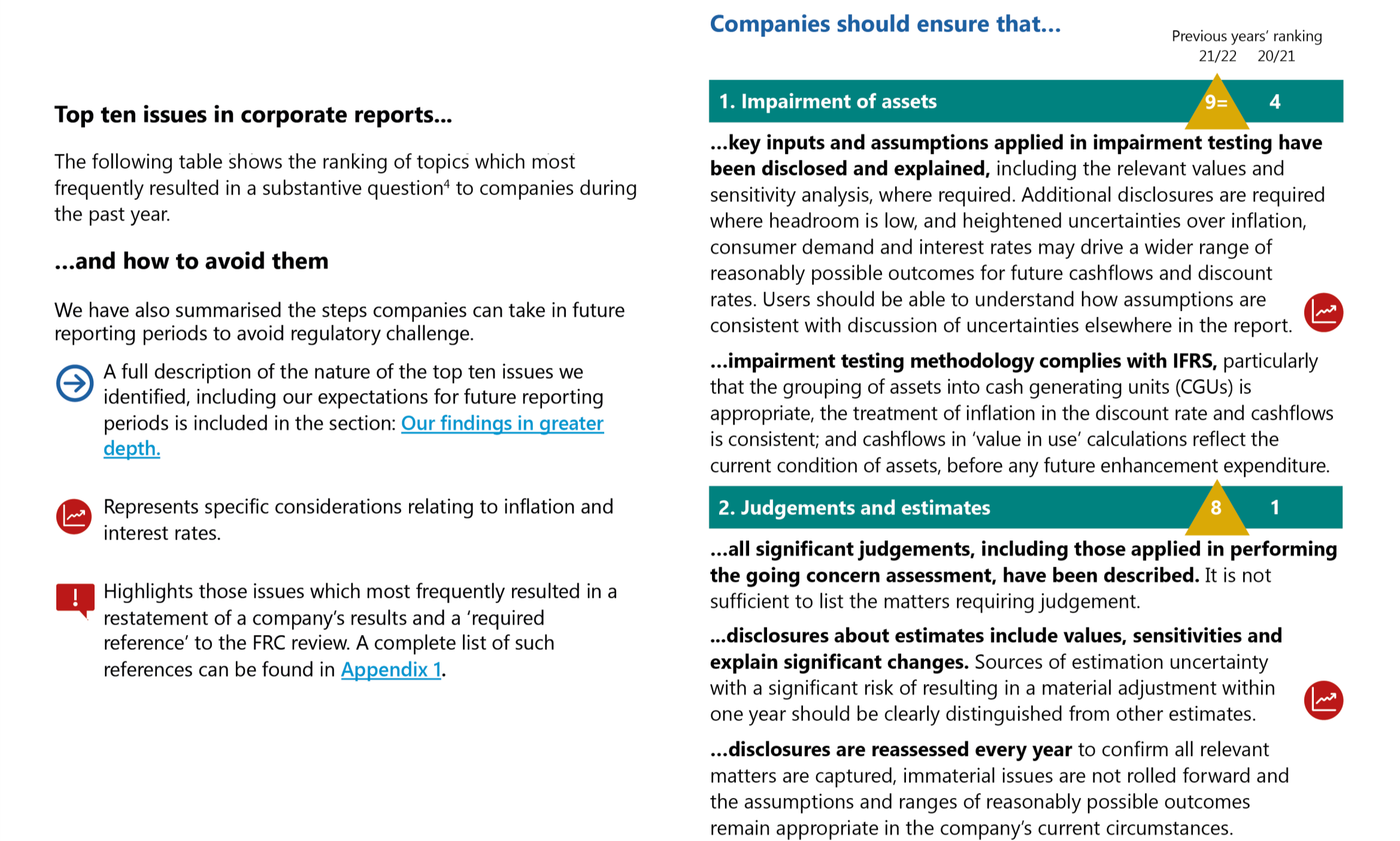
A red arrow with a line indicates a full description of the nature of the top ten issues we identified, including our expectations for future reporting periods is included in the section: Our findings in greater depth.
A megaphone icon indicates specific considerations relating to inflation and interest rates.
An exclamation mark highlights those issues which most frequently resulted in a restatement of a company's results and a 'required reference' to the FRC review. A complete list of such references can be found in Appendix 1.
Companies should ensure that...
1. Impairment of assets
(Previous years' ranking: 21/22: 9=, 20/21: 4)
...key inputs and assumptions applied in impairment testing have been disclosed and explained, including the relevant values and sensitivity analysis, where required. Additional disclosures are required where headroom is low, and heightened uncertainties over inflation, consumer demand and interest rates may drive a wider range of reasonably possible outcomes for future cashflows and discount rates. Users should be able to understand how assumptions are consistent with discussion of uncertainties elsewhere in the report.
A megaphone icon indicates this refers to specific considerations relating to inflation and interest rates.
...impairment testing methodology complies with IFRS, particularly that the grouping of assets into cash generating units (CGUs) is appropriate, the treatment of inflation in the discount rate and cashflows is consistent; and cashflows in 'value in use' calculations reflect the current condition of assets, before any future enhancement expenditure.
2. Judgements and estimates
(Previous years' ranking: 21/22: 8, 20/21: 1)
...all significant judgements, including those applied in performing the going concern assessment, have been described. It is not sufficient to list the matters requiring judgement.
...disclosures about estimates include values, sensitivities and explain significant changes. Sources of estimation uncertainty with a significant risk of resulting in a material adjustment within one year should be clearly distinguished from other estimates.
A megaphone icon indicates this refers to specific considerations relating to inflation and interest rates.
...disclosures are reassessed every year to confirm all relevant matters are captured, immaterial issues are not rolled forward and the assumptions and ranges of reasonably possible outcomes remain appropriate in the company's current circumstances.
Please see Appendix 5 for information about the FRC's approach to reviews.
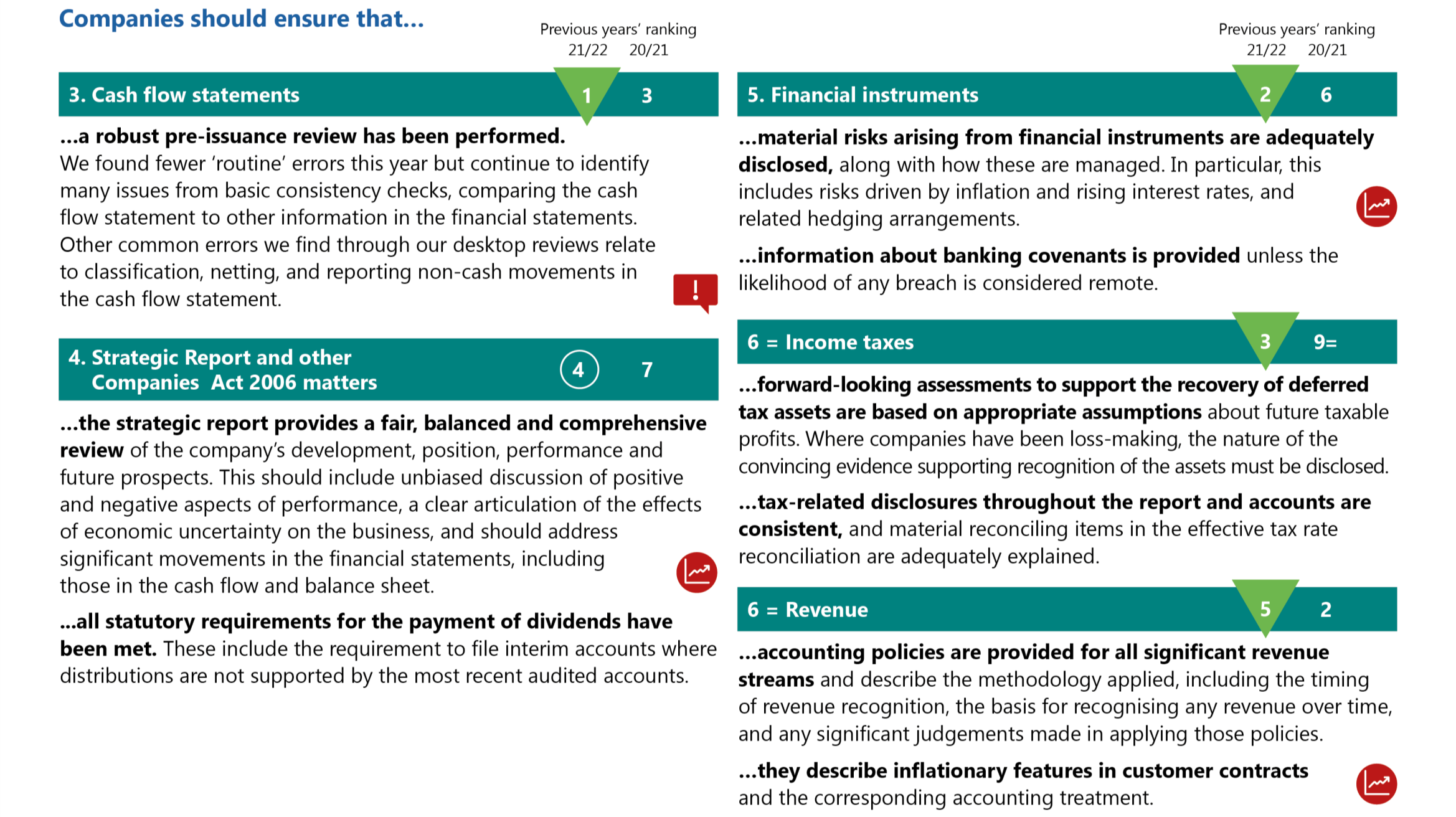
3. Cash flow statements
(Previous years' ranking: 21/22: 1, 20/21: 3)
...a robust pre-issuance review has been performed.
We found fewer 'routine' errors this year but continue to identify many issues from basic consistency checks, comparing the cash flow statement to other information in the financial statements. Other common errors we find through our desktop reviews relate to classification, netting, and reporting non-cash movements in the cash flow statement.
An exclamation mark highlights this issue resulted in a restatement of results or required reference to the FRC review.
4. Strategic Report and other Companies Act 2006 matters
(Previous years' ranking: 21/22: 4, 20/21: 7)
...the strategic report provides a fair, balanced and comprehensive review of the company's development, position, performance and future prospects. This should include unbiased discussion of positive and negative aspects of performance, a clear articulation of the effects of economic uncertainty on the business, and should address significant movements in the financial statements, including those in the cash flow and balance sheet.
A megaphone icon indicates this refers to specific considerations relating to inflation and interest rates.
...all statutory requirements for the payment of dividends have been met. These include the requirement to file interim accounts where distributions are not supported by the most recent audited accounts.
5. Financial instruments
(Previous years' ranking: 21/22: 2, 20/21: 6)
...material risks arising from financial instruments are adequately disclosed, along with how these are managed. In particular, this includes risks driven by inflation and rising interest rates, and related hedging arrangements.
A megaphone icon indicates this refers to specific considerations relating to inflation and interest rates.
...information about banking covenants is provided unless the likelihood of any breach is considered remote.
6. Income taxes
(Previous years' ranking: 21/22: 3, 20/21: 9=)
...forward-looking assessments to support the recovery of deferred tax assets are based on appropriate assumptions about future taxable profits. Where companies have been loss-making, the nature of the convincing evidence supporting recognition of the assets must be disclosed.
...tax-related disclosures throughout the report and accounts are consistent, and material reconciling items in the effective tax rate reconciliation are adequately explained.
6. Revenue
(Previous years' ranking: 21/22: 5, 20/21: 2)
...accounting policies are provided for all significant revenue streams and describe the methodology applied, including the timing of revenue recognition, the basis for recognising any revenue over time, and any significant judgements made in applying those policies.
...they describe inflationary features in customer contracts and the corresponding accounting treatment.
A megaphone icon indicates this refers to specific considerations relating to inflation and interest rates.
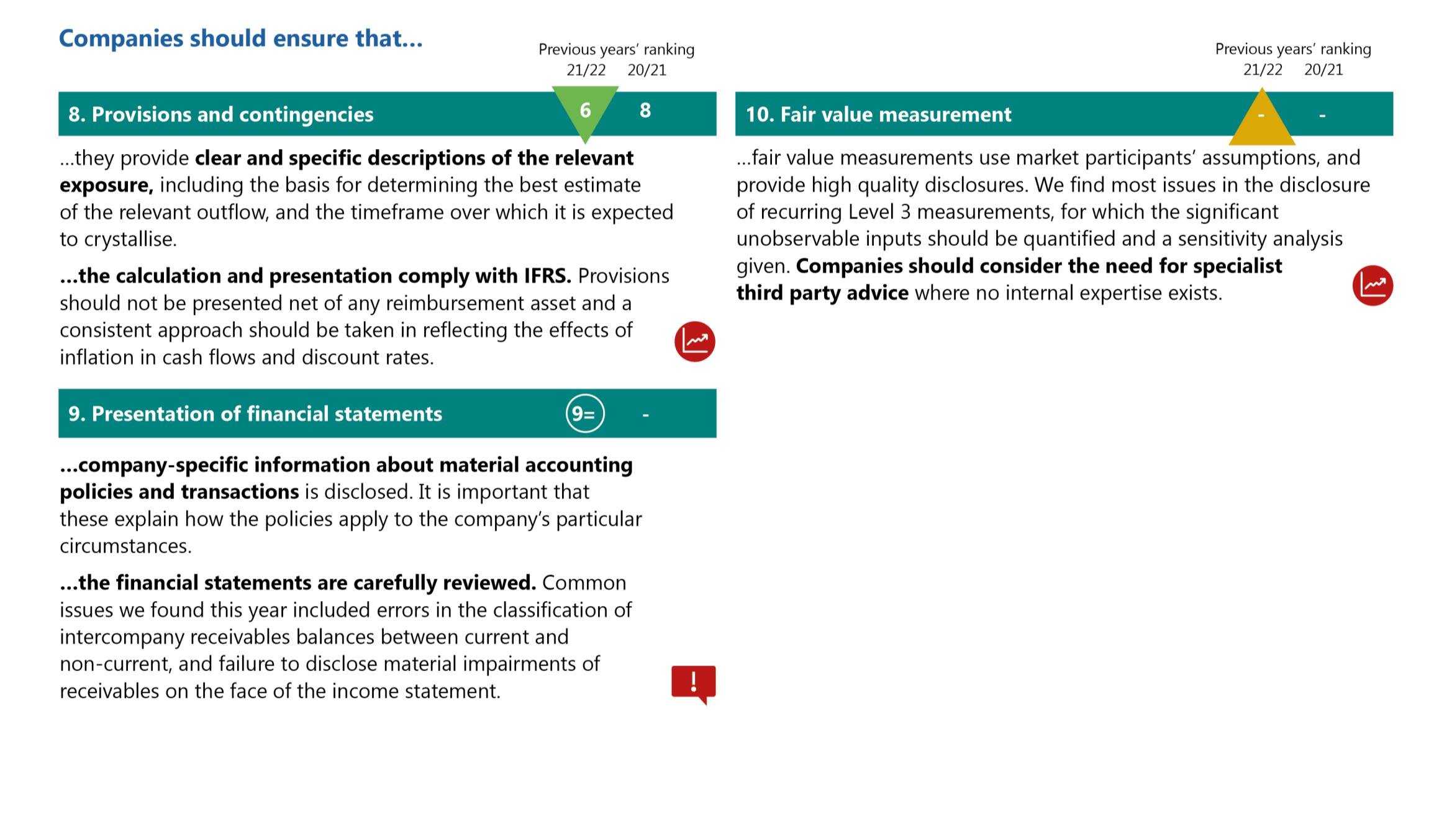
8. Provisions and contingencies
(Previous years' ranking: 21/22: 6, 20/21: 8)
...they provide clear and specific descriptions of the relevant exposure, including the basis for determining the best estimate of the relevant outflow, and the timeframe over which it is expected to crystallise.
...the calculation and presentation comply with IFRS. Provisions should not be presented net of any reimbursement asset and a consistent approach should be taken in reflecting the effects of inflation in cash flows and discount rates.
A megaphone icon indicates this refers to specific considerations relating to inflation and interest rates.
9. Presentation of financial statements
(Previous years' ranking: 21/22: 9=)
...company-specific information about material accounting policies and transactions is disclosed. It is important that these explain how the policies apply to the company's particular circumstances.
...the financial statements are carefully reviewed. Common issues we found this year included errors in the classification of intercompany receivables balances between current and non-current, and failure to disclose material impairments of receivables on the face of the income statement.
An exclamation mark highlights this issue resulted in a restatement of results or required reference to the FRC review.
10. Fair value measurement
(Previous years' ranking: 21/22: -, 20/21: -)
...fair value measurements use market participants' assumptions, and provide high quality disclosures. We find most issues in the disclosure of recurring Level 3 measurements, for which the significant unobservable inputs should be quantified and a sensitivity analysis given. Companies should consider the need for specialist third party advice where no internal expertise exists.
A megaphone icon indicates this refers to specific considerations relating to inflation and interest rates.
Thematic reviews
2022/23
Performing focused thematic work allows us to assess the quality of reporting on emerging or complex reporting areas, set out clear expectations, and provide companies with guidance and better practice examples. Reports reviewed as part of a thematic review represented over a third of our casework this year. We reported on these reviews in section 4.1 of last year's annual review. Links to the full reports can be found below:
- Discount rates
- TCFD disclosures and climate in the financial statements
- Deferred tax assets
- Business combinations
- Earnings per share
- Judgements and estimates
The findings of substantive enquiries that arose from these reviews have been incorporated into the 'top ten' findings on the previous pages.
Fair value measurement (IFRS 13)
Many IFRSs require or permit fair value measurements. The challenging economic environment and the risks posed by climate change may increase the degree of estimation uncertainty and management judgement in this area. Consequently, clear and transparent disclosures of fair value measurements are likely to become increasingly important. Although the review focuses on disclosure matters, it also highlights those areas where CRR commonly finds errors in its routine monitoring of corporate reporting and to which companies may want to pay particular attention.
Section 6.1 Full report
TCFD – metrics and targets
We also carried out a focused thematic review to assess the quality of companies' disclosures of metrics and targets, and the extent to which they had been reflected in the financial statements. We saw an incremental improvement in reporting since our 2022 thematic review, although some companies are struggling to clearly articulate their plans to adapt to a lower carbon economy. Most companies have set net zero or other climate-related targets and interim emissions targets, but these were not always well explained. We assessed the extent of comparability between companies in the same sector and found some commonality, but methodological differences made direct comparisons challenging. It was often difficult to determine the extent to which the impact of climate-related targets on the financial statements had been considered, due to lack of company-specific disclosures.
Section 6.2 Full report
2023/24
We are performing the following four thematic reviews in our 2023/24 review cycle:
- Fair value measurement
- TCFD – metrics and targets
- Large private companies (review in progress)
- Insurance contracts (review in progress)
Our findings or planned work for each of these projects are summarised below, with further detail in Section 6 of this report.
Thematic reviews
Insurance contracts (IFRS 17)
Section 6.3
We are carrying out a thematic review on the disclosures of the impact of this new standard included within the June 2023 interim reports of a sample of companies, which we expect to publish in November. The purpose of the review is to observe the initial application of the standard and to identify good examples, and any weaknesses, within interim disclosures, to help us provide relevant and timely guidance for companies to consider when preparing their year-end accounts. The thematic review will also inform our selection of annual reports for review during the next year. The companies selected are predominantly listed life and general insurers, but the sample will also cover specialty, re-insurance and bancassurance.
Reporting by the largest private companies
Section 6.4
The proposed introduction of new reporting requirements for the largest private companies will bring an enhanced regulatory focus on entities in that part of the market. While it is still subject to finalisation, at the time of writing, the Government's intended threshold for these new requirements is entities that exceed £750 million annual revenue and 750 employees. The Reporting by the largest private companies thematic review, due to be published in early 2024, will consider a selection of the annual reports and accounts of private companies that meet this definition to identify any areas of poorer compliance with reporting requirements, with a view to informing our future monitoring activities.
Other reviews
Outcomes of 2022/23 TCFD case reviews and our regulatory approach for 2023/24
Section 6.5
The review of TCFD-aligned disclosures was embedded into CRR's routine reviews of premium listed company annual reports in the 2022/23 cycle. We also continued to monitor the extent to which climate change was incorporated into companies' financial statements.
Our initial supervisory approach for mandatory TCFD reporting, developed in collaboration with the FCA, was focused on raising awareness of the new rules and guidance and improving the quality of disclosure in this fast-evolving area. This meant that the majority of the FRC's correspondence with companies in respect of TCFD disclosures was in the form of points for the company to consider when preparing its next annual report and accounts, referencing the expectations set out in our 2022 TCFD thematic report.
In the second year of listed companies' reporting against the TCFD framework, we are more likely to enter into substantive correspondence with companies that do not meet the expectations set in both our 2022 and 2023 thematic reports, especially when climate change is significant for the company, and it does not provide the TCFD recommended disclosures that are 'particularly expected' by the Listing Rules. We will continue to work closely with the FCA in this respect. We will also develop our regulatory approach in respect of new Companies Act climate-related financial disclosures (see Appendix 2).
Other reviews
Review of Directors' Remuneration Reports (DRR)
Section 6.6 In preparation for our transition to ARGA, we have extended our review work to include directors' remuneration reporting for a selection of ten companies. We have reviewed the disclosures against the requirements of Schedule 8 to the Large and Medium-sized Companies and Groups (Accounts and Reports) Regulations
- We wrote to nine companies with most of the points being raised relating to the clarity of targets and achieved performance. This will continue to be our key area of focus going forward. We also highlighted instances of non-compliance as well as lack of consistency between DRR and the information presented elsewhere in the report and accounts, such as alternative performance measures, TCFD disclosures and the key management personnel note. We are repeating this exercise in 2023/24 cycle with a slightly larger sample size.
Review of Corporate Governance disclosures
Appendix 1
CRR continued to work with the FRC's Corporate Governance team, coordinating a number of our reviews with their annual review of governance disclosures (see next page). We wrote to companies where we identified opportunities to improve reporting. As in previous years, we focused on potential non-compliance with the Code's provisions not declared, inadequate explanations for non-compliance and instances where it was unclear how the company had applied the Code's principles, particularly when disclosures lacked detail about actions and outcomes.
Update on the FRC's transition to ARGA
In May 2022, the government issued its response to the consultation 'Restoring Trust in Audit and Corporate Governance', which included proposals to transform the FRC into a new regulator, the Audit, Reporting and Governance Authority (ARGA). Several of these proposals increase the scope and powers of the FRC's CRR function and are based primarily on the recommendations of Sir John Kingman's 'Independent Review of the Financing Reporting Council' in
- A number of the changes proposed5 require primary legislation to grant the relevant powers. We are disappointed that it remains unclear when the ARGA Bill will receive parliamentary time. In the absence of a firm legislative timetable, we continue to focus on changes we can implement using our existing powers and remit, such as the publication of case summaries, with companies' consent. Other corporate reporting developments rooted in the Kingman recommendations are progressing through draft secondary legislation as described in Appendix 2.
CRR continues to raise matters on areas within ARGA's proposed remit, but outside the FRC's current statutory enforcement powers, as part of its routine reviews. Where appropriate, we are drawing companies' attention to potential opportunities for improvement. Such work includes our trial reviews of remuneration reports and ongoing work on corporate governance disclosures (left). Our findings from this work will help inform our regulatory approach once we have statutory powers over the whole report and accounts.
Messages from other FRC publications
Corporate Governance reporting
Section 7.2 Full report
The FRC's Corporate Governance team performs annual reviews of companies' reporting on their governance in line with the Principles and Provisions of the UK Corporate Governance Code (the Code). A majority of companies disclose non-compliance with at least one Code provision, which is permitted under the comply-or-explain framework. However, explanations for departures continue to lack detail specific to companies' circumstances. Improvements could also be made to disclosures of the effects of companies' policies and procedures, which should highlight outcomes and impacts and explain how these relate to the company's purpose, strategy and values.
FRC Lab
Section 7.3
The FRC Lab continues to focus on encouraging better practice reporting to meet the needs of investors. Its current work is focused on two themes: environmental, social and governance (ESG) and technology. This year, the Lab's projects include 'Materiality in practice', which provides tips for companies on how to apply a materiality mindset; and 'ESG data: distribution and consumption', reporting on how investors are accessing and collecting ESG data, the related role of third party providers and how investors are using this data in their investment processes.
What Makes a Good Annual Report and Accounts
During the year we published 'What Makes a Good Annual Report and Accounts'. This publication, which complements our thematic reviews, is designed to support preparers, audit committee chairs and company secretaries in preparing high quality annual reports and accounts.
In the report we set out our view, as an improvement regulator, of the high-level characteristics a good quality ARA possesses. It does not provide information on how to meet GAAP, legislation or code requirements.
Set against a backdrop of materiality, the publication identifies these characteristics using a framework of corporate reporting principles and the 4Cs of effective communication:
- Company specific
- Clear, concise and understandable
- Clutter free and relevant
- Comparable
Where possible, the report uses published examples to demonstrate these attributes.
Section 7.4 Full report
4. Key matters for 2023/24 annual reports and accounts
The FRC seeks to support companies in complying with the relevant reporting requirements and providing decision-useful information for users of their annual reports and accounts. Our headline expectations for the coming reporting season, set out in this section, are driven by our findings throughout this report, as well as matters in the current trading or reporting environment which we consider likely to present reporting challenges for companies.
'Top ten' and other key reporting issues
We have highlighted how our headline expectations align to those reporting issues which we most frequently raise with companies, or have highlighted elsewhere in the report. We also expect companies to carefully consider how current economic conditions may impact on financial and narrative reporting in 2023/24. In particular:
- High inflation and rising interest rates may drive significant changes to discount rates and expected future cash flows which can have effects ranging from additional impairments to a reduction in pension scheme liabilities and the potential recognition of a surplus.
- The range of uncertainty over a number of economic factors, including inflation, has increased. This may increase the degree of judgement required by management in determining inputs to the financial statements, and require disclosure of sensitivities to a wider range of reasonably possible outcomes.
An arrow pointing right indicates the potential implications of reporting in an uncertain and inflationary environment are summarised on the following page.
An arrow pointing right indicates further detail on the reporting implications of high inflation and rising interest rates can be found in Section 7.1.
Developments in corporate reporting
Changes to IFRS accounting standards for the coming reporting season are relatively minor, with the exception of the implementation of IFRS 17. This will have a greater impact on reporting in the insurance sector, but companies outside the sector will need to assess whether they have any contracts within its scope, which could include certain warranties, breakdown or product replacement cover, and guarantees.
Sustainability-related disclosure requirements continue to develop at pace. This year, in addition to those subject to the FCA's comply or explain TCFD listing rules, a larger range of companies and LLPs will be required to provide mandatory, TCFD-based, climate-related financial disclosures in their annual reports.
An arrow pointing right indicates for full detail and a timeline of effective dates see: Appendix 2: Developments in corporate reporting.
4.1 Reporting on the effects of inflation and other uncertainties
Businesses continue to report in a context of significant economic and geopolitical uncertainty and in an inflationary trading environment. The extent of companies' exposures will vary depending on the profile, including the pace of any reduction, of inflation in the territories in which they operate. The annual report and accounts, taken as a whole, should tell a coherent story about the anticipated impacts on the business, and the assumptions the company has made about those uncertainties in preparing the financial statements.
The central diagram illustrates key economic factors and uncertainties: Rising interest rates6, High inflation6, Climate change, Labour market constraints, Supply chain stresses, and Changes in consumer demand. These are all encompassed by 'Uncertainties'.
Companies should...
| Category | Narrative Reporting | Financial Statements 1See Appendix 2 for details on proposals for the endorsement of ISSB standards for use in the UK 2Please see Appendix 3 for details on the scope of our work 3Case reviews opened between 1 April 2022 and 31 March 2023, generally companies with December 2021 or later year-ends 4Please see Appendix 5 for information about the FRC's approach to reviews 5A description of the Government's proposals most relevant to CRR's monitoring work can be found in Section 6.4 of last year's annual review 6See Section 7.1 for further information about reporting considerations relating to high inflation and rising interest rates
| Companies should... | |
|---|---|
| ...explain the risks and changes in the business environment and their impact on the company's position, performance and prospects | ...consider the effect of uncertainty and high inflation on the recognition and measurement of assets and liabilities, and related disclosures. This should include review of whether assumptions and 'reasonably possible' ranges for sensitivity disclosures remain appropriate |
| NARRATIVE REPORTING | FINANCIAL STATEMENTS |
| Going concern and viability reporting | |
| TCFD and climate-related disclosures | |
| Updates to investing, financing and hedging strategies and financial instruments disclosures | |
| Principal risks and uncertainties | Impairment testing |
| Changes in business environment | Judgements and estimates |
| Impacts on the business model | Recoverability of assets including deferred tax, inventory and expected credit loss provisions |
| Financial position and performance | Recognition and measurement of pensions, including assets in respect of surpluses6 |
| Provisions, contingencies and onerous contracts | |
| ...ensure assumptions are consistent, to the extent required by the standards, and explain any differences in approach to users |
Diagram showing key areas of uncertainty and their relation to reporting
The diagram illustrates several types of uncertainties and highlights their connection to "Rising interest rates" and "High inflation".
Uncertainties highlighted: * Climate change * Rising interest rates * High inflation * Labour market constraints * Supply chain stresses * Changes in consumer demand
4.2 Our key disclosure expectations for 2023/24
How these align to the top ten areas we challenge, and other key matters in this report
Our overall expectations, bringing together the major themes identified previously in this report, are set out below. We expect companies to...
- ...ensure disclosures about uncertainty are sufficient to meet the relevant requirements and for users to understand the positions taken in the financial statements. In particular:
- The values of key assumptions and sensitivities or a range of reasonably possible outcomes, must be provided, where required for impairment tests and major sources of estimation uncertainty.
- Significant accounting judgements must be described.
- Disclosures should be re-assessed each year to ensure they remain relevant and assumptions, and the range of outcomes used for sensitivity disclosures, remain appropriate.
- Better disclosure helps users understand the linkage between narrative reporting on uncertainties such as inflation and climate change, and the assumptions made in the financial statements.
- ...give a clear description in the strategic report of risks facing the business, their impact on strategy, business model, going concern and viability, cross-referenced to relevant detail in the reports and accounts.
- ...provide transparent disclosure of the nature and extent of material risks arising from financial instruments, including changes in investing, financing and hedging arrangements; the use of factoring and reverse factoring in working capital financing; the approach to and significant assumptions made in the measurement of expected credit losses; concentrations of risks and information about covenants (where material).
- ...provide a clear statement of consistency with TCFD7 which explains, unambiguously, whether management considers they have given sufficient information to comply with the framework in the current year. We may challenge companies which have not disclosed information the FCA 'particularly expects' to be provided.8 Companies must, in any case, comply with the new mandatory requirements for disclosure of certain TCFD-aligned information.9
- ...perform sufficient critical review of the annual report and accounts, including...
- ...taking a step back to consider whether the report as a whole is clear, concise and understandable, omits immaterial information and whether additional information, beyond the requirements of specific standards, is required to understand particular transactions, events or circumstances; and
- ...a robust pre-issuance review to consider issues we commonly challenge including: internal consistency; whether accounting policies address all significant transactions; and presentational matters, such as cash flow and current/non-current classification.
| 1. Impairment |
| 2. Judgements and estimates |
| 6= Income taxes |
| 8. Provisions and contingencies |
| 10. Fair value measurement |
| Other: TCFD/Climate change |
| 4. Strategic Report/Companies Act |
| 5. Financial instruments |
| Other: TCFD/Climate change |
| 3. Cash flow statements |
| 6= Revenue |
| 9. Presentation of financial statements |
| Other: What Makes a Good Annual Report and Accounts |
Our findings in greater depth
5. Top ten issues
This section explores the most common topics on which we raised substantive questions with companies in our 2022/23 monitoring cycle,10 ranked in order of the number of companies involved. For each topic, we outline the more significant or common issues that arose as a result of our reviews.
These summaries are not a substitute for knowing the relevant reporting requirements, but they do provide insights into common areas for improvement. We encourage preparers to read the summaries and consider whether the matters raised are relevant to their own reports and accounts.
This year we have continued to publish case summaries for reviews that resulted in a substantive question to a company. This process is explained further in Appendix 1.
- Represents relevant requirements of a standard or guidance
- Represents key points to consider when preparing annual reports and accounts
- Represents specific considerations relating to inflation and interest rates
5.1 Impairment of assets
Impairment of assets has consistently been in our top ten topics. Although we raised queries with more companies than last year, the issues involved are generally the same. The effect of inflation and higher interest rates on cash flow projections and discount rates may have resulted in more instances of impairment, or reduced headroom in recoverable amounts, prompting more detailed disclosures under IAS 36, ‘Impairment of Assets’. Many of our queries would have been avoided by clearer, more complete disclosures.
For further guidance, including examples of better disclosure practice, we encourage companies to refer to our previous reports on impairment of non-financial assets, the financial reporting effects of Covid-19, and discount rates.
| Key inputs and assumptions | Impairment method |
|---|---|
| • Disclosures about the key inputs and assumptions used to determine recoverable amounts, including discount rates and growth rates, were not always provided. | • When descriptions of forecasts used in VIU calculations included restructuring programmes or meeting carbon reduction targets, we asked whether cash flows related to improving or enhancing an asset, rather than reflecting the asset's current condition. |
| • We queried the discount rates used in value in use (VIU) calculations if they appeared inconsistent with other information in the annual report and the general economic environment. | • We asked a retailer that allocated online sales to cash generating units (CGUs) based on physical stores how the sales related to the stores, and whether the assets of the online business had also been allocated to the CGUs. |
| • We asked a company that had calculated VIU using a post-tax discount rate to confirm whether its estimated future cash flow forecasts reflected the specific amount and timing of future tax cash flows, and to explain how it had concluded that using a post-tax discount rate produced a result that was not materially different to using pre-tax cash flows and a pre-tax discount rate, as required by IAS 36.11 | • A company with significant exposure to climate risks was asked to clarify how its VIU calculations took account of those risks. |
| • We asked for further information when companies’ VIU calculations used financial budgets/forecasts for a period longer than five years without explaining why.12 | • Some companies did not explain clearly how they had determined their CGUs, or their CGUs seemed inconsistent with descriptions of operations elsewhere in the report. |
| • We questioned assumptions used for impairment that appeared inconsistent with those in going concern and viability assessments. | • In one case, it was unclear if goodwill acquired in a business combination during the year had been tested for impairment. |
| • We asked for an explanation when a company’s interim report stated that no impairment review had been performed because it was impractical to do so. |
5.1 Impairment of assets (continued)
| Indicators of impairment | Investments in subsidiaries |
|---|---|
| • We raised queries with companies when their net assets, or the carrying amount of subsidiaries in their parent company accounts, exceeded their market capitalisation at the reporting date, but there was no evidence that an impairment assessment had been performed. | • We asked companies for further explanation when it was not clear whether a parent’s investments in subsidiaries had been assessed for impairment. |
| • We asked for clarification where a company’s TCFD disclosures identified significant climate related risks to parts of its business, and it was unclear whether they had been considered as indicators of impairment. | • We asked for more information about the impairment loss recognised on an investment in a subsidiary where the company’s disclosures did not clearly explain the basis on which the impairment had been recognised. |
| Sensitivity to key assumptions | Other disclosure and presentation considerations |
|---|---|
| • Several companies did not disclose whether reasonably possible changes in assumptions would result in a recoverable amount below the carrying amount. | • The disclosures required when a material impairment loss or reversal has been recognised were not always provided. |
| • Some companies that disclosed that such a change would result in impairment did not provide the required quantitative disclosures about the amount of headroom in the recoverable amount over the carrying amount, the key assumptions, or the sensitivity of the headroom to changes in the key assumptions.13 | • We questioned a company whose accounting policy referred to using VIU for impairment testing, but the explanation of the impairment test said that fair value less costs to sell had been used. |
| • We questioned why a company had accounted for an impairment reversal as a prior year adjustment, rather than recognising it in the current year.14 |
5.1 Impairment of assets (continued)
Companies should ensure that ...
- they provide adequate disclosures about the key inputs and assumptions used in their impairment testing, including justifying the use of financial budgets/forecasts for periods longer than five years.
- the discount rates used in VIU calculations are consistent with the assumptions in the cash flow projections, particularly in respect of risk and the effect of inflation (that is, nominal cash flows, which include the effect of inflation, should be discounted at a nominal rate and real cash flows, which exclude the effect of inflation, should be discounted at a real rate).15
- the forecasts used for VIU calculations reflect the asset in its current condition. When VIU disclosures cross-refer to forecasts used in going concern and viability assessments, it should be made clear how any costs and benefits in those forecasts that relate to future improvements to assets or restructuring activities have been addressed for the VIU calculation.
- impairment reviews and/or disclosures appropriately reflect information elsewhere in the report and accounts, including events or circumstances that are indicators of potential impairment.
- they explain the sensitivity of recoverable amounts to reasonably possible changes in assumptions, particularly where increased economic uncertainty has widened the range of possible outcomes.16
- descriptions of CGUs, and explanations of how they have been determined, are consistent with information about the company’s operations elsewhere in the report and accounts.
5.2 Judgements and estimates
This year, significant judgements and estimates has returned to being one of the highest ranked topics in our top ten. Most of the queries related to estimation uncertainty, and often involved disclosures that either did not contain sufficient information to be useful, or which appeared inconsistent with information elsewhere in the report and accounts. This highlights the importance of providing disclosures that are tailored to a company’s circumstances and explain the specific judgements and assumptions made.
Providing quality disclosures in this area remains particularly important in the light of ongoing economic and political uncertainty. We refer companies to last year’s judgements and estimates thematic review report for guidance on this topic, including examples of better disclosures.
| Key sources of estimation uncertainty | |
|---|---|
| • Disclosures of estimation uncertainty did not always include sufficient information about the key assumptions, or the sensitivities to changes in those assumptions or ranges of potential outcomes. | • One company had disclosed estimation uncertainty relating to cash flows for its value in use calculations, but it was unclear whether this applied to all cash generating units for which an impairment review was performed. |
| • We questioned a company that had not disclosed an estimation uncertainty when other information in the report suggested there were estimates with a significant risk of material adjustment in the following year.17 | • A query we raised on a company’s disclosures on the impairment of investments in subsidiaries identified that there were estimation uncertainties involved that should have been disclosed. |
| • We asked for explanations if an estimation uncertainty disclosed in the prior year was no longer disclosed, but information in the report and accounts suggested it was still relevant. | • We commented that a company’s accounts did not include a full explanation of changes made to past assumptions for an uncertainty that remained unresolved,18 but noted that more helpful explanations had been included in the audit committee report. |
| • We asked for more information where a company had disclosed estimation uncertainty relating to the use of a discount rate, but had not explained how the discount rate had been derived. As noted in our report on discount rates, we expect this disclosure where the effect of discounting is material. |
5.2 Judgements and estimates (continued)
| Significant accounting judgements | Material uncertainties in relation to going concern |
|---|---|
| • We raised a query where disclosures did not make clear whether a judgement was considered a key judgement under IAS 1. | • When a company concludes that a material going concern uncertainty does not exist but the conclusion required significant judgement, we expect the judgement to be disclosed.19 |
| • In some cases, responses from companies to our queries on particular accounting treatments indicated that significant judgements had been made that should have been disclosed. | • We questioned companies where information in the report and accounts indicated that such a judgement might have been required, but no such judgement was disclosed. |
| • We asked why a significant judgement disclosed in the prior year was no longer disclosed, when information in the report and accounts suggested it was still relevant. | |
| • We queried where disclosures in the group accounts referred to judgements made in the impairment testing of operating subsidiaries, but no similar disclosures were made in the parent company’s accounts in relation to investments in subsidiaries. |
Companies should ensure that ...
- disclosures explain the significant judgements involved in applying accounting policies (a list is not sufficient), and provide quantified sensitivities where such judgements involve a significant source of estimation uncertainty. This should include judgements and estimates relating to the going concern assessment and accounting for inflationary features, including the use of discount rates.
- sources of estimation uncertainty and the related disclosures are reassessed to ensure they remain relevant at the reporting date.
- changes to assumptions are explained, particularly if the range of possible outcomes has widened due to increased uncertainty.
- judgements and estimates disclosures are consistent with information elsewhere in the report and accounts.
We also remind companies that sources of estimation uncertainty with a significant risk of resulting in a material adjustment within one year should be clearly distinguished from any other estimates disclosed.
5.3 Cash flow statements
Cash flow statements are again high in our top ten, with the frequency of questions raised only slightly lower than last year. It also remains one of the most frequent reasons for companies making a prior year restatement as a result of our enquiries, although the number of companies restating their cash flow statement fell to seven compared to 15 last year. The type of questions we raised remains similar to previous years, but there were fewer ‘routine’ errors, with a number of our queries relating to relatively unusual or more complex transactions. In some cases, our question would have been avoided if the transaction, and the rationale for the treatment of its cash flows, had been more clearly explained.
The findings below summarise the issues identified from our routine reviews. Further detail of the restatements relating to cash flow statements are provided in Appendix 1.
We expect companies to consider the guidance and better disclosure examples in our cash flow and liquidity disclosures thematic review. The report provides more detail of the issues we have raised on the cash flow statement in recent years, and outlines the consistency checks we perform in this area.
Cash advances and loans made to other parties and repayments thereof are examples of investing cash flows.20 Cash proceeds from, or repayments of, borrowings are examples of financing activities.21
| Classification of cash flows |
|---|
| • We questioned companies when cash flows that appeared to relate to funding from or to subsidiaries were classified as operating activities in parent company cash flow statements. We also queried when it was unclear whether such cash flows had been appropriately classified as investing or financing activities. |
| • We have challenged companies that did not classify the repayment of debt acquired in a business combination as financing activities, when the repayment was material. We generally expect this cash flow to be financing, although there may be certain scenarios where investing is appropriate. Where that is the case, companies should explain the reasons for classification as investing. |
| • Two companies had classified the acquisition-related costs of a business combination as investing activities rather than operating activities. |
IASB Priorities 2022 to 2026 The IASB has added the cash flow statement to its work plan as one of its priorities for 2022 to
- This is in response to stakeholders identifying deficiencies in the reporting of cash flows. As part of its initial work, the IASB will consider whether the aim should be to review IAS 7 comprehensively, or make targeted improvements.
5.3 Cash flow statements (continued)
| Reported cash flows | Disclosures |
|---|---|
| • We asked for further explanation when there appeared to be inconsistencies between amounts or descriptions in the cash flow statement compared to other information in the report and accounts, or transactions referred to elsewhere did not appear be identified in the cash flow statement. For example, amounts described in the cash flow statement as relating to current balances included non-current items; and payment of contingent consideration referred to in the narrative report was not identifiable in the cash flow statement. | • We asked for more information where we could not link items in the reconciliation of changes in liabilities from financing activities to the cash flow statement. |
| • We queried the net presentation of cash flows, such as a single net amount for notes payable rather than separate cash advances and repayments. | • We also queried companies that did not present sufficiently disaggregated information in the reconciliation of liabilities from financing activities, including cash movements relating to business combinations and non-cash changes. |
| • In some cases, non-cash investing or financing transactions were included in the cash flow statement, for example where bondholders had exchanged one issue of bonds for another. | • We questioned a company that had not disclosed any restrictions over cash and cash equivalents, but other disclosures indicated that cash equivalents had been pledged as security for borrowings. |
Companies should ensure that ...
- amounts and descriptions of cash flows are consistent with those reported elsewhere in the report and accounts.
- the parent company cash flow statement (where provided22) complies with the requirements of the standard.
- non-cash investing and financing transactions are excluded from the statement and disclosed elsewhere if material (non-cash operating transactions will normally be disclosed as adjustments in deriving cash flows from operating activities).
- classification of cash flows, cash and cash equivalents comply with relevant definitions and criteria in the standard.
- cash flows are not inappropriately netted.
5.4 Strategic report and other Companies Act 2006 matters
This year, the most common aspects of the Companies Act 2006 (CA 2006) on which we asked questions of companies were the requirement for the strategic report to be ‘fair, balanced and comprehensive’, and compliance with distributable profits requirements when paying dividends and repurchasing shares.
Last year we raised a number of questions on SECR disclosures as part of our 2020/21 SECR thematic review, but this year we have not raised any substantive questions specifically on non-financial reporting requirements, including SECR. This may indicate that companies are becoming more familiar with these newer areas of reporting. However, we have made observations on climate-related reporting requirements in appendix points to our letters with companies, which do not contribute to our top ten issues, but which are summarised in Section 6.5.
| Fair, balanced and comprehensive | Section 172 statement and stakeholder engagement |
|---|---|
| • We questioned companies that did not discuss material balance sheet and cash flow items, and significant changes in balances from the prior year, in the strategic report. | • Several companies, including large private companies, did not provide a section 172 statement. |
| • One company’s strategic report did not include sufficient discussion of a very large impairment loss. | |
| • In one instance, we questioned whether the prominence given to a company’s alternative performance measures (APMs) over its IFRS measures, and deficiencies in its explanations of APMs, resulted in the strategic report failing to give a fair review of the business. | |
| • We successfully challenged whether a large private company’s strategic report contained sufficient information to meet the requirements of CA 2006, when it omitted a discussion of the company’s performance compared to pre-pandemic levels, did not include key performance indicators, and did not describe how its principal risks affected the company or were mitigated. |
5.4 Strategic report and other Companies Act 2006 matters (continued)
Where we identify company law-related matters, such as lawfulness of distributions, we raise these with companies even when, strictly, they are outside of our statutory powers. We are pleased to note that companies generally respond constructively to these enquiries.
| Distributable profits | Other Companies Act 2006 matters |
|---|---|
| • We queried the lawfulness of dividends and share repurchases that were not supported by the company’s last audited accounts, and where the required interim accounts had not been filed at Companies House.23 | We asked questions where: |
| • We asked for clarification when the process to be followed to rectify dividends that had been paid in breach of CA 2006, as set out in the company’s report and accounts, did not appear to have been implemented. | • large private companies had not disclosed information about directors’ emoluments. |
| • We asked companies for further information where it was unclear whether certain transactions had been treated as realised or unrealised profits when assessing distributable profits to support dividend payments, including: | • the nominal value of a company’s allotted share capital had fallen below the authorised minimum for a public company. |
| – cumulative equity-settled share-based payment amounts not expensed by the company. | • it was unclear whether the accounting treatment for a company’s additional investment in a subsidiary complied with CA 2006 requirements and relevant IFRSs. |
| – dividends receivable from subsidiary undertakings. | • a company disclosed an investment in a subsidiary but had not prepared consolidated accounts and had not explained why. |
| • a company had filed revised accounts but made no statement giving the reasons for doing so, which CA 2006 requires. | |
| • it was not clear which of the balance sheet presentations permitted by CA 2006 was being used in the parent company’s accounts, and whether the classification of loans from subsidiaries complied with the relevant requirements. | |
| • a company had not recognised share premium or merger relief on shares issued in connection with a business combination. |
5.4 Strategic report and other Companies Act 2006 matters (continued)
Companies should ensure that ...
- the strategic report does not focus only on financial performance, but also explains significant movements in the statements of financial position and cash flows.
- they comply with the legal requirements for making distributions and share repurchases, including the requirement to file interim accounts that show sufficient distributable profits to support the transaction, if the distribution or repurchase exceeds distributable profits reported in the most recent annual accounts.
As well as complying with legal requirements, companies should refer to the FRC’s 'Guidance on the Strategic Report' (June 2022)), which provides principles-based guidance to help prepare a high-quality strategic report. The guidance is mindful of recent developments in narrative reporting best practice and is aligned with the requirements in the UK Corporate Governance Code. Application of its principles will help to ensure that the strategic report:
- articulates the effect of the risks and uncertainties facing the business, which should include economic and other risks such as inflation, rising interest rates, supply chain issues and labour relations in the inflationary environment.
- explains the company’s risk mitigation strategies.
- where relevant, links the risks and uncertainties to the discussion of the entity’s strategy and business model, and information disclosed in the financial statements.
- highlights and explains linkages between information presented within the strategic report and the accounts.
We also encourage companies to consider the principles set out in our publication 'What Makes a Good Annual Report and Accounts' when preparing their strategic report (see Section 7.4).
5.5 Financial instruments
The number of substantive questions raised this year in relation to financial instruments is similar to last year, but the topic’s ranking has fallen as more queries have been raised in other top ten areas. In 2022/23, five companies (2021/22: two) restated their primary statements as a result of our enquiries on this topic. Further details of those restatements are included in Appendix 1.
We have again raised questions about companies’ expected credit loss (ECL) provisions, although this year most of these related to smaller financial institutions rather than non-financial companies. A lack of clear disclosures to explain the basis on which cash and overdraft balances have been offset has led us to question several companies this year.
An entity shall disclose information that enables users of its financial statements to evaluate the nature and extent of risks arising from financial instruments to which the entity is exposed at the end of the reporting period.24
| Scope, recognition and measurement |
|---|
| • When companies had announced arrangements to repurchase their own shares but had not recognised a liability for the apparent obligation, we asked for further information if it was unclear whether the obligation could be avoided. |
| • We asked companies to clarify how certain significant items had been accounted for, where this was not clear from their accounting policies, including: |
| – cash flow hedge accounting movements. |
| – non-controlling interests classified as financial liabilities measured at fair value through profit and loss. |
| – deferred equity consideration, relating to a business combination, presented within equity. |
| – a debt restructuring involving an exchange of instruments. |
| – a net own credit adjustment that significantly reduced the fair value of financial liabilities (for a company reporting under FRS 102, and applying IAS 39 to its financial instruments). |
| • For one company reporting under FRS 102, it was unclear which of the permitted accounting policy choices for financial instruments it had applied.25 |
5.5 Financial instruments (continued)
| ECL provisions and credit risk | Offsetting |
|---|---|
| • We questioned a financial institution when it was unclear how the scenarios used in its ECL model reflected an unbiased and probability-weighted amount that is determined by evaluating a range of possible outcomes, as required by IFRS 9. | • We asked for further information where a company had offset cash and overdraft balances but it was unclear whether the qualifying criteria for offset had been met.26 |
| • We also asked a financial institution to explain why it had not recognised a loss allowance and determined that a significant increase in credit risk had not occurred, in the light of the severity of the downside scenario described in the accounts. | • We also questioned why overdrafts in the parent company accounts were greater than those in the consolidated accounts, when no disclosures were provided about offsetting financial assets and financial liabilities. |
| • We asked a financial institution to explain the factors considered in determining whether there had been a significant increase in credit risk for a financial instrument, and its definition of default, where these were not disclosed. | Other disclosures |
| • We asked financial institutions for explanations of how forecasts of future economic conditions had been incorporated into the determination of ECLs, details of key assumptions used, and any overlay adjustments made to ECL models, where such information had not been disclosed. | • We asked companies to explain apparent inconsistencies in information disclosed about their borrowings or committed facilities. |
| • We queried apparent inconsistencies in disclosures of ECL provisions for trade receivables where the analysis of movement in the provision did not align with the closing balance of the provision disclosed elsewhere in the accounts. | • We asked for further information where companies had not provided disclosures about the collateral held as security for financial instruments. |
| • We questioned a company when disclosures indicated that financial assets had been pledged as security, but no details of the amount or nature of the security were provided. | |
| • A company did not provide information about liquidity risk associated with contingent consideration. |
ECL provisions and credit risk
- We questioned a financial institution when it was unclear how the scenarios used in its ECL model reflected an unbiased and probability-weighted amount that is determined by evaluating a range of possible outcomes, as required by IFRS 9.
- We also asked a financial institution to explain why it had not recognised a loss allowance and determined that a significant increase in credit risk had not occurred, in the light of the severity of the downside scenario described in the accounts.
- We asked a financial institution to explain the factors considered in determining whether there had been a significant increase in credit risk for a financial instrument, and its definition of default, where these were not disclosed.
- We asked financial institutions for explanations of how forecasts of future economic conditions had been incorporated into the determination of ECLs, details of key assumptions used, and any overlay adjustments made to ECL models, where such information had not been disclosed.
- We queried apparent inconsistencies in disclosures of ECL provisions for trade receivables where the analysis of movement in the provision did not align with the closing balance of the provision disclosed elsewhere in the accounts.
Offsetting
- We asked for further information where a company had offset cash and overdraft balances but it was unclear whether the qualifying criteria for offset had been met. 26
- We also questioned why overdrafts in the parent company accounts were greater than those in the consolidated accounts, when no disclosures were provided about offsetting financial assets and financial liabilities.
Other disclosures
- We asked companies to explain apparent inconsistencies in information disclosed about their borrowings or committed facilities.
- We asked for further information where companies had not provided disclosures about the collateral held as security for financial instruments.
- We questioned a company when disclosures indicated that financial assets had been pledged as security, but no details of the amount or nature of the security were provided.
- A company did not provide information about liquidity risk associated with contingent consideration.
Companies should ensure that...
- the nature and extent of material risks arising from financial instruments (including inflation and rising interest rates) and related risk management are adequately disclosed, including:
- the methods used to measure exposure to risks and any changes from the previous period.
- any hedging arrangements put in place to fix interest rates or hedge against the effects of inflation. 27
- the approach and significant assumptions applied in the measurement of ECL, and concentrations of risks, where material, are disclosed.
- in making ECL assessments, historical default rates are reviewed and adjusted for forecast future economic conditions.
- accounting policies are provided for all material financing (including factoring and reverse factoring) and hedging arrangements, and any changes in the arrangements.
- the effect of refinancing and changes to covenant arrangements is explained.
- cash and overdraft balances have been offset only when the qualifying criteria have been met. Balances that are part of a cash-pooling arrangement that includes a legal right of offset may only be offset in the balance sheet when there is also an intention either to settle on a net basis, or to realise the asset and settle the liability simultaneously.
We also remind companies that information about banking covenants should be provided unless the likelihood of any breach is considered remote.
5.6 Income taxes
This year, we raised fewer queries in relation to income taxes, but the topic remains firmly in our top ten. Clarification of reconciling items in effective tax rate reconciliations, and support for the recoverability of deferred tax assets, are the most common aspects on which we asked questions of companies. In 2022/23, two companies restated their primary statements as a result of our questions on income taxes (2021/22: one). Details of these restatements are included in Appendix 1.
Almost all the questions we raise on income taxes relate to companies reporting under IFRSs and the requirements of IAS 12, ‘Income Taxes’. However, the same principles apply to UK GAAP reporters using FRS 102, 28 although the specific disclosure requirements differ in some respects. This year we raised a query with one company on a disclosure that is specific to FRS 102, which is shown separately in our summary below.
Further guidance on accounting for income taxes, and examples of better disclosures, can be found in our thematic report from last year, which considered the basis of recognition of deferred tax assets and related disclosure requirements in the light of the effect of the Covid-19 pandemic on companies’ profitability. We also expect companies to consider our previous tax thematic report which addresses other aspects of disclosure including the effective tax rate reconciliation.
Recoverability of deferred tax assets (DTAs)
- Where companies with a recent history of losses had recognised material DTAs, we asked for details of the convincing evidence supporting their recognition, as required by IAS 12. 29 In such instances, the companies were encouraged, or agreed, to improve the related disclosures in future annual report and accounts.
Effective tax rate reconciliation
- We asked for explanations when it was unclear what significant items in the effective tax rate reconciliation related to, or why they were reconciling items.
- We questioned the basis on which a company had used the standard UK tax rate for its reconciliation when its business operated outside the UK.
In such cases, where a group operates in several jurisdictions, it may be more meaningful to aggregate reconciliations prepared using the domestic rate in each individual jurisdiction 30 and to disclose a weighted average tax rate applied to accounting profit.
5.6 Income taxes (continued)
Recognition of deferred tax assets and liabilities
- We asked a company that had presented deferred tax asset and liability balances on a gross basis for more information as the extent to which it had assessed the balances against the qualifying criteria for offsetting deferred tax assets and liabilities was not clear.
- We queried the apparent non-recognition of deferred tax assets where disclosures indicated that there were taxable temporary differences relating to the same tax authority and taxable entity.
- We asked a company for more information where the description of deferred tax liabilities recognised in a business combination appeared inconsistent with the nature of the assets acquired.
Other issues
- Companies were asked to explain the accounting for current and deferred tax recognised on share-based payments when the basis for recognising the tax was unclear.
- We asked for more information when we were unable to reconcile movements in the current tax balances with the current tax expense and cash outflow disclosed.
- Meaningful descriptions were not always provided for the types of temporary difference to which deferred tax balances related.
- We asked a company to provide further explanation of its uncertain tax provision when it was unclear from the disclosures provided what the provision related to.
- We questioned a company when it was unclear why a movement in deferred tax assets had been recognised directly in equity.
- We asked some companies to clarify the accounting policy they had applied to Research and Development Expenditure Credits (RDEC) and related tax implications.
- We asked a company to explain why no tax appeared to have been charged on gains recognised in OCI. 31
- A company reporting under FRS 102 had not disclosed the expected net reversal of deferred tax assets within the next financial period. 32
Companies should ensure that...
- where material deferred tax assets are recognised by loss-making entities, the nature of the evidence supporting their recognition is disclosed. Such cases will also often require disclosure of significant accounting judgements and sources of estimation uncertainty.
- the effect of the difficult economic environment and changes in tax regimes are taken into account when making forward-looking assessments to support tax recognition.
- tax-related disclosures are consistent throughout the annual report and accounts.
- uncertain tax positions are adequately disclosed.
- material reconciling items in the effective tax rate reconciliation are presented separately and appropriately described.
5.7 Revenue
The frequency of substantive queries on revenue recognition and related disclosures remained at a similar level to last year, lower than it had been in preceding years. This indicates that companies have become more familiar with the recognition model introduced by IFRS 15 and how to explain its application. No companies restated their income statements as a result of our queries on this topic (2021/22: one).
Our most common area of query was variable consideration, followed by principal versus agent considerations and contract balances. In most cases, we raised questions because disclosures did not provide sufficient information to show that companies had complied with specific requirements. Companies were generally able to answer our questions by providing more explanation and agreed to enhance their disclosures in future.
For more guidance on this subject, and examples of better disclosures, we encourage companies to read our 2019 IFRS 15 ‘Revenue from Contracts with Customers’ thematic review and 2020 follow up report.
Determining transaction price (including variable consideration)
- We queried accounting policies that indicated the existence of variable consideration but did not explain the circumstances in which it arose or how it was estimated.
- We questioned companies where their accounting policy did not appear to reflect the requirement to constrain the estimate of variable consideration such that it was ‘highly probable’ that a significant reversal would not occur.
- We asked a company that had recognised a significant reversal of revenue for further information about how the variable consideration constraint had been applied and the circumstances leading to the reversal.
- We questioned a company on how its measurement of variable consideration complied with the requirement to estimate the amount using either the expected value or most likely amount method.
Performance obligations
- We asked a company to explain how contract set-up fees were deemed to be distinct from other services, and therefore a separate performance obligation.
- One company stated that an input method was used to measure progress for each performance obligation in fixed-price contracts but did not explain the input method used or how it was applied.
Contract modifications
- We asked a company to clarify whether variations in contracts were accounted for as contract modifications and, if so, how the accounting policy complied with IFRS 15.
5.7 Revenue (continued)
Principal versus agent considerations
- Where it was unclear how a company had determined that it was acting as principal or agent, we asked for further explanation of the assessment performed by the company and for information about the contractual arrangements in place.
- We questioned professional services firms when their accounting policies stated that disbursements were excluded from revenue but did not provide any further information on the treatment of disbursements or indicate whether they involved the firms acting as principal or agent.
Other IFRS 15 points
- We asked companies for an explanation where they had not clearly disclosed information about the nature of a significant revenue stream, or the accounting policies applied to it.
- A company that made sales with a right of return did not disclose the right of return liability and it was unclear where the asset for the right to recover products from customers was presented in the balance sheet.
Contract balances
- We asked a company for more information where the accounting policy for capitalised contact costs was unclear, disclosures about related judgements had not been provided, and we could not tell whether the amounts involved were material. 33
- Where a company had capitalised commission fees as contract costs that were significantly higher than in the prior year, we asked for more information about the nature of the contracts and the costs, and the basis for their recognition as a contract asset.
- We raised a query when a comment in the accounts suggested that raw materials purchased for future use may have been included in contract assets, rather than inventory.
- We questioned a company that had not provided an explanation of significant changes in contract balances. 34
Companies should ensure that...
- when material variable consideration exists, sufficient company-specific information is provided to explain how it arises and how it is estimated and constrained.
- accounting policies are provided for all significant performance obligations and address in sufficient detail:
- the timing of revenue recognition.
- the basis for recognising any revenue over time.
- the methodology applied.
- significant judgements made in relation to revenue recognition are disclosed (for example, in relation to whether the company is acting as agent or principal, the allocation of the transaction price and the timing of satisfaction of performance obligations).
We also remind companies that inflationary features in contracts with customers and accounting for such clauses (that is, whether the feature is an embedded derivative or variable consideration) should be adequately disclosed and explained clearly.
5.8 Provisions and contingencies
The number of substantive questions we raised in relation to provisions and contingencies this year is similar to last year. The issues involved are broadly the same and again include several instances where it was not clear how a company had accounted for reimbursement assets. No companies restated their balance sheet as a result of our enquiries on this topic this year (2021/22: one).
We encourage companies to refer to our 2021 thematic report on this subject, which includes our key disclosure expectations, as well as better practice examples.
Recognition and measurement
- We asked companies to explain the basis on which insurance reimbursements were recognised when it was unclear from information disclosed whether their realisation was ‘virtually certain’.
- We questioned companies about the discount rates used for certain provisions, including when it was unclear whether the inflation assumptions in the cash flows and discount rates were internally consistent, or the discount rate did not appear to reflect the risks specific to the liability.
- Where a company had disclosed that it had not measured significant non-current provision balances at present value because the effect of discounting would not be material, we asked how it had reached that conclusion.
- We asked one company to clarify the accounting treatment applied to maintenance provisions for leased aircraft.
Disclosures
- We questioned companies when the disclosures required by IAS 37 for a class of provision, or contingent liability, appeared to have been omitted. 35
- We asked for more information where descriptions of provisions balances were unclear or not meaningful.
- Some queries were prompted by information from sources other than the annual report and accounts that indicated there might be unrecognised provisions or undisclosed contingent liabilities, such as for potential claims against the company.
5.8 Provisions and contingencies (continued)
Presentation
- We asked for clarification where it appeared that companies had presented a provision net of the related reimbursement asset, instead of recognising the gross amounts.
- We queried the accounting treatment when a significant increase in a dilapidations provision was described as an ‘addition to assets’ but did not appear consistent with changes in tangible assets reported elsewhere in the accounts.
- One company described a claims-related liability as an accrual and it was unclear whether it had been included within provisions.
- We questioned a company where it was unclear whether the increase in a provision due to the effect of discounting had been recognised as an interest expense.
As set out in our thematic report on IAS 37, we expect a clear description of the underlying claims covered by insurance/self-insurance arrangements to help users understand the nature of the company’s exposure.
Reimbursement assets that are virtually certain to be received should be presented separately from the related provision. 36
Companies should ensure that...
- clear and specific descriptions of the nature and uncertainties are disclosed for each material exposure for which a provision is recognised or a contingent liability is disclosed, as well as the timeframe over which it is expected to crystallise and the basis for determining the best estimate of the probable or possible outflow.
We also remind companies that: * the inputs used in measuring provisions should follow a consistent approach in incorporating the effects of inflation. Nominal cash flows, which include the effect of inflation, should be discounted at a nominal rate and real cash flows, which exclude the effect of inflation, should be discounted at a real rate. 37 * details of how the inflation assumptions have been calculated should be provided where their impact on the accounts is material.
5.9 Presentation of financial statements and related disclosures
The number of substantive questions raised in this area is similar to last year. In 2022/23, seven companies restated their primary statements as a result of our enquiries on this topic (2021/22: three). Details of these restatements are included in Appendix
- The most frequent issues raised with companies were those relating to the classification of balances as current or non-current, the presentation of financial instrument impairment losses on the face of the income statement, and the adequacy of disclosures of accounting policies for material transactions or amounts.
Presentation of primary statements
- We challenged the classification of amounts due to or from subsidiaries as current or non-current when it appeared inconsistent with other information in the annual report.
- We challenged companies where disclosures showed that items of income and expense were inappropriately combined and offset in the same line in the income statement.
- Some companies had not presented material impairment losses in relation to financial assets on the face of the income statement. 38 We remind companies that this includes impairment losses in respect of trade receivables (i.e. ‘bad debt expense’). Our enquiries this year resulted in four companies restating their income statement to correct this matter.
- We queried a company’s explanation of the basis on which it presented certain items separately in the income statement.
- We questioned a company that had recognised a transaction which appeared to be with owners of the company in their capacity as owners in the income statement rather than directly in equity.
Disclosures and other matters
- We wrote to companies where the accounting policy for a material transaction or amount was not explained in sufficient detail for readers to understand its substance.
- We questioned companies that had aggregated material items that were dissimilar in nature.
Companies should ensure that...
- Material accounting policy information is clearly disclosed. 39
- Additional company-specific disclosures are provided when compliance with the specific requirements in IFRS is insufficient to explain the impact of particular transactions, events and conditions on the company’s financial position and financial performance. 40
5.10 Fair value measurement
This year, compliance with IFRS 13, ‘Fair Value Measurement’ is another topic that has returned to our top ten, and has also been the subject of a thematic review. An overview of the findings from the thematic review and a link to the report can be found in Section 6.1.
Below are the main issues on which we have questioned companies this year. While we have seen examples of missing disclosures, most of our queries arose because companies had not explained clearly enough how they had applied the requirements of the standard to their fair value measurements.
Sensitivity analyses
- Some companies did not provide disclosures of the effect on the fair value of financial assets and liabilities of reasonably possible alternative assumptions.
- We asked a company to explain the basis for its statement that significant unobservable inputs used in the fair value measurement of a contract were not interrelated when it was unclear why this should be the case.
Quantification of unobservable inputs
- Some companies did not provide quantitative details of the significant unobservable inputs for measurements categorised within Level 3 of the fair value hierarchy.
- One company provided a wide range of values when quantifying inputs, which did not provide meaningful information to readers.
Other matters
- We questioned companies where it was not clear that market participant assumptions had been used in determining fair values.
- Some companies did not disclose a reconciliation of opening and closing balances categorised as Level 3.
- We asked for further information where a company’s explanation of its valuation techniques and key inputs was unclear.
- We questioned the categorisation of a fair value measurement where information in the annual report or available elsewhere appeared to contradict the category to which it was assigned. For example, the description of the valuation technique used for a measurement categorised as Level 2 appeared to include significant unobservable inputs, indicating that it should have been Level 3; and we were unable to identify a quoted price for a measurement classified as Level 1.
See Section 6.1 on our thematic review for our observations on what companies should consider when applying IFRS 13.
6.1 Thematic review: fair value measurement
Many IFRSs require or permit fair value measurements. The challenging economic environment and the risks posed by climate change may increase the degree of estimation uncertainty and management judgement in this area. Consequently, clear and transparent disclosures of fair value measurements are likely to become increasingly important. IFRS 13 ‘Fair Value Measurement’ has featured in the CRR team’s top ten several times in the past. While the standard is, based on our work, generally satisfactorily applied by larger companies and its principles are well understood by certain sectors such as banking, insurance and real estate, smaller companies can struggle with the requirements. The thematic review highlights the following areas.
Market participants' assumptions
Fair value measurements should use market participants’ rather than the company’s own assumptions. Whilst the transaction price usually reflects fair value, there may be circumstances where this is not the case, for example, in transactions with related parties. Companies should adjust the transaction price to ensure it reflects fair value in such cases.
Specialist third-party advice
We expect companies to consider using specialist third-party advice when valuing a material item and where there is no internal expertise.
Transparent disclosures
Companies should be transparent about the valuation approach, underlying assumptions, management judgement and estimation uncertainty in fair value measurements, avoiding boilerplate and immaterial information.
When determining an appropriate level of detail and aggregation or disaggregation of information, companies should consider which provides the most useful disclosures.
Where climate-related matters materially affect fair value measurement, we expect companies to explain how the impact has been incorporated into the measurement and, if relevant, to quantify any significant estimation uncertainty.
6.2 Thematic review: TCFD metrics and targets disclosures
UK listed companies are required to provide climate reporting consistent with TCFD recommendations on a comply-or-explain basis. In 2022 we undertook a thematic review of the first year of mandatory TCFD reporting for premium listed companies; one area identified as requiring improvement was the disclosure of climate-related metrics and targets.
The 2023 TCFD metrics and targets thematic review considered the disclosures of 20 UK premium and standard listed companies, operating in four sectors with a high climate risk, to assess the quality of company disclosures of metrics and targets, and the extent to which they had been reflected in the financial statements.
Has companies’ climate-related metrics and targets reporting improved since last year?
We saw an incremental improvement in companies’ reporting since our 2022 review, although some are struggling to clearly articulate their plans to adapt to a lower carbon economy due to the volume of additional information presented. We remind companies of the ‘4Cs’ of effective corporate communication: company-specific; clear, concise and understandable; clutter free and relevant; and comparable.
Transparency about data challenges has increased. However, companies can still improve the linkage between climate-related metrics and targets and identified risks and opportunities, provide more company-specific metrics related to net zero transition plans, and explain movements and performance more clearly.
Are companies adequately disclosing their plans for transition to a lower carbon economy, including interim milestones and progress?
Most companies have set net zero or other climate-related targets and interim emissions targets, but these were not always well explained. We identified some better practice examples that outline expected steps to meet targets, highlighting areas of judgement and uncertainties such as reliance on technological advances, or the commercialisation of early-stage technology.
Are companies using consistent and comparable metrics?
Our sector-based approach assessed the extent of comparability between companies in the same sector. Whilst we did identify some commonality, methodological differences due to company-specific adjustments made direct comparisons challenging.
We encourage the use of TCFD cross-sector and industry-specific metrics to aid comparability. Some companies provided details of the methodology applied when calculating non-standard metrics to help interested parties make inter-company comparisons.
Are companies explaining how their targets have affected the financial statements?
It was often difficult to determine the extent to which the impact of climate-related targets on the financial statements had been considered, due to lack of company-specific disclosures.
When there is a reasonable expectation that companies’ climate-related targets and transition plans could impact the financial statements, we expect companies to explain the assessments undertaken and any impacts on the financial statements.
6.3 Thematic review: IFRS 17, ‘Insurance Contracts’ Interim Disclosures in the First Year of Application
The expected effect of the new IFRS for insurance accounting IFRS 17 ‘Insurance Contracts’, became mandatory for accounting periods beginning on or after 1 January
- The objective of IFRS 17 is to provide more transparent and useful information about insurance contracts. IFRS 17 introduces consistent principles, improving international comparability compared with current accounting practices. As well as significant changes to the way insurance contracts are measured, IFRS 17 also introduces new requirements for presentation and disclosure.
We are carrying out a thematic review on the disclosures of the impact of the new standard included within the June 2023 interim reports of a sample of companies, which we expect to publish in November. The purpose of the review is to observe the initial application of the standard and to identify good examples, and any weaknesses, within interim disclosures, to help us provide relevant and timely guidance for companies to consider when preparing their year-end accounts. The thematic review will also inform our selection of annual reports for review during the next year.
Due to the limited number of insurers within our scope which report under IFRS, our sample is smaller than previous thematic reviews and comprises ten companies. The companies selected are predominantly listed life and general insurers, but the sample will also cover specialty, re-insurance and bancassurance. While not included within our sample, the review will also consider the extent to which disclosures are made by those non-insurance groups where IFRS 17 is relevant.
6.4 Thematic review: reporting by the largest private companies
The proposed introduction of new reporting requirements for the largest private companies will bring an enhanced regulatory focus on entities in that part of the market. While it is still subject to finalisation, at the time of writing, the Government’s intended threshold for these new requirements is entities that exceed £750 million annual revenue and 750 employees. This review will consider a selection of the annual reports and accounts of private companies that meet this definition to identify whether and where there are areas of poor compliance with existing reporting requirements with a view to informing our monitoring activities going ahead.
Focus of review
The thematic will focus on the sections of the annual report and accounts where we expect the highest risk of poor compliance. This is based on experience from our previous regular monitoring work and the findings of other thematic reviews. Our reviews will cover the following matters, including any associated accounting policies:
- presentation of primary statements.
- cash flow statement and supporting notes.
- revenue.
- financial instruments.
- strategic report.
- judgements and estimates.
- provisions and contingencies.
The companies to be reviewed
We will perform a desktop review of between 20 and 25 private companies. Our selection will be based upon the annual reports and accounts of companies that meet the proposed thresholds and which have year-ends falling between September 2022 and March
- Our selection will cover companies from a variety of sectors.
Our selection will include companies which apply each of the main UK accounting frameworks which could be applicable to companies that meet the proposed thresholds. This includes IFRSs, FRS 101 and FRS 102.
Publication
Due to the longer period allowed for publishing the annual reports in our sample, compared to their listed peers, our review is currently ongoing and the final report will be published in early 2024.
6.4 Thematic review: reporting by the largest private companies
The proposed introduction of new reporting requirements for the largest private companies will bring an enhanced regulatory focus on entities in that part of the market. While it is still subject to finalisation, at the time of writing, the Government's intended threshold for these new requirements is entities that exceed £750 million annual revenue and 750 employees. This review will consider a selection of the annual reports and accounts of private companies that meet this definition to identify whether and where there are areas of poor compliance with existing reporting requirements with a view to informing our monitoring activities going ahead.
Focus of review
The thematic will focus on the sections of the annual report and accounts where we expect the highest risk of poor compliance. This is based on experience from our previous regular monitoring work and the findings of other thematic reviews. Our reviews will cover the following matters, including any associated accounting policies:
- presentation of primary statements.
- cash flow statement and supporting notes.
- revenue.
- financial instruments.
- strategic report.
- judgements and estimates.
- provisions and contingencies.
The companies to be reviewed We will perform a desktop review of between 20 and 25 private companies. Our selection will be based upon the annual reports and accounts of companies that meet the proposed thresholds and which have year-ends falling between September 2022 and March
- Our selection will cover companies from a variety of sectors.
Our selection will include companies which apply each of the main UK accounting frameworks which could be applicable to companies that meet the proposed thresholds. This includes IFRSs, FRS 101 and FRS 102.
Publication
Due to the longer period allowed for publishing the annual reports in our sample, compared to their listed peers, our review is currently ongoing and the final report will be published in early 2024.
6.5 Other reviews: TCFD and climate in the financial statements
Introduction
As part of our routine reviews in 2022/23, we reviewed premium listed companies' TCFD-aligned disclosures against the requirements of Listing Rule 9.8.6R (8) in accordance with the supervisory strategy agreed with the Financial Conduct Authority (FCA) and set out in Primary Market Bulletin 36. Our correspondence in the first year of TCFD reporting was intended to improve the standard of corporate reporting in this fast-evolving area; we wrote to 75 companies in respect of their TCFD disclosures in this cycle. We principally highlighted specific areas where companies could improve their disclosures, and signposted sections of our 2022 TCFD and climate change thematic report that they should take into account when producing future annual reports and accounts ('appendix observations'). In a small number of cases, we sought specific undertakings from companies to improve the clarity of their statement of consistency with the TCFD framework ('substantive queries').
In the second year of listed companies' reporting against the TCFD framework, we are more likely to enter into substantive correspondence with companies who do not meet the expectations set in both our 2022 and 2023 thematic reports, especially when climate change is significant for the company and it does not provide the TCFD recommended disclosures that are 'particularly expected' by the Listing Rules. We will continue to work closely with the FCA in this respect. We will also develop our regulatory approach in respect of new Companies Act climate-related financial disclosures (see Appendix 2).
In addition to our review of TCFD-aligned disclosures, we continued to monitor the extent to which climate change was incorporated into companies' financial statements and whether these disclosures were consistent with the degree of emphasis placed on climate change risks and uncertainties identified in their narrative reporting.
The following section provides statistics on our correspondence with companies in respect of TCFD disclosures and climate change in the financial statements in the 2022/23 review cycle. We hope that this information will guide companies as to which areas may need more attention in preparing future annual report and accounts.
Statement of consistency with TCFD
Paragraph 8(a) of Listing Rule 9.8.6R requires that listed companies include a statement of the extent of consistency of their disclosures with the TCFD framework. The main reasons for correspondence with companies in this respect are shown in the chart below.
Statement of consistency with TCFD. This horizontal bar chart shows the reasons for correspondence regarding TCFD disclosures.
| Reason | Appendix observation | Substantive query |
|---|---|---|
| Statement unclear or inconsistent | ~16 | ~1 |
| Plans/timeline for future disclosures unclear | ~12 | ~2 |
| No reasons for separate document | ~8 | ~0 |
| No compliance statement provided | ~5 | ~0 |
| Missing scope 3 emissions | ~4 | ~0 |
(Approximate values derived from visual inspection of the bar chart)
6.5 Other reviews: TCFD and climate in the financial statements (continued)
TCFD Recommendations and Recommended Disclosures
This page summarises the points we raised with companies in the 2022/23 cycle in relation to the four TCFD recommendations and recommended disclosures ((a), (b) and (c) below).
Governance
Descriptions of governance processes lacked clarity in respect of:
Horizontal bar chart illustrating areas where descriptions of governance processes lacked clarity in TCFD reporting.
| Area of clarity concern | Appendix observation (approximate count) | Substantive query (approximate count) |
|---|---|---|
| Board oversight (a) | 10 | 4 |
| Management's role (b) | 4 | 1 |
Risk Management
Companies' risk management disclosures could have been improved in respect of:
Horizontal bar chart illustrating areas where risk management disclosures could have been improved in TCFD reporting.
| Area of improvement needed | Appendix observation (approximate count) | Substantive query (approximate count) |
|---|---|---|
| Relative significance to other risks (a) | 16 | 1 |
| Materiality determination (b) | 13 | 1 |
| Process for prioritising climate risks (b) | 12 | 1 |
| Process for managing climate risks (b) | 10 | 1 |
| Integration into overall risk management (c) | 8 | 1 |
| Other | 2 | 0 |
Strategy
Descriptions of risks and opportunities lacked clarity in respect of:
Horizontal bar chart illustrating areas where descriptions of risks and opportunities lacked clarity in TCFD reporting.
| Area of clarity concern | Appendix observation (approximate count) | Substantive query (approximate count) |
|---|---|---|
| Timeframes (a) | 11 | 1 |
| Sector/geography analysis (a) | 9 | 1 |
| Materiality of impact (a) | 7 | 0 |
| Lack of detail (a) | 5 | 0 |
| Financial/transition plans (b) | 10 | 2 |
| Scenario analysis (c) | 8 | 2 |
| Other | 0 | 0 |
Metrics and Targets
We identified missing or unclear information in the following areas:
Horizontal bar chart illustrating areas where metrics and targets information was missing or unclear in TCFD reporting.
| Area of missing/unclear information | Appendix observation (approximate count) | Substantive query (approximate count) |
|---|---|---|
| Carbon pricing (a) | 8 | 1 |
| Missing metrics and comparatives (a) | 7 | 1 |
| Scope 1, 2 and 3 emissions (b) | 14 | 1 |
| Performance against targets (c) | 9 | 1 |
| Base year (c) | 6 | 1 |
| Target not defined or missing (c) | 13 | 1 |
| Methodologies (a), (b) & (c) | 10 | 1 |
| Other | 2 | 0 |
6.5 Other reviews: TCFD and climate in the financial statements (continued)
Climate in the financial statements
There is no standalone IFRS standard which specifically addresses climate change. However, the requirements of IFRS standards provide a clear framework for incorporating the risks of climate change into companies' financial reporting.
Points were raised in relation to a variety of IFRS standards in the year; a summary of which can be seen in the graph below.
We made more substantive enquiries in relation to IAS 36 ‘Impairment of Assets' than any other standard. We queried whether climate risks discussed in narrative reporting had been appropriately incorporated into impairment testing and obtained agreement from companies to increase the level of disclosure about climate-related assumptions.
We asked one company whether the valuation of certain assets should have been considered a significant source of estimation uncertainty in scope of IAS 1 ‘Presentation of Financial Statements', and made enquiries of another in respect of whether a low carbon segment had been aggregated with other reportable segments under IFRS 8.
In addition to these substantive enquiries, we wrote 18 appendix observations to 13 companies. Our IAS 36 observations generally suggested where users may find it useful to have additional explanation of how climate-related risks included in narrative reporting have been taken into consideration in impairment disclosures and sensitivity analysis. The IAS 1 appendix points41 identified instances in which users might reasonably have expected to see explanations of climate risk in the financial statements, but these were not provided.
Horizontal bar chart showing the number of appendix observations and substantive queries made in relation to specific IFRS standards concerning climate-related risks.
| IFRS Standard | Appendix observation (approximate count) | Substantive query (approximate count) |
|---|---|---|
| IAS 36 'Impairment of Assets' | 8 | 4 |
| IAS 1 'Presentation of Financial Statements' | 7 | 2 |
| IFRS 8 'Operating Segments' | 3 | 0 |
| IFRS 15 'Revenue from Contracts with Customers' | 2 | 0 |
| IAS 38 'Intangibles' | 1 | 0 |
| IAS 37 'Provisions, Contingent Liabilities and Contingent Assets' | 1 | 0 |
| IAS 16 'Property, Plant and Equipment' | 1 | 0 |
6.6 Other reviews: Directors' Remuneration Reports (DRR)
During the year, we extended our review work to include the remuneration reporting of a selection of companies. This was done in preparation for our transition to ARGA, when our statutory powers will cover the whole of the annual report and accounts. We reviewed a sample of ten companies against the requirements of Schedule 8 to the Large and Medium-sized Companies and Groups (Accounts and Reports) Regulations
- We wrote to nine companies, raising mainly appendix points (which do not require a substantive response) to highlight instances of non-compliance and/or a lack of consistency between DRR and the information presented elsewhere in the report and accounts. We are repeating this exercise in 2023/24 cycle with a slightly larger sample size.
Targets and achieved performance
Most of the points we raised related to the clarity of targets and achieved performance for the annual bonus and long-term incentive plan awards. Such disclosure is important in understanding the link between directors' remuneration and a company's performance. It will continue to be our key area of focus going forward.
Most of the companies we reviewed did not disclose financial performance targets and personal or strategic objectives for the next financial year on the basis of commercial sensitivity. In several instances, nor was a broader indication of their nature or weightings provided. While non-disclosure of prospective targets is permitted, 42 we encourage companies to be more transparent about the structure of their future bonuses and awards.
Consistency with other areas of report and accounts
As well as checking compliance against the requirements of Schedule 8, we reviewed DRR for consistency with other disclosures in the annual report and accounts.
- Key Management Personnel (KMP) disclosure: Generally, we expect the salary component of KMP compensation to be higher than the remuneration disclosed in the single total figure table. This is because KMP may include other senior employees in addition to the executive and non-executive directors.43 We also draw companies' attention to the fact that different measurement frameworks apply to KMP disclosures, which are based on accrual accounting, 44 and the DRR, where variable remuneration is recognised when the performance conditions are met.
- Alternative Performance Measures (APMs): We expect consistency between the APMs (or key performance indicators) used in the strategic report and the performance measures disclosed in the DRR. Where this is not the case, we expect any differences, and the reasons for them, to be clearly explained.
- TCFD: We expect consistency between ESG targets within DRR and the narrative included within the TCFD disclosures.
7. Other key reporting issues
7.1 Inflation and rising interest rates
Companies will need to consider the impact on their corporate reporting of both the persistent high levels of inflation and interest rates, as well as heightened uncertainty around how these will evolve in future periods. The extent of companies' exposures will vary depending on the pace of reduction in inflation in the territories in which they operate.
Strategic report
Companies will have to consider, among other things, how resilient their business model is to an inflationary environment, changes to the principal risks and uncertainties and the related mitigation actions, and the impact of inflation on suppliers, customers and employees.
Pension schemes
Companies should clearly explain their investment strategy and associated risks, including details of any asset-liability matching arrangements (such as liability driven investments). Please see page 13 of our thematic review 'Pension Disclosures'.
Reductions in pension obligations arising from increased discount rates may not be fully matched by corresponding movements on investments, and some companies may need to consider whether an asset in respect of any surplus should be recognised. Companies should clearly explain their basis for the recognition of an asset and any judgement required.
Discount rates
The inputs used in measurement (for example, provisions, fair value measurement and VIU calculations) need to follow a consistent approach in incorporating the effects of inflation (that is, nominal cash flows, which include the effect of inflation, should be discounted at a nominal rate and real cash flows, which exclude the effect of inflation, should be discounted at a real rate).45
Material assumptions and sensitivity disclosures
Where inflation and interest-rate related assumptions, including discount rates, represent a source of significant estimation uncertainty (please see Section 5.2), we expect companies to explain how the assumptions have been calculated and disclose sensitivity.
Disclosure of key assumptions and sensitivities is also required by a number of other standards including inputs in relation to impairment testing, fair value measurement and pensions valuation.
Companies should consider whether sensitivity ranges based on 'reasonably possible' changes to inflation and discount rate assumptions remain appropriate in the current economic circumstances.
7.1 Inflation and rising interest rates (continued)
Inflationary clauses in contracts
Companies need to consider whether inflationary features embedded in revenue, supply, leasing and other financing contracts need to be separated and accounted for as derivatives.46 Companies need to disclose information relevant for the users of their financial statements in relation to such contractual features, for example:
- the nature of inflationary features in contractual arrangements.
- accounting policy adopted for such features.
- significant judgements made by management.
- the potential effect of such features on the financial statements – for example, the prevalence of inflationary features in leasing contracts, the key variables and the magnitude of variable lease payments relative to fixed payments. Please see page 10 of our leases thematic review for an example.
7.2 Corporate Governance reporting
The FRC's Corporate Governance team performs annual reviews of companies' reporting on their governance in line with the Principles and Provisions of the UK Corporate Governance Code (the Code). The most recent Review of Corporate Governance Reporting was published in November 2022 and key reporting issues identified have been summarised below. The 2023 report will be published later this year.
Compliance
A majority of companies reviewed disclose non-compliance with at least one Code provision – which is permitted under the comply-or-explain framework. Unfortunately, companies' explanations to support departing from the Code continue to lack detail related to the company's individual circumstances. For example, the majority of companies who did not comply with provision 38, where pension contribution rates for executive directors should be aligned with those available to the workforce, either provided no explanation or an unsatisfactory explanation.
The FRC is supportive of companies who offer transparency for investors and readers of annual reports, and who clearly explain the reason for departures from the Code. There are many reasons why a company may depart from the Code but such departures should be clearly explained as we have set out in our guidance.47
Actions, outcomes and impact
In the 2022 Review of Corporate Governance Reporting, we reiterated that companies should disclose the effects of their policies and procedures by highlighting the outcomes and impacts of their initiatives/actions and explaining how these relate to company purpose, strategy and values.
This extends to a wide range of governance issues, including compliance, where high-quality reporting should show how the board has successfully applied the Principles of the Code to achieve effective outcomes for the company, shareholders and other stakeholders. The quality of reporting on outcomes and actions could be improved in a number of areas including culture, purpose and values and shareholder and other stakeholder engagement, including on modern slavery.
As a result, we are proposing to introduce a new Principle in Section 1 of the revised Code which sets out our expectation that companies should, when reporting on their governance activity, including Code compliance, focus on activities and outcomes to demonstrate the impact of governance practices. This is an attempt to reduce boilerplate reporting by encouraging companies to tell their own story of how their activities impact on company strategy, purpose and stakeholders. We consulted on this and a number of other changes to the Code during May-September 2023, with the new Code likely to be applicable for financial years starting on or after 1 January 2025.
7.3 FRC Lab
The work of the FRC Lab (Lab) has continued to focus on encouraging better practice reporting to meet the needs of investors. The Lab's work is currently focused on two themes: environmental, social and governance (ESG) and technology. Below are findings from the Lab's recent work.
Materiality in practice
Boards and management determine the financial, narrative and other information to be reported. This process is often referred to as a materiality assessment. Most forms of corporate reporting are subject to a materiality assessment, albeit some disclosures are always required by laws, regulation or relevant accounting standards. Deciding what information is material can be difficult; what may be material to one group of users, may not be to another. It is subjective and requires management and boards to use judgement.
Current practice typically appears to view materiality through three lenses of quantitative, qualitative and sustainability-related assessments, rather than taking a connected and holistic approach. To help companies, the Lab will shortly issue a report providing practical tips on how to take a holistic approach to materiality assessments, as well as how to embed a materiality mindset into reporting.
ESG data distribution and consumption
Last year, the Lab published a report on the processes and systems used by companies to produce ESG data for internal decision-making and external reporting, and set out possible actions for improvement. This year, the Lab issued a follow-up report on how investors are accessing and collecting companies' ESG data, the related role of third-party providers, and how investors are using this data in their investment processes.
Many investors primarily obtain ESG data about companies via third-party providers as this is a more efficient process when managing a portfolio of companies. However, they also rely on companies' own narrative and financial reporting to understand ESG priorities and put the data in context. Companies need to consider how they present data to both investors and data providers so that investors are more likely to receive a complete and accurate picture of a company's ESG performance and how it relates to its strategy. A key challenge for investors is that the volume of data risks obscuring relevant ESG issues and metrics if the annual report does not focus on what is material. Datasheets can be used to provide additional detail.
The Lab report provides further guidance on how companies can optimise the data flows to investors.
Upcoming work and focus
Later in the year, the Lab will release its findings relating to business model-focused reporting and will provide an update on the structured digital format under the European Single Electronic Format (ESEF). In 2024, the Lab will continue to provide practical guidance to support companies in applying a materiality mindset to reporting.
7.4 What Makes a Good Annual Report and Accounts
The annual report and accounts (ARA) is the cornerstone of corporate reporting. It should provide investors with clear and relevant information about the company's performance and prospects to help them make informed investment decisions and promote effective stewardship. That is why it is vital, and in the public interest, that ARAs are of high quality.
Preparing a high-quality ARA can be a challenging task due to increasing reporting requirements and the complexity of most businesses. It is further complicated by the different information needs of stakeholders. The 'What Makes a Good Annual Report and Accounts' publication draws out key points from previous FRC documents and sets out our view, as an improvement regulator, of the high-level characteristics a good quality ARA possesses. It does not provide information on how to meet GAAP, legislation or code requirements.
Set against a backdrop of materiality, it identifies these characteristics using a framework of corporate reporting principles and the 4Cs of effective communication. Where possible, the report uses published examples to demonstrate these attributes.
A high-quality ARA:
- complies with relevant accounting standards, laws and regulations, and codes.
- is responsive to the needs of stakeholders in an accessible way.
- demonstrates the corporate reporting principles and effective communication characteristics outlined in this publication.
Materiality must be considered in applying both the effective communication principles and the corporate reporting principles as should the entity's size and complexity to ensure that the breadth and depth of the ARA is commensurate with the business.
Diagram showing the hierarchy of elements that contribute to a good annual report and accounts, set against a backdrop of materiality.
At the base of a pyramid are 'GAAP, law and code requirements met'. Above this is 'Corporate reporting principles'. Above this is 'Effective communication principles'. At the top is 'Good annual report and accounts'. A vertical bar labelled 'Materiality' runs up the side of the pyramid.
7.4 What Makes a Good Annual Report and Accounts (continued)
Materiality
As reporting requirements grow, it is increasingly important that ARAs only include information that is relevant and material.
Information is likely to be relevant to users if it has predictive value, has confirmatory value or provides information in respect of the organisation's ability to create (or lose) value.
Information is material if omitting it or misstating it could influence the decisions and assessments of ARA users.
Determining whether something is material is a matter of judgement. Quantitative and qualitative factors must be considered as should the item's nature and context.
In particular, the context of the entity's business and any relevant legal or regulatory guidance must be considered in determining the materiality of a specific piece of information. Whether a particular piece of information is material will vary between entities.
Flowchart illustrating materiality decision-making process for disclosure.
- Start: Is the disclosure required by law or regulation irrespective of materiality?
- Yes: Disclose.
- No: Is the item quantitatively material?
- Yes: Disclose.
- No: Does the item have characteristics which may suggest it is qualitatively material?
- Yes: Does the significance of the item's qualitative characteristics mean it is likely to influence ARA users?
- Yes: Disclose.
- No: Omit.
- No: Omit.
- Yes: Does the significance of the item's qualitative characteristics mean it is likely to influence ARA users?
7.4 What Makes a Good Annual Report and Accounts (continued)
Corporate reporting principles
Corporate reporting principles are the overarching qualitative characteristics of a good ARA.
Effective communication principles
Communication principles focus on how information can be delivered to users.
Diagram showing 'Materiality' as an overarching concept, flowing into two main categories: 'Corporate reporting principles' and '4Cs of effective communication'.
Corporate reporting principles: * Accurate * Connected and consistent * Complete * On-time * Unbiased * Navigable * Transparent
4Cs of effective communication: * Company specific * Clear, concise and understandable * Clutter free and relevant * Comparable
A concluding statement: "Good ARAs take ACCOUNT of corporate reporting principles and the 4Cs of effective communication".
Appendices
Appendix 1: CRR monitoring activities (Review activities for the year)
Number of reviews for the year
We performed 263 reviews in 2022/23, which represents a 4% increase on the number performed in the prior year. The breakdown by type of review is as follows:
| 2022/23 | 2021/22 | 2020/21 | |||||||
|---|---|---|---|---|---|---|---|---|---|
| FTSE 100 | FTSE 250 | Other | Total | FTSE 100 | FTSE 250 | Other | Total | FTSE 100 | |
| Routine reviews48 | 22 | 66 | 75 | 163 | 32 | 65 | 68 | 165 | 26 |
| Thematic reviews | 31 | 36 | 33 | 100 | 17 | 29 | 41 | 87 | 45 |
| 53 | 102 | 108 | 263 | 49 | 94 | 109 | 252 | 71 |
FTSE 350 companies continue to be the main focus of our work, accounting for a similar proportion of total reviews as in the previous year:
| 2022/23 | 2021/22 | 2020/21 | |
|---|---|---|---|
| FTSE 350, as percentage of total reviews | 59% | 57% | 72% |
This represents a decrease in the proportion compared to two years ago. In both this year and last year, our thematic review selections have involved a higher proportion of companies from outside the FTSE 350, including AIM-quoted and private companies, than previously. Also, this year we reviewed large private companies within the FRC's priority sectors, particularly retail, as well as a number of professional services firms.
Complaints
When the FRC receives a complaint about a company's report and accounts that falls within CRR's remit, the matter is reviewed by members of our team. We always welcome well-informed complaints, and a substantial amount of time can be absorbed in their consideration. Where we identify that there is, or may be, a question of whether the report complies with relevant accounting or reporting requirements, we write to the company seeking further information and explanations. Other matters not within our remit are shared with other FRC units and other regulators as appropriate.49
| 2022/23 | 2021/22 | 2020/21 | |
|---|---|---|---|
| Total number of complaints received | 17 | 32 | 21 |
| Approach made to company | 9 | 13 | 11 |
Appendix 1: CRR monitoring activities (Review activities for the year) (continued)
Queries raised with companies
We wrote to 112 companies with substantive queries for which a response was sought. This represents a 'write-rate' of 43%, which is consistent with the year before of 41% (2020/21: 39%):
| Letter type | 2022/23 | 2021/22 | 2020/21 |
|---|---|---|---|
| Substantive | 112 | 103 | 97 |
| Appendix50 | 114 | 98 | 56 |
Substantive and appendix letters together accounted for 86% of our cases. We consider each case on its own merits and do not have a target rate for writing to companies.
Response times
We aim to respond to companies' letters within 28 days, although the response time may be longer on more complex cases. Our response times have been 25 days or less over the past three years:
Bar chart showing companies' average response time vs. CRR average response time over three years.
| Year | Companies' average response time (days) | CRR average response time (days) |
|---|---|---|
| 2022/23 | 31 | 21 |
| 2021/22 | 32 | 23 |
| 2020/21 | 32 | 25 |
We ask companies to respond to our queries within 28 days of our letter, so that potential matters are addressed promptly. Reasonable requests for extensions are granted; we prefer companies to take more time where necessary to produce a high-quality, well-considered response that, preferably, has been discussed with their auditors. Considerable time can be wasted if an initial response is subsequently found to be inaccurate or incomplete. Appendix 4 summarises best practice for responding to our queries.
Cases completed
We aim to close our correspondence with companies in time for agreed improvements to be reflected in their next annual report and accounts, ensuring that better quality information is in the public domain at the earliest opportunity.
94% of the cases in this cycle (2021/22: 93%; 2020/21: 94%) were completed before the next annual report and accounts was due for publication.
Appendix 1: CRR monitoring activities (Review activities for the year) (continued)
Working with other parts of the FRC
Audit Quality Review team (AQR)
Where scheduling allows, we work with colleagues from the FRC's AQR team to identify and consider matters relevant to our reviews. We can also access AQR review documents and make or consider referrals to, or from, them where there is a significant concern over the quality of financial reporting.
Audit Firm Supervision team (AFS)
Where we identify a material error in a company's financial statements which may also raise a question as to whether there has been a failure in the audit process, we refer the matter to the Case Examiner in AFS's Case Assessment function (previously Case Examination and Enquiries) for consideration.
Other FRC teams
We provide technical advice, case support and training to other parts of the FRC, including AQR, Enforcement and policy teams, where our knowledge of the corporate reporting requirements, and our practical experience of their application by companies, can support their work.
Corporate Governance and Stewardship (CG&S) team
We continued to work with the CG&S team, reviewing the Corporate Governance disclosures of 19 companies and writing to 13 of these where we identified opportunities to improve their reporting against the 2018 UK Corporate Governance Code. This represents a subset of the selection of reports reviewed by the CG&S team, as discussed in Section 7.2. As in previous years, we focused on potential non-compliance with the Code's provisions not declared, inadequate explanations for non-compliance and instances where it was unclear how the company had applied the Code's principles, particularly when disclosures lacked detail about actual actions and outcomes. We are pleased that the majority of companies to which we wrote provided better quality reporting on the issues we raised in their latest annual reports. As our review of one company's governance reporting resulted in an unusually high number of points, we requested that the company respond to our observations and explain how it would improve the reporting of its governance arrangements in future annual reports. The company provided an extensive response to the matters raised and agreed to improve its reporting in this area.
We are working with the CG&S team again this year, reviewing the corporate governance statements of a similar number of companies. We will maintain our focus on the adequacy of explanations for departures from the Code and the quality of disclosures around the application of the principles, including the reporting on outcomes of governance activities during the year.
Appendix 1: CRR monitoring activities (Review activities for the year) (continued)
Working with other parts of the FRC
Audit Quality Review team (AQR)
Where scheduling allows, we work with colleagues from the FRC's AQR team to identify and consider matters relevant to our reviews. We can also access AQR review documents and make or consider referrals to, or from, them where there is a significant concern over the quality of financial reporting.
Audit Firm Supervision team (AFS)
Where we identify a material error in a company's financial statements which may also raise a question as to whether there has been a failure in the audit process, we refer the matter to the Case Examiner in AFS's Case Assessment function (previously Case Examination and Enquiries) for consideration.
Other FRC teams
We provide technical advice, case support and training to other parts of the FRC, including AQR, Enforcement and policy teams, where our knowledge of the corporate reporting requirements, and our practical experience of their application by companies, can support their work.
Corporate Governance and Stewardship (CG&S) team
We continued to work with the CG&S team, reviewing the Corporate Governance disclosures of 19 companies and writing to 13 of these where we identified opportunities to improve their reporting against the 2018 UK Corporate Governance Code. This represents a subset of the selection of reports reviewed by the CG&S team, as discussed in Section 7.2. As in previous years, we focused on potential non-compliance with the Code's provisions not declared, inadequate explanations for non-compliance and instances where it was unclear how the company had applied the Code's principles, particularly when disclosures lacked detail about actual actions and outcomes. We are pleased that the majority of companies to which we wrote provided better quality reporting on the issues we raised in their latest annual reports. As our review of one company's governance reporting resulted in an unusually high number of points, we requested that the company respond to our observations and explain how it would improve the reporting of its governance arrangements in future annual reports. The company provided an extensive response to the matters raised and agreed to improve its reporting in this area.
We are working with the CG&S team again this year, reviewing the corporate governance statements of a similar number of companies. We will maintain our focus on the adequacy of explanations for departures from the Code and the quality of disclosures around the application of the principles, including the reporting on outcomes of governance activities during the year.
Working with other public bodies
FCA
Regular meetings are held between the FRC and the FCA to share the outcome of our work on regulated companies and discuss ongoing matters of joint interest. All the outcomes of substantive enquiries into Main Market and AIM companies are shared with the FCA on closure.
Under the Companies (Audit, Investigations and Community Enterprise) Act 2004, we also have monitoring duties with respect to interim reporting and the reports of non-UK companies, and we pass our findings to the FCA for further consideration and a decision on whether the use of its enforcement powers is appropriate. The FCA may refer corporate reporting matters to the FRC when it is best suited to investigate further.
We continue to work closely with the FCA, in accordance with a joint supervisory strategy,53 on the TCFD-aligned climate-related disclosure requirements for listed companies. We will continue to monitor the disclosures required by the Listing Rules and will refer matters to the FCA for further action where necessary.
Other public bodies
The CRR Technical Director is the FRC's observer on the UKEB, which provides a conduit for issues identified by CRR regarding the application of extant IFRS standards, and potential issues relating to any proposed changes to IAS, to be fed into the UKEB activities. CRR also has a representative with observer status on the UKEB's newly formed Sustainability Working Group. For any major proposed changes to IFRS standards, CRR also engages directly with the outreach activities of the IASB staff.
We meet with the PRA quarterly and liaise on matters of mutual interest regarding financial institutions. We share all our case outcomes from banking and insurance reviews, and may share further information, for example, on complaints that affect both corporate and prudential reporting.
We discuss developments in corporate reporting with HM Revenue and Customs (HMRC) and it may refer matters within our regulatory scope to us.
We cooperate with the US Securities and Exchanges Commission (the SEC) in relation to entities with dual UK and US listing when, amongst other things, the FRC view on an IFRS matter could result in a significant change to the issuer's financial statements. We hold ad-hoc meetings with the SEC on matters of mutual interest.
Appendix 1: CRR monitoring activities (Publication of CRR interaction) (continued)
Case summaries
This is the second year in which the FRC has published summaries of its findings of recently closed cases that resulted in substantive enquiries.
As we are currently subject to legal restrictions on disclosing confidential information received from companies, summaries can only be disclosed with their consent. We are pleased to note that there have been only nine instances of consent being withheld since we started publishing summaries in March 2021 (total summaries published to the end of September 2023: 285).
Revision of defective accounts
Where the directors of a company identify defects in the annual report and accounts, they may correct them by voluntary reissuance.54 As a result of our enquiries, Eight Capital Partners plc decided to reissue its annual report and accounts to 31 December 2021 to address a number of defects, including the following corrections identified through our review:
- Excluding the effect of non-cash transactions for the purchase of bonds and issue of debt instruments from investing cash outflows and financing cash inflows, respectively.55
- Revising the carrying amount, as at the period end, of a financial asset relating to listed bonds for which there was no quoted price, and reporting a fair value loss in the revised income statement. Having agreed that the bonds should be measured at fair value in accordance with IFRS 13 and considered unobservable inputs to a discounted cash flow estimate, the company also revised the notes to provide additional disclosures relevant to measurement within Level 3 of the fair value hierarchy.56
- Revising its income statement to include the recognition of a debt modification loss and its statement of financial position for the revised carrying amount of the modified liabilities. The company had undertaken a restructuring of its debt liabilities, which did not meet the criteria for treatment as substantial modification, i.e., an extinguishment of the original financial liability and the recognition of a new financial liability.57 In response to our enquiries, the company recalculated the present value of the modified cash flows at the original effective interest rate, yielding a liability higher than the carrying amount before modification.
The company also updated the commentary in its strategic report, reflecting the revised position as at 31 December 2021 and performance in the period.
Required references
In some cases, we may ask a company to refer to its discussions with us in the report and accounts in which it makes a change to a significant aspect of its reporting following our enquiries.
Such references may relate to a material error affecting the primary statements, an omission of disclosure with a material impact, or multiple omissions of relevant information or the provision of poor quality information.
Details of the required references in the current review cycle are set out below.
| 2022/23 | 2021/22 | 2020/21 | |
|---|---|---|---|
| Number of companies restating their accounts58 | 25 | 27 | 15 |
Information in this section has been anonymised where it is not yet in the public domain.
Cash flow statements
Cash flow statements remain an area of frequent restatement, with seven companies making restatements this year (2021/22: 15; 2020/21: 8). The following companies reclassified cash flows in their consolidated accounts:
| Company | Nature of cash flows | Original classification | Revised classification |
|---|---|---|---|
| Bridgepoint Group plc | - IPO-related expenses were allocated between the income statement and statement of changes in equity. However, the related payments were wholly classified as cash outflows from financing activities. | Financing | Operating |
| Bridgepoint Group plc | - Proceeds from sale-and-repurchase agreements that, in substance, appeared to represent collateralised borrowings were classified as cash inflows from investing activities. | Investing | Financing |
| Clarkson PLC | - Cash payments to acquire the company's own shares. | Operating | Financing |
| Next 15 Group plc | - Payments of contingent consideration for the settlement of a long-term liability that financed an acquisition. | Investing | Financing |
| Petrofac Limited | - Cash receipts from subleases to joint operation partners. - The company also made consequential changes to its income statement to present lease finance income and expense on a gross basis. | Financing | Investing |
| Rathbones Group Plc | - Cash flows relating to the repayment to a third party of debt acquired in a business combination. | Operating | Financing |
Cash flow statements (continued)
Companies also agreed to restate their consolidated statements for the following reasons:
- In its interim report, Chill Brands Group plc presented as 'purchase of intangible assets' the total costs of the purchase including an amount that had not yet been paid at the end of the period.
- Hilton Food Group plc had included non-cash transactions relating to a business combination in its consolidated cash flow statement.
In addition, two companies agreed to restate their parent company cash flow statement as follows:
- Petrofac Limited had presented movements relating to restricted cash and amounts due to and from group entities, and related derivatives, within operating activities. The restatement presented movements in restricted cash within investing activities, and the cash flows in relation to amounts due to and from group entities within financing and investing activities, respectively.
- Bridgepoint Group plc made the equivalent reclassification for cash flows for IPO-related expenses as it did in its consolidated cash flow statement, as explained on the previous page.
Presentation of financial statements
Seven companies made restatements relating to the presentation of financial statements this year.
The most common reason for restatements was the requirement to present impairment losses relating to financial assets on the face of the income statement.59 Four companies (Deuce Topco Limited, Dignity plc, James Fisher and Sons Plc, Redde Northgate plc) had not presented material impairment losses relating to trade receivables on the face of the income statement and agreed to restate. We remind companies that this requirement applies to all financial assets, including trade receivables.
Other restatements relating to the presentation of financial statements were as follows:
- Proton Motor Power Systems Plc restated its income statement and statement of changes in equity to recognise a material gain relating to a transaction with owners in their capacity as owners directly in equity, rather than in profit or loss.
- Langley Holdings plc had presented items of income and expenditure on a net basis in its income statement, described as 'net operating expenses', instead of showing items of income and expenditure on a gross basis.
- Deuce Topco Limited had recognised rent invoices for which payment had been deferred due to Covid-19 within trade payables, with a corresponding increase in prepayments, in addition to the lease creditor previously recognised in accordance with IFRS 16 'Leases'. The company acknowledged that the balance sheet was inappropriately grossed-up and agreed to restate the comparative amounts by decreasing both trade and other payables and trade and other receivables. Also, the company had not reclassified an intangible asset relating to operating leasehold interests from previous acquisitions to right-of-use assets on the company's transition to IFRS 16.
- One company had presented loan receivables not expected to be realised within 12 months as current balances in its parent company balance sheet, rather than as non-current balances.
Financial instruments
- Three companies (including Tyman PLC and DiscoverlE Group Plc) had presented cash and overdrafts on a net basis. In response to our enquiries, the companies reassessed their treatment and concluded they could not demonstrate the intention to settle the period-end balances on a net basis, or to realise the asset and liability simultaneously, as required by IAS 32.60 The companies agreed to restate their comparatives to present the positive bank balances and overdrafts separately.
- Following our enquiries, Hotel Chocolat Group Plc agreed that the loans to its joint venture (JV) should have been initially measured at fair value, rather than the transaction price. In addition, expected credit losses (ECL) should have been recognised on the loans in prior periods. The company also established that the guarantees issued to the external lender of the JV met the definition of financial guarantee contracts. A financial liability in respect of the guarantees should, therefore, have been measured initially at fair value and thereafter at the higher of the expected credit loss allowance and the amount recognised initially less, where appropriate, the cumulative amount of income.61 The company restated its balance sheet and statement of comprehensive income for prior periods accordingly. There were consequential adjustments to the carrying value of its investment in the JV and for its share of the entity's losses.
- In response to our enquiry, Wilkinson Hardware Stores Limited agreed to make restatements to reclassify the effect of cash flow hedging in relation to inventory sold in the year from administrative expenses to cost of sales, and to present the related amount added to the cost of inventory purchased in the year as a movement in equity rather than as a reclassification within other comprehensive income, as required under IFRS 9, 'Financial Instruments'.
Non-current assets held for sale
- The Alumasc Group plc had disclosed assets and liabilities as held for sale in the notes to the accounts, but the gross balances were not presented separately in the balance sheet.62 The company agreed to restate its comparatives to present the gross amounts of assets and liabilities held for sale.
Foreign currency
- In response to our review, Hotel Chocolat Group Plc restated its comparatives to show the currency loss arising on the retranslation of the net investment in foreign subsidiaries as part of other comprehensive income in line with IAS 21, rather than being recognised directly in equity.63
Research & Development Expenditure Credits (RDECs)
- QinetiQ Group plc had accounted for RDECs under IAS 12, 'Income Taxes', rather than IAS 20, 'Government Grants', which is the more common treatment, and we highlighted factors that might indicate that IAS 20 is the more appropriate standard. The company reconsidered its approach and agreed to change its accounting policy to apply IAS 20 instead of IAS 12, and to restate its comparatives.
Earnings per share (EPS)
- Just Group plc's calculation of EPS had not included an adjustment to earnings for the loss arising on redemption of the company's equity classified Tier 1 notes, which had been recognised in equity. The company concluded that the notes were similar to equity preference shares and the loss should have been deducted from earnings for the purposes of the calculation,64 and agreed to restate its comparative EPS.
- Proton Motor Power Systems Plc had undertaken a share subdivision during the year, but its effect had not been reflected retrospectively in the weighted average number of ordinary shares used for calculating EPS. The company also concluded that potential ordinary shares arising from its stock awards scheme should have been included in the calculation of diluted EPS. The company agreed to restate its comparative EPS for both matters.
Separate financial statements
- Bridgepoint Group plc restated its balance sheet and statement of changes in equity to correct an error in the measurement of its additional investment in a subsidiary.
Dividends
- EVRAZ plc had recognised a liability for interim dividends paid after the year end. In such cases, an obligation does not normally exist prior to payment unless the directors have taken steps to establish a legally binding liability at an earlier date. The company confirmed that no such obligation existed and agreed to restate its comparatives and revise its accounting policy for dividends.
Income taxes
- Tyman Plc had presented deferred tax asset and liability balances on a gross basis, although they arose in the same tax jurisdiction and met the criteria for offsetting under IAS 12, 'Income Taxes'.65 The company agreed to restate its comparatives, offsetting the balances.
- Baltic Classifieds Group PLC's effective tax rate reconciliation included the reversal of a temporary difference. In response to our query on why this was a reconciling item, the company identified that it related to a deferred tax liability that should have been released in the previous year. The company agreed to restate its comparatives.
Business combinations
- Gateley (Holdings) Plc had undertaken business combinations involving payments that were contingent upon the vendors remaining in employment for a specified period. The company agreed to account for these payments as a post-acquisition remuneration expense, rather than as acquisition consideration, and to restate its comparatives accordingly.
Appendix 1: CRR monitoring activity (Post-review survey)
CRR aims for continuous improvement not only in corporate reporting but also in its own practices. In accordance with the Regulators' Code (2014), we seek to provide simple and straightforward ways to engage with those we regulate and to hear their views.
CRR collects anonymous feedback from company directors and key staff on their experience of an enquiry through an online survey. The requested feedback covers the majority of the full scope reviews completed in 2022/23. This is the first year that we have sent surveys to companies whose reports are subject to thematic reviews, where these led to substantive questions being raised.
The anonymised responses indicated that we have received views representing a wide range of companies and roles. We ask the Chair, CFO, Audit Committee Chair, and anyone else with primary responsibility for responding to our letters, four key questions:66
Did you consider the matters raised to be clear and understandable?
Yes: 99% 2021/22: 100% 2020/21: 100%
Were the matters raised in our review relevant to your company?
Yes: 98% 2021/22: 98% 2020/21: 100%
Were the outcomes of our review proportionate?
Yes: 97% 2021/22: 99% 2020/21: 98%
Did our review take place early enough in your reporting cycle to factor any issues raised into your subsequent annual report?
Yes: 94% 2021/22: 100% 2020/21: 92%
Subject to resource constraints, we continue to focus on the timing of correspondence, aiming to write to companies well before the next balance sheet date, so as to allow sufficient time for incorporating changes in the next accounts.
We also ask for respondents' views about the usefulness of our annual publications. The responses show that our main publications, the Annual Review and our thematic reviews, are well received, with 86% rating them as 'very' or 'somewhat' useful (2021/22: 93%; 2020/21: 90%).
We invite comments on the survey questions and consider them carefully alongside the standard responses. Where respondents choose to identify themselves, we may engage with them directly to better understand their views and identify potential improvements to our processes and approach.
Appendix 2: Developments in corporate reporting
UK companies reporting under IFRSs are required to use UK-adopted international accounting standards. We summarise below the forthcoming changes to the financial reporting requirements and the status of the UK adoption at the date of this report.51
IFRS financial statements
The following IFRS financial statements developments are presented along a timeline of "Periods beginning on or after":
- January 2022:
- Annual Improvements to IFRS Standards 2018 - 2020 Cycle
- Property, Plant and Equipment: Proceeds before Intended Use (Amendments to IAS 16 'Property, Plant and Equipment')
- Onerous contracts – Cost of Fulfilling a Contract (Amendments to IAS 37)
- Reference to the Conceptual Framework (Amendments to IFRS 3)
- April 2022:
- IFRS 17 'Insurance Contracts' and Amendments to IFRS 17
- Initial Application of IFRS 17 and IFRS 9: Comparative Information
- Deferred Tax related to Assets and Liabilities arising from a Single Transaction (Amendments to IAS 12)
- Definition of Accounting Estimates (Amendments to IAS 8)
- Disclosure of Accounting Policies (Amendments to IAS 1 and IFRS Practice Statement 2)
- International Tax Reform – Pillar Two Model Rules (Amendments to IAS 12)
- January 2024:
- Non-current Liabilities with Covenants (Amendments to IAS 1)
- Classification of Liabilities as Current or Non-current (Amendments to IAS 1)
- Lease Liability in a Sale and Leaseback (Amendments to IFRS 16)
- Supplier Finance Arrangements (Amendments to IAS 7/ IFRS 7)
Timeline: 1 January 2022 --> April 2022 --> 1 January 2023 --> 1 January 2024
Other developments
- 1 January 2022: Standard listed companies to report in line with TCFD recommendations on a comply-or-explain basis. Premium and standard listed companies to apply revised 2021 TCFD guidance. 14
- 1 April [2023]: Comply-or-explain board and executive committees' diversity disclosures apply to listed companies. 16
- 6 April [2023]: Mandatory climate-related financial disclosure requirements for publicly quoted companies, large private companies and Limited Liability Partnerships apply. 15
- 1 January 2025/1 January 2026: Proposed effective date of draft regulations: The Companies (Strategic Report and Directors' Report) (Amendment) Regulations 2023 17
Keys: E indicates standards that have been endorsed by the UKEB52 1 indicates reference to further information on the following pages
Appendix 2: Developments in corporate reporting: amendments to various IFRSs (continued)
① Annual Improvements to IFRS Standards 2018-2020 Cycle
Subsidiary as a First-time Adopter (Amendment to IFRS 1 'First-Time Adoption of International Financial Reporting Standards')
This amendment simplifies the application of IFRS 1 by a subsidiary that becomes a first-time adopter after its parent in relation to measurement of cumulative translation differences.
Taxation in Fair Value Measurements (Amendment to IAS 41 'Agriculture')
The amendment removes a requirement to exclude cash flows from taxation when measuring fair value, thereby aligning the fair value measurement requirements in IAS 41 with those in other IFRS Standards.
Fees in the '10 per cent' Test for Derecognition of Financial Liabilities (Amendment to IFRS 9)
The amendment to IFRS 9 clarifies which fees a company includes when assessing whether the terms of a new or modified financial liability are substantially different from the terms of the original financial liability.
② Proceeds before Intended Use (Amendments to IAS 16)
The amendments to IAS 16 prohibit a company from deducting from the cost of property, plant and equipment amounts received from selling items produced while the company is preparing the asset for its intended use. Instead, such sales proceeds and related cost are recognised in profit or loss.
③ Onerous Contracts – Cost of Fulfilling a Contract (Amendments to IAS 37)
The amendment to IAS 37 clarifies that, for the purpose of assessing whether a contract is onerous, the cost of fulfilling the contract includes both the incremental costs of fulfilling that contract and an allocation of other costs that relate directly to fulfilling contracts.
④ Reference to the Conceptual Framework (Amendments to IFRS 3)
The amendments updated IFRS 3 by replacing a reference to an old version of the IASB's Conceptual Framework for Financial Reporting with a reference to the latest version, which was issued in March 2018.
The IASB also inserted an exception to its requirement for an entity to refer to the Conceptual Framework to determine what constitutes an asset or a liability. The exception specifies that, for some types of liabilities and contingent liabilities, an entity applying IFRS 3 should instead refer to IAS 37.
⑤ Deferred Tax related to Assets and Liabilities arising from a Single Transaction (Amendments to IAS 12)
The amendments narrow the scope of the initial recognition exemption so that it no longer applies to transactions (such as leases) that, on initial recognition, give rise to equal taxable and deductible temporary differences to reduce diversity in such cases.
⑥ Definition of Accounting Estimates (Amendments to IAS 8 'Accounting Policies, Changes in Accounting Estimates and Errors')
These amendments introduce a definition of 'accounting estimates' and include other amendments to IAS 8 to help entities distinguish changes in accounting policies from changes in accounting estimates.
⑦ Disclosure of Accounting Policies (Amendments to IAS 1 and IFRS Practice Statement 2)
These amendments to IAS 1 require entities to disclose their material accounting policy information rather than their significant accounting policies. To support this amendment, the IASB has also developed guidance and examples to explain and demonstrate the application of the 'four-step materiality process' described in IFRS Practice Statement 2.
⑧ International Tax Reform — Pillar Two Model Rules (Amendments to IAS 12)
These amendments introduce a mandatory temporary exception to the recognition and disclosure requirements for deferred tax assets and liabilities related to Pillar Two income taxes. They also require targeted additional disclosures for affected entities.
⑨ Non-current Liabilities with Covenants (Amendments to IAS 1)
The amendments clarify how covenants with which an entity must comply within 12 months of the reporting date affect the classification of a liability as current or non-current and require the disclosure of additional information about such covenants.
⑩ Classification of Liabilities as Current or Non-current (Amendments to IAS 1)
The amendments clarify a criterion in IAS 1 for classifying a liability as non-current: the requirement for an entity to have the right to defer settlement of the liability for at least 12 months after the reporting period.
⑪ Lease Liability in a Sale and Leaseback (Amendments to IFRS 16)
These amendments specify the subsequent measurement requirements for a sale and leaseback transaction, such that the seller-lessee recognises no gain or loss on the retained right of use.
⑫ Supplier Finance Arrangements (Amendments to IAS 7 and IFRS 7)
The amendments require entities to disclose additional information about their supplier finance arrangements to help users understand the impact of such arrangements on an entity's liabilities, cash flows and liquidity risks.
Appendix 2: Developments in corporate reporting: IFRS 17
⑬ Overview of the standard and related amendments
The objective of IFRS 17 is to provide more transparent and useful information about insurance contracts. IFRS 17 introduces consistent principles for accounting for insurance contracts, improving international comparability compared with current accounting practices. As a result of the significant change for the insurance sector, it is important that insurers provide high-quality disclosures on the impact of IFRS 17. The effective date of IFRS 17 was 1 January
- This means that for most companies the 2023 interims will be the first financial statements applying IFRS 17, and the 2023 annuals will be the first annual financial statements produced applying IFRS 17. Many insurance companies will have applied the temporary exemptions from applying IFRS 9, and so will apply IFRS 9 for the first time at the same time as applying IFRS 17.
While IFRS 17 will have a greater impact on the reporting in the insurance sector, companies outside the insurance sector need to assess whether they have any contracts within its scope, which could include certain warranties, breakdown or product replacement cover, and performance or financial guarantees.
Paragraph 28 of IAS 8 contains detailed disclosure requirements on the effect of adopting a new IFRS.
Paragraphs 114 to 116 of IFRS 17 contain disclosures required on transition amounts recognised on initial application of the standard.
Some larger insurers and banks have also published dedicated IFRS 17 educational material and transition documents, setting out key messages and quantitative impacts on the transition balance sheet. While such additional documents may be useful for stakeholders, they are not mandatory under IFRS or UK company law and are not subject to audit or formal monitoring.
2023 interim financial statements and transition documents
Paragraph 16A(a) of IAS 34 ‘Interim Financial Reporting' requires disclosure in interims of changes in accounting policies since the most recent annual report, which would include the adoption of new standards, such as IFRS 17.
2023 annual financial statements
As well as significant changes to the way insurance contracts are measured, IFRS 17 also introduces new requirements for presentation and disclosure.
Our Thematic Review Report of IFRS 17 interim disclosures will set out the key messages preparers will need to consider for the first annual financial statements following adoption of IFRS 17. We expect companies to disclose both qualitative and quantitative entity-specific information about the effect of transition, with a particular focus on key areas of accounting judgement and estimation uncertainty.
In addition to the financial statement disclosures required by accounting standards, we expect companies to carefully consider the impact of IFRS 17 on narrative reporting, APMs and key performance indicators in the first reports applying IFRS 17.
Appendix 2: Developments in corporate reporting: narrative reporting
Sustainability-related disclosures
⑭ Comply-or-explain TCFD reporting for listed companies
Under the FCA's Listing Rules, reporting against the TCFD framework has been required on a comply-or-explain basis for UK commercial companies with a premium listing for accounting periods beginning on or after 1 January 2021, and for those with a standard listing for accounting periods beginning on or after 1 January
-
Such companies are required to include a statement in their annual report setting out whether they have made disclosures consistent with the TCFD recommendations, and if they have not, explain why not, along with any plans to make omitted disclosures in the future. For all listed companies, TCFD disclosures given for accounting periods beginning on or after 1 January 2022 need to be consistent with the revised TCFD guidance published in
-
The main changes include:
- more detailed disclosure of transition plans.
- more explicit disclosure of the potential financial impact.
- further guidance on the metrics and targets to be used.
- an explicit requirement to disclose scope 1 and 2 emissions regardless of materiality, and further encouragement to disclose scope 3.
- disclosure of interim targets.
⑮ Mandatory climate-related financial disclosure requirements for certain listed companies, large private companies and LLPs
For accounting periods starting on or after 6 April 2022, mandatory climate-related financial disclosure requirements apply to:
- traded,67 banking, insurance and AIM companies, and groups with more than 500 employees.
- private companies and LLPs with more than 500 employees and a turnover of more than £500m.
These entities will be required to disclose specified climate-related financial information that is aligned with, but not identical to, the four overarching pillars of the TCFD recommendations (governance, strategy, risk management, metrics and targets).
The requirements apply on a mandatory basis and only some are subject to a materiality assessment. The disclosures must be included within the annual report, in the Non-Financial and Sustainability Information Statement within the Strategic Report (or Energy and Carbon Report for certain LLPs). Cross-referencing to documents outside the annual report is not permitted for mandatory and material disclosures.
Appendix 2: Developments in corporate reporting: narrative reporting
Sustainability-related disclosures
14 Comply-or-explain TCFD reporting for listed companies
Under the FCA's Listing Rules, reporting against the TCFD framework has been required on a comply-or-explain basis for UK commercial companies with a premium listing for accounting periods beginning on or after 1 January 2021, and for those with a standard listing for accounting periods beginning on or after 1 January
-
Such companies are required to include a statement in their annual report setting out whether they have made disclosures consistent with the TCFD recommendations, and if they have not, explain why not, along with any plans to make omitted disclosures in the future. For all listed companies, TCFD disclosures given for accounting periods beginning on or after 1 January 2022 need to be consistent with the revised TCFD guidance published in
-
The main changes include:
- more detailed disclosure of transition plans.
- more explicit disclosure of the potential financial impact.
- further guidance on the metrics and targets to be used.
- an explicit requirement to disclose scope 1 and 2 emissions regardless of materiality, and further encouragement to disclose scope 3.
- disclosure of interim targets.
15 Mandatory climate-related financial disclosure requirements for certain listed companies, large private companies and LLPs
For accounting periods starting on or after 6 April 2022, mandatory climate-related financial disclosure requirements apply to:
- traded, 67 banking, insurance and AIM companies, and groups with more than 500 employees.
- private companies and LLPs with more than 500 employees and a turnover of more than £500m.
These entities will be required to disclose specified climate-related financial information that is aligned with, but not identical to, the four overarching pillars of the TCFD recommendations (governance, strategy, risk management, metrics and targets).
The requirements apply on a mandatory basis and only some are subject to a materiality assessment. The disclosures must be included within the annual report, in the Non-Financial and Sustainability Information Statement within the Strategic Report (or Energy and Carbon Report for certain LLPs). Cross-referencing to documents outside the annual report is not permitted for mandatory and material disclosures.
Sustainability-related disclosures (continued)
International Sustainability Standards Board (ISSB)
The ISSB issued its inaugural standards, IFRS S1 'General Requirements for Disclosure of Sustainability-related Financial Information' and IFRS S2 'Climate-related Disclosures' on 26 June
-
The UK government is now setting up a framework to assess these standards for their suitability for use in the UK with further details to be announced later in 2023. Following endorsement of the standards, decisions to require disclosure against them will be taken independently by the UK government, for UK registered companies and limited liability partnerships, and by the FCA for UK listed companies. The FCA expects to finalise its policy position by the end of 2024, with a view to bringing in new requirements for reporting periods beginning on or after 1 January 2025 as indicated in Primary Market Bulletin 45. In January 2022, the FCA introduced rules for listed companies and large regulated asset owners and asset managers to disclose transition plans as part of their Task Force on Climate-Related Financial Disclosures (TCFD)-aligned disclosures, on a comply or explain basis. This will continue until superseded by requirements for reporting against the UK endorsed IFRS S
-
The Transition Plan Taskforce (TPT) is expected to release its final sector neutral disclosure framework in October 2023. In the 2023 Green Finance Strategy, the UK Government committed to consulting on the introduction of requirements for the UK's largest companies based on the TPT's final framework. The FCA will consult on introducing guidance aligned with the framework at the same time it consults on use of UK-endorsed ISSB standards (see Primary Market Bulletin 45).
International Accounting Standards Board (IASB)
In March 2023 the IASB announced a narrow scope maintenance project on Climate-related Risks in the Financial Statements. In July 2023 it published updated educational material on the Effects of climate-related matters on financial statements reminding stakeholders of long-standing requirements in IFRS accounting standards.
16 Disclosure of diversity and inclusion on company boards and executive committees on a comply-or-explain basis for listed companies
For accounting periods starting on or after 1 April 2022, the FCA has introduced new listing rules requiring issuers to include a statement in the annual financial report setting out whether they have met specific board diversity targets. If companies cannot meet the targets they are required to explain why not.
The comply-or-explain statement targets are as follows:
- At least 40% of the board should be women.
- At least one of the senior board positions (Chair, Chief Executive Officer (CEO), Chief Financial Officer (CFO) or Senior Independent Director (SID)) should be a woman.
- At least one member of the board should be from an ethnic minority background excluding white ethnic groups (as set out in categories used by the Office for National Statistics).
17 The Companies (Strategic Report and Directors' Report) (Amendment) Regulations 2023
The Government's response of 31 May 2022 to its consultation on the March 2021 White Paper 'Restoring Trust in Audit and Corporate Governance' confirmed proposals to introduce the following new corporate reporting requirements:
- An annual Resilience Statement, setting out how the company is managing risk and building or maintaining resilience over the short, medium and long term.
- A triennial Audit and Assurance Policy Statement, explaining how the company proposes to assure non-financial reporting over the following three years as well as an annual update on the implementation of the policy.
- An annual statement about distributable profits and the company's policy on distributions.
- An annual statement on steps taken to prevent and detect material fraud.
The Department for Business and Trade has developed draft secondary legislation to introduce the new reporting requirements, which are expected to apply to UK public and private companies with 750 or more employees and an annual turnover of £750m or more. The draft regulations were laid in Parliament on 19 July 2023.
It is proposed that the regulations will be effective for periods starting on or after 1 January 2025 for companies with equity share capital admitted to trading on a UK-regulated market, and periods starting on or after 1 January 2026 for all other companies within scope. The FRC is developing guidance on the new reporting requirements for consultation and to be finalised before reporting is first required.
The FRC has also consulted on changes to the UK Corporate Governance Code (the Code), including proposals that may extend some of the new requirements on a comply or explain basis to other entities that apply the Code for periods starting on or after 1 January 2025.
Appendix 2: Developments in corporate reporting: UK GAAP
Recent amendments to FRS 100 to 105
- In November 2022, Amendments to FRS 100 Application of Financial Reporting Requirements – The Interpretation of Equivalence was issued to reflect changes in UK company law following the UK's exit from the European Union. A new edition of FRS 100 was issued at the same time. (Effective immediately).
- The FRC has carried out its annual review of FRS 101 Reduced Disclosure Framework (2022/23 cycle). No amendments were made to FRS 101, but the Basis for Conclusions was amended in May 2023 to reflect this decision and the current adoption and endorsement status of IFRS Accounting Standards. (Note, amendments to adopted IFRS Accounting Standards apply to FRS 101 preparers from their effective date.)
- The FRC published Amendments to FRS 102 and FRS 101 – International tax reform – Pillar Two model rules in response to an urgent need for standard-setting on this topic. The amendments introduce a temporary exception to the accounting for deferred taxes arising from the implementation of the OECD's Pillar Two model rules, alongside targeted disclosure requirements. The amendments are effective for accounting periods beginning on or after 1 January 2023. Early adoption is permitted.
Upcoming developments in UK GAAP
Periodic review of UK and Ireland accounting standards
The second periodic review of UK and Republic of Ireland accounting standards continues. The financial reporting exposure draft FRED 82 Draft amendments to FRS 102 The Financial Reporting Standard applicable in the UK and Republic of Ireland and other FRSs – Periodic Review was published on 15 December 2022, with a consultation period which ran until 30 April 2023.
The principal amendments proposed in FRED 82 and expected to have an impact on financial statements were:
- The accounting requirements for revenue in both FRS 102 and FRS 105 The Financial Reporting Standard applicable to the Micro-entities Regime would be updated to align towards the five-step model for revenue recognition from IFRS 15 Revenue from Contracts with Customers, with appropriate simplifications. The extent to which this would change an entity's revenue recognition in practice would depend on the form of its contracts with customers.
- The lease accounting requirements in FRS 102 (but not FRS 105) would be updated to align towards the on-balance sheet model from IFRS 16 Leases, with appropriate simplifications. This is expected to result in an impact on the financial statements of most entities that are lessees under one or more operating leases.
- Section 2 Concepts and Pervasive Principles would be updated to reflect the IASB's Conceptual Framework for Financial Reporting, issued in 2018.
Periodic review of UK and Ireland accounting standards (continued)
- A new Section 2A Fair Value Measurement, updated to reflect the principles of IFRS 13 Fair Value Measurement, would replace the Appendix Fair value measurement to Section 2.
- Other incremental improvements and clarifications throughout the financial reporting standards would include greater clarity for small entities in the UK applying Section 1A Small Entities on which disclosures need to be provided in order to give a true and fair view.
FRED 82 did not contain proposals to introduce an expected credit loss model based on that in IFRS 9 Financial Instruments, pending further consideration after the publication of the IASB's third edition of the IFRS for SMEs Accounting Standard.
The FRC received 54 comment letters from a wide range of stakeholders, including accountancy firms, professional bodies, industry bodies, corporate preparers and individuals. The comment letters are published on our website. The FRC is currently in the process of reviewing the responses and redeliberating where appropriate, in preparation for issuing final amendments to FRS 102 and other financial reporting standards. The proposed effective date of the amendments set out in FRED 82 was for periods commencing on or after 1 January
- The FRC continues to work towards publishing the final amendments and intends to allow an implementation period of at least 12 months before the effective date.
Annual review of FRS 101
The next annual review of FRS 101 (2023/24 cycle) is expected to follow the usual timetable.
Appendix 3: Scope of CRR's work
CRR is responsible for reviewing parts of the annual reports of public and large private UK companies, as well as some public overseas companies that prepare their accounts under IFRS or UK GAAP. We are also responsible for monitoring interim reports of entities with securities listed on a regulated market.
The FRC's operating procedures for reviewing corporate reporting can be found on the FRC website.
CRR's statutory function is assessing compliance with legal requirements and relevant accounting standards in:
- the strategic report, including the Section 172 statement and non-financial information statement.
- the directors' report.
- the annual accounts (financial statements).
CRR focuses on the quality of reporting, often suggesting ways in which a company could improve communication with investors. This is consistent with its philosophy of continuous improvement.
We recognise that others with more detailed understanding of a company's business – auditors and audit committees – may also have recommendations for future improvement. We encourage companies to consider these.
Please see Section 6.4 of last year's annual review for possible future changes in our scope.
Appendix 4: How to deal with a CRR query
Company responses to our letters
We are often asked how companies should deal with a letter from us that requests additional information and explanations. In our experience, the good practices that tend to result in earlier closure of the matters under review include:
A response letter that ...
- clearly identifies the question that is being answered.
- addresses all questions included in the main body of our letter (substantive questions).
- clearly states if the issue at hand is not material and why.
- offers additional, relevant information or explanation to bring our level of understanding to that of the company.
- explains fully the Board's judgements and how they comply with the financial reporting requirements.
- candidly and clearly addresses the issue – vague responses only prompt further questions.
- admits a deficiency in reporting and suggests a way of putting it right.
- doesn't argue a lost cause.
- volunteers other helpful explanations to aid our understanding.
- is clear to what extent the board, audit committee and auditors have been involved.
It is also helpful to:
- acknowledge receipt.
- use email, rather than post.
- call us if you don't understand the question.
- be realistic about the timing – a 28-day turnaround is expected, but we would always prefer companies to take more time where necessary to produce a high-quality, well-considered response.
- engage with the auditors and the audit committee at an early stage.
- review relevant discussions, decisions and documentation to help inform the response.
Appendix 5: How we perform our reviews
| Stage | What we do |
|---|---|
| Review68 | - We select companies based on a risk assessment from across the Main Market and AIM, with an additional selection on a rotational basis for the FTSE 350. A number of other entities within our scope (such as large private companies and LLPs) are also selected for review. - We perform desktop reviews of published information. - In routine cases, CRR reviews all areas of the annual report that are within scope for the selected companies. - Full or targeted reviews are performed in response to complaints indicating a potential breach (please see Appendix 1 for details). - Thematic reviews focus on areas of particular stakeholder interest, looking at just a single aspect of reporting in a selected sample of annual or interim reports where there may be room for improvement. Section 6 contains summaries of the 2022/23 thematic reviews. |
| Correspondence | - If there is a question as to whether there is, or may be, a breach of the relevant reporting requirements, CRR writes to the company to obtain sufficient information to determine whether there is in fact a breach or an opportunity for improvement. - Otherwise, we may highlight areas for improvement without asking for a substantive response. |
| Engagement | - Most companies with whom we engage want to do the 'right thing' and engage with CRR on a voluntary basis, with a view to improving their corporate reporting (please see Appendix 4 for a summary of best practice for responding to our queries). - We rarely have to invoke the FRC's statutory power, under the Companies Act 2006, to require companies, their officers or their auditors to provide any information and explanations required to carry out our function. - The Financial Reporting Review Panel was stood down in January 2021 when the revised FRC Corporate Reporting Operating Procedures were published. The FRC Board is now responsible for considering whether to invoke the FRC's statutory powers. |
| Outcome | - Our enquiries may lead to the company volunteering or agreeing to correct numerical errors, restate comparative figures in subsequent accounts, or improve narrative disclosures. - For information on published case summaries and more significant outcomes in the period, see Appendix 1. - We always follow up to ensure companies fulfil their undertakings to make specific improvements in subsequent reports. |
The FRC does not accept any liability to any party for any loss, damage or costs, howsoever arising, whether directly or indirectly, whether in contract, tort or otherwise from any action or decision taken (or not taken) as a result of any person relying on or otherwise using this document or arising from any omission from it.
The Financial Reporting Council Limited 2023
The Financial Reporting Council Limited is a company limited by guarantee. Registered in England number
- Registered Office: 8th Floor, 125 London Wall, London, EC2Y 5AS
Financial Reporting Council 8th Floor 125 London Wall London EC2Y 5AS +44 (0)20 7492 2300
www.frc.org.uk
Follow us on @FRCnews or Linked in
-
See Appendix 2 for details on proposals for the endorsement of ISSB standards for use in the UK ↩
-
Please see Appendix 3 for details on the scope of our work ↩
-
Case reviews opened between 1 April 2022 and 31 March 2023, generally companies with December 2021 or later year-ends ↩
-
Please see Appendix 5 for information about the FRC's approach to reviews ↩
-
A description of the Government's proposals most relevant to CRR's monitoring work can be found in Section 6.4 of last year's annual review ↩
-
See Section 7.1 for further information about reporting considerations relating to high inflation and rising interest rates ↩↩↩
-
Where required by the Listing Rules (LR), or an explanation of the reasons for not doing so ↩
-
The FCA ordinarily expects companies 'in particular' to be able to provide disclosures consistent with the governance, risk management, and strategy (a)&(b) recommendations (LR 9.8.6E(2)) ↩
-
Where applicable. See Appendix 2: Developments in Corporate Reporting: narrative reporting ↩
-
Case reviews opened between 1 April 2022 and 31 March 2023 ↩
-
IAS 36, ‘Impairment of Assets’, paragraph 55 ↩
-
IAS 36, paragraph 33(b) ↩
-
IAS 36, ‘Impairment of Assets’, paragraph 134(f) ↩
-
IAS 36, paragraph 119 ↩
-
Pages 44-47 of our Covid-19 thematic review set out further considerations in relation to the impairment of non-financial assets in an uncertain environment ↩
-
IAS 36, paragraph 40 ↩
-
IAS 1, ‘Presentation of Financial Statements’, paragraph 125 ↩
-
IAS 1, ‘Presentation of Financial Statements’, paragraph 129(d) ↩
-
The July 2014 IFRIC Agenda Decision ‘IAS 1 Presentation of Financial Statements – disclosure requirements relating to assessment of going concern’ of the IASB’s Interpretations Committee ↩
-
IAS 7, ‘Statement of Cash Flows’, paragraphs 16(e) and 16(f) ↩
-
IAS 7, paragraphs 17(c) and 17(d) ↩
-
FRS 101, ‘Reduced Disclosure Framework’ offers entities applying FRS 101 a disclosure exemption from preparing a cash flow statement (paragraph 8(h)) ↩
-
Sections 830 and 836 of CA 2006 ↩
-
IFRS 7, ‘Financial Instruments: Disclosures’, paragraph 31 ↩
-
FRS 102, ‘The Financial Reporting Standard applicable in the UK and Republic of Ireland’, paragraph 11.2 and 12.2 ↩
-
IAS 32, paragraph 42(b). Also, IFRS Interpretations Committee conclusion in relation to a specifically described cash-pooling arrangement, March 2016 ↩↩
-
IFRS 9, paragraph B6.3.13, contains a rebuttable presumption that unless inflation risk is contractually specified, it cannot be designated as a risk component of a hedged item, except for limited cases ↩
-
Paragraph 29.27(c) of FRS 102, ‘The Financial Reporting Standard applicable in the UK and Republic of Ireland’ ↩
-
IAS 12, ‘Income Taxes’, paragraph 35 ↩
-
IAS 12, ‘Income Taxes’, paragraph 85 ↩
-
Other comprehensive income ↩
-
Paragraph 29.27(c) of FRS 102 ↩
-
Paragraphs 127 and 128 of IFRS 15, ‘Revenue from Contacts with Customers’ ↩
-
Paragraph 118 of IFRS 15 ↩
-
Paragraphs 85 and 86 of IAS 37, ‘Provisions, Contingent Liabilities and Contingent Assets’ ↩
-
IAS 37, paragraph 53 ↩
-
Please see page 11 of our report on discount rates ↩
-
IAS 1, paragraph 82(ba) ↩
-
IAS 1, paragraph 117, as amended for accounting periods beginning on or after 1 January 2023 (please see Appendix 2) ↩
-
IAS 1, paragraph 31 ↩
-
IAS 1.112(c) requires disclosure, in the notes, of information that is not presented elsewhere in the financial statements, but is relevant to an understanding of any of them ↩
-
Paragraphs 2(5) and 2(6) of Schedule 8 ↩
-
See definition of 'Key management personnel' in paragraph 9 of IAS 24, 'Related Party Disclosures' ↩
-
Paragraph 9 of IAS 24, 'Related Party Disclosures' defines compensation with references to IAS 19, 'Employee Benefits' and IFRS 2, 'Share-based Payment' ↩
-
Please see page 11 of our thematic report on discount rates ↩
-
IFRS 9, paragraphs 4.3.3 and B4.3.8(f) ↩
-
Improving the quality of 'comply or explain' reporting (February 2021) ↩
-
This number includes full scope reviews and complaints, in relation to which we wrote to companies ↩
-
Further information on how we address complaints and referrals is available on our website. Further information in relation to the complaints received during the year is available on page 65 of the FRC Annual Report and Accounts ↩
-
Appendix letters convey less significant matters where the company may not have complied with the relevant legal, accounting or reporting requirements or where there is opportunity for enhancing the general quality of reporting, but no substantive queries have been raised ↩
-
1 January 2022 amendments will already have been applied by many entities reporting after the date of publication of this report, including those with December year ends ↩
-
The latest status of the UK adoption and the UK Endorsement Board (UKEB) workplan are available on the UKEB website ↩
-
Set out in Primary Market Bulletin 36 ↩
-
Section 454 Companies Act 2006 and the Companies (Revision of Defective Accounts and Reports) Regulations 2008 ↩
-
Paragraph 43 of IAS 7, 'Statement of Cash Flows' ↩
-
Paragraphs 72 and 93 of IFRS 13, 'Fair Value Measurement' ↩
-
Paragraph B3.3.2 of IFRS 9, 'Financial Instruments: Recognition and Measurement' ↩
-
Including revision of defective accounts ↩
-
Paragraph 82(ba) of IAS 1, 'Presentation of Financial Statements' ↩
-
Paragraph 42(b) of IAS 32, 'Financial Instruments: Presentation' ↩
-
Paragraph B4.2.1(c) of IFRS 9, 'Financial Instruments' ↩
-
Paragraph 38 of IFRS 5, 'Non-current Assets Held for Sale and Discontinued Operations' ↩
-
Paragraph 32 of IAS 21, 'The Effects of Changes in Foreign Exchange Rates' ↩
-
Paragraphs 12 and 16 of IAS 33, 'Earnings per Share' ↩
-
Paragraph 74 of IAS 12 ↩
-
Results are from responses received to 31 March 2023 ↩
-
Please see Appendix 3 for the scope of our work ↩