
The content on this page has been converted from PDF to HTML format using an artificial intelligence (AI) tool as part of our ongoing efforts to improve accessibility and usability of our publications. Note:
- No human verification has been conducted of the converted content.
- While we strive for accuracy errors or omissions may exist.
- This content is provided for informational purposes only and should not be relied upon as a definitive or authoritative source.
- For the official and verified version of the publication, refer to the original PDF document.
If you identify any inaccuracies or have concerns about the content, please contact us at [email protected].
The influence of proxy advisors and ESG rating agencies on the actions and reporting of FTSE 350 com
Copyright © The Financial Reporting Council Limited 2023 The Financial Reporting Council Limited is a company limited by guarantee. Registered in England number 2486368. Registered Office: 8th Floor, 125 London Wall, London EC2Y 5AS
Liability No party accepts any liability for any loss damage or costs howsoever arising, whether directly or indirectly, whether in contract, tort or otherwise from any action or decision taken (or not taken) as a result of any person relying on or otherwise using this publication or arising from any omission from it.
- I. INTRODUCTION
- II. EXECUTIVE SUMMARY
- III. PROXY VOTING RESEARCH
- Footnotes
- INVESTORS' USE OF VOTING POLICIES
- IMPACT ON COMPANIES' BEHAVIOUR
- HOW PROXY ADVISORS DEVELOP VOTING POLICIES
- COMPANY VIEWS AND BEHAVIOURS
- HOW PROXY ADVISORS DEVELOP AND APPLY POLICIES
- HOW INVESTORS USE VOTING RESEARCH
- OTHER INPUTS TO INVESTOR VOTING POLICIES AND DECISIONS
- INVESTORS' DECISION-MAKING PROCESSES
- VOTING ANALYSIS
- ANALYSIS OF VOTING OUTCOMES
- ENGAGEMENT DURING THE AGM SEASON
- INTRODUCTION
- CONTEXT
- THE ABILITY TO REVIEW DRAFT RESEARCH REPORTS
- TIME AVAILABLE FOR COMMENT
- THE ACCURACY AND BALANCE OF RESEARCH REPORTS
- FACTUAL ERRORS IN RESEARCH REPORTS
- BALANCE ON RESEARCH REPORTS
- ENGAGEMENT ON DRAFT RESEARCH REPORTS
- DIRECT ENGAGEMENT BETWEEN COMPANIES AND PROXY ADVISORS
- DIRECT ENGAGEMENT BETWEEN COMPANIES AND PROXY ADVISORS
- ENGAGEMENT BETWEEN COMPANIES AND INVESTORS
- NOTIFICATION OF VOTING INTENTION
- ENGAGEMENT OUTSIDE THE AGM SEASON
- OTHER ISSUES
- IV. ESG RESEARCH AND RATINGS
- IMPACT ON COMPANIES OF ESG RESEARCH AND RATING AGENCIES
- HOW INVESTORS USE ESG RESEARCH TO SUPPORT STEWARDSHIP
- CONCERNS RAISED BY COMPANIES AND INVESTORS
- OVERALL VIEWS ON QUALITY OF ESG RATING AGENCIES' RESEARCH
- TRANSPARENCY OF METHODOLOGIES
- HOW TRANSPARENCY COULD BE IMPROVED
- USE AND RELEVANCE OF ESG METRICS AND DATA POINTS
- DATA GATHERING ISSUES - COMPANY DISCLOSURES
- DATA GATHERING ISSUES - CONTROVERSY REPORTS
- RESPONSIVENESS OF ESG RATING AGENCIES
- TIMELINESS
- OTHER ISSUES
- APPENDIX A: METHODOLOGY
- ETHICAL CONSIDERATIONS
- APPENDIX B: LIST OF SOURCES
I. INTRODUCTION
1In August 2022 the Financial Reporting Council (FRC) commissioned independent research to better understand the influence and impact of proxy voting advisors and ESG rating agencies on actions and reporting by FTSE 350 companies and on investors (asset managers and asset owners). This report presents the findings of the project carried out for the FRC by a team of researchers from Morrow Sodali (including its subsidiary Nestor Advisors) and Durham University Business School.
2When commissioning the research, the FRC asked these questions:
2.1What are the impacts of recommendations/ratings given by proxy voting/ESG rating agencies on FTSE 350 companies' behaviour and reporting, and investor voting decisions? This should include the impact on governance policies and practices, and on so-called ‘tick box' behaviour.
2.2What have been the processes and outcomes of engagement over the last two years among FTSE 350 companies, investors, and proxy voting/ESG rating agencies? We are interested in three types of bilateral engagement:
2.2.1Between FTSE 350 companies and proxy voting/ESG rating agencies on recommendations/ratings given by the latter;
2.2.2Between investors and proxy voting/ESG rating agencies on recommendations/ratings given by the latter; and
2.2.3Between investors and FTSE 350 companies on recommendations/rating given by proxy voting/ESG rating agencies.
3Answering these questions is not a straightforward task. There are many different factors that influence the behaviour of companies and investors and the decisions that they take – not least resource constraints and the deadlines to which they have to work during the AGM season – and there is considerable variety in the policies that they apply and their working practices.
4Recommendations and ratings given by proxy advisors and ESG rating agencies undoubtedly have some influence on behaviour and voting decisions. However, our analysis of voting patterns and interviews with investors suggests that the nature and extent of this influence may be more nuanced and less clearcut than is believed to be the case by many companies, stakeholders and other commentators.
5For many companies, their perceptions of the influence that proxy advisors and ESG rating agencies have over investors in turn influences their own behaviour and affects the nature and tenor of engagement between the different parties. With this in mind, this Report aims to reflect the full range of perspectives that we heard from companies, investors, proxy advisors and ESG rating agencies during the course of our research.
6In order to answer the FRC’s questions, between October 2022 and March 2023 the research team: 1
6.1Obtained and analysed survey responses received from 48 companies, 32 investors and eight proxy advisors and ESG rating agencies;
6.2Conducted in-depth interviews with 13 companies, 14 investors, and five proxy advisors and three ESG rating agencies;
6.3Held three roundtable discussions with 55 representatives of companies and investors;
6.4Examined resolutions on board appointments and remuneration from 2022 FTSE 350 AGMs on which either or both Institutional Shareholder Services (ISS) and Glass Lewis – as the two proxy advisors with the largest client bases – recommended voting against, reviewing the voting outcomes and how a representative sample of 38 investors voted in those resolutions.
7Morrow Sodali and Durham University Business School are grateful to everyone who participated in the surveys, interviews, and roundtables. We would also like to thank the Chartered Governance Institute and GC100 for facilitating the company survey, the GC100 again for helping to organise one of the roundtables, and Minerva Analytics for providing some of the data used in the voting analysis.
Acknowledgements
Dr. Anna Tilba, Associate Professor in Strategy and Governance Durham University Business School
Chris Hodge, Senior Advisor Morrow Sodali Patrick McNamara, Manager
- Governance Morrow Sodali
Julian Green, Analyst – Governance Morrow Sodali
II. EXECUTIVE SUMMARY
During the course of the research some themes emerged that were common to both proxy advisors and ESG rating agencies, for example, the quality and timeliness of their research and the extent to which they were willing or able to take account of each company's specific circumstances.
However, there are also notable differences in the use made of the research by investors, the nature of the agencies' relationships with their investor clients and companies, and the structure of the markets for proxy voting and ESG research. For these reasons, this Report assesses the influence of proxy advisors separately from that of ESG rating agencies.
THE INFLUENCE OF PROXY ADVISORS
Voting decisions and outcomes
The first section of the Report looks at how investors use proxy voting research to inform their voting decisions and at voting outcomes where proxy advisors recommend a vote against, focusing on board appointments and remuneration. The aim was to test the validity of the accusation that many investors will automatically follow the voting recommendations of their chosen proxy advisor.
While almost all investors use the services of proxy advisors, an increasing number of them ask for voting research to be based on the investor's own in-house voting policies (known as customised policies) rather than the advisor's standard policies (known as benchmark policies) – 75% of those investors that responded to the survey stated that they do so.
Due to limited resources, most investors will issue voting instructions based on recommendations from proxy advisors without manual intervention where the resolution is uncontroversial. All investor interviewees said that they always review recommendations to vote against management and other resolutions that met certain criteria. For example, all companies above a certain size or in which they own more than a certain percentage of the shares, or with which they have previously engaged about governance concerns.
While there is some evidence of correlation between negative voting recommendations and voting outcomes in FTSE 350 companies, it appears to be less extensive than is sometimes asserted. A vote of 20% or more against a resolution relating to director elections or remuneration occurred in only half of the cases where one or both of ISS or Glass Lewis had made such a recommendation in 2022, although this increased to 77% of cases when both did so.
There do not appear to be many notable differences in voting behaviour based on the size of the investor or the choice of proxy advisor. However, comparing investors with UK-based teams to those without UK-based teams, a much higher proportion of the latter voted in line with their proxy advisor on more than 50% of resolutions. There is a similar pattern when comparing asset owners and asset managers.
With the notable exception of remuneration, recommendations by the largest proxy advisors to vote against resolutions are relatively rare on most topics. For example, only 1.2% of all board appointment resolutions in FTSE 350 companies in 2022 attracted a vote against recommendation from one or both of ISS or Glass Lewis. By contrast, 14.6% of remuneration resolutions attracted a vote against recommendation.
Engagement during the AGM season
There can be considerable variation in the position taken by ISS and Glass Lewis on remuneration and director appointments. In two-thirds of cases where one recommended a vote against in 2022, the other took the opposite position.
Many company interviewees considered that proxy advisor methodologies should be aligned to the UK Corporate Governance Code (the Code) to increase consistency. All proxy advisor interviewees stated that the Code is one of the main sources for their UK benchmark policy. However, there are a few topics on which benchmark policies are more specific than the Code and other UK regulatory requirements and standards.
This section of the Report also looks at how companies' perceptions of the extent of proxy advisors' influence on the likely voting outcomes affects their own behaviour. Some company interviewees stated that they had changed proposals purely in order to avoid receiving a recommendation to vote against from proxy advisors on at least one occasion, but only in relation to what they considered to be non-strategic issues.
During the AGM season, companies, investors and proxy advisors are all working under pressure, with time and resources at a premium. There can be as few as 14 calendar days between AGM papers being sent by companies to shareholders and the shareholders having to submit their voting instructions; and a large number of AGMs take place in a short period of time, increasing the pressure on investors and proxy advisors.
Perhaps inevitably, these conditions contribute to frustrations on all sides about the effectiveness of the process, the behaviour of the other parties and, on companies' part, to concerns that their AGM resolutions may not get the level of attention from proxy advisors and investors that they deserve.
Companies value the opportunity to comment on draft research reports produced by proxy advisors for their investor clients to ensure they are balanced and factually accurate. Proxy advisors have adopted different policies – some provide an opportunity to comment in all cases, others only in certain circumstances, and others not all. All companies considered that they should have a mandatory right to comment on draft research reports. Only 56% of investor respondents thought that companies should have this right.
The majority of proxy advisors will not usually engage face-to-face with companies during the AGM season, with most citing time and resource constraints as the main reason. Many investors take the same position for the same reasons. In addition, the majority of investors do not notify companies of their intention to vote against a resolution in advance of doing so.
There was no consensus between companies and investors on the quality of the research reports prepared by proxy advisors. Nearly half of companies that responded to the survey said that they were dissatisfied, compared to only 6% of investors.
Engagement outside the AGM season
Many companies will seek to engage with proxy advisors and major shareholders when considering changes to their governance policies and structures. Because of the constraints described above, this engagement typically takes place in advance of the AGM season.
Just over 60% of companies that responded to the survey had attempted to engage with one or more proxy advisor in advance of the AGM season in the previous two years. Of these companies, 96% had engaged on remuneration, compared to 23% on both board composition and ESG issues.
There was a notable difference in the percentage of FTSE 100 companies that had attempted to engage with proxy advisors (68%) compared to FTSE 250 companies (50%). The reason for this difference is not clear.
Companies and proxy advisors had different views on the purpose of engagement in advance of the AGM season. Many companies sought to obtain an indication of whether or not the proxy advisor would recommend voting in favour of the company's proposals, whereas proxy advisors viewed it purely as an opportunity to exchange information.
Interviews with company and investor representatives suggest that there can often be a mismatch between a company's desire to engage with its major shareholders and those shareholders' willingness or ability to do so. Some company interviewees suggested that when investors were unwilling or unable to engage, this contributed to the perception on the part of companies, that those investors were not active stewards and may have delegated their voting decisions to proxy advisors.
Evidence suggests that the ability of companies to engage with their major shareholders may be related to the size of the company and the composition of its share register. Investor interviewees stated that their decision on which companies to engage with were primarily driven by their own priorities rather than in response to requests from companies.
THE INFLUENCE OF ESG RATING AGENCIES
Most companies stated that the fear of receiving an adverse ESG rating was not a significant consideration when the company was setting the strategy and developing action plans to address ESG-related issues.
However, they were concerned that investors may place reliance on the headline ratings when making voting decisions, and that the potential existed for the company to be penalised on the basis of a rating that, in their opinion, did not fairly reflect the company's actions or performance. For this reason, the majority of company interviewees concluded that they needed to 'play the game' by providing the information used by ESG rating agencies in their methodologies, in the hope that they would receive a positive rating.
Most investors stated that they primarily used ESG rating agencies as a source of data rather than relying on the rating itself to inform voting decisions; and some have developed their own proprietary rating systems. However, some investors acknowledged that their clients may place more weight on the headline ratings from the rating agencies than they do themselves.
There are many ESG data providers and rating agencies operating in the UK market. This means there are considerable differences in terms of the reliability of the research and the approach taken to collecting and interpreting data, as well as the particular data points that are used. This can have a significant impact on the volume of data that companies measure and publish and the associated resources.
Both companies and investors would welcome greater transparency on the methodologies used by ESG rating agencies including, for example, more information on the specific ESG factors covered and how they are weighted, the extent to which the model takes account of national and sectoral differences, and the quality assurance process. The code of conduct being developed by the FCA and an industry working group may address some of these issues.
Companies identified a number of concerns about the data-gathering techniques used by some ESG rating agencies and data providers, in particular the use of 'data scraping' and controversy reports (reports on ESG-related incidents involving the company).
In addition, both companies and some investors raised concerns about the timeliness and timing of ESG rating agencies' updates to their ratings and research reports. These do not always align with reporting and voting cycles, meaning that the information on which investors draw when making decisions may be out-of-date.
III. PROXY VOTING RESEARCH
8This chapter of the Report dealing with proxy voting research has been divided into four sections. The first section provides an overview of the market for voting research and the regulatory framework within which proxy advisors operate.
9The second section assesses the impact of this research on voting outcomes. It covers how proxy advisors develop their voting policies and recommendations, how those are used by investors, and the perceptions and behaviour of FTSE 350 companies. This section concludes with an analysis of voting activity in the 2022 AGM season to assess the extent to which there is a correlation between proxy advisors' recommendations and voting outcomes.
10The third section addresses engagement between companies, investors, and proxy advisors in the period between companies issuing their AGM papers and the voting deadline, with a particular focus on the content of the research reports issued by proxy advisors and companies' ability to comment on them. The final section elaborates on the extent and nature of engagement between the different parties outside the AGM season, the period during which companies will be developing the policies and proposals on which they will ultimately seek shareholder approval.
11Key research insights on each of these topics can be found at the beginning of the second, third and fourth sections.
MARKET OVERVIEW
CONTEXT
12Proxy advisors provide research and advice to shareholders and their intermediaries, including recommendations on how to vote in the general meetings of listed companies. The services offered by proxy advisors are increasingly used by investors as a source to inform and implement voting decisions. According to the research commissioned by the FRC, 47% of asset managers outsource proxy vote management and administration – the most frequently outsourced stewardship activity – and 27% outsource all proxy governance research. 2 As a result, proxy advisors have come under increasing scrutiny and criticism, in particular from companies, for their perceived influence over voting outcomes.
13Proxy advisors offer a variety of research and voting services. The main services include voting research, voting platforms for clients to manage votes, vote processing, and in some cases ESG data research. Most proxy advisors operating in the UK, but not all of them, have a standard voting policy (known as a benchmark policy) which they will use when assessing a company's governance and when making voting recommendation to their clients. Some proxy advisors also offer 'specialty' research and voting policies which vary from the benchmark policy in certain respects, usually in relation to one or more aspects of ESG. In addition, almost all proxy advisors will provide customised research and recommendations using the client's own policy.
SUMMARY OF PROVIDERS
14In the UK, there are six proxy advisors: 3 Glass Lewis, Institutional Shareholder Services (ISS), Minerva Analytics, Pensions & Investment Research Consultants (PIRC), Institutional Voting Information Service (IVIS), and Federated Hermes EOS. Proxy research is the primary service provided by the first five, although some offer other services to investors and in some cases companies as well (see paragraph 227), including voting platforms for clients to manage votes, vote processing, and ESG data research. Federated Hermes EOS offers proxy services as part of its broader engagement overlay service, and neither it nor IVIS provide a voting platform for clients. In addition, Sustainalytics offers a limited proxy advisory service on ESG resolutions only.
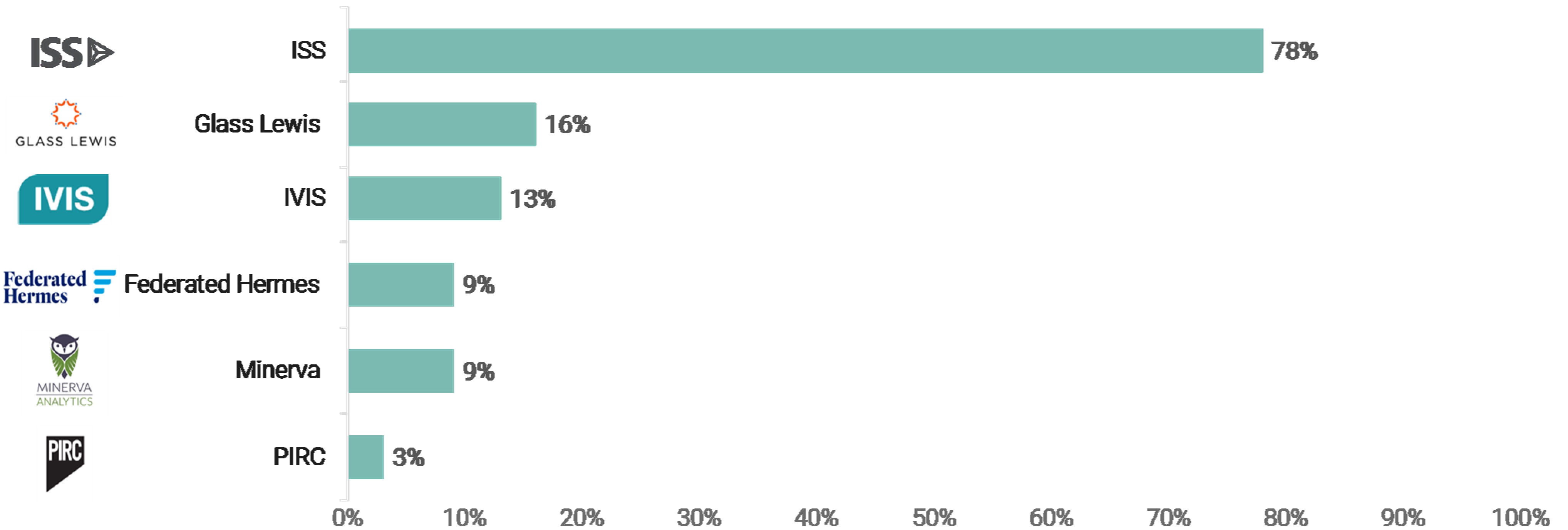
15ISS has the largest market presence. As shown in Exhibit 1, three-quarters of the investors that responded to the survey stated that they used ISS for voting research, but not exclusively in all cases. In total, 31% of investor survey participants indicated they use more than one proxy advisor.
 |
16Proxy advisors can be differentiated to a degree according to their client base in terms of their location and type of investor. For example, approximately 76% of Glass Lewis' clients are based in the Americas 4 while ISS maintains a significant presence both globally and in the UK. In comparison 52% of IVIS' subscribers are Investment Association members, who are predominantly UK-based global asset managers. 5 The majority of ISS and Glass Lewis' proxy research clients are asset managers (65% in the case of Glass Lewis), while a significant proportion of Federated Hermes EOS' clients are asset owners. 6 Similarly, PIRC's client base leans towards asset owners, predominantly pension funds.
17Investors are the primary customers for proxy advisors. However, some proxy advisors also provide consulting services to companies.
REGULATORY FRAMEWORK
18In the UK, proxy advisors are regulated under The Proxy Advisors (Shareholders' Rights) Regulations 2019. 7 The regulations require proxy advisors to state whether they adhere to an identified code of conduct and to disclose certain prescribed information, for example, on their methodologies and voting policies, the sources of information they use, their quality assurance procedures, and how they manage conflicts of interest. The regulations are overseen by the Financial Conduct Authority (FCA).
19In addition to the regulations, the FRC's UK Stewardship Code (2020) 8 contains a set of 'apply and explain' Principles for service providers (including proxy advisors) covering their purpose, governance, conflicts of interest, the promotion of well-functioning financial markets, how they support their clients' stewardship and how they review and assure their internal policies and processes.
20Compliance with the UK Stewardship Code is not mandatory, but signatories are required to disclose on an annual basis how they have applied the principles. The majority of proxy advisors operating in the UK are currently signatories. [^9]
21In the final quarter of 2023, the FRC – working with the FCA, Department for Work and Pensions (DWP) and The Pensions Regulator – will review the regulatory framework for effective stewardship, including the operation of the Stewardship Code. The review will assess whether the Stewardship Code is creating a market for effective stewardship and the need for any further regulation in this area.
22The majority of proxy advisors are also signatories to the Best Practice Principles for Shareholder Voting Research (BPP). The BPP Group [^10] (BPPG) was formed in February 2013 by a collective of industry members to develop an industry code of conduct, and the principles were most recently revised in 2019. These three principles cover service quality, conflict of interest avoidance or management, and communications policy with signatories' compliance reviewed based on an apply-and-explain framework.
23In 2020, the Group established an independent Oversight Committee to provide an annual review of the BPP and the public compliance statements of each BPP Signatory and to provide oversight of the BPPG's complaints management procedure, including monitoring of outcomes of those procedures.
THE USE MADE OF PROXY VOTING RESEARCH
INTRODUCTION
24The FRC's first objective when commissioning this research project was to gain a better understanding of the impacts of recommendations given by proxy advisors on the behaviour of FTSE 350 companies and on investor voting decisions.
25This section starts by looking at how companies believe investors make use of the research and recommendations they receive from proxy advisors. It also considers the extent and manner in which companies take account of the perceived influence of proxy advisors when designing their own governance arrangements and policies. It then compares the views of companies with evidence received from investors and proxy advisors, including on the selection of the voting policy against which the proxy advisor provides recommendations, other inputs used by investors, and processes followed by investors when making voting decisions, and the use made by investors of proxy advisors' voting platforms.
26The section concludes with an analysis of voting behaviour in 2022 FTSE 350 AGMs, focusing primarily on a sample of resolutions on which one or both of ISS and Glass Lewis recommended voting against the resolution, in an attempt to identify whether there is an apparent correlation between those recommendations and the voting outcomes.
KEY INSIGHTS
INFLUENCE ON VOTING OUTCOMES An analysis was undertaken of the voting recommendations made by ISS and Glass Lewis – as the proxy advisors with the largest client base – on resolutions on board appointments and remuneration in FTSE 350 companies in
- These recommendations were compared with the actual voting outcomes and the voting activity of selected investors.
While there is some evidence of correlation between negative voting recommendations and voting outcomes in FTSE 350 companies, it appears to be less extensive than is sometimes asserted. A vote of 20% or more against a resolution relating to director elections or remuneration occurred in only half of the cases where one or both of ISS or Glass Lewis had made such a recommendation in 2022, although this increased to 77% of cases when both did so.
Only one of the 38 investors in our sample voted against resolutions in more than 75% of cases when their proxy advisor recommended doing so, while 45% of investors voted against in fewer than half such cases. Higher levels of correlation might be expected if proxy advisors' recommendations were the primary influence on voting decisions.
There do not appear to be many notable differences in voting behaviour based on the size of the investor or the choice of proxy advisor. However, comparing investors with UK-based teams to those without UK-based teams, a much higher proportion of the latter voted in line with their proxy advisor on more than 50% of resolutions. There is a similar pattern when comparing asset owners and asset managers.
Recommendations by the largest proxy advisors to vote against resolutions are relatively rare on most topics, for example, only 1.2% of board appointment resolutions in 2022 attracted a vote against recommendation from one or both of ISS or Glass Lewis. A notable exception is resolutions relating to remuneration, of which 14.6% attracted a vote against recommendation.
INVESTORS' USE OF VOTING POLICIES
An increasing number of investors are asking proxy advisors to provide voting research based on the investor's own customised voting policies (policies developed by the investor rather than the proxy advisor) – 75% of those investors that responded to the survey did so, and all proxy advisor interviewees reported an increase in the demand for customised policies from clients.
There is some evidence of investors taking a harder line than proxy advisors on some issues, for example, overboarding (directors holding multiple board positions). In 40% of the cases where a director's election attracted a vote against of more than 20% in 2022, both ISS and Glass Lewis had recommended a vote in favour.
As well as research reports from proxy advisors, the other main sources used by investors that responded to the survey when taking voting decisions are: their own in-house analysis, the company's disclosures, and ESG research obtained from other service providers.
Due to limited resources, most investors will issue voting instructions based on recommendations from proxy advisors without manual intervention where the resolution is uncontroversial. All investor interviewees said that they always review recommendations to vote against management and resolutions that met certain criteria, for example, all companies above a certain size or in which they own more than a certain percentage of the shares, or with which they have engaged about governance concerns.
IMPACT ON COMPANIES' BEHAVIOUR
All company interviewees said that they attempted to anticipate the likely position of some or all proxy advisors and ensure that the board or relevant committee had this information available. Many had analysed their share register to identify which proxy advisors were most likely to have a potential impact on voting outcomes.
A few company interviewees stated that their company had changed proposed resolutions or their existing governance arrangements purely in order to avoid receiving a recommendation to vote against from proxy advisors on at least one occasion, but only in relation to what they considered to be non-strategic issues.
HOW PROXY ADVISORS DEVELOP VOTING POLICIES
There can be considerable variation in the position taken by ISS and Glass Lewis on remuneration and director appointments. In two-thirds of cases where one of these proxy advisors recommended a vote against in 2022, the other took the opposite position.
Footnotes
| Financial Reporting Council (frc.org.uk) [^10]: More information available at: Home
| Best Practice Principles for Shareholder Voting Research (bppgrp.info)
INVESTORS' USE OF VOTING POLICIES
An increasing number of investors are asking proxy advisors to provide voting research based on the investor's own customised voting policies (policies developed by the investor rather than the proxy advisor) – 75% of those investors that responded to the survey did so, and all proxy advisor interviewees reported an increase in the demand for customised policies from clients.
There is some evidence of investors taking a harder line than proxy advisors on some issues, for example, overboarding (directors holding multiple board positions). In 40% of the cases where a director’s election attracted a vote against of more than 20% in 2022, both ISS and Glass Lewis had recommended a vote in favour.
As well as research reports from proxy advisors, the other main sources used by investors that responded to the survey when taking voting decisions are: their own in-house analysis, the company's disclosures, and ESG research obtained from other service providers.
Due to limited resources, most investors will issue voting instructions based on recommendations from proxy advisors without manual intervention where the resolution is uncontroversial. All investor interviewees said that they always review recommendations to vote against management and resolutions that met certain criteria, for example, all companies above a certain size or in which they own more than a certain percentage of the shares, or with which they have engaged about governance concerns.
IMPACT ON COMPANIES' BEHAVIOUR
All company interviewees said that they attempted to anticipate the likely position of some or all proxy advisors and ensure that the board or relevant committee had this information available. Many had analysed their share register to identify which proxy advisors were most likely to have a potential impact on voting outcomes.
A few company interviewees stated that their company had changed proposed resolutions or their existing governance arrangements purely in order to avoid receiving a recommendation to vote against from proxy advisors on at least one occasion, but only in relation to what they considered to be non-strategic issues.
HOW PROXY ADVISORS DEVELOP VOTING POLICIES
There can be considerable variation in the position taken by ISS and Glass Lewis on remuneration and director appointments. In two-thirds of cases where one of these proxy advisors recommended a vote against in 2022, the other took the opposite position.
All proxy advisor interviewees stated that the UK Corporate Governance Code is one of the main sources for their UK benchmark policy. On some issues the UK benchmark policies set more onerous standards than the same proxy advisors' voting guidelines for other markets, which may reflect higher expectations on the part of their UK clients as well as national requirements.
There are a few topics on which benchmark policies are more specific than the Code and other UK regulatory requirements and standards. One such example is the total number of board appointments that can be held by a director. Company interviewees consider that proxy advisor methodologies should be aligned to the Code to increase consistency, or that proxy advisors should at least be required to state explicitly how their policies deviated from the Code to increase transparency.
A relatively recent development has been the introduction by some proxy advisors of what are referred to as 'specialty' policies which vary from the benchmark policy, usually in relation to one or more aspects of ESG. The use of these products is likely to increase the variation in proxy advisors' voting recommendations noted by companies.
COMPANY VIEWS AND BEHAVIOURS
COMPANY VIEWS ON PROXY ADVISORS' IMPACT ON VOTING OUTCOMES
27The majority of company representatives that were interviewed or who took part in the roundtable meetings believed that at least some investors have in effect outsourced many or all of their voting decisions to proxy advisors, with the result that the advisors exercise considerable influence over voting outcomes. Interviewees’ views on how and why voting outcomes are influenced are set out below; the voting analysis in paragraph 91 onwards assesses to what extent the evidence appears to support these views.
28This was a particular concern because proxy advisors were perceived as taking a 'box-ticking' approach which failed to take into account individual companies’ specific circumstances and was inconsistent with the 'comply or explain' approach advocated in the UK Corporate Governance Code and because, in the words of one company interviewee, 'you have people without skin in the game.'
29These views were consistent with those of previous commentators working for or with listed companies, such as the FTSE chairs quoted in the report by Tulchan Communications published in November 2022.[^11]
30While almost all company interviewees believed that some investors vote in line with proxy advisors' recommendations without any further scrutiny, there were differences of view about the extent to which this happened. Some considered that it was widespread, while others felt it was more likely to be confined to certain circumstances.
31Several interviewees suggested that investors were more likely to vote in line with voting recommendations where they lacked resources or were looking to reduce costs. Among other impacts, this meant that these investors were often unable or unwilling to engage with companies to obtain a more informed view of their position and the rationale for the company's proposals.
32Other factors mentioned by interviewees as potentially influencing investors to vote in line with proxy advisors' recommendations included:
32.1The investor's investment approach. In particular, it was suggested by a few interviewees that index funds and investors adopting a passive approach would be more likely to follow recommendations.
‘I think passive investment funds may treat it as a tick box exercise because they’re not proactively choosing what companies to invest in.’
Company Secretary
32.2Foreign investors that did not have a UK presence. It was suggested by some interviewees that these investors may be less familiar with the UK companies in which they invest, and/or that these companies may be viewed as less significant in terms of their overall portfolio.
‘There is a difference between the US and UK in terms of how they vote. US shareholders will automatically vote against resolutions in our notice.’
Company Secretary
33Many company respondents believed that where voting decisions were taken by the investor’s stewardship or responsible investment teams, they often lacked the necessary understanding of the company or its business model and would therefore be more inclined to rely on the proxy advisor. It was implied that the same investor’s fund managers might reach a different conclusion.
34One company interviewee also considered that investors' internal processes to sign off on voting decisions might create a disincentive to vote in a way contrary to the recommendation received from the proxy advisor, as it would require them to escalate the issue in order to do so.
‘When you look at voting patterns, a lot of institutional investors won’t vote until the ISS report comes out. If they want to disagree with ISS, they have to go to their investment committees. So as long as they’re aligned with ISS, they can vote.’
Company Secretary
EVIDENCE OF INVESTOR-LED VOTING OUTCOMES
35There were different views on how widespread the reliance on proxy advisors was, with several interviewees sharing examples of where at least some investors had voted contrary to the recommendation made by their proxy advisor, both for and against the company. In their experience, it tended to be larger shareholders (in terms of their shareholding in the company and/or their overall assets under management) that did so. This might perhaps suggest that those shareholders voted in accordance with their own customised policy rather than the proxy advisors’ benchmark policy.
36Several company interviewees perceived that some UK investors were more ‘hard line’ than most of the proxy advisors’ benchmark policies on some corporate governance issues. The most frequently cited issue was overboarding (directors holding multiple board positions). One interviewee said that one of their directors had attracted a significant vote against at the previous AGM even though all the proxy advisors had recommended a vote in favour in their benchmark policies.
‘None of the proxy advisors recommended voting against the reappointment. The vote against was led by major shareholders using their own internal governance policies on overboarding. In this case it was four of the top 50 shareholders voting against. Before and after the vote we engaged with them, to hear what their concerns were and to avoid a similar case in the future. Their policy was stricter than the UK Corporate Governance Code, but they stood by it.’
Company Secretary
THE IMPACT OF PROXY ADVISORS ON COMPANIES' OWN PRACTICES
37All company interviewees were asked how they took account of the perceived influence of proxy advisors when designing their own governance arrangements and policies and explaining them to shareholders in their AGM papers and annual reports.
38The majority of the interviewees stated that they attempted to engage with proxy advisors before and during the AGM season with the aim of ensuring that they understood the company’s proposal, and that the research reports produced by proxy advisors for their investor clients were factually accurate. These issues are addressed in more detail in the Engagement During the AGM Season and Engagement Outside the AGM Season sections of this report.
Understanding proxy advisors' likely views
39In addition to engagement, most company interviewees said they attempted to anticipate the likely position of some or all proxy advisors and ensure that the board or relevant committee had this information available.
40This was considered particularly important when the company was developing governance policies, such as the remuneration policy, or considering significant changes to their governance structures, such as those affecting senior board positions.
41Most interviewees said that they scrutinised the proxy advisors' benchmark voting policies in an attempt to anticipate what their view was likely to be toward the company’s proposals, but noted that this can be very time-consuming for the company secretariat.
‘It would be easily two to three days’ work for somebody in the team to go through each report and build a matrix of what the voting recommendation looks like, including the main agencies and the large institutional investors that write to you on their key focus areas for the year. So, a lot of work goes into this.’
Company Secretary
42The majority of company interviewees said that they either analysed their share register to identify which shareholders were clients of which proxy advisors or engaged a third party to do so. This enabled them to identify which of the advisors might potentially have an impact on voting outcomes, helping them to target their engagement and reduce the level of resource required.
‘We focus a lot on the top 30 shareholders who make up about 70% of our register. In that group, we think ISS is the biggest swing factor for us.’
Company Secretary
How proxy advisors' views inform a company's decisions
43Once the analysis of proxy advisors’ policies has been undertaken it will typically be shared with the board or relevant committee so that they can factor it into their decision-making process.
‘Whenever we are doing something that we are aware will cross a line for a proxy voting advisor, we do highlight that and then the board makes the decision.’
Company Secretary
44The extent to which the views of proxy advisors informed the development of the company’s proposals, as opposed to being viewed as a ‘health check’ before the proposals were approved, varied between interviewees. Some described examples of where the views of proxy advisors were integral to the process.
‘We are very mindful when producing policy about what the proxy guidelines are. That is a big part of how we structure our internal policies.’
Head of Secretariat
45Interviewees were asked whether their company had ever changed proposals or their existing governance arrangements purely to avoid receiving a recommendation to vote against from one or more proxy advisor. A few interviewees said that there had been instances where this had been the case, but only in relation to what they described as ‘non-strategic’ issues. On matters of strategic importance, for example, board composition and the company’s climate action plan, all interviewees believed that their board would do what it considered to be in the best interests of the company and accept the potential consequences.
‘If there’s an easier path to take and it’s actually not going to fundamentally affect us from a strategic perspective, then we would probably go down the path of least resistance.’
Company Secretary and General Counsel
‘We try to do what’s right for the business and then just live with the consequences with the proxy advisors. If our approach is not what they support, so be it.’
Company Secretary
Conflicting proxy advisor recommendations
46One aspect of proxy advisors’ influence that was raised by several company interviewees was the perception that proxy advisors would often take different positions on specific resolutions or certain governance topics. This complicated the assessment process, as it could put the company in the position where it would fall foul of at least one proxy advisor whatever action it chose to take. It also made it more difficult to anticipate the likely voting outcome.
47Many company interviewees found this very frustrating and expressed the view that proxy advisor methodologies should be more closely aligned to the UK Corporate Governance Code and other national standards to ensure more consistency, or that proxy advisors should at least be required to state explicitly how their policies deviated from the Code to increase transparency. Several interviewees took the view that as there were clearly diverging views among investors on certain governance topics it was only to be expected that this would be reflected in proxy advisors’ voting policies. While some shared the frustration of the other interviewees, they accepted this was unlikely to change and was something that companies needed to learn to manage.
‘You’ve got people with different views; you’ve got to accept that you’ve got to try and strike a balance… When you get to things like remuneration where the views can be so polar or so diverse, you are going to have to accept that you’re not going to please everyone. But that’s a challenge for us.’
Company Secretary
‘Take the issue of director overboarding. There is quite a disparity of opinion, so we take the sort of lowest common denominator across all of them to make sure that any particular group that has influence isn’t unduly annoyed when we make an appointment.’
Company Secretary
48A few interviewees commented on the introduction of specialty voting policies by ISS and Glass Lewis (see paragraph 58), which can sometimes make different voting recommendations to the same proxy advisors’ benchmark policies. This added to the complexity of assessing proxy advisors’ views and predicting voting outcomes. Specifically, it may result in a single proxy advisor making different recommendations on the same resolution depending on which policy is being applied. Some company interviewees gave examples of where this had happened in relation to one of their resolutions.
49The level of awareness of these policies among company interviewees was low, and respondents felt that there was a need for greater transparency on the part of proxy advisors.
HOW PROXY ADVISORS DEVELOP AND APPLY POLICIES
BENCHMARK POLICIES
50The majority of the proxy advisors operating in the UK have a standard voting policy which they will use when assessing a company's governance and making a recommendation to their clients on whether to vote for or against a resolution (or in the case of IVIS, whether to colour code their report as 'red' or 'amber' to indicate to clients that there are potential concerns). The exception is Minerva Analytics, which produces a tailored research report for each client based on their preferences.
51These standard policies are normally referred to as benchmark policies (or 'house policies'). All the proxy advisors that use them have developed a UK-specific benchmark policy, which may be derived from a global policy in the case of those advisors who offer voting research services in multiple markets.
52All proxy advisor interviewees stated that the UK Corporate Governance Code is one of the main sources for their respective UK benchmark policies. Other sources cited by all proxy advisors include UK laws and regulations, for example, the UK Listing Rules requirements on gender and ethnic diversity at board level,[^12] and the views of investor clients and other UK stakeholders. Multiple other sources were mentioned by one or more proxy advisor.
53The proxy advisors' latest UK benchmark policies were reviewed as part of the research. In most respects they are consistent with the Code and other UK requirements and we found no evidence of different standards being 'imported' from elsewhere (a claim that is sometimes made by companies). On some issues, the UK benchmark policies set more onerous standards than the same proxy advisors' voting guidelines for other markets, which may reflect higher expectations on the part of their UK clients as well as national requirements. For example, both ISS and Glass Lewis address the issue of pensions alignment in their 2023 UK voting guidelines, but not in their guidelines for other markets.
54However, there are a few topics on which benchmark policies are less flexible than the Code or other UK regulatory requirements and standards. These tend to be topics on which the Code does not specify a minimum requirement. One such example is the total number of board appointments that can be held by a director. With the exception of executive directors the Code does not currently specify what the FRC considers to be an acceptable number of board positions, whereas the UK benchmark policies of both ISS and Glass Lewis specify a maximum of five board positions (with some exceptions and with specific circumstances taken into consideration).[^13]
55Typically, proxy advisors have an established process which they use to review the benchmark policy and update it where necessary. All proxy advisor interviewees stated that their benchmark policies are reviewed annually to take account of any regulatory changes and other market developments. Though the details of the formal process varied, the majority of interviewees mentioned that client feedback and consultation contributed to any potential revisions. For example:
55.1PIRC consults with clients annually on each new edition of its UK Shareholder Voting Guidelines. Once finalised, the guidelines are sent to all companies on the FTSE All Share Index and presented at client seminars and webinars.
55.2Glass Lewis’ review of their UK guidelines includes engagement with the Investment Association and the Association of Investment Companies among others. Glass Lewis also arranges roundtables to give investor clients an opportunity to comment directly.
56While proxy advisors use many of the same inputs to develop their benchmark policies, their voting recommendations may differ. In some cases this may result from differences between their policies on specific governance practices, in others from differences in the detailed methodology used to assess whether the company in question complied with the policy. As noted in paragraph 46, this was a source of frustration for some company interviewees.
57The analysis of voting in FTSE 350 AGMs in 2022 undertaken for this research confirms that there is considerable variation between the voting recommendations made by different proxy advisors (see paragraph 98). While the number of instances where either ISS or Glass Lewis recommended a vote against either a director election or a remuneration resolution was relatively small in terms of the overall number of resolutions, they only made the same recommendation in one-third of those cases when applying their benchmark policies.
SPECIALTY POLICIES AND RESEARCH
58A relatively recent development in the market has been the introduction by some proxy advisors, led by ISS and Glass Lewis, of what are sometimes referred to as 'specialty' research and voting policies which vary from the benchmark policy in certain respects, and which usually relate to one or more aspects of ESG.
59In some cases, these are 'off-the-shelf' policies available to all clients, as opposed to customised research tailored to the specific needs of an individual client.
Specialty policies offered by ISS include, for example:
- Climate Voting Policy
- Public Fund Voting Policy
- Socially Responsible Voting Policy
- Sustainability Voting Policy
60In other cases, proxy advisors will offer supplementary research which is intended to help inform the client's voting decisions. For example, Glass Lewis offers an ESG Profile which includes a series of data points as well as a scoring methodology it has developed (see paragraph 261 onwards for a more detailed analysis of the use of ESG data and methodologies).
61The use of these products is likely to increase the variation in proxy advisors' voting recommendations noted by companies. Specifically, it may result in a single proxy advisor making different recommendations on the same resolution depending on which policy is being applied.
62As noted in paragraph 48, it was clear from the interviews with company representatives that there has to date been little awareness of the existence of these specialty products, and it was confirmed by the proxy advisor interviewees that companies are not given an opportunity to comment on the content of these research reports in the same way as some consult companies on their benchmark research reports.
‘Specialty policies are transparent and on our website. We can’t provide every single custom voting policy to issuers, so they’ll receive a benchmark report. I think that was the issue: companies have visibility of the benchmark report but then hear there’s a different stance on the voting resolution. It looks similar but it’s an educational issue. It’s something we need to address and communicate with issuers.’
Director, Regulatory Affairs and Public Policy (Proxy Advisor)
CUSTOMISED VOTING RESEARCH AND RECOMMENDATIONS
63All proxy advisors apart from IVIS also offer customised research and/or voting recommendations to individual clients, based on that client's own in-house voting policy. This enables that investor to tailor the research and recommendations to reflect its own position, which on some issues may be more stringent than the proxy advisors' benchmark policy.
64All the proxy advisor interviewees confirmed that the number of clients that request customised voting research or recommendations has increased in recent years. Their estimates of the number of clients currently receiving customised research ranged between 25% and 75%. Interviewees stated that the majority tended to be larger or niche investors with in-house stewardship resources. This appears to be borne out by the evidence gathered from the investor survey and interviews described in paragraph 67. However, one proxy advisor interviewee noted that an increasing number of their smaller clients were also adopting customised policies.
65Proxy advisors maintain different processes for helping clients update and implement custom policies. For example:
65.1If requested, ISS’ custom research analysts may offer guidance to clients on how to create and apply their own voting policies, including back-testing policies by market to ensure consistency of application. ISS also offers regular review of clients’ custom policies to ensure new or emerging issues that have garnered increased interest in the investment community are identified.[^14] The interviewee from ISS estimated that they implemented voting recommendations for more than 500 custom client policies in 2022.
65.2Minerva Analytics has a voting policy workbook which covers all topics that clients may wish to cover in their voting policy. Their analysts go through the workbook with the client to establish what their voting preferences are, and these preferences are then used to develop a bespoke voting template. Additionally, Minerva produces background briefings on voteable issues.
HOW INVESTORS USE VOTING RESEARCH
66The evidence from the survey and investor interviews suggests that the nature of the research that investors receive from proxy advisors, and the use to which they put it, varies considerably between investors.
USE OF CUSTOMISED POLICIES
67In total, 75% of the investors who responded to the survey said that they instruct proxy advisors to apply the investors own customised policy as well as or instead of the benchmark policy when undertaking research.
68It is recognised that the respondents may not necessarily be representative of investors as a whole; for example, they have all demonstrated a commitment to stewardship by being signatories to the Stewardship Code. However, these findings are consistent with previous research commissioned by the FRC.[^15]
69An analysis of the respondents found no significant difference between asset managers and asset owners or between UK and foreign-based investors in the use of customised policies. However, there does appear to be some correlation between the size of the investor’s portfolio or assets under management and their use of customised policies, with only 60% of small asset managers using them compared to 90% of large managers.[^16] This is consistent with the evidence from proxy advisors referred to in paragraph 63.
EXHIBIT 2: USE OF CUSTOMISED POLICIES [INVESTOR SURVEY]

70There are not necessarily a significant number of differences between the benchmark policy and the customised policies of individual investor clients. Interviewees highlighted that in-house and benchmark policies will often overlap to a large extent, in part because the investor and proxy advisor both use many of the same sources, such as the UK Corporate Governance Code. In addition, in some cases investors are able to influence the content of the benchmark policy by participating in the proxy advisors' annual review process.
71Examples from interviewees of issues on which their own customised policies often took a harder line than proxy advisors' benchmark policy, included overboarding of directors, diversity and (in the case of some UK-based investors) the alignment of directors' pension arrangements with those of the workforce. One investor interviewee stated that they have a harder line than their proxy advisor on long-term incentives retention periods, and unlike some proxy advisors did not apply lower standards on independence and diversity to smaller companies.
‘They sometimes take too strong a stance and that’s why we do not blanket follow. We look at their recommendations on a case-by-case basis and if there is a difference would much rather go with our own voting policy.’
ESG and Stewardship Analyst
‘Sometimes we differ from our proxy advisor for two reasons. One is because we just have a different view and we’re coming at it from a different starting point. The second is that quite often they don’t do the depth of analysis on emerging ESG issues that we think they should do, for example on workforce analysis.’
Head of Stewardship
USE OF MULTIPLE POLICIES
72Even where an investor is receiving customised research or applying their own in-house voting policy, they may also obtain research that uses a benchmark or specialty policy from the same or a different proxy advisor. As noted in paragraph 15, 31% of investors that responded to the survey use the services of more than one proxy advisor.
73Investor interviewees identified a number of reasons for doing so, including to identify issues on which the customised and benchmark policies and/or the various proxy advisors reached different conclusions – which might prompt them to look at the issue in more detail – and to provide additional insights or fill in gaps in the research.
‘We’re always guided by our own voting policy, but it’s very useful to have that additional research. We get a custom policy report through from the proxy advisor, as well as their benchmark policy, and a sustainability voting template, to give an ESG overlay to our voting.’
ESG and Stewardship Analyst
‘We subscribe to both ISS and Glass Lewis research globally, and we actively look for differences of opinion or discrepancies between the two providers so we can compare and contrast opinions.’
Investment Stewardship Director
OTHER INPUTS TO INVESTOR VOTING POLICIES AND DECISIONS
74All investor interviewees stated that they made use of other inputs when developing their in-house policies and taking voting decisions. As one of them put it, the proxy research report was just 'one piece of the jigsaw.'
75This was consistent with responses to the survey. All investors that responded, including those that use the proxy advisors' benchmark policy rather than a customised policy, identified at least one other source of information that they used. As already noted, interviewees and respondents may not necessarily be representative of all investors.
EXHIBIT 3: WHAT OTHER RESOURCES DO YOU USE TO INFORM YOUR VOTING DECISIONS? [INVESTOR SURVEY]
Bar chart showing the percentage of investors using various resources to inform voting decisions: In-House Analysis 100%, Investee Company Disclosures 91%, ESG Research or Ratings 72%, Other Sources 41%, and None 0%.
76The other sources identified by survey respondents included engagement with the company (either one-to-one engagement or as part of broader collaborative engagement), media reports and guidance, and briefings from third parties, for example, the Pensions and Lifetime Savings Association (PLSA) and Climate Action 100+.
INVESTORS' DECISION-MAKING PROCESSES
THE ROLE OF VOTING PLATFORMS
77Four of the proxy advisors currently providing voting research in the UK – Glass Lewis, ISS, Minerva and PIRC – also provide a voting platform that investors can use to manage their voting activity.
78The scope and functionality of these platforms varies but most share a number of common features. These typically include: access to shareholder meeting agendas, papers and research reports, alerts to notify the investor of impending deadlines (including voting deadlines), and filters that enable investors to identify specific resolutions that they wish to review.
79Most platforms will also include a vote execution function which enables the shareholder to send voting instructions to a custodian or their agent for onward transmission through the voting chain and ultimately to the company (more details of how the voting chain works can be found in the Voting Chain Deadlines section of this report). In the case of Minerva Analytics, instructions are sent directly to vote tabulators rather than to custodians.
80Typically, the voting instructions form for each meeting will be filled in by the proxy advisor using as a default the voting recommendations derived from whichever policy and parameters the investor has asked them to apply. Investors have the ability to change these settings if they wish to vote differently to their chosen policy’s recommendations, or wish not to vote at all.
81Investors can choose to submit their voting instructions in advance of the voting deadline for a specific meeting. If they choose not to do so, then the instructions will be sent automatically by the custodian or intermediary’s deadline, or the deadline agreed with the voting platform if different, regardless of whether or not they have been confirmed by the investor.
USE OF DEFAULT VOTING RECOMMENDATIONS
82The way that the platforms typically work means that it is possible for all of an investor’s votes to be executed without any direct involvement from the investor themselves other than agreeing with the proxy advisor which voting policy was to be applied.
83This contributes to the perception many companies have that some investors effectively delegate their voting decisions to proxy advisors, especially in cases where the same proxy advisors provide both the platform and the voting research (as was the case for 87% of investors that responded to the survey). In interviews with the proxy advisors, some acknowledged that this approach had been adopted by a number of their clients, although the interviewees stated that clients were encouraged to review voting instructions before the relevant deadline.
84Most investor interviewees confirmed that many voting recommendations – in some cases the majority - were executed without having been manually confirmed by the investor. However, they emphasised that this only applied to resolutions that they considered uncontroversial and where the recommendation was to vote with management.
85The main reason given for taking this approach was limited resources. Most interviewees invest in a large number of companies, many of whose AGMs are held close together. Filtering out uncontroversial votes in favour of management enables allows the investor to focus on those AGMs and resolutions that they consider to be priorities.
86All investor interviewees said that they will always review any recommendation to vote against management. Each interviewee also identified other criteria that were used to identify priority resolutions. Examples included:
- All holdings above a certain value;
- All companies in which they own more than a certain percentage of the shares;
- All companies above a certain size;
- All companies about which the investor has previously had concerns or with which they have engaged about governance concerns; and
- All resolutions on certain topics, for example remuneration or climate.
‘All our sizeable positions in the big markets in Western Europe where we have holdings are voted in-house. What gets voted through via the platform using our custom policy is a long tail of very small positions.’
Managing Director, EMEA Investment Stewardship
‘For instance, we have a workforce watchlist because one of our priority themes is the workforce. Every time our intelligence gathering picks up a company where there have been issues we put that on the watchlist. Then we know to pay particular attention to that company when the vote comes up.’
Head of Stewardship
VOTING DECISIONS ON CONTROVERSIAL RESOLUTIONS
87Investor interviewees all stated that they had policies and delegations that applied when considering a vote against a resolution or against their own customised policy (and in some cases also against the recommendation of their proxy advisor).
88The majority of investors stated that the policies required consultation with other teams in these circumstances, for example, with the portfolio manager when the stewardship team had the overall lead responsibility and vice versa. This could sometimes lead to differing views about how to vote. In addition, some investors allow their portfolio managers to vote in different ways, while others require internal alignment.
89Some policies required escalation to a more senior level when voting against a resolution or the usual policy and in cases where there is a difference of opinion, while others allowed some discretion.
‘Each meeting goes to the analyst who is responsible for the stock. They also have responsibility to vote, apart from where it’s deemed a significant vote, a shareholder resolution or it’s something controversial. In those cases it gets elevated up to the senior portfolio manager.’
Responsible Investment Manager
‘If there are areas that we can engage with the companies on, my team has the discretion to go against the proxy advisor recommendation. In addition, any analyst can actually go against a policy recommendation, be it our own custom policy or that of the proxy advisor. However, they have to provide us with a written rationale explaining why they have chosen to do so.’
Head of Governance and Stewardship
| EXHIBIT 4: INVESTOR APPROACHES TO CONTROVERSIAL VOTING DECISIONS | |
|---|---|
| INVESTOR 1 | |
| • | Investor 1 has a dedicated sustainable investing team, which works with the investment teams and is responsible for consolidating the firm’s approach to stewardship, engagement, ESG integration, and exercising votes at general meetings. |
| • | For voting activity, the relevant portfolio managers and analysts will generally be consulted before the vote is cast on certain matters. This includes voting resolutions related to M&A and capital raisings, debt issuances, material changes to the articles and votes against management where the investors shareholding is material. |
| • | In cases where individual portfolio managers have opposing views on a particular resolution, or where views differ between the portfolio managers and the sustainable investing team, the investor has an escalation process. |
| • | Final decision-making authority resides with the Sustainable Investing Oversight Committee (SIOC). Votes that are particularly significant for the organisation as a whole, for example, for reputational reasons, may also be escalated to the SIOC for review and approval. |
| INVESTOR 2 | |
| • | Investor 2 has a voting process which is managed by its Sustainable Investment Research and Stewardship team, who work closely with the fundamental investment teams to decide how to exercise voting rights based on voting principles, any engagement that has been undertaken, and internal knowledge of the investee company. |
| • | In cases where Investor 2 plans to deviate from its initial policy view, the Stewardship Committee reviews the reason and considers the case for/against changing the initial recommendation. |
| • | A majority of committee members should approve the intended vote. Reasons for the final decisions are recorded, tracked and used to inform future policy reviews. |
| • | If an individual portfolio manager is managing a strategy which is seen to be completely different to anything else within the firm, then they have the right to vote in line with the best interest of that particular investment approach. Ideally, however, the investor seeks to arrive at a single decision. |
90While their internal procedures differed, most investor interviewees were able to give examples of where their voting decision differed from the proxy advisor’s recommendations. One head of ESG estimated that this happened on as many as 20% of the resolutions that they classified as priorities, particularly those relating to remuneration and director appointments.
VOTING ANALYSIS
91In an attempt to establish whether there is evidence to support the view held by companies that many investors will routinely vote in line with proxy advisors’ recommendations to vote against resolutions, an analysis was undertaken of selected resolutions from FTSE 350 AGMs in 2022.
92The analysis reviewed the recommendations made by ISS and Glass Lewis on resolutions on board appointments and remuneration (including both binding votes on remuneration policies and advisory votes on remuneration reports) and compared them with the actual voting outcome and the voting activity of selected investors.
93While there are some limitations to the analysis, as explained below, it has produced some interesting findings on the extent of the correlation between voting recommendations of proxy advisors and the voting decisions of investors.
94However, it is important to emphasise that the analysis does not demonstrate any causation between the two activities. As investors and proxy advisors pointed out in the interviews, if an investor has selected a voting policy that closely reflects their views then it is to be expected that their voting decisions would be in line with that policy in most instances, especially where it is their own customised policy.
SAMPLE OF RESOLUTIONS
95The sample included all resolutions on remuneration and board appointments proposed by FTSE 350 companies that held their AGMs before 30 October 2022 – a total of 322 AGMs. An analysis of these resolutions identified 93 cases where one or both of ISS and Glass Lewis recommended a vote against a resolution, 60 on remuneration and 33 on board appointments. Where a proxy advisor recommended against the election of more than one director this has been counted as a single case.
96For context, the total number of remuneration-related resolutions proposed by the 322 companies in the sample was 411, while the total number of directors put forward for election was 2,667.9
97This means that recommendations to vote against were made by either or both ISS and Glass Lewis in respect of 14.6% of all remuneration-related resolutions and 1.2% of director elections.10
98The analysis appears to support the contention of some company interviewees that the recommendations made by different proxy advisors will often differ. In only one-third of the 93 cases in the sample did both ISS and Glass Lewis recommend a vote against in their benchmark policies.
EXHIBIT 5: COMPARISON OF VOTE AGAINST RECOMMENDATIONS BY PROXY ADVISOR
| Category | Both | ISS | Glass Lewis | Total | Overlap |
|---|---|---|---|---|---|
| Total | 30 | 29 | 34 | 93 | 32% |
ANALYSIS OF VOTING OUTCOMES
99The first part of the analysis looked at the percentage total votes for and against each of the resolutions in the sample, using data published by the companies concerned following their AGM. The analysis aimed to identify:
- How many resolutions received a significant level of votes against (defined as 20% or more in the UK Corporate Governance Code and the Investment Association’s Public Register);11
- Whether there was a consistent pattern in the levels of voting dissent across all resolutions in the sample (which might be an indicator of a correlation between voting recommendations and outcomes);
- Whether there was a difference in the levels of dissent where both ISS and Glass Lewis recommended a vote against as opposed to only one of them; and
- Whether there was a difference in the levels of dissent depending on the topic (some company interviewees believed that votes on remuneration will tend to attract higher levels of dissent) or the size of the company (some company interviewees believed that smaller companies might be more exposed to 'automatic voting' as they may be considered lower priority by investors when allocating their stewardship resources).
100There are some limitations to this analysis, the most obvious being that the analysis only covers voting recommendations made by ISS and Glass Lewis rather than all the proxy advisors. The decision only to review the recommendations of the two proxy advisors with the largest client base was primarily taken because of resource and data constraints but it means the potential impact of other advisors has not been researched.
101In addition, it was only possible to analyse the recommendations in ISS’ and Glass Lewis’ benchmark policies; the recommendations made when applying their specialty policies or client’s customised policies may differ. Finally, data was not available on the percentage of each company’s share register that consists of ISS and Glass Lewis clients, which clearly affects the potential impact of their recommendations.
TOTAL VOTES AGAINST
102The analysis found that just over 50% of the resolutions in the sample received a vote against of 20% or more (48 of 93 resolutions), with an average vote against for all resolutions in the sample of 22.3% (see Exhibit 6). Only three resolutions were not approved by shareholders, one in the FTSE 100 and two in the FTSE 250. All three were remuneration-related resolutions.
103There was considerable variation in the levels of dissent across the sample. The lowest percentage of votes against a resolution was 2.2% and the highest was 71.3%. While allowance needs to be made for differences in the composition of company share registers, there appears to be no consistent pattern in the level of dissent where proxy advisors recommend a vote against.
EXHIBIT 6: AVERAGE AND RANGE OF VOTES AGAINST FOR RESOLUTIONS WHERE ONE OR BOTH OF GLASS LEWIS AND ISS RECOMMENDED VOTING AGAINST
| Category | Resolutions | >20% votes against | % >20% votes against | Average vote against | Range of votes against |
|---|---|---|---|---|---|
| ALL | 93 | 48 | 52% | 22.3% | 2.2% 71.3% |
COMPARISON OF VOTING RECOMMENDATIONS BY PROXY ADVISORS
104The analysis found there was a significantly higher likelihood of votes against exceeding 20% when both ISS and Glass Lewis recommended a vote against than when only one did so (see Exhibit 7). The difference between ISS and Glass Lewis might perhaps be expected given their respective UK market shares.
EXHIBIT 7: SIGNIFICANT VOTES AGAINST WHEN RECOMMENDED BY INDIVIDUAL PROXY ADVISORS
Bar chart comparing significant votes against recommendations by individual proxy advisors.
- Both against: 77%
- ISS only against: 59%
- GL only against: 21%
VOTING BY TOPIC AND COMPANY SIZE
105The analysis found that a higher proportion of remuneration-related resolutions received a vote against that exceeded 20% of votes cast than resolutions relating to board appointments (55% compared to 45%), and that the average vote against was higher for these resolutions. However, it was also the case that there was a wider distribution in terms of the highest and lowest levels of dissent.
EXHIBIT 8: BREAKDOWN OF VOTES BY TOPIC
| Category | Resolutions | >20% votes against | % >20% votes against | Average vote against | Range of votes against |
|---|---|---|---|---|---|
| Board appointments | 33 | 15 | 45% | 18.2% | 2.2% 38.8% |
| Remuneration | 60 | 33 | 55% | 24.4% | 5% 71.3% |
106By contrast, there was no significant difference between companies of different sizes. Resolutions proposed by FTSE 100 companies were marginally more likely to receive 20% or more votes against (54% of the total compared to 50% for FTSE 250 companies), but the average vote against was virtually identical.
EXHIBIT 9: BREAKDOWN OF VOTES BETWEEN FTSE 100 AND FTSE 250
| Category | Resolutions | >20% votes against | % >20% votes against | Average vote against | Range of votes against |
|---|---|---|---|---|---|
| FTSE 100 | 39 | 21 | 54% | 22.5% | 3.8% 71.3% |
| FTSE 250 | 54 | 27 | 50% | 22.1% | 2.2% 55.4% |
OTHER SIGNIFICANT VOTES AGAINST
107During the course of the company interviews, a couple of interviewees shared examples of where a resolution had attracted a vote against of more than 20% even though all the proxy advisors had recommended a vote in favour in their benchmark policies. Both examples concerned director elections, and in both cases the interviewees attributed the outcome to the fact that some investors were concerned about overboarding and took a stricter position than their proxy advisor.
108An additional analysis was undertaken after the completion of the interviews. Using the Investment Association's Public Register, a list was compiled of all remuneration and board appointment resolutions from FTSE 350 companies that received a vote against of 20% or more in the period covered by the analysis described above. Each resolution was checked against the recommendations made by ISS and Glass Lewis in their benchmark policies.
109The findings appear to confirm the experience of the interviewees. The Public Register which tracks shareholder dissent in UK FTSE All Share companies, identified 25 companies that had received 20% or more votes against for one or more directors. In ten of these cases (40%) both ISS and Glass Lewis recommended voting in favour of the directors concerned.12
110While it is possible that other proxy advisors and/or ISS' and Glass Lewis' own specialty policies may have recommended voting against, these do appear to be examples of where opposition has been led by investors applying their own customised voting policies rather than by the proxy advisors. As noted in paragraph 63, investors' customised policies will often take a harder line than the proxy advisors' benchmark policies on a small number of issues.
111By contrast, there were many fewer such examples in relation to remuneration. Of the 38 cases listed on the Public Register, there were only five (13%) where both ISS and Glass Lewis had recommended a vote in favour.
ANALYSIS OF INVESTOR VOTING ACTIVITY
112The second part of the analysis investigated how a sample group of investors, who were clients of ISS or Glass Lewis (or both), had voted on the same set of resolutions for those companies in which they were shareholders.
113The analysis shows the percentage of resolutions on which the investor had voted against, and their proxy advisor had recommended doing so. The data is shown as a percentage rather than a figure for the sake of comparability as not all investors in the sample invested in the same number of companies.
114The aims were:
- To identify whether there was any apparent correlation between the way in which each investor voted, and the recommendations made by their proxy advisor;
- To identify any differences in voting behaviour of investors based on their size, their location (UK or elsewhere), whether they were asset managers or asset owners, and which proxy advisor they use. These were all factors identified by some interviewees as influencing whether investors were likely to vote in line with the recommendations of their proxy advisor.
115There are a number of limitations to the analysis. The sample of investors excluded those that have not published full data on how they voted in FTSE 350 AGMs, and those who did not invest in a sufficient number of the companies concerned to provide meaningful data. This resulted in a bias towards large investors and towards asset managers rather than asset owners.
116It was not possible to compare the voting behaviour of active and passive funds – another factor that some company interviewees identified as perhaps being relevant (see paragraph 32.1) – as voting data was only available at firm, not fund, level and some investors manage both types of fund.
117Finally, it was not possible to identify whether the investors in the sample used the benchmark policy of their selected proxy advisor(s) as opposed to a customised or specialty policy. Specialty and customised policies may contain different voting recommendations compared to the benchmark policies.
EXHIBIT 10: VOTING ANALYSIS PER INVESTOR, SHOWING THE PERCENTAGE OF RESOLUTIONS WHERE THE INVESTOR VOTED AGAINST A RESOLUTION
| PERCENTAGE IN-LINE | 0-49% | 50-74% | 75-99% | 100% IN LINE | TOTAL |
|---|---|---|---|---|---|
| PROXY ADVISOR USED | |||||
| Use ISS | 9 | 12 | 0 | 0 | 21 |
| Use Glass Lewis | 1 | 3 | 0 | 0 | 4 |
| Use both | 7 | 5 | 1 | 0 | 13 |
| INVESTOR SIZE13 | |||||
| Large | 12 | 15 | 1 | 0 | 28 |
| Medium | 4 | 3 | 0 | 0 | 7 |
| Small | 1 | 2 | 0 | 0 | 3 |
| LOCATION | |||||
| UK-based | 13 | 10 | 0 | 0 | 23 |
| Non-UK-based | 4 | 10 | 1 | 0 | 15 |
| INVESTOR TYPE | |||||
| Asset Manager | 16 | 15 | 0 | 0 | 31 |
| Asset Owner | 1 | 5 | 1 | 0 | 7 |
| TOTAL | 17 | 20 | 1 | 0 | 38 |
118Perhaps the most notable findings are that only one investor in the sample voted against resolutions in more than 75% of cases where their proxy advisor recommended they should do so, and that 45% of investors in the sample voted against in fewer than half such cases. One might expect to see higher levels of correlation were these investors relying solely or primarily on proxy advisors’ voting recommendations when taking voting decisions.
119While allowance needs to be made for the fact that some sub-groups are very small, there do not appear to be many notable differences in voting behaviour based on the size of the investor or the choice of proxy advisor, at least where only one proxy advisor is used.
120By contrast, a much higher proportion of asset owners voted in line with their proxy advisor in more than 50% of cases than asset managers (86% of asset owners compared to 48% of asset managers). A similar pattern can be found when comparing investors that do not have teams based in the UK compared to those that do (73% compared to 43%). This is potentially significant as non-UK investors hold the majority of shares by value in UK listed stocks (56.3% in 2020).14
121In both cases the difference may perhaps be because UK-based asset managers are more likely to have had direct dealings with the company and/or access to additional information and are able to draw on a wider range of inputs when making voting decisions. That said, the levels of correlation for non-UK based investors and asset owners are still lower that might perhaps have been expected.
ENGAGEMENT DURING THE AGM SEASON
INTRODUCTION
122The previous section of the Report reviewed the evidence of how investors make use of the research reports and voting recommendations from proxy advisors. This section looks at what happens during the period immediately before a company's AGM, when those reports are written and voting decisions have to be taken.
123Most of the companies that participated in interviews and roundtables raised concerns about the effectiveness of engagement during the AGM season, which can be grouped into three related themes:
- The ability to review and comment on proxy advisors’ draft research reports, and the time available for them to do so;
- The factual accuracy and balance of those research reports, in particular in cases where the proxy advisor was proposing to recommend voting against a resolution; and
- The responsiveness of proxy advisors, in terms of their willingness to correct errors, reflect the company’s views in their report and, where relevant, change their recommendations.
124These themes are explored in this section, which summarises the evidence from companies and proxy advisors, together with insights obtained during the course of the research into the extent to which investors are willing or able to engage with companies during the AGM season.
KEY INSIGHTS
For most company interviewees, engagement with proxy advisors either before or during the AGM season was an important part of ensuring that the company’s proposals were understood and the research reports produced by proxy advisors for their investor clients were balanced and factually accurate.
Proxy advisors have different policies on giving companies the opportunity to comment on draft research reports. Some aim to do so in all cases, others only in certain circumstances, and others not all. Where the opportunity to comment exists it extends only to research reports that apply the proxy advisors’ benchmark voting policy, not to the ‘specialty’ policies offered by some proxy advisors.
All companies that responded to the survey considered that they should have a mandatory right to comment on draft benchmark research reports. Only 56% of investor respondents thought that companies should have this right.
There was no consensus between companies and investors on the quality of the research carried out by proxy advisors. Nearly half of companies that responded to the survey said that they were dissatisfied, compared to only 6% of investors.
The majority of proxy advisors and investors interviewed said that they will not engage directly with companies during the AGM season, with most citing time and resource constraints as the main reason. In addition, the majority of investors interviewed do not notify companies of their intention to vote against a resolution in advance of doing so.
CONTEXT
125During the AGM season, companies, investors and proxy advisors are all working under pressure, with time and resources at a premium. There can be as few as 14 calendar days between AGM papers being sent by companies to shareholders and the shareholders having to submit their voting instructions. An explanation of the different stages of the voting chain and how they impact on the time available to companies, investors and proxy advisors can be found in Voting Chain Deadlines.
126At the height of the AGM season, the large number of AGMs taking place in a short period of time increases the pressure on investors and proxy advisors. For example, 110 FTSE 350 companies held their AGMs in May 2022, with 35 held in the week beginning 9 May alone.15 For proxy advisors and for investors with global portfolios this may represent just a fraction of the total number of AGMs on which they are writing research reports and voting respectively.
127Perhaps inevitably, these conditions contribute to frustrations on all sides about the effectiveness of the process, the behaviour of the other parties and, on companies’ part, to concerns that their AGM resolutions may not get the level of attention from proxy advisors and investors that they deserve.
THE ABILITY TO REVIEW DRAFT RESEARCH REPORTS
128All company participants in interviews and roundtables valued the opportunity to review and comment on proxy advisors’ draft research reports. In their view, doing so could help to reduce the likelihood of negative voting recommendations and decisions being taken on the basis of an incorrect or incomplete understanding of the company’s position.
129While their experience varied, many interviewees raised concerns about their ability in practice to comment on draft research reports and, when granted access, the amount of time that they were given to comment.
130This feedback was reflected in the company survey. In response to a question about the transparency and openness of proxy advisors, half of the respondents stated that they were slightly or very dissatisfied. None said that they were very satisfied.
131Proxy advisors have adopted different policies on sharing draft research reports with companies, as summarised in Exhibit 11.
EXHIBIT 11: POLICIES AMONG PROXY ADVISORS ON SHARING DRAFT RESEARCH REPORTS WITH COMPANIES
- ISS aims to send full draft reports (including the proposed voting recommendations) to all FTSE 350 companies free of charge and invite them to review and comment on the factual accuracy of the report, with the exception of reports relating to special meetings or meetings where the agenda includes potentially controversial or market-sensitive items (such as M&A approvals). All companies receive copies of the report after publication.
- Glass Lewis shares the factual information in its draft report with companies free of charge so that they can check the accuracy (via the Issuer Data Report), but only companies that are paid subscribers to Glass Lewis have the ability to submit a 'Report Feedback Statement' if they wish to do so. In these cases, the company's comments will be sent to Glass Lewis' investor customers.
- IVIS generally does not provide companies the opportunity to engage or provide comment prior to publication of its research reports unless they have questions about any issues in the company's annual report or are considering issuing a red top. In these instances, companies are given 24 hours for comment prior to publication to address factual inaccuracies and provide additional comments or other relevant information. All other reports are sent to the company concerned following publication.
- PIRC will provide issuers with its Guidelines and an opportunity to identify any factual inaccuracies.
- Federated Hermes EOS does not proactively engage with issuers with its voting recommendations ahead of AGMs, but will typically contact companies within its engagement programme or in which clients have a significant stake.
- Minerva does not share any of its draft research reports with companies.
132These practices relate only to research reports that are prepared using the proxy advisor's benchmark voting policy where there is one (all of Minerva's research reports are customised for individual clients, so there is no benchmark policy). ISS and Glass Lewis do not currently give companies an opportunity to comment on research reports based on their 'specialty policies' (see paragraph 62).
133Company interviewees were critical of proxy advisors who do not provide access free of charge to their full research reports and proposed recommendations. In the survey, companies and investors were asked whether all proxy advisors should be obliged to give companies an opportunity to comment on their draft research reports. All company respondents agreed with this proposition, but only 56% of investors did. The main reasons given by those investors that were opposed to the idea are shown in Exhibit 12.
EXHIBIT 12: WHAT ARE THE PRIMARY CONCERNS OF GIVING COMPANIES THE OPPORTUNITY TO COMMENT? [INVESTOR SURVEY]
Bar chart showing investor concerns about giving companies opportunity to comment on draft research reports:
- Impact on objectivity and independence: 86%
- Will reduce the time we have to consider the report: 86%
- Increased cost to us and/or our clients/beneficiaries: 71%
TIME AVAILABLE FOR COMMENT
134The most common complaint from company interviewees was about the amount of time available to review and comment on draft research reports.
135While the practices of individual proxy advisors vary, the majority of company interviewees and respondents to the survey said that they would typically be given between 24 and 48 hours to respond, with one-third of survey respondents saying they were always or usually given less than 24 hours.
EXHIBIT 13: IF YOU HAVE COMMENTED ON A PROXY ADVISORS' REPORT, HOW LONG WERE YOU GIVEN TO COMMENT? [COMPANY SURVEY]
Bar chart showing how long companies were given to comment on proxy advisors' reports:
- Different deadlines - all more than 48 hours: 2%
- All between 24-48 hours: 42%
- Different deadlines: shortest between 24-48 hours: 21%
- Different deadlines - shortest less than 24 hours: 25%
- All less than 24 hours: 10%
136The majority of company interviewees considered this was insufficient, noting that draft research reports could be very lengthy, that there was often a need for different teams within the company to review them before commenting, and that the draft reports often contained errors (see paragraph 148).
137A few of the same interviewees also mentioned that companies were not normally given advance notice of when the draft report would be sent, which made it more difficult to plan, for example, by ensuring that the right people were available to review the report.
'The proxy advisor will share its report with you usually 24 to 48 hours before it issues and often that can be on the weekend. So you can get that email drop in on a Saturday afternoon and they’ll want you to go back to them before close of business on a Sunday or possibly first thing on a Monday.'
Group Company Secretary
'We would have our company secretariat coordinating this, but we would get input from the sustainability team on ESG questions or remuneration team to review on the remuneration related questions.'
Company Secretary
138Proxy advisor interviewees noted that, while they aimed to be flexible, their ability to give companies more time to respond was constrained by the limited amount of time between AGM papers being issued and votes having to be registered, and the need to get the research reports and voting recommendations to investors sufficiently far enough in advance of the voting deadline to allow them to consider the report properly before making their voting decision.
139Investors that responded to the survey were asked to state how far in advance of their deadline for taking voting decisions they typically received research reports. Most investor respondents receive more time than companies, with 85% of them reporting a minimum of three days to consider the reports and 38% at least five days.
140While investors’ deadlines are typically longer than those given to companies, some investors would like more time. In response to a follow-up question in the survey asking, ‘Does this [number of days] give you enough time to inform your voting decision and/or engage with the company if you wish to do so?’ – 41% of respondents said that it did not. Some interviewees were concerned that adding more time for company comments may reduce their ability to engage with companies if they wanted to do so.
'[Having more time] enables us as investors to better perform our fiduciary duty for clients. We’re making more informed decisions with the accurate reflection of what’s actually happening at these companies.'
Head of Stewardship
'When we see something that’s unusual or out of the ordinary, we would like to have the chance to be able to talk to the company ahead of the voting deadline. Anything that shortens the window ahead of the cut-off makes that more challenging.'
Manager, Stewardship
THE ACCURACY AND BALANCE OF RESEARCH REPORTS
141Company participants believed that it was of critical importance that voting research reports produced by proxy advisors were factually accurate and that the company’s position was explained in a balanced way.
142Company interviewees reported different experiences as regards the quality of the research reports received, but a substantial number were critical of what they considered to be factual inaccuracies and/or lack of balance in these reports. Some comments concerned specific proxy advisors; others were more general.
143By and large, investor interviewees did not share companies’ concerns about the quality of proxy advisors’ research reports. The survey results for companies and investors were also significantly different, as Exhibits 14 and 15 show.
144The tables show the aggregate ratings by companies and investors for all proxy advisors, and do not necessarily represent overall levels of satisfaction with any single advisor.
EXHIBIT 14: OVERALL, HOW SATISFIED ARE YOU WITH THE ACCURACY AND QUALITY OF RESEARCH UNDERTAKEN BY PROXY ADVISORS? [COMPANY SURVEY]
Chart showing company satisfaction with accuracy and quality of research by proxy advisors:
- Very satisfied: 0%
- Slightly satisfied: 26%
- Neither satisfied nor dissatisfied: 26%
- Slightly dissatisfied: 38%
- Very dissatisfied: 10%
EXHIBIT 15: HOW SATISFIED ARE YOU THAT THE PROXY ADVISORS YOU USE HAVE THE KNOWLEDGE AND RESOURCES TO DELIVER ACCURATE AND USEFUL INFORMATION? [INVESTOR SURVEY]

145Almost half of the companies that responded to the survey (48%) said that they were very or slightly dissatisfied with the quality of research carried out by proxy advisors. By contrast, 85% of investor respondents were either very or slightly satisfied, with only 6% expressing any level of dissatisfaction.
146It should be noted that companies’ views would be based on the draft research reports on which they had commented, while investors would have judged the final reports that they receive from the proxy advisors. If those proxy advisors had addressed points raised by companies, then that might have a positive impact on their level of satisfaction.
147However, it seems unlikely that this alone could account for the level of disparity between the views of companies and investors. It may be the case that the two groups use different criteria when assessing the quality of research, and that there may be a degree of subjectivity in some of the views expressed.
FACTUAL ERRORS IN RESEARCH REPORTS
148Company interviewees had different views and experiences of the extent to which factual errors were found in draft research reports. A few said that they were all 'always peppered with inaccuracies,' many singled out particular proxy advisors for criticism, while others were broadly satisfied with the accuracy of the factual information in reports.
149Investor interviewees reported few factual errors in research reports, at least in the reports on those companies about which they already had information as a result of engagement or in-house analysis. Some interviewees acknowledged that they were not in a position to judge the accuracy of reports on companies with which they were less familiar.
150Several investor interviewees stated that they reviewed the accuracy and quality of the information received from the proxy advisor(s) that they used.
'One of the concerns we’ve heard from corporates over the years is inaccuracies in the data collection and reporting from proxy advisors. We do an annual due diligence of our proxy advisor, in terms of quality of the research, but also the quality of the data that’s provided.'
Head of Stewardship
BALANCE ON RESEARCH REPORTS
151Company interviewees raised a number of different concerns about what many of them saw as a lack of balance in some draft research reports. As with data accuracy, some concerns were specific to individual proxy advisors while others were generally applicable.
152Most of the concerns raised by interviewees could be grouped together under three themes:
- Faulty analysis: Some company interviewees believed that proxy advisors had failed to understand the rationale for the company’s proposed approach or take account of its specific circumstances, and as a result had not taken these factors into account when making their assessment.
- Proxy advisor interviewees disputed the claim that their analysis was flawed and argued that it was instead a case of them applying a different interpretation to that of the company. Proxy advisors also considered that their formal review processes prior to the publication of research reports further safeguarded the quality of analysis.
- Box-ticking: Most company interviewees believed that proxy advisors applied their voting policy rigidly and would always recommend against any proposals which deviated from it without considering the reasons given by the company or explaining the company’s position in the research report.
'It’s very much a tick box approach to governance. The UK Corporate Governance Code is “comply or explain” but I think in the proxy advisors’ world it’s “comply”. There’s very little opportunity to explain.'
Company Secretary
- Proxy advisor interviewees argued that application of their respective voting policies allowed a degree of flexibility and that analysts had some discretion to take account of each company’s circumstances, although there were certain ‘red lines’ which would always result in a recommendation to vote against. For example, on remuneration one proxy advisor stated that they would always recommend a vote against where there was no alignment of pension contributions, but issues relating to the total value of the remuneration package and pay for performance would be assessed on a case-by-case basis.
- Own agenda: Some company interviewees believed that some proxy advisors had a 'political' agenda which informed their voting policy, analysis, and recommendations, which were not based on an objective assessment of the company’s proposals.
ENGAGEMENT ON DRAFT RESEARCH REPORTS
SUBMITTING COMMENTS
Company views: impact of comments
153Respondents to the company survey were asked whether they had commented on draft research reports when given the opportunity to do so and, if so, whether the proxy advisor made any changes to their report as a result. Two-thirds of respondents said that they had responded on all occasions, with the other third choosing only to do so in certain instances.
154The vast majority (90%) of respondents stated that their comments had been reflected in research reports in some cases. It is not known what the nature of the changes were, but additional remarks made by the survey respondents suggest that many have been corrections to factual errors rather that changes to the analysis or recommendation. This would be consistent with the feedback received from company interviewees.
EXHIBIT 16: COMMENTS FROM COMPANY RESPONDENTS TO THE SURVEY
'To our knowledge, none of the agencies have changed their recommendations off the back of any engagement. They are only willing to change factual inaccuracies.'
'Reference to the company’s responses was made in the proxy advisor’s report but no changes made.'
155Company interviewees explained that their decisions on whether to comment on draft research reports were informed by the perceptions about the receptiveness of the proxy advisor in question and their influence on the share register.
156All interviewees said that they commented on draft reports from ISS given its perceived influence on voting outcome and, in most cases, the presence of a large number of ISS clients on the share register. Similarly, most interviewees said they responded to IVIS when given the opportunity to comment. By contrast, a number of interviewees said that they did not comment on PIRC's draft reports as PIRC clients had only a small presence on the share register.
157Company interviewees took different positions on Glass Lewis. Some objected to being required to pay a fee to have access to the full draft research report, and therefore did not subscribe; others felt that the benefits of having their position reflected in the report outweighed the cost.
Proxy Advisors Views
158When describing their approach to considering comments from companies on draft research reports, all proxy advisor interviewees distinguished between different categories of comments that they received. The main categories were:
- Factual errors: All proxy advisor interviewees stated that where factual errors had been identified in research reports, for example, where information from company disclosures had been incorrectly input to the proxy advisor’s database or where there were errors in the company’s own disclosures, these would be corrected.
- New or additional information: All proxy advisor interviewees stated that they would as a matter of principle aim to update their reports to incorporate relevant additional information or new developments, and issue alerts to their clients. However, most said that they would only do so where that information was in the public domain and material to voting decisions.
- Requests to have the company’s views included in the research report: Proxy advisor interviewees had different positions on this issue. Glass Lewis will include commentary from the company alongside the research report when it is sent to investor clients, but only if the company is a subscriber. IVIS will also include commentary from the company prior to publication where they are being given a 'red top' but not otherwise. PIRC will include material comments received from companies in its proxy reports. ISS does not include post-publication comments from the company in its reports.
- Requests to change the recommendation (in cases where a vote against or ‘red top’ recommendation is proposed): Proxy advisors’ willingness to change their recommendation will depend on the circumstances. All interviewees said that this would usually happen only if correcting errors or considering additional or new information that substantially changed their analysis. They would not change a recommendation if doing so was inconsistent with the policy being applied. Some interviewees stated that their clients expected them to apply the policy consistently and voting differently from the policy should be a decision for individual investors.
DIRECT ENGAGEMENT BETWEEN COMPANIES AND PROXY ADVISORS
Company views
159With some exceptions, most company interviewees stated that they found it difficult to engage with proxy advisors during the AGM season, other than by responding to invitations to comment on draft research reports.
160Some stated that requests for meetings or calls had been declined, and that some proxy advisors appeared to have a policy of not engaging directly during the AGM season.
Proxy advisor views
161Proxy advisor interviewees stated that they will either not engage directly with companies during the AGM season, or will only do so in limited circumstances, as illustrated in Exhibit 17.
158.2 New or additional information: All proxy advisor interviewees stated that they would as a matter of principle aim to update their reports to incorporate relevant additional information or new developments, and issue alerts to their clients. However, most said that they would only do so where that information was in the public domain and material to voting decisions.
158.3 Requests to have the company's views included in the research report: Proxy advisor interviewees had different positions on this issue. Glass Lewis will include commentary from the company alongside the research report when it is sent to investor clients, but only if the company is a subscriber. IVIS will also include commentary from the company prior to publication where they are being given a 'red top' but not otherwise. PIRC will include material comments received from companies in its proxy reports. ISS does not include post-publication comments from the company in its reports.
158.4 Requests to change the recommendation (in cases where a vote against or 'red top' recommendation is proposed): Proxy advisors' willingness to change their recommendation will depend on the circumstances. All interviewees said that this would usually happen only if correcting errors or considering additional or new information that substantially changed their analysis. They would not change a recommendation if doing so was inconsistent with the policy being applied. Some interviewees stated that their clients expected them to apply the policy consistently and voting differently from the policy should be a decision for individual investors.
DIRECT ENGAGEMENT BETWEEN COMPANIES AND PROXY ADVISORS
Company views
159 With some exceptions, most company interviewees stated that they found it difficult to engage with proxy advisors during the AGM season, other than by responding to invitations to comment on draft research reports.
160 Some stated that requests for meetings or calls had been declined, and that some proxy advisors appeared to have a policy of not engaging directly during the AGM season.
Proxy advisor views
161 Proxy advisor interviewees stated that they will either not engage directly with companies during the AGM season, or will only do so in limited circumstances, as illustrated in Exhibit 17.
| EXHIBIT 17: POLICIES AMONG PROXY ADVISORS ON DIRECT ENGAGEMENT WITH COMPANIES |
|---|
- Both Glass Lewis and ISS state that they will not engage directly with companies during the solicitation period unless their analysts have questions or require clarification on a particular issue; 16, 17
- IVIS may engage with companies for further detail on any aspect of their disclosures, when necessary. After publication, IVIS also states that its reports may be updated to reflect factual inaccuracies or feedback (such as additional rationale or explanations) from companies, where appropriate;
- Federated Hermes EOS will seek to engage with companies on its voting watchlist if they are likely to make recommendations against management, and will consider their views in reaching a final decision; 18
- PIRC generally requests that companies submit comments in writing but may engage directly with them in some circumstances;
- Minerva will not speak to companies to discuss amendments to their reports, at the request of its clients.
ENGAGEMENT BETWEEN COMPANIES AND INVESTORS
162 Some company participants in the interviews and roundtables also commented on their experience of engaging with investors during that period. All investor interviewees were asked about their approach to engagement during the AGM season.
DIRECT ENGAGEMENT BETWEEN COMPANY AND INVESTORS
163 There were parallels between companies' experience in attempting to engage with investors during the AGM season and their efforts to engage with proxy advisors.
164 Most company participants stated that they would welcome the opportunity to engage with shareholders in the period between the AGM papers being issued and voting instructions being submitted, in particular in cases where a proxy advisor had made a negative recommendation or the company had other reasons to believe that investors might be considering voting against.
165 However, many company interviewees commented that in their experience most investors were usually reluctant to engage directly.
166 Some company interviewees said that, in recognition of the difficulty of engaging directly during this period, they had tried using other means of engagement; for example, writing to all or selected shareholders to set out the company's position and inviting them to contact the company.
167 Most investor interviewees confirmed the companies' perception that they were reluctant to engage directly during the AGM season. Some said they declined all requests to engage, as they did not wish to be drawn into last minute negotiations on issues that the company should have engaged on much earlier in the process.
168 Other interviewees stated that they would engage but only in certain circumstances, for example, if they had an established relationship with the company. Even when interviewees were willing in principle to engage with companies during the AGM season, resource constraints meant that it was necessary for them to prioritise requests from companies.
'We definitely don't have enough time to talk to everybody. If we have a resolution that we are curious about for whatever reason and we've got a good contact at the company or it's part of a dialogue with a company, then we'll get on the phone and try and have a chat with them about this resolution and what the company thinks and our thoughts on voting.' Responsible Investment Manager
'We very much do try to speak particularly to the UK companies where we've got large positions ahead of making that decision to make sure that we've absolutely got all the information that we need.' Head of ESG
NOTIFICATION OF VOTING INTENTION
169 One specific issue raised by a number of company interviewees was the extent to which investors notified the company when they intended to vote against one or more resolutions at the AGM.
170 Some company interviewees said that they would find this very helpful as it would assist them in assessing likely voting outcomes and enable them to target any attempts at direct engagement prior to the AGM. However, all interviewees who raised this issue stated that in their experience shareholders rarely notified them in advance of voting.
171 Investor interviewees took different approaches to this issue. While a few of them said that they did provide companies with advance notification in certain circumstances, usually if they were considered a priority investment, the majority reported that they did not do so. The most frequent reasons given by interviewees for not notifying companies in advance were the same as for their broader policy on engagement, namely limited resources and a desire not to be drawn into last minute negotiations.
'Due to resource constraints we don't want to initiate engagement. So we usually send a letter after we have voted with a link to our website where our voting record can be found.' Analyst, Responsible Investment
'We send our 120 priority companies pre-AGM notifications letting them know how we intend to vote at least a few days in advance. This has helped get some last-minute changes through, so we see the benefits in notifications in advance of us voting.' Head of Stewardship
ENGAGEMENT OUTSIDE THE AGM SEASON
INTRODUCTION
172 As already described, many companies believe that the proxy advisors can potentially have a significant influence over voting outcomes.
173 For this reason, companies will seek to engage with one or more proxy advisors when considering changes to their governance policies and structures, in particular when shareholder approval would be required, and also in cases where they have previously received a significant vote against. This engagement takes place in advance of the AGM season.
174 This section of the Report contains the research findings on the extent to which engagement takes place, the topics addressed and the views of companies, proxy advisors and investors on the purpose and effectiveness of engagement. It also includes some insights into companies' experience of engagement with investors that were obtained during the course of the research.
175 The primary focus of the research was on engagement that was initiated by companies and how proxy advisors and investors respond to companies' efforts to engage, rather than engagement initiated by investors or proxy advisors as part of their own strategic engagement programmes.
KEY INSIGHTS
Company and proxy advisor interviewees had different views on the purpose of engagement in advance of the AGM season. Many companies sought to obtain an indication of whether or not the proxy advisor would recommend voting in favour of the company's proposals, whereas proxy advisors viewed it purely as an opportunity to exchange information.
Just over 60% of companies that responded to the survey had attempted to engage with one or more proxy advisors in advance of the AGM season in the previous two years. Of these companies, 96% had engaged on remuneration, compared to 23% on both board composition and ESG issues.
There was a notable difference in the percentage of FTSE 100 companies that had attempted to engage with proxy advisors (68%) compared to FTSE 250 companies (50%). The reason for this difference is not clear.
Interviews with company and investor representatives suggest that there can often be a mismatch between a company's desire to engage with its major shareholders and those shareholders' willingness or ability to do so. Some company interviewees suggested that when investors were unwilling or unable to engage this contributed to the perception that those investors were not active stewards and may have delegated their voting decisions to the proxy advisors.
Evidence suggests that the ability of companies to engage with their major shareholders may be related to the size of the company and the composition of its share register. Investor interviewees stated that their decision on which companies to engage with were primarily driven by their own priorities rather than in response to requests from companies.
EXTENT OF ENGAGEMENT BETWEEN COMPANIES AND PROXY ADVISORS
176 Of the companies that responded to the survey, 62% had engaged with one or more proxy advisors outside the AGM season during the previous two years. The majority of company interviewees also said that they had done so, although several stated that they preferred instead to devote their available resource to producing high quality annual reports and disclosures in the hope that this then leads to better informed investor and proxy advisor analysis.
177 There was a notable difference among survey respondents in the percentage of FTSE 100 companies that had engaged with proxy advisors (68%) compared to FTSE 250 companies (50%). The reason for this difference is not clear. It could simply be that fewer FTSE 250 companies had proposed making significant changes to governance policies or structures during the period in question. Alternatively, it could be that smaller companies experience more barriers to engagement, have fewer resources, or were not persuaded of the benefits of doing so.
178 Typically, companies will only aim to engage with those proxy advisors whose clients or subscribers have a significant presence on the share register. More than 80% of the respondents to the survey had engaged directly with each of Glass Lewis, ISS and IVIS or attempted to do so compared with 15% or fewer with the other proxy advisors (excluding Minerva Analytics whose policy is not to engage with companies).
'We want to stay as close as we possibly can to our investors, and we also try and loop in proxy advisors in that regard. The main proxy advisors that we connect with would be ISS, Glass Lewis, the Investment Association [IVIS]. And then we tend to respond to information requests from other proxy advisors like Minerva and PIRC.' Company Secretary
179 All survey respondents and interviewees whose companies had engaged with proxy advisors said that this was in addition to attempting to engage with their larger shareholders, with varying degrees of success (see paragraph 201).
ENGAGEMENT TOPICS
180 Survey respondents whose companies had engaged with proxy advisors in the previous two years were asked what topic(s) had been discussed. Engagement was heavily focused on remuneration.
| EXHIBIT 18: IF YOUR COMPANY HAS ENGAGED WITH PROXY ADVISORS OUTSIDE THE AGM SEASON IN THE LAST TWO YEARS, WHAT TOPICS WERE DISCUSSED? [COMPANY SUREY] |
|---|
Bar chart showing topics discussed when companies engaged with proxy advisors outside the AGM season in the last two years: * Remuneration: 96% * Board composition or succession planning: 23% * Environmental or social issues: 23% * Other: 4%
181 Many interviewees from all categories expressed disappointment that remuneration continued to dominate engagement initiated by companies, possibly at the expense of other issues. But given that 14.6% of all remuneration resolutions over the period analysed in the voting analysis attracted a 'vote against' recommendation from at least one proxy advisor, it is perhaps understandable.
182 While no comparable data is available for earlier periods, the fact that 23% of companies engaged with proxy advisors on ESG topics may support evidence from the interviews that ESG is now a higher priority for many investors, and as a result features more prominently in proxy voting research reports.
183 Survey respondents who indicated 'other' topics had been discussed outside the AGM season did not always specify what the topic was, but one mentioned an M&A engagement.
PURPOSE OF ENGAGEMENT BETWEEN COMPANIES AND PROXY ADVISORS
184 Company participants in the interviews and roundtables had varied experiences of engagement with proxy advisors outside the AGM season. While some had been positive, a significant proportion expressed frustrations about the quality and outcomes of engagement, as described below.
185 Comparing the comments made by company participants with those of proxy advisor interviewees suggests that one of underlying causes of at least some of these frustrations may be that the two parties have differing views about the purpose of engagement, and therefore different expectations of the outcomes.
186 In broad terms, company participants indicated that most engagement with proxy advisors outside the AGM season was usually undertaken for one of two purposes.
187 The first was to make the case for the proposals they were considering putting forward for shareholder approval, with either the implied or explicit objective of ensuring that the proxy advisor made a voting recommendation in favour of the company, or at least reflecting the company's views in its research report.
188 The second was to obtain an indication from the proxy advisor as to the voting recommendation the company would be likely to receive, or advice on whether there were steps they could take that would ensure a recommendation in favour.
'We engaged on our remuneration policy... I think any policy that you bring to your AGM has the possibility of going disastrously wrong, so you want to make sure that you're in the right lane.' Head of Secretariat
189 While the specific practices of different proxy advisors varied, all said that from their perspective the purpose of engagement was not to provide an indication of the likely voting recommendation but to exchange information. Some were willing to explain the details of their policy, leaving companies to draw their own conclusions, while others were primarily in listening mode. All said that they would not give a commitment to the company at this stage.
'[Regarding issuer engagement outside of AGM season,] we're pretty clear that it's to add understanding to both sides on what we're looking at. We can't say “if you do X, then we'll vote for you." Proxy Advisor Interviewee
'At meetings they will state that they understand it [the proposal], which can get misinterpreted by the company as meaning “Yes, we've understood it, and we're going to support it.”' Company Secretary
190 Proxy advisor interviewees gave two main reasons for taking this position. First, that it would not be appropriate to indicate a likely recommendation until they had the opportunity to study the final, detailed proposals; and second, that their clients had not mandated the proxy advisor to negotiate with companies on their behalf. All said that they would not give a commitment to the company at this stage.
'Companies often want an opinion from us on a proposal six months ahead when it hasn't been fully formed and the full context isn't known yet. We can't confirm three-to-six months out what our view will be. We have to make a judgement based on the annual report.' Proxy Advisor Interviewee
'We are not the people who are making the decision. If they want to know how people are going to vote, they need to speak to the people who are in charge of doing the voting, which are the shareholders.' Proxy Advisor Interviewee
191 Some investor interviewees supported the position of the proxy advisors, noting that while they were comfortable with companies engaging with proxy advisors to exchange information, any negotiations should be with their shareholders.
QUALITY OF ENGAGEMENT BETWEEN COMPANIES AND PROXY ADVISORS
192 Companies that responded to the survey were asked to indicate how satisfied they were with the outcome of their engagement with proxy advisors outside the AGM season in the previous two years.
| EXHIBIT 19: WERE YOU SATISFIED WITH THE OUTCOME OF THE ENGAGEMENT? [COMPANY SURVEY] |
|---|
Horizontal bar chart displaying the level of satisfaction with the outcome of engagement with proxy advisors, based on a company survey: * Very satisfied: 11% * Slightly satisfied: 39% * Neither satisfied nor dissatisfied: 28% * Slightly dissatisfied: 18% * Very dissatisfied: 4%
193 The table shows the aggregate ratings for engagement with all proxy advisors and does not necessarily represent overall levels of satisfaction with any single advisor. As with the company participants in the interviews and roundtables, views were mixed. Company participants reported different experiences when engaging with the same proxy advisor, or on the same topic.
'We did engage on our remuneration policy and that was such a positive experience that we would definitely seek further engagement with the proxy agencies in the future if we were coming up with a policy.' Company Secretary
'Personally, I did not find engagement outside the AGM on remuneration particularly useful because to some extent they'll just repeat their well-publicised policy.' Investor Relations and ESG Senior Manager
194 There are multiple factors that might affect whether a company is satisfied with the process and outcomes of engagement. The most common complaint was a perceived unwillingness on the part of the proxy advisors to engage in constructive discussion, as described above. In addition, many company interviewees commented on the proxy advisors' accessibility and on the seniority and expertise of their representatives.
Accessibility
195 Company interviewees reported different experiences in attempting to persuade proxy advisors to engage directly with them. While there was no clear pattern among the companies that interviewees represented, some considered that the likelihood of engagement was linked to the relative size and importance of the company and/or whether it had governance or performance issues.
‘You get a different engagement depending on the performance of the company or what the particular company is going through. If they're having a tough time in the market, then the engagement that they're going to be seeking is going to be far more intense. We're not in that position, thankfully.' Company Secretary
196 In addition to the willingness of proxy advisors to meet the company, a number of interviewees reported that even simply establishing initial contact with certain proxy advisors could be a challenge.
'You have to go through a portal. We recently reached out for a conversation about remuneration policy because we're going to change policy on that next year. One week, two weeks... nothing. I sent an email chaser. Nothing.' Company Secretary and General Counsel
197 Proxy advisor interviewees took different positions regarding engagement with companies outside the AGM season. Some proxy advisors declined to engage on principle as they wish to base their research and analysis purely on publicly available information. Others were willing to engage in principle, but resource constraints meant that it was not possible to respond positively to all company requests, and they needed to be selective when deciding whether to agree to a meeting.
Seniority and expertise of proxy advisor representatives
198 With some exceptions, company interviewees were generally critical of what they perceived as the lack of seniority and expertise of the representatives of the proxy advisors with whom they engaged. Some commented on what they saw as the mismatch between them and the individuals representing the company who might include, for example, a board committee chair. This is exacerbated by a perceived lack of continuity among proxy agency staff and was also regarded by some company interviewees as a weakness when it came to communication and engagement.
199 A perceived mismatch in seniority between company and proxy advisor representatives may in part be due to misaligned expectations of the purpose of engagement (with one side seeing it as a negotiation and the other only an exchange of information), and may be influenced by the relative significance that the company places on the engagement topic. One proxy advisor interviewee commented that, in their experience, companies will often send board members for remuneration engagements but will seldom do so for other topics.
200 Interviews with company and investor representatives suggest that there can often be a mismatch between a company's desire to engage with its major shareholders and those shareholders' willingness or ability to do so. Some company interviewees suggested that when investors were unwilling or unable to engage this contributed to the perception, on the part of companies, that those investors were not active stewards and had in effect delegated their voting decisions to the proxy advisors.
Company experiences
201 Many company interviewees agreed in principle that any negotiations on proposed changes to governance policies or structures should be primarily with the shareholders not the proxy advisors.
'I think the onus on companies is to make sure that they're engaging with the right people in the right way, and I think it would be misadvised to solely rely on the view of the proxy agencies in the run up to policy making.' Company Secretary
202 All interviewees had attempted to engage with their major shareholders outside the AGM season as well as contacting the proxy advisors, and some had succeeded in building relationships with both, as shown in Exhibit 20.
| EXHIBIT 20: COMPANY EXAMPLE |
|---|
'We tend to operate on a kind of calendar where we feel there is something that we want to change from a governance perspective. Our normal process for handling this is that we go to a handful of our top investors first, talk to them about the issues, get their feedback and then reach out to the proxy advisors. Then in December every year, we will have a meeting where the top 50 shareholders are invited, portfolio managers and corporate governance contacts, as well as ISS, Glass Lewis and the Investment Association [IVIS]. The meeting is with the chairs of all our board committees and our audit engagement partner for any shareholder or proxy advisor to question and interrogate as they see fit and provide their feedback. If there are proposals that we want to see each shareholder approval for, we tend to cover those.' Group Company Secretary
203 However, a significant minority of company interviewees said that they had experienced difficulties in engaging with their shareholders, with the result that the opportunity to use them as a sounding board rather than (or as well as) the proxy advisors had not been available. Factors that were identified as contributing to this included the size of the company, both in absolute terms and related to the rest of the investor's portfolio, and the composition of the share register, for example, the presence of overseas investors and passive funds.
Investor experiences
204 The feedback from investor participants was similar to that from proxy advisors. Many referred to resource constraints which required them to prioritise engagement. While they were in principle willing to engage with companies that approached them, in practice it was not possible to agree to all the requests they received.
205 Most investor interviewees said that the majority of their engagement activities were proactive and based on their own priorities rather than reacting to requests from companies.
206 The extent of engagement and the criteria used to select engagement targets depended on the investor, but typically included the size of the holding (either in terms of value or percentage of the share register) and priority topics. Some investors also stated that their approach included taking part in some form of collective engagement.
'We can't engage with every corporate. So we prioritise our engagement based upon a number of factors: one is the size of the position we have, the second is we have our own internal ESG materiality framework, and we use that to identify companies where there are risks and opportunities across the ESG spectrum. So we're not going to engage with everyone in the FTSE 350 on an annual basis.' Head of Stewardship
'Engagement depends on whether we've got an existing relationship or so forth. For some companies, we've been chatting to them for ages about climate change under the Climate Action 100+ vehicle. So if one of those companies contacts us, we will always talk to them about positioning and what we're thinking.' Responsible Investment Manager
207 One of the selection criteria commonly mentioned by investor interviewees was where they had previously voted against, or raised concerns about, a company's governance arrangements. Some interviewees said that they would usually aim to initiate this engagement relatively quickly after the AGM.
OTHER ISSUES
208 During the course of the research a number of issues were raised by participants that were not within the formal remit of the project. However, they may be relevant to understanding the impact of proxy advisors' research and recommendations and may influence the behaviour of proxy advisors, companies, and investors. These are summarised in this section of the Report.
VOTING CHAIN DEADLINES
209 One of the main frustrations expressed by many company participants during the research was the limited amount of time they had to comment on proxy advisors' draft research reports. Respondents to the company survey said that in most cases they were given less than 48 hours, and in many cases less than 24 hours.
210 The ability of proxy advisors to provide companies with more time to comment is constrained to some extent by deadlines set in law. The Companies Act 2006 specifies that AGM notices for listed companies must be circulated at least 21 calendar days before the AGM, and that votes must be received at least 48 hours before the meeting in order to be counted.
211 This means that if the company issues the AGM papers on the statutory deadline, 19 there are in principle 19 days available for proxy advisors to prepare research reports, companies to comment on them, and for investors to review them alongside any other inputs before deciding how to vote. In practice, however, less time is available for those steps to be completed. This is because there are a number of intermediaries between companies and investors in the voting chain.
212 The most significant of these intermediaries in terms of their impact on the time available to write and review research reports are the custodians. Custodians hold an investor's securities in client accounts at a securities depository and in many cases are also responsible for facilitating the voting rights associated with those securities. In practice, this means that they submit the votes on behalf of the investor in accordance with the voting instructions sent to them.
213 In some cases, there may be more than one custodian involved in the process, for example, if the company and investor are based in different countries which can reduce the available time even further. Depending on the circumstances, the deadline for voting instructions to be submitted to the custodian(s) typically ranges between two and five days before the voting deadline.
214 This means that in theory there could be as few as 14 days between AGM papers being issued and voting instructions being submitted.
215 In these circumstances it is almost inevitable that there will need to be a trade-off between the time available to proxy advisors, companies, and investors, but there was little agreement between participants on what that trade-off should be.
'The deadlines by different custodians or providers are getting longer and longer and it puts pressure on us to produce our research earlier and earlier. It puts pressure on investors to make a decision earlier and earlier. There continues to be issues with the timing of voting cut-offs.' Proxy Advisor Interviewee
216 Companies felt they should be given more time to comment on research reports, but some other participants felt that if as a consequence this meant proxy advisors had less time to undertake robust research, or investors less time to review the research before making their voting decision, this was not necessarily compatible with the desire to have well-informed and properly considered voting.
217 Policymakers in the UK and elsewhere have long recognised that the operation of the voting chain can be suboptimal, and not only in relation to voting. In the UK, the Government's Digitisation Taskforce is the latest attempt to address this issue. The Taskforce was launched by the Government in July 2022 to drive forward the modernisation of the UK's shareholding framework 20 and is due to publish its final report and recommendations by spring 2024.
VOTING BY ASSET OWNERS
218 One of the objectives of the Digitisation Taskforce is to ensure that ‘investors as beneficial owners are better able to exercise rights associated with shares which intermediaries hold on their behalf.' The Taskforce's objective is consistent with what appears to be a growing desire among many asset owners to be given more direct control over the voting rights associated with their assets.
219 Many of the larger asset owners interviewed for the research said in some cases they had made it a condition of mandates awarded to asset managers that they should retain the right to make voting decisions, and these owners are often also direct clients of proxy advisors.
220 Separately, some UK asset owners have been campaigning for asset managers to permit 'split voting' in pooled funds (funds that pool the assets of multiple clients), 21 which would allocate the voting rights associated with the investments held by the fund to clients in proportion to their share of its total assets.
221 One potentially significant recent development is the decision by BlackRock to introduce a degree of voting choice for selected clients investing in pooled funds. Under its Voting Choice program, investors in selected funds can choose to have their share of the fund's votes cast either in line with BlackRock's customised in-house voting policy or selected off-the-shelf policies from third-party proxy advisors, including ISS and Glass Lewis. A number of other major asset managers are reportedly considering introducing similar sorts of arrangements.
222 Interviewees had different views on the potential impact on decisions on which voting policy to apply is being taken by individual clients rather than by the asset manager.
223 Asset owner interviewees were broadly in favour of having greater ability to direct their votes, but the views of asset managers and companies were mixed. Some interviewees from both groups felt that it could make engagement between companies and asset managers more difficult or less valuable if ‘I've got nothing to give them in terms of the vote' (in the words of one investor interviewee). Others were concerned that it might increase the influence of proxy advisors if the asset owners in question lacked resource and expertise and were therefore more likely to follow the recommendations of their proxy advisor as a matter of course.
CHANGES IN OWNERSHIP AND INVESTMENT STRATEGIES
224 A few interviewees commented on changes to the ownership base of many UK companies and/or the investment strategies of some large global institutional investors which had contributed to what they believed to be an increase in the influence of proxy advisors.
225 Some interviewees noted the growth in the presence of foreign investors in the UK listed market. At the end of 2020 they accounted for 56% of the total value of the UK stock market, compared to 35% ten years previously. 22 It was suggested that foreign investors may be more reliant on recommendations from their proxy advisors than UK-based investors as they would have less direct knowledge of, and engagement with, UK listed companies.
226 Some company interviewees suggested that the growth of passive investment funds had bolstered the influence of proxy advisors, arguing that indexed funds in particular were not focused on the company's performance and as a result took a ‘tick box' approach to governance and voting. This characterisation was challenged by a number of investor interviewees.
PROXY ADVISORS' CONFLICTS OF INTEREST
227 A significant number of interviewees – primarily but not solely from companies – commented on what they perceived to be the conflicts of interest of various proxy advisors. Most comments related either to the services that ISS provided to companies or Glass Lewis' requirement that companies become subscribers in order to have access to the research reports written about them.
AWARENESS OF EXISTING REGULATION AND CODES
228 As described in the market overview section (see paragraph 18), proxy advisors are required by law to make certain disclosures and most of them are signatories to the UK Stewardship Code and/or Best Practice Principles for Shareholder Voting Research (BPP).
229 However, judging by the interviews conducted for this research there is little awareness of the existing regulatory and voluntary framework – in particular the BPP – among companies. Several company interviewees expressed the view that there should be some form of code of practice for proxy advisors and were very surprised to be told that there already was one. Similarly, most company interviewees were not aware of the existing complaints and/or feedback mechanisms available to them to raise concerns about proxy advisors.
230 It was not possible to ascertain what the reason for this lack of awareness was, but proxy advisors and the FRC might wish to consider doing more to publicise the BPP and the Stewardship Code's principles for service providers respectively.
IV. ESG RESEARCH AND RATINGS
231 This chapter of the report sets out the main findings from the research on the impact of ESG rating agencies on FTSE 350 companies and how the research and ratings they produce are used by investors for stewardship purposes. It also highlights some specific aspects of the service provided by these agencies about which both companies and some investors raised concerns.
232 There are many ESG data providers and rating agencies operating in the UK market. The multiplicity of providers inevitably means there are considerable differences in terms of quality and the approach taken to collecting and interpreting data. When reading the comments from companies and investors, it should not be assumed that some of the specific criticisms made by participants apply to all ESG rating agencies.
233 It should also be pointed out that only three of the ESG rating agencies that received a request to participate in the research agreed to do so. As a result, the description of the practices and policies of those agencies that are described in this section of the report may not be representative of rating agencies in general.
KEY INSIGHTS
The majority of company interviewees had concluded that they needed to 'play the game' by providing the information used by ESG rating agencies in their methodologies, in the hope that by they would receive a positive rating.
Company interviewees that had attempted to meet the data requirements of ESG rating agencies reported that this could have a significant impact on the volume of data they measured and published and the associated resources. This was exacerbated by the large number of rating agencies and data providers and differences in methodology.
Both companies and investors would welcome greater transparency on the methodologies used by ESG rating agencies including, for example, more information on the ESG factors covered and how they are weighted, the extent to which the model takes account of national and sectoral differences, and the quality assurance process.
Most investor interviewees stated that, for stewardship purposes, they primarily used ESG rating agencies as one of a number of different sources of data rather than relying on the rating itself to inform decisions. Some have developed their own proprietary rating systems. However, some investors acknowledged that their clients may place more weight on the headline ratings from the rating agencies than they do themselves.
Company interviewees identified a number of concerns about the data-gathering techniques used by some ESG rating agencies and data providers, in particular the use of 'data scraping' and controversy reports (reports on ESG-related incidents involving the company).
In addition, both companies and some investors highlighted concerns about the timeliness and timing of ESG rating agencies' updates to their ratings and research reports, which do not always align with the reporting and voting cycle.
231This chapter of the report sets out the main findings from the research on the impact of ESG rating agencies on FTSE 350 companies and how the research and ratings they produce are used by investors for stewardship purposes. It also highlights some specific aspects of the service provided by these agencies about which both companies and some investors raised concerns.
232There are many ESG data providers and rating agencies operating in the UK market. The multiplicity of providers inevitably means there are considerable differences in terms of quality and the approach taken to collecting and interpreting data. When reading the comments from companies and investors, it should not be assumed that some of the specific criticisms made by participants apply to all ESG rating agencies.
233It should also be pointed out that only three of the ESG rating agencies that received a request to participate in the research agreed to do so. As a result, the description of the practices and policies of those agencies that are described in this section of the report may not be representative of rating agencies in general.
KEY INSIGHTS
The majority of company interviewees had concluded that they needed to 'play the game' by providing the information used by ESG rating agencies in their methodologies, in the hope that by they would receive a positive rating.
Company interviewees that had attempted to meet the data requirements of ESG rating agencies reported that this could have a significant impact on the volume of data they measured and published and the associated resources. This was exacerbated by the large number of rating agencies and data providers and differences in methodology.
Both companies and investors would welcome greater transparency on the methodologies used by ESG rating agencies including, for example, more information on the ESG factors covered and how they are weighted, the extent to which the model takes account of national and sectoral differences, and the quality assurance process.
Most investor interviewees stated that, for stewardship purposes, they primarily used ESG rating agencies as one of a number of different sources of data rather than relying on the rating itself to inform decisions. Some have developed their own proprietary rating systems. However, some investors acknowledged that their clients may place more weight on the headline ratings from the rating agencies than they do themselves.
Company interviewees identified a number of concerns about the data-gathering techniques used by some ESG rating agencies and data providers, in particular the use of 'data scraping' and controversy reports (reports on ESG-related incidents involving the company).
In addition, both companies and some investors highlighted concerns about the timeliness and timing of ESG rating agencies' updates to their ratings and research reports, which do not always align with the reporting and voting cycle.
MARKET OVERVIEW
234ESG rating agencies seek to assess the sustainability track record of companies and provide a score of a company's ESG performance based on its policies and practices. As investors, regulators and companies have become more sensitive to the financial risks posed by climate change and the potential impact of other ESG considerations on their company performance, a company's ESG rating has become increasingly significant.
235The ESG data and services industry is growing rapidly. The International Organization of Securities Commissions (IOSCO) has noted that, 'according to a recent [2020] study by UBS, global revenues generated by ESG data and services could more than double by 2025.'23 It cites two main reasons for this growth: the increasing legislative and regulatory focus on financial market participants' consideration of the ESG characteristics of potential investments, with some jurisdictions imposing or considering imposing new regulatory obligations; and increasing demand from investors,24 with projections that $33.9 trillion (£27.3 trillion) of global assets under management will consider ESG factors within three years.
SUMMARY OF PROVIDERS
236The current landscape of ESG rating providers is still evolving. In 2020, KPMG estimated there are over 150 major ESG data providers worldwide. More recently, the International Regulatory Strategy Group (IRSG) reported there are around 30 significant global ESG rating and data providers. As the FCA notes, 'as merger and acquisition activities continue, and with the frequent entrance of new players, the market appears to be dynamic.'25
237In our survey, we asked investors which ESG research services and rating agencies they used. In total 17 different providers were identified by respondents, and this list is not comprehensive. The most frequently used were MSCI, Sustainalytics and ISS. Although the exact percentages differ, the ranking from our survey is consistent with that quoted in the FCA's report ESG integration in UK capital markets: Feedback to CP21/18.26
EXHIBIT 21: WHICH ESG RESEARCH SERVICES AND RATING AGENCIES DO YOU USE? [INVESTOR SURVEY]

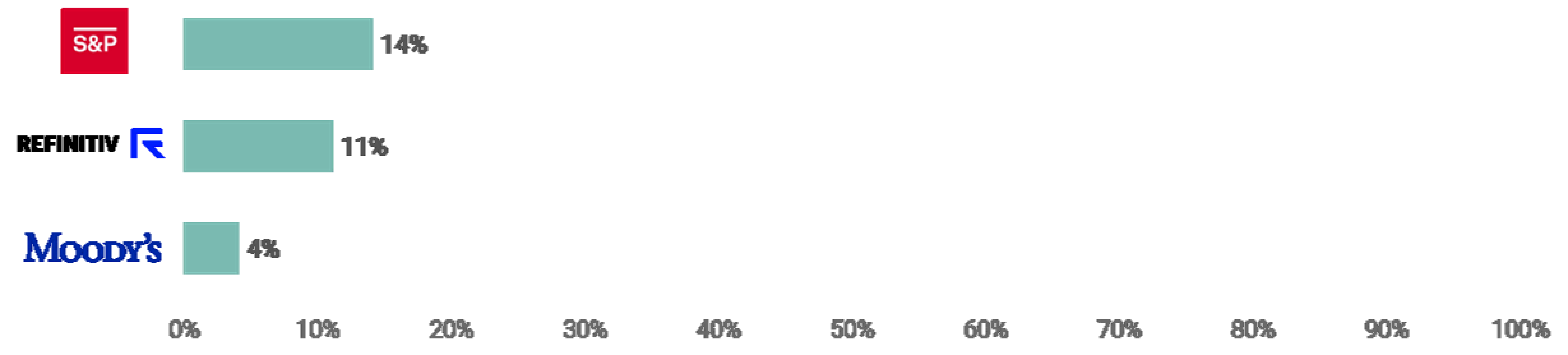
SUMMARY OF SERVICES PROVIDED
238One consequence of having so many different providers in the industry is that companies, particularly larger ones, receive many ratings. As the different providers each have their own methodology – with different topics considered, weightings applied for each topic, and industry classification, among others – this can result in a company receiving various different ESG ratings. As noted by IOSCO, there is both ‘little clarity and alignment on definitions, including on what ratings or data products intend to measure' and 'a lack of transparency about the methodologies underpinning these ratings or data products.'27
239The different providers also vary in the range of services they offer. Some provide consulting services in addition to their ESG ratings. For example, Sustainalytics provides the following services:28
239.1ESG Risk Ratings; 239.2EU Sustainable Finance Action Plan Solutions; 239.3Impact Solutions; 239.4Compliance and ESG Screening Solutions; 239.5Controversies Research; 239.6Corporate Governance Research & Ratings; and 239.7Country Research & Ratings.
240ESG rating agencies also vary in their scoring methodology. Companies are often assessed on a relative basis, compared to other companies in their assigned peer group. Rating agencies identify industry leaders and under-performers based on their exposure to ESG risks and how well they manage those risks relative to their peers. Some rating agencies, however, also rate companies in absolute terms, to allow for ratings to be comparable across markets and industries, and for investors to aggregate information more easily at the portfolio level. 29
241In addition, some data providers and rating agencies provide services to companies. Examples given by interviewees included enabling companies to benchmark their ESG performance against their peers, board and management training, and advising on green bonds.
EXISTING REGULATORY FRAMEWORK
242There is not currently a regulatory framework governing ESG rating agencies in the UK, but the first steps towards establishing one have been taken in recent months.
243In March 2023, the Treasury published a consultation paper outlining the Government's proposal to make ESG ratings a regulated activity.30 The Government's view as set out in the paper is that it is critical that ESG information is reliable, transparent and delivers strong outcomes for the benefit of UK markets and consumers.
244Separately, the FCA has formed a working group to develop a Code of Conduct for ESG data and ratings providers. While this is planned currently to be voluntary, the stated aim of such a code would be to foster an 'effective, trusted, and transparent market.'31 The research team presented some of the emerging findings to the working group at its meeting in February 2023. The group aims to issue a consultation paper in the first half of 2023,32 with the final code to be structured around four outcomes: transparency, good governance, robust systems and controls, and the sound management of conflicts of interest. The FCA is seeking to build on the recommendations issued by IOSCO to ensure international coherence and consistency.
245It should also be noted that ESG rating agencies are eligible to apply to become signatories to the FRC's UK Stewardship Code, which includes principles for service providers. The UK Asset Management Taskforce has recommended that all service providers be encouraged to become signatories.33 At present, however, only Sustainalytics of the major ESG rating agencies is a signatory to the Code.
IMPACT ON COMPANIES OF ESG RESEARCH AND RATING AGENCIES
246FTSE 350 companies may have multiple interactions with ESG rating agencies and data providers. For example, some companies are clients of rating agencies themselves and may make use of the data to measure their own performance or meet their regulatory disclosure requirements.
247This research focuses primarily on companies' relationships with ESG agencies in their capacity as service providers to investors. The findings in this section are based principally on comments made by company interviewees and participants at the roundtables.
248During those conversations there were many comments about the methodologies used for calculating ratings, the accuracy and relevance of the information used to do so, and the speed at which the research reports and ratings were updated or corrected.
249These issues are addressed substantially in later sections but are relevant to an understanding of the impact of the agencies on companies' thinking and behaviour. Many company interviewees believed that at least some of the ratings they have received gave an inaccurate picture of the company's performance.
IMPACT ON STRATEGY AND PLANNING
250All company interviewees were clear that the fear of an adverse ESG rating was not a significant consideration when the company was setting the strategy and developing action plans to address ESG-related issues.
251However, some said that they studied the underlying analyses and the rationale for the rating, as this could be helpful in identifying weaknesses in the company's plans or performance, and to understand how changes to their public disclosures might affect the rating.
252The primary concern of most company interviewees was that investors may place reliance on the headline ratings when making investment or voting decisions, and that the potential existed for the company to be penalised on the basis of a rating that, in their opinion, did not fairly reflect the company's actions or performance. The extent to which investors actually rely on these ratings is discussed in paragraph 262 onwards.
253This concern has grown in recent years as ESG has become a more important consideration for investors.
'Five years ago, ESG would have been an afterthought at the end of an investor meeting. That probably persisted until about three years ago. But we've passed the pivot point now where ESG is not a nice to have, it's an absolute essential.'
Company Secretary
254Some company interviewees stated that they had made a concerted effort to identify which rating agencies were used by their major investors in order to engage with them in an attempt to influence the rating.
255A few interviewees questioned the value of engagement with rating agencies on the grounds that it was difficult to persuade them that the rating given to the company was flawed, for example, because the rating agency's methodology was not well suited for their company's sector or business model. A larger number noted that the sheer variety of agencies and methodologies meant engagement would always be an uphill struggle.
'We try to understand which rating agencies are used by our investors and potential investors... So then you can actually create a dollar value – how much money follows MSCI etc., – that helps us prioritise.'
Investor Relations and ESG Senior Manager
'In terms of the external benchmarking agencies, I think we decided early on that there was just too many of them and there was too much stuff to do. So you know, we would focus on one or two and getting our own story right.'
Company Secretary
IMPACT ON PUBLIC REPORTING
256The majority of company interviewees had concluded that they needed to 'play the game' by trying to ensure that they provided the information needed to ‘tick the boxes' used by agencies to construct their rating, in the hope that they would receive a positive rating.
'For us, it's making sure we are drafting disclosures in a way that gets us maximum value for the work we're already doing.'
Head of Secretariat
257Many company interviewees explained that this involved publishing additional information. This may include either more or different data about ESG topics on which the company already discloses, or new information on issues that the company itself may not feel is particularly relevant. In some cases this was in response to requests for additional data from some data providers.
258In addition, some company interviewees said that they were adapting how they present information because of the data collection techniques used by ESG rating agencies, for example by using buzzwords. These issues are discussed in more detail in paragraph 285 onwards.
'It does influence our disclosures because we think well, we haven't said anything on toxic waste... We don't have any toxic waste, but because we didn't say that we got marked out. As soon as we said we've got no toxic waste, our score went up. So this whole negative assurance piece is very frustrating because that adds to the burden.'
Group Company Secretary
259One interviewee commented that the demands for more data from ESG rating agencies, investors and regulators were turning annual reports into 'a depository of data rather than a document that tells the company's story.' They considered this was ultimately not in the best interests of either the company or its shareholders and stakeholders.
IMPACT ON RESOURCES
260Attempting to meet ESG rating agencies and data providers' demands for data can potentially be very time-consuming and resource intensive for companies.
'Because there's just so many metrics, it's hugely time-consuming and we have to prioritise the ones we think are the most important ones and other ones we won't engage with at all. It's not just different methodologies, it's the effort that's required by companies to provide the data in the first place... as a business, we are not going to put in place an unlimited amount of resource to engage with all these people.'
Company Secretary
'A lot of the information is in there because it's what the rating agencies look for. But we've got the teams to do that, and I completely sympathise with smaller companies that don't.'
Company Secretary
HOW INVESTORS USE ESG RESEARCH TO SUPPORT STEWARDSHIP
261The findings reported in this section are based principally on comments made by investor interviewees and participants at the roundtables. All these investors were signatories to the UK Stewardship Code and the majority had at least some dedicated stewardship of ESG-related resources. It is recognised that their views and practices may not be representative of all investors.
THE RELEVANCE OF RATINGS
262The majority of investor interviewees stated that they primarily used ESG rating agencies as a source of data, rather than relying on the headline or sub-ratings to guide their decision-making. If the headline ratings were used, it was usually as an initial filter to help them identify companies that may merit closer scrutiny.
'We subscribe to multiple data providers for ESG. From a stewardship perspective, I could confidently say that we don't rely on any of them to drive any outcomes. They're purely for risk screening for us.'
Investment Stewardship Director
263Many interviewees said that the weighting given by rating agencies to different ESG factors did not necessarily always reflect the investor's own ESG priorities. For this reason many of them have developed proprietary in-house ratings that were aligned with those priorities, and which are populated with data obtained from rating agencies and other sources.
'What we have is what we call basic ESG due diligence, which effectively is expected to be done on every stock that the analysts recommend and oversights going forward. That basic ESG is a combination of tech and human. The technology is basically bringing in the agency's ESG rating and key points of materiality to the business. Then the human side is saying, “Do we think they have missed something? Do we know something that they don't know through our past relationships?”
Responsible Investment Manager
'The research certainly forms part of the ESG scoring framework that we have internally. Much like the voting, we're led by our own internal approach and the agency's research is a sort of supplement. I think we've all seen the dangers of blindly following external ESG data providers. I remember one giving an AAA rating to Boohoo and then we saw what happened in the news. So that's something we're mindful of.'
ESG and Stewardship Analyst
264Interviewees said that these in-house ratings were then used to decide where to target their stewardship efforts, through individual or collective engagement with companies and increasingly through voting as well (72% of the investors that responded to the survey stated that they use ESG research as an input to their voting decisions).
265A few interviewees noted that some of their clients placed more importance on the headline ratings than did the investor themselves.
'We definitely do not rely on the top line ratings but it is certainly helpful if a company is rated triple-A and not triple-C. Partly because our clients will be saying, well, how can you hold a triple-C rated stock?'
Responsible Investment Manager
USE OF MULTIPLE RATING AGENCIES
266Most investor interviewees and survey respondents stated that they acquire data from multiple sources, not only from ESG rating agencies. Some extract data directly from companies' annual reports and other disclosures, where they have the resource to do so. Others referred to using freely available benchmarks and reports from NGOs, as well as bespoke sustainability/ESG reporting software, among other sources.
267That said, most interviewees confirmed that they were reliant to a certain extent on data from ESG rating agencies and data providers, and the majority said that they use more than one. This was consistent with the responses to the survey.
268In most instances, the reason investors used more than one source was because no single rating agency was currently able to provide them with all the data that they required. Each had strengths and weaknesses.
269For example, some rating agencies provided breadth in terms of the number of companies and geographical markets that they covered, but without the depth of information the investor required on specific topics, and vice versa. For some ESG issues that are relatively new in terms of investor priorities, for example, some workforce related topics and some aspects of biodiversity, data was currently only available from niche providers or non-commercial sources if at all.
270A few investor interviewees commented that the availability of reliable data and ratings on smaller listed companies was a general weakness across the board. They felt this was unfortunate as it was precisely those companies on which investors most needed high-quality information to supplement their own knowledge.
271When it comes to stewardship, investors' decisions on which companies to engage with are linked to various factors. Many interviewees stated that they took a strategic approach to engagement on ESG issues primarily driven by the investor's priority topics, as set out in its investment strategy and values. Factors such the size of the investor's active position were then used to prioritise specific companies.
272Within that framework, ESG data is used to inform specific engagements. For example, one investor stated that data is used to identify companies that may be exposed to long-term financial risk arising from ESG issues. Another stated that it was used to support thematic engagements such as on climate transition, by helping the investor to track investee companies' progress towards specific goals.
CONCERNS RAISED BY COMPANIES AND INVESTORS
OVERALL VIEWS ON QUALITY OF ESG RATING AGENCIES' RESEARCH
273In general, company participants in the interviews and roundtables were more critical of the quality of research undertaken by ESG rating agencies than their investor counterparts. This was consistent with the results of the company and investor surveys, as Exhibits 22 and 23 demonstrate.
274The tables show the aggregate ratings by companies and investors for all ESG rating agencies which they have dealt with, and do not necessarily represent overall levels of satisfaction with any single agency.
EXHIBIT 22: OVERALL, HOW SATISFIED ARE YOU WITH THE ACCURACY AND QUALITY OF RESEARCH UNDERTAKEN BY ESG RATING AGENCIES? [COMPANY SURVEY]
Bar chart illustrating company satisfaction with accuracy and quality of ESG rating agencies' research: * Very satisfied: 0% * Slightly satisfied: 19% * Neither satisfied nor dissatisfied: 40% * Slightly dissatisfied: 29% * Very dissatisfied: 12%
EXHIBIT 23: HOW SATISFIED ARE YOU THAT THE ESG RESEARCH SERVICES AND RATING AGENCIES YOU USE HAVE THE KNOWLEDGE AND RESOURCES TO DELIVER ACCURATE AND USEFUL INFORMATION? [INVESTOR SURVEY]
Bar chart illustrating investor satisfaction with ESG research services and rating agencies' knowledge and resources: * Very satisfied: 16% * Slightly satisfied: 47% * Neither satisfied nor dissatisfied: 19% * Slightly dissatisfied: 12% * Very dissatisfied: 6%
275The majority of investors that responded to the survey (63%) were very or slightly satisfied with the ESG rating agencies. By contrast only 19% of companies expressed a degree of satisfaction, while 18% of them stated that they were very or slightly dissatisfied.
276The remainder of this section summarises the criticisms of ESG rating agencies that were most frequently raised by the companies and investors that participated in the interviews and roundtables. These views were not shared by all participants, and some of the issues raised were seen as concerns by companies but not investors, and vice versa.
277While some of the criticisms were general ones, for example, the lack of transparency about methodologies, others may only apply to some providers, such as those using specific techniques for gathering data. As already noted, the description of the practices used by the agencies that participated in the research may not be representative of rating agencies in general.
TRANSPARENCY OF METHODOLOGIES
278Many company interviewees expressed frustration at the lack of consistency between the ratings given by different rating agencies. For many this was exacerbated by the lack of transparency about how the ratings were calculated, which made it difficult for companies to work out the basis on which they had been scored, and therefore what actions they might take to improve or challenge the rating.
'The transparency is a little bit lacking. For example, this year they've gone through and changed quite a few of our scores, but there's no justification given. They know why they've scored it down, so if they could just tell us that would be really helpful.'
Company Secretary
279Investor interviewees were less concerned by the differences in headline ratings than companies were (as noted, many of them stated they make use of the underlying data only and not the rating), but a number of them shared companies' concerns over the lack of transparency about the methodologies use by rating agencies.
'They do have open methodologies, but they are pages and pages and pages of very complex equations, and that's not really helpful when I'm looking to audit the methodology. I'm more looking at the logic behind it and they protect it.'
Senior Associate, ESG (Investor)
280Interviewees from ESG rating agencies mentioned the formal processes they have in place for reviewing and consulting stakeholders on proposed updates to their methodologies. These processes vary. In some cases rating agencies already carry out public consultations or plan to do so, while in other cases consultation was restricted to their clients. One rating agency said that their review process was conducted independently with no client involvement.
'On the ESG ratings, there's client engagement and annual client consultation. We put out our updates for market consultation. That's a formal process so we're engaging with investor clients.'
ESG Rating Agency
'We use an industry materiality map which maps all weighted issues which is shared with clients on an annual basis alongside proposed changes.'
ESG Rating Agency
281Both the UK Government and the FCA have identified the lack of transparency as a potential harm. It is one of the justifications for the Government's proposals to regulate ESG rating agencies and for the FCA's establishment of a working group to develop a Code of Conduct.
HOW TRANSPARENCY COULD BE IMPROVED
Company and investor interviews and roundtable participants identified a number of aspects of ESG rating agencies' methodologies and processes about which they felt more transparency would be helpful. These included:
- How often rating agencies update their methodology, and their process for doing so;
- What ESG factors are included and how they are weighted, including whether weightings are adjusted for different sectors;
- Whether the methodology takes account of national regulatory and other requirements;
- The data sources that are used and how they are verified;
- The data-gathering techniques that are used (for example, the use of AI); and
- The sign-off and quality assurance processes that are used to ensure consistency.
USE AND RELEVANCE OF ESG METRICS AND DATA POINTS
282Many company interviewees commented on the use by ESG rating agencies of certain metrics and data that they considered not to be relevant or appropriate to their company's business model or to the sector in which they operated. In their view, the inclusion of such metrics and data distorted the rating and did not accurately reflect their actual ESG performance. Some considered that the methodologies used by rating agencies should take greater account of sectoral and national differences.
'They use all sorts of different data points. They use different algorithms, and internal prioritisations to come up with their ratings... and it's problematic.'
Company Secretary
'It seems to be so bizarre where we get poor marks for product toxicity. We sell insurance. I surmise that the reason we're getting poor marks in that area is because of the absence of data. And because we haven't produced any data because we're selling bits of paper or a promise and therefore haven't populated the necessary boxes, we're being penalised.'
Company Secretary
283Some company interviewees also complained that ESG rating agencies were focused on a limited number of metrics and data points rather than making a more rounded assessment of the company's performance. Similarly, a few investor interviewees commented that sometimes the focus on specific details meant that the ESG rating agencies might miss the broader impact of a company's activities.
'It always feels like they're not seeing the wood for the trees. If they want us to demonstrate investment in our employee base or whatever else, then is a data point the best or only way to do that or can they accept other thoughtful disclosures?'
Company Secretary and General Counsel
'Rating agencies tend to be overly focused on data rather than what the organisation actually does. For a while you had the likes of tobacco companies under their frameworks, which at the end of the day are actually making a product that is harmful to human health.'
Head of ESG (Investor)
284Interviewees from ESG rating agencies stated that their methodologies did take into account some variables such as the company's sector to some extent, for example, by adjusting the weightings given to selected ESG factors and through the selection of peer groups. However, they also noted that the need for comparability between companies and markets limited the scope for doing so.
'Our approach is risk exposure. We look at the most financially relevant key issues for any particular industry. We do a risk exposure assessment. The exposure methodologies are at the industry level: which of the 35 issues will be most relevant per industry? We would only weight four-to-eight key issues per industry.'
ESG Rating Agency
‘There's no UK-specific methodology – the ESG ratings is a global framework as clients want to compare across geographies. But we do have specific nuances for different markets – for example, a risk factor may be higher in one rather than another.'
ESG Rating Agency
DATA GATHERING ISSUES - COMPANY DISCLOSURES
285Many company interviewees, and some investors, highlighted what they considered to be shortcomings in the way in which ESG rating agencies gather information contained in the company's own disclosures.
286Several company interviewees gave examples where information had apparently been missed and was not included in the research report produced by the agency or reflected in the rating. A smaller number of investor interviewees also mentioned examples of where relevant information of which they were aware had been omitted from the research report.
'The coverage is not ideal, and we do find that their feeds don't pick up on a lot of things that we pick up on, because we're doing in depth bottom-up analysis of these companies and tend to know them quite well and engage with them.'
Head of ESG (Investor)
287Some company interviewees attributed this to ESG rating agencies' focus on specific data points in their models, which could mean either that they had not looked for additional information, or did not appreciate its relevance. Many interviewees commented that it was necessary to use particular terminology in order to be certain that the information would be picked up.
'A lot of narrative in there doesn't seem to get recognised by the rating agencies because it doesn't have the right terms or the right heading.'
Company Secretary
'They seem to be looking for buzzwords rather than actually reading the content and assessing it. So if we said nothing about ESG within our annual report but talked at length about being a responsible business it would just completely go over their heads. There's a very literal approach and it feels fragmented.'
Company Secretary
288A few company and investor interviewees went further and specifically attributed the failure of ESG rating agencies to identify relevant information to their use of AI as a data-gathering tool.
'It's not terribly clear at what point humans are involved and how much is based on AI. Clearly, there's quite a lot based on AI because of the problems that the likes of the smaller companies face who don't know the buzzwords and end up getting into difficulty.'
Head of ESG (Investor)
289Interviewees from ESG rating agencies described the methods that they use for collecting and analysing company information and their quality assurance processes. While interviewees accepted that errors were made, they did not agree that this happened as extensively as some companies believed. All also said that where machine learning or AI was used to collect data there was a subsequent process for analysts to validate its accuracy.
'We collect data manually ourselves via analysts, we also outsource to vendors which go through quality assurance processes, and we also use machine learning techniques. Where there's standardised disclosures, we use analyst collection as well as machines collection. If there's agreement between the two, it goes into our system but if not there's further vetting.'
ESG Rating Agency
'An additional step is that we may use AI or machine learning but it's specifically used in news gathering; not data gathering.'
ESG Rating Agency
Data requests from ESG rating agencies
290Many company interviewees reported that they had received requests from one or more ESG rating agencies to provide them with data, which could be very time-consuming. These requests took different forms, such as questionnaires and requests to populate fields in a database. Some interviewees said that they did not respond to such requests, either as a point of principle or because they did not have the available resources.
291Submitting data requests to companies is not a universal practice among ESG rating agencies. All those agencies that we interviewed stated that they relied solely on companies' public disclosures and did not make any requests for additional information, with one commenting that 'being mindful of the survey fatigue faced by issuers, we make efforts not to overburden companies with data review requests.'
DATA GATHERING ISSUES - CONTROVERSY REPORTS
292One feature of many ESG rating agencies' methodologies – including all the agencies interviewed as part of the research – is the use of 'controversy reports.' These cover events or ongoing situations in which company operations and/or products allegedly have a negative ESG impact. These are often initially sourced from the internet using AI. For example, on the Sustainalytics website it states that the company 'leverages smart technologies to monitor more than 700,000 news stories daily.'
293Many company interviewees were critical of this practice, as were some investors. Companies stated that it was not clear on what basis individual 'controversies' had been assessed as relevant or what weighting had been given to them. Some said in their experience the issues included in the rating were often minor ones (in their view) or had long since been resolved.
'A case we had ten years ago just took a long time to close out, but going by the headlines from one of the ESG analysts you would think it was a new case and a new issue. We had shareholders contacting us to say we hear you've got this problem again.'
Group Company Secretary
'Third-party ratings are forced to address outdated controversies which are backward looking and do not provide value in our forward-looking approach to investment. They become a constraint on resources rather than a value to investment analysis.'
Investor Survey Respondent
294Interviewees from ESG rating agencies argued that controversy reports are relevant to calculating a company's rating as they assessed the reputational risk facing the company as a result of the incident. They considered that it was inevitable that there would sometimes be a difference of opinion between them and the company, but considered that their assessment processes were robust.
'We use as objective criteria as we can design: affecting a certain number of people, affecting a certain area, etc. Of course, issuers complain about certain controversies. If a controversy is judged to be severe, we publish the issuer's verbatim response to our assessment.'
ESG Rating Agency
EXHIBIT 24: MSCI'S ESG CONTROVERSIES AND GLOBAL NORMS METHODOLOGY
In March 2023, MSCI published its ESG Controversies and Global Norms Methodology. In that document MSCI states that it assesses controversies using three criteria:
- the Severity of the case based on the nature of harm and scale of alleged impact, and application of specific exacerbating circumstances: Very Severe, Severe, Moderate or Minor; II. the Role of the company implicated in the case: Direct or Indirect; and III. the Status of the case: Concluded, Partially Concluded, Ongoing, Archived or Historical Concern.
| UBS Global
'A case we had ten years ago just took a long time to close out, but going by the headlines from one of the ESG analysts you would think it was a new case and a new issue. We had shareholders contacting us to say we hear you've got this problem again.' Group Company Secretary
'Third-party ratings are forced to address outdated controversies which are backward looking and do not provide value in our forward-looking approach to investment. They become a constraint on resources rather than a value to investment analysis.' Investor Survey Respondent
294Interviewees from ESG rating agencies argued that controversy reports were relevant to calculating a company's rating as they assessed the reputational risk facing the company as a result of the incident. They considered that it was inevitable that there would sometimes be a difference of opinion between them and the company, but considered that their assessment processes were robust.
'We use as objective criteria as we can design: affecting a certain number of people, affecting a certain area, etc. Of course, issuers complain about certain controversies. If a controversy is judged to be severe, we publish the issuer's verbatim response to our assessment.' ESG Rating Agency
EXHIBIT 24: MSCI'S ESG CONTROVERSIES AND GLOBAL NORMS METHODOLOGY
In March 2023, MSCI published its ESG Controversies and Global Norms Methodology. In that document MSCI states that it assesses controversies using three criteria:
- the Severity of the case based on the nature of harm and scale of alleged impact, and application of specific exacerbating circumstances: Very Severe, Severe, Moderate or Minor;
- the Role of the company implicated in the case: Direct or Indirect; and
- the Status of the case: Concluded, Partially Concluded, Ongoing, Archived or Historical Concern.
RESPONSIVENESS OF ESG RATING AGENCIES
295Company interviewees and survey respondents were both asked about their experience of engaging with ESG rating agencies, specifically whether they invited or accepted comments on their research reports and were willing to engage when companies had concerns. There were some differences in the evidence received from the two sources.
296According to survey respondents, 83% of them had been approached by one or more ESG rating agencies in the previous two years and invited to comment on the research report, while 33% had approached one or more agencies themselves. The results of those engagements in terms of changes being made to the report and the overall rating are shown in Exhibit 25.
EXHIBIT 25: IF YOU HAVE COMMENTED ON AN ESG RATING AGENCIES ASSESSMENT, EITHER BECAUSE THEY OFFERED OR YOU ASKED, WERE YOUR COMMENTS REFLECTED IN THEIR ASSESSMENT? [COMPANY SURVEY]
Bar chart showing responses to whether comments were reflected in ESG rating agency assessments: - Yes, in all cases: 17% - Yes, in some cases: 66% - No: 17%
EXHIBIT 26: IF YES IN SOME OR ALL CASES, DID THE ESG RATING AGENCY CHANGE ITS RATING? [COMPANY SURVEY]
Bar chart showing whether ESG rating agencies changed their rating based on comments: - Yes, in all cases: 6% - Yes, in some cases: 54% - No: 6% - Don't know: 34%
297As with the data on company views on the quality of research, these tables reflect companies' experiences with all ESG rating agencies and are not necessarily representative of engagement with any single agency. One ESG rating agency interviewee explained that their policy was to contact companies to provide them with an opportunity to comment, but not all did so.
'We send the report pre-publication to 5,000 companies (not our entire investment universe as some companies don't have the capacity to respond, such as the necessary team or quality of reporting). You can flag errors and we have a contact point for companies and a complaint tracking process.' ESG Rating Agency
298While companies clearly had different experiences, the fact that two-thirds of survey respondents said that one or more agencies had made changes to the assessment, and that over half of them reported that the rating had been changed in some cases, appears to suggest that at least some rating agencies are relatively responsive.
299Company interviewees gave a less positive impression. One partial explanation for this might be because during the interviews the discussion tended to focus on specific examples rather than on the company's overall experience. Several interviewees gave examples of where an ESG rating agency had declined to engage or where the company felt engagement had not been constructive.
TIMELINESS
300One of the issues raised most frequently by both company and investor interviewees was what they saw as delays in updating ratings and research reports. The processes followed by the ESG rating agencies for reviewing and updating ratings meant there could often be a long gap between the company publishing new information or pointing out errors, and this being reflected in the report and ratings.
301This was a concern for many company interviewees, especially when they felt they were not getting credit for improving their processes or performance, or that errors in the research were going uncorrected. It was also a concern for some investor interviewees who wanted reassurance that they were using the latest and most reliable data.
'They were reviewing us in February of each year. We have a March year-end and publish information in May. So by the time they were updating in February, the information was almost a year out of date.' Company Secretary
'The timing of ESG data does not align with the voting cycle for AGMs. And I think that's probably the critical challenge there. Even where the accuracy is high, it's not updated in the same cycle as the AGMs', so it would be very difficult to use in that capacity. In terms of stewardship we find that it can really only be used as a screening tool.' Investment Stewardship Director (Investor)
302Interviewees from ESG rating agencies acknowledged that the length of time taken to update ratings could be frustrating for companies and investors but mentioned various contributory factors. Some related to resources; for example, one interviewee mentioned client demand for them to provide research on a greater number of companies, which impacted on the resources available for reviewing reports on the companies they already covered.
'We do annual updates to the rating score but underneath there's a whole lot of data which is updated more frequently. Our clients would have access to all the data. That said, if the underlying data has moved, suggesting a different rating band, that band doesn't change until an analyst reviews it.' ESG Rating Agency
OTHER ISSUES
304During the course of the research, a number of issues were raised by participants that were not within the formal remit of the project, but which may be relevant to understanding the impact of ESG rating agencies' research and ratings, and may influence the behaviour of data providers, companies, and investors. These are summarised in this section of the Report.
THE NUMBER AND QUALITY OF SERVICE PROVIDERS
305In contrast to the market for voting research, which in the UK consists of two global firms and a small number of local proxy advisors, there are a multitude of providers of ESG research. As noted in paragraph 236, the investor respondents to the survey identified 17 different data providers whose services they used, and this list is far from comprehensive.
306Data providers can be divided between those organisations that aim to provide data and ratings covering a wide range of ESG factors, industry sectors and geographical markets and those that specialise, for example, in climate-related data; and between those that operate on a commercial and non-commercial basis.
307While investor participants expressed reservations about the quality of some service providers, by and large they welcomed the fact that they had access to a wide range of sources of data. This was particularly the case for those investors that had developed their own proprietary ESG ratings system to reflect their ESG priorities.
308Investor interviewees had mixed views on whether consolidation in the market would be welcome. While appreciating the breadth of the research provided by some of the larger service providers, many also stated that they were currently dependent on some of the smaller, niche providers to meet their specific data needs. Consolidation might put that at risk.
309One interviewee suggested there might be a trade-off between breadth and quality.
'The research specialist space has gone through an enormous transition over the last 15 years. Everybody wants to be an ESG specialist and provider. Some were governance specialist providers who may not have the same expertise in E&S. And I think that one of the challenges these providers have is quality.' Head of Stewardship
310On the other hand, all company participants considered that the large number of different service providers exacerbated their concerns as described in this chapter of the Report. The use of different methodologies resulted in multiple ratings that often appeared to be inconsistent, at least to the company concerned; and the use of different data points had led in some cases to an increase in the volume of data disclosed and the related resources.
THE REPORTING AND STANDARDS FRAMEWORKS
311The differences in the ratings that companies receive are largely attributable to differences in the methodologies used by ESG rating agencies. These include, for example, differences in the ESG factors covered, the weighting given to each, and the specific metrics and data points used to assess each factor.
312The latter was a particular source of frustration for many company participants, a number of whom suggested that rating agencies and data providers should be encouraged or required to use the same metrics and data points for each ESG factor. This would reduce the burden on companies that resulted from having to measure and report on different sets of data points.
313Some participants in the interviews and roundtables noted that the fragmented nature of the current global framework for ESG standard-setting and reporting made this more difficult to achieve.
314For example, in 2020 and 2021, the FCA introduced rules for UK premium listed companies and issuers of standard listed shares to comply or explain against the recommendations of the Taskforce on Climate-related Financial Disclosures (TCFD) framework, which overlaps with but is not fully compatible with other reporting standards. Furthermore, none of these competing standards necessarily provide all the data that is used by some rating agencies. 34
315Some participants recognised the establishment in 2021 of the International Sustainability Standards Board (ISSB) with the aim of developing a single set of global sustainability standards, but commented that this was a long way off and may not prove to be achievable.
REGULATION OF INVESTORS
316A number of investor interviewees noted that they do not use the services of ESG rating agencies solely to obtain research that is used to inform their investment and stewardship decisions. Increasingly they also need to collect relevant ESG data in order to meet regulatory requirements placed on them, and to meet the demand from their clients for the information that they in turn need to meet their own obligations.
317Examples include the FCA rules requiring asset managers and some owners to make TCFD disclosures; the Occupational Pension Schemes (Climate Change Governance and Reporting) Regulations, which impose similar requirements on pension funds; and additional Sustainability Disclosure Requirements for asset managers offering sustainable investment products, on which the FCA is consulting.
318While these requirements apply to investors, a few investor interviewees noted that they also had an indirect impact on their investee companies as much of the information that investors needed to disclose had of necessity to be derived from those companies' own disclosures. As a result, any further ESG-related regulation of investors would potentially also increase the burden on companies, as ESG data providers ask for this additional information on behalf of their clients.
CONFLICTS OF INTEREST
319A number of interviewees commented on what they perceived to be potential conflicts of interest on the part of some rating agencies and data providers, in particular those that offered services to companies as well as investors.
APPENDIX A: METHODOLOGY
320To achieve the aims of this project the research team used a combination of research methods, which involved desktop research, analysis of voting records, surveys, semi-structured interviews and roundtable discussions with company and investor participants. The research and fieldwork took place between October 2022 and March 2023.
321DESKTOP RESEARCH identified previously articulated issues regarding the relationship between companies, investors, and proxy advisors or ESG rating agencies. This included a review of Morrow Sodali's annual Institutional Investor Survey, 35 the Morrow Sodali platform of proprietary data, disclosures made by signatories to the UK Stewardship Code, and other publicly disclosed information including proxy advisors' statements of compliance with the Best Practice Principles for Shareholder Voting Research. It also included our team's career experience and subject knowledge and points flagged by the FRC in our initial kick-off discussions.
322ONLINE SURVEYS: Following extensive discussion with the FRC on the content, we prepared and distributed a tailored online survey to each of the four actor categories within the project scope: Companies, Investors, Proxy Advisors, and ESG Rating Agencies. Content was based on initial themes identified by our research, additional areas flagged by the FRC, and the specific activities of the actor in question. The complete survey questions can be found in Annex 1: Online Questionnaires. Participants received a link to access the survey using BoardMirror®, our secure online survey platform.
323We received a total of 89 survey responses. The responses received were automatically aggregated to facilitate further analysis, as well as acting as a key input to our interview agendas and roundtable discussions. All data received was used anonymously and will not be directly attributed in this Report. The following received invitations to participate in the survey:
- 323.1FTSE 350 companies: We would like to thank both the Chartered Governance Institute (CGI) and GC100 for providing contact details and for distributing the questionnaire to selected companies from among their respective membership bases. In total, 272 companies were contacted, with 48 responses received;
- 323.2Investors: all asset managers who are signatories to the UK Stewardship Code were contacted, as well as selected asset owners who are known to manage some investments in-house or retain voting responsibility. In total, 188 investors in total were contacted, with 32 responses received;
- 323.3Proxy advisors: six were contacted (Federated Hermes (EOS), Glass Lewis, ISS, IVIS, Minerva Analytics, and PIRC), all of whom responded; and
- 323.4ESG rating agencies: we contacted six, selected based on market share. These were MSCI, Sustainalytics, ISS, Moody's, S&P, and Refinitiv. We received two responses.
324INTERVIEWS: This study incorporated semi-structured interviews in addition to a survey. These interviews are useful when the researcher wants to comprehend the interviewee's views and beliefs about a particular issue or situation, and when it is necessary to grasp the interviewee's perspective. Semi-structured interviews are considered the most effective method for exploring the participants' values, norms, and experiences. The interview technique used involves a predetermined set of open-ended questions to obtain more personalised and detailed responses.
325Interviews were conducted with companies, investors, proxy advisors, and ESG rating agencies. At the end of each of the four surveys, we asked respondents if they would be interested in participating in either one-on-one interviews or roundtable discussions. Interviews were held virtually over Microsoft Teams, and lasted approximately one hour. Agendas were informed by our overall research themes and the survey findings, with agendas shared in advance with interviewees to aid their preparation. Indicative Interview Guides can be found in Annex 1: Online Questionnaires. A list of participants by job title and type of organisation can be found in Annex 2: Interview Guides and List of Interviewees.
326Interviews with companies and investors were held first, in order to inform the discussions with the proxy advisors and ESG rating agencies. In total, we interviewed 48 individuals from 34 organisations:
- 326.113 companies;
- 326.214 investors;
- 326.3Five proxy advisors; and
- 326.4Three ESG rating agencies (one of which is also a proxy advisor).
327Interviews were recorded and transcribed. To guarantee the robustness of the data analysis, methods similar to those employed by Tilba and Wilson (2017) were used. These consisted of using NVivo qualitative research software to assist and facilitate the analysis of the qualitative data. Using NVivo allowed the interview content to be analysed systematically using codes, keywords, word frequencies, and reference counts to quantify theme coverage and theme cross-comparisons. Due to the variety and specificity of job titles, we have applied standard labels in the report to avoid identification of individual respondents.
328ROUNDTABLES: We held two roundtable discussions virtually over Microsoft Teams with a mixed group of companies and investors, on 8 February 2023 and 14 February 2023. The first focused on the role and influence of proxy advisors, the second on that of ESG rating agencies. Each was attended by approximately 20 participants, with roughly equal participation between companies and investors for the first session, and a 2:1 split respectively for the second. For each, a set of summary slides was shared with participants in advance, outlining key findings from the SURVEY, INTERVIEWS, and VOTING ANALYSIS, as well as our planned main discussion points.
329We also held a roundtable with GC100 members on 8 March 2023, and covered both proxy advisor and ESG rating agencies. Approximately 15 companies attended. Again, a summary of findings was shared with participants in advance.
330To provide an adequate 'right of reply', we approached the proxy advisors and ESG rating agencies to ask if they wished to participate in a follow-up interview in which we shared some key takeaways from the roundtables, and again some of the main issues discussed with companies and investors. Five of the proxy advisors asked to participate, including ISS, with whom we also discussed points related to ESG rating agencies.
ETHICAL CONSIDERATIONS
331VOTING ANALYSIS: To quantify the effect of proxy advisors on shareholder resolution voting patterns, we examined resolutions from 2022 FTSE 350 AGMs for which either or both ISS and Glass Lewis recommended voting against in a specific area. We looked at their recommendations against in two areas, board appointments and remuneration policies and reports, for all FTSE 350 AGMs held in 2022 before 1 November 2022, reviewing the total vote against (for the whole share register) and how a representative sample of 38 investors voted in those resolutions. Our sample contained a total of 93 resolutions. We are grateful to our colleagues Luiza Weinhold de Freitas and Benjamin Keyes for their work in compiling and analysis of the data used in this Report, and Minerva Analytics for providing us with additional data on the total number of resolutions put forward by FTSE 350 companies during the same period.
332OTHER RESEARCH: Finally, our Report was informed by additional research and sources. Dr Anna Tilba has previously conducted research on behalf of the FRC on the influence of the UK Stewardship Code [2020] on practice and reporting, 36 and the findings from that research had been drawn on in our analysis. We also examined Stewardship Code reports (where relevant) and other public disclosures by proxy advisors (such as statements of compliance with the Best Practice Principles for Shareholder Voting Research), and ESG rating agencies, and other documentation published during the course of the project. For a full list of sources used, please see Appendix B: List of Sources.
333Each of these inputs has contributed to the content of this Report. We are conscious that the views expressed by survey respondents, and the interview and roundtable attendees, are not necessarily representative of all FTSE 350 companies and UK investors. There will most likely be a selection bias, particularly regarding interviews and roundtables, with those with strong views more likely to participate.
334Additionally, there may be resource constraints for smaller companies and investors that prevented them from participating in the research project. The breakdown of responses to the company survey, for example, were 32 FTSE 100 responding versus 16 FTSE 250 companies, while all asset owners that responded to the investor survey were classified as 'large' using the FRC's criteria.
335To mitigate potential selection bias issues for the interviews we sought to ensure that, of those volunteering to be interviewed, a suitable mix of sectors were selected for the company interviews, as well as a proportional group of FTSE 100 versus FTSE 350 companies, as well as a mix of asset managers and asset owners of different sizes for the investor interviews.
336Researchers have an ethical responsibility to treat research participants with fairness by obtaining their informed consent, ensuring confidentiality, doing good and avoiding causing harm. For this study, data collection and analysis were conducted in accordance with Durham University's Research Ethics framework. The interviewees and roundtable discussants were informed about the research's purpose, methods, and intended use as part of an Interview Guide, and what their participation in the study would entail. Confidentiality and anonymity were maintained, and no participant was coerced into participating in the interview and the roundtables. An informed consent was obtained during the scheduling of interviews and roundtables and any conflicts of interest or partiality were disclosed. Informed consent was also obtained for the video recording and auto-transcription of an interview, and the interviewees were informed that they could stop the recording at any time.
APPENDIX B: LIST OF SOURCES
- Asset Management Taskforce [2020], Investing With Purpose
- Berg, F., Heeb, F., and Kölbel, J. F. [2022], The Economic Impact of ESG Ratings
- Berg, F., Koelbel, J. F., Pavlova, A., and Rigobon, R. [2022], ESG Confusion and Stock Returns: Tackling the Problem of Noise
- Bernard, J., Boiral, O., Guillaumie, L., Brotherton, M. C. [2022], Does proxy voting really promote corporate sustainability? * BPP Group [2022], Home
| Best Practice Principles for Shareholder Voting Research * EOS at Federated Hermes [2022], Stewardship Report 2021 * EOS at Federated Hermes [2022], Best Practice Principles for Providers of Shareholder Voting Research & Analysis – Compliance Statement * FCA [first published 2019; updated 2022], Proxy Advisors * FCA [2022], ESG Data and Ratings Code of Conduct Working Group: Terms of Reference * FCA [2022], ESG integration in UK capital markets: Feedback to CP21/18 * FCA [2023], FCA Handbook * FRC [2018], Guidance on Board Effectiveness * FRC [2019], The UK Stewardship Code 2020 * FRC [2022], The influence of the UK Stewardship Code 2020 on practice and reporting * FRC [2022] Review of Stewardship Reporting 2022 * FRC [2023], FRC ESG Statement of Intent: What's Next * FRC [2023], UK Corporate Governance Code: Consultation document * FRC [2023], UK Stewardship Code Signatories * Georgeson [2023], 2022 European AGM Season Review * Glass Lewis [2021], UK Stewardship Report: Reporting against the UK Stewardship Code 2020 * HM Government [2021], The Report of the Taskforce for Pension Scheme Voting Implementation * HM Treasury [2019], The Proxy Advisors (Shareholders' Rights) Regulations 2019 * HM Treasury [2023] Digitisation Taskforce – Terms of Reference * HM Treasury [2023], Future regulatory regime for Environmental, Social, and Governance (ESG) ratings providers Consultation * The Investment Association [2022], Investment Association Services Limited (trading as Institutional Voting Information Services) Stewardship Report 2021 * The Investment Association [2023], The Public Register * The Investor Forum [2023] Review 2022 * IOSCO [2021] FR09/2021 Environmental, Social and Governance (ESG) Ratings and Data Products Providers * ISS [2022] Best Practice Principles for Providers of Shareholder Voting Research & Analysis: ISS Compliance Statement * MSCI [2023] ESG General FAQs for Corporate Issuers * The Office for National Statistics [2022], Ownership of UK quoted shares: 2020 * Tilba, A. [2022], Appearance or substance of Stewardship and ESG reporting? The challenges of translating 'commitment' into tangible outcomes? * Tilba. A. and Wilson, J.F. (2017). Vocabularies of Motive and Temporal Perspectives: Examples of Pension Fund Engagement and Disengagement. British Journal of Management, 28(3), 1-17 * Tulchan Communications [2022], The State of Stewardship Report. * UBS Global (2020) Future Reimagined: Will ESG Data and Services Demand Accelerate Post-COVID & Who Will Win?
Additionally, we looked at all current BPP statements and Stewardship Code reports of all proxy advisors and ESG ratings that are signatories. We also looked at the Stewardship Code reports of investor interviewees, in preparation for interviews. A list of interviewees can be found in Annex 2: Interview Guides and List of Interviewees.
-
More details of the methodology can be found in Appendix A: Methodology. ↩
-
FRC (2022) 'The Influence of the UK Stewardship Code on practice and reporting, available at: FRC Influence of the Stewardship Code_ July 2022 ↩
-
FCA (2022) 'Proxy advisors', available at: Proxy Advisors. It should be noted that not all of these service providers describe themselves as proxy advisors. For example, Minerva Analytics describes itself as a voting agency. ↩
-
Glass Lewis (2022) '2021 UK Stewardship Report: Reporting against the UK Stewardship Code 2020', available at: 2021-UK-Stewardship-Report_Glass-Lewis-(1).pdf (frc.org.uk).pdf) ↩
-
The Investment Association (2022) 'Investment Association Services Limited (trading as Institutional Voting Information Services) Stewardship Report 2021, available at investment-association-services-limited-ivis-stewardship-report-2021.pdf ↩
-
EOS at Federated Hermes (2022) 'Stewardship Report 2021, available at: eos-corporate-stewardship-report-2021.pdf (hermes-investment.com) ↩
-
HM Treasury (2019) 'The Proxy Advisors (Shareholders' Rights) Regulations 2019', available at: The Proxy Advisors (Shareholders' Rights) Regulations 2019 (legislation.gov.uk) ↩
-
FRC (2020) 'The UK Stewardship Code 2020, available at: Stewardship-Code_Dec-19-Final-Corrected.pdf (frc.org.uk) [^9]: FRC (2023) 'UK Stewardship Code Signatories,' available at: UK Stewardship Code Signatories ↩
-
Data provided by Minerva Analytics. ↩
-
These figures are consistent with other sources, for example Georgeson's '2022 AGM Season Review', which analysed FTSE 100 AGMs in the period 1 July 2021 to 30 July 2022, available at: 2022 European AGM Season Review (georgeson.com) ↩↩
-
The Investment Association [2023], The Public Register, available at: The Public Register/The Investment Association (theia.org) ↩
-
Georgeson (2023) '2022 European AGM Season Review', available at: 2022 European AGM Season Review (georgeson.com). In three of the five largest votes against a FTSE 100 director, both ISS and Glass Lewis had recommended a vote in favour. ↩
-
For asset managers, the FRC defines 'small' as denoting global assets under management totalling less than £50 billion, 'medium' between £50 billion and £250 billion, and 'large' as over £250 billion. For asset owners, 'small' denotes a global portfolio under £5 billion, 'medium' between £5 billion and £15 billion, and 'large' over £15 billion. ↩
-
Office for National Statistics (2022) 'Ownership of UK quoted shares: 2020, available at: Ownership of UK quoted shares, Office for National Statistics (ons.gov.uk) ↩
-
Data provided by Minerva Analytics. ↩
-
Glass Lewis (2022) '2021 UK Stewardship Report: Reporting against the UK Stewardship Code 2020', available at: 2021-UK-Stewardship-Report_Glass-Lewis-(1).pdf (frc.org.uk).pdf) ↩
-
ISS (2022) 'Best Practice Principles for Providers of Shareholder Voting Research & Analysis: ISS Compliance Statement', available at: ISS_Compliance-Statement_Best-Practice-Principles_17Feb2022.pdf (bppgrp.info) ↩
-
EOS at Federated Hermes (2022) 'Best Practice Principles for Providers of Shareholder Voting Research & Analysis: Compliance Statement', available at: eos-corporate-bpp-compliance-statement-04-2022.pdf (bppgrp.info) ↩
-
In practice, many listed companies aim to circulate papers 20 working days before the AGM, as recommended in the FRC's 'Guidance on Board Effectiveness' (2018). ↩
-
HM Treasury (2022) 'Policy Paper: Digitisation Taskforce - Terms of Reference', available at: Digitisation Taskforce – Terms of Reference ↩
-
For example, 'The report of the Taskforce on Pension Scheme Voting Implementation, September 2021. ↩
-
Office for National Statistics (2022) 'Ownership of UK quoted shares 2020', available at: Ownership of UK quoted shares - Office for National Statistics (ons.gov.uk) ↩
-
UBS Global (2020) 'Future Reimagined: Will ESG Data and Services Demand Accelerate Post-COVID & Who Will Win?', available at: Future Reimagined: Will ESG Data and Services Demand Accelerate Post-COVID & Who Will Win? ↩
-
IOSOC (2021) ‘FR09/2021 Environmental, Social and Governance (ESG) Ratings and Data Products Providers', available at: FR09/2021 Environmental, Social and Governance (ESG) Ratings and Data Products Providers (iosco.org): page 6 ↩
-
FCA (2022) 'ESG integration in UK capital markets: Feedback to CP21/18,' available at: ESG integration in UK capital markets: Feedback to CP21/18: page 11 ↩
-
Idem, page 12 ↩
-
IOSOC (2021) 'FR09/2021 Environmental, Social and Governance (ESG) Ratings and Data Products Providers,' available at: FR09/2021 Environmental, Social and Governance (ESG) Ratings and Data Products Providers (iosco.org): page 1 ↩
-
Available at: https://www.sustainalytics.com/, under 'Investor Solutions - ESG Research.' ↩
-
Available at: https://www.sustainalytics.com/esg-data ↩
-
HM Treasury (2023) 'Future regulatory regime for Environmental, Social, and Governance (ESG) ratings providers Consultation,' available at: https://www.gov.uk/government/consultations/future-regulatory-regime-for-environmental-social-and-governance-esg-ratings-providers ↩
-
FCA (2022) 'ESG Data and Ratings Code of Conduct Working Group - Terms of Reference,' available at: ESG Data and Ratings Code of Conduct Working Group: Terms of Reference (fca.org.uk) ↩
-
Idem ↩
-
Asset Management Taskforce (2020) 'Investing With Purpose,' available at: Asset Management Taskforce_proof7.pdf (theia.org) ↩
-
For example, in MSCI's ESG General FAQs for Corporate Issuers (February 2023) it states that "While there may be broad overlap in our metrics with one or more of these initiatives we do not use or place emphasis on one framework over another." ↩
-
The most recent of which is available at: INSTITUTIONAL-INVESTOR-SURVEY-2021.pdf (morrowsodali.com) ↩
-
FRC (2022) 'The influence of the UK Stewardship Code 2020 on practice and reporting,' available at: The influence of the UK Stewardship Code 2020 on practice and reporting ↩