
The content on this page has been converted from PDF to HTML format using an artificial intelligence (AI) tool as part of our ongoing efforts to improve accessibility and usability of our publications. Note:
- No human verification has been conducted of the converted content.
- While we strive for accuracy errors or omissions may exist.
- This content is provided for informational purposes only and should not be relied upon as a definitive or authoritative source.
- For the official and verified version of the publication, refer to the original PDF document.
If you identify any inaccuracies or have concerns about the content, please contact us at [email protected].
Review of Corporate Governance Reporting 2022
- 1. Foreword
- 2. Executive summary
- 3. Reporting expectations
- 4. Main findings
- The feedback cycle
- Board decision making
- Shareholder Engagement
- Board chair's engagement with shareholders
- Committee chair's engagement with shareholders
- Shareholder engagement following a significant vote against a board-recommended resolution
- Workforce Engagement
- Customer Engagement
- Supplier Engagement
- Modern Slavery
- Community Engagement
- Environment
- C. Division of Responsibilities and Board Composition
- D. Audit and Risk and Internal Controls
- 4. EMERGENCE OF ENVIRONMENTAL TAX INSTRUMENTS
- E. Remuneration
- 5. Conclusion
The FRC does not accept any liability to any party for any loss, damage or costs however arising, whether directly or indirectly, whether in contract, tort or otherwise from action or decision taken (or not taken) as a result of any person relying on or otherwise using this document or arising from any omission from it.
© The Financial Reporting Council Limited 2022 The Financial Reporting Council Limited is a company limited by guarantee. Registered in England number 2486368. Registered Office: 8th Floor, 125 London Wall, London EC2Y 5AS
1. Foreword

Sir Jonathan Thompson CEO, Financial Reporting Council Last year, my introduction focussed on uncertainty and change
- caused by the pandemic – and the role of the UK Corporate Governance Code in helping business and investors respond to the challenges presented. Uncertainty remains the theme this year, but there are new causes in addition to the lasting effects of the pandemic. How companies govern themselves through these difficulties is more important than ever, and the UK Corporate Governance Code provides a clear and flexible basis to address governance policy and practice.
We continue to see improvements in the quality of reporting – risk management procedures and ESG disclosures and more generally, where there are departures from the Code. This is an area where improvement is needed for the Code to work effectively, so that companies report in a way which demonstrates that they are thinking critically about their governance. We will continue to work to improve the quality of explanations and provide clear information for shareholders about the activities undertaken and outcomes when companies depart from the Code's Provisions.
Despite the Code retaining widespread support from companies and investors, we have seen familiar criticism from a small section of practitioners and commentators. These criticisms are often due to a continuing misunderstanding and misrepresentation of the Code's purpose. The Code is not a set of hard rules and should not be treated as such; this is a guiding principle from the original Cadbury Report. The Code comprises principles which must be applied and provisions which allow companies to report on their governance on a "comply or explain" basis, which enables investors to engage more effectively on material governance issues relating to individual companies. It allows governance and stewardship to work hand-in-hand, improving market confidence and lowering the cost of capital. The vast majority of companies and investors prefer a Code-based approach to governance as it gives them a better opportunity to engage. Rules-based compulsory disclosures remove flexibility and risk creating friction between companies and shareholders, leading to conflict and litigation.
Next year the FRC will consult on a revision of the Code. This is chiefly a consequence of our transition to ARGA and the changes to governance and related reporting recommended in the government's response to its consultation “Restoring Trust in Audit and Corporate Governance”. We do not intend a wholesale revision of the Code. Our consultation will focus on those areas identified in the FRC's Position Paper, published in July this year. We will avoid and minimise duplication with other reporting requirements so that the Code continues to provide clear direction and reduces reporting burdens.
2. Executive summary
For the third year, the FRC has reviewed how companies have reported on their governance in line with the Principles and Provisions of the UK Corporate Governance Code (the Code). We assessed 100 FTSE 350 and Small Cap companies.
We now hold a body of evidence, on those areas where companies report well and where improvements could be made. This evidence is important, as our recently issued Position Paper explains that we will be consulting on changes to the Code where reporting is currently weaker.
Since we began assessing reporting, we have seen year-on-year improvements in reporting, but there are few companies whose disclosures meet the highest standards throughout their report.
We are pleased to see that more companies are now offering greater transparency when reporting departures from the Code, including those instances where the chair's tenure is extended beyond nine years. This demonstrates the Code's flexibility. Where a company has departed from a Provision a meaningful explanation should be provided. Some companies fail to provide an explanation, whereas many others give boilerplate or vague ones. We looked closely for the disclosure of actions and outcomes resulting from governance policies, procedures and activities. The better disclosures included specific examples and case studies
- but these were generally in the minority.
We were pleased to see that workforce engagement issues continue to be high on companies' agendas, although disclosures on outcomes of the engagement are almost exclusively in relation to flexible working matters. Where companies engaged their workers in reviewing corporate culture, purpose, values or desired behaviours, most reported on the positive impact of such an approach.
Reporting on wider stakeholder engagement is generally of a good standard. However, there is often insufficient narrative on the outcomes from the engagement, including feedback received, or commentary on whether the board acted on any of the issues raised and how decisions align with company strategy, or culture, purpose and values.
We found minimal disclosure of specific board members' engagement with major shareholders. Significant votes against resolutions are common, votes against remuneration matters remain high, and there is renewed interest in environmental, and social matters; therefore, we expected to see reporting on engagement by the chair and committee chairs increase in both quantity and quality. Regrettably, this is not the case. Indeed, where engagement is reported, it offers little insight.
We found that the majority of companies have met or are on track to meet external diversity targets. However, this progress has yet to translate into senior roles, for example, CEO and CFO roles where progress appears slow. Due to the lack of transparency in relation to diversity policies and targets, it is not clear how many companies strive to go beyond external targets.
Over half of the companies provided a statement to confirm that their risk management and internal control systems are effective or that no weaknesses or inefficiencies have been identified. However, many of those companies do not explain how they assessed the effectiveness of these systems to justify the results of their assessment.
Only through high-quality reporting, including outcomes and impacts, will readers be able to assess the effectiveness of governance activity.
3. Reporting expectations
Last year we said that good reporting is characterised by clear and consistent explanations, supported by real-life examples of application and cross-referencing between related initiatives and sections. Only the better reporters have taken this on board and also disclosed the outcomes and impacts of the governance policies that have been put in place.
Key Message:
Companies should disclose the effects of their policies and procedures by highlighting the outcomes and impacts of their initiatives/ actions and explaining how these relate to company purpose, strategy and values.
Additional disclosures of this nature should not increase the reporting burden on business. We found that many reports include instances of duplication and repetition, along with declaratory or boilerplate statements that offer little insight into company governance. While some reports repeat extracts of the Code and include paragraphs from previous years' reporting with minimal updating.
Key Message:
Companies should provide clear and specific reporting, avoiding repetition, ambiguity and lengthy boilerplate statements. The aim of reporting should not be to provide large amounts of detail. Indeed, the better reporters offered concise information that was clear and specific to the company.
To improve disclosures, the FRC reporting expectations include the following:
- Moving away from declaratory statements and providing specific disclosures.
- Providing clear and meaningful explanations when departing from the Code.
- Demonstrating how the company's culture, is aligned to its purpose, values and strategy.
- Reporting on engagement with shareholders and stakeholders, and how their views have been considered.
- Making clear linkages in the report to policies or disclosures that relate to stakeholder matters.
- Reporting on diversity, including at a senior leadership level beyond the recommended external targets including objectives and targets.
- Explaining how the board or a committee has reviewed the effectiveness of the risk management and internal control systems.
- Reporting on how the executive remuneration arrangements align with the company's purpose, values and strategy.
4. Main findings
A. Code Compliance
Application of the Principles
The Listing Rules require companies to provide a statement of how they have applied the Principles of the Code in a manner that would enable shareholders to evaluate how these Principles have been applied. This year our review looked closely at how companies have applied some of these Principles, analysing the quality of the disclosure supporting the application. Our review aimed to understand how companies have explained actions taken and the resulting outcomes as they apply the Code's Principles.
The Code states that: 'It is important to report meaningfully when discussing the application of the Principles and to avoid boilerplate reporting. The focus should be on how these have been applied, articulating what action has been taken and the resulting outcomes.'
We found some good examples of reporting against the requirements of different Principles, particularly on the application of Principle O (risk management procedures), with most companies providing a good level of helpful information about their risk management procedures.
However, our findings, overall, showed that disclosures on the application of other Principles could be improved, particularly those Principles that require actions by the board (for example, Principle D on shareholder engagement). We found that many companies may concentrate their reporting on compliance with the Provisions of the Code rather than articulating the application of the Principles.
While it is important to provide information on processes and procedures, a good statement of how Principles have been applied should also show the following:
- Actions – the work and decisions taken by the board during the year.
- Outcomes – the impact their work and decisions have had on the company's strategy and governance and how it affects shareholders and other stakeholders of the company.
Key Message:
High-quality reporting should show in a clear manner how the board has successfully applied the Principles of the Code to achieve effective outcomes for the company, shareholders and other stakeholders.
Compliance with Provisions
Seventy-three companies disclosed non-compliance with one or more Provisions of the Code
We were pleased to see that more companies are using the flexibility of the 'comply or explain' nature of the Code. While 58 companies claimed full compliance with the Code in 2020, only 27 companies did so this year.
Total number of companies claiming full compliance
This bar chart illustrates the total number of companies claiming full compliance with the Code over three years: - 2020: 58 companies - 2021: 36 companies - 2022: 27 companies
The chart shows a declining trend in full compliance.
Such an increase in non-compliance demonstrates the benefits of a code-based approach to governance, which allows companies to choose bespoke governance arrangements most suitable to their particular circumstances in both the short and long-term. We have seen instances where it is clear how non-compliance benefits the company and its strategy. As such, it is worth emphasising, as we have done in the past, that companies and shareholders should not favour strict compliance over effective governance and reporting.
We have seen no significant changes in the rate of non-compliance with Provisions compared to last year. However, there is a noticeable change compared to 2020, particularly an increase in non-compliance with Provision 38 (pension alignment), but also with provisions 24 and 32, (composition of audit and remuneration committees).
Interestingly there was a significant drop in the rate of non-compliance with Provision 9 (the chair not being independent on the appointment, or the roles of chair and CEO are combined). In 2020, 50% of those companies disclosing non-compliance with at least one provision disclosed non-compliance with Provision 9 (16 out of 32 companies). This year, that figure fell to 19%: only 12 out of 63 companies which disclosed non-compliance with at least one provision disclosed non-compliance with Provision 9.
Provisions with the highest rate of non-compliance this year, compared to the previous years:
| Provision Name | 2020 | 2021 | 2022 |
|---|---|---|---|
| Provision 38 Alignment of pension contributions |
11 | 27 | 30 |
| Provision 19 Chair tenure not exceeding nine years since their first appointment to the board |
9 | 16 | 15 |
| Provision 9 Chair independence on appointment and the combined roles of chair and CEO |
16 | 18 | 12 |
| Provision 41 Description of the work of the remuneration committee |
4 | 7 | 11 |
| Provision 24 Establishment and composition of the audit committee |
3 | 10 | 10 |
| Provision 32 Establishment and composition of the remuneration committee |
3 | 11 | 9 |
| Provision 36 Post-employment shareholding requirement |
6 | 11 | 8 |
| Provision 11 Board composition with a majority of independent NEDs |
4 | 4 | 7 |
Transparency and clarity
We are pleased to see that the increase in non-compliance is also directly linked to a higher level of transparency by companies. Our review in 2020 found that 58 companies disclosed full compliance; however, we also noted that most of these 58 companies failed to disclose non-compliance with one or more Provisions of the Code. The increased transparency is best demonstrated by the level of non-compliance with Provision 38 (executive pensions aligned to those of the workforce). Only 11 companies disclosed non-compliance with this Provision in 2020, despite a much larger number of companies not having their pensions aligned. We know that many more companies have had their pensions aligned since; however, the number of companies disclosing non-compliance with Provision 38 has nearly tripled since 2020.
Key Message:
In line with the Listing Rules, companies should be transparent about their non-compliance with the Code, by clearly acknowledging any departures from it.
Nevertheless, there remain a number of companies unwilling to provide full transparency, by not disclosing their non-compliance with one or more provisions. For example, we found that in at least four companies, the chair remained in their position for longer than nine years since their first appointment to the board; however, those companies did not disclose non-compliance with Provision 19.
In addition, similar to last year, some companies are still not offering clarity on their reporting of non-compliance by providing ambiguous statements such as 'the company has complied with all the Provisions of the Code except as specifically identified in this report.' In our last year's review and in our Improving the quality of 'comply or explain reporting' report, we emphasised that companies should be transparent in their reports about departures from the Code by naming the Provision(s) in the compliance statement, followed by an explanation or signposting to where the explanation could be found.
Financial Reporting Council
The FRC expects companies to make it easy for users of the annual reports to find whether the company has fully complied with all elements of the Provisions of the Code throughout the whole financial year; or in the case of departure from the Code, the Provision(s) it has not complied with and the explanation for non-compliance.
Explanations for non-compliance
Last year, we said that we expect companies to provide a clear and meaningful explanation for any departures from the Code. Unfortunately, this year, again, the quality of explanations provided by companies for non-compliance could be significantly improved. Of the many instances of non-compliance, our review found only four explanations which we considered good quality. Of all cases of disclosed non-compliance, some companies:
- did not provide an explanation or any other details other than disclosing non-compliance
- stated that they had either complied since or that they will comply at a specific date; however, they did not provide a reason for non-compliance
- provided brief and vague explanations, lacking clarity
- provided boilerplate explanations, which do not persuade a reader that non-compliance benefits the company
- provided slightly more detailed and meaningful explanations, which still lacked detail, particularly on risks associated with non-compliance and mitigating actions taken by the board
Similar to last year, we found many instances where companies simply state that they either complied with or will comply with a Provision without giving reasons for non-compliance. In line with the Listing Rules, companies should provide an explanation, even when non-compliance is temporary, which should include the reasons for non-compliance and the period they did not comply with the Provision(s). In our last year's review and in our Improving the quality of 'comply or explain reporting' report, we explain the elements of a clear and meaningful explanation, such as the one below:
Example: providing a meaningful explanation for non-compliance
Why it's useful:
The example shows why the company has not complied with Provision 19 of the Code. The explanation:
- Sets the context and background
- Gives a convincing rationale for the approach taken.
- Considers any risks and describes any mitigating actions
- Sets out when the company intends to comply (timescales)
It is overall an understandable and persuasive explanation Provision 19 of the Code states that 'The chair should not be in post beyond nine years from the date of their first appointment to the board.' Annette Court was appointed as Board Chair in April 2017, having spent five years as a Non-Executive Director of the Board. Annette reached her nine-year tenure as Non-Executive Director on the Board in March
As reported in the Annual Reports for the two prior periods, in 2019, the Board considered and agreed, having consulted shareholders, that she should remain in post as Board Chair for up to three years beyond March 2021, with the expectation that she would serve two years, subject to annual approval by the shareholders. This represents a departure from the Code for the 2021 financial year.
Provision 19 of the Code goes on to state that 'To facilitate effective succession planning and the development of a diverse board, this period can be extended for a limited time, particularly in those cases where the chair was an existing non-executive director on appointment.' Not only was Annette an existing Non-Executive Director upon her appointment as Board Chair, but we also believe that it continues to be necessary to extend her tenure until March 2024 at the latest, in order to facilitate Board continuity and succession following David Stevens, a founder of Admiral, stepping down from his role as CEO in December 2020 and Milena Mondini assuming the role of Group CEO in January 2021.
The Board takes comfort from the fact that Annette's re-election was supported by shareholders at the previous AGM on 30 April 2021 (99.93% votes in favour) and that her 2021 performance review, led by the SID, concluded that she continued to perform effectively as Board Chair, continued to exercise objective judgement and promoted constructive challenge amongst Board members.
Owen Clarke: 'The Board concluded that the risk of the Chair failing to operate with sufficient independence is low, but the Board, led by the Senior Independent Director, will continue to monitor the Chair's performance and objective judgement during 2022 in order to mitigate any risk of reduced challenge to decision-making and any compromise in the Chair's objectivity.'
The 2021 Board evaluation also concluded that the Board continued to function well, under the leadership of Annette. In addition, the Board's composition has continued to be refreshed during 2021, with the appointment of Evelyn Bourke and Bill Roberts, further strengthening the Board's mix of skills, experience and knowledge whilst further mitigating any potential reduction of challenge.
Source: Admiral Group PLC, Annual Report and Accounts 2021, p. 140
Financial Reporting Council
The FRC expects companies to provide clear and meaningful explanations for any departures from the Code, particularly where non-compliance is long-term or indefinite.
Reasons for non-compliance – non-UK registered companies
Some companies who are not registered in the UK, but listed in the UK, stated non-compliance with the Code for the following reasons:
- because the legislation in their country of incorporation does not require them to do something asked by a Provision; or
- because what the Provision asks for is not a common practice in their country of incorporation.
It is understandable that a requirement of the Code may be difficult to undertake by a company that is incorporated in an overseas jurisdiction, as it may be subject to different rules and legislation. The flexibility given by the Code provides companies with an alternative to compliance with the Provisions, considering the differences between companies, including taking into account different rules and legislation companies need to comply with.
However, every effort should be made to comply with the Code's provisions. Companies should choose alternative arrangements over the Code's requirements when this non-compliance benefits the company.
B. Leadership
Culture, purpose and values
Reporting in this area has generally improved, with more prominent disclosure – often via a dedicated section or together with other Environmental, Social and Governance (ESG) matters, and increased reference to the need of fostering a 'positive culture' within the organisation. This is in line with our report on Creating Positive Culture: Opportunities and Challenges (2021 Culture Report), which encourages companies to attain positive culture through honest conversations, psychological safety and by building trust to improve their performance and bolster sustainable growth. Additional resources to help companies address those areas can be found on the FRC's Culture Hub.
Although companies generally support the need for increased focus on culture, purpose and values, only one company reported on the benefits of increased investment and activity in those areas:
Example:
We increased investment in Group-wide leadership training and diversity and inclusion initiatives for our people, to help them develop more robust and ambitious strategies while leading change and creating a continuous improvement culture and capability. This is already having tangible benefits, with more robust strategies and execution plans, improved change management, factory and functional processes.
By bringing together different practices under culture reporting (for example, recruitment and training, diversity and inclusion, communication and engagement), supplemented by reporting on both the actions and outcomes (investment and benefits, for example), companies can demonstrate that their approach/strategy is comprehensive and has an impact.
Principle B states 'The Board should establish the company's purpose, values and strategy, and satisfy itself that these and its culture are aligned.'
We were pleased to see that almost all companies have disclosed their purpose statement. However, very few companies disclosed any supporting information explaining how this was derived in order to support strategy. We found seven companies which reported effectively on their purpose. Good disclosures in this area included examples of the effect on board decision-making and company stakeholders (mostly workers and consumers), and how purpose was established and is embedded across the organisation.
Better disclosures included case studies and reporting on actions and outcomes through the lens of the reported area – as opposed to reporting on a single issue in isolation:
Example:
That's why this year we introduced a new format for Board reporting which requires every matter that's brought to the Board for approval to clearly draw out the Purpose connection and in Board meetings the Chairman actively encourages Board members to constructively challenge management on why a recommendation is Purpose-driven.
Reporting on corporate values remains in line with our findings last year. Almost all companies refer to their values within their report; however, a quarter of companies did not disclose them. By not disclosing values it is difficult to assess how they translate into behaviours, are aligned with culture, contribute to success, and support the company's purpose and strategy.
Key Message:
Persistent reference to but non-disclosure of corporate values means that too many companies simply refer to principles of the Code without explaining how they applied them.
Better reporting in this area entailed disclosure of company values supported by an explanation of what they mean in practice, often including quotes from employees. Some companies described how their values translate into desired behaviours (see below), and how they were consulted on and periodically reviewed. Case studies were also used to support the narrative, which helped the reader better understand the role of values.
Example:
Integrity Always doing the right thing in a professional, respectful and honest way.
Desired behaviours:
- Be direct, honest and encourage constructive challenge
- Respect diversity and be inclusive in everything you do
- Create a safe environment in which everyone feels comfortable speaking up
Responsibility
For safety and the environment, for complying with our policies and procedures, for delivering against individual and team goals.
Desired behaviours:
- Demonstrate that you care for each other's safety every day
- Actively consider the environmental impact of every decision you take
- Take personal responsibility for delivery and results
Explaining in a meaningful way the alignment between corporate culture, purpose, values and strategy also continues to be a challenge for many companies. While 60 organisations mentioned alignment, half of them provided minimal supporting information and just two provided examples of application – the impact.
Key Message:
Disjointed reporting on corporate purpose, values, strategy and culture, or reporting that lacks examples of impact gives the impression that a company is not fully leveraging the benefits that the alignment can have on its performance and stakeholders.
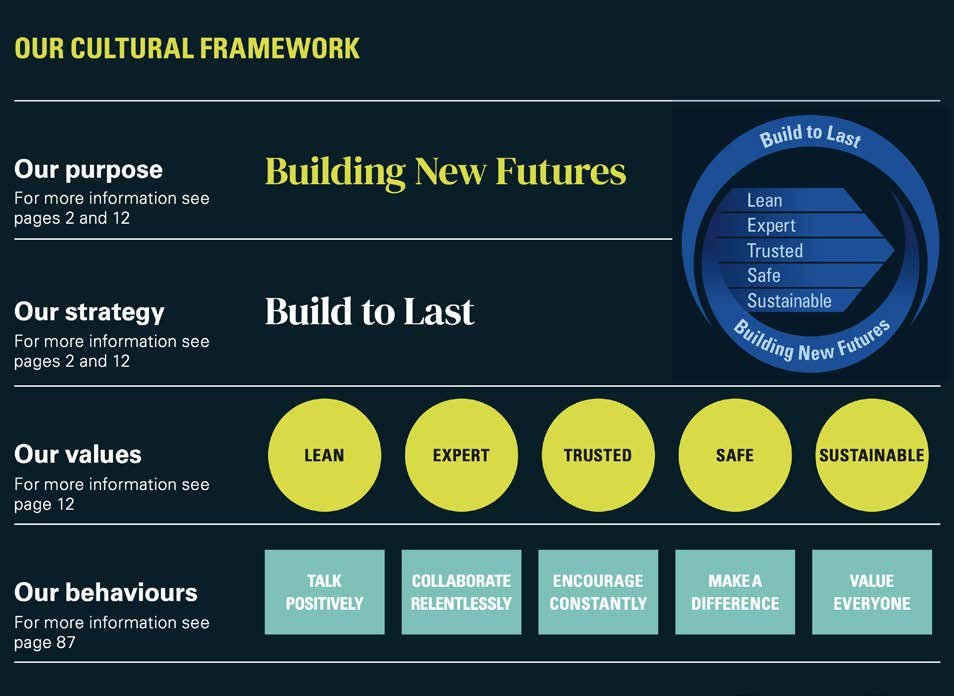
Some companies opted to present their alignment in a visual format (see below) and/or link it with corporate behaviours, risk, sustainability or ESG agendas. Those approaches are generally insightful, providing they are supplemented with a commentary or case studies to evidence the practice.
Example: Presenting the alignment in a visual form
Why it's useful: Balfour Beatty demonstrates how different elements fit together into their culture framework, with clear signposting.
Source: Balfour Beatty, Annual Report and Accounts 2021, p.128
Assessment and monitoring
Provision 2 states 'The board should assess and monitor culture. ...The annual report should explain the board's activities and any action taken.'
Although a majority of companies have given their reporting on culture assessment and/ or monitoring activities more prominence, 20 companies neither explicitly referred to this nor declared non-compliance with the Provision.
Out of those that did report in this area, only six companies provided meaningful disclosure beyond simply listing the review methods and briefly describing them, and just one organisation went a step further and discussed outcomes from the review process and referred to follow-up actions.
For example, they explained that their culture dashboards, which were presented to the board twice over the last year, were amended to include various trends and a section on workforce to capture staff demographics (for example, diversity, pay and reward). This helped to identify a potential red flag – exit interviews data exceeding the predefined tolerance level, which led to a salary benchmarking review and changes being implemented in some areas of the business.
We are concerned that no company reported on the impact of actions that were undertaken either in the year under review or following the previous year's culture review process.
Financial Reporting Council
FRC expects companies to report not only on the outcomes from their culture assessment and monitoring activities, but also on the impact of any remedy initiatives to assess their effectiveness in the following reporting year.
Some of the better disclosures described the remit of each board committee in this area – the approach we encourage, periodic review of assessment and monitoring methods, and how chosen measurement/observation methods correlate with the company's cultural priorities.
We were also pleased to see that the majority of companies went beyond workforce surveys both annual and pulse, and reported on some, or on rare occasions, on all of the methods set out below in the context of culture assessment and monitoring:
- culture/people dashboards
- HR, internal audit and executive reports
- whistleblowing and exit interviews
- designated NED, employee forum/ roundtables and other listening mechanisms
- direct engagement, including site visits and Q&A sessions
While it was encouraging to see that 30 companies listed a selection of their culture/ people metrics, we expect more companies to discuss the mix of their qualitative and quantitative measures. The most commonly referred to culture metrics include the following:
The most commonly referred to culture metrics include:
- Applications per vacancy
- Survey scores
- Covid-19 infection and quarantine data
- D&I statistics & targets
- Net Promoter Score
- Days of training
- Clients & suppliers metrics
- External ratings & benchmarks (e.g. Glassdoor)
- Sick days
- Anonymity rate of speak-up reports
- Pay gaps
- Sustainability & climate metrics/targets
- Leadership stability
- Lost Time Injury/Total Recordable Incident Rate
- Employee retention
- Employee assistance
- Annual certification of compliance
Implementation, embedding and assurance
We are pleased to see that almost half of companies have referred to the implementation and/or embedding of their corporate culture, purpose and values – the approach discussed and encouraged in the 2021 Culture Report.
Nonetheless, disclosures in those areas are largely limited to a statement. A handful of better reporters supplemented their reporting with examples of how implementation and/ or embedding were done in practice, and in a few instances, a case study or a flow chart was included to demonstrate the whole evaluation cycle.
Culture assurance, also addressed in the 2021 Culture Report, is still a relatively underdeveloped approach. Just one tenth of companies discussed it explicitly, and 20 referred to culture assurance only indirectly.
Evaluating, training and supporting our people to embed the 'Step-Up' culture framework.
| Evaluation | Training | Support |
|---|---|---|
| We use external benchmarks to evaluate our ethics and compliance practices, monitor our culture through the Culture and Perceptions Survey, and monitor our 'winning behaviours' with the ad hoc survey designed by the university. | We trained our executives and managers in masterclasses delivered by professors from the university, trained a group of internal trainers to deliver ethics workshops for the rest of our employees, and are deploying an e-learning course to reinforce areas of opportunity detected in the culture survey. All our training follows the 'Step-Up' culture framework. | We use the 'moral compass' tool and 'Step-Up' culture framework to enhance ethical decision-making. We are converting our trainers into ethical ambassadors, learning and sharing best practice by participating in external organisations, and raising awareness of key elements of our Code of Conduct through e-learning. |
While those numbers are low, it is encouraging to see that companies are increasingly reporting in this area. Out of those that disclosed details of their culture assurance process, four companies employed external consultants, and for others it was within a remit of responsibilities of the Internal Audit function. Most assurance appears to be proactive, at times linked to the acquisition/ merger, apart from one company, where the review and subsequent assurance were in response to the allegations of misconduct.
Key Message:
It is important to have a continuous focus on culture rather than wait for a crisis.
Example:
The Board asked [the auditing firm] to undertake a Culture Audit in 2021, the first time this has been completed at the Company. This provided the Board with further insights into how the Company's culture is developing and how effectively the link to our Values manifests itself across the business. This independent review also provides a triangulation point to complement the cultural insight gained from the Board site visits and the flow through the usual channels.
Other good practices
Increasingly, more companies are introducing non-financial/ESG performance targets in their executive pay. Good practice suggests clearly disclosing targets and demonstrating how they are stretching. Out of 35 organisations that included a culture-related underpin, most of them were related to H&S, employee engagement and undergoing a culture change. However, as most reports did not provide sufficient supporting information, it was difficult to determine how meeting the target and receiving the associated compensation correlated to improvements in culture. For example, a high return rate to a company questionnaire does not automatically denote a satisfied workforce. For more findings on executive pay reporting and ESG metrics, please see page 52. Consultation with workers on proposed culture change or the introduction of a new purpose, values or behaviours is good practice, but only 12 companies took this approach. A collaborative approach to workforce engagement is encouraged as it is more likely to lead to positive outcomes a position we took in the 2021 Culture Report. However, it is important that the reported feedback is balanced
- including both the opportunities and challenges. Please see page 21 for more insights on workforce engagement.
Nonetheless, we are pleased to see that some companies specifically referred to the constructive nature of their industrial relations – the approach that is encouraged.
Lastly, while we welcome increased reporting on corporate culture, purpose and values, this shouldn't lead to the overuse of those terms throughout the report. Companies ought to try to strike a balance between providing enough information for the reader to get a good picture of the strategies, policies and practices in place, and avoid disclosing too much operational detail, which can lead to confusing and lengthy reports.
Engagement with shareholders and stakeholders
Principle D of the Code asks that 'In order for the company to meet its responsibilities to shareholders and stakeholders, the board should ensure effective engagement with, and encourage participation from, these parties.'
'Effective engagement' and 'participation' for the Code's purposes should include different approaches to engagement which enable the board to consider views expressed and act on that information. There will normally be an element of dialogue, where all parties are able to express and discuss their views on strategy, governance and other matters as appropriate.
Importance of dialogue
The Guidance on Board Effectiveness: 'An effective board will appreciate the importance of dialogue with shareholders, the workforce and other key stakeholders, be proactive in ensuring that such dialogue takes place and that the feedback is taken into account in the board's decision-making.'
It is positive to see that boards continue to develop practices to engage with a wide range of stakeholders and shareholders. Companies reported on many different methods of engagement. These broadly fell into three categories:
- Giving – the company presents information, with little or no discussion; for example, the annual reports, the company's website, RNS announcements and Codes of Conduct.
- Receiving – the company receives information and generally is not able to respond to the views immediately; for example, surveys, questionnaires and feedback forms.
- Dialogue – an opportunity for all parties to air their views, discuss issues and receive information. The most common methods of dialogue that companies reported included Formal meetings, forums, townhalls, summits and roundtables. The most effective had a clear remit, were attended by senior management or the board and disclosed an outcome.
Example:
Since 2018, we have held annual roundtables with civil society organisations to listen, learn and understand how we can improve. The roundtables provide an opportunity for us to explore and discuss key social, environmental and economic issues facing society and our business. They also provide an important touch point to sense check the issues that matter most to society and help us to better understand evolving expectations. The roundtables are attended by senior leadership.
Feedback
Those companies that reported on a number of different approaches to engagement generally presented the most informative reporting describing outcomes and impacts.
Key Message:
Good reporting on how the board ensured effective engagement with shareholders and stakeholders should include details of:
- actions taken by the board: how the board engaged with the shareholders and stakeholders (methods of engagement, those involved, the frequency of engagement and topics discussed)
- outcomes from the engagement: what was the feedback from the shareholders and stakeholders, and the impact it had on board discussions and decision-making
We did see some reporting on engagement that went beyond the most common methods and, in some cases, explained that less complimentary feedback was welcomed.
Example:
This year we ran sessions for our senior management team where they listened directly to customers about their experience with the group – focussing as much on where we got things wrong as what we did well.
We also found some examples of companies sourcing feedback from a wide variety of partners, including international, and using engagement to understand if actions taken from previous feedback had improved relationships.
Example:
We completed our second annual Supplier Viewpoint survey, extending the participants to our top 30 product suppliers (previously top 20 product suppliers). This allows us to understand if actions we have taken following previous feedback has improved our supplier relationship management.
Although there was positive progress in some areas of stakeholder feedback, companies should reconsider the use of vague language such as 'feedback channels'. For transparency, companies should be as specific as possible in the exact methods that the board has used to obtain feedback. For example, some companies described in detail how they are using digital resources for engagement with a wider variety of stakeholders.
Effective engagement has the following characteristics:
- Clear purpose for the engagement
- Use the most appropriate method to achieve the purpose
- Feedback analysed with key issues drawn out and supported by any metrics
- Inform board discussions and decision-making
- Outcomes identified for either the company or stakeholder or not appropriate
- Dissemination of outcomes back to stakeholders
- Actions implemented, where appropriate
Engagement cannot be effective if shareholders and wider stakeholders do not get the opportunity to express their views or raise concerns.
The feedback cycle
Diagram illustrating the feedback cycle for stakeholder engagement. The cycle starts with "Inputs" (Who is responsible for engagement at company level? Why are we engaging?), moves to the central "Stakeholder Engagement" node, then to "Outputs" (What issues were raised during the engagement?), and finally to "Impacts and Outcomes" (Actions taken by the board as a direct result of stakeholder feedback and the impact of these actions).
Board decision making
Provision 5 of the Code asks that 'The board should understand the views of the company's other key stakeholders and describe in the annual report how their interests and the matters set out in section 172 of the Companies Act 2006 have been considered in board discussions and decision-making.'
We were pleased to see a few very good examples of reporting in this area. These included disclosure on the exact issue that has been discussed, the mechanisms by which they have taken feedback and from which stakeholder groups. The example below shows a high-quality explanation of how stakeholder feedback had been used by the board to help direct decision-making and outcomes:
Example:
During the year, we received feedback from cyclists that led to us to re-examine our training in this area. As a result, we engaged with partners to draw out key messages we needed to include in our revised training and created a short video to engage drivers. This was backed up with regular communications and a competition highlighting cycle awareness.
It is also encouraging to see that companies continue to consider how actions have led to long-term success for the company. Boards should continue to be as clear as possible on which areas of strategy or decision-making they have been impacted as boilerplate statements are still prevalent.
Better reporting linked feedback from stakeholders to outcomes. For example, reporting on customer feedback helping design net zero transition plans which included strategic decisions made by the board to improve and implement safety initiatives for stakeholders. Others focused on shorter-term issues where NEDs sat in on discussions with stakeholder focus groups to understand their insights.
When the stakeholder engagement section of a report signposts to other specific areas of the report, it can simplify the reading of the report and make it clearer to the reader how the board has incorporated a variety of discussions into their stakeholder engagement throughout the year, the outcomes achieved from the engagement and the impact of decisions taken on each stakeholder group. Some companies also used tables to demonstrate issues raised by different stakeholder groups – engagement is clearly linked to outcomes.
Shareholder Engagement
Key Message:
We are pleased to see that 92 companies reported engagement with shareholders during the year.
However, despite these encouraging figures, our review found that disclosures on shareholder engagement could be significantly improved. Some companies simply confirmed there had been meetings with shareholders without providing further detail on their engagement and its outcomes, whereas many others offered just brief statements; for example, "the CEO met with shareholders to update them on strategy."
Effective shareholder engagement
We have previously expressed concerns that engagement with shareholders can resemble an information campaign rather than a meaningful dialogue. This year, again, we found that disclosures were not always clear about the extent to which shareholders were able to ask questions and present their views and ideas rather than just hearing the company's presentation. We found instances where it was clear that engagement reported was only one-sided communication; for example, 'We engage through annual reports, the company's website and RNS announcements.'
Key Message:
Effective engagement with shareholders should allow them to express their views, ask questions and raise concerns.
Some companies only reported engagement by the investor relations unit. While we note the importance of the investor relations team in bringing shareholders up to date with company matters, beyond this, major shareholders should be offered meetings with members of the board – the chair, committees' chairs, the senior independent director and senior management, as appropriate.
Provision 3 states In addition to formal general meetings, the chair should seek regular engagement with major shareholders in order to understand their views on governance and performance against the strategy. Committee chairs should seek engagement with shareholders on significant matters related to their areas of responsibility. The chair should ensure that the board as a whole has a clear understanding of the views of shareholders.
Many companies did not report any engagement from the board chair and committee chairs but stated that they are 'available to meet with shareholders'. It is important to note that while the Stewardship Code stresses the importance of engagement by investors, Principle D and Provision 3 of the Code ask for active engagement from members of the board of the company. The engagement should therefore be sought by both the board and the investors.
Three companies reported engagement with shareholders at the AGM but no other engagement during the year. As stated above, to comply with Provision 3, the chair should seek regular engagement with major shareholders outside the general meetings. This would allow the board to be regularly informed about shareholders' views on governance and strategy.
In our recent Good Practice Guidance for Company Meetings, we emphasise that effective and transparent shareholder engagement should not be limited just to the AGM or in the lead-up to it. We highlight how meetings are an opportunity for the board to explain how they have considered matters raised through engagement with shareholders that may have a longer-term impact on the company's purpose, strategy, governance and future direction.
Key Message:
Regular engagement has a twofold purpose:
- It gives the board a clear understanding of the views of shareholders.
- It gives shareholders information on what impact their feedback has had on board decision-making, and as a result, on the company's strategy and governance, and social and environmental issues.
Board chair's engagement with shareholders
The Guidance on Board Effectiveness:
'The chair has an important role in fostering constructive relations with major shareholders and in conveying their views to the board as a whole.'
We were surprised that only 52 companies explicitly reported that the chair engaged with shareholders. It is important for the chair of the board to meet shareholders to obtain their views on and inform them about the important matters which impact the company. Some examples of issues where it may be useful for the chair to engage with shareholders include the following:
- Board effectiveness in directing the company
- Board structure, including board diversity and expertise
- Company compliance with legislative and other regulatory requirements, including compliance with the Code
- Performance of senior management
- Company strategy, culture and values
- Dividend payments
If the board chair has not engaged with shareholders during the reporting year outside formal general meetings, the company should disclose non-compliance with Provision 3, followed by an explanation.
Committee chair's engagement with shareholders
- 52 companies reported meetings with the board's chair
- 43 companies reported meetings with the remuneration committee's chair
- 2 companies reported meetings with the nomination committee's chair
- 0 companies reported meetings with the audit committee's chair
We were pleased to see that 43 companies in our sample explicitly stated that the chair of the remuneration committee met with shareholders during the year, which is in line with Provision 3 (in total, 70 companies reported engagement on remuneration matters; however, 27 companies did not specify if the committee chair was involved).
In contrast, we were surprised to see that only two companies stated that the chair of the nomination committee met with the shareholders, whereas none of the companies reported engagement from the chair of the audit committee.
Instances when the chair of the Nomination Committee may approach shareholders for engagement include the following:
- The company is appointing new directors, particularly when it is appointing a new chair, CEO or CFO.
- The board chair will continue to stay in their role even if they have been on the board of directors for over nine years.
- The company has not complied or has been unable to comply with the Code's requirements concerning the independence of the board or the chair, membership of the committees, or directors' re-election.
- The company has not reached its diversity targets, even in an instance where it is working towards achieving these targets.
- The board has not had an external evaluation in over three years.
- An internal or external board evaluation has identified significant weaknesses.
- A board-recommended resolution to appoint or reappoint a director has received significant votes against.
Instances when the chair of the Audit Committee may approach shareholders for engagement include the following:
- The company is in the process of appointing a new auditor.
- There is a significant increase in the likelihood or impact of the principal risks faced by the company.
- The going concern of the company is uncertain, or there are reasons to believe that the company will not be able to continue in operation and meet its liabilities as they fall due.
- Significant failings in the risk management procedures, the internal control systems or the internal audit function have been identified.
- A board-recommended resolution to appoint or reappoint the external auditor proposed by the board has received significant votes against.
Reporting engagement with shareholders
Three companies provided statements such as 'the chair and CEO regularly meet with shareholders'; however, it was unclear if they or anyone else actually met any shareholders during the year. In addition, some companies did not specify who carried out the engagement and/or the method used. Some companies listed the available engagement methods (for example, meetings and phone calls) without specifying which of these or any other methods were used during the year. Some also listed those who typically engage with shareholders (i.e. the chair, CEO, CFO and committee chairs) but without specifying who, if any, of those individuals met any shareholders during the year.
We were disappointed that only 39 companies provided insights on the subject of discussions with shareholders. Better reporters provided detailed and specific information. Examples of subjects discussed reported by companies included the following:
- Particular elements of the company's strategy and operations; for example, progress on specific projects, acquisition of new businesses, financial performance, product development and risks.
- Issues that affect shareholders more directly, such as dividend policy and distribution, share price and share buyback.
- Issues that affect other stakeholders, such as the environment, climate change, working conditions and relationships with suppliers.
- Governance issues, particularly on remuneration, but also succession planning, board diversity and expertise, and chair tenure and independence.
Good reporting should provide some level of specificity while not disclosing commercially sensitive information. General headings such as 'financial performance', 'investment in new products' or 'so succession planning for the new chair' provide context for users of the annual report. Better reporters discussed both the individual(s) who carried out the engagement and the topics discussed; for example: 'The CFO met with shareholders twice in the last quarter to discuss the financial results' or 'The chair had a meeting with two major shareholders to discuss board composition and succession planning.'
Key Message:
Disclosures are informative if they go beyond general statements stating that a meeting/event occurred.
Sixteen companies in our sample provided a timeline showing who engaged with shareholders, when and how. This made it more accessible and straightforward for the reader to understand how the board engaged with shareholders during the year.
Good reporting should include information on activities undertaken during the year and any outcomes, showing how the board engaged and considered shareholders' feedback. Feedback on shareholder engagement was reported by only 23 companies, with 17 of these companies only explaining the feedback received on remuneration matters.
Key Message:
Reporting on the feedback received from shareholders is an important indication of the effectiveness of the engagement.
Where appropriate, reporting on the outcomes from engagement should include how the shareholders' feedback affected board decisions, such as on strategy, governance, and approach to social and environmental issues. Examples of decisions taken by the company following shareholder feedback from the companies in our sample included:
- bringing forward the Net Zero targets
- changes to dividend policy
- separation of the roles of chair and CEO
- establishing a sustainability board committee
- recruitment of new NEDS
Good reporting on outcomes also includes instances where the board considered or discussed shareholders' feedback but decided not to take any action.
Shareholder engagement following a significant vote against a board-recommended resolution
Provision 4 states 'When 20 per cent or more of votes have been cast against the board recommendation for a resolution, the company should explain, when announcing voting results, what actions it intends to take to consult shareholders in order to understand the reasons behind the result. An update on the views received from shareholders and actions taken should be published no later than six months after the shareholder meeting. The board should then provide a final summary in the annual report and, if applicable, in the explanatory notes to resolutions at the next shareholder meeting, on what impact the feedback has had on the decisions the board has taken and any actions or resolutions now proposed.' The FRC is currently undertaking research into how companies report against the requirements of Provision 4 of the Code. The research will focus on those companies which have received a significant vote against a board-recommended resolution in the period between 2019 and
- It will evaluate the level of reporting on shareholder engagement on the statements provided by companies when announcing voting results, update statements published six months following the vote and the summary of these engagements in the annual reports.
Workforce Engagement
This year, companies explained their workforce engagement processes well. However, only 28 companies connected the views of the workforce and actions carried out by the board. Most companies listed boilerplate actions which appeared to be unrelated to their employee engagement feedback, or included a vague statement similar to the one below:
Example:
The issues that were identified in the engagement survey have been addressed by the board.
The majority of the outcomes reported centered around employee wellbeing and hybrid working. It is inevitable that the pandemic has had a disruptive effect on many employees, and it is encouraging to see companies focusing on initiatives to tackle this. However, we were unable to find many examples of outcomes which were linked to other matters; for example, delivering the company's strategy.
Beyond these specific pandemic-related outcomes, many companies have not reported in any detail outcomes and impacts of their workforce engagement. Good practice reporting would include examples of company-specific initiatives which were implemented as a result of employee feedback.
Those companies that did outline their outcomes in relation to wider issues discussed matters such as the following:
- Transformation and innovation
- Charity and volunteering
- Diversity and inclusion
- Discrimination at work
- Recycling policies
Better reporters gave specific examples of their initiatives, clearly linking them to employee feedback:
Example:
Employees raised that they wanted 'Better segmentation of audiences for communication purposes and greater visibility of the Senior Leadership Team. More structure around celebrating success and morale boosting activity.' As a result, 'The Group communications team has been strengthened with the recruitment of a new Head of Internal Communications. A 'Top 100' group has been created for planning and communication of new initiatives, and a programme of global townhalls introduced. Celebrating success has been amplified through more regular communications via multiple channels and a weekly written newsletter.
To enhance this, the company could have also outlined the expected impacts of implementing these new initiatives. This will help companies' explanations of their feedback cycles. If companies have not yet seen the results of their actions, it would be helpful for them to include the impacts of their initiatives implemented in the previous reporting year.
As mentioned earlier in the report, the most effective reporters used a table or a diagram to present their disclosures on workforce engagement. If used effectively, a table can help to ensure that the complete feedback loop is included in their report.
A few companies included a list of 'what is important to their employees', without explaining how they collected this information (for example, is the issue a direct result of information collected from employees or an assumption of the management). Companies should be specific and avoid including information that has no connection to their wider workforce.
Although some companies have given some detail of their actions and outcomes, their reporting could be improved if they included information on the regularity of their engagement and, importantly, link the outcomes to specific employee feedback. This can be found in the example below.
Agenda items at employee engagement meetings
It is recognised that having pre-agreed agenda items is an effective way of structuring a productive meeting. It is important that the employees are able to influence these meetings, and adding agenda items beyond those suggested by the board is one way to achieve this. However, it is important to avoid making the agenda so rigid that issues of the day can't be added to the agenda at short notice.
One company said that their designated NEDs will only attend workforce engagement meetings for pre-agreed topics.
Our report on Workforce Engagement and the UK Corporate Governance Code provides an understanding of the benefits of having a balance between topics of management interest and topics of workforce interest when setting an agenda. Good practice reporting would outline that they included topics that were agreed by the wider workforce as well as include items set by the board.
| Meeting | Presentations and topics discussed | Outcome/impact |
|---|---|---|
| The new ways of working Admiral's approach to ESG |
Please see the new way of working section under principal decisions on page 101. The importance of the internal communications strategy in respect of the work on ESG factors was emphasised, as was the need to help the community and other businesses. Please see the sustainability approach section under principal decisions on page 104 for further information. |
|
| February 2021 | Sale of the Penguin Portals businesses (as reported in the 2020 Annual Report) | Colleague views of the announcement of the sale of the Penguin Portals businesses were heard from the Confused.com ECG representative, noting that further clarity was needed in respect of how profits from the sale would be distributed. This was followed up by management after the meeting. This was raised as a specific topic for discussion at the Board during the year, at which it was reconfirmed that the majority of the sale proceeds would be returned to shareholders, with a proportion being retained by the Group to develop other areas of the business. |
Source: Admiral Group PLC, Annual Reports and Accounts 2021, p.92
Workforce engagement methods
Overall, companies have given good explanations of how views of the workforce are escalated to the board.
In line with last year's analysis, we found that a designated NED was the most common engagement mechanism. This continues to be an effective engagement mechanism, particularly when companies clearly define the role of the NED, outlining the board's expectations and how the NED's role will aid engagement with employees.
It was also encouraging to see that a few companies gave explanations of the reasons why a particular NED was appointed to engage with the workforce. A simple explanation of why the NED has been chosen ensures that companies are using this method appropriately and that the designated NED will genuinely facilitate two-way engagement between employees and the board.
It is especially helpful to see that some designated NEDs have experience in the relevant fields. Such as having a background in Human Resources and have knowledge of relevant ESG issues.
We were pleased that some companies explained how the membership of their formal workforce advisory panels were decided.
A few companies had elected members from the workforce to be on the panel; this is more likely to lead to a more effective engagement as they are more likely to accurately reflect the views of employees. For example:
Example:
There is a democratic member election process and members are provided with an induction to ensure that there is clarity about the role and remit of the employee forum, as well as their role as members.
More companies are combining the use of an advisory panel with the support or under the leadership of a designated NED to engage with the workforce. This approach allows for a form of structured engagement with employees that the NED is then able to feed back to the board. Although it is not often reported, we would expect that this approach allows the NED to directly feedback the views and outcomes from board discussions that the NED has raised.
We have not seen an increase in companies choosing to appoint a workforce director to the board. If more companies used this mechanism, we would be able to assess the effectiveness of it. One company that appointed a director from the workforce included an interview with them in their annual report. It was helpful to see how their workforce director viewed their role on using their own experiences as well as the opinions of their colleagues to inform the board on issues relevant to employees. One of the challenges they reported was the impact of Covid-19 and the effect that this had on company operations. The company's workforce director briefed the board, bringing any important feedback to the attention of the board.
Provision 5 of the Code states that 'If the board has not chosen one or more of these methods, it should explain what alternative arrangements are in place and why it considers they are effective.'
This year we have continued to see the use of alternative arrangements with some good explanations of why they are effective. Out of the 26 companies who opted to follow an alternative arrangement, 17 explained why their method was effective.
Example:
The Board reviewed [the company's] method of workforce engagement during 2021 and concluded that leveraging existing channels of colleague engagement had been an effective mechanism for providing a rich and varied insight into the views and experiences of colleagues across the workforce with feedback from both Directors and colleagues participating in the programme being extremely positive. The innovative use of digital channels continued to be a key enabler to the success of the programme ensuring that Board members, management and colleagues remained connected despite the restrictions on face-to-face meetings which were in place throughout the year. The Board has therefore decided to continue with this approach for workforce engagement rather than adopting one of the methods prescribed in the Code and will continue to both evolve and enhance the approach and keep its effectiveness under review.
In our previous report, we mentioned that we would be paying closer attention to how companies assess their engagement mechanisms to ensure that they are continually effective. Our analysis this year shows that very few companies disclosed that they reviewed the effectiveness of one of the three engagement mechanisms.
Key Message:
Good practice reporting would include an explanation of why the company has chosen their engagement mechanism and how they will monitor this to ensure that it is effective.
Customer Engagement
This year we found that 47 companies reported explicitly in this area. Many organisations have created specific programmes and channels through which to hear feedback from customers, with surveys and customer satisfaction scores among the most prevalent modes of direct engagement.
Many of this year's disclosures referred to the use of data to illustrate how they had reported against the Principles and Provisions of the Code. This allowed for more effective measurement and metrics to quantify the effectiveness of engagement. Despite many positive examples of targets for customer engagement from a range of companies, only one company provided any examples of targets concerning customer-focused engagement not being met. When boards had discussed poor scores, more general narratives were given. There is an opportunity when reporting for companies to explain how they had dealt with poor scores and what positive actions were proposed.
Customer engagement was the area where some good-quality feedback-based stakeholder engagement was seen and where outcomes were clear. During discussions concerning feedback, the better reporting companies were specific on what was sought from these groups. For example:
Example:
Non-executive directors were able to observe customer-facing colleagues in action and to hear customer feedback as part of a focus group or customer listening surgery. Feedback videos were shown to the Board as part of the annual Board strategy session and provided useful insights to help inform Board discussions.
Two companies this year had discussed the work of the Chief Customer Officer (CCO). The role of the CCO is to feed customer-related issues directly to the board for discussion and necessary decisions. For example, one company had effectively linked customer satisfaction data to the formulation of its 2022 strategy and how this approach had led to the hiring of a CCO:
Example: We gather feedback throughout the customer journey, including onsite product reviews, public review sites and internal customer satisfaction measures. At each Board meeting, the Chief Executive Officer reports the latest customer satisfaction indicators and provides updates on key actions taken in relation to ongoing improvements to the customer proposition at each Board meeting. Customer feedback and satisfaction data has been a key driver for the Board's formulation of the 2022 strategy
- Experience, Reach, Choice and Sustainability. The Board demonstrated its commitment to improving customer experience by approving the hire of a dedicated Chief Customer Officer to the Executive Leadership Team who will join in 2022.
This year, 12 companies discussed the use of Net Promoter Score (NPS), this is an increase of 11 companies compared to last year. Net Promoter Score is a measurement tool for customer loyalty and satisfaction, and has allowed directors to have a clear measure on the views of its customers. In reporting, Net Promoter Scores have been used to illustrate clear targets and improvements in service.
Aggregated scores are used by companies to help businesses improve in areas such as delivery and customer service. These were typically used as positive examples demonstrating how companies had actively engaged with their stakeholders throughout the year. The use of metrics does, however, need to be balanced across all stakeholders, not just customers, to have maximum impact:
Example: Goal 8 - Reach and maintain a top-quartile Customer NPS score of at least
- The Group's mission is to help people connect, and it is important that the Group's customers believe it is doing this. The Group's weighted average Customer NPS score across its brands was 71 in FY22 (FY21: 67), which places it in the top quartile for technology companies. We have improved order and delivery information, introduced a customer service chatbot, worked with our partners to improve delivery performance and worked with our supply chain to improve flower quality.
Supplier Engagement
Climate-related and sustainability issues were a major theme in this area. Companies took time to discuss how they had worked as a partner alongside suppliers to embed climate-related issues. This also included examples of considerations in Requests for Proposal and how stakeholder integration was used as a pillar for the board's climate change policy. Presentations to the board and executive management were again a popular form of supplier engagement. This has been used as a strong form of two-way engagement. These presentations discussed a variety of long-term business interests and different issues across geographies.
As well as the most common methods of engagement mentioned earlier in this section, those specific to suppliers included the following:
- Use of relationship managers
- Supplier reviews
- Audits and inspections
- Awareness training, including modern slavery
- Ethical audits
- Due diligence questionnaires
- Clauses in supplier contracts
- Whistleblowing channels
- On-site visits
Better reporters talked about the frequency of their engagement and shared information on the exact issues considered in regular engagement with suppliers.
Impact reporting on suppliers and communities
It was positive to see companies this year engaging on how their operations and activities impacted their suppliers and communities. We found that 76 companies reported on outcomes of engagements compared to 69 last year. Most notably, climate
- and sustainability-related issues. Reporting on impacts was most effective when companies were able to quantify results or timeframes for actions. Examples of sustainability related impacts on companies included working with materials suppliers on one-on-one ESG practice assessments and upskilling suppliers on sustainability issues to better understand the barriers and issues within the sector.
A good example might include training suppliers on ESG concepts. Companies have also consulted with suppliers on the formation of their climate-change strategies as well as working with specific manufacturers on the development of low-emissions infrastructure and equipment.
Impacts on communities were more varied. Many companies still gave boilerplate examples of very general discussions concerning the impact of a company's activities, such as improvements to career opportunities or more common disclosures were those surrounding climate risks.
Despite this continued use of boilerplate reporting, when companies actively engaged with these issues, reporting was strong. This was most effective when it was linked to wider business concerns and strategy. One company designed a 'Responsible Business framework' alongside community stakeholders, which is used by the internal CSR Committee to review progress against targets. Other better reporting examples include linking commitments on net zero targets to the opportunity to create a fairer society and supporting livelihoods inside communities in which they operate:
Example:
"We developed the Driving What Matters plan (the Plan) during 2021. Two of its pillars, Places and Planet, will assess the impact of the Group's operations on the community and the environment. The Responsible Business framework was designed collaboratively and is owned and delivered by our colleagues around the Group. Their input has shaped the way we approach responsibility and set out what responsible business means for Inchcape. The CSR Committee, and the Board, will regularly review progress against targets as the Plan matures alongside monitoring the Group's corporate responsibility, sustainability and stakeholder engagement activities”
Modern Slavery
Provision 1 states that companies 'should describe in the annual report how opportunities and risks to the future success of the business have been considered and addressed.'
Earlier this year, in collaboration with Lancaster University and the UK Independent Modern Slavery Commissioner, we published a report on Modern Slavery Reporting Practices in the UK. A number of the Code's Principles and Provisions cover matters relating to supplier issues, including the board's responsibility to assess and manage the company's risks, to embed appropriate internal controls and for effective engagement with wider stakeholders. This year, we therefore continue our research to determine reporting quality in annual reports as it relates to areas of the Code. Our assessment this year focused on (i) Risk and Governance (ii) Policies and Effectiveness and (iii) Stakeholder Engagement.
Overall, while nearly half of companies report on their policies and procedures as they relate to modern slavery, reporting fails to address the effectiveness of these measures.
While almost all companies mention modern slavery in their annual report, these were mostly brief and in relation to legal and compliance issues. Others reported on modern slavery within sustainability strategies, s.172 and risk statements. Concerningly, just 24 companies provided a direct working link (URL) to their modern slavery statement from their annual report.
Key Message:
Companies should provide appropriate cross-referencing to modern slavery statements in annual reports.
Risk and governance
We found that 53 companies identified modern slavery as a risk in their annual report, with 13 identifying it as a principal risk and the majority only briefly mentioning the term in the context of risk. As a principal risk, modern slavery was categorised as third-party and supplier risk, legal and compliance risk, reputational risk, supplier management and breach of contract. Those who did report on modern slavery as a principal risk were from a wide range of sectors.
We saw some good practice on how companies identify and manage risks relating to modern slavery.
One company reported that it has mapped its suppliers to identify particular industry/sectoral risks as well as risks from their geographical location. A risk assessment matrix was used, looking at sectoral risk, country risk and spend data to prioritise next steps. It reviewed 82 supplier sectoral categories, which were given a human rights and modern slavery risk rating from 'low' to 'high'. The company set out six priority categories that were prioritised based on their geographical location. To identify country-specific risks, the company took account of a number of external indices in its process, including the UN Human Development Index, the Global Slavery Vulnerability Index and the World Bank Worldwide Governance Indicators – Regulatory Quality.
Some companies reported that they had brought in external consultancies to carry out assessments and provide expertise on the matter. This included risk mapping and improving reporting procedures. One company, for example, brought in a third-party non-profit organisation which set out a three-year improvement plan to improve modern slavery risk identification.
Only 18 companies identified in their annual report the person and/or committees responsible for overseeing modern slavery issues.
We were pleased to see some companies report that they have established cross-functional working groups on modern slavery. These included representation by individuals from HR, legal, procurement and supply chain, internal audit and corporate responsibility who are responsible for implementing and maintaining the relevant policies, communication and training to combat modern slavery.
Key Message:
Drawing internal expertise from across the organisation to inform modern slavery strategy ensures a joined-up approach which is strategically aligned to the business and its goals.
Some companies integrate the consideration of modern slavery into HR-related strategies, procurement strategies, workforce strategies and commercial strategies. Others reported their participation in initiatives such as the People Matter Charter, which brings challenges related to decent work, including diversity, exploitation and employment conditions, together into one workforce strategy.1
Key Message:
By integrating modern slavery into existing strategies, companies can ensure that their modern slavery response is aligned with the business, including alignment with policies, KPIs and culture.
While almost all companies in our sample report that the board approved or reviewed the modern slavery statement, board engagement with modern slavery issues beyond this was minimal.
For example, only one company reported on board-level decisions relating to modern slavery in their annual report. That company reported that, following questions by stakeholders on its strategy to address modern slavery risk, the board sought more assurance outside the UK business surrounding mitigation actions and requested more engagement in smaller markets. This resulted in a modern slavery 'playbook' being issued across the world and an annual certification of compliance from local businesses. The company linked this decision to its strategy, reporting that supporting decent work is central to its culture and values, and is a cornerstone of its sustainability strategy.
Policies and effectiveness
As part of broader supplier governance measures, many companies are reporting on appropriate policies to manage their relationships with their suppliers. These include policies which aim to ensure suppliers abide by business standards and values.
We found 45 companies to have reported on how their policies relate to modern slavery. The most commonly cited policies which deal with modern slavery issues were supplier/employee codes of conduct and modern slavery policies. Other policies included codes of ethics, human rights statements, whistleblowing policies, vendor and procurement policies, and HR policies. Significantly, where companies reported that they have a specific modern slavery policy, in the majority of cases there was often no information about who was responsible for ensuring its effectiveness. Where companies did disclose who was responsible for ensuring their modern slavery policies remain effective, this was often designated to the internal audit or legal and compliance functions.
A third of companies reported that they have reviewed and developed their governance, policies or procedures on modern slavery during the reporting year.
Improvements to approaches included updates to governance, updates to employee and supplier codes of conduct, updates to supplier contracts, and additional due diligence checks. Building knowledge and awareness throughout the organisation, however, was the most prevalent development within organisations this year. A number of companies also linked improvements to sustainability strategy and responsible sourcing targets. One company reported on its responsible sourcing target to launch a new digital tender system for group suppliers and integrate sustainability compliance into the tender process, including in relation to modern slavery and the living wage.
Not one company in our sample reported in their annual report that it had found any cases of modern slavery in the reporting year.
Although some reported on process-orientated results, for example, the number of supplier audits or the number of audits of key supplier compliance with modern slavery policies, not one company reported in their annual report on the outcomes of these audits and whether any issues had been found and/ or resolved.
Key Message:
The failure to report on outcomes of engagement on modern slavery was a missed opportunity by companies to demonstrate the effectiveness of their internal processes.
It was disappointing to see that only one company reported that it had developed KPIs for their approach to modern slavery, yet it did not disclose what those KPIs were. When establishing metrics and performance indicators, companies should ensure that they provide accurate insight into performance and are interpreted correctly. For example, a consistently low score may indicate that the company has not taken appropriate steps to eliminate modern slavery in its supply chain as opposed to an effective modern slavery strategy.
Stakeholder engagement on modern slavery
Provision 5 states 'The board should keep engagement mechanisms under review so that they remain effective.'
We found that 67 companies reported that they engaged with one or more stakeholder groups on modern slavery, predominantly suppliers and employees. Supplier engagement on modern slavery, however, was often simply stated in a list of other engagement issues, such as prompt payments, and so it was unclear if the company actually engaged on this issue during the year.
Where companies reported on stakeholder engagement methods, there was rarely any indication of how the effectiveness of engagement policy or strategy is measured.
For example, although many companies report that they have a whistleblowing policy for employees and suppliers to raise modern slavery concerns, the majority of companies with a whistleblowing policy simply stated that no concerns of modern slavery were raised during the year. Importantly, there was seldom information on whether employees/suppliers are sufficiently aware of the policies or if any cases have been raised and/or resolved. This limited reporting is generally in line with wider reporting on whistleblowing hotlines.
Similarly, one company reported that their supplier code states that the company encourages and welcomes feedback from suppliers on how policies and procedures can be improved. However, reporting did not say whether suppliers have utilised this clause, if feedback received has led to meaningful improvements or if suppliers are sufficiently aware of the policy. Therefore, although in principle this type of procedure is in line with the spirit of Provision 5, reporting did not provide insight into the effectiveness of such methods of engagement in practice. A better approach was seen by companies who measured effectiveness through metrics such as surveys on policy awareness or through case studies on action taken following cases raised, whether or not modern slavery was found.
While some companies are adopting an approach that fosters a dialogue between suppliers and the business, the main method of engagement remains supplier audit.
Although audits are an essential element of a modern slavery strategy, not one company reported in their annual report that they have found instances of modern slavery in their supply chain as a result of the audits.
Key Message:
Companies must assess the effectiveness of their engagement methods at identifying instances of modern slavery.
A better approach was seen by companies who opted for an approach which aims to build trust and capacity with suppliers through increased engagement. For example, instead of ending contracts when concerns are first raised, some companies worked with suppliers to minimise risk and work together on corrective action plans. One company, for example, reported that following review by an external consultancy, a human rights specialist consultancy database was established to assist in conducting this due diligence and to support clients to implement corrective action plans when human rights allegations are flagged. It reports that it also produced guidance for clients to support the development of their own human rights policies and procedures.
To improve reporting on modern slavery in annual reports, companies should address the following areas:
- Risk – how the company has evaluated the impact of modern slavery on their business
- Governance – who is responsible for driving strategy on modern slavery
- Policies – what policies relate to the company's approach on modern slavery
- Engagement – how the company has engaged with stakeholders on modern slavery
- Effectiveness – how the effectiveness of the policies and engagement strategy is measured, including KPIs
Community Engagement
We are pleased to see that 96 companies identified both communities and suppliers in their reporting/disclosures. However, the quality of reporting on communities was mixed, often limited.
It is unfortunate to see that community engagement has not developed further; it was a key message in our previous report. Companies appear unwilling to elaborate beyond positive stories and general outreach within communities.
Businesses generally continue to give generic statements that lack a full explanation of engagement. The most prevalent disclosure of community feedback was through examples:
Example:
We recognise the need for action in addressing the climate crisis and transitioning to a greener, safer and more resilient economy. We are committed to improving the impacts that our operations have on the environment, managing the climate-related risks and working together with our clients, suppliers and local communities towards delivering a more sustainable future.
However, when not discussed in relation to specific engagement or action from the board, these statements hold little weight. Companies are urged to give the highest quality disclosures possible, explaining the process of engagement with local communities and linking it to wider business strategy.
Some international firms focused on the interests of local and indigenous communities to good effect. It is positive to see companies engaging directly with communities when linked to the protection of the local environment. These engagements were also related to the continued impacts they would have to suppliers on issues such as faster payment systems for indigenous and regional communities. For example:
Example:
The Board considered whether the transaction would have any positive or negative effect on local communities. The Board concluded that the transaction would have a positive impact in terms of providing future job security for employees.
Environment
Climate change
Although the Code does not specifically ask for reporting on environmental issues, it does deal with the governance of risk, engagement with stakeholders and links to s.172 reporting. Therefore, we have considered the environment and Task Force on Climate-related Financial Disclosures (TCFD) reporting for a second year, as climate-related issues are becoming highly important for stakeholders, as well as recognised as a principal or emerging risk for many companies.
Following the introduction of TCFD-aligned climate-related disclosure requirements for premium listed companies for periods beginning on or after 1 January 2021, we saw many companies reporting in line with the TCFD Recommendations and Recommended Disclosures for the first time. We were pleased to see the majority of companies taking steps to improve their reporting and strengthen their governance of climate-related issues during the year.
Statement of consistency with the TCFD framework
For reports with December 2021 year ends, Paragraph 8(a) of Listing Rule 9.8.6R requires that listed companies must include in their annual financial report a statement setting out whether
the listed company has included in that financial report climate-related financial disclosures consistent with the TCFD Recommendations and Recommended Disclosures.
Of the 100 companies, 63 stated that they had provided disclosures fully consistent with all of the TCFD Recommendations and Recommended Disclosures.
We found 18 companies that stated they were partially consistent, where some disclosures were not provided, or were provided only in part.
Key Message:
Where companies do not provide all disclosures in full, we would expect, as required by the Listing Rule, an adequate explanation and an expected timeline for compliance.
We found 14 companies that stated they were not yet consistent with the TCFD Recommendations and Recommended Disclosures, but provided a statement of intent for compliance in future.
We found six companies that were not consistent and did not provide any explanation or discussion of an intention to become consistent in future. Of these, we noted one company in our sample that made no mention at all of the mandatory TCFD disclosures in their report.
As set out in the CRR Thematic Review of TCFD disclosures and climate in the financial statements, the FRC expects companies to improve their level of compliance across all the recommended TCFD disclosures in what will be the second year of reporting for many companies. In particular, the FRC expects TCFD disclosures to become more specific and granular, more balanced between risks and opportunities, and better linked with other narrative reporting; it also expects materiality decisions to be better explained.
We found a great deal of variation in the quality of statements of consistency. A good statement explains clearly a company's level of consistency with the TCFD Recommendations and Recommended Disclosures, states any areas where they are not yet compliant, and avoids vague statements, such as 'We support the TCFD framework'
Example:
The Group have made disclosures consistent with the four TCFD recommendations and the 11 recommended disclosures
Governance of climate-related issues
Better reporting in this area included clear and specific disclosure of the governance structures and processes by which the Board considers climate-related issues.
Companies that reported well in this area included clear and informative discussions of how the board considers climate-related risks and opportunities, including how frequently this was included on board agendas, what decisions were made at board level, the committees or advisors involved in informing the board on these issues, as well as a discussion of the other committees or working groups that are involved in the monitoring and decision-making process, and how these issues are integrated into the company's strategic thinking and future planning.
We were pleased to see many companies take significant steps to improve their governance structures for assessing and considering environmental issues at board-level during the reporting year. In particular, we noted 20 companies that created new board committees during 2021 which have a particular focus on climate-related issues, reflecting an increased commitment to address sustainability at the highest levels.
Overall, 45 companies now have board-level committees (with similar structures to remuneration and nominations committees – made up of NEDs) with responsibility for assessing and considering environmental issues. These are given various names, such as the sustainability committee, the ESG committee, and the CSR committee.
We found that companies with board-level environmental committees were evenly spread across sectors, highlighting that companies are making efforts to improve their governance of climate-related issues across the board. We found a higher proportion of FTSE 100 companies in our sample with board-level environmental committees.
Overall, we found that 45 companies in our sample had board-level ESG/sustainability committees.
Of those, 21 were FTSE 100, 17 were FTSE 250, and 6 were Small Cap companies.
36 FTSE 100 (21 with Board Committees)
58.3%
48 FTSE 250 (17 with Board Committees)
35.42%
16 FTSE Small Cap (6 with Board Committees)
37.5%
We also found that where companies did not have board-level environmental committees, most disclosed committees, working groups or task-forces at executive or management level with a broad remit of considering climate-related issues. We found only 11 companies that had none of these structures in place, and these tended to be companies that reported less well on environment issues overall.
Board expertise
While we noted significant improvements and strengthening of overall governance structures related to climate-related issues over the last year, we found the level of board and senior management expertise or knowledge disclosed in the report remained largely unchanged from last year, with 73 companies not disclosing any expertise relating to climate issues.
Number of companies disclosing climate expertise on boards
- 27 Yes
- 73 No
We also found that where expertise was disclosed, it was often poorly explained. Best practice reporting in this area is specific and detailed. For example:
Example:
[The newly appointed independent NED] is a qualified environmental scientist and an experienced environmental, social and governance (ESG) professional with expertise in a range of issues, including sustainability, strategy, governance, business transformation, and energy transition.
Key Message:
It is important that companies incorporate sufficient experience, expertise and knowledge of climate-related issues at board and senior management levels to help them better navigate these complex and increasingly material issues.
Climate change and risk
Risk management is a fundamental component of TCFD disclosures, and it is becoming increasingly important for companies to recognise and address the risks that climate change can pose to a company's facilities and operations, supply and distribution chains, employees, shareholders, and customers.
Similarly to last year's review, we looked at how companies are considering climate-related risks, and found that in this year's sample:
- 41 companies had identified climate change as a principal risk
- 30 companies identified climate change as an emerging risk
This includes six companies who elevated climate change from an emerging risk to a principal risk during the reporting period.
Bar chart showing Principal risk vs. Emerging risk for 2020 and 2021.
The Y-axis ranges from 0 to 50. For Principal risk: 33 companies in 2020, 41 companies in 2021. For Emerging risk: 20 companies in 2020, 30 companies in 2021.
Interestingly, we noted a number of companies that identified climate-related regulation, or the costs associated with a climate transition as a risk, rather than climate change itself.
Metrics and targets
The disclosure of metrics and targets is a fundamental component of TCFD disclosures. Companies that reported well in this area used a variety of metrics relevant to their business model, included discussions comparing their metrics across years, talked about what actions they are taking to expand or improve the quality of reporting, and linked their metrics to wider business strategy and targets. Best practice reporting on targets set goals that were measurable, specific and actionable, and included a good balance of short, medium and long-term targets.
Example: Setting out targets
Why it's useful: The example sets out their targets, including which Scopes are included, and maps out their specific actions and future timeline for delivery.
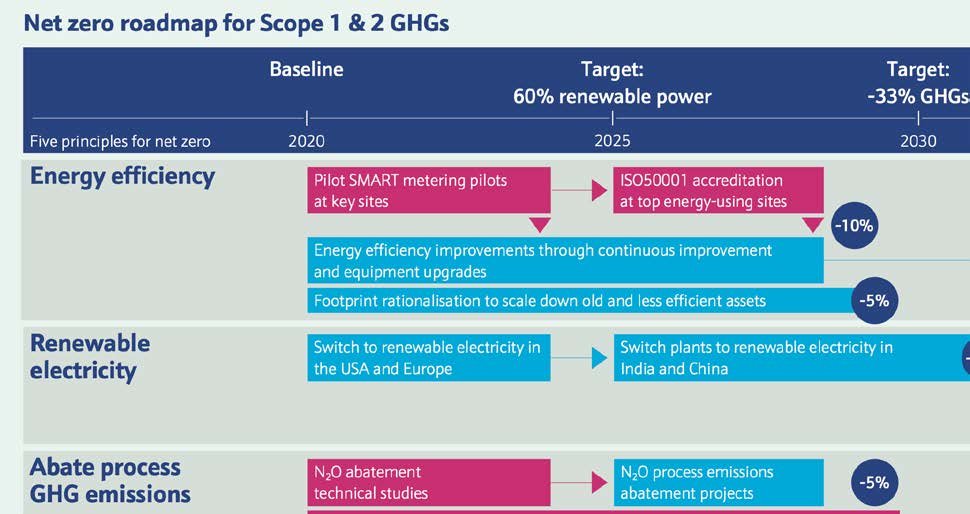 Source: Johnson Matthey PLC, Annual report and Accounts 2022, p.44
Metrics
UK-listed companies are required by the Streamlined Energy and Carbon Reporting requirements and the TCFD framework to report their Scope 1 and 2 emissions, energy use and an appropriate emissions intensity metric. While 94 companies in our sample disclosed Scope 1 and 2 emissions, we again found fewer companies that reported Scope 3 or other climate-related metrics.
- 94 companies reported Scope 1 and 2 (direct greenhouse gas emissions and energy indirect emissions)
- 66 companies reported Scope 3 (other indirect emissions)
We expect, as required by the Listing Rule, companies to determine the materiality of Scope 3 emissions to users of the financial statements, and report emissions where required, clearly identifying which categories are included. Where companies did not report Scope 3 emissions, we expect companies to include the reason for non-disclosure in their compliance statement, including a timeline for when they expect to report.
There was significant variation in the scope of reporting Scope 3 emissions where these were disclosed, with much of reporting in this area limited to only one or two categories, such as business travel and/or employee commuting.
We recognise the disclosure of Scope 3 emissions can present a significant data collection challenge, however, for many companies their value-chain Scope 3 emissions will be much more significant than their Scope 1 and 2 emissions, so we expect to see disclosure of the methodology used to calculate data disclosed, as well as a discussion of work that is underway to disclose in future, or to enhance current disclosure, and clarity about which of the Scope 3 categories they will include.
Targets
While most companies in our sample had set targets for climate-based metrics, there was significant variation in the quality of reporting in providing more detailed information about targets. Better reporting discussed their current performance against targets, provided comparison across years and set out achievable short-term or interim targets to measure progress. We found 62 companies in our sample to have set net zero or carbon neutrality targets, the timings of which ranged from 2030 to
- Fifty of these companies had set their targets in line with the Science-Based Targets initiative (SBTi) framework. However, we also found that targets often referred to only companies' Scope 1 and 2 emissions, were unclear about which baseline year was used to measure against, and sometimes lacked clarity over the actual plans in place to meet these targets or measure progress.
Other targets used by companies refer to factors such as percentage of renewable energy used; reduction of carbon intensity metric; water consumption; ecosystems; biodiversity and nature-based targets; waste management; and other industry-specific measures, such as hazardous materials.
While we recognise this is an emerging area of reporting, we would like to see more companies disclosing targets that are clear regarding the following:
- Commitments – providing clarity on what the commitment includes and excludes
- Impacts – explaining how the targets may impact the company's strategy and business model, including information on transition plans, risks and opportunities, assumptions and uncertainties
- Performance – how progress will be measured in the short, medium and long-term and how data quality and accountability will be ensured
For more information and guidance on net zero disclosures, please see FRC's Lab Report on Net Zero Disclosures.
Assurance
We found that 39 companies in our sample stated that they had obtained some form of external assurance over at least some aspect of their TCFD data disclosure. Better reporting in this area explained the level of external assurance given and what it covered. Companies have reported seeking assurance from different organisations; for example, some companies use audit firms, others specialist environmental firms, while others use consultancies.
C. Division of Responsibilities and Board Composition
Chair Independence
As mentioned above, 12 companies stated that the chair had not been independent on appointment. The most common reasons given for non-compliance with this provision were:
- the chair serves as an executive at the company
- the chair is a representative of a major/controlling shareholder
Notably, when examining explanations, not all statements included insight on whether major shareholders were consulted ahead of the chair's appointment. Two companies noted this, and one company highlighted that due to the position not being a permanent arrangement, it was not discussed with shareholders in advance. Many companies are able to set the background as to why the chair was not independent when they were first appointed on the board, but proceed to provide low-level explanations on the rationale for the approach taken, the risks and mitigating actions, and when the company intends to comply with this Provision.
The chair facilitates constructive board relations and the effective contribution of all NEDs (Principle F), whose role is to provide constructive challenge and hold management to account (Principle H). In those rare occasions where a company has departed from the Code and combined the roles of the chair and CEO, it is important that there are checks and balances to ensure independent thought and effective challenge within the boardroom. An explanation of how this is achieved should be included in the annual report. A good explanation should include a description of the risks associated with this and how these are mitigated. It should be clear how the company has ensured board independence and effectiveness.
The chair holds a unique position, and they are required to exercise objective judgement throughout their service and gain a detailed understanding of the business. This is carried out by forming strong and effective relationships with the chief executive and other senior managers. When not complying with Provision 9, it is important that the role of the senior independent director is robust, particularly their responsibilities of serving as an intermediary for the other directors and shareholders, and leading the evaluation of the chair's performance.
Further details on the issues that should be considered in such circumstances can be found in our Improving the quality of 'comply or explain reporting report.
Chair Tenure
As in previous years, Provision 19 (chair tenure) was among the provisions with the highest rate of non-compliance. Fifteen companies stated that the chair remained in post beyond nine years from the date of their first appointment to the board. We found four other companies where the chair had been on the board for longer than nine years, but they did not disclose non-compliance with Provision 19.
There were various reasons given for non-compliance with this provision, which demonstrates the flexibility given by the Code in relation to chair tenure. For the majority of those companies, non-compliance was only temporary, and the reasons given included succession planning, completion of an acquisition or wider changes within the board. Two companies stated that they had complied with this provision by the end of the year, whereas another eight companies confirmed they will comply with it in the next reporting year or the foreseeable future.
Of those companies where non-compliance was indefinite, the extended chair tenure was associated with the chair either not being independent on their appointment or not considered independent by the board during the year. The explanation provided by all these companies was similar, explaining that the board valued the chair's knowledge, skills or experience.
Companies should not forget the overall purpose of the chair tenure recommendation under the Code. As stated within our Guidance on Board Effectiveness, there are risks of becoming too reliant on the skills of one individual, and efforts should be made by the nomination committee to develop and create arrangements to mitigate these risks.
Long-term tenure can lead to a higher risk of complacency and groupthink. The aim of Provision 19 is to protect and maintain the effectiveness, integrity and independence of the board through refreshment. Continually extending a chair's tenure without good reason makes it difficult to understand at what point the chair may stand down and how the company will develop its board leadership in the future. Nomination committees should continually consider the company's succession planning arrangements, acknowledge the needs of the company and ensure diversity of thought, in addition to a broad mix of skills, knowledge and experience present in their boardroom.
Diversity
The third and fourth elements of Provision 23 of the Code states that the Nomination Committee should describe 'the policy on diversity and inclusion, its objectives and linkage to company strategy, how it has been implemented and progress on achieving the objectives; and the gender balance of those in the senior management and their direct reports.'
Diversity policy
We have previously commented on the lack of clarity on company diversity policies – it has not always been clear whether companies had policies, and if so, who they were aimed at: board members, senior appointments below the board or the whole organisation.
This year, 89 companies stated that they had some form of diversity policy, and just 11 companies not commenting on the matter or not being clear if there was a policy of any kind. Of the 11 companies, ten failed to refer to a specific policy within their report and one is set to publish a diversity, equity and inclusion (DEI) policy later this year.
The approach to reporting on policies differed in annual reports, with some citing their diversity policies without describing them, and others providing a link to their website to where the policy is located. The third approach was to highlight other forms of reporting, for example, gender pay gap reporting, ethnicity pay gap reporting or other documents that deal with diversity issues.
Others simply provided general statements that included basic descriptions of what the diversity policy covered, with no additional description of the company's efforts to increase diversity within its organisation, for example, by use of a target or set objectives. Below are examples of the common terms used.
- The board has a Diversity Policy which is reviewed and assessed annually...
- It is the Board's policy that new appointments to the board are made on merit, taking into account the different skills, industry experience...
- The Committee will consider candidates on merit against objective criteria and with due regard for the benefits of diversity on the board...
A minority of companies, however, provided clear information on what its board diversity policy was, the current progress against the objectives under its policy, and noted that its nomination committee will continue to review the policy and associated objectives. Below is an example of the company's objectives and its current progress.
Key Message:
While we have seen an improvement in the disclosure of diversity policies, we continue to highlight that policies should include objectives and targets, and link to company strategy, along with actions taken to implement the policy and progress on achieving objectives. These elements form part of the reporting requirements in Provision 23.
Companies should also be mindful of the FCA's Policy Statement on diversity and inclusion on company boards and executive management measures announced earlier this year, which encourages companies to disclose the following information in their annual report to provide further context:
I. A brief summary of any key policies, procedures and processes, and any wider context that it considers contributes to improving the diversity of its board and executive management. II. Any mitigating factors or circumstances which make achieving diversity on its board more challenging (for example, the size of the board or the country where its main operations are located). III. Any risks it foresees in being able to meet or continue to meet the board diversity targets in the next accounting period, or any plans to improve the diversity of its board.
Link to company strategy
Despite the improved disclosure of diversity policies this year, we continue to find weaknesses in reporting against this Provision. The third element of Provision 23 asks companies to describe the diversity and inclusion policy's 'linkage to company strategy', which requires an explanation from the company of how diversity supports the company in meeting its strategic objectives. Very few companies make this link within their reports, and we strongly encourage companies to include evidence of this within future reports in order to satisfy this element of the Provision.
| Objectives | Progress |
|---|---|
| The Board aspires to meet and ultimately exceed the target of 33% of Board and the CEO's direct report positions to be held by women. | There are currently six female Directors on the Board, resulting in 46% women on the Board. We currently have 33% female direct reports to the CEO. |
| The Board aspires to meet and ultimately exceed the Parker Review target for FTSE 100 boards to have at least one Director from a non-white ethnic minority by 2021. | We currently have two Directors from a non-white ethnic minority. |
| The Board aspires to achieve 50% diversity* on the Board. | We currently have 54% diversity on the Board. |
* Diversity of the Board is defined, in this context, as female and non-white ethnic minorities.
Source: National Grid PLC, Annual Report and Accounts 2021/22, p.100
Instead, many companies explained how their diversity strategy was linked to a wider diversity and inclusion or people strategy. This approach, although helpful to the reader, does not always filter into the wider strategy.
Reporting on such was mixed, with some simply stating they had a diversity strategy in place with no additional narrative, while others detailed a specific diversity strategy with evidence of the progression they had made. One company highlighted that it had recently launched its global DEI strategy:
Example:
Our new DEI strategy is the beginning of an exciting journey for the Group. It'll help us build a more diverse, fair, inclusive and effective company, one that is more reflective of the communities we work in and the world around us. It's essential that we continue to hold ourselves accountable and we have set ourselves clear goals to help us realise our ambitions in this space.
It further supports this statement by demonstrating how its strategy is made up of three distinct phases, with a timeline of delivery which will work towards the desired goal for
- To complement this desired goal, it has supplemented its main goal with shorter-term targets which will continue to evolve as they improve its data measurement capabilities around DEI.
Key Message:
Companies should make clearer links on how their targeted diversity objectives and initiatives link to company strategy.
Gender and ethnicity targets
What we found in our analysis:
- 4 FTSE 100 companies did not meet the 33% threshold for women on boards.
- 14 FTSE 250 companies did not meet the 33% threshold for women on boards.
- 19 FTSE 350 companies had at least one woman in either a CEO or CFO role.
- 77 Companies had women committee chairs.
- 29 FTSE 250 companies have met the Parker targets before 2024.
We continued to examine diversity targets that were disclosed within annual reports. The majority of targets were aligned with the Hampton-Alexander Review (now known as the FTSE Women Leaders Review) and Parker Review targets, and it was positive to see that progress had been made on both independent reviews. Only four FTSE 100 companies fell below the 33% threshold for women on boards.
Of the four, one company stated that the number of women on the board had decreased due to a departure and has plans to align with the review target. The remaining three acknowledged that they have not met the 33% target but have not provided high-level statements explaining whether they have plans in place to achieve the target, with no detail on a timeline or process on how they will deliver on the review target. The majority of board roles were in a non-executive director capacity and only 19 FTSE 350 companies had at least one woman in either a CEO or CFO role. Generally, the reporting continues to consist of an affirmation to hire individuals based on merit. Encouragingly, only one FTSE 100 company did not meet the Parker target of at least one director of colour on the board at year end; however, within its report, it has announced the appointment of a board director which will broaden the ethnic diversity of the board and was set to join during
- More than half of the FTSE 250 firms reported that they had met or exceeded the Parker recommendation in advance of the 2024 target. The continued progressive and committed steps to achieve this voluntary target is encouraging and it is promising to see many FTSE 250 companies have taken on board our message to consider their current recruitment and selection processes from our last review.
We encourage companies to continue to consider the diversity of their board and senior management positions, and take into account the benefits of a diverse board. The introduction of the FCA's Diversity and inclusion on company boards and executive management policy statement measures are intended to increase transparency on progress companies are making to encourage greater diversity, with potential further benefits for corporate governance and decision-making.
Further research to promote diversity was released in late September. The FRC published our commissioned report conducted by Cranfield University in collaboration with Delta Alpha Psi, called Navigating barriers to senior leadership for people from minority ethnic groups in FTSE 100 and FTSE 250 companies, which aimed to develop a greater understanding of the barriers preventing individuals from minority ethnic backgrounds achieving senior representation in FTSE 100 and FTSE 250 companies. The report uses three methods to gather data: semi-structured interviews, focus groups and the examination of annual reports. In addition, it also provides recommendations for practice based on the analysis of findings. We encourage companies to continue to promote diverse boards and build on the work that has already taken place in relation to gender and ethnicity.
Initiatives and objectives beyond Parker and the FTSE Women Leaders Review
Due to the prominence of the FTSE Women Leaders and Parker reviews, gender and ethnicity-based initiatives and policies dominate disclosures related to diversity.
Outside these two reviews, we also encountered gender and ethnicity-based initiatives and objectives with information focused on events or the company's relationship to an inclusion-independent accreditation scheme or charter scheme. The quality of information on these objectives and schemes varied across reports and, in many cases, was the only form(s) of diversity mentioned within annual reports.
It is important to note that diversity and ensuring challenge and views at the top of the organisation as well as throughout relates to wider matters that consider diversity in its fullest sense, for example, disability, neurodiversity, social mobility matters and LGBTQ+.
Out of all the companies we examined, only 30 referred to disability under its diversity plans. This either referred to a disability-focused independent accreditation scheme/charter, an employee network or noted the company's efforts to create accessible facilities.
In some cases, companies would refer to their employee networks; for example, one company highlighted that it had several employee resource groups (ERGs) which were sponsored by its global inclusion board chaired by its CEO. One of the resource groups under the ERG was its global disability working group; however, no information was provided in the report on how this group benefited or improved its existing disability arrangements.
LGBTQ+ and neurodiversity were also areas of low attention. However, we acknowledge that neurodiversity is a wide term. Whilst the Code is not specific in requiring companies to disclose information regarding all aspects of diversity, we encourage companies to consider reporting more information about all forms of diversity.
Two companies included aspirational targets, with both including a global workforce disability target before the end of the decade. One of the two also highlighted that it has redesigned its recruitment process to facilitate this and has also achieved Disability Confident Status. Such disclosure is beneficial to readers, as the approach demonstrates that companies have understood the benefits diversity could bring to their organisation, and we encourage companies to consider similar targets to drive diversity and inclusion across their organisation.
Companies have made positive progress toward reporting on certain aspects of diversity in annual reports. While this is significant, more can be done by companies to cement progress at all levels of the organisation. We continue to ask companies to make diversity and inclusion central to their business strategy, and continue to create and develop plans to achieve truly diverse boards and executive committees.
D. Audit and Risk and Internal Controls
Audit
Auditor independence and effectiveness
Provision 26 asks the audit committee for 'an explanation of how it has assessed the independence and effectiveness of the external audit process and the approach taken to the appointment or reappointment of the external auditor.'
Last year we commented that there was room for improvement in reporting relating to disclosures of how the committee has assessed the independence and effectiveness of the external audit process. This year, we have seen some improvement in disclosures, in particular, a reduction in the over-reliance on assessing independence by the receipt of a letter from the audit firm, without additional information.
However, this year we still found ten companies that offered no explanation to support the audit committee's findings that the external auditor was independent, with two companies solely relying on letters confirming the independence of the auditor, a reduction of two from last year. Our messaging had been clear that although a letter from the audit firm is a useful resource in ensuring the independence of the external auditor, letters should be used in conjunction with other checks for independence.
Better quality of independence reporting included detailed discussions of the safeguards used to protect the external auditor. This year these included:
- continuing professional education and instilling professional values concerning independence
- providing confidential helplines to help employees report concerns between group employees and the external auditor, and
- a clear discussion of the scope of the independence policy
Examples of disclosures were:
- independent reporting lines from the external auditor to the committee and ensuring the external auditor is afforded the opportunity for in-camera sessions with the committee, and
- prohibiting the CEO, CFO, group financial controller or group chief accountant from having been employed by the external auditors within a certain timeframe
Boilerplate reporting was still evident this year. Companies should strive to be more specific when reporting on their compliance with Provision 26.
Examples, such as the one below, show that the firm has not expanded on how they have reviewed the independence of the committee and have given no indication of whether any independence policies were followed:
Example:
The Audit Committee has reviewed the independence, objectivity and effectiveness of the external auditor, and has concluded that [the auditing firm] continues to possess the skills and experience to fulfil its duties effectively and efficiently.
[The auditing firm] has confirmed that in its professional opinion it is independent within the meaning of regulatory and professional requirements and the objectivity of the audit engagement partner and audit staff are not impaired.
A strong example is shown below:
Example:
The company's independence and objectivity are safeguarded by a control measures including:
- limiting the nature of non-audit services
- the external auditor's own internal processes to approve requests for non-audit work to the external auditor
- monitoring changes in legislation related to auditor independence and objectivity
- the rotation of the lead auditor partner after five years
- independent reporting lines from the external auditor to the Committee and ensuring the external auditor in camera sessions with the Committee
- restrictions on the employment by the Group of certain employees of the external auditor
- providing a confidential helpline that employees can use to report any concerns,
- an annual review by the Committee of the policy to ensure the objectivity and independence of the external auditor.
Effectiveness
Nine companies this year did not report on the effectiveness of the external auditor. This has reduced from 12 last year.
Overall, reporting on the effectiveness of the external auditor saw higher-quality disclosures compared to last year's reporting. Better reporting on effectiveness included areas such as levels of professional scepticism, the number and regularity of meetings with the audit committee, feedback from committee members and internal stakeholders and the levels of technical skills and experience.
We have also seen improved disclosures relating to levels of challenge from the external auditor. This was often due to a more precise level of detail and examples of the issues raised. The best quality of reporting included specific examples of where the external auditor had challenged the assumptions of the committee. Areas in which discussions of challenge had improved included:
- Clarification of profit and loss items
- Valuation of deferred tax assets
- Financial statements from the committee
One overseas company had also explained in their review of effectiveness how the two international arms of the external auditor had coordinated their work. This was very positive to see and showed how companies should discuss all aspects of their business and strive for transparency, especially when the firm is globally integrated.
It is also positive to see a number of firms responding to and engaging with FRC Audit Quality Review (AQR) reports. Audit Quality Reviews are essential to ensure high-quality audits and robust assurance to ensure trust in business. In discussions concerning AQR reports, the main usages were as a confirmation of the independence of the auditor and as a basis for the assessment of effectiveness.
Discussions concerning the culture of the external auditor were positive. Four companies stated that Mindset and Culture was one of the factors used to assess the quality of the external auditor alongside other factors, such as judgement, skills, character and quality control. This is a very positive step, as last year we did not find any companies that discussed culture as an area for consideration in their disclosures.
Tender and tenure of the external auditor
Reporting on the date the external audit was tendered and the length of tenure continues to be poor. While all companies reported on one of these issues, a significant number of companies failed to report on both. We found that 28 companies did not state the date of the last tender, while 12 failed to disclose the length of tenure. None of these companies reported non-compliance with Provision
- Reporting on both elements removes ambiguity and assumptions.
Internal audit
Provision 25 states the audit committee's responsibilities should include 'monitoring and reviewing the effectiveness of the company's internal audit function or, where there is not one, considering annually whether there is a need for one and making a recommendation to the board.'
We have found that six companies did not have internal audit functions. Of those six firms, three had confirmed that they were looking into or had actively laid plans to create an internal audit function in
- Two of those had recently completed IPOs. Of the remaining three, one was in the FTSE 100, one in the FTSE 250 and one small-cap firm. For these three companies, the reasoning behind the absence of an internal audit function was consistent. The companies had stated that due to the present nature of the business model under which they operate and due to the level of oversight from other finance functions, internal audit was not needed. For example:
Example:
The Committee has again considered the requirement for the setting up of an internal audit function. As part of this review, the Committee considered:
- The business model under which the Company currently operates in the context of its activities and in particular the management model which it has put in place to manage its business operations. There is a significant degree of senior oversight, particularly in respect of ongoing business performance, involving both the CEO and CFO.
- The existing internal control environment. In this respect, the Committee was satisfied that procedures and routines are well established across the business and that management had given sufficient assurances that other monitoring processes (including internal reviews of the Group's operations undertaken periodically by senior finance staff) were being applied and would be developed using the existing expertise of the finance department to help ensure that the Group's system of internal control was functioning as intended.
- Reports from the external auditors with regard to internal control and risk management, supplemented by extended assurance reviews by external consultants in key risk areas.
This level of reporting also needs to be supported by strong internal control frameworks. The company above explained why their internal controls system was effective without an internal control function – this is in line with Provision 29 of the Code. Shareholders should consider this commentary and decide whether this is an appropriate level of assurance.
Risk and internal controls
Risk management procedures
Principle O requires the board to establish the company's risk management procedures. As we stated last year, such procedures should demonstrate the company's approach to identifying, assessing and mitigating internal and external risks. We were pleased to see that many companies have provided good disclosures of their risk management procedures, with some providing good-quality information specific to the company. Last year, we said that good reporting on risk procedures should include an explanation of the governance of risk:
- Who – who are the individuals and units with risk-related responsibilities within the company?
- What – what are their duties and responsibilities?
Good reporting would provide specific details about the duties and responsibilities of the relevant individuals or units, as set out in the example below:
Global Risk Committee
The Global Risk Committee is chaired by the General Counsel and Company Secretary, supported by the EVP Chief Risk Officer, and has responsibility for providing direction and support to the management of risk across Sage. It meets quarterly and seeks to:
- Establish clear governance and accountability for risk, and any associated (remediation) activities;
- Provide direction to functions, regions and countries, including the creation and deployment of common methodologies and practices;
- Provide a point of escalation for critical or emerging risks;
- Drive the consideration of risk in decision making;
- Drive the inclusion of risk management into performance management; and
- Provide the Board and Audit and Risk Committee with sufficient and effective information to enable them to discharge their risk reporting requirements.
The Global Risk Committee's membership includes the Chief Executive Officer, all principal risk owners and rotational representation from across the business.
Relevant regional or emerging risks are escalated from the Regional Risk Committees and Corporate Risk Boards to the Global Risk Committee where necessary.
Source: Sage Group PLC, Annual Report and Accounts 2021, p.54
Reporting on governance structures was mixed; however, we found some good examples with detailed and specific explanations of the units within the company with risk responsibilities and their duties and responsibilities.
Reporting on risk governance
A pie chart illustrating the breakdown:
- 7 Detailed and specific explanations
- 24 Good level of information, but could be more specific
- 29 Generic or boilerplate information
- 37 Brief or vague information
- 3 No information
We were pleased to see that disclosures on the processes undertaken to identify and mitigate risks had improved from last year, with many companies providing a good level of insight into their processes.
Reporting on risk processes
A pie chart illustrating the breakdown:
- 16 Detailed and specific explanations
- 32 Good level of information, but could be more specific
- 31 Generic or boilerplate information
- 18 Brief or vague information
- 3 No information
We also said last year that good reporting should include information on the processes undertaken to review the risks:
- How – how different groups with risk-related responsibilities interact, discuss and share information, how the company maintains and reviews documentation, etc.
- When – frequency of reporting and interaction between each group, frequency of meetings, risk assessments, etc.
Good quality reporting would provide a specific overview of these processes, such as below:
1. COMPANY REVIEWS
Each network undertakes monthly and quarterly procedures and day-to-day management activities to review their operations and business risks, supported by our policies, training and guidance on required internal controls over financial reporting and monitoring controls and reviews within their network.
In addition, our companies must maintain and update documentation of their internal controls and processes. This documentation incorporates an analysis of business risks, detailed control activities and monitoring, together with IT and financial controls and controls over security of data and the provision of timely and reliable information to management.
The information collated feeds up to each network's Risk Committee which uses it to assess and monitor current risk exposures, identify new risk types and set future risk strategy as well as to compile it into reporting and insights for the WPP Risk Committee and executive management.
2. EXECUTIVE MANAGEMENT REVIEWS
The network reviews are formally communicated to executive management in monthly reports and quarterly review meetings and, in turn, to the Board. At each Board meeting, the management team presents a business review of each of the operations, including an assessment of the risks in each business and details of any change in the risk profile since the last Board meeting.
The business review includes the possibility of winning or losing major business; succession and the addition or loss of a key employee; regulatory changes; sustainability, including risks relating to marketing ethics, privacy, diversity and employment; political instability; and changes in accounting or corporate governance practice.
To add to this, the WPP Risk Committee, supported by the business integrity team, has evolved our enterprise-wide risk management process through the design and build of a risk analytics platform which sits over data feeds and alongside refreshed risk appetite statements and tolerances and incorporates our internal risk management framework including around policies, controls and reporting (whether through disclosures, monitoring, audit work, investigation work or internal reporting processes). The resulting dashboard analysis allows risks to be monitored and tracked across all businesses and markets and will feed into the regular risk discussions of executive management, the Audit Committee and the Board. Source: WPP PLC, Annual Report and Accounts 2021, p.91
While we found many good examples of reporting on governance and processes, disclosures on risk management could be improved by providing further information on the frequency of actions ('When'). We found that 58 companies provided some information on the frequency of their processes. Such examples included the following:
- Directors review principal risks biannually
- At least twice a year, senior managers meet with representatives from the risk committee
- The chief risk officer reports to the board quarterly
- Risk policies are reviewed on an annual basis
- Directors conduct, annually, a review to identify and assess emerging risks
- Senior management performs a quarterly review of the risk register
Better reporting came from those companies, which in addition to describing their risk management procedures, also provided information on actions undertaken by different individuals or units during the year. For example:
Example:
In 2021, we took the opportunity to conduct a deep dive analysis of each principal risk, breaking each risk down into component subrisks and their associated root causes,
In 2021, we took the opportunity to conduct a deep dive analysis of each principal risk, breaking each risk down into component subrisks and their associated root causes, looking at the controls in place and actions being taken as well as confirming how each aligns with strategy and risk appetite.
This has improved our understanding and enhanced our ability to prioritise risk management resources more effectively, in turn giving us greater confidence in the ability to execute strategy successfully.
Example:
During 2021, the ARC and the Board received a number of presentations from senior executives on a number of risks including the principal risks, and gave input on the steps planned to mitigate these risks. The risks are considered not only in isolation but also the correlation between risks and the likelihood of one risk occurring at the same time as another or even triggering it, and the potential combined impact of that and any further mitigating actions that can be taken.
Key Message:
Good reporting on risk management procedures should give a detailed overview of the company's risk governance framework, the processes undertaken, and actions taken by the board during the year to review risks.
Emerging risks
Last year, we stressed how Covid-19 was a prime example of the importance of being prepared for all eventualities and demonstrated the necessity of having procedures in place to identify and mitigate emerging risks before they turn into principal risks. Events of this year have further highlighted this.
Provision 28 requires companies to confirm that they have conducted a robust assessment of emerging risks in the annual report, and to describe what procedures are in place to identify and manage or mitigate those risks. We were disappointed to see that a large number of companies had not fully complied with this Provision, with 19 companies not confirming in their report that they carried a robust assessment of their emerging risks. In addition, 42 companies did not give any detail on their procedures to identify and manage emerging risks. While it is not necessary to report a specific risk in the annual report, it is necessary to undertake the assessment.
However, following an assessment, if any emerging risks are identified, good reporting would include an explanation of these in the annual report, followed by details about how the board is managing or mitigating such risks.
Only 43 companies identified at least one emerging risk, with some of them only disclosing climate change as their sole emerging risk. Of these 43 companies, only 25 explained these risks. Where an explanation was given, most were brief and general. Nevertheless, we found some good examples of reporting, with some companies offering a detailed overview of their emerging risks.
We advised companies last year to aim to provide the same level of detail on their emerging risks that they do for their principal risks. This gives shareholders and others a better overview of the risks faced by the company. The example below provides an effective summary of the emerging risk, demonstrating how it impacts the company and the mitigating actions taken as a response:
4. EMERGENCE OF ENVIRONMENTAL TAX INSTRUMENTS
Mitigation
The risk: We see a potential increase in the use of taxes or other fiscal instruments in areas such as materials (e.g. plastics), packaging (e.g. single-use or non-recyclable), landfill disposal, as well as emerging water or carbon taxes as governments seek to encourage producer responsibility, promote behaviour change and fully cost externalities. This is particularly the case as governments seek to redress the financial impacts of COVID-19 and 'build back better'.
Our Sustainability Ambitions have been designed to reduce our environmental footprint and allow us to respond to the Extended Producer Responsibility (EPR) and tax regulation we are seeing emerge across multiple geographies. Our ambitions include combating climate change by reducing greenhouse gas emissions, increasing our use of renewable energy sources and reducing our overall carbon footprint. We are increasing water efficiency and aim to be water positive in water-stressed areas through catchment management; and we have set a target of zero waste to landfill for all of our manufacturing sites. Progress in these areas is tracked through quarterly reporting.
Potential impact
Introduction of environmental taxes or other related fiscal instruments could impact our commercial strategies by increasing the overall cost of production. Failure to comply with such emerging regulations could also result in adverse financial or reputational impact.
A number of initiatives are underway to reduce our use of plastics and other non-recyclable packaging materials, including virgin plastic, as well as our overall chemical footprint. These projects have been built into product development pipelines across each Global Business Unit. A working group has been established to coordinate our response to emerging EPR and tax regulation across 45 products. This will include an initial review of the data required to support reporting and analysis, and subsequent strategic intervention through innovation to lower the potential cost burden.
Source: Reckitt Benckiser Group PLC, Annual Report and Accounts 2021, p.102
This shows how essential it is for companies to continuously have effective and robust risk management and internal control systems.
FRC Financial Reporting Council
The FRC expects companies to provide better reporting on their procedures to identify and manage emerging risks; and following an assessment, give an explanation of the emerging risks identified and actions to mitigate them.
Monitoring and reviewing the effectiveness of the risk management and internal control systems
Provision 29 of the Code asks the board to monitor the company's risk management and internal control systems and, at least annually, carry out a review of their effectiveness and report on that review in the annual report. The events and conditions of the past few years have demonstrated how quickly the risks emerge and the significant impact they could have.
Monitoring the effectiveness
The Guidance on Risk Management, Internal Control and Related Financial and Business Reporting states that: 'The existence of risk management and internal control systems does not, on its own, signal the effective management of risk. Effective and on-going monitoring and review are essential components of sound systems of risk management and internal control.'
Good reporting should include details on how the board monitors these systems on a regular basis, in addition to a formal annual review. The annual report should describe any actions that companies have taken during the year to improve or strengthen the risk management and internal controls systems, even when the annual review of these has found no weaknesses or inefficiencies.
We found 34 companies to have stated that they had taken steps during the year to improve or strengthen their systems (despite the annual review of these systems not finding any weaknesses). Some examples of changes made by companies included the following: * Formation of a management risk committee * Recruitment of risk specialists * Introduction of new risk assessment tools and platforms * Changes to current policies and procedures * Implementation of online risk registers * Specific activities undertaken during the year, for example, workshops to increase awareness and understanding of risks * Introduction of new IT systems
Good reporters provided specific details of steps they have undertaken during the year to improve or strengthen their systems, such as the one below:
Example: explaining steps undertaken during the year
Why is it useful?
Schroders give a detailed and specific overview which shows the changes and improvements made to their systems during 2021
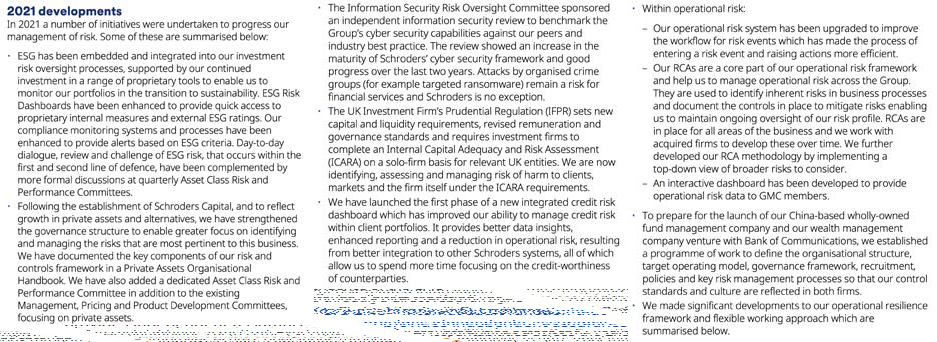
Source: Schroders PLC, Annual Report and Accounts 2021, p.50
FRC Financial Reporting Council
The FRC expects companies to explain how they have monitored their risk management and internal control systems throughout the year and any changes made to ensure their continuous efficacy.
Annual review of the effectiveness
Last year, we emphasised the importance of a formal review on an annual basis of the effectiveness of the risk management and internal control systems. We explained that good reporting should include the following:
- Give a full description of the process for reviewing the effectiveness of risk management and internal control systems.
- Explain the outcome of the review. Are these systems operating effectively? If not, what weaknesses or inefficiencies were identified?
- If any weaknesses or inefficiencies were identified, explain what actions the board has taken, or will take, to remedy these.
Actions taken by the board to review the systems
We found 93 companies that confirmed that they reviewed the effectiveness of their risk management and internal control systems during the year. In contrast, seven companies did not indicate, or it was unclear from their reporting if they had undertaken such a review. While the overall reporting in this area needs considerable improvement, we were pleased to see that there has been some improvement from last year, with a higher number of companies providing good and specific disclosures.
However, similar to last year, we were surprised by the high number of companies that did not report on the process carried out for the review.
Chart showing companies' reporting on the review process:
- 20 Provided specific and/or detailed information
- 45 Only offered brief and vague information
- 35 Did not give any detail on the process
Despite the overall poor level of reporting, we still found some good examples of explaining the process carried out by the board or a committee on its behalf to review the risk management and internal control systems. Examples of actions undertaken by the board or a committee included: * Considering the reports from senior management on their own assessment control and risk management * Receiving assurance from management on compliance with relevant policies * Receiving internal assurance of the effectiveness of the internal control function * Reviewing reports from the management risk committee * Reviewing reports from the internal audit function * Reviewing reports from the external auditor * Appraising the company's response to cyber-risks and data protection * Reviewing instances of whistleblowing and other incidents * Carrying out an independent external review
Our review found that when it comes to describing how the board or a committee has reviewed the company's systems, there is often too much repetition, or the information about that review is scattered in different sections of the annual report. These make it difficult or confusing for a reader to distinguish or piece together the information to understand the process the company has undertaken for the review. It should be easy and straightforward for a reader to find out how the company has reviewed the effectiveness of their systems.
Key Message:
Reporting on the steps taken by the board to review risk management and internal control systems provides the shareholders and other stakeholders with assurance that the company has taken active steps to assure the efficiency and resilience of these systems. It also increases confidence in the company's capability to identify and manage risks effectively.
Example:
One of the companies in our sample gave a good overview of how the effectiveness of their systems was reviewed during the year and the outcome from it.
- Review by executive directors and senior management: The executive directors and senior management carried out an assessment of the company's risks to ensure that the risk management systems had captured all these risks and that appropriate controls were in place to manage these. They considered the appropriateness of these systems in assessing the impact and likelihood of risks faced by the company.
Review by the audit committee: The audit committee gathered information from the senior management on the risk processes ownership, including oversight of the risk registers and methodology of mitigating risks. The committee also received information from different units within the company about the controls in place, which included operational, financial and compliance controls. They also reviewed reports provided by the external auditor on the appropriateness of the controls.
The committee considered the risk governance framework and reports by different units relating to principal and emerging risks and changes to these risks during the year. 3. Review by the board: The board reviewed reports produced by senior management on the appropriateness of the risk governance framework and processes. They received reports from different units about the principal risks and their impact. They received a report from the CFO on the efficiency of controls over financial reporting. They received a summary of the executive directors' meetings where risk assessments and other risk-related issues were discussed. The board also reviewed a summary of the review undertaken by the audit committee and the findings from it.
The board also considered Principal Risks identified by comparable companies to assess any gaps in risk assessments and mitigation.
They concluded that no significant failings or weaknesses were identified, and these systems were operating effectively.
Outcome
Following a review, companies should report on the outcome from it, which should demonstrate the current state of the risk management and internal control systems. Good reporting would either confirm the effectiveness of these systems or, where weaknesses or inefficiencies have been found, describe these in the report.
Key Message:
As stated in the Guidance on Risk Management, Internal Control and Related Financial and Business Reporting: 'The board should summarise the process it has applied in reviewing the effectiveness of the risk management and internal control systems. The board should explain what actions have been or are being taken to remedy any significant failings or weaknesses.'
The board should provide information on the current state of the company's risk management and internal control systems. This demonstrates to shareholders and other stakeholders that the board is exercising effective stewardship over these systems.
Good reporting should provide transparency, and where weaknesses or inefficiencies have been found, companies should explain these in the annual report. Five companies provided only a simple statement to confirm that where weaknesses or inefficiencies were found, the company had taken steps to address these. However, they did not explain these in the annual report.
Chart showing companies' reporting on outcomes of review:
- 63 State that their systems are either effective/adequate or no weaknesses/inefficiencies have been identified
- 10 State that weaknesses have been identified
- 20 Do not comment on the outcome of the review
- 7 Do not state, or it is unclear if they reviewed their systems
Three other companies explained the issues found but did not explain any actions taken. Only two companies explained both the findings and the actions that the board had undertaken to address them. Good reporting should show how the board has taken satisfactory steps to ensure the efficiency of the company's systems. Companies do not have to disclose confidential information; however, they could provide simple yet specific information on their actions and outcomes.
This is an area that we have been asked to consult on in 2023, which is why it is encouraging to see so many companies reporting on the effectiveness of their systems. Nevertheless, companies should disclose what evidence led them to their conclusion about the effectiveness, by:
- reporting on the actions they have taken to monitor these systems during the year
- reporting on the formal process carried out for the annual review of the effectiveness of these systems
E. Remuneration
Principle P of the Code states that 'Remuneration policies and practices should be designed to support strategy and promote long-term sustainable success. Executive remuneration should be aligned to company purpose and values, and be clearly linked to the successful delivery of the company's long-term strategy.'
The creation of the policy should also take into account Principle Q: 'A formal and transparent procedure for developing policy on executive remuneration and determining director and senior management remuneration should be established. No director should be involved in deciding their own remuneration outcome.'
Policies should reflect and promote good corporate governance, and remuneration committees should structure their package to deliver long-term shareholder value. Many companies acknowledge this, but there continues to be a divide between the statements provided within the annual report and voting at company AGMs on both the policy and the outcomes from the policy.
This year, we collected data on how many FTSE 350 and Small Cap companies faced a significant vote (20% or more) against remuneration resolutions at their 2021 AGM. 2 There were over 70 companies that faced a 20% vote or more against one of the remuneration-related resolutions at their AGM.
The remuneration committee has delegated responsibility for designing and determining remuneration for the chair, executive directors and, very often, the next level of senior management. It is expected to focus on the strategic rationale for executive pay and the links between remuneration, strategy and long-term sustainable success.
Several pay structures continue to evidence the reliance on benchmarking practices and remuneration consultants in design, and, in some cases, this appears to be the defining rationale behind the policy. For example, one company included an additional LTIP award for an executive director due to matching market practices overseas.
Remuneration packages should incentivise strong performance in achieving both the business plan and long-term strategy. Policies must include stretching targets which are achievable and can be evidenced, rather than generalisations, which are difficult to quantify and lack clarity.
We encourage remuneration committees to consider the questions placed within our Guidance on Board Effectiveness and consider their existing arrangements. Below are key reflective questions remuneration committees should take into account:
| Questions | |
|---|---|
| ? | How is executive remuneration aligned with the wider company pay policy? |
| ? | How does executive remuneration link with your strategy and KPIs? |
| ? | How will any financial and non-financial performance measures support long-term thinking and delivery against strategy? |
| ? | What steps have you taken to make sure that any performance measures are stretching? |
| ? | How are you innovating and updating your executive remuneration policy, for example, to strengthen the incentives for long-term thinking? |
| ? | Are you able to explain how you expect to exercise discretion over remuneration outcomes? |
Strategy
As similarly stated last year, almost all companies stated that their remuneration structures supported their company strategy. However, many of these statements were basic short-sentenced references. For example:
Example:
The remuneration structure is simple to understand for participants and shareholders and is aligned to the strategic priorities of the business.
We also examined the strategic links within performance-based incentive plans and closely looked at explanations for the company's choice of performance measures. The rationale for chosen performance measures for annual bonuses and/or LTIPs was not always explained. Instead, there was increased use of icons and tables to demonstrate and highlight strategic alignment. The inclusion of such information is useful to investors and other stakeholders to be able to understand why a chosen metric benefits the organisation. Company annual reports should explain the rationale for each performance metric, include the weighting as well as the target achievement, and link to the company's strategy and KPIs.
It was encouraging to see an increase in material ESG metrics being included in annual bonuses and/or LTIPs. Most of these measures were industry-focused and varied between sectors, and the more established metrics focused on health and safety, customer satisfaction and employee engagement.
However, there were newer metrics related to areas such as diversity, for example, the percentage of women within senior management and environmental issues such as waste reduction. One company highlighted that its 2021 LTIP had an ESG Scorecard which carried a 15% weighting and comprised of measures focused on colleague diversity and a reduction in operational carbon emissions. It has broadened the diversity target to include ethnicity, and the carbon emissions target represents continued momentum towards net zero operational emissions by 2030.
As with any other performance metric, it is essential that ESG measures are clearly linked to the implementation of the company's strategy and, as such, companies should ensure they have disclosed and explained the weightings, the level of achievement and how this translates into granted awards.
Purpose and values
As emphasised in last year's review, the quality of reporting about the alignment of executive remuneration with the company's purpose and values continues to be of concern. Our analysis highlighted that 28 companies did not directly refer to the company's purpose, and 30 companies did not make any direct reference to company values when discussing their executive remuneration arrangements. Greater care should be taken by companies when considering the requirements of Principle P: 'Executive remuneration should be aligned to company purpose and values and be clearly linked to the successful delivery of the company's long-term strategy.'
The narrative on how remuneration is aligned with the purpose and values of the company should be clear and transparent. We encourage companies to provide improved quality disclosures on the application of this Principle in future reports.
We also found that when reporting on the alignment, many disclosures are limited to declaratory statements without providing supporting information. No more than 48 companies just mentioned the word 'purpose', and 46 companies just mentioned the word 'values', with the two words being most commonly used where there was a review of the current policy or a proposal for a new policy.
Key Message:
Companies should look to provide specific explanations and directly refer to their corporate purpose and values when discussing their executive remuneration arrangements. Most of these statements fail to explain how the framework is designed to align with purpose and values, and what the benefits are.
Better reporters included greater, more insightful and aligned detail in this area. Below is a comprehensive explanation of how a company aligned its values with its remuneration:
Example:
Our values are reflected in the measures used in our incentive schemes. In particular, our incentive arrangements link to them in the following ways: * Do the right thing – AIP and LTIP performance measures incentivise participants to choose the right path for our customers, our people and shareholders by using measures which directly assess outcomes for these stakeholders. For example, the Committee felt introducing an emissions target to the 2022 LTIP furthers this ambition.
- Work together – the Strategic element of the AIP requires our Executive Directors and senior leadership to work together to deliver key results to our stakeholders. For example, the Committee has amended the underlying categories and sub-weightings of the strategic elements under the AIP to better align with delivering profitable growth, realising cost savings alongside supporting customers and great people.
- Take ownership – financial targets under the AIP are the same for all eligible participants, regardless of seniority, linking everyone's individual contribution to AIP reward outcomes.
Further insight on the reporting of culture, purpose and values can be found on page 10.
Discretion
Over the course of the reporting year, we continued to see many companies highlight the extent of their discretionary powers. Over 40 companies reported the use of their discretionary powers to cancel or reduce the amount of bonus or LTIP awarded. Unlike last year, Covid-19 was not the dominant factor.
Reasons for the use were wide-ranging. Some companies reduced the outcomes due to targets not being met, fines faced during the year and, in some cases, the overall industry and company performance.
Explanations on the use of these powers are mixed, with some companies providing less detailed rationales for using discretion. We encourage companies to avoid general statements and instead clearly explain why the use of discretion was required and insert detail on the adjusted outcome. In addition, it is helpful to highlight the factors that have been taken into account in making the decision.
Some companies within our sample were able to fully explain their reasoning for discretion and included a course of action. An example of a good explanation is provided below:
Example:
The formulaic outcome under the annual bonus leads to a 100% of maximum pay out for both the former Executive Chair and the Chief Financial Officer. The outcome takes into account the exceptional financial performance (108.2% increase in profit before tax and exceptional items on a pro-forma IAS 17 basis), strong shareholder returns (18% TSR) and the repayment of furlough monies during the year.
Nevertheless ... the Committee is determined that discretion should be applied to reduce the formulaic bonus outcomes by 10%. The Group will continue to further strengthen corporate governance and intends to specifically measure an element of the 2022/23 annual bonus on corporate governance related issues. As a result, the final annual bonus outcome is equivalent to 90% of maximum; equivalent to 180% of salary for the former Executive Chair and 108% of salary for the Chief Financial Officer.
Such explanations are useful as they allow the reader, investors and other stakeholders to understand under what circumstances executive remuneration could be altered and be assured that the final remuneration outcomes are appropriate. Below, we have provided reflective questions that remuneration committees should focus upon when disclosing the use of their discretionary powers.
When explaining the use of discretion, companies should consider the following:
- Is the use of discretion clearly disclosed within the annual statement of the remuneration report?
- Have you given any background to any discretion exercised by the remuneration committee?
- Is an explanation provided on how the resulting level of the award was determined?
- Has the committee disclosed how it has considered the experience of material stakeholders when operating discretion?
- If you have not used discretion in the year under review, has this been made clear within the remuneration report?
Recover and withhold provisions (malus/clawback)
This year, we continued to examine whether companies specified the circumstances in which their recover and withhold provisions may be applied. We found 86 companies had disclosed the circumstances in which their provisions applied in their report, while 11 did not include any information on the circumstances but noted that they had provisions in place. Three companies did not have malus and/or clawback provisions in place. 3
The most common circumstances specified by the companies in our sample (not a definitive list):
| Circumstance | No. of companies |
|---|---|
| Material misstatement in the company's accounts | 83 |
| Misconduct | 81 |
| Payment based on an error, inaccurate or misleading information | 63 |
| Reputation | 55 |
| Corporate failure | 36 |
| Failure of risk management | 29 |
| Financial loss/deterioration | 12 |
| Breach of health and safety standards/regulations | 5 |
| Contravention of company values | 4 |
| Other (including fraud) | 48 |
As the table illustrates, the circumstances under which recover or withhold provisions apply continue to be recorded in many of the annual reports this year and, as we found in our last review, most companies stated that both provisions applied to both the bonus and the LTIP. Despite the high number of companies setting out their conditions, there continues to be limited use of these provisions. This year, we found one company that clearly stated it had exercised the use of its clawback provisions during the year. One highlighted that during its Q1 activities, it considered making use of its malus adjustments, and one stated that its malus and clawback provisions would be considered as part of the accountability process due to breaches of regulation.
We also found three companies which proposed to strengthen their malus and clawback provisions. Of the three, two companies offered more insight: one is proposing to strengthen its provisions within its proposed 2022 policy under the annual bonus and LTIP to 'include trigger events of serious reputational damage and unreasonable failure to protect the interests of employees and customers'; and the other had strengthened its remuneration policy at its 2021 AGM to 'include any future events that materially impact our social licence to operate' and to make clawing back bonuses easier. While this was a very small number of companies, it is encouraging to see that companies have expanded their provisions to include reputational damage or failure of risk management.
Following the publication of the government's response to the consultation on Strengthening the UK's Corporate Governance, Corporate Reporting and Audit systems, our Position Paper sets out the next steps to reform the UK's audit and corporate governance framework. As a result, the FRC will consult on the development of the existing malus and clawback regime in the Code to deliver greater transparency and to consider a broader range of conditions for pay being withheld or removed.
Provisions 40 and 41
Provision 40 states that companies 'should be transparent and promote effective engagement with shareholders and the workforce'. This Provision requires the board to engage with shareholders and the workforce on remuneration issues. In addition, Provision 41 requires companies to explain in their reports such engagement during the year and the impact it has had on remuneration policy and outcomes. To comply with these provisions, companies should not only engage with shareholders and employees but also explain the outcome of their engagement.
Shareholder engagement on remuneration
Of the 93 companies that confirmed they engaged with shareholders during the year, only 70 of them reported engagement on remuneration matters. We also found room for improvement in reporting engagement on remuneration, particularly on how the remuneration committee has considered shareholders' feedback when drafting the remuneration policy or determining remuneration outcomes.
As with wider shareholder engagement, reporting on such engagement could be clearer. Some companies did not explicitly state that they engaged with shareholders during the year. For example, eleven companies simply stated that they 'consider shareholders' views on remuneration', whereas seven other companies provided general statements such as 'we consult with shareholders regularly on remuneration matters'.
In addition, it is not always clear if the engagement has taken place during the year. Six companies provided statements such as 'in drafting the new policy, the committee undertook a consultation with the shareholders'. To offer increased transparency, disclosures should add additional clarity about the engagement timings.
Better reporters provided clearer reporting, describing who carried the engagement during the year and how. For example, one company stated that the chair of the board and the chair of the remuneration committee met with some of the major shareholders during the year to discuss the new performance targets for the annual bonus.
As we reported in the shareholder section, engagement should offer shareholders the opportunity to raise questions and express their views on the policy and outcomes. One company reported that the board chair wrote to the directors to update them on the new policy. A better example of engaging through correspondence is a company that explained how the chair of the remuneration committee exchanged correspondence with some of the shareholders to understand and, if appropriate, incorporate their views and suggestions on possible changes to their remuneration structure.
Key Message:
Effective engagement on remuneration allows shareholders to raise concerns and provide their views on the remuneration policy and the annual outcome.
Engagement should include discussions with shareholders on remuneration outcomes, not just policy. One company stated that the committee did not deem it necessary to discuss any remuneration matters with shareholders during the year. Another company stated that they were not planning to change their remuneration policy, and therefore no engagement had taken place during the year. Both of these statements are inadequate in terms of explanations.
Remuneration outcome refers to the committee's final decision on the amount of reward available to executive directors. The annual report should explain how the remuneration committee discussed shareholders' feedback when discussing whether the targets for variable remuneration were achieved and whether any discretion ought to be used. Only four companies described shareholders' feedback on remuneration outcomes, from which only one reported changes to the outcome by the committee following consultation with shareholders.
As referred above, over 70 FTSE 350 and Small Cap companies received significant votes against the remuneration report or other resolutions related to the amount of pay awarded to executive directors. Considering the substantial amount of attention that remuneration outcomes receive from shareholders, it is unclear why companies do not report shareholder engagement much beyond the remuneration policy.
We found seven companies that reported engagement with shareholders on remuneration as a result of the company receiving significant votes against one or more remuneration-related resolutions. It is interesting that none of these companies reported engagement with shareholders prior to the vote. If this had occurred, appropriate changes to the policy might have averted the significant vote. The remuneration committee chair should seek regular engagement with shareholders throughout the year (also as required by Provision 3).
Reporting on engagement with shareholders
For Provision 41, the annual report should describe the impact shareholders' views had on remuneration policy and outcomes. Only 27 companies reported how the board considered shareholder feedback when determining remuneration policies and outcomes.
Better reporters provided information on the shareholders' feedback, how the board considered their feedback, and what impact it had on policy and outcomes. Some companies provided specific details as to changes they made following consultations. Examples of outcomes from the engagement included the following:
Changes to policy
- Introduction of new metrics, particularly ESG targets
- Adjustments to the weighting of current metrics
- Increased clarity of the performance measurement
- Changes to vesting periods
- Introduction of post-employment shareholding requirement
- Executives' pensions alignment with the workforce
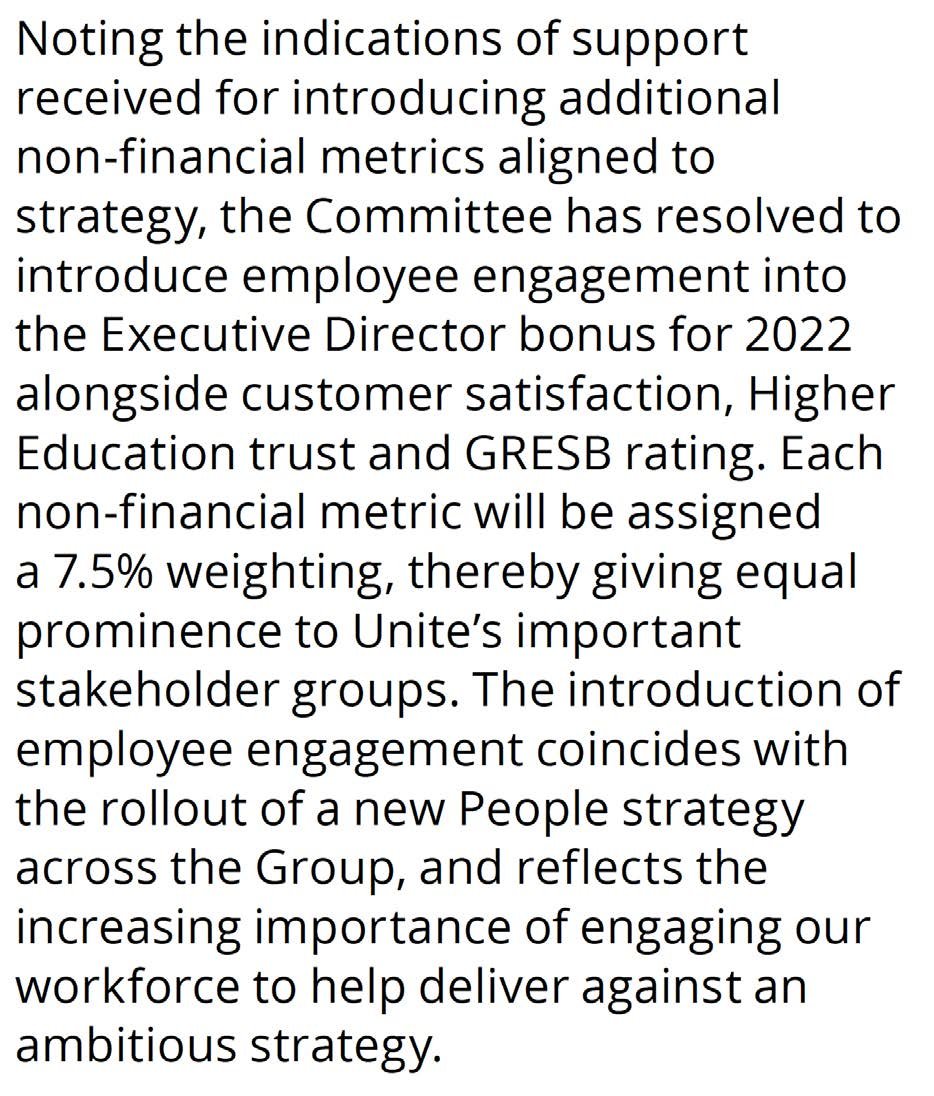
Changes to outcomes
- Reduction of executives' salaries
- Use (or not) of discretion by the remuneration committee to change outcomes
Better reporters provided specific information of how they have taken into account their shareholders' feedback, such as the one below:
Source: Unite Group PLC, Annual Report and Accounts 2021, p.137
'Impact' for the purposes of Provision 41 also includes instances where the remuneration committee considered shareholder feedback but decided not to make any changes to either their policy, outcomes or both. For example, one company reported that considering the strong support their current policy received from shareholders during their engagement, they planned not to make any changes. Another company explained that a few shareholders proposed amendments to the remuneration policy; however, the remuneration committee decided not to make these amendments due to opposition by other shareholders.
Key Message:
Good reporting on shareholder engagement should include information on:
- Actions – how the remuneration committee or the board engaged with shareholders to consult on remuneration matters
- Impact - what impact has such engagement had on remuneration policy and outcomes
Reporting on engagement with the workforce
Our analysis this year shows an improvement in the number of companies who engaged with the workforce to discuss their remuneration policies. However, many companies simply stated that remuneration was discussed when engaging with the workforce through their current engagement method.
In cases of better practice, companies held dedicated meetings/forums to engage with the workforce on remuneration.
Example:
The Committee Chairman met with colleagues through the Colleague Advisory Panel in November 2021 to discuss how we take a consistent approach to workforce remuneration. He also highlighted some of the challenges being faced with the existing Policy for executive directors. The proposed introduction of annual bonus for executive directors under the new Policy will create closer alignment with the remuneration construct for the wider workforce.
Two-way engagement
'Effective engagement' in the context of Provision 40 relates to more than explaining companies' remuneration policy to the workforce. Good practice reporting under Provision 40 should demonstrate that the engagement is two-sided. It was disappointing to see that only a minority of companies reported that there was a channel for employees to feedback to the board in relation to remuneration. Better reporters used effective mechanisms to facilitate two-sided engagement.
Example:
This year I, alongside (our Non-Executive Director Designated Employee Representative), undertook a number of Listening Forums. Amongst a wide range of topics, I shared our approach to Executive remuneration, how it aligns with Company strategy and invited comments, questions and input. There was a wide ranging and constructive conversation that we intend to act on and continue our listening.
To enhance their reporting, this company could have gone further to disclose what was discussed during the engagement, what issues were raised by employees and how the board has acted on this feedback.
Reporting on Provision 41 on workforce engagement
Key Message:
In line with Provision 41, the annual report should describe how the company engaged with the workforce to explain how executive remuneration aligns with wider company pay policy.
We were disappointed to find that only 19 companies reported that they explained to employees how executive pay aligns with wider company pay policy.
Although we have seen some good reporting on engagement with the workforce in relation to remuneration, the majority of companies didn't disclose that they explained to the workforce how executive remuneration aligns with wider company pay policy.
5. Conclusion
This report deep dives into a selection of corporate governance issues assessing the quality of reporting against the Code. Overall, year on year, we are seeing improvements in corporate governance reporting, despite a continuously challenging economic landscape, but there are still areas which require more attention.
It is important to acknowledge that no company reports exceptionally in all areas; however, by sharing good practice examples we want to encourage companies to learn from each other and 'race to the top' on quality reporting.
Encouraging greater disclosure on actions, outcomes and impact; balanced feedback, specific examples and case studies; insightful explanations for non-compliance with the Code; and the alignment of board decisions with strategy, as well as culture, purpose and values, are some of the key messages of this year's report.
We were pleased to see several good examples of reporting in those areas, which will enrich our body of evidence that we have built over the last three years in advance of reviewing the Code and becoming ARGA. The key purpose of the Code is to make premium listed companies more resilient and competitive by demonstrating best-in-class corporate governance, and wider issues affecting the environment and society, as well as clear and transparent disclosure, while minimising burden to the business.
As stated in the Code, companies do not exist in isolation; successful and sustainable businesses underpin our economy and society by employment and creating prosperity. This is why we will continue our assessment of reporting against the Code by companies in the scope, to drive good governance practices and raise standards in weaker areas to support a well-functioning market.
Financial Reporting Council 8th Floor 125 London Wall London EC2Y 5AS
+44 (0)20 7492 2300 www.frc.org.uk
Follow us on Twitter @FRCnews or Linked in
Footnotes: