
The content on this page has been converted from PDF to HTML format using an artificial intelligence (AI) tool as part of our ongoing efforts to improve accessibility and usability of our publications. Note:
- No human verification has been conducted of the converted content.
- While we strive for accuracy errors or omissions may exist.
- This content is provided for informational purposes only and should not be relied upon as a definitive or authoritative source.
- For the official and verified version of the publication, refer to the original PDF document.
If you identify any inaccuracies or have concerns about the content, please contact us at [email protected].
FRC Gender Pay Gap 2021/22
Foreword from the Chief Executive Officer
Addressing the gender pay gap is an important part of our Diversity and Inclusion strategy so that the FRC can continue to attract and develop a diverse mix of people at all levels of the FRC and create an inclusive culture where everyone can fulfil their potential.
Since gender pay gap legislation was introduced in 2017, we have seen a year-on-year improvement in reducing the gap and this report sets out the progress we've made and are continuing to make in closing this gap.
Our latest reporting figures for the 31 March 2021 has seen a further reduction in the gender pay gap from 18.4% to 12.4% (mean figure) and 15.9% to 9.4% (median figure). Although we are required to report our gender pay gap at the end of March 2021, we have re-run the data at the end of January 2022 and have seen a further reduction to 10.9% (mean) and 7% (median).
This continual reduction in our gender pay gap reflects the increased number of women at all job levels in our organisation. The proportion of women is either level with men or in the majority at all job levels of the FRC except at the Executive Director job level. Having said that, I am also proud that 4 out of 7 (57%) positions on ExCo are held by women which demonstrates our commitment to D&I.
At the date of this report (31 March 2021), the Executive Director of Supervision was a secondee to the FRC and was therefore excluded from the Gender Pay Gap report, otherwise we would have parity at the Executive Director level. This role holder changed in the year and remains excluded from our January 2022 data refresh.
Continually reducing the gender pay gap year on year is something that myself, the Board and our Executive Committee are committed to, and to do this, it's important to know why the gap exists. As we reported last year, the gender pay gap is caused by a disproportionate percentage of women in the lower pay quartile and specifically in job level 1 roles where 91% are women and at job level 2, 66% are women.
I am also conscious that gender identity is broader than making a choice between male and female and that some employees may for example identify as being nonbinary however, there is no scope currently to report this on gov.uk which is the portal where we are required to report our gender pay gap statistics.
My ambition is to work towards eliminating the gap and over the course of the new financial year, I will be working with the Executive Team, the D&I Committee and the newly formed FRC's Women's Network to explore what further measures can be taken to reduce the Gender Pay Gap in the FRC. This will be in addition to continuing to support the talent development of women in the FRC and providing access to leadership and career development opportunities.
Sir Jon Thompson, Chief Executive Officer
Introduction
The FRC has prepared this report as part of the legal requirement for public bodies to publish their gender pay gap on an annual basis. In 2017, the government introduced legislation that made it a statutory requirement for organisations with employees of 250 or more to report annually on their gender pay gap. Though the FRC was not required to report at that time because the number of employees was below the threshold of 250 employees, we decided to publish our information as a demonstration our long-standing commitment to diversity and inclusion for all our people and to lead by example. At 31 March 2021 we had 317 employees and at the end of January 2022 we had 372 employees that were counted as part of our gender pay gap calculations.
These statutory Regulations underpin the Public Sector Equality Duty (PSED) and require relevant organisations to publish their gender pay gap by 30 March annually for the prior 31 March. This includes the mean and median gender pay gaps; the mean and median gender bonus gaps; the proportion of men and women who received bonuses; and the proportions of men and women employees in each pay quartile.
The gender pay gap shows the difference in the average pay between all men and women in a workforce. If a workforce has a particularly high gender pay gap, this can indicate there may be several issues to deal with, and the individual calculations may help to identify what those issues are.
The gender pay gap is different to equal pay. Equal pay deals with the pay differences between men and women who carry out the same jobs, similar jobs, or work of equal value. It is unlawful to pay people unequally because they are a man or a woman. The FRC supports the fair treatment and reward of all staff irrespective of gender.
This report fulfils our reporting requirements, explains why we have a gap and shows the steps we are taking to reduce the gap.
Headline figures
The Gender Pay Gap figures at the 31 March 2021 show that our gender pay gap has fallen to 9.4% (median) and 12.4% (mean). This equates to an 18% reduction in the median pay gap since we started reporting the gender pay gap in 2018 and 11.7% reduction in our mean pay gap over the same period (see figure 1 below).
Although we are required to report our gender pay gap as of the 30 March 2021, we have re-run the data at the end of January 2022 and have seen a further reduction to 7% (median) and 10.9% (mean).
Figure 1
| Gender Pay Gap | 2018 | 2019 | 2020 | 2021 | Jan 2022 (not published) |
|---|---|---|---|---|---|
| Median Pay Gap | 27.8% | 27.3% | 15.9% | 9.4% | 7.0 |
| Mean Pay Gap | 23.9% | 22.7% | 18.4% | 12.4% | 10.9 |
Bonus Pay Gap
During the period of this report, no payments contributed towards the bonus pay gap.
Why do we have a gender pay gap?
In answering this question, it is important to consider FRC's workforce demographic (full time versus part time), the percentage of males and females in each of the pay quartiles, and the proportion of males and females at each job level in the FRC.
Workforce Demographic
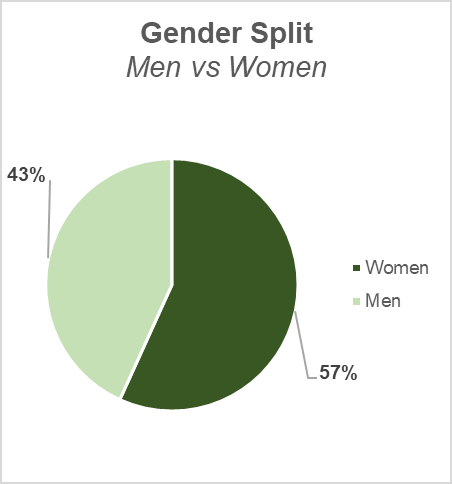
In the FRC at 31 March 2021, men made up 43% of the workforce and women made up 57% of the workforce (see figure 3).
Figure 3
Working Pattern
In addition to this, 83% of the workforce are full time with 17% of the workforce employed on part time contracts (see figure 4).
Figure 4
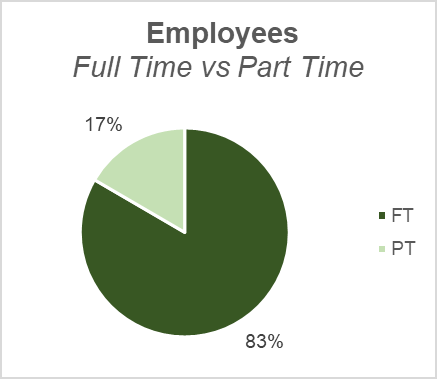
Figure 5
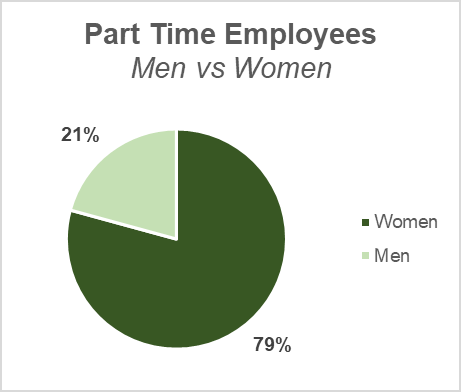
Of this 17% of the workforce on part time contracts, 79% of part time roles were held by women and 21% of part time roles were held by men (see figure 5 above).
Pay Quartile data
In further understanding why there is a gender pay gap, it is important to consider the proportion of males and females in each of the four pay quartiles (please see figure 6).
Figure 6
| PROPORTION OF MALES AND FEMALES IN EACH QUARTILE BAND | Female | Male | TOTAL | ||
|---|---|---|---|---|---|
| # | % | # | % | # | |
| Lower Quartile | 52 | 70.3 | 22 | 29.7 | 74 |
| Lower Middle Quartile | 47 | 57.3 | 35 | 42.7 | 82 |
| Upper Middle Quartile | 39 | 50.0 | 39 | 50.0 | 78 |
| Upper Quartile | 42 | 50.6 | 41 | 49.4 | 83 |
| TOTAL | 180 | 137 | 317 |
Proportion of Men and Women in each Pay Quartile
This stacked bar chart shows the percentage breakdown of women and men across four pay quartiles:
- Lower Quartile: 70.3% Women, 29.7% Men
- Lower Middle Quartile: 57.3% Women, 42.7% Men
- Upper Middle Quartile: 50.0% Women, 50.0% Men
- Upper Quartile: 50.6% Women, 49.4% Men
Figure 6 shows that although more than half of women are in the upper pay quartile there is significantly more women in the lower pay quartiles.
Job Level
Analysis of the workforce demographic by job level also provides an insight as to why we have a gap (see figure 7 below).
Figure 7 – Gender split by Job level at 30 March 2021
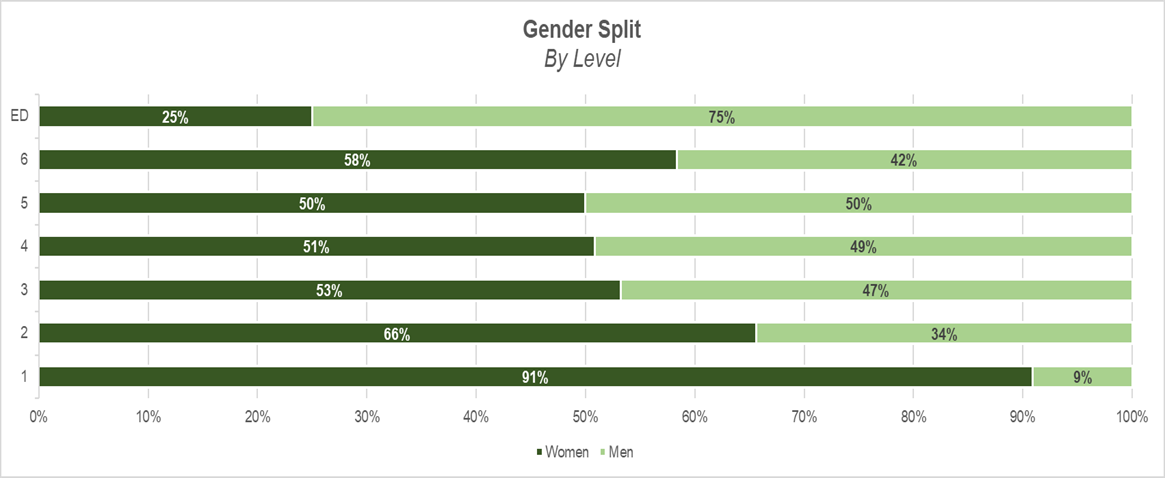
You will see from figure 7, that a disproportionate percentage (91%) of women are employed in L1 job roles. Most job roles at L1 are Personal Executive Assistant (PA) roles (see also proposed actions below).
What is also clear from figure 7 in the report is that women are in the majority of roles in the FRC except for level 5 where it is even. It should also be noted that men occupy the majority of Executive Director roles (excluding the one Executive Director who is on an inward secondment).
Bonus Pay Gap - 31 March 2020
During the period of this report, the FRC has made no payments that have contributed towards the bonus pay gap.
Actions we have taken to reduce the pay gap
Over the last year, we have taken the following actions below to reduce the gender pay gap
- Launched a new three-year strategy for Diversity and Inclusion which places an emphasis on addressing the under-representation of women and minority groups.
- Continue to apply our policies on pay and reward to support the principle of equal pay and gender pay equality.
- Expanded the behavioural statements that underpin our FRC Values to include Diversity and Inclusion
- Published our Women in Finance (WiF) Charter results which shows an increase in the percentage of women in senior management from 58% to currently 61%
- Launched a further round of mentoring and reverse mentoring programmes
- Invested significantly in the management and leadership development of women
- Introduced a standard interview question on Diversity and Inclusion as part of the selection and recruitment process
- Introduced a new approach to hybrid working which offers staff greater flexibility than they had before Covid-19
- Piloted training on building inclusive teams which is now a part of our Learning and Development curriculum.
Proposed actions to further reduce the pay gap
Although the Gender Pay Gap has reduced significantly since 31 March 2020, we will continue to adopt a strict approach to enforcing the FRC's reward policy. In addition to this, we propose to continue to
- Explore introducing anonymised sifting as part of the recruitment process
- Continue to invest in the leadership development of women across the whole of the FRC
- Work with the FRC's Women's Network to explore how further progress can be made in closing the gap.