
The content on this page has been converted from PDF to HTML format using an artificial intelligence (AI) tool as part of our ongoing efforts to improve accessibility and usability of our publications. Note:
- No human verification has been conducted of the converted content.
- While we strive for accuracy errors or omissions may exist.
- This content is provided for informational purposes only and should not be relied upon as a definitive or authoritative source.
- For the official and verified version of the publication, refer to the original PDF document.
If you identify any inaccuracies or have concerns about the content, please contact us at [email protected].
FRC Climate Thematic – Corporate Reporting
- Introduction
- Background
- The challenges of climate change
- How might disclosure respond?
- Reporting requirements in relation to climate change – narrative reporting
- Reporting requirements in relation to climate change – financial statements
- The Financial Reporting Lab report
- The Task Force on Climate-related Financial Disclosures
- Our findings and expectations on reporting
- Narrative reporting
- Impact of climate change on the company
- TCFD disclosure
- FRC view on reporting frameworks
- Risk disclosure
- Physical and transitional risks
- Climate-related risk process
- Lab insight - investor views on risk management
- Opportunities
- Scenario planning
- Materiality
- IMPACT OF THE COMPANY ON CLIMATE CHANGE AND THE EXTERNAL ENVIRONMENT
- Commitment-setting
- Board practice
- Lab findings – investor views on target-setting
- Outcomes of environmental policies and Key Performance Indicators (KPIs)
- Impact of the business on the environment
- Greenhouse Gas Emissions (GHG) disclosures
- Upstream and downstream of Unilever operations (scope 3)
- Section 172 and stakeholder engagement
- Financial statements – headline finding:
- Climate change in the financial statements
- Extent of climate disclosure in the financial statements
- Reporting requirements in relation to climate change
- Consistency between narrative reporting and financial statement disclosures
- UK Corporate Governance Code
- Materiality
- IAS and IFRS requirements - Materiality
- Lab finding - investor views on financial statements implications
- TCFD assessment of possible financial statements implications of climate change
- Impairment reviews
- IAS requirements – Impairment disclosures: cash-generating units (CGUs) containing goodwill or intangible assets with indefinite useful lives (IAS 36.134-135)
- Commodity price assumptions – insights from a specific review
- FRC climate thematic – audit
- Climate scenarios – implications for the financial statements
- Accounting for climate change
- Useful lives of assets
- Judgements and estimates
- Segmental reporting and disaggregated revenue disclosures
- Other forward-looking assumptions
- Appendix – Scope
Introduction
Throughout 2020, the Financial Reporting Council (FRC) has been undertaking a thematic review of climate-related considerations by boards, companies, auditors, investors and professional associations. This report forms part of that review and addresses the question ‘how are companies developing their reporting on climate-related challenges?'.
Other aspects of the FRC's findings can be found at the following links:
- The consolidated findings across corporate reporting and audit can be found here.
- The detailed findings on governance can be found here.
- The detailed findings on audit can be found here.
- The detailed findings on professional oversight can be found here.
- The detailed findings on investor reporting and better practice reporting under the Task Force on Climate-related Financial Disclosures can be found here.
KEY TO SYMBOLS
We use the following key to identify specific elements of reporting, to identify requirements or recommendations, and to identify better practice disclosure. 'Mandatory requirements' relate to the Companies Act or IFRS, for instance. 'TCFD and other guidance' includes publications and guidance which is not required, but may be better practice or reflect investor expectations.
Represents good practice
Represents an omission of required disclosure or other issue
Represents an opportunity for enhancing disclosures
Mandatory requirements
TCFD and other guidance
Examples of better disclosure
Highlighting aspects of reporting by a particular company should not be considered an evaluation of that company's reporting as a whole. Nor does it provide any assurances of the viability or going concern of that company and should therefore not be relied upon as such. Investors have contributed to this project at a conceptual level. The examples used illustrate the principles and should not be taken as confirmation of acceptance of the company's reporting more generally.
The diagram illustrates the interconnected elements of Corporate Reporting. It shows Corporate Reporting at the center, influenced by:
- Audit
- Professional Oversight
- Company approach and disclosure (leading to Corporate Reporting)
- Investors
- Governance
We asked: How are companies developing their reporting on climate-related challenges?
Why is this important?
As climate change has the potential to impact societies and companies around the world, companies are, and will need to, respond to its far-reaching impacts.
Corporate reporting provides a link between a company and its investors. Reporting about how a company is considering climate-related impacts on its business model, its risks and opportunities, the impact the company has on the environment and the financial statements impacts of climate-related considerations now and in the future provides a key insight for investors. It helps them understand the future the company faces, and the future it intends to help bring about.
What did we do?
We assessed a sample of 24 companies' annual reports and accounts to see whether they complied with the requirements of the Companies Act 2006, including reporting in accordance with International Financial Reporting Standards. The sample, which was based primarily on December 2019 annual reports, was weighted towards sectors and industries which are perceived to face greater risks concerning climate change.
We assessed a sample of 60 premium-listed companies' governance structures and references to climate-related considerations in the context of the UK Corporate Governance Code.
We spoke to investors to re-test their views to see if, and how, they had developed since the publication of the FRC Lab's 2019 report on climate-related corporate reporting.
What did we find?
An increasing number of companies are providing narrative reporting on climate-related issues. While minimum legal requirements are often being met, users are calling for additional disclosure to inform their decision making. Some companies have set strategic goals such as ‘net zero', but it is unclear from their reporting how progress towards these goals will be achieved, monitored or assured.
Consideration and disclosure of climate change in the financial statements lags behind narrative reporting. We identified areas of potential non-compliance with the requirements of International Financial Reporting Standards (IFRS).
Background
The challenges of climate change
The Paris Agreement aims to strengthen the response to climate change by: "Holding the increase in the global average temperature to well below 2°C above pre-industrial levels and pursuing efforts to limit the temperature increase to 1.5°C above pre-industrial levels, recognising that this would significantly reduce the risks and impacts of climate change", amongst other aims.
A serious reallocation of resources would be required to meet these goals, and therefore companies can be exposed to a wide range of risks and opportunities. Below is a high-level overview of some of the physical and transitional risks and opportunities companies will face. Climate change considerations are obviously relevant for entities across many industries and will therefore be relevant for their reporting and their financial statements.
| Physical risks | Transition risks | Opportunities |
|---|---|---|
| Long-term changes to weather and climate at a regional and international level | Impact of changing policy and regulation | Resource efficiency |
| Risks of acute events such as floods, droughts and storms | Reputational damage | Energy source |
| Changing consumer preferences and concerns | Products and services | |
| Changes in technology to respond to climate concerns | Markets | |
| Resilience |
Figure 1: Possible physical risks, transitional risks and opportunities companies may face, as identified by the Task Force on Climate-related Financial Disclosures.
How might disclosure respond?
While 'climate change' is not specifically mentioned as a required topic for reporting, there are a number of ways in which climate-related issues may still need to be disclosed.
Reporting requirements in relation to climate change – narrative reporting
Narrative reporting requirements and expectations relate to both the company's impact on the environment, where climate change may be relevant for some companies, and the impact climate change may have on the future of the business.
There are a number of Companies Act requirements for companies to report on environmental-related matters, or areas where climate-related considerations may be material, for example their company's strategy.
The UK Corporate Governance Code 2018 also includes some reporting expectations for which climate-related considerations may be relevant.
How we considered these narrative reporting requirements and associated expectations in our thematic review is outlined on page 6.
Reporting requirements in relation to climate change – financial statements
Companies may also need to report on the financial implications of climate-related challenges they face. The range of physical and transitional risks, and opportunities, highlights the wide consideration that needs to be given to the possible financial impacts of climate change.
There is no standalone IFRS which addresses climate change specifically. However, the requirements of IFRS standards provide a clear framework for incorporating the risks of climate change into companies' financial reporting. These apply, for example, to measurement uncertainty associated with forward-looking assumptions and estimates, and the related disclosures.
In November 2019, a member of the International Accounting Standards Board (IASB) provided an overview of existing IFRS requirements and guidance on the application of materiality in the article 'IFRS Standards and climate-related disclosures' (IASB article). The article does not have the status of a standard and does not provide a complete 'checklist' of relevant requirements but does provide helpful insight into how climate change should be considered when addressing certain requirements. The article also emphasises the existing materiality requirements and guidance.
The Financial Reporting Lab report
The Financial Reporting Lab's 2019 report on climate-related disclosure outlined investors' views on the integration of climate-related considerations into company activity and reporting. This report found that investors were very interested in climate-related reporting, and the investors we spoke to were very supportive of the Task Force on Climate-related Financial Disclosures (TCFD) frameworks of 11 recommended disclosures across four core areas as a framework for companies to think through, and report on, their climate-related activities.
Climate change can be a new consideration, so in order to help companies consider what they might report in the context of the TCFD recommendations, the Lab's report outlines a series of questions investors encourage companies to ask themselves in relation to governance, strategy risk management and metrics and targets.
The report highlighted examples of the developing area of reporting, and whilst those developments were welcomed, investors noted that reporting needed to continue to develop to better meet their needs. We spoke to a range of investors as part of the 2020 thematic and the views remain very similar.
The Task Force on Climate-related Financial Disclosures
The TCFD, established in December 2015 by the Financial Stability Board, was tasked with reviewing how the financial sector could take account of climate-related issues. In 2017, the TCFD published a report which set out four core elements of recommended climate-related financial disclosures that apply to organisations across sectors and jurisdictions:
- Governance: The organisation's governance around climate-related risks and opportunities.
- Strategy: The actual and potential impacts of climate-related risks and opportunities on the organisation's businesses, strategy, and financial planning.
- Risk Management: The processes used by the organisation to identify, assess, and manage climate-related risks.
- Metrics and Targets: The metrics and targets used to assess and manage relevant climate-related risks and opportunities.
While reporting using the TCFD is not currently mandatory, as outlined through this report, a number of companies have begun to use this as a disclosure framework, and this additional disclosure is well supported by investors.
The TCFD also recently published its 2020 Status Report providing an overview of current disclosure practices in terms of their alignment with the TCFD's recommendations. The report found that “Disclosure of TCFD-aligned information increased by six percentage points, on average, between 2017 and 2019; and the Task Force applauds the improvements made – both in terms of the number of companies reporting and the quality of such reporting. However, companies' disclosure of the potential financial impact of climate change on their businesses and strategies remains low."
| Governance | Strategy | Risk Management | Metrics and Targets |
|---|---|---|---|
| Disclose the organization's governance around climate-related risks and opportunities. | Disclose the actual and potential impacts of climate-related risks and opportunities on the organization's businesses, strategy, and financial planning where such information is material. | Disclose how the organization identifies, assesses, and manages climate-related risks. | Disclose the metrics and targets used to assess and manage relevant climate-related risks and opportunities where such information is material. |
| Recommended Disclosures | Recommended Disclosures | Recommended Disclosures | Recommended Disclosures |
|
|
|
|
|
|
|
|
|
|
|
Figure 2: TCFD recommended disclosures
Our findings and expectations on reporting
Our assessment of reporting – what is covered
The areas our assessment, or consideration, of corporate reporting addressed are outlined in the schematic below.
- The Corporate Reporting Review (CRR) team, as the regulator of UK corporate reporting, has assessed a sample of 24 annual reports and accounts against the requirements of the Companies Act 2006 and International Financial Reporting Standards.
- The Corporate Governance and Stewardship (CG&S) team sampled 60 premium-listed companies to monitor how companies have taken account of climate-related considerations in reporting against the UK Corporate Governance Code 2018. Such areas include the consideration of emerging risks, or how climate-related considerations have been incorporated into considerations of the long-term success of the company.
- The Financial Reporting Lab (the Lab) spoke to investors to get their views on company reporting, and whether it meets their needs.
This report brings together the key findings from the work of all the FRC teams above. Our observations reflect compliance with regulatory requirements, expectations of good governance and investor expectations. Companies should reflect on all of these matters. The FRC's expectations of how relevant reporting requirements should be addressed are set out on page 9 for narrative reporting and page 10 for financial statements.
The diagram illustrates two main categories of narrative reporting and financial statements, with an overarching theme of "Consistency".
Narrative reporting - impact of climate change on the company * Business model and strategy * Risks, uncertainties and opportunities * Disclosure under the TCFD * Reporting on scenarios and viability
Narrative reporting - impact of the company on the environment * Non-financial information * Targets, commitments and key performance indicators * Greenhouse Gas (GHG) Emissions * Board consideration and stakeholder engagement
Financial Statements * Financial statement assumptions * Materiality * Asset impairment and useful lives * Judgements and Estimates * Segmental reporting
What did we find?
This review has resulted in a range of detailed findings included over the next two pages, but our headline findings are as follows:
An increasing number of companies are providing narrative reporting on climate-related issues. While minimum legal requirements are often being met, users are calling for additional disclosure to inform their decision making. Some companies have set strategic goals such as 'net zero', but it is unclear from their reporting how progress towards these goals will be achieved, monitored or assured.
Consideration and disclosure of climate change in the financial statements lags behind narrative reporting. We identified areas of potential non-compliance with the requirements of International Financial Reporting Standards (IFRS).
FRC Statement – Green Finance Strategy
In 2019 the FRC joined the Financial Conduct Authority (FCA), the Prudential Regulation Authority (PRA) and The Pensions Regulator (TPR) in stating its view that the challenges associated with climate change, including both physical factors, such as extreme weather events, and transition risks that can arise for the process of adjustment to a carbon neutral economy, would challenge and change our society and the wider market. At the time, the FRC stated that:
The Boards of UK companies have a responsibility to consider their impact on the environment and the likely consequences of any business decisions in the long-term. They should therefore address, and where relevant report on, the effects of climate change (both direct and indirect). Reporting should set out how the company has taken into account the resilience of the company's business model and its risks, uncertainties and viability in both the immediate and longer-term in light of climate change. Companies should also reflect the current or future impacts of climate change on their financial position, for example in the valuation of their assets, assumptions used in impairment testing, depreciation rates, decommissioning, restoration and other similar liabilities and financial risk disclosures.
This expectation in part led us to undertake the FRC's thematic review of corporate reporting and audit. In some instances, our review has identified potential non-compliance with the reporting requirements, both in relation to narrative and financial statements disclosures. Climate-related issues will be an ongoing area of focus for the FRC. We will continue to consider climate-related issues in our Code monitoring. Financial reporting in respect of climate change will be an area of focus for the FRC in our regulatory reviews of companies' annual reports and accounts. The FRC's expectations of how relevant reporting requirements should be addressed are set out on pages 9 and
- We will make enquiries with companies where it is apparent that the relevant reporting requirements have not been met.
Our findings – narrative reporting
An increasing number of companies are providing narrative reporting on climate-related issues. While minimum legal requirements are often being met, users are calling for additional disclosure to inform their decision making. Some companies have set strategic goals such as 'net zero', but it is unclear from their reporting how progress towards these goals will be achieved, monitored or assured.
Whilst many of the requirements are being met, a view of the impacts of climate change on the business model is often lacking the detail that users are calling for.
More companies are referencing TCFD in their disclosures, with more fulsome reporting at the larger end of the listed market. This reporting is developing, but does not yet meet investors' needs, particularly regarding strategy and metrics and targets.
Consideration of climate change as a risk is increasing, but disclosures are often lacking in substance, unclear and non-specific. Most companies discussed the risks they faced from climate change. Where users might have a reasonable expectation that climate change is an issue, but management considers that it does not give rise to any significant risk, it may be helpful to explain why.
Opportunities were identified by the majority of companies, but these disclosures were often non-specific. Better disclosures explained the changes needed to their strategy to capitalise on these opportunities.
The discussion of risks and opportunities should be balanced. Where a company believes that it has significant opportunities from the response to climate change but also potential risks, it should pay equal attention to describing areas of the business at risk.
Reporting on scenarios remains a key area of investor interest, and an area of weaker disclosure. Some companies disclose climate change scenarios that may affect viability, but detail is scarce.
Disclosures of the impact of the company on the environment were less developed. There is scope to improve non-financial reporting statements in relation to specific policies pursued, and details of the specific business relationships, products and services which are likely to cause adverse environmental impacts.
A number of companies are reporting climate change commitments, for example pledges to reach ‘net zero', and disclosing indicators around climate change, but these are often ill-defined, difficult to understand and compare, and have the potential to be misleading. Companies should clearly distinguish ‘aims' and 'ambitions' from policies which are actively being pursued and are included in business plans and budgets.
Companies should avoid providing disproportionate focus on ‘good news stories' representing a small part of the business, and clearly report the most significant outcomes for the business as a whole, including performance against any previously announced targets.
Information outlining the impact of the company on the environment is less developed and informative than the challenge climate change poses to the company.
Required greenhouse gas emissions (GHG) disclosures were provided by almost all companies, but the scope of the emissions included and the basis on which the emissions are calculated is often unclear. This is particularly important where this forms the basis of a ‘net zero' commitment or strategy.
Stakeholder engagement and section 172 disclosures were often combined, sometimes leading to the omission of certain aspects of the required disclosures, particularly those not directly related to stakeholder engagement.
Our findings – financial statements
Consideration and disclosure of climate change in the financial statements lags behind narrative reporting. We identified areas of potential non-compliance with the requirements of International Financial Reporting Standards (IFRS).
There was limited reference to climate change in the financial statements and it was generally unclear how the forward-looking assumptions and judgements applied in preparation of the financial statements were consistent with narrative discussion of climate change in the strategic report.
Companies should consider whether the annual report and accounts, taken as a whole, presents a consistent message on the most significant risks presented by climate change, and includes all information that may be material for decision making.
Climate change was not generally addressed in disclosures of management's approach to determining key assumptions in impairment assessments, and it was unclear whether all disclosure requirements had been met. Given the wide range of outcomes and the potentially significant impacts on the financial statements, it is important that users can understand the basis applied by management in arriving at assumptions related to impairments.
There are no requirements to link financial statement assumptions to a particular climate scenario, although users have highlighted the importance of being able to understand this linkage.
It was unclear whether climate change uncertainties had been taken into account when determining useful economic lives of assets which appear to be exposed to these risks.
Climate change was not generally addressed in disclosures of significant judgements, or about sources of estimation uncertainty which have a significant risk of resulting in a material adjustment within the next financial year. While uncertainties associated with climate change are often resolved over a timeframe greater than 12 months, this is not always the case.
Segmental and disaggregated revenue disclosures did not typically provide insight into the differing impact of climate change across separate parts of the business.
Uncertainties associated with climate change may impact a broad range of financial statement estimates. We identified company-specific issues in relation to fair values, commodity hedging, expected credit losses and other provisions.
Our expectations – narrative reporting
Climate change and related disclosures will be an area of focus for CRR in its ongoing reviews. In relation to narrative reporting, we expect companies to:
Include a separately identifiable non-financial information statement in their strategic report which addresses environmental matters such as climate change 'to the extent necessary for an understanding of the company's development, performance and position and the impact of its activity' (CA2006 414CB(1)(a)). In particular companies should:
- provide a description of significant 'policies pursued' with respect to climate change, rather than simply naming them, or explain the reason if no such policies are pursued;
- provide clear explanations which help users to understand and compare major commitments such as 'net zero emissions' targets or 'Paris-aligned' strategies, including which activities and emissions are included in the scope of these commitments. It should be clear whether these are aspirational, or currently pursued and factored into budgets and business plans used when preparing the financial statements;
- describe the most significant outcomes of those policies for the business as a whole, without disproportionate focus on immaterial activities or 'good news stories';
- where climate-related targets have previously been announced, describe the company's performance against those targets;
- explain any changes in targets or KPIs from the previous year, including the reason for the change;
- describe the impact of the company's business on the environment, as well as the risks that climate change gives rise to for the company;
- ensure impacts within the company's supply chain and from use of products are addressed in the disclosures, particularly where these are significant relative to those arising from the company's direct activities;
- ensure that any cross-referencing to information included elsewhere in the annual report is sufficiently specific to enable readers to locate and identify the particular information in question.
Describe the principal risks and uncertainties facing the company which relate to climate change, and any significant impacts on the business model. Better disclosures provide users with information which is specific to the company's circumstances, and are clear on the magnitude of the risk.
Consider explaining the rationale if management has concluded that climate change does not give rise to any significant risks for the company.
Describe the methodologies used to calculate emissions metrics and the extent of any due diligence or assurance over these. There is significant scope for judgements in determining boundaries and which emissions are included so companies should explain these decisions clearly. This information is expected to be more material where these metrics underpin a major policy or strategy.
Ensure that section 172(1) statements describe the actions of the board of directors, rather than other parties, and address all the regulatory requirements, not just those associated with stakeholder engagement, particularly where those statements are combined.
Ensure that stakeholder engagement reports reflect all significant environmental matters discussed with stakeholders during the year.
Our expectations – financial statements
Climate change and related disclosures will be an area of focus for CRR in its ongoing reviews. In relation to financial statements, we expect companies to:
Ensure that material climate change risks and uncertainties discussed in narrative reporting have been appropriately considered in the financial statements. Narrative reporting should not be inconsistent with the financial statements. Better disclosures present a coherent linkage between narrative reporting and accounting judgements and estimates and may explain why apparently significant risks have not had a material impact on the financial statements where investors may expect them to do so.
Reflect on the information about climate change which is material to users for both narrative reporting and financial statement disclosure. We do not encourage a checklist approach as this may lead to both clutter and omission of key information. Information may be required by IAS 1 where it is relevant to an understanding of the financial statements, even where it is not specified in a standard. We note that expectations from investors in this area are high.
Ensure that disclosures of impairment assumptions and sensitivities meet the requirements of IAS 36 with additional requirements for cash generating units (CGUs) containing goodwill or indefinite lived intangibles. In particular:
- Impairment should be assessed on an asset by asset basis, as well as by cash generating unit ('CGU'); where investors may reasonably expect climate change to have a significant impact on future expected cash flows for a particular asset or CGU, ensure that this is addressed in the description of management's approach to determining the risk of impairment and any key assumptions;
- Where a reasonably possible change in a key assumption would lead to an impairment under IAS 36, companies should disclose the value of the assumption, headroom and amount by which that assumption would need to change to drive an impairment. IAS 36 does not include a timescale for this assessment; and
- Sensitivities should address all reasonably possible changes in the relevant timescale. Better disclosure helps users understand how assumptions and sensitivities correspond to scenarios discussed in narrative reporting.
Include sensitivity analysis or the range of reasonably possible outcomes where an estimate meets the IAS 1 paragraph 125 criteria, with a significant risk of material adjustment within one year. This may arise if an uncertainty is expected to be resolved, or if longer-term assumptions around climate change are at risk of significant revision within the next year. It may be helpful to disclose other uncertainties associated with climate change which are not expected to result in an adjustment in one year, but these should be clearly distinguished.
Provide all required segmental and disaggregated revenue disclosures to enable users of financial statements to understand the relative sizes of operations for which climate change presents substantially different risks and opportunities, particularly where this is discussed in narrative reporting.
Consider the matters highlighted in the IASB article 'IFRS Standards and climate-related disclosures' in their financial reporting. The article does not have the status of a standard and does not provide a complete ‘checklist' of relevant requirements but does provide helpful insight into how climate change should be considered when addressing existing IFRS requirements.
Consider explaining how climate change has been taken into account where investors may reasonably expect a significant impact on the expected life or fair value of an asset or liability.
Narrative reporting
Narrative reporting – headline finding:
An increasing number of companies are providing narrative reporting on climate-related issues. While minimum legal requirements are often being met, users are calling for additional disclosure to inform their decision making. Some companies have set strategic goals such as 'net zero', but it is unclear from their reporting how progress towards these goals will be achieved, monitored or assured.
Impact of climate change on the company
Climate-related narrative reporting requirements and expectations cover both the potential impact on the future of a business and the company's impact on the environment. This section outlines how company disclosures address the challenges posed to the business model. It discusses strategy, risks, uncertainties and opportunities, TCFD disclosures and reporting on scenarios and viability.
Companies Act requirement - Impact of climate change on the business model
Section 414CB of the Companies Act 2006 requires public interest entities to include a non-financial information statement as part of their strategic report. Amongst other matters, this must include information regarding the impact of environmental matters on the company's business, to the extent necessary for an understanding of the company's development, performance and position and the impact of its activity. We would expect this to include climate change where material to the company.
Business model reporting
KEY FINDING: Whilst many of the requirements are being met, a view of the impacts of climate change on the business model is often lacking the detail that users are calling for.
20 companies in the sample of 24 disclosed that their business model was affected by climate change, as would be expected given the sample bias towards industries expected to be affected (further detail on the scope of our review can be found in Appendix - Scope).
Topics discussed included exposure to fossil fuels, future investments, renewable energy, sustainable growth and customer expectations.
Disclosures in this area, however, could be improved.
Omission/Issue: Generic comments such as to be 'flexible and adapt' are not helpful to users of financial statements.
Opportunity: Several companies had discussed strategies that were aligned with the goals of the Paris climate agreement or an intention to 'be carbon negative' or reach 'net zero emissions' by a particular date. This did not always address what this meant in practice for the business. We have highlighted our expectations on these matters on page 32.
Good practice: We observed that the most helpful disclosures:
- Included climate change within the business model section itself.
- Gave specific detail about product lines, services and investments.
- Linked climate-related risks and opportunities to these business areas.
- Specifically addressed sustainability.
Lab finding - business model and strategy
As the demand for climate-related disclosure by investors and wider stakeholders increases, many companies are developing their climate governance in line with reporting frameworks, principally TCFD. The Lab's 2019 report on climate-related disclosures found investors to be very supportive of the TCFD framework for company consideration, and disclosure, of climate-related issues. The investors we spoke to as part of this thematic remained enthusiastic about TCFD reporting.
The Lab's report identified that investors wanted to understand the challenges a company faces in relation to climate change, and the strategy for addressing these issues. A key question investors ask relates to the resilience and sustainability of the business model. Unfortunately, many companies are failing to articulate their conclusions in this area.
Investors echo our insights, including the finding that generic comments and lack of specificity as to actual business plans is unhelpful.
Business model and strategy questions
- What does the company look like in the future and how will it continue to generate value? What strategy does the company have for responding to the challenges?
- How was the decision about the materiality of climate-related issues made?
- What opportunities and risks concerning climate-related issues are most relevant to the company's business model and strategy? Which, if any, of these are financially material? What process has been followed in order to assess the impact of climate-related issues?
- Where do the biggest risks and opportunities sit?
- Has the company considered the impact of low-carbon transition as well as physical risk?
- What are the relevant short, medium and long-term horizons? How do these different horizons affect key divisions, markets, products and/or revenue/profit drivers?
- How resilient is the business model to climate change? How does the company respond to a 1.5 degree, 2 degree or more world?
- What strategy has been put in place to reach that aim, and what operational or capital expenditures are needed to address any necessary business model changes? How are long-term projects structured to ensure flexibility, including options for deemphasising and emphasising if circumstances should dictate?
- What are the possible effects on the company's revenues, expenditures, assets, liabilities, products, customers, suppliers etc of different climate scenarios?
- How does the information gathered factor into strategic planning? What triggers would require a change of direction?
- Are there opportunities better to explain exposure to particular product lines or 'green' revenues?
- How are the risks and opportunities reflected in the financial statements, for example the effect of assumptions used in impairment testing, depreciation rates, decommissioning, restoration and other similar liabilities and financial risk disclosures?
"On Paris-agreement goals, I want not only an assessment of where the risks are, I want to know what the company is doing. How is it adjusting its business model and strategy to thrive in a changed world where we have transitioned to low carbon, or there is some degree of increased climate risk?" - Investor
“At the end of the day this is the beginning [of reporting]. More of an art than a science and I'm not looking for precision. I want the company to be doing the exercise, having high-level decision makers involved, some kind of strategic implementation and consideration – that's the important part" - Investor
TCFD disclosure
KEY FINDING: More companies are referencing TCFD in their disclosures, with more fulsome reporting at the larger end of the listed market. This reporting is developing, but does not yet meet investors' needs, particularly regarding strategy and metrics and targets.
The TCFD is a framework under which many companies are choosing to report the narrative aspects of their climate-related considerations. This framework covers reporting in four core areas – governance, strategy, risk management and metrics and targets.
Our review identified many companies using, or stating that they will use, the TCFD framework for their reporting. This was welcomed by the investors we spoke to, but they noted that a greater degree of granularity, particularly with regard to specific plans and targets, and metrics used to assess climate-related factors was important for their investment decision making.
Extent of TCFD reporting
Many of the FTSE 100 companies reviewed had started to implement TCFD recommendations, some with full effect. In our sample of 24, five FTSE 100 companies had fully adopted the TCFD requirements; with four choosing to include a separately identifiable section in their strategic report.
Whilst a separate TCFD section is not necessarily needed, it can be an effective method to present the information. However, it is important to ensure that the information presented does not appear to be an 'add-on' containing boilerplate messages. Reporting under the TCFD recommendations was improved where it was better integrated with the company's strategy with the use of cross-referencing.
Other company reports we assessed stated the company's intention to implement the framework in the next two years. For example, in our sample of 24, nine companies either partly complied with TCFD or disclosed that they had the intention to adopt.
We found some encouraging reporting practice within the FTSE250, where companies disclosed a clear and comprehensive roadmap towards full TCFD disclosure as well as their progress thus far, including any relevant milestones. This was more common in more carbon-intense industries such as Materials, Buildings and Construction.
Lab finding - investor views on TCFD
Investors reported an increase in disclosure on TCFD. Whether this is in response to investor pressure, or governmental and regulatory pressures, this development was welcomed.
Investor support for the TCFD as a framework for companies to consider and report on their climate-related issues appears only to grow. This view is increasingly supported by regulatory changes. In fact, many investors were supportive of the increasing international momentum to include, or consider including, TCFD within the regulatory disclosure framework, including within FCA rules as proposed in the recent consultation (see next page).
However, investors noted that disclosure needed to continue to develop to meet their needs. As outlined above, issues around the strategy and business model remain key. This also links to the expectations of scenario analysis and disclosures, and through to assessments of the sustainability and resilience of the business model.
Metrics and targets remain another area of concern for investors, with many investors reporting that targets are non-specific and lack substance, particularly relating to interim milestones. More specific views are provided in the section on target-setting.
FRC view on reporting frameworks
The FRC supports the establishment and adoption of global non-financial reporting standards and we look forward to engaging with the IFRS Foundation Trustees and other organisations working to achieve that goal. However, in the shorter term we think there is a need for the market to move more quickly to improve disclosures in this area. In order to help investors and other capital providers to get more of the information they seek, the FRC encourages UK public interest entities to report against the TCFD 11 recommended disclosures and, with reference to their sector, to use the Sustainability Accounting Standards Board (SASB) metrics.
Encouraging reporting under TCFD and SASB is a step towards a better system of reporting. The FRC's full statement on non-financial reporting can be found here.
FCA consultation on TCFD reporting
On 6 March 2020, the FCA launched a consultation on the introduction of TCFD disclosures, on a comply or explain basis, for commercial companies with a premium-listing (CP20/3: Proposals to enhance climate-related disclosures by listed issuers and clarification of existing disclosure obligations). We support the FCA's encouragement of greater transparency over the climate-related risks and opportunities premium-listed companies face and the FCA's role in encouraging and supporting a greater range of companies to meet these expectations.
Investor views on TCFD from FRC review of the UK Stewardship Code 2020
The scope of our review of UK Stewardship Code disclosures is outlined in the connected report on investor reporting, available here. However, the vast majority of the investor reports reviewed noted that they were supporters of TCFD. Many of the organisations explained that they use the TCFD core areas as a lens to consider climate-related issues for the companies in which they invest. A number of reports reviewed, particularly those by larger asset managers, indicated that they are already, or intend to, produce their own TCFD reporting, though these disclosures are largely still at a preliminary stage.
“TCFD disclosure is obviously very helpful and useful regarding a focus on strategy and not just risk, but it's possible to create TCFD reports that are as good as meaningless, [with companies] hiding behind the high-level disclosure that things are fine" - Investor
Risk disclosure
KEY FINDING: Consideration of climate change as a risk is increasing, but disclosures are often lacking in substance, unclear and non-specific. Most companies discussed the risks they faced from climate change. Where users might have a reasonable expectation that climate change is an issue, but management considers that it does not give rise to any significant risk, it may be helpful to explain why.
Companies Act requirement – principal risks
Section 414CB of the Companies Act 2006 requires a description of the principal risks relating to environmental matters, including a description of how it manages the principal risks.
Extent of climate-related risk disclosure
As outlined above, the Companies Act requires disclosure regarding principal risks related to environmental matters, and the Code now also encourages the consideration of emerging risks. Our review identified many companies reporting climate change as either a principal or emerging risk. However, in the small cap sample, only a small minority of companies mentioned climate change as a risk.
About half (13 of 24 companies reviewed) disclosed a principal risk relating to climate change, of which one was disclosed under non-financial reporting specific risks and the remainder were included within general risks. A further four companies disclosed climate-related matters as emerging risks. The number of climate-related principal risks disclosed for any one company ranged from one to six.
It was expected that companies within the oil and gas and mining sectors would disclose at least one climate-related principal risk, which proved to be the case within our sample, with the impacts of climate change linked to specific areas of the business and strategy. These included regulatory developments, carbon pricing, disruption of operations, business reputation and energy costs. Only one company within the mining sector disclosed climate change as an emerging risk rather than a principal risk. This company had less exposure to commodity price risk due to the nature of its products. Some companies chose to disclose climate change as one main principal risk, discussing several issues under one heading, whilst others chose to present separate climate-related risks.
Some companies in other sectors, including financial services, aviation, packaging and consumer goods, had disclosed at least one climate-related principal risk. Those that had not, tended to operate in sectors in which climate change is considered to have a predominantly medium or long-term impact.
Better practice reporting:
- Disclosed both the likelihood and impact of the climate-related principal risk(s). Whilst a matrix presentation is not required, we encourage companies to indicate the significance of climate-related risks relative to other risks.
- Discussed how they had determined which risks were material to disclose.
Of the companies that did not disclose any climate-related principal risks, four disclosed climate change as an emerging risk. Disclosure is considered helpful in circumstances where users would have a reasonable expectation that climate change would give rise to a risk. If management considers that climate change does not give rise to any significant risk, we encourage companies to articulate why in sufficient detail to enable users to assess management's considerations and conclusions in this area.
Physical and transitional risks
We also found that a number of companies distinguished between physical and transitional risks; for example, in our sample, 13 of the 24 companies did so.
The most helpful disclosures:
- Further divided physical risks between acute and chronic.
- Further divided transitional risks between policy and legal, technology, market and reputation.
- Linked each risk to a specific business area.
The physical and transitional risks identified by companies included government intervention on climate change and environmental issues (e.g. Greenhouse Gas emissions, packaging, waste); extreme weather events which may impact business operations; the impact of use of products by customers; supply chain risk; large fluctuations in energy costs; and sustainability performance failing to keep pace with demands.
| Global Risk Report | |||
|---|---|---|---|
| 2017 | 2018 | 2019 | 2020 |
| Extreme weather | Extreme weather | Extreme weather | Extreme weather |
| Involuntary migration | Natural disasters | Climate action failure | Climate action failure |
| Natural disasters | Cyberattacks | Natural disasters | Natural disasters |
| Terrorist attacks | Data fraud or theft | Data fraud or theft | Biodiversity loss |
| Data fraud or theft | Climate action failure | Cyberattacks | Human-made environmental disasters |
World Economic Forum, The Global Risks Report 2020, Insight Report 15th Edition In partnership with Marsh & McLennan and Zurich Insurance Group.
The World Economic Forum Global Risk Report 2020 identified environmental risks as the five greatest risks in terms of likelihood. The five risks identified were extreme weather; climate action failure; natural disasters; biodiversity loss; and human-made environmental disasters. The environmental risks of climate action failure; biodiversity loss; and extreme weather were also identified as three of the top five risks in terms of impact.
Examples of better disclosure
"vi) The impact of climate change on the Group's business
The risks associated with climate change are subject to rapidly increasing societal, regulatory and political focus, both in the UK and internationally. Embedding climate risk into the Group's risk framework in line with regulatory expectations, and adapting the Group's operations and business strategy to address both the financial risks resulting from: (i) the physical risk of climate change; and (ii) the risk from the transition to a low-carbon economy, could have a significant impact on the Group's business.
Physical risks from climate change arise from a number of factors and relate to specific weather events and longer-term shifts in the climate. The nature and timing of extreme weather events are uncertain but they are increasing in frequency and their impact on the economy is predicted to be more acute in the future. The potential impact on the economy includes, but is not limited to, lower GDP growth, higher unemployment and significant changes in asset prices and profitability of industries. Damage to the properties and operations of borrowers could impair asset values and the creditworthiness of customers leading to increased default rates, delinquencies, write-offs and impairment charges in the Group's portfolios. In addition, the Group's premises and resilience may also suffer physical damage due to weather events leading to increased costs for the Group.
As the economy transitions to a low-carbon economy, financial institutions such as the Group may face significant and rapid developments in stakeholder expectations, policy, law and regulation which could impact the lending activities the Group undertakes, as well as the risks associated with its lending portfolios, and the value of the Group's financial assets. As sentiment towards climate change shifts and societal preferences change, the Group may face greater scrutiny of the type of business it conducts, adverse media coverage and reputational damage, which may in turn impact customer demand for the Group's products, returns on certain business activities and the value of certain assets and trading positions resulting in impairment charges. In addition, the impacts of physical and transition climate risks can lead to second order connected risks, which have the potential to affect the Group's retail and wholesale portfolios. The impacts of climate change may increase losses for those sectors sensitive to the effects of physical and transition risks. Any subsequent increase in defaults and rising unemployment could create recessionary pressures, which may lead to wider deterioration in the creditworthiness of the Group's clients, higher ECLs, and increased charge
- offs and defaults among retail customers.
If the Group does not adequately embed risks associated with climate change into its risk framework to appropriately measure, manage and disclose the various financial and operational risks it faces as a result of climate change, or fails to adapt its strategy and business model to the changing regulatory requirements and market expectations on a timely basis, it may have a material and adverse impact on the Group's level of business growth, competitiveness, profitability, capital requirements, cost of funding, and financial condition.”
Barclays plc, Annual Report 2019, page 131
Discussion of physical and transition risks.
Clear articulation of the potential impact of transition to a low-carbon economy on the business.
Discussion of second order risks.
Climate-related risk process
The TCFD framework suggests that companies disclose the process for identifying and assessing climate-related risks. Many of the company reports we reviewed identified the process for the identification, monitoring and management of climate-related risks. A number of companies had also initiated risks projects and environmental initiatives to gain greater understanding of current and potential future risks arising from climate change.
Risk identification processes included top-down, bottom-up risk assessments, the establishment of a Climate Change Working Group and regular management updates on non-financial risk areas presented to the Audit Committee. It was encouraging that companies not currently compliant with TCFD also mentioned steps being taken to identify and assess climate-related risks such as increased data collection and the inclusion of climate change on risk registers.
The management of climate-related risks should discuss decisions on mitigating, transferring, accepting or controlling those risks.
- Weaker disclosures discussed climate-related risks, internal controls, mitigation and monitoring in general.
- The most helpful disclosures discussed the management of each risk in turn.
12 of the 13 companies in our sample of 24 that identified at least one climate-related principal risk disclosed how these were managed. Examples of mitigation activities included:
- employing specialist technical advisors to assist in understanding climate-related risk;
- action to influence policy and regulation;
- optimising use of fossil fuels and increasing efficiency; and
- diversification of supply chain.
Risk management disclosure should cover both risks to the company and risks to the environment. There is further discussion of the disclosure of risks posed by the company to the environment on page 29.
WE EXPECT COMPANIES TO: Describe the principal risks and uncertainties facing the company which relate to climate change, and any significant impacts on the business model. Better disclosures provide users with information which is specific to the company's circumstances, and are clear on the magnitude of the risk.
Consider explaining the rationale if management has concluded that climate change does not give rise to any significant risks for the company.
Lack of specificity
Our sample identified examples of good disclosure with impacts of climate change linked to specific areas of the business and strategy. However, this finding may reflect the fact that these companies were selected from sectors most likely to be affected by climate change.
Our wider sample of reporting by premium-listed companies found that disclosure on climate-related risks often lacked substance. For example, many companies provided vague or generic explanation of climate-related risks (e.g. extreme weather events, flooding that may impact sites negatively), but did not report on the specific location of their operations or assets at risk. There was also a lack of detail as to how some of the risks connected to the company's specific business model and strategy. These are key focus areas for investors.
We found that reporting was more effective where it identified the climate-related risk (e.g. financial impact of extreme weather events), described the specific mechanism used to mitigate or help identify that risk (e.g. flood mapping analytics) and the specific outcome of such risk mitigation (e.g. building flood defences at site X).
In a similar vein, when reporting on climate-related risk mitigation, some companies pointed to actions taken to mitigate climate-related risk; for example, a diversified geographical and technological portfolio of assets. However, they did not make it clear whether certain locations have the capacity to recoup any losses incurred by damage to business operations at another location.
Examples of better disclosure
Risk management – policy
In 2019, the Group published a 'Climate Change Financial Risk and Operational Risk Policy'. This introduced climate change as an overarching risk impacting certain principal risks: credit risk, market risk, treasury & capital risk and operational risk. The policy is jointly owned by the relevant Principal Risk Leads with oversight by the BRC.
Each relevant Principal Risk Lead has developed a methodology and implementation plan for quantifying climate change risk.
| Risk | Measurement approach |
|---|---|
| Credit risk | A Credit Risk Materiality Matrix (Climate Lens) assesses the climate change risk of a counterparty to which the Group is exposed. The Climate Lens considers transition factors such as a counterparty's reliance on fossil fuels, sensitivity to policy changes and ability to diversify, as well as exposure to physical risks. Where an obligor is rated as Medium or High, the details are referred to the Environmental Risk Management team, who conduct enhanced due diligence. |
| Market risk | Stress tests are used to assess and aggregate exposures arising from climate related risks. Stress test scenarios are applied to a range of assets, reflecting the impact of climate change across sectors, countries and regions. |
| Treasury and capital risk | Stress tests are used to assess and aggregate exposures arising from climate related risks. They are measured as part of existing stress testing, ICAAP and capital planning. |
| Operational risk | The risks associated with Climate Change are relevant to the following Operational Risk Categories/Themes, which are managed through the Operational Risk Framework: Premises Risk, Supplier Risk and Resilience. Climate Change has been included in the Strategic Risk Assessment to understand exposure on a forward looking basis across the five-year business planning cycle. |
Climate change specifically addressed within risk management policy.
Gives a clear horizon over which risk assessment has been carried out.
Barclays plc, Annual Report 2019, page 138
Lab insight - investor views on risk management
Investors report that risks and opportunities are often not clearly described. The Lab's recent projects on risk and viability have consistently found that investors do not consider risks and opportunities to be sufficiently related to the strategy and business model of the company.
Investors are looking to understand the risks and opportunities presented by climate change including the prioritisation, likelihood and impact, what scenarios might affect the company's sustainability and viability, and how the company is responding.
The increasing consideration of climate change within principal or emerging risk disclosure was welcomed by investors, but the lack of specificity made a true assessment of the risks and opportunities the entity faces difficult to appreciate. Investors seek to understand over which timeframes risks and opportunities might crystallise.
Investors report that it is still difficult to understand how the company intends to respond to the climate-related risks and opportunities it faces. Disclosure can be very generic, and the lack of clarity, particularly in the context of targets such as 'net zero', is a key concern.
In order to help companies respond, the Lab's 2019 report posed a series of suggested questions. Investors noted that these remain highly relevant and useful, so the risk management questions have been included to the right.
“So when, for example I'm looking at capital expenditure for opportunities, it's difficult for investors to consider it material when making investment decisions if it's not linked through. This gap is not being met" - Investor
Risk management questions
- What oversight does the board have of climate-related opportunities and risks?
- What systems and processes are in place for identifying, assessing and managing climate-related risks? To what extent can current processes be developed to assist?
- How will transitional and physical risks affect the company?
- How is a consideration of climate-related issues integrated into the risk management process and connected to other related risks?
- Over what horizons have the risks been considered and risk assessments carried out?
- How are the risks from climate change being monitored, including decisions around mitigation, transfer, acceptance and control?
- How is the assessment of the company's viability over the longer-term taking into account climate-related issues?
- Is the company's business and business model viable? What signals or leading indicators might encourage a reconsideration of this assessment and the related strategy, or an understanding of whether the risk mitigation activities are being achieved?
- If the company is undertaking scenario analysis, how did the company decide on which scenarios to use and what assumptions have been made? How do these relate to the outcomes advocated in the Paris Agreement?
- Are the scenarios sufficiently diverse and challenging?
- How did the company translate scenarios to operational/financial models?
- How is the scenario analysis used in strategic planning?
Opportunities
KEY FINDING: Opportunities were identified by the majority of companies, but these disclosures were often non-specific. Better disclosures explained the changes needed to their strategy to capitalise on these opportunities.
15 companies gave some indication of the changes needed to strategy to capitalise on climate-related opportunities. We observed that the most helpful disclosures:
- Clearly showed a change in strategy either by including climate change in the strategy section itself or by specifically referring to strategy in the narrative.
- Discussed changes in operations.
- Disclosed any investments such as in research and development.
- Discussed specific growth strategies e.g. organic, M&A.
Extent of disclosure of opportunities
CRR's review, with a sample biased towards those most affected by climate change, identified several examples of good disclosure. However, the wider review of premium listed companies by CG&S identified that disclosures of opportunities related to climate change were often boilerplate. Where companies had identified risks and opportunities these were often not identified according to specific horizons, and the horizons themselves were not identified.
Although not required by legislation, 18 companies in the CRR sample disclosed climate-related opportunities. Examples included the development of products to help customers comply with sustainability requirements, demand for raw materials used in environmentally friendly products and sales of byproducts from generating green energy. However, six of these companies provided more boilerplate comments, such as being well-placed to address the need for low and zero emission technology or referencing opportunities in new markets but without further detail.
Weaker disclosures:
- Mentioned actions or decisions concerning climate change opportunities within the annual report but did not specifically discuss strategy.
- Made general comments such as needing to respond to customer expectations.
Risks and opportunities horizons
Across all of our reporting reviews, we found that disclosures of risks and opportunities over the short, medium and long term varied in how clearly they were presented. Some companies referred to time frames within their narrative, often discussing climate-related risks in general rather than separate risks, for example stating that climate-related risks were viewed as having only medium or long-term impacts.
- Better disclosures provide sufficiently detailed information about products and services, supply chain and/or value chain, adaptation and mitigation activities, investment in research and development and operations.
On a sector-by-sector basis across the premium-listed sample, reporting on specific horizons was most developed in the Materials, Buildings and Construction industry and least developed in Consumer Products & Manufacturing. Where companies did report on these issues, comparability was enhanced where the company used informative graphics and/or tables to explain, in a concise yet complete manner, the short, medium and long-term risks and opportunities engendered by climate change.
Examples of better disclosure
Describe the climate-related risks and opportunities the organisation has identified over the short, medium and long-term
- Short-term (0-5 years): customer carbon emission targets and increasing availability of green electricity could encourage a move towards electric heating solutions that have zero emissions at point of use. While an opportunity for the Electric Thermal Solutions business, some sales could be at risk in the Steam Specialties business for applications where steam or electric heating solutions are equally viable.
- Medium-term (5-10 years): growth in electric vehicles could cause a decline in the oil and gas industry, particularly refinery demand.
- Long-term (10+ years): large oil, coal and gas fired boilers could be replaced by banks of small electric generators reducing demand for boiler controls and boiler-house products.
- Increasing frequency of climate related extreme weather events.
Spriax-Sarco Engineering plc, Annual Report 2019, page 69
Risks and opportunities are divided into clear time bands
Examples of better disclosure
"Managing climate-related risks and opportunities
We identify and assess climate-related risks using our group-wide risk management framework. It includes pre-determined risk tolerance limits, established by the Board, based on the likelihood and severity of risk factors. Climate change has the potential to affect our business in various ways. While these may not be severe in the short term, we believe climate-related risks are likely to have a medium and long-term impact on our business. We have identified both transition and physical risks. Governments and regulators are likely to take action to curb carbon emissions that may impact our business, such as the introduction of carbon taxes. Changes in precipitation patterns and extreme weather conditions such as floods, storms, droughts and fires may impact our plantations and the forests we source wood from and could result in fibre supply chain interruptions and higher fibre costs. Higher temperatures may also increase the vulnerability of forests to pests and disease. Increased severity of extreme weather events may also interrupt our operations. In water-scarce countries, we may see an impact on our production process as a result of limited water availability. [...] Our climate-related opportunities include reduced operating costs through greater energy and water efficiency and generating income by selling low-carbon, biomass based chemical by-products from our pulp process (such as turpentines) as well secondary raw materials."
Mondi Group, Integrated report and financial statements 2019, page 43
Timeframes for the impact of climate change on the company.
Discusses transition and physical risks.
Links to specific areas of the business (plantations/forests). These are discussed in greater detail in the sustainability performance section of the annual report.
Income generated from the sale of green energy and CO2e credits is recorded within other net operating expenses in the income statement.
All five companies in our sample that had adopted TCFD explained how the risks and opportunities that had been identified were factored into their considerations of strategy and financial planning.
- The best disclosures clearly articulated how climate change considerations were embedded into strategic plans and budgets.
- We expect to see discussion of the impact of financial planning on operating costs and revenues, capital expenditures and capital allocation, acquisitions or divestments, and access to capital.
KEY FINDING: The discussion of risks and opportunities should be balanced. Where a company believes that it has significant opportunities from the response to climate change but also potential risks, it should pay equal attention to describing areas of the business at risk.
Scenario planning
KEY FINDING: Reporting on scenarios remains a key area of investor interest, and an area of weaker disclosure. Some companies disclose climate change scenarios that may affect viability, but detail is scarce.
There is no single view of the future we face in relation to climate change. Equally, where a specific temperature outcome is being used for scenario purposes there will be a range of possible pathways that could be followed to reach that outcome. Considering the wide range of ways climate change could impact businesses and the difficulty in planning for uncertain climate-related events, boards should be considering the possible impacts of climate change on their company. This approach can help organisations plan for a number of eventualities and demonstrate to investors the resilience of the business model.
Extent of disclosure on scenarios
It was encouraging to find that companies are beginning to develop models and tools to evaluate the potential impact on the business of different climate scenarios, typically the four scenarios identified by the Intergovernmental Panel on Climate Change (IPCC). Reporting on climate scenario analyses was more common by companies that had endorsed the TCFD.
The TCFD provides that companies should develop and apply scenario analysis to the impact of climate change. These disclosures should document:
- Detailed key inputs, assumptions, analytical methods and outputs
- Sensitivities to key assumptions
- Management's assessment of the resilience of its strategic plans to climate change
11 companies of the 24 assessed disclosed at least one scenario that might affect the company's sustainability and viability. In addition to scenarios based on global temperature rises, scenarios included weather pattern disruption, water stress and the reduction of CO2 allowances.
Detail of the scenarios
There were large variations in the level of detail provided for the outcomes a business may be exposed to under each scenario. Most companies described assessing their business model and strategy against certain scenarios and stress tests but these gave little detail on key inputs, and provided only vague detail concerning the specific risks considered, the assumptions made and the outcomes.
Disclosure of climate scenarios could be improved by:
- Providing sufficient detail of the scenarios and stress tests used for readers to understand their key features.
- Discussing clear outcomes of the scenario analysis in terms of how these outcomes influenced strategic planning and the actions taken as a result.
- Describing how the outcomes of the scenarios relate to the outcomes advocated in the Paris Agreement, where relevant.
- Ensuring that narrative discussion of climate scenarios is consistent with the assumptions and disclosures in the financial statements. Users may find additional explanation helpful. This includes how both financial statement assumptions, and sensitivities considered, correspond to narrative disclosures of climate change (see further discussion in Climate change in the financial statements – Climate scenarios).
It is also worth noting that none of the companies in our sample for whom climate change presents an immediate significant risk included all the disclosures recommended by the TCFD.
- Three of the five companies adopting TCFD discussed using climate-related scenarios but gave no further details. Another company explained that it was still reviewing its resilience in the context of a 2°C scenario.
- Given the level of investor interest in this area, we encourage companies to expand their disclosures giving the key outcomes of each modelled scenario and the changes to business areas, strategy and financial planning that would be needed as a result in order to ensure the company's sustainability and viability.
- As practice develops, scenarios should develop from qualitative to quantitative models and, where applicable, provide disclosure of key inputs, assumptions, analytical methods, outputs and sensitivities.
- None of the companies in our sample linked their scenarios clearly to an assessment of the resilience of their climate-related strategic plans.
Lab finding - investor views on scenarios
The analysis of scenarios as a key input into strategic planning remained an area of great interest to investors when we asked them about their views on climate-related disclosure this year. Mirroring many of the FRC's findings above, investors noted that they find reporting in this area to be vague and lacking in specifics related both to the scenario and to the company.
Investors want to understand the resilience of business models under a range of scenarios. Investors find especially important the disclosure of assumptions around the scenarios being tested, as there are many different pathways to one temperature outcome. Most investors expect a range of scenarios to be modelled, but want a 'below 2 degrees' scenario to be tested as one of the key possible scenarios.
The more detail a company provides on the ways in which the business model may be affected, and how it could capitalise on opportunities or mitigate risks, the more helpful it is for investors and other stakeholders to make an informed decision. And that is, ultimately, also why investors want companies to be considering scenario analyses
- so they are in the best position to make the most informed decisions about the future of the company, and to be able to respond to different inflection points and pathways. Scenario analysis is not intended to be a process in and of itself, but instead to feed into the strategic decision making undertaken by the board and management.
"Scenario analysis is clearly challenging – there are hundreds of scenarios that involve lots of assumptions, so we need to understand those assumptions in a bit of detail to know what it actually means" - Investor
"There should be consideration of an ambitious scenario (less than 2), and an understanding of a 'current policy' scenario – so what if there's no political will and we continue on the same trajectory given current policies. Rather than aligning with X – tell me what the range of outcomes might be in different scenarios" - Investor
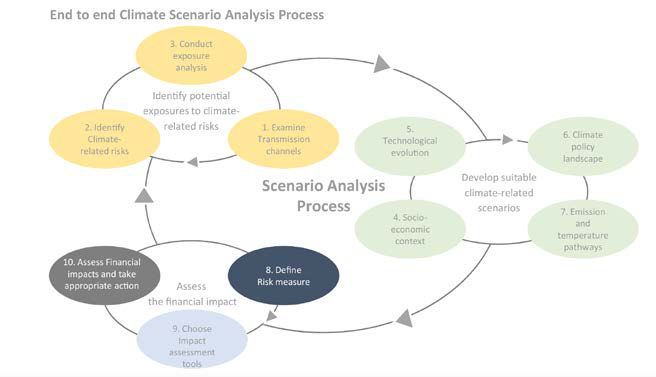
End to end Climate Scenario Analysis Process
This diagram illustrates a 10-step cyclical process for climate scenario analysis:
- Examine Transmission channels
- Identify Climate-related risks
- Conduct exposure analysis
- (Sub-step: Identify potential exposures to climate-related risks)
- Socio-economic context
- Technological evolution
- (Sub-step: Develop suitable climate-related scenarios)
- Climate policy landscape
- Emission and temperature pathways
- Define Risk measure
- Choose Impact assessment tools
- Assess Financial impacts and take appropriate action
- (Sub-step: Assess the financial impact)
“I have seen an uptick on disclosures on scenarios. I'm not prescribing [scenarios]. I want evidence it has been done and then different underlying scenarios, but at least one on 1.5 degrees" - Investor
"I'm sceptical of everything on scenario planning. Where companies say they're fine in all scenarios, that's clearly not the case" - Investor
Climate Financial Risk Forum
Established in March 2019 and convened by the PRA and FCA, the Climate Financial Risk Forum (CFRF) consists of a range of market participants, predominantly financial services participants, interested in climate-related issues. The CFRF set up four working groups on climate-related topics covering disclosure, scenario analysis, risk management and innovation.
In June 2020, guides to these four areas were published by the working groups. The scenario analysis guide provides this model of an end to end climate scenario analysis process that can be helpful as organisations consider the steps involved in such a process.
CFRF, Scenario Analysis chapter, June 2020.
Materiality
The FRC's Guidance on the Strategic Report notes that the strategic report, and the annual report more broadly, should contain information that is material to stakeholders. Qualitative factors will often have a greater influence on the determination of materiality in the context of the strategic report, particularly in relation to non-financial information.
Certain strategic report requirements in the Companies Act include a filter to ensure neither too little nor too much information is included and serve as a guide to the level of detail that should be provided. The filters that apply are:
- 'principal' for risks and uncertainties (Section 414C, paragraph 2(a));
- 'to the extent necessary for an understanding of' when referring to trends and factors and non-financial information (Section 414C, paragraph 4); and
- 'key' for key performance indicators (Section 414C, paragraph 4-5).
The materiality of an item in the financial statements may be based on its magnitude relative to other items included in the financial statements in the year under review but may also be based on the potential effect over the longer term. The potential magnitude of future effects of a matter on the entity's development, performance, position or future prospects should also be considered when determining the materiality of a matter in the context of the strategic report.
- It was pleasing to see that seven of the companies in the sample of 24 explained how they had assessed materiality in regard to non-financial matters.
- Whilst narrative reporting and financial statement materiality are driven by different requirements, we encourage companies to reflect on any potential inconsistencies. Where climate change features heavily in material disclosures in the front half of the annual report but the financial statements are silent on the issue, we encourage companies to reflect on whether this is appropriate. If it is deemed appropriate, users would benefit from disclosure setting out why the company believes this to be the case. Materiality from the perspective of the financial statements is discussed further in the later section on financial statements.
Examples of better disclosure
Determining materiality is an important aspect of operating sustainably; it involves identifying and prioritising a business's most critical non-financial issues. These issues are the ones that have the greatest impact on the business, our stakeholders and society in general. This matrix is based on our materiality assessment of the most important sustainability issues for easyJet. Some issues which are important to the business as a whole may not be prioritised in this matrix.
MATERIALITY MATRIX
This matrix visually plots various issues based on their 'Importance to Stakeholders' (Lower to Higher, vertical axis) and 'Importance to the Business' (Lower to Higher, horizontal axis).
PRIORITY ISSUES
- CLIMATE CHANGE (including carbon emissions, climate change adaptation, fuel efficiency and types)
- EMPLOYEES (including decent work and labour relations, employee engagement)
- WASTE & PLASTIC REDUCTION
- EMPLOYEE HEALTH & SAFETY
Other Issues (with indicative placement):
- Higher Stakeholder / Higher Business: Employee Health and Safety, Employees, Climate Change, Waste and plastics reduction, Economic performance, Security, Emergency preparedness
- Higher Stakeholder / Medium Business: Human rights and human trafficking, Diversity and inclusion, Training and development, Wellbeing
- Higher Stakeholder / Lower Business: Customer accessibility, Local air quality, Ethical supply chain management, Customer satisfaction, Data protection, Aircraft noise
- Medium Stakeholder / Medium Business: Cyberattacks
- Lower Stakeholder / Lower Business: Corruption, Economic contribution, Tax practices, Over-tourism, Charitable giving and community programmes, Wildlife conservation
The matrix also includes a legend for 'Track', 'Actively monitor', and 'Prioritise' indicating the company's management approach to these issues.
Clear colour coding to identify prioritised sustainability issues.
Clear presentation in matrix form.
Easyjet, Annual Report and Accounts 2019, page 49
IMPACT OF THE COMPANY ON CLIMATE CHANGE AND THE EXTERNAL ENVIRONMENT
KEY FINDING: Disclosures of the impact of the company on the environment were less developed. There is scope to improve non-financial reporting statements in relation to specific policies pursued, and details of the specific business relationships, products and services which are likely to cause adverse environmental impacts.
Non-financial reporting (NFR)
18 of the 24 companies reviewed had included a separately identifiable non-financial information statement in their strategic report. Three were not within scope of the requirements, and three included the information but not in a separately identified statement. However, only 11 companies had clearly met all of the environmental NFR requirements.
- The Companies Act requires the necessary information to be included in a separately identifiable statement within the strategic report.
- Cross-referencing may be used if information is reported elsewhere in the annual report, but this should be sufficiently specific for a reader to be able to determine exactly which elements are considered to constitute the non-financial information statement. In some cases, items were referenced to entire sections of the annual report, and it was not always possible to locate the information referred to.
Impact of the company on the environment
Section 414CB of the Companies Act 2006 requires public interest entities to include a non-financial information statement as part of their strategic report. Amongst other matters, this must include the following information regarding the impact of the company's business on the environment:
- a description of the policies pursued in relation to the matters and any due diligence process implemented in pursuance of those policies;
- a description of the outcome of the policies;
- a description of the principal risks arising in relation to environmental matters arising in connection with the entity's operations, and where relevant and proportionate, a description of its business relationships, products and services which are likely to cause adverse impacts in those areas of risk, and a description of how it manages the principal risks (7B.27); and
- a description of the non-financial key performance indicators relevant to the entity's business.
This information should be disclosed to the extent necessary for an understanding of the company's development, performance and position and the impact of its activity.
Examples of better disclosure
Drax Group, Annual Report and accounts 2019, page 51
Non-Financial Information Statement We have summarised in this Annual Report and Accounts our policies, standards and disclosures in relation to non-financial matters in line with the Non-Financial Reporting (NFR) requirements of the Companies Act
- This report forms our UN Global Compact (UNGC) Communication on Progress and we have mapped the NFR requirements to the four issue areas of the Ten Principles of the UNGC.
| UN Global Compact | Non-Financial Reporting Requirement | Policies, due diligence processes and outcomes | Page reference |
|---|---|---|---|
| Environment | Environmental matters | Environmental policy | |
| Sustainability policy | Page 41 | ||
| Responsible Sourcing policy | Page 41 | ||
| Carbon Emissions | Page 38 | ||
| Environmental Impact | Page 40 | ||
| Sourcing Sustainable Biomass | Page 41 | ||
| Healthy Forest Landscapes | Page 44 |
This example sets out clearly where each element of the required non-financial information can be found.
Policies pursued
All of the companies within scope of the NFR requirements had made some mention of a policy with respect to environmental matters, although in two cases this did not encompass climate change.
- Whilst there is no requirement in legislation for climate change to be discussed, we expect this to be a relevant matter for companies in many sectors.
- Information disclosed should be tailored to the company's specific circumstances. Statements of a general nature are not helpful to users of the accounts.
- In many cases, while a significant amount of information was disclosed regarding aspirations and actions taken related to environmental matters, it was difficult to determine which part of this disclosure constituted the company's actual policies in this area.
- A number of reports gave the name of the relevant policy, such as the environmental policy or sustainability policy, without describing what the policy says.
- Information should be disclosed within the annual report itself, and not just referenced to other publications such as a sustainability report or website.
- Commitments to achieve 'net zero' emissions or align strategy with the Paris agreement often represent significant 'policies pursued' in relation to climate change.
Examples of better disclosure
This is an example of a more detailed policy in a specific area.
"In 2019, we published Responsible Sourcing: A policy for biomass from sustainable forests, available at www.drax.com/sustainability/responsiblesourcing/. This Responsible Sourcing policy for biomass strengthens our approach in line with recommendations made by a report commissioned by the European Climate Foundation. This is to provide further assurance that the sustainable biomass we source makes a net positive contribution to climate change, protects and enhances biodiversity and has a positive social impact on local communities.
Signpost to where more detailed information can be found.
The Responsible Sourcing policy outlines our forest biomass sustainability commitments:
- We will reduce carbon dioxide emissions We are committed to ensuring the biomass we use makes a positive contribution to tackling the climate change crisis and fulfilling the UK's Paris Agreement targets.
- We will protect the natural environment We recognise our duty to keep forests thriving and to respect the many benefits they bring, including carbon storage, protection of soil and water quality, supporting biodiversity and provision of habitat.
- We will support people and communities From state-owned forests to smallholdings, and from the US Southeast to the Baltic states, forest owners, forest workers and communities in our sourcing areas are bound by their common reliance on forests for employment, wellbeing and quality of life.
- We will invest in research, outreach and intervention The strength of our collaboration with others will improve the sourcing choices we make. We are committed to working with governments, nongovernmental organisations, academia and other stakeholders to continually improve biomass sourcing and develop best practice."
Overview of policy included in annual report.
Drax Group, Annual Report and accounts 2019, page 41
Due diligence
22 of the 24 companies assessed for compliance provided some information regarding the due diligence process implemented in respect of their environmental policies. In most cases this consisted of a description of the governance process in place, although six companies also described internal audit or similar reviews carried out on aspects of their operations, and ten companies described some form of external assurance or certification.
- Where external assurance has been obtained, disclosures should explain the level of assurance given and what it covered, to avoid giving the impression of a higher level of assurance than has actually been obtained.
WE EXPECT COMPANIES TO: Include a separately identifiable non-financial information statement in their strategic report which addresses environmental matters such as climate change ‘to the extent necessary for an understanding of the company's development, performance and position and the impact of its activity' (CA2006 414CB(1)(a)). In particular companies should:
- provide a description of significant 'policies pursued' with respect to climate change, rather than simply naming them, or explain the reason if no such policies are pursued;
- provide clear explanations which help users to understand and compare major commitments such as ‘net zero emissions' targets or ‘Paris-aligned' strategies, including which activities and emissions are included in the scope of these commitments. It should be clear whether these are aspirational, or currently pursued and factored into budgets and business plans used when preparing the financial statements;
- describe the most significant outcomes of those policies for the business as a whole, without disproportionate focus on immaterial activities or 'good news stories';
- where climate-related targets have previously been announced, describe the company's performance against those targets;
- explain any changes in targets or KPIs from the previous year, including the reason for the change;
- describe the impact of the company's business on the environment, as well as the risks that climate change gives rise to for the company;
- ensure impacts within the company's supply chain and from use of products are addressed in the disclosures, particularly where these are significant relative to those arising from the company's direct activities;
- ensure that any cross-referencing to information included elsewhere in the annual report is sufficiently specific to enable readers to locate and identify the particular information in question.
Examples of better disclosure
"To the maximum extent achievable, we aim to:
- Incorporate ESG-related audit and inspection rights into our agreements
- Conduct regular site visits and gather periodic reports from our operating partners on their ESG activities
- Insert change of control clauses which help us ensure that the assets will continue to be operated by responsible companies in cases of ownership change
- Encourage our counterparties to align with leading ESG initiatives, including the ICMM Sustainable Development Framework, IFC Performance Standards and the Voluntary Principles on Security and Human Rights, among others".
Anglo Pacific Group plc, 2019 Annual Report & Accounts, page 18
A clear description of due diligence activities in a particular area of operations.
"In 2019, a Climate Change-Related Risks Project was initiated by the Board, to understand current and potential future risks arising from climate-related change, to understand disclosure and reporting requirements (as compared to current practices), and to ensure that there is appropriate governance around managing climate-related risks.
The project steering group consists of senior managers across the business, including our Group CRO, Group CFO, Head of Investor Relations and Head of Facilities, amongst others. Our Group Strategic Risk Lead drives the steering committee, ensuring that the group meets on a monthly basis, is updated on regulatory and market developments, and that the project progresses towards incorporating climate-related risks into business as usual risk management. The Chair of our Group Risk Committee is kept updated on related developments on an ad hoc basis, and the Admiral Group Board are to expect updates and progress updates as deemed suitable by the steering group.
During the year, Admiral completed three climate change stress tests for submission to the PRA as part of the 2019 General Insurance Stress Test programme.
Looking ahead, we intend to further investigate the impacts to claim costs, and the wider business and investment performance.
For more information relating to how the Group views risk relating to climate change please refer to page 97."
Admiral Group plc, Annual Report and Accounts 2019, page 36
Gives insight into the governance over climate- related activities.
Details of board involvement and ownership of the project.
Commitment-setting
KEY FINDING: A number of companies are reporting climate change commitments, for example pledges to reach 'net zero', and disclosing indicators around climate change, but these are often ill-defined, difficult to understand and compare, and have the potential to be misleading. Companies should clearly distinguish 'aims' and 'ambitions' from policies which are actively being pursued and are included in business plans and budgets.
Extent of disclosure of commitments
Many governments, companies and investors are setting targets or commitments to reach specific goals related to climate change. For example, they aim to be 'net zero' or 'Paris-aligned'. To reflect progress, many of the larger companies we reviewed disclosed climate-related targets and achievements. In the small cap sample, although 'green' initiatives were relatively common, reporting on targets and outcomes was generally poor.
What does 'net zero' mean?
There is no single agreed pathway to achieving the goals of the Paris Agreement and users have different views on the typical characteristics of a Paris-compliant transition. Certain scenarios state that they are aligned with 'net zero' or 'Paris-aligned' goals, such as the International Energy Agency (IEA) Sustainable Development Scenario. However, assumptions in these models represent only one possible approach and others may also be valid.
The definitions of 'net zero' or 'Paris-aligned' goals were often unclear and differed between companies. Many companies present ‘net zero' and 'carbon neutral' to be synonymous, while others see a distinction. The lack of a single definition within and between sectors is unhelpful and weakens the comparability of reporting. At a minimum, until industries can decide on an agreed definition, companies must clearly explain the terms they use and any commitments they make.
There is significant variation in the way in which emissions are reflected in targets. The most significant difference is whether they include scope 3 emissions, or only a minor category of scope 3 emissions, such as business travel. For many companies, the use of carbon-intensive products and other emissions in the supply chain are much more significant than scope 1 and 2 emissions. Additionally, the categories of emissions that companies report, and the determination of the boundary of the organisation, are subjective judgements made under commonly applied standards.
Commitments with similar descriptions may mask the fact that significantly different policies have been applied. Therefore, these commitments can be difficult for users to understand and compare.
We found that it was often unclear whether a 'net zero' objective was central, peripheral or aspirational in the context of a company's strategy. Many companies, particularly in the FTSE250 and small cap sample, briefly acknowledged the government's commitment to 'net zero' in aspirational terms, often in the Chair's statement, but did not clearly align with such statements elsewhere. Reporting on 'net zero' or similar commitments is of little use to users if a company does not explain clearly their intentions in terms of integrating this as an objective into its strategy.
💡 Where commitments to Paris or emissions targets represent a major component of a company's strategy, we expect companies to:
- Clearly explain what these terms mean, in the context of the company, ensuring that disclosures about such commitments are not misleading.
- Explain which emissions are included in the targets and ensure metrics included in greenhouse gas reporting align to these targets.
- Clearly distinguish 'aims' and 'ambitions' from policies which are actively being pursued and are included in business plans and budgets.
Within our sample of premium-listed companies we were able to identify some encouraging reporting practice, including carbon reduction strategies within the Buildings and Construction industry. In this industry, a number of companies identified the key areas of the business which have the resilience and potential to significantly reduce the company's environmental impact and ensure that the company is prepared to respond to the risks engendered by climate change.
We noted that:
- Better practice examples made use of informative graphics.
- Carbon reduction strategies were best articulated where the company included a 'net zero roadmap' which demonstrates its achievements so far and its future plans, whilst integrating the requirements and expectations from independent frameworks and organisations they engage with including TCFD, United Nations Sustainable Development Goals (UNSDGs) and the Science-based Targets Initiative.
- Identification of the key areas of business which have the resilience and potential to significantly reduce the company's environmental impact and ensure that the company is prepared to respond to the risks engendered by climate change.
- Transparent reporting on the areas in which the company did not perform as well as they had planned and the identification of specific elements of strategy which will help meet targets in the future.
"If a company hasn't set a target, or isn't considering that, the company is not taking it seriously... I know there can be greenwashing, but it does give some insight into strategic messaging and that management and boards are taking it seriously" - Investor
"There has been more reporting, more understanding on TCFD expectations around reporting, but what we have seen is still fairly limited to Scope 1 and 2 emissions. [There have been] some bigger commitments, but we also need the milestones and short to medium-term targets" - Investor
Board practice
The Goal 13 impact platform, an initiative run by Deloitte, the CBI, Chapter Zero, A4S, Dell technologies and the Met Office, intends to support organisations in managing the transition to a low-carbon and resilient future, encouraging both ambitious commitments and pragmatic action. The group recently undertook a series of 100 interviews with business leaders to highlight business approaches to meeting the challenge of climate change. These interviews identified that:
- 61% of the companies interviewed have at least one significant headline carbon reduction target.
- 43% of the companies interviewed have set ‘net-zero' or carbon neutral targets. These are typically more recent, longer-term and represent bolder ambitions than companies' absolute carbon reduction targets.
- 72% of initiatives implemented to date have an attributable payback period, and many of these are short-term. Operational efficiencies with short-term payback are proving valuable for gaining traction, but to realise their targets companies need to look to longer-term, more transformative initiatives.
Goal 13 Impact Platform: emerging findings How companies are managing the transition to a low-carbon, resilient and valuable future, September 2020
Lab findings – investor views on target-setting
Investors in the Lab's project in 2019 were very supportive of the setting of targets, and this support was mirrored in our interviews in
- For investors, getting an understanding of the targets being set gives insight into whether the company is serious about assessing and considering the implications of climate change to its business.
Investors are interested in the targets being set, the timeframes over which they are set and the boundaries of the targets. Investors are assessing whether companies are setting the appropriate metrics and targets for managing climate impact and considering wider impacts on the business and strategy. Investors noted that many companies are reporting more targets, which they welcome. However, there is a great deal of scepticism as to whether the targets are being acted upon and integrated into the company's strategy. Investors often find reporting in this area to be unclear and lacking in detail, particularly in relation to the overall target and the interim milestones that need to be achieved in order to get there.
The disclosure of metrics and targets is a key expectation of the TCFD framework. However, this remains a more underdeveloped area of company reporting. The investors we spoke to reiterated that they wanted to try to understand how climate-related issues, and their impact, are measured, including metrics, data and financially-relevant information. The questions they are asking remain the same as last year, so we have reproduced the questions investors suggested companies ask themselves, included in last year's Lab report, to the right.
“Too many companies are end-loading. [We need] In next five years X, Y and Z. In the five years after, after 2030 these parts of our business may not be viable. Intermediate targets are very important – can re-evaluate whether longer-term timeframes and ambitions are then achievable in the timeframe" - Investor
"The thing to do now is to set a ‘net zero' target, but then what matters is the detail behind it. What assumptions go into that target, what is covered in scope... companies should set an ambitious target and a short-term target, say 30 years and then also five years to make it meaningful for the current management team" - Investor
“I want there to be disclosures on targets because I want there to be targets" - Investor
Metrics and targets questions
- What information is most relevant to monitoring and managing the impacts of climate-related issues? How were these identified and how do they link to the strategy and business model?
- Has a strategy been defined, with related metrics to measure progress, setting the company on a course to 'net zero' carbon by 2050, and for interim stages in between now and then? What metrics are monitored in relation to mitigation and adaptation? If metrics are not related, what metrics are being used, and what timelines has it set?
- What signals or specific climate scenarios are monitored?
- Has the company considered whether issues regarding water, energy, land use and waste management may be material, and if so, how these should be measured?
- What do the metrics being monitored and managed indicate about the future direction of the company? How is this information used? How are they being integrated into day-to-day business management and reporting?
- What is the scope and boundary of the information presented? Is this the same across all information presented?
- To what level of oversight or assurance have the metrics been subjected?
- What external data, or external expertise, has the company relied upon?
- Are the metrics disclosed calculated consistently? Is trend data provided?
- Which methodology has been used for constructing the metrics? Is this comparable to other companies in the sector?
- Have estimates been used in compiling measures or targets? Can you describe the calculation of these?
- What are the company's Scope 1, Scope 2 and, where relevant, Scope 3 greenhouse gas emissions? Is the GHG Protocol and/or another industry-specific methodology used for this calculation?
- Is an internal carbon price used? If so, what is it and for which purposes is it used?
- What is the company trying to achieve in relation to climate resilience and what targets has it set? Have the targets been achieved, and what comes next?
- How are metrics being integrated into the remuneration policies? Is this the most effective linkage possible?
Outcomes of environmental policies and Key Performance Indicators (KPIs)
KEY FINDING: Companies should avoid providing disproportionate focus on 'good news stories' representing a small part of the business, and clearly report the most significant outcomes for the business as a whole, including performance against any previously announced targets.
20 of the 24 companies reviewed had provided some information on the outcomes of their environmental policies, all but one of which included outcomes relating to climate change. Two thirds of the companies had set targets with respect to climate change, but only nine explained how they had performed against previous targets; in many cases this was because the targets had been set only recently.
💡 Companies should give a fair and balanced explanation of the outcomes of their environmental policies, including performance against any previous targets.
💡 If targets or KPIs have changed from the prior year, this should be clearly explained, including the reason for the change.
⚠️ One company only showed performance against a benchmark year, which disguised the fact that the desired outcomes had actually worsened from the previous year.
⚠️ Companies should not focus on ‘good news stories' relating to relatively small parts of the business whilst neglecting to comment on less positive outcomes for the majority of the business.
Half of the 24 companies reviewed disclosed at least one KPI relating to climate change, although this was less common amongst smaller companies.
A number of companies in the FTSE350 sample also identified meeting their commitments on climate change as a standalone non-financial KPI. Those that did this provided an explanation of how they measure the KPI (e.g. a combination of stakeholder engagement, GHG emissions and use of resources) and why they intend to the use specific environmental factors as measurements of their performance.
The value of reporting on environmental non-financial KPIs was enhanced where companies reported on both elements.
Boards should consider providing an explanation of the relevance of each environmental KPI in the context of the resilience of the business model to climate-related risks, in line with their responsibility for narrative reporting.
The quality of reporting in the premium-listed sample was significantly improved where the company linked its environmental KPIs to their role in meeting the United Nations Sustainable Development Goals (SDGs), adopted by member states as part of the 2030 Agenda for Sustainable Development to provide "a shared blueprint for peace and prosperity for people and the planet, now and into the future”. SDG No. 13 urges parties to take climate action urgently, however businesses may impact many other SDGs directly or indirectly. Encouragingly, a significant number of companies had integrated the UNSDGs into their climate strategy. Amongst the smaller companies reviewed, on the other hand, no company had linked the UNSDGs to their environmental strategy. The recognition of the relevant SDGs within a business' climate strategy is a positive step forward by companies to align corporate practice with Principle A of the Code which highlights the function of the board to promote the long-term sustainable success and contribute to wider society.
The most commonly disclosed climate-related metrics were, unsurprisingly, the statutory greenhouse gas emissions figures, although a variety of other measures were also used by the sample of 24 reviewed, as shown on the next page.
Most common climate-related KPIs in the sample reviewed
Bar chart showing the frequency of different climate-related KPIs reported in the sample, from 0 to 7 companies.
- Greenhouse gas emissions: 7
- Emissions intensity: 6
- Emissions reduction: 5
- Energy consumption: 5
- Energy intensity: 4
- Renewable energy %: 3
- Sustainable raw materials %: 2
- Other industry-specific measures: 1
Industry-specific measures included fleet composition by fuel type for a fleet hire company, amount of environmental financing for a bank, and methane intensity for an oil and gas company. A number of companies also included metrics for items such as water usage and waste reduction that are indirectly linked to climate change.
Long-term aspirational goals are supported by shorter-term targets.
This example gives a balanced assessment of the company's performance against its long-term goals regarding environmental matters.
Our performance
Our 10 long-term aspirational goals
| 2020 target | Performance to 31 December 2019 |
|---|---|
| Water: Total water impacts of products and solutions balanced with local human and ecosystem needs | |
| Water footprint available for products accounting for 75% of revenue and considerations embedded in new product development process. Total potable water consumption no higher than 2016 actual. | Products accounting for 75% of revenue identified. Water footprint tools identified. Life Cycle Assessment (LCA) not completed. Water reduction of 5% since 2016. |
| Waste: All materials are either shipped as part of product or returned for beneficial use | |
| Total material efficiency estimated for products accounting for 75% of revenue and 80% or more of waste generated reused, recycled or recovered. | Products accounting for 75% of revenue identified. Material efficiency tools identified. LCA not completed. We currently reuse, recycle or recover energy from 76% of our total waste, up from 74% in 2016. |
| Carbon: 80% absolute reduction in total life cycle greenhouse gas emissions by 2050 | |
| Estimate total life cycle greenhouse gas emissions of products accounting for 75% of revenue. Total Scope 1 & 2 greenhouse gas emissions reduced by 10% from 2016 actual. | Products accounting for 75% of revenue identified. Total life cycle greenhouse gas emissions tools identified. LCA not completed. Greenhouse gas emissions reduction of 16% since 2016. |
| Products and services are aligned to market economic, social and environmental expectations and anticipate future market conditions | |
| Sustainability attributes described for products accounting for 75% of revenue. Robust emphasis on sustainability attributes of new products/services in place. | Products accounting for 75% of revenue identified. Product/service sustainability attributes agreed. New product development (NPD) sustainability focus planning under way. |
| Environmental, social, and economic impacts of business activities fully understood and appropriately balanced | |
| Formal programmes in place to measure/assess the economic, social and environmental impacts of (1) potential acquisitions, (2) technologies to be extended to Emerging Markets, (3) innovative business models, (4) cost-of-quality reduction initiatives, and (5) manufacturing siting, functional optimisation and site utilisation alternatives. | Conducted a number of 'deep dives' into several key risks. Tools and standards to address new technologies are being developed to support our NPD work above. LCA outputs not available. |
Smith & Nephew plc, Annual Report 2019, page 34
Details of performance against all targets, including those still in progress.
| Operational greenhouse gas footprint emissions (tonnes CO₂e)¹ | Waste production (tonnes) | ||
|---|---|---|---|
| 2019 | 1,974,949 | 2019 | 34,193 |
| 2018 | 1,852,104 | 2018 | 31,080 |
| 2017 | 1,768,071 | 2017 | 31,199 |
| 2016 | 1,739,046 | 2016 | 31,899 |
| 2015 | 1,845,505 | 2015 | 30,785 |
1,974,949 tonnes CO₂e
34,193 tonnes
| Energy consumption (MWh)¹ | Water use (million m³) | ||
|---|---|---|---|
| 2019 | 1,749,404 | 2019 | 3.55 |
| 2018 | 1,863,931 | 2018 | 4.01 |
| 2017 | 1,757,895 | 2017 | 3.89 |
| 2016 | 1,799,669 | 2016 | 4.02 |
| 2015 | 1,828,712 | 2015 | 4.32 |
1,749,404 MWh % total energy from renewables¹ 2019: 29.4% 2018: 28.9% 2017: 27.0% 2016: 25.1% 2015: 6.2%
3.55 million m³
1 Regular review of the data is carried out to ensure accuracy and consistency. This has led to changes in the data from previous years. The data quoted in this Annual Report are generated from the revised data.
AstraZeneca plc, Annual Report and Form 20-F Information 2019, page 38
This company uses charts to show its five year record against its environmental targets.
Changes from prior year disclosures are explained.
This example succinctly describes the environmental impact of the use of one of the company's products.
KEY FINDING: Information outlining the impact of the company on the environment is less developed and informative than the challenge climate change poses to the company.
Impact of the business on the environment
The non-financial information statement must also include, to the extent necessary for users' understanding, a description of the company's business relationships, products and services which are likely to cause adverse environmental impacts, and a description of how it manages these risks. In general, we found that descriptions of the impacts that the company has on the environment were less developed and informative than those capturing risks that climate change poses to the company. Only 15 of the 24 companies reviewed had clearly described the impact of the company's business on climate change, and of these, only 11 provided high quality, tailored descriptions rather than bland or boilerplate statements. Seven companies included some description of impacts associated with their supply chain, and 13 included some information on impacts from the company's customers or products. We expect non-financial reporting to address impacts associated with suppliers and customers, particularly in cases where the majority of the lifecycle carbon emissions would be expected to arise in the use of the product, for example oil and gas or fleet hire.
"Our PMDI therapies rely on hydrofluoroalkane (HFA) propellants, which are emitted during use and disposal, and contribute to our Scope 3 GHG footprint. While HFAs have no ozone depletion potential and a third or less of the global warming potential than the chlorofluorocarbons they replaced, they are still potent greenhouse gases.
During 2019, we progressed a project spanning all key functions in the business to investigate alternative low-Global Warming Potential propellant options available from an environmental, technical, regulatory, medical and commercial viewpoint."
AstraZeneca plc, Annual Report and Form 20-F Information 2019, page 39
Clearly sets out the risks the business poses to the environment.
Environmental impact
Potential impact We operate in a sector where the environmental impact of our business can be high and we need to manage the associated risks.
Our operations are water, carbon and energy intensive; consume materials such as fibre, polymers, metals and chemicals; and generate emissions to air, water and land. We are the custodian of more than two million hectares of forested land. We consider potential negative impacts on constrained resources and loss of biodiversity and ecosystems from our forestry and manufacturing operations.
We are subject to a wide range of international, national and local environmental laws and regulations, as well as the requirements of our customers and expectations of our broader stakeholders. Costs of continuing compliance, potential restoration and clean-up activities, and increasing costs from the effects of emissions could have an adverse impact on our profitability.
Monitoring, mitigation, and where relevant, independent assurance activities We ensure that we are complying with all applicable environmental and health and safety requirements where we operate. Our own policies and procedures, at or above local policy requirements, are embedded in all our operations and are supported through the use of externally accredited environmental management systems.
We focus on a clean production philosophy to address the impact from emissions, discharge, and waste. We manage our water resources responsibly to address risks related to water scarcity in some of our operations, and to ensure equitable use of water resources among local stakeholders wherever we operate. We emphasise the responsible management of forests and associated ecosystems and protect high conservation value areas. We ensure that we manage our forests responsibly and implement measures to protect biodiversity.
We collaborate with customers and supply chain stakeholders to better understand the concerns related to the impact of plastics in the environment, and to work together on scaleable, meaningful solutions to address this. Our product design and innovation efforts focus on reducing the environmental impact of our products throughout their life cycle.
We monitor our environmental performance indicators and report our progress against our 2020 commitments, with our GHG emissions independently assured to reasonable assurance level. We monitor regulatory developments to ensure compliance with existing operating permits and perform SEAT (Socio-economic Assessment Toolbox) assessments and water impact assessments locally to better understand our local environmental footprint and stakeholder needs.
Mondi Group, Integrated report and financial statements 2019, page 58
Mitigating activities.
Details of monitoring and assurance.
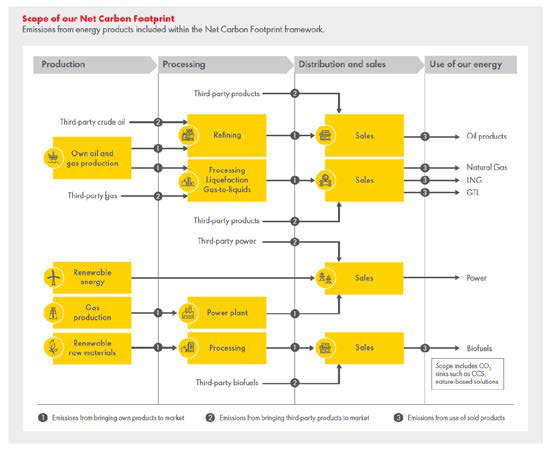
Royal Dutch Shell plc, Annual Report and Accounts for the Year Ended December 31 2019, page 97
Company included a diagram showing where carbon emissions arise in the production and use of all of its products.
Greenhouse Gas Emissions (GHG) disclosures
KEY FINDING: Required greenhouse gas emissions (GHG) disclosures were provided by almost all companies, but the scope of the emissions included and the basis on which the emissions are calculated is often unclear. This is particularly important where this forms the basis of a 'net zero' commitment or strategy.
Companies Act - Greenhouse gas emission requirements
Part 7 of schedule 8 to the Companies Act 2006 requires the directors' reports of quoted companies with financial years starting before 1 April 2019 to disclose the carbon emissions for which they are responsible from:
- The direct combustion of fuel ('Scope 1'), including company vehicles and fugitive emissions.
- The generation of purchased electricity, steam, heating and cooling consumed by the reporting entity ('Scope 2').
The directors' report must also disclose:
- The methodologies used to calculate this information.
- At least one intensity ratio.
Some companies also voluntarily disclose Scope 3 emissions, which are other indirect emissions that occur in a company's value chain, such as:
- Purchased goods and services.
- Business travel.
- Employee commuting.
- Waste disposal.
- Use of sold products.
- Transportation and distribution (up- and downstream)
- Investments.
- Leased assets and franchises.
For financial years starting on or after 1 April 2019, more stringent extensive requirements came into force, known as Streamlined Energy and Carbon Reporting. These requirements were not yet effective for the sample of company reports under review.
22 of the 24 companies in the sample reviewed had reported their greenhouse gas emissions, although two of these had only disclosed a single total rather than separate subtotals for scope 1 and 2 emissions as required by the Companies Act. A further two companies did not disclose the methodology used.
Five of the 24 companies had early-adopted the Streamlined Energy and Carbon Reporting requirements fully or in part, none of which were oil and gas, energy or mining companies. Three of these, plus four other companies, had gone beyond the requirements by obtaining some form of external assurance over the data presented, although what that level of assurance entailed was not always clear.
⚠️ The Companies Act does not provide an exemption from the disclosure of greenhouse gas emissions on the grounds of materiality. Quoted companies should provide these disclosures even if the directors do not consider the information to be material to shareholders.
⚠️ Separate disclosure should be provided of scope 1, scope 2 and (if applicable) scope 3 emissions.
⚠️ The methodology used to calculate this information should be disclosed.
⚠️ Where it is not practical to obtain some or all of the required information, the reason must be disclosed.
💡 Where external assurance has been obtained, the description should be adequate to explain the assurance given, to avoid giving the impression of a higher level of assurance than has actually been obtained.
Five of the companies that had provided the necessary disclosures had stated that it was not practical to obtain some or all of the information.
"The following sources of emissions were excluded or part-excluded from this report:
- Fugitive emissions (refrigerant gases): excluded on the basis of expected immateriality and difficulty in acquiring data
- Gas and electricity of part-exchange properties: excluded on the basis of immateriality due to very few completions of this type
- Certain emissions from District Heating Schemes where we are receiving a rebate from customers prior to handover to the long term operator
- Certain joint venture properties: where Taylor Wimpey was not part of the handover process. In these cases other homebuilders have captured MCR-related data".
Taylor Wimpey plc, Annual Report and Accounts 2019, p138
This example makes clear which emissions were excluded, and explains why.
"Our CO2e 2019 emissions data have been audited by TÜV UK Ltd, which has provided limited assurance as follows: TÜV UK Ltd is acting as the independent verifier of the carbon footprint of Spirax Sarco. Based on our checks and reviews, taking into consideration a materiality level of 5% and a limited level of assurance we have found no evidence suggesting that the calculated greenhouse gas emissions are materially misstated and, hence, they are not an unreasonable assertion of the greenhouse gas-related data and information. Further, no facts became evident, which led us to the assumption that the calculation was not carried out in accordance with the applied international norm for the quantification, monitoring and reporting of GHG emissions (GHGProtocol). The emissions for the reporting period 1st January 2019 to 31st December 2019 (inclusive) are: 23,878 tCO2e for Scope 1 and 19,497 tCO2e for Scope
- TÜV UK Ltd, London, February 2020".
Spirax-Sarco Engineerging plc, Annual Report 2019, p68
The company has used an extract from the audit report to describe the assurance that has been obtained.
"Methodology The greenhouse gas emissions data is reported in line with the Greenhouse Gas Protocol Corporate Accounting and Reporting Standard 'Operational Control' method, and emission factors for fuels and electricity are published at www.gov.uk/government/collections/government-conversion-factors-forcompany-reporting.
For the 2019 reporting cycle, the 2019 emissions factors have been utilised as opposed to the 2018 factors. In previous years the emissions factors used for the Group's greenhouse gas emissions reporting have been a year behind, mainly due to the factors not being released in time for half-year assurance (for example, 2016 emissions factors used for 2017 reporting cycle). Going forward, the emissions factors used will coincide with the year of the reporting cycle as these are the latest factors available for the majority of the Group's reporting period.
The CO2e associated with carbon dioxide, methane and nitrous oxide is reported. Greenhouse gas emissions associated with hydrofluorocarbons, perfluorocarbons and sulphur hexafluoride are estimated to be immaterial to total emissions and are, therefore, not reported.
The principal record of the Group's worldwide facilities is its legal department's Global Property Database.
Greenhouse gas emissions are primarily calculated from energy consumption records reported via the Group's global environmental database. Where actual usage data is not available for facilities and residences within the Global Property Database, an estimated consumption is used based on the type of building.
Greenhouse gas emissions related to business travel include air travel data for the majority of the global business and rail data for business units operating in the UK and US. These data are taken from travel suppliers' procurement records.
Emissions from joint ventures and pension scheme properties not occupied by the Group are not included. Where a business or facility is acquired during a reporting year, it will be included in our reporting in the next full reporting year after the change. The Scope 2 greenhouse gas emissions associated with the Greenhouse Gas Protocol ‘market-based' method have been calculated as 517,035 tonnes CO2e
- Supplier-specific emission factors have been sought for our most significant operating regions, but were either deemed of insufficient quality to use at present, or were unavailable. Therefore, in line with the GHG Protocol Guidance, this figure has been calculated using residual-mix emission factors where available for our UK, US and Swedish operations. In our other significant operating regions, residual-mix emission factors are either unavailable or the resulting absolute emissions at Group level are within the margin of error and, therefore, country-specific emissions factors have been used in line with the GHG Protocol Guidance."
BAE Systems plc, Annual Report 2019, page 41
Clearly explains the methodology behind the figures disclosed.
Changes from the previous year explained.
Boundary of the emissions disclosed.
All companies providing greenhouse gas emissions disclosures had provided at least one intensity ratio as required; five had provided two different ratios. Intensity ratios compare emissions data with an appropriate business metric or financial indicator, such as sales revenue or square metres of floor space, to facilitate comparisons over time and with other similar types of organisations. The intensity ratios disclosed by the companies were based on unit of production or service (in 12 cases), employee numbers (eight) and revenue (four).
Scope 3 emissions
Ten of the 24 companies reviewed had voluntarily reported at least some scope 3 emissions; this included one oil major but no other energy or mining companies. The premium-listed sample also found that some companies were voluntarily reporting this information, but that sample identified some inconsistencies in the reporting of upstream versus downstream Scope 3 emissions between companies.
The Greenhouse Gas Protocol lists 15 different categories of scope 3 emissions, but notes that, since companies have discretion over which categories they choose to report, scope 3 may not lend itself well to comparisons across companies. That standard also includes different approaches to determining the boundary for consolidating emissions – equity share and control approaches. For this reason, companies should be very clear what they are including and why. The categories that were included most frequently within reported emissions are included below.
Whilst disclosure of Scope 3 emissions is not required, it is encouraged by the TCFD, and by many investors. Due to its voluntary nature, omission of Scope 3 emission disclosure does not necessarily reflect poor practice, but companies are encouraged to be transparent about the (in)completeness of their data.
Most common categories of scope 3 emissions included in reporting
Bar chart showing the frequency of different Scope 3 emissions categories reported in the sample, from 0 to 6 companies.
- Business travel: 6
- Waste generated in operations: 5
- Use of sold products: 4
- Downstream transportation and...: 3
- Employee commuting: 3
- Upstream transportation and distribution: 2
- Other fuel and energy related activities: 2
- Purchased goods and services: 1
We identified the following better practice, and causes for concern, in our sample:
- Only one of the companies reviewed clearly stated that all 15 categories of emissions were included within its scope 3 disclosures.
- In some cases, the disclosed emissions only included part of a given category, for example only air travel was included within business travel. Better disclosures clearly identify which scope 3 emissions are included in order to enhance comparability.
- In two cases it was unclear which types of emissions were included within the scope 3 figures reported.
⚠️ Companies should ensure that their disclosures are not misleading and avoid reporting only relatively small categories of scope 3 emissions whilst omitting other categories that potentially have a much more significant effect. For example, for an oil and gas company we would expect the most significant class of emissions to arise from the use of its products; if this category is excluded from scope 3 disclosures, the company should make sure that this is made very clear.
⚠️ We have outlined our expectations when companies make climate change commitments such as 'net zero' or 'Paris-aligned' strategies on page 32.
WE EXPECT COMPANIES TO: Describe the methodologies used to calculate emissions metrics and the extent of any due diligence or assurance over these. There is significant scope for judgements in determining boundaries and which emissions are included so companies should explain these decisions clearly. This information is expected to be more material where these metrics underpin a major policy or strategy.
| 7,234,606 | 6,273,907 | 5,855,309 | |
|---|---|---|---|
| Scope 3 Total: Emissions from all 15 Greenhouse Gas Protocol Scope 3 Categories | |||
| 2016-2025 Strategy Scope 3 intensity measurement KPI: Scope 3 emissions from all 15 Greenhouse Gas Protocol Scope 3 Categories normalised to million US dollar revenue. Baseline year is 2015 (one year in arrears) | 297 | 284 | 261 |
AstraZeneca Group plc, 2019 Annual Report and Accounts, p266
This company makes it clear that all categories of scope 3 emissions are included.
Intensity ratio provided for Scope 3.
"Our Scope 3 footprint includes UK booked business travel, global water consumption and UK waste generated from our occupied properties with operational control. We continue to review the extent of our Scope 3 reporting and increase coverage where practicable."
M&G plc, 2019 Annual Report and Accounts, p32
This disclosure clearly and concisely indicates which emissions are included within the scope 3 data.
| Upstream and downstream of Unilever operations (scope 3) | ||
|---|---|---|
| Total scope 3 (tonnes CO₂e) | 58,558,031 | 59,250,469 |
| Top 3 scope 3 by emission source: | ||
| Consumer use (tonnes CO₂e) (e) | 39,730,116 | 39,895,946 |
| Ingredients and packaging use (tonnes CO₂e) (f) | 14,448,186 | 14,985,897 |
| Distribution and retail use (tonnes CO₂e) (g) | 4,379,729 | 4,368,626 |
- We measure the full GHG footprint of our product portfolio and annual sales using an LCA method compliant with the ISO 14040 standard. We measure the consumer use phase using a combination of primary habits data and on pack recommendations of use combined with lifecycle inventory data. We measure a representative sample of products across 14 countries which account for around 60-70% of our annual sales volume.
- We use a combination of external lifecycle inventory databases (secondary data) and supplier specific data (primary data eg for surfactants, perfumes and some of food ingredients) to measure the GHG emissions of purchased ingredients and packaging materials used in the production of our products.
- Downstream distribution is calculated using average distances and modes of transport derived from data collected from our distribution network and logistic providers.
Unilever plc, Annual Report and Accounts 2019, p43
Scope 3 emissions split out by source.
This disclosure provides greater detail regarding the calculation of scope 3 emissions for each source.
Drax Power Station Average Biomass Supply Chain GHG Emissions in 2019 (%)
Bar chart showing percentage of GHG emissions at each stage of the biomass supply chain:
- Cultivation: <1%
- Harvesting: 2%
- Chipping in forest: 1%
- Transport to pellet plant: 4%
- Drying: 8%
- Pelletising: 50%
- Transport to port: 12%
- Shipping: 20%
- Rail to Drax: 3%
Drax Group plc, Annual report and accounts 2019, page 43
The company used a graph to show where emissions arise in the supply chain.
Examples of better disclosure
Upstream and downstream of Unilever operations (scope 3)
Scope 3 emissions split out by source.
| Total scope 3 (tonnes CO₂e) | 58,558,031 | 59,250,469 |
| Top 3 scope 3 by emission source: | ||
| Consumer use (tonnes CO₂e) (e) | 39,730,116 | 39,895,946 |
| Ingredients and packaging use (tonnes CO₂e) (f) | 14,448,186 | 14,985,897 |
| Distribution and retail use (tonnes CO₂e) (g) | 4,379,729 | 4,368,626 |
This disclosure provides greater detail regarding the calculation of scope 3 emissions for each source.
(e) We measure the full GHG footprint of our product portfolio and annual sales using an LCA method compliant with the ISO 14040 standard. We measure the consumer use phase using a combination of primary habits data and on pack recommendations of use combined with lifecycle inventory data. We measure a representative sample of products across 14 countries which account for around 60-70% of our annual sales volume. (f) We use a combination of external lifecycle inventory databases (secondary data) and supplier specific data (primary data eg for surfactants, perfumes and some of food ingredients) to measure the GHG emissions of purchased ingredients and packaging materials used in the production of our products. (g) Downstream distribution is calculated using average distances and modes of transport derived from data collected from our distribution network and logistic providers.
Unilever plc, Annual Report and Accounts 2019, p43
Section 172 and stakeholder engagement
KEY FINDING: Stakeholder engagement and section 172 disclosures were often combined, sometimes leading to the omission of certain aspects of the required disclosures, particularly those not directly related to stakeholder engagement.
Companies Act requirement – section 172
Section 172 of the Companies Act 2006 requires directors to act to promote the success of the company for the benefit of the members as a whole, having regard to a number of matters, including the impact of the company's operations on the environment. Section 414CZA of the Companies Act 2006 requires the strategic report of a large company to include a statement (a 'section 172(1) statement') which describes how the directors have had regard to these matters when performing their duties.
The matters required for consideration under section 172 include: * the likely consequences of any decision in the long term; * the interests of the company's employees; * the need to foster the company's business relationships with suppliers, customers and others; * the impact of the company's operations on the community and the environment; * the desirability of the company maintaining a reputation for high standards of business conduct, and; * the need to act fairly as between members of the company.
2020 saw the requirement to produce section 172 statements by all large companies, as The Companies (Miscellaneous Reporting) Regulations 2018%20Regulations%202018) and the Code came into effect starting 1 January 2019. The Code also made some changes to require companies to set out how stakeholders, and other matters included in section 172, have been considered in board discussions and decision making.
Section 172 statements
22 of the 24 companies reviewed had included a section 172(1) statement setting out how the directors had regard to various matters when performing their duties. One was not required to do so. 18 companies described how climate change had been taken into consideration.
We noted that:
Better disclosures explained how the board considered and assessed the topic of climate change during the year.
Where information is reported elsewhere in the annual report to meet this disclosure requirement, it should be clearly cross-referenced.
It is insufficient to refer to information held outside the strategic report, for example in a separate sustainability report. The information must be included within the annual report itself in order to meet the requirements of the Companies Act.
Companies Act requirement – stakeholder engagement
Part 4 of Schedule 7 to the Companies Act 2006 requires the directors' report (or strategic report) to explain how the directors: * have engaged with employees, suppliers, customers and others; * have had regard to employee interests, the need to foster the company's business relationships with suppliers, customers and others,
and the effect of that regard, including on the principal decisions taken by the company during the financial year.
Most companies reviewed had included a stakeholder engagement statement. Although the requirements do not stipulate the matters to be addressed, 17 of the 24 companies in the sample (including all of the oil and gas, other energy and mining companies selected) described engagement with stakeholders regarding climate change.
A number of companies also reported on environmental initiatives in response to stakeholder concerns relating to climate change, while some provided accessible tables showing the results of engagement surveys on the materiality of certain issues, including those related to climate change, by each of their key stakeholder groups. However, evidence of actions taken by boards in response, as expected by the Code, was often scarce.
Better practice identified in the context of the Code included:
Descriptions of a specific method of engagement used to understand the needs of stakeholders in relation to climate change.
A specific concern was as follows:
Press reports indicated that one of the companies within the sample had been discussing significant climate-related matters with investors, but this was not referred to in the stakeholder reporting disclosures.
Conflating the two requirements
Eight of the companies in the sample had combined their section 172(1) statement and their stakeholder engagement statement into a single report.
Where this is the case:
Care should be taken that all elements of both requirements are adequately addressed.
In particular, those elements of the section 172(1) requirement that do not relate to engagement with stakeholders (such as the impact of the company's operations on the environment) should be covered.
The combined statement must also describe the actions of the board of directors, not just, for example, investor relations or other areas of the business.
WE EXPECT COMPANIES TO: Ensure that section 172(1) statements describe the actions of the board of directors, rather than other parties, and address all the regulatory requirements, not just those associated with stakeholder engagement, particularly where those statements are combined.
Ensure that stakeholder engagement reports reflect all significant environmental matters discussed with stakeholders during the year.
Examples of better disclosure
Principal Decisions
| Decision: | APPROVAL OF THE STRATEGIC PLAN 2019-2023 |
|---|---|
| Context | The Strategic Plan sets out the Company's strategic objectives and guidance on how to achieve them. It is developed considering a healthy balance between: (i) growth, shareholder returns under conservative assumptions of internal and external factors; and (ii) stakeholder considerations. The Executive Committee presents the plan for the Board's challenge and approval. |
| Stakeholder considerations | In reviewing the Strategic Plan, the Board considered the potential impact that the Company's growth might have on its key stakeholders. The expected growth has several challenges with stakeholder implications: • Talent development, contractor workforce and organisational model. • Health & Safety, community, land access and environmental performance at existing operations (brownfield projects). • Community, land access and environmental issues deriving from new projects (greenfield projects). In addition, there are global trends with stakeholder implications that have been considered by the Board: • Resource sovereignty: increased expectations and demands leading to more social and labour conflicts. • Consistently higher tax pressure across countries. • Clean energy and the environment: increased pressure from regulators and environmental organisations to protect the environment. |
| Strategic actions supported by the Board | The Board decided to approach these stakeholder implications with a focus on: • Generating value for all stakeholders in an increasingly challenging environment. • Prioritising excellent health, safety, social and environmental performance. The strategic actions supported by the Board to generate value for stakeholders are: • Implementing social and land access strategy to mitigate risks in new operations, especially in mines in new districts. • Defining and executing water access strategy for new operations at water stressed regions. • Developing next generations of leaders. • Growing contractors' workforces to operate new mines. • Adapting the organisational model to increased complexity (e.g. regional vs. mine model). |
Climate change included in the considerations for the approval of the strategic plan.
Links to transition risks in the company's TCFD section.
Water stress identified as an emerging risk.
Fresnillo, Annual Report and Accounts 2019, page 104
Examples of better disclosure
Our Environment
| Why we engage | Examples of how we engage | Examples of actions taken in 2019 | How we monitor the impact of our actions | Examples of stakeholder outcomes | Purpose |
|---|---|---|---|---|---|
| The Board is mindful that it is increasingly important to demonstrate responsible business behaviour with regards to the environment. | We aim to reduce our environmental footprint and encourage responsible behaviour. Employee directed activities include; • Regular updates from the 'Green Team', an internal working group • Internal promotion of 'Green Week' • Promoting video and telephone conferencing systems between the international businesses to reduce travel • Various recycling initiatives across our offices • Installation of scooter parking with charging sockets (Admiral Seguros) • Cycle to work scheme for employees • Monthly meetings of our Climate Change Project Group | In June 2019, the Group Board approved the updated Responsible Investment Policy. In 2019 the Climate Change Project Group was established. We successfully reduced CO₂e emissions per employee, and Group-wide emissions in 2019. Partnership with envoPAP (to use carbon neutral paper across all of our UK offices). | Our facilities department measures and monitors key aspects of our environmental performance and regularly reviews progress • We track and measure CO₂e emissions per employee and at Group level • Our Cardiff and Newport offices are rated BREEAM Excellent for exceeding sustainability benchmarks above regulatory requirements • 85% of our staff believe we are working to reduce our environmental footprint • Ensuring our asset managers are signed up to the PRI guidelines 100% our UK recyclable waste is converted into energy | Ongoing improvements relating to recycling and energy usage. Increased awareness and understanding of environmentally responsible behaviour among our employees. Our facilities team are exploring ways in which a third party can verify our emissions in 2020. In 2019 the Board decided to formalise our environmental policy. The Board reviewed and amended the Group's purpose statement in 2019, to include '...whilst building a sustainable business for the long term.' This reflects a commitment that the Company's operations will consider the impact on the community and the environment, both now and into the future. | Directors' Report page 124 Being a Responsible Business page 60 Our Business Model page 16 |
| We perceive that key material issues for our environment generally relates to; the direction of travel and progress relating to environmental concerns, awareness of topical issues and the sharing of best practice, reducing carbon emissions and the Group's overall environmental footprint, and the creation of a sustainable business for the future. | At Board level; • Directors receive updates on our Responsible Investment Policy, and give feedback relating to investments and topics for consideration. • Directors are kept up to date with UK, European and Global initiatives on ESG matters. • The Group Risk Committee and the Board receive updates from our Climate Change Project Group, on which our CFO and CRO both sit. |
Clear explanation of how the matter has been considered by the board of directors.
Description of the outcome of these activities.
Admiral Group plc, Annual Report and Accounts 2019, pages 22 and 23
Helpful case study showing how a specific board decision has been influenced by stakeholder engagement.
Graphic showing the key issues considered for each stakeholder group.
The diagram illustrates key issues considered for various stakeholder groups:
- Our customers: Affordability and supply of housing, Placemaking, design and community infrastructure, Efficient homes, Innovation, Customer service, Climate change mitigation and adaption, Sustainable transport, Air quality, Responsible sourcing.
- Our employees: Customer service, Health, safety and wellbeing, Site environment and remediation, Diversity and inclusion, Access to skills, Employee engagement, Labour relations, Taxation and remuneration policies.
- Our partners: Land, planning and community engagement, Health, safety and wellbeing, Responsible sourcing, Diversity and inclusion, Access to skills, Labour relations, Public policy, Charitable giving.
- Our investors: Climate change mitigation and adaption, Business ethics and corporate governance, Taxation and remuneration policies, Public policy, Customer service, Employee engagement.
- Our communities: Affordability and supply of housing, Placemaking, design and community infrastructure, Efficient homes, Innovation, Land, planning and community engagement, Climate change mitigation and adaption, Site environment and remediation, Sustainable transport, Air quality, Biodiversity, Brownfield and greenbelt development, Charitable giving.
Taylor Wimpey plc, Annual Report and Accounts 2019, page 32
Financial statements – headline finding:
Consideration and disclosure of climate change in the financial statements lags behind narrative reporting. We identified areas of potential non-compliance with the requirements of International Financial Reporting Standards (IFRS).
Climate change in the financial statements
Extent of climate disclosure in the financial statements
Only six of the 24 companies reviewed made any specific reference to climate change in their financial statements. This is in clear contrast to narrative disclosure in annual reports by the same companies, where 22 companies had discussed climate change to some extent.
While some of the matters discussed may not correspond to financial statement disclosure requirements, we note that our sample was heavily weighted towards those companies and sectors which we may expect to be the most affected by climate change. We acknowledge that practice is developing at pace in this area, partly in response to investor demand and the IASB article (below). However, this review suggests that consideration of climate change in the financial statements lags behind narrative reporting, and we have identified few examples of better practice. We have highlighted a number of matters where we consider there to be scope for improvement, both from the perspective of compliance with requirements, and meeting user expectations.
Reporting requirements in relation to climate change
As outlined in previous sections, there is no standalone IFRS standard addressing climate change specifically. However, the requirements of IFRS standards provide a clear framework for incorporating the risks of climate change into companies' financial reporting. The overview of existing IFRS requirements and guidance on the application of materiality in the IASB article, as published by a member of the IASB Board, provides helpful insight into how climate change should be considered when addressing certain requirements. These were among the issues we considered when reviewing the reports in our sample.
Consistency between narrative reporting and financial statement disclosures
During the course of our review it was generally unclear how forward-looking assumptions and judgements applied in preparation of the financial statements were consistent with narrative discussion of climate change in the strategic report. Companies often provided detailed narrative discussion of climate change in their annual reports. This included both the risks to the business and policies affecting the company's impact on climate change, such as the company's own 'net zero' pathway. This narrative often addressed specific uncertainties associated with climate change which users may reasonably expect to materially affect balances in the financial statements. These included factors such as the outlook for commodity prices, expectations of growth, or potential changes to regulation or support schemes. Where the effect is material, management is required to develop an expected position on these uncertainties, for the purposes of estimates such as useful lives, impairment or valuation. In some cases, disclosure of these assumptions is required, and in others it may be best practice. Specific examples of this are highlighted in the sections below.
The matters discussed in some parts of the narrative may not affect recognition or disclosure in the financial statements under the relevant standards. This may apply to high-impact, low-likelihood scenarios or developments discussed in the context of risk or viability disclosures. It can still be helpful to users to make it clear where a risk appears to have potentially significant financial impact but does not materially affect the financial statements.
WE EXPECT COMPANIES TO: Ensure that material climate change risks and uncertainties discussed in narrative reporting have been appropriately considered in the financial statements. Narrative reporting should not be inconsistent with the financial statements. Better disclosures present a coherent linkage between narrative reporting and accounting judgements and estimates and may explain why apparently significant risks have not had a material impact on the financial statements where investors may expect them to do so.
KEY FINDING: There was limited reference to climate change in the financial statements and it was generally unclear how the forward-looking assumptions and judgements applied in preparation of the financial statements were consistent with narrative discussion of climate change in the strategic report.
KEY FINDING: Companies should consider whether the annual report and accounts, taken as a whole, presents a consistent message on the most significant risks presented by climate change and includes all information that may be material for decision making.
The consistency of message across the annual report is particularly important where users see a strong linkage between strategic issues and financial statement balances. In several of the companies reviewed, different outcomes on climate change may be expected to significantly impact the company's strategy, operations and financial statement balances in the near term.
UK Corporate Governance Code
For those subject to the requirements of the Code, it states that directors should explain in the annual report their responsibility for preparing the annual report and accounts, and state that they consider the annual report and accounts, taken as a whole, is fair, balanced and understandable, and provides the information necessary for shareholders to assess the company's position, performance, business model and strategy.
We saw limited evidence of companies making financial statement disclosures about climate change and related uncertainties, other than the minimum information specified by the relevant standard. We do not encourage disclosure of information which is not useful. However, in the context of clear evidence of investor interest in more meaningful climate change disclosures, companies should reflect on whether the financial statements include all information that may be material for decision making and ensure that appropriate consideration is built into the financial statement preparation and review process.
WE EXPECT COMPANIES TO: Reflect on the information about climate change which is material to users for both narrative reporting and financial statement disclosure. We do not encourage a checklist approach as this may lead to both clutter and omission of key information. Information may be required by IAS 1 where it is relevant to an understanding of the financial statements, even where it is not specified in a standard. We note that expectations from investors in this area are high.
Materiality
The IASB article states that companies applying IFRS Standards when preparing financial statements would consider (i) whether investors could reasonably expect that climate-related risks could affect the amounts and disclosures reported and (ii) what information about the effect of climate-related risks on assumptions is material and should therefore be disclosed. It also notes that investors have indicated the importance of information about such risks to their decision making. This is consistent with the FRC's engagement with users on climate change issues.
IAS and IFRS requirements - Materiality
Information is material if omitting, misstating or obscuring it could reasonably be expected to influence the decisions that the primary users of general purpose financial statements make on the basis of those financial statements, which provide financial information about a specific reporting entity.
IAS 1, paragraph 112(c), also requires disclosure in the notes of any information that is not presented elsewhere in the financial statements but is relevant to an understanding of them. Information is relevant if it is capable of making a difference in the decisions made by users. (Conceptual Framework 2.6)
IFRS Practice Statement 2: Making Materiality Judgements Example C is an example in which a company provides additional disclosures of assumptions used to determine the recoverable amount of a tangible asset which are not required by IAS 36. The assumptions relate to the likelihood of the enactment of regulations to reduce carbon-based energy. In the example, the assumptions are required to be disclosed, because management has determined this information could reasonably be expected to influence the decisions of primary users.
"With some disclosures you still get the sense of 'so what?'. You can talk in quite broad terms about what it might mean regarding demand for the product, or you can talk about the capital expenditures you might need to employ... It's hard if you're not getting some idea of magnitude and financial impact”
– Investor
Lab finding - investor views on financial statements implications
As mentioned above, the FRC's engagement with users has shown a great deal of interest in the financial implications of climate-related issues. Over the course of this thematic, the Lab encountered more investors calling for greater integration of climate-related issues into the financial statements of a company.
Investors reiterate the need for consistency between the front half and back half of reports, and also noted that financial statement disclosures lag far behind those in the narrative reporting. The disclosure of assumptions made, in this context when considering financial statements implications, is a key disclosure expectation. Although outside the scope of this report, which predominantly looked at reporting of 2019 December year-ends, investors also commented positively on the asset impairments reported throughout
- Investors also commented positively on the disclosures that explained how the impact of climate change had resulted in asset impairments reported in 2020.
“If investors think it's important it should be considered and reflected in financial statements, and that goes beyond the oil and gas companies, it needs to be much wider”
– Investor
TCFD assessment of possible financial statements implications of climate change
The TCFD's 11 recommended disclosures do not, ‘require' financial statements disclosures, but the TCFD report in 2017 highlighted some possible financial impacts of climate-related risks and opportunities and encouraged disclosure of these areas.
Task Force on Climate-related Financial Disclosures, 'Final Report: Recommendations of the Task Force on Climate-related Financial Disclosures', June 2017, pages 8 and 9.
Figure 1 Climate-Related Risks, Opportunities, and Financial Impact
The diagram illustrates a framework connecting climate-related risks and opportunities to financial impact.
Risks: * Transition Risks: Policy and Legal, Technology, Market, Reputation * Physical Risks: Acute, Chronic
Opportunities: * Resource Efficiency, Energy Source, Products/Services, Markets, Resilience
Strategic Planning & Risk Management are central.
Financial Impact is broken down into: * Revenues → Income Statement * Expenditures → Income Statement * Cash Flow → Cash Flow Statement * Assets & Liabilities → Balance Sheet * Capital & Financing → Balance Sheet
Figure 2 Major Categories of Financial Impact
Income Statement: * Revenues: Transition and physical risks may affect demand for products and services. Organizations should consider the potential impact on revenues and identify potential opportunities for enhancing or developing new revenues. In particular, given the emergence and likely growth of carbon pricing as a mechanism to regulate emissions, it is important for affected industries to consider the potential impacts of such pricing on business revenues. * Expenditures: An organization's response to climate-related risks and opportunities may depend, in part, on the organization’s cost structure. Lower-cost suppliers may be more resilient to changes in cost resulting from climate-related issues and more flexible in their ability to address such issues. By providing an indication of their cost structure and flexibility to adapt, organizations can better inform investors about their investment potential. It is also helpful for investors to understand capital expenditure plans and the level of debt or equity needed to fund these plans. The resilience of such plans should be considered bearing in mind organizations’ flexibility to shift capital and the willingness of capital markets to fund organizations exposed to significant levels of climate-related risks. Transparency of these plans may provide greater access to capital markets or improved financing terms.
Balance Sheet: * Assets and Liabilities: Supply and demand changes from changes in policies, technology, and market dynamics related to climate change could affect the valuation of organizations’ assets and liabilities. Use of long-lived assets and, where relevant, reserves may be particularly affected by climate-related issues. It is important for organizations to provide an indication of the potential climate-related impact on their assets and liabilities, particularly long-lived assets. This should focus on existing and committed future activities and decisions requiring new investment, restructuring, write-downs, or impairment. * Capital and Financing: Climate-related risks and opportunities may change the profile of an organization’s debt and equity structure, either by increasing debt levels to compensate for reduced operating cash flows or for new capital expenditures or R&D. It may also affect the ability to raise new debt or refinance existing debt, or reduce the tenor of borrowing available to the organization. There could also be changes to capital and reserves from operating losses, asset write-downs, or the need to raise new equity to meet investment.
Impairment reviews
KEY FINDING: Climate change was not generally addressed in disclosures of management's approach to determining key assumptions in impairment assessments, and it was unclear whether all disclosure requirements had been met. Given the wide range of outcomes and the potentially significant impacts on the financial statements, it is important that users can understand the basis applied by management in arriving at assumptions related to impairments.
Many of the companies used forward-looking assumptions in their impairment assessments which are closely linked to climate change. We identified potential issues with impairment assumptions or sensitivity disclosures for nine companies in our sample.
As mentioned above, there have been a number of recent impairment announcements where management has referenced climate change, or changing expectations of the pace of energy transition, as major factors.
We identified a number of issues from our review:
The description of management's approach to determining key assumptions generally did not reference climate change. This included estimates, such as growth in carbon-intensive industries, where we would expect a close relationship between management's assumption and their assessment of climate change risks.
There is scope to improve the consistency between the financial statement disclosure and other parts of the annual report.
- Climate policies (internal factors): It was generally not clear whether commitments made by the company, such as 'net zero' pathways, had been included in the budgets and forecasts applied by management in impairment assessments. In narrative reporting, these are often described as 'aims' or 'ambitions'. Understanding whether these are included in budgets may be material for users assessing both the financial statement risks, and the credibility of management's commitments.
IAS requirements – Impairment disclosures: cash-generating units (CGUs) containing goodwill or intangible assets with indefinite useful lives (IAS 36.134-135)
IAS 36 requires disclosures about these CGUs (or groups of CGUs) whether or not an impairment loss (or reversal) is recognised in the period. The disclosures are primarily concerned with the assumptions and estimates used in determining value in use or fair value less costs of disposal, whichever supports the recoverable amount. The required disclosures include:
Assumptions: * The key assumptions to which the recoverable amount is most sensitive. * A description of management's approach to determining values for key assumptions. * Whether those values are consistent with external sources of information and past experience and, if not, explain how and why they differ. * The periods covered by budgets/forecasts, and the growth rate applied beyond this period. * The discount rate(s) applied. Sensitivities
- where a 'reasonably possible' change in a key assumption would cause carrying amount to exceed recoverable amount:
- The amount by which the recoverable amount exceeds the carrying amount (the 'headroom').
- The value assigned to the key assumption.
- The amount by which the value assigned to the key assumption must change, after incorporating any consequential effects of that change on the other variables, in order for the headroom to be completely eroded.
Continued below
- Climate expectations (external factors): It was unclear how certain climate risks or scenarios discussed by companies in their strategic reports had been considered when determining financial statement assumptions.
- One company's strategic report discussed uncertainties in the renewal of a subsidy scheme, and the need to reduce its production costs per unit in order for this business to remain viable. The financial statements did not disclose management's assessment of either of these uncertainties for impairment purposes.
- In one case, the explanation of the reason for an impairment during the year was inconsistent between the narrative reports, which indicated that the climate transition was a significant factor, and the financial statements disclosures, which instead listed a variety of other reasons.
- One company had performed a high-level scenario analysis of the impacts of two different climate change scenarios. The narrative indicated that production and key raw material costs would increase under the faster transition scenario. It was not clear whether this uncertainty had any significant impact on the key margin and growth assumptions in the impairment assessment.
- It may be helpful to disclose that climate uncertainty does not have a material impact on the impairment assessment where users may reasonably expect it to. This is particularly relevant where users expect climate risks to be significant based on narrative elsewhere in the report or other information in the public domain.
Commodity price assumptions – insights from a specific review
As part of this project we also considered wider practice on commodity price assumptions and their disclosure for a distinct sample of 22 companies where we would expect these to be key assumptions.
In the oil and gas industry we were generally pleased to see that the information provided by UK companies was sufficient for users to construct a price curve of the assumptions adopted and disclosures were more transparent than those of some international competitors. Linkage of price assumptions in the financial statements to climate change was mixed and developing, but better than we had seen in other sectors. However, sensitivity disclosures were not always provided. In the context of recent impairments in the sector, and clear investor interest, companies should carefully consider materiality and their disclosures in this area. This will be an area of increased focus in the FRC's future reviews.
Looking across other climate-exposed sectors the extent of disclosures of commodity price assumptions were less detailed. For example, only 8 of 13 metals and mining companies we considered in the FTSE 350 had disclosed commodity price assumptions. The information was generally less specific than that provided by oil and gas companies, and none had drawn a link to climate change. While the level of required disclosure is driven by company circumstances, including the extent of headroom, we expect companies to comply in all respects with IAS 36 and to give robust consideration as to whether any other information is otherwise required, for instance under IAS 1.125 or 1.112, for an understanding of the financial statements.
In several cases key assumption or sensitivity disclosures had not been provided where it appeared they may be required. Issues we noted included: * No disclosure of growth rates used to extrapolate cash flow projections. * Providing no sensitivity disclosures to changes in oil and gas prices, or not including headroom or the amount by which these would need to change to drive an impairment. No company had provided disclosures which exactly illustrated these requirements in the context of climate change. The 'sensitivities' case study on the next page illustrates the required information. * Not disclosing the value of a key future power price assumption, where a reasonably possible change and sensitivities had been disclosed. * It was not always clear that assumptions corresponding to all 'reasonably possible' outcomes had been considered. There was limited evidence of considering the effects of a number of unfavourable factors arising from climate change together. * It was also often unclear how the 'reasonably possible' outcomes used for the sensitivity analysis were related to alternative climate scenarios discussed elsewhere in the annual report. * Additional sensitivity disclosures may be required where impairment assessments meet the definition of IAS 1 sources of estimation uncertainty (see page 62).
Disclosures of the impairment assessments could provide a better insight into management's process. In particular: * It was generally unclear how companies had incorporated risk into their impairment assessments, given the wide range of outcomes and potentially significant impacts on cashflows. Risk should be incorporated into either the cashflows or the discount rate. * Climate change was not generally discussed in consideration of impairment indicators for assets which are not subject to annual impairment testing.
- We saw limited discussion of the two step process by which companies consider individual assets for impairment prior to performing a CGU, or group of CGU, level impairment test. Certain individual assets may be subject to significantly higher climate risk than the group of assets at the level at which goodwill is monitored, for example, projects which require a higher oil or gas price to break even.
WE EXPECT COMPANIES TO: Ensure that disclosures of impairment assumptions and sensitivities meet the requirements of IAS 36 with additional requirements for cash generating units (CGUs) containing goodwill or indefinite lived intangibles. In particular: * Impairment should be assessed on an asset by asset basis, as well as by cash generating unit (‘CGU'); where investors may reasonably expect climate change to have a significant impact on future expected cash flows for a particular asset or CGU, ensure that this is addressed in the description of management's approach to determining the risk of impairment and any key assumptions; * Where a reasonably possible change in a key assumption would lead to an impairment under IAS 36, companies should disclose the value of the assumption, headroom and amount by which that assumption would need to change to drive an impairment. IAS 36 does not include a timescale for this assessment; and * Sensitivities should address all reasonably possible changes in the relevant timescale. Better disclosure helps users understand how assumptions and sensitivities correspond to scenarios discussed in narrative reporting.
FRC climate thematic – audit
The FRC's climate thematic has also considered how auditors are ensuring climate risk is appropriately reflected in companies' financial reporting. Detailed findings, including our observations on the audit of financial statement assumptions, can be found here.
Examples of better disclosure – assumptions
Describes management's approach to determining the value of a key assumption, and how the value is consistent with external sources of information.
"Oil and natural gas prices Used for investment appraisal are recommended by the group chief economist after considering a range of external price, and supply and demand forecasts under various energy transition scenarios. They are reviewed and approved by management. As a result of the current uncertainty over the pace of transition to lower-carbon supply and demand and the social, political and environmental actions that will be taken to meet the goals of the Paris climate change agreement, the forecasts and scenarios considered include those where those goals are met as well as those where they are not met. The assumptions below represent management's best estimate of future prices; they do not reflect a specific scenario and sit within the range of the external forecasts considered."
BP plc, Annual Report and Form 20-F 2019, page 162
Better practice: indicates the relationship between the value of the key assumption and climate scenarios, which are discussed elsewhere in the report.
Examples of better disclosure – sensitivities (created by the Corporate Reporting Review team to highlight elements of better practice disclosure)
Required sensitivity disclosures are provided, including the headroom and the amount the key assumption would need to change to erode the headroom to nil.
Shows management has considered consequential effects of the change on other assumptions, which may be complex in this context.
Better practice: company has explained the relationship between the impairment sensitivities and scenario discussion in the strategic report and further, voluntary, sensitivities to these.
Better practice: company has cross- referenced other closely related estimates which would be similarly affected under the same conditions.
The Directors performed sensitivity analysis on the estimates of recoverable amounts and found that the excess of recoverable amount over the carrying amount of the ABC group of CGUs would be reduced to nil as a result of a reasonably possible change in the key assumption of the long-term oil prices in the cash flow forecasts.
The excess of the ABC group of CGUs' recoverable amount over its carrying value is £Xm. The value assigned to the oil price assumption is $75 per barrel from 2024 onwards (2019: $75). The recoverable amount would equal the carrying value if the price were reduced to $68 per barrel. The Directors do not consider that the relevant change in this assumption would have a consequential effect on other key assumptions.
The Directors have discussed a range of scenarios for climate change and their potential impacts on the company on pages X-Y of the Strategic Report. These include scenarios consistent with meeting the Paris goals of limiting the global temperature increase to well below 2° C, which the Directors consider to be a reasonably possible outcome. These scenarios are associated with a forecast of approximately $65 per barrel, which would correspond to an impairment of £Xm.
The corresponding effects of a lower price environment on decommissioning liabilities and the recoverability of deferred tax assets are disclosed in 'sources of estimation uncertainty' on page X.
Climate scenarios – implications for the financial statements
KEY FINDING: There are no requirements to link financial statement assumptions to a particular climate scenario, although users have highlighted the importance of being able to understand this linkage.
A number of companies discussed climate scenarios in their narrative reporting. These included in-house models, references to commonly used external scenarios, such as the IEA Sustainable Development Scenario, and broader references to meeting Paris 2°C or 1.5°C or 'net zero' goals. Forecasts of financial statement assumptions may have a strong association with climate scenarios, and investors have told us they are interested in how assumptions correspond to climate scenarios. * 'Base case' assumptions should be based on management's best estimate of the assumptions. This may not correspond with any particular climate change scenario, although we are aware of one non-UK oil and gas company aligning assumptions to the IEA scenario. Better practice company reporting stated the relationship clearly, including where assumptions were not linked to a scenario. The auditor of one UK company drew a comparison between the assumptions and sensitivities in the company's impairment assumptions and a 2°C scenario. * In setting the assumptions, IAS 36 requires management to consider whether those values are consistent with external sources of information and to explain where they are not. * Narrative reporting may include statements that the company's strategy is compliant with the Paris goals, or similar. In such cases, management should ensure that the financial statement assumptions are not inconsistent with this strategy, and provide any necessary explanations. * Sensitivity disclosures under IAS 36 should address all reasonably possible scenarios for the values of impairment assumptions. Unlike IAS 1, this is not restricted to those which may give rise to an adjustment in the next financial year. If management consider an unfavourable climate scenario to be reasonably possible, the range of assumptions associated with this should form part of management's sensitivity analysis and disclosure. * For example, if a company has developed a 'faster transition scenario', under which long-term commodity prices would fall 20-30%, and the directors consider this reasonably possible, disclosures of sensitivity to a 5% fall would not meet the IAS 36 requirement. While not required by IAS 36, an indication of how sensitivity disclosures correspond to climate scenarios discussed in the narrative reporting may help users understand the financial reporting as a whole. * Similar considerations apply to the disclosure of judgements and estimates and any related sensitivities disclosures.
Accounting for climate change
A number of investor groups recently issued an open letter expressing their support for accounting that takes account of the IASB article, and consequential activity by auditors. The PRI, UNEP FI, UN-convened Net-Zero Asset Owner Alliance, IIGCC, IGCC and AIGCC are calling for the following: * "Companies to apply the IASB opinion in the letter and the spirit, including showing the key assumptions that have been made with regard to climate-related risks. * The assumptions made by companies in preparing financial statements under International Financial Reporting Standards be compatible with the Paris Agreement".
Accounting for Climate Change
There is no requirement in IFRS to align assumptions with a particular scenario. However, companies should be clear on the link between financial statement assumptions and scenarios discussed in narrative reporting, for instance those used in strategic planning.
Useful lives of assets
IAS requirements – useful lives
Companies are required by IAS 16 and IAS 38 to make assumptions about the useful lives of assets and their residual values and to disclose the useful lives or amortisation rates used. Where it is determined that an asset has an indefinite useful life, the reasons for this need to be disclosed.
KEY FINDING: It was unclear whether climate change uncertainties had been taken into account when determining useful economic lives of assets which appear to be exposed to these risks.
Our review identified seven companies where the nature of the assets, or commentary in the narrative reporting suggested that estimates of the useful lives of assets are sensitive to climate change, but it was not clear whether this had been considered. These typically included:
- Long-lived assets in industries which are exposed to potentially significant climate change risks, either transitional or physical, on shorter timescales than the lives of the assets.
- Assets, including those with shorter lives, where unfavourable regulatory developments or significant falls in demand may occur in the near term.
Companies should consider the impact of climate change on the determination of useful lives, noting that the effects and timescales vary considerably between entities and industries.
The disclosure requirements in IAS 16 and IAS 38 for assets with finite lives are limited to the useful lives or rates used. The companies in our sample have typically met those disclosure requirements, although additional information may be useful for users where the assets and potential impacts of climate change are significant. It may be helpful to disclose that climate uncertainty does not have a material impact on the assessment of useful lives where users may reasonably expect it to.
Additional disclosure may be required by IAS 1.125 where a change in the estimate of useful lives of assets has a significant risk of resulting in a material adjustment in the next financial year (see box to the right). This is particularly relevant where a significant regulatory or other development is expected in the following year.
IAS requirements - Judgements and estimates disclosures
IAS 1 sets out the requirements for disclosures of judgements and estimates, including those not within the scope of other, more specific, standards.
It requires disclosure of judgements, apart from those involving estimation, that management makes when applying its significant accounting policies and that have the most significant effect on amounts that are recognised in the accounts. The standard is clear that companies should not disclose all judgements.
The disclosure requirements for sources of estimation uncertainty also apply to a limited set of matters. These relate to assumptions and estimates at the end of the current reporting period that have a significant risk of resulting in a material adjustment to the carrying amounts of assets and liabilities within the next financial year. The disclosure requirements for estimates are more wide-ranging. As noted in our Judgements and Estimates review in 2017, we expect these disclosures to include sensitivity analysis or the range of reasonably possible outcomes.
Judgements and estimates
KEY FINDING: Climate change was not generally addressed in disclosures of significant judgements, or about sources of estimation uncertainty which have a significant risk of resulting in a material adjustment within the next financial year. While uncertainties associated with climate change are often resolved over a timeframe greater than 12 months, this is not always the case.
The estimation uncertainty disclosures in IAS 1 are specifically limited to those which may result in an adjustment in the next financial year. Many of the material uncertainties associated with climate change will resolve over a longer time period. However, this is not always the case. Examples of changes which may result in a change in estimate within one year include:
- Major changes in regulation or government support mechanisms in key territories.
- Significant changes in demand, such as the move from diesel to electric vehicles.
- A change in management's assessment of the pace of energy transition and longer-term price and demand outlook. IAS 1 does not distinguish between changes in management estimates driven by an external development or event, and changes due to evolving management assessments. It is helpful to identify other material uncertainties which are not expected to result in an adjustment within one year, but these should be clearly distinguished from IAS 1 estimates.
Our review identified some good examples of disclosure of judgements and estimates associated with climate change risks and uncertainties. In one example the company referred to climate change and cross-referenced this disclosure to narrative reporting.
We identified matters in nine companies which may represent significant judgements or estimates which had not been identified as such, or where the expected sensitivity disclosures had not been provided. These included:
- Assessments of useful lives of assets, or impairment, where it appears there is risk of a change in the assumptions in the next financial year.
- No disclosure of sensitivities of decommissioning provisions to changes in the discount rate or timing assumptions.
- Recoverability of deferred tax appears to have similar dependencies on commodity price assumptions to asset impairment, but this was not identified as an area of estimation uncertainty.
Where several matters are affected by the same underlying uncertainties it can be helpful to present these together. For example, where a rapid energy transition would result in asset impairments, but also changes in the timing of provisions and impairments of inventory.
WE EXPECT COMPANIES TO: Include sensitivity analysis or the range of reasonably possible outcomes where an estimate meets the IAS 1 paragraph 125 criteria, with a significant risk of material adjustment within one year. This may arise if an uncertainty is expected to be resolved, or if longer-term assumptions around climate change are at risk of significant revision within the next year. It may be helpful to disclose other uncertainties associated with climate change which are not expected to result in an adjustment in one year, but these should be clearly distinguished.
Examples of better disclosure
"Significant judgements and estimates: provisions
The group holds provisions for the future decommissioning of oil and natural gas production facilities and pipelines at the end of their economic lives. The largest decommissioning obligations facing BP relate to the plugging and abandonment of wells and the removal and disposal of oil and natural gas platforms and pipelines around the world. Most of these decommissioning events are many years in the future and the precise requirements that will have to be met when the removal event occurs are uncertain. Decommissioning technologies and costs are constantly changing, as are political, environmental, safety and public expectations. The timing and amounts of future cash flows are subject to significant uncertainty and estimation is required in determining the amounts of provisions to be recognized. Any changes in the expected future costs are reflected in both the provision and the asset.
If oil and natural gas production facilities and pipelines are sold to third parties, judgement is required to assess whether the new owner will be unable to meet their decommissioning obligations, whether BP would then be responsible for decommissioning, and if so the extent of that responsibility. The group has assessed that no material decommissioning provisions should be recognized as at 31 December 2019 (2018 no material provisions) for assets sold to third parties where the sale transferred the decommissioning obligation to the new owner.
Decommissioning provisions associated with downstream refineries and petrochemicals facilities are generally not recognized, as the potential obligations cannot be measured, given their indeterminate settlement dates. The group performs periodic reviews of its downstream refineries and petrochemicals long-lived assets for any changes in facts and circumstances that might require the recognition of a decommissioning provision.
The provision for environmental liabilities is estimated based on current legal and constructive requirements, technology, price levels and expected plans for remediation. Actual costs and cash outflows can differ from current estimates because of changes in laws and regulations, public expectations, prices, discovery and analysis of site conditions and changes in clean-up technology.
The timing and amount of future expenditures relating to decommissioning and environmental liabilities are reviewed annually, together with the interest rate used in discounting the cash flows. The interest rate used to determine the balance sheet obligations at the end of 2019 was a nominal rate of 2.5% (2018 a nominal rate of 3.0%), which was based on long-dated US government bonds. The weighted average period over which decommissioning and environmental costs are generally expected to be incurred is estimated to be approximately 18 years (2018 18 years) and 6 years (2018 6 years) respectively. Further information about the group's provisions is provided in Note
- Changes in assumptions in relation to the group's provisions could result in a material change in their carrying amounts within the next financial year. A 0.5% change in the nominal discount rate could have an impact of approximately $1.4 billion (2018 $1.3 billion) on the value of the group's provisions.
A two-year change in the timing of expected future decommissioning expenditures does not have a material impact on the value of the group's decommissioning provision. Management do not consider a change of greater than two years to be reasonably possible either in the next financial year or as a result of changes in the longer-term economic environment.
As described in Note 33, the group is subject to claims and actions for which no provisions have been recognized. The facts and circumstances relating to particular cases are evaluated regularly in determining whether a provision relating to a specific litigation should be recognized or revised. Accordingly, significant management judgement relating to provisions and contingent liabilities is required, since the outcome of litigation is difficult to predict ". BP plc, Annual Report and Form 20-F 2019, page 167
Describes the nature of the estimation uncertainty in respect of decommissioning and other provisions.
Describes a specific judgement and management's assessment.
Discloses the values assigned to the key assumptions – discount rate and timing of decommissioning.
Disclosure of quantified sensitivity to a reasonably possible change in the discount rate.
Disclosure of quantified sensitivity to a change in the timing of decommissioning, noting that a greater variation is not considered to be reasonably possible.
Examples of better disclosure
"Critical judgements in applying the Group's accounting policies
The Directors have concluded that no critical judgements, apart from those involving estimations (which are dealt with separately below) have been made in the process of applying the Group's accounting policies"
Judgements and estimates have been clearly distinguished.
Key sources of estimation uncertainty
The key assumptions concerning the future, and other key sources of estimation uncertainty at the reporting period that may have a significant risk of causing a material adjustment to the carrying amounts of assets and liabilities within the next financial year, are outlined below.
[...]
Climate change is a global challenge and an emerging risk to businesses, people and the environment across the world. We have a role to play in limiting warming by improving our energy management, reducing our carbon emissions and by helping our customers do the same. Growing awareness of climate change and customer sustainability targets will provide impetus for business growth as we provide products, services and solutions that increase efficiency and reduce customers' energy use and carbon emissions. As a result, in our view climate change doesn't represent a material estimation uncertainty. For further detail see the Risk Management and Sustainability sections of the Strategic Report."
Spirax-Sarco Engineering plc, Annual Report 2019, p154
Climate change has been addressed in the context of the financial statements, along with a clear statement that it does not represent a source of estimation uncertainty under IAS 1.
There is a link between the discussion in the financial statements and the annual report.
Segmental reporting and disaggregated revenue disclosures
KEY FINDING: Segmental and disaggregated revenue disclosures did not typically provide insight into the differing impact of climate change across separate parts of the business.
IFRS requirements – disaggregated revenues and segmental disclosures
Disaggregated revenues
Paragraph 114 of IFRS 15 requires an entity to disaggregate revenue from contracts with customers into categories that depict how the nature, amount, timing and uncertainty of revenue and cash flows are affected by economic factors.
Segmental disclosures
IFRS 8 requires disclosure of information about operating segments. The information to be disclosed is based on that which is regularly reviewed by the chief operating decision maker (CODM) which, subject to quantitative thresholds, may be aggregated into reportable segments. Information may only be aggregated if segments have similar economic characteristics and are similar in a series of other specified respects. These include the nature of products and services, the production processes and, where applicable, the regulatory environment. Where these characteristics substantially differ, segments should not be aggregated, and separate disclosure of results and, where applicable, segment assets and liabilities, should be provided.
In our review of narrative reporting we saw several examples of companies discussing distinct business operations which would be affected in substantially different ways by climate change. This may occur, for example, if a business has a carbon-intensive component which is in decline, and a renewables business which is anticipated to grow. The relative sizes of these businesses, in terms of contributions to revenues and profits, and net assets, was not always obvious from the financial statements.
In several companies, the business lines appeared to differ in terms of economic and other characteristics to such an extent that it was unclear whether the relevant reporting requirements of IFRS 8 had been met. Where separate information is reviewed by the CODM, this may only be aggregated in the financial statements if the characteristics of these businesses are sufficiently similar. Separate disclosure may also be required by IFRS 15 to meet the general objective of depicting distinct characteristics of the different revenue streams.
In other cases, where this is not required by the standards, users may find this information helpful in terms of understanding the future prospects of the business. One company had distinguished between its 'commodity' and 'non-commodity' business in terms of risks in narrative discussion, and relative volatility of returns in its dividend policy in the financial statements. These appeared to have very different exposures to climate change risks, but the relative importance of these businesses and how this was changing over time was not clear from the financial statements.
WE EXPECT COMPANIES TO: Provide all required segmental and disaggregated revenue disclosures to enable users of financial statements to understand the relative sizes of operations for which climate change presents substantially different risks and opportunities, particularly where this is discussed in narrative reporting.
Revenue by sector
Examples of better disclosure
Disclosure of revenue by sector can be helpful where the company's main markets are exposed to different climate change risks.
| 31 December 2019 | 31 December 2018 | |||||||
|---|---|---|---|---|---|---|---|---|
| PSI | PSU | RS | Group | PSI | PSU | RS | Group | |
| £ million | £ million | £ million | £ million | £ million | £ million | £ million | £ million | |
| Utilities | 19 | 346 | 82 | 447 | 27 | 514 | 99 | 640 |
| Oil & gas | 178 | – | 148 | 326 | 163 | – | 110 | 273 |
| Petrochemical & refining | 8 | – | 157 | 165 | 9 | – | 147 | 156 |
| Building services & construction | 43 | – | 151 | 194 | 48 | – | 151 | 199 |
| Events | 55 | – | 72 | 127 | 53 | – | 80 | 133 |
| Manufacturing | 31 | – | 56 | 87 | 32 | – | 56 | 88 |
| Mining | 64 | – | 48 | 112 | 53 | – | 43 | 96 |
| Other | 36 | – | 119 | 155 | 39 | – | 136 | 175 |
| Total | 434 | 346 | 833 | 1,613 | 424 | 514 | 822 | 1,760 |
Aggreko plc, Annual Report and Accounts 2019, page 103
Other forward-looking assumptions
KEY FINDING: Uncertainties associated with climate change may impact a broad range of financial statement estimates. We identified company-specific issues in relation to fair values, commodity hedging, expected credit losses and other provisions.
The following matters were company-specific but illustrate the potential impact of climate change on forward-looking assumptions and carrying values.
- Fair values – one company held royalty assets for fossil-fuel extraction, and another held forestry assets for which the valuation may be expected to have some sensitivity to climate change. Other entities held derivatives in commodities whose future usage may be impacted by the climate transition. Disclosures did not make clear how climate change uncertainties had been considered in the valuation of any of these.
- Where commodity derivatives are held for hedging purposes, climate uncertainties may also influence the extent to which forecast transactions remain highly probable – where this is the case, we would expect management to explain how this has been taken into account.
- Expected Credit Losses (ECL) – one company held a loan portfolio which may be reasonably expected to have significant exposure to carbon-intensive industries. Disclosures did not provide sufficient information to determine the extent of the exposure or how climate change had been considered in the ECL calculations. Subsequent to the year end, the company made commitments to align financing activities to the goals of the Paris Agreement. One other company had a similar exposure to long-term receivables associated with coal production, but again it was unclear how climate change had been considered in assessing the ECL provision.
- Other provisions - some companies had material provisions dependent on the future performance of part of the business expected to be heavily impacted by climate change, such as decommissioning provisions for fossil fuel assets. One company had not explained how the climate transition had been taken into account in estimating the amount of a provision. There were also no sensitivities given for the impact on the provision of bringing forward the timing of the expected outflow due to an earlier than expected cessation of the relevant business.
WE EXPECT COMPANIES TO: Consider explaining how climate change has been taken into account where investors may reasonably expect a significant impact on the expected life or fair value of an asset or liability.
Appendix – Scope
Corporate Reporting Review
The Corporate Reporting Review (CRR) thematic review looked at both narrative reporting and financial statements disclosures related to climate change across a sample of 24 companies.
The sample, which was based primarily on December 2019 annual reports, was weighted towards sectors and industries which are perceived to face greater risks concerning climate change, including oil and gas, mining, utilities, transport, manufacturing, construction, consumer products and the financial sector (banks and insurers).
Narrative Reporting
In reviewing narrative reporting we considered how companies had met Companies Act requirements for the Strategic Report and Directors' Report for those matters impacted by climate change. We considered how disclosure as a whole addressed those matters which stakeholders have told us are important to them, including how companies have explained the risks of climate change to their business, and the commitments they are making to reduce their impact on the environment. Narrative reporting considerations included:
- Non-Financial Information Statement (section 414CB of the Companies Act 2006);
- Greenhouse gas reporting (Part 7 of schedule 7 to the Companies Act 2006);
- Section 172 reporting (section 414CZA of the Companies Act 2006) and stakeholder engagement reporting (Part 4 of Schedule 7 to the Companies Act 2006); and
- Other narrative reporting areas and areas of investor interest, including viability reporting, assessment of materiality, and understandability of any 'net zero' or 'Paris compliant' targets or assertions.
Financial Statements review
Our review of financial statements considered how companies were having regard to the risks of climate change in meeting the requirements under IFRS accounting standards. In particular, we focused on financial statement balances which depend on forward-looking information and estimates, where users may reasonably expect these to be materially affected by climate change. For completeness, we considered the consistency of the financial statements with the narrative reporting, and with other information in the public domain about how climate change may affect companies and industry groups. Financial statements considerations included:
- Critical accounting judgements and sources of estimation uncertainty;
- Asset impairments and useful economic lives of assets;
- Changes in fair values of assets;
- Impact of climate change on onerous contract provisions, other provisions or contingent liabilities including decommissioning or environmental rehabilitation and expected credit losses for financial assets;
- Disaggregation of revenue and determination of operating segments;
- Going concern; and
- Other aspects including defined benefit pension schemes and hedge accounting disclosures.
We considered the consistency of the assumptions and sensitivities disclosed in the financial statements with any policies, strategies or actions (including 'net zero' or 'Paris-compliant' goals) disclosed in the narrative reports.
We also undertook a wider desktop review of commodity pricing assumptions, considering:
- Values/ranges adopted in valuation/impairment assessments (e.g. longer- term future oil prices, wholesale energy price, demand assumptions); and
- Extent of disclosures (e.g. assumption values, sensitivities and explanations).
The Lab
Over the course of 2019 The Lab held discussions with 20 investors and investor groups to gather views on what they wanted to see from the integration of climate-related issues into corporate reporting and audit. Investors were asked about their views on the developing reporting and audit, and whether the views shared in the Lab's 2019 report on this topic
- Climate-related corporate reporting – Where to next? held true or had developed further. We thank the investors who participated in this thematic for giving up their time.
Corporate Governance and Stewardship
The latest version of the UK Corporate Governance Code (Code) applies to companies with a premium listing on the London Stock Exchange and for accounting periods beginning on or after 1 January
- The Code focuses on the application of its Principles. Reporting should cover the application of the Principles in the context of the particular circumstances of the company and how the board has set the company's purpose and strategy, met objectives and achieved outcomes through the decisions it has taken.
Financial Reporting Council
Information about the Financial Reporting Council can be found at: https://www.frc.org.uk
Follow us on Twitter @FRCnews or LinkedIn
Our purpose The FRC's purpose is to serve the public interest by setting high standards of corporate governance, reporting and audit, and by holding to account those responsible for delivering them.
The FRC does not accept any liability to any party for loss, damage or costs however arising, whether directly or indirectly, whether in contract, tort or otherwise from any action or decision taken (or not taken) as a result of any person relying on or otherwise using this document or arising from any omission from it.
© The Financial Reporting Council Limited 2020 The Financial Reporting Council Limited is a company limited by guarantee. Registered in England number 2486368.
FINANCIAL REPORTING COUNCIL 8TH FLOOR 125 LONDON WALL LONDON EC2Y 5AS
+44 (0)20 7492 2300
www.frc.org.uk