
The content on this page has been converted from PDF to HTML format using an artificial intelligence (AI) tool as part of our ongoing efforts to improve accessibility and usability of our publications. Note:
- No human verification has been conducted of the converted content.
- While we strive for accuracy errors or omissions may exist.
- This content is provided for informational purposes only and should not be relied upon as a definitive or authoritative source.
- For the official and verified version of the publication, refer to the original PDF document.
If you identify any inaccuracies or have concerns about the content, please contact us at [email protected].
Culture Conference - Collection of Perspectives
- Foreword
- Executive Summary
- List of essays
- Chapter 1: Building an audit firm culture that supports high quality audit
- Chapter 2: The role of the audit committee
- Chapter 3: Developing a mindset of professional scepticism and challenge
- Chapter 4: Embedding and measuring organisational culture
- Chapter 5: Audit firm culture, audit quality and the role of the regulator
- Chapter 1: Building an audit firm culture that supports high quality audit
- Footnotes
- 1.3 Fostering a culture to attract and retain the best talent in the UK audit profession (cont.) KPMG UK LLP
- 1.4 What is an audit firm's purpose and how has it been defined? Grant Thornton UK LLP
- 1.4 What is an audit firm's purpose and how has it been defined? (continued) Grant Thornton UK LLP
- 1.5 Towards a new audit culture: foundations, blockers, and lessons for the future Dr Yasmine Chahed, Visiting Research Fellow at Alliance Manchester Business School
- 1.5 Towards a new audit culture: foundations, blockers, and lessons for the future (cont.) Dr Yasmine Chahed, Visiting Research Fellow at Alliance Manchester Business School
- 1.6 What are the moral values that underpin a good organisational culture? Roger Steare, The Corporate Philosopher
- 1.6 What are the moral values that underpin a good organisational culture? (continued) Roger Steare, The Corporate Philosopher
- Chapter 2: The role of the audit committee
- 2.1 Repairing the three-legged stool of audit quality Bertrand Malsch, Queen's University & Oriane Couchoux, HEC Montreal
- 2.1 Repairing the three-legged stool of audit quality (continued) Bertrand Malsch, Queen's University & Oriane Couchoux, HEC Montreal
- 2.2 The role of the audit committee in leading and governing audit firm culture Oonagh Harpur, Independent Non-Executive
- 2.2 The role of the audit committee in leading and governing audit firm culture (cont.) Oonagh Harpur, Independent Non-Executive
- 2.3 Dignity as an indicator of audit firm culture Tracey Groves, CEO of Intelligent Ethics
- 2.3 Dignity as an indicator of audit firm culture (continued) Tracey Groves, CEO of Intelligent Ethics
- Chapter 3: Developing a mindset of professional scepticism and challenge
- 3.1 A culture of challenge in hybrid work environments
- 3.2 Challenge and moral courage – Part of the audit DNA
- 3.3 Audit firm incentives and audit firm culture: the role of the auditee
- 3.4 How can firms create a healthy culture of challenge internally?
- 3.5 Healthy challenge for effective audits – challenge as a critical component for effective audits
- Embedding and measuring organisational culture
- 4.1 Measuring organisational culture in audit firms
- 4.2 What gets measured gets managed ... but does it?
- 4.3 The audit profession needs a culture audit: “A what? Why now? And why, generally?”
- 4.4 Could audit firms be worthy of trust? Parallels between the audit and banking sectors
- 4.5 How to measure whether an audit firm's culture is helping or hindering the ability to deliver societal confidence in audit?
- Chapter 5
- 5.1 The role of the regulator in shaping audit firm culture and work quality
- 5.2 Influencer vs. supervisor?: how the regulator can impact the culture of audit firms
- 5.3 Role of regulation and regulators in shaping audit firm culture
- 5.4 Shifting regulatory focus to "Just Culture” and organisational performance
- 5.4 Shifting regulatory focus to "Just Culture” and organisational performance
- Appendix
- Bibliography
The FRC does not accept any liability to any party for any loss, damage or costs howsoever arising, whether directly or indirectly, whether in contract, tort or otherwise from an action or decision taken (or not taken) as a result of any person relying on or otherwise using this document or arising from an omission from it.
The FRC does not express any opinions on the matters addressed. The views expressed in this document are those of the authors.
The Financial Reporting Council Limited 2021 The Financial Reporting Council Limited is a company limited by guarantee. Registered in England number
- Registered Office: 8th Floor, 125 London Wall, London EC2Y 5AS
Foreword
In June 2021, the FRC held a virtual conference on audit culture. This was an opportunity for us to engage with a wide range of stakeholders to explore the theme of creating a culture of challenge within audit firms and to restore trust in the profession as part of the FRC's wider transformation journey to becoming ARGA. This Collection of Perspectives further explores the themes discussed at the conference, with essays contributed by academics, audit firms, directors, regulators, culture change experts and other parties within the audit ecosystem.
While the views in this collection are the authors' own, and do not necessarily represent the views of the FRC, this publication serves to highlight consensus between contributors, as well as thoughts on best practice to encourage learning and continuous improvement in this area. We'd therefore like to take this opportunity to thank all of those who participated in the conference and contributed to this collection. Having contributions from such a wide range of stakeholders provides multiple perspectives about audit firm culture and its role in supporting high quality audit and resilience in the market.
Following this publication, we will carry out a thematic review of how audit firms are seeking to build a culture supporting effective challenge of management and encouraging robust professional scepticism. Through this, we aim to influence, facilitate exchange of insights, encourage continuous improvement and accelerate the pace of cultural transformation in the audit ecosystem.
Executive Summary
Since the FRC first started to examine audit culture in 2018, there has been a shift from the questions of 'what' and 'why' – 'what is a culture that promotes high quality audit and why is it important?' – to considerations of 'how' to actually achieve this.
There is general agreement that culture is the purpose, values and expected behaviours that drive an organisation. So there is an expectation that an auditor's behaviour – primarily their ability to effectively challenge and exercise professional scepticism – directly correlates to the foundations of a high quality audit. However, despite a clear understanding of what culture is and why it is important, the question remains: how to achieve this? This Collection of Perspectives is designed to provide an opportunity to share ideas and discuss what can be done to put these ideas into action.
This collection is divided into five key areas:
- Building an audit firm culture that supports high quality audit
- The role of the audit committee
- Developing a mindset of professional scepticism and challenge
- Embedding and measuring organisational culture
- Audit firm culture, audit quality and the role of the regulator
Building an audit firm culture that supports high quality audit
The recent reviews of the UK audit market, prompted by large corporate failures, have been clear that reform is needed to drive a mindset of professional scepticism and challenge, with the benefits of a focus on culture stretching far beyond the delivery of high quality audit. Culture also plays a strong factor in the attractiveness of the profession and the retention of talent, and is seen as a crucial element in restoring trust in audit.
Throughout the contributions in this collection, there is a clear consensus on the importance of a purpose-led culture and how an audit firm's purpose should have audit quality and maintaining trust in capital markets at its core. The contributors explore the characteristics of audit firm culture that support high quality audit highlighting that expertise, independence and strong moral and ethical values should form the foundation of an audit firms' culture.
The role of the audit committee
The audit committee is emphasised as having a critical role in audit firm culture, alongside auditors and management. Recommendations of specific actions for these committees to take in order to identify and assess audit firm culture are made by the essays in chapter 2 of this collection, and demonstrate the importance of considering culture on the same level as that of the audit itself and corporate reporting.
Developing a mindset of professional scepticism and challenge
There is agreement across contributors that effective challenge of management is crucial to high-quality audit, and by extension the development of an environment in which there is support to do so constructively. This reflects the importance of buy-in from individual auditors and management – management must be open to challenges and auditors must feel comfortable in doing so.
Embedding and measuring organisational culture
While changing an organisation's culture is widely recognised as one of the most difficult leadership tasks, these perspectives reiterate the importance of doing so to embed these behaviours consistently across individual firms and the industry more widely. To succeed, culture must be aligned with business practices. The collection also considers the difficult question of assessing and measuring culture, providing suggested approaches and useful indicators to examine.
Audit firm culture, audit quality and the role of the regulator
Of course, the role of the regulator is essential in promoting and monitoring culture. There are a number of suggestions made as to how the regulator should act, from proactive assessment of culture by the regulator to setting minimum standards for firms to comply with. While there is a wide range of approaches in these essays, the importance of regulator oversight is reflected in them all.
This Collection of Perspectives is designed to encourage further thought on audit firm culture. It is not designed to be a set of rules but to encourage all market participants to consider how good audit firm culture can be embedded into their own work and practice.
List of essays
Chapter 1: Building an audit firm culture that supports high quality audit
| Essay | Title | Contributor | Page |
|---|---|---|---|
| 1.1 | Putting ethical values at the heart of audit firm culture | Professor Chris Cowton and Dr Ian Peters, MBE, Institute of Business Ethics | 10 |
| 1.2 | Audit firm culture: the prime mover behind high-quality audits | Kevin Dancey, CEO of the International Federation of Accountants (IFAC) | 12 |
| 1.3 | Fostering a culture to attract and retain the best talent in the UK audit profession | KPMG UK LLP | 14 |
| 1.4 | What is an audit firm's purpose and how has it been defined? | Grant Thornton UK LLP | 16 |
| 1.5 | Towards a new audit culture: foundations, blockers, and lessons for the future | Dr Yasmine Chahed, Visiting Research Fellow at Alliance Manchester Business School | 18 |
| 1.6 | What are the moral values that underpin a good organisational culture? | Roger Steare, The Corporate Philosopher | 20 |
Chapter 2: The role of the audit committee
| Essay | Title | Contributor | Page |
|---|---|---|---|
| 2.1 | Repairing the three-legged stool of audit quality | Bertrand Malsch, Queen's University & Oriane Couchoux, HEC Montreal | 23 |
| 2.2 | The role of the audit committee in leading and governing audit firm culture | Oonagh Harpur, Independent Non-Executive | 25 |
| 2.3 | Dignity as an indicator of audit firm culture | Tracey Groves, CEO of Intelligent Ethics | 27 |
Chapter 3: Developing a mindset of professional scepticism and challenge
| Essay | Title | Contributor | Page |
|---|---|---|---|
| 3.1 | A culture of challenge in hybrid work environments | Karthik Ramanna, Blavatnik School of Government, University of Oxford | 30 |
| 3.2 | Challenge and moral courage – part of the audit DNA | Institute of Chartered Accountants of Scotland (ICAS) | 32 |
| 3.3 | Audit firm incentives and audit firm culture: the role of the auditee | Olof Bik, Nyenrode Business Universiteit and Jan Bouwens, University of Amsterdam and Research fellow at the University of Cambridge | 34 |
| 3.4 | How can firms create a healthy culture of challenge internally? | Tom Noble and Pete McDermott, Partners, Deloitte UK LLP | 37 |
| 3.5 | Healthy challenge for effective audits – challenge as a critical component for effective audits | Mazars LLP | 39 |
Chapter 4: Embedding and measuring organisational culture
| Essay | Title | Contributor | Page |
|---|---|---|---|
| 4.1 | Measuring organisational culture in audit firms | Tom Reader, Associate Professor at London School of Economics | 42 |
| 4.2 | What gets measured gets managed...but does it? | Olivia Fahy, Head of Culture at TCC Group | 44 |
| 4.3 | The audit profession needs a culture audit: "A what? Why now? And why, generally?" | Dr Roger Miles, Faculty Lead, UK Finance Academy; author, 'Culture Audit in Financial Services' (2021) | 46 |
| 4.4 | Could audit firms be worthy of trust? Parallels between the audit and banking sectors | Rick Borges, Director of Strategy at Financial Services Culture Board | 49 |
| 4.5 | How to measure whether an audit firm's culture is helping or hindering the ability to deliver societal confidence in audit? | Ernst & Young UK LLP | 51 |
Chapter 5: Audit firm culture, audit quality and the role of the regulator
| Essay | Title | Contributor | Page |
|---|---|---|---|
| 5.1 | The role of the regulator in shaping audit firm culture and work quality | Stephen Scott and Mark Cooke, Starling Trust | 55 |
| 5.2 | Influencer vs. supervisor?: how the regulator can impact the culture of audit firms | PricewaterhouseCoopers UK LLP | 57 |
| 5.3 | Role of regulation and regulators in shaping audit firm culture | S.P. Kothari, Professor at Massachusetts Institute of Technology | 59 |
| 5.4 | Shifting regulatory focus to "Just Culture" and organisational performance | Ben Alcott, International Director & Graham Ward, Non-Executive Member at UK Civil Aviation Authority | 60 |
Chapter 1: Building an audit firm culture that supports high quality audit
1.1 Putting ethical values at the heart of audit firm culture
Professor Chris Cowton and Dr Ian Peters, MBE, Institute of Business Ethics
A professional foundation
In considering how to strengthen the culture of audit firms, an excellent starting point is to remember that auditing is a 'profession'. It is a word that is often used quite loosely in everyday life, but researchers usually highlight several characteristics to distinguish 'true' professions from other occupational groups (see Abbott, 1988; Cowton, 2009):
- There is an extensive set of specialist skills based on a theoretical kind of knowledge base...
- which involves a long period of training, formal certification of competence and, perhaps, some form of licence to practise,
- and the application of which requires the use of judgement in a wide range of circumstances.
- There is independence and self-regulation, with control over the expert knowledge base, setting of entry standards and criteria for membership, and responsibility for the disciplining of members.
- There is often a high level of personal, social and financial reward, but...
- a profession is expected to go beyond self-interest and serve the public interest,
- a key tool for which is adherence to...
- a code of ethics, which demands more than ordinary morality and the law (Davis, 1997).
Two strands can be seen in this list. First, there are references to things like expertise and skills, which might be summed up as competence. Second, there are the elements that relate to ethics and the public interest. This might be summed up by the word, integrity (Cowton, 2009). Woven together, the two strands make for a powerful combination, ensuring that expertise is employed appropriately and not used for undue advantage (or 'conspiracy against the laity', as George Bernard Shaw's famous phrase has it).
Culture and values
Although 'embedded' accountants, who are employed by commercial and other organisations (Cowton, 2019), are also expected to live up to this agenda, those who work in 'professional' audit firms would seem to have a particularly strong responsibility – and opportunity – to do so. However, high-profile corporate collapses and an apparent erosion of confidence in auditing suggest that the professional agenda does not translate straightforwardly into audit firm behaviour. If culture is 'how things are done around here', some firms seem to have a cultural problem. Culture reflects what counts and what does not really matter; which ways of working are acceptable or even celebrated, and which are taboo. Such processes of prioritisation mean that, at the heart of a firm's culture, there is a set of core values guiding choices, even if those values are only implicit – and perhaps not even recognised.
It takes hard work on several fronts to change a dysfunctional culture, but given their importance, a good starting point is to articulate the values that the firm wants to live by. Some might reflect elements of the current culture that are worth preserving, whereas others will be more aspirational. At the IBE, we differentiate between business values and ethical values. Like the two interwoven strands of professionalism, together they can make for a powerful combination, steering an audit firm towards a sustainable future in which it is trusted by key stakeholders.
But what should those values be – especially the ethical ones, which is probably where most work needs to be done? The list of values should be consistent with the purpose and professional nature of auditing, but all firms need to think through how they intend to conduct their business. There are choices to be made. Espoused values signal commitments that the firm is making and against which its leaders are willing to be held accountable. This should be more than a quick exercise in writing down a few fine-sounding words.
Embedding ethical values
If a statement of values is going to make a difference to behaviour on the ground, the values need to be meaningful and relevant to employees. Involving colleagues in the process of identifying values is recommended. It is important that the values are not just named but fleshed out too. It is a good idea to elaborate them in behavioural terms, so that people can see what they really mean 'around here'.
Leadership and communication are essential. General messages are useful, but traction will only be gained when values feature in 'normal' communications and conversations at work, especially if senior leaders are involved. Examples of when values have made a difference should be celebrated, because stories are great carriers of culture. And to really gain credibility, the values should be modelled in leaders' behaviour; staff have a right to think, 'don't just tell me, show me'.
Many business values are firmly built into the way organisations are run. Ethical values can be too. For example, appraisal and bonus systems should express what it means to do a good job, where 'good' is not just about meeting short-term targets but reflects the firm's espoused values.
An audit firm should also have a high-quality code of ethics at the heart of its ethics programme. Such a code should be consistent with professional ethics and build on good practice in the corporate sector (IBE, 2021). Interestingly, IBE research shows that, whereas the primary purpose of corporate codes of ethics for many years was to guide employees (which is still important), more recently it has become to shape culture (Dondé, 2020). When made publicly available, a code of ethics can also play a valuable role in helping to set stakeholder expectations. Writing a good code is just a start, though; it needs to be lived and breathed.
Conclusion
To sum up what we have been outlining in this short essay: an excellent audit firm's purpose is delivered through business and (especially) ethical values embedded in culture, which – supported by a firm's own code of ethics - guides behaviour, resulting in audits that are reliably conducted with competence and integrity. Ultimately, this will restore confidence in auditing – which is what we all want.
1.2 Audit firm culture: the prime mover behind high-quality audits
Kevin Dancey, CEO of the International Federation of Accountants (IFAC)
Audit firm culture and audit quality are inseparable. Audit firms need the right culture to drive the right behaviours, which in turn are necessary for high-quality audits.
For all firms, fostering the right culture entails many considerations, from the personal characteristics of auditors to a given jurisdiction's regulatory environment. Moreover, working toward high-quality audits means working with and within an ecosystem of audit, alongside internal and external stakeholders who are in "cooperative tension" with auditors.
This complex environment calls for a thorough account of what makes a good audit firm culture, what ensures high-quality audits, and how these pieces fit together.
Expertise and Independence
An audit firm needs to build its culture around expertise and independence. These two qualities are the foundation of strong relationships between companies and their investors and other stakeholders.
First, expertise. There is no substitute for the technical knowledge and skills that come with rigorous education and training in audit services. An audit firm simply must know what it is doing. Expertise depends on whether a firm has the right people for the job – a subject I will return to below.
Second, independence. Because investors depend on the audit firm as a neutral third party, the firm's legitimacy depends on its ability to maintain substantial independence from the company it is auditing. Every discerning stakeholder in a company's enterprise value will scrutinize an audit firm to gauge whether it is substantially independent.
In November 2020, the International Ethics Standards Board for Accountants (IESBA) revised the Code of Ethics for Professional Accountants to include Role and Mindset provisions. 1 These provisions build on the existing principles in the Code of Ethics, including the foundational public interest mandate of all professional accountants. It calls on professional accountants to have an inquiring mind, to stand firm, and to challenge others in difficult situations with ethical considerations. It emphasizes the importance of the principles of objectivity, professional competence and due care, and professional behavior. These provisions emphasize the importance of being aware of, and mitigating, bias in all its forms, and the central role that organisational culture has on how well the Code of Ethics is applied. The IESBA explicitly recognizes the professional accountant's personal obligation to promote ethical behavior and a strong culture of challenge in their organisations.
Further Considerations for Firms and Auditors
The IESBA's Role and Mindset provisions offer a strong baseline for building a culture across an entire firm – audit and non-audit. However, it is also important to note where auditors must apply an even greater level of professional scepticism. This can come with practical requirements, such as critically assessing evidence relevant to an audit.
Firms can build up their expertise and independence by allocating certain resources or making certain investments. Still, several external factors can have a formative effect on a firm's culture and audit quality: audit committee oversight, regulatory reviews, reputational risk, and litigation risk. Although some of these factors are beyond a firm's control, all of them deserve the attention of a firm's leadership.
Achieving High-Quality Audits
Achieving high-quality audits requires a well-functioning ecosystem of internal and external stakeholders. IFAC's Point-of-View on Achieving High-Quality Audits 2 describes an ecosystem with five factors – all of which shape and reinforce an audit firm's culture.
First, the right audit process. The most important aspect of the audit process is a shared understanding among all stakeholders in the audit ecosystem that audits are not compliance exercises, but instead add significant value. The audit process will continue evolving as the purpose and scope of audit changes in a multi-stakeholder system.
Second, the right people. This is the single most important factor in audit quality. Audits are becoming more complex and technically challenging as business themselves become more complex and, increasingly, digitalized. The audit profession should look to preserve the benefits of the multi-disciplinary firm model 3 in attracting, developing, and using the right people to achieve high-quality audits.
Third, the right governance. The role of the audit committee is exceptionally important: its selection and oversight of auditors must create the necessary "cooperative tension" in the audit ecosystem between all of the players, including management, boards, external auditors, internal auditors, regulators, investors, and other stakeholders.
Fourth, the right regulation. The right supervisory framework will ensure balance between intervention and rules on the one hand, and the right framework for the market to get it right. Part of this pillar of audit quality is allowing the right business model for firms. Efforts to make audit operationally separate and independent from other service lines, while maintaining the benefits of the multi-disciplinary firm model, is a good model for striking this balance.
Fifth, the right measurement. Auditors have an enormous breadth of qualitative and quantitative factors to consider when forming an audit opinion. As the saying goes, "you cannot manage what you do not measure."
An audit firm needs each of these five factors to work in concert to support its core mission.
The Bottom Line
The most recent annual survey results 4 from the International Forum of Independent Audit Regulators (IFIAR) shows a positive trend in audit quality over the medium-term. The share of IFIAR members who reported at least one finding in their inspections rose slightly year-on-year, from 33 percent in 2019 to 34 percent in 2020, sharply lower than the rate of 47 percent in 2014.
With tens of millions of audits conducted around the world every year, there will always be findings. The key is identifying them and, wherever possible, learning from them to examine a firm's culture and improve audit quality.
Plenty of change is in store. New standards for audit and assurance could emerge as the demand for new kinds of assurance services rises – perhaps most significantly in the assurance of sustainability information. 5 Public health challenges will continue for the foreseeable future, and technological change is guaranteed.
Ultimately, success is all about the people. The audit profession's culture must continue to attract the best and the brightest.
1.3 Fostering a culture to attract and retain the best talent in the UK audit profession
KPMG UK LLP
The past 18 months have seen dramatic changes, not just in the way people work but in their expectations of how work and life fit together. This creates both a challenge and an opportunity for the audit profession – and now is the time to grasp it.
The pandemic has accelerated the pre-existing trend towards more digital and remote working. The skillsets that auditors need are changing, while the recruitment landscape is becoming increasingly competitive. The audit profession is under more scrutiny than ever before and attrition rates, especially after qualification, highlight the importance of creating the right culture to stimulate engagement and job satisfaction. At the same time, the profession needs to ensure it continues to create opportunities for individuals to deliver stretching and challenging work and make the audit profession an attractive long-term career prospect.
Many of the aspects that have always made the profession attractive remain in place today. A career in audit continues to provide great opportunities for accountants to build the technical and soft skills needed to be a business professional, whilst giving exposure to a wide range of organisations and how they are run. Audit continues to offer multiple career pathways.
However, as we emerge from the pandemic, the time is right to re-define the way we work. The audit profession can build on three major societal changes that have shaped the last 18 months:
- We live in a VUCA (volatile, uncertain, complex, ambiguous) world. While this creates challenges, it also brings new opportunities;
- At the height of the pandemic, collective purpose drove day-to-day decision making ("Stay Home, Protect the NHS, Save Lives"). A shared set of beliefs or attitudes helps individuals understand the significance of collective work that is not only important but meaningful and worthwhile; and
- Technology usage hugely accelerated. Teams, Zoom and data analytics now form part of our daily lives. Meaningful data has moved to the forefront of decision making.
We believe the key to translating these shifts into a compelling talent proposition is culture. It is through having an agile, purpose-led, technology-driven culture that audit firms will be able to attract and retain the best and most diverse range of talent into the profession.
An agile profession that continues to matter
In a VUCA world, the need for trust and assurance means the requirement for high quality audits has never been greater.
Auditors need to assure an ever-wider range of information flowing between management and investors. The resulting breadth of topics within the auditor remit requires an active learning mindset and creates the potential for non-traditional career pathways and experiences. Auditors often need to immerse themselves, for example, in key strategic issues such as ESG (Environmental, Social and Governance). It is this variety – and auditors' vital bridging role – that can be a key draw to attract and retain talent.
With regulatory change and consultation aiming to reframe and reinforce the importance of audit, those who are agile can take the lead in responding to the opportunities. This will help audit professionals take pride in the purpose of the work they do. Audit really matters – this should be a rallying point and at the heart of audit's attractiveness as a profession.
Why purpose is key
Despite these trends, audit firms and professionals often feel under great public and regulatory scrutiny. The attractiveness of the profession has been called into question. Notwithstanding all the work/life balance measures the profession has embraced, the hours can be long and the work demanding.
It has never been more important therefore for audit firms to communicate purpose with clarity, in a way that resonates with their teams. Culture drives collective purpose and is now a top priority when people are looking at which roles to take, in which firm.
This is partly about having clear values that define the way people work and how they interact with each other (inside and outside the firm). This creates a sense of collective purpose, team working and identity.
This matters because a growing body of research highlights the link between purpose and job satisfaction, and the impact this has on the quality of the work delivered. At KPMG, we have rolled out a coaching programme that links these elements, delivering continuous development of individuals while supporting their wellbeing, and defining purpose for:
- the individual (this matters to me);
- the task (my work matters);
- collective (I'm contributing to a shared purpose) and;
- social (I'm making a difference).
We believe that the strong Values in place at KPMG, underpinned by coaching and development, help build a culture of 'high challenge, high support' - contributing to the ambition of delivering high quality work, fulfilling a public interest role, and creating engaging and rewarding careers.
A technology-led, flexible, and diverse culture
Technology and data analytics have become crucial enablers in the audit process. Audit is increasingly an innovation and technology business. Harnessing technology frees up audit professionals to focus on more complex, interesting areas, creates reskilling opportunities (into data analytics, for example) and builds the skills needed to be a modern business professional.
It also supports more flexible working patterns – another critical element in meeting professionals' work and life needs. With greater flexibility there is more opportunity for people to find purpose through balancing the career they deserve with the things that bring meaning outside of work.
The growing emphasis on technology can also help the profession attract a wider set of talent. Innovation relies on diversity of people, and creating a diverse workforce is key to the attractiveness of the profession. We've diversified our recruitment more than ever before in the last year across entry routes – at graduate, apprentice, and experienced hire levels.
What's next?
The audit profession and regulator can now build a culture that supports a new way of working that is agile and dynamic.
As the landscape continues to evolve, agile audit firms will re-frame themselves to deliver a purpose-led, technology-driven, and flexible culture. They will also find ways of listening to all staff, including junior employees who will be running firms in 10-20 years' time. We have an Audit Evolution Board (shadow board) at KPMG made up of young, future leaders which is making a real impact. Their views are crucial to bring diversity of thought and develop a strategy which is future proof. This culture and values-led approach will provide a career experience that is rich and rewarding
- meeting the intrinsic needs of talented people and helping firms attract and retain the best talent today and tomorrow.
Footnotes
1.3 Fostering a culture to attract and retain the best talent in the UK audit profession (cont.) KPMG UK LLP
It has never been more important therefore for audit firms to communicate purpose with clarity, in a way that resonates with their teams. Culture drives collective purpose and is now a top priority when people are looking at which roles to take, in which firm.
This is partly about having clear values that define the way people work and how they interact with each other (inside and outside the firm). This creates a sense of collective purpose, team working and identity.
This matters because a growing body of research highlights the link between purpose and job satisfaction, and the impact this has on the quality of the work delivered. At KPMG, we have rolled out a coaching programme that links these elements, delivering continuous development of individuals while supporting their wellbeing, and defining purpose for:
- the individual (this matters to me);
- the task (my work matters);
- collective (I'm contributing to a shared purpose) and;
- social (I'm making a difference).
We believe that the strong Values in place at KPMG, underpinned by coaching and development, help build a culture of 'high challenge, high support' - contributing to the ambition of delivering high quality work, fulfilling a public interest role, and creating engaging and rewarding careers.
A technology-led, flexible, and diverse culture
Technology and data analytics have become crucial enablers in the audit process. Audit is increasingly an innovation and technology business. Harnessing technology frees up audit professionals to focus on more complex, interesting areas, creates reskilling opportunities (into data analytics, for example) and builds the skills needed to be a modern business professional.
It also supports more flexible working patterns – another critical element in meeting professionals' work and life needs. With greater flexibility there is more opportunity for people to find purpose through balancing the career they deserve with the things that bring meaning outside of work.
The growing emphasis on technology can also help the profession attract a wider set of talent. Innovation relies on diversity of people, and creating a diverse workforce is key to the attractiveness of the profession. We've diversified our recruitment more than ever before in the last year across entry routes – at graduate, apprentice, and experienced hire levels.
What's next?
The audit profession and regulator can now build a culture that supports a new way of working that is agile and dynamic.
As the landscape continues to evolve, agile audit firms will re-frame themselves to deliver a purpose-led, technology-driven, and flexible culture. They will also find ways of listening to all staff, including junior employees who will be running firms in 10-20 years' time. We have an Audit Evolution Board (shadow board) at KPMG made up of young, future leaders which is making a real impact. Their views are crucial to bring diversity of thought and develop a strategy which is future proof. This culture and values-led approach will provide a career experience that is rich and rewarding
- meeting the intrinsic needs of talented people and helping firms attract and retain the best talent today and tomorrow.
1.4 What is an audit firm's purpose and how has it been defined? Grant Thornton UK LLP
Kenny (2014) describes an organisation's purpose as “This is what we're doing for someone else...and it's motivational, because it connects with the heart as well as the head." Purpose as a driver of for-profit entities is a relatively modern concept born out of societal disillusionment with capitalism and some perceived failings of the capitalist model. In August 2019, the Business Roundtable in America (a Washington D.C.-based non-profit whose members are the CEOs of America's leading companies) redefined the purpose of a corporation away from shareholder primacy to one focused on all of a corporation's stakeholders. Shareholders are not even mentioned in the new 300-word corporation purpose statement until word 250 (Business Roundtable, 2019).
The audit industry is facing a similar crisis of trust, which is clearly connected to the public disillusionment with capitalism. A firm's purpose must evolve from the primacy of partner/shareholder profits to a model focused on all stakeholders with audit quality and trust in capital markets at its core. Audit firms already take their societal obligations seriously, but they must do more to demonstrate their value to stakeholders, including their responsibility to society in providing trust and integrity in capital markets, as huge employers of people and in providing high-quality audits to their clients.
Various studies show that identifying your organisational purpose provides the opportunity to ensure everyone has clarity on what your core activity is, thus driving behaviour to achieve consistency and quality. It also better meets the needs of the modern workforce who are demanding more from employers beyond the traditional concept of 'a day's work for a day's pay'.
Identifying your organisational purpose is a complex task that requires thought and planning. As audit functions generally sit within firms that undertake multiple activities, any purpose must be broad enough that it applies to all, but not so bland that it is meaningless. Key considerations include:
- Support - there must be support for the identification of your purpose from leadership
- Engagement - broad consultation is key. The journey is as important as the destination
- Authentic - the output must feel like it fits with your organisation
- Use - the output must be integrated into the structure of your organisation.
Grant Thornton recently embarked upon this journey, speaking to around 70% of its people to understand what it stood for as a firm. The process of identifying its purpose included conversations across all levels of the business, gathering thousands of stories and creating great levels of engagement with the end result being the statement: 'We do what's right ahead of what's easy.' One of the benefits Grant Thornton found from the process it went through was it helped develop a culture of challenge and greater openness between colleagues, so there was freedom and permission to have challenging conversations. The statement itself is now used as a way of holding itself and others to account for actions.
In his 2019 report on 'Building a culture of challenge in audit firms', Professor Karthik Ramanna of the University of Oxford's Blavatnik School of Government concludes that one of the outputs of a culture of challenge is that it attracts talented and purposeful people to the audit profession (Ramanna, 2019). This should result in a virtuous circle.
1.4 What is an audit firm's purpose and how has it been defined? (continued) Grant Thornton UK LLP
Second, all audited entities need to understand the purpose of the audit, the value it brings and the audit fee that needs to attach to a robust, high-quality audit. Audited entities who continue to view an audit as a commodity or a "year-end process to get through" are missing out on the significant amount of value a strong, robust audit relationship can bring and are likely to find themselves increasingly unable to find a credible audit firm to audit them. Audit firms are being more selective about who they are prepared to audit, for a variety of reasons, such that an entity which values the true purpose of the audit, is happy to receive robust challenge from the entire audit team and sees the value in the audit is the client who audit firms are seeking to work with.
The value that a high-quality audit brings to each audited entity is undeniable and all parties in the equation (audit firms, audit teams, audited entities, regulators, registered bodies, and government) need to be aligned as to what the purpose of an audit is, how that purpose translates into the work performed and the relationship between auditor and audited entity. Achieving clear alignment and removing any blockers or distractors to that alignment will bring significant benefits to the UK economy and we urge all parties to continue this debate as mindsets unfold. High quality audits and a sustainable audit profession can only be achieved if each of the parties to the equation play their part and work to a common goal. The purpose of an audit and the benefits it can bring is a strong common goal to work toward.
1.5 Towards a new audit culture: foundations, blockers, and lessons for the future Dr Yasmine Chahed, Visiting Research Fellow at Alliance Manchester Business School
It is now well understood that working culture in audit practices is a critical factor in explaining audit quality (FRC, 2020; IAASB, 2020; AFM, 2017). Recent audit debates in the United Kingdom (UK) have made it clear that "reform is needed” to drive the adoption of "a new auditor mindset" of professional scepticism and challenge (BEIS, 2021).
What is less well understood is what culture actually is and why changing culture is not as easy as asking people to say or do things differently.
What is culture
Debates on strengthening audit firm culture tend to gravitate towards firm-level variables, such as the 'tone at the top' in audit practices, operational separation between the audit and consulting arms in multidisciplinary firms, the involvement of independent non-executives (INEs) in firm governance and monitoring of culture, and the use of audit quality indicators (AQIs) in internal management and incentive systems (CMA, 2019; FRC, 2018; FRC, 2020).
Yet, those observable factors – shared behaviours, technologies, or structures are in themselves not yet culture. Culture is the intangible factor that stands behind them. It is about what groups of people believe to be important and what they value – in themselves and the world around them (Alvesson and Sveningsson, 2015).
Culture is a complex mental process triggered by social interactions. It explains why larger groups of people do similar things, talk in similar ways, and why they use similar tools to achieve something. Therefore, 'true' cultural change in audit practices requires a deep reframing of how auditors give meaning to their day-to-day activities, choices, and relationships with others.
The relational aspect of culture means that the options for building an audit firm culture that supports high-quality audits cannot be easily evaluated without consideration of the broader cultural environment in which those firms operate.
Culture also defines what we, as a society, trust in an audit, how we define problems with audit quality, and what we accept as regulatory and practical solutions. Without that understanding, there is a real risk that efforts to 'improve' audit firm culture reinforce exactly the wrong culture.
From trust to mechanistic procedures
Over the last 70 years or so, the wider operating culture of audit has changed dramatically. Societies have moved from placing high personal trust in professional experts to relying on formal standards and mechanistic procedures. The idea that highly technical knowledge and rational-scientific methods should replace human judgment as a foundation for better and fairer decisions has infiltrated most aspects of life – from business administration to public policymaking, healthcare and education (Porter, 1995).
For comparison, public arguments about audit quality in the 1920s still emphasised the relative importance of the auditor's "due sense of [their] moral duty and responsibility" and professional autonomy over audit procedures (Plender, 1926). Fast forward to the 21st century, audit reform and innovation appear almost synonymous with adopting more mechanistic approaches, such as statistical sampling, risk-based auditing, data analytics tools, and a drive for standardisation (Power, 2003, Toh, 2016).
Today's auditors comply with a variety of technical, quality and ethical standards. Although those standards have reached an unprecedented level of detail, for example the ethical standard for auditors in the UK is more than 100 pages long and comes with an additional 37 pages long glossary of terms, the perception that "audit has lost its way" persists (Brydon, 2019).
Suppose we stay with the established pattern of reform, the most likely response to perceived problems with audit firm culture is to try and fix it by defining a set of
1.5 Towards a new audit culture: foundations, blockers, and lessons for the future (cont.) Dr Yasmine Chahed, Visiting Research Fellow at Alliance Manchester Business School
cultural indicators that audit firms and regulators can track, compare, and use to sanction failure. The problem is that there is a mismatch between calling on auditors to free themselves from a compliance attitude and then using standards and metrics to deliver it.
Standards might work well as safeguards and are important in that respect. Still, they are unlikely to shift people's mindsets by treating culture just like any other optimisation problem. Even if we get to a structured approach that leads audit teams to question management on every audit engagement, it is still more likely that their behaviour builds from a widespread culture of compliance, or even a culture of fear, but not a culture of challenge (Guénin-Paracini et al., 2014).
Breaking established patterns
Changing the current audit culture needs an effort to rebuild trust in the more elusive cornerstones of professional scepticism and challenge.
Society would not need auditors if businesses could be made entirely calculable. Most important to the auditor's role is the ability to help build confidence in uncertain environments. Central to this task is the practice of professional judgment which goes hand in hand with professional scepticism and challenge (Samsonova-Taddei and Siddiqui, 2016).
Effective judgment and challenge require the ability to step back and think again about what we see or hear. They build on the experience in knowing when something just does not make sense. And they require the ability to detach personal interests from the professional role to be able to act on any concerns (Likierman, 2020).
The UK Government already accepts that “central to achieving this" is the creation of a distinct professional identity for corporate auditors, built from an overarching set of principles, relevant skillset, and a clear commitment to the public interest (BEIS, 2021).
However, a culture of challenge will work best when it can spread more widely and deeply into the relationships between auditors, audit committees, shareholders, regulators, and other stakeholders to become part of the lived experience of audit. A more widespread culture of challenge should give everyone in the audit ecosystem the confidence to step back and think again about what a modern British society – one that aspires to be digital, sustainable, and fairer for all – needs from audit.
Such a new, healthier audit culture will reveal itself in more openness to questioning the existing purpose, scope, and methods of auditing. In turn, it will help unleash more creativity, innovation, and competition in practice and regulation and, ultimately, help build more continuously towards delivering a socially purposeful audit function (Chahed et al., 2020, Humphrey et al., 2021).
1.6 What are the moral values that underpin a good organisational culture? Roger Steare, The Corporate Philosopher
We value many things in life, but moral values are the foundation for family, friendship and for all sustainable social groups. This ought to be the same for our workplace cultures.
What do we mean by "moral" values? These are character traits that are universal across social groups and cultures around the world and throughout history. Anthropologists, psychologists, sociologists, and moral philosophers such as Patricia Churchland (Braintrust, 2018) and Oliver Scott Curry (Curry, Mullins and Whitehouse, 2019), are all pretty much in agreement that to survive and prosper the most important moral values that we need to sustain a good culture are pro-social, co-operative moral values such as love, trust, fairness and humility.
These moral values are the psychological antidote to what psychologists call the "dark triad" traits of narcissism, Machiavellianism and psychopathy (Paulhus and Williams, 2002). These moral vices are the root causes of toxic workplace cultures and behaviours, manifesting themselves in excessive pay, fraud and bullying.
The first of these is love, and if this is too disruptive a word for the auditor, then we can call this care, kindness, compassion, or humanity.
We are a highly social and empathic species. Without love, we cannot survive and thrive as fragile infants. Without love as grown-ups, we become fearful, anxious, neurotic and economically inefficient. Without humanity we cannot create a culture of psychological safety.
Love is also the foundation for courage. Courage comes from the heart, not from a balance sheet.
Without the courage to challenge each other with love, we are unable to learn from each others' mistakes. If we do not care enough to have the courage to be sceptical and to challenge each other, then mistakes and failures multiply.
And if you still doubt the need for the moral values of love and courage, just think about our response to this pandemic. Think about the compassion and courage shown not only by healthcare workers, but by all who have put their lives on the line every day of their working lives.
Next is trust. Trust is also something we feel because trust is not the same as assurance. It is the human default that enables us to live our daily lives without the need for constant verification on every interaction and transaction. But as one head of audit once said to me, the first question he asks himself when taking on a new audit entity is "Do I trust management?". In my own work with boards and senior executive teams around the world, it begins with getting to know them well enough as fellow human beings to decide why I might trust them
- or not.
I do believe that developing a more forensic approach to assessing the moral character of the Boards and executive teams of audited entities and indeed of audit firms themselves could pay huge dividends. Objective psychometric tools to such as MoralDNA (CMI, 2014), assess moral values. Why are they not being used?
Justice as fairness is the next moral value we need to see. The philosopher John Rawls (1971) has made a powerful argument for "justice as fairness" to be the cornerstone of a moral community. We can see the power in his argument not only with the diversity, equity and inclusion agendas, but also in the relative prosperity and sustainability of those communities and societies that truly level-up, such as the Nordic countries for example.
The final moral value I want to mention is humility. Humility is rarely to be found in values statements, but it should be. Humility is our vaccine against narcissistic or greedy behaviours. Without humility, we will never listen or learn. We will never take any notice of the audit junior who raises a red flag. We will never act in the public interest.
1.6 What are the moral values that underpin a good organisational culture? (continued) Roger Steare, The Corporate Philosopher
The one moral value I have not mentioned is "integrity" and that is because integrity is the sum of all the moral values we say we believe in and that others can observe in our behaviour and in our culture. The opposite of integrity is hypocrisy and sadly whilst many workplace organisations and professional bodies cite integrity as a core value, some clearly do not understand it or practice it, or both.
If we compare these values with the values stated by audit firms and and indeed by professional bodies and government agencies, there is clearly a lot more work to be done for them to show that they truly understand the importance of moral values to a good culture and a good audit culture. Whilst most audit firms have values statements, there are few references to care, love, or humanity. Respect is more common, but it is passive. You can respect someone and still not show compassion. Integrity is mentioned a lot, but almost always with its twin, honesty. Honesty is an important moral value, but the distinction between the two is rarely explored or understood.
I have met many good people in audit firms. But until audit firms and the audit profession truly understand and embrace moral values as the foundation for their cultures, then it is going to be difficult for firms to instil a mindset of professional scepticism, to fulfil their public interest responsibilities, or to attract the next generation talent.
Chapter 2: The role of the audit committee
2.1 Repairing the three-legged stool of audit quality Bertrand Malsch, Queen's University & Oriane Couchoux, HEC Montreal
Audit quality is a three-legged stool involving auditors, management, and audit committees, meaning that high quality audits can only be achieved through the collaboration of all three parties. Accordingly, various interrelated regulatory measures targeting concurrently the work of audit committees and auditors have been adopted over the last two decades to restore confidence in the audit function. In this contribution, we discuss the discrepancy observed between the ongoing cultural transformation of public accounting firms, under the pressure of independent audit regulators, and the cultural and regulatory stagnation of audit committees. We argue that this discrepancy jeopardizes the effort to improve the quality of audited financial information provided to market participants.
The path to partnership within firms has frequently been accused of being colonized by a reward structure mainly based on billable hours and profit. Critics claimed that aspiring partners were pushed to embody a commercially oriented image of professional success to the detriment of audit quality and public interest, which materialized in an adherence to the "customer is king" motto. The negative consequences of this culture have been largely acknowledged, with the understanding that high-quality audits could not be achieved without a significant change in the way auditors are trained and promoted. For instance, the Public Oversight Board in the U.S., in the early 2000s, urged firms' leaders to communicate "a positive constructive message” internally that would celebrate "taking difficult stands on earnings management issues" regardless of client preferences (Public Oversight Board, 2000).
Almost two decades later, the assessment of culture and leadership tone has become a standard procedure in audit inspections. A handful of recent studies point to a positive cultural inflection at the top of the firms, with new types of quality-related controls and accountability mechanisms being implemented by firms at different levels (Johnson, Keune, and Winchel 2019; Westermann, Cohen, and Trompeter 2019). Regulators also seem to be witnessing this evolution. For instance, the director of the division of inspections at the PCAOB publicly acknowledged "a change in tone and culture at a number of firms" (PCAOB 2017). Our research in the Canadian regulatory space highlights a similar cultural shift triggered by a renewed emphasis on technical skills and quality in the processes of evaluation and promotion. In other words, the ability of audit partners and aspiring partners to navigate inspections successfully and achieve high-quality audits is now supported, celebrated, and rewarded.
By contrast, the regulatory reforms that have assigned additional responsibilities to audit committee members and set specific requirements in terms of expertise and independence appear to have been less transformational. For instance, a shared belief among directors is still that "their primary role is to develop and support management" (Boivie et al. 2021, 3) rather than monitor them. Our recent interviews with audit committee members of publicly listed Canadian companies allowed us to identify four predominant and problematic opinions with respect to how they perceive and enact their monitoring role: 1) They do not believe they possess the financial and accounting expertise that matches the complexity of current financial reporting and audit processes and tend to rely, sometimes blindly, on management's and auditors' knowledge and conclusions; 2) They consider that the responsibility for high-quality audit rests primarily with management and auditors; 3) They view independent audit inspections as a regulatory issue that is mainly, if not exclusively, the concern of auditors and are quite sceptical about the overall impact of inspections on audit quality; 4) They are reluctant to support an increase in audit fees resulting from additional audit work arising from inspection requirements and recommendations.
2.1 Repairing the three-legged stool of audit quality (continued) Bertrand Malsch, Queen's University & Oriane Couchoux, HEC Montreal
These opinions reveal the existence of important barriers to the achievement of a sustainable culture of audit quality: 1) The collaborative efforts required to address complex and sensitive audit matters appear to be compromised. Audit partners are unlikely to establish meaningful communications with audit committee members if the latter do not feel concerned by inspection processes and disengage from the technical substance of auditing; 2) The lack of shared accountability between audit committee members and auditors generates frustration among audit teams, especially when the client is directly and partially responsible for some of the quality deficiencies identified in the inspection reports; 3) The flatness of audit fees sends a mixed message about the primacy of audit quality over commercial considerations, as auditors are asked to do more with less resources. Too much pressure on the profitability structure of the audit industry is not healthy.
To conclude, we maintain that the audit industry and the public cannot afford for the three-legged stool of audit quality to remain wobbly. We suggest three courses of action to help repair the stool. First, regulators need to provide much more specific guidelines about how audit committee members should perform their role and mobilize their expertise to fulfil their monitoring function. Second, independent audit inspections should adopt a broader view of the audit engagement by considering the role and responsibility of clients and audit committees when identifying audit deficiencies and designing solutions. Third, the ability of audit committees to deal with the increasing complexity of financial reporting and auditing standards needs to be reassessed. A more realistic view of what audit committees can actually understand and monitor might help avoid the side effect of the illusion of control and expertise.
2.2 The role of the audit committee in leading and governing audit firm culture Oonagh Harpur, Independent Non-Executive
Why should Audit Committees be interested in the culture within the audit firm they work with?
The role of the Audit Committee is to ensure that the audit serves the public interest including those who rely on the audited entity for their livelihoods: employees, suppliers, customers, pensioners and many others. This is achieved by overseeing the delivery of a high-quality audit. Root cause analysis by audit firms and the FRC of audit quality review findings consistently show that culture drives quality within the audit.
Apocryphally attributed to Michael Porter “culture eats strategy for breakfast". The audit plan is the strategy to deliver the audit on time, and to the highest standards. Culture is often the highest execution risk to achieving a high quality audit. Therefore, Audit Committees need to be as assiduous about culture as they are about audit processes and corporate reporting.
What culture and behaviours lead to a high quality audit?
There are three parties who determine the culture and consequently the quality of an audit: not only that within the audit firm but also that within the audited entity and within the Audit Committee itself. The Audit Committee's role is to set the "tone from the top" i.e. the culture and behaviours it expects to be evidenced by all three parties, including itself.
It is the interaction between all three parties that enables or disables an audit plan from coming apart and results in a poor or high quality audit. A constructive tension in the relationships between the parties is evidence of a healthy and productive culture e.g. tough conversations; understanding and respecting each other's perspectives, different management styles, judgements and opinions; remaining sceptical while encouraging each other to act openly and with integrity; bringing a transparent informed view to audit and reporting issues, which is not biased towards delivering a certain result. This starts in the Audit Committee and is led by the Audit Committee Chair.
The behaviours that matter most both for a high quality audit and to attract and retain the best talent are high challenge and high support underpinned with the highest integrity and collaboration. These are motivated by the mindsets of professional scepticism, continuous improvement and coaching and underpinned by moral values and character. These behaviours and mindset will drive the actions taken. And in an audit, like anywhere else, it is often the accumulation of small actions that make or break a quality audit. Audit Committee vigilance is essential.
There is no one size fits all when it comes to culture. Every audit firm and audited entity will have developed its own unique culture and behaviours. This makes the challenge for the Audit Committee more complex – there are risks and opportunities.
What can Audit Committees do to lead and govern a healthy and productive culture?
The Audit Committee's leadership of culture and behaviours, as well as monitoring and assurance, starts before the audit plan is drafted and is integrated into every stage of the audit plan and reviewed again after the audit is signed off.
The best audit committee chairs set the tone from the top. They will:
- inspire the audit team and the audit entity's management as well as the audit committee with their commitment to deliver a high quality audit that serves the public interest.
- be unambiguous about the expected behaviours and mindsets of everyone involved in the audit, not just the auditors.
- role model the expected behaviours and mindsets and encouraging those behaviours and mindsets in the Audit Committee and in all formal and informal engagement with the audit team and with the audited entity.
- be conscious about who they choose to meet, what they ask and how they ask it. This is as true when stepping into an audit room and talking to the most junior auditors or when speaking with the CEO.
- assure themselves that the audit plan and the judgements being made are consistent with the tone that they have set in the audit committee.
2.2 The role of the audit committee in leading and governing audit firm culture (cont.) Oonagh Harpur, Independent Non-Executive
What specific actions can audit committees take to assess audit firm culture?
Examples of good practice include:
- Kick off the audit planning process by bringing management and the audit firm together. Lead a discussion to identify the key challenges, risks and judgements that will be critical this year and set priorities accordingly for the plan - agreeing milestones for review. Be unambiguous about the purpose and quality of the audit and the behaviours and mindsets expected of everyone.
- Provide guidance for critical decisions to be made by the team and expectations around how issues are to be escalated and when.
- Create and hold a safe space where everyone can speak up, challenge and support each other, encouraging different ideas and perspectives to be heard, respected and considered.
- Hold to account at key milestones, applying a mindset of professional scepticism to whatever progress has been made, challenging in a constructive and supportive way.
- Be very clear about choreography i.e. who each audit committee member interacts with, and when they do so. Start with all the people you might want to see later. People get worried if the first time they hear from you is just before the audit closes.
- Constantly observe the behaviours of all members of the team and interactions between them, including members of the Audit Committee.
Conclusion
The Audit Committee's role is to lead and govern a healthy and productive culture and behaviours that will deliver a high quality audit that serves the public interest.
This paper draws on “Governing Culture: Risks and Opportunity? A Guide to Board Leadership in purpose, values and culture” 6 to address the role of Audit Committees in leading and governing culture. A dozen of the best Audit Committee chairs and lead audit partners helped to inform paper, alongside my personal experience of inhabiting Audit Committees in executive and non-executive roles for over 30 years. Views expressed are my own.
2.3 Dignity as an indicator of audit firm culture Tracey Groves, CEO of Intelligent Ethics
Measuring Audit Firm Culture
Is it possible for an audit committee to measure the culture of audit firm? If not, what role should the audit committee play when it comes to audit firm culture?
Arguably, there is no single ideal 'culture' to which every audit firm should or can aspire to. Each firm will possess a culture that is unique, dynamic and reflects its historical roots and the collective impact of its people. These roots express themselves in the valued behaviours that matter to that firm and its organisational purpose.
An audit firm's culture may also evolve and adapt, either by intentional design or as the complex factors that shape the culture change over time, such as societal expectations, environmental demands and regulatory requirements. Therefore, if no blueprint or clear comparator exists for what an audit firm's culture should be, can the audit committee measure it with confidence?
This means the real question to address may not be what is the audit committee's role in measuring culture but instead, how can audit committees assess the culture of audit firms, as rigorously and consistently as possible?
Increased vigilance and line of enquiry
Overall, there is some agreement that the audit committee has a key role to play in driving audit quality and promoting and encouraging an 'appropriate' audit firm culture. It has also been suggested that audit committees need to up their game when it comes to their role and audit firm culture. They need to be vigilant and actively inquisitive about what is not being said or performed by the audit team, as well as what is. An effective audit committee needs to be alert to the implicit and explicit behaviours of an audit team across all levels of seniority, with a sharp focus and line of enquiry on 'how' the audit is being delivered, rather than solely on the 'what'.
This in turn means that audit committees need to invest time and energy in exploring how the audit team is operating and making key decisions, the behavioural norms and cultural climate that shapes it and, arguably most significantly, the extent to which dignity lies at the heart of the audit.
On this basis, what behaviours and cultural indicators should audit committees seek to identify and assess in audit firms, and where does dignity fit in to audit?
Dignity as an indicator of culture
"The most exciting breakthrough of the twenty-first century will not occur because of technology, but because of an expanding concept of what it takes to be human." (Hicks, 2018).
Dignity, writes Donna Hicks, of Harvard University, not only explains a key aspect of what it takes to be human, but is also 'a hallmark of our shared humanity' (Hicks 2018). It is 'our inherent value and worth' (Hicks 2018). Everyone wants to be treated in a way that shows they matter. Hicks goes on to describe dignity as an attribute that we are all born with and something that we all deserve, no matter our position, role or level of authority.
Transferring this concept to the workplace means we may differ in status and influence, but we are all equal in dignity. Dignity builds mutually beneficial connections, grounds us in our sense of self and hardwires resilience through the knowledge that we will always have dignity and are worthy. The ten elements of dignity form the basis of the Hicks Dignity Model (Table I).
The model acts as a framework for a collective pattern of behaviours that creates a workplace culture which fosters health and well-being, builds trust and inclusion, and creates a climate of psychological safety. In essence, a workplace full of dignity brings out the best in all of us.
2.3 Dignity as an indicator of audit firm culture (continued) Tracey Groves, CEO of Intelligent Ethics
| Element of Dignity | Behavioural Indicators of Culture |
|---|---|
| Table I: The Dignity Model (adapted from the 'leading with dignity' model) | |
| 1. Acceptance of Identity | Approach people as neither inferior nor superior |
| Give others the freedom to express their authentic selves without fear of being negatively judged | |
| Interact without prejudice or bias accepting how race, religion, gender, class, sexual orientation, age, disability, etc. are at the core of identity | |
| 2. Recognition | Validate each other for skillset, hard work, thoughtfulness and support |
| Be generous with praise | |
| Give credit to others for their contributions, ideas and experience | |
| 3. Acknowledgement | Give people full attention by listening, hearing, validating and responding to concerns and experience |
| 4. Inclusion | Make others feel that they belong at all levels of groups and relationships (e.g. family, community, team, organisation, nation) |
| 5. Safety | People are at ease at two levels: physically, where they feel free of bodily harm and psychologically, where they feel free of concern about being shamed or humiliated |
| People are and feel free to speak without fear of retribution | |
| 6. Fairness | Treat people justly, with equality, and in an even-handed way, according to agreed-upon laws and rules |
| 7. Independence | Empower others to act on their own behalf so that they feel in control of their lives and experience a sense of hope and possibility |
| 8. Understanding | Believe that what others think matters |
| Give others the chance to explain their perspectives, express their points of view | |
| Actively listen to understand, not to respond | |
| 9. Benefit of the Doubt | Treat others as trustworthy |
| Start with the premise that others have good motives and are acting with integrity | |
| 10. Accountability | Take responsibility for your actions |
| When and if you violate the dignity of another, apologize | |
| Commit to changing hurtful behaviours |
Action for the audit committee
As a key determinant of the timely and quality delivery of an audit, the audit committee has a vested interest in assessing audit firm culture. However, far beyond the transactional requirements of what it takes to deliver an audit, an audit culture built on dignity can not only accelerate the timeliness of delivery but can transform how it is done, bringing out the best in each auditor and unlocking performance potential.
Using dignity as an indicator of a thriving and flourishing culture with strong ethical leadership, audit committees can use the Dignity Model to evaluate audit firm culture consistently, as a practical and robust means of assessment. For example, how does the audit partner show the audit team that they care? Are audit team members given the time and space to express their points of view? Is the health and well-being of the audit team valued and prioritised? Do audit team members show up as their true, authentic selves and if so, how does this manifest itself?
A key action for any vigilant audit committee is to embrace the role of dignity as an enabler of a high-performance culture and to encourage the hardwiring of the ten elements of dignity into the heart of the audit.
Chapter 3: Developing a mindset of professional scepticism and challenge
3.1 A culture of challenge in hybrid work environments Karthik Ramanna, Blavatnik School of Government, University of Oxford
In academic economics, the culture of the faculty-research workshops at the University of Chicago, particularly from the 1960s to the 1990s, has a somewhat legendary status. Professors, seasoned and newly minted alike, would seek out an opportunity to present innovative ideas at the Chicago workshop – before Nobelists such as Milton Friedman and George Stigler – because they knew that if there was a substantive criticism to be surfaced on an idea, it would emerge there. And if an idea survived that workshop, it would most likely be published in a top-tier academic outlet. The challenge culture at the Chicago workshops was not generally disrespectful
- indeed, many long-time faculty members of that department became lifelong friends – yet the culture was one where the sometimes-relentless Socratic inquisition of proposals was encouraged and even celebrated.
Today, social norms around what constitutes acceptable challenge in the workplace have changed, for mostly good reasons, as challenge can often be experienced as confrontation, thereby having a counterproductive impact on employee morale. But the need for challenge in organisations – the value of having proposals fully vetted through sceptical frames – has not diminished. And many organisations are left wondering how to cultivate a productive culture of challenge.
The challenge of catalysing a culture of challenge has been made more acute by the remote-work revolution, accelerated in-turn by Covid pandemic lockdowns. Even as the pandemic seemingly recedes, the changes to workplace behaviour that it ushered appear to endure. As employees now lack serendipitous and informal gathering spaces, where social bonds can be formed that would help mitigate the otherwise-awkward nature of challenge, organisations are finding that online meetings that should cultivate robust discussion are instead low-energy and mechanistic.
So, how do we build a culture of challenge in this hybrid, asynchronous world, where opportunities for mischief nonetheless abound, where spatial and temporal distances among colleagues mean mistakes are more likely, and where challenge is thus evermore relevant?
In addressing the question, let me first state how not to build a culture of challenge, whether online or offline, and that is by trying to measure or quantify culture. After all, culture is what is left behind when you strip an organisation of its explicitly stateable rules: it is what drives behaviour when those rules do not offer a clear-cut solution to a problem at hand. Culture, perhaps in a stretched analogy to Schrödinger's cat, is not robust to being explicitly described: when you try to measure your firm's culture, you change its very state.
We know the outcomes a culture must drive – for instance, we want juniors in an audit firm who see something suspicious to bring it to the attention of seniors, partners, or even NEDs if necessary. But when we try to measure the implicit belief of juniors in whether they will be protected (and rewarded) by their employer for being whistle-blowers, then we change those implicit beliefs, and often not for the better!
So, as organisational leaders, we must be committed to a culture that gives us the outcomes we desire, but we must also be satisfied that we will never really know whether our culture works as intended until it is put to a live test. For accountants especially, who like to measure and count things and who appreciate certainty and objectivity, this is a somewhat unsatisfactory state of affairs.
Elsewhere, I have written about the steps to bring about a culture of challenge7 – hiring smart people and educating them for good judgement; creating a shared belief around the value of challenge; creating robust processes for challenge; and rewarding challenge, both monetarily and through recognition. Here, I will briefly focus on some elements to be reinforced or adapted when building a challenge culture in a hybrid work environment.
3.1 A culture of challenge in hybrid work environments
Karthik Ramanna, Blavatnik School of Government, University of Oxford In academic economics, the culture of the faculty-research workshops at the University of Chicago, particularly from the 1960s to the 1990s, has a somewhat legendary status. Professors, seasoned and newly minted alike, would seek out an opportunity to present innovative ideas at the Chicago workshop – before Nobelists such as Milton Friedman and George Stigler – because they knew that if there was a substantive criticism to be surfaced on an idea, it would emerge there. And if an idea survived that workshop, it would most likely be published in a top-tier academic outlet. The challenge culture at the Chicago workshops was not generally disrespectful
- indeed, many long-time faculty members of that department became lifelong friends – yet the culture was one where the sometimes-relentless Socratic inquisition of proposals was encouraged and even celebrated.
Today, social norms around what constitutes acceptable challenge in the workplace have changed, for mostly good reasons, as challenge can often be experienced as confrontation, thereby having a counterproductive impact on employee morale. But the need for challenge in organisations – the value of having proposals fully vetted through sceptical frames – has not diminished. And many organisations are left wondering how to cultivate a productive culture of challenge.
The challenge of catalysing a culture of challenge has been made more acute by the remote-work revolution, accelerated in-turn by Covid pandemic lockdowns. Even as the pandemic seemingly recedes, the changes to workplace behaviour that it ushered appear to endure. As employees now lack serendipitous and informal gathering spaces, where social bonds can be formed that would help mitigate the otherwise-awkward nature of challenge, organisations are finding that online meetings that should cultivate robust discussion are instead low-energy and mechanistic.
So, how do we build a culture of challenge in this hybrid, asynchronous world, where opportunities for mischief nonetheless abound, where spatial and temporal distances among colleagues mean mistakes are more likely, and where challenge is thus evermore relevant?
In addressing the question, let me first state how not to build a culture of challenge, whether online or offline, and that is by trying to measure or quantify culture. After all, culture is what is left behind when you strip an organisation of its explicitly stateable rules: it is what drives behaviour when those rules do not offer a clear-cut solution to a problem at hand. Culture, perhaps in a stretched analogy to Schrödinger's cat, is not robust to being explicitly described: when you try to measure your firm's culture, you change its very state.
We know the outcomes a culture must drive – for instance, we want juniors in an audit firm who see something suspicious to bring it to the attention of seniors, partners, or even NEDs if necessary. But when we try to measure the implicit belief of juniors in whether they will be protected (and rewarded) by their employer for being whistle-blowers, then we change those implicit beliefs, and often not for the better!
So, as organisational leaders, we must be committed to a culture that gives us the outcomes we desire, but we must also be satisfied that we will never really know whether our culture works as intended until it is put to a live test. For accountants especially, who like to measure and count things and who appreciate certainty and objectivity, this is a somewhat unsatisfactory state of affairs.
At the root of building a culture of challenge, whether hybrid or not, still lies the timeless liberal-arts skill of critical thinking. This process entails using rational, impersonal criticism to try invalidate any given proposition about the world – for instance, a proposition from a CFO that her company's purchased goodwill is not impaired. The idea is to continue to attack a proposition with critical arguments until such time as the proposition is rejected or one is convinced that the proposition is reasonable. Usually, even the latter generates a fuller understanding of the proposition's weaknesses – that is, the conditions under which the proposition would falter. Critical thinking is a valuable skill in any role requiring judgment, not least auditing. And critical thinking is a learned skill – to be a good critical thinker, one must be schooled in deploying rational arguments to combat propositions about the world, and one must develop the self-discipline to pursue excellence in the critical analysis. Indeed, a personal and organisational habit of excellence is integral to critical thinking
- the higher one's internal standard for accepting a proposition, the better the quality of critical thinking.
To sustain a culture of challenge in an organisation such as an audit firm is to continually train and empower successive generations of employees to be outstanding critical thinkers. This entails the continuous pursuit of excellence in critical analysis – something that is both emotionally exhausting for most and somewhat unnatural as a human instinct. But it is what separates the great from the rest. A key issue for all audit leaders is how well is their curriculum for critical-thinking education porting online: What elements of the learning objectives continue to deliver in asynchronous and online learning formats and what needs to be repurposed? To ignore these questions is to impair the firm's future talent pool.
Some of us have found that it is easier to be misunderstood on videoconference than it is in person, because some obvious cues in body-language do not travel well over Zoom and its cousins. So, a corollary to continuing critical-thinking education online is to engage in better training for staff to disagree without appearing as disagreeable. This too is a learned skill one that is imbibed as much from the behaviour of audit partners as from any explicit skills-based training.
An in-person culture of challenge relies on certain processes that help normalise the act of disagreeing – for instance, if auditors have a regulator-mandated checklist to complete in advance of signing-off on an audit, that gives license to the auditor asking difficult questions. These sorts of processes often travel well into the digital environment as online completion of checklists is efficient and real-time. But getting seasoned partners to embrace new digital systems is also an opportunity for greater error and misjudgement. How many times have I tried to do one thing on Zoom and ended up pushing the wrong button? Now imagine if I did this with computer systems that mattered.
But audit leaders cannot afford to be seen as behind the curve on technological adoption of the processes that enable challenge. Even the sense that a leader is unfamiliar with the technology will spread through the organisation as a license to others to be less than excellent with it. And that is how mistakes happen and how the window to mischief opens. Know the technology like you knew your way to the snacks bar in your physical office.
It is a hoary cliché nowadays to say "Never waste a crisis," but hoary clichés endure because they often have kernels of truth. Let's face it – audit firms pre-Covid were not being especially lauded in civil and political society for the quality of their cultures of challenge. There had long been a sense that there was work to do in this space. So, here now is a crisis that can be used to drive momentum towards a firm culture that truly seeds, cultivates, and rewards employees who challenge. Doing so is the very purpose of auditing.
3.2 Challenge and moral courage – Part of the audit DNA
Institute of Chartered Accountants of Scotland (ICAS)
Reminiscent of historical perspectives such as that of Briloff's "a covenant desecrated" (Briloff, 1990), Sir Donald Brydon 2019 in his report 'Assess, assure and inform: improving audit quality and effectiveness', proposes to 'reinforce audit [...] as a public interest function that demonstrates more than compliance with laws and rules, [it] exists fundamentally to help its users know how confident they can be in the audited information [...]". As a profession we are yet to clearly articulate the purpose of audit, but for this essay let's simply define the objective of external auditing as broadly being to ensure that the information contained in financial statements is not misleading and allows stakeholders to make informed decisions.
Meeting this objective is not an easy task. The increased complexity of the global business environment has led to increasingly complex financial reporting standards, and resulted in a significant increase in the level of judgement to be applied in preparing and auditing financial statements. The growing use of fair value measurement is a case in point, where acceptable valuation ranges sometimes replace point estimates. A 2019 research report funded by the Institute of Chartered Accountants of Scotland (ICAS) examines the perspective of financial instruments valuation specialists employed by accounting firms. It highlights that these specialists prefer to develop independent measures rather than replicate preparers' processes (Barr-Pulliam et al. 2019), and that developing independent estimates mitigates the risk of bias from using a specific target number or value as a starting point. Furthermore, the Financial Reporting Council (FRC) recently pointed out that automated tools and techniques such as predictive analysis 'can assist the auditor in forming independent expectations of events, conditions or outcomes' in support of 'the informed and effective challenge of management [as] a cornerstone of a high quality audit' FRC, 2020. These approaches help the auditor to challenge from an independent perspective. The need for the auditor to exercise professional scepticism in examining the judgements of management has never been more important in the eyes of stakeholders.
Challenge is unanimously recognised as a key part of a quality audit, but what does it take to challenge? The ability to challenge effectively is not an independent quality but depends on having the necessary technical audit and accounting skills, market understanding and business acumen to allow auditors to adopt and reinforce a particular point of view even when this may not align with the views of management.
Making a strong case is only one side of the coin however, the other one being fortitude and the determination to exert professional scepticism. Moreover, in certain circumstances where there may be evidence or grounds to suspect unethical behaviour, moral courage is required. In 2015, ICAS launched its business ethics initiative, The Power of One, highlighting that it is the duty of each individual Chartered Accountant to be personally responsible for upholding the highest standards of ethical behaviour throughout their career. ICAS's paper on Moral Courage 2015, re-issued in 2020 recognises that it is not always easy to do 'the right thing', and cites moral courage as a key attribute in order to comply with the five fundamental ethics principles ICAS, 2021.
In a welcome development, the International Ethics Standards Board for Accountants (IESBA), in the recent revision of its Code of Ethics effective from 31 December 2021 (IESBA, 2020), expressly supplemented the application material to the 'Integrity' principle with the need to challenge, promoting the substance of the message of moral courage, as follows:
"111.1 A1 Integrity involves fair dealing, truthfulness and having the strength of character to act appropriately, even when facing pressure to do otherwise or when doing so might create potential adverse personal or organisational consequences.
111.1 A2 Acting appropriately involves:
- Standing one's ground when confronted by dilemmas and difficult situations; or
- Challenging others as and when circumstances warrant, in a manner appropriate to the circumstances."
But whilst the ability to challenge is a personal attribute, underpinned by moral courage and supported by having the necessary other skills of an auditor, the support of the accountancy firm is paramount. The full hierarchy of the firm must embrace the need for constructive and considered challenge focussed on the key risks of the audited entity, and where all members of the audit team know that the audit firm and the other members of the team 'has their back' and values and supports this behaviour. The embedding of this culture of audit challenge is therefore central to the delivery of a quality audit, and it is incumbent on today's audit leaders to lead by example and ensure this is realised.
But culture must also be accompanied by the recruitment and development of suitable audit professionals 'in ways that prioritise intellectual curiosity and not just technical compliance' (Turley et al., 2016). Auditors must be equipped with appropriate training in ethics and in the softer skills ICAS; FRC, 2016 such as emotional intelligence, negotiation skills and psychological strategies that are crucial to being able to stand up to management. Case studies can highlight to trainee auditors the consequences of what might happen if sufficient challenge is not exercised and provide good examples of where challenge has been exercised. The responsibility for developing auditors with these attributes rests with both the audit firms and the professional accountancy bodies, as challenge is a critical quality if audit is to fulfil the ethical purpose that stakeholders attribute to it.
To be 'seen to challenge' will of course require auditors to appropriately document the challenge taking place, but more importantly it needs to be reflected in the experience of the audit. Naturally, some of this challenge may not be appropriate to be externally communicated, but the profession needs to earn the trust of stakeholders to know that being audited intrinsically involves being challenged. If audit committees and management do indeed feel that they have experienced a real challenge from the auditors, it is likely that they have experienced a high quality and uncompromising audit, which is to be valued by shareholders and stakeholders alike.
3.3 Audit firm incentives and audit firm culture: the role of the auditee
Olof Bik, Nyenrode Business Universiteit and Jan Bouwens, University of Amsterdam and Research fellow at the University of Cambridge
There is a growing consensus among policymakers and regulators that distorted organisational cultures within audit firms are the culprit of flawed audits. We argue that client cultures and incentives of auditors to service the audited entity can clout audit firm cultures geared towards the auditor's judgments – ultimately at the cost of audit quality. We further argue that auditors make many of such judgments that involve the processing of hard and soft information which increases the risk of misjudgements. In addition, empirical evidence suggests that many audited entities want their auditors to conduct audits quickly and cheaply and with minimum fuss Brooke Masters, 2021. If audited entities maintain such cultures and are successful in pressuring auditors to minimize their efforts, it will arguably impair the auditors judgments and thus audit quality. We will discuss opportunity and pressure in turn.
Opportunity: how culture creates the opportunity for onerous judgements
Auditors must typically acquire a deep understanding of the audited entity's business model, business and financial risk exposure, effectiveness of internal controls and firm procedures, assets, financial structure, and management quality. In addition to understanding these factors, the auditor also has to make a call on the condition of these individual factors and their relationships, which results in judgements on these individual factors and how they are, in totality, reflected in the underlining economics reported in a company's financial statements. In the end the auditor makes an assessment of collected evidence to “opine” whether the annual report gives a true and fair view of the state of the firm's affairs and whether the firm's financial statements have been properly prepared in accordance with (international) accounting standards. By the time the audit opinion will be issued, the signing auditor and their team have made numerous judgements extending from management quality to data quality and appropriate testing levels. Each of these judgements, large and small, may result in a type I and/or a type II error. In case of a type I error the audit team falsely concludes that the (financial) state of affairs is worse than the reality, while in case of a type II error the auditor concludes that the (financial) state of affairs is better than the reality. Type II errors come at a particularly high price to the audit profession as they reflect the situation where the user of accounting information is led to believe that the position of the audited company is more favourable than the underlying situation would justify. At this point, judgements are of particular importance for the auditor too, as (s)he may have decided on a less intensive audit approach than de facto was necessary, based on which (s)he may have concluded that it was nearly inconceivable that the managing directors of the audited company would commit fraud
- while they did.
In making judgements auditors rely on both hard (verifiable) audit evidence and soft information which entail tacit knowledge. The culture that exists in audit teams seems to provide the key to reducing the chance of missing out on such signals. That is, in a "quality oriented "culture these signals are more likely to be picked up and acted upon, than in a culture where the individual team members are discouraged from speaking up. This is because under these conditions it is less likely that tacit (soft) knowledge will be included in the auditor's judgement and decision-making process – hence, this will more easily result in onerous judgments in the audit at hand. Then still, even in a culture where such signals do come through, it cannot be ruled out that such signals are inadvertently dismissed given the subjective and ambiguous nature inherent to judgments – which arguably are likely to result in mistakes made by the audit team.
We now proceed with presenting conditions where auditors are more likely to miss out of collecting and interpreting the necessary evidence to make a balanced judgement.
Pressure: how auditors may be susceptible to the pressure of audited entities
If Brooke Masters (2021) is right, it would suggest that audit engagements suffer from an endemic lack of budget to conduct audits which would lead to a significant reduction in available time to collect the data and draw conclusions sufficiently to support the audit. While academic research does suggest auditors step up their efforts if the financial statements require more intense vetting, auditors may still underestimate the required effort leading to budget pressure. If this budget pressure is present, this situation arguably results in a lower likelihood of audit team members collecting appropriate audit evidence, let alone collect and consider soft information when available.
Some recent evidence from the USA would suggest that conditions exist where auditors are punished if they step up their effort in an attempt to reveal issues in the financial statements. Ege and Stuber (2021) found in the insurance industry that auditors who are more lenient (stricter) relative to other audit firms in the same area are more likely to keep (lose) non-manipulating clients, i.e., clients that have no practice nor the intention to manipulate numbers but who apparently prefer auditors to refrain from imposing on other audited entities when they do manipulate. Auditors who allow insurance companies to present their results more favourably are more likely to keep their existing client base, while auditors who impose more prudent accounting on these firms lose non-manipulating clients.
In a similar vein, Beck and Mauldin (2014) described a process where dominant CFOs successfully negotiated lower audit fees where higher fees were expected. They tested whether audit fees rose (as expected) in the wake of the financial crisis and found that was the case. However, not for firms where a dominant CFO a key player in the cooperation between the auditor and the audited entity – de facto decides on the audit fee and thus on audit intensity while that role resides formally with audit committees. Here the researchers documented a fee reduction rather than the expected fee rise. Moreover, Cowle and Rowe (2021) showed that "results indicate that the market for audit services penalizes auditors for disclosing information critical of management, which undermines the value of direct-to-investor auditor communications and provides insight into potential longer-term implications of the expanded auditor's report.”. These studies would suggest that a client culture may exist where the audited entity seeks to minimise the effort of the auditor.
Taking together the results of these studies would suggest Brooke Masters is right in her observation that at least some audited entities "prefer audits done quickly and cheaply, with minimum fuss, so that the company can release its results and move on.", and studies like Beck and Mauldin (2014) identified conditions where audited entities get their way.
In case audited entities systematically put their auditors under pressure by requiring their (financial) statements to be under-audited, it will only add to a "culture short" where audit teams are less likely to challenge the audited entity's claims.
Of course, audit committees and auditors are supposed to prevent these pressures from taking effect but the findings in the literature suggested that auditors cannot always resist this pressure (e.g., Beck and Mauldin, 2014) and audited entities de facto put pressure on audit firms to level down on reporting findings (Cowle and Row, 2021). While both the auditors as well as the audited entities contribute to this "cultural short” of insufficiently challenging the audited entity's statements, its negative impact on audit quality radiates chiefly on the auditors as (s)he is considered to be the last line of defence.
Conclusion
In this essay we discuss that auditors are required to make judgements throughout the audit process and that the quality of these judgments depend on the quality of the information that underlies these judgments, and on the time auditor can spend on interpreting the hard data and combine this data with tacit knowledge of the client they collect during the audit. A "quality-oriented" audit firm culture may stimulate proper auditor judgements. However, audit firm culture by itself may not suffice to withstand a "client culture" that seeks auditors to minimise its audit efforts. The quality of these judgements is seriously impeded when the auditee seeks to reduce audit effort to the minimum. We identify, based on research, conditions where competing auditor and auditee cultures collide. For instance when the auditor takes a decision against management will (s)he is likely to be dismissed or not invited for a bidding. We observe that, as a consequence, auditors are incentivised to under-audit the financial statements of a company so that they keep attracting auditees in the future.
A way forward in remedying this situation institutionally, in support of audit firms' efforts to improve their cultures, is to wield more control over the bidding process and over the way that audit engagements come about. This increased oversight may be executed by the managing board of the audit firm and/or by the regulator.
3.4 How can firms create a healthy culture of challenge internally?
Tom Noble and Pete McDermott, Deloitte UK LLP
The importance of challenge
Challenge is a fundamental cornerstone of all audits. Effective challenge means that judgements are robust, having considered alternative and diverse viewpoints and sources of evidence.
To serve its purpose and provide confidence to the financial markets, an audit firm must instil the right behaviours in its auditors and embed a culture of "doing the right thing". At its heart, this involves equipping its people with the tools and confidence to constructively challenge management at the entities they audit and effect meaningful change.
Fostering a culture of challenge
The ability to challenge effectively is a key skill that auditors must develop. Like all other skills, some people will be naturally more adept at it than others who may need more practice and more training. Challenge can be taught in the classroom and is developed through practice. It is important that this is developed throughout an individual's career and not just at the outset, ensuring that on-going learning is delivered throughout an auditor's career.
Providing the training ground for auditors to safely practice constructive challenge, means that audit firms need to actively encourage it, leaders need to champion it, specific feedback needs to be given, and effective challenge needs to be celebrated.
To create an environment that encourages constructive challenge, firms need to embed a culture of psychological safety8, where it is widely understood that it is more important to do the right thing than to avoid challenge.
Culture is built from the tone set at the top of the firm. Leaders of firms and of teams within firms need to lead by example and demonstrate to their teams their own skills of challenging information and management. Importantly though, they also need to be open to being challenged by their teams and their peers. Strong leaders will admit they do not have all the answers and can demonstrate this through encouraging their teams to challenge the proposed audit approach, historical accounting treatments, ways of working, and other things that may be the perceived status quo. They can also demonstrate the power of consultation, through which their peers and subject matter experts may ultimately challenge their initial stance on a matter. The relationship between an engagement partner and their engagement quality control review partner to deliver audit quality is a strong example of this, encouraging a fresh perspective from a viewpoint unencumbered by management influence. With this culture embedded within the audit firm, auditors – from partners to new joiners
- will learn that doing the right thing, and challenging at the right time, is at the heart of effective auditing. They will bring this to their day-to-day audit work, challenging management of audited entities, even when it is not the easiest course of action.
Purpose, diversity and reward
Audit firms are diverse in their make-up, with people from many backgrounds and cultures. It is key that the culture of the firm is such that everybody, no matter their background, feels comfortable constructively challenging each other and being challenged. Furthermore, diversity of thought is an important driver of innovation and improved quality. This goes to the heart of a firm's purpose: not only to deliver high quality, but to make an impact through its work and through developing its people. Embedding this culture will have benefits for the stakeholders of entities being audited and for the audit firms themselves, particularly in attracting and retaining diverse talent.
Exceptional performance in the area of constructive challenge should be celebrated. Audit firms should regularly recognise and reward those who demonstrate a challenging mindset and make an impact in the public interest. It is important that celebration and reward of exceptional performance in this area is specific and demonstrable in its purpose. Sharing stories of good behaviours is an effective way of communicating good challenge and the outcomes it brings, while focussing on the individual's or team's positive actions. These reinforce the firm's purpose and underline the importance of these behaviours.
The future of audit
Entities are becoming more complex and are operating in an ever more demanding world. This makes for difficult judgments and estimates, and for complex auditing and accounting requirements, so the ability to challenge lies at the heart of the skillset of an auditor. Analytics tools will increasingly be deployed on more routine areas of the audit, allowing auditors more time to focus on challenging management's key judgements and estimates, and technology will increasingly provide evidence and data to support that challenge. It is therefore critical that these skills are developed from the outset.
Furthermore, research shows9 that the current generation of trainee auditors places greater value on purpose than in the past. Demonstrating the positive impact they can make, in a firm whose culture encourages and rewards constructive challenge, will provide a better, more attractive career experience.
In summary, fostering a safe environment where auditors are taught how to challenge effectively and encouraged to do so as a matter of course will build a culture that values doing the right thing above all else. This, in turn, will lead to consistently high-quality audits, acting in the public interest, and will enhance the attractiveness of, and pride in, the profession.
3.5 Healthy challenge for effective audits – challenge as a critical component for effective audits
Mazars LLP
As corporate collapses and audit reform continue to change the shape of the audit landscape, the role of the auditor has never been more essential and in focus. Providing an effective, good quality audit is underpinned by several internal and external factors, however, the focus of this paper will be on the concept of challenge as a critical component for delivering an effective audit. Establishing a culture of challenge on all audits supports the provision of high-quality financial information which delivers real value to stakeholders. One may ask why challenge can be considered a critical component for delivering an effective audit
- the answer is easily found in the recent headlines damning auditors for corporate collapses on account of not providing robust enough challenge. As Copeland (2020) states in his article 'Carillion, BHS, Thomas Cook, Patisserie Valerie, and many other companies were given clean bills of financial health by their auditors before collapsing... The number of fines for negligence in failed audits speaks for itself.' These were but a few of the many audit failures in the headlines.
Effective audits involve forming a balanced view on judgements and estimates where the 'right' answer may not be clear cut or binary. The use of challenge as a technique is key to minimise the risk of poor judgment caused by bias, incompetence or dishonesty. Developing auditors with a challenging mindset who apply critical thinking and professional scepticism to their everyday tasks involves fostering a culture of challenge within the firm (Ramanna, 2019). This requires not only the right tone at the top, but also requires audit firms to provide staff members at all levels with tools, techniques and mentoring necessary to develop good judgement and the ability to challenge. This supportive environment encourages auditors to be aware of their own biases and to have the courage of not settling for 'evidence' that is not sufficient, which in turn pushes auditors to deliver a high quality audit.
Such a culture is not created only by hiring talented, highly skilled individuals who can be trained to develop such skills, but also involves ensuring cultural and ethnic diversity in the firm and within audit teams. The importance of a diverse team with different backgrounds to bring challenge within the audit and differing perspectives on how to challenge management cannot and should not be underestimated.
How to develop and sustain this culture of challenge within an audit firm is the question that most firms are grappling with. Research in this area and proven development methods are still in their infancy, however, this does not mean that firms currently have the inability to challenge management but rather that embedding this culture throughout the firm is a difficult task. Ramanna (2019, p.6) outlines five elements of a culture of challenge 'People', with the technical judgement to challenge; 'Shared beliefs' that the organisation will support people who challenge; an 'Alignment structure' that rewards challenge; and 'Processes' that normalize the practice of challenge... and 'support from clients.' The common thread among these five elements is that challenge is at the foreground of every thought, action and process.
From the moment an auditor joins the firm, they should be immersed in a world where challenge is the norm, where teams are encouraged through every level to develop, mentor and help each other to challenge the status quo and where challenging the company is expected from both the firm and the company. Through immersive case studies, on-the-job mentoring and leaders who live the culture of challenge through their actions, the ultimate goal of fostering such a culture should ultimately be achieved.
Knowing who to challenge is one further element that needs to be examined. One would normally consider the auditor's role as that of challenging management, however, Those Charged with Governance are the custodians of that company and have a duty themselves to challenge management on behalf of the shareholders. Taking this into consideration, the auditor's role should fully be expected to include challenging Those Charged with Governance of the company on how they have undertaken their duty to the shareholders.
Indeed within audit, the documentation of challenge, to prove how the auditor robustly challenged the company on their judgements, is what oftentimes separates a 'good' audit to one that is seen as 'requiring improvements' when under regulatory or internal inspection. Demonstrating challenge and not falling into the trap of corroborating what the company has provided involves considering a full suite of contradictory and confirmatory evidence, and articulating in detail how this evidence was used to reach an opinion in line with the auditing standards. Obtaining a consistent level of good-quality documentation can again be attributed to the firm's culture; if an auditor is immersed in such a culture where good documentation is the standard, then this becomes second nature.
One would be remiss to only consider the benefits of robust challenge (resulting in a high quality, efficient audit) from the perspective of the auditor. Good challenge adds value to all stakeholders of the business as stated by the IAASB (2011) 'Trust in the quality of audit underpins confidence in business, the money invested in listed firms by private and institutional investors, and the livelihoods of the people who work for and with the audited companies.' A good quality audit increases the reliability of reported financial results and validates stakeholder confidence in those results. Fostering a culture of challenge to ensure the deliverance of a good quality audit requires mutual respect and understanding from both the auditor and the company, that audit is a service performed in the public interest, and as such, as Ramanna (2019) states, 'a good client leadership appreciates the value of being challenged.'
When challenge is embedded in the culture of an audit firm, it helps remove the negative connotation oftentimes seen from the point of view of the company and becomes a way of building trust as both parties gain the benefits of the provision of a high quality audit. As noted by the OECD (2020) 'Professional investors consider the outputs from the audit, i.e. quality of financial disclosures, reported episodes of fraud within audited companies, and the quality of the information in the auditor's report as some of the most important factors that influence their perception of audit quality.' Having the ability to challenge and be challenged is the product of a healthy audit business relationship, where being challenged is not seen as a necessary evil, but rather a sign of trust, value creation and respect for the role being performed – the public interest role.
As the popular English expression says 'two heads are better than one', where people working in groups are more likely to come to a better decision than they would if working alone, joint or shared audits benefit from the two pairs of eyes approach. Two auditors have more strength to challenge management on sensitive accounting treatments and are therefore more independent. As stated in Marne (2021) 'Joint audits can provide beneficial synergy including higher scepticism, higher accountability..., peer consultation and review, and... suggest that joint audits can also contribute to enhancing audit quality by reducing auditor dependence (Velte, 2017 in Marne, 2021).' Considering the benefits of challenge from the company's perspective, joint or shared audits can only be seen to provide additional benefits of shared perspectives, enhanced collective challenge and an even more effective audit.
David Rule (cited in Jakubowski, 2020) said 'Robust, focused and independent challenge is vital to a high-quality audit, particularly at a time of prolonged heightened uncertainty and operational challenges.' This aptly summarises why a culture of challenge is a critical component of delivering a high-quality audit. Creating this culture is a function of highly skilled auditors from diverse backgrounds, working together in an environment that fosters critical thinking and encourages consistent challenge in the interest of serving the ultimate client – shareholders, stakeholders and public interest.
Embedding and measuring organisational culture
4.1 Measuring organisational culture in audit firms
Tom Reader, Associate Professor at London School of Economics
A strong organisational culture within audit firms is essential for identifying and addressing concerns about financial conduct within the companies they audit. In other industries which manage high levels of risk – for example, aviation, energy, and nuclear power – culture is systematically measured within operating firms and regulatory organisations to identify safety threats and opportunities for improvement. Drawing on this work, the current essay considers how audit firms can effectively measure and evaluate their cultures.
What is organisational culture?
Organisational culture relates to the values, beliefs, and assumptions that are shared by members, and provide a common frame of reference for guiding behaviour and understanding the organisation (Schein, 1992; Schneider et al., 2013). Organisational culture can be found to vary according to the level of an institution and sub-group (e.g., between teams), and is developed through a combination of leadership, employee, and contextual factors (Hofstede et al., 1990; Howard-Grenville et al., 2020; Martin, 1992). Common to many conceptualizations of organisational culture is the idea that social norms which "guide the thinking and behaviour of members" explain outcomes (Cooke & Rousseau, 1988, p. 246). Accordingly, attempts to measure and study culture often focus on collecting data that is indicative or revealing of organisational norms (e.g., surveys, interviews, behavioural data) (Chatman & O'Reilly, 2016).
Measuring and improving organisational culture in audit firms
In organisations that routinely manage risk, culture measurement is considered essential for ensuring that the norms and values shared by members are aligned with institutional objectives. For example, in aviation, energy, and healthcare, culture measurement often focuses upon norms for speaking-up (e.g., raising safety concerns), teamwork (e.g., sharing information on risk), compliance (e.g., following procedures), correcting and learning from mistakes, and balancing safety and productivity demands (Bisbey et al., 2019; Guldenmund, 2000). Measurements tend to focus on these values and behaviours because they are essential for identifying and mitigating risk, and a variety of methods and data sources are used to study culture (e.g., surveys, interviews, incident data, complaints, unstructured feedback).
Ultimately, the purpose of culture measurement is to predict organisational behaviour in specific and important circumstances (e.g., reporting an incident, preventing unsafe acts), identify emerging threats to performance, and specify areas of practice that require development.
To effectively measure and develop the culture of audit firms, the risk research literature indicates three key steps are required.
First, the cultural norms and behaviours that underpin effective auditing must be identified in order that they can be operationalized into psychometric measurements. For example, akin to other institutions with an oversight function, it is likely that practices for ensuring independence from clients, consistently applying rules, avoiding conflicts of interest, voicing concerns, and collaborating to resolve problems are important for effective auditing. A range of methods might be used to identify the factors that underpin these practices: for instance, interviews with subject matter experts, document analysis, observations of performance during simulated tasks, analyses of successes and failures, and comparing the perspectives of staff in audit firms and the organisations being evaluated (Mearns et al., 2013). These data give both insight on the core norms and behaviours that underpin an effective audit culture (e.g., challenge behaviours), and provide concrete examples and data on what they look like in practice. This ensures that culture measurements are not overly abstract (e.g., on general attitudes towards 'speaking-up'), and are grounded in fine-grained descriptions of important practices (e.g., speaking-up in the context of a high-stakes client).
Second, a robust and valid range of measurements should be developed in order to gauge the norms and behaviours identified as underpinning an effective audit culture. Given that self-report methods are the most commonly used approach to studying organisational culture, this might include the development and testing of questionnaire items and interview protocols. Furthermore, more 'unobtrusive' forms of culture measures might also be utilized so that assessments are comprised of both attitudinal and behavioural data. Increasingly, it is recognized that self-report measures can be ineffective for identifying cultural factors relating to communication and risk management: for example, due to participants wishing to give a good impression of themselves, key parties not participating in culture evaluations, and certain behaviours being normalized and therefore not seen as problematic (e.g., cutting corners) (Reader, 2021). Alternative forms of information – such as employee online feedback, emails, compliance data, errors, client observations can provide alternative and independent insight on organisational culture. This can be especially useful for identifying performance 'blind spots' within the organisation (e.g., where ineffective behaviour has become accepted) (Reader et al., 2020).
Finally, once a suite of measurements has been developed, their reliability and validity can be ascertained through content analysis, factor analysis, triangulation with other culture measurements, and association with outcome variables. Benchmark data, for instance across the organisational units, or between firms, is essential for identifying what is 'normal', and also areas for improvement. Other issues, such as the influence of societal factors, regulation, and economic context can be important for interpreting culture data (e.g., in terms of whether speaking-up to authority is normal within a given country or context). Data is often best interpreted at the level of teams rather than entire institutions: this is because experiences of culture will vary according to organisational functions, and associate differentially with outcomes (e.g., in terms of back-office and front-office operations). The analysis of mean scores is useful for characterizing the organisation overall: however, where there is concern over a particular practice, value, or group, the extremities of culture measurements (especially unobtrusive and behavioural data) can be more insightful and revealing. Initiatives for change tend to be more effective when they are grounded and applied to everyday work and behaviour (e.g., communication on audit concerns between supervisors and employees).
Conclusion
Through scientifically identifying the characteristics of an effective culture, and operationalizing these into diverse and valid measurements, the norms and practices of audit firms can be systematically measured and improved. Other industries which face similar challenges in managing risk have shown the process of culture measurement to be vital for effective performance.
4.2 What gets measured gets managed ... but does it?
Olivia Fahy, Head of Culture of TCC Group
Culture has generally been considered more of an art than a science, and for some time this was used as an excuse for why it was not measurable. Deemed to be too elusive and nebulous, there are hundreds of definitions for culture. So, if we can't even agree on how to define it, how could it possibly be measured?
But, as soon as there is a regulatory focus on culture, this excuse becomes more difficult to justify. And the fact that regulators are prioritising culture, also means that flurries of 'solutions' get created to satisfy regulatory requirements.
Metrics give you a chapter, not the whole book
In financial services, these solutions have tended to consist of 'culture' management information (MI) and dashboards, that feed into an organisation's regular reporting cycle. Metrics are gathered, RAG rated and sent up to the Board. Rinse and repeat. It screams 'tick-box culture' a process created to satisfy a regulatory priority, but can these metrics really paint a picture of the organisational culture? What insight does the number of whistleblowing reports and customer complaints, response times to Data Subject Access Requests, percentage of training completed and senior manager diversity representation metrics – all taken at a single point in time
- really provide? How can this data possibly show whether your culture is purposeful, your leaders are effective, and your people feel safe to express their opinions and bring their whole selves to work?
I would argue, it cannot. This is not to say that these metrics are completely without value. If a firm is getting repeatedly high numbers of customer complaints, then something is probably going wrong. And as most conduct failures can be traced back to culture, then it is probably a safe bet that the 'something' is rooted in culture.
The point is, it is too late by then. While these metrics might reveal red flags, they are being flagged after the event. If a customer is complaining or an employee is blowing the whistle, then the poor behaviour has already manifested. And these indicators also do not tell you what is driving the poor behaviour – they're identifying the symptom, not the problem.
Metrics can also tell a different story depending on the lens they are viewed through. For example, a low number of whistleblowing reports could mean that people are aware of the whistleblowing process but are too scared to use it, suggesting the organisation is operating under a culture of fear. But on the flipside, low numbers of whistleblowing reports could be a positive sign, reflecting that an organisation has cultivated an environment of genuine psychological safety, and so there is no need to utilise the whistleblowing procedures. The numbers alone are never going to provide this insight. To really understand the organisational culture, firms need to dig deeper to understand the narrative beneath the numbers.
Progress has been too slow
Given that the 'culture dashboard' was created in response to the financial crisis, if they really worked to help firms manage their culture, then surely we would have seen more progress? But in 2018, a decade after the crisis, the FCA launched the Transforming Culture initiative with the goal of encouraging firms to take action to drive healthier cultures because progress had been lacking, and later that year, the term 'non-financial misconduct' was introduced by the FCA as an area they view as falling squarely within the scope of their regulatory framework.
This refers to behaviours like bullying, sexual harassment and victimisation, which unfortunately are still too prevalent in financial services firms. If the metrics utilised over the last decade provide an effective 'measure' of organisational culture, then why have these sorts of unacceptable behaviours not been identified and addressed?
Assessment above measurement
A firm's approach to its culture needs to be strategic – it should be treated with the same level of importance as the business model & strategy, and not viewed as an 'add-on' or a 'nice to have'. To manage culture, leaders need to understand it, and in-depth understanding comes from assessment, rather than measurement.
So how can organisations go about assessing culture? First, break it down into its core components, and decide what these mean for your organisation. While every firm's culture is different, there are some generally agreed elements that make up a healthy culture a meaningful purpose, an inclusive and psychologically safe environment, and effective leadership, people policies and governance.
Second, broaden your scope and think about what information or data you can gather that will provide insight on actual behaviours within the organisation. We are all utilising technology platforms that hold vast amounts of data on communication patterns, collaboration, and ways of working. Unlocking and analysing this real-time data can provide invaluable culture intelligence, not only helping you gain insight into your working culture with much shorter time lags, but also helping you understand the impact of any interventions or changes you make to try and address problems as they are happening.
Finally, act on the data in a meaningful way. Culture change is often approached as a change programme, with a start and end date and significant change expected in a short period of time. Instead, approach culture as a strategic priority, something that requires ongoing assessment and management, and that becomes part of 'the way things are done', i.e. part of the culture itself.
Take an experimental approach, with a learning mindset – even if the experiment fails, what have you learned that can be applied when you try again? Empower managers and give them the skills and capabilities to build healthy cultures within their teams. After all, while healthy cultures need to be driven from the top, the top cannot change culture alone – it exists within teams and departments.
Everyone needs to be bought into the culture to sustain it, and to embed meaningful culture change throughout an organisation.
4.3 The audit profession needs a culture audit: “A what? Why now? And why, generally?”
Dr Roger Miles, Faculty Lead, UK Finance Academy; author, 'Culture Audit in Financial Services' (2021)
Let's start with two cheers for the audit profession. At last auditors are talking candidly about public trust, governance, culture and behaviour. Take comfort that you're not alone: audit is just the latest of many sectors to suffer a self-made "crisis of legitimacy".
Looking at those other sectors who have trodden a similar thorny path, there is plenty to learn from their experiences. As audit encounters its own crossroads of public trust, it's good to know others have been here before. You'll recognize the signs: suddenly it becomes clear that an industry was not doing what everyone had assumed it was (or should be) doing – indeed, was perhaps doing the opposite.
What is audit at all, if not a trustworthy opinion? I'll suggest here how auditors might usefully adopt 'culture reporting' to bring in valuable lessons about trust, from other sectors that use this technique. Banks, for example, are working with the behaviour-based 'conduct risk' controls introduced in 2013 following the Global Financial Crisis (GFC). These include Culture Audits, introduced in FY2021-22 by conduct regulators in an effort to get bankers to reappraise their own behaviour and so improve collective culture.
Well-applied behavioural science has already transformed culture in some sectors. The audit profession would do well to audit its own culture, as we'll now see.
Applying Culture Audit principles to the audit sector
Whichever audit firm occupies the scandal spotlight this week, we might begin by agreeing on what audit generically says it does: audit exists for the socially useful purpose of providing “objective assurance" an independent view that all is well. (If, indeed, it is.)
There's a simple test of whether a profession's 'basic purpose' is apparent in practice. Find an articulate person from outside the profession; what we behavioural scientists (rather patronisingly) call a 'Normal Person'. Then ask Mx Normal what they'd reasonably assume an auditor does. They'll say something like: “Well, I'd assume an auditor checks facts, against other sources, to make sure any claims to performance are true? Impartially making sure that whatever entity they're auditing isn't trading on false assumptions?".
It's a basic but reliable test: What 'useful work' do people expect an auditor to be doing? Through that lens, auditors' collective problem is plain to see. Recent audit scandals have upset Mx Normal's previous benign assumption of what the auditor is there for. That's likely because, rather than calibrating success in terms of a reputation for trustworthiness, audit measures itself by commercial growth and distributions to equity partners. Rewards no longer align with core (publicly expected) purpose.
Many occupations have suffered similar self-inflicted existential crises. Their pattern will be sadly familiar to anyone who cares to study the behavioural roots of crisis. Financial services firms continue to throw up 'trust crises' at an exceptional rate, even as they now explore the new path to corrective action provided by culture audit, under the recent ‘Conduct regime' of regulation in their sector.
Whilst accounting professionals may find that word 'audit' comforting, it works rather differently from an audit of financial statements . Here follows a rough guide to putting culture audit principles into practice.
Culture audit's ‘behavioural lens' has transformed many sectors
Both the FRC and audit firms now seem ready to talk about culture, to learn from other sectors' experiences. You could start by studying exemplary trail-blazers: civil aviation, whose "Just Culture” programme transformed travel safety thanks to blame-free incident reporting; and Food safety, whose regulator's "Food We Can Trust" initiative is similarly reducing hazards. Even bankers are now building "culture audit" functions. All three of these sectors now publish research on the benign effects of culture programmes. Their published studies note the value of inclusion and psychological safety; of holding status
- and stress-free conversations about purpose and conduct; of actively welcoming "hands-up" (constructive criticism, continuous learning); and of building a "new MI” of behavioural indicators that predict where abuses will occur, the better to prevent them.
Like other compromised sectors before it, the audit profession had lapsed into self-comfort, reassuring itself with a parochial definition of purpose. Its business model meanwhile had come to rely on client retention. Since the client commissions the audit, the audit firm has a perverse incentive to condone any optimistic financial assumptions the client may make. Behavioural science tackles such "misaligned incentive" problems head-on in a famous study, punchily titled On the Folly of Rewarding A, While Hoping for B - concluding that, in effect, it's "difficult to get a person to understand something, when their salary depends on their not understanding it.10 Just as with financial service firms, so auditors' rewards too have been geared to quantity of sales rather than quality of service or external value (broader social value) of services.
Changes in public expectations
In the wider world, we have seen rising pressure for greater transparency, sweeping away many past practices of "just how things are", such as old habits of turning a blind eye when a big fee-earner behaved obnoxiously. Tech assisted, co-ordinated protest, fuelled by the social upsets of economic reversals, has produced a generational attitude-change akin to the upsurge in the human rights movement in the 1960s. Technology opens the public's eyes to corporate misdeeds: Google leaves no question unanswered; citizen journalists and bloggers feed on public curiosity; websites aggregate "I was there” criticisms. Hashtags convene critiques of entire sectors, summoning #metoo to call out abusers in senior roles, #glassdoor to reveal how employers really treat their staff, #blacklivesmatter to challenge civil justice and exclusion, and #violationtracker reveal serial corporate misconduct. In the financial services sector, regulators are only too happy to ingest 'unstructured qualitative data' from such sources, using them to sharpen the hard edge of their culture audit challenge to firms' claims of 'social purpose'. Two of the world's largest financial conduct regulators are this month prosecuting firms that indulge in "woke-washing" (falsely asserting ESG standards ). The direction of travel is clear.
How a culture audit, of the audit profession itself, will benefit all concerned
Culture audit brings to bear a 'behavioural lens' that delivers a clearer view of abuses, and of necessary reforms, than does any conventional form of audit practice. The stakes are high: professional legitimacy and even, as we've seen, survival. By conducting a culture audit on itself, the audit profession will see beyond its own predilection for financial accounting, to question what the profession truly achieves that's socially useful; how its norms of behaviour help or hinder good management; and how far its claimed values of truth-telling and impartiality are externally observable in practice.
Applying culture audit principles, the profession can identify and improve its own alignment to what the Bank of England calls "socially purposeful” work: a wider benefit to society beyond simply enriching itself. We might also wish the audit profession to triangulate its claims to trustworthiness by, for example, sourcing objectively observed data that restores and legitimises its self-styled status of "trusted referee". Whilst culture assessment does not deny that businesses need to make money, the regulators (and Mx Normal) now look to judge any provider by what it leaves behind, that's of enduring social value? Or, to frame the question more abruptly: If your firm imploded tomorrow, who would care, really?
Finally, culture audit brings an important conceptual difference in scope. Where conventional (book-keeping) audit deploys generic assumptions about control design (accounting standards, risk models, and so on) and looks at structured records, culture audit is in-the-moment, observant and sentient. Culture audit's main concern is not accounting conventions; rather, it's What Actually Happens (WAH). Culture audit notes harmful WAH effects wherever a clumsily-applied control has made people resort to a “workaround”, or to "gaming the system". Challengingly, behavioural science shows us that a zero-tolerance control policy isn't the answer to this problem: too often, such a response itself induces "terror of error", driving employees to hide their honest mistakes for fear of consequences; these hidden errors pile up until, later, a vital system buckles under their weight.
Culture audit recognises and pushes back against such effects. It anticipates and prevents risk control failures by inviting intelligent, sentient challenge and change, questioning mindless box-ticking, calling out blame-shifting. The audit profession needs to summon a willingness to look beyond its own predilection for box-ticking, to start this new form of self-aware critique. It doesn't need to feel like an existential challenge to do this; it would surely be more of an existential threat not to do a culture audit, at this point. Here, then, are some quick pointers towards getting started.
No great mystery, it's easy to start
The best culture assessments begin straightforwardly, with simple conversations between senior managers and frontline people, status-free and jargon-free. This should be a plain-speaking but qualitatively rich conversation: How do you see your responsibility? What does a properly-served client look like? How do you get to that? When was the last time somebody (junior) put a hand up in a team meeting to question anything that a senior person has said? What happens to the person who puts their hand up – do we thank for raising a problem that needed solving, or do we throw them under a bus? And so on.
A well-run culture audit engages and enthuses participants. Contrast this with employers who missed the memo about workers' expectations of 'purposeful culture'; the truly talented now avoid these compromised brands.
It is welcome that the audit profession is stepping up to formulate a modern expression of purpose and to "walk the talk” of any claimed values. Without fixing this, the profession risks losing its taken-for-granted status as guardian of the public interest. The challenges are to recover professional legitimacy; hence public trust; and hence also, continued access to the best future talent.
A well-conceived culture audit can expand a firm's cognitive diversity (problem-solving capacity) and predict where patterns of abusive behaviour may worsen, intervening to stop the rot. It plots a route map of necessary systemic changes, such as a rethink of rewards and a general raising of situational-awareness skills. Along the way, it strips out legacy problems such as implausible self-attestations and tacit conflicts of interest. But best of all, culture audit helps everyone to move forward harmoniously, aligning claimed values with normal business practices and with everyone's intrinsic preference to "do the right thing" in their daily work. Surely it's worth suffering a bit of short-term culture shock to old ways of thinking, where the potential reward is the profession's long-term survival as the "trusted referee"?
4.4 Could audit firms be worthy of trust? Parallels between the audit and banking sectors
Rick Borges, Director of Strategy at Financial Services Culture Board
The audit failures at BHS, Carillion and Patisserie Valerie are indicative of a wider crisis of trust in the audit industry'; so stated the Business, Energy and Industrial Strategy (BEIS) Select Committee in its Future of Audit report (House of Lords; House of Commons; BEIS Select Committee, 2019). A series of high-profile audit and accounting scandals have, over the years, undermined confidence and trust in the sector. This article will explore some similarities with the decline in trust in banks and the banking sector after the financial crisis, share learnings and experiences. If some firms do not uphold high standards of behaviour and competence, their failure will impact upon the reputation of the whole sector. Firms cannot require customers or anyone else to trust them; they can however ensure that, as a firm, they are worthy of trust. And for a firm, understanding organisational culture is central to being trustworthy.
As was the case in the banking sector following the financial crisis, a number of reforms have taken place or been proposed with respect to regulation. The Financial Reporting Council will be given more powers as it becomes the Audit, Reporting and Governance Authority. In both banking and accounting professions, trust is intrinsic to the nature of the work with a clear public interest.
The financial crisis of 2008 exposed failures of competence, behaviour, management and leadership – as well as breaches of the law – in the banking sector. While some of these practices stemmed from the period prior to the crisis, others occurred or continued well after it, notwithstanding conduct having risen up the agendas of bank boards and executive teams. The trust and confidence affected was that not only of customers, but also of taxpayers, regulators, public policy makers, investors and banking sector employees themselves. The UK Parliamentary Commission on Banking Standards (PCBS) proposed a series of measures, including a new regulatory framework, to deal with some of the issues identified post
- financial crisis (House of Lords; House of Commons; Parliamentary Commission on Banking Standards, 2013). The Commission also, however, identified the need to go beyond regulation if the underlying problems which led to such widespread misconduct were to be addressed. At its root, the problem was not solely how the sector was regulated, but in the culture of banking institutions and the competence and behaviour of some individuals working within them.
Changing an organisation's culture is widely recognised as being one of the most difficult leadership tasks. Changing the culture of an entire sector is even more difficult and not a task that can be achieved without the genuine ownership of the challenge by the organisations within the sector. The PCBS recognised that the industry itself both had to want to change and needed help to do so. It recommended that the industry establish an independent body to demonstrate 'commitment to high standards is expected throughout banking and that individuals are expected to abide by higher standards than those that can be enforced through regulation alone' (House of Lords; House of Commons; Parliamentary Commission on Banking Standards, 2013). The Financial Services Culture Board (FSCB, formerly the Banking Standards Board) was set up by the industry in
- We are a not for profit, independent membership body that works with but does not represent the sector. Our purpose on establishment was to help raise standards of behaviour and competence across the sector. To do this we needed data, and we wanted to provide firms with information that would enable them to see their progress over time and relative to each other. Given that each firm's culture will be unique, finding ways of tracking and comparing organisational cultures is not easy.
To meet this challenge and provide firms with robust and useful information, we developed (with input from experts in organisational psychology, behaviour and ethnography) an FSCB Assessment framework that is predicated not on what a good culture should look like, but on a set of characteristics that we would expect to be associated with any good culture in any organisation focused on serving the needs of its customers, clients, employees and broader society. The nine characteristics are: honesty, respect, openness, accountability, competence, reliability, responsiveness, personal and organisational resilience and shared purpose.
We use different methods to assess how far these characteristics are demonstrated by and within a firm. One of these approaches is our employee survey, run in 2021 for a sixth year in the banking sector and run also with interested organisations of different types and sectors outside banking.11 The Survey gathers the perceptions, beliefs and observations of employees about their firm's culture. It consists of a set of 36 core statements, divided under each of the nine characteristics, that we ask employees to agree or disagree (5-point agreement scale).12 We keep these statements consistent so firms can track progress year on year.
We can also include additional survey questions to cast light on specific issues based on our evidence or other relevant topics. In past years we have, for example, included questions on speaking up, challenging and listening to better understand why people do not feel comfortable to speak up and whether they feel listened to and treated seriously if they do. We identified fear and futility as the main barriers to speaking up. Individuals who had wanted to raise a concern had sometimes not done so because they thought either that it would be held against them or that nothing would happen if they spoke out. Understanding the barriers to speak up and challenge could, for example, help firms strengthen professional scepticism and challenge of management, both essential for a successful audit.13
Our Assessment provides a picture of a firm's culture, identifying areas of strength and areas that require improvement. Using a range of other approaches (e.g. behavioural interventions, ethnography) we can then help firms to address issues or build on strengths. As the FSCB is by its nature a collective exercise, we also promote the identification and sharing of good practice, and of learning from experience, both between our members and more widely.
According to the BEIS Select Committee report 'audits matter because they underpin confidence in financial reporting by companies. This in turn supports the orderly functioning of financial markets, where shareholders, investors and other stakeholders can form a view about an audited entity built on trustworthy and transparent information' (House of Lords; House of Commons; BEIS Select Committee, 2019). Audits that in retrospect look questionable, have wider consequences for the economy and society. Trust and confidence matter as much in audit and accounting as they do in financial services, and firms – and sectors – can learn from each other when it comes to managing culture and being worthy of trust.
4.5 How to measure whether an audit firm's culture is helping or hindering the ability to deliver societal confidence in audit?
Ernst & Young UK LLP
The 'right' culture is fundamental to the audit profession's ability to effectively serve the public interest. How can leadership measure the extent to which this 'intangible' is helping or hindering a firm's ability to act in the public interest?
The topic of organisational culture has been the subject of considerable debate and how to define, measure and influence it are questions which have long since occupied board rooms in the UK.
"Culture can be defined as a combination of the values, attitudes and behaviours manifested by an organisation in its operations and relations with its stakeholders" (FRC, 2018)
"organisational culture is the set of values, beliefs, and behaviours that determine 'how things get done'." (Anderson & Smit, 2019)
Simply put, an organisation's culture is the sum of the values, beliefs, behaviours and attitudes that are present within it.
Every company is different, and these values, behaviours, beliefs and attitudes will vary dependent upon an industry, business and organisational purpose. When embarking on cultural assessment, it is important that the firm considers both the existing culture and the culture that leadership are looking to create. An understanding of the existing values and behaviours is helpful, but without a 'desired state' to assess against, this understanding will lack meaning and direction.
Leadership should define the foundation of a desired culture and develop, engage and communicate this broadly. That is not to say that by advertising a desired culture a leader's job is done because it is presumptive to assume that what might be on a poster represents the reality of how people feel or act.
What should the audit culture of the future be?
If the job of leadership is to establish the foundation, then a cultural assessment is needed to identify inconsistencies in how these foundations are represented by the lived experiences of leaders and employees.
Having drawn on academic research, we consider there are three key cultural attributes that are fundamental to the audit profession's ability to effectively deliver confidence to the markets.
- Empowering auditors to provide constructive challenge to the organisations that they audit
"Robust, focused and independent challenge is vital to a high quality audit" (FRC, 2020)
- Prioritising public interest over 'customer service'
"There is a need to reconnect with auditor's identity as market custodians, and by re-establishing the independence of the audit product" (Ramanna, 2019)
- Embracing the values and behaviours that are integral to audit quality: openness, teamwork, challenge, professional scepticism/ judgement'.
"The culture of the audit practice supports audit quality and the public interest by encouraging ethical behaviour, openness, teamwork, challenge and professional scepticism/ judgement." (FRC, 2021)
Once cultural attributes are defined, a firm's leadership should design a measurement process around these to ensure that the right behaviours are being assessed.
What does a culture assessment look like in practice?
"Measurement of culture leads to increased understanding and better decision making. Measuring culture can provide insight from all people within your organisation to identify what is working and what is not.” (Chapman & Co. Leadership Institute, n.d.)
Focus groups, interviews, engagement surveys and statistical analysis of key performance metrics are all mechanisms that businesses have employed to assess their culture. All provide useful insight but come with limitations.
The sentiment from a focus group or interview can be challenging to quantify, and their output is subject to question as to representation. Can you really draw conclusions on an organisation's culture having spoken to a small percentage of leaders or employees?
Although we appreciate that standard employee engagement surveys are a useful output measure of an organisation's culture, a typical engagement survey would not quantify the values, behaviours, beliefs and attitudes that sit behind the level of employee engagement.
When we consider the definition of an organisation's culture i.e. the 'values', behaviours, beliefs and attitudes', then we have the basis for a more impactful approach.
A new approach
From the outset, creating the right tone from the top is essential in setting the right environment for any survey to be successful. To confidently assess culture, a firm needs to have evidence from a representative (i.e. statistically significant) sample of employees.
A well-structured anonymous survey, asking employees to describe the culture they experience from a prescribed list of values, behaviours, beliefs and attitudes is a highly effective way of obtaining evidence of the existing culture. The Barrett methodology is a good basis, but others are available too. However, this will not, on its own, be sufficient and hence, needs to be supported by questions which probe the impact of these attributes. We would recommend that the base survey be augmented by a Likert framework (which give clear metrics to benchmark over time), supplemented by free text questions and responses to give greater insight into employee sentiment as well as tapping into their collective ideas.
In addition to a workforce survey, the firm should search for contributory independent evidence e.g. by asking customers to describe the culture they see and whether it aligns with their desired attributes. It is also best practice to get the firm's Audit Non-Executives to interact directly with people to assess the lived experience of staff. Audit firms should also consider root cause analysis and how Audit Quality Indicators may be positively or negatively influenced by the culture of the firm. Equally, audit team interventions such as prior period adjustments, modified opinions or delayed opinions, are all important indicators towards the existence of the right culture.
Finally, the firm needs to focus on individual's behaviours during periodic performance assessments and call out where individuals are or are not displaying the desired culture.
Action planning
"Company culture is the foundation of employee experience – it determines how people behave and work together and is reinforced by the organisation's operating model, which defines such things as how they are rewarded and assessed." (Everett, 2020)
If an organisation's culture is shaped by the operational and performance processes that it has in place (e.g. how teams are structured, what is recognised and rewarded within performance assessment processes), then these systems must be the first port of call when looking at the levers which can be used to drive cultural change.
A culture assessment will enable leaders to understand the impact that existing structures are having on the attitudes within their teams. It will force them to accept if there are issues and highlight where values and behaviours support or conflict with the culture that they are looking to nurture.
The very action of running a cultural survey is the beginning of an evolution towards the desired culture because it forces people to take stock of the extant culture, ask themselves what they consider they feel now and to evaluate their responses.
The survey, together with the contributory independent evidence, should be compared with the desired attributes and a gap analysis developed which calls out the positive and negative drivers of audit culture that have been observed.
The resultant communication of the results should form an important part of the engagement process and the basis of an action plan for the operational and performance processes of the future.
The action plan should be owned by the Audit leadership team and clearly communicated in a way that links back to the survey and the desired attributes. Progress against the action plan should also be communicated openly. It is only then that people link changes in processes to the desired cultural state.
Finally, communicating the results with honesty
Assessing culture is a brave step and one which will draw out issues and concerns which may have been undetected or, worse still, known about but ignored. There is a substantial risk to trust within an organisation where a cultural assessment is undertaken and the feedback to employees is not fulfilled.
To ensure that the assessment does not become superficial, leaders should set the tone from the top and give an honest communication of the results, gaps and the strengths and developmental areas to employees and broader stakeholders. It is the job of leaders to make sure there is not a blockage lower down the organisation
- people influence people, so how the audit firm evolves the desired state to become the lived experience needs alignment of the partners and leaders engaging at all levels.
Audit firm culture, audit quality and the role of the regulator
Chapter 5
5.1 The role of the regulator in shaping audit firm culture and work quality
Stephen Scott and Mark Cooke, Starling Trust
Regulators play a unique and critical role in helping to maintain trust in firms, markets, economies and nations. At a time when trust in many of our core institutions is lacking, the role of the regulator becomes all the more essential. And this is particularly so for the overseers of the financial and audit industries. With some 80 percent of the market capitalization of the S&P 500 made up of intangible value, trust in a company's brand is a critical corporate asset. Firm culture is viewed as an essential contributor to the value of that asset (Elsten and Hill, 2017). Poor culture
- and the poor conduct that invariably results – is now seen to represent an 'intangible risk' to a firm, with very tangible negative effects on firm valuation.
But current audit practices regularly fail to inquire deeply enough to assess these intangible risks, and this is true in both the auditing of private enterprise (Eaglesham and Jones, 2021) and of publicly traded firms, where it has been argued that inadequate levels of "professional scepticism" has led to numerous audit quality problems in recent years (Financial Times, 2021). Investors, and legislators, are now calling for the closing of what has been referred to as an “expectation gap" in audit work quality. (Alberti, 2021)
In line with changes being seen among banking regulators, overseers of the audit industry have begun to study linkages between an audit firm's culture and the quality of the work it produces. They are re-thinking the role they might play in this regard and exploring new supervisory methodologies.
The 'normalization of deviance'
A necessary first step has involved a close examination of relevant learnings drawn from the behavioural sciences. Studies from diverse fields of research evolutionary anthropology (Tett, 2021), organisational psychology (Edmondson, 2018), cognitive neuroscience (Lieberman, 2013), behavioural economics (Akerlof and Kranton, 2010), and more all point to a common conclusion: humans are an "obligatorily gregarious" species (Cacioppo and Patrick, 2009) for whom belongingness is of paramount importance, by evolutionary design (Baumeister, 2012). This is achieved through bonds of trust, maintained through compliance with group norms. (House, 2018) And this has profound implications for the governance and supervision of firms.
In her landmark study into the causes of the space shuttle Challenger disaster, sociologist Diane Vaughan expected to find that NASA managers and engineers had willfully violated established rules and processes. Instead, she found that the disastrous launch decision had been reached through conformity: "to cultural beliefs, organisational rules and norms, and NASA's bureaucratic, political and technical culture."
Emphasizing the "social construction of risk”, Vaughan coined the phrase, “the normalization of deviance”, to describe what had happened at NASA. By "normalization", Vaughan meant that decision making processes and action choices which deviated from established rules were simply "reinterpreted” so that they were seen to sit within the bounds of accepted operational standards. That is, she wrote, "they redefined evidence that deviated from an acceptable standard so that it became the standard."
Regulators, boards and management tend to focus on risk governance 'inputs' – values statements, training protocols, etc. – and then examine subsequent performance outcomes ('outputs') with the assumption that these inputs will produce expected outcomes. They are regularly surprised when this expectation goes unmet. Why does this cycle of expectation and disappointment persist?
Missing is scrutiny of operational 'throughputs,' and specifically data that reflects a firm's culture-in-action. Vaughan instructs us to look here for the root causes of mission critical performance failure. This is the frequent goal of ubiquitous staff surveys but, as Tom Reader of the London School of Economics notes, responses to such surveys may merely reflect, rather than reveal, problematic cultures (Suss et al., 2021).
Better tools are called for if we are to achieve a proactive approach to culture and conduct risk governance. Vaughan points to a means of probing the behavioural predilections within an organisation. By studying firm culture in vivo, we may identify problematic conduct norms before they impair firm performance. This would allow management to operate from the front-foot and permit supervisors to make pre-emptive inquiries.
The challenge is achieving this across a firm's global footprint, in real time, without creating an economically untenable and dystopian Panopticon.
Instead of more surveillance and surveys, we might wish for some “organisational spectroscope"14 – like an MRI, allowing us to probe organisational tissue without intrusive procedures, to detect signs of illness and apply remedies before catastrophe strikes, and to focus therapeutic efforts where they are likely to yield greatest effect. Such a capability and practice would save time, money, and help to avoid needless harm.
A better standard of care
By marrying learnings from the behavioural sciences to the power of modern machine learning technologies, new “computational social science" tools (Lazer et al., 2009) have made this vision a reality. It is now possible to achieve a real-time view of culture in action, allowing us to anticipate performance outcomes. The application of such capabilities in examining audit firm culture would help to close the expectation gap.
Until now, a prevailing assumption – among firms and regulators alike – is that culture and conduct risks are discoverable only after harm has been suffered. Because culture is seen to be too woolly to submit to meaningful measurement, they have instead chosen to adopt a 'detect and correct' standard of care that places emphasis on surveillance and monitoring systems, aiming to discover bad actors in the act.
This 'detect and correct' practice is wholly unacceptable in other industries – e.g., nuclear power, aviation, pharma, and more where waiting for harm to occur may imply waiting for people to die. Regulators in these industries therefore insist that firms identify and respond to signals that foretell mission-critical organisational failures. Audit sector regulators should follow suit.
If the banking sector serves as the circulatory system for any given economy, then the audit industry acts as its kidneys. When we see both blood toxicity and renal failure, the prognosis for the patient is grim. It is therefore essential that audit and finance regulators actively promote the adoption of better methods and insist upon 'predict and prevent' as the standard of care if we are to maintain a healthy economy.
5.2 Influencer vs. supervisor?: how the regulator can impact the culture of audit firms
PricewaterhouseCoopers UK LLP
Together, the FRC, and the audit firms it regulates, share a common goal; they are committed to continually improving and strengthening the quality of audit and corporate reporting so that it meets the needs of companies, investors and society.
Conducting an audit is complex. Audit teams are required to make decisions and form balanced judgements in a number of intricate areas. Auditors take great pride in their work and are acutely aware of the impact that the quality of their audits can have on the market and on the reputations of individuals involved, the audit firm and the profession. Audit firms seek to support this focus by recognising and rewarding behaviours that they believe help drive high audit quality. Behaviours that form an important part of their organisational culture.
Whilst audit firms are responsible for establishing and promoting their own high-quality culture, it is important to recognise that they exist in a broader ecosystem, and as such, their cultures are inevitably influenced by the behaviours of the other participants, including the regulator.
Lessons from enhancing safety in the aviation sector
So how can regulators positively influence the quality culture of those they regulate? A useful example can be drawn from the Civil Aviation Authority (CAA) which prioritises the importance of learning from mistakes to improve safety. The CAA promotes a 'just culture' across the aviation sector that encourages the open reporting of incidents by ensuring they are dealt with in a fair and just manner. This is reflected by a regulatory environment where negligence is not tolerated, and serious error should be avoided at all cost, but where individuals are not punished for unintentional actions or errors that are commensurate with their experience and training (FRC Conference, 2021).
In an ecosystem encompassing airlines through to airports, where safety is of paramount importance, their 'just culture' acknowledges the impact that unfair blame and punishment can have on the willingness to report issues when they arise. Through this 'just culture' the ability to challenge and speak up is championed across the industry.
Applying a "just culture” to the audit and corporate reporting ecosystem
Like the aviation industry, the audit and corporate reporting ecosystem also has no tolerance for negligence or serious error. However, an ecosystem wide consensus on what constitutes a serious error, as opposed to an unintentional incident, is less easily established. A regulatory approach that supports a 'just culture' requires a clear delineation between the two. This creates a "bar" that is understood and accepted by all market participants. Incidents on either side of the 'bar' would attract different regulatory responses, with one side being primarily viewed as opportunities to learn.
Auditing and reporting is evolving at high-speed, as are the regulations, technologies and expectations that underpin it. New issues will arise, subjective judgements will be made, and there will be occasions where shortcomings need to be identified and learned from. The promotion of a 'just culture' across the wider ecosystem is critical to achieving this.
There is no one "right" culture, and each audit firm will have cultural differences that reflect their strategy and values. However, some cultural traits are inextricably linked to quality. In the pursuit of continual improvement, creating a sense of "psychological safety" (Edmondson 2019) that enables auditors to speak up and report issues or concerns without fear of unjust blame or punishment, is fundamental to identifying and learning from incidents.
An improvement regulator
The regulator's role in establishing a 'just culture', including setting the "bar", is critical. Doing so allows quality to be considered in the context of the overall system, not isolated individuals, events or outcomes. Mistakes are seen as opportunities to improve the design of the system, and to help individuals, teams and the wider organisation to grow, and become more resilient. The regulator's role can be hugely valuable, not only to ensure positive behaviours are embedded across the organisations it regulates, but to reflect that same culture through its own approach to supervision and enforcement.
There is also an opportunity for the regulator to build on the work undertaken through thematic reviews, its contribution to the challenges of corporate reporting during the pandemic and the use of the constructive engagement process, enhancing their collaboration with audit firms to anticipate future challenges. Closer collaboration would help all parties to address emerging issues as they arise, and identify how best to help drive improvement across the ecosystem.
Promoting examples of high-quality across the ecosystem is another example of how the regulator influences audit firm culture. This recognises the work being undertaken to improve quality, helping to build greater trust in audit and corporate reporting. It may also help to foster a sense of pride and loyalty amongst those working in the industry, boosting overall morale.
Opportunity for change
As the FRC transitions into ARGA, there is a real opportunity to create a more open and constructive environment of continuous improvement while maintaining zero tolerance for serious misconduct or negligence. Embracing its role as an improvement regulator and influencer, ARGA could consider the suggestion made by Professor Karthik Ramanna in his report on audit firm culture (Ramanna 2019), to do more to recognise and share best practice and innovation.
Learning from the experience of other industries, such as aviation, ARGA could introduce a fresh approach to supervision and enforcement that positively influences audit firm cultures, and strikes a new balance between the regulator's dual roles as influencer and supervisor.
5.3 Role of regulation and regulators in shaping audit firm culture
S.P. Kothari, Professor at Massachusetts Institute of Technology
Before analysing the role of regulators and regulation in shaping audit culture, one presumes there exists a shared meaning of culture. However, culture conjures a different meaning to each. My search for examples of what corporate culture means to managers and consultants confirmed my priors. Deloitte (2015, p.3) states that "Strong cultures have ... a high level of agreement about what is valued, and a high level of intensity with regard to those values.” To PwC (2019), culture is about "the way people think and behave. Organisations that figure out which behaviours embedded in their culture can be applied to accelerate the changes that they want
- and find ways to counterbalance and diminish other elements of the culture that hinder them - can initiate, accelerate, and sustain beneficial change with less effort, time, and expense, and generally with better results."
McKinsey (2018) believes "Culture starts with what people do and how they do it. In any industry, what people do may not differ dramatically, but high-performing organisations distinguish themselves in how they do it. This cumulative effect of what is done and how it is done ultimately determines an organisation's performance."
These are not isolated or curated examples. Each defines culture uniquely, but perhaps the common thread, especially in the context of audit firms is integrity. Fortunately, as I peer through an economic lens to hazard a guess about the role of regulation and regulators on audit culture, I also conclude integrity. After all, auditors are in the business of providing assurance to financial statement users that the information in the financials is true and fair, i.e., it does not lack integrity.
Regulation can influence integrity and therefore culture within an audit firm through two channels. First, the nature of regulation itself can promote integrity. Regulation that addresses conflicts of interest between an auditor and its clients or codifies independence in auditors' judgement and actions they take has the potential to enhance the credibility of audited financial statements. Regulation can also specify (stringent) compliance standards that enhance the credibility of audited financial information and increase understandability and comparability of the financial information across firms within an industry or the economy. Comparability in financial information is useful to investors.
Second, effective enforcement by the regulator disciplines auditors both ex ante and ex post. The ex-ante incentive effect of effective enforcement is to discourage auditors from succumbing to conflicts of interest or compromising their independence. Still, misbehaviour might not entirely get eradicated. The ex-post incentive effect of enforcement is through penalties a regulator might impose on errant auditors. Good enforcement means a regulator invests adequately in the staff charged with the enforcement function.
An externality of good regulation is that it promotes a culture of integrity within audit firms. Wealth-maximizing auditors recognize the costs and benefits of integrity. A reputation of independence and integrity for an audit firm enables it to price their services at a premium and to attract more clients. To accrue this benefit, an audit firm might have to invest in attracting superior talent and in continually training its employees.
Auditors would also recognize the cost of compromising integrity and independence – the loss of reputation and penalties it might incur due to enforcement actions by a regulator and/or through private litigation. Audit firms therefore have an incentive to monitor their partners and staff and invest in training their auditors. In other words, auditors are likely to promote internally a culture of integrity and independence!
These days, many describe culture with reference to gender and racial diversity, inclusiveness, sustainability, and social and economic inequities. While all of these might be noble attributes of culture, I am not confident that regulation or regulators are best positioned to influence culture on one or more of these dimensions. Progress on these dimensions of culture is best left to the management and staff of audit firms and to the society that chooses to shape social and political norms and laws of the land.
In summary, good regulation promotes a culture of integrity within audit firms in two ways, through the nature of regulation itself and through effective enforcement. Audit firms should recognise the costs and benefits of integrity and therefore be incentivised to monitor their staff and invest in training in order to promote internally a culture of integrity and independence.
5.4 Shifting regulatory focus to "Just Culture” and organisational performance
Ben Alcott, International Director & Graham Ward, Non-Executive Member at UK Civil Aviation Authority
Regulated organisations and those who regulate them are well used to demonstrating compliance and addressing 'findings' from audits, but compliance does not need to mean prescription. By crafting regulations for the industry and procedures for the regulator that demand both creation of satisfactory organisational performance (for the industry) and assessment of that performance (for the regulator), regulated industries can move relatively quickly from a prescriptive environment to a performance-based environment without losing the central tenet of compliance; indeed the organisation's attitude to its own compliance with the complete set of applicable regulations is in itself a performance indicator. In aviation the implementation of Safety Management Systems (SMS) in regulation provided the 'hook' to create the environment for a change to the regulatory oversight methodology. The four elements of an SMS are shown in figure 1.
Figure 1 - The Four Elements of a Safety Management System
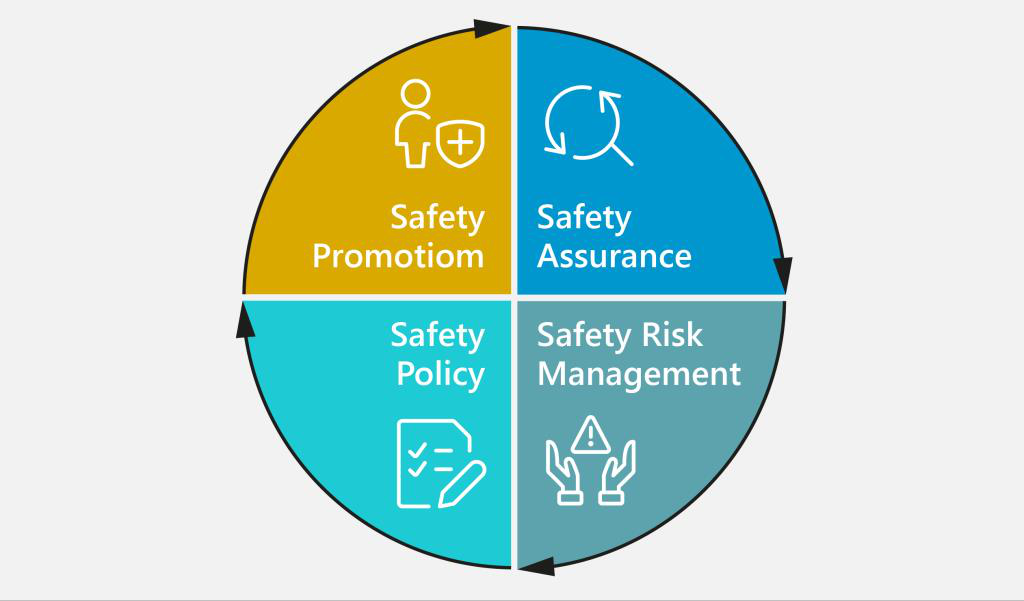
The rule requires systems to measure and report safety performance and is proportionate: the organisation's system is scaled to the size and complexity of its operation.
In any performance-based system, however, there must be sufficient data to evidence performance. In aviation there is a significant amount of automated data, particularly from the aircraft itself, but data provided by the workforce is still the best indicator of the organisation's culture; the right safety culture is essential to generate the right safety performance: “What do the staff report?”, “how often?”, and "how are the reports dealt with?” are all critical questions when considering safety culture. The subset of an organisation's safety culture that provides the environment for reporting of data is known as Just Culture. Just Culture is distinct from 'No Blame' culture, in that there are consequences for individuals in some circumstances: it is not a 'free ride'. Done well, however, it generates a belief that all will be treated fairly, leading to more reporting of problems and more effective design of improvements to address them.
Just Culture is "a culture in which front-line operators or other persons are not punished for actions, omissions or decisions taken by them that are commensurate with their experience and training, but in which gross negligence, wilful violations and destructive acts are not tolerated" (UK Civil Aviation Authority, 2021)
To maximise the benefit of this approach, the regulator's procedures must be linked to assessment of the delivered safety performance, rather than simply to assessment of whether the system is there (which is necessary but not sufficient). The regulator must engage with the performance, risks and issues faced by the regulated organisation and design oversight based on that knowledge.
5.4 Shifting regulatory focus to "Just Culture” and organisational performance
Ben Alcott, International Director & Graham Ward, Non-Executive Member at UK Civil Aviation Authority
Regulated organisations and those who regulate them are well used to demonstrating compliance and addressing 'findings' from audits, but compliance does not need to mean prescription. By crafting regulations for the industry and procedures for the regulator that demand both creation of satisfactory organisational performance (for the industry) and assessment of that performance (for the regulator), regulated industries can move relatively quickly from a prescriptive environment to a performance-based environment without losing the central tenet of compliance; indeed the organisation's attitude to its own compliance with the complete set of applicable regulations is in itself a performance indicator. In aviation the implementation of Safety Management Systems (SMS) in regulation provided the 'hook' to create the environment for a change to the regulatory oversight methodology. The four elements of an SMS are shown in figure 1.
The rule requires systems to measure and report safety performance and is proportionate: the organisation's system is scaled to the size and complexity of its operation.
In any performance-based system, however, there must be sufficient data to evidence performance. In aviation there is a significant amount of automated data, particularly from the aircraft itself, but data provided by the workforce is still the best indicator of the organisation's culture; the right safety culture is essential to generate the right safety performance: “What do the staff report?”, “how often?”, and "how are the reports dealt with?” are all critical questions when considering safety culture. The subset of an organisation's safety culture that provides the environment for reporting of data is known as Just Culture. Just Culture is distinct from 'No Blame' culture, in that there are consequences for individuals in some circumstances: it is not a 'free ride'. Done well, however, it generates a belief that all will be treated fairly, leading to more reporting of problems and more effective design of improvements to address them.
Figure 1 – The Four Elements of a Safety Management System
- Safety Promotion: Training, communication, other actions to create a positive safety culture.
- Safety Assurance: Evaluates the continued effectiveness of implemented risk control strategies.
- Safety Risk Management: Identifies hazards, determines the need for and adequacy of risk controls.
- Safety Policy: Establishes senior management commitment to continually improve safety.
Just Culture is "a culture in which front-line operators or other persons are not punished for actions, omissions or decisions taken by them that are commensurate with their experience and training, but in which gross negligence, wilful violations and destructive acts are not tolerated" (UK Civil Aviation Authority, 2021)
To maximise the benefit of this approach, the regulator's procedures must be linked to assessment of the delivered safety performance, rather than simply to assessment of whether the system is there (which is necessary but not sufficient). The regulator must engage with the performance, risks and issues faced by the regulated organisation and design oversight based on that knowledge.
The requirement for the regulator to design oversight based on risk and performance:
- The competent authority shall establish and maintain an oversight programme covering the oversight activities required by [the relevant requirements].
- For organisations certified by the competent authority, the oversight programme shall be developed taking into account the specific nature of the organisation, the complexity of its activities, the results of past certification and/or oversight activities required by [the relevant requirements] and shall be based on the assessment of associated risks. It shall include within each oversight planning cycle: (1) audits and inspections, including ramp and unannounced inspections as appropriate; and (2) meetings convened between the accountable manager [of the regulated organisation] and the competent authority to ensure both remain informed of significant issues"
(European Union Aviation Safety Agency, 2021)
The CAA's implementation of the requirements on regulators is known as 'Performance Based Regulation' (PBR).[^15] It is a holistic approach that combines two processes. The first, at the company level, looks at all aspects of each regulated organisation's performance, e.g. their levels of compliance and operational safety data to create audit and other oversight events that target not just compliance with the regulations but also specific risks and issues. The second, at the system level, combines common themes from oversight and other safety intelligence to build a system level risk picture to focus CAA-wide activity in the right areas for long term improvements. The outputs from this second process are shared at CAA Board level, providing transparency and challenge.
The shift to PBR was managed as a complex change programme; significant changes to processes, tools and behaviours were required to make it stick. A team of 15-20 secondees were tasked with delivery over a three-year period, at which point continuous improvement processes took over for ongoing development.
The change has delivered significant benefits: understanding of industry safety performance so as to drive the right regulatory interventions is improved; internal collaboration is enhanced; conversations with industry to support their own performance improvement are of more value than just a conversation on compliance errors; and system level risks are more transparent, with active planning for mitigation.
This paper has focused on safety performance in aviation but, by replacing 'safety' with any other regulated aspects, or simply 'organisational performance', the theory can be applied more generally. Indeed “Just Culture” shares similar principles to those of 'psychological safety': the willingness to speak up and share concerns and mistakes to support improvement (Edmondson, 2018). Sharing of performance data with the regulator increases the industry's potential for improvement.
In considering how to move to a regulatory model where organisational performance, including an organisation's attitude to its own compliance, is core to the assessment it is important to consider the culture and behaviour of the regulator and the regulated as a symbiotic ecosystem. This includes designing regulations for the regulated and the regulator that focus on organisational performance and "Just Culture".
Appendix
Bibliography
- Abbott, A., 1988. The System of Professions. Chicago, IL: Chicago University Press.
- AFM 2017. Quality of PIE audit firms: Findings of the assessment of the implementation and embedding of improvement programmes at PIE audit firms and the inspection of the quality of statutory audits at the Big 4 audit firms. Amsterdam: The Dutch Authority for the Financial Markets.
- Akerlof, G.A. and Kranton, R.E. (2010), Identity economics: How our identities shape our work, wages, and well-being, Princeton: Princeton University Press
- Alberti, S. (2021), 'Audit must "dial up focus" to detect fraud more effectively', AccountancyAge, 24 August [online]. Available at: https://www.accountancyage.com/2021/08/24/audit-must-dial-up-focus-to-detect-fraud-more-effectively/
- Alvesson, M. & Sveningsson, S. 2015. Changing Organizational Culture: Cultural Change Work in Progress, London and New York, Routledge.
- American Institute of Certified Public Accountants, SEC Practice Section, Public Oversight Board. (2000). Panel on Audit Effectiveness, "Panel on Audit Effectiveness report and recommendations : August 31, 2000".
- Anderson, G. & Smit, C., 2019. More than a feeling: How do you measure culture?. [Online] Available at: https://www.strategy-business.com/blog/More-than-a-feeling-How-do-you-measure-culture
- Barr-Pulliam, D., Joe, J. R., Mason, S. A. & Sanderson, K.-A., 2019. Unlocking the Black Box of Fair Value Measurement for Financial Instruments: The Role and Perspectives of Accounting Firm-Employed Specialists. [Online] Available at: https://www.icas.com/data/assets/pdf_file/0020/531272/Fair-Value-Barr-Pulliam-Final-Report-2020.pdf
- Baumeister, R. F. (2012), 'Need-to-belong theory' in Van Lange, P. A. M., Kruglanski, A. W. and Higgins, E. T. (eds.) Handbook of theories of social psychology, London: Sage Publications Ltd, p121-140.
- Beck, M. J., Mauldin & G, E., 2014. Who's Really in Charge? Audit Committee versus CFO Power and Audit Fees. The Accounting Review, 89(6).
- BEIS 2021. Restoring trust in audit and corporate governance: Consultation on the government's proposals. Department for Business, Energy & Industrial Strategy.
- Bisbey, T. M., Kilcullen, M. P., Thomas, E. J., Ottosen, M. J., Tsao, K., & Salas, E. (2019). Safety culture: an integration of existing models and a framework for understanding its development. Human Factors.
- Bloomberg, 2021. Regulators Intensify ESG Scrutiny as Greenwashing Explodes. [Online] Available at: https://www.bloomberg.com/news/articles/2021-09-01/regulatory-scrutiny-of-esg-greenwashing-is-intensifying [Accessed 1 September 2021].
- Boivie, S., M. C. Withers, S. D. Graffin, and K. G. Corley. (2021). Corporate directors' implicit theories of the roles and duties of boards. Strategic Management Journal 42 (9): 1662–95.
- Braintrust. (2018). [online] press.princeton.edu. Available at: https://press.princeton.edu/books/paperback/9780691180977/braintrust
- Briloff, A. J., 1990. Accountancy and society a covenant desecrated. Critical Perspectives on Accounting, pp. 5-30.
- Brydon, S. D. C., 2019. Assess, Assure and Inform: Improving Audit Quality and Effectiveness - Report of the independent review into the quality and effectiveness of audit. [Online] Available at: https://assets.publishing.service.gov.uk/government/uploads/system/uploads/attachment_data/file/852960/brydon-review-final-report.pdf
- Business Roundtable, 2019. Statement on the Purpose of a Corporation. [Online] Available at: https://s3.amazonaws.com/brt.org/BRT-StatementonthePurposeofaCorporationJuly2021.pdf [Accessed 1 September 2021].
- Cacioppo, J.T. and Patrick, W. (2009), Loneliness: human nature and the need for social connection, New York: W.W. Norton & Company.
- Chahed, Y., Humphrey, C., O'Dwyer, B., Quattrone, P., Siddiqui, J. & Turley, S. 2020. Written evidence submitted by Alliance Manchester Business School to the Business, Energy and Industrial Strategy Committee inquiry on Delivering Audit Reform. London: UK Parliament.
- Chapman & Co. Leadership Institute, n.d. The Importance of Measuring Organizational Culture. [Online] Available at: https://www.ccoleadership.com/resource/the-importance-of-measuring-organizational-culture/,
- Chatman, J. A., & O'Reilly, C. A. (2016). Paradigm lost: Reinvigorating the study of organizational culture. Research in Organizational Behavior, 36, 199-224.
- CMA 2019. Statutory Audit Services Market Study – Final Report. London: Competitions and Markets Authority.
- CMI. (2014). The MoralDNA of Performance. [online] Available at: https://www.managers.org.uk/knowledge-and-insights/research/the-moraldna-of-performance/
- Cooke, R. A., & Rousseau, D. M. (1988). Behavioral norms and expectations: A quantitative approach to the assessment of organizational culture. Group & Organization Studies, 13(3), 245-273.
- Copeland, J. (2020) 'Audit keeps failing – here's why a fundamental change is needed', [online]. Available at: https://theconversation.com/audit-keeps-failing-heres-why-a-fundamental-change-is-needed-142598 [Accessed 05 August 2021]
- Cowle, Elizabeth N. and Rowe, Stephen P., Don't Make Me Look Bad: How the Audit Market Penalizes Auditors for Doing Their Job (June 1, 2021). Available at SSRN: https://ssrn.com/abstract=3228321 or http://dx.doi.org/10.2139/ssrn.3228321
- Cowton, C., 2019. Professional Responsibility and the Banks. In: C. Cowton, J. Dempsey & T. Sorell, eds. Business Ethics After the Global Financial Crisis: Lessons from The Crash. New York: Routledge, pp. 106-126.
- Cowton, C. J., 2009. Accounting and the ethics challenge: Re-membering the professional body. Accounting and Business Research, 39(3), pp. 177-189.
- Curry, O.S., Mullins, D.A. and Whitehouse, H. (2019). Is It Good to Cooperate? Testing the Theory of Morality-as-Cooperation in 60 Societies. Current Anthropology, 60(1), pp.47–69.
- Davis, M., 1997. Professional codes. In: P. Werhane & R. Freeman, eds. Encyclopedic Dictionary of Business Ethics. Malden, MA: Blackwell, pp. 514-515.
- Deloitte Development LLC, 2015. Corporate culture: The second ingredient in a world-class ethics and compliance program. [Online] Available at: https://www2.deloitte.com/content/dam/Deloitte/us/Documents/risk/us-aers-corporate-culture-112514.pdf
- Eaglesham, J. and Jones, C. (2021) 'Weak oversight plagues audits of billions in private assets', The Walls Street Journal, 13 August [online]. Available at: https://www.wsj.com/articles/weak-oversight-plagues-audits-of-billions-in-private-assets-11628847000
- Edmondson, A. C. (2018), The fearless organization: creating psychological safety in the workplace for learning, innovation, and growth, Hoboken: John Wiley & Sons.
- Ege, M. S. & Stuber, S. B., 2021. Are auditors rewarded for low audit quality? The case of auditor lenience in the insurance industry. Journal of Accounting and Economics, 72(1).
- Elsten, C. and Hill, N. (2017) ‘Intangible asset market value study?', Journal of Licensing Executives Society, 52(4) [online]. Available at: https://ssrn.com/abstract=3009783
- European Union Aviation Safety Agency, 2021. Easy Access Rules for Air Operations ARO.GEN.305 Oversight programme. [Online] Available at: https://www.easa.europa.eu/sites/default/files/dfu/Easy%20Access%20Rules%20for%20Air%20Operations%20%28July%202021%29_0.pdf
- Everett, C., 2020. 3 ways HR can measure the value of organisational culture change in 2020. [Online] Available at: https://www.raconteur.net/the-hive/measure-organisational-culture-change/
- Financial Times, 2021. EY/audit quality: number-crunchers need to sharpen up. [Online] Available at: https://www.ft.com/content/17cbbe69-ea99-4e2f-a9f7-a320107a891b
- FRC, 2018. Audit Culture Thematic Review. [Online] Available at: https://www.frc.org.uk/getattachment/2f8d6070-e41b-4576-9905-4aeb7df8dd7e/Audit-Culture-Thematic-Review.pdf
- FRC 2020. Audit Quality Indicators: AQR Thematic Review. London: Financial Reporting Council.
- FRC, 2020. Letter to Head of Audit: Challenge of Management. [Online] Available at: https://www.frc.org.uk/getattachment/e297b54c-8d11-4ff7-b6c2-772b06b00c15/Challenge-of-management-Letter-Final.pdf
- FRC, 2020. The use of technology in the audit of financial statements. [Online] Available at: https://www.frc.org.uk/getattachment/1c1478e7-3b2e-45dc-9369-c3df8d3c3a16/AQT-Review_Technology_20.pdf
- FRC, 2021. Operational separation of audit practices. [Online] Available at: https://www.frc.org.uk/news/february-2021/operational-separation-of-audit-practices
- FRC, (2021). FRC Conference: Audit Firm Culture: Challenge. Trust. Transformation. Session 5: Audit firm culture, audit quality and the role of the regulator, 21 - 25 June 2021, London, UK [online]. UK: Financial Reporting Council. [Accessed 3 September 2021]. Available from: https://vimeo.com/567614858
- Guénin-Paracini, H., Malsch, B. & Paillé, A. M. 2014. Fear and risk in the audit process. Accounting, Organizations and Society, 39, 264-288.
- Guldenmund, F. W. (2000). The nature of safety culture: a review of theory and research. Safety Science, 34(1-3), 215-257.
- Hicks, Donna. 2018. Leading with Dignity. USA: Yale University Press.
- Hofstede, G., Neuijen, B., Ohayv, D. D., & Sanders, G. (1990). Measuring organizational cultures: A qualitative and quantitative study across twenty cases. Administrative Science Quarterly, 35(2), 286-316.
- Howard-Grenville, J., Lahneman, B., & Pek, S. (2020). Organizational Culture as a tool for change Stanford Social Innovation Review, 18(3), 28-33.
- House, B.R. (2018), 'How do social norms influence prosocial development?', Current Opinion on Psychology, 20, p87-91.
- House of Lords; House of Commons; BEIS Select Committee (2019). The Future of Audit. Available at: https://publications.parliament.uk/pa/cm201719/cmselect/cmbeis/1718/171804.htm#idTextAnchor006 [Accessed 16 August 2021]
- House of Lords; House of Commons; Parliamentary Commission on Banking Standards. (2013). Changing Banking for Good, Vol 1: Summary, and Conclusions and recommendations (excerpts from paragraphs 94 and 96). Available at: https://www.parliament.uk/globalassets/documents/banking-commission/Banking-final-report-volume-i.pdf# [Accessed 16 August 2021]
- Humphrey, C., Sonnerfeldt, A., Komori, N. & Curtis, E. 2021. Audit and the Pursuit of Dynamic Repair. European Accounting Review, 30, 445-471.
- IAASB. (2011) 'Audit quality: An IAASB perspective', [online]. Available at: https://www.ifac.org/system/files/meetings/files/6086_0.pdf [Accessed 02 August 2021]
- IAASB 2020. International Standard on Quality Management (ISQM) 1. Quality Management for Firms that Perform Audits or Reviews of Financial Statements, or Other Assurance or Related Services Engagements. New York: International Auditing and Assurance Standards Board.
- IBE, 2021. FTSE 100 Codes of Ethics: room for improvement, London: Institute of Business Ethics. https://www.ibe.org.uk/resource/ftse-100-codes-of-ethics-room-for-improvement.html
- ICAS, 2020. The Power of One: Moral Courage. [Online] Available at: https://www.icas.com/data/assets/pdf_file/0008/564461/MORAL-COURAGE_FINAL.pdf
- ICAS, 2021. Code of Ethics. [Online] Available at: https://www.icas.com/professional-resources/ethics/icas-code-of-ethics#2020%20code
- IESBA, 2020. Final Pronouncement: Revisions to the Code to Promote the Role and Mindset Expected of Professional Accountants. [Online] Available at: https://www.ethicsboard.org/publications/final-pronouncement-revisions-code-promote-role-and-mindset-expected-professional-accountants * Jakubowski, Z. (2020) ‘FRC flags 'importance of challenge culture' in audit firms', [online]. Available at: FRC flags 'importance of challenge culture' in audit firms
| Accountancy Daily [Accessed 02 August 2021] * Johnson, L. M., Keune, M. B., & Winchel, J. (2019). US auditors' perceptions of the PCAOB inspection process: A behavioral examination. Contemporary Accounting Research, 36(3), 1540-1574. * Kenny, G., 2014. Your Company's Purpose Is Not Its Vision, Mission, or Values. [Online] Available at: https://hbr.org/2014/09/your-companys-purpose-is-not-its-vision-mission-or-values [Accessed 1 September 2021]. * Kerr, S., 1975. On the Folly of Rewarding A, While Hoping for B. Academy of Management Journal, 18(4), pp. 769-783. * Lazer, D. et al. (2009), 'Life in the network: the coming age of computational social science', Science, 323(5915), p721-723. * Lieberman, M.D. (2013), Social: why our brains are wired to connect, New York: Crown Publishers. * Likierman, A. 2020. The elements of good judgment. Harvard Business Review, 98, 102-111. * Marne, O. (2021) 'Joint audit and audit quality', [online]. Available at: Joint audit and audit quality by Oliver Marnet :: SSRN [Accessed 16 September 2021] * Martin, J. (1992). Cultures in organizations: Three perspectives. Oxford University Press. * Masters, B., 2020. Auditors keep falling into the same trap. [Online] Available at: https://www.ft.com/content/b4c3db1c-b2a6-4679-a413-6de8eda5feb1 * McKinsey & Company, 2018. Culture: 4 keys to why it matters. [Online] Available at: https://www.mckinsey.com/business-functions/organization/our-insights/the-organization-blog/culture-4-keys-to-why-it-matters * Mearns, K., Kirwan, B., Reader, T. W., Jackson, J., Kennedy, R., & Gordon, R. (2013). Development of a methodology for understanding and enhancing safety culture in Air Traffic Management. Safety Science, 53, 123-133. * OECD. (2020) 'The importance of audit quality for trust in business', [online]. Available at: https://biac.org/wp-content/uploads/2020/01/the-importance-of-audit-quality-for-trust-in-business-1.pdf [Accessed 05 August 2021] * Paulhus, D.L. and Williams, K.M. (2002). The Dark Triad of personality: Narcissism, Machiavellianism, and psychopathy. Journal of Research in Personality, 36(6), pp.556-563. * PCAOB. 2017. Building a Foundation for Audit Quality. Speech delivered at the AICPA Conference on Current SEC and PCAOB Developments, December 6. Available at: https://pcaobus.org/News/Speech/Pages/Munter-Building-A-Foundation-for-Audit-Quality.aspx [Accessed November 2, 2020] * Plender, W. The Accountant's Certificate in Connection with the Accountant's responsibility. Het internationaal accountantscongress, 1926 Amsterdam 25-59. * Porter, T. M. 1995. Trust in numbers: the pursuit of objectivity in science and public life, Princeton, N.J, Princeton University Press. * Power, M. 2003. Auditing and the production of legitimacy. Accounting, Organizations and Society, 28, 379-394.PwC Global, 2019. Organisational culture and purpose: Harnessing culture to deliver results. [Online] Available at: https://www.pwc.com/gx/en/services/people-organisation/organisational-culture-and-purpose.html * Ramanna, K., 2019. Building a culture of challenge in audit firms. [Online] Available at: https://www.pwc.co.uk/who-we-are/future-of-audit/building-a-culture-of-challenge-in-audit-firms.pdf * Rawls, J., 1971. A Theory of Justice. Cambridge, Massachusetts: The Belknap Press of Harvard University Press. * Reader, T. (2021). Measuring culture and conduct risk (Culture & Conduct Risk in the Banking Sector, Issue. * Reader, T., Gillespie, A., Hald, J., & Patterson, M. (2020). Unobtrusive Indicators of Culture for organizations: A systematic review. European Journal of Work and Organizational Psychology. * Samsonova-Taddei, A. & Siddiqui, J. 2016. Regulation and the Promotion of Audit Ethics: Analysis of the Content of the EU's Policy. Journal of Business Ethics, 139, 183-195. * Schein, E. (1992). Organizational Culture and Leadership. Jossey-Bass. * Schneider, B., Ehrhart, M. G., & Macey, W. H. (2013). Organizational climate and culture. Annual Review of Psychology, 64, 361-388. * Suss, J. et al. (2021), Organisational culture and bank risk, working paper, Bank of England. Available at: https://www.bankofengland.co.uk/working-paper/2021/organisational-culture-and-bank-risk * Tett, G. (2021), Anthro-vision: a new way to see in business and life, New York: Avid Reader Press. * Toh, D. 2016. The changing constellations of audit quality. PhD thesis, The London School of Economics and Political Science. * Turley, S. et al., 2016. Skills, Competencies and the Sustainability of the Modern Audit. [Online] Available at: https://www.icas.com/data/assets/pdf_file/0010/239455/Skills-competencies-and-the-Sustainability-of-modern-audit.pdf * UK Civil Aviation Authority, 2021. Occurrence Reporting: UK Guidance Material For Regulation (EU) No. 376/2014 as retained (and amended in UK domestic law) under the European Union (Withdrawal) Act 2018. [Online] Available at: https://publicapps.caa.co.uk/docs/33/CAA%20376-2014%20Occurrence%20Reporting%20GM.pdf * Velte, P. (2017) 'What do we know about empirical joint audit research? A literature review', [online]. Available at: https://www.researchgate.net/publication/325890126_What_do_we_know_about_empirical_joint_audit_research_A_literature_review [Accessed 16 September 2021] * Westermann, K. D., Cohen, J., & Trompeter, G. (2019). PCAOB inspections: Public accounting firms on “trial”. Contemporary Accounting Research, 36(2), 694-731.
Financial Reporting Council 8th Floor 125 London Wall London EC2Y 5AS
+44 (0)20 7492 2300 www.frc.org.uk
--- [^15]: Performance based regulation
| UK Civil Aviation Authority: https://www.caa.co.uk/Safety-initiatives-and-resources/How-we-regulate/Performance-based-regulation/
-
IESBA Fact Sheet - The Role and Mindset of the Professional Accountant: https://www.ethicsboard.org/publications/iesba-fact-sheet-role-and-mindset-professional-accountant ↩
-
IFAC's Points of View - Achieving High-Quality Audits: https://www.ifac.org/what-we-do/speak-out-global-voice/points-view/achieving-high-quality-audits ↩
-
Audit quality in a multidisciplinary firm - What the evidence shows: https://www.ifac.org/system/files/publications/files/Audit-Quality-in-a-Multidisciplinary-Firm.pdf ↩
-
IFIAR Annual Inspection Findings Survey: https://www.ifiar.org/activities/annual-inspection-findings-survey/ ↩
-
IFAC The State of Play in Sustainability Assurance: https://www.ifac.org/knowledge-gateway/contributing-global-economy/publications/state-play-sustainability-assurance ↩
-
Governing Culture: Risks and Opportunity? A Guide to Board Leadership in purpose, values and culture, published by tomorrow's company: https://www.tomorrowscompany.com/publication/governing-culture/ ↩
-
Building a culture of challenge in audit firms - An independent perspective: https://www.pwc.co.uk/who-we-are/the-future-of-audit/insights/an-independent-perspective-on-building-a-culture-of-challenge.html ↩
-
Definition from rework.withgoogle.com: https://rework.withgoogle.com/print/guides/5721312655835136/: The concept of psychological safety refers to an individual’s perception of the consequences of taking an interpersonal risk or a belief that a team is safe for risk taking in the face of being seen as ignorant, incompetent, negative, or disruptive. In a team with high psychological safety, teammates feel safe to take risks around their team members. They feel confident that no one on the team will embarrass or punish anyone else for admitting a mistake, asking a question, or offering a new idea. ↩
-
The Deloitte Global 2021 Millennial and Gen Z Survey: https://www2.deloitte.com/global/en/pages/about-deloitte/articles/millennialsurvey.html ↩
-
Adapted from US writer Upton Sinclair (1878-1968); US Dictionary of Humorous Quotations, 1949, Ed. Even Esar; Dorset Press, New York. ↩
-
FSCB – Our Work Outside Membership: https://financialservicescultureboard.org.uk/who-we-are/our-work-outside-membership/ ↩
-
FSCB - Our Assessment: https://financialservicescultureboard.org.uk/what-we-do/assessment/ ↩
-
See FSCB's analysis on 'Speaking Up and Listening' at https://financialservicescultureboard.org.uk/speaking-up-and-listening/[Accessed 4 October 2021]; and article 'Speaking Up: small steps to big changes' by Kate Coombs, FSCB's Head of Insights, at https://financialservicescultureboard.org.uk/speaking-up-small-steps-to-big-changes/ [Accessed 4 October 2021] ↩
-
'Organisational Spectroscope': https://medium.com/@duncanjwatts/the-organizational-spectroscope-7f9f239a897c ↩