
The content on this page has been converted from PDF to HTML format using an artificial intelligence (AI) tool as part of our ongoing efforts to improve accessibility and usability of our publications. Note:
- No human verification has been conducted of the converted content.
- While we strive for accuracy errors or omissions may exist.
- This content is provided for informational purposes only and should not be relied upon as a definitive or authoritative source.
- For the official and verified version of the publication, refer to the original PDF document.
If you identify any inaccuracies or have concerns about the content, please contact us at [email protected].
TCFD disclosures and climate in the financial statements
The FRC does not accept any liability to any party for any loss, damage or costs howsoever arising, whether directly or indirectly, whether in contract, tort or otherwise from an action or decision taken (or not taken) as a result of any person relying on or otherwise using this document or arising from any omission from it.
© The Financial Reporting Council Limited 2022 The Financial Reporting Council Limited is a company limited by guarantee. Registered in England number 2486368. Registered Office: 8th Floor, 125 London Wall, London EC2Y 5AS
- Executive Summary
- Background to this thematic review
- (1) Granularity and specificity
- (2) Balance
- (3) Interlinkage with other narrative disclosures
- (4) Materiality
- (5) Connectivity between TCFD and financial statements disclosures
- Summary of key findings – TCFD disclosures
- Summary of key findings – financial statements disclosures (Section 8)
- How to use this thematic report
- Notes on sample selection
- 1. Introduction
- 2. Statement of the extent of consistency with the TCFD framework
- Footnotes
- Listing Rules requirement – statement of the extent of consistency with the TCFD framework
- Listing Rules requirement – location of disclosures
- Location of TCFD disclosures
- Signposting of disclosures outside the annual report
- Reasons for providing TCFD disclosures outside the annual report
- Materiality assessment
- Extent of compliance with TCFD recommendations and recommended disclosures
- TCFD overview
- 2. Statement of the extent of consistency with the TCFD framework
- Listing Rules requirement – statement of the extent of consistency with the TCFD framework
- Listing Rules requirement – location of disclosures
- Location of TCFD disclosures
- Signposting of disclosures outside the annual report
- Reasons for providing TCFD disclosures outside the annual report
- Materiality assessment
- Extent of compliance with TCFD recommendations and recommended disclosures
- TCFD overview
- 3. TCFD – governance
- 4. TCFD – strategy
- 5. TCFD – risk management
- 6. TCFD – metrics and targets
- TCFD recommendation:
- 6. TCFD – metrics and targets (continued)
- 6. TCFD – metrics and targets (continued)
- 6. TCFD – metrics and targets (continued)
- 6. TCFD – metrics and targets (continued)
- 6. TCFD – metrics and targets (continued)
- 6. TCFD – metrics and targets (continued)
- 6. TCFD – metrics and targets (continued)
- 6. TCFD – metrics and targets (continued)
- 6. TCFD – metrics and targets (continued)
- 6. TCFD – metrics and targets (continued)
- 6. TCFD – metrics and targets (continued)
- 6. TCFD – metrics and targets (continued)
- 6. TCFD – metrics and targets (continued)
- 6. TCFD – metrics and targets (continued)
- Net zero
- Our path to Net Zero
- Stewardship of net zero
- Other reporting / disclosure frameworks and industry groups
- 7. TCFD – sector-specific and other guidance
- 8. Climate change in the financial statements
- 8. Climate change in the financial statements (continued)
- 8. Climate change in the financial statements (continued)
- Appendices
- Appendix 1 – Scope
- Appendix 2 - Detailed FRC expectations
Executive Summary
Background to this thematic review
Companies' responses to the risks and opportunities posed by climate change and the transition to a low carbon economy are at the forefront of the minds of investors, regulators and other users of corporate reporting. Comprehensive, high-quality and internally consistent climate-related disclosures lead to greater transparency about companies' responses to these challenges which, in turn, helps investors to make more informed investment decisions. In response to these considerations, the Financial Conduct Authority (FCA) introduced specific TCFD climate-related disclosure requirements for listed companies 1, with the first reports issued by premium listed companies in relation to December 2021 year ends.
In accordance with the supervisory strategy agreed with the FCA and set out in Primary Market Bulletin 36, we have carried out a review, supported by the FCA, of both the TCFD disclosures and of climate-related reporting in the financial statements of 25 premium listed companies. This thematic report sets out the results of our review. The FCA have also published a separate report setting out the results of their preliminary review of premium listed companies' TCFD disclosures, which includes an analysis of companies' TCFD disclosures by sector and company size.
A significant step forwards for UK-listed companies' climate change reporting....
The first year of mandatory TCFD disclosures has been challenging for many preparers due to the complexities of data collection, the need to establish robust new processes, sometimes involving information provided by third parties in the company's value chain, and the lack of established good reporting practice. We found that the companies included in our review – which was focussed on larger premium listed companies in sectors that are more exposed to climate change – have generally risen to the challenge, and were broadly able to provide the TCFD disclosures that are 'particularly expected' by the FCA's Listing Rule. 22 of 25 companies also made reference to climate-related risks in their financial statements disclosures, a significant improvement since our 2020 thematic review.
As a result, the December 2021 annual reports and accounts of many of our sample of UK premium listed companies provide a better basis for users of annual reports and accounts to make decisions about risks and opportunities related to climate change, responding to the needs of investors. We have provided examples of better practice disclosures throughout this report, and encourage companies, especially those at an earlier stage in their climate-related reporting journey, to use these as reference points when preparing their own disclosures.
...but companies need to continue to develop their narrative and financial statements disclosures
There is, however, a range of maturity in companies' disclosures, even within our sample which was weighted towards companies who were better prepared for the reporting requirement. Below, we set out five main ways in which companies could significantly improve their TCFD disclosures and financial statements reporting in relation to climate change. We encourage all entities preparing TCFD disclosures under the Listing Rules and/or TCFD-aligned disclosures under the new Companies Act regulations to refer to these broad themes, as well as our more detailed expectations throughout the report, which are also summarised in Appendix 2.
(1) Granularity and specificity
Some companies provided high-level, generic information about climate change which did not appear to adequately explain the potential impact on different businesses, sectors and geographies. We expect the specificity and granularity of companies' climate-related disclosures to improve as their processes to manage climate-related risks and opportunities become more fully embedded into governance and management structures; we also expect the link with financial planning to become clearer and more quantified.
(2) Balance
Some companies discussed opportunities arising from climate change and the transition to a low carbon economy without specifying the expected size of the opportunity relative to existing, more carbon-intensive, businesses, and without identifying dependencies on new technology. We expect companies to ensure that the discussion of climate-related risks and opportunities is balanced, and to consider linking the description of climate-related opportunities to any technological dependencies.
(3) Interlinkage with other narrative disclosures
We saw examples of TCFD disclosures which were not well integrated with other elements of companies' narrative reporting. We expect companies to consider the interlinkages of TCFD disclosures with other narrative disclosures in the annual report. For example, they may need to consider the output of climate-related scenario analysis in discussion elsewhere in the strategic report about the company's business model and strategy, or to explain how climate-related risks have been assessed and prioritised compared to other risks.
(4) Materiality
Most companies in our sample included a clear statement of the extent of compliance with the TCFD framework as required by the new Listing Rule. However, companies did not always explain how they had applied materiality to their TCFD disclosures, and many did not make it clear how they had taken into account the TCFD all-sector guidance and supplemental guidance for financial and non-financial companies. In many cases, when a company did not include some elements from this guidance in their disclosures, it was unclear whether they had considered these elements and decided that they were not relevant or material, or whether these elements had been omitted for other reasons such as a lack of robust data. This is reflected in the charts in Sections 3 to 6 of this report, which show that our assessment of the level of companies' compliance with TCFD was consistently lower than that claimed by the companies.
While we do not encourage a 'checklist' approach to the TCFD guidance, we expect companies to clearly articulate how they have considered materiality in the context of their TCFD disclosures when preparing the TCFD 'statement of compliance'.
We may challenge companies that claim consistency with a recommended disclosure where it is not clear that all relevant and material elements of the recommended TCFD disclosures – including the all-sector guidance and, where appropriate, the supplemental guidance for the financial sector and for non-financial groups – have been addressed.
In addition, we may challenge companies if they do not provide disclosures consistent with the recommendations 'particularly expected' by the FCA, for example, in the areas of risk management and the elements of strategy not concerning scenario analysis, without a credible explanation.
(5) Connectivity between TCFD and financial statements disclosures
Some companies' discussion of the impact of climate on the financial statements was generic in nature and hence not very helpful in understanding the relationship between climate-related risks and amounts in the financial statements. This included a few companies who discussed climate change and transition plans extensively in the strategic report. Investor groups have called for greater connectivity between narrative reporting and climate-related assumptions and estimates in financial statements, including an understanding of the extent to which accounting assumptions and estimates are 'Paris-aligned' (see page 92 for a discussion of 'Paris-aligned' accounting).
We expect companies to consider the connectivity between TCFD disclosures and the financial statements, and to provide explanations where necessary, to address whether:
- the degree of emphasis placed on climate change risks and uncertainties in the narrative reporting, including TCFD disclosures, is consistent with the extent of disclosure about how those uncertainties have been reflected in judgements and estimates applied in the financial statements;
- the relationships between assumptions and sensitivities considered in TCFD scenarios, including any Paris-aligned scenarios, and those applied in the financial statements, require further elaboration;
- emissions reduction commitments and strategies described in the narrative have been appropriately reflected in the financial statements;
- the scale of growth of businesses and extent of progress against climate-related opportunities referred to in the narrative reporting is appropriately reflected in the segmental disclosures; and
- discussion of matters which may have an adverse effect on asset values or useful lives in the narrative reporting is consistent with positions taken in the financial statements.
We may challenge companies who disclose significant climate risks or net zero transition plans in narrative reporting, but who do not appear to adequately explain how this has been taken into account when preparing their financial statements.
Our detailed expectations are set out in dark blue boxes throughout Sections 2 to 8 of this report; for ease of reference, our expectations are also shown against the respective Listing Rule and TCFD requirements in Appendix 2.
Summary of key findings – TCFD disclosures
- Governance (Section 3)
- Describe the organization's governance around climate-related risks and opportunities.
- As expected, all companies provided information about the governance of climate-related matters.
- Fewer companies explained how often the board considers climate-related matters, how management reports back to the board, whether climate-related performance objectives have been set, and the effects of climate on major capital expenditure, acquisitions and disposals.
- Strategy (Section 4)
- Disclose the actual and potential impacts of climate-related risks and opportunities on the organization's businesses, strategy, and financial planning where such information is material.
- All companies described some climate-related risks and opportunities, but the impact on strategy was not universally well articulated, and granular information linked to businesses or geographies was sometimes missing.
- Some companies' discussion of climate-related risks and opportunities appeared to be unduly focussed on opportunities at the expense of risks.
- Most companies undertook a scenario analysis, but the level of detail provided was variable; only a quarter of companies disclosed quantified outcomes.
- It was unclear from most reviews how the scenario analysis had informed financial planning.
- Risk Management (Section 5)
- Disclose how the organization identifies, assesses, and manages climate-related risks.
- Risk management of climate-related matters was integrated into the overall risk management process of most companies, but it was not always clear how climate risks had been prioritised against other risks, and materiality was often not well explained.
- Metrics and Targets (Section 6)
- Disclose the metrics and targets used to assess and manage relevant climate-related risks and opportunities where such information is material.
- Metrics disclosures were focussed on the Scope 1 and 2 emissions which are also required for statutory reporting, with fewer companies reporting Scope 3 emissions or other climate-related risk and opportunity metrics.
- Most companies reported a net zero target, but there was a lack of clarity and consistency in how it was described.
- Historical data and explanations for movements in metrics were not always provided, making it hard to understand how a company is progressing against its targets.
The detailed results of our review of companies' TCFD disclosures and compliance with Listing Rule 9.8.6R(8) / 9.8.7R can be found in Sections 3 to 7.
Summary of key findings – financial statements disclosures (Section 8)
- Judgements and estimates
- A few companies disclosed climate change as a relevant factor for sources of estimation uncertainty with a significant risk of a material adjustment in the next financial year, and for significant judgements.
- In some cases, companies explained why climate was not currently a relevant factor for significant judgements and estimates.
- Some companies presented additional sensitivity disclosures to show the effect of assumptions included in the scenario analysis in TCFD disclosures.
- Impairment reviews
- Several companies clearly addressed climate change in impairment reviews, quantifying significant assumptions such as commodity pricing and carbon pricing, and providing additional climate-related sensitivity analysis.
- Others provided very generic disclosure of how climate had been factored into impairment review calculations and sensitivities.
- A minority of companies did not provide all the disclosures required by IAS 36, which made it difficult to assess how they had considered climate change in their impairment reviews.
- It was not always clear whether climate risk had been factored into cash flow projections or discount rates.
- Useful economic lives of assets
- Several companies clearly explained why the useful economic lives of certain assets were not affected by climate change or the transition to a low carbon economy.
- Other companies, including some that stated their intention to replace or upgrade certain types of asset or production facilities, or that had set specific net zero targets, did not explain how climate change had been taken into account when determining the useful economic lives of related assets.
- Segmental reporting and disaggregated revenue disclosures
- Several companies revised their segmental reporting to reflect changes in the way management information was delivered in response to climate change and transition
- The prominence of other companies' discussion of new low carbon businesses did not appear to be reflected in the segmental disclosures or in disaggregation of revenue disclosures.
- Emerging areas
- A small number of companies recognised emissions right assets or disclosed green finance or sustainability linked finance.
- The extent of explanation of the accounting policies for these items did not always match their prominence in companies' narrative reporting.
The detailed results of our review of companies' financial statements disclosures in respect of climate change can be found in Section 8.
How to use this thematic report
Each section contains relevant requirements in light blue boxes, followed by our observations on the disclosures of the companies in our sample, in the following format:
- Represents good practice
- Represents an opportunity for improvement or enhancement
- ▲ Represents an omission of required disclosure or other issue
We have provided several examples of better practice in our report, highlighted in grey boxes, and encourage companies, especially those at an earlier stage in their climate-related reporting journey, to use these as reference points when preparing their own disclosures.
Dark green boxes contain other information relevant to our thematic report.
Our expectations of companies are included in dark blue boxes in each section, and also summarised in Appendix 2 to this report.
Notes on sample selection
Our sample was weighted towards sectors and industries that are perceived to face greater risks concerning climate change, and towards FTSE 350 companies. It is not, therefore, representative of all listed companies, as the companies in our sample are likely to be further advanced in their TCFD implementation process than the market in general.
This review focussed on the premium listed companies that were required to provide TCFD disclosures for the first time this year. However, our findings will be of interest to other companies for whom climate-related disclosures will be required in future see Section 1 below). Our findings on climate in financial statements are relevant for all companies.
Highlighting aspects of reporting by a particular company should not be considered an evaluation of that company's reporting as a whole. The examples included in this report illustrate better practice in a particular area, and should not be taken as an indication of either the accuracy of the underlying information, which has not been verified by our review, or the quality of the company's reporting more generally.
1. Introduction
Why did we carry out this review?
In 2020, the FRC published a wide-ranging thematic review of climate-related considerations by boards, companies, auditors, investors and professional associations. As part of this review, the Corporate Reporting Review team (CRR) issued a report addressing the question 'How are companies developing their reporting on climate-related challenges?'.
This 2020 thematic report found that:
- an increasing number of companies were providing narrative reporting on climate-related issues. While minimum legal requirements were often being met, users were calling for additional disclosures to inform their decision making;
- some companies had set strategic goals such as 'net zero', but it was unclear from their reporting how progress towards these goals would be achieved, monitored or assured; and
- consideration and disclosure of climate change in financial statements lagged behind narrative reporting; our review identified areas of potential non-compliance with the requirements of International Financial Reporting Standards (IFRS).
Since the publication of that report, a new Listing Rule 2 has come into force requiring commercial companies with a UK premium listing to include a statement in their annual financial report setting out:
- whether they have made disclosures consistent with the recommendations of the Task Force on Climate-related Financial Disclosures (TCFD) in their annual financial report;
- where they have included some, or all, of the disclosures in a document other than the annual financial report, an explanation of why and a reference to where the disclosures can be found; and
- where disclosures have not been made, an explanation of why, and a description of any steps taken or planned to be able to make consistent disclosures in the future – including relevant time frames.
This report seeks to assess the quality of the TCFD disclosures provided by premium listed companies in response to the new Listing Rule. We also consider the extent to which the financial statements reflect the impact of climate change, to determine whether this has improved since our 2020 thematic review.
What did we do?
Our review assessed a sample of 25 premium listed companies' annual reports and accounts to see whether they complied with the requirements of Listing Rule 9.8.6R(8), which requires companies to include a statement in their annual report setting out whether they have included disclosures consistent with the TCFD framework, as summarised below:
Recommendations and Supporting Recommended Disclosures
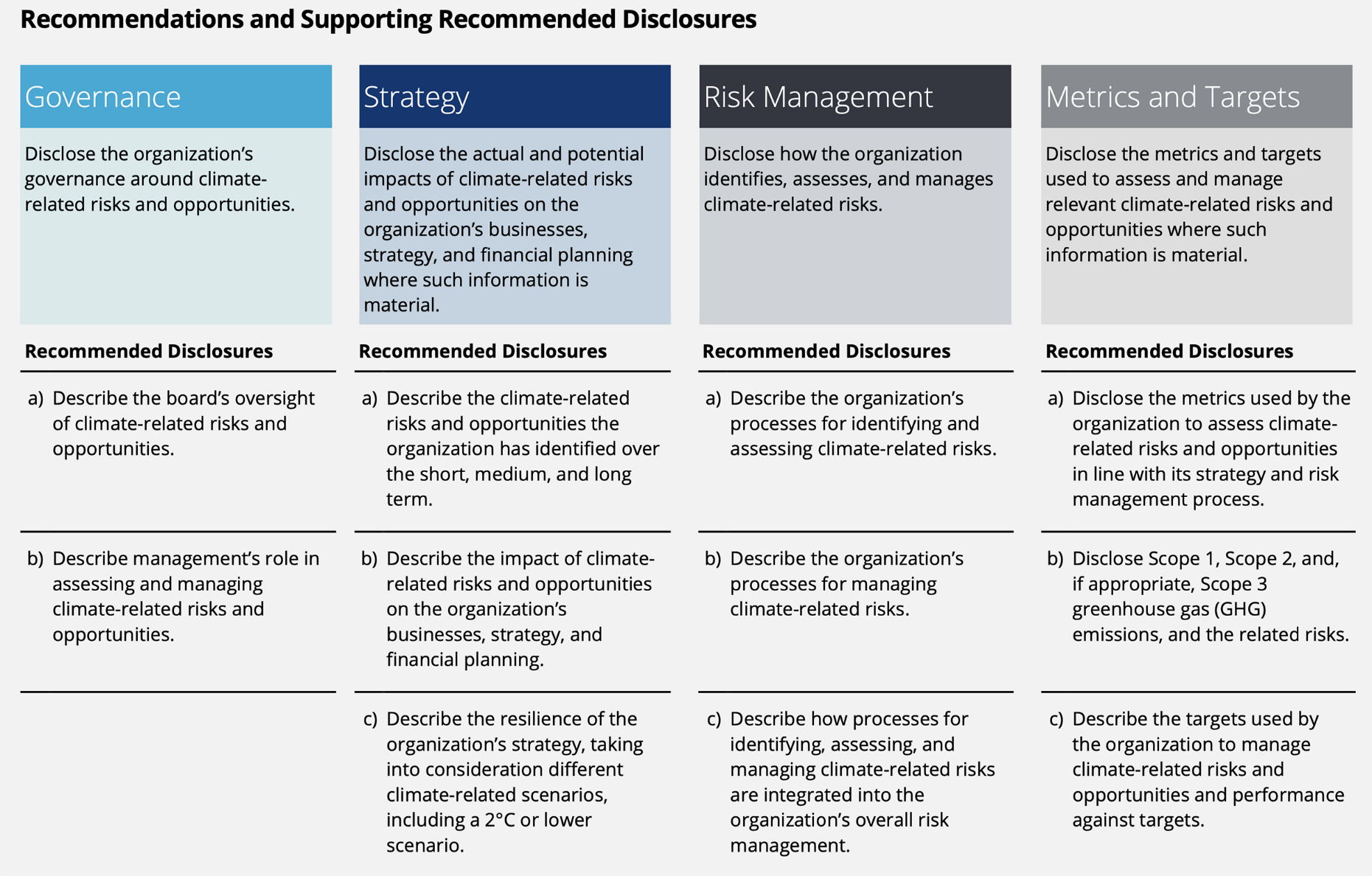
| Governance | Strategy | Risk Management | Metrics and Targets |
|---|---|---|---|
| Disclose the organization's governance around climate-related risks and opportunities. | Disclose the actual and potential impacts of climate-related risks and opportunities on the organization's businesses, strategy, and financial planning where such information is material. | Disclose how the organization identifies, assesses, and manages climate-related risks. | Disclose the metrics and targets used to assess and manage relevant climate-related risks and opportunities where such information is material. |
| Recommended Disclosures | Recommended Disclosures | Recommended Disclosures | Recommended Disclosures |
| a) Describe the board's oversight of climate-related risks and opportunities. | a) Describe the climate-related risks and opportunities the organization has identified over the short, medium, and long term. | a) Describe the organization's processes for identifying and assessing climate-related risks. | a) Disclose the metrics used by the organization to assess climate-related risks and opportunities in line with its strategy and risk management process. |
| b) Describe management's role in assessing and managing climate-related risks and opportunities. | b) Describe the impact of climate-related risks and opportunities on the organization's businesses, strategy, and financial planning. | b) Describe the organization's processes for managing climate-related risks. | b) Disclose Scope 1, Scope 2, and, if appropriate, Scope 3 greenhouse gas (GHG) emissions, and the related risks. |
| c) Describe the resilience of the organization's strategy, taking into consideration different climate-related scenarios, including a 2°C or lower scenario. | c) Describe how processes for identifying, assessing, and managing climate-related risks are integrated into the organization's overall risk management. | c) Describe the targets used by the organization to manage climate-related risks and opportunities and performance against targets. |
Listing Rule 9.8.6BG requires companies to perform a detailed assessment of their disclosures taking into account the TCFD 'Guidance for All Sectors', as well as the supplemental guidance for the financial sector and for non-financial groups in certain industries. In order to assess companies' compliance with the Listing Rules, we considered this guidance where relevant. See Section 7 for further details. The TCFD framework against which companies were required to report for the purposes of the Listing Rules is that set out in the 'Recommendations of the Task Force on Climate-related Financial Disclosures' published in June
- An updated version of the annexe to this report was published in October 2021 (the '2021 guidance', which includes updated guidance for all sectors, as well as some changes to the guidance for specific sectors. Further details of this change can be found in Section 7 below. The Listing Rules require companies to take account of the 2021 guidance with effect from 1 January 2022.
We also assessed the extent to which these companies had considered the risks of climate change in meeting the requirements of IFRS accounting standards.
The FRC's CRR team reviewed 22 UK-registered companies, and a team from the Financial Conduct Authority (FCA) reviewed 3 companies registered overseas with UK listings. The findings of all 25 reviews are incorporated into this report.
Further details of both the sample selected and the areas of reporting reviewed can be found in Appendix 1 to this report.
The FRC's work on ESG and climate-related reporting
In July 2021, the FRC's ESG and Climate Group produced a Statement of Intent on six areas of current challenge in Environmental, Social and Governance (ESG) reporting which outlined the actions the FRC will take within the diverse regulatory framework.
Extract Statement of Intent from the ESG and Climate Group:
"To work towards a more consistent architecture, we will take proportionate action within our remit including developing Codes, standards, guidance and expectations. We will also work with and influence standard setters, regulators, market participants and other stakeholders to build a system that is forward-looking and fit for purpose. We will work to build expectations for collation and ensure the development of appropriate standards and controls, delivering robust internal information which is considered strategically and then reported externally where relevant through high quality disclosure, in a useable and useful format, leading to better stakeholder and investment decision-making, all in the public interest. Some of these actions will be short term and some we will take forward in the longer term. Not all of them can be delivered simultaneously, and we need to use our resources carefully, identifying those areas where we can make the greatest contribution and have the greatest impact.”
Further details of the FRC's other work on ESG and climate-related reporting, including reports from CRR and the Financial Reporting Lab, can be found on our website.
A rapidly changing regulatory environment
Future climate-related reporting requirements will be applicable to a much broader population of companies in the UK, as set out below. These disclosures will also fall to CRR to monitor and enforce; the findings of this review will also help other companies preparing for the extended disclosure regime.
| Standard-listed companies | Regulated businesses | Other companies and LLPs | |
|---|---|---|---|
| What are the new requirements? | The FCA is extending the scope of the climate-related disclosure requirements currently applied to premium listed companies, as set out in Listing Rule 9.8.6R(8) 3 | The FCA has introduced a new Environmental, Social and Governance (ESG) sourcebook containing rules and guidance for disclosures consistent with the TCFD framework 4 | The Department for Business, Energy & Industrial Strategy (BEIS) will require mandatory climate-related financial disclosures in the strategic report in line with the four overarching pillars of the TCFD recommendations (Governance, Strategy, Risk Management, Metrics & Targets) 5. Unlike the current Listing Rules, which allow companies to comply or to explain their non-compliance, these disclosures will be mandatory. |
| Who is affected? | Issuers of standard listed shares and Global Depositary Receipts representing equity shares, in each case excluding listed investment entities and shell companies | * asset managers life insurers (including pure insurers) non-insurer FCA-regulated pension providers, including platform firms and Self-invested Personal Pension (SIPP) operators * FCA-regulated pension providers |
Publicly quoted companies, large private companies and Limited Liability Partnerships (LLPs), specifically: UK companies that have more than 500 employees and have transferable securities admitted to trading on a UK regulated market banking and insurance companies with more than 500 employees UK registered companies with securities admitted to AIM with more than 500 employees Other UK registered companies and LLPs with more than 500 employees and a turnover of more than £500m |
| What is the effective date? | Accounting periods beginning on or after 1 January 2022 | Accounting periods beginning on or after 1 January 2022 | Accounting periods beginning on or after 6 April 2022 |
International reporting developments
In March 2022, the International Sustainability Standards Board (ISSB) published two exposure drafts for public consultation. IFRS S1 covers General Requirements for Disclosure of Sustainability-related Financial Information, while IFRS S2 specifically addresses Climate-related Disclosures. Both exposure drafts are structured around the four pillars of TCFD, and are designed to provide a baseline for individual jurisdictions to build on. The FRC welcomes the publication of the exposure drafts and strongly supports the development of high-quality global standards for sustainability reporting. The FRC's response to the exposure drafts can be found on our website.
The UK government has confirmed it intends to incorporate these standards into the UK corporate reporting framework, and will be consulting on the endorsement and adoption mechanisms in due course.
On 21 June 2022, the Council and European Parliament reached a provisional political agreement on the corporate sustainability reporting directive (CSRD) 6. The CSRD amends the European Non-Financial Reporting Directive (2014). It introduces more detailed reporting requirements on sustainability issues such as environmental rights, social rights, human rights and governance factors. The European Financial Reporting Advisory Group will be responsible for establishing European standards, following technical advice from a number of European agencies. Mandatory application of these proposed standards will be phased in from 2023 to 2026.
In the US, the Securities and Exchange Commission issued a proposed rule titled 'The Enhancement and Standardization of Climate-related Disclosures for Investors' 7, which was also open for public consultation earlier this year. This rule is also proposed to be phased in from 2023, starting with the largest filers.
2. Statement of the extent of consistency with the TCFD framework
Footnotes
Listing Rules requirement – statement of the extent of consistency with the TCFD framework
Paragraph 8(a) of Listing Rule 9.8.6R requires that listed companies must include in their annual financial report a statement setting out whether the listed company has included in that financial report climate-related financial disclosures consistent with the TCFD Recommendations and Recommended Disclosures. (For brevity, we refer to such a statement throughout this report as a 'compliance statement'.)
Of the 25 companies included in our review, 22 provided a clear and unambiguous statement of the extent of consistency with the TCFD framework.
A number of companies used the compliance statement to describe areas of proposed improvement for future years. While this is useful information, in some cases it was not clear whether the company considered that it was currently in compliance with the TCFD Recommendations.
A small number of companies had a clear statement in one location setting out which TCFD disclosures had and had not been provided, but elsewhere in the reporting used terminology referring to "TCFD compliance” without noting the areas where disclosures had not been provided, which could potentially be misleading.
Some companies used vague terminology such as “we support" the TCFD framework; it was not clear from this whether or not they considered their disclosures to be consistent with the TCFD framework as required by the Listing Rules.
We expect companies to:
- Provide a statement of the extent of consistency in the annual report as required by the Listing Rules.
- Ensure that it is clear from the compliance statement whether management considers that they have given sufficient information to be consistent with the TCFD framework in the current year.
- Ensure that any references to the TCFD disclosures elsewhere in the annual report should give consistent messages about the extent of consistency.
"We set out below our climate-related financial disclosures consistent with all of the TCFD recommendations and recommended disclosures. By this we mean the four TCFD recommendations and the 11 recommended disclosures set out in Figure 4 of Section C of the report entitled “Recommendations of the Task Force on Climate-related Financial Disclosures" published in June 2017 by the TCFD.”
Shell plc, Annual Report and Accounts 2021, page 75
Straightforward statement of full compliance
"At the time of publication, the Company has made climate-related financial disclosures consistent with the TCFD recommendations and recommendations disclosures [sic] in this TCFD summary against:
- governance (all recommended disclosures)
- risk management (all recommended disclosures)
- strategy (disclosures (a) and (b))
- metrics and targets (disclosures (a) and (b)).
For strategy disclosures (a) and (b), further work is underway to enhance the identification, impact and reporting for climate-related risks and opportunities, and how these map over the short, medium and long term. This further work will be published in an updated TCFD report which the Company will publish later in the year."
James Fisher and Sons plc, Annual Report 2021, page 52
Clear statement of which recommended disclosures have been provided
Future improvements have been explained without casting doubt on current year compliance
Listing Rules requirement – location of disclosures
Paragraph 8(b)(i) of Listing Rule 9.8.6R requires that, where a listed company has made climate-related financial disclosures consistent with the TCFD Recommendations and Recommended Disclosures, but has included some or all of these disclosures in a document other than the annual financial report, it should disclose:
- the recommendations and/or recommended disclosures for which it has included disclosures in that other document;
- a description of that document and where it can be found; and
- the reasons for including the relevant disclosures in that document and not in the annual financial report.
Paragraph 8(c) requires disclosure of where in its annual financial report or (where appropriate) other document the climate-related financial disclosures can be found.
The majority of the companies in our sample included their TCFD disclosures within the strategic report, as shown below:
Location of TCFD disclosures
This pie chart shows the location of TCFD disclosures:
- 56% - Strategic report
- 28% - Summary in strategic report, further detail elsewhere
- 12% - Elsewhere in annual report
- 4% - Spread between a number of different documents
In a small number of cases, clearer signposting could have been provided to the correct document, for example by ensuring that consistent document titles were used. One company provided additional detail in a separate sustainability report, but did not mention this in the disclosures given in the annual report.
We do not consider vague references such as "these disclosures can be found throughout our Annual Report and Sustainability Report" to be sufficiently precise to meet the Listing Rules requirement.
One company referred to its 2020 CDP report for some of the required information. This was unhelpful as these disclosures related to a different time period. The 2021 update to the TCFD Implementing Guidance clarifies that TCFD disclosures should report information for the same period covered by their mainstream financial filings.
Another company referred to a sustainability report that was to be published later than the annual report. TCFD disclosures should be available at the same time as the annual report.
Signposting of disclosures outside the annual report
Where some or all disclosures were provided outside the annual report, including in integrated reports, sustainability reports and climate change reports, the majority of companies provided an adequate explanation of which disclosures were included in another document and where that document could be found.
As explained in Section 1 above, from 2023 many large companies and LLPs will be required by the Companies Act to provide certain climate-related financial disclosures within their strategic reports. These disclosure requirements are substantially aligned with the TCFD Framework, so companies that are required to comply with both sets of requirements may choose to reduce duplication by also presenting the TCFD-aligned disclosures required by the Listing Rules in their strategic reports.[^8]
We expect companies to:
- Provide granular and specific signposting to where the TCFD disclosures can be found, including specific page references or hyperlinks. Where disclosures are spread between several different locations, it is helpful to provide a single table indicating the location of each element required.
- Ensure that any referenced information presented outside of the annual report covers the same time period and is available no later than the publication of the annual report.
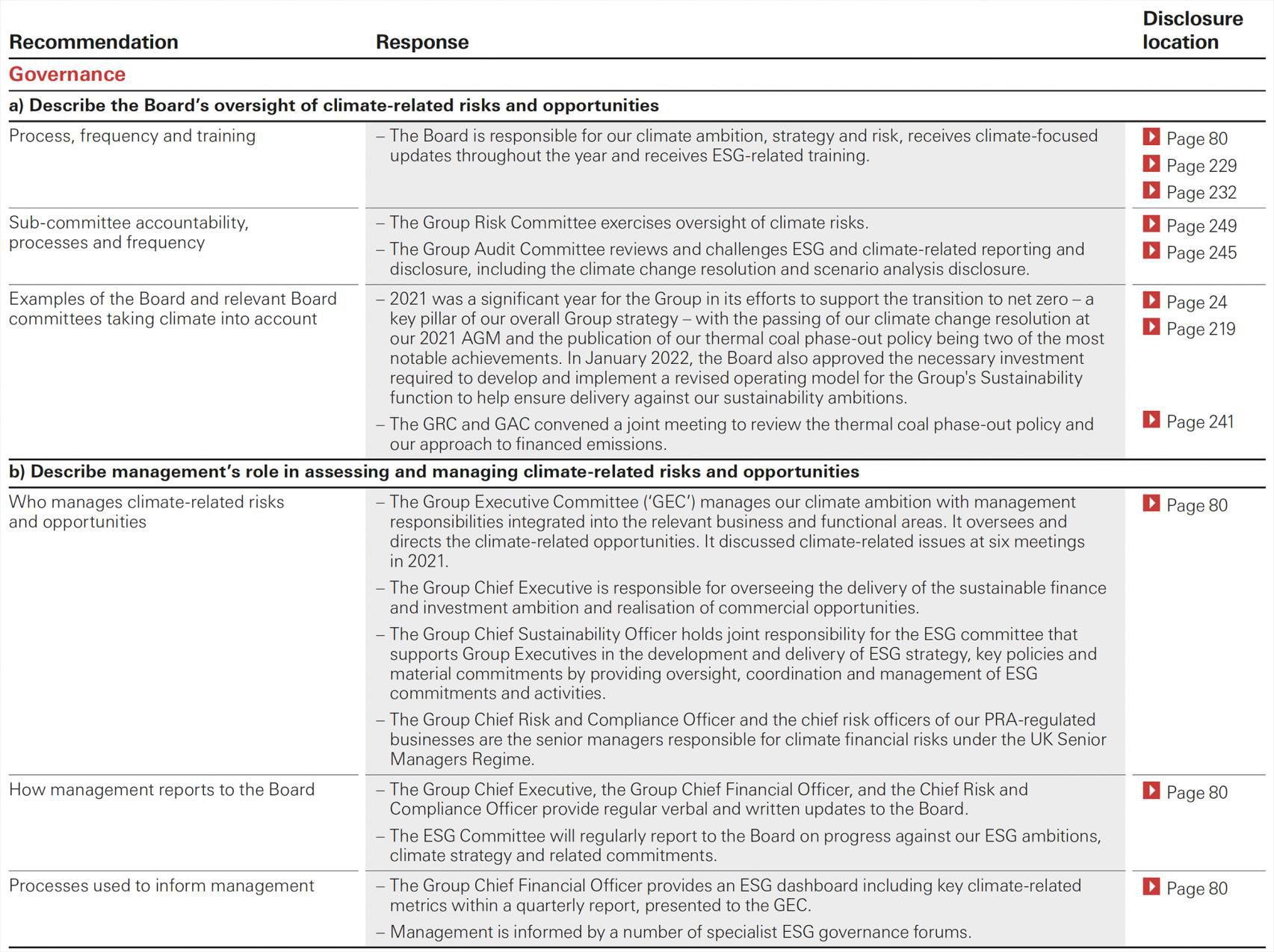
Table clearly setting out where to find each disclosure
HSBC Holdings plc, Annual Report and Accounts 2021, page 63
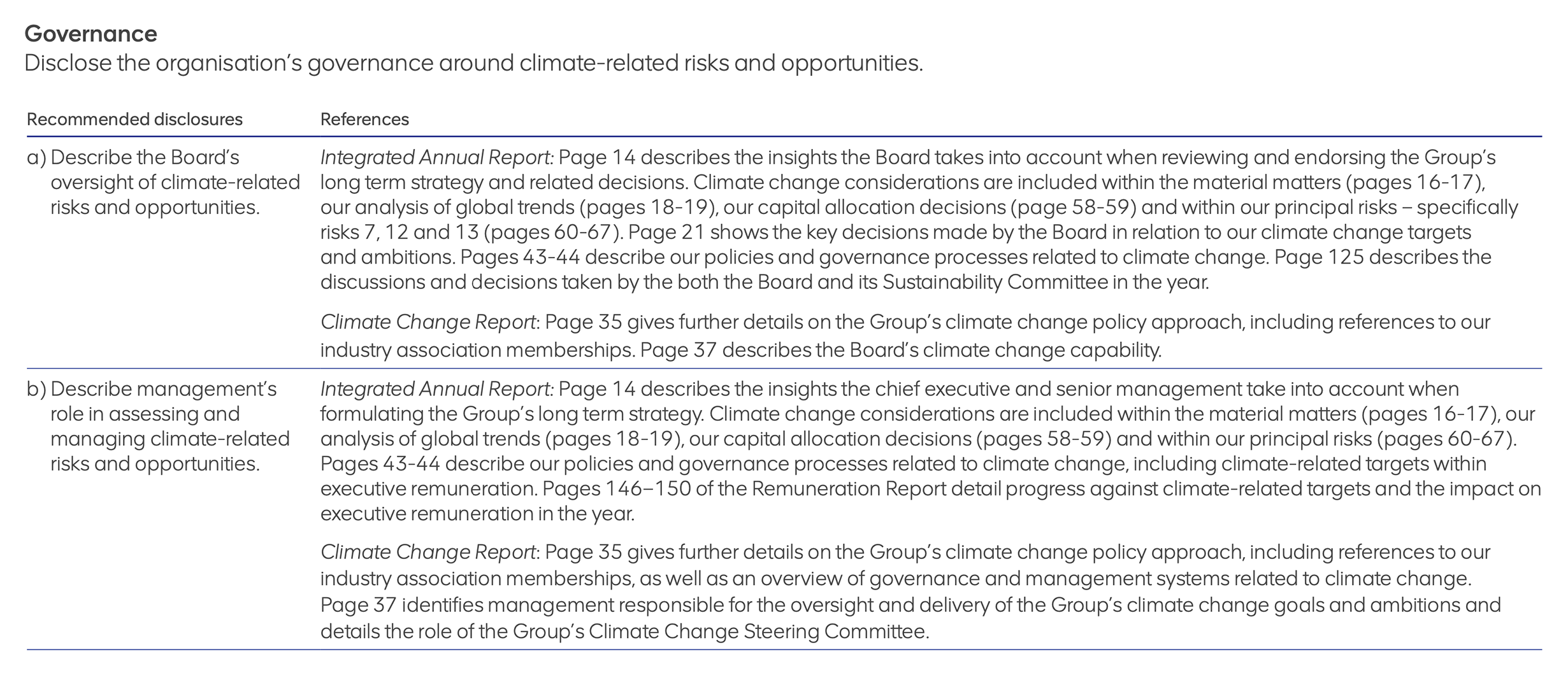
Clearly sets out which disclosures are found in each document
Anglo American plc, Integrated Annual Report 2021, page 102
Reasons for providing TCFD disclosures outside the annual report
Seven companies provided some or all disclosures outside the annual report.
Two companies explained that this was due to the size and scale of the disclosures.
The remaining five companies did not provide an explanation for why the disclosures were provided outside the annual report.
"We are reporting against the Task Force on Climate-related Disclosures (TCFD) framework for the second time this year, building on our prior year reporting. Given its size and scale, our comprehensive 2021 report including all 11 disclosures can be found separately on our website. To aid readers of the accounts we provide a summary of the key disclosures from the report below, together with an overview of our approach to addressing climate change.”
St. James's Place plc, Annual Report and Accounts, page 44
Reason given for disclosing information outside of annual report
We expect companies to:
- Address the Listing Rule requirement to disclose the reasons for including relevant disclosures in a document other than the annual financial report.
Materiality assessment
Materiality and the TCFD
The TCFD recognises that most information included in financial filings is subject to a materiality assessment. However, because climate-related risk is a non-diversifiable risk that affects nearly all industries, many investors believe it requires special attention. For example, in assessing organisations' financial and operating results, many investors want insight into the governance and risk management context in which such results are achieved. The Task Force believes disclosures related to its Governance and Risk Management recommendations directly address this need for context and should be included in annual financial filings irrespective of any materiality assessment.
For disclosures related to the Strategy and Metrics and Targets recommendations, the TCFD believes that organisations should provide such information in annual financial filings when the information is deemed material.
In determining whether information is material, the TCFD believes that organisations should determine materiality for climate-related issues consistent with how they determine the materiality of other information included in their financial filings. In addition, the TCFD cautions organisations against prematurely concluding that climate-related risks and opportunities are not material based on perceptions of the longer-term nature of some climate-related risks.
Listing Rules requirement – materiality assessment
Listing Rule 9.8.6DG requires that, in determining whether climate-related financial disclosures are consistent with the TCFD Recommendations and Recommended Disclosures, a listed company should consider whether those disclosures provide sufficient detail to enable users to assess the listed company's exposure to and approach to addressing climate-related issues.
A listed company should carry out its own assessment to ascertain the appropriate level of detail to be included in its climate-related financial disclosures, taking into account factors such as:
- the level of its exposure to climate-related risks and opportunities; and
- the scope and objectives of its climate-related strategy,
noting that these factors may relate to the nature, size and complexity of the listed company's business.
We encourage companies to disclose the basis on which they have assessed the materiality of climate-related disclosures. This helps readers to understand whether materiality considerations have driven omissions of recommended disclosures, or whether disclosures have been omitted for other reasons such as the non-availability of information. The Listing Rules also explain that companies should undertake a detailed assessment of the TCFD all-sector guidance and supplemental guidance for financial and non-financial entities when preparing their TCFD disclosures (see Section 7). Companies should bear this in mind when considering their approach to materiality.
For 17 of the 25 companies reviewed, it appeared that some assessment of the adequacy of disclosures had been made by the company.
Several companies described their process for determining which climate-related information to include in the report, and how this is kept under review over time.
Process undertaken to determine which information to include
Explanation of how materiality is interpreted
"How we decide what to measure
We listen to our stakeholders in a number of different ways, which we set out in more detail within the ESG review. We use the information they provide us with to identify the issues that are most important to them and consequently also matter to our own business.
Our ESG Committee (previously the ESG Steering Committee) and other relevant governance bodies regularly discuss the new and existing themes and issues that matter to our stakeholders. Our management team then uses this insight, alongside the framework of the ESG Guide (which refers to our obligations under the Environmental, Social and Governance Reporting Guide contained in Appendix 27 to The Rules Governing the Listing of Securities on the Stock Exchange of Hong Kong Limited), and other applicable laws and regulations to choose what we measure and publicly report in this ESG review.
Under the ESG Guide, 'materiality' is considered to be the threshold at which ESG issues become sufficiently important to our investors and other stakeholders that they should be publicly reported. We are also informed by stock exchange listing and disclosure rules globally. We know that what is important to our stakeholders evolves over time and we plan to continue to assess our approach to ensure we remain relevant in what we measure and publicly report."
HSBC Holdings plc, Annual Report and Accounts 2021, page 44
Extent of compliance with TCFD recommendations and recommended disclosures
Listing Rules requirement – disclosures not provided
Paragraph 8(b) of Listing Rule 9.8.6R requires that, where a listed company has not included climate-related financial disclosures consistent with all of the TCFD Recommendations and Recommended Disclosures in either its annual financial report or other document as referred to above, it should disclose:
- the recommendations and/or recommended disclosures for which it has not included such disclosures;
- the reasons for not including such disclosures; and
- any steps it is taking or plans to take in order to be able to make those disclosures in the future, and the timeframe within which it expects to be able to make those disclosures.
19 of the 25 companies in our sample stated that they had provided disclosures fully consistent with all of the TCFD Recommendations and Recommended Disclosures. It should be noted that, as our sample was biased towards the industries expected to be most affected by climate change, the companies in our sample may be further advanced in their TCFD implementation process than the market in general – just over half of the companies in our sample had provided at least some TCFD disclosures in 2020.
Other companies stated that some disclosures were not provided, or were provided only in part. The extent of stated compliance with each of the recommended disclosures was as follows:
Declared provision of recommended disclosures
This horizontal bar chart illustrates the declared provision of recommended TCFD disclosures across Governance, Strategy, Risk Management, and Metrics & Targets, broken down into sub-recommendations (a, b, c). The x-axis represents the 'Number of companies' (0 to 25). Each bar is segmented by compliance level: "Provided in full", "Partially provided", and "Not provided".
- Governance (a): Approximately 19 companies provided in full, 4 partially, 2 not provided.
- Governance (b): Approximately 19 companies provided in full, 4 partially, 2 not provided.
- Strategy (a): Approximately 18 companies provided in full, 4 partially, 3 not provided.
- Strategy (b): Approximately 18 companies provided in full, 4 partially, 3 not provided.
- Strategy (c): Approximately 15 companies provided in full, 5 partially, 5 not provided.
- Risk management (a): Approximately 19 companies provided in full, 4 partially, 2 not provided.
- Risk management (b): Approximately 19 companies provided in full, 4 partially, 2 not provided.
- Risk management (c): Approximately 18 companies provided in full, 4 partially, 3 not provided.
- Metrics & targets (a): Approximately 16 companies provided in full, 6 partially, 3 not provided.
- Metrics & targets (b): Approximately 16 companies provided in full, 6 partially, 3 not provided.
- Metrics & targets (c): Approximately 14 companies provided in full, 6 partially, 5 not provided.
The Listing Rules state that, in particular, the FCA would expect that listed companies should ordinarily be able to make recommended disclosures on governance and risk management and recommended disclosures (a) and (b) on strategy, except where they face transitional challenges in obtaining relevant data or embedding relevant modelling or analytical capabilities. The FCA has a slightly lower level of expectation regarding the recommended TCFD disclosures in respect of metrics and targets (sections (a) (b) and (c)) and strategy section (c) regarding scenario analysis, although it would still ordinarily expect companies to be able to make these disclosures, subject to transitional challenges.
We identified a number of instances where a company's compliance statement indicated a certain recommended disclosure had been provided, but a detailed review indicated that a significant number of the disclosures recommended by the TCFD's 'Guidance for All Sectors', or relevant sector-specific Supplemental Guidance, had not been given. It was unclear whether the companies had considered these disclosures and determined them not to be material, or whether these matters had not been addressed. See Section 7 for further consideration of the guidance that the FCA expects companies to take into account when determining the extent of disclosure necessary.
Several companies used tables and/or symbols to indicate the extent of compliance with each recommended disclosure.
We expect companies to:
- Improve their level of compliance across all the recommended TCFD disclosures, following this initial year of mandatory reporting for premium listed companies.
- We may challenge companies if they do not provide disclosures consistent with the 'particularly expected' recommendations, for example in the areas of risk management and the elements of strategy not concerning scenario analysis, without a credible explanation.
- We may also challenge companies that state consistency with a recommended disclosure where it is not clear that all relevant and material elements of the recommended TCFD disclosures – including the all-sector guidance and, where appropriate, the supplemental guidance for the financial sector and for non-financial groups – have been addressed.
TCFD overview
| Recommendation | Recommended disclosures and disclosure level | Reference | Disclosure level: Full / Partial / Omitted | Summary of progress |----------|-------------------------------------------------------------------------------------------------------------------------------------------------------------------------------------------------------------------------------------------------------------------------------------------------------------------------------------------------------------------------------------------------------------------------------------------------------------------------------------------------------------------------------------------------------------------------------------------------------------------------------------------------------------------------------------------------------------------------------------------------------------------------------------------------------------------------------------------------------------------------------------------------------------------------------------------------------------------------------------------------------------------------------------------------------------------------------------------------------------------------------------------------------------------------------------------------------------------------------------------------------------------------------------------------------------------------------------------------------------------------------------------------------------------------------------------------------------------------------------------------------------------------------------------------------------------------------------------------------------------------------------------------------------------------------------------------------------------------------------------------------------------------------------------------------------------------------------------------------------------------------------------------------------------------------------------------------------------------------------------------------------------------------------------------------------------------------------------------------------------------------------------------------------------------------------------------------------------------------------------------------------------------------------------------------------------------------------------------------------------------------------------------------------------------------------------------------------------------------------------------------------------------------------------------------------------------------------------------------------------------------------------------------------------------------------------------------------------------------------------------------------------------------------------------------------------------------------------------------------------------------------------------------------------------------------------------------------------------------------------------------------------------------------------------------------------------------------------------------------------------------------------------------------------------------------------------------------------------------------------------------------------------------------------------------------------------------------------------------------------------------------------------------------------------------------------------------------------------------------------------------------------------------------------------------------------------------------------------------------------------------------------------------------------------------------------------------------------------------------------------------------------------------------------------------------------------------------------------------------------------------------------------------------------------------------------------------------------------------------------------------------------------------------------------------------------------------------------------------------------------------------------------------------------------------------------------------------------------------------------------------------------------------------------------------------------------------------------------------------------------------------------------------------------------------------------------------------------------------------------------------------------------------------------------------------------------------------------------------------------------------------------------------------------------------------------------------------------------------------------------------------------------------------------------------------------------------------------------------------------------------------------------------------------------------------------------------------------------------------------------------------------------------------------------------------------------------------------------------------------------------------------------------------------------------------------------------------------------------------------------------------------------------------------------------------------------------------------------------------------------------------------------------------------------------------------------------------------------------------------------------------------------------------------------------------------------------------------------------------------------------------------------------------------------------------------------------------------------------------------------------------------------------------------------------------------------------------------------------------------------------------------------------------------------------------------------------------------------------------------------------------------------------------------------------------------------------------------------------------------------------------------------------------------------------------------------------------------------------------------------------------------------------------------------------------------------------------------------------------------------------------------------------------------------------------------------------------------------------------------------------------------------------------------------------------------------------------------------------------------------------------------------------------------------------------------------------------------------------------------------------------------------------------------------------------------------------------------------------------------------------------------------------------------------------------------------------------------------------------------------------------------------------------------------------------------------------------------------------------------------------------------------------------------------------------------------------------------------------------------------------------------------------------------------------------------------------------------------------------------------------------------------------------------------------------------------------------------------------------------------------------------------------------------------------------------------------------------------------------------------------------------------------------------------------------------------------------------------------------------------------------------------------------------------------------------------------------------------------------------------------------------------------------------------------------------------------------------------------------------------------------------------------------------------------------------------------------------------------------------------------------------------------------------------------------------------------------------------------------------------------------------------------------------------------------------------------------------------------------------------------------------------------------------------------------------------------------------------------------------------------------------------------------------------------------------------------------------------------------------------------------------------------------------------------------------------------------------------------------------------------------------------------------------------------------------------------------------------------------------------------------------------------------------------------------------------------------------------------------------------------------------------------------------------------------------------------------------------------------------------------------------------------------------------------------------------------------------------------------------------------------------------------------------------------------------------------------------------------------------------------------------------------------------------------------------------------------------------------------------------------------------------------------------------------------------------------------------------------------------------------------------------------------------------------------------------------------------------------------------------------------------------------------------------------------------------------------------------------------------------------------------------------------------------------------------------------------------------------------------------------------------------------------------------------------------------------------------------------------------------------------------------------------------------------------------------------------------------------------------------------------------------------------------------------------------------------------------------------------------------------------------------------------------------------------------------------------------------------------------------------------------------------------------------------------------------------------------------------------------------------------------------------------------------------------------------------------------------------------------------------------------------------------------------------------------------------------------------------------------------------------------------------------------------------------------------------------------------------------------------------------------------------------------------------------------------------------------------------------------------------------------------------------------------------------------------------------------------------------------------------------------------------------------------------------------------------------------------------------------------------------------------------------------------------------------------------------------------------------------------------------------------------------------------------------------------------------------------------------------------------------------------------------------------------------------------------------------------------------------------------------------------------------------------------------------------------------------------------------------------------------------------------------------------------------------------------------------------------------------------------------------------------------------------------------------------------------------------------------------------------------------------------------------------------------------------------------------------------------------------------------------------------------------------------------------------------------------------------------------------------------------------------------------------------------------------------------------------------------------------------------------------------------------------------------------------------------------------------------------------------------------------------------------------------------------------------------------------------------------------------------------------------------------------------------------------------------------------------------------------------------------------------------------------------------------------------------------------------------------------------------------------------------------------------------------------------------------------------------------------------------------------------------------------------------------------------------------------------------------------------------------------------------------------------------------------------------------------------------------------------------------------------------------------------------------------------------------------------------------------------------------------------------------------------------------------------------------------------------------------------------------------------------------------------------------------------------------------------------------------------------------------------------------------------------------------------------------------------------------------------------------------------------------------------------------------------------------------------------------------------------------------------------------------------------------------------------------------------------------------------------------------------------------------------------------------------------------------------------------------------------------------------------------------------------------------------------------------------------------------------------------------------------------------------------------------------------------------------------------------------------------------------------------------------------------------------------------------------------------------------------------------------------------------------------------------------------------------------------------------------------------------------------------------------------------------------------------------------------------------------------------------------------------------------------------------------------------------------------------------------------------------------------------------------------------------------------------------------------------------------------------------------------------------------------------------------------------------------------------------------------------------------------------------------------------------------------------------------------------------------------------------------------------------------------------------------------------------------------------------------------------------------------------------------------------------------------------------------------------------------------------------------------------------------------------------------------------------------------------------------------------------------------------------------------------------------------------------------------------------------------------------------------------------------------------------------------------------------------------------------------------------------------------------------------------------------------------------------------------------------------------------------------------------------------------------------------------------------------------------------------------------------------------------------------------------------------------------------------------------------------------------------------------------------------------------------------------------------------------------------------------------------------------------------------------------------------------------------------------------------------------------------------------------------------------------------------------------------------------------------------------------------------------------------------------------------------------------------------------------------------------------------------------------------------------------------------------------------------------------------------------------------------------------------------------------------------------------------------------------------------------------------------------------------------------------------------------------------------------------------------------------------------------------------------------------------------------------------------------------------------------------------------------------------------------------------------------------------------------------------------------------------------------------------------------------------------------------------------------------------------------------------------------------------------------------------------------------------------------------------------------------------------------------------------------------------------------------------------------------------------------------------------------------------------------------------------------------------------------------------------------------------------------------------------------------------------------------------------------------------------------------------------------------------------------------------------------------------------------------------------------------------------------------------------------------------------------------------------------------------------------------------------------------------------------------------------------------------------------------------------------------------------------------------------------------------------------------------------------------------------------------------------------------------------------------------------------------------------------------------------------------------------------------------------------------------------------------------------------------------------------------------------------------------------------------------------------------------------------------------------------------------------------------------------------------------------------------------------------------------------------------------------------------------------------------------------------------------------------------------------------------------------------------------------------------------------------------------------------------------------------------------------------------------------------------------------------------------------------------------------------------------------------------------------------------------------------------------------------------------------------------------------------------------------------------------------------------------------------------------------------------------------------------------------------------------------------------------------------------------------------------------------------------------------------------------------------------------------------------------------------------------------------------------------------------------------------------------------------------------------------------------------------------------------------------------------------------------------------------------------------------------------------------------------------------------------------------------------------------------------------------------------------------------------------------------------------------------------------------------------------------------------------------------------------------------------------------------------------------------------------------------------------------------------------------------------------------------------------------------------------------------------------------------------------------------------------------------------------------------------------------------------------------------------------------------------------------------------------------------------------------------------------------------------------------------------------------------------------------------------------------------------------------------------------------------------------------------------------------------------------------------------------------------------------------------------------------------------------------------------------------------------------------------------------------------------------------------------------------------------------------------------------------------------------------------------------------------------------------------------------------------------------------------------------------------------------------------------------------------------------------------------------------------------------------------------------------------------------------------------------------------------------------------------------------------------------------------------------------------------------------------------------------------------------------------------------------------------------------------------------------------------------------------------------------------------------------------------------------------------------------------------------------------------------------------------------------------------------------------------------------------------------------------------------------------------------------------------------------------------------------------------------------------------------------------------------------------------------------------------------------------------------------------------------------------------------------------------------------------------------------------------------------------------------------------------------------------------------------------------------------------------------------------------------------------------------------------------------------------------------------------------------------------------------------------------------------------------------------------------------------------------------------------------------------------------------------------------------------------------------------------------------------------------------------------------------------------------------------------------------------------------------------------------------------------------------------------------------------------------------------------------------------------------------------------------------------------------------------------------------------------------------------------------------------------------------------------------------------------------------------------------------------------------------------------------------------------------------------------------------------------------------------------------------------------------------------------------------------------------------------------------------------------------------------------------------------------------------------------------------------------------------------------------------------------------------------------------------------------------------------------------------------------------------------------------------------------------------------------------------------------------------------------------------------------------------------------------------------------------------------------------------------------------------------------------------------------------------------------------------------------------------------------------------------------------------------------------------------------------------------------------------------------------------------------------------------------------------------------------------------------------------------------------------------------------------------------------------------------------------------------------------------------------------------------------------------------------------------------------------------------------------------------------------------------------------------------------------------------------------------------------------------------------------------------------------------------------------------------------------------------------------------------------------------------------------------------------------------------------------------------------------------------------------------------------------------------------------------------------------------------------------------------------------------------------------------------------------------------------------------------------------------------------------------------------------------------------------------------------------------------------------------------------------------------------------------------------------------------------------------------------------------------------------------------------------------------------------------------------------------------------------------------------------------------------------------------------------------------------------------------------------------------------------------------------------------------------------------------------------------------------------------------------------------------------------------------------------------------------------------------------------------------------------------------------------------------------------------------------------------------------------------------------------------------------------------------------------------------------------------------------------------------------------------------------------------------------------------------------------------------------------------------------------------------------------------------------------------------------------------------------------------------------------------------------------------------------------------------------------------------------------------------------------------------------------------------------------------------------------------------------------------------------------------------------------------------------------------------------------------------------------------------------------------------------------------------------------------------------------------------------------------------------------------------------------------------------------------------------------------------------------------------------------------------------------------------------------------------------------------------------------------------------------------------------------------------------------------------------------------------------------------------------------------------------------------------------------------------------------------------------------------------------------------------------------------------------------------------------------------------------------------------------------------------------------------------------------------------------------------------------------------------------------------------------------------------------------------------------------------------------------------------------------------------------------------------------------------------------------------------------------------------------------------------------------------------------------------------------------------------------------------------------------------------------------------------------------------------------------------------------------------------------------------------------------------------------------------------------------------------------------------------------------------------------------------------------------------------------------------------------------------------------------------------------------------------------------------------------------------------------------------------------------------------------------------------------------------------------------------------------------------------------------------------------------------------------------------------------------------------------------------------------------------------------------------------------------------------------------------------------------------------------------------------------------------------------------------------------------------------------------------------------------------------------------------------------------------------------------------------------------------------------------------------------------------------------------------------------------------------------------------------------------------------------------------------------------------------------------------------------------------------------------------------------------------------------------------------------------------------------------------------------------------------------------------------------------------------------------------------------------------------------------------------------------------------------------------------------------------------------------------------------------------------------------------------------------------------------------------------------------------------------------------------------------------------------------------------------------------------------------------------------------------------------------------------------------------------------------------------------------------------------------------------------------------------------------------------------------------------------------------------------------------------------------------------------------------------------------------------------------------------------------------------------------------------------------------------------------------------------------------------------------------------------------------------------------------------------------------------------------------------------------------------------------------------------------------------------------------------------------------------------------------------------------------------------------------------------------------------------------------------------------------------------------------------------------------------------------------------------------------------------------------------------------------------------------------------------------------------------------------------------------------------------------------------------------------------------------------------------------------------------------------------------------------------------------------------------------------------------------------------------------------------------------------------------------------------------------------------------------------------------------------------------------------------------------------------------------------------------------------------------------------------------------------------------------------------------------------------------------------------------------------------------------------------------------------------------------------------------------------------------------------------------------------------------------------------------------------------------------------------------------------------------------------------------------------------------------------------------------------------------------------------------------------------------------------------------------------------------------------------------------------------------------------------------------------------------------------------------------------------------------------------------------------------------------------------------------------------------------------------------------------------------------------------------------------------------------------------------------------------------------------------------------------------------------------------------------------------------------------------------------------------------------------------------------------------------------------------------------------------------------------------------------------------------------------------------------------------------------------------------------------------------------------------------------------------------------------------------------------------------------------------------------------------------------------------------------------------------------------------------------------------------------------------------------------------------------------------------------------------------------------------------------------------------------------------------------------------------------------------------------------------------------------------------------------------------------------------------------------------------------------------------------------------------------------------------------------------------------------------------------------------------------------------------------------------------------------------------------------------------------------------------------------------------------------------------------------------------------------------------------------------------------------------------------------------------------------------------------------------------------------------------------------------------------------------------------------------------------------------------------------------------------------------------------------------------------------------------------------------------------------------------------------------------------------------------------------------------------------------------------------------------------------------------------------------------------------------------------------------------------------------------------------------------------------------------------------------------------------------------------------------------------------------------------------------------------------------------------------------------------------------------------------------------------------------------------------------------------------------------------------------------------------------------------------------------------------------------------------------------------------------------------------------------------------------------------------------------------------------------------------------------------------------------------------------------------------------------------------------------------------------------------------------------------------------------------------------------------------------------------------------------------------------------------------------------------------------------------------------------------------------------------------------------------------------------------------------------------------------------------------------------------------------------------------------------------------------------------------------------------------------------------------------------------------------------------------------------------------------------------------------------------------------------------------------------------------------------------------------------------------------------------------------------------------------------------------------------------------------------------------------------------------------------------------------------------------------------------------------------------------------------------------------------------------------------------------------------------------------------------------------------------------------------------------------------------------------------------------------------------------------------------------------------------------------------------------------------------------------------------------------------------------------------------------------------------------------------------------------------------------------------------------------------------------------------------------------------------------------------------------------------------------------------------------------------------------------------------------------------------------------------------------------------------------------------------------------------------------------------------------------------------------------------------------------------------------------------------------------------------------------------------------------------------------------------------------------------------------------------------------------------------------------------------------------------------------------------------------------------------------------------------------------------------------------------------------------------------------------------------------------------------------------------------------------------------------------------------------------------------------------------------------------------------------------------------------------------------------------------------------------------------------------------------------------------------------------------------------------------------------------------------------------------------------------------------------------------------------------------------------------------------------------------------------------------------------------------------------------------------------------------------------------------------------------------------------------------------------------------------------------------------------------------------------------------------------------------------------------------------------------------------------------------------------------------------------------------------------------------------------------------------------------------------------------------------------------------------------------------------------------------------------------------------------------------------------------------------------------------------------------------------------------------------------------------------------------------------------------------------------------------------------------------------------------------------------------------------------------------------------------------------------------------------------------------------------------------------------------------------------------------------------------------------------------------------------------------------------------------------------------------------------------------------------------------------------------------------------------------------------------------------------------------------------------------------------------------------------------------------------------------------------------------------------------------------------------------------------------------------------------------------------------------------------------------------------------------------------------------------------------------------------------------------------------------------------------------------------------------------------------------------------------------------------------------------------------------------------------------------------------------------------------------------------------------------------------------------------------------------------------------------------------------------------------------------------------------------------------------------------------------------------------------------------------------------------------------------------------------------------------------------------------------------------------------------------------------------------------------------------------------------------------------------------------------------------------------------------------------------------------------------------------------------------------------------------------------------------------------------------------------------------------------------------------------------------------------------------------------------------------------------------------------------------------------------------------------------------------------------------------------------------------------------------------------------------------------------------------------------------------------------------------------------------------------------------------------------------------------------------------------------------------------------------------------------------------------------------------------------------------------------------------------------------------------------------------------------------------------------------------------------------------------------------------------------------------------------------------------------------------------------------------------------------------------------------------------------------------------------------------------------------------------------------------------------------------------------------------------------------------------------------------------------------------------------------------------------------------------------------------------------------------------------------------------------------------------------------------------------------------------------------------------------------------------------------------------------------------------------------------------------------------------------------------------------------------------------------------------------------------------------------------------------------------------------------------------------------------------------------------------------------------------------------------------------------------------------------------------------------------------------------------------------------------------------------------------------------------------------------------------------------------------------------------------------------------------------------------------------------------------------------------------------------------------------------------------------------------------------------------------------------------------------------------------------------------------------------------------------------------------------------------------------------------------------------------------------------------------------------------------------------------------------------------------------------------------------------------------------------------------------------------------------------------------------------------------------------------------------------------------------------------------------------------------------------------------------------------------------------------------------------------------------------------------------------------------------------------------------------------------------------------------------------------------------------------------------------------------------------------------------------------------------------------------------------------------------------------------------------------------------------------------------------------------------------------------------------------------------------------------------------------------------------------------------------------------------------------------------------------------------------------------------------------------------------------------------------------------------------------------------------------------------------------------------------------------------------------------------------------------------------------------------------------------------------------------------------------------------------------------------------------------------------------------------------------------------------------------------------------------------------------------------------------------------------------------------------------------------------------------------------------------------------------------------------------------------------------------------------------------------------------------------------------------------------------------------------------------------------------------------------------------------------------------------------------------------------------------------------------------------------------------------------------------------------------------------------------------------------------------------------------------------------------------------------------------------------------------------------------------------------------------------------------------------------------------------------------------------------------------------------------------------------------------------------------------------------------------------------------------------------------------------------------------------------------------------------------------------------------------------------------------------------------------------------------------------------------------------------------------------------------------------------------------------------------------------------------------------------------------------------------------------------------------------------------------------------------------------------------------------------------------------------------------------------------------------------------------------------------------------------------------------------------------------------------------------------------------------------------------------------------------------------------------------------------------------------------------------------------------------------------------------------------------------------------------------------------------------------------------------------------------------------------------------------------------------------------------------------------------------------------------------------------------------------------------------------------------------------------------------------------------------------------------------------------------------------------------------------------------------------------------------------------------------------------------------------------------------------------------------------------------------------------------------------------------------------------------------------------------------------------------------------------------------------------------------------------------------------------------------------------------------------------------------------------------------------------------------------------------------------------------------------------------------------------------------------------------------------------------------------------------------------------------------------------------------------------------------------------------------------------------------------------------------------------------------------------------------------------------------------------------------------------------------------------------------------------------------------------------------------------------------------------------------------------------------------------------------------------------------------------------------------------------------------------------------------------------------------------------------------------------------------------------------------------------------------------------------------------------------------------------------------------------------------------------------------------------------------------------------------------------------------------------------------------------------------------------------------------------------------------------------------------------------------------------------------------------------------------------------------------------------------------------------------------------------------------------------------------------------------------------------------------------------------------------------------------------------------------------------------------------------------------------------------------------------------------------------------------------------------------------------------------------------------------------------------------------------------------------------------------------------------------------------------------------------------------------------------------------------------------------------------------------------------------------------------------------------------------------------------------------------------------------------------------------------------------------------------------------------------------------------------------------------------------------------------------------------------------------------------------------------------------------------------------------------------------------------------------------------------------------------------------------------------------------------------------------------------------------------------------------------------------------------------------------------------------------------------------------------------------------------------------------------------------------------------------------------------------------------------------------------------------------------------------------------------------------------------------------------------------------------------------------------------------------------------------------------------------------------------------------------------------------------------------------------------------------------------------------------------------------------------------------------------------------------------------------------------------------------------------------------------------------------------------------------------------------------------------------------------------------------------------------------------------------------------------------------------------------------------------------------------------------------------------------------------------------------------------------------------------------------------------------------------------------------------------------------------------------------------------------------------------------------------------------------------------------------------------------------------------------------------------------------------------------------------------------------------------------------------------------------------------------------------------------------------------------------------------------------------------------------------------------------------------------------------------------------------------------------------------------------------------------------------------------------------------------------------------------------------------------------------------------------------------------------------------------------------------------------------------------------------------------------------------------------------------------------------------------------------------------------------------------------------------------------------------------------------------------------------------------------------------------------------------------------------------------------------------------------------------------------------------------------------------------------------------------------------------------------------------------------------------------------------------------------------------------------------------------------------------------------------------------------------------------------------------------------------------------------------------------------------------------------------------------------------------------------------------------------------------------------------------------------------------------------------------------------------------------------------------------------------------------------------------------------------------------------------------------------------------------------------------------------------------------------------------------------------------------------------------------------------------------------------------------------------------------------------------------------------------------------------------------------------------------------------------------------------------------------------------------------------------------------------------------------------------------------------------------------------------------------------------------------------------------------------------------------------------------------------------------------------------------------------------------------------------------------------------------------------------------------------------------------------------------------------------------------------------------------------------------------------------------------------------------------------------------------------------------------------------------------------------------------------------------------------------------------------------------------------------------------------------------------------------------------------------------------------------------------------------------------------------------------------------------------------------------------------------------------------------------------------------------------------------------------------------------------------------------------------------------------------------------------------------------------------------------------------------------------------------------------------------------------------------------------------------------------------------------------------------------------------------------------------------------------------------------------------------------------------------------------------------------------------------------------------------------------------------------------------------------------------------------------------------------------------------------------------------------------------------------------------------------------------------------------------------------------------------------------------------------------------------------------------------------------------------------------------------------------------------------------------------------------------------------------------------------------------------------------------------------------------------------------------------------------------------------------------------------------------------------------------------------------------------------------------------------------------------------------------------------------------------------------------------------------------------------------------------------------------------------------------------------------------------------------------------------------------------------------------------------------------------------------------------------------------------------------------------------------------------------------------------------------------------------------------------------------------------------------------------------------------------------------------------------------------------------------------------------------------------------------------------------------------------------------------------------------------------------------------------------------------------------------------------------------------------------------------------------------------------------------------------------------------------------------------------------------------------------------------------------------------------------------------------------------------------------------------------------------------------------------------------------------------------------------------------------------------------------------------------------------------------------------------------------------------------------------------------------------------------------------------------------------------------------------------------------------------------------------------------------------------------------------------------------------------------------------------------------------------------------------------------------------------------------------------------------------------------------------------------------------------------------------------------------------------------------------------------------------------------------------------------------------------------------------------------------------------------------------------------------------------------------------------------------------------------------------------------------------------------------------------------------------------------------------------------------------------------------------------------------------------------------------------------------------------------------------------------------------------------------------------------------------------------------------------------------------------------------------------------------------------------------------------------------------------------------------------------------------------------------------------------------------------------------------------------------------------------------------------------------------------------------------------------------------------------------------------------------------------------------------------------------------------------------------------------------------------------------------------------------------------------------------------------------------------------------------------------------------------------------------------------------------------------------------------------------------------------------------------------------------------------------------------------------------------------------------------------------------------------------------------------------------------------------------------------------------------------------------------------------------------------------------------------------------------------------------------------------------------------------------------------------------------------------------------------------------------------------------------------------------------------------------------------------------------------------------------------------------------------------------------------------------------------------------------------------------------------------------------------------------------------------------------------------------------------------------------------------------------------------------------------------------------------------------------------------------------------------------------------------------------------------------------------------------------------------------------------------------------------------------------------------------------------------------------------------------------------------------------------------------------------------------------------------------------------------------------------------------------------------------------------------------------------------------------------------------------------------------------------------------------------------------------------------------------------------------------------------------------------------------------------------------------------------------------------------------------------------------------------------------------------------------------------------------------------------------------------------------------------------------------------------------------------------------------------------------------------------------------------------------------------------------------------------------------------------------------------------------------------------------------------------------------------------------------------------------------------------------------------------------------------------------------------------------------------------------------------------------------------------------------------------------------------------------------------------------------------------------------------------------------------------------------------------------------------------------------------------------------------------------------------------------------------------------------------------------------------------------------------------------------------------------------------------------------------------------------------------------------------------------------------------------------------------------------------------------------------------------------------------------------------------------------------------------------------------------------------------------------------------------------------------------------------------------------------------------------------------------------------------------------------------------------------------------------------------------------------------------------------------------------------------------------------------------------------------------------------------------------------------------------------------------------------------------------------------------------------------------------------------------------------------------------------------------------------------------------------------------------------------------------------------------------------------------------------------------------------------------------------------------------------------------------------------------------------------------------------------------------------------------------------------------------------------------------------------------------------------------------------------------------------------------------------------------------------------------------------------------------------------------------------------------------------------------------------------------------------------------------------------------------------------------------------------------------------------------------------------------------------------------------------------------------------------------------------------------------------------------------------------------------------------------------------------------------------------------------------------------------------------------------------------------------------------------------------------------------------------------------------------------------------------------------------------------------------------------------------------------------------------------------------------------------------------------------------------------------------------------------------------------------------------------------------------------------------------------------------------------------------------------------------------------------------------------------------------------------------------------------------------------------------------------------------------------------------------------------------------------------------------------------------------------------------------------------------------------------------------------------------------------------------------------------------------------------------------------------------------------------------------------------------------------------------------------------------------------------------------------------------------------------------------------------------------------------------------------------------------------------------------------------------------------------------------------------------------------------------------------------------------------------------------------------------------------------------------------------------------------------------------------------------------------------------------------------------------------------------------------------------------------------------------------------------------------------------------------------------------------------------------------------------------------------------------------------------------------------------------------------------------------------------------------------------------------------------------------------------------------------------------------------------------------------------------------------------------------------------------------------------------------------------------------------------------------------------------------------------------------------------------------------------------------------------------------------------------------------------------------------------------------------------------------------------------------------------------------------------------------------------------------------------------------------------------------------------------------------------------------------------------------------------------------------------------------------------------------------------------------------------------------------------------------------------------------------------------------------------------------------------------------------------------------------------------------------------------------------------------------------------------------------------------------------------------------------------------------------------------------------------------------------------------------------------------------------------------------------------------------------------------------------------------------------------------------------------------------------------------------------------------------------------------------------------------------------------------------------------------------------------------------------------------------------------------------------------------------
2. Statement of the extent of consistency with the TCFD framework
Listing Rules requirement – statement of the extent of consistency with the TCFD framework
Paragraph 8(a) of Listing Rule 9.8.6R requires that listed companies must include in their annual financial report a statement setting out whether the listed company has included in that financial report climate-related financial disclosures consistent with the TCFD Recommendations and Recommended Disclosures. (For brevity, we refer to such a statement throughout this report as a 'compliance statement'.)
Of the 25 companies included in our review, 22 provided a clear and unambiguous statement of the extent of consistency with the TCFD framework.
A number of companies used the compliance statement to describe areas of proposed improvement for future years. While this is useful information, in some cases it was not clear whether the company considered that it was currently in compliance with the TCFD Recommendations.
A small number of companies had a clear statement in one location setting out which TCFD disclosures had and had not been provided, but elsewhere in the reporting used terminology referring to "TCFD compliance” without noting the areas where disclosures had not been provided, which could potentially be misleading.
Some companies used vague terminology such as “we support" the TCFD framework; it was not clear from this whether or not they considered their disclosures to be consistent with the TCFD framework as required by the Listing Rules.
We expect companies to:
- Provide a statement of the extent of consistency in the annual report as required by the Listing Rules.
- Ensure that it is clear from the compliance statement whether management considers that they have given sufficient information to be consistent with the TCFD framework in the current year.
- Ensure that any references to the TCFD disclosures elsewhere in the annual report should give consistent messages about the extent of consistency.
"We set out below our climate-related financial disclosures consistent with all of the TCFD recommendations and recommended disclosures. By this we mean the four TCFD recommendations and the 11 recommended disclosures set out in Figure 4 of Section C of the report entitled “Recommendations of the Task Force on Climate-related Financial Disclosures" published in June 2017 by the TCFD.”
Shell plc, Annual Report and Accounts 2021, page 75
Straightforward statement of full compliance
"At the time of publication, the Company has made climate-related financial disclosures consistent with the TCFD recommendations and recommendations disclosures [sic] in this TCFD summary against:
- governance (all recommended disclosures)
- risk management (all recommended disclosures)
- strategy (disclosures (a) and (b))
- metrics and targets (disclosures (a) and (b)).
For strategy disclosures (a) and (b), further work is underway to enhance the identification, impact and reporting for climate-related risks and opportunities, and how these map over the short, medium and long term. This further work will be published in an updated TCFD report which the Company will publish later in the year."
James Fisher and Sons plc, Annual Report 2021, page 52
Clear statement of which recommended disclosures have been provided
Future improvements have been explained without casting doubt on current year compliance
Listing Rules requirement – location of disclosures
Paragraph 8(b)(i) of Listing Rule 9.8.6R requires that, where a listed company has made climate-related financial disclosures consistent with the TCFD Recommendations and Recommended Disclosures, but has included some or all of these disclosures in a document other than the annual financial report, it should disclose:
- the recommendations and/or recommended disclosures for which it has included disclosures in that other document;
- a description of that document and where it can be found; and
- the reasons for including the relevant disclosures in that document and not in the annual financial report.
Paragraph 8(c) requires disclosure of where in its annual financial report or (where appropriate) other document the climate-related financial disclosures can be found.
The majority of the companies in our sample included their TCFD disclosures within the strategic report, as shown below:
Location of TCFD disclosures
This pie chart shows the location of TCFD disclosures:
- 56% - Strategic report
- 28% - Summary in strategic report, further detail elsewhere
- 12% - Elsewhere in annual report
- 4% - Spread between a number of different documents
In a small number of cases, clearer signposting could have been provided to the correct document, for example by ensuring that consistent document titles were used. One company provided additional detail in a separate sustainability report, but did not mention this in the disclosures given in the annual report.
We do not consider vague references such as "these disclosures can be found throughout our Annual Report and Sustainability Report" to be sufficiently precise to meet the Listing Rules requirement.
One company referred to its 2020 CDP report for some of the required information. This was unhelpful as these disclosures related to a different time period. The 2021 update to the TCFD Implementing Guidance clarifies that TCFD disclosures should report information for the same period covered by their mainstream financial filings.
Another company referred to a sustainability report that was to be published later than the annual report. TCFD disclosures should be available at the same time as the annual report.
Signposting of disclosures outside the annual report
Where some or all disclosures were provided outside the annual report, including in integrated reports, sustainability reports and climate change reports, the majority of companies provided an adequate explanation of which disclosures were included in another document and where that document could be found.
As explained in Section 1 above, from 2023 many large companies and LLPs will be required by the Companies Act to provide certain climate-related financial disclosures within their strategic reports. These disclosure requirements are substantially aligned with the TCFD Framework, so companies that are required to comply with both sets of requirements may choose to reduce duplication by also presenting the TCFD-aligned disclosures required by the Listing Rules in their strategic reports.[^8]
We expect companies to:
- Provide granular and specific signposting to where the TCFD disclosures can be found, including specific page references or hyperlinks. Where disclosures are spread between several different locations, it is helpful to provide a single table indicating the location of each element required.
- Ensure that any referenced information presented outside of the annual report covers the same time period and is available no later than the publication of the annual report.
Table clearly setting out where to find each disclosure
HSBC Holdings plc, Annual Report and Accounts 2021, page 63
Clearly sets out which disclosures are found in each document
Anglo American plc, Integrated Annual Report 2021, page 102
Reasons for providing TCFD disclosures outside the annual report
Seven companies provided some or all disclosures outside the annual report.
Two companies explained that this was due to the size and scale of the disclosures.
The remaining five companies did not provide an explanation for why the disclosures were provided outside the annual report.
"We are reporting against the Task Force on Climate-related Disclosures (TCFD) framework for the second time this year, building on our prior year reporting. Given its size and scale, our comprehensive 2021 report including all 11 disclosures can be found separately on our website. To aid readers of the accounts we provide a summary of the key disclosures from the report below, together with an overview of our approach to addressing climate change.”
St. James's Place plc, Annual Report and Accounts, page 44
Reason given for disclosing information outside of annual report
We expect companies to:
- Address the Listing Rule requirement to disclose the reasons for including relevant disclosures in a document other than the annual financial report.
Materiality assessment
Materiality and the TCFD
The TCFD recognises that most information included in financial filings is subject to a materiality assessment. However, because climate-related risk is a non-diversifiable risk that affects nearly all industries, many investors believe it requires special attention. For example, in assessing organisations' financial and operating results, many investors want insight into the governance and risk management context in which such results are achieved. The Task Force believes disclosures related to its Governance and Risk Management recommendations directly address this need for context and should be included in annual financial filings irrespective of any materiality assessment.
For disclosures related to the Strategy and Metrics and Targets recommendations, the TCFD believes that organisations should provide such information in annual financial filings when the information is deemed material.
In determining whether information is material, the TCFD believes that organisations should determine materiality for climate-related issues consistent with how they determine the materiality of other information included in their financial filings. In addition, the TCFD cautions organisations against prematurely concluding that climate-related risks and opportunities are not material based on perceptions of the longer-term nature of some climate-related risks.
Listing Rules requirement – materiality assessment
Listing Rule 9.8.6DG requires that, in determining whether climate-related financial disclosures are consistent with the TCFD Recommendations and Recommended Disclosures, a listed company should consider whether those disclosures provide sufficient detail to enable users to assess the listed company's exposure to and approach to addressing climate-related issues.
A listed company should carry out its own assessment to ascertain the appropriate level of detail to be included in its climate-related financial disclosures, taking into account factors such as:
- the level of its exposure to climate-related risks and opportunities; and
- the scope and objectives of its climate-related strategy,
noting that these factors may relate to the nature, size and complexity of the listed company's business.
We encourage companies to disclose the basis on which they have assessed the materiality of climate-related disclosures. This helps readers to understand whether materiality considerations have driven omissions of recommended disclosures, or whether disclosures have been omitted for other reasons such as the non-availability of information. The Listing Rules also explain that companies should undertake a detailed assessment of the TCFD all-sector guidance and supplemental guidance for financial and non-financial entities when preparing their TCFD disclosures (see Section 7). Companies should bear this in mind when considering their approach to materiality.
For 17 of the 25 companies reviewed, it appeared that some assessment of the adequacy of disclosures had been made by the company.
Several companies described their process for determining which climate-related information to include in the report, and how this is kept under review over time.
Process undertaken to determine which information to include
Explanation of how materiality is interpreted
"How we decide what to measure
We listen to our stakeholders in a number of different ways, which we set out in more detail within the ESG review. We use the information they provide us with to identify the issues that are most important to them and consequently also matter to our own business.
Our ESG Committee (previously the ESG Steering Committee) and other relevant governance bodies regularly discuss the new and existing themes and issues that matter to our stakeholders. Our management team then uses this insight, alongside the framework of the ESG Guide (which refers to our obligations under the Environmental, Social and Governance Reporting Guide contained in Appendix 27 to The Rules Governing the Listing of Securities on the Stock Exchange of Hong Kong Limited), and other applicable laws and regulations to choose what we measure and publicly report in this ESG review.
Under the ESG Guide, 'materiality' is considered to be the threshold at which ESG issues become sufficiently important to our investors and other stakeholders that they should be publicly reported. We are also informed by stock exchange listing and disclosure rules globally. We know that what is important to our stakeholders evolves over time and we plan to continue to assess our approach to ensure we remain relevant in what we measure and publicly report."
HSBC Holdings plc, Annual Report and Accounts 2021, page 44
Extent of compliance with TCFD recommendations and recommended disclosures
Listing Rules requirement – disclosures not provided
Paragraph 8(b) of Listing Rule 9.8.6R requires that, where a listed company has not included climate-related financial disclosures consistent with all of the TCFD Recommendations and Recommended Disclosures in either its annual financial report or other document as referred to above, it should disclose:
- the recommendations and/or recommended disclosures for which it has not included such disclosures;
- the reasons for not including such disclosures; and
- any steps it is taking or plans to take in order to be able to make those disclosures in the future, and the timeframe within which it expects to be able to make those disclosures.
19 of the 25 companies in our sample stated that they had provided disclosures fully consistent with all of the TCFD Recommendations and Recommended Disclosures. It should be noted that, as our sample was biased towards the industries expected to be most affected by climate change, the companies in our sample may be further advanced in their TCFD implementation process than the market in general – just over half of the companies in our sample had provided at least some TCFD disclosures in 2020.
Other companies stated that some disclosures were not provided, or were provided only in part. The extent of stated compliance with each of the recommended disclosures was as follows:
Declared provision of recommended disclosures
This horizontal bar chart illustrates the declared provision of recommended TCFD disclosures across Governance, Strategy, Risk Management, and Metrics & Targets, broken down into sub-recommendations (a, b, c). The x-axis represents the 'Number of companies' (0 to 25). Each bar is segmented by compliance level: "Provided in full", "Partially provided", and "Not provided".
- Governance (a): Approximately 19 companies provided in full, 4 partially, 2 not provided.
- Governance (b): Approximately 19 companies provided in full, 4 partially, 2 not provided.
- Strategy (a): Approximately 18 companies provided in full, 4 partially, 3 not provided.
- Strategy (b): Approximately 18 companies provided in full, 4 partially, 3 not provided.
- Strategy (c): Approximately 15 companies provided in full, 5 partially, 5 not provided.
- Risk management (a): Approximately 19 companies provided in full, 4 partially, 2 not provided.
- Risk management (b): Approximately 19 companies provided in full, 4 partially, 2 not provided.
- Risk management (c): Approximately 18 companies provided in full, 4 partially, 3 not provided.
- Metrics & targets (a): Approximately 16 companies provided in full, 6 partially, 3 not provided.
- Metrics & targets (b): Approximately 16 companies provided in full, 6 partially, 3 not provided.
- Metrics & targets (c): Approximately 14 companies provided in full, 6 partially, 5 not provided.
The Listing Rules state that, in particular, the FCA would expect that listed companies should ordinarily be able to make recommended disclosures on governance and risk management and recommended disclosures (a) and (b) on strategy, except where they face transitional challenges in obtaining relevant data or embedding relevant modelling or analytical capabilities. The FCA has a slightly lower level of expectation regarding the recommended TCFD disclosures in respect of metrics and targets (sections (a) (b) and (c)) and strategy section (c) regarding scenario analysis, although it would still ordinarily expect companies to be able to make these disclosures, subject to transitional challenges.
We identified a number of instances where a company's compliance statement indicated a certain recommended disclosure had been provided, but a detailed review indicated that a significant number of the disclosures recommended by the TCFD's 'Guidance for All Sectors', or relevant sector-specific Supplemental Guidance, had not been given. It was unclear whether the companies had considered these disclosures and determined them not to be material, or whether these matters had not been addressed. See Section 7 for further consideration of the guidance that the FCA expects companies to take into account when determining the extent of disclosure necessary.
Several companies used tables and/or symbols to indicate the extent of compliance with each recommended disclosure.
We expect companies to:
- Improve their level of compliance across all the recommended TCFD disclosures, following this initial year of mandatory reporting for premium listed companies.
- We may challenge companies if they do not provide disclosures consistent with the 'particularly expected' recommendations, for example in the areas of risk management and the elements of strategy not concerning scenario analysis, without a credible explanation.
- We may also challenge companies that state consistency with a recommended disclosure where it is not clear that all relevant and material elements of the recommended TCFD disclosures – including the all-sector guidance and, where appropriate, the supplemental guidance for the financial sector and for non-financial groups – have been addressed.
[^9] Listing Rule 9.8.6EG
TCFD overview
| Recommendation | Recommended disclosures and disclosure level | Reference | Disclosure level | Summary of progress ----------------------------------------------------------------------------------------------------------------------------------------------------------------------------------------------------------------------------------------------------------------------------------------------------------------------------------------------------------------------------------------------------------------------------------------------------------------------------------------------------------------------------------------------------------------------------------------------------------------------------------------------------------------------------------------------------------------------------------------------------------------------------------------------------------------------------------------------------------------------------------------------------------------------------------------------------------------------------------------------------------------------------------------------------------------------------------------------------------------------------------------------------------------------------------------------------------------------------------------------------------------------------------------------------------------------------------------------------------------------------------------------------------------------------------------------------------------------------------------------------------------------------------------------------------------------------------------------------------------------------------------------------------------------------------------------------------------------------------------------------------------------------------------------------------------------------------------------------------------------------------------------------------------------------------------------------------------------------------------------------------------------------------------------------------------------------------------------------------------------------------------------------------------------------------------------------------------------------------------------------------------------------------------------------------------------------------------------------------------------------------------------------------------------------------------------------------------------------------------------------------------------------------------------------------------------------------------------------------------------------------------------------------------------------------------------------------------------------------------------------------------------------------------------------------------------------------------------------------------------------------------------------------------------------------------------------------------------------------------------------------------------------------------------------------------------------------------------------------------------------------------------------------------------------------------------------------------------------------------------------------------------------------------------------------------------------------------------------------------------------------------------------------------------------------------------------------------------------------------------------------------------------------------------------------------------------------------------------------------------------------------------------------------------------------------------------------------------------------------------------------------------------------------------------------------------------------------------------------------------------------------------------------------------------------------------------------------------------------------------------------------------------------------------------------------------------------------------------------------------------------------------------------------------------------------------------------------------------------------------------------------------------------------------------------------------------------------------------------------------------------------------------------------------------------------------------------------------------------------------------------------------------------------------------------------------------------------------------------------------------------------------------------------------------------------------------------------------------------------------------------------------------------------------------------------------------------------------------------------------------------------------------------------------------------------------------------------------------------------------------------------------------------------------------------------------------------------------------------------------------------------------------------------------------------------------------------------------------------------------------------------------------------------------------------------------------------------------------------------------------------------------------------------------------------------------------------------------------------------------------------------------------------------------------------------------------------------------------------------------------------------------------------------------------------------------------------------------------------------------------------------------------------------------------------------------------------------------------------------------------------------------------------------------------------------------------------------------------------------------------------------------------------------------------------------------------------------------------------------------------------------------------------------------------------------------------------------------------------------------------------------------------------------------------------------------------------------------------------------------------------------------------------------------------------------------------------------------------------------------------------------------------------------------------------------------------------------------------------------------------------------------------------------------------------------------------------------------------------------------------------------------------------------------------------------------------------------------------------------------------------------------------------------------------------------------------------------------------------------------------------------------------------------------------------------------------------------------------------------------------------------------------------------------------------------------------------------------------------------------------------------------------------------------------------------------------------------------------------------------------------------------------------------------------------------------------------------------------------------------------------------------------------------------------------------------------------------------------------------------------------------------------------------------------------------------------------------------------------------------------------------------------------------------------------------------------------------------------------------------------------------------------------------------------------------------------------------------------------------------------------------------------------------------------------------------------------------------------------------------------------------------------------------------------------------------------------------------------------------------------------------------------------------------------------------------------------------------------------------------------------------------------------------------------------------------------------------------------------------------------------------------------------------------------------------------------------------------------------------------------------------------------------------------------------------------------------------------------------------------------------------------------------------------------------------------------------------------------------------------------------------------------------------------------------------------------------------------------------------------------------------------------------------------------------------------------------------------------------------------------------------------------------------------------------------------------------------------------------------------------------------------------------------------------------------------------------------------------------------------------------------------------------------------------------------------------------------------------------------------------------------------------------------------------------------------------------------------------------------------------------------------------------------------------------------------------------------------------------------------------------------------------------------------------------------------------------------------------------------------------------------------------------------------------------------------------------------------------------------------------------------------------------------------------------------------------------------------------------------------------------------------------------------------------------------------------------------------------------------------------------------------------------------------------------------------------------------------------------------------------------------------------------------------------------------------------------------------------------------------------------------------------------------------------------------------------------------------------------------------------------------------------------------------------------------------------------------------------------------------------------------------------------------------------------------------------------------------------------------------------------------------------------------------------------------------------------------------------------------------------------------------------------------------------------------------------------------------------------------------------------------------------------------------------------------------------------------------------------------------------------------------------------------------------------------------------------------------------------------------------------------------------------------------------------------------------------------------------------------------------------------------------------------------------------------------------------------------------------------------------------------------------------------------------------------------------------------------------------------------------------------------------------------------------------------------------------------------------------------------------------------------------------------------------------------------------------------------------------------------------------------------------------------------------------------------------------------------------------------------------------------------------------------------------------------------------------------------------------------------------------------------------------------------------------------------------------------------------------------------------------------------------------------------------------------------------------------------------------------------------------------------------------------------------------------------------------------------------------------------------------------------------------------------------------------------------------------------------------------------------------------------------------------------------------------------------------------------------------------------------------------------------------------------------------------------------------------------------------------------------------------------------------------------------------------------------------------------------------------------------------------------------------------------------------------------------------------------------------------------------------------------------------------------------------------------------------------------------------------------------------------------------------------------------------------------------------------------------------------------------------------------------------------------------------------------------------------------------------------------------------------------------------------------------------------------------------------------------------------------------------------------------------------------------------------------------------------------------------------------------------------------------------------------------------------------------------------------------------------------------------------------------------------------------------------------------------------------------------------------------------------------------------------------------------------------------------------------------------------------------------------------------------------------------------------------------------------------------------------------------------------------------------------------------------------------------------------------------------------------------------------------------------------------------------------------------------------------------------------------------------------------------------------------------------------------------------------------------------------------------------------------------------------------------------------------------------------------------------------------------------------------------------------------------------------------------------------------------------------------------------------------------------------------------------------------------------------------------------------------------------------------------------------------------------------------------------------------------------------------------------------------------------------------------------------------------------------------------------------------------------------------------------------------------------------------------------------------------------------------------------------------------------------------------------------------------------------------------------------------------------------------------------------------------------------------------------------------------------------------------------------------------------------------------------------------------------------------------------------------------------------------------------------------------------------------------------------------------------------------------------------------------------------------------------------------------------------------------------------------------------------------------------------------------------------------------------------------------------------------------------------------------------------------------------------------------------------------------------------------------------------------------------------------------------------------------------------------------------------------------------------------------------------------------------------------------------------------------------------------------------------------------------------------------------------------------------------------------------------------------------------------------------------------------------------------------------------------------------------------------------------------------------------------------------------------------------------------------------------------------------------------------------------------------------------------------------------------------------------------------------------------------------------------------------------------------------------------------------------------------------------------------------------------------------------------------------------------------------------------------------------------------------------------------------------------------------------------------------------------------------------------------------------------------------------------------------------------------------------------------------------------------------------------------------------------------------------------------------------------------------------------------------------------------------------------------------------------------------------------------------------------------------------------------------------------------------------------------------------------------------------------------------------------------------------------------------------------------------------------------------------------------------------------------------------------------------------------------------------------------------------------------------------------------------------------------------------------------------------------------------------------------------------------------------------------------------------------------------------------------------------------------------------------------------------------------------------------------------------------------------------------------------------------------------------------------------------------------------------------------------------------------------------------------------------------------------------------------------------------------------------------------------------------------------------------------------------------------------------------------------------------------------------------------------------------------------------------------------------------------------------------------------------------------------------------------------------------------------------------------------------------------------------------------------------------------------------------------------------------------------------------------------------------------------------------------------------------------------------------------------------------------------------------------------------------------------------------------------------------------------------------------------------------------------------------------------------------------------------------------------------------------------------------------------------------------------------------------------------------------------------------------------------------------------------------------------------------------------------------------------------------------------------------------------------------------------------------------------------------------------------------------------------------------------------------------------------------------------------------------------------------------------------------------------------------------------------------------------------------------------------------------------------------------------------------------------------------------------------------------------------------------------------------------------------------------------------------------------------------------------------------------------------------------------------------------------------------------------------------------------------------------------------------------------------------------------------------------------------------------------------------------------------------------------------------------------------------------------------------------------------------------------------------------------------------------------------------------------------------------------------------------------------------------------------------------------------------------------------------------------------------------------------------------------------------------------------------------------------------------------------------------------------------------------------------------------------------------------------------------------------------------------------------------------------------------------------------------------------------------------------------------------------------------------------------------------------------------------------------------------------------------------------------------------------------------------------------------------------------------------------------------------------------------------------------------------------------------------------------------------------------------------------------------------------------------------------------------------------------------------------------------------------------------------------------------------------------------------------------------------------------------------------------------------------------------------------------------------------------------------------------------------------------------------------------------------------------------------------------------------------------------------------------------------------------------------------------------------------------------------------------------------------------------------------------------------------------------------------------------------------------------------------------------------------------------------------------------------------------------------------------------------------------------------------------------------------------------------------------------------------
| Recommendation | Recommended disclosures and disclosure level | Reference | Disclosure level | Summary of progress |
|---|---|---|---|---|
| Metrics and Targets | Recommended disclosures | |||
| Disclose the metrics and targets used to assess and manage relevant climate-related risks and opportunities. | a) Disclose the metrics used by the organization to assess climate-related risks and opportunities in line with its strategy and risk management process. | Annual Report 2021, page 77, 85, 93, 107 | Consistent | Most companies disclosed Scope 1 and Scope 2 GHG emissions (see page 68-71). Fewer companies provided Scope 3 GHG emissions or other climate-related metrics like carbon intensity, energy consumption, water usage (see page 72-73). Some companies included climate-related targets but their measurement periods often differed from other financial reporting periods (see page 74-75). Few companies explained how climate-related targets linked to remuneration (see page 65-66). |
| b) Disclose Scope 1, Scope 2, and, if appropriate, Scope 3 greenhouse gas (GHG) emissions, and the related risks. | Annual Report 2021, page 77, 85, 93, 107 | Consistent | ||
| c) Describe the targets used by the organization to manage climate-related risks and opportunities and performance against targets. | Annual Report 2021, page 77, 85, 93, 107 | Consistent |
The majority of the companies in our sample stated that they had chosen to obtain some form of voluntary assurance over at least some of their TCFD reporting, although it was not always clear what form this assurance had taken.
The areas of reporting over which the companies reviewed had obtained assurance were as follows:
Areas of voluntary assurance
A pie chart shows the breakdown of assurance types: - Assurance by auditor: 16% - Assurance by third party: 56% - Assurance - unclear by whom: 12% - No assurance: 16%
A horizontal bar chart titled "Number of companies" shows how many companies obtained assurance for different areas: - GHG emissions: 16 companies - Other KPIs: 7 companies - Other: 3 companies - Unclear: 2 companies - None: 1 company
We expect companies to:
- Clearly explain the level of any external assurance given and what it covered.
- Avoid the use of terminology such as “verified” that may imply a higher level of assurance than has actually been obtained.
3. TCFD – governance
TCFD recommendation: Disclose the organisation's governance around climate-related risks and opportunities.
Listing rules: the FCA has stated that it particularly expects that a listed company should ordinarily be able to make disclosures consistent with the governance recommendations and recommended disclosures.
The TCFD considers that matters relating to governance provide important context for investors and recommends that these disclosures should be included irrespective of a materiality assessment.
All companies provided some information consistent with the recommended disclosures for governance.
Several companies, however, did not include all suggested disclosures from the TCFD guidance for all sectors. Of these, the majority disclosed climate as a principal risk, indicating that governance of climate-related matters was a key matter for the company. None of these companies explained the reasons for omitting items in their compliance statement, implying that they did not consider them to affect their compliance with the overall TCFD recommendation.
Governance disclosures per company statement and FRC review
Two stacked horizontal bar charts compare "Company statement" and "FRC review" for two governance aspects (a) and (b).
Governance (a): - Company statement: Shows a mix of 'Full compliance' (dark blue), 'Largely all items from all sector guidance provided' (medium blue), and 'Some items from all sector guidance provided' (light blue), with a higher proportion of full and largely compliant items. - FRC review: Shows a similar mix, but with 'Some items' being more prominent than in the company statements.
Governance (b): - Company statement: Similar distribution to Governance (a), indicating a good level of compliance. - FRC review: Also similar to Governance (a) and (b) FRC review, showing consistent patterns in disclosure levels.
The legend indicates: - Dark blue: Full compliance - Medium blue: Largely all items from all sector guidance provided - Light blue: Some items from all sector guidance provided
As explained on page 26, where companies do not provide an explanation of how they determine materiality, it is difficult to determine whether or not omitted disclosures are relevant.
3. TCFD – governance (continued)
Interaction with other governance requirements
Companies should consider how the governance disclosures interact with other requirements in their annual reports, providing appropriate cross-references to enable users to understand the governance of climate change and the actions by the board in an overall context.
UK Corporate Governance Code: Companies should consider the principles of good governance in the UK Corporate Governance Code. For those subject to the requirements of the Code it states that directors should explain in the annual report their responsibility for preparing the annual report and accounts, and state that they consider the annual report and accounts, taken as a whole, is fair, balanced and understandable, and provides the information necessary for shareholders to assess the company's position, performance, business model and strategy.
Companies Act requirement: Section 172 of the Companies Act 2006 requires directors to act for the benefit of the members as a whole, having regard to a number of matters, including the impact of the company's operations on the environment. Section 414CZA requires the strategic report of a large company to include a statement (a 'section 172(1) statement') which describes how the directors have had regard to these matters when performing their duties.
3. TCFD – governance (continued)
Recommended Disclosure a) Describe the board's oversight of climate-related risks and opportunities.
Governance recommended disclosure (a)
Stacked horizontal bar chart showing the number of companies reporting on various governance recommended disclosures:
- Processes to inform board/committee: Majority provided, some information, very few not provided.
- Frequency of informing board/committee: Fewer provided, more some information, still few not provided.
- Strategy, plans, risk mgt, budgets: Good mix of provided and some information.
- Setting performance objectives: Good mix of provided and some information.
- Implementation and performance: Good mix of provided and some information.
- Capex, acquisitions and divestitures: Roughly half provided, half some information, few not provided.
- Monitors and overseas progress: Roughly half provided, half some information, few not provided.
Legend: - Provided (dark blue) - Some information provided (medium blue) - Not provided (light blue)
Over half of the companies reviewed provided information on whether climate-related issues were considered when overseeing major capital expenditure, acquisitions or divestitures. Around two thirds of companies discussed whether climate-related matters were considered when setting the organisation's performance objectives. For other companies, it was often not clear whether they considered this information to be material.
Better practice examples provided information on the responsibilities of relevant committees or individual management positions and gave a summary of the information flows showing how and when information was provided to the board, using organograms where relevant. Some companies also provided detail of agenda items considered by the board or of specific reviews undertaken.
Some companies also provided information on the activities undertaken by other board committees, such as the audit and remuneration committees. This was useful in assessing the integration of climate-related issues into the governance of the company.
Most companies described their processes for informing the board or board committee, but there was typically less detail about the frequency of that reporting, the nature of the matters considered, or any actions taken.
We expect companies to:
Explain how the highest governing body monitors and oversees progress against goals and targets related to addressing climate issues, providing sufficient detail for users to understand how the board exercises its governance of the matter, including the channels and frequency of communication between management and the Board.
3. TCFD – governance (continued)
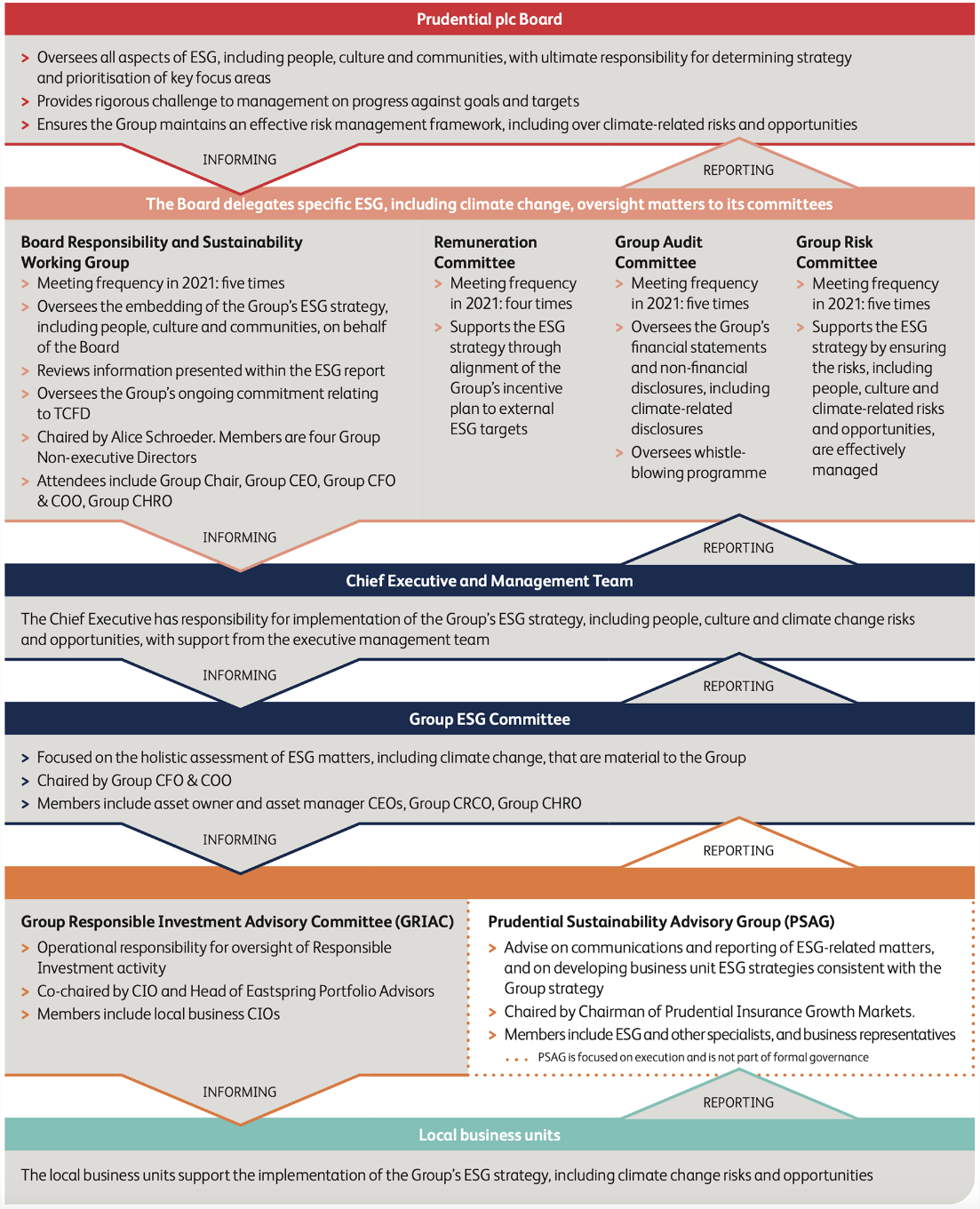
Prudential plc, Annual Report 2021, page 70
3. TCFD – governance (continued)
Recommended Disclosure b) Describe management's role in assessing and managing climate-related risks and opportunities.
Governance recommended disclosure (b)
Stacked horizontal bar chart showing the number of companies reporting on management's role in assessing and managing climate-related risks and opportunities:
- Assigned to management/committees: Mostly provided, some information, few not provided.
- Reports to board: Good mix of provided and some information.
- Assessing and/or managing: Mostly provided, some information, few not provided.
- Description of organisational structure: Mostly provided, some information, few not provided.
- Processes to inform management: Mostly provided, some information, few not provided.
- How management monitors: Mostly provided, some information, few not provided.
Legend: - Provided (dark blue) - Some information provided (medium blue) - Not provided (light blue)
Fewer companies provided details of how information delegated to management was reported back to the board. For example, some companies had specific sustainability committees with delegated responsibilities; however, disclosure on how information was reported back to the board was less clear.
We expect companies to:
Provide sufficient detail on how management assesses and manages climate-related issues, including communicating to the board or other governing body.
All companies provided some information about management's role in assessing and managing climate-related issues. Most companies described the organisational structure and responsibilities of the committee or position responsible for assessing and managing climate-related issues; of these, some provided job titles and their individual accountabilities. There was a lack of disclosure of whether the company's climate policies and strategies were covered by the same governance processes, disclosure controls and procedures used for financial management, with around a third of companies not clearly stating whether that was the case.
3. TCFD – governance (continued)
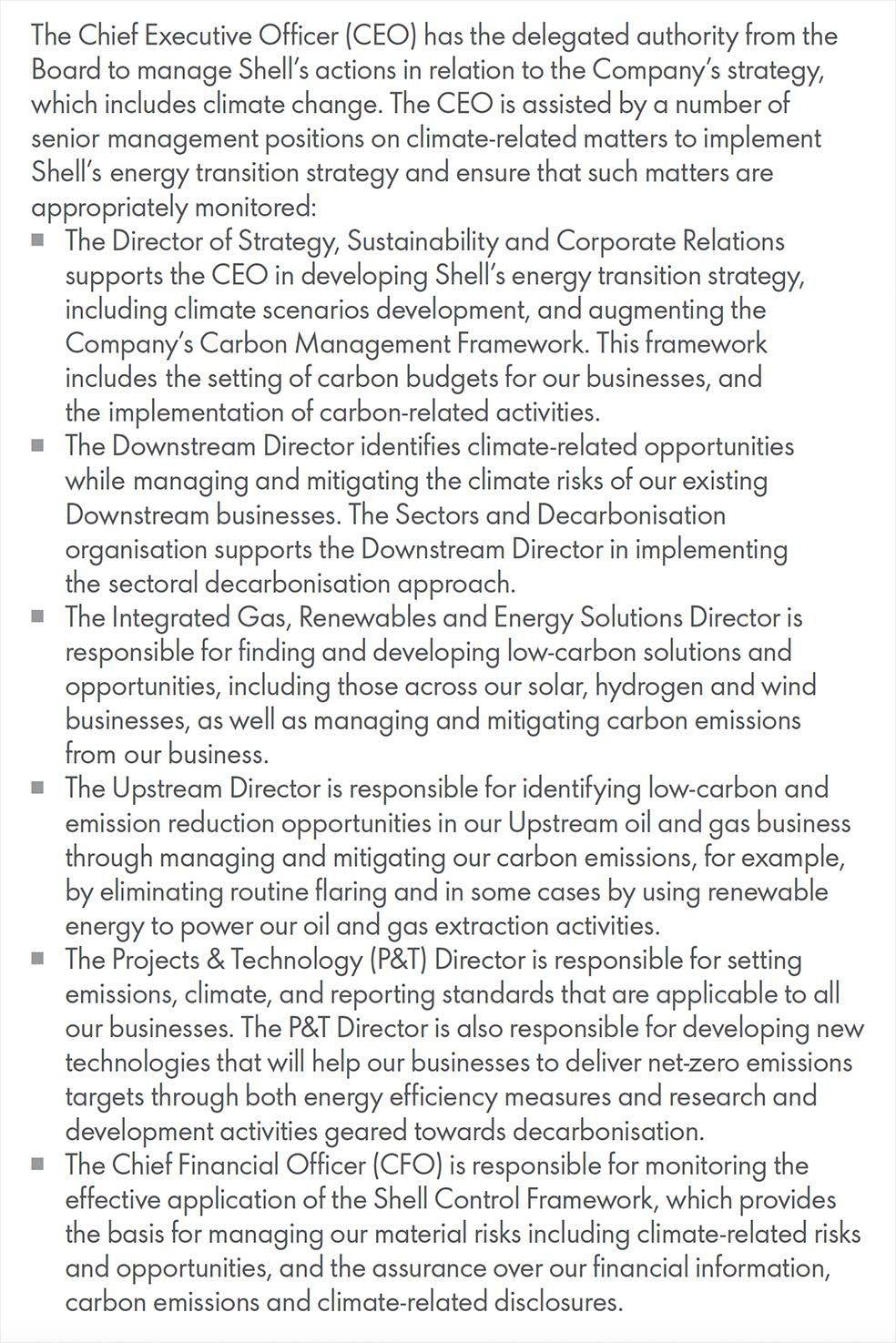
Shell plc, Annual Report and Accounts 2021, page 77
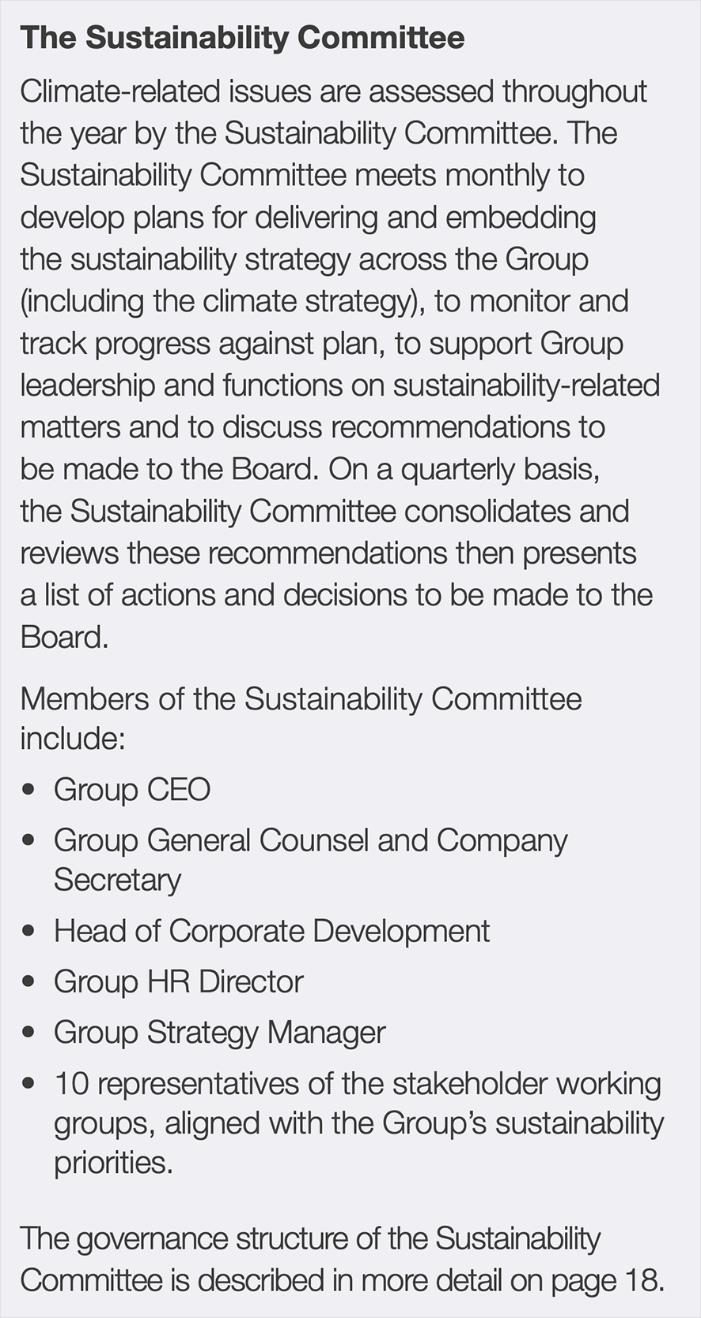
James Fisher and Sons plc, Annual Report 2021, page 52
3. TCFD – governance (continued)
Engagement with investors
Investor views on engagement mechanisms
In 2022 the Stewardship Regulators Group (SRG) held a series of workshops to obtain investor, preparer and other stakeholders views on the stewardship of net zero, including engagement mechanisms with companies.
Participants explained the issue of information asymmetry between the climate-related information companies are disclosing and what information investors and/or wider stakeholders need to understand the progress companies are making in decarbonising their business models responsibly.
It was suggested investors and wider stakeholders need to find a way to assess quickly which companies are on track to reach net zero and which are not, based on the information currently available (which is subject to imperfection).
Other participants cautioned whether investors and wider stakeholders need all the information they are asking for from companies on climate-related issues. It was also noted that often insufficient time was allocated to climate change issues at AGMs, to allow relevant questions to be asked at AGMs stakeholders asked for sufficient time to analyse information prior to voting.
Company engagement with investor groups
Several companies noted engagement with investor groups, such as Climate Action 100 as part of their TCFD and s172 disclosures. The 2021 update to the TCFD recommendations, which were not mandatory for the annual reports reviewed for this thematic report, states that where companies have agreed to meet investor expectations regarding GHG emissions, they should describe their plans for transitioning to a low carbon economy, including targets and specific activities to support the transition.
4. TCFD – strategy
TCFD recommendation: Disclose the actual and potential impacts of climate-related risks and opportunities on the organisation's businesses, strategy, and financial planning where such information is material.
Listing rules: the FCA has stated that it particularly expects that a listed company should ordinarily be able to make disclosures consistent with strategy recommendations (a) and (b) to the extent that the company does not face transitional challenges.
Interaction with other reporting requirements: Section 414CB of the Companies Act 2006 requires certain disclosures in respect of non-financial and sustainability information. 414CB(2)(b) and (e) includes a description of relevant policies pursued by the company in respect of environment matters and the outcome of those policies. 414CB(2)(d) requires a description of the principal risks relating to environmental matters, and where relevant and proportionate, a description of products and services which are likely to cause adverse impacts in those areas of risk.
Less than half of the companies reviewed included disclosures satisfying all of the all-sector guidance disclosures for each strategy recommended disclosure.
Where recommended disclosures had not been included, for most companies it was unclear whether this was due to the omitted disclosures not being considered relevant by the company. However, some of the omitted information might reasonably be considered relevant, for example not defining the time periods for identified climate-related risks and opportunities.
Strategy disclosures per company statement and FRC review
Three stacked horizontal bar charts compare "Company statement" and "FRC review" for three strategy aspects (a), (b), and (c).
Strategy (a): - Company statement: High compliance for 'Full compliance' and 'Largely all items'. - FRC review: Lower compliance, with more 'Some items' and 'Not provided'.
Strategy (b): - Company statement: Similar to Strategy (a), showing good compliance. - FRC review: Similar to Strategy (a) FRC review, with a notable increase in 'Not provided'.
Strategy (c): - Company statement: Similar to previous strategy sections, indicating consistent reporting. - FRC review: Similar to previous strategy sections, with 'Not provided' still prominent.
Legend: - Full compliance (dark blue) - Partial compliance (medium blue) - Not complied with (light blue) - Largely all items from all sector guidance provided (green) - Some items from all sector guidance provided (orange) - Not provided (light grey)
4. TCFD – strategy (continued)
Recommended Disclosure a) Describe the climate-related risks and opportunities the organisation has identified over the short, medium, and long term.
Strategy recommended disclosure (a)
Stacked horizontal bar chart showing the number of companies reporting on various strategy recommended disclosures:
- Description of time horizons: High proportion of "Provided".
- Short-term risks/opportunities: High proportion of "Provided" and "Some information provided".
- Medium-term risks/opportunities: Similar to short-term.
- Long-term risks/opportunities: Similar to short-term and medium-term.
- Time periods indicated: High proportion of "Provided".
- Physical risks disclosed: Significant proportion of "Provided" and "Some information provided".
- Transitional risks disclosed: Significant proportion of "Provided" and "Some information provided".
- Opportunities disclosed: Good mix of "Provided" and "Some information provided".
- Process re material impact: Good mix of "Provided" and "Some information provided".
- Description by sector/geography: Lower proportion of "Provided" and higher proportion of "Not provided".
Legend: - Provided (dark blue) - Some information provided (medium blue) - Not provided (light blue) - N/A (light grey)
Discussion of the risks and opportunities by sector and geography was missing for around half of the companies in our review, which was disappointing given that many of them were complex businesses with multiple segments and operating in different geographies. However, some companies discussed how certain products would be used in a low carbon economy, for example metals and minerals used in batteries for electric vehicles.
The level of detail provided about climate-related risks and opportunities was variable. For some companies there was little indication of when the risks and opportunities were expected to materialise.
Better practice examples used informative graphics and/or tables to explain, concisely and comprehensively, the identified risks and opportunities across the defined time periods. Some companies also included the outcomes from scenario analysis which helped to articulate the expected impact of climate change on business activities.
Most companies included some description of the climate-related risks and opportunities they face, but certain areas of disclosure were more comprehensive than others. Some companies made overarching statements that climate was included when defining their strategic direction, but did not explain clearly how it was considered.
Time periods considered
The majority of companies defined the time periods they considered as short, medium and long term. As expected, given the companies reviewed operate in different sectors, a wide range of time periods was reported. Of those providing definitions, a few explained the rationale, providing a mixture of reasons related to business operations and / or external factors. For many companies, it was unclear how the time periods disclosed related to their asset base, business model or strategy.
4. TCFD – strategy (continued)
Short, medium and long-term time periods disclosed
A timeline chart for 2021 to 2050. - Short term: 2021 to around 2024 - Medium term: around 2024 to 2030 - Long term: 2030 to 2050
Below the timeline, a horizontal line shows years from 0 to 30, with an upward triangle indicating "Average (mean) of time periods reported" at roughly 10 years.
We expect companies to:
Consider whether it would be helpful to users of the annual report to provide explanations for the time periods chosen, particularly where those disclosed for financial targets or financial reporting are different to those used for climate-related matters.
Consider how the time periods disclosed for climate-related risks and opportunities relate to the time periods considered in their going concern and viability statements.
Time horizons: short, medium and long
Due to the inherent uncertainty, and the pervasive nature of the risks across our strategy and business model, the climate-related risks and opportunities are monitored across multiple time horizons. * Short term (up to three years): we develop detailed financial projections and use them to manage performance and expectations on a three-year cycle. These projections incorporate decarbonisation measures required to meet our short-term targets. * Medium term (generally three to 10 years): embedded within our operating plan, with our continued focus on the customer, the investments and portfolio shifts required in the medium term that will fundamentally reshape Shell's portfolio. At the same time, our existing asset base is expected to provide the cash flow to finance this transition of our revenue in this period. * Long term (generally beyond 10 years): it is expected that our portfolio and product mix will look very different, addressing the shift from an asset-based approach to a customer-based business model.
Definition of time periods against which climate-related risks and opportunities are managed, referencing business processes
Shell plc, Annual Report and Accounts 2021, page 79
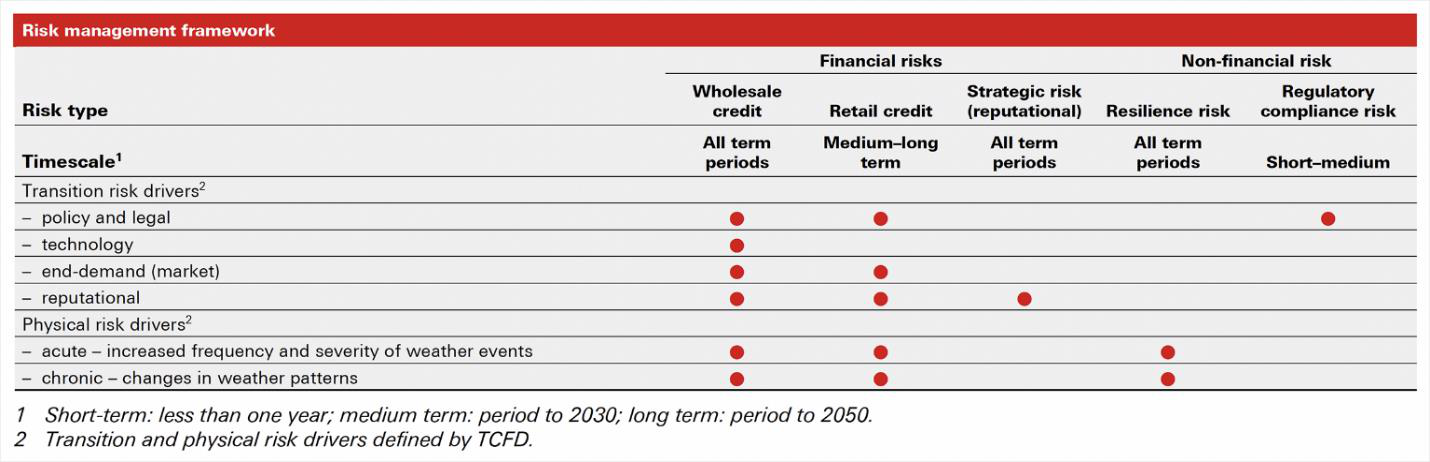
Risks linked to time periods
HSBC Holdings plc, Annual Report and Accounts 2021, page 133
4. TCFD – strategy (continued)
Disclosure of physical and transitional climate-related risks
Some companies provided generic explanations of climate-related risks (e.g. changing weather patterns) but did not link to the specific operations or businesses at risk. 14 companies provided more detailed disclosures of identified actual and potential sources of physical risks (such as acute risks from extreme weather events or chronic risks from changing weather patterns) and 17 of transition risks (such as technology, carbon costs and legal changes).
There were some good examples of disclosures linking the impacts of climate change to areas of the company's strategy; however, only five companies provided a detailed description of their risks and opportunities by geography or sector. Weaker disclosures gave a blanket statement that a diversified portfolio provided mitigation to climate change, without making it clear whether certain locations would have the capacity to recoup any losses incurred to business operations at another location.
Better practice examples disclosed the specific locations at risk.
Better practice examples demonstrated that the company had considered the risks outlined in the TCFD guidance (Table A1.1 of the TCFD Implementation Guidance which provides a list of example risks applicable to all sectors) and gave details of potential and actual physical impacts across the defined time periods, actions being taken to mitigate or remediate, and the potential financial impact.
We expect companies to:
Consider the relative importance of physical and transition risks to different parts of the business, and include sufficient detail to understand the varying level of risk in different business sectors and geographies.
Consider the relative importance of physical and transition risks to different parts of the business, and include sufficient detail to enable users to understand the varying level of risk in different business sectors and geographies.
Where there are widely different impacts, consider if there is an impact on segmental disclosures in the financial statements (see Section 8 for further discussion).
Consider the linkage between narrative reporting of climate-related risks and accounting judgements and estimates (see Section 8).
4. TCFD – strategy (continued)
Disclosure of climate-related opportunities
Most companies identified actual and potential sources of opportunities, although only five companies quantified climate-related opportunity metrics, making performance in relation to climate-related opportunities difficult to assess. This may be due to the fact that the reliability of data for opportunities may be lower than that for climate-related risks. The FRC Lab has undertaken a project on ESG data collection, see page 29.
A few companies discussed low carbon business activities prominently in the front half of the annual report and accounts but did not make the expected magnitude of revenue from those activities clear.
Materiality of identified risks and opportunities
Most companies provided some information on how they considered which risks and opportunities could have a material financial impact; the level of disclosure varied, although around two-thirds provided sufficient detail. Better practice examples provided an explanation of the factors considered in the assessment of materiality including quantification thresholds. See page 23 for a discussion of materiality.
Some companies included commentary on whether the risks and opportunities were included in the business plan, highlighting where assessment was still ongoing.
We expect companies to:
Consider whether climate-related opportunities are material to the company.
Ensure that the discussion of risks and opportunities is balanced, not placing undue emphasis on any opportunities disclosed.
Consider if there are relevant opportunity-based metrics to be reported.
Consider linking the description of climate-related opportunities to any technology-related dependencies disclosed under Strategy (b).
Ensure that descriptions of low carbon business streams which are relatively small in the context of other operations are not emphasised in a way that is misleading.
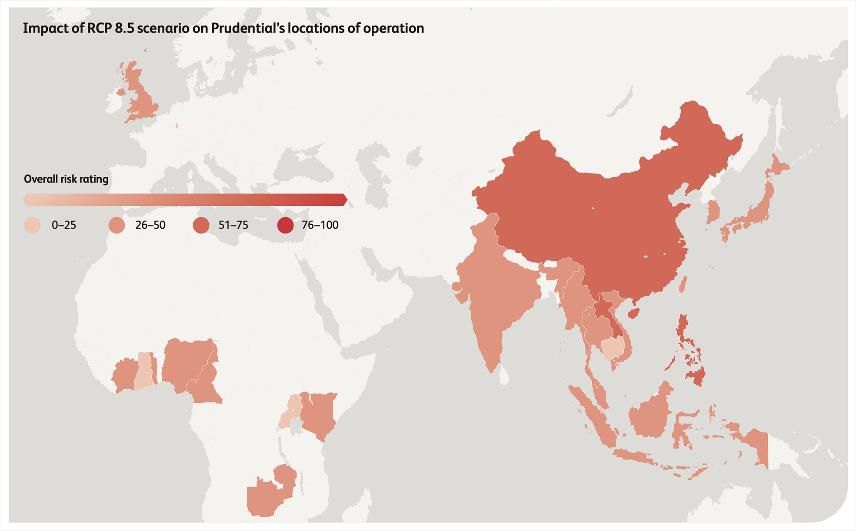
Prudential plc, Annual Report 2021, page 88
4. TCFD – strategy (continued)
Summary of our most material risks and opportunities (2)
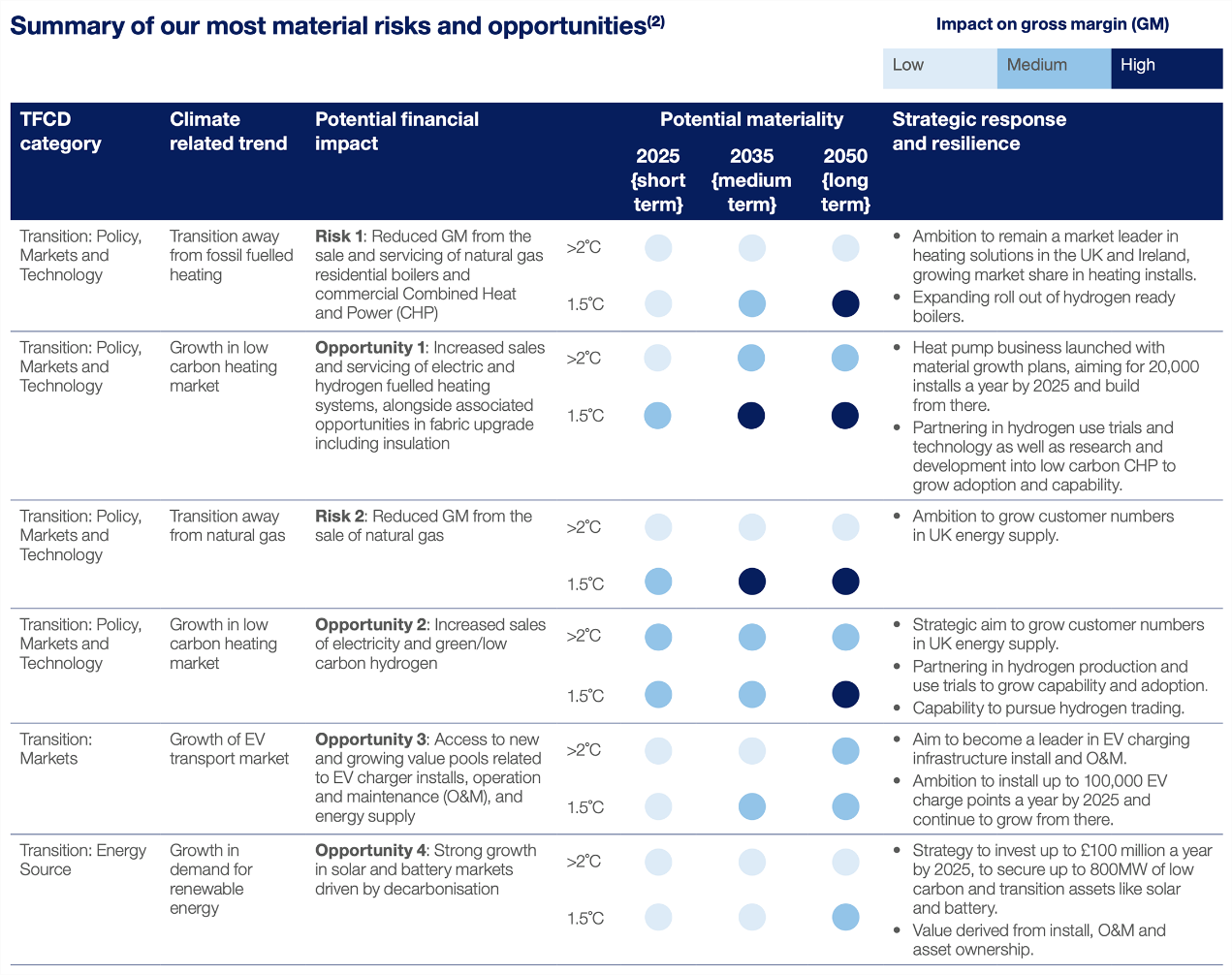
Centrica plc, Annual Report and Accounts 2021, page 34
Summary of climate-related risks and opportunities, with potential materiality linked to scenario analysis and strategic response
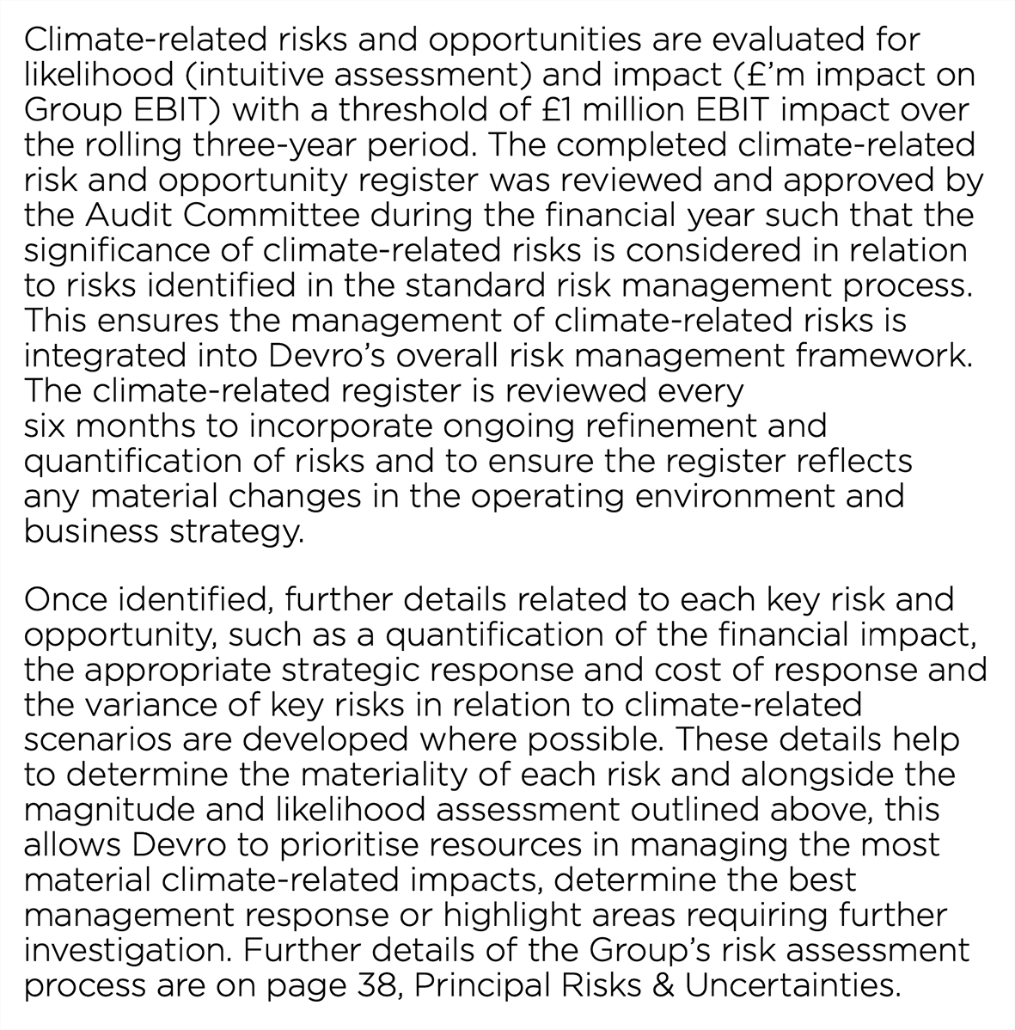
Devro plc, Annual Report and Accounts 2021, page 44
Climate-related risks and opportunities are evaluated for likelihood (intuitive assessment) and impact (£'m impact on Group EBIT) with a threshold of £1 million EBIT impact over the rolling three-year period. The completed climate-related risk and opportunity register was reviewed and approved by the Audit Committee during the financial year such that the significance of climate-related risks is considered in relation to risks identified in the standard risk management process. This ensures the management of climate-related risks is integrated into Devro's overall risk management framework. The climate-related register is reviewed every six months to incorporate ongoing refinement and quantification of risks and to ensure the register reflects any material changes in the operating environment and business strategy.
Once identified, further details related to each key risk and opportunity, such as a quantification of the financial impact, the appropriate strategic response and cost of response and the variance of key risks in relation to climate-related scenarios are developed where possible. These details help to determine the materiality of each risk and alongside the magnitude and likelihood assessment outlined above, this allows Devro to prioritise resources in managing the most material climate-related impacts, determine the best management response or highlight areas requiring further investigation. Further details of the Group's risk assessment process are on page 38, Principal Risks & Uncertainties.
Centrica plc, Annual Report and Accounts 2021, page 34
Table summarizing material climate-related risks and opportunities, showing TCFD category, climate trend, financial impact, materiality across short, medium, long term, and strategic responses.
Clear explanation of the process for considering materiality of climate-related risks and opportunities
Recommended Disclosure b)
Describe the impact of climate-related risks and opportunities on the organisation's businesses, strategy, and financial planning.
Most companies provided some details of the impact of the identified risks and opportunities, but fewer provided detail of how they impacted the business strategy and financial planning.
Strategy recommended disclosure (b)
A stacked bar chart showing the number of companies (0-25) that provided information across various strategic disclosure categories, categorized as Provided, Some information provided, Not provided, and N/A. Categories include: Products, services, operations; Supply chain/value chain; Adaption and mitigation; Research and development; Acquisitions and divestments; Access to capital; Integrated into financial planning; How used in financial planning; Time periods used; Prioritisation; Independencies; Revenues and costs; Capital expenditure and allocation; Scenarios inform strategy/planning.
Impact on strategy
- Only 11 companies appeared to adequately identify the operations, products, services, assets, markets and geographical areas that are likely to be affected by climate-related risks and opportunities. As climate will impact these areas differently, it is more meaningful for companies to provide disclosures that explain the expected impacts across the business.
- 21 companies provided some description of the impact on the supply chain. In some cases, however, the actions described were vague, such as referring to engaging with suppliers to help influence a move to lower carbon intensive materials.
- Several companies referenced new technology that was expected to enable them to meet their emissions and / or climate targets; however, the source of the expected technological advances was not always clear.
- Only eight companies provided detailed information on the impact of the identified risks and opportunities on investment in research and development. Of these, some provided examples of technology they were investigating, and a few had quantified targets such as percentage of revenue or a financial amount.
- Most companies did not explain the impact of climate-related risks and opportunities on acquisitions and divestments or access to capital. Half explained the impact on capital expenditure and capital allocation.
- Few companies disclosed the impact of climate-related risks and opportunities on revenue and costs and only three quantified the impact.
We expect companies to:
Provide discussion and, where practical, quantification of the expected impact of climate-related risks and opportunities on operating costs and revenues, capital expenditures and capital allocation, acquisitions or divestments, and access to capital.
Explain potential implications for their strategy where transition plans are dependent upon technology not yet proven, particularly where they are not investing in research and development.
Adaptation and mitigation activities
- Disclosure of policies and strategies to address the impacts of climate-related risks and opportunities was a weaker area of disclosure: only four companies provided a detailed description of both long-term and short-term policies and strategies (transition plans) to address the impacts of climate risks and opportunities. 14 companies provided some explanations, but the timescales were unclear.
We expect companies to: Describe their adaptation and mitigation activities such as long
- and short-term policies and strategies to address climate risks, opportunities, and the climate transition, including whether there have been any significant changes since the prior reporting period.
Impact on financial planning
- When describing how climate-related issues impacted upon financial planning, only seven companies provided detailed explanations of how climate-related risks and opportunities were prioritised; ten provided partial explanations and eight provided no explanation at all.
- Disclosures about the interdependencies among the factors that affect a company's ability to create value over time was one of the weaker areas of reporting. Only four companies provided a specific explanation, although interdependencies were implied by a further six companies.
- 17 companies indicated that climate-related scenarios were used to inform the organisation's strategy and financial planning, but they provided less detail on how scenario planning informed these areas. It was frequently unclear how management used climate-related information in their financial planning.
- Better disclosures clearly articulated how climate change considerations were embedded into strategic plans and budgets, providing narrative and quantitative information to enable the user to assess the potential impact of the disclosed risks and opportunities on the strategy of the business.
We expect companies to:
Disclose how risks and opportunities are prioritised, cross-referencing to the risk management and any other relevant sections of the annual report where appropriate.
Clearly explain how climate change considerations and any climate-related scenarios inform the company's strategy and financial planning.
Summary Description of Transition Risks
Table summarizing various business risks, categorized by policy, technology, market, and reputation, detailing potential impact, timeframe, and business readiness.
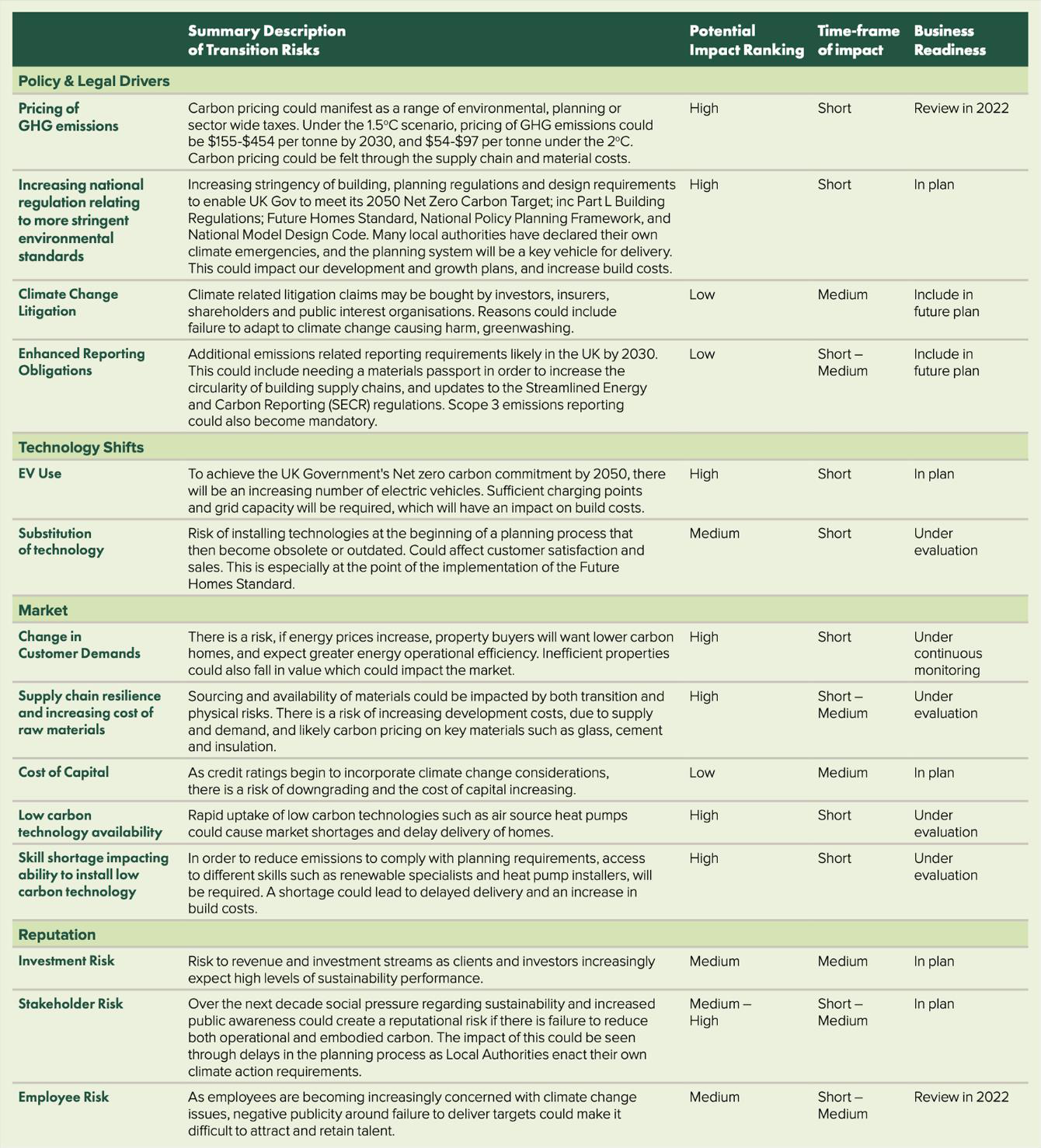
Summary of transition risks with impact time-period and high-level business readiness
Persimmon Plc, Annual Report 2021, page 64
Recommended Disclosure c)
Describe the resilience of the organisation's strategy, taking into consideration different climate-related scenarios, including a 2°C or lower scenario.
Strategy recommended disclosure (c)
A stacked bar chart showing the number of companies (0-25) that provided information across various strategic disclosure categories, categorized as Provided, Some information provided, Not provided, and N/A. Categories include: Description of resilience; 2°C or lower scenario; Hot-house scenario; Assumptions used in scenarios; Explanation for choosing scenarios; Information on time horizons; Financial performance/position impact.
- Three companies did not provide scenario analysis and identified this as an area of non-compliance in their statement, setting out the expected timeframe for making the disclosures in future.
- Companies generally provided information on what scenarios were conducted, but there was less disclosure around the reasons for their selection, the underlying assumptions and how the analysis was undertaken.
- 22 companies used a scenario consistent with 2°C or lower global heating and 21 used a scenario representing increased physical risk (a "hothouse" type scenario). Around half of the companies reviewed considered three scenarios, with global heating ranging from <1.5°C to >4°C. A variety of scenario and data sources were referred to, with the most frequently referenced being various scenarios by the Intergovernmental Panel on Climate Change (IPCC) and the International Energy Agency (IEA).
Scenario assumptions / data sets referenced
A horizontal bar chart showing the number of companies (0-10) referring to different data sets for scenario assumptions, including: IPCC (various), IEA (various), Other (named once in sample), Network for Greening the Financial System, Company specific, Wood Mackenzie, Industry groups, and Not specified.
The majority of the companies in the sample (22 companies) described the resilience of their strategy under different climate scenarios, with seven providing quantification. A few companies undertook scenario analysis over a sample of assets or product groups, rather than the business as a whole.
- Better practice examples provided details on how the scenario analysis had been undertaken, key assumptions and the impact on the business strategy.
We expect companies to:
Provide sufficient detail of any scenarios for users to understand the analysis undertaken and the potential impact on the business strategy, including where relevant: - explanations of why the specific scenarios have been chosen; - key input assumptions, analytical methods, outputs and sensitivities; - discussion of how the outcomes have influenced strategic planning and any actions taken as a result; and - explanations of how the scenarios discussed, including assumptions and sensitivities, correspond to the discussions in the financial statements.
Table detailing WBCSD scenario catalogue family ranges for 2030 key transition variables, including min and max values for different business areas and scenarios.
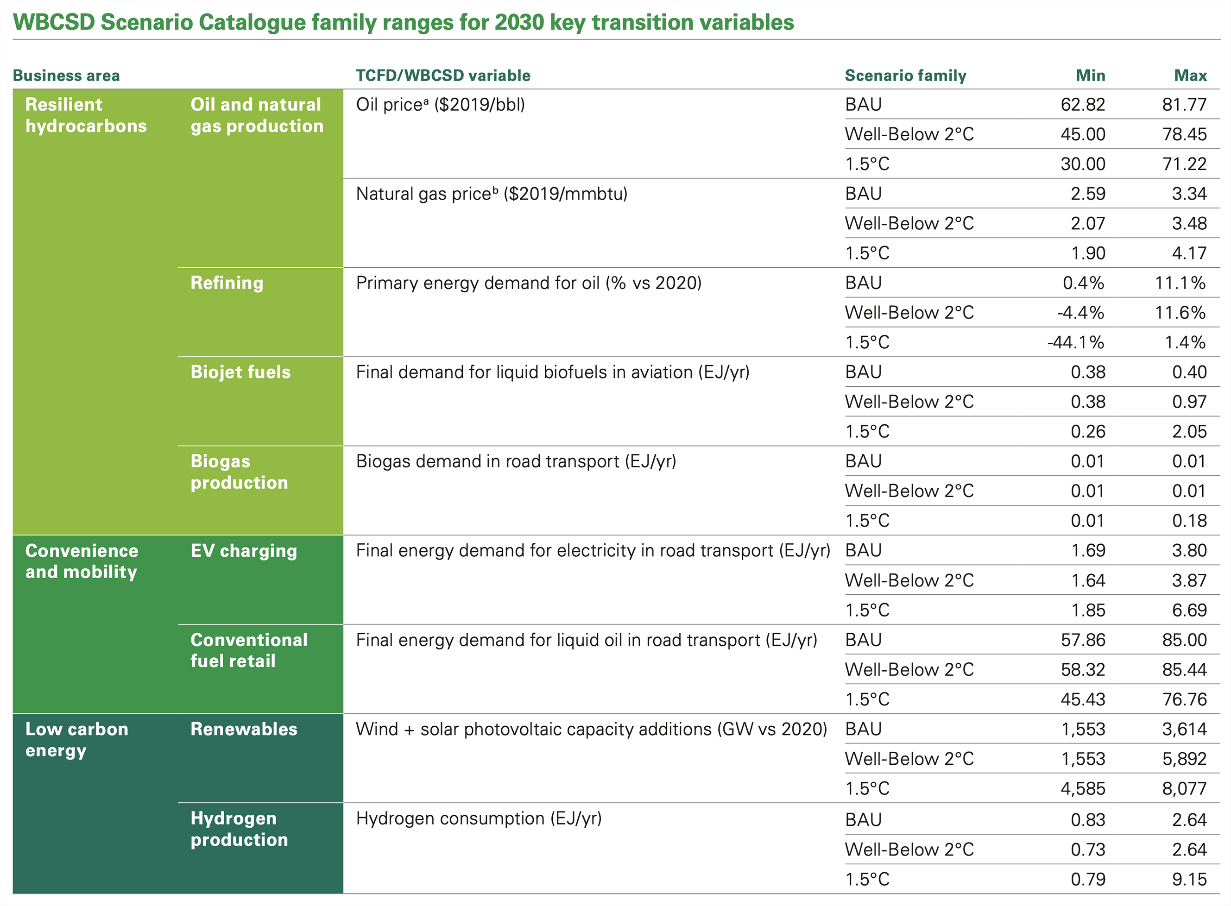
Disclosure of assumptions per scenario and business area
Considers impact of carbon costs across scenario analysis time periods and quantifies potential impact
1.5°C scenario analysis financial quantification in current money
Table showing 1.5°C scenario analysis for financial quantification, detailing potential profit impact of carbon tax and removal costs from 2030 to 2050, with key assumptions.
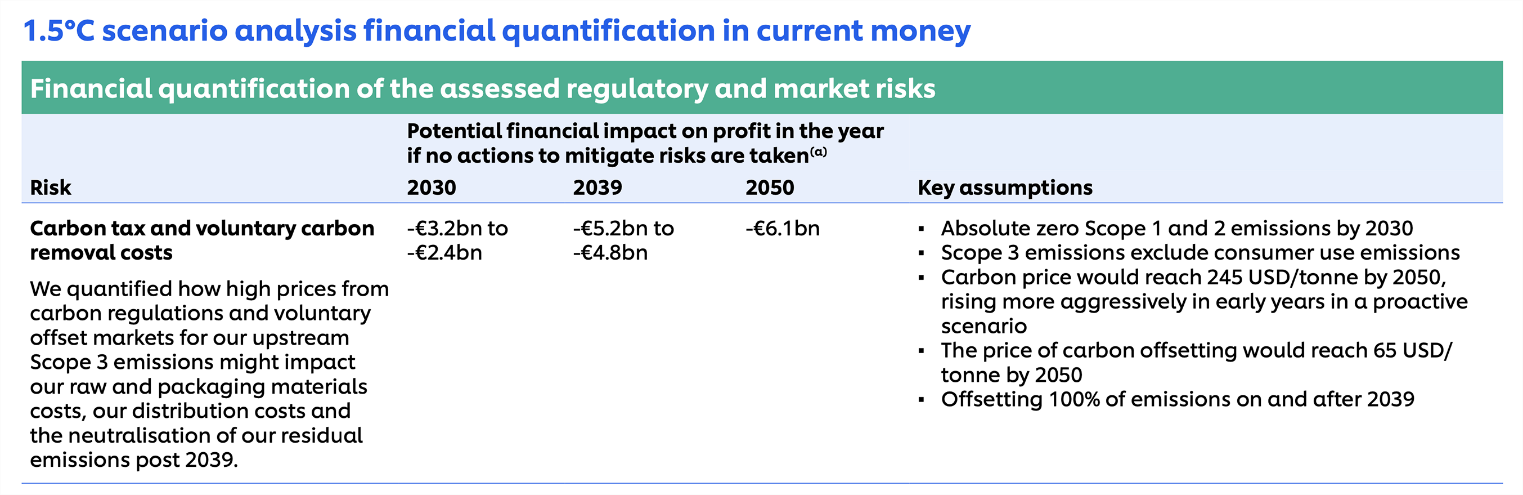
bp p.l.c., Annual Report and Form 20-F 2021, page 64 Unilever PLC, Annual Report and Accounts 2021, page 61
5. TCFD – risk management
TCFD recommendation: Disclose how the organisation identifies, assesses, and manages climate-related risks.
Listing rules: the FCA has stated that it particularly expects that a listed company should ordinarily be able to make disclosures consistent with the risk management recommendations.
Interaction with other reporting requirements
Companies Act requirement – principal risks: Section 414CB of the Companies Act 2006 requires a description of the principal risks relating to environmental matters, including a description of how it manages the principal risks.
Risk management disclosures per company statement and FRC review
Three stacked bar charts, each representing a different aspect of risk management (a), (b), (c), showing the number of companies (0-25) in terms of Company statement and FRC review. The bars are segmented by Full compliance, Partial compliance, Largely all items from all sector guidance provided, and Some items from all sector guidance provided.
The TCFD considers that matters relating to risk management provide important context for investors and recommends that these disclosures should be included irrespective of a materiality assessment.
The majority of companies provided most of the risk management recommended disclosures. Our assessment aligned more closely with companies' assessments than for other TCFD recommended disclosures.
Recommended Disclosure a)
Describe the organisation's processes for identifying and assessing climate-related risks.
Risk management recommended disclosure (a)
A stacked bar chart showing the number of companies (0-25) that provided information across various risk management disclosure categories, categorized as Provided, Some information provided, Not provided, and N/A. Categories include: Identifying, assessing and managing; Relative significance to other risks; Consideration of regulatory requirements; Assessing potential size and scope; Risk terminology/classification.
Disclosures about the processes in place for identifying, assessing and managing risks and opportunities was the most disclosed area, whilst information about the processes for assessing their size and relative significance was the least disclosed. Some companies indicated that they were undertaking projects or initiatives to enhance their assessment and management of climate-related or environmental risks.
Principal risks
- As expected, given the sectors covered by our sample, most companies included climate as a principal risk. Of these, 15 companies disclosed climate change as a single principal risk, discussing one or more issues within the single risk, whilst others presented climate change within another principal risk. Of the companies that did not disclose any climate-related principal risks, two disclosed climate change within other or emerging risks and three identified other ESG or sustainability-related risks (which incorporated climate-related risks, such as in relation to water management).
- Better practice examples were clear on the magnitude of the risk and showed the relative importance of climate to other risks, some using a matrix presentation.
- It was not always clear how the principal risks disclosed in the risk management section of the strategic report related to the specific climate-related risks disclosed as part of the TCFD disclosures.
Most companies provided some disclosure on how climate-related risks were identified and assessed, but not all companies provided sufficient detail to enable a user to fully understand the process. Weaker disclosures included general information about their risk management but did not explain how they applied to climate-related risks.
Climate risk disclosures
A pie chart illustrating climate risk disclosures, segmented into: Climate related other / emerging risk (dark blue), Included in other principal risk (light blue), Other ESG / Environmental / Sustainability (grey), and Climate related principal risk (green).
Climate mitigations disclosed
A horizontal bar chart showing the number of companies (0-10) reporting on various climate mitigations, including: Climate change plans, Targets (emissions, water, waste etc), Supply chain / products, Stakeholder engagement, Other (mentioned once), Committee oversight and regular review, Use of data / investment in data systems, Diversified portfolio / portfolio choices, Renewable power, and Industry specific.
We expect companies to:
Clearly articulate the process used to identify and assess climate-related risks, including the relative importance of climate to other risks, how regulatory risks are considered, and provide a link to the company's strategic priorities.
Describe the principal risks and uncertainties facing the company which relate to climate change, and any significant impacts on the business model. Better disclosures provide users with information which is specific to the company's circumstances, and are clear on the magnitude of the risk.
Ensure the relationship between climate-related risk disclosures and other risk disclosures in the annual report is clear.
Where users would reasonably expect climate to be a principal risk, but the company does not consider climate to be a principal risk, or part of a principal risk, we encourage companies to articulate the rationale for their conclusion.
Explanation of climate change being included within existing principal risks
Text block describing the integration of climate change risk into Synthomer's risk management framework, including physical and transitional risks, and listing principal risks for 2022.
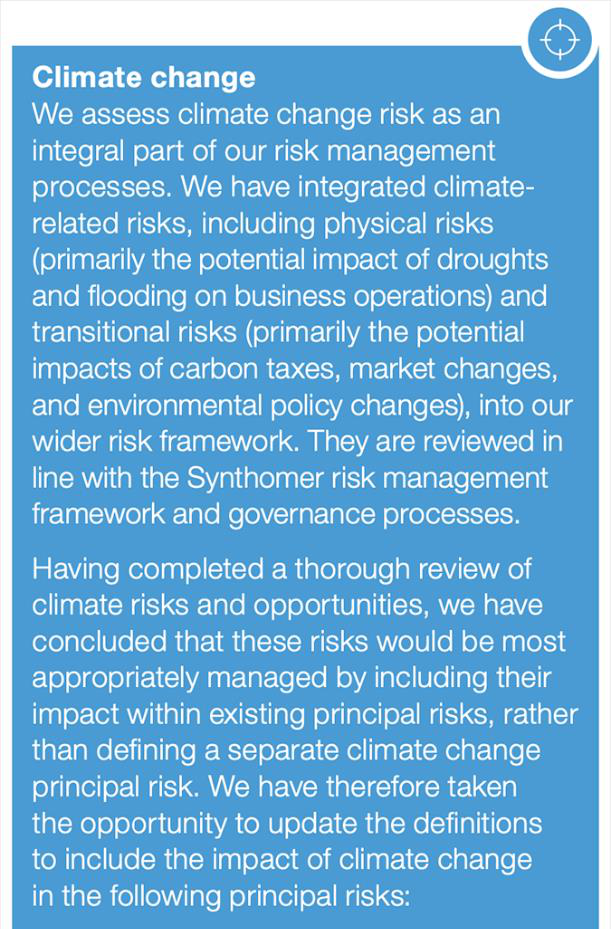
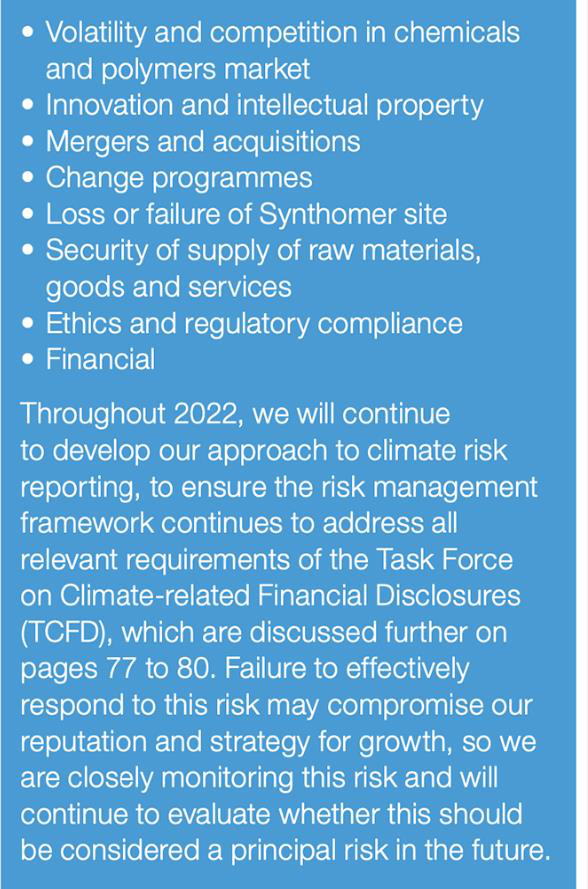
Synthomer plc, Annual Report 2021, page 71
Current assessment of principal risks
Risk matrix plotting 19 principal risks against increasing likelihood (Rare to Almost Certain) and increasing financial and non-financial consequences (Very Low to Very High), and a table listing these principal risks and their strategic focus (Strategic, ESG, Economic, Operational, ESG).
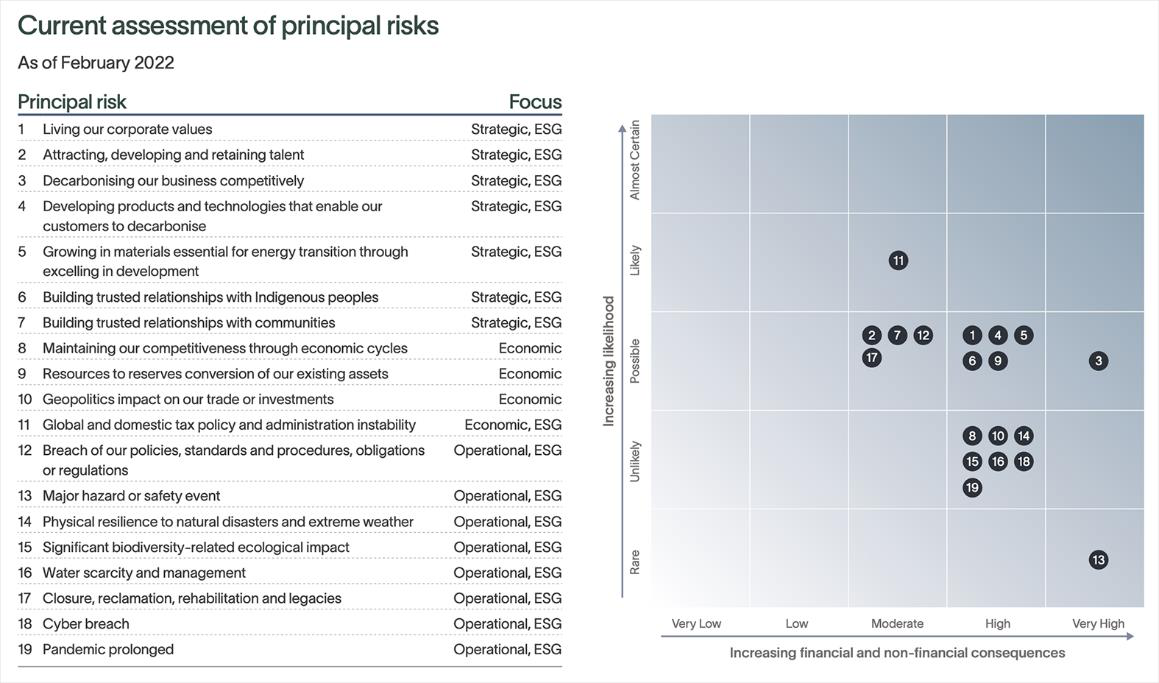
Rio Tinto plc, Annual Report 2021, page 117
Materiality assessment of principal risks includes climate alongside other risks and link to strategic areas
Recommended Disclosure b)
Describe the organisation's processes for managing climate-related risks
Risk management recommended disclosure (b)
A stacked bar chart showing the number of companies (0-25) that provided information across various risk management disclosure categories, categorized as Provided, Some information provided, Not provided, and N/A. Categories include: Managing climate-related risks; Mitigate, transfer, accept or control risks; Prioritisation of climate-related risks; Assessment of climate-related issues; Materiality determination.
- All companies provided some information on how climate-related risks are managed, with ten providing more detailed disclosures. Around half of the companies explained specifically how they make decisions to mitigate, transfer, accept, or control climate-related risks.
- 11 companies described how climate-related risks and opportunities were prioritised, with ten disclosing the prioritisation process for general risks, implying that the disclosure also related to climate-related risks. Fewer companies (nine) provided a clear description of how they determined materiality for the purpose of managing climate-related risks, with a similar number providing more limited disclosures.
We expect companies to:
Provide a clear explanation of the processes for managing climate-related risks and opportunities including how they are prioritised and managed, including any relevant materiality considerations.
Reviewed as a standalone section, there was less compliance with this recommended disclosure than the other risk management disclosures. Weaker disclosures included general descriptions about risk management but did not explain how they applied specifically to climate-related risks.
Recommended Disclosure c)
Describe how processes for identifying, assessing, and managing climate-related risks are integrated into the organisation's overall risk management.
Risk management recommended disclosure (c)
A stacked bar chart showing the number of companies (0-25) that provided information on the Integration into overall risk management category, categorized as Provided and Some information provided.
FIGURE 1.2 INTEGRATION OF CLIMATE-RELATED RISK INTO ERM FRAMEWORK
Diagram illustrating the integration of climate-related risk into the ERM framework across Group, Business, and Project levels, with associated actions for each.
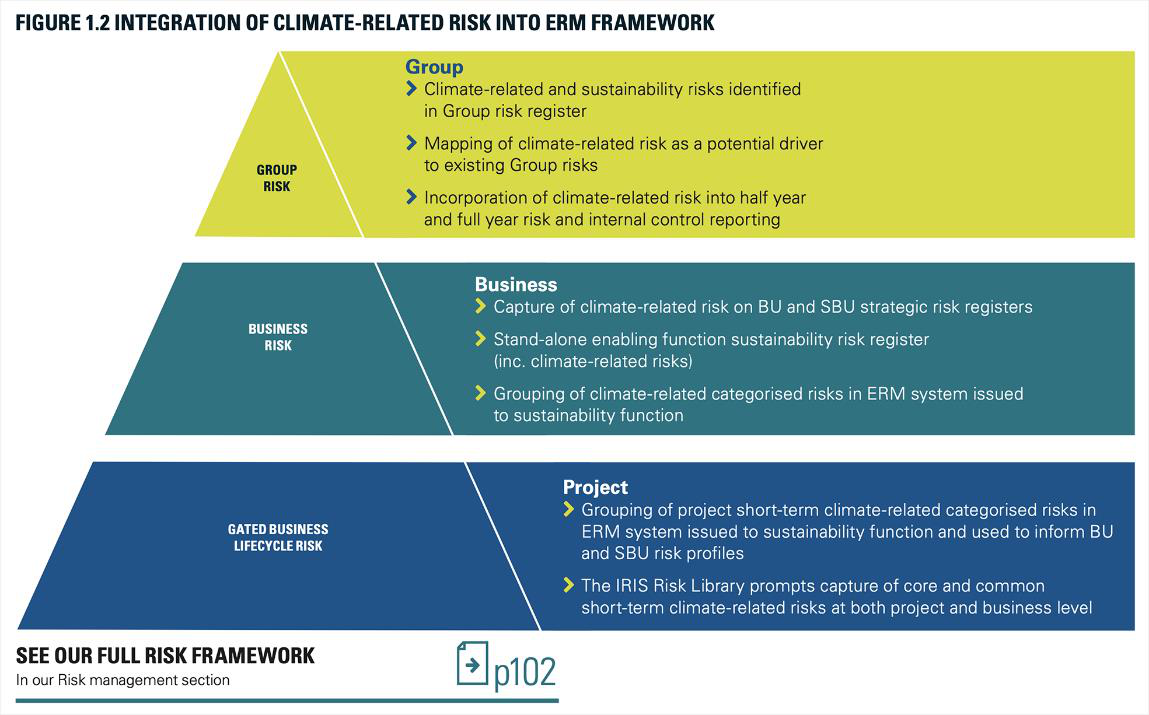
Balfour Beatty plc, Annual Report and accounts 2021, page 119
Diagram showing integration of climate-related risk management into risk framework
- Better practice examples provided more disclosure over the processes and integration, utilising organograms where appropriate.
We expect companies to:
Clearly explain the linkages between general and climate-related risk disclosures, using cross-referencing where relevant.
Provide evidence in the risk section of the strategic report, for example in the discussion of principal risks, where companies provide a simple statement in their TCFD disclosures that management of climate-related risks is integrated into the overall risk management process.
All but two of the sample included, at a minimum, a statement to confirm that the climate-related risk management processes were integrated into the overall risk management framework.
6. TCFD – metrics and targets
TCFD recommendation:
Disclose the metrics and targets used to assess and manage relevant climate-related risks and opportunities where such information is material.
Metrics and targets disclosures per company statement and FRC review
Bar chart showing the level of compliance for climate-related metrics and targets disclosures, segmented by company statement and FRC review. The x-axis represents the 'Number of companies' from 0 to
- The y-axis shows three categories: 'Metrics & targets (a)', 'Metrics & targets (b)', and 'Metrics & targets (c)'. Each category has two bars: 'Company statement' and 'FRC review'.
The bars are color-coded to represent: - Full compliance (dark blue) - Partial compliance (light blue) - Not complied with (green) - Largely all items from all sector guidance provided (light green) - Some items from all sector guidance provided (orange) - Not provided (pink)
Overall, 'Company statement' shows a higher level of full compliance compared to 'FRC review' across all three categories. 'Not provided' is generally low for 'Company statement' but slightly higher for 'FRC review'.
Interaction with other reporting requirements:
Section 414CB of the Companies Act 2006 requires certain disclosures in respect of non-financial and sustainability information. 414CB(2)(e) requires a description of the non-financial key performance indicators relevant to the company's business.
All the companies in our sample complied at least partially with the TCFD Metrics and Targets recommendation. Whilst all companies in the sample disclosed Scope 1 and Scope 2 emissions, as required by the Streamlined Energy and Carbon Reporting (SECR1) requirements for UK listed companies as well as by the TCFD framework, fewer companies reported Scope 3 or other climate-related risk and opportunity metrics.
6. TCFD – metrics and targets (continued)
Recommended Disclosure a)
Disclose the metrics used by the organisation to assess climate-related risks and opportunities in line with its strategy and risk management process.
Metrics & targets recommended disclosure (a)
Bar chart displaying the number of companies reporting on various climate-related metrics. The x-axis shows the 'Number of companies' from 0 to
- The y-axis lists categories such as: Climate-related metrics, Metrics all quantified, Remuneration, Internal carbon price, External carbon price, Opportunity metrics, Comparatives provided, More than one year of data, Movements explained, and Methodologies.
The bars are segmented by: - Provided (dark blue) - Some information provided (light blue) - Not provided (green) - N/A (light green)
"Climate-related metrics" and "Methodologies" show high levels of 'Provided'. "Metrics all quantified", "Remuneration", "Internal carbon price", "External carbon price", and "Opportunity metrics" show significantly higher proportions of 'Not provided' or 'Some information provided'.
There was not always a clear linkage between metrics reported and the climate-related risks and opportunities outlined in the strategy and risk management disclosures. Most companies described climate-related opportunities, but only five quantified metrics, such as the percentage of revenue from renewables and remediation offerings or revenue from specific products. One company referred to metrics and targets being the primary way in which they measure and manage their impact on climate change. As the actual metrics were not disclosed, it was not possible to assess the company's performance against targets.
Whilst the majority of companies reported some cross-industry climate-related metrics (as per Table A2.1 of the TCFD Recommendations) there was less evidence that all companies had reviewed and considered the supplementary guidance for their sector. There was also some inconsistency between companies in terms of definitions of metrics reported making meaningful comparisons difficult.
Climate-related metrics reported
Horizontal bar chart illustrating the number of companies reporting on various climate-related metrics. The x-axis represents the 'Number of companies' from 0 to 25. The y-axis lists categories such as: GHG emissions
- scope 1 & 2, Emissions intensity, Energy use, Waste / plastic, GHG emissions Scope 3, Water, Business / technology development, Renewable power / alternative fuels, Land / agricultural, Product related, Lending / investment related, Feedstocks / procurement, Flaring, and Carbon offsets.
'GHG emissions - scope 1 & 2' is highlighted as 'SECR metrics' and shows the highest number of companies reporting. Other categories like 'Emissions intensity', 'Energy use', 'Waste / plastic', and 'GHG emissions Scope 3' also show significant reporting. Categories towards the bottom, such as 'Flaring' and 'Carbon offsets', have fewer companies reporting.
6. TCFD – metrics and targets (continued)
Better practice examples demonstrated that the companies had considered supplementary guidance for their sector and included metrics they consider relevant, clearly identifying which metrics were not provided.
The TCFD all-sector guidance states that metrics should be provided for historical periods to allow for trend analysis. In our sample, most companies provided some comparatives for metrics reported but fewer reported more than one year of data. A third of companies did not explain all significant movements, making it harder to understand the factors driving performance and the progress made.
Better practice examples provided clear explanations of movements in key metrics highlighting both ongoing and one-off events impacting performance.
We recommend that companies keep their peers' reporting under review and consider industry practice and established reporting initiatives such as SASB when considering which metrics to report (see page 82).
This is an emerging area of reporting and there are inherent challenges in determining the appropriate metrics to measure and manage. As reporting in this area matures and companies develop their transition plans further, we expect to see sufficient quantitative and qualitative data to enable users to undertake meaningful assessments of their progress and resilience over time.
We expect companies to:
Consider the risks and opportunities to which they are exposed and the information that is most relevant to their measurement and monitoring when determining which metrics to report.
Consider the linkage to business strategy and targets, acknowledging that this may change over time.
Clearly identify relevant climate-related metrics reported elsewhere in their reporting, using cross-referencing where appropriate.
Review and comply with updated TCFD guidance on metrics, targets and transition plans as required for future reporting periods.
6. TCFD – metrics and targets (continued)
Illustrative examples
Materials and Buildings Group - Metals and Mining
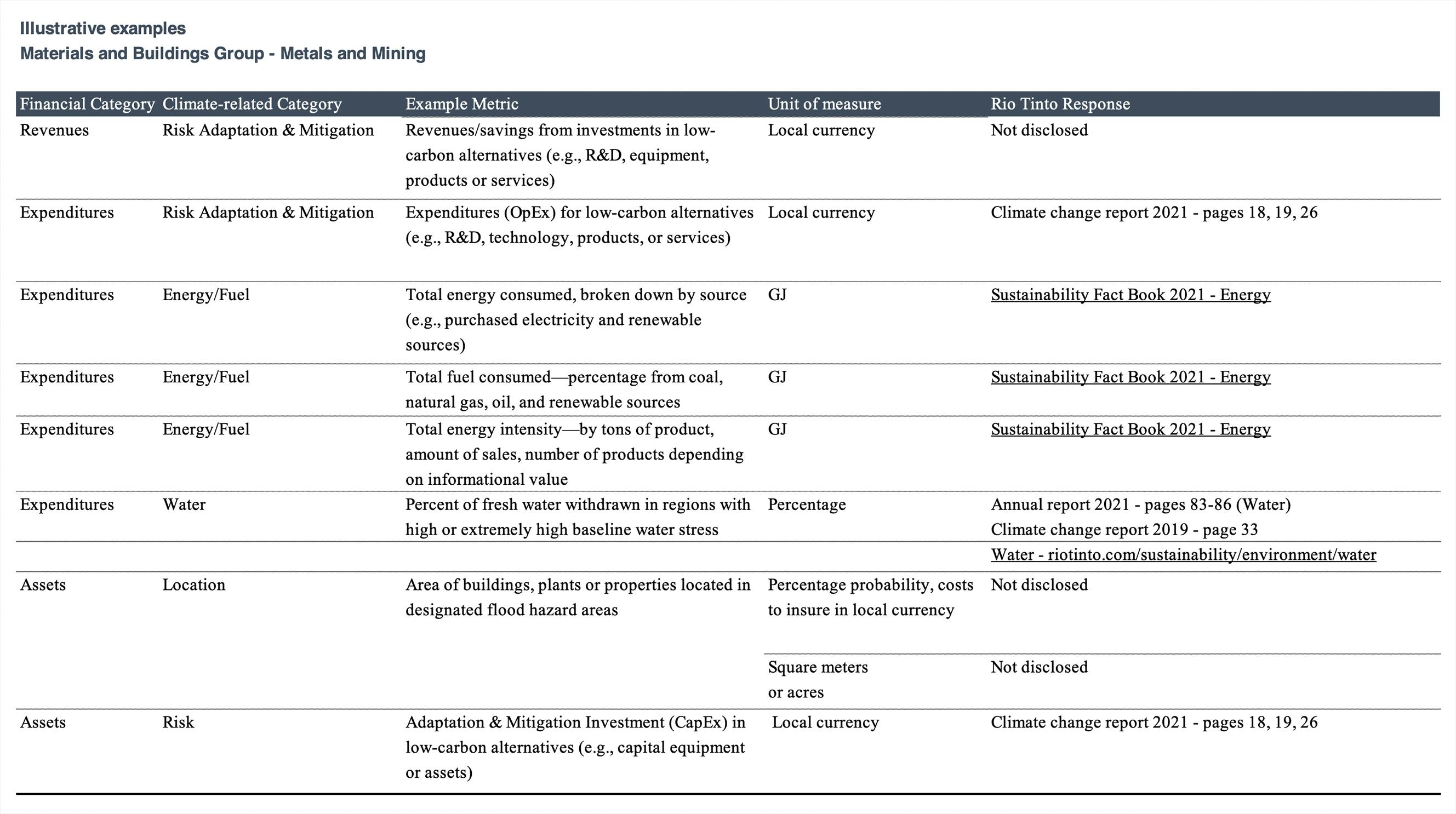
Rio Tinto plc, 2021 Sustainability Fact Book, TCFD tab
Shows whether sector-specific disclosures are provided, providing links to reporting or stating that they are not disclosed
6. TCFD – metrics and targets (continued)
Carbon pricing
The TCFD all-sector guidance recommends disclosing internal and external carbon prices where relevant. Only six companies disclosed and quantified their internal carbon price, and just three the external carbon prices to which they are exposed, perhaps reflecting the considerable uncertainty in the markets. Given the sectors in which the companies operated, we would have expected many more to be impacted by carbon prices. A few companies reported that they had included their carbon prices in CDP submissions, rather than their annual reports.
Better practice examples explained how they used carbon pricing, for example for investment appraisals or impairment testing, integrated carbon pricing into other appropriate sections of their reporting, or explained the impact of carbon pricing on their strategy, for example, through incorporation into their scenario analysis.
We expect companies to:
Consider the impact of carbon pricing on their strategy and targets as part of their transition plan and consider how this may change over time and across different business areas.
Impact on remuneration
There was some disclosure of how wider management-level staff are held accountable and incentivised for addressing environmental issues, but more companies disclosed the impact on board remuneration; of these, a few disclosed that their climate change / ESG objectives would be approved in
- Better practice examples provided an explanation of how climate-related metrics were incorporated into remuneration policies, providing clear links to relevant disclosures within the annual report and summarising whether or not the scorecard metrics were met.
We expect companies to:
Consider whether it is relevant to disclose how climate-related metrics are incorporated into remuneration policies, explaining whether relevant metrics were met during the year.
6. TCFD – metrics and targets (continued)
Our ESG ambitions, metrics and targets
Text block outlining the company's ESG ambitions, metrics, and targets, including details on executive remuneration links.
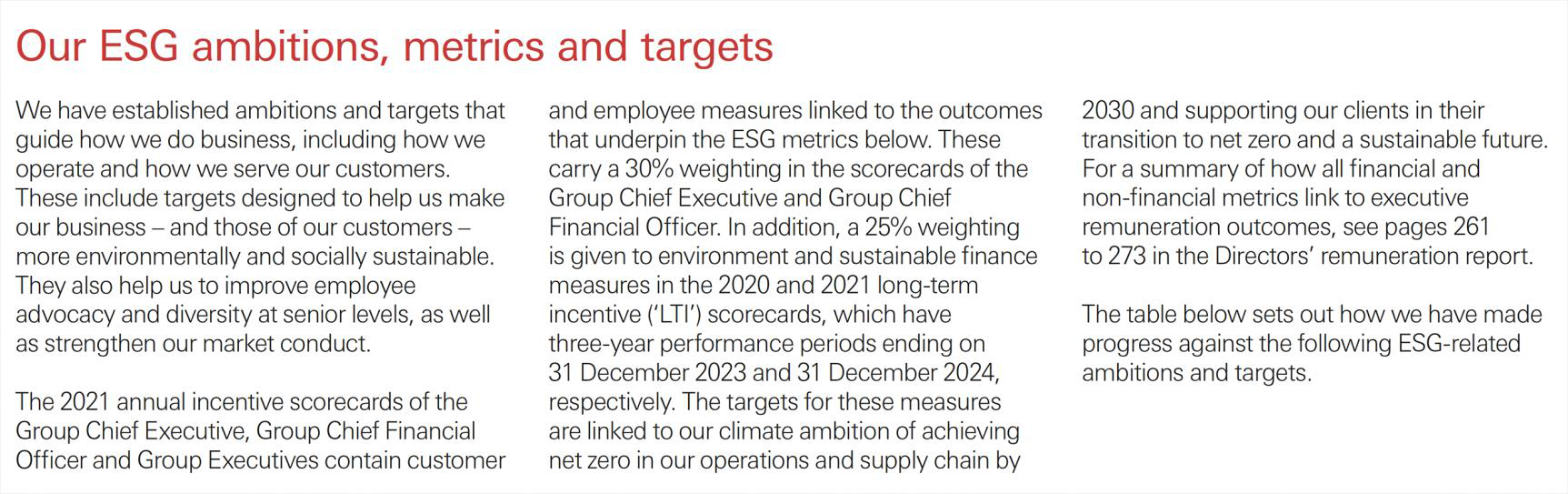
HSBC Holdings plc, Annual Report and Accounts 2021, page 17
Explanation of impact of ESG-related targets on remuneration and link to strategy
Climate performance and remuneration
Text block explaining how climate performance indicators are integrated into Shell's remuneration and incentive programs for 2021.
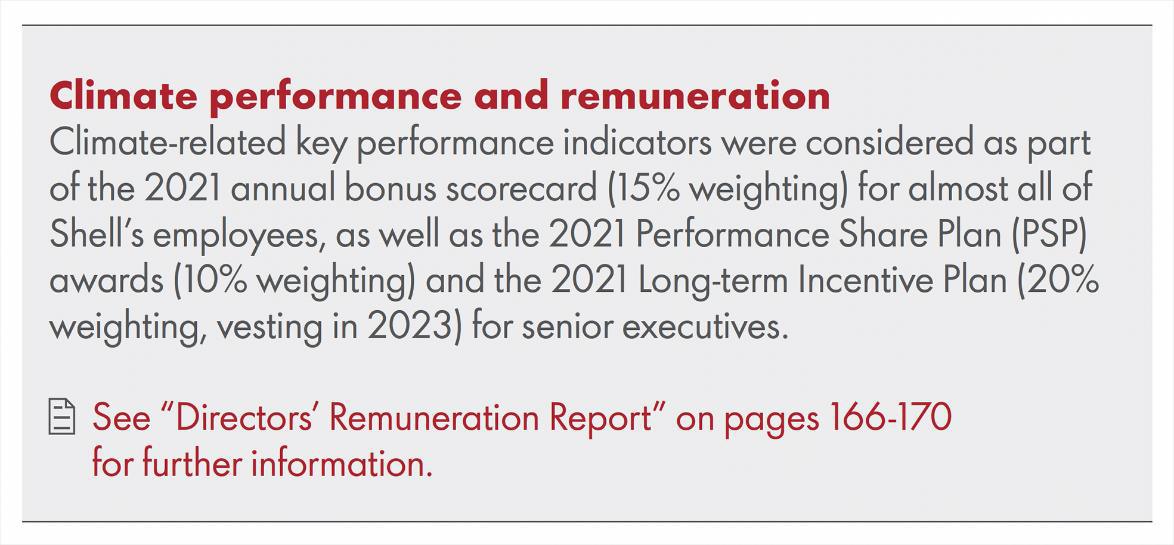
Shell plc, Annual Report and Accounts 2021, page 76
Refers to impact of climate performance on wider employee remuneration
6. TCFD – metrics and targets (continued)
Recommended Disclosure b)
Disclose Scope 1, Scope 2, and, if appropriate, Scope 3 greenhouse gas (GHG) emissions, and the related risks.
Metrics & targets recommended disclosure (b)
Bar chart showing the number of companies disclosing various aspects of GHG emissions. The x-axis represents the 'Number of companies' from 0 to
- The y-axis lists categories such as: Scope 1, Scope 2, Scope 3, Scope 3 categories, Reporting boundaries disclosed, Methodology disclosed, Compatible with GHG Protocol, Appropriate efficiency ratios, Generally accepted industry ratio, Reason for efficiency ratios, Comparatives for all metrics, More than one year of data, and Movements explained.
The bars are segmented by: - Provided (dark blue) - Some information provided (light blue) - Not provided (green) - N/A (light green)
'Scope 1', 'Scope 2', 'Methodology disclosed', and 'Compatible with GHG Protocol' show high levels of 'Provided'. 'Scope 3', 'Scope 3 categories', 'Appropriate efficiency ratios', 'Generally accepted industry ratio', and 'Reason for efficiency ratios' show higher proportions of 'Not provided' or 'Some information provided'.
Companies should provide Scope 1 and Scope 2 GHG emissions, independent of a materiality assessment, and, if appropriate, Scope 3 GHG emissions, along with related risks. All of the companies in our sample disclosed absolute Scope 1 and 2 GHG emissions, with 17 also providing Scope 3.
UK listed companies are required to report Scope 1, Scope 2 and an appropriate emissions intensity. In our sample several companies referred to their SECR reporting in order to meet the TCFD recommendation. The FRC SECR thematic provides a summary of requirements and expectations, including a discussion of the potential for different reporting boundaries.2
Methodologies
Many companies stated that their methodology aligned with the GHG Protocol and some provided more detailed methodology in a separate document. The GHG Protocol includes two different approaches to determining the boundary for consolidating emissions: equity share and control approaches. In our sample we saw a mix of both approaches, although some companies' approach was not clear from their disclosures. We also observed that two companies changed their reporting basis since the prior year: one company from equity share to operational control and one from operational control to equity.
6. TCFD – metrics and targets (continued)
We expect companies to:
Provide an explanation of the methodology used to calculate emissions metrics, including whether it is in accordance with the GHG Protocol methodology, the reporting boundaries and highlighting any changes in the basis of reporting. As there is significant scope for judgements in determining boundaries and which emissions are included, companies should explain these decisions clearly. This information is expected to be more material where these metrics underpin a major policy or strategy.
Provide explanations for changes in reported emissions where there have been changes in methodologies or restatements.
Provide clear signposting to additional methodology detail reported separately from the annual report with weblinks to facilitate access.
6. TCFD – metrics and targets (continued)
Text block discussing the consolidation approach for GHG emissions and energy consumption data based on operational control.

Shell plc, Annual Report and Accounts 2021, page 97
Explanation of using operational control approach to reporting greenhouse gas emissions
Basis of preparation - net carbon intensity Shell's net carbon intensity (NCI) provides an annual measure of the life-cycle emissions intensity of the portfolio of energy products sold. The intended use of the NCI metric is to track progress in reducing the overall carbon intensity of the energy products sold by Shell, as described in Shell's climate target. The NCI is calculated on a life-cycle basis and as such includes GHG emissions – on an equity basis – from several sources, including: * direct GHG emissions from Shell operations; * indirect GHG emissions from generation of energy consumed by Shell; and * indirect GHG emissions from the use of the products we sell.
Emissions from other parts of the product life cycle are also included, such as those from the extraction, transport and processing of crude oil, gas or other feedstocks and the distribution of products to our customers.
Also included are emissions from parts of this life cycle not owned by Shell, such as the extraction of oil and gas processed by Shell but not produced by Shell; or from the production of oil products and electricity marketed by Shell that have been not processed or generated at a Shell facility.
Emissions offset through various measures, such as by working with nature to create carbon sinks – including forests and wetlands – or mitigated by using CCS technology are also taken into account.
Text explaining the basis of preparation for net carbon intensity and Scope 1 emissions, including calculation methodologies and exclusions.
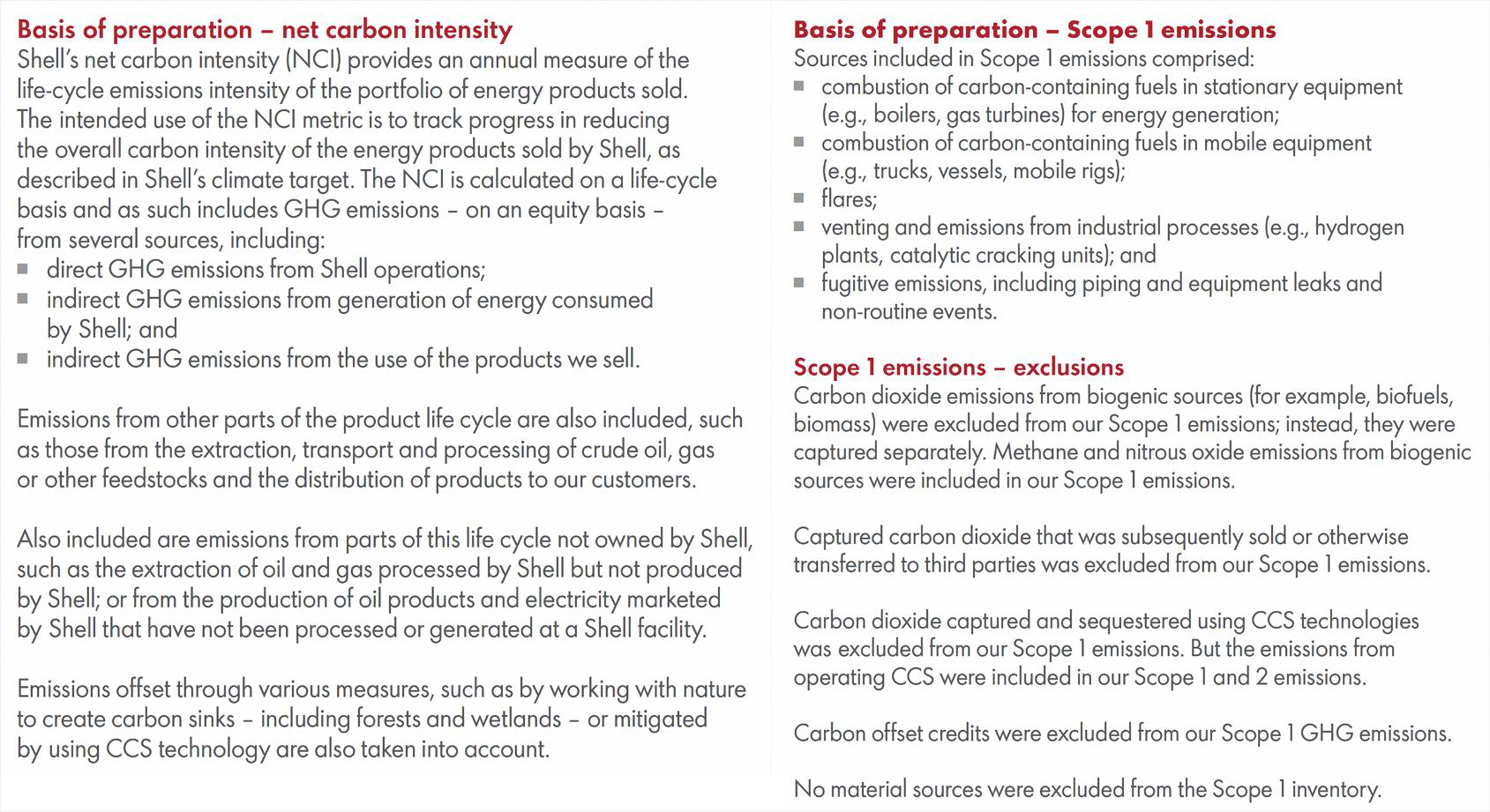
Basis of preparation - Scope 1 emissions Sources included in Scope 1 emissions comprised: * combustion of carbon-containing fuels in stationary equipment (e.g., boilers, gas turbines) for energy generation; * combustion of carbon-containing fuels in mobile equipment (e.g., trucks, vessels, mobile rigs); * flares; * venting and emissions from industrial processes (e.g., hydrogen plants, catalytic cracking units); and * fugitive emissions, including piping and equipment leaks and non-routine events.
Scope 1 emissions - exclusions Carbon dioxide emissions from biogenic sources (for example, biofuels, biomass) were excluded from our Scope 1 emissions; instead, they were captured separately. Methane and nitrous oxide emissions from biogenic sources were included in our Scope 1 emissions.
Captured carbon dioxide that was subsequently sold or otherwise transferred to third parties was excluded from our Scope 1 emissions.
Carbon dioxide captured and sequestered using CCS technologies was excluded from our Scope 1 emissions. But the emissions from operating CCS were included in our Scope 1 and 2 emissions.
Carbon offset credits were excluded from our Scope 1 GHG emissions.
No material sources were excluded from the Scope 1 inventory.
Centrica plc, Annual Report and Accounts 2021, page 35
(3) Restated due to changes in methodology following a move from equity to operational control to align with the more commonly used organisational boundary approach set out by the WRI/WBCSD Greenhouse Gas Protocol and means that Spirit Energy and Nuclear are not included, whilst scope 2 and 3 have moved to a market-based approach to better reflect our decisions on where we source imported power.
Explanation of changes to the methodology used to report greenhouse gas emissions from equity to operational control reporting and a market-based approach
Summary of greenhouse gas emission methodology with additional detail provided for Scope one emissions, including the treatment of offsets
Shell, Annual Report 2021, page 95-96
6. TCFD – metrics and targets (continued)
Intensity ratios
All companies provided at least one intensity ratio, comparing emissions data with an appropriate business metric or financial indicator to facilitate comparisons over time and with other similar types of organisations.
A variety of ratios were reported, including tonnes of CO2 equivalent: * per full time equivalent employees at year end; * per currency unit of sales revenue; * per tonne of copper equivalent production; * per MWh power generated; and * per tonne of hydrocarbon production available for sale.
These were generally appropriate for the sectors and aided comparison across companies.
In some instances, it was not possible to assess the suitability of intensity ratios provided, as it was not clear whether the ratio was in accordance with normally accepted industry norms and no reason for the selection was included. It was also not always possible to recalculate the intensity ratio from the information disclosed.
Better practice examples explained the basis for providing the ratio disclosed.
We expect companies to:
Consider the relevant intensity metrics for their sector and business and provide clear explanations of the choice of metric where they are not standard for the industry.
Provide appropriate commentary on performance, taking account of business activities such as unplanned shut-downs, acquisitions or disposals that have led to significant movements.
“Carbon intensity of revenue is employed as our intensity measure as it is the most meaningful intensity measure for our diverse business and is the most widely used and understood measure for climate-related stakeholders such as CDP. Based on statutory revenue.”
Centrica plc, Annual Report and Accounts 2021, page 35
Explanation of the reason for selecting the company's basis for emissions intensity metric
6. TCFD – metrics and targets (continued)
Scope 3 emissions
The TCFD framework states that Scope 3 emissions should be reported if appropriate, but encourages organisations to disclose such emissions irrespective of the amounts.
Scope 3 categories reported
Bar chart showing the number of companies reporting on each Scope 3 emissions category. The x-axis represents the 'Number of companies' from 0 to
- The y-axis lists the 15 Scope 3 categories: Purchased Goods & Services, Capital Goods, Fuel & Energy Related Activities, Upstream Transportation & Distribution, Waste Generated in Operations, Business Travel, Employee Commuting, Upstream Leased Assets, Downstream Transportation &..., Processing of Sold Products, Use of Sold Products, End of Life Treatment of Sold Products, Downstream Leased Assets, Franchises, and Investments.
'Business Travel' shows the highest number of companies reporting, followed by 'Purchased Goods & Services' and 'Capital Goods'. Several categories, such as 'Upstream Leased Assets', 'Downstream Leased Assets', and 'Franchises', have very few or no companies reporting.
The Greenhouse Gas Protocol lists 15 different categories of Scope 3 emissions, but notes that, since companies have discretion over which categories they choose to report, Scope 3 may not lend itself well to comparisons across companies.
For many companies, emissions from their supply chain or due to carbon-intensive products are much more significant than their Scope 1 and 2 emissions, but also present a much bigger data collection challenge. In our sample, 17 companies disclosed Scope 3 emissions and, of those companies not providing Scope 3, a few noted that work is underway to determine the emissions that they expect to publish in 2022.
The most common Scope 3 reporting category reported was business travel. A few companies reported against all Scope 3 categories, disclosing which were, and which were not, relevant to their business. In two cases it was unclear which category of emissions was disclosed or whether only part of the category was included.
None of the companies reviewed reported emissions in relation to leased assets, despite some reporting significant right of use assets and liabilities. Of these, some companies provided explanations for not including these categories; one company stated that these were outside their reporting boundary and another stated that these categories were assessed as being not-material.
<blockquotequote markdown="1"> Where companies did not report Scope 3 emissions, better disclosures explained why, considered the impact on the companies' compliance statement, and provided an expected timeline in which to report.
6. TCFD – metrics and targets (continued)
We expect companies to:
Undertake an assessment to determine the materiality of Scope 3 emissions to users of the financial statements and report emissions where required, clearly identifying which categories are included.
Consider the impact on the company's TCFD compliance statement where Scope 3 emissions are relevant but not reported, including the reason for the non-disclosure and the expected timeframe to report.
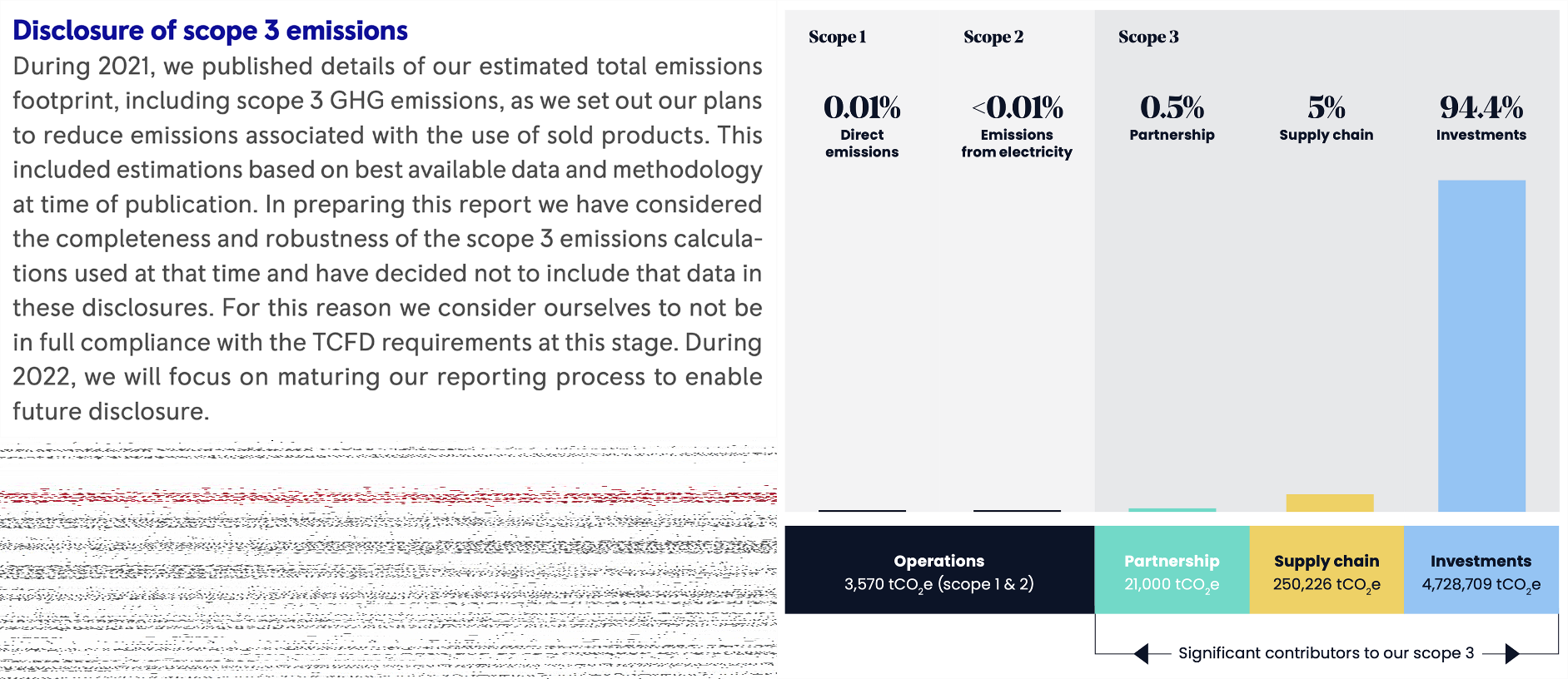
St James's Place plc, 2021 TCFD Report, page 19
Shows relative magnitude of emissions by source and scope
Explanation for not disclosing scope 3 including considering impact on compliance statement of the extent of compliance with TCFD recommended disclosures
Disclosure of scope 3 emissions During 2021, we published details of our estimated total emissions footprint, including scope 3 GHG emissions, as we set out our plans to reduce emissions associated with the use of sold products. This included estimations based on best available data and methodology at time of publication. In preparing this report we have considered the completeness and robustness of the scope 3 emissions calculations used at that time and have decided not to include that data in these disclosures. For this reason we consider ourselves to not be in full compliance with the TCFD requirements at this stage. During 2022, we will focus on maturing our reporting process to enable future disclosure.
Rolls-Royce Holdings plc, Annual Report 2021, page 42
6. TCFD – metrics and targets (continued)
SCOPE 3 TOTAL ANNUAL GHG EMISSIONS
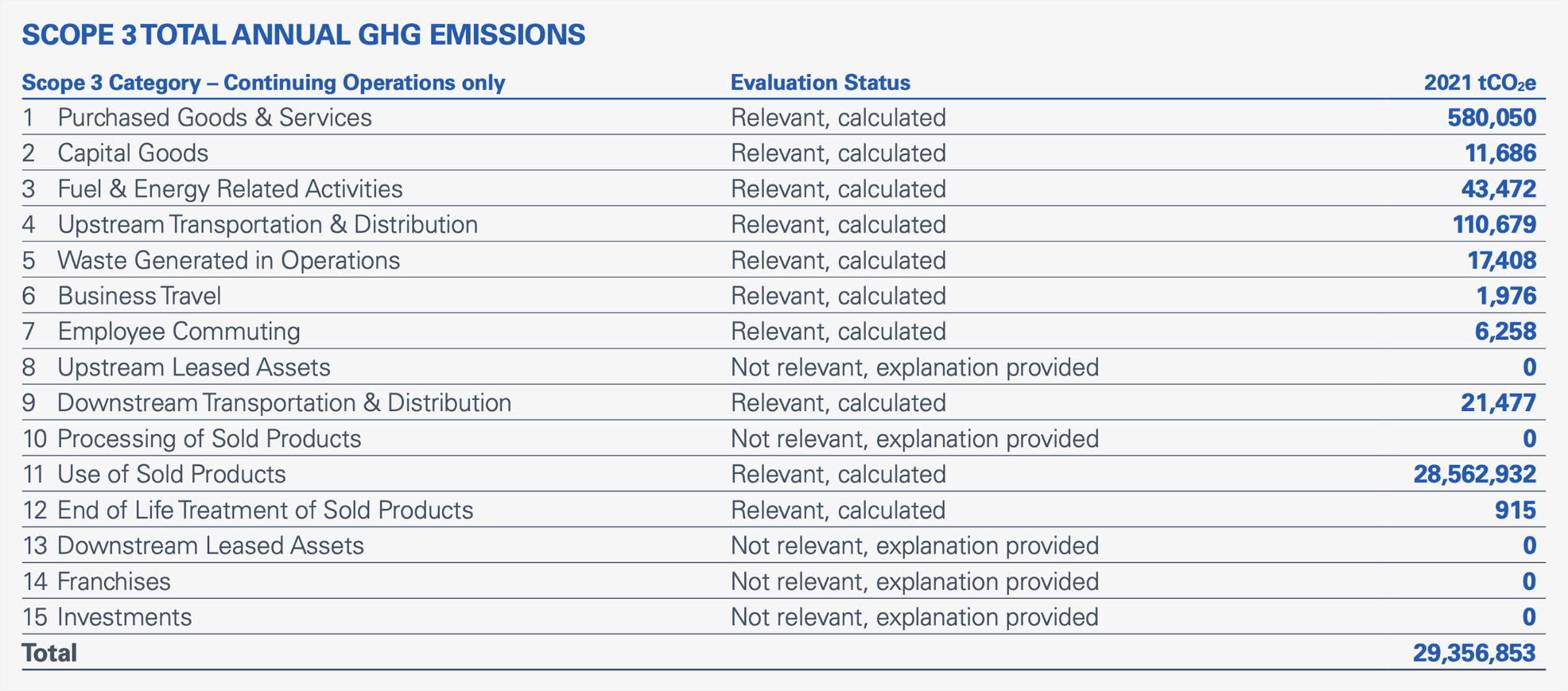
Clear reporting against each of the Scope 3 categories
Scope 3
Text describing the methodology for calculating scope 3 emissions, including categories, methods, and assurance processes.
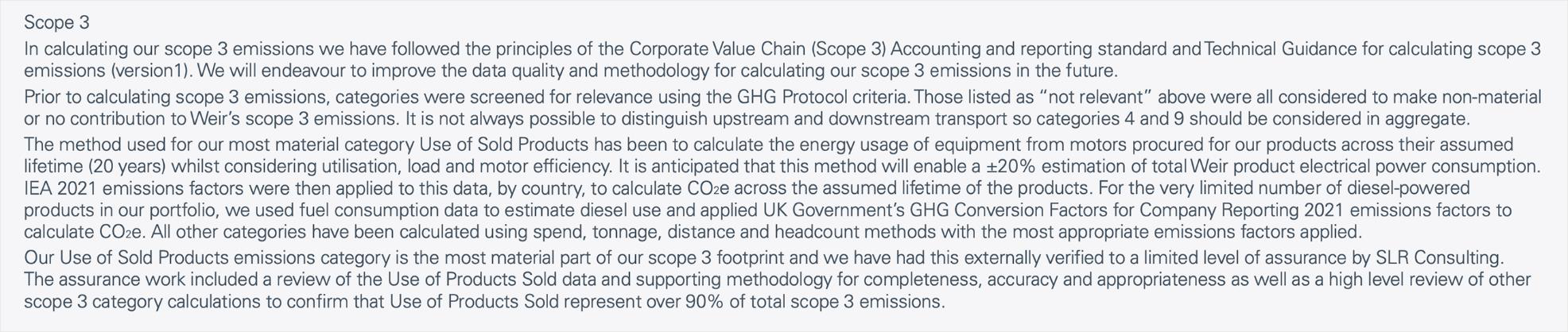
The Weir Group PLC, Annual Report and Financial Statements 2021, page 61
6. TCFD – metrics and targets (continued)
Recommended Disclosure c)
Describe the targets used by the organisation to manage climate-related risks and opportunities and performance against targets.
Metrics & targets recommended disclosure (c)
Bar chart showing the number of companies disclosing various aspects of climate targets. The x-axis represents the 'Number of companies' from 0 to
- The y-axis lists categories such as: GHG targets, Other climate targets, Targets are quantified, Performance against target, Comparatives provided, Timeframe for target, Base year for target, Interim milestones, KPIs to assess targets, and Methodology.
The bars are segmented by: - Provided (dark blue) - Some information provided (light blue) - Not provided (green) - N/A (light green)
'GHG targets' and 'Methodology' show high levels of 'Provided'. Categories like 'Targets are quantified', 'Performance against target', 'Comparatives provided', 'Timeframe for target', 'Base year for target', 'Interim milestones', and 'KPIs to assess targets' show varying levels of 'Provided', 'Some information provided', and 'Not provided'.
There was mixed practice in providing more detailed information about targets; some companies did not quantify the current performance, provide comparatives, clearly disclose the base year or the timeframe for all metrics, making it difficult to assess the targets in the context of business performance.
Climate / other environment related targets
Horizontal bar chart illustrating the number of companies reporting on various climate and other environment-related targets. The x-axis represents the 'Number of companies' from 0 to
- The y-axis lists categories such as: Net zero / emissions reduction, Water, Renewable energy, Products / circular economy, Waste reduction / zero waste, Land, Procurement, Biodiversity, Financed emissions related, Other operational, Plastic, and Other air emissions.
'Net zero / emissions reduction' shows the highest number of companies reporting. Other categories like 'Water', 'Renewable energy', and 'Products / circular economy' also show significant reporting. Categories towards the bottom, such as 'Other air emissions', have fewer companies reporting.
Most companies in our sample had set targets for climate-based metrics. 23 of these had net zero or carbon neutral targets, with 17 companies reporting other climate-based metrics, such as plastic use. The emissions targets reported were a mixture of absolute
- and intensity-based.
Basis of emissions targets
Pie chart illustrating the basis of emissions targets. The segments are: - Absolute (dark blue) - Intensity based (light blue) - Mixture (green) The chart shows that 'Absolute' targets are the most common, followed by 'Intensity based' and 'Mixture'.
6. TCFD – metrics and targets (continued)
There was a general lack of consistency between the definitions, timelines and scope of companies' climate and net zero commitments despite having similar descriptions, making meaningful comparison difficult, even within sectors.
We expect companies to:
Ensure they clearly distinguish between 'targets', 'pledges, 'goals', 'aims', 'commitments' and 'ambitions', explaining which of these policies that are actively pursued and included in business plans and budgets.
Clearly highlight which KPIs are used to monitor progress against targets and provide sufficient information to assess performance. Companies should ensure they include definitions and methodologies to explain their metrics and targets, particularly where they are company-specific.
Explain which Scope 1, 2 or 3 emissions are included in their targets and ensure that the relationship with metrics included in greenhouse gas reporting is explained clearly.
Explain the reporting boundaries of the target, for example whether any joint ventures or businesses are excluded.
Provide comparative information for all metrics alongside current reporting to enable performance against the target to be assessed. If any updates are made to targets, such as restatements or updates to baselines, these should be disclosed and explained.
Consider identifying any areas where performance was not in accordance with the target, and any actions taken, to address this.
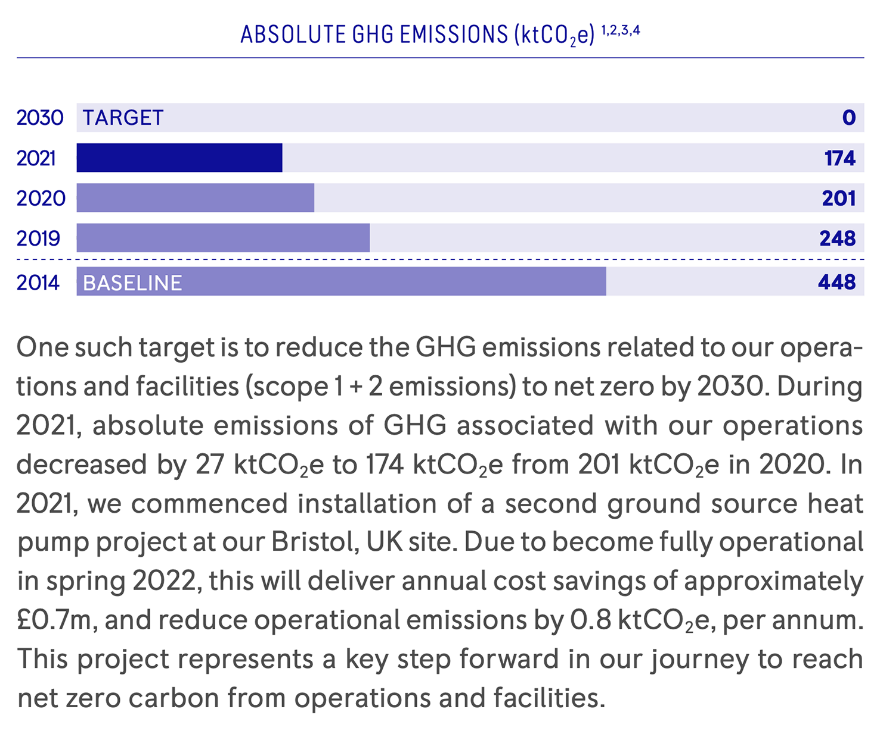
Current year performance with target, comparatives and baseline </blockquotequote>
One such target is to reduce the GHG emissions related to our operations and facilities (scope 1 + 2 emissions) to net zero by
- During 2021, absolute emissions of GHG associated with our operations decreased by 27 ktCO₂e to 174 ktCO₂e from 201 ktCO₂e in 2020. In 2021, we commenced installation of a second ground source heat pump project at our Bristol, UK site. Due to become fully operational in spring 2022, this will deliver annual cost savings of approximately £0.7m, and reduce operational emissions by 0.8 ktCO₂e, per annum. This project represents a key step forward in our journey to reach net zero carbon from operations and facilities.
Shows metrics against short-, medium
- and longer-term targets
Rolls-Royce Holdings plc, Annual Report 2021, page 42
| Time Period | Target | Metrics |
|---|---|---|
| Short Term (2022–2025) | Continue to embed climate risk and opportunity analysis into the business strategy and operations | Qualitative |
| Reduce our operational footprint (Scope 1 & 2) | % reduction in diesel fuel use % energy efficiency | |
| Maintain 100% carbon neutral electricity purchased – green/REGO backed | Zero CO₂ from Scope 2 sources | |
| Undertake embodied carbon assessments, set reduction targets | Tonne CO₂/m² completed floor area | |
| Supply chain engagement on embodied carbon | Action plans in place to reduce carbon content of top CO₂ contributors | |
| Medium Term (to 2030) | Homes to be net zero carbon in use by 2030 | SAP calculation |
| Reduce absolute Scope 1 & 2 GHG emissions by 46% by 2030 (2019 baseline) | Transition pathway – tonnes/CO₂ against a 2019 baseline | |
| Reduce Scope 3 Purchased goods and services, and use of sold products by 22% per m² completed floor area | Tonnes/CO₂/m² completed floor area against a 2019 baseline over their lifetime | |
| Longer term (to 2040) | Net zero carbon emissions in our own operations (Scope 1 & 2) by 2040 | % zero carbon % carbon offsets |
Persimmon Plc, Annual Report 2021, page 67
Find our full set of goals, targets, metrics, data scope and definitions in our 2021 ESG Report at www.bat.com/ESGreport.
On track or met target ![Green circle icon] Acceleration required ![Orange circle icon] Ongoing focus area ![Red square icon]
| Topic | Goals and targets | Metrics | 2021 | 2020 | 2019 | Status |
|---|---|---|---|---|---|---|
| E Climate Change | Net Zero achieve carbon neutral operations (Scope 1 and 2 CO₂e emissions) by 2030 and net zero emissions across our value chain by 2050 | Scope 1 CO₂e emissions (thousand tonnes)¹ | 325 | 342 | 396 | ![Green circle icon] |
| Scope 2 CO₂e (market-based) emissions (thousand tonnes)¹ | 170 | 199 | 386 | ![Green circle icon] | ||
| Total Scope 1 & 2 CO₂e emissions (thousand tonnes)¹ | 495 | 541 | 782 | ![Green circle icon] | ||
| Scope 1 and scope 2 CO₂e emissions intensity ratio (tonnes per £m revenue)¹ | 19.3 | 20 | 30.4 | ![Green circle icon] | ||
| Scope 3 CO₂e emissions (thousand tonnes) including biogenic emissions and biogenic removals†² | N/A | 5,587 | 6,781 | ![Green circle icon] | ||
| 30% by 2025 of total energy from renewable sources | Total direct energy use (GWh)³ | 2,480 | 2,568 | 2,874 | ![Green circle icon] | |
| 100% by 2030 of electricity sourced for operations sites that is renewable | Renewable energy as a % of total direct energy use | 28.6 | 26.8 | 10.8 | ![Orange circle icon] | |
| % of electricity sourced for operations sites that is renewable | 64.4 | 61.1 | 10.7 | ![Orange circle icon] | ||
| ![Waste icon] Waste | 100% by 2025 of operations sites to achieve zero waste to landfill | Waste sent to landfill (thousand tonnes) | 11.93 | 12.73 | 13.95 | ![Green circle icon] |
| % of operations sites reporting zero waste to landfill | 35 | 27 | N/A | ![Green circle icon] | ||
| ![Water icon] Water | -35% by 2025 of total amount of water withdrawn (vs 2017 baseline) | Total water withdrawn (mn cubic metres m³) | 3.76 | 4.03 | 4.51 | ![Green circle icon] |
| ![Biodiversity & Afforestation icon] Biodiversity & afforestation | Net Zero Deforestation by 2025 aiming for net zero deforestation of managed forests in our supply chain and net positive impact on forests in our tobacco supply chain | % of sources of wood used by our contracted farmers for curing fuels that are from sustainable sources | 99.9 | 99.7 | 99.6 | ![Green circle icon] |
| % paper and pulp volumes that is certified as sustainably sourced† | 89 | N/A | N/A | ![Green circle icon] |
Provides sustainability-related metrics showing link to targets, current performance and comparatives
British American Tobacco p.l.c., Annual Report and Form 20-F 2021, page 47
Net zero
23 of the companies had targets that referred to net zero or carbon neutrality, the timings of which ranged from 2033 to 2050. The majority aligned to the UK government commitment to net zero by 2050 (as per the Climate Change Act 2008. Some companies provided a reason for the time-periods chosen, for example one company's target was aligned to its 200-year anniversary and one company stated its target was 'in step with society'.
Net-zero targets disclosed
The bar chart illustrates the "Number of companies" with net-zero targets disclosed against "Year". The bars show counts for: Not set: 2 2030: 7 2033: 1 2035: 1 2039: 1 2040: 3 2045: 1 2050: 13
Companies used a range of different terms, such as 'pathway', 'transition plan' or 'climate action plan' when referring to their strategy or plans to meet targets. Some companies also referred to a 'just transition' but were less clear about what exactly that meant or how it might impact their climate strategy.
Ten companies had more than one target covering different emissions scopes and some referred to their net zero targets being 'Paris-aligned'. There is no single agreed pathway to achieving the goals of the Paris Agreement and users have different views on the typical characteristics of a Paris-compliant transition, which can make it difficult to compare companies' commitments even within the same sector.
Most companies with net zero or carbon neutral targets had interim targets, but there was less clarity over the plans in place to meet these interim targets.
The use of carbon offsets to achieve net zero is part of many companies' transition plans. However, only twelve companies mentioned offsetting directly and there was little disclosure about the nature or quality of the offsets. A further three referred to offsetting elsewhere, such as providing examples of offsets employed on specific projects or in the narrative about carbon prices but did not discuss this in relation to net zero.
Better practice examples provided explanations of achievements so far, planned actions and areas of uncertainty in pathways to meet their net zero targets.
Better practice examples clearly explained the approach to offsetting and disclosed the use of offsets in their emissions reporting.
We expect companies to:
- Clearly explain what 'net zero' or 'carbon neutrality' terms mean, in the context of the company, ensuring that disclosures about such commitments are not misleading.
- Whilst we recognise the inherent challenges in preparing transition plans, we consider that it is helpful where possible for companies to include interim milestones, outline the steps they are taking to meet them, the expected timelines and the main areas of uncertainty.
- Explain whether carbon offsetting represents a significant part of a company's strategy to reach net zero.
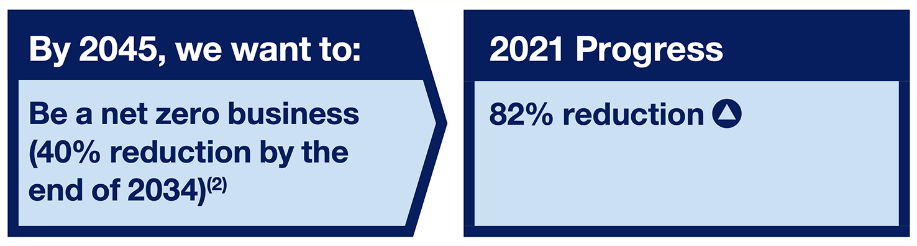
Clear definition of the company's net zero target, including boundary and baseline
2Net zero goal measures scope 1 (direct) and 2 (indirect) greenhouse gas emissions based on operator boundary which excludes Spirit Energy and Nuclear emissions, and is normalised to reflect acquisitions and divestments in line with changes in Group structure and therefore excludes Direct Energy, against a 2019 baseline of 1,146,601mtCO2e.
Centrica plc, Annual Report and Accounts 2021, page 32
| Climate | ||
|---|---|---|
| Target: | ||
| 2025 | 2030 | |
| -25% relative* | -25% absolute* | 2050 Net-zero |
*Scope 1 & 2 emissions
Energy and greenhouse gas emissions We aim to minimise our impact on climate change by reducing our energy intensity and carbon emissions. The main contributor to CO₂ emissions is site energy use in the heat and electricity used in our manufacturing processes. Emissions associated with the generation of heat, or co-generation, account for around two-thirds of Group emissions. We monitor and maintain our equipment and processes to reduce the impact of CO₂ emissions and major capital projects incorporate the best available technologies at the design stage to minimise emissions and energy usage per kilometre of product. For planning purposes, we use an internal carbon price of £50/t CO₂e.
Our targets do not assume any significant step-change in technology. We aim to achieve our interim 2025 target via efficiency improvements, such as modular solar investments and purchase of renewably sourced electricity via power purchase agreements. Some opportunities to achieve this have been identified, such as site-specific LED and solar PV projects expected to be approved in H1 2022; a 1020kW solar PV project in Nantong has been approved. For 2030, we will focus of improving our efficiency, reducing our energy demand, further renewable procurement, and the decarbonisation of our heat requirements.
Commentary on actions taken to reach interim greenhouse gas emissions target
Devro plc, Annual Report and Accounts 2021, page 53
Our path to Net Zero
Existing portfolio: Scope 1 and 2 emissions
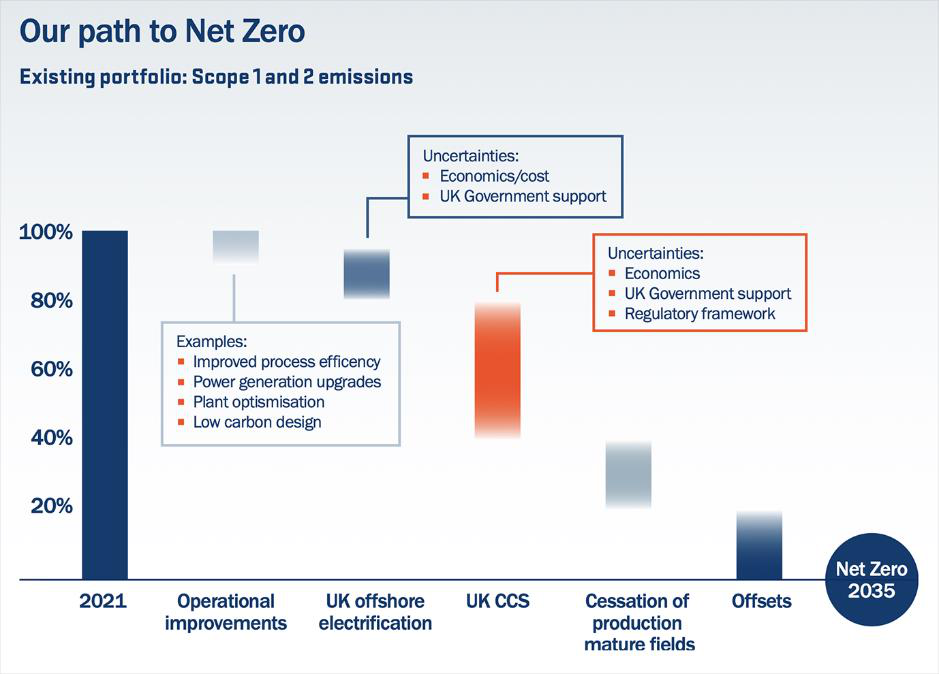
Path to net zero, highlighting areas of uncertainties and planned use of carbon offsets
Harbour Energy plc, ESG Report 2021, page 20
| BASELINE YEAR 2019 | PREVIOUS REPORTING YEAR 2020 | CURRENT REPORTING YEAR 2021 | |
|---|---|---|---|
| GRAND TOTAL | UK | GLOBAL (EXCL. UK) | |
| SCOPE 1 & 2 EMISSIONS (TONNES OF CO₂E) | |||
| SCOPE 1 - COMBUSTION OF FOSSIL FUELS | 107,797 | 13,477 | 94,321 |
| SCOPE 2 - ELECTRICITY PURCHASED FOR OWN USE | 22,287 | 1,073 | 21,214 |
| TOTAL | 130,085 | 14,550 | 115,535 |
| INTENSITY RATIO (SCOPE 1 & 2 EMISSIONS/METRIC) | |||
| TONNES OF CO₂E/$000 REVENUE | 0.08 | 0.04 | 0.09 |
| TONNES OF CO₂E/FTE | 4.20 | 2.31 | 4.68 |
| SCOPE 3 EMISSIONS (TONNES OF CO₂E) | |||
| HIRE CARS & PERSONAL VEHICLES USED FOR BUSINESS | Not calculated for 2019 | ||
| OFFSETS & NET EMISSIONS (TONNES OF CO₂E) | |||
| OFFSETS | (2,233) | ||
| NET EMISSIONS | 127,851 | ||
| UNDERLYING ENERGY USE (KWH) | |||
| TOTAL | Not calculated for 2019 | 360,669 | 39,448 |
Offsets shown alongside emissions with comparatives
12019 and 2020 Scope 1 and 2 emissions and underlying energy use figures are different to those reported previously. This is due to a. an adjustment of the conversion factor used for diesel off-road from 'Diesel 100% mineral oil' to 'Gas oil (also known as red diesel)'. b. correction of two previously unidentified errors in Sydney & London Gatwick in 2020. 2The 2019 and 2020 tonnes of CO₂e/revenue intensity ratio figures are different to those reported previously. This is due to the Group's change in presentational currency, to reporting in US dollars rather than British pounds.
John Menzies plc, Annual Report and Accounts 2021, page 57
Stewardship of net zero
In 2022 the Stewardship Regulators Group (SRG) held a series of workshops to obtain investor, preparer and other stakeholders views on the stewardship of net zero. More detailed findings will be published in September. Overall the concerns over net-zero targets were similar to those of investors who took part in the FRC Lab's project on target setting in 2019.
Investors are interested in the targets being set but would like clarification of what is meant by 'net zero' and 'Paris-aligned'. There was recognition that sectors and companies will have unique transition pathways, but stakeholders would like to see standardised, consistent and comparable information with a defined scope and including interim milestones in the short, medium and long term.
The TCFD framework was considered an appropriate starting point for the disclosure of transition plans, but many investors expect more information about the key items impacting a company, for example capital expenditure, use of carbon offsets and the role of technology.
Other reporting / disclosure frameworks and industry groups
We welcome the formation of the ISSB which will help to enhance comparability and reporting in this space.
Providing disclosures in accordance with recognised reporting initiatives can help improve comparability across businesses, and provide information which can aid the assessment of climate-exposure.
Many companies referred to contributing to reporting initiatives and reporting against frameworks. The main frameworks or reporting initiatives mentioned by the companies we reviewed were the Science Based Targets initiative (SBTi), the CDP (formerly the Carbon Disclosure Project), the UN Sustainable Development Goals (UN SDG) and the Sustainability Accounting Standards Board (SASB).
18 companies reported that they either had SBTi in place or were intending to set aligned targets during 2022. We note that one oil and gas company in our sample referred to discussions with SBTi, but that they flagged that there are currently no agreed SBTi pathways in that sector.
17 companies referred to CDP submissions; as noted in the compliance section, (see page 18)) companies should consider the periods referenced for their reporting.
14 companies referred to either reporting or undertaking analysis against SASB standards, with some providing a SASB index within the annual report and some referring to separate indexes or disclosures in other reports.
Some companies also referred to being part of climate-related industry groups. These groups can enable sharing of information and good practices in their sectors, but companies should be clear that participation does not necessarily enhance the credibility of their climate disclosures.
Companies referring to frameworks / initiatives
The horizontal bar chart shows the "Number of companies" referring to various frameworks / initiatives:
- SBTi (already or planned for 2022): 18
- CDP: 17
- UN SDGs: 14
- SASB: 14
- UN race to zero: 11
- ESG performance indexes: 9
- Business Ambition for 1.5°C: 7
- GRI: 7
- Other industry groups: 6
- WEF metrics: 4
7. TCFD – sector-specific and other guidance
Listing Rules requirement – sector based and other guidance
Listing Rule 9.8.6BG states that, in determining whether climate-related financial disclosures are consistent with the TCFD Recommendations and Recommended Disclosures, a listed company should undertake a detailed assessment of those disclosures which takes into account:
- Section C of the TCFD Annex entitled “Guidance for All Sectors";
- (where appropriate) Section D of the TCFD Annex entitled "Supplemental Guidance for the Financial Sector"; and
- (where appropriate) Section E of the TCFD Annex entitled "Supplemental Guidance for Non-Financial Groups".
Listing Rule 9.8.6CG goes on to list further guidance that is relevant in making this determination, including
- the TCFD Final Report and the TCFD Annex, to the extent not already referred to in LR 9.8.6R(8) and LR 9.8.6BG;
- the TCFD Technical Supplement on the Use of Scenario Analysis;
- the TCFD Guidance on Risk Management Integration and Disclosure;
- (where appropriate) the TCFD Guidance on Scenario Analysis for Non-Financial Companies; and
- the TCFD Guidance on Metrics, Targets and Transition Plans.
As the Guidance for All Sectors is relevant for all industries, we considered it for all of the companies in our review. The findings from a detailed consideration of this guidance are included in the relevant sections of our report.
All but one of the companies in our sample also fell within the scope of at least one of the industries for which supplemental sector-specific guidance has been published by the TCFD. The extent to which the sector-specific supplemental TCFD guidance had been taken into account in determining the disclosures given was not always clear. A small number of companies either explicitly indicated that the guidance had been taken into account or explained why the guidance for a particular sector was not considered relevant; others gave the majority of the disclosures recommended for the relevant sector, indicating that the guidance had been considered.
We focus on life, health and wealth products and therefore do not have greenhouse gas (GHG) intensive activities in our underwriting portfolio. While climate change can impact morbidity, mortality and persistency, the impact of climate change does not directly alter the Group's assumptions for its insurance business based on the annual review of experience. If experience or exposure were to change, for example due to a step change in long-term morbidity and/or mortality expectations in a particular region due to climate events, the financial impacts from climate-related risks on our insurance liabilities could be more significant and would be allowed for as part of the regular review. However, the longer-term impact to the Group should be managed by our ability to reprice contracts if needed and develop new products. Work continues on plotting significant clusters of customer locations to assess the potential risk from physical climate events to our known customer base.
Explanation of why majority of insurance-specific recommendations are not relevant
Prudential plc, Annual Report 2021, page 87 The TCFD framework against which companies are required to report for the purposes of the Listing Rules is the report 'Recommendations of the Task Force on Climate-related Financial Disclosures' published in June
- An updated version of the annexe to this report was published in October 2021 (the '2021 guidance'), which includes updated guidance for all sectors, as well as some changes to the guidance for specific sectors.
The Listing Rules require companies to take account of the 2021 guidance with effect from 1 January 2022.
The main changes applicable to all sectors are as follows:
Strategy
- Revised to more explicitly address disclosure of actual financial impacts on organisations as well as key information from organisations' plans for transitioning to a low-carbon economy (transition plans).
- Revised to more explicitly address disclosure of potential financial impacts on organisations.
Metrics and Targets
- Revised to more explicitly address disclosure of metrics consistent with cross-industry, climate-related metric categories for current, historical, and future periods, where appropriate.
- Revised disclosure of Scope 1 and Scope 2 GHG emissions to be independent of a materiality assessment.
- Revised to encourage disclosure of Scope 3 GHG emissions.
- Added disclosure of targets consistent with cross-industry, climate-related metric categories, where relevant.
- Added disclosure of interim targets, where available, for organisations disclosing medium-term or long-term targets.
The UK government has established a Transition Plan Taskforce (TPT) to develop a gold standard for transition plans, which will help to drive decarbonisation by ensuring that financial institutions and companies prepare rigorous plans to achieve net zero and support efforts to tackle greenwashing.
We were encouraged to find that most of the companies in our sample provided at least some disclosures regarding their plans for transitioning to a low-carbon economy, although the requirement to report is not yet in force. A smaller number of companies was also meeting some of the other recommendations from the 2021 guidance.
"In October 2021, the TCFD released additional guidance implementing the 'Recommendations of the Task Force on Climate-related Financial Disclosures' (2021 TCFD Annex). Some of the additional guidance in the 2021 TCFD Annex will require more time for us to fully consider. We will start this review over the course of 2022."
Prudential plc, Annual Report 2021, page 76
Acknowledgement of the changes needed to meet the updated recommendations
8. Climate change in the financial statements
Reporting requirements in relation to climate change
There is no standalone IFRS standard which specifically addresses climate change. However, the requirements of IFRS standards provide a clear framework for incorporating the risks of climate change into companies' financial reporting.
The IASB published educational material in November 2020 which provides a non-exhaustive list of examples where IFRS standards may require companies to consider the effects of climate change. This guidance supplements the earlier IASB article by Nick Anderson, which also addresses questions of materiality judgements in the context of climate change.
We considered the areas highlighted in these sources, including their references to investor expectations, when reviewing the reports in our sample.
Overall adequacy of climate disclosure in the financial statements
22 of 25 companies in our sample made reference to climate change in the financial statements. This marked a significant increase from our climate thematic in 2020, where only six out of 24 companies referred to climate change.
A smaller proportion of companies disclosed the impact of climate change on amounts recognised in the financial statements.
- Several companies quantified and discussed changes in climate-related assumptions in relation to accounting estimates in their value in use calculations for impairment testing. In a small number of cases this resulted in the recognition of an impairment loss which was partially linked to climate-related assumptions;
- A few companies appear to have incorporated climate-related assumptions into other areas such as the measurement of deferred tax assets and decommissioning provisions, although the details were not always clearly articulated; and
- One company disclosed a change in amounts recognised in the balance sheet in respect of long term contract costs as a result of a climate-related accounting judgement.
Better examples of disclosures of how management considered climate-related risks in the preparation of their financial statements showed a coherent link between the narrative reporting of climate risks and the related financial statement disclosures, including:
- entity-specific information, avoiding boilerplate disclosures;
- a description of the impact of climate upon key judgements and significant sources of estimation uncertainty, including climate-specific sensitivities where applicable;
- quantification of the impact of climate change, for example on key assumptions; and
- an explanation of the areas where climate was not expected to have a material impact, but where users might reasonably have expected some climate exposure, including a clear description of the financial statement balances considered, and why the impact of the climate was not anticipated to be material.
Some companies did not provide sufficient detail in their financial statement disclosures to provide meaningful information to users, especially when compared to extensive disclosures about climate-related risks and opportunities in the strategic report.
For example:
- Several companies highlighted commitments to electrify parts of their fleet of vehicles or equipment. None, however, explained how they had considered the impact of these plans on the valuation and useful economic lives of assets currently owned by the company.
- One company referred to climate change over 100 times in the front half of the annual report, yet made no reference to it within the financial statement disclosures, where a statement to explain the expected impact on the financial statements might have helped readers understand the apparent inconsistency.
- One company which was exposed to significant climate risks referred to considering climate change in the impairment test cash flow projections, but did not explain their impact.
- In some instances, it appeared from the extent of climate coverage in both audit committee reports and external audit opinions that companies had considered climate change in some detail; however, the disclosures in the financial statements did not appear to reflect those considerations.
We expect companies to consider whether the degree of emphasis placed on climate change risks and uncertainties in the narrative reporting, including TCFD disclosures, is consistent with the extent of disclosure about how those uncertainties have been reflected in judgements and estimates applied in the financial statements.
Better reporting presents a coherent link between the narrative and the financial statements, and may include explanations of why certain risks do not have a material impact where investors may expect them to do so.
We may challenge companies who disclose significant climate risks or net zero transition plans in narrative reporting, but who do not appear to adequately explain how this has been taken into account when preparing their financial statements.
Consideration of climate change In preparing the financial statements, the Directors have considered the impact of climate change, particularly in the context of the risks identified in the TCFD disclosure on pages 114 to 119 this year. There has been no material impact identified on the financial reporting judgements and estimates. In particular, the Directors considered the impact of climate change in respect of the following areas:
- contract judgements made on the Group's Construction Services and Support Services contracts;
- going concern and viability of the Group over the next three years;
- cash flow forecasts used in the impairment assessments of non-current assets including goodwill and infrastructure investments assets;
- carrying value and useful economic lives of property, plant and equipment; and
- the valuation of assets held within the Group's pension schemes.
Whilst there is currently no medium-term impact expected from climate change, the Directors are aware of the ever-changing risks attached to climate change and will regularly assess these risks against judgements and estimates made in preparation of the Group's financial statements.
Clearly discloses that there is no material impact from climate change on financial reporting judgements and estimates, and links financial statements disclosures to risks highlighted in TCFD disclosures
Balfour Beatty plc, Annual Report and accounts 2021, page 186
8. Climate change in the financial statements (continued)
Materiality
| IAS and IFRS requirements – Materiality | We expect companies to: |
|---|---|
| Information is material if omitting, misstating or obscuring it could reasonably be expected to influence the decisions that the primary users of general-purpose financial statements make on the basis of those financial statements, which provide financial information about a specific reporting entity. | Consider financial statement materiality in relation to climate change in the financial statements in the same way as for other accounting and disclosure matters. |
| IAS 1, paragraph 112(c), also requires disclosure in the notes of any information that is not presented elsewhere in the financial statements but is relevant to an understanding of them. Information is relevant if it is capable of making a difference in the decisions made by users (Conceptual Framework 2.6). | |
| IFRS Practice Statement 2: Making Materiality Judgements Example C provides an example in which a company provides additional disclosures of assumptions used to determine the recoverable amount of a tangible asset which are not required by IAS 36. The assumptions relate to the likelihood of the enactment of regulations to reduce carbon-based energy. In the example, the assumptions are required to be disclosed because management has determined this information could reasonably be expected to influence the decisions of primary users. |
Materiality in the context of TCFD disclosures is addressed in Section 2 of this report.8
'Paris-aligned' accounting
Some commentators have called for companies to adopt 'Paris-aligned' or '2050 net zero-aligned' assumptions and estimates in their accounts, or to explain why they have not and disclose the impact that such assumptions would have on the financial position. The Paris Agreement aims to avoid dangerous climate effects by limiting global warming to well below 2°C – and preferably to 1.5°C – by reaching net zero emissions globally by
- There are multiple possible pathways to a Paris-aligned outcome. It is therefore important for companies to consider the implications of the Paris agreement, related country-specific net zero targets, and companies' own published net zero commitments in preparing their financial statements.
IFRS accounting standards often specify the use of best estimates when valuing assets and liabilities; however, management may not consider that any of the possible global warming paths targeted by the Paris Agreement represents their best estimate of the actual outcome. IFRS standards may also prohibit companies from reflecting certain future developments associated with a Paris-aligned climate transition in their financial statements, for example where anticipated liabilities do not yet meet the criteria for recognition of a provision or asset enhancement expenditure cannot be reflected in impairment assessments. Management should ensure such matters are clearly explained to users, having sufficient regard to investor expectations in this area.
It can be helpful to distinguish between 'internal' assumptions, that are (at least to some extent) within a company's control, and 'external' assumptions, which constitute management's best estimate regarding matters largely outside the company's control. We expect internal assumptions, for example, some of those underlying the cash flow forecasts supporting value in use calculations, to be consistent with any other information publicly disclosed by the company, such as any net zero commitments or transition plans, except where not permitted by IFRS.
On the other hand, companies' 'external' assumptions may, in many cases, not be aligned with Paris global warming scenarios if these do not represent the market's best estimate of the likely warming path. Where this is the case, it may be helpful to disclose this fact, particularly if the company has made its own net zero commitment.
Several IFRS standards, including IAS 36 'Impairment of Assets', require companies to disclose assumptions and sensitivities to 'reasonably possible' alternatives. If management has not used assumptions consistent with a Paris-aligned scenario in preparing its financial statements, but considers a 1.5°C or 2°C scenario to be reasonably possible, the company should consider whether these standards require disclosure of sensitivities to illustrate the financial effect of a Paris-aligned pathway. Where key estimation uncertainties are disclosed under paragraph 125 of IAS 1, we expect further information such as sensitivities to be disclosed if this is necessary to understand the assumptions made. We also note that paragraph 112(c) of IAS 1 requires disclosure of any additional information that is not presented elsewhere in the financial statements but is relevant to an understanding of them. In the context of clear investor interest in more meaningful climate change disclosures, we encourage companies to consider whether additional information regarding the impact that Paris-aligned assumptions would have on the financial statements would be useful.
A number of ongoing reporting developments in the UK are expected to increase the transparency and granularity of available detail about companies' expectations and strategies on climate change. These include Companies Act and TCFD disclosure requirements and the proposal in the government's Greening Finance paper for companies to publish transition plans that consider the government's net zero commitment. Companies will also need to consider the linkage between its accounting assumptions and these additional disclosures in the annual report, and CRR will continue to assess compliance with all the relevant IFRS reporting requirements in our reviews.
We expect companies to:
Apply the measurement bases set out in IFRS standards, and the IASB's educational material on the effects of climate-related matters, when preparing their financial statements.
Consider to what extent the global warming outcomes targeted by the Paris Agreement, and relevant government and regulatory plans to reduce carbon emissions in accordance with that agreement, need to be taken into account in measuring assets and liabilities and in fulfilling the disclosure requirements of IFRS standards.
Disclose any related judgements and estimates which management considers to be significant as required by paragraphs 122 and 125 of IAS 1, and consider whether additional explanations of how Paris-aligned outcomes have been taken into account when preparing the financial statements may be required by paragraph 112(c) of IAS 1 or useful to users of the annual reports and accounts, having regard to investor expectations in this area.
Clearly distinguish between: * disclosures required because they meet a specific definition in a standard, such as estimation uncertainties that have a significant risk of resulting in a material adjustment to the carrying amounts of assets and liabilities within the next financial year as required by paragraph 125 of IAS 1; and, * other disclosures, including additional information presented in order to meet the requirements of paragraph 112(c) of IAS 1, or any further voluntary disclosures in respect of the impact on the company of different global heating scenarios.
"In developing its commodity price forecasts, the Group considers three strategic scenarios with differing underlying assumptions about geopolitics, technology and society. As existing climate policies in many countries are not aligned with achieving the Paris Agreement, only one of the three strategic scenarios assumes a temperature increase of well below 2°C. The three scenarios include differing assumptions on carbon pricing and result in differing commodity price forecasts. Our central case commodity price forecasts represent a blend of the three scenarios. As a consequence, our central case is not aligned with the goals of the Paris Agreement. These central case commodity price forecasts are used pervasively in our financial processes including impairment testing, estimating remaining economic life, and discounting closure and rehabilitation provisions.
We have disclosed sensitivity information based on cash flows flexed for the carbon and commodity price forecasts generated by the one scenario that we believe is consistent with achieving the goals of the Paris Agreement. These sensitivities indicate that, in relation to impairment testing for example, higher recoverable amounts would have been determined had we applied commodity price forecasts aligned with the Paris Agreement.”
Rio Tinto plc, Annual Report 2021, page 155
Clearly states that the central case is not aligned with Paris goals
Provides sensitivities to a Paris-aligned scenario
Judgements and estimates
IAS 1 requires certain disclosures in relation to significant judgements and sources of estimation uncertainty
Paragraph 122 requires disclosure of judgements, apart from those involving estimation, that have the most significant effect on the amounts disclosed in the financial statements.
Paragraph 125 requires disclosure of information about those assumptions or sources of estimation uncertainty that have a significant risk of resulting in a material adjustment to the carrying amounts of assets or liabilities in the next financial year, including details of: * the nature of those assets and liabilities; and * their carrying amount.
Key findings from CRR's Judgements and estimates thematic review included 9: * the need to disclose the specific estimates at risk of material adjustment in the next year; * the need to quantify key assumptions; and * the importance of sensitivity disclosures in relation to key assumptions.
Paragraph 129 gives examples of the type of disclosure that may be required to address the requirements of paragraph 125, including: * the nature of the assumption/estimation uncertainty; * sensitivity disclosures; and * explanation of changes to past assumptions.
IAS 8 also contains disclosure requirements (paragraph 39) in relation to the nature and amount of changes in accounting estimates that has an effect in the current period or is expected to in a future period.
Climate change was a relevant factor for sources of estimation uncertainty with a significant risk of material adjustment in the next financial year for six companies in our review, primarily in the context of the assumptions used in impairment calculations. Several companies also disclosed significant judgements relating to climate change, such as those associated with the capitalisation of development expenditure, or with the ability to pass potential carbon pricing on to customers.
Some companies clearly articulated that they did not consider there to be a significant risk of material adjustment to the carrying values of assets or liabilities in the next financial year as a result of the impact of climate change on estimation uncertainty. Such disclosure may be helpful where investors may reasonably expect climate change to have a significant impact on assumptions or estimation uncertainty.
Some companies presented additional disclosures to highlight the anticipated longer-term impact of climate change on estimation uncertainty, for example, sensitivity disclosures associated with climate-related assumptions included in scenario analysis in the TCFD disclosures in the narrative reporting. Better examples clearly distinguished between those disclosures and the disclosures required by paragraphs 125 of IAS 1 where there is a significant risk of a material adjustment to the carrying amounts of assets or liabilities in the next financial year.
A few companies appeared to have omitted the IAS 1.125(b) required disclosure of the carrying amount of those specific assets or liabilities at risk of material adjustment due to climate change, instead only providing information about the total financial statement line item.
We expect companies to consider whether disclosure of climate-related significant judgements or assumptions and sources of estimation uncertainty is required by paragraphs 122 or 125 of IAS 1.
Where climate-related sources of estimation uncertainty are expected to have a material impact over a longer timeframe than the next financial year, for example where government regulation is expected to be introduced in the future, we expect companies to consider whether disclosure of this information may be required by 112(c) of IAS 1 – if it is not presented elsewhere, and is relevant to an understanding of financial statements – or whether disclosure of this information may be helpful for users.
When providing estimation uncertainty disclosures, companies should: * quantify the carrying amount of assets and liabilities at significant risk of material adjustment in the next year, and provide additional disclosures, such as sensitivities, to address the disclosure requirements of IAS 1.125; * clearly distinguish between these disclosures and any additional disclosures which may be required to address longer term estimation uncertainty which is not expected to result in a material impact in the next financial year; and * consider the use of cross referencing/labelling of IAS 1.125 estimates where climate estimates are presented in a separate note or section.
The climate-related estimates and assumptions that have been considered to be key areas of judgement or sources of estimation uncertainty for the year ended 31 December 2021 are those relating to the recoverable amount of non-current assets including goodwill, capitalised development costs, recovery of deferred tax assets, recognition and measurement of provisions and recognition of revenue on long-term contracts. These items are included within the key areas of judgement and key sources of estimation uncertainty summarised on page 119 and 120 and explained in detail throughout the significant accounting policies.
Items that may be impacted by climate-related risks, but which are not considered to be key areas of judgements or sources of estimation uncertainty in the current financial year are outlined below:
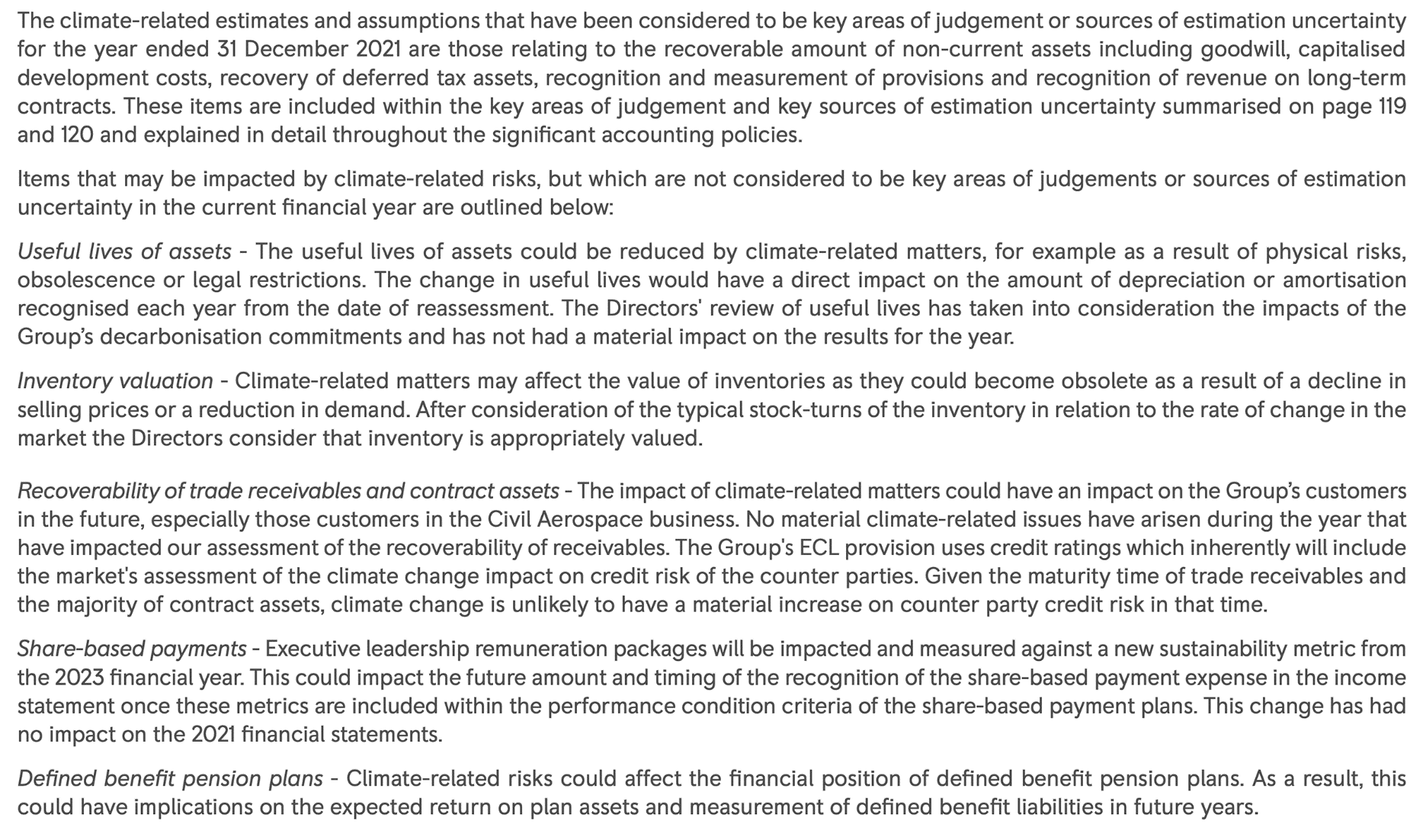
Rolls-Royce Holdings plc, Annual Report 2021, page 118
Identifies climate-related judgements and estimates within the scope of IAS 1.122/125, with cross reference to more detailed disclosures. Separately identifies other climate-related risks that are not considered to fall within IAS 1.122/125 disclosure requirements
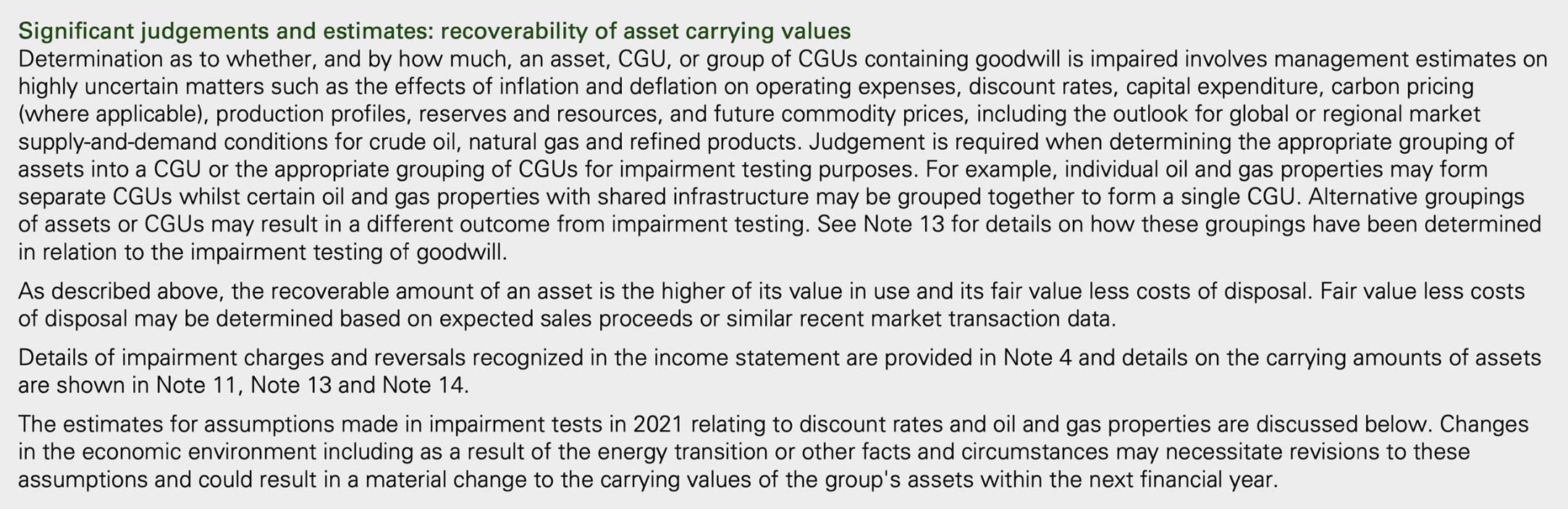
bp p.l.c., Annual Report and Form 20-F 2021, page 184
Clearly identifies that changes in the economic environment including as a result of energy transition could lead to a material change in the carrying value of assets within the next financial year
Impairment reviews
IAS requirements – Impairment disclosures: cash-generating units (CGUs) containing goodwill or intangible assets with indefinite useful lives (IAS 36.134-135)
IAS 36 requires disclosures about these CGUs (or groups of CGUs) irrespective of whether or not an impairment loss (or reversal) is recognised in the period. The disclosures are primarily concerned with the assumptions and estimates used in determining value in use or fair value less costs of disposal, whichever supports the recoverable amount.
The required disclosures include:
Assumptions: * the key assumptions to which the recoverable amount is most sensitive; * a description of management's approach to determining values for key assumptions; * whether those values are consistent with external sources of information and past experience and, if not, explain how and why they differ; * the periods covered by budgets/forecasts, and the growth rate applied beyond this period; and * the discount rate(s) applied.
Sensitivities – where a 'reasonably possible' change in a key assumption would cause the carrying amount to exceed recoverable amount:
- the amount by which the recoverable amount exceeds the carrying amount (the 'headroom');
- the value assigned to the key assumption; and
- the amount by which the value assigned to the key assumption must change, after incorporating any consequential effects of that change on the other variables, in order for the headroom to be completely eroded.
Impairment testing and future climate-related expenditure
IAS 36 defines the recoverable amount of an asset or CGU as the higher of its fair value less costs of disposal and its value in use.
Where a company calculates the recoverable amount of a CGU as its value in use, paragraph 45 of IAS 36 requires this calculation to be made in relation to the CGU's assets in their current condition. This means that cash outflows related to improving or enhancing an asset's performance, or the related cash inflows that are expected to arise from such outflows, should not be included in these calculations. Judgement may be required in determining whether cash inflows and outflows related to reducing the carbon emissions from revenue producing assets should be included in value in use calculations.
Where a company calculates the recoverable amount of a CGU as its fair value less costs of disposal, expenditure to enhance an asset may be included in the calculation if a market participant would be expected to incur such expenditure in order to meet regulatory requirements or customer expectations.
Some companies clearly addressed climate change in their impairment disclosures, including quantification of significant assumptions and additional climate-related sensitivities, representing an improvement in transparency since our last thematic report in 2020.
Better examples within our review showed clear connectivity between climate disclosures in the front half of the annual report and impairment disclosures in the financial statements. We noted a range of clear and helpful disclosures explaining how climate had been taken into account.
Better disclosures included: * clear linkage of impairment disclosures to climate scenarios discussed in the strategic report or TCFD disclosures, for example * explaining how scenarios were incorporated into cash flow projections; or * additional disclosure to explain how specific climate scenarios, which differ from IAS 36 best estimates, could impact the output of impairment review calculations and the carrying value of assets; * quantification of assumptions such as commodity pricing, including an explanation of how the figures have been derived, and any associated judgements and sensitivities; * clear explanation of the impact of short-term price volatility for commodities within the assumptions for impairment reviews based on value-in-use calculations; * quantified carbon pricing assumptions; although, consistent with the discussion about TCFD disclosures in Section 6 of this report, the companies which quantified these assumptions remain a minority; and * clear explanation of how cashflow based valuations have factored in the company's plans to update its business strategy to meet its own net zero commitments and reflecting the transition to low-carbon economies, where this would be expected to have a significant impact; for example: * using asset lifespans in valuation calculations which are clearly consistent with those described in TCFD disclosures; * reducing or removing terminal growth rates for businesses affected by the transition to a low-carbon economy; or * explaining why the company's transition to a low-carbon economy was not expected to have a material impact on the cash flow projections underpinning the impairment review calculations.
There were a small number of examples where it was unclear whether climate change uncertainties had been incorporated into impairment reviews. In addition, some companies stated that they had considered the effects of climate change, but without further explanation of how climate risks had been incorporated into their calculations.
In some instances, companies did not provide all of the disclosures required by IAS 36, IAS 1 or IAS 8, in relation to impairment review assumptions, which made it difficult to understand how they had incorporated climate-related risks into these calculations. A number of the issues we identify below are consistent with points raised in the CRR thematic review of impairment disclosures in 2019, which may be a useful reference point for those preparing or reviewing impairment disclosures.10
Issues identified in the current review included: * not providing adequate justification for forecast periods exceeding 5 years (IAS 36.134(d)(iii)); * not disclosing comparative figures for certain key assumptions (IAS 1.38); * no explanation of significant year on year changes in assumptions, including significant increases in projected CGU growth rate (IAS 8.39); * not disclosing the assumptions supporting a significant impairment charge in the period in relation to a CGU with significant climate exposure, which has been valued using fair value less costs of disposal (IAS 36.130(f)); * not disclosing sensitivity analysis or a range of possible outcomes in the event of further impairment in the following year, where the degree of climate exposure indicated significant risk of a material adjustment resulting from estimation uncertainty (IAS 1.125. and 1.129); * not clearly identifying the CGUs to which certain key assumptions related, for example, discount and growth rates, making it difficult to understand whether or not climate risks had been incorporated (IAS 36.134); and * not explaining the basis for using terminal growth rates in excess of short-term growth rates for CGUs with potential climate exposure.
One company included capital expenditure to achieve carbon reduction targets in its value in use calculations. It was not clear whether this expenditure complied with paragraph 44 of IAS 36, which does not permit the inclusion of cash flows arising from improvements or enhancements to an asset in value in use calculations.
We expect companies to:
Quantify significant climate-related assumptions affecting management's estimate of the recoverable amount of assets subject to impairment review.
Clearly explain how net zero commitments or plans to transition to a low-carbon economy discussed in the strategic report have been taken into account in impairment review calculations, including any effect on the period for which cash flows have been included and / or terminal growth rates, and discussion of any judgements associated with whether forecast expenditure linked to these plans will enhance or maintain assets.
Explain significant movements in assumptions, including those associated with climate change.
Disclose how climate risks have been incorporated into sensitivity disclosures, with clear links to the company's narrative disclosures.
Where significant, explain the basis for including climate-related capital expenditure in cash flow forecasts in value in use calculations.
Avoid boilerplate statements such as 'climate has been incorporated into our impairment review assumptions' which provide limited insight without describing the relevant assumptions, uncertainties and the position taken.
Oil and natural gas prices
The price assumptions used for value-in-use impairment testing are based on those used for investment appraisal. bp's carbon emissions cost assumptions and their interrelationship with oil and gas prices are described in 'Judgements and estimates made in assessing the impact of climate change and the transition to a lower carbon economy' on page
- The investment appraisal price assumptions are recommended by the senior vice president economic & energy insights after considering a range of external price sets, and supply and demand profiles associated with various energy transition scenarios. They are reviewed and approved by management. As a result of the current uncertainty over the pace of transition to lower-carbon supply and demand and the social, political and environmental actions that will be taken to meet the goals of the Paris climate change agreement, the scenarios considered include those where those goals are met as well as those where they are not met.
During the year, bp's price assumptions applied in value-in-use impairment testing for Brent oil up to 2030 were increased to reflect near-term supply constraints. bp's management also expects an acceleration of the pace of transition to a lower carbon economy. As such, the long-term Brent oil assumptions were decreased during the year, reaching $55 per barrel by 2040 and $45 per barrel by 2050 (in 2020 real terms). The price assumptions applied in value-in-use impairment testing for Henry Hub gas were unchanged to those used in 2020 except that the assumption for 2022 was increased to reflect short term market conditions. These price assumptions are derived from the central case investment appraisal assumptions, adjusted where applicable to reflect short-term market conditions (see page 32). A summary of the group's revised price assumptions for Brent oil and Henry Hub gas, applied in 2021 and 2020, in real 2020 terms, is provided below. The assumptions represent management's best estimate of future prices at the balance sheet date, which sit within the range of external scenarios considered as appropriate for the purpose. They are considered by bp to be in line with a range of transition paths consistent with the temperature goal of the Paris climate change agreement, of holding the increase in the global average temperature to well below 2°C above pre-industrial levels and pursuing efforts to limit the temperature increase to 1.5°C above pre-industrial levels. However, they do not correspond to any specific Paris-consistent scenario. An inflation rate of 2% (2020 2%) is applied to determine the price assumptions in nominal terms.
Clear explanation of changes in short-term price assumptions, coupled with clear disclosure of current and prior period assumptions
| 2021 price assumptions | 2022 | 2025 | 2030 | 2040 | 2050 |
|---|---|---|---|---|---|
| Brent oil ($/bbl) | 70 | 60 | 60 | 55 | 45 |
| Henry Hub gas ($/mmBtu) | 4.00 | 3.00 | 3.00 | 3.00 | 2.75 |
| 2020 price assumptions | 2021 | 2025 | 2030 | 2040 | 2050 |
|---|---|---|---|---|---|
| Brent oil ($/bbl) | 50 | 50 | 60 | 60 | 50 |
| Henry Hub gas ($/mmBtu) | 3.00 | 3.00 | 3.00 | 3.00 | 2.75 |
bp p.l.c., Annual Report and Form 20-F 2021, page 185
Oil price assumptions
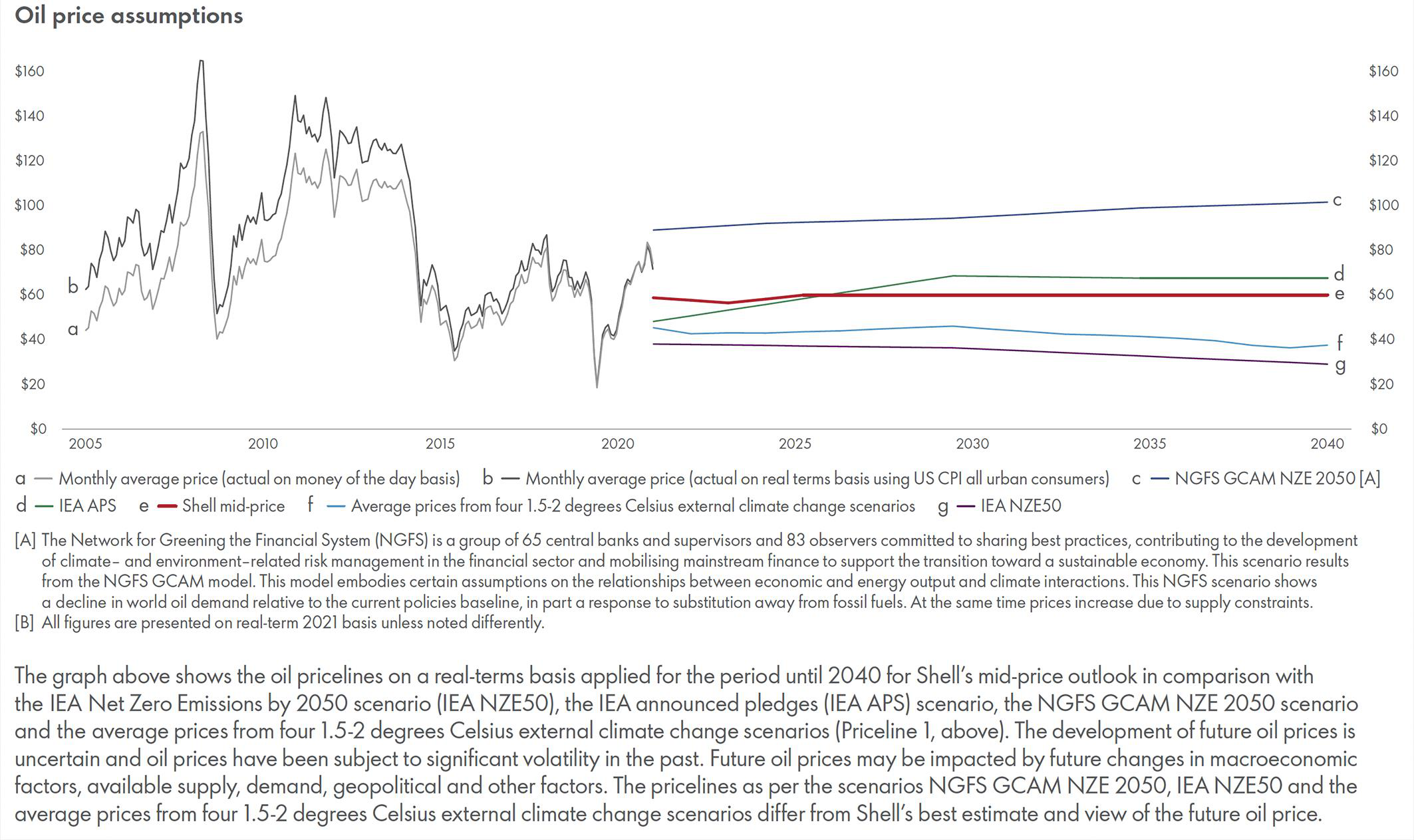
a - Monthly average price (actual on money of the day basis) b - Monthly average price (actual on real terms basis using US CPI all urban consumers) c - NGFS GCAM NZE 2050 [A] d - IEA APS e - Shell mid-price f - Average prices from four 1.5-2 degrees Celsius external climate change scenarios g - IEA NZE50
[A] The Network for Greening the Financial System (NGFS) is a group of 65 central banks and supervisors and 83 observers committed to sharing best practices, contributing to the development of climate- and environment-related risk management in the financial sector and mobilising mainstream finance to support the transition toward a sustainable economy. This scenario results from the NGFS GCAM model. This model embodies certain assumptions on the relationships between economic and energy output and climate interactions. This NGFS scenario shows a decline in world oil demand relative to the current policies baseline, in part a response to substitution away from fossil fuels. At the same time prices increase due to supply constraints. [B] All figures are presented on real-term 2021 basis unless noted differently.
The graph above shows the oil pricelines on a real-terms basis applied for the period until 2040 for Shell's mid-price outlook in comparison with the IEA Net Zero Emissions by 2050 scenario (IEA NZE50), the IEA announced pledges (IEA APS) scenario, the NGFS GCAM NZE 2050 scenario and the average prices from four 1.5-2 degrees Celsius external climate change scenarios (Priceline 1, above). The development of future oil prices is uncertain and oil prices have been subject to significant volatility in the past. Future oil prices may be impacted by future changes in macroeconomic factors, available supply, demand, geopolitical and other factors. The pricelines as per the scenarios NGFS GCAM NZE 2050, IEA NZE50 and the average prices from four 1.5-2 degrees Celsius external climate change scenarios differ from Shell's best estimate and view of the future oil price.
Shell plc, Annual Report and Accounts 2021, page 243
Identifies the external sources they have used to benchmark against their internal best estimate, clear communication of future oil prices assumptions
| Sensitivity + 10% to the mid-price outlook | Sensitivity - 10% to the mid-price outlook | ||
|---|---|---|---|
| $ billion | $ billion | ||
| Carrying amount | Sensitivity | Carrying amount | |
| Integrated Gas | 65 | 3 | 5 |
| Upstream | 89 | 3 | 4 |
| Total | 154 | 6 | 9 |
| Average prices from four 1.5-2 degrees Celsius external climate change scenarios | Sensitivity Hybrid Shell Plan + IEA NZE50 | ||
|---|---|---|---|
| $ billion | $ billion | ||
| Carrying amount | Sensitivity | Carrying amount | |
| Integrated Gas | 65 | -13 | -16 |
| Upstream | 89 | -14 | -17 |
| Total | 154 | -27 | -33 |
Shell plc, Annual Report and Accounts 2021, page 243
Additional sensitivity disclosures provided show sensitivity to movements in key assumptions, including alternative climate scenarios

Rolls-Royce Holdings plc, Annual Report 2021, page 118
Clear identification and quantification of carbon pricing used for impairment reviews, and identification of scenarios used to derive other assumptions
8. Climate change in the financial statements (continued)
| Sensitivity + 10% to the mid-price outlook | Sensitivity - 10% to the mid-price outlook | |||
|---|---|---|---|---|
| $ billion | $ billion | |||
| Carrying amount | Sensitivity | Carrying amount | ||
| Integrated Gas | 65 | 3 | 5 | Integrated Gas |
| Upstream | 89 | 3 | 4 | Upstream |
| Total | 154 | 6 | 9 | Total |
| Average prices from four 1.5-2 degrees Celsius external climate change scenarios | Sensitivity Hybrid Shell Plan + IEA NZE50 | |||
| $ billion | $ billion | |||
| Carrying amount | Sensitivity | Carrying amount | ||
| Integrated Gas | 65 | -13 | -16 | Integrated Gas |
| Upstream | 89 | -14 | -17 | Upstream |
| Total | 154 | -27 | -33 | Total |
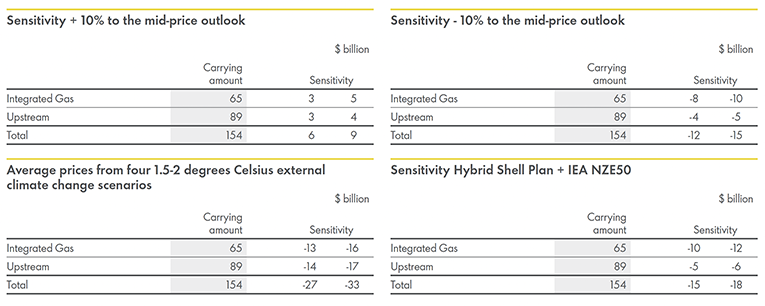
Shell plc, Annual Report and Accounts 2021, page 243
Assumptions used within the Financial Statements in relation to areas such as revenue recognition for long-term contracts, impairment reviews of non-current assets and the carrying amount of deferred tax assets consider the findings from the climate scenarios prepared. Key variables include carbon prices based on the IEA Net Zero scenario, which assumes an increase from $47 per tonne of carbon in 2022 to $250 per tonne in 2050, commodity price trends derived from the climate scenarios set out by the Intergovernmental Panel on Climate Change (IPCC RCP1.9), temperature rises from the (IPCC SSP1-19) scenario, and GDP information from the Oxford Economics Net Zero model.
Rolls-Royce Holdings plc, Annual Report 2021, page 118
Clear identification and quantification of carbon pricing used for impairment reviews, and identification of scenarios used to derive other assumptions
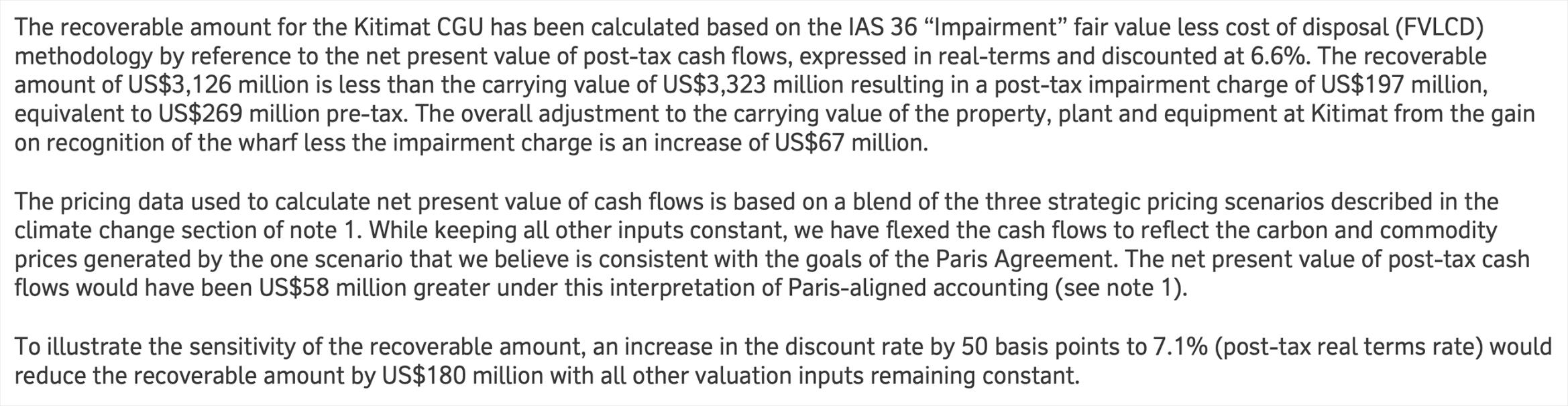
Rio Tinto plc, Annual Report 2021, page 243
Refers to the three scenarios from which it has derived carbon pricing assumptions. Also includes additional sensitivity disclosure of cash flows/carbon pricing consistent with the one scenario they consider consistent with Paris-aligned accounting
Indicators of impairment
IAS requirements – impairment testing
In addition to the annual impairment testing of indefinite lived intangible assets and goodwill required by IAS 36, an entity must conduct an impairment test if there are indications that an asset, or CGU, may be impaired.
Climate change could be a factor in one or more of the external or internal indicators of impairment set out in paragraph 12 of IAS 36, for example:
- significant changes in the market, or regulatory environment, in which the asset operates, for example relating to carbon emissions;
- significant changes to an entity's plans for the asset as a result of climate commitments, which could lead to exiting a market, or reassessing the useful life of the asset; or
- increases in market interest rates or other rates of return – for example as lenders move away from lending to certain carbon intensive industries – that may indicate the discount rate used in value in use calculations has changed, which could lead to a material reduction in the recoverable amount.
We saw a small number of disclosures explaining that indicators of impairment had not been identified. Better examples clearly explained the factors considered in reaching this conclusion.
In circumstances where users might reasonably expect that an indication of impairment exists as a result of climate change impacts, and no impairment indicator has been identified, we encourage entities to consider whether their disclosures adequately explain why this conclusion has been reached.
Entities should also consider whether this may represent a significant judgement requiring separate disclosure by IAS 1.122 (see Judgements and Estimates section above).
In the current year the Group performed climate change scenario analysis as part of the TCFD disclosures on a selection of assets across the portfolio, covering 55% and 60% of the Group's Adjusted EBITDA and Revenue respectively. A detailed risk assessment was performed, after which scenarios were modelled to consider the potential impact of climate related risks over the life of the assets. We considered whether any of the results of the TCFD scenario analysis could result in an indicator of impairment, including whether factors driven by climate change could result in a change in the useful life. Whilst there are a number of assumptions inherent in long term economic forecasting that underpins the scenario analysis, the Group's PPA arrangements typically provide mechanisms to protect against movements in market prices for energy and carbon over the duration of the PPA. Beyond the PPA period, the scenario analysis indicated that there was also not a material impact to any of the assets modelled. As such, no indicators of impairment were identified.
ContourGlobal plc, Annual Report 2021, page 164
Clearly refers to considering TCFD scenarios, including factors driven by climate change, with a clear conclusion that no indicators of impairment are identified
Discount rates in impairment tests
IAS requirements – discount rates in impairment tests
Paragraph 55 of IAS 36 requires the discount rate for a value in use measurement to be a pre-tax rate that reflects the current market assessments of both the time value of money and the risks specific to the asset which have not been reflected in the cash flows.
Our review of climate in the context of impairment reviews identified several issues in respect of discount rates which were consistent with those identified in CRR's thematic review on discount rates in financial statements:11
- Observation: In several instances, it was not clear whether asset-specific climate risks – for example, risks associated with coal-producing assets – were incorporated into the discount rate, or adjusted in cash flow forecasts.
- Observation: Three companies disclosed changes in discount rates for some CGUs since the prior period that were not explained. It would be helpful to know whether the rates had moved due to climate change related factors specific to those CGUs or some other factor.
We expect companies to explain how climate risk has been incorporated into cash flow projections or discount rates where the business is exposed to significant climate risks.
Useful economic lives of tangible and intangible fixed assets
IAS requirements – useful lives
Companies are required by IAS 16 and IAS 38 to make assumptions about the useful lives of assets and their residual values and to disclose the useful lives or amortisation rates used. Where it is determined that an intangible asset has an indefinite useful life, the reasons for this need to be disclosed.
✔ Several companies provided clear and credible explanations of why the useful economic lives of certain assets were not affected by their published commitments to reach net zero emissions, generally because the lives of the affected assets were shorter than the companies' published net zero timeframes.
▲ Nine companies disclosed targets or commitments relating to climate change, indicating that estimates of the useful lives of these companies' assets may be sensitive to climate change, but without clearly addressing how this had been taken into account when determining useful lives and amortisation rates.
Issues included: * narrative in the strategic report discussing commitments to replace or upgrade all or some of a particular type of asset, for example to change from diesel or other polluting fossil fuels to lower carbon alternatives including electric vehicles, with no explanation of how this affected the useful lives of the affected assets. In some examples, these commitments were relatively short term, and so might reasonably have been expected to have an impact upon useful lives of assets to be replaced; and * companies with significant finite-lived intangible assets, including customer intangibles and brands, where the remaining lives suggested that these could be susceptible to climate-related risks – either due to physical risks increasing costs, through expected government regulation to reduce carbon emissions, or through the company's own transition plans indicating a move away from some existing lines of business within the medium-long term – but with no explanation of how the potential effect on the useful lives of assets had taken these risks into account.
We expect companies to:
Explain how they have taken account of any published plans to replace material long-lived assets or to transform the business in which they are used in their assessment of the assets' useful economic lives.
Explain clearly how they have reflected known plans to reduce carbon emissions as a result of regulation (for example, shipping, oil and gas) in their assessment of the assets' useful lives.
Consider whether an explanation that transition plans or potential regulatory changes do not impact the useful life of assets is likely to be useful information to users of the annual report and accounts.
Consider whether it may be appropriate to reflect significant uncertainty about regulatory developments or global heating pathways through a probability-weighted estimated useful economic life for the affected assets.

bp p.l.c., Annual Report and Form 20-F 2021, page 179
Explains why the company does not consider there to be change in useful economic lives of oil and gas assets
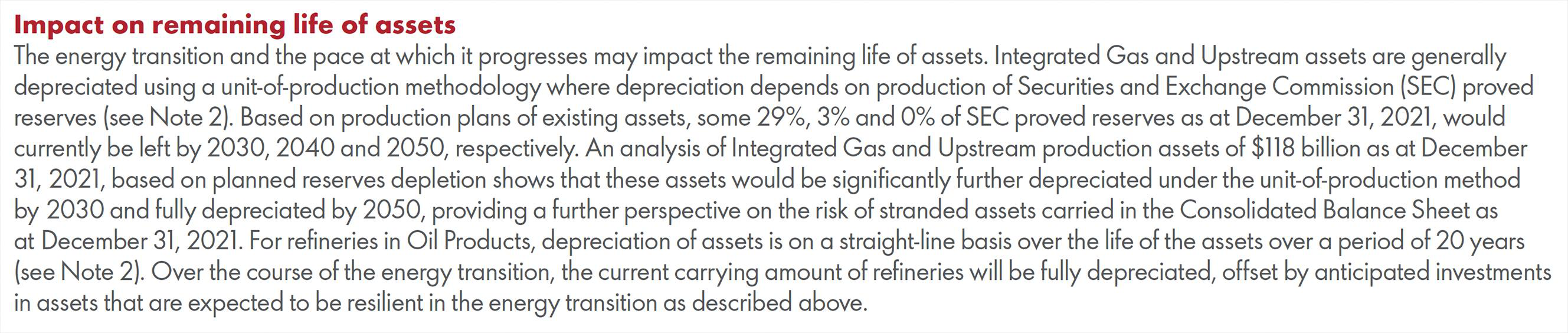
Shell plc, Annual Report and Accounts 2021, page 244
Explains the anticipated impact of energy transition on the remaining life of assets
Segmental reporting and disaggregated revenue disclosures
IAS requirements – disaggregated revenues and segmental disclosures
Disaggregated revenues Paragraph 114 of IFRS 15 requires an entity to disaggregate revenue from contracts with customers into categories that depict how the nature, amount, timing and uncertainty of revenue and cash flows are affected by economic factors.
Segmental disclosures IFRS 8 requires disclosure of information about operating segments. The information to be disclosed is based on that which is regularly reviewed by the chief operating decision maker (CODM) which, subject to quantitative thresholds, may be aggregated into reportable segments. Information may only be aggregated if segments have similar economic characteristics and are similar in a series of other specified respects. These include the nature of products and services, the production processes and, where applicable, the regulatory environment. Where these characteristics substantially differ, segments should not be aggregated, and separate disclosure of results and, where applicable, segment assets and liabilities, should be provided.
💡 In some examples, the prominence attached to newer areas of business in the strategic report arising from transition to a low carbon economy did not appear to be reflected in the segmental disclosures or through disaggregation of revenue disclosures in the financial statements.
▲ The business lines of several companies appeared to differ in terms of economic and other characteristics in relation to climate risks to such an extent that it was unclear whether the relevant reporting requirements of IFRS 8 had been met.
These included two companies with significant revenue streams associated with coal, where it is likely that users would have expected separate disclosure of the revenue stream to better understand the risks, and address the requirements of paragraph 114 of IFRS 15.
✔ Several companies revised their segmental reporting to reflect changes in the way management information was delivered in response to climate change and transition.
We expect companies to:
Keep segmental reporting under review as the risk profiles of their businesses evolve in response to climate change and the climate transition, monitoring the consistency between the strategic report and financial statements. In some cases, anticipated changes to the business may mean that information should be disclosed about a new business segment even where quantitative thresholds have not yet been exceeded.
Remember that, where separate information for a business is reviewed by the CODM, this may only be aggregated in the financial statements if the characteristics of this business is sufficiently similar to those of other businesses.
Consider whether separate disclosure of revenues from a business subject to specific climate risks may be required by IFRS 15 to meet the general objective of depicting distinct characteristics of the different revenue streams.
Segmental reporting
Our reporting segments are Integrated Gas, Upstream, Oil Products, Chemicals and Corporate. Integrated Gas, Upstream, Oil Products and Chemicals include their respective elements of our Projects & Technology organisation. The Corporate segment comprises our holdings and treasury organisation, self-insurance activities, and headquarters and central functions. See Note 5 to the "Consolidated Financial Statements" on pages 245-248. With effect from 2022, our reporting segments will change to Integrated Gas, Upstream, Marketing, Chemicals and Products, Renewables and Energy Solutions and Corporate, reflecting the way Shell reviews and assesses its performance.
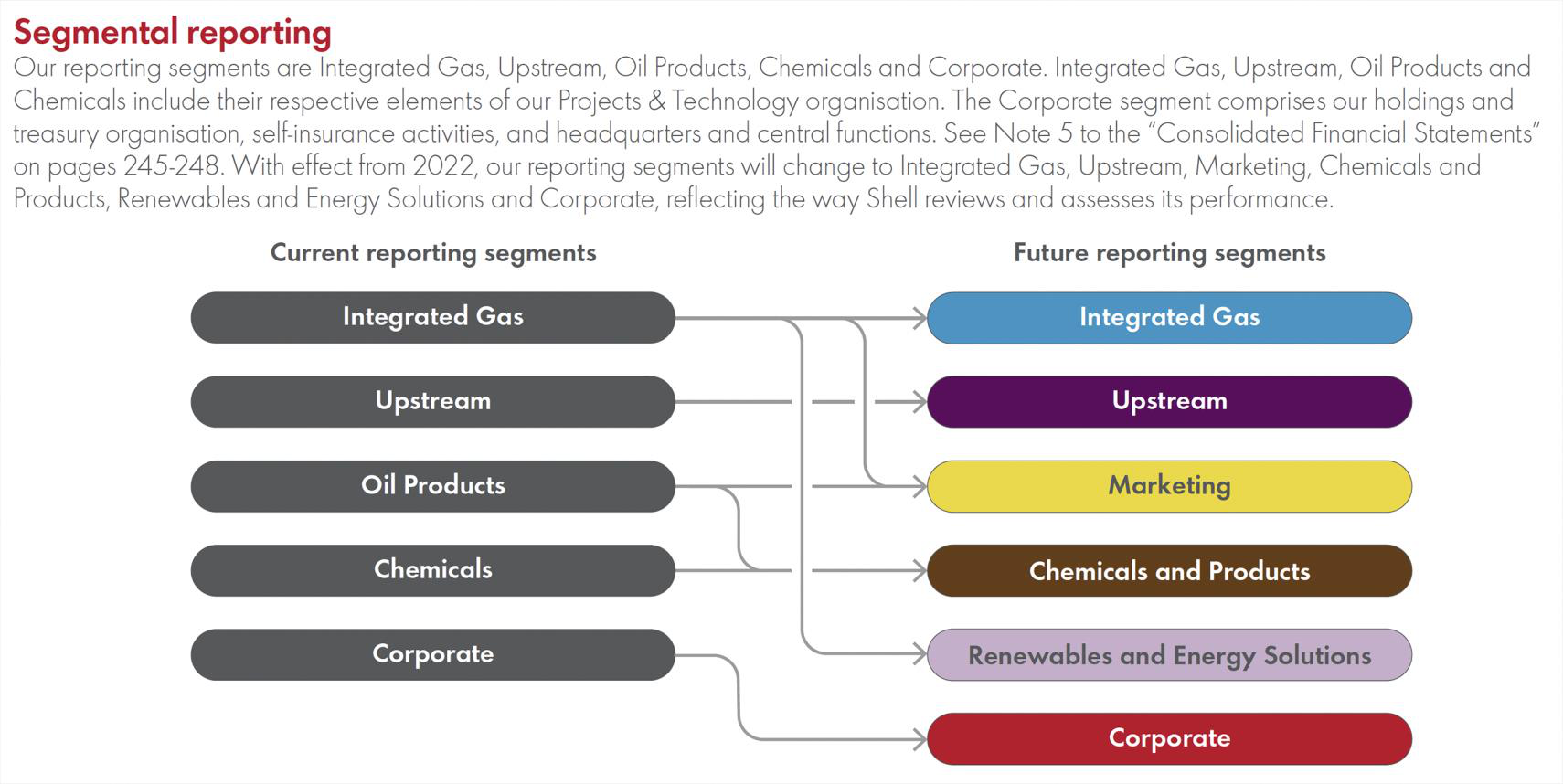
Explains that from 2022 the company will revise its segmental reporting to include a renewables and energy solutions segment
Shell plc, Annual Report and Accounts 2021, page 10

Rolls-Royce Holdings plc, Annual Report 2021, page 132
Discloses a new segment with effect from 2021
Emerging areas
Green finance
We noted examples in our review of borrowers and lenders referring in their narrative reporting to green finance or sustainability linked finance; for example, interest rates linked to achievement of specific emissions targets and other sustainability linked measures.
Where such features are material, we expect both borrowers and lenders to include a clear explanation of the related accounting policy, including:
- for lenders, disclosure of whether these loans are measured at fair value or amortised cost, including an explanation of any significant judgement associated with whether contractual cash flows meet the 'SPPI' test of IFRS 9.4.1.2. This topic is currently the subject of an IASB project;
- for borrowers, disclosure of any accounting policy choice or significant judgement relating to whether the sustainability-linked features meet the definition of an embedded derivative; and
- for borrowers and lenders, where these instruments are measured at amortised cost, an explanation of how changes in expected cash flows as a result of these features are accounted for.
Where such features are not material, companies should consider whether their prominence in the narrative reporting is appropriate.
Accounting for emissions allowances
We identified four companies within our review which recognised emissions rights assets. It is likely that the recognition of purchased emissions allowances on company balance sheets will continue to increase.
Unless emissions allowances are held for trading purposes, we would normally expect such rights to meet the definition of intangible assets. As these rights become more prominent in financial statements, we remind companies of the importance of explaining any judgements associated with their classification, and the method and timeframe over which it is anticipated they will be recognised in the profit and loss account.
Other areas considered
Our review also considered climate-related disclosures in relation to the following areas highlighted in the IASB Educational Material 'Effects of climate-related matters on financial statements':
- going concern;
- inventories;
- provisions and contingent liabilities;
- IFRS 9 Expected credit losses;
- IFRS 13 fair value measurement; and
- deferred tax assets.
While our current review did not identify any findings of significance in relation to these areas, we will continue to monitor these, in addition to those detailed above, in relation to climate change in CRR's ongoing programme of reviews of company annual reports and accounts.
Auditor reporting in relation to climate change
The audit reports in 24 out of 25 companies in our review referred to climate change in the context of their audit of the financial statements. Most of these audit reports included a separate section explaining how climate change had been considered as part of the audit. Some referred to consideration of climate change in the description of key audit matters.
Audit committee reporting on climate
We noted a number of audit committee reports included discussion of the work they had carried out in relation to considerations of climate change during the previous year. Most audit committee reports referred to consideration of TCFD disclosure requirements, while a number provided explanation of different areas of the financial statements that they had considered in relation to climate change.
The Auditor's responsibilities in respect of climate-related reporting required by the Financial Conduct Authority
In February 2022, the FRC issued a Staff Guidance paper-720-Other-Information-25-February-2022.pdf) regarding auditor responsibilities under ISA (UK) 720 “The Auditor's Responsibilities Relating to Other Information” in respect of climate-related reporting by companies required by the Financial Conduct Authority (see Section 2 of this report).
Appendices
Appendix 1 – Scope
Sample selection
This thematic review looked at both reporting in accordance with the requirements of the TCFD framework, and financial statements disclosures related to climate change, across a sample of 25 Premium Listed companies. The Corporate Reporting Review (CRR) team of the FRC reviewed 22 UK-registered companies, while a team from the FCA reviewed 3 companies registered overseas with UK listings. The findings of all 25 reviews are incorporated into this report.
The sample, which was based on December 2021 annual reports, was weighted towards sectors and industries which are potentially most affected by climate change, including financial services, energy, transportation, materials and buildings, agriculture, food and forestry. 60% of our sample were in the FTSE 100, 28% in the FTSE 250 and 12% smaller listed companies.
Industry representation of thematic sample
A pie chart illustrating the industry representation of the thematic sample, with segments and numerical values indicating the number of companies:
- Financial services: 4
- Industrial & chemicals: 3
- Construction & engineering: 2
- Metals & mining: 3
- Food & tobacco: 2
- Utilities: 2
- Oil & gas: 3
- Aero & auto: 2
- Transportation: 2
- Metals & mining
- Food & tobacco
- Utilities
- Oil & gas
- Aero & auto
- Construction & engineering
- Industrial & chemicals
- Transportation
- Financial services
- Consumer & technology
TCFD reporting
We reviewed the selected companies' compliance with Listing Rule 9.8.6R(8), which requires companies to include a statement in their annual report setting out whether they have included disclosures consistent with the TCFD Recommendations and Recommended Disclosures (together referred to in this reports as the 'TCFD framework'). Where not all of the requirements of the TCFD framework were provided, we considered the adequacy of the explanation of the reasons for this, and companies' plans to be able to make those disclosures in the future. In cases where TCFD disclosures were provided outside of the annual report, we considered the adequacy of the explanations provided for this.
We also reviewed the TCFD disclosures themselves. As part of this review, we considered the guidance given in:
- Section C of the TCFD Annex entitled “Guidance for All Sectors";
- (where appropriate) Section D of the TCFD Annex entitled "Supplemental Guidance for the Financial Sector"; and
- (where appropriate) Section E of the TCFD Annex entitled "Supplemental Guidance for Non-Financial Groups".
In Sections 4 to 7 of this report we have used graphs to show the results of our review as 'Largely all items from the all-sector guidance provided', 'Some items from the all-sector guidance provided' and 'not provided', at a recommended disclosure level. In some cases, as explained in Section 2, it was not clear how companies had taken the all-sector guidance into account when preparing their statement of consistency with TCFD requirements, resulting in differences between our assessment and the companies' assessment.
Our review did not assess the accuracy of the TCFD disclosures. We did, however, consider whether the TCFD disclosures provided were consistent with the statement of compliance under the Listing Rules.
Financial Statements review
As in our 2020 Climate thematic review, our review of financial statements considered how companies had considered the risks of climate change in meeting the requirements under IFRS accounting standards. In particular, we focused on financial statement balances which depend on forward-looking information and estimates, where users may reasonably expect these to be materially affected by climate change. For completeness, we considered the consistency of the financial statements with the narrative reporting. We also considered the extent of any improvement in reporting since our last climate thematic review in 2020.
Financial statements considerations included:
- critical accounting judgements and sources of estimation uncertainty;
- asset impairments and useful economic lives of assets;
- changes in fair values of assets;
- impact of climate change on onerous contract provisions, other provisions or contingent liabilities including decommissioning or environmental rehabilitation;
- disaggregation of revenue and determination of operating segments;
- going concern; and
- other aspects including leases, expected credit losses and hedge accounting disclosures.
Regulatory activity
We are writing letters to a number of companies included in our sample where there is a substantive question relating to their reporting of climate change, or to draw their attention to less significant matters and aspects of their disclosures which could be improved.
Appendix 2 - Detailed FRC expectations
Listing Rules requirements
| Requirement | FRC expectations |
|---|---|
| LR 9.8.6R(8) In the case of a listed company incorporated in the United Kingdom, the following additional items must be included in its annual financial report: | Statement of consistency must be included in annual report |
| (8) a statement setting out: | Statement must be clear and unambiguous |
| (a) whether the listed company has included in its annual financial report climate-related financial disclosures consistent with the TCFD Recommendations and Recommended Disclosures; | If companies describe the ongoing development of their disclosures, they should be clear whether the relevant disclosures are considered consistent in the current reporting period |
| (b) in cases where the listed company has: | Granular and specific signposting, including specific page references or hyperlinks |
| (i) made climate-related financial disclosures consistent with the TCFD Recommendations and Recommended Disclosures, but has included some or all of these disclosures in a document other than the annual financial report: | Reason for inclusion elsewhere |
| 1 (A) the recommendations and/or recommended disclosures for which it has included disclosures in that other document; | Any referenced information presented outside of the annual report should cover the same time period and be available no later than the publication of the annual report |
| 2 (B) a description of that document and where it can be found; and | Full, clear and meaningful explanations that are specific to both the company and the individual disclosure requirement in question and avoid boilerplate references to 'transitional challenges' |
| 3 (C) the reasons for including the relevant disclosures in that document and not in the annual financial report; | Any references to the TCFD disclosures elsewhere in the annual report should give consistent messages about the extent of compliance |
| (ii) not included climate-related financial disclosures consistent with all of the TCFD Recommendations and Recommended Disclosures in either its annual financial report or other document as referred to in (i): | |
| 4 (A) the recommendations and/or recommended disclosures for which it has not included such disclosures; | |
| 5 (B) the reasons for not including such disclosures; and | |
| 6 (C) any steps it is taking or plans to take in order to be able to make those disclosures in the future, and the timeframe within which it expects to be able to make those disclosures; and | |
| (c) where in its annual financial report or (where appropriate) other document the climate-related financial disclosures referred to in (a) can be found. |
| 6 (C) any steps it is taking or plans to take in order to be able to make those disclosures in the future, and the timeframe within which it expects to be able to make those disclosures; and | Full, clear and meaningful explanations that are specific to both the company and the individual disclosure requirement in question and avoid boilerplate references to 'transitional challenges' |
| (c) where in its annual financial report or (where appropriate) other document the climate-related financial disclosures referred to in (a) can be found. | Any references to the TCFD disclosures elsewhere in the annual report should give consistent messages about the extent of compliance |
| **LR 9.8.6BG** | For the purposes of LR 9.8.6R(8)), in determining whether climate-related financial disclosures are consistent with the TCFD Recommendations and Recommended Disclosures, a listed company should undertake a detailed assessment of those disclosures which takes into account:<br/>(1) Section C of the TCFD Annex entitled “Guidance for All Sectors";<br/>(2) (where appropriate) Section D of the TCFD Annex entitled “Supplemental Guidance for the Financial Sector"; and<br/>(3) (where appropriate) Section E of the TCFD Annex entitled “Supplemental Guidance for Non-Financial Groups". | We may challenge companies that state disclosures are consistent with the TCFD Framework if it is not clear how all relevant and material elements of the all-sector and relevant sector-specific guidance have been addressed |
| **LR 9.8.6CG** | For the purposes of LR 9.8.6R(8)), in determining whether a listed company's climate-related financial disclosures are consistent with the TCFD Recommendations and Recommended Disclosures, the FCA considers that the following documents are relevant:<br/>(1) the TCFD Final Report and the TCFD Annex, to the extent not already referred to in LR 9.8.6R(8)) and LR 9.8.6BG;<br/>(2) the TCFD Technical Supplement on the Use of Scenario Analysis;<br/>(3) the TCFD Guidance on Risk Management Integration and Disclosure;<br/>(4) (where appropriate) the TCFD Guidance on Scenario Analysis for Non-Financial Companies; and<br/>(5) the TCFD Guidance on Metrics, Targets and Transition Plans. | |
| **LR 9.8.6DG** | For the purposes of LR 9.8.6R(8)), in determining whether climate-related financial disclosures are consistent with the TCFD Recommendations and Recommended Disclosures, a listed company should consider whether those disclosures provide sufficient detail to enable users to assess the listed company's exposure to and approach to addressing climate-related issues.<br/>A listed company should carry out its own assessment to ascertain the appropriate level of detail to be included in its climate-related financial disclosures, taking into account factors such as:<br/>(1) the level of its exposure to climate-related risks and opportunities; and<br/>(2) the scope and objectives of its climate-related strategy,<br/>noting that these factors may relate to the nature, size and complexity of the listed company's business. | TCFD disclosures should include sufficient, company-specific information to support decision-making by investors. This may require:<br/>• explanations of the assessment carried out to ascertain the appropriate level of detail to be included, including the assessment of the TCFD all-sector guidance and any relevant sector-specific guidance for financial and non-financial entities, and/or<br/>• explanation of why management considers that certain climate-related risks and uncertainties do not significantly impact the strategy or financial statements, where investors may reasonably expect them to<br/><br/>Clearly describe the extent of any external assurance over TCFD disclosures and what information was covered, avoiding terms that may imply a higher level of assurance than that obtained |
| **LR 9.8.6EG** | (1) For the purposes of LR 9.8.6R(8)), the FCA would ordinarily expect a listed company to be able to make climate-related financial disclosures consistent with the TCFD Recommendations and Recommended Disclosures, except where it faces transitional challenges in obtaining relevant data or embedding relevant modelling or analytical capabilities.<br/>(2) In particular, the FCA would expect that a listed company should ordinarily be able to make disclosures consistent with:<br/>(a) the recommendation and recommended disclosures on governance in the TCFD Recommendations and Recommended Disclosures;<br/>(b) the recommendation and recommended disclosures on risk management in the TCFD Recommendations and Recommended Disclosures; and<br/>(c) recommended disclosures (a) and (b) set out under the recommendation on strategy in the TCFD Recommendations and Recommended Disclosures, to the extent that the listed company does not face the transitional challenges referred to in (1) in relation to such disclosures. | We expect companies to improve their level of compliance across all the recommended TCFD disclosures, following this initial year of mandatory reporting<br/><br/>We may challenge companies that have not made those disclosures the FCA has identified it would particularly expect to be provided without providing a credible explanation |
| **LR 9.8.6FG** | Where making disclosures on transition plans as part of its disclosures on strategy under the TCFD Recommendations and Recommended Disclosures, a listed company that is headquartered in, or operates in, a country that has made a commitment to a net zero economy, such as the UK's commitment in the Climate Change Act 2008 (2050 Target Amendment) Order 2019, is encouraged to assess the extent to which it has considered that commitment in developing and disclosing its transition plan. Where it has not considered this commitment in developing and disclosing its transition plan, the FCA encourages a listed company to explain why it has not done so. | See Metrics & Targets c) below for FRC recommendations related to net zero targets |
<br/>
### TCFD recommendations
#### Governance
<div class="table-container" markdown="1">
| | Disclose the organisation's governance around climate-related risks and opportunities |
|:----------|:----------|
| **Recommended disclosures** | a) Describe the board's oversight of climate-related risks and opportunities. | b) Describe management's role in assessing and managing climate-related risks and opportunities. |
| **FRC expectations** | Sufficient detail on how the highest governing body monitors and oversees progress against goals and targets related to addressing climate issues for users to understand how the board exercises its governance of the matter. | Sufficient detail on how management assesses and manages climate-related issues, including communicating to the board or other governing body. |
| | Governance disclosures should include the channels and frequency of communication between management and the Board. | |
</div>
#### Strategy
<div class="table-container" markdown="1">
| | Disclose the actual and potential impacts of climate-related risks and opportunities on the organisation's businesses, strategy, and financial planning where such information is material |
|:----------|:----------|
| **Recommended disclosures** | a) Describe the climate-related risks and opportunities the organisation has identified over the short, medium, and long term. | b) Describe the impact of climate-related risks and opportunities on the organisation's businesses, strategy, and financial planning. | c) Describe the resilience of the organisation's strategy, taking into consideration different climate-related scenarios, including a 2°C or lower scenario. |
| **FRC expectations** | Ensure that:<br/>• the discussion of risks and opportunities is balanced, not placing undue emphasis on opportunities that are not material.<br/>Consider whether:<br/>• it would be helpful to explain the time periods chosen, particularly where these are different from those disclosed for financial targets or financial reporting, including the going concern and viability statement; or<br/>• there are relevant opportunity-based metrics to be reported.<br/>Also consider:<br/>• the relative importance of physical and transition risks to different parts of the business; and<br/>• linking the description of climate-related opportunities to any technology-related dependencies disclosed under Strategy b). | Explain:<br/>• the expected impact of climate-related risks and opportunities on operating costs and revenues, capital expenditures and capital allocation, acquisitions or divestments, and access to capital, quantified where practical;<br/>• potential implications for the strategy where transition plans are dependent upon unproven technology;<br/>• the short- and long-term adaptation and mitigation activities, policies and strategies to address climate risks, opportunities, and the climate transition, including whether there have been any significant changes since the prior reporting period; and<br/>• how risks and opportunities are prioritised, cross-referencing to the risk management and any other relevant sections of the annual report where appropriate. | • Clearly explain how climate change considerations and any climate-related scenarios inform the company's strategy and financial planning; and<br/>• Provide sufficient detail of any scenarios for users to understand the analysis undertaken and the potential impact on the business strategy, explaining where relevant:<br/> - why the specific scenarios have been chosen;<br/> - key input assumptions, analytical methods, outputs and sensitivities;<br/> - how the outcomes have influenced strategic planning and any actions taken as a result; and<br/> - how the scenarios discussed, including assumptions and sensitivities, correspond to the discussions in the financial statements. |
</div>
#### Risk Management
<div class="table-container" markdown="1">
| | Disclose how the organisation identifies, assesses, and manages climate-related risks |
|:----------|:----------|
| **Recommended disclosures** | a) Describe the organisation's processes for identifying and assessing climate-related risks. | b) Describe the organisation's processes for managing climate-related risks. | c) Describe how processes for identifying, assessing, and managing climate-related risks are integrated into the organisation's overall risk management. |
| **FRC expectations** | Clearly explain:<br/>• the process used to identify and assess climate-related risks, including the relative importance of climate to other risks, how regulatory risks are considered, and the link to the company's strategic priorities;<br/>• the principal climate-related risks and uncertainties facing the company and any significant impacts on the business model. Disclosures should be specific to the company's circum-stances, and clear on the magnitude of the risk; and<br/>• the rationale for any conclusion that climate change does not give rise to any principal risk, if users would reasonably this to be the case.<br/>Ensure that relevant climate-related risk disclosures are consistent across the annual report. | • Provide a clear explanation of the processes for managing climate-related risks and opportunities including how they are prioritised and managed, including any relevant materiality considerations. | • Clearly explain the linkages between general and climate-related risk disclosures, using cross-referencing where relevant.<br/>• If a company states that management of climate-related risks is integrated into the overall risk management process, we expect to see evidence of this in the risk section of the strategic report, for example in the discussion of principal risks. |
</div>
#### Metrics and Targets
<div class="table-container" markdown="1">
| | Disclose the metrics and targets used to assess and manage relevant climate-related risks and opportunities where such information is material |
|:----------|:----------|
| **Recommended disclosures** | a) Disclose the metrics used by the organisation to assess climate-related risks and opportunities in line with its strategy and risk management process. | b) Disclose Scope 1, Scope 2 and, if appropriate, Scope 3 greenhouse gas (GHG) emissions and the related risks. | c) Describe the targets used by the organisation to manage climate-related risks and opportunities and performance against targets. |
| **FRC expectations** | Consider:<br/>• the information most relevant to monitoring the risks and opportunities to which the company is exposed;<br/>• the linkage to strategy and targets;<br/>• using cross-referencing to clearly identify climate-related metrics reported elsewhere in the reporting;<br/>• the impact of carbon pricing on strategy and targets; and<br/>• disclosing how climate-related metrics affect remuneration policies.<br/>Keep under review:<br/>• updated TCFD guidance on metrics, targets and transition plans; and<br/>• reporting of peers, industry practice and established reporting initiatives such as SASB.<br/>As reporting matures, we expect to see sufficient quantitative and qualitative data to enable users to undertake meaningful assessments of their progress over time. | Explain:<br/>• the calculation methodology of emissions metrics, including reporting boundaries and any changes in the basis of reporting, particularly where these underpin a major policy or strategy; and<br/>• movements in performance including business activities such as unplanned shutdowns, acquisitions or disposals that have led to significant movements as well as any changes in methodologies or restatements.<br/>Assess<br/>• the materiality of Scope 3 emissions to users of the financial statements and report where material, clearly identifying the categories included.<br/>Consider:<br/>• the relevant intensity metrics for the business sector, explaining if these are not standard for the industry; and<br/>• the impact on the company's TCFD compliance statement if Scope 3 emissions are relevant but not reported. | Clearly distinguish between committed targets, that are included in plans and budgets, and looser ambitions or goals.<br/>Explain:<br/>• the KPIs used to monitor progress against targets, including comparatives as well as definitions and methodologies;<br/>• which Scope 1, 2 or 3 emissions are included in any targets;<br/>• the reporting boundaries of targets;<br/>• any updates are made to targets, such as re-statements or updates to baselines;<br/>• the meaning of any terms used such as 'net zero' or 'carbon neutrality', ensuring that their usage is not misleading; and<br/>• whether carbon offsetting represents a significant part of a company's strategy.<br/>Consider<br/>• identifying missed targets, and the actions taken to address this; and<br/>• including interim milestones in any transition plans, along with the steps being taken to meet them, the expected timelines and any areas of uncertainty. |
</div>
### Key expectations for good reporting of climate in the financial statements
<div class="table-container" markdown="1">
| Topic | FRC expectations |
|:----------|:----------|
| **Connectivity with TCFD disclosures** | Consider the connectivity between TCFD disclosures and the financial statements, and explain where necessary, including whether:<br/>• the emphasis placed on climate change risks and uncertainties in narrative reporting, including TCFD disclosures, is consistent with the disclosure of this impact of those uncertainties on judgements and estimates in the financial statements;<br/>• the relationships between assumptions and sensitivities considered in TCFD scenarios, and those in the financial statements, is clear;<br/>• emissions reduction commitments and strategies are appropriately reflected in the financial statements;<br/>• the scale of growth of businesses and climate-related opportunities is consistent between narrative and segmental disclosures;<br/>• the time periods disclosed for TCFD reporting are consistent with the going concern and viability statements; and<br/>• discussion of matters that may have an adverse effect on asset values or useful lives in the narrative reporting is consistent with judgements in the financial statements, for example, that there are no indicators of impairment. |
| **Judgements and estimates** | Consider whether disclosure of climate-related significant judgements or assumptions and sources of estimation uncertainty is required by paragraphs 122 or 125 of IAS 1. Companies should:<br/>• clearly distinguish between these disclosures and any additional disclosures which may be included to address longer term estimation uncertainty which is not expected to result in a material impact in the next financial year; and<br/>• consider to what extent the global warming outcomes targeted by the Paris Agreement, and relevant government and regulatory plans to reduce carbon emissions, need to be taken into account in measuring assets and liabilities and in fulfilling the disclosure requirements of IFRS standards. |
| **Impairment** | Explain how climate-related uncertainties have been reflected in impairment assessments, avoiding boilerplate statements that climate has been incorporated. Companies should:<br/>• ensure that quantified disclosures of impairment assumptions and sensitivities meet the requirements of IAS 36, including the additional requirements for cash generating units (CGUs) containing goodwill or indefinite lived intangibles;<br/>• explain how material climate uncertainties and transition plans discussed in the narrative reporting have been incorporated into the assessment including, where relevant, impacts on budget periods or terminal growth rates. We encourage companies to explain whether they have incorporated climate risk into cashflows or discount rates; and<br/>• explain significant movements in assumptions, including those associated with climate change. |
| **Useful economic lives** | Ensure useful lives of assets are appropriate in the context of the climate transition. Where there are published plans to replace material long-lived assets, or anticipated regulatory changes in a geography or industry which would drive early retirement of assets, we expect companies to explain how these matters have been taken into account in determining useful lives. |
| **Revenue & segment disclosures** | The extent of aggregation permitted in IFRS 8 and IFRS 15 depends on whether component businesses have similar characteristics. Companies should consider these requirements where businesses are subject to very different risks and uncertainties from the climate transition, and keep these disclosures under review as these businesses evolve. |
</div>
**Financial Reporting Council**<br/>
8th Floor<br/>
125 London Wall<br/>
London EC2Y 5AS<br/>
+44 (0)20 7492 230<br/>
www.frc.org.uk<br/>
Follow us on<br/>
Twitter @FRCnews<br/>
or Linked in
-
SECR reporting requirements can be accessed on UK government website. ↩↩
-
https://www.fca.org.uk/publications/policy-statements/ps-21-23-enhancing-climate-related-disclosures-standard-listed-companies ↩
-
https://www.fca.org.uk/publications/policy-statements/ps-21-24-climate-related-disclosures-asset-managers-life-insurers-regulated-pensions ↩
-
Sections 414CA-CB of the Companies Act 2006 ↩
-
https://www.consilium.europa.eu/en/press/press-releases/2022/06/21/new-rules-on-sustainability-disclosure-provisional-agreement-between-council-and-european-parliament/ ↩
-
https://www.federalregister.gov/documents/2022/04/11/2022-06342/the-enhancement-and-standardization-of-climate-related-disclosures-for-investors ↩
-
Materiality in the context of TCFD disclosures is addressed in Section 2 of this report. ↩
-
https://www.frc.org.uk/accountants/corporate-reporting-review/corporate-reporting-thematic-reviews ↩
-
https://www.frc.org.uk/getattachment/4daee650-59fe-43b0-904c-ba9abfb12245/CRR-Thematic-Review-Impairment-of-Non-financial-Assets-final.pdf ↩
-
https://www.frc.org.uk/getattachment/af41b51d-0b8f-4d3b-943c-73466d6c01fa/FRC-Thematic-Review-Discount-Rates_May-2022.pdf ↩