
The content on this page has been converted from PDF to HTML format using an artificial intelligence (AI) tool as part of our ongoing efforts to improve accessibility and usability of our publications. Note:
- No human verification has been conducted of the converted content.
- While we strive for accuracy errors or omissions may exist.
- This content is provided for informational purposes only and should not be relied upon as a definitive or authoritative source.
- For the official and verified version of the publication, refer to the original PDF document.
If you identify any inaccuracies or have concerns about the content, please contact us at [email protected].
Reporting on stakeholders, decisions and Section 172
- Quick read
- Introduction
- Section 1 - Information on stakeholders
- The investor view
- The company view
- What investors want to see reported
- Fresnillo plc Annual Report 2020 pg 80
- Relationship with stakeholders
- Fresnillo plc Annual Report 2020 pg 28-31
- National Grid plc Annual Report 2019/20 pg 45-47
- Risks and opportunities
- Uncomfortable Truths and Difficult Decisions
- Post Pandemic Retention?
- OUTLOOK FOR THE YEAR AHEAD
- Next PLC Annual Report January 2021 pg 11, 13, 16
- Diageo plc Annual Report June 2020 pg 14-16, 24-25
- Performance and metrics
- Some stakeholder metrics that investors told us they want:
- Taylor Wimpey plc Annual Report 2020 pg 23-24
- International Airlines Group (IAG) Annual Report 2020 pg 18
- Barclays PLC Annual Report 2020 pg 22-23
- Safestore Holdings plc Annual Report 2020 pg 44-45
- First Group plc Annual Report 2020 pg 56, 57
- Our customers
- 5 Maintain responsible partnerships with our customers and communities
- Spotlight on suppliers
- Suppliers
- International Airlines Group (IAG) Annual Report 2020 pg 16
- OUR SUPPLIERS
- Next PLC Annual Report January 2021 pg 81
- Spirax-Sarco Engineering plc Annual Report 2020 pg 75
- Associated British Foods plc (ABF) Annual Report y/e 12 Sept 2020 pg 18
- Primark decision to cease placing new orders with suppliers following worldwide closure of all stores and subsequent reinstatement of orders.
- Assessing the risks
- Risk profile by region
- Pentland Brands Modern Slavery Report 2019 pg 21
- Culture and stakeholders
- Overarching considerations for information on stakeholders
- Section 2: Information on decisions
- The investor view
- The company view
- A challenge for subsidiaries?
- Tips for approaching disclosures on decisions and decision-making
- The work of the Board
- BAE Systems plc Annual Report 2020 pg 30-33
- SSE plc Annual Report y/e 31 March 2020 pg 16-23
- Fresnillo plc Annual Report 2020 pg 132-134
- Fresnillo plc Annual Report 2020 pg 132-134
- Taylor Wimpey plc Annual Report 2020 pg 72-75
- Section 3
- Section 172 statements
- Section 4
- Appendices
- Appendix 3: Process and participants
- Explore more work of the Lab
Quick read
There are increasing calls for better information on how companies are having regard for their stakeholders and how key decisions take their perspectives into account. New regulatory requirements, including the introduction of the Section 172 statement and changes to the UK Corporate Governance Code and the Guidance on the Strategic Report in particular, have driven companies to increase reporting on their stakeholders. Discussions with investors on reporting on stakeholders and Section 172 statements highlighted that they are ultimately interested in understanding how a company is progressing towards fulfilling its purpose and achieving long-term success. Information on stakeholders and information on decisions can help with that understanding. With consideration of stakeholders and consequences of decisions being part of the Section 172 duty, the Section 172 statement is then a helpful bridge between the two types of information.
Such reporting may be of interest to a range of stakeholders, but this Lab report sets out what investors are looking for in reporting on these areas and how companies can improve their reporting to better meet their needs. In light of what we have heard from investors, this report has been divided into three sections to address the overarching need for information on how a company is progressing towards its purpose and long-term success:
- In the first section, we highlight that investors view information on a company's key stakeholders as critical to understanding the company and its prospects. We outline how investors want to see information on stakeholders' relevance to the business model and strategy, the strength of stakeholder relationships, risks and opportunities, and performance and metrics.
- In the second section, we highlight that investors want to know what the strategic decisions were during the period, how such decisions were made, including how stakeholders were considered in reaching them, the difficulties encountered, and the outcomes of these decisions.
- The final section addresses better practice Section 172 statements, highlighting that the statements are not just about stakeholder engagement, but should reflect all aspects of the Section 172 duty to allow a better understanding of how a company is progressing in its pursuit of its purpose and long-term success.
Each section includes examples which reflect possible helpful ways of addressing some of the aspects highlighted by investors.
Information that investors need in order to understand how a company is progressing towards its purpose and long-term success includes:
A Venn diagram showing "Information on stakeholders" and "Information on decisions" overlapping, with the intersection labeled "Section 172 statement". This illustrates that Section 172 statements act as a bridge between information on stakeholders and information on decisions.
Information on stakeholders
Many investors believe they currently do not get sufficient information on stakeholders from companies themselves and, when information is provided, investors are concerned about “social washing" and too much generic information, without sufficient discussion of what really matters to the company and of any negative issues.
Investors we spoke to wanted companies to set out clearly:
- what could affect the company's relationships with its stakeholders and how these relationships could affect the company's pursuit of success – this includes information on:
- market factors and trends or regulatory changes that have affected or could affect the company's key stakeholders;
- the risks that could affect key stakeholders and the company's relationship with them, as well as the risks that the stakeholder relationships give rise to;
- the mitigating actions taken to address these risks; and
- the opportunities arising from key stakeholders which the company is considering strategically.
- who are the stakeholders relevant to a company's success and how they influence the operation of the business model and delivery of strategy – this includes information on:
- who the key stakeholders are, i.e. identify the stakeholders the business model depends on, including those who become more relevant over a longer time horizon;
- why these key stakeholders are important, including how the business model and strategy depend on them, how they have been considered strategically, and what value is created through the stakeholder relationship; and
- what is important to the company's key stakeholders, including the value the company creates for them and what encourages the stakeholder group to maintain a relationship with the company or discourages them from it.
- how the company builds and maintains strong relationships with its stakeholders and understands their interests, needs and concerns to enable it to pursue long-term success - this includes information on:
- the actions the company is taking to build and maintain strong relationships with its key stakeholders, including how it engages and the feedback mechanisms it uses;
- the board's role in engagement, as well as the information the board receives about stakeholders and engagement; and
- the feedback received and the outcomes of engagement, including the actions the company took in response and how it affected decisions.
- what is measured, monitored and managed in relation to stakeholders, to understand the strength of a company's relationships with its stakeholders and how they are contributing to the company's success – this includes:
- metrics used by management and the board to monitor and assess stakeholder relationships;
- prior-years' comparatives, targets and industry benchmarks to allow trend analysis; and
- explanations of what affected the performance, whether a trend is likely to continue, and related actions to address performance issues.
Information on decisions
To understand how a company is progressing in meeting its purpose and its pursuit of success, investors want information on the decisions taken by management and the board since decisions link directly to the company's strategy and will have implications for the company's future. Investors told the Lab they expect decisions, and disclosures on those decisions, to:
- be connected to the company's purpose;
- be aligned with the business model and strategy;
- take into consideration risks and opportunities; and
- consider how different stakeholders will be impacted.
Investors we spoke to wanted companies to set out clearly:
- the significant decisions taken during the year and how they link to the company's purpose and strategic priorities, and for each significant decision:
- how the board or management reached the decision, including information used to back it up and any long-term considerations;
- how stakeholders were considered in reaching the decision, including consideration of feedback and engagement activities, and the impacts of the decision on different stakeholders;
- the difficulties or challenges in making the decision, including how different stakeholder needs or concerns are balanced, and any short-term negative consequences which are offset by long-term benefits; and
- the expected and/or actual outcomes of the decision, including how they are reflected in current performance and metrics, and the long-term implications on the company.
It is also helpful for investors to understand the process undertaken by the board for reaching principal decisions and its oversight when decisions are delegated to management. This helps them assess the board's role in challenging and overseeing that decisions are conducive to the success of the company.
Section 172 statements
The Section 172 statement requirement has led many companies to reconsider how they engage with their stakeholders and has prompted them to specifically discuss significant decisions during the year. With the requirement having come into effect for annual reports published in 2020, investors expect to see companies report more significant and difficult decisions than usual, in light of the COVID-19 pandemic. Investors expect companies not to shy away from discussing thorny issues and to discuss how impacts and consequences on different stakeholders were considered. So far, investors have seen too many statements that just focus on stakeholder engagement and that are process-oriented without a consideration of outcomes. Instead, the statement should tackle what the company is doing to be successful for the long term and highlight the board's role in this. Section 172 statements should address a company's route to long-term success and reflect all of the (a-f) aspects of Section 172, with a particular focus on decisions.
The Lab's tips on Section 172 statements, published in October 2020, provide a basis for what companies need to consider including in the statement and how to present it. In our discussions, investors emphasised that more useful Section 172 statements:
- do not only focus on stakeholder engagement, but consider the other aspects of Section 172;
- discuss principal decisions (linking to the long-term success of the company) and how stakeholders and other factors were considered in making those decisions;
- bridge information on stakeholders and decisions by considering them in a two-way approach, and incorporate both in the statement even if by cross-referencing;
- can be a standalone source of information which is still concise if cross-referencing is used well; and
- fit into a connected narrative linking to business model, strategy and how business is done (through consideration of governance and culture), demonstrating how the company is progressing in its pursuit of its purpose and long-term success.
Conclusion
This project has highlighted that investors are interested in how a company is progressing in fulfilling its purpose and achieving long-term success. Understanding how the company has considered its stakeholders and other Section 172 aspects strategically, including the company's impact on the stakeholders it relies on, as well as understanding what and how decisions were taken in the interest of the company's success, will help investors assess this progress. Currently, investors do not typically obtain sufficient insight from companies' reporting on these areas, which is often considered generic.
Investors also emphasised the importance of a connected narrative throughout, whether the company is reporting on stakeholders, its decisions or its Section 172 duty. Such information is seen in the context of the whole annual report and investors' knowledge of the company from other sources. Therefore, investors will be looking for consistency of message and alignment with the company's purpose and discussion of business model and strategy. Companies need to also remember not just to focus on the positives, and to discuss more the outcomes of both engagement with stakeholders and of decisions, for both stakeholders and the company.
Finally, although this report reflects on reporting under UK requirements, these are matters of global interest which provide companies with the opportunity to improve practice across different jurisdictions. In addition, this information, while targeted at investors, may also be of interest to stakeholders themselves.
Examples used in the report
| Information on stakeholders | |
| Relevance to business model and strategy | Barratt Developments plc, SSE plc, Handelsbanken, Fresnillo plc |
| Relationship with stakeholders | Fresnillo plc, National Grid plc |
| Risks and opportunities | Next PLC, Diageo plc |
| Performance and metrics | Taylor Wimpey plc, International Airlines Group (IAG), Barclays plc, Safestore plc, First Group plc |
| Spotlight on suppliers | International Airlines Group (IAG), Next PLC, Spirax-Sarco Engineering plc, Associated British Foods plc (ABF), Pentland Brands |
| Information on decisions | |
| Significant decisions | BAE Systems plc, SSE plc |
| Consideration of stakeholders | Fresnillo plc, Taylor Wimpey plc |
| Difficulties in making decisions | Taylor Wimpey plc, BAE Systems plc |
| Decision outcomes | Fresnillo plc |
| Section 172 statements | |
| Statements addressing (a)-(f) aspects | BT Group plc, Derwent London plc |
| Specific aspects of S172 duty: act fairly as between members | Man Group plc |
| Specific aspects of S172 duty: communities | Fresnillo plc |
Introduction
The requirement for a Section 172 statement introduced by The Companies (Miscellaneous Reporting) Regulations 2018, the UK Corporate Governance Code, the Guidance on the Strategic Report and other recent regulations have driven UK companies to increase reporting on their stakeholders (see Appendix 2 for more detail). In parallel, recent events, including the COVID-19 pandemic, and an increasing interest by investors and civil society alike, have also meant that treatment of stakeholders has been brought into sharper focus.
Calls for "stakeholder capitalism" are not just driven by stakeholder groups or their representatives, but also by investors who recognise that considering stakeholders is in the interest of the company and its shareholders in the long term. Asset managers and asset owners that sign up to the UK Stewardship Code and/or the UN Principles for Responsible Investment (PRI) need to integrate environmental, social and governance (ESG) issues into their investment process and, therefore, need to understand how the companies they invest in consider stakeholders.
"Companies that seek to build long-term value for their stakeholders will help deliver long-term returns to shareholders" Larry Fink, Blackrock CEO, 2021 letter to CEOs
Given these requirements and developments, and in response to companies' demand for guidance on reporting that best addressed investors' needs, the Lab launched this project addressing Section 172 statements and reporting on stakeholders more broadly, i.e. beyond the statements. As part of this project, the Lab spoke to companies of differing sizes across a variety of industries to understand their approach to reporting on their stakeholders and the Section 172 duty. We also spoke to both institutional and retail investors to understand how they currently obtain information on stakeholders and what is missing or could be improved. In the course of our discussions, investors highlighted how they are seeking to understand how a company is progressing towards fulfilling its purpose and achieving long-term success. Besides information on how stakeholders are being considered strategically, they are interested in how the Section 172 duty of promoting the success of the company is being met, particularly the aspect concerning decisions and their consequences for the long term. The discussions further highlighted that the Section 172 statement should be a helpful bridge between information on stakeholders and on decisions.
Recent and upcoming developments
Numerous sustainability and ESG reporting frameworks and initiatives address stakeholders to a greater or lesser extent. As noted in a BEIS report on frameworks for standards for non-financial reporting, these include:
- Task Force on Climate-related Financial Disclosures (TCFD) recommendations, on which research by CDSB on how the four pillars could be applied to reporting on social factors, including stakeholders, is ongoing.
- Sustainability Accounting Standards Board (SASB) standards by industry, which include stakeholder metrics where relevant.
The FRC has already encouraged public interest entities to report under TCFD and SASB.
In 2020, the IFRS Foundation announced the proposed establishment of the International Sustainability Standards Board. Although the initial focus will be on climate reporting, it is expected that any new board will later address broader sustainability reporting with an investor focus. In the meantime, the International Accounting Standards Board has published an Exposure Draft on Management Commentary, which includes guidance on addressing stakeholders through its discussion of resources and relationships.
In October 2020, the FRC published a discussion paper on the Future of Corporate Reporting, where it considered the need to report to a wider set of stakeholders. Responses are being analysed and proposed next steps will be published later this year.
To reflect these discussions, the Lab's report is structured around these two distinct but interrelated strands of information and Section 172 statements.
Information that investors need in order to understand how a company is progressing towards its purpose and long-term success includes:
A Venn diagram showing "Information on stakeholders" and "Information on decisions" overlapping, with the intersection labeled "Section 172 statement". This illustrates that Section 172 statements act as a bridge between information on stakeholders and information on decisions.
Section 1 - Information on stakeholders
Investors want to understand:
- who are the stakeholders relevant to the company's success, and how they influence the operation of the business model and delivery of strategy
- how the company builds and maintains strong relationships with its stakeholders and understands their interests, needs and concerns to enable it to pursue long-term success
- what could affect the company's relationships with its stakeholders, and how these relationships could affect the company's pursuit of success
- what is measured, monitored and managed in relation to stakeholders to understand the strength of the company's relationships with its stakeholders and how they are contributing to the company's success
The investor view
To understand how a company is progressing in meeting its purpose and its pursuit of success, investors need information on stakeholders. While much of this information is currently used for stewardship purposes, an understanding of a company's stakeholders is critical to an understanding of that company's business model and strategy, and the likelihood of its success. The COVID-19 pandemic has only further highlighted the importance of stakeholders and companies' dependency on them and the need to improve reporting in this area.
"It's one thing to report, but it's another thing to actually do. Some companies have poor relationships with stakeholders but this is usually not reflected in reporting. It has to be authentic reporting.” Investor
Investors are looking for an honest dialogue and assessment of where the company stands with its stakeholders. A concern shared by many investors is that there is too much generic information, without sufficient discussion of what really matters to the company and its stakeholders and of any negative issues.
"Stakeholder sections tend to be very descriptive and paint a picture which is acceptable but not enlightening. These sections seem to be more of a policing health check – you won't read anything that's bad.” Investor
A few investors commented how the information they seek in order to understand how a company is pursuing success is aligned with the four pillars in the TCFD recommendations that were also found to be a useful structure for workforce reporting as set out in the in the Lab's report on Workforce reporting. Those four elements (governance, strategy, risk management and metrics and targets) were raised by a range of investors, alongside the importance of a connected narrative across stakeholder issues.
Investors told us that when considering the business and its stakeholders, they are trying to understand and assess the following:
- Relevance to business model and strategy – who are the stakeholders relevant to a company's success and how they influence the operation of the business model and delivery of strategy.
- Relationship with stakeholders – how the company builds and maintains strong relationships with its stakeholders and understands their interests, needs and concerns to enable it to pursue long-term success.
- Risks and opportunities – what could affect the company's relationships with its stakeholders and how these relationships could affect the company's pursuit of success.
- Performance and metrics – what is measured, monitored and managed in relation to stakeholders to understand the strength of a company's relationships with its stakeholders and how they are contributing to the company's success.
In addition, investors are interested in the governance and oversight that the board and management exercise across all the above elements. Reporting on the processes undertaken in considering and engaging with stakeholders can indicate to investors whether the company has the capability to detect particular issues through its monitoring and engagement, and the level of importance the company attributes to stakeholder matters.
However, while investors are interested in the "how", what they are truly interested in and would like to see more of in the annual report is the why and the outcomes of processes, implementation of policies and engagement.
Investors told us they use a number of different sources for information on stakeholders. These include the company's annual report, website and sustainability report, as well as data aggregators and providers. For some investors, the annual report is the first indication that a company's board is engaged on stakeholder issues and they will use the information within the annual report, or lack thereof, as an engagement tool to drill for more information.
The company view
However, access to management and direct engagement, as well as some information from data providers, is often not easily available to retail shareholders, which is why publicly available information from the company itself, particularly within the annual report, is considered so important.
Yet, some investors believe they currently do not get sufficient information on stakeholders from companies themselves and so they look at external sources such as customer review sites, as well as using Al-driven data scraping tools. Such information is helpful for investors to corroborate what companies are reporting. This is especially relevant due to concerns of "social washing" or that reporting on stakeholders ends up being more of a public relations or marketing exercise.
Although many companies say that consideration of stakeholders has been part of "business as usual" for many years, the recent wave of new regulations has led companies to reassess, formalise and articulate how they think about and engage with stakeholders. Companies highlighted that in the past some stakeholders were viewed through a corporate social responsibility lens but they are now being assessed more strategically. Some companies have undertaken stakeholder mapping exercises to identify their stakeholders and the issues that matter to them. Companies have updated their board papers and minutes templates to remind both those preparing and those reading the papers to consider stakeholders. Some companies also told us they are seeing a better feedback loop as engagement feedback is now more visible to the board.
"Having to report on stakeholders is leading to improved practice and better engagement" Company
Responsibility for reporting on stakeholders varies by company. Due to the nature of the requirements and the board duty, company secretarial teams are often managing the process but are collaborating with investor relations, sustainability, talent, remuneration and procurement teams to compile the information.
Companies noted the following challenges in reporting on stakeholders, including:
- identifying what is most important to report;
- balancing the need to provide useful information with not disclosing commercially sensitive information; and
- distinguishing between what the board and management does.
"There is a new level of transparency – we had to get the necessary buy-in on what needs to be communicated" Company
Tips for approaching stakeholder-related considerations and disclosures
- Assess stakeholders strategically. Whilst some companies felt that they were already doing this, the new regulations forced them to reassess.
- Really consider which stakeholders are most pertinent to the company. Disclosure on other stakeholders may be relevant and useful, but investors want to understand which stakeholders are considered to be most important by the board and management.
- Consider whether board paper templates and discussions need updating. However, this should not be the only way to evidence the company's consideration of stakeholders. While the Section 172 duty, which includes consideration of stakeholders, is the directors' duty, investors expect that stakeholders will be considered throughout the company, and not just by the board. Therefore, consider whether other processes and templates need to be updated too.
- There is not one right 'owner' of stakeholder relationships and reporting for every company. Integration and coordination is key.
- Consider highlighting key information through use of graphics and tables to help time-poor investors.
What investors want to see reported
In this section, we explore further what investors want to see included in information on stakeholders and identify some examples from current reporting practice which address particular aspects.
Relevance to business model and strategy
"Without employees you cannot run the company but without customers you cannot sustain the company.” Investor
"There is no harm in not talking about a stakeholder group if it is genuinely not applicable – companies should set out how they thought about the impacts and explain why they are not key (if they would generally be expected to be)." Investor
Who are the company's key stakeholders?
Investors want to know who the company has identified as its key stakeholders, that is those stakeholders on which the company's business model depends. Although there is a general expectation that the workforce and customers are likely to always be key and reported on, investors expect the key stakeholders to vary by company and want companies to reach their own conclusions in identifying the ones that are most important. Some investors told us that they are interested in management's process for identifying stakeholders and how they decide why particular stakeholders are more important than others. One example of this is reporting on how the company conducted its stakeholder mapping exercise and a review in the current year (Rentokil Initial plc
-
page 24 of its 2020 annual report). Investors also expect companies to consider the following when identifying their key stakeholders:
-
There are many possible stakeholders, not just those listed in Section 172. These could include future generations, lenders, governments and regulators. Some consider nature also to be a stakeholder.
- There are stakeholders that are relevant for the long term and those who become important if there is a problem – these need to be monitored regularly, and as a result, prioritisation of stakeholders may vary over time.
- Key stakeholders will be ones the company impacts, but also ones the company may want to avoid impacting.
- Companies also need to consider the connectivity between stakeholders, for example, employees are future pension holders and communities hold potential customers or future employees.
Investors also need information to assess who makes up each stakeholder group. Although information about the identity of stakeholders may not be possible due to commercial sensitivity or practical reasons, information about the number of individuals or organisations within a stakeholder group and where the stakeholder is located would be helpful. Such information can be valuable in enabling investors to assess associated risks and how the stakeholders could influence the company's success.
Companies should also consider whether information about key stakeholders applies across a whole group or whether there are significant differences in regions, business units or segments. Investors want sufficient granularity and disaggregation so that underlying issues cannot be masked.
"Stakeholder relationships are often a key source of value that help to ensure that an entity's success is sustainable over the longer term. It is important that boards identify [the company's] key stakeholders and the importance of those stakeholders to the long-term success of the company." paragraph 8.16, Guidance on the Strategic Report
Why are these stakeholders important?
Investors want to know how the key stakeholders fit in with the operation of the business model and the delivery of strategy, and ultimately, purpose and the company's long-term success. They want to understand how stakeholders have been considered strategically and what the related strategic long-term priorities are. Information on the implications of loss, damage or reduction of a stakeholder relationship, such as loss of skills or intellectual capital, reputational damage or fines should also be provided. In this way, investors can be reassured that such issues are being considered by management but can also assess the implications on the company's success.
What is important to the company's key stakeholders?
"There will be instances where it really matters to focus on certain stakeholders – you also need to realise that they impact each other besides also considering them individually.” Investor
"Companies need to consider the circular impact of stakeholders and cannot just focus on one particular stakeholder group, as an emphasis on just customers for example, giving priority to speed of low-cost delivery could be detrimental to employees and suppliers if the counter effect is not considered." Investor
By recognising and providing information on what is important to their key stakeholders, investors can assess how value creation for stakeholders affects value and success for the company. The value created is not necessarily quantifiable. What is important to stakeholders should ultimately link back to why they are important for the company. If these matters affect the continuity of the relationship, they then have an effect on the company's business model and strategy. A possible way of reporting this is by depicting the company's materiality assessment.
The examples on pages 13-16 reflect possible ways of addressing some of these aspects, and below we set out some questions for companies to consider when reporting who the key stakeholders are and their relevance to business model and strategy.
| Who are the company's key stakeholders? | Why are these stakeholders important? | What is important to the company's key stakeholders? |
|---|---|---|
| * On which stakeholder groups does the business model depend? | * How does the business model depend on these stakeholders? | * What value does the company create for its key stakeholders? |
| * Are there different relevant stakeholders for different business units, segments or locations? | * What role do these stakeholders play in enabling the company to achieve its strategy? | * What encourages or discourages the stakeholder group in maintaining its relationship with the company? |
| * Are there stakeholders who become more relevant over a longer time horizon? | * How does the continuity and strength of the relationship affect the company's ability to deliver on its strategy? | |
| * Who makes up each stakeholder group and where are they located? | * How are these stakeholders considered strategically? | |
| * How does the company identify its key stakeholders and is this appropriate? | * What value is created for the company through the stakeholder relationship? | |
| * How often are key stakeholders reviewed, including consideration of whether new stakeholders have emerged or will become key? | * Which stakeholders could detract value from the company? |
Barratt Developments plc
Annual Report 2020 pg 64
What is useful? For each of its strategic priorities and principles, Barratt Developments outlines the objectives and (qualitative) value created for the relevant stakeholders over the short, medium and long term and the progress so far.
Being a trusted partner
Our principles
Housebuilding is a long term business and the development of sustained partnerships with landowners, local authorities, suppliers and sub-contractors is critical to our success.
Strategic priority
We build meaningful, long term relationships that make us the developer of choice for our partners. We are innovating in our supply chain to drive efficiency and meet our customer needs.
Our objectives
- Short term
- Continue the deployment of our strategic supplier capability assessment, a process designed to work with our suppliers in highlighting and addressing potential supply performance risks to ensure deliverability and reliability.
- Highlight and address potential supply performance risks, including through our strategic supplier capability assessment.
- Medium term
- Work with our suppliers on ways we can manage and reduce embodied carbon in our supply chain.
- Adapt our business and supply chain requirements to meet the Future Homes Standard.
- Long term
- Work with our offsite partners on more advanced forms of MMC.
- Investigate, develop and grow industrialised offsite solutions to meet housing demand through our AIMCH project.
Value created for stakeholders
- Short term
- Ongoing engagement with suppliers, particularly as the impact of COVID-19 evolves, is important to help them identify risks and plan accordingly to ensure they can meet our demand.
- Medium term
- We engage with local authorities and other key Government agencies to understand their priorities and needs and ensure we build quality homes in the right locations.
- We are developing offsite solutions to reduce embodied carbon and make our operations efficient and effective.
- Long term
- Suppliers and sub-contractors are critical to our business success, carrying out the majority of construction on our sites and providing the materials and services we require. It is essential for us to build good, long-lasting relationships that make us the developer of choice to partner with.
Progress
- Working with our partners to build homes We are committed to delivering high quality, sustainable, energy efficient places to live that satisfy the needs of customers and communities. Key to this is ensuring we provide quality housing in the right locations. It is vital that we have good relationships with landowners and other partners to ensure we are their developer of choice. We have a comprehensive Group Partnerships Policy to ensure proper engagement with our key land partners and stakeholders.
-
Working with our suppliers and sub-contractors We recognise our suppliers and sub-contractors are critical to the delivery of our strategic objectives and we invest in our relationships with them. We continuously communicate with our suppliers, holding regular performance and business reviews focusing on our ongoing relationship and health and safety. This engagement has become vitally important during the COVID-19 pandemic. We are committed to providing a safe place in which our employees and sub-contractors can work. We engaged with our suppliers throughout the lockdown and remobilisation periods of our site operations to ensure we had clear visibility of each other's plans. This exchange of business planning information, such as our build programmes and their manufacturing plans, enabling a smooth transition between our respective operational phases.
The procurement for the majority of our construction materials, site equipment and business consumables is centralised. This arrangement enables us to manage supply, cost, sustainability specifications and supplier relationships effectively. We believe it is important to engage openly with our suppliers regarding the challenges they are facing and to help them identify and address opportunities and mitigate risk. Through the COVID-19 pandemic we have been able to leverage our investment in supplier relationships to ensure we have appropriate supply of scarce resources such as PPE and other consumable material requirements directly related to new COVID-19 operating protocols. We have also been able to ensure that whilst our supply chain returns from hibernation and material supply in some areas is constrained, they support our build requirements as required.
Annual Report 2020 pg 38-48
What is useful? As part of its S172 statement, Barratt Developments' stakeholder engagement section includes Venn diagrams for each stakeholder group's interests and concerns, highlighting how these have changed from before and during the pandemic, and what they expect them to be after lockdown. For each stakeholder group they also include the outcomes of engagement and the effect on board decisions.
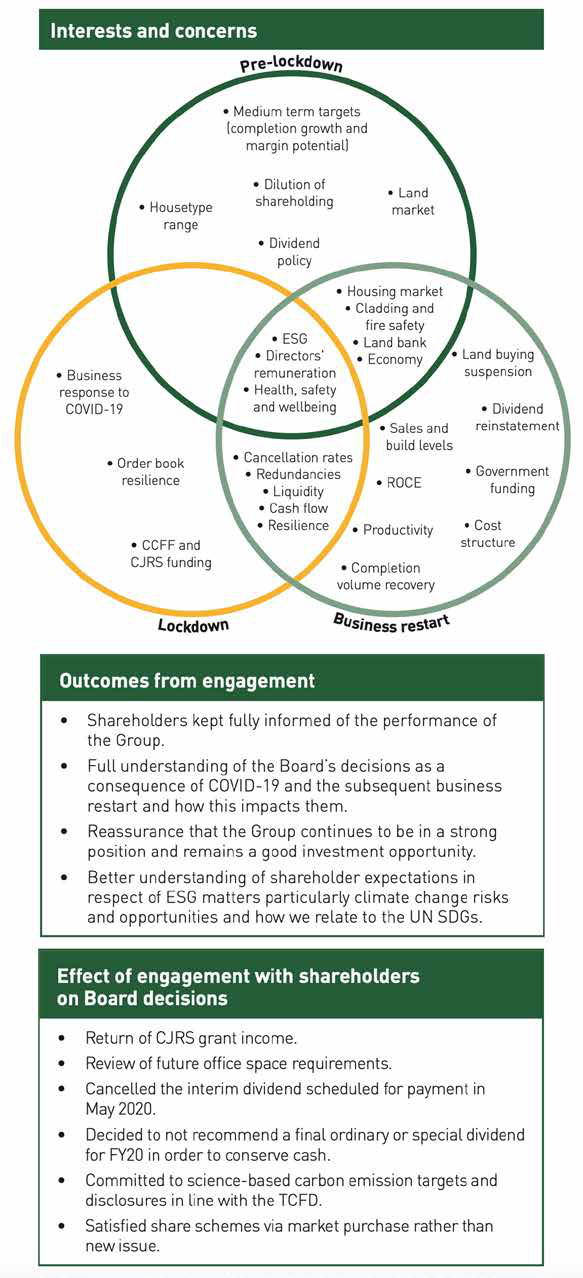
Interests and concerns
Pre-lockdown
- Medium term targets (completion growth and margin potential)
- Dilution of shareholding
- Housetype range
- Land market
- Housing market
- Cladding and fire safety
- Economy
- Land bank
- Directors' remuneration
- Land buying suspension
- Dividend policy
- Dividend reinstatement
- ESG
- Government funding
- Business response to COVID-19
- ROCE
- Order book resilience
- Cancellation rates
- Cost structure
- Redundancies
- Liquidity
- Cash flow
- Productivity
- Resilience
- Completion volume recovery
- CCFF and CJRS funding
Lockdown
Business restart
Outcomes from engagement
- Shareholders kept fully informed of the performance of the Group.
- Full understanding of the Board's decisions as a consequence of COVID-19 and the subsequent business restart and how this impacts them.
- Reassurance that the Group continues to be in a strong position and remains a good investment opportunity.
- Better understanding of shareholder expectations in respect of ESG matters particularly climate change risks and opportunities and how we relate to the UN SDGs.
Effect of engagement with shareholders on Board decisions
- Return of CJRS grant income.
- Review of future office space requirements.
- Cancelled the interim dividend scheduled for payment in May 2020.
- Decided to not recommend a final ordinary or special dividend for FY20 in order to conserve cash.
- Committed to science-based carbon emission targets and disclosures in line with the TCFD.
- Satisfied share schemes via market purchase rather than new issue.
SSE plc
Annual Report y/e 31 March 2020 pg 12
What is useful? SSE's introduction to the stakeholder engagement section includes a diagram highlighting the inputs and outputs (i.e. a two-way consideration) of the relationships for its key stakeholders, addressing the benefits that the company and stakeholders obtain respectively.
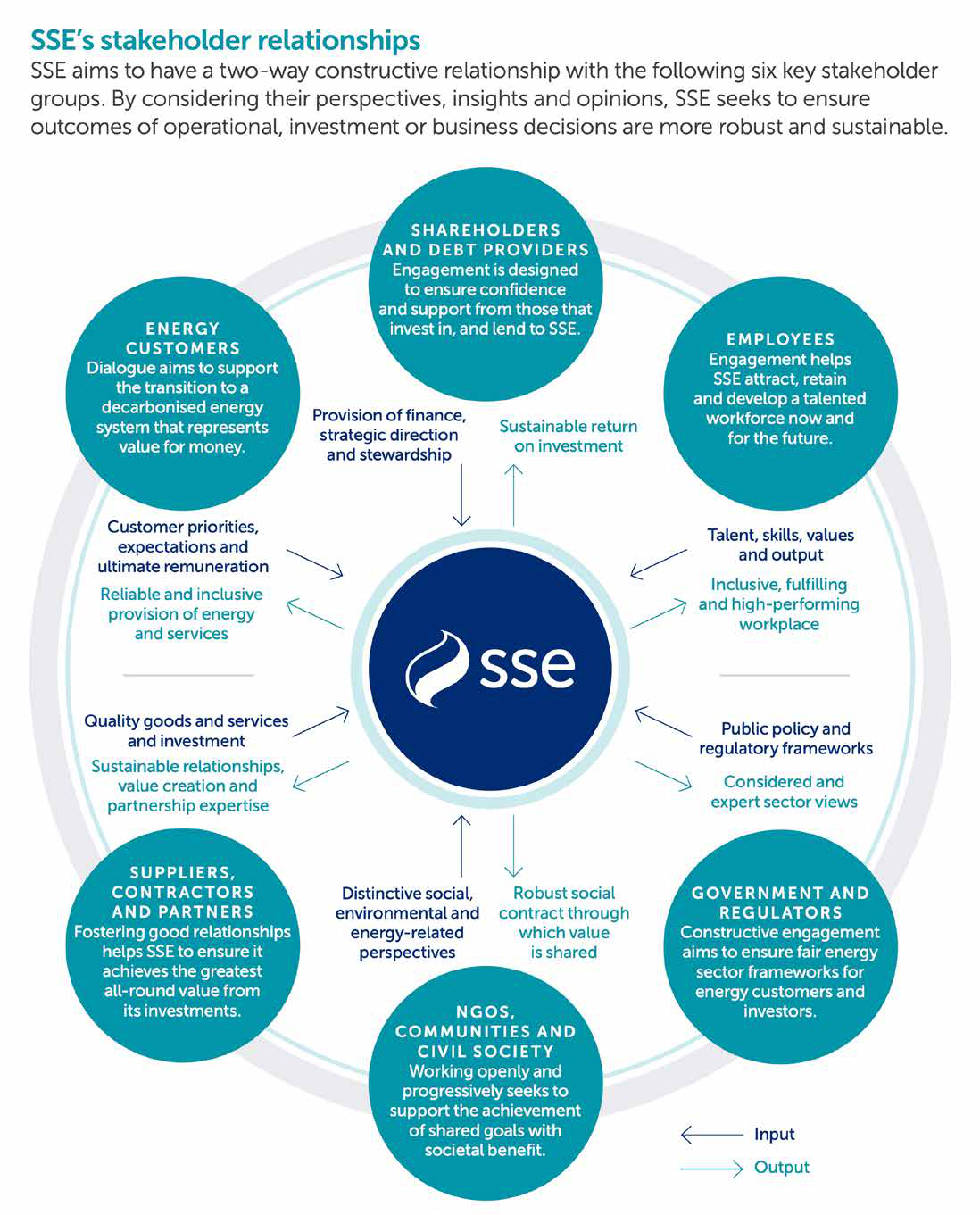
SSE's stakeholder relationships
SSE aims to have a two-way constructive relationship with the following six key stakeholder groups. By considering their perspectives, insights and opinions, SSE seeks to ensure outcomes of operational, investment or business decisions are more robust and sustainable.
Handelsbanken
Annual and Sustainability Report 2020 pg 42
What is useful? Handelsbanken discloses distribution of economic value creation amongst different stakeholders across five years, allowing for comparison with prior years, and clearly highlights where no distributions (e.g. dividends) were made during the year.
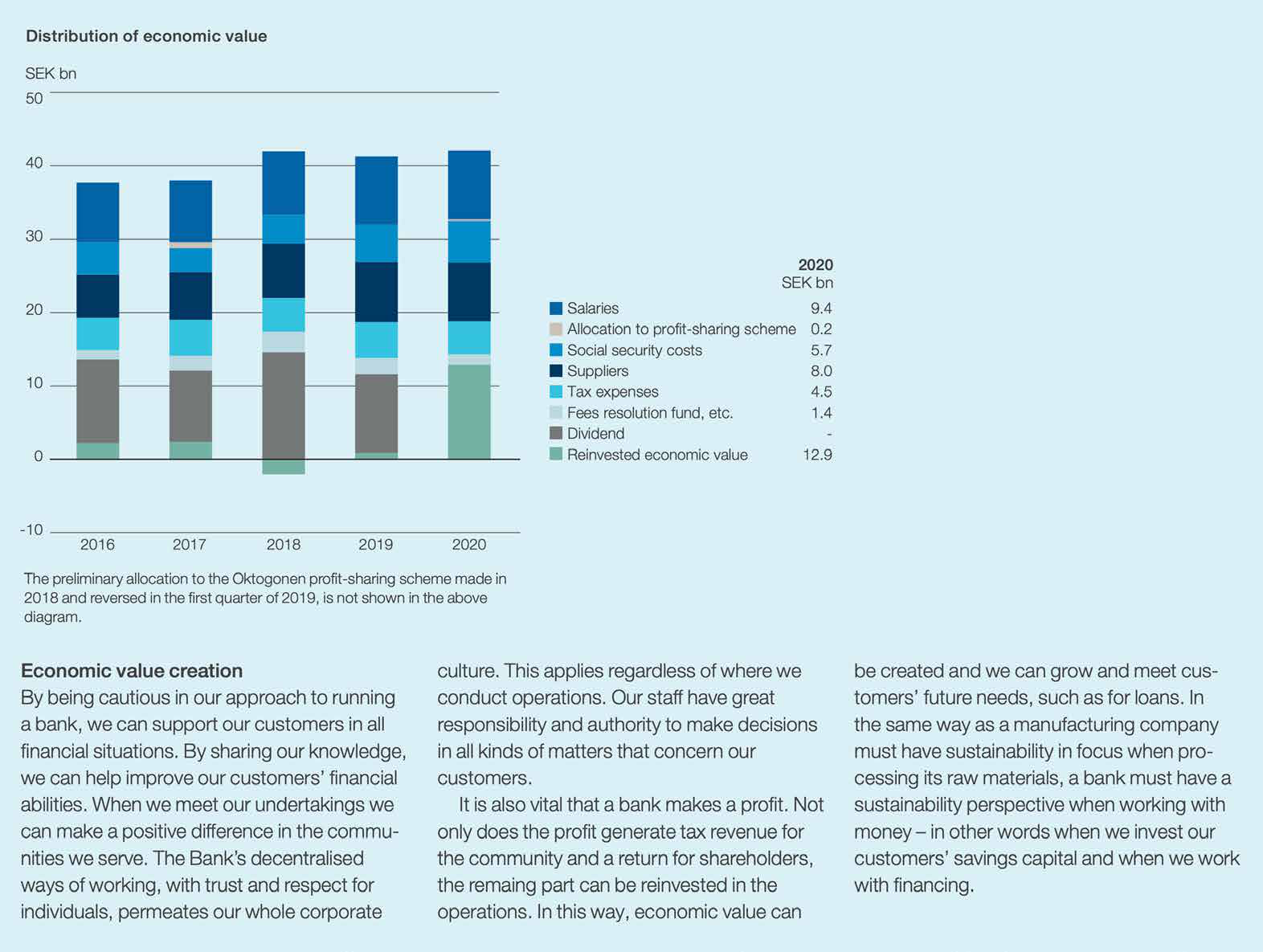
| 2020 SEK bn | |
|---|---|
| Salaries | 9.4 |
| Allocation to profit-sharing scheme | 0.2 |
| Social security costs | 5.7 |
| Suppliers | 8.0 |
| Tax expenses | 4.5 |
| Fees resolution fund, etc. | 1.4 |
| Dividend | |
| Reinvested economic value | 12.9 |
The preliminary allocation to the Oktogonen profit-sharing scheme made in 2018 and reversed in the first quarter of 2019, is not shown in the above diagram.
Economic value creation
By being cautious in our approach to running a bank, we can support our customers in all financial situations. By sharing our knowledge, we can help improve our customers' financial abilities. When we meet our undertakings we can make a positive difference in the communities we serve. The Bank's decentralised ways of working, with trust and respect for individuals, permeates our whole corporate culture. This applies regardless of where we conduct operations. Our staff have great responsibility and authority to make decisions in all kinds of matters that concern our customers. It is also vital that a bank makes a profit. Not only does the profit generate tax revenue for the community and a return for shareholders, the remaing part can be reinvested in the operations. In this way, economic value can be created and we can grow and meet customers' future needs, such as for loans. In the same way as a manufacturing company must have sustainability in focus when processing its raw materials, a bank must have a sustainability perspective when working with money
- in other words when we invest our customers' savings capital and when we work with financing.
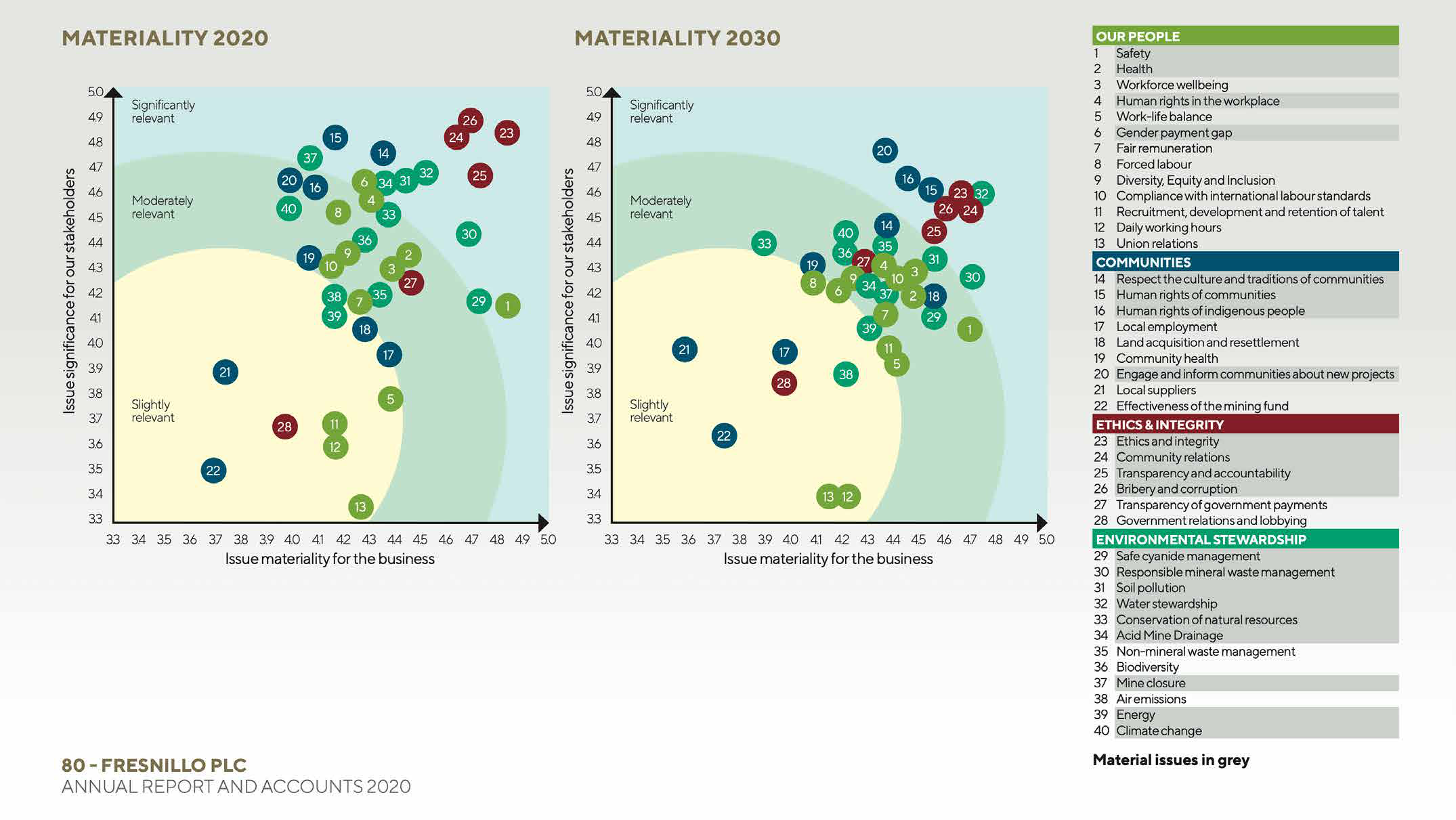
Our People 1. Safety 2. Health 3. Workforce wellbeing 4. Human rights in the workplace 5. Work-life balance 6. Gender payment gap 7. Fair remuneration 8. Forced labour 9. Diversity, Equity and Inclusion 10. Compliance with international labour standards 11. Recruitment, development and retention of talent 12. Daily working hours 13. Union relations
Communities 14. Respect the culture and traditions of communities 15. Human rights of communities 16. Human rights of indigenous people 17. Local employment 18. Land acquisition and resettlement 19. Community health 20. Engage and inform communities about new projects 21. Local suppliers 22. Effectiveness of the mining fund
Ethics & Integrity 23. Ethics and integrity 24. Community relations 25. Transparency and accountability 26. Bribery and corruption 27. Transparency of government payments 28. Government relations and lobbying
Environmental Stewardship 29. Safe cyanide management 30. Responsible mineral waste management 31. Soil pollution 32. Water stewardship 33. Conservation of natural resources 34. Acid Mine Drainage 35. Non-mineral waste management 36. Biodiversity 37. Mine closure 38. Air emissions 39. Energy 40. Climate change
Material issues in grey
Fresnillo plc Annual Report 2020 pg 80
What is useful? As part of its materiality assessment, Fresnillo identifies issues by stakeholder group or topic and the degree of relevance to the company. Fresnillo provides a materiality map not only for the current year but also for 10 years ahead, showing how issues change in importance.
Relationship with stakeholders
What actions is the company taking to build and maintain strong relationships with its key stakeholders?
Investors want information on the actions that a company is taking to build and maintain strong relationships with its key stakeholders. This is not only about engaging with stakeholders, but also about monitoring the relationship and how management and the board use information to understand the stakeholders' interests, needs and concerns.
When it comes to reporting on engagement, investors note that companies tend to discuss the engagement mechanisms in detail, particularly for employees. However, many companies do not sufficiently discuss the outcomes of the engagement, including the feedback received, how the company responded to it, and what implications it has on strategy and decisions. As highlighted in the FRC's 2020 Annual Review of Corporate Governance Reporting, there needs to be a two-way process of engagement which ensures that stakeholders' views are being heard (and reflected in reporting), as some engagement seems to be more about just informing stakeholders. See Fresnillo for a discussion of actions and outcomes as a result of engagement.
“Companies are good at saying what engagement they've done but not what they've learnt from it.” Investor
“There is a lack of strategic interpretation of engagement surveys.” Investor
Investors also highlighted that discussion of feedback or outcomes often did not sufficiently address negative feedback or problems. Investors expect honest disclosure on disappointing feedback which then includes the actions that the company is taking to address such issues.
"Negative news needs to be presented with how the company is planning to address it if it is reasonably significant – it is important to reassure stakeholders that it's a problem under control and that there are plans in place.” Investor
Investors recognise that the majority of engagement is undertaken by management, but they do expect the board to engage where relevant (including through designated non-executive directors and committees). They also expect the board to have oversight of the engagement and receive insights, which together are considered in decision-making and in assessing whether any actions are needed to improve stakeholder relationships. Disclosure which distinguishes between engagement at a company/management level and the board's role, including assigned director responsibilities, board oversight and direct engagement, is helpful (e.g. by Fresnillo). National Grid also distinguishes between board and company level, and breaks down the latter at regional level where relevant.
Especially in light of the COVID-19 pandemic, investors are also interested in actions that a company is taking to support its stakeholders to ensure a continuing relationship and sustain the pursuit of the company's success. Evidence of supporting stakeholders in difficult circumstances, and doing the right thing by them, indicates that the company is more likely to in turn have supportive stakeholders enabling it to create value and be resilient and successful.
To help investors understand how the company builds and maintains strong relationships with its stakeholders and understands their interests, needs and concerns to enable it to pursue long-term success, companies should ask themselves:
- What actions is the company taking to build and maintain strong relationships with its key stakeholders?
- How does the company engage with its key stakeholders?
- Does engagement differ across business units, segments or locations?
- What is the board's role in this engagement?
- Where the board does not engage directly, what information does the board receive about the stakeholders and the engagement with them?
- What feedback mechanisms are used?
- What was the feedback received from stakeholders?
- What are the outcomes of this engagement?
- How did the company respond to feedback received?
- What actions has the company taken to address the feedback or in response to other information about the stakeholder group?
- Has the company made any changes to its strategy in response to stakeholder feedback?
- How do management and the board get comfort that appropriate and sufficient engagement is taking place and that the company is acting on feedback received?
- How do management and the board get comfort that appropriate policies around stakeholder relationships are in place and that these have been reliably followed?
- Has the company taken any actions to support stakeholders in view of difficult circumstances or other factors?
Fresnillo plc Annual Report 2020 pg 28-31
What is useful? In its section "Relationships with key stakeholders", Fresnillo distinguishes between what management does and what the Executive Committee and Board do in terms of engagement. In addition, they include governance activities and, where relevant, highlight the designated non-executive director and their activities. The section also discusses actions taken during the year and what's planned based on the engagement undertaken.
Communities
Metrics * Social and environmental incidents. * Local employment and procurement. * Social investment.
How we engage our communities What management does: * Raise awareness on the measures to prevent Covid-19. * Engage with formal and informal leaders, local and regional authorities to understand and discuss their concerns and aspirations. * Preventive measures were implemented to safely conduct interviews and to limit the number of participants in meetings. * Operate grievance mechanisms to address community concerns and questions. * Conduct social studies every two years to identify and evaluate issues that matter to our communities. The next round of studies may be conducted in the second half of 2021 or postponed, depending on the Covid-19 risk. * Support our social investment portfolio with emphasis on education, health and sports, capacity building and water access. During Covid-19, some programmes were postponed and others adapted to be conducted online, while a number of new initiatives were launched.
How the Board complements the engagement efforts: * Visits from Board members to communities to gain further insights into the Company's social projects. Visits were postponed in 2020 to mitigate the Covid-19 risks. * Visits/appointments of the Chairman, the Deputy Chairman and other members of the Board with key Government officials, both at the federal and local level.
28-FRESNILLO PLC ANNUAL REPORT AND ACCOUNTS 2020
Governance activities of the Board and Board Committees * Gain insights into the corporate citizenship expectations of society during Covid-19. * Monitor community engagement and social investment portfolio in order to collaborate with communities to address the impacts of Covid-19.
Actions and Decisions (A - Actions undertaken, D - Decisions) * A - Engaged our communities on preventive measures to contain Covid-19, notably the use of masks. * A - Supported the most vulnerable members of the community, including supplying food so they could stay at home during lockdowns. * A - Shared rapid testing of Covid-19 with the communities. * A - Adapted our education and entrepreneurship programmes to be delivered online. To address the digital gap in remote communities, we launched a pilot project to test technologies and content for educational internet services. * A - Partnered with INNOVEC and the Smithsonian Science Education Center to create Covid-19 training, based on science, for children and their parents. * D - To increase donations of personal protection equipment and ventilators to the regional hospitals that serve our communities.
Outcomes * No conflicts with communities affecting our ability to operate. * Community engagement and programmes were adapted to the new dynamic of Covid-19. * Social investment (KPI). * Local employment (KPI).
For more information → See pages 105-109
29-FRESNILLO PLC ANNUAL REPORT AND ACCOUNTS 2020
National Grid plc Annual Report 2019/20 pg 45-47
What is useful? National Grid's S172 statement distinguishes between company and board-level engagement and, where relevant, it also distinguishes engagement at a divisional level (UK and US).
Stakeholder group
Our regulators
How we engage and communicate
Company engagement UK - regular interactions with Ofgem and the Health and Safety Executive. The Company also organises stakeholder fora and consultations with stakeholders, including members of the public, our suppliers and customers around specific projects and proposed business plan submissions for RIIO-2.
We work with other networks and organisations outside of the energy industry to identify good practice.
US - regular interface with both federal and state regulators and customers on an ongoing basis, as well as the pre-filing stakeholder engagement programme in the build-up to and during any rate case process. Specific engagement was undertaken regarding the decarbonisation pathways and the Niagara Mohawk Power Corporation advanced metering infrastructure.
Board-level engagement The Board met with the Chair, CEO and incoming CEO of Ofgem in November
- The topics of conversation included our net zero ambition, with a focus on practical solutions to move the agenda forward. The discussions also covered RIIO-2.
The outcomes of engagement activities are reported to the appropriate forum and ultimately to the Executive Committee and Board. In the US, any rate case engagement is reported up to the Executive Committee and the ordering of Executive Committee and Board as appropriate. The Board met with the Governor of Massachusetts and a member of the Governor's office in March
- Recognising the severity of the adverse reaction of various stakeholders to the gas moratorium that was enforced by the Company in downstate New York, the Board commissioned two external reviews to understand how the US business had made the original decision. Long-term solutions are being implemented.
How stakeholder interests have influenced decision-making and the execution of our strategy
In the UK, discussions with our regulators have contributed to the productive outcome of key business issues such as: * the 9 August 2019 power outage: the Company had regular engagement with Ofgem and the UK government, and the Board regularly discussed the outcome of investigations and reports focused on this, including the response to Ofgem on the findings from the investigation. In January 2020, the Board welcomed Ofgem's report on this incident which confirmed that our actions did not cause the outage. * the future of our ESO business, which will be reviewed by Ofgem following legal separation last year. * RIIO-2 business plans: for the development of the RIIO-2 business plans, we have followed Ofgem's enhanced stakeholder engagement process, which is based on greater engagement with our industry and end consumers to prioritise their needs in our RIIO-2 business plans. Three independent groups were established to provide challenge throughout this process - two independently Chaired User Groups, (one for the ESO and one for the transmission businesses) and an Ofgem Challenge Group. Regular discussions were held at the Executive Committee and the Board on progress with stakeholder engagement, the development of the RIIO-2 business plans and on interactions with the challenge groups. On invitation, the Chairs of the Chaired Independent User Groups met with the Board in 2019. Following a period of engagement with Ofgem, we submitted our final business plans for RIIO-2 in December
- Thereafter, engagement has continued with Ofgem evidencing various aspects of the Company's RIIO-2 business plans such as the formal question and answer process to explore our RIIO-2 business plan submission ahead of its draft and final determinations later in 2020.
In the US we refined the Company's regulatory strategy and business planning for rate cases and other US regulatory priorities. The Company's rate case pre-filing stakeholder engagement programme has become a major contributor to the Company's successful rate case outcomes. The external reviews conducted on the gas moratorium have highlighted lessons and recommendations which are already being implemented. In the short term, all affected customers have been contacted and plans are in place to make sure that they are connected to a gas supply in the near future. Medium
- to long-term solutions that are in the best interests of our customers and regulators continue to be progressed. The Board is closely monitoring the output of these developments.
Views of other stakeholder groups considered Customers, Investors, Communities and governments, Suppliers, Our colleagues.
Risks and opportunities
What could affect key stakeholders and how do they affect the company?
Investors want information about what could affect a company's relationships with its stakeholders and how these relationships could affect the company's pursuit of success. Investors will be aware of trends and factors that could affect a company's stakeholders and will be forming an opinion on related risks and opportunities. However, they want to understand the board and management's own assessment. They want information on: * how management makes its risk assessment and monitors risks, which is in part addressed by how management understands who its stakeholders are and what their concerns are; * factors that are affecting or could materially affect stakeholders, such as market trends, economic factors, technological change, social movements and new legislation and the resulting risks or opportunities; * what are the risks and opportunities associated with stakeholders and how the company is responding to them.
The COVID-19 pandemic highlighted that certain risks affecting stakeholders, particularly customers and suppliers, were not sufficiently considered and disclosed. Investors hope that this increased awareness will lead to better practice and reporting, including an honest depiction of the uncertainties and consequences for the business model. Some investors are concerned that disclosures can still be too positive, even when discussing implications of new government-imposed restrictions and changes in people's attitudes which could drastically affect the way stakeholders interact with a company and how a company operates.
"It's a shame it took a pandemic to bring certain stakeholders and risks into focus." Investor
This information could be included either in the risk section or in the stakeholder section in the annual report – what is important is that there is good linkage between the different sections where these issues are relevant, including discussion of business model and strategy. We set out some helpful examples of reporting on trends and opportunities on pages 22-23. Disclosures of risks and opportunities will be addressed in the Lab's upcoming project report on reporting of risks and uncertainties, which will be published later in the year.
To help investors understand what could affect the company's relationships with its stakeholders and how these relationships could affect the company's pursuit of success, companies should ask themselves:
- What could affect key stakeholders and how do they affect the company?
- How does the company, including the board, monitor what could affect its key stakeholders over different time horizons?
- What market factors and trends or regulatory changes have affected or could affect the company's key stakeholders?
- What are the risks that could affect the stakeholders and the company's relationship with them?
- What risks do the stakeholder relationships give rise to?
- What mitigating actions are being taken to address these risks?
- What are the opportunities that the key stakeholders give rise to that the company is considering strategically?
Uncomfortable Truths and Difficult Decisions
In many ways the last ten years has been about adapting to the simple truth that, initially, we did not want to believe: Retail stores were, and will remain, at a fundamental and irreversible disadvantage to online competition. This is not being driven by price or even home delivery, but by the scale of the choice websites can offer relative to any physical store. The annual decline in Retail like-for-like sales has become the new normal, and looks set to remain that way for many years.
The moment we reconciled ourselves to that fact was, in some ways, a new beginning. Managing the transition was harder than fighting it, but much more productive. It allowed us to follow the new money rather than defend the old.
Following the money can be uncomfortable, because new ideas often pose a threat to existing businesses. The decision to compete with ourselves through selling third-party brands and, more recently, the opening up of our sourcing skills to other brands through licensing were not entirely uncontroversial. We have learned to embrace these and other opportunities nonetheless.
Our view is simple: there is nowhere to hide on the internet, and we are better to collaborate with other brands to our mutual benefit, than cling on to past advantages in the vain hope our customers will not find the competition. And of course, the broader our product offer, the more relevant our website becomes to an increasing number of customers.
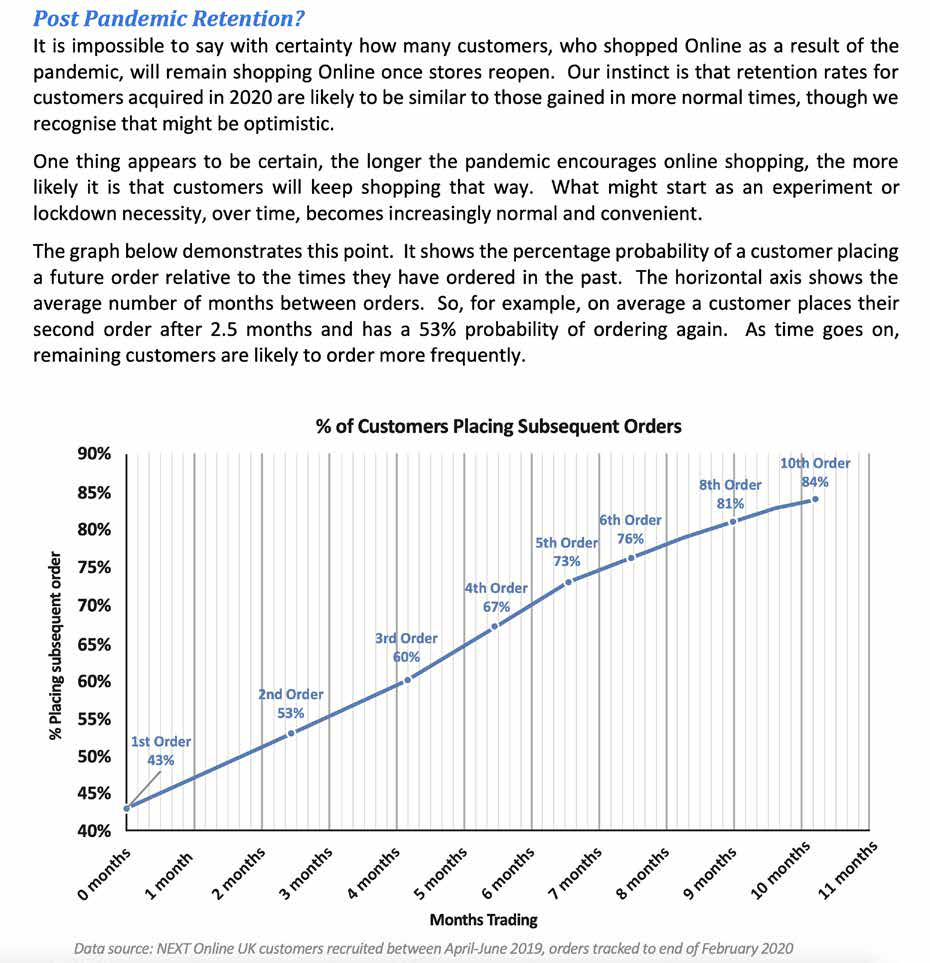
Post Pandemic Retention?
It is impossible to say with certainty how many customers, who shopped Online as a result of the pandemic, will remain shopping Online once stores reopen. Our instinct is that retention rates for customers acquired in 2020 are likely to be similar to those gained in more normal times, though we recognise that might be optimistic.
One thing appears to be certain, the longer the pandemic encourages online shopping, the more likely it is that customers will keep shopping that way. What might start as an experiment or lockdown necessity, over time, becomes increasingly normal and convenient.
The graph below demonstrates this point. It shows the percentage probability of a customer placing a future order relative to the times they have ordered in the past. The horizontal axis shows the average number of months between orders. So, for example, on average a customer places their second order after 2.5 months and has a 53% probability of ordering again. As time goes on, remaining customers are likely to order more frequently.
OUTLOOK FOR THE YEAR AHEAD
Uncertainty on Many Levels It is hard to think of a year where the outlook has been so uncertain. The health of the consumer economy, the future course of the pandemic and the prospects for Retail stores remain unknown. It also remains to be seen how many of the product preferences and shopping trends induced by the pandemic will persist once life returns to normal. The following paragraphs set out our thinking on the main uncertainties facing the business and our guidance for the year ahead.
Assumptions About the Consumer Economy and Future Lockdowns Our best guess is that the consumer economy, at least in the short term, will be healthier than many presume. It seems likely that a combination of pent-up demand along with a healthy overall increase in personal savings will serve to keep the consumer economy moving forward.
Whether or not there will be further lockdowns this year is impossible to predict. We have (perhaps optimistically) assumed that the rollout of COVID vaccines will result in stores remaining open for the year, once the current lockdown has passed. If this assumption is not correct, it is unlikely we will meet our central guidance for sales and profit.
Structural Change and the Future of Retail Stores There remains a big question mark over the level of sales our stores will achieve when they reopen. The pandemic has served to accelerate a pre-existing social trend – the move to more online shopping. History has been given a shove and, having moved forward, seems unlikely to reverse.
That said, the steady reduction in Retail occupancy costs, the continued relevance of our stores to online shopping through collections and returns and (perhaps) the closure of competing shops, mean that the battle to keep our stores relevant in an online world is far from over.
So our base case for the year ahead is that store sales will decline, on a like-for-like basis, by -20%. At this level (after reversing out the effects of the current lockdown) our store network would remain marginally profitable (see page 49).
Next PLC Annual Report January 2021 pg 11, 13, 16
What is useful? Next discusses the difficulties and uncertainties affecting the company because of the pandemic and changing customer behaviours affecting retail, particularly its store strategy. Next also provides an analysis of online customer ordering patterns and insight into sales opportunities.
Diageo plc Annual Report June 2020 pg 14-16, 24-25
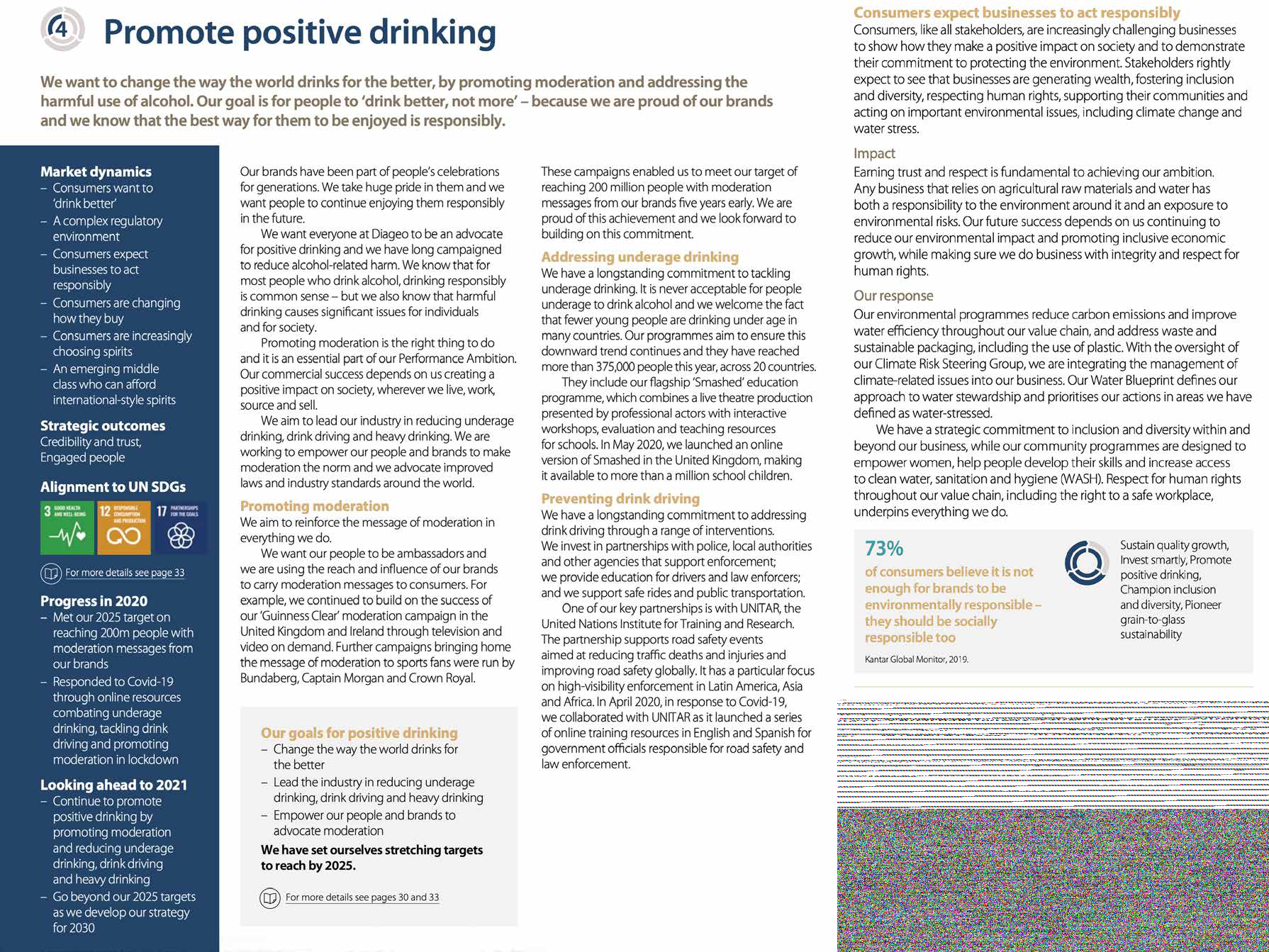
What is useful? Diageo includes a detailed discussion of market trends and consumer behaviours (including interest in the company's treatment of other stakeholders), which addresses how each trend affects the company and what the related response is. The trends are also linked to relevant strategic priorities. In discussing the strategic priority, which is linked directly to market dynamics and consumer behaviour, Diageo provides further detail on its response and future goals.
4 Promote positive drinking
We want to change the way the world drinks for the better, by promoting moderation and addressing the harmful use of alcohol. Our goal is for people to 'drink better, not more' - because we are proud of our brands and we know that the best way for them to be enjoyed is responsibly.
Market dynamics * Consumers want to 'drink better' * A complex regulatory environment * Consumers expect businesses to act responsibly * Consumers are changing how they buy * Consumers are increasingly choosing spirits * An emerging middle class who can afford international-style spirits
Strategic outcomes Credibility and trust, Engaged people
Alignment to UN SDGs
Section of a report page displaying alignment to UN Sustainable Development Goals 3, 12, and 17, and a visual summary of 73% consumer belief in social responsibility, listing five key principles.
For more details see page 33
Progress in 2020 * Met our 2025 target on reaching 200m people with moderation messages from our brands * Responded to Covid-19 through online resources combating underage drinking, tackling drink driving and promoting moderation in lockdown
Looking ahead to 2021 * Continue to promote positive drinking by promoting moderation and reducing underage drinking, drink driving and heavy drinking * Go beyond our 2025 targets as we develop our strategy for 2030
Our brands have been part of people's celebrations for generations. We take huge pride in them and we want people to continue enjoying them responsibly in the future. We want everyone at Diageo to be an advocate for positive drinking and we have long campaigned to reduce alcohol-related harm. We know that for most people who drink alcohol, drinking responsibly is common sense
- but we also know that harmful drinking causes significant issues for individuals and for society. Promoting moderation is the right thing to do and it is an essential part of our Performance Ambition. Our commercial success depends on us creating a positive impact on society, wherever we live, work, source and sell. We aim to lead our industry in reducing underage drinking, drink driving and heavy drinking. We are working to empower our people and brands to make moderation the norm and we advocate improved laws and industry standards around the world.
Promoting moderation We aim to reinforce the message of moderation in everything we do. We want our people to be ambassadors and we are using the reach and influence of our brands to carry moderation messages to consumers. For example, we continued to build on the success of our 'Guinness Clear' moderation campaign in the United Kingdom and Ireland through television and video on demand. Further campaigns bringing home the message of moderation to sports fans were run by Bundaberg, Captain Morgan and Crown Royal.
Our goals for positive drinking * Change the way the world drinks for the better * Lead the industry in reducing underage drinking, drink driving and heavy drinking * Empower our people and brands to advocate moderation
We have set ourselves stretching targets to reach by 2025.
(D) For more details see pages 30 and 33
These campaigns enabled us to meet our target of reaching 200 million people with moderation messages from our brands five years early. We are proud of this achievement and we look forward to building on this commitment.
Addressing underage drinking We have a longstanding commitment to tackling underage drinking. It is never acceptable for people underage to drink alcohol and we welcome the fact that fewer young people are drinking under age in many countries. Our programmes aim to ensure this downward trend continues and they have reached more than 375,000 people this year, across 20 countries. They include our flagship 'Smashed' education programme, which combines a live theatre production presented by professional actors with interactive workshops, evaluation and teaching resources for schools. In May 2020, we launched an online version of Smashed in the United Kingdom, making it available to more than a million school children.
Preventing drink driving We have a longstanding commitment to addressing drink driving through a range of interventions. We invest in partnerships with police, local authorities and other agencies that support enforcement; we provide education for drivers and law enforcers; and we support safe rides and public transportation. One of our key partnerships is with UNITAR, the United Nations Institute for Training and Research. The partnership supports road safety events aimed at reducing traffic deaths and injuries and improving road safety globally. It has a particular focus on high-visibility enforcement in Latin America, Asia and Africa. In April 2020, in response to Covid-19, we collaborated with UNITAR as it launched a series of online training resources in English and Spanish for government officials responsible for road safety and law enforcement.
Consumers expect businesses to act responsibly Consumers, like all stakeholders, are increasingly challenging businesses to show how they make a positive impact on society and to demonstrate their commitment to protecting the environment. Stakeholders rightly expect to see that businesses are generating wealth, fostering inclusion and diversity, respecting human rights, supporting their communities and acting on important environmental issues, including climate change and water stress.
Impact Earning trust and respect is fundamental to achieving our ambition. Any business that relies on agricultural raw materials and water has both a responsibility to the environment around it and an exposure to environmental risks. Our future success depends on us continuing to reduce our environmental impact and promoting inclusive economic growth, while making sure we do business with integrity and respect for human rights.
Our response Our environmental programmes reduce carbon emissions and improve water efficiency throughout our value chain, and address waste and sustainable packaging, including the use of plastic. With the oversight of our Climate Risk Steering Group, we are integrating the management of climate-related issues into our business. Our Water Blueprint defines our approach to water stewardship and prioritises our actions in areas we have defined as water-stressed. We have a strategic commitment to inclusion and diversity within and beyond our business, while our community programmes are designed to empower women, help people develop their skills and increase access to clean water, sanitation and hygiene (WASH). Respect for human rights throughout our value chain, including the right to a safe workplace, underpins everything we do.
73% of consumers believe it is not enough for brands to be environmentally responsible – they should be socially responsible too
Kantar Global Monitor, 2019.
Sustain quality growth, Invest smartly, Promote positive drinking, Champion inclusion and diversity, Pioneer grain-to-glass sustainability
Performance and metrics
As part of this project, investors reiterated their desire for information about performance and progress against strategic objectives and targets. In respect of stakeholders, this will primarily be non-financial information but could also relate to financial metrics, such as spending on employees or revenue from customers. Performance information is useful where it helps investors assess the strength or otherwise of a relationship with a stakeholder and see how that affects the pursuit of strategy, and ultimately the company's success. Investors also want to understand the metrics that management and the board are using to monitor, understand and manage their stakeholder relationships and assess where improvements are necessary.
The principles for reporting metrics identified in the Lab's report Performance metrics – principles and practice are still relevant and apply to metrics in relation to stakeholders too:
Aligned to strategy: Investors want to know how metrics tie into the strategy, reflecting what is being monitored by the board and management for their assessment on the delivery of strategy, but they also want the metrics which give insight into the capability of meeting and delivering the strategy. These should ultimately be the same, which is why it is useful for companies to explain why the key performance indicators (KPIs) and metrics chosen are important to the company (e.g. Taylor Wimpey). An alternative presentation is a dashboard view such as Barclays table of KPIs by key stakeholder group, which in turn are linked to strategy and the business model. Linking to remuneration is another way of highlighting the importance of KPIs but as noted in the FRC's May 2021 research on remuneration reporting, although many companies used non-financial KPIs such as diversity or health and safety KPIs in executive pay formulas, they often did not explain why these were chosen or how they were formulated. More granular metrics can indicate the current success of strategy and plans, e.g. customer and employee satisfaction scores, and/or provide insight into the future "health" of the drivers of value and any related risks, e.g. diversity, training and turnover metrics. We noted reporting that included detailed breakdowns of employee departures, including dismissals, by country, and average remuneration by categories of seniority, age and gender. While these disclosures can be helpful as data builds up over subsequent periods, companies should provide their interpretation of the results and discuss any actions to address related performance issues or stakeholder matters reflected by the metrics.
Transparent: Transparency in metrics is achieved through genuine explanations of what is driving the performance and through consistent application. This is particularly relevant in the context of COVID-19 where there is the potential to either use the pandemic as an excuse for poor performance or to ignore its effect if the result is positive. An example of where the effects of COVID-19 have been addressed is IAG's discussion of its net promoter score. A consistent concern we hear from investors is over-emphasis of the positives and insufficient discussion of the negatives. Providing a trend analysis for a metric is undeniably helpful in identifying whether something has gone wrong, but companies need to be transparent and upfront on the reasons why. It is also helpful to explain what went wrong, even when it is not evident within the KPI or there has been an improvement in the year.
In context: Context can be provided through clear definition of the metric and the target and objective to be achieved (e.g. Safestore). Providing market background or an industry benchmark or sector average (e.g. First Group) is also helpful in contextualising the company's performance.
Reliable: Investors recognise that some areas of stakeholder reporting and relevant metrics are still in their infancy and developing, which is why it is important to include descriptions of how the metrics were measured. Information on whether the metrics were subject to assurance or to board oversight are helpful. Using or corroborating own metrics with third party measures is another way of enhancing reliability. More investors are using review sites as supporting evidence on stakeholder performance. Therefore, recognition by companies of this external information in support of their stated performance is useful. Safestore uses a variety of customer review sites, depending on which is prevalent in a particular market, while Rentokil Initial plc includes extracts from employee reviews across different divisions and its rating from Glassdoor and also notes that the board reviews the ratings as part of its monitoring of culture.
Consistent: Investors want consistency in metrics to be able to track them over time. Depending on when the data starts being collected and monitored, the ideal track record would be over 5 years (e.g. First Group). Consistency does not mean that metrics cannot change if new ones become more relevant, but if a change takes place, the reason why and the new definition needs to be explained. As internationally recognised ESG standards start to develop and be required, investors will eventually expect consistency against those standards.
Taking these principles into account, we set out some questions for companies to consider when reporting performance and metrics on stakeholders.
Some stakeholder metrics that investors told us they want:
Customers: * Net promoter scores * Satisfaction metrics * Churn rates
Employees: * Turnover/attrition * Satisfaction scores * Remuneration/wage differentials * Health and safety metrics * Diversity * Training
Suppliers: * Due diligence (undertaken and findings) * Payments
There are other stakeholders and other metrics that investors will be interested in, depending on the company. Metrics should be reported if relevant to the industry and material to the company. Breakdown of metrics by location or business units should be provided where possible.
To help investors understand what is measured, monitored and managed in relation to stakeholders, as well as understand the strength of a company's relationships with its stakeholders and how they are contributing to the company's success, companies should ask themselves:
- What are the metrics used by management, including risk management, to monitor and assess relationships with stakeholders?
- What are the metrics presented to and reviewed by the board in order to understand the strength of stakeholder relationships and what may need changing or improving?
- Which metrics provide insight into the continuation of the stakeholder relationship into the future?
- Which metrics on stakeholders link to the achievement of strategic priorities and objectives?
For the metrics presented, consider: * What affected the performance in the year? Is this a trend that is likely to continue? If it is not the desired performance, what steps are being taken to rectify the situation? * Are the metrics representative of the whole company's performance? Should metrics by division be presented? * Are there quantified targets against which to compare performance in the year? * Are there industry or market measures or benchmarks against which to compare the company performance? * Are there third party data points or measures which can corroborate performance measured internally? Are these reviewed by the board? * Are the metrics subject to assurance? * Are there consistently-applied definitions for the metrics? Are prior-year comparatives, ideally presenting a 5-year trend, available?
Taylor Wimpey plc Annual Report 2020 pg 23-24
What is useful? Taylor Wimpey links its performance and KPIs to its strategic priorities and relevant stakeholders. Each associated KPI includes a track record, definition, objective/target and its importance to strategy. The strategic priority is also linked to the principal risks which could affect the performance.
Strategic priority
Be the employer of choice in our industry
Principal Risks D, F, G PR Read more on pages 49 to 53 S Read more on pages 34 to 35
Performance in 2020 * We are pleased that our Annual Injury Incidence Rate (AIIR) reduced again to 151 in 2020 (2019: 156). Our AIIR for reportable injuries per 100,000 employees and contractors remains well below both the HBF and Health and Safety Executive Construction Industry averages. * Our dedicated teams have demonstrated the ability to quickly adapt to new working practices through the pandemic. * To gain feedback we ran three 'pulse' surveys in 2020 which were designed to provide a 'temperature check' on employee engagement. These showed our employees to be highly engaged as well as aligned to the Group's actions during the COVID-19 crisis. * We continue to have one of the lowest rates of voluntary employee turnover in the industry. With a well known shortage of skills, we have taken a proactive approach to our early talent programmes and direct labour model. In 2020, we reviewed the structure of the business and engaged with employees throughout the process.
Priorities going forward * We continue to use research and development to test and implement measures on site in order to make our sites as safe as possible. * We continue to value a stable workforce using surveys and feedback to understand our employees' views and to develop our employee offering. * In 2021, we plan to run a 'Talkback' survey, as we did in 2019. We undertake an engagement survey periodically and it forms an important part of how we involve, gain feedback from and communicate with our employees. * We continue to improve our recruitment strategy and diversity road map with supportive training and working practices. * We aim to reach a wider talent pool through different attraction channels to increase BAME representation in our workforce and establish a more gender balanced workforce which is more representative of the communities we serve.
KPI Voluntary employee turnover
Overview of Key Performance Indicators with bar charts for voluntary employee turnover, talent recruitment, tradespeople, and health & safety injury rates for years 18, 19, 20. Includes sections on strategic priority, 2020 performance, and future plans.
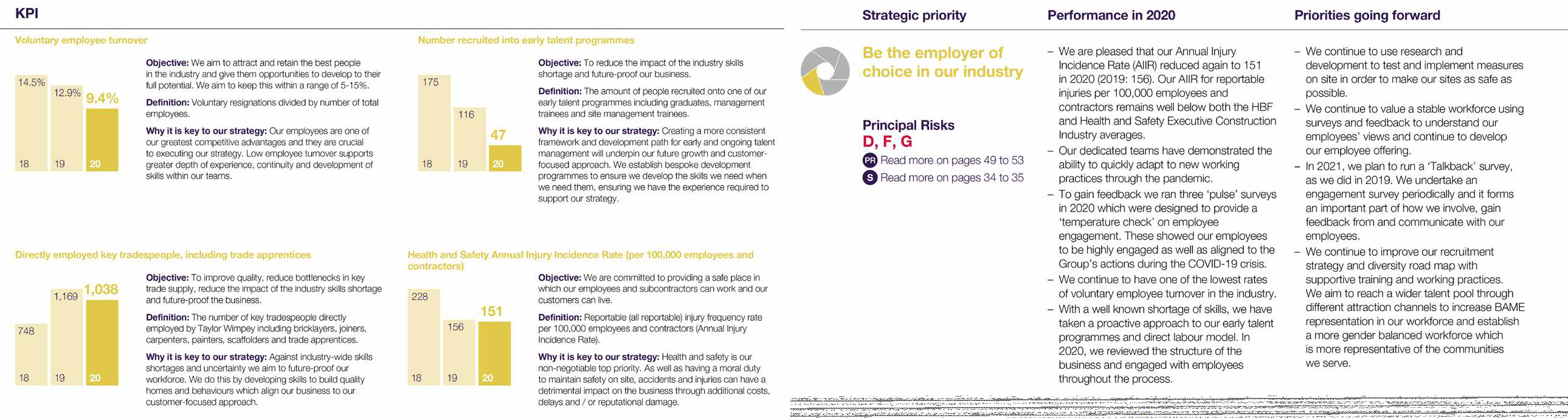
Objective: We aim to attract and retain the best people in the industry and give them opportunities to develop to their full potential. We aim to keep this within a range of 5-15%. Definition: Voluntary resignations divided by number of total employees. Why it is key to our strategy: Our employees are one of our greatest competitive advantages and they are crucial to executing our strategy. Low employee turnover supports greater depth of experience, continuity and development of skills within our teams.
Number recruited into early talent programmes Objective: To reduce the impact of the industry skills shortage and future-proof our business. Definition: The amount of people recruited onto one of our early talent programmes including graduates, management trainees and site management trainees. Why it is key to our strategy: Creating a more consistent framework and development path for early and ongoing talent management will underpin our future growth and customer-focused approach. We establish bespoke development programmes to ensure we develop the skills we need when we need them, ensuring we have the experience required to support our strategy.
Directly employed key tradespeople, including trade apprentices Objective: To improve quality, reduce bottlenecks in key trade supply, reduce the impact of the industry skills shortage and future-proof our business. Definition: The number of key tradespeople directly employed by Taylor Wimpey including bricklayers, joiners, carpenters, painters, scaffolders and trade apprentices. Why it is key to our strategy: Against industry-wide skills shortages and uncertainty we aim to future-proof our workforce. We do this by developing skills to build quality homes and behaviours which align our business to our customer-focused approach.
Health and Safety Annual Injury Incidence Rate (per 100,000 employees and contractors) Objective: We are committed to providing a safe place in which our employees and subcontractors can work and our customers can live. Definition: Reportable (all reportable) injury frequency rate per 100,000 employees and contractors (Annual Injury Incidence Rate). Why it is key to our strategy: Health and safety is our non-negotiable top priority. As well as having a moral duty to maintain safety on site, accidents and injuries can have a detrimental impact on the business through additional costs, delays and/or reputational damage.
International Airlines Group (IAG) Annual Report 2020 pg 18
What is useful? IAG links its KPIs to its strategic priorities to which stakeholders are also mapped. When explaining its Net Promoter Score, it highlights that although the score has risen favourably, this cannot be compared to past performance and is unlikely to be comparable to future performance due to the pandemic. However, IAG explains the trend for the proportion of the year that would have been comparable (i.e. pre-pandemic).
Report section detailing Strategic Priority 1: Strengthening brands and operations, with focus on 2020 activities, 2021 priorities, and 2020 Net Promoter Score (NPS) of 36.7, up 10.9 points year-on-year.
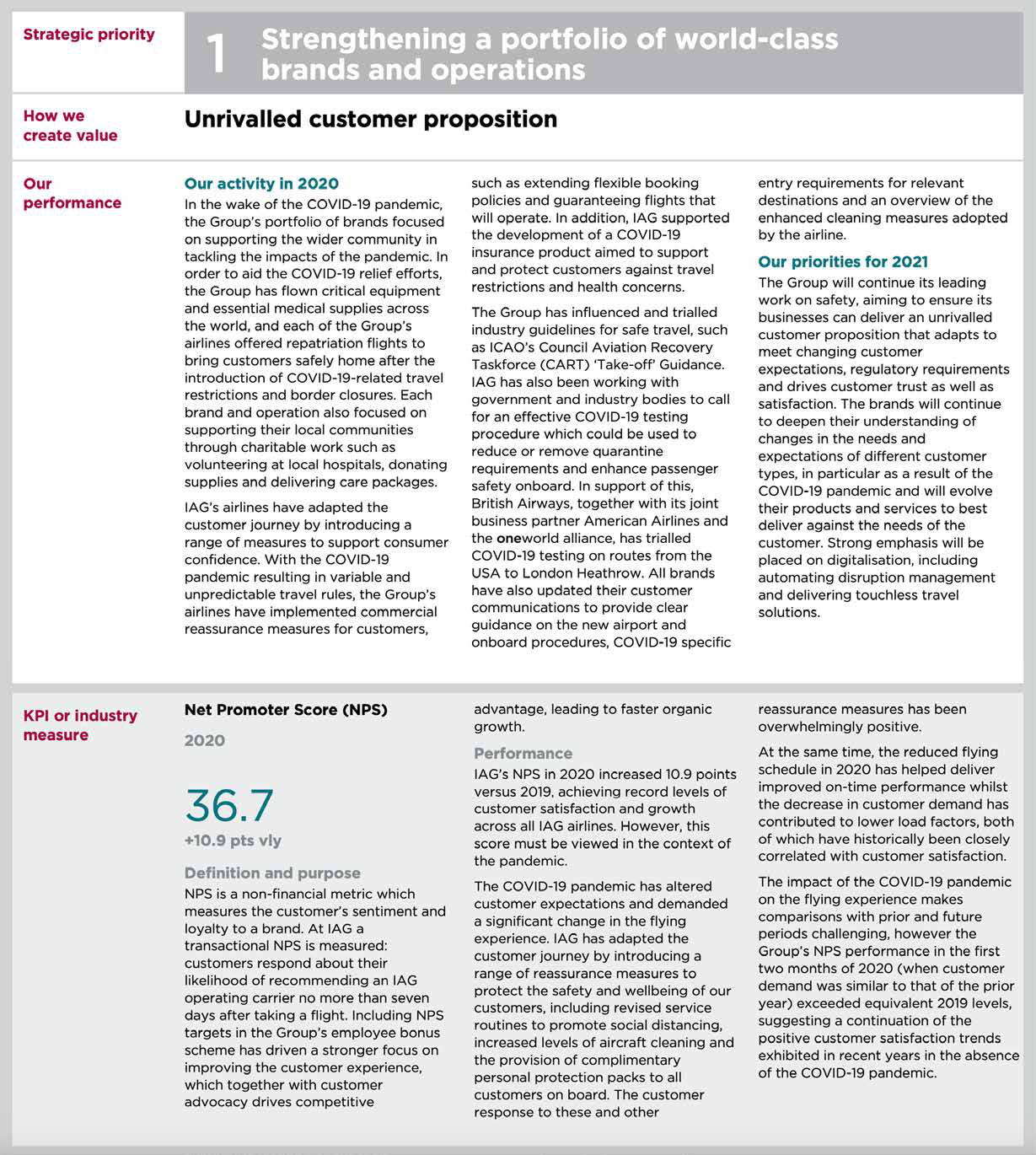
Strategic priority
1 Strengthening a portfolio of world-class brands and operations
How we create value
Our performance
Unrivalled customer proposition
Our activity in 2020 In the wake of the COVID-19 pandemic, the Group's portfolio of brands focused on supporting the wider community in tackling the impacts of the pandemic. In order to aid the COVID-19 relief efforts, the Group has flown critical equipment and essential medical supplies across the world, and each of the Group's airlines offered repatriation flights to bring customers safely home after the introduction of COVID-19-related travel restrictions and border closures. Each brand and operation also focused on supporting their local communities through charitable work such as volunteering at local hospitals, donating supplies and delivering care packages. IAG's airlines have adapted the customer journey by introducing a range of reassurance measures to protect consumer confidence. With the COVID-19 pandemic resulting in variable and unpredictable travel rules, the Group's airlines have implemented commercial reassurance measures for customers, such as extending flexible booking policies and guaranteeing flights that will operate. In addition, IAG supported the development of a COVID-19 insurance product aimed to support and protect customers against travel restrictions and health concerns. The Group has influenced and trialled industry guidelines for safe travel, such as ICAO's Council Aviation Recovery Taskforce (CART) 'Take-off' Guidance. IAG has also been working with government and industry bodies to call for an effective COVID-19 testing procedure which could be used to reduce or remove quarantine requirements and enhance passenger safety onboard. In support of this, British Airways, together with its joint business partner American Airlines and the oneworld alliance, has trialled COVID-19 testing on routes from the USA to London Heathrow. All brands have also updated their customer communications to provide clear guidance on the new airport and onboard procedures, COVID-19 specific entry requirements for relevant destinations and an overview of the enhanced cleaning measures adopted by the airline.
Our priorities for 2021 The Group will continue its leading work on safety, aiming to ensure its businesses can deliver an unrivalled customer proposition that adapts to meet changing customer expectations, regulatory requirements and drives customer trust as well as satisfaction. The brands will continue to deepen their understanding of changes in the needs and expectations of different customer types, in particular as a result of the COVID-19 pandemic and will evolve their products and services to best deliver against the needs of the customer. Strong emphasis will be placed on digitalisation, including automating disruption management and delivering touchless travel solutions.
KPI or industry measure
Net Promoter Score (NPS) 2020
36.7 +10.9 pts vly
Definition and purpose NPS is a non-financial metric which measures the customer's sentiment and loyalty to a brand. At IAG a transactional NPS is measured: customers respond about their likelihood of recommending an IAG operating carrier no more than seven days after taking a flight. Including NPS targets in the Group's employee bonus scheme has driven a stronger focus on improving the customer experience, which together with customer advocacy drives competitive advantage, leading to faster organic growth.
Performance IAG's NPS in 2020 increased 10.9 points versus 2019, achieving record levels of customer satisfaction and growth across all IAG airlines. However, this score must be viewed in the context of the pandemic. The COVID-19 pandemic has altered customer expectations and demanded a significant change in the flying experience. IAG has adapted the customer journey by introducing a range of reassurance measures to protect the safety and wellbeing of our customers, including revised service routines to promote social distancing, increased levels of aircraft cleaning and the provision of complimentary personal protection packs to all customers on board. The customer response to these and other reassurance measures has been overwhelmingly positive. At the same time, the reduced flying schedule in 2020 has helped deliver improved on-time performance whilst the decrease in customer demand has contributed to lower load factors, both of which have historically been closely correlated with customer satisfaction. The impact of the COVID-19 pandemic on the flying experience makes comparisons with prior and future periods challenging, however the Group's NPS performance in the first two months of 2020 (when customer demand was similar to that of the prior year) exceeded equivalent 2019 levels, suggesting a continuation of the positive customer satisfaction trends exhibited in recent years in the absence of the COVID-19 pandemic.
Barclays PLC Annual Report 2020 pg 22-23
What is useful? Barclays provides the key measures it monitors on each of its stakeholder priority groups in one location, after its S172 statement and descriptions of dialogue with those stakeholders. The metrics have a comparison allowing for an understanding of trends. Further detail on the stakeholders and additional measures can be found in the cross-referred pages.
Customers and clients
We aim to build trust by offering innovative products and services, with an excellent customer and client experience, such that customers and clients are happy to recommend us to others.
See our divisional reviews on pages 25 to 31
Infographic showing Barclays' performance across Customers (NPS), Colleagues (engagement), Society (social financing), and Investors (CET1 ratio) from 2018-2020, with bar charts for each metric.
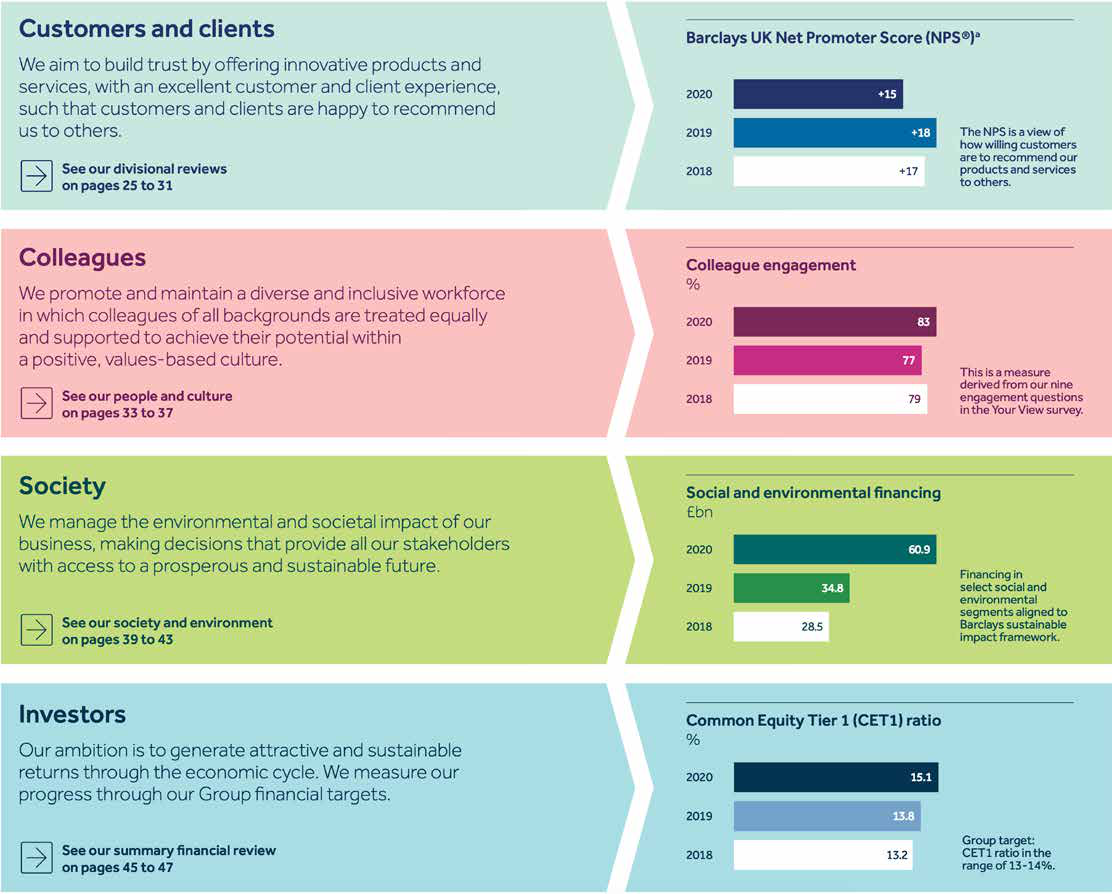
A dashboard displaying 8 charts comparing Barclays' performance metrics from 2018 to 2020, including customer engagement, complaints, diversity, employee sentiment, carbon emissions, skills training, operating expenses, and cost-income ratio.
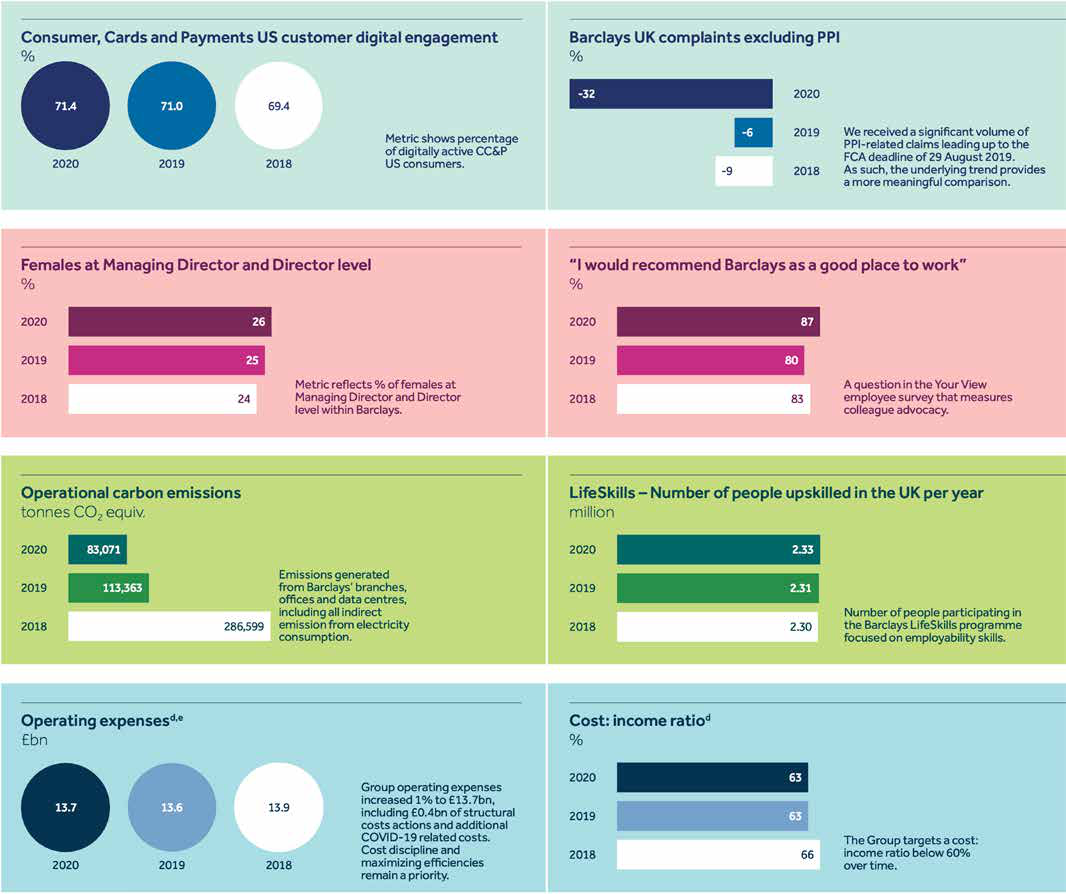
Barclays UK Net Promoter Score (NPS®) * % * 2020: +15 * 2019: +18 * 2018: +17 The NPS is a view of how willing customers are to recommend our products and services to others.
Consumer, Cards and Payments US customer digital engagement * % * 2020: 71.4 * 2019: 71.0 * 2018: 69.4 Metric shows percentage of digitally active CC&P US consumers.
Barclays UK complaints excluding PPI * % * 2020: -32 * 2019: -6 * 2018: -9 We received a significant volume of PPI-related claims leading up to the FCA deadline of 29 August
- As such, the underlying trend provides a more meaningful comparison.
Colleagues
We promote and maintain a diverse and inclusive workforce in which colleagues of all backgrounds are treated equally and supported to achieve their potential within a positive, values-based culture.
See our people and culture on pages 33 to 37
Colleague engagement * % * 2020: 83 * 2019: 77 * 2018: 79 This is a measure derived from our nine engagement questions in the Your View survey.
Females at Managing Director and Director level * % * 2020: 25 * 2019: 24 * 2018: 24 Metric reflects % of females at Managing Director and Director level within Barclays.
"I would recommend Barclays as a good place to work" * % * 2020: 87 * 2019: 80 * 2018: 83 A question in the Your View employee survey that measures colleague advocacy.
Society
We manage the environmental and societal impact of our business, making decisions that provide all our stakeholders with access to a prosperous and sustainable future.
See our society and environment on pages 39 to 43
Social and environmental financing * £bn * 2020: 28.5 * 2019: 34.8 * 2018: 26.0 Financing in select social and environmental segments aligned to Barclays sustainable impact framework.
Operational carbon emissions * tonnes CO₂ equiv. * 2020: 83,071 * 2019: 113,363 * 2018: 286,599 Emissions generated from Barclays' branches, offices and data centres, including all indirect electricity consumption.
LifeSkills – Number of people upskilled in the UK per year * million * 2020: 2.33 * 2019: 2.31 * 2018: 2.30 Number of people participating in the Barclays LifeSkills programme focused on employability skills.
Investors
Our ambition is to generate attractive and sustainable returns through the economic cycle. We measure our progress through our Group financial targets.
See our summary financial review on pages 45 to 47
Common Equity Tier 1 (CET1) ratio * % * 2020: 15.1 * 2019: 13.8 * 2018: 13.2 Group target: CET1 ratio in the range of 13-14%.
Operating expensesd,e * £bn * 2020: 13.7 * 2019: 13.6 * 2018: 13.9 Group operating expenses increased 1% to £13.7bn, including £0.4bn of structural costs actions and additional COVID-19 related costs. Cost discipline and maximizing efficiencies remain a priority.
Cost: income ratiod * % * 2020: 63 * 2019: 63 * 2018: 66 The Group targets a cost: income ratio below 60% over time.
Ethnicity split
Global * % * 2020: 55 White
| 39 Asian | 33 Black | Other ethnically diverse colleagues
United Kingdom * % * 2020: 81 White
| 14 Asian | 32 Black | Other ethnically diverse colleagues
USA * % * 2020: 49 White
| 32 Asian | 9 Black | 10 Other ethnically diverse colleagues Other ethnically diverse colleagues category includes Hispanic/Latino, Mixed, Native Hawaiian or Other Pacific Islander and Native American. USA and UK relate to Country and not Region. Colleagues with an undeclared ethnicity and/or are based in continental Europe and the Middle East (21% of our global population) has been excluded from all calculations
Bar charts display employee ethnicity percentages globally, in the UK, and USA for
- Also includes multi-generational age split for 2019 and 2020, categorizing employees by age ranges from under 20 to over 60 years.
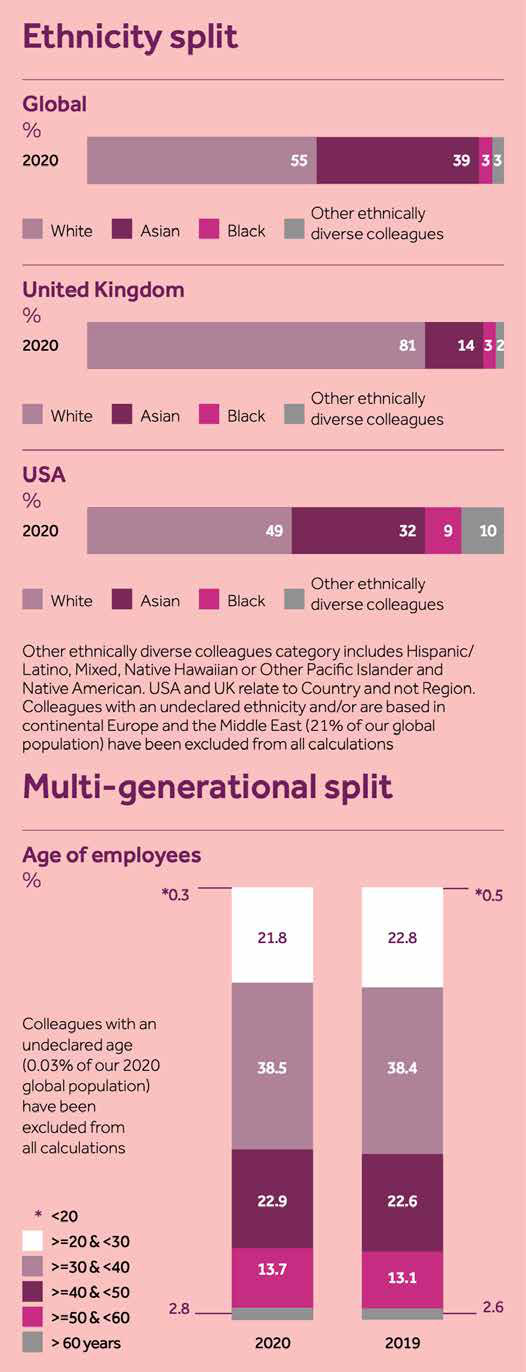
Multi-generational split
Age of employees * % * *0.3 <20 * 21.8 >=20 & <30 * 38.5 >=30 & <40 * 22.9 >=40 & <50 * 13.7 >=50 & <60 * 2.8 >60 years Colleagues with an undeclared age (0.03% of our 2020 global population) have been excluded from all calculations
Chart displaying gender diversity data, likely showing percentage of females at different management levels within Barclays.
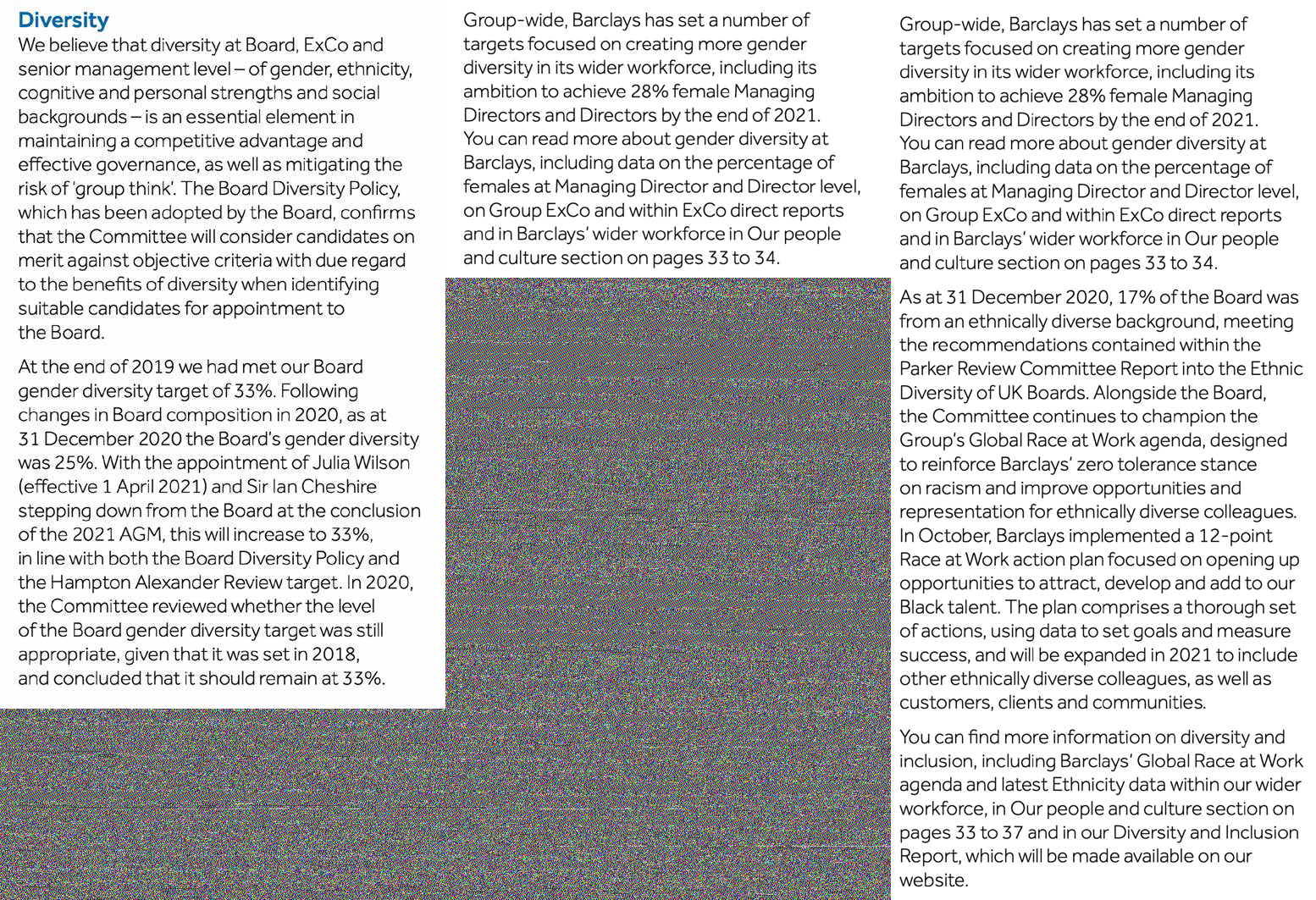
Diversity We believe that diversity at Board, ExCo and senior management level
- of gender, ethnicity, cognitive and personal strengths and social backgrounds - is an essential element in maintaining a competitive advantage and effective governance, as well as mitigating the risk of 'group think'. The Board Diversity Policy, which has been adopted by the Board, confirms that the Committee will consider candidates on merit against objective criteria with due regard to the benefits of diversity when identifying suitable candidates for appointment to the Board. At the end of 2019 we had met our Board gender diversity target of 33%. Following changes in Board composition in 2020, as at 31 December 2020 the Board's gender diversity was 25%. With the appointment of Julia Wilson (effective 1 April 2021) and Sir Ian Cheshire stepping down from the Board at the conclusion of the 2021 AGM, this will increase to 33%, in line with both the Board Diversity Policy and the Hampton Alexander Review target. In 2020, the Committee reviewed whether the level of the Board gender diversity target was still appropriate, given that it was set in 2018, and concluded that it should remain at 33%. Group-wide, Barclays has set a number of targets focused on creating more gender diversity in its wider workforce, including its ambition to achieve 28% female Managing Directors and Directors by the end of
- You can read more about gender diversity at Barclays, including data on the percentage of females at Managing Director and Director level, on Group ExCo and within ExCo direct reports and in Barclays' wider workforce in Our people and culture section on pages 33 to 34. As at 31 December 2020, 17% of the Board was from an ethnically diverse background, meeting the recommendations contained within the Parker Review Committee Report into the Ethnic Diversity of UK Boards. Alongside the Board, the Committee continues to champion the Group's Global Race at Work agenda, designed to reinforce Barclays' zero tolerance stance on racism and improve opportunities and representation for ethnically diverse colleagues. In October, Barclays implemented a 12-point Race at Work action plan focused on opening up opportunities to attract, develop and add to our Black talent. The plan comprises a thorough set of actions, using data to set goals and measure success, and will be expanded in 2021 to include other ethnically diverse colleagues, as well as customers, clients and communities. You can find more information on diversity and inclusion, including Barclays' Global Race at Work agenda and latest Ethnicity data within our wider workforce, in Our people and culture section on pages 33 to 37 and in our Diversity and Inclusion Report, will be made available on our website.
Our customers
Target Maintain 90%+ satisfaction scores in each market
Performance 2019/20 * UK: 94% Feefo/ 93% Trustpilot * France: 93% Trustpilot * Spain: 96% Google
In addition to using Feefo, Safestore invites customers to leave a review on a number of other platforms, including Facebook, Google and Trustpilot. As a result, wherever customers look for trust and reputational signals about Safestore, they will see an impartial view of our excellent customer satisfaction.
Trustpilot is a well recognised and authoritative third party review platform. This year we are delighted that Safestore has maintained a TrustScore of 4.7 out of 5 in the UK. We are committed to delivering an excellent customer experience and our independent customer feedback shows a high level of customer satisfaction at 93% from 1,135 reviews. Une Pièce en Plus also continues to use Trustpilot to obtain independent customer reviews. In 2020, 275 reviews have been collected with 93% of customers rating their service experience as 'Excellent' or 'Great' resulting in a TrustScore of 4.6 out of
- In Spain, OhMyBox! collects customer feedback via Google reviews and has maintained a score of at least 4.8 out of 5.
We are proud to be recognised for delivering exceptional customer service and we see this as a great achievement and a testament to the hard work of our colleagues in store and in the Customer Support Centre.
We continue to seek customer feedback through Feefo, the online review platform which guarantees 100% genuine feedback. All UK stores receive feedback allowing customers to view ratings. This year, Safestore achieved a customer service rating of 94% based on UK customers who rated their experience as 'Excellent' or 'Good'.
In 2020, Safestore won the Feefo Platinum Trusted Service award given to businesses which have achieved Gold standard for three consecutive years. It is an independent mark of excellence that recognises businesses for delivering exceptional experiences, as rated by real customers. This is a highly valued award and as all reviews are verified as genuine, the accreditation is a true reflection of Safestore's commitment to delivering outstanding service.
5 Maintain responsible partnerships with our customers and communities
Customer and passenger satisfaction
First Student (Average rating out of ten) * 2020: 8.93 * 2019: 8.75 * 2018: 8.75 * 2017: 8.76 * 2016: 8.38 First Student increased their overall customer satisfaction score to record levels this year (8.93 out of ten), despite sector-wide driver shortage challenges. Our teams collaborated with school districts to collectively problem solve and develop awareness around recruitment measures.
First Transit (Average rating out of ten) * 2020: 8.87 * 2019: 8.88 * 2018: 9.05 * 2017: 8.84 * 2016: 8.64 First Transit also maintained their strong overall satisfaction score, with 8.87 out of ten; just below last year's high achievement of 8.88.
Greyhound (Net Promoter Score) * 2020: -19.5 * 2019: -28.7 * 2018: -12.8 * 2017: -0.8 * 2016: -23.2 Greyhound's Net Promoter Score improved year-on-year thanks to improvements in on-time performance and as a result of fleet investments.
First Bus (% satisfied with their journey overall) * 2020: 84 * 2019: 83 * 2018: 84 * 2017: 84 * 2016: 84 Overall satisfaction with First Bus in the independent Transport Focus Bus Passenger Survey in England was 84%, a slight increase compared to last year (83%). A key factor in overall customer satisfaction is punctuality, where our satisfaction score improved by 1%. Our driver welcome/greeting score improved again in 2019 from 70% to 72%, and our driver helpfulness and attitude score improved from 72% to 73%. These results demonstrate the benefit of focus given to driver behaviour through our Journey Makers programme and to driver engagement, facilitated by First Bus Connect, our colleague app which is well used by drivers.
Bar charts showing customer and passenger satisfaction scores for First Student, First Transit, Greyhound, and First Bus from 2016-2020.
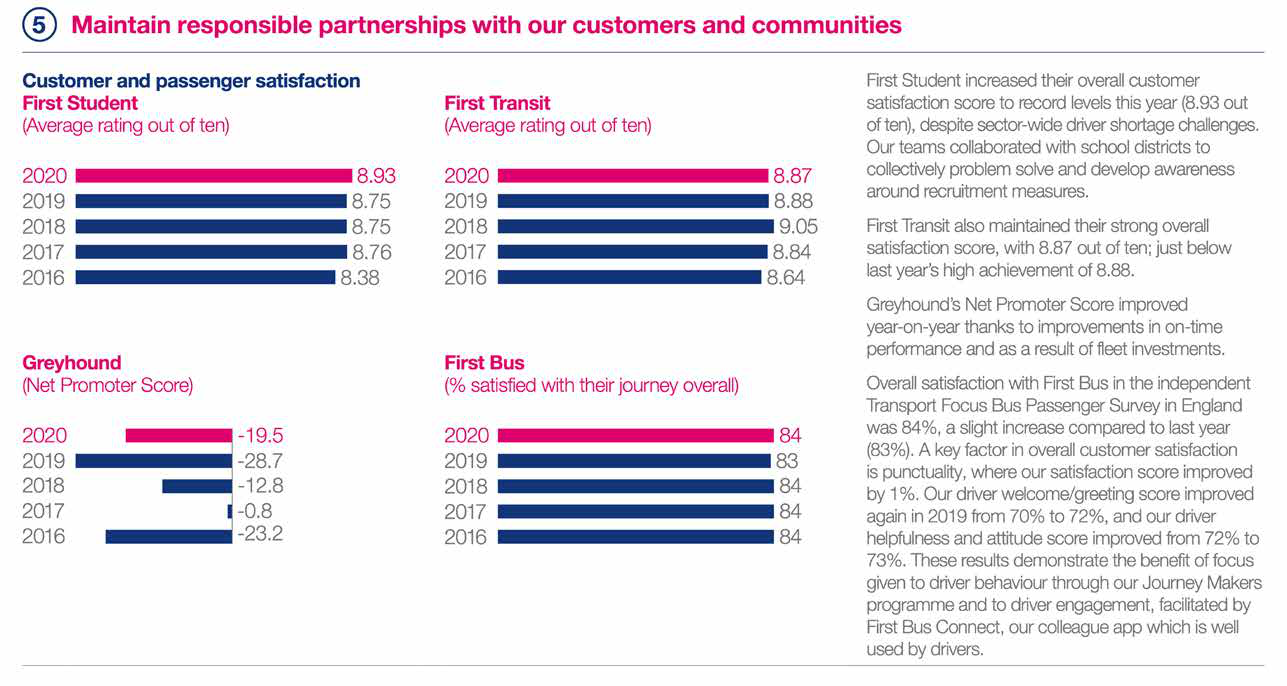
Transport Focus National Rail Passenger Survey (% satisfied with their journey overall)
Line graph of Transport Focus National Rail Passenger Survey results for various rail companies and the national average, 2015-2020.
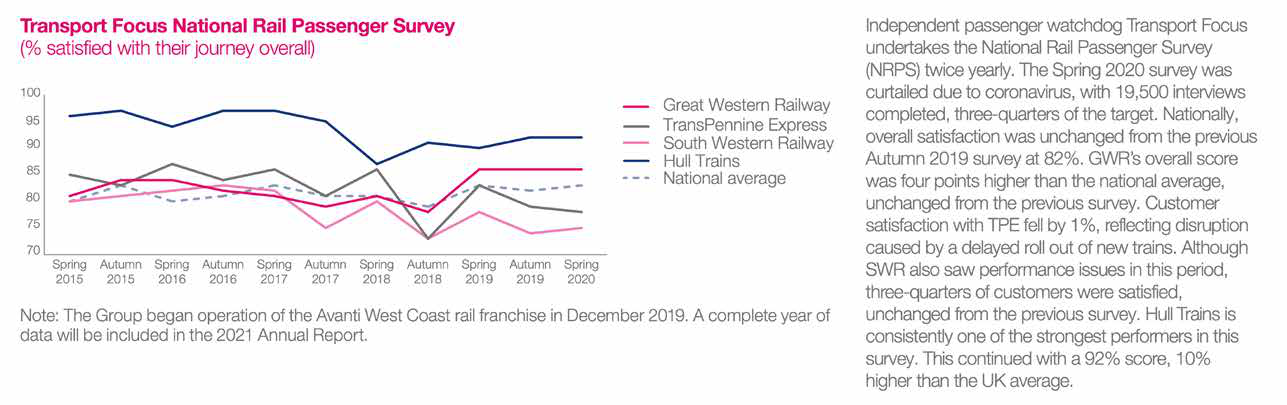 Note: The Group began operation of the Avanti West Coast rail franchise in December
- A complete year of data will be included in the 2021 Annual Report. Independent passenger watchdog Transport Focus undertakes the National Rail Passenger Survey (NRPS) twice yearly. The Spring 2020 survey was curtailed due to coronavirus, with 19,500 interviews completed, three-quarters of the target. Nationally, overall satisfaction was unchanged from the previous Autumn 2019 survey at 82%. GWR's overall score was four points higher than the national average, unchanged from the previous survey. Customer satisfaction with TPE fell by 1%, reflecting disruption caused by a delayed roll out of new trains. Although SWR also saw performance issues in this period, three-quarters of customers were satisfied, unchanged from the previous survey. Hull Trains is consistently one of the strongest performers in this survey. This continued with a 92% score, 10% higher than the UK average.
Safestore Holdings plc Annual Report 2020 pg 44-45
What is useful? Safestore reports externally gathered customer review scores, such as Trustpilot, against its performance target. The reporting of more than one external score with similar results, reflecting a consistent trend across markets and different review sites, increases credibility.
First Group plc Annual Report 2020 pg 56, 57
What is useful? First Group provides KPIs, including customer satisfaction, by its market divisions, not a group average.
Our customers
Target Maintain 90%+ satisfaction scores in each market
Performance 2019/20 UK: 94% Feefo/93% Trustpilot France: 93% Trustpilot Spain: 96% Google
In addition to using Feefo, Safestore invites customers to leave a review on a number of other platforms, including Facebook, Google and Trustpilot. As a result, wherever customers look for trust and reputational signals about Safestore, they will see an impartial view of our excellent customer satisfaction.
Trustpilot is a well recognised and authoritative third party review platform. This year we are delighted that Safestore has maintained a TrustScore of 4.7 out of 5 in the UK. We are committed to delivering an excellent customer experience and our independent customer feedback shows a high level of customer satisfaction at 93% from 1,135 reviews. Une Pièce en Plus also continues to use Trustpilot to obtain independent customer reviews. In 2020, 275 reviews have been collected with 93% of customers rating their service experience as 'Excellent' or 'Great' resulting in a TrustScore of 4.6 out of
- In Spain, OhMyBox! collects customer feedback via Google reviews and has maintained a score of at least 4.8 out of 5.
We are proud to be recognised for delivering exceptional customer service and we see this as a great achievement and a testament to the hard work of our colleagues in store and in the Customer Support Centre.
We continue to seek customer feedback through Feefo, the online review platform which guarantees 100% genuine feedback. All UK stores receive feedback allowing customers to view ratings. This year, Safestore achieved a customer service rating of 94% based on UK customers who rated their experience as 'Excellent' or 'Good'.
In 2020, Safestore won the Feefo Platinum Trusted Service award given to businesses which have achieved Gold standard for three consecutive years. It is an independent mark of excellence that recognises businesses for delivering exceptional experiences, as rated by real customers. This is a highly valued award and as all reviews are verified as genuine, the accreditation is a true reflection of Safestore’s commitment to delivering outstanding service.
5 Maintain responsible partnerships with our customers and communities
Customer and passenger satisfaction
First Student (Average rating out of ten)
| 2020 | 2019 | 2018 | 2017 | 2016 | |
|---|---|---|---|---|---|
| 8.93 | 8.75 | 8.75 | 8.76 | 8.38 |
First Student increased their overall customer satisfaction score to record levels this year (8.93 out of ten), despite sector-wide driver shortage challenges. Our teams collaborated with school districts to collectively problem solve and develop awareness around recruitment measures.
First Transit (Average rating out of ten)
| 2020 | 2019 | 2018 | 2017 | 2016 | |
|---|---|---|---|---|---|
| 8.87 | 8.88 | 9.05 | 8.84 | 8.64 |
First Transit also maintained their strong overall satisfaction score, with 8.87 out of ten; just below last year's high achievement of 8.88.
Greyhound (Net Promoter Score)
| 2020 | 2019 | 2018 | 2017 | 2016 | |
|---|---|---|---|---|---|
| -19.5 | -28.7 | -12.8 | -0.8 | -23.2 |
Greyhound's Net Promoter Score improved year-on-year thanks to improvements in on-time performance and as a result of fleet investments.
First Bus (% satisfied with their journey overall)
| 2020 | 2019 | 2018 | 2017 | 2016 | |
|---|---|---|---|---|---|
| 84 | 83 | 84 | 84 | 84 |
Overall satisfaction with First Bus in the independent Transport Focus Bus Passenger Survey in England was 84%, a slight increase compared to last year (83%). A key factor in overall customer satisfaction is punctuality, where our satisfaction score improved by 1%. Our driver welcome/greeting score improved again in 2019 from 70% to 72%, and our driver helpfulness and attitude score improved from 72% to 73%. These results demonstrate the benefit of focus given to driver behaviour through our Journey Makers programme and to driver engagement, facilitated by First Bus Connect, our colleague app which is well used by drivers.
Transport Focus National Rail Passenger Survey
(% satisfied with their journey overall)
Note: The Group began operation of the Avanti West Coast rail franchise in December
- A complete year of data will be included in the 2021 Annual Report.
Independent passenger watchdog Transport Focus undertakes the National Rail Passenger Survey (NRPS) twice yearly. The Spring 2020 survey was curtailed due to coronavirus, with 19,500 interviews completed, three-quarters of the target. Nationally, overall satisfaction was unchanged from the previous Autumn 2019 survey at 82%. GWR's overall score was four points higher than the national average, unchanged from the previous survey. Customer satisfaction with TPE fell by 1%, reflecting disruption caused by a delayed roll out of new trains. Although SWR also saw performance issues in this period, three-quarters of customers were satisfied, unchanged from the previous survey. Hull Trains is consistently one of the strongest performers in this survey. This continued with a 92% score, 10% higher than the UK average.
Spotlight on suppliers
Recent events, from the pandemic to the blockage of the Suez Canal, have shown how easily supply chains and the associated business models can be disrupted, leading to a recognition of the importance of strong and varied supplier relationships. Other recent news such as the discovery of poor labour and wage practices, and concerns over working conditions and potential slavery in factories, have increased reputational risks for particular industries, highlighting the need for companies to know their suppliers well. As per our discussions with investors, these events highlighted that disclosures on suppliers and supply chains have tended to be weak and more is needed. The Lab is considering more focused work on supply chains, but in this section we highlight how information on suppliers aligns with investors' reporting expectations and include some examples which reflect this. Some examples are from outside the annual report. Companies should consider whether such information is material to be included within the annual report based on their dependence on suppliers.
| Stakeholder consideration | Application to suppliers as a key stakeholder group | Examples |
|---|---|---|
| Who is the stakeholder and why are they important? (How do they link to the strategy and business model?) | - Who are the company's suppliers, or what type of companies make up the supply chain? - How many suppliers does the company have for each critical component? - Where are they located? - Why are suppliers important to the business? - Which aspects of the business depend on suppliers? - What is needed from suppliers to achieve the strategy? |
IAG, Next |
| How is value created through and for this stakeholder group? | - What practices and standards of quality are expected from suppliers, for example Code of Conduct or standards? | Spirax-Sarco, Next |
| What actions is the company taking to build and maintain strong relationships with this stakeholder group? | - How well does the company know and keep track of its suppliers? - How does the company engage with suppliers? Is it a two-way process? - What actions has the company taken to support its suppliers, including through its payment practices? |
IAG, ABF |
| What are the risks and opportunities that could affect the stakeholder or arise from the stakeholder relationship? | - What are the risks that could affect the supply chain and the company's suppliers? What mitigating actions, such as having multiple suppliers, have been taken? - What factors could improve how the company works with its suppliers? |
Pentland |
| What are the metrics used to measure the strength of the relationship with the stakeholder group? | - What metrics are used to monitor whether to continue the relationship or make changes to it? | See note |
Note: We came across a few examples of supplier metrics, usually related to supplier audit results or supplier satisfaction, and typically found in sustainability reports rather than in the annual report. However, companies did not discuss the implications of what the results meant and what actions were being taken as a result.
Suppliers
Why is this stakeholder relevant to the Group?
IAG is dependent on the performance of key suppliers that provide services to our customers and the Group, including aircraft and engine maintenance suppliers, airport operators and caterers. Any sub-optimal service delivery or asset supplied by a critical supplier can impact on the Group's operational and financial performance as well as disrupting our customers, leading to significant reputational damage for the airline and the Group.
In addition, the Group's suppliers are fundamental to ensuring our companies meet the high standards of conduct that customers and other key stakeholders expect. Group Procurement launched the Supplier Code of Conduct to all our active suppliers which builds on the Group's commitment to a sustainable growth.
Supply chain integrity is critical to our business as we rely on our suppliers to help meet our customers' needs and to ensure the reliability of our services. 2020 was significantly different from any other year due to the impact of COVID-19, and a key area of focus for Group Procurement has been in-depth monitoring of the suppliers' risks. The Group's goal is to ensure its supply chain is secure, if risks are identified at key suppliers, timely analysis is performed to understand the situation and define a potential Business Continuity Plan.
Access to the latest, fuel efficient aircraft with deliveries to meet our growth and operational requirements at competitive prices is essential to meeting the strategy of the Group.
Disruption to the timely delivery of aircraft, caused by technical or production issues can have an adverse impact on IAG's ability to meet its strategic goals, which is mitigated by providing upside and downside flexibility in fleet plans, however an effective working relationship with our airframe partners is also an essential part of managing this risk.
Which are our engagement mechanisms with this stakeholder group and the principal matters considered in the reporting period?
Group Procurement, an IAG Global Business Services (GBS) department, provides a centralised procurement function for the Group and manages supplier engagement, with approximately 23,000 suppliers. Group Procurement strives to conduct business and build relationships with suppliers sharing the Group's values: acting with honesty and integrity in all business dealings, reducing environmental footprints, improving safety, and strengthening contributions to building better societies, locally and globally. In addition to usual procurement processes, the Group engages with suppliers using joint projects, including our Hangar 51 accelerator programme, industry conferences and supplier workshops.
The COVID-19 outbreak changed GBS's ordinary day-to-day activity. The level and frequency of engagement with key suppliers increased and we started to adopt temporary measures until we had further clarity about the size of the impact COVID-19 would have on the Group. We updated the procurement supplier engagement plan in order to start articulating the situation clearly and work in partnership to defer spend and reduce costs. Wider measures were also implemented to temporarily waive minimum volume commitments across our contracts, work commenced on stopping or postponing capital investment projects that were longer needed during the pandemic and the procurement team also focussed on converting fixed cost deals into variable to facilitate a more adaptable approach to revised capacity requirements.
During the second half of 2020, we entered a more structured phase of supply chain review and launched our Zero-Based Taskforces across all operating companies. The objective was to scrutinise the entire supply chain and our contracts in order to reflect new requirements. New specifications were also introduced to support our customers, colleagues and business requirements, such as, enhanced cleaning and PPE solutions.
These challenging times have helped us strengthen many supplier relationships who have become true partners during this difficult period. Working side by side with the businesses we operate to ensure mutual success. Equally, we have worked hard to identify those suppliers who may have been heavily impacted by the crisis and assisted in developing quick and effective solutions to ensure support was given where it was needed.
Overall, Group Procurement has delivered on its commitment to be a value generator for the Group and work in partnership with the supply base to ensure performance is aligned to business needs.
In 2020 procurement kept up its commitment to further enhance sustainability through the supply chain, with CSR, financial performance, diversity and environmental assessments at the centre of everything we do.
IAG Fleet Investments manages the overall relationship with airframe manufacturers along with the Fleet and Engineering departments at the Group's airlines.
At the start of 2020 IAG had commitments to take delivery of new aircraft from Airbus and Boeing and planned to exercise options to purchase further new aircraft. Following the COVID-19 outbreak, IAG suspended plans to exercise options for further aircraft and entered discussions to defer the delivery of aircraft and the associated pre-delivery payments.
By the summer of 2020, IAG had agreed to defer the delivery of a number of aircraft from 2020 and to reschedule aircraft due to be delivered in the 2021-2025 period. These agreements provided a reduction in capital expenditure for IAG and at the same time confirmed the delivery of some aircraft, providing planning certainty for the airframers, and allowing them to adjust their production plans to suit the new requirements.
The airframe manufacturers also suffered periods of disruption to their production capability caused by the need to adapt to COVID-19-secure working practices and outbreaks of the virus at their facilities. Technical and logistical delays further reduced the number of new aircraft delivered in 2020, but in a way that was managed between IAG and the airframers to avoid disruption.
As the impact of the COVID-19 virus has evolved, IAG has continued to engage with its airframe partners on further changes to deliveries scheduled between 2021 and 2025, again with the intention of creating planning certainty for our partners and right-sizing the delivery stream for IAG's revised requirements.
International Airlines Group (IAG) Annual Report 2020 pg 16
What is useful? IAG's S172 statement discusses how the group is dependent on suppliers and the engagement and actions taken during the year, particularly in light of COVID-19. It names its critical manufacturers and discusses the potential adverse impact of delays of delivery in usual circumstances and links to its business continuity plan. It then discusses how it has been collaborating with its suppliers and making arrangements for revised requirements up to 2025 to meet the challenges brought about by the pandemic.
OUR SUPPLIERS
Ethical trading
In common with other retailers, NEXT's product supply chain is both diverse and dynamic. During the year, NEXT products were manufactured in around 40 countries through over 600 suppliers. Our Tier 1 supply chain comprises some 1.5 million workers. Diversity of supply provides us with a cost-effective supply chain and an extensive range of products for our customers; it can also increase the risk of sourcing from unethical suppliers. We consider our primary risks in this area to be worker safety, human rights, employment and working conditions, and infringement of workers' rights. Trading ethically and acting responsibly is a fundamental cornerstone of our business
- we want our products to be made by workers who are treated fairly and whose safety, human rights and wellbeing are respected. We induct, train and support our suppliers to make sure they understand what is expected of them and to help them raise standards where necessary. Wherever possible, we work with suppliers to raise their standards rather than terminating the relationship as it has the potential to deliver a better outcome for workers and the supply chain as a whole. Our aim is always to support factories in resolving issues, but we will not continue to work with them indefinitely if there is no willingness to improve standards.
Our drive to support ethical trading in our supply chain includes:
- Working with our suppliers to ensure they understand our requirements and COP Principle Standards.
- Encouraging regular meetings with individual suppliers to share information and develop relationships.
- Our own in-house global Code of Practice (COP) team which comprises approximately 50 employees that administer our COP programme based on the Ethical Trading Initiative Base Code (ETI) and International Labour Organisation Conventions.
Our COP team works directly with new and existing suppliers and their factories. They are based in key sourcing locations and this enables the team to respond quickly if issues occur. It also allows us to develop trust and build strong relationships with our suppliers by being able to offer one-to-one meetings, training and support even before orders are placed by our product teams.
COP Principle Standards are monitored through audits by our Code of Practice team which generally take place unannounced. Our auditing standards provide detailed information to help our suppliers fulfil their obligations. Our audit plan prioritises the human rights of workers in our supply chain and is risk-based, taking into account geographic location, ethical reputation, the type of manufacturing process and the factory's most recent audit rating. Where we find areas for improvement during an audit, we create a Corrective Action Plan which is agreed with the supplier and factory management. Follow up reviews are undertaken to monitor progress under the Corrective Action Plan.
During 2020/21, the COP team carried out almost 1,500 audits. This was a reduction on the previous year due to travel prohibition, restrictions on access and factory closures combined with lockdowns. Despite this, and with the inclusion of virtual audits, we were able to audit more than 900 Tier 1 manufacturing sites. Of the audits conducted, 96% related to Tier 1 suppliers and 4% related to Tier 2 suppliers. We supported 24 factories to successfully remediate critical issues found. Unfortunately, during the year we had to disengage with 10 factories that refused to satisfactorily rectify their critical non-compliance with our Code. A breakdown of audits by rating is provided in the illustration below.
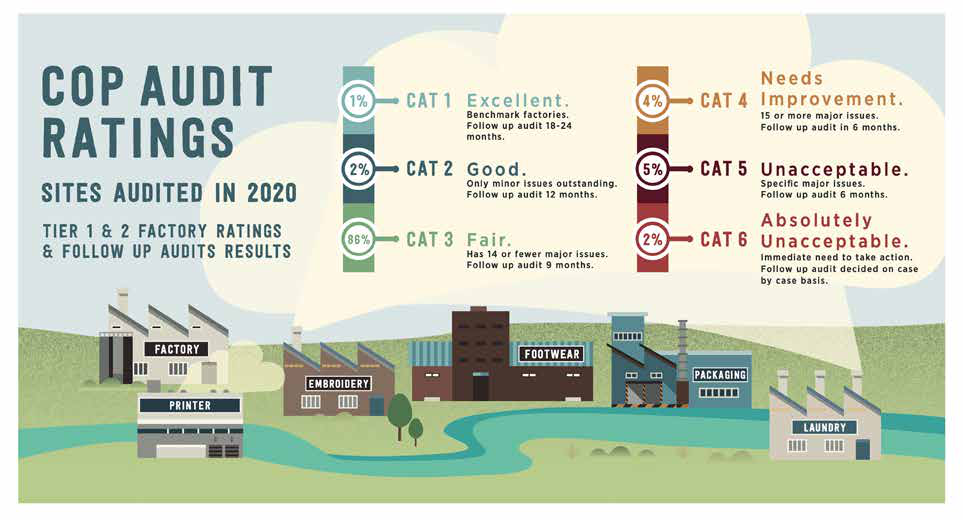
Next PLC Annual Report January 2021 pg 81
What is useful? Next discusses the broad range of suppliers it works with and how they support the business in providing an extensive product range, links that fact to a heightened risk and explains the mitigating steps it takes to support ethical practice. Next highlights the number of audits undertaken and provides a breakdown of the issues found and how these were remediated, including termination of the supplier relationship where they did not rectify non-compliance.
Spirax-Sarco Engineering plc Annual Report 2020 pg 75
What is useful? Spirax-Sarco explains how it is working with its suppliers to sign up to its Supplier Sustainability Code and outlines the expectations the suppliers should meet. It also notes where it has stopped working with suppliers, as well as its plans for monitoring suppliers' sustainable practice in the coming year.
Our supply chain: End-to-end supply chain
Overview Throughout our operations, we seek to improve the sustainability of our end-to-end supply chain by focusing on sourcing materials ethically, manufacturing responsibly and distributing efficiently, with the aim of providing high levels of customer service, while managing our social and environmental impacts. We have 32 manufacturing sites globally and manufacture close to the point of sale to shorten lead times, produce to local specifications, reduce transportation of finished goods, provide local employment, improve customer service and strengthen our competitive advantage.
Supplier Sustainability Code Our Supplier Sustainability Code (Code) is central to our commitment to ethical and sustainable sourcing. The Code outlines the expectations that we have for suppliers and enables us to embed sustainability into our purchasing processes. The requirements of the Code fall within four broad categories:
- Ethics: suppliers are required to comply with all applicable trade laws and regulations and commit to international ethical business conventions, including compliance with competition laws, the rejection of bribery and corruption, a commitment to trace the origin of materials, the maintenance of records to demonstrate compliance with regulations, and the use of anonymous grievance and whistle-blowing mechanisms.
- Human Rights: suppliers are expected to comply with international Human Rights conventions and, amongst other requirements, prohibit the use of child labour, eliminate discrimination in their employment practices, comply with laws regulating wages, working hours and working conditions, allow their colleagues freedom of association, and comply with the UK Modern Slavery Act and the US Dodd-Frank Act.
- Health & Safety (H&S): suppliers must operate a safe working environment, with a suitable H&S Policy and management system, and the products produced by suppliers must comply with all applicable environmental, health and safety regulations.
- Environmental Sustainability: suppliers should implement initiatives that contribute to the preservation of the environment and mitigate their impact on natural resources, complying with all legal environmental requirements and demonstrate continuous improvement in environmental performance.
2020 Performance and actions
Supplier Sustainability Code roll-out Our targets for 2020 were for 97% of Phase 1 (direct suppliers of our Spirax Sarco and Watson-Marlow manufacturing companies), Phase 2 (direct suppliers of our Spirax Sarco and Watson-Marlow sales companies) and Phase 3 (direct suppliers of our recently acquired companies Hiter Controls, Aflex Hose, Gestra and Chromalox) suppliers to have signed the Supplier Sustainability Code, and for over 90% of Phase 4 (suppliers to Thermocoax) to have signed the Code.
Despite the disruption caused by the global pandemic, which required resources to be redeployed to manage the situation on both our own and our suppliers' sites, we achieved our Phase 1 to 3 target with 97% of suppliers having signed the Code. We fell slightly short of our Phase 4 target but made good progress with 86% of suppliers having signed the Code. Overall, 96% of Company suppliers have now signed the Code.
During 2021, we will continue to roll out the Code, with a focus on Phase 4 suppliers, and maintain our target of over 90% of Phase 4 suppliers to have signed the Code by the end of the year.
Suppliers exited If suppliers are unwilling or unable to sign the Code, unless in the case of a serious breach of our standards, our preference is to work with them on a continuous improvement basis until they are in a position to sign the Code. However, if suppliers' standards fall short and they will not or do not make adequate progress to improve, we exit them. This is rarely for reasons of sustainability alone. Typically, we find that when suppliers score well on sustainability criteria they tend to be well run, well managed companies that are also good at quality and delivery, and vice versa. As a result, the decision to exit suppliers is usually for a combination of reasons, with quality, reliability and sustainability concerns together prompting the decision to exit them. During 2020, we exited 4 suppliers for the reasons outlined above.
Standardised terms As an additional mechanism to ensure we are purchasing ethically, during 2020 we updated and implemented standard terms and conditions of purchase, and standard long-term supply agreements across the Group. The updated terms and agreements include a number of requirements concerning ethical operations, including provisions addressing a supplier's obligation to comply with the UK Modern Slavery Act.
Monitoring supplier sustainability During 2020 we planned to review our method for monitoring supplier sustainability. A working group convened early in the year and was making good progress – identifying the need for a third-party supplier monitoring system and assessing 11 different providers – before the pandemic struck and team members needed to redirect their attention to managing the situation. Although the pandemic is not yet over, the situation has stabilised, compared with the uncertainty during much of 2020 and, as a result, it is our intention to reconvene the working group and make progress on this during 2021.
Modern Slavery Statement Spirax-Sarco Engineering plc prides itself on setting high standards for sustainable and ethical business practices in its operations worldwide. Included in those high standards is a commitment to respecting and protecting the human rights of all individuals and combating all forms of modern slavery or human trafficking in all parts of our business organisation, including our supply chain. We are continuously developing and improving our business practices and policies in line with that commitment. We support a strong, collective stand to identify, prevent and raise awareness of modern slavery and human trafficking practices in all parts of the world.
Further reading Read our Modern Slavery Statement in full or view our Supplier Sustainability Code on our website. www.spiraxsarcoengineering.com/sustainability/supply-chain
Focus for 2021 - Review our method for monitoring supplier sustainability, and, if appropriate, identify a third party solution and agree an implementation plan. - Achieve progress against our Phase 4 Supplier Sustainability Code roll-out target.
Associated British Foods plc (ABF) Annual Report y/e 12 Sept 2020 pg 18
What is useful? In its S172 statement, ABF provides a timeline for the decisions and steps taken in relation to how Primark store closures due to the pandemic would affect its suppliers and how it supported them during this period.
Primark decision to cease placing new orders with suppliers following worldwide closure of all stores and subsequent reinstatement of orders.
Which stakeholders most affected?
- Suppliers
- Communities/Environment
Consideration of stakeholder views/interests and impact on decision making
Primark's product and sourcing teams were in close and regular contact with suppliers. Those teams then reported through to the CEO of Primark, the Director of Primark Ethical Trade and the Director of Primark Supply Chain, Sourcing and Quality, including on any concerns raised by suppliers.
The CEO of Primark, Director of Primark Ethical Trade and Director of Primark Supply Chain, Sourcing and Quality liaised closely with the executive directors of the Company, who updated the Board on a weekly basis throughout the period in which all shops were closed.
Stakeholder views were taken into account by the Board, alongside weekly reports of group cash flow, in making various decisions throughout the period from stores closing through to their reopening including:
- the decision, announced by Primark on 22 March 2020, to cease placing new orders with suppliers, reflected the need to reduce costs in order to secure the longer-term success of the business. This also reflected the fact that some £1.5bn worth of stock was already in stores, depots or in transit with no avenue through which to sell while stores were closed;
- the decision, announced by Primark on 3 April, to establish a fund to cover the wages component of orders that had been cancelled, taking into account concerns raised by suppliers and reflecting a reputation for high standards of business conduct;
- the decision, announced by Primark on 20 April 2020, to commit to pay for some £370m of additional orders, meaning that Primark had committed to take all product that was both in production and finished and planned for handover by 17 April;
- the decision, announced by Primark on 31 July 2020, to commit to pay its garment suppliers in full for all outstanding finished garments and to utilise or pay for any finished fabric liabilities; and
- the decision, announced by Primark on 31 July 2020, to place some £1.2bn of orders for coming seasons, reflecting the trading performance of stores after reopening.
The above actions reflected the decision to prioritise more funds to support the supply chain, as costs began to be mitigated and a reopening timetable could be seen. They also recognised the longer term need for there to be a healthy, thriving retail environment (which is also in customers' interests) in order to underpin a healthy, thriving supply chain.
Assessing the risks
Our Supplier Agreement sets out our expectations around human rights, governance and the environment. In September 2019, we piloted our Supplier Agreement with four of our second tier suppliers that provide our materials and components. We plan to roll this out further in 2020.
We use a risk assessment tool, developed in collaboration with the University of Lancaster, to comprehensively evaluate risks of modern slavery across our supply chain. This helps us build a modern slavery profile for the regions in which we source.
The data shows us:
- The prevalence of forced labour in the region
- The strength of government action to combat it
- The overall vulnerability of the region to modern slavery
Alongside the tool, we use our supplier questionnaire and social audits to provide a comprehensive risk assessment. We've reviewed and made improvements to our supplier self-assessment questionnaire to evaluate risks in our factories.
Risk profile by region
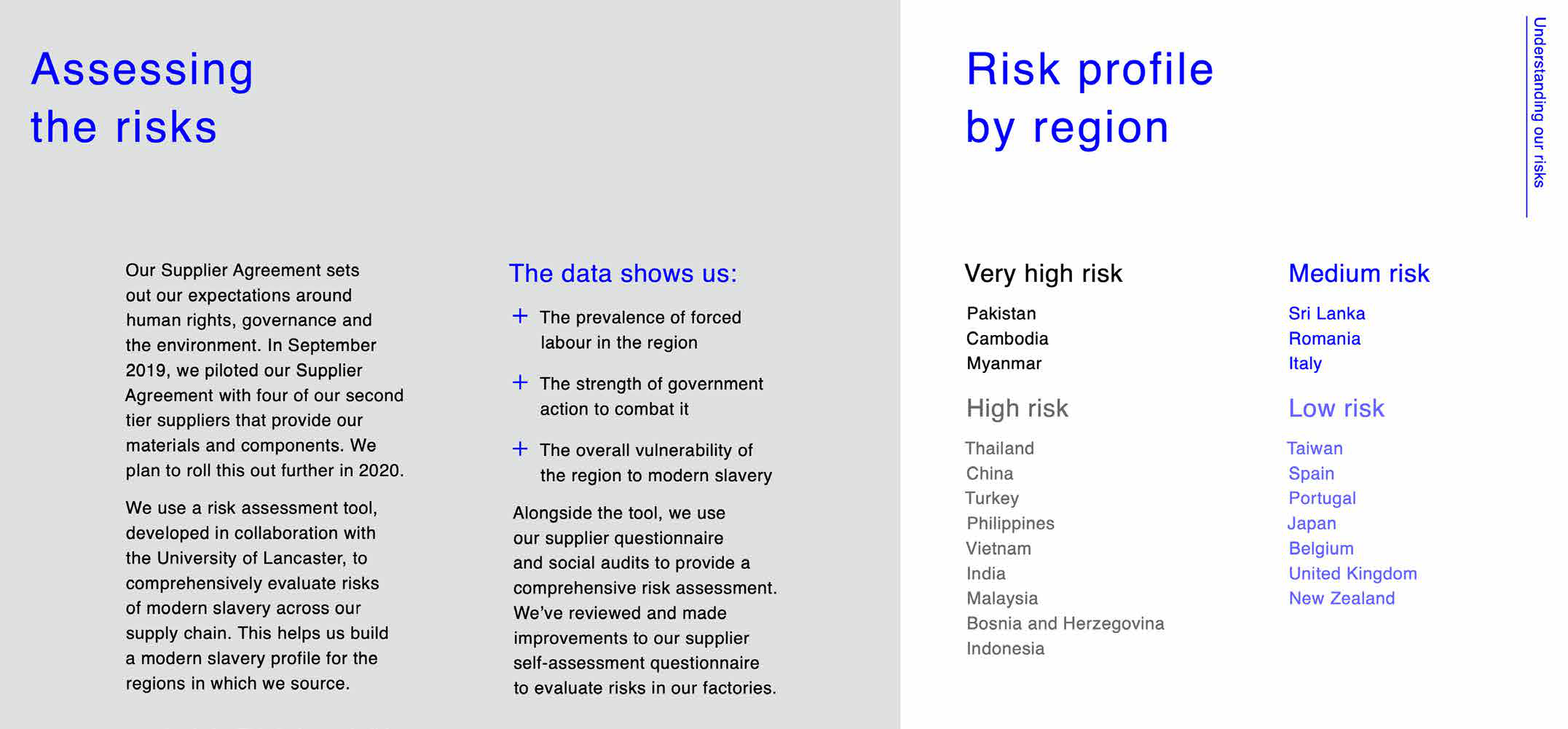
Pentland Brands Modern Slavery Report 2019 pg 21
What is useful? Pentland explains its supplier risk assessment process and rates the level of risk for each of its 22 manufacturing locations.
Culture and stakeholders
Culture is intrinsic to how businesses treat their stakeholders. As discussed in the FRC's 2016 report on corporate culture and the role of boards, and further emphasised in the 2018 UK Corporate Governance Code, culture is intertwined with the purpose the company seeks to achieve and the strategy to deliver long-term success. Culture should also align with how directors perform their Section 172 duty. Company behaviours driving the strategy then need to be consistent with the desired values and culture which are influenced by the tone at the top. Relationships and engagement with stakeholders will reflect a company's culture. Our discussions indicated that investors are increasingly interested in culture and companies typically associate this with an assessment of their employee relationships and composition and diversity. Investors confirmed their interest in these areas, but highlighted that culture is not just about how a company engages with its internal stakeholders but also its external stakeholders such as customers and communities. A few investors highlighted cases where a company's culture was focused on a particular stakeholder group without considering the implications on other stakeholders, which may have led to short-term profitability but adversely affected longer-term value and eventually necessitated a change in culture. Again this shows that culture needs to be consistent with the company's purpose.
"We are looking for information on stakeholders that can be a proxy for insights into how companies behave.” Investor
- external sources of insight, including customer complaints and satisfaction data, supplier feedback and third party ratings like Glassdoor; and
- behavioural indicators, such as attitudes to regulators and actions taken to deal with poor behaviour.
While investors are interested in understanding what information boards are using to monitor culture, they also want to see such information reported to be able to make their own assessment of the company's culture. The information they want to see on stakeholders, particularly on performance and metrics, as discussed on pages 24-25, helps provide these insights into culture.
"Is the reporting compliance or is it culture? Were requirements an afterthought and a duty of the company secretary or were they well understood by the board?” Investor
In addition, investors told us that, while companies need to comply with the increasing number of reporting requirements on stakeholder matters, the reporting needs to be reflective of what is important to the company and what is embedded in its culture. Investors hope that this reporting is not treated as a compliance or tick-box exercise, but that the board and management understand and follow the spirit of the requirements in their dealings with stakeholders. Investors can then assess the authenticity of the reporting and whether it genuinely reflects the company's culture when they are engaging directly with the company's board and management or through corroboration with external sources such as surveys, the press and social media.
"The board has a role in ensuring that a business is sustainable in the long term. This includes embedding the desired culture. Culture is a combination of the culture of the values, attitudes and behaviours demonstrated by a company in its activities and relations with stakeholders." paragraph 8.30 of the Guidance on the Strategic Report
What investors want to see reported
Investors are looking for indicators into a company's culture. Reporting on how stakeholders are considered and engaged with can be a reflection of the culture, but information on outcomes, stakeholder metrics and the actions management takes based on the resulting information is particularly insightful. The FRC's report on culture includes a number of indicators which boards can use to assess, measure and monitor culture, such as:
- HR sources of insight, including employee surveys and exit interviews feedback, staff turnover, absenteeism, diversity and training data;
- compliance and control indicators, including health and safety metrics, whistleblowing incidents and promptness of payments to suppliers;
Overarching considerations for information on stakeholders
In summary, when providing information on stakeholders, companies should consider the following:
- Consideration of stakeholders, including the actions and outcomes as a result of stakeholder engagement, is pertinent to all the different elements of reporting which represent the drivers of performance and ultimately the company's success:
- purpose and culture
- governance and management
- business model and strategy (including decisions)
- risks and opportunities.
- Information on performance, including metrics, both of the company and specifically related to stakeholders, provides a feedback loop as it indicates whether changes are necessary in how stakeholders are considered across the different drivers in order to promote the success of the company.
- Companies should provide information about the actions and outcomes that the board and management consider necessary following their analysis of performance and engagement with stakeholders.
- A consistent and connected narrative on stakeholders is key and should flow through the different elements of reporting.
- Companies need to consider whether the information presented on stakeholders is truly applicable across the whole group or whether there are differences in certain regions, business units or segments – such differences should not be masked.
There needs to be a two-way consideration of stakeholders, in terms of:
- engagement – companies need to ensure that they are hearing from stakeholders and responding to feedback as informing stakeholders of policies or what the company is doing is not enough.
- impact and value – investors need to understand how stakeholders affect the company: that is how they affect the business model and strategy and what risks and opportunities they give rise to; but they also need to understand how stakeholders are affected by the company's strategy, its decisions and its activities. Similarly, there needs to be a consideration of how stakeholders contribute to value creation for the company, but also how the company creates value for its stakeholders – the latter is what helps ensure strong and continuing stakeholder relationships which support the company in pursuit of its success.
Two-way consideration
Diagram illustrating a two-way consideration model for stakeholders, showing "Company" and "Stakeholders" connected by two-way arrows for "Engagement" and "Impact and value".
Section 2: Information on decisions
The investor view
To understand how a company is progressing in meeting its purpose and its pursuit of success, investors also need information on the decisions taken by management and the board since decisions link directly to the company's strategy and will have implications for the company's future. Investors we spoke to highlighted that decisions should be connected to the company's purpose with the long term in mind.
"Decisions should be rooted in the company's sense of purpose and mission." Investor
Investors commented that whilst decisions may be 'assigned' to a specific reporting year they cannot be standalone and considered only in the context of that particular financial year. Instead, they should also be explained in the context of the strategy and impacts on the future success of the company. Similarly, disclosures on decisions need to be part of a connected narrative on the different drivers of long-term success. Investors expect principal decisions to:
- be aligned with the business model and strategy;
- take into consideration risks and opportunities; and
- consider how different stakeholders will be impacted.
Investors noted that typically there may be few significant decisions in a year, but in light of the COVID-19 pandemic, they expect to see more decisions disclosed than usual. Many will have been prompted by the pandemic, such as decisions on whether to furlough staff or make redundancies, shortening payment terms to support suppliers, or cutting or pausing dividends. All these decisions directly impact at least one stakeholder group and may have indirect consequences on other stakeholders – investors want to understand the impact assessment conducted by the board and management and what trade-offs were necessary. If particular stakeholders' interests were given priority over others', they want to understand the rationale and how it links to the company's long-term interest and success. Investors said they will be paying particular attention to decisions on dividends and on remuneration, particularly in the context of other pandemic-related decisions such as furlough and redundancies.
Undoubtedly, many difficult decisions were taken in the last year and investors expect companies not to shy away from discussing thorny issues. Some investors noted how case studies on particular decisions were often presented as if they were in all stakeholders' interest, without acknowledgement of difficulties and negative consequences. While investors understand why companies may be reluctant to discuss negatives, companies that are ready to report on difficult decisions and issues are viewed more positively. This is especially the case if companies provide the reasons why the decision was considered the best course of action.
"If you report problems or difficulties, you show that you're doing something about the issue, and this elicits more trust that management is taking the difficult but necessary decisions.” Investor
“Companies are still in the mindset that they present everything in a positive light, even when talking about difficult decisions.” Investor
"Decisions are about doing the right thing and not taking the easy route – directors should then be able to respond to potential criticism.” Investor
Some investors told us they are not only interested in the decisions themselves, but how management and the board came to the decision. This links to how feedback from stakeholder engagement informs the decision. Investors told us they focus on the board's decision-making as the board is accountable to shareholders. They recognise that boards delegate some decision-making to management, but non-executive directors are there to challenge and oversee that these decisions are conducive to the success of the company. That is why information on the decision-making process, and not just the decisions, is helpful to investors.
The company view
Companies have different approaches to how they define a principal or significant decision. From our discussions, these include decisions that are:
- mapped to strategic ambitions or priorities;
- capital allocation decisions, such as dividend decisions and acquisitions;
- expected to significantly impact a stakeholder group;
- expected to result in a significant change or to have an impact on the business for five years or more;
- addressing a key regulatory change; or
- over a stipulated threshold.
For some companies there is a tiered level of decision-making with delegation to committees or business unit management, with the board being the final "gatepost" for approval of significant decisions. In some cases, any decisions delegated to management were not considered to be principal decisions and therefore, not disclosed as such – for example, some highlighted that acquisitions were only discussed by the board if over a certain size. This delegation of decision-making has led to some concern about disclosures on decisions by the board, particularly to address the Section 172 duty. However, companies are recognising the importance of reflecting the board's oversight of the decision-making process, particularly the role of non-executive directors in challenging management on ensuring the right decisions are being made and that stakeholders are being considered appropriately.
Companies agreed that stakeholder consideration is now, more than ever, an important part of decision-making. As noted in Section 1, the process is now more formalised, including training and briefings for board members and management alike, to ensure stakeholders are considered.
A challenge for subsidiaries?
While some companies expressed concern on how to discuss decisions at a board level when decision-making is delegated to management or business units, others are concerned about how to report decisions at a subsidiary level when decision-making is centralised or the subsidiaries are not operational. For these companies, the same issue arises on stakeholder engagement and, ultimately, what to include in their Section 172 statement.
However, irrespective of the structure and function of a subsidiary company, directors of that company are still required to comply with the Section 172 duty. Issues that may be relevant for subsidiaries to consider include:
- Which central decisions affected the company and how did the directors consider their implications?
- Which stakeholders are relevant to the company and how have they been considered in the company's activities or plans during the year?
- Where cross-referencing to group disclosures, are there any differences due to local laws or other contextual reasons?
Investors told us that they expect consistency within a group, particularly in terms of how stakeholders are considered, due to the culture across the group. However, they recognise that there may be differences due to local laws or what is in the interest of the company. When it comes to disclosures, subsidiaries should report what is material to them.
"It is no longer just about the financial implications; people now understand they won't get approval for decisions from the board unless they make these [stakeholder] considerations.” Company
Tips for approaching disclosures on decisions and decision-making
- In identifying which decisions to disclose, focus on the strategically important ones which have implications for the company's long-term success. It is easier to then discuss the relevant stakeholder considerations for each decision disclosed, rather than trying to identify relevant decisions for each stakeholder group (as this risks being an artificial exercise).
- Consider whether templates for papers on board decisions require reminders on the Section 172 duty and consideration of stakeholders. This is helpful for both those preparing the papers and for the board to approve it. In addition, the papers can be useful evidence of the decision-making process for both reporting and possible assurance.
- Some years entail fewer significant decisions, so for those that are more 'business as usual', focus on discussing the board's oversight and monitoring of previous decisions and how it links to the delivery of strategy.
- Similarly, where decision-making is delegated to management or business units, consider the board's role in oversight, including in the lead-up to decisions. Consider what reports were received and what discussions committees held.
What investors want to see reported
We now explore further what investors want to see included in information on decisions and identify some examples from current reporting practice which address particular aspects.
Principal decisions
Investors want to know about those strategically important decisions that management and the board took during the year. They want to understand how they link to strategy and the company's long-term success, which is best addressed by explaining the rationale and providing context for the decision (e.g. BAE and Fresnillo). Although principal decisions seem to be most frequently presented in Section 172 statements, some companies reported decisions in the discussion of strategy (e.g. SSE) or in the corporate governance section (e.g. Taylor Wimpey). Wherever a company chooses to report its decisions, it is important to ensure a connected narrative and consistency between sections – cross-referencing can be helpful to show connected thinking.
In some cases, companies tend to present a case study and focus on one or two decisions. However, companies should consider whether it is more helpful to provide a full narrative of all the principal decisions. Also, companies tend to just present principal decisions that were made during the financial year, but they should consider whether there were any significant decisions in the intervening period up to the publication of the annual report (see Persimmon plc - page 77 of its annual report).
Board oversight and the decision-making process
In addition to information about the decisions themselves, it is helpful for investors to understand the process undertaken by the board for reaching principal decisions and its oversight when decisions are delegated to management.
Consideration of stakeholders
As part of understanding how a decision was reached, investors want to know how relevant stakeholders were considered. This includes how feedback from stakeholder engagement was considered and how the company expects stakeholders to be affected. Fresnillo's table of decisions includes the different considerations by relevant stakeholder group. Taylor Wimpey highlights which stakeholders were relevant to different decisions and includes a discussion of the interdependencies between different stakeholders.
“The interests of one group of stakeholders may not always be aligned with the interests of other stakeholders or with the interests of shareholders. Where there are conflicts, or where in the interests of one group have been prioritised over another, the [company] could explain how the directors have considered the different interests and the factors taken into account in making that decision." paragraph 8.24 of Guidance on the Strategic Report
Difficulties in making decisions
As part of understanding the board's and management's process of making a decision, investors also want information about challenges and difficulties encountered in reaching the conclusion on the best course of action. They want information on any prioritisation of one stakeholder group over another or trade-offs and how different stakeholder needs or concerns were balanced. Such considerations do not only apply to decisions which are difficult or negative by their nature, such as dividend cuts or deferral (e.g. Taylor Wimpey and BAE) or store closures (e.g. ABF), but also to decisions such as acquisitions and new strategies.
Decision outcomes
Investors also want information about impacts and outcomes of the decisions. Providing information about expected outcomes (e.g. Fresnillo) is helpful, especially where there are long-term implications and benefits. Companies should consider both positive and negative effects on both the company and its stakeholders, and whether the outcomes are measurable and included in reported metrics.
To help investors understand what the company’s principal decisions were and how they contribute to the company’s success, companies should ask themselves:
| What were the decisions of strategic significance during the year? | How were stakeholders considered in reaching the decision? | What are the expected and/or actual outcomes of the decision? |
|---|---|---|
| - How do they link to the company’s purpose and strategic priorities? | - How did stakeholder views from engagement activities feed into the decision? | - What are the long-term implications for the company? |
| For each principal decision: | - What are the impacts of the decision on different stakeholders? | - How are the outcomes of the decision being tracked? |
| How and why did the board or management reach the decision? | What were the difficulties or challenges in making the decision? | |
| - What information did the board receive to make or approve that decision? | - How were the different needs or concerns of different stakeholders balanced? | |
| - What were the long-term considerations? | - Are there any short-term negative consequences which are offset by long-term benefits? | |
| - How were the different aspects of Section 172 considered? |
The work of the Board
The directors of BAE Systems – and those of all UK companies – must act in accordance with a set of general duties. These include a duty under Section 172 of the Companies Act to promote the success of the Company, and in doing so the directors must have regard (amongst other things) to certain stakeholders and other factors. In this statement, we highlight some of the key decisions and discussions undertaken by the Board during 2020.
Overview of the year
The COVID-19 pandemic had a significant impact on business and communities in 2020, and that was also the case for BAE Systems and the Board. At the start of the pandemic, a great deal of Board and executive time was focused on understanding what was required to safeguard our employees, our local communities and support our defence and national security customers in the vital roles they play. During this period of uncertainty, the Board took important decisions to manage cash resources in the near term, until the risks to the business were better understood.
The first few months of the crisis provided additional insight as to the culture and underlying resilience of our people and our businesses, and our ability to adapt. As the year progressed, and after a tremendous effort by all involved, the Board was able to focus once more on longer-term decisions, including how best to incorporate what had been learned from how the Company had dealt with that initial crisis.
As a result of the various global restrictions, the Board was unable to complete its planned programme of non-boardroom activities, which originally included site visits and the associated face-to-face engagement with employees, customers and shareholders. Where possible, the programme was adapted to seek stakeholder feedback and engage remotely but, as felt by much of society, this did not entirely replicate the richness of first-hand engagement.
In the second half of the year, with the first phase of the pandemic behind us, the Company's performance stabilised and the Board was able to consider the long-term trends in defence and the changes in technology that are driving these. This deep understanding of future trends is integral to how the Board allocates capital and invests to secure the long-term success of the Company.
Throughout the year, the Board has been listening to customers, suppliers, shareholders, employees and our local communities in respect of our wider responsibilities to society. The Board appreciates and understands its responsibility for maintaining our reputation for high standards of business conduct, and it recognises that social and environmental responsibility are a key element of these high standards. These important matters will be on the Board's agenda for 2021 and beyond.
February Pension funding
In February last year, the Board made an important decision on the funding of our commitments to the UK pension scheme. In October 2019, six of our nine UK pension schemes were consolidated into a single scheme, with nearly 165,000 members
- of whom 150,000 have defined benefit arrangements. The consolidation helped to facilitate discussions between the Company and the trustee on a proposal to accelerate funding into the defined benefit sections of the main UK Scheme. Following completion of an actuarial valuation to determine the level of funding deficit and engagement with the trustee, the Board reviewed the proposal to agree a new deficit recovery plan. Under the proposal, the Company would make a one-off £1bn payment in April 2020 (to be funded by way of a bond issue), followed by fulfilment of the existing funding commitments of £490m by 31 March 2021.
The Board agreed the accelerated deficit funding plan as proposed. In doing so it had regard to a number of the factors detailed in the Section 172 duty, including:
- the likely consequences of the decision in the long term;
- the interest of employees and former employees participating in the pensions scheme; and
- the important stakeholder relationships with the trustees and The Pensions Regulator in the UK.
The decision was also important in terms of the Board's capital allocation policy. Meeting its pension funding obligations is one of the stated aims of this policy and the use of debt finance to accelerate deficit funding has enabled the Board to meet its employee and pensioner stakeholder commitments, whilst providing increased flexibility in terms of other funding priorities.
March-December Supporting employees
The Board's principal focus in the second quarter of 2020 was the health and wellbeing of our employees and supporting our customers, suppliers and local communities. Providing safe on-site working environments was essential to maintaining our performance and continuing to support our defence and national security customers. The Board considered how vital Personal Protective Equipment (PPE) supplies were being utilised and how workplaces were being adapted to create safe working environments in compliance with COVID-19 regulations. As part of this, it received updates on our close working relationship with the trades unions in the UK and their support in helping us manage workplace safety matters during such difficult times.
Board members were keen to understand the steps taken to maintain communication with employees, who were working from home or on site in new and challenging circumstances. Directors were pleased to see the agile and rapid deployment of various means of communication across the Company. These included the enhanced roll-out of an employee app, which allowed us to update employees directly and immediately through their personal devices and receive feedback from them. In subsequent Board meetings following the initial impact of COVID-19, directors dedicated a significant amount of time to better understanding workforce matters. One such matter was that of employee wellbeing, resilience and mental health, particularly in regard to the implications of lockdown and the associated changes in work environment and personal circumstances.
April-July Dividend decisions
As with many businesses, the lockdown measures used to manage the COVID-19 pandemic required the Board to understand urgently the possible stresses that a lengthy shutdown of operations would have on finances. Facilitated by the Group Finance Director, the Board reviewed the output from a scenario-based exercise, which modelled potential impacts of the pandemic. These ranged from moderate disruption to activity and supply chain effectiveness, through to severe operational disruptions for an extended period of time. Cash flow was the key consideration in all the scenarios, and measures were taken immediately to conserve cash.
The Board held a special meeting at the beginning of April to consider the potential impact the pandemic could have on employees, customers, suppliers and our finances, and take any short-term actions as may be necessary to protect the Company and promote its success in the longer term. Given the level of uncertainty at the beginning of April, the Board considered whether it would be prudent to defer the payment of the final dividend for 2019, due to be paid in June and requiring a cash outflow of approximately £442m. It considered the various stakeholders that had an interest in the long-term success of the Company
- including employees, customers and suppliers. The Board was equally conscious of the importance of the dividend to shareholders. Having weighed up the various factors, and taking into account the high level of uncertainty at the time, the Board believed that it was in the best interest of all stakeholders to defer the final dividend in the short term and review the matter later in the year when there would be greater clarity as to the impact of the pandemic.
The Board reconsidered the payment of dividends at the end of July, when the half-year results were available. A great deal had been achieved in the four months since the dividend deferment decision, and many of our defence operations had well over 90% of employees working. There was real evidence of the Company's adaptability and resilience, plus we had supported our customers and they had supported us through a very difficult period. We engaged with many of our larger shareholders, and also heard from a number of smaller shareholders, and understood the importance of corporate dividends to the wider economy and to individuals for whom this was a significant part of their income.
Having considered what was in the best long-term interests of the Company and having had regard to shareholder and broader stakeholder interests, the Board agreed that the deferred dividend should be paid in September. Based on the performance of the Company in the year to date, it also decided that an interim dividend be paid in November, in line with our usual dividend timetable.
December Retention of the Chief Executive
During the last quarter of 2020 our Chief Executive received an unsolicited offer of a role in another major international company. Given his commitment to the Company, prior to making a decision, he chose to share details of the opportunity with the directors. The Board valued the significant contribution he has made since his appointment and recognised the importance of his leadership role at a critical time in the development of the Company. Accordingly, the directors decided that steps should be taken to secure his leadership of the Company.
In the three years that he has been in post, considerable progress has been made in the strategic development and operational performance of the business. The directors considered the risks to the Company and its stakeholders that could result from the loss of a high-performing Chief Executive and the difficulty in replacing him given not only the demands of the role but also the UK nationality requirement enshrined in our Special Share provisions.
As part of its long-term succession plans, the directors had successfully managed changes to the other two board-level executive roles earlier in the year. With those recent changes in mind, the directors agreed that it was particularly important to maintain the continuity of leadership and experience provided by the Chief Executive.
The directors were also aware of their Section 172 duty to promote the success of the Company and in doing so have regard to certain stakeholder considerations. Consequently, the Board reviewed the likely consequences of their decision in the long term and, amongst others, the interests of shareholders, customers and employees.
As detailed opposite, during October and November the Chairman had met with a number of major shareholders and, during discussions largely on governance matters, had sought views on the management of the Company, and the performance of the Chief Executive in particular. This feedback, which was relayed to the directors by the Chairman, had been universally positive.
Given the nature of the issue, it was not possible to consult with shareholders prior to considering the matter but subsequent engagement with shareholders, whose holdings represent around 60% of our issued share capital, has been positive and broadly supportive of the decision.
Based on previous feedback from customers, the directors also believed that continuity in leadership was crucial in maintaining customer relationships and in sustaining the progress made in the execution of major defence programmes that are vital to the long-term success of the Company.
Having considered the interests of various stakeholders and what was in the best long-term interest of the Company, the directors determined that they should seek to retain Dr Woodburn. They also agreed that his then remuneration appeared to no longer reflect his value to the Company or, in light of the offer he had received, his standing in the market. It asked the Remuneration Committee to review the matter with a view to retaining Charles Woodburn as Chief Executive. Details of the one-off and exceptional decisions it subsequently made are detailed in the Remuneration Committee Report on pages 124 to 128.
BAE Systems plc Annual Report 2020 pg 30-33
What is useful? BAE System's S172 statement centres around the work of the board and includes detailed descriptions of the major decisions during the year including pension funding, employee support, dividend decisions and ensuring the retention of the CEO. This section reflects the board's decision-making journey through the year. For each decision, BAE explains the rationale for why it was taken, including feedback from stakeholders.
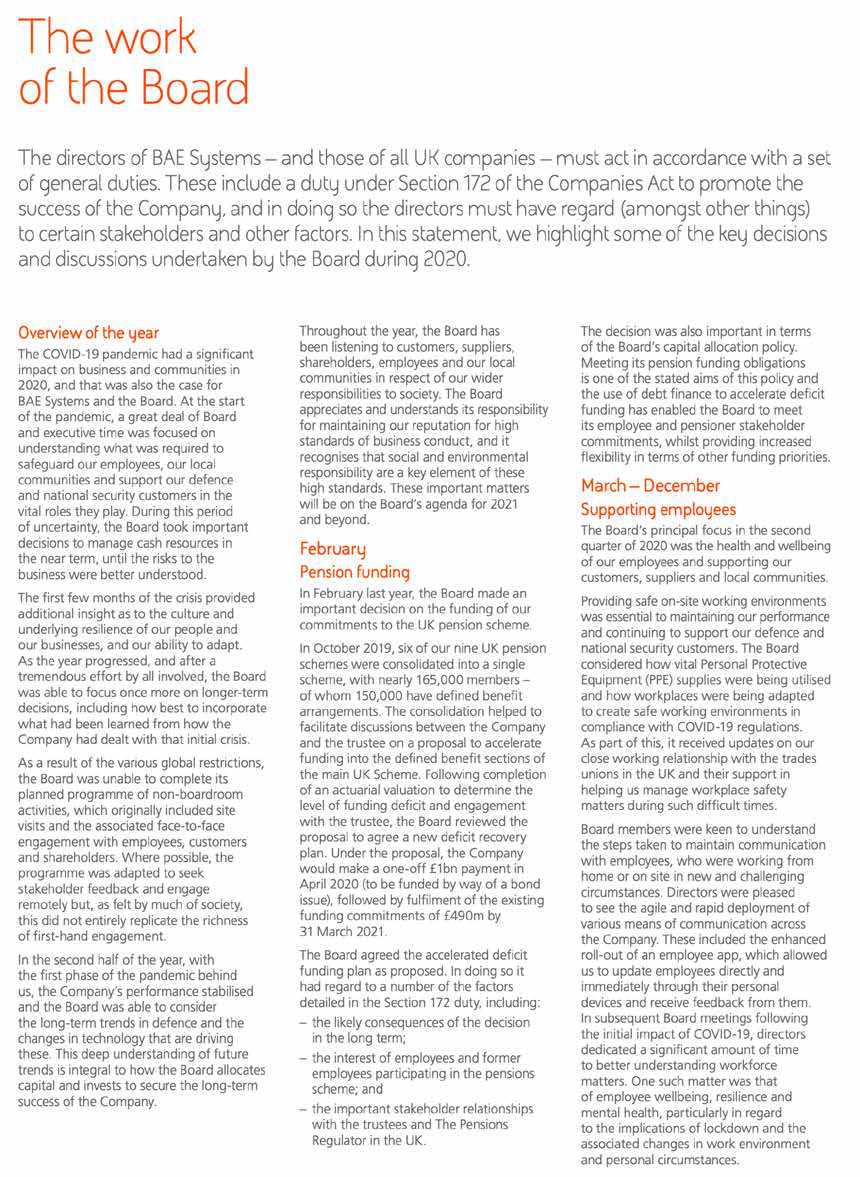
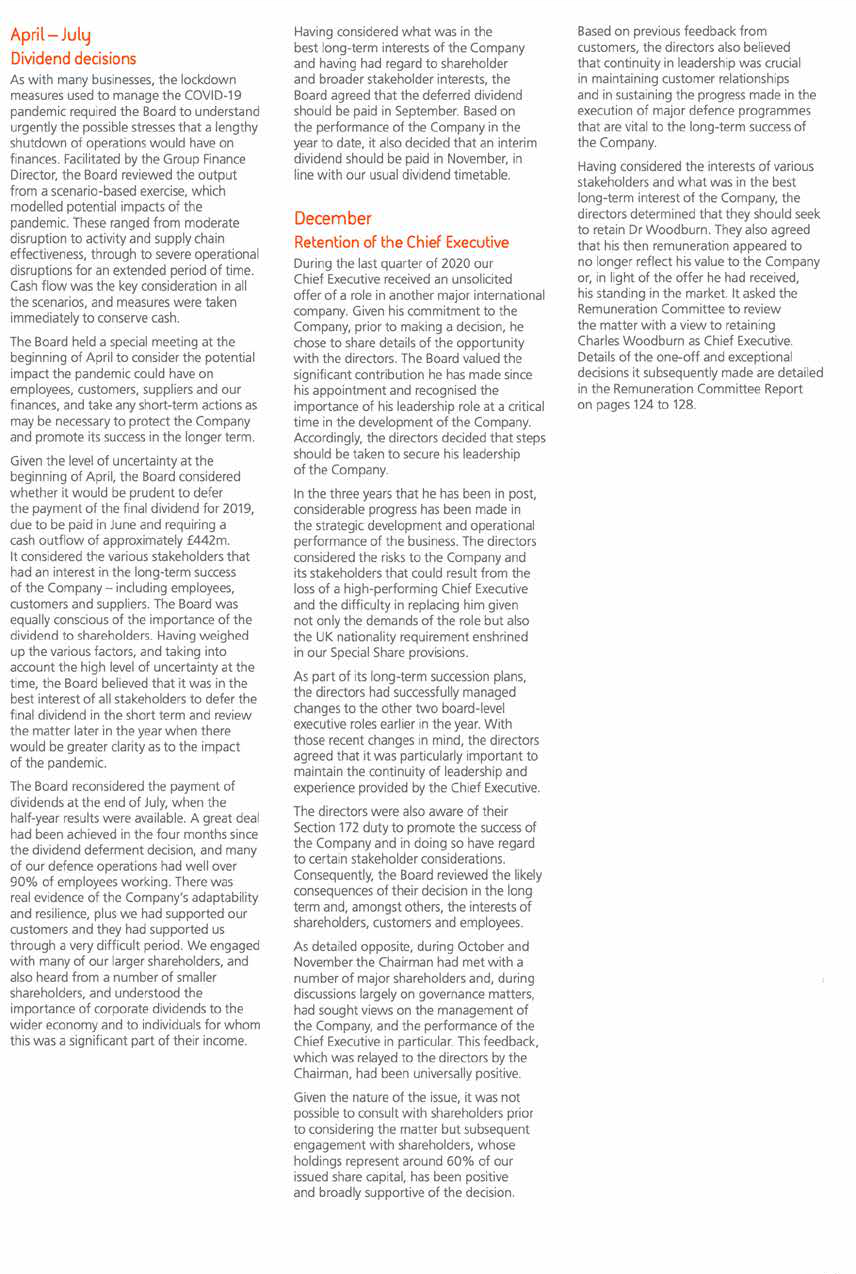
SSE plc Annual Report y/e 31 March 2020 pg 16-23
What is useful? SSE has a "Strategy in Action (Promoting SSE's Long-term success)" section within the strategic report in which it discusses the decisions and developments of strategic importance during the year. Stakeholder considerations are included for each decision/development.
RESHAPING THE GROUP
COMPLETING THE SALE OF SSE ENERGY SERVICES
Key development In September 2019 SSE entered into an agreement to sell its SSE Energy Services business to OVO Energy Ltd at an enterprise value of £500m. The transaction was completed in January 2020.
Objective Securing the best future for SSE Energy Services, taking account of stakeholder considerations, outside the SSE Group.
Strategic and stakeholder considerations In its Annual Report 2019, SSE confirmed that while its strategic focus was on regulated energy networks and renewable energy, its commitment to securing the best future for SSE Energy Services outside the SSE Group was clear.
SSE Energy Services supplies energy and related services to household customers across Great Britain and in 2019 employed around 8,000 people.
In the summer of 2019, SSE entered into discussions with OVO to see if a transaction could be agreed that would be consistent with the strategic focus of the SSE Group on regulated energy networks and renewable energy; in the interests of SSE Energy Services' customers and employees; and in the interests of shareholders.
SSE concluded that by becoming part of OVO, SSE Energy Services would have new opportunities to help transform the GB energy supply market for the benefit of customers. It also concluded that while it would clearly bring significant change for employees, OVO had recognised credentials as being a good employer. SSE also recognised completing the sale of Energy Services would be in line with its key strategic objectives.
In December 2019, the Competition and Markets Authority cleared the proposed sale, confirming that the transaction would not result in a substantial lessening of competition. This underlined SSE's belief that a dedicated, focused and independent energy supplier would ultimately best serve key stakeholder groups of the business.
SSE Finance Director Gregor Alexander said: "Completing this transaction was an important milestone for SSE in reshaping the Company, and was the result of outstanding work of all of the teams of people involved, both within Energy Services itself and in key Group-wide functions as well. The commitment and skills shown in completing successfully the Energy Services sale will stand SSE in good stead in the future."
SSE Energy Services enterprise value £500m
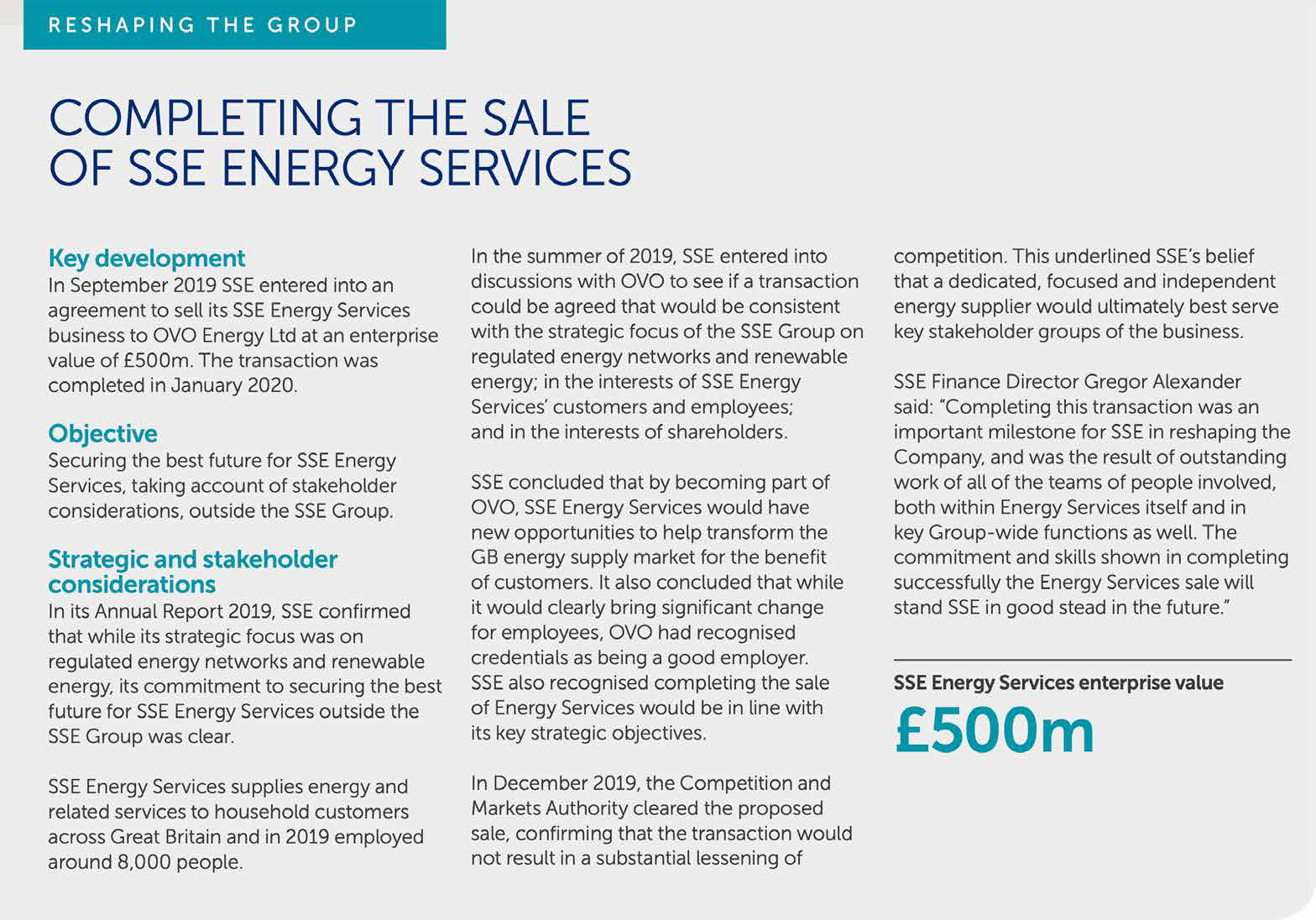
Fresnillo plc Annual Report 2020 pg 132-134
What is useful? Fresnillo's S172 statement focuses on principal decisions, with each set out in a table with headings and considerations by each relevant stakeholder group. The context for each decision includes long-term implications. The section includes the decisions' expected outcomes or outcomes achieved.
| Decision: | The Board considers 'Principal Decisions' to be those decisions which entail significant long-term implications and consequences for the Company and/or its stakeholders - to distinguish these from the normal, ordinary course decision-making processes that the Board engages in. These Principal Decisions are discussed in this report. When preparing Board meetings a proforma template identifying the relevant stakeholder considerations has been developed for inclusion in the Board papers which accompany any discussions, which due to their strategic nature, should include specific documented consideration of Section 172 stakeholder interests when they are discussed. | Evaluate the Energy Strategy with the aim of setting decarbonisation targets and assessing its resilience to the Transition Risks of Climate Change | |:----------|:---------------------------------------------------------------------------------------------------------------------------------------------------------------------------------------------------------------------------------------------------------------------------------------------------------------------------------------------------------------------------------------------------------------------------------------------------------------------------------------------------------------------------------------------------------------------------------------------------------------------------------|:------------------------------------------------------------------------------------------------------------------------------------------------------------------------------------------------------------------------------------------------------------------------------------------------------------------------------------------------------------------------------------------------------------------------------------------------------------------------------------------------------------------------------------------------------------------------------------------------------------------------------------------------------------------------------------------------------------------------------------------------------------------------------------------------------------------------------------------------------------------------------------------------------------------------------------------------------------------------------------------------------------------------------------------------------------------------------------------------------------------------------------------------------------------------------------------------------------------------------------------------------------------------------------------------------------------------------------------------------------------------------------------------------------------------------------------------------------------------------------------------------------------------------------------------------------------------------------------------------------------------------------------------------------------------------------------------------------------------------------------------------------------------------------------------------------------------------------------------------------------------------------------------------------------------------------------------------------------------------------------------------------------------------------------------------------------------------------------------------------------------------------------------------------------------------------------------------------------------------------------------------------------------------------------------------------------------------------------------------------------------------------------------------------------------------------------------------------------------------------------------------------------------------------------------------------------------------------------------------------------------------------------------------------------------------------------------------------------------------------------------------------------------------------------------------------------------------------------------------------------------------------------------------------------------------------------------------------------------------------------------------------------------------------------------------------------------------------------------------------------------------------------------------------------------------------------------------------------------------------------------------------------------------------------------------------------------------------------------------------------------------------------------------------------------------------------------------------------------------------------------------------------------------------------------------------------------------------------------------------------------------------------------------------------------------------------------------------------------------------------------------------------------------------------------------------------------------------------------------------------------------------------------------------------------------------------------------------------------------------------------------------------------------------------------------------------------------------------------------------------------------------------------------------------------------------------------------------------------------------------------------------------------------------------------------------------------------------------------------------------------------------------------------------------------------------------------------------------------------------------------------------------------------------------------------------------------------------------------------------------------------------------------------------------------------------------------------------------------------------------------------------------------------------------------------------------------------------------------------------------------------------------------------------------------------------------------------------------------------------------------------------------------------------------------------------------------------------------------------------------------------------------------------------------------------------------------------------------------------------------------------------------------------------------------------------------------------------------------------------------------------------------------------------------------------------------------------------------------------------------------------------------------------------------------------------------------------------------------------------------------------------------------------------------------------------------------------------------------------------------------------------------------------------------------------------------------------------------------------------------------------------------------------------------------------------------------------------------------------------------------------------------------------------------------------------------------------------------------------------------------------------------------------------------------------------------------------------------------------------------------------------------------------------------------------------------------------------------------------------------------------------------------------------------------------------------------------------------------------------------------------------------------------------------------------------------------------------------------------------------------------------------------------------------------------------------------------------------------------------------------------------------------------------------------------------------------------------------------------------------------------------------------------------------------------------------------------------------------------------------------------------------------------------------------------------------------------------------------------------------------------------------------------------------------------------------------------------------------------------------------------------------------------------------------------------------------------------------------------------------------------------------------------------------------------------------------------------------------------------------------------------------------------------------------------------------------------------------------------------------------------------------------------------------------------------------------------------------------------------------------------------------------------------------------------------------------------------------------------------------------------------------------------------------------------------------------------------------------------------------------------------------------------------------------------------------------------------------------------------------------------------------------------------------------------------------------------------------------------------------------------------------------------------------------------------------------------------------------------------------------------------------------------------------------------------------------------------------------------------------------------------------------------------------------------------------------------------------------------------------------------------------------------------------------------------------------------------------------------------------------------------------------------------------------------------------------------------------------------------------------------------------------------------------------------------------------------------------------------------------------------------------------------------------------------------------------------------------------------------------------------------------------------------------------------------------------------------------------------------------------------------------------------------------------------------------------------------------------------------------------------------------------------------------------------------------------------------------------------------------------------------------------------------------------------------------------------------------------------------------------------------------------------------------------------------------------------------------------------------------------------------------------------------------------------------------------------------------------------------------------------------------------------------------------------------------------------------------------------------------------------------------------------------------------------------------------------------------------------------------------------------------------------------------------------------------------------------------------------------------------------------------------------------------------------------------------------------------------------------------------------------------------------------------------------------------------------------------------------------------------------------------------------------------------------------------------------------------------------------------------------------------------------------------------------------------------------------------------------------------------------------------------------------------------------------------------------------------------------------------------------------------------------------------------------------------------------------------------------------------------------------------------------------------------------------------------------------------------------------------------------------------------------------------------------------------------------------------------------------------------------------------------------------------------------------------------------------------------------------------------------------------------------------------------------------------------------------------------------------------------------------------------------------------------------------------------------------------------------------------------------------------------------------------------------------------------------------------------------------------------------------------------------------------------------------------------------------------------------------------------------------------------------------------------------------------------------------------------------------------------------------------------------------------------------------------------------------------------------------------------------------------------------------------------------------------------------------------------------------------------------------------------------------------------------------------------------------------------------------------------------------------------------------------------------------------------------------------------------------------------------------------------------------------------------------------------------------------------------------------------------------------------------------------------------------------------------------------------------------------------------------------------------------------------------------------------------------------------------------------------------------------------------------------------------------------------------------------------------------------------------------------------------------------------------------------------------------------------------------------------------------------------------------------------------------------------------------------------------------------------------------------------------------------------------------------------------------------------------------------------------------------------------------------------------------------------------------------------------------------------------------------------------------------------------------------------------------------------------------------------------------------------------------------------------------------------------------------------------------------------------------------------------------------------------------------------------------------------------------------------------------------------------------------------------------------------------------------------------------------------------------------------------------------------------------------------------------------------------------------------------------------------------------------------------------------------------------------------------------------------------------------------------------------------------------------------------------------------------------------------------------------------------------------------------------------------------------------------------------------------------------------------------------------------------------------------------------------------------------------------------------------------------------------------------------------------------------------------------------------------------------------------------------------------------------------------------------------------------------------------------------------------------------------------------------------------------------------------------------------------------------------------------------------------------------------------------------------------------------------------------------------------------------------------------------------------------------------------------------------------------------------------------------------------------------------------------------------------------------------------------------------------------------------------------------------------------------------------------------------------------------------------------------------------------------------------------------------------------------------------------------------------------------------------------------------------------------------------------------------------------------------------------------------------------------------------------------------------------------------------------------------------------------------------------------------------------------------------------------------------------------------------------------------------------------------------------------------------------------------------------------------------------------------------------------------------------------------------------------------------------------------------------------------------------------------------------------------------------------------------------------------------------------------------------------------------------------------------------------------------------------------------------------------------------------------------------------------------------------------------------------------------------------------------------------------------------------------------------------------------------------------------------------------------------------------------------------------------------------------------------------------------------------------------------------------------------------------------------------------------------------------------------------------------------------------------------------------------------------------------------------------------------------------------------------------------------------------------------------------------------------------------------------------------------------------------------------------------------------------------------------------------------------------------------------------------------------------------------------------------------------------------------------------------------------------------------------------------------------------------------------------------------------------------------------------------------------------------------------------------------------------------------------------------------------------------------------------------------------------------------------------------------------------------------------------------------------------------------------------------------------------------------------------------------------------------------------------------------------------------------------------------------------------------------------------------------------------------------------------------------------------------------------------------------------------------------------------------------------------------------------------------------------------------------------------------------------------------------------------------------------------------------------------------------------------------------------------------------------------------------------------------------------------------------------------------------------------------------------------------------------------------------------------------------------------------------------------------------------------------------------------------------------------------------------------------------------------------------------------------------------------------------------------------------------------------------------------------------------------------------------------------------------------------------------------------------------------------------------------------------------------------------------------------------------------------------------------------------------------------------------------------------------------------------------------------------------------------------------------------------------------------------------------------------------------------------------------------------------------------------------------------------------------------------------------------------------------------------------------------------------------------------------------------------------------------------------------------------------------------------------------------------------------------------------------------------------------------------------------------------------------------------------------------------------------------------------------------------------------------------------------------------------------------------------------------------------------------------------------------------------------------------------------------------------------------------------------------------------------------------------------------------------------------------------------------------------------------------------------------------------------------------------------------------------------------------------------------------------------------------------------------------------------------------------------------------------------------------------------------------------------------------------------------------------------------------------------------------------------------------------------------------------------------------------------------------------------------------------------------------------------------------------------------------------------------------------------------------------------------------------------------------------------------------------------------------------------------------------------------------------------------------------------------------------------------------------------------------------------------------------------------------------------------------------------------------------------------------------------------------------------------------------------------------------------------------------------------------------------------------------------------------------------------------------------------------------------------------------------------------------------------------------------------------------------------------------------------------------------------------------------------------------------------------------------------------------------------------------------------------------------------------------------------------------------------------------------------------------------------------------------------------------------------------------------------------------------------------------------------------------------------------------------------------------------------------------------------------------------------------------------------------------------------------------------------------------------------------------------------------------------------------------------------------------------------------------------------------------------------------------------------------------------------------------------------------------------------------------------------------------------------------------------------------------------------------------------------------------------------------------------------------------------------------------------------------------------------------------------------------------------------------------------------------------------------------------------------------------------------------------------------------------------------------------------------------------------------------------------------------------------------------------------------------------------------------------------------------------------------------------------------------------------------------------------------------------------------------------------------------------------------------------------------------------------------------------------------------------------------------------------------------------------------------------------------------------------------------------------------------------------------------------------------------------------------------------------------------------------------------------------------------------------------------------------------------------------------------------------------------------------------------------------------------------------------------------------------------------------------------------------------------------------------------------------------------------------------------------------------------------------------------------------------------------------------------------------------------------------------------------------------------------------------------------------------------------------------------------------------------------------------------------------------------------------------------------------------------------------------------------------------------------------------------------------------------------------------------------------------------------------------------------------------------------------------------------------------------------------------------------------------------------------------------------------------------------------------------------------------------------------------------------------------------------------------------------------------------------------------------------------------------------------------------------------------------------------------------------------------------------------------------------------------------------------------------------------------------------------------------------------------------------------------------------------------------------------------------------------------------------------------------------------------------------------------------------------------------------------------------------------------------------------------------------------------------------------------------------------------------------------------------------------------------------------------------------------------------------------------------------------------------------------------------------------------------------------------------------------------------------------------------------------------------------------------------------------------------------------------------------------------------------------------------------------------------------------------------------------------------------------------------------------------------------------------------------------------------------------------------------------------------------------------------------------------------------------------------------------------------------------------------------------------------------------------------------------------------------------------------------------------------------------------------------------------------------------------------------------------------------------------------------------------------------------------------------------------------------------------------------------------------------------------------------------------------------------------------------------------------------------------------------------------------------------------------------------------------------------------------------------------------------------------------------------------------------------------------------------------------------------------------------------------------------------------------------------------------------------------------------------------------------------------------------------------------------------------------------------------------------------------------------------------------------------------------------------------------------------------------------------------------------------------------------------------------------------------------------------------------------------------------------------------------------------------------------------------------------------------------------------------------------------------------------------------------------------------------------------------------------------------------------------------------------------------------------------------------------------------------------------------------------------------------------------------------------------------------------------------------------------------------------------------------------------------------------------------------------------------------------------------------------------------------------------------------------------------------------------------------------------------------------------------------------------------------------------------------------------------------------------------------------------------------------------------------------------------------------------------------------------------------------------------------------------------------------------------------------------------------------------------------------------------------------------------------------------------------------------------------------------------------------------------------------------------------------------------------------------------------------------------------------------------------------------------------------------------------------------------------------------------------------------------------------------------------------------------------------------------------------------------------------------------------------------------------------------------------------------------------------------------------------------------------------------------------------------------------------------------------------------------------------------------------------------------------------------------------------------------------------------------------------------------------------------------------------------------------------------------------------------------------------------------------------------------------------------------------------------------------------------------------------------------------------------------------------------------------------------------------------------------------------------------------------------------------------------------------------------------------------------------------------------------------------------------------------------------------------------------------------------------------------------------------------------------------------------------------------------------------------------------------------------------------------------------------------------------------------------------------------------------------------------------------------------------------------------------------------------------------------------------------------------------------------------------------------------------------------------------------------------------------------------------------------------------------------------------------------------------------------------------------------------------------------------------------------------------------------------------------------------------------------------------------------------------------------------------------------------------------------------------------------------------------------------------------------------------------------------------------------------------------------------------------------------------------------------------------------------------------------------------------------------------------------------------------------------------------------------------------------------------------------------------------------------------------------------------------------------------------------------------------------------------------------------------------------------------------------------------------------------------------------------------------------------------------------------------------------------------------------------------------------------------------------------------------------------------------------------------------------------------------------------------------------------------------------------------------------------------------------------------------------------------------------------------------------------------------------------------------------------------------------------------------------------------------------------------------------------------------------------------------------------------------------------------------------------------------------------------------------------------------------------------------------------------------------------------------------------------------------------------------------------------------------------------------------------------------------------------------------------------------------------------------------------------------------------------------------------------------------------------------------------------------------------------------------------------------------------------------------------------------------------------------------------------------------------------------------------------------------------------------------------------------------------------------------------------------------------------------------------------------------------------------------------------------------------------------------------------------------------------------------------------------------------------------------------------------------------------------------------------------------------------------------------------------------------------------------------------------------------------------------------------------------------------------------------------------------------------------------------------------------------------------------------------------------------------------------------------------------------------------------------------------------------------------------------------------------------------------------------------------------------------------------------------------------------------------------------------------------------------------------------------------------------------------------------------------------------------------------------------------------------------------------------------------------------------------------------------------------------------------------------------------------------------------------------------------------------------------------------------------------------------------------------------------------------------------------------------------------------------------------------------------------------------------------------------------------------------------------------------------------------------------------------------------------------------------------------------------------------------------------------------------------------------------------------------------------------------------------------------------------------------------------------------------------------------------------------------------------------------------------------------------------------------------------------------------------------------------------------------------------------------------------------------------------------------------------------------------------------------------------------------------------------------------------------------------------------------------------------------------------------------------------------------------------------------------------------------------------------------------------------------------------------------------------------------------------------------------------------------------------------------------------------------------------------------------------------------------------------------------------------------------------------------------------------------------------------------------------------------------------------------------------------------------------------------------------------------------------------------------------------------------------------------------------------------------------------------------------------------------------------------------------------------------------------------------------------------------------------------------------------------------------------------------------------------------------------------------------------------------------------------------------------------------------------------------------------------------------------------------------------------------------------------------------------------------------------------------------------------------------------------------------------------------------------------------------------------------------------------------------------------------------------------------------------------------------------------------------------------------------------------------------------------------------------------------------------------------------------------------------------------------------------------------------------------------------------------------------------------------------------------------------------------------------------------------------------------------------------------------------------------------------------------------------------------------------------------------------------------------------------------------------------------------------------------------------------------------------------------------------------------------------------------------------------------------------------------------------------------------------------------------------------------------------------------------------------------------------------------------------------------------------------------------------------------------------------------------------------------------------------------------------------------------------------------------------------------------------------------------------------------------------------------------------------------------------------------------------------------------------------------------------------------------------------------------------------------------------------------------------------------------------------------------------------------------------------------------------------------------------------------------------------------------------------------------------------------------------------------------------------------------------------------------------------------------------------------------------------------------------------------------------------------------------------------------------------------------------------------------------------------------------------------------------------------------------------------------------------------------------------------------------------------------------------------------------------------------------------------------------------------------------------------------------------------------------------------------------------------------------------------------------------------------------------------------------------------------------------------------------------------------------------------------------------------------------------------------------------------------------------------------------------------------------------------------------------------------------------------------------------------------------------------------------------------------------------------------------------------------------------------------------------------------------------------------------------------------------------------------------------------------------------------------------------------------------------------------------------------------------------------------------------------------------------------------------------------------------------------------------------------------------------------------------------------------------------------------------------------------------------------------------------------------------------------------------------------------------------------------------------------------------------------------------------------------------------------------------------------------------------------------------------------------------------------------------------------------------------------------------------------------------------------------------------------------------------------------------------------------------------------------------------------------------------------------------------------------------------------------------------------------------------------------------------------------------------------------------------------------------------------------------------------------------------------------------------------------------------------------------------------------------------------------------------------------------------------------------------------------------------------------------------------------------------------------------------------------------------------------------------------------------------------------------------------------------------------------------------------------------------------------------------------------------------------------------------------------------------------------------------------------------------------------------------------------------------------------------------------------------------------------------------------------------------------------------------------------------------------------------------------------------------------------------------------------------------------------------------------------------------------------------------------------------------------------------------------------------------------------------------------------------------------------------------------------------------------------------------------------------------------------------------------------------------------------------------------------------------------------------------------------------------------------------------------------------------------------------------------------------------------------------------------------------------------------------------------------------------------------------------------------------------------------------------------------------------------------------------------------------------------------------------------------------------------------------------------------------------------------------------------------------------------------------------------------------------------------------------------------------------------------------------------------------------------------------------------------------------------------------------------------------------------------------------------------------------------------------------------------------------------------------------------------------------------------------------------------------------------------------------------------------------------------------------------------------------------------------------------------------------------------------------------------------------------------------------------------------------------------------------------------------------------------------------------------------------------------------------------------------------------------------------------------------------------------------------------------------------------------------------------------------------------------------------------------------------------------------------------------------------------------------------------------------------------------------------------------------------------------------------------------------------------------------------------------------------------------------------------------------------------------------------------------------------------------------------------------------------------------------------------------------------------------------------------------------------------------------------------------------------------------------------------------------------------------------------------------------------------------------------------------------------------------------------------------------------------------------------------------------------------------------------------------------------------------------------------------------------------------------------------------------------------------------------------------------------------------------------------------------------------------------------------------------------------------------------------------------------------------------------------------------------------------------------------------------------------------------------------------------------------------------------------------------------------------------------------------------------------------------------------------------------------------------------------------------------------------------------------------------------------------------------------------------------------------------------------------------------------------------------------------------------------------------------------------------------------------------------------------------------------------------------------------------------------------------------------------------------------------------------------------------------------------------------------------------------------------------------------------------------------------------------------------------------------------------------------------------------------------------------------------------------------------------------------------------------------------------------------------------------------------------------------------------------------------------------------------------------------------------------------------------------------------------------------------------------------------------------------------------------------------------------------------------------------------------------------------------------------------------------------------------------------------------------------------------------------------------------------------------------------------------------------------------------------------------------------------------------------------------------------------------------------------------------------------------------------------------------------------------------------------------------------------------------------------------------------------------------------------------------------------------------------------------------------------------------------------------------------------------------------------------------------------------------------------------------------------------------------------------------------------------------------------------------------------------------------------------------------------------------------------------------------------------------------------------------------------------------------------------------------------------------------------------------------------------------------------------------------------------------------------------------------------------------------------------------------------------------------------------------------------------------------------------------------------------------------------------------------------------------------------------------------------------------------------------------------------------------------------------------------------------------------------------------------------------------------------------------------------------------------------------------------------------------------------------------------------------------------------------------------------------------------------------------------------------------------------------------------------------------------------------------------------------------------------------------------------------------------------------------------------------------------------------------------------------------------------------------------------------------------------------------------------------------------------------------------------------------------------------------------------------------------------------------------------------------------------------------------------------------------------------------------------------------------------------------------------------------------------------------------------------------------------------------------------------------------------------------------------------------------------------------------------------------------------------------------------------------------------------------------------------------------------------------------------------------------------------------------------------------------------------------------------------------------------------------------------------------------------------------------------------------------------------------------------------------------------------------------------------------------------------------------------------------------------------------------------------------------------------------------------------------------------------------------------------------------------------------------------------------------------------------------------------------------------------------------------------------------------------------------------------------------------------------------------------------------------------------------------------------------------------------------------------------------------------------------------------------------------------------------------------------------------------------------------------------------------------------------------------------------------------------------------------------------------------------------------------------------------------------------------------------------------------------------------------------------------------------------------------------------------------------------------------------------------------------------------------------------------------------------------------------------------------------------------------------------------------------------------------------------------------------------------------------------------------------------------------------------------------------------------------------------------------------------------------------------------------------------------------------------------------------------------------------------------------------------------------------------------------------------------------------------------------------------------------------------------------------------------------------------------------------------------------------------------------------------------------------------------------------------------------------------------------------------------------------------------------------------------------------------------------------------------------------------------------------------------------------------------------------------------------------------------------------------------------------------------------------------------------------------------------------------------------------------------------------------------------------------------------------------------------------------------------------------------------------------------------------------------------------------------------------------------------------------------------------------------------------------------------------------------------------------------------------------------------------------------------------------------------------------------------------------------------------------------------------------------------------------------------------------------------------------------------------------------------------------------------------------------------------------------------------------------------------------------------------------------------------------------------------------------------------------------------------------------------------------------------------------------------------------------------------------------------------------------------------------------------------------------------------------------------------------------------------------------------------------------------------------------------------------------------------------------------------------------------------------------------------------------------------------------------------------------------------------------------------------------------------------------------------------------------------------------------------------------------------------------------------------------------------------------------------------------------------------------------------------------------------------------------------------------------------------------------------------------------------------------------------------------------------------------------------------------------------------------------------------------------------------------------------------------------------------------------------------------------------------------------------------------------------------------------------------------------------------------------------------------------------------------------------------------------------------------------------------------------------------------------------------------------------------------------------------------------------------------------------------------------------------------------------------------------------------------------------------------------------------------------------------------------------------------------------------------------------------------------------------------------------------------------------------------------------------------------------------------------------------------------------------------------------------------------------------------------------------------------------------------------------------------------------------------------------------------------------------------------------------------------------------------------------------------------------------------------------------------------------------------------------------------------------------------------------------------------------------------------------------------------------------------------------------------------------------------------------------------------------------------------------------------------------------------------------------------------------------------------------------------------------------------------------------------------------------------------------------------------------------------------------------------------------------------------------------------------------------------------------------------------------------------------------------------------------------------------------------------------------------------------------------------------------------------------------------------------------------------------------------------------------------------------------------------------------------------------------------------------------------------------------------------------------------------------------------------------------------------------------------------------------------------------------------------------------------------------------------------------------------------------------------------------------------------------------------------------------------------------------------------------------------------------------------------------------------------------------------------------------------------------------------------------------------------------------------------------------------------------------------------------------------------------------------------------------------------------------------------------------------------------------------------------------------------------------------------------------------------------------------------------------------------------------------------------------------------------------------------------------------------------------------------------------------------------------------------------------------------------------------------------------------------------------------------------------------------------------------------------------------------------------------------------------------------------------------------------------------------------------------------------------------------------------------------------------------------------------------------------------------------------------------------------------------------------------------------------------------------------------------------------------------------------------------------------------------------------------------------------------------------------------------------------------------------------------------------------------------------------------------------------------------------------------------------------------------------------------------------------------------------------------------------------------------------------------------------------------------------------------------------------------------------------------------------------------------------------------------------------------------------------------------------------------------------------------------------------------------------------------------------------------------------------------------------------------------------------------------------------------------------------------------------------------------------------------------------------------------------------------------------------------------------------------------------------------------------------------------------------------------------------------------------------------------------------------------------------------------------------------------------------------------------------------------------------------------------------------------------------------------------------------------------------------------------------------------------------------------------------------------------------------------------------------------------------------------------------------------------------------------------------------------------------------------------------------------------------------------------------------------------------------------------------------------------------------------------------------------------------------------------------------------------------------------------------------------------------------------------------------------------------------------------------------------------------------------------------------------------------------------------------------------------------------------------------------------------------------------------------------------------------------------------------------------------------------------------------------------------------------------------------------------------------------------------------------------------------------------------------------------------------------------------------------------------------------------------------------------------------------------------------------------------------------------------------------------------------------------------------------------------------------------------------------------------------------------------------------------------------------------------------------------------------------------------------------------------------------------------------------------------------------------------------------------------------------------------------------------------------------------------------------------------------------------------------------------------------------------------------------------------------------------------------------------------------------------------------------------------------------------------------------------------------------------------------------------------------------------------------------------------------------------------------------------------------------------------------------------------------------------------------------------------------------------------------------------------------------------------------------------------------------------------------------------------------------------------------------------------------------------------------------------------------------------------------------------------------------------------------------------------------------------------------------------------------------------------------------------------------------------------------------------------------------------------------------------------------------------------------------------------------------------------------------------------------------------------------------------------------------------------------------------------------------------------------------------------------------------------------------------------------------------------------------------------------------------------------------------------------------------------------------------------------------------------------------------------------------------------------------------------------------------------------------------------------------------------------------------------------------------------------------------------------------------------------------------------------------------------------------------------------------------------------------------------------------------------------------------------------------------------------------------------------------------------------------------------------------------------------------------------------------------------------------------------------------------------------------------------------------------------------------------------------------------------------------------------------------------------------------------------------------------------------------------------------------------------------------------------------------------------------------------------------------------------------------------------------------------------------------------------------------------------------------------------------------------------------------------------------------------------------------------------------------------------------------------------------------------------------------------------------------------------------------------------------------------------------------------------------------------------------------------------------------------------------------------------------------------------------------------------------------------------------------------------------------------------------------------------------------------------------------------------------------------------------------------------------------------------------------------------------------------------------------------------------------------------------------------------------------------------------------------------------------------------------------------------------------------------------------------------------------------------------------------------------------------------------------------------------------------------------------------------------------------------------------------------------------------------------------------------------------------------------------------------------------------------------------------------------------------------------------------------------------------------------------------------------------------------------------------------------------------------------------------------------------------------------------------------------------------------------------------------------------------------------------------------------------------------------------------------------------------------------------------------------------------------------------------------------------------------------------------------------------------------------------------------------------------------------------------------------------------------------------------------------------------------------------------------------------------------------------------------------------------------------------------------------------------------------------------------------------------------------------------------------------------------------------------------------------------------------------------------------------------------------------------------------------------------------------------------------------------------------------------------------------------------------------------------------------------------------------------------------------------------------------------------------------------------------------------------------------------------------------------------------------------------------------------------------------------------------------------------------------------------------------------------------------------------------------------------------------------------------------------------------------------------------------------------------------------------------------------------------------------------------------------------------------------------------------------------------------------------------------------------------------------------------------------------------------------------------------------------------------------------------------------------------------------------------------------------------------------------------------------------------------------------------------------------------------------------------------------------------------------------------------------------------------------------------------------------------------------------------------------------------------------------------------------------------------------------------------------------------------------------------------------------------------------------------------------------------------------------------------------------------------------------------------------------------------------------------------------------------------------------------------------------------------------------------------------------------------------------------------------------------------------------------------------------------------------------------------------------------------------------------------------------------------------------------------------------------------------------------------------------------------------------------------------------------------------------------------------------------------------------------------------------------------------------------------------------------------------------------------------------------------------------------------------------------------------------------------------------------------------------------------------------------------------------------------------------------------------------------------------------------------------------------------------------------------------------------------------------------------------------------------------------------------------------------------------------------------------------------------------------------------------------------------------------------------------------------------------------------------------------------------------------------------------------------------------------------------------------------------------------------------------------------------------------------------------------------------------------------------------------------------------------------------------------------------------------------------------------------------------------------------------------------------------------------------------------------------------------------------------------------------------------------------------------------------------------------------------------------------------------------------------------------------------------------------------------------------------------------------------------------------------------------------------------------------------------------------------------------------------------------------------------------------------------------------------------------------------------------------------------------------------------------------------------------------------------------------------------------------------------------------------------------------------------------------------------------------------------------------------------------------------------------------------------------------------------------------------------------------------------------------------------------------------------------------------------------------------------------------------------------------------------------------------------------------------------------------------------------------------------------------------------------------------------------------------------------------------------------------------------------------------------------------------------------------------------------------------------------------------------------------------------------------------------------------------------------------------------------------------------------------------------------------------------------------------------------------------------------------------------------------------------------------------------------------------------------------------------------------------------------------------------------------------------------------------------------------------------------------------------------------------------------------------------------------------------------------------------------------------------------------------------------------------------------------------------------------------------------------------------------------------------------------------------------------------------------------------------------------------------------------------------------------------------------------------------------------------------------------------------------------------------------------------------------------------------------------------------------------------------------------------------------------------------------------------------------------------------------------------------------------------------------------------------------------------------------------------------------------------------------------------------------------------------------------------------------------------------------------------------------------------------------------------------------------------------------------------------------------------------------------------------------------------------------------------------------------------------------------------------------------------------------------------------------------------------------------------------------------------------------------------------------------------------------------------------------------------------------------------------------------------------------------------------------------------------------------------------------------------------------------------------------------------------------------------------------------------------------------------------------------------------------------------------------------------------------------------------------------------------------------------------------------------------------------------------------------------------------------------------------------------------------------------------------------------------------------------------------------------------------------------------------------------------------------------------------------------------------------------------------------------------------------------------------------------------------------------------------------------------------------------------------------------------------------------------------------------------------------------------------------------------------------------------------------------------------------------------------------------------------------------------------------------------------------------------------------------------------------------------------------------------------------------------------------------------------------------------------------------------------------------------------------------------------------------------------------------------------------------------------------------------------------------------------------------------------------------------------------------------------------------------------------------------------------------------------------------------------------------------------------------------------------------------------------------------------------------------------------------------------------------------------------------------------------------------------------------------------------------------------------------------------------------------------------------------------------------------------------------------------------------------------------------------------------------------------------------------------------------------------------------------------------------------------------------------------------------------------------------------------------------------------------------------------------------------------------------------------------------------------------------------------------------------------------------------------------------------------------------------------------------------------------------------------------------------------------------------------------------------------------------------------------------------------------------------------------------------------------------------------------------------------------------------------------------------------------------------------------------------------------------------------------------------------------------------------------------------------------------------------------------------------------------------------------------------------------------------------------------------------------------------------------------------------------------------------------------------------------------------------------------------------------------------------------------------------------------------------------------------------------------------------------------------------------------------------------------------------------------------------------------------------------------------------------------------------------------------------------------------------------------------------------------------------------------------------------------------------------------------------------------------------------------------------------------------------------------------------------------------------------------------------------------------------------------------------------------------------------------------------------------------------------------------------------------------------------------------------------------------------------------------------------------------------------------------------------------------------------------------------------------------------------------------------------------------------------------------------------------------------------------------------------------------------------------------------------------------------------------------------------------------------------------------------------------------------------------------------------------------------------------------------------------------------------------------------------------------------------------------------------------------------------------------------------------------------------------------------------------------------------------------------------------------------------------------------------------------------------------------------------------------------------------------------------------------------------------------------------------------------------------------------------------------------------------------------------------------------------------------------------------------------------------------------------------------------------------------------------------------------------------------------------------------------------------------------------------------------------------------------------------------------------------------------------------------------------------------------------------------------------------------------------------------------------------------------------------------------------------------------------------------------------------------------------------------------------------------------------------------------------------------------------------------------------------------------------------------------------------------------------------------------------------------------------------------------------------------------------------------------------------------------------------------------------------------------------------------------------------------------------------------------------------------------------------------------------------------------------------------------------------------------------------------------------------------------------------------------------------------------------------------------------------------------------------------------------------------------------------------------------------------------------------------------------------------------------------------------------------------------------------------------------------------------------------------------------------------------------------------------------------------------------------------------------------------------------------------------------------------------------------------------------------------------------------------------------------------------------------------------------------------------------------------------------------------------------------------------------------------------------------------------------------------------------------------------------------------------------------------------------------------------------------------------------------------------------------------------------------------------------------------------------------------------------------------------------------------------------------------------------------------------------------------------------------------------------------------------------------------------------------------------------------------------------------------------------------------------------------------------------------------------------------------------------------------------------------------------------------------------------------------------------------------------------------------------------------------------------------------------------------------------------------------------------------------------------------------------------------------------------------------------------------------------------------------------------------------------------------------------------------------------------------------------------------------------------------------------------------------------------------------------------------------------------------------------------------------------------------------------------------------------------------------------------------------------------------------------------------------------------------------------------------------------------------------------------------------------------------------------------------------------------------------------------------------------------------------------------------------------------------------------------------------------------------------------------------------------------------------------------------------------------------------------------------------------------------------------------------------------------------------------------------------------------------------------------------------------------------------------------------------------------------------------------------------------------------------------------------------------------------.### SSE plc Annual Report y/e 31 March 2020 pg 16-23 {: #sse-plc }
What is useful? SSE has a "Strategy in Action (Promoting SSE's Long-term success)" section within the strategic report in which it discusses the decisions and developments of strategic importance during the year. Stakeholder considerations are included for each decision/development.
RESHAPING THE GROUP
COMPLETING THE SALE OF SSE ENERGY SERVICES
Key development In September 2019 SSE entered into an agreement to sell its SSE Energy Services business to OVO Energy Ltd at an enterprise value of £500m. The transaction was completed in January 2020.
Objective Securing the best future for SSE Energy Services, taking account of stakeholder considerations, outside the SSE Group.
Strategic and stakeholder considerations In its Annual Report 2019, SSE confirmed that while its strategic focus was on regulated energy networks and renewable energy, its commitment to securing the best future for SSE Energy Services outside the SSE Group was clear.
SSE Energy Services supplies energy and related services to household customers across Great Britain and in 2019 employed around 8,000 people.
In the summer of 2019, SSE entered into discussions with OVO to see if a transaction could be agreed that would be consistent with the strategic focus of the SSE Group on regulated energy networks and renewable energy; in the interests of SSE Energy Services' customers and employees; and in the interests of shareholders.
SSE concluded that by becoming part of OVO, SSE Energy Services would have new opportunities to help transform the GB energy supply market for the benefit of customers. It also concluded that while it would clearly bring significant change for employees, OVO had recognised credentials as being a good employer. SSE also recognised completing the sale of Energy Services would be in line with its key strategic objectives.
In December 2019, the Competition and Markets Authority cleared the proposed sale, confirming that the transaction would not result in a substantial lessening of competition. This underlined SSE's belief that a dedicated, focused and independent energy supplier would ultimately best serve key stakeholder groups of the business.
SSE Finance Director Gregor Alexander said: "Completing this transaction was an important milestone for SSE in reshaping the Company, and was the result of outstanding work of all of the teams of people involved, both within Energy Services itself and in key Group-wide functions as well. The commitment and skills shown in completing successfully the Energy Services sale will stand SSE in good stead in the future."
SSE Energy Services enterprise value £500m
Fresnillo plc Annual Report 2020 pg 132-134
What is useful? Fresnillo's S172 statement focuses on principal decisions, with each set out in a table with headings and considerations by each relevant stakeholder group. The context for each decision includes long-term implications. The section includes the decisions' expected outcomes or outcomes achieved.

Taylor Wimpey plc Annual Report 2020 pg 72-75
What is useful? In its Corporate Governance section, Taylor Wimpey links its principal decisions to its S172 duty, and in presenting the principal decisions throughout the year, it highlights the interrelationships between stakeholders and the short-term consequences of some decisions with justification for why the board felt the decision was necessary.
Corporate governance: Board leadership and Company purpose continued
How the Board considered stakeholders during the year
The Directors are required by law to act in a way that promotes the success of the Company for the benefit of shareholders as a whole. In so doing the Company must, in accordance with Section 172 of the Companies Act 2006, also have regard to wider expectations of responsible business behaviour, such as having due regard to the interests of, and actively engaging with, its employees; the need to engage and foster business relationships with suppliers, customers and others; the need to act fairly as between members of the Company; the likely consequences of any decision in the long term; the desirability of maintaining a reputation for high standards of business conduct; and the impact of the Company's operations on the community and the wider environment. The Company's section 172 (1) statement of compliance can be found on page 29 and further details on how the Directors have fulfilled their duties can be found on the next six pages. The Company's stakeholders are set out on page
- The Board understands the importance of stakeholder engagement and continues to engage with each stakeholder on a regular basis. Further information on how the Board directly engaged with shareholders and employees can be found on pages 75 and 76 and details on how the Company engaged with our customers, partners, investors and communities (and outcomes as a result of that engagement) during the year is noted on pages 28 and 29. The Board receive an update from the Executive Directors on this engagement on a regular basis.
During the year, the Board was closely involved in all key decisions of the Company. Alongside providing rigorous evaluation, risk management and challenge to maintain strong governance, the Board also used the stakeholder engagement to inform each decision. The Board is aware that in some situations, stakeholders' interests will be conflicted, however the engagement enabled them to fully understand the key issues relevant to each stakeholder. Further details on how the Board considered stakeholders during the decision making process, and how the stakeholder engagement fed into this process, are set out on the next three pages.
Read more about stakeholder engagement on pages 28 to 41.
Details of how the Directors have fulfilled their duties can be found throughout the Strategic and Governance reports on the following pages: * The likely consequences of any decision in the long term – Pages 11, 12 and 13, 18 and 19 and 72 to 75. * The interests of the company's employees – pages 24 to 29, 34 and 35, and 72 to 75. * The need to foster the company's business relationships with suppliers, customers and others – pages 28 to 41 and 72 to 75. * The impact of the company's operations on the community and the environment – pages 28 and 29, 42 to 44 and 73 to 75. * The desirability of the company maintaining a reputation for high standards of business conduct – pages 18, 20 and 21, 26 to 29 and 67 to 75. * The need to act fairly as between members of the company – pages 28 and 29, 38 and 39, and 72 and 75.
Key Customers Employees Partners Investors Communities
| Closure of construction sites and sales offices | Dividends and executive pay | Taylor Wimpey Pay it Forward Scheme | Remobilisation | Equity raise |
|---|---|---|---|---|
| March 2020 | March 2020 | April 2020 | May 2020 | June 2020 |
| The Board took the proactive decision to be the first major housebuilder to close construction sites and sales offices. In making this decision, the Board considered the following stakeholders: | To protect the long term financial stability of the Company the Board made the decision to cancel the 2019 final dividend and the 2020 special dividend. The Remuneration Committee also considered the application of the Remuneration Policy during 2020. In making this decision, the Board considered the following stakeholders: | The Board oversaw the implementation of the Taylor Wimpey Pay it Forward Scheme (the Scheme) by the GMT and Internal Audit. In making this decision, the Board considered the following stakeholders: | Following the UK Government's announcement to restart the housing market, the Board oversaw the development of the processes and plans to ensure that work could start back on site in a safe and sustainable manner, whilst at all times complying with the relevant UK Government guidelines. In making this decision, the Board considered the following stakeholders: | The Board approved the decision to raise £510 million through issuing new shares in order to take advantage of attractive opportunities in the land market. In making this decision, the Board considered the following stakeholders: |
| Whilst construction was deemed to be a permitted activity by the UK Government, the Board believed it was essential to ensure that our working practices could strictly adhere to social distancing and this would require time and careful planning. The health and safety of our customers, employees and partners has always been a non-negotiable priority at Taylor Wimpey. The Chief Executive wrote to all customers when we closed sites. As a result of this engagement, we continued to support new and existing customers and conducted all business by telephone or digitally. To give added reassurance we extended our two-year warranty for all customers in warranty, at any point in the first national lockdown, by two months. The Board understood that closing our sites and sales offices would have an impact on sales and completions, and this in turn would impact our investors. The Board felt strongly that it was important to ensure the enhanced safety measures were put in place to protect the health and safety of all our stakeholders that visit our sites. | The Board were very aware of the impact this decision would have on our loyal shareholders who rely on dividend income. The Board took this proactive measure to protect the balance sheet and increase flexibility in the short term until the extent and duration of the pandemic was better understood. The Board continues to be committed to providing a reliable minimum annual return to shareholders, therefore in July 2020, the Board announced its intention to resume the payment of an ordinary dividend in 2021. At the request of the Executive Directors, the Remuneration Committee amended the application of the Remuneration Policy in 2020. The Executive Directors' 2020 annual bonus was cancelled and they took a voluntary reduction in base salary and pension from 1 April to 31 July 2020. The Non Executive Directors also took a voluntary reduction in their fees for the same period of time. Further details of these changes can be found on page 102. The Board is aware that over 64% of our employees are also shareholders in the business and this decision directly impacted them in the same way. | Most people working on our sites are subcontractors and their support and loyalty was vital to ensure we were able to re-start work on sites as soon as possible, with new working practices to be COVID-secure. The Board considered that the interest-free loan would make a real difference to our self-employed subcontractors when they otherwise would not be able to eam during the first national lockdown. In addition, we remained in constant dialogue with our partners and remained committed to paying them promptly. The Board considered that the Scheme would protect the business in the short term whilst also strengthening the business for the future and increasing shareholder returns. Many of our subcontractors live in the communities in which we build, so the Scheme indirectly benefits the communities by ensuring job security. | To ensure that customers who had already reserved homes were able to move as soon as possible with minimum delays. The Board ensured that the COVID-19 Code of Conduct and adapted COVID-secure working practices protected our employees and partners. In addition, the Board made the decision to share our updated working practices with other housebuilders to support them to remobilise as soon as possible. The Board ensured that the revised processes were developed so that we could re-open our sites as quickly as possible, whilst being COVID-secure, to limit the impact on our investors. | The Board recognised that the reduced level of competition for land created a disconnect in the market, resulting in short term opportunities to acquire land from a range of sources at attractive returns. These investments will support sustainable future growth and deliver enhanced long term value to shareholders. Retail shareholders were also able to participate in the equity raise through the retail offer. All Directors participated in the equity raise. The Board ensured that employees had the opportunity to participate in the equity raise. The Board were pleased to note that 329 employees participated in the equity raise. The Board considered that the equity raise would increase our opportunity to provide homes in the locations our customers want to live. |
| For further information see page 4. | For further information see pages 3 and 98. | For further information see pages 36 and 37. | For further information see pages 10 and 11. | For further information see pages 12 and 13. |
Section 3
Section 172 statements
Investors want Section 172 statements that bridge information on stakeholders and decisions, and reflect how the company is progressing in its pursuit of its purpose and long-term success
Section 3: Section 172 statements
The Section 172 duty to promote the success of the company by considering consequences of decisions in the long term and the interests of different stakeholders, among other matters, means that the Section 172 statement can be either the conduit for, or a bridge between, information on stakeholders and information on decisions within the annual report. Irrespective of where a company chooses to include this information, many of the considerations and tips throughout the report are applicable to Section 172 statements and are consistent with the tips previously published by the Lab. We now explore in more detail investors' views on the statements, as well as companies' practical experience.
The investor view
Investors told us that while the Section 172 duty has been a requirement for directors for a long time, the introduction of the requirement to produce a statement to explain how that duty is being exercised had only further stimulated their interest in this area. They also thought the requirement was beneficial by prompting companies to improve how they consider stakeholders.
"The benefit of the Section 172 statement requirement is to shine a light on the quality or lack thereof of how companies consider stakeholders." Investor
However, investors emphasised that the statement should not focus only on stakeholder engagement. A narrow focus on individual stakeholder groups often reflects engagement that is not set in the context of the company's success and strategy. The statement needs to address the company's route to long-term success and consider the (a)-(f) aspects of Section 172 strategically. In their view, the statement should tackle what the company is doing to be successful for the long term, and consideration of stakeholders needs to be embedded across different drivers of value creation and the other Section 172 aspects, such as maintaining a reputation for high standards of business conduct.
"Stakeholder interests cannot be boxed as singular interests, but they are interlinked across different issues." Investor
"Together with the financial statements and the discussion of business model, the Section 172 statement should provide a holistic view of the company: what has happened in the reporting period and then linking it to where the company is heading in the future." Investor
Investors commented that some statements tended to be boilerplate and not connected to the business model or strategic issues. There is an expectation that the statement should cover areas of board concern – this then reassures investors that the company is tackling or rectifying an issue. The statement is seen in the context of the whole annual report and should be consistent with the discussion elsewhere in the report. Investors noted that it can be helpful for the statement to be a standalone source of information, but while they might initially view it in isolation, they will reconcile it to other information they know about the company.
The Section 172 statement is a strategic report requirement, but many companies choose to include it in the corporate governance section and incorporate it in the strategic report by cross-reference. While some investors did not have a preference where the statement was located, others did highlight that where the company chose to locate it could indicate the importance given to the statement or how the directors considered the Section 172 duty. Also, while it is about directors' duties and therefore linked to governance, the board's oversight and involvement in principal decisions drives strategy across both the short and long term, and therefore the statement should have a clear strategic link.
One concern that a few investors raised was that since Section 172 was a UK Companies Act 2006 requirement, some statements were very UK-focused. Investors expect that the Section 172 duty applies across the whole group, whichever jurisdiction business units are found in. As highlighted in relation to information on stakeholders, any significant differences in relevant stakeholders, approaches to engagement or relevance of decisions between regions should be explained.
The company view
“As an international group, the need to enhance UK disclosures was an opportunity to enhance disclosures and practice across the group – there was a ripple effect across different jurisdictions for best practice.” Company
Most companies highlighted that while the requirement to prepare the Section 172 statement was new, the duty and the consideration of stakeholders was ingrained in the way they conducted business. However, many recognised the benefit of having reassessed their processes and made improvements as a result of the new requirement.
Some companies noted that a challenge in preparing the statement is identifying what to include and avoiding duplication with the strategic report since that entire report should be reflective of the Section 172 duty. Companies typically address this by focusing on the board's role and on principal decisions within the Section 172 statement. Although approaches vary by company, the majority of statements of participating companies were prepared by company secretarial teams, but with involvement from across the company.
What investors want to see reported
Structure and content
In our review of Section 172 statements, we noted the following approaches:
- stakeholder engagement-focused – typically, the section on stakeholder engagement is used as the Section 172 statement;
- decision-based – the statement takes either a tabular or more narrative approach to describe the principal decisions during the year and then addresses stakeholder considerations for each;
- (a) to (f) approach – the statement addresses all (a)-(f) aspects of Section 172;
- hybrid approach – the statement combines two or three of the preceding approaches; generally, one or two decisions are selected as case studies;
- cross-referencing – this approach varies from a list of links or references to other parts of the annual report (sometimes presented as addressing (a)-(f) of Section 172) to more detailed cross-referencing with context provided;
- other - approaches have included using the Chairman's Statement or a Q&A with the CEO as the statement.
While the investors we spoke to did not generally express a specific preference for one type of format, they emphasised that statements should not be just about stakeholder engagement. Statements that addressed decisions in detail, such as BAE and Fresnillo, were viewed favourably. Both these statements then cross-referred to the sections on stakeholders. BT's Section 172 statement combines a concise section on principal decisions with addressing the aspects (a)-(f) of Section
- This is helpful in ensuring that all aspects are addressed and preventing omission, as long as a tick-box approach is avoided and only relevant information is provided. Derwent also addresses (a)-(f) in a concise manner but by using cross-referencing combined with useful background (e.g. how directors perform their duties) and a table indicating how different stakeholders were considered in principal decisions.
Detailed narrative can provide useful insight, but a concise approach which is focused but still informative can be just as helpful. Companies need to consider which approach works best to tell their company's story of its pursuit of long-term success.
Some investors highlighted that Section 172 statements often do not address (d) the impact of the company's operations on the community [...] and (f) the need to act fairly as between members of the company. Two examples below provide helpful detail on consideration of community (e.g. Fresnillo) and shareholders (e.g. Man Group).
Location
As noted earlier, where a company chooses to locate its Section 172 statement could indicate the importance attributed to the statement. However, the location also contributes to the narrative flow of the annual report and should link to strategy. Many statements are at the end of the strategic report and just before the corporate governance section – arguably this reflects how the Section 172 duty straddles both strategy and governance. However, when the statement is included early on in the strategic report, for example following on from business model and strategy and introducing the stakeholder section, or within the Chairman's Statement as done by SSE plc (2020 Annual Report pages 4-5), this can better highlight the board's strategic role. The sequence of sections can also be helpful in directing investors to relevant information in an efficient way. Barclays' stakeholder KPI dashboard was not formally part of its Section 172 statement but followed straight after – this helped provide a connected narrative.
Conclusion
In summary, better Section 172 statements, which are more useful to investors:
- Do not only focus on stakeholder engagement, but consider the other aspects of Section 172;
- Discuss principal decisions (linking to long-term success of the company) and how stakeholders and other factors were considered in making those decisions;
- Bridge information on stakeholders and decisions by considering them in a two-way approach, and incorporate both in the statement even if by cross-referencing;
- Can be a standalone source of information which are still concise if cross-referencing is used well; and
- Fit into a connected narrative linking to business model, strategy and how business is done (through consideration of governance and culture) demonstrating how the company is progressing in its pursuit of its purpose and long-term success.
Tips for approaching Section 172 statements
- Consider whether the templates for board papers, agendas and minutes need prompts on all aspects of Section 172, and not just consideration of stakeholders. These can then be used for evidence to compile the statement.
- As much as possible, the person or team responsible for drafting the Section 172 statement should attend board and/or committee meetings to facilitate the process of drafting and better reflect the board's priorities and actions. However, the Section 172 duty is the responsibility of each director, and the board should ensure that the statement is an authentic reflection of its key considerations of stakeholders and other factors during the year.
- The Section 172 statement should be a reflection of how the Section 172 duty is met throughout the year – similarly, consider gathering information throughout the year to compile the statement rather than rolling forward and tweaking the statement at the end of the year. This helps avoid boilerplate, but also facilitates the reporting process.
- Consider where best to include the Section 172 statement within the annual report so that it clearly reflects links to strategy and other parts of the report. It should be part of a connected narrative. Do not let the location of the statement, or ordering of information within it, be a function of design and pagination, rather than a correlation with strategic prioritisation. The statement should be clearly labelled and included in the contents page of the annual report.
- Consider bi-directional cross-referencing where the Section 172 statement links to where various components of the annual report provide more detail on highlights provided in the statement, and those sections then link back to the statement.
BT Group plc Annual Report y/e 31 March 2021 pg 42-43
What is useful? BT's S172 statement addresses parts (a)-(f) of Section 172 by explaining the Board's processes and cross-referencing to other parts of the annual report for more detail. The statement also includes a description of four significant decisions, including the board's consideration of the impact on the affected stakeholders.
Section 172 statement
In their discussions and decisions during the year ending 31 March 2021, the directors of BT Group plc have acted in the way that they consider, in good faith, would be most likely to promote the success of the company for the benefit of its members as a whole (having regard to stakeholders and the matters set out in sub-sections 172(1)(a)-(f) of the Companies Act 2006 (the 2006 Act).
The Board considers the matters set out in section 172 of the 2006 Act in all its discussions and decision-making. That includes:
The likely consequence of any decision in the long term: The directors recognise that the decisions they make today will affect BT's long-term success. During the year, the Board had particular regard to the long-term success of the company in its discussions on the evolution of the company's purpose and strategic framework, as set out in the Board activities section on pages 74 to 77. Our purpose and strategy demonstrate how we will realise our ambition and grow value for all our stakeholders. This in turn guides the Board's decisions, specifically the balance between short
- and long-term investments (more details on page 43). The third pillar of our strategy (lead the way to a bright, sustainable future) incorporates our aim to identify and develop new business opportunities that will help us grow sustainably in the future. More information on our strategy can be found from page 19.
The impact of BT's operations on the community and environment: The Digital Impact & Sustainability Committee monitors progress on the digital impact and sustainability strategy and supporting goals for digital skills, responsible tech and human rights, and climate change and the environment. During the year, the committee reviewed and endorsed the Skills for Tomorrow programme and its pivot to become 'digital-first' during the Covid-19 pandemic. Our digital impact and sustainability strategy incorporates responsible tech and human rights, and our sector-leading approach to climate action, with a target to become a net zero carbon emissions business by 2045, as well as our two related group KPIs (see pages 30 to 33). We are also committed to implementing the recommendations of the Task Force on Climate-related Financial Disclosures (TCFD). See page 67 for our response to TCFD.
The desirability to maintain a reputation for high standards of business conduct: The Board acknowledges its responsibility for setting and monitoring the culture, values and reputation of the company. Our colleagues are central to us achieving our ambition and we are building a culture where our colleagues can be their best. During the year, the Board considered BT's culture in its decision-making and discussions; further details on this can be found on page
- The Digital Impact & Sustainability Committee reviewed and endorsed BT's new responsible tech and human rights approach which aims to develop, use, buy and sell technology in a way that benefits people and minimises harms (see page 87 for more details on the activities of the Digital Impact & Sustainability Committee and page 30 for our digital impact and sustainability strategy). The Audit & Risk Committee also received and considered regular reports from the group ethics and compliance director on BT's ethics and compliance priorities, including Speak Up, our confidential, whistleblowing hotline (see page 85). We set out our commitment to high standards of business conduct in The BT Way (our Ethics Code), see bt.com/ethics.
The interests of our colleagues, and the need to foster business relationships with our key stakeholders: The Board and its committees understand the strategic importance of stakeholders to BT's business. When making decisions, the directors have regard to the interests of colleagues, and the need to foster business relationships with other key stakeholders. We acknowledge that not every decision we make will necessarily result in a positive outcome for all our stakeholders; the Board therefore has to balance competing interests in reaching its decisions. While the Board engages directly with stakeholders on some issues, the size and distribution of BT and our stakeholder groups means that stakeholder engagement often happens below Board level. However, the Board considers information from across the organisation to help it understand how our operations affect our stakeholders' interests and views. There are more details on how we engage with key stakeholders (including customers and suppliers) on pages 34 to 41 and on the chief executive's role in reporting engagement feedback to the Board through his chief executive's report on page
- For further details on how the Board operates and makes decisions, and its activities this year, see pages 71 to 77. Our colleagues are key to our success and they are always considered as part of the Board's discussions and decision-making. Their wellbeing, especially during the Covid-19 pandemic, as well as diversity and inclusion, our culture, transformation programme and employee relations, have been a prominent focus of Board discussions this year (see page 76 for more details). The Board engages with colleagues primarily through the Colleague Board and via Isabel Hudson, our designated non-executive director for workforce engagement (see pages 35 to 36 for more details on the Colleague Board). Isabel provides feedback after each formal Colleague Board meeting and also discusses any topics raised by members at relevant Board and committee meetings. Our other employee communication channels are set out on page 34. As explained on page 76, the Board also discussed with HR and the chief executive the findings from other colleague engagement mechanisms during the year.
The need to act fairly as between BT's shareholders During 2020/21, the Board, the chief executive and chief financial officer, other executives and the investor relations team held various meetings with investors (see page 38 for more detail on our engagement with shareholders). These meetings gave investors the opportunity to discuss views on financial and operational performance, capital investment, pensions, capital allocation policy, as well as prospective governmental and regulatory policy decisions.
Decisions made during the year: The following are some of the decisions made by the Board this year which demonstrate how colleague interests, the need to foster business relationships with other key stakeholders, and other section 172 matters have been taken into account in discussions and decision-making:
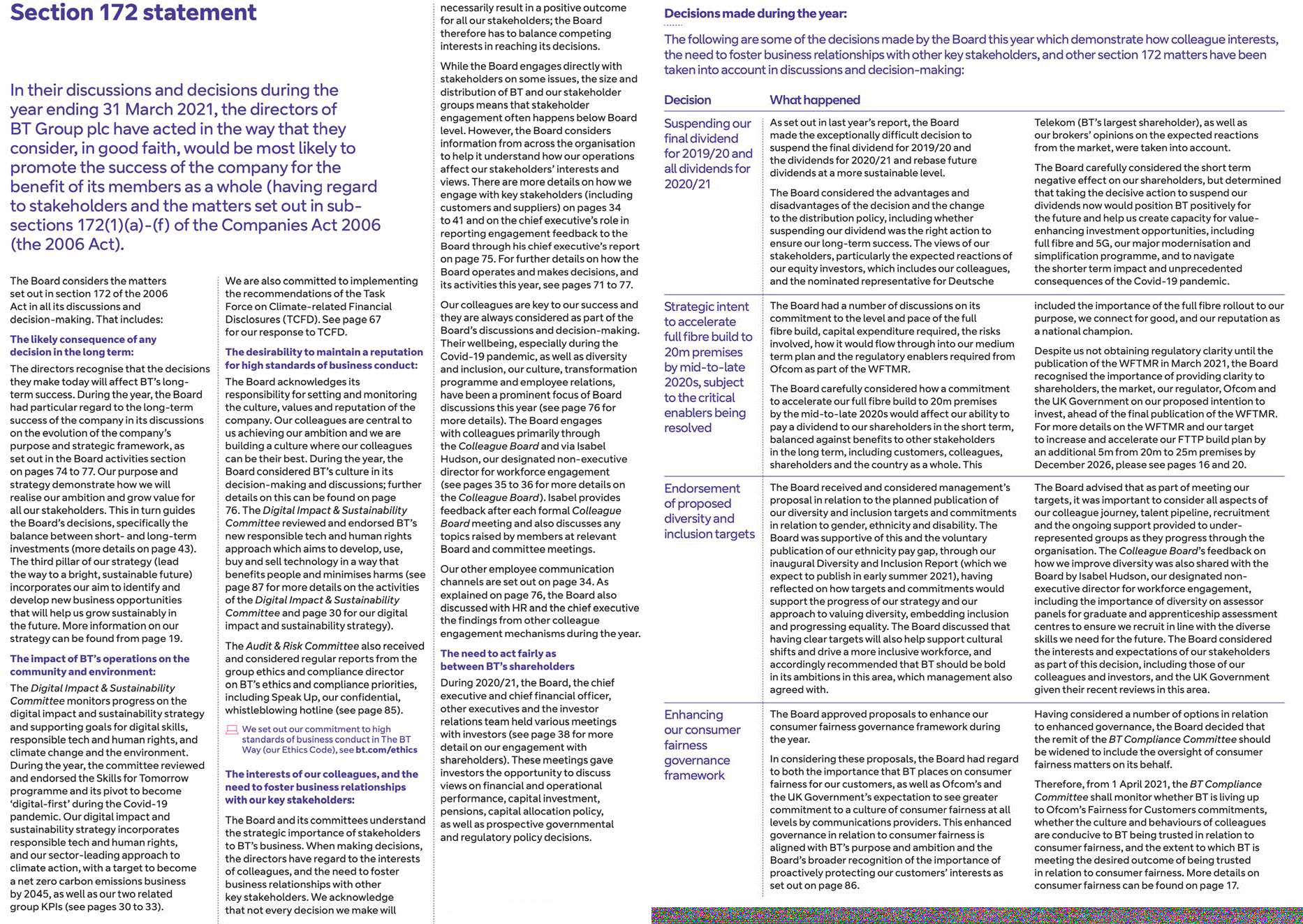
Derwent London plc Annual Report 2020 pg 104-105
What is useful? Derwent addresses different elements of S172 in different parts of the annual report and uses cross-referencing to keep its S172 statement concise, but provides sufficient detail and context to allow it to stand alone as a statement. Derwent also highlights the board's consideration of different stakeholders across its principal decisions.
The section 172(1) statement
The Board of Directors confirm that during the year under review, it has acted to promote the long-term success of the Company for the benefit of shareholders, whilst having due regard to the matters set out in section 172(1)(a) to (f) of the Companies Act 2006.
Issues, factors and stakeholders
The Board has direct engagement principally with our employees and shareholders but is also kept fully apprised of the material issues of other stakeholders through the Executive Directors, reports from senior management and external advisers. On pages 26 and 27 we outline the ways in which we have engaged with key stakeholders and the material issues that they have raised with us.
| s172 factor | Relevant disclosures |
|---|---|
| (a) the likely consequences of any decision in the long-term | Company purpose (page 1) Operating in challenging times (page 6) Central London office market (page 18) Investing in our pipeline (page 24) Our business model (page 30) Our strategy (page 32) Non-financial reporting (page 58) |
| (b) the interests of the Company's employees | Our people (page 50) Diversity and inclusion (page 50) Employee engagement (page 115) |
| (c) the need to foster the Company's business relationships with suppliers, customers and others | Delivering value to customers (page 10) Supporting stakeholders in 2020 (page 12) Responsible payment practices (page 135) Anti-bribery and corruption (page 142) Human rights and modern slavery (pages 57 and 149) Supply Chain Sustainability Standard (page 148) |
| (d) the impact of the Company's operations on the community and the environment | Net Zero Carbon Pathway (page 28) Supporting communities in 2020 (page 13) TCFD disclosures (page 60) Our Community Fund (page 53) Corporate giving (page 53) |
| (e) the desirability of the Company maintaining a reputation for high standards of business conduct | Derwent London brand (page 86) Culture and values (page 111) Whistleblowing (page 116) Internal financial controls (page 134) Awards and recognition (see inside back cover) |
| (f) the need to act fairly between members of the Company | Shareholder engagement (page 114) Annual General Meeting (AGM) (page 175) Rights attached to shares (page 173) Voting rights (page 174) |
Methods used by the Board
2020 was an unprecedented year. In addition to the main methods used by the Board (listed below), in response to the uncertainty and difficulties facing our stakeholders, the Board responded by:
- Holding additional meetings to ensure effective oversight of management decisions and policies, particularly in respect to:
- financial support being offered to our occupiers;
- our ability to safely operate our buildings;
- supporting the local community and NHS; and
- providing clear communications and support to our employees.
- Seeking independent verification that the business is responding proactively and effectively via:
- RSM internal audit into our response to Covid-19 (page 136);
- Occupier and employee pulse surveys (page 103); and
- Capgemini cyber security audit in response to the increase in home working (page 144).
The main methods used by the Directors to perform their duties include:
- the Board sets the Group's purpose, values and strategy and ensures they are aligned with our culture (see page 111);
- the Responsible Business Committee monitors the Group's corporate responsibility, sustainability and stakeholder engagement activities and reports to the Main Board on its activities (see pages 146 to 149);
- the Board utilises a stakeholder impact analysis to assess the potential impact of significant capital expenditure decisions on our stakeholders (see page 116);
- the Board's risk management procedures identify the potential consequences of decisions in the short, medium and long-term so that mitigation plans can be put in place to prevent, reduce or eliminate risks to our business and wider stakeholders (see pages 138 and 145);
- strategy reviews which assess the long-term sustainable success of the Group and our impact on key stakeholders;
- direct and indirect stakeholder engagement (see pages 12 to 13 and 26 to 27);
- external assurance is received through audits, stakeholder surveys and reports from brokers and advisers; and
- specific training for our Directors and senior managers.
Public interest statement - 2020
As a business that designs and manages office space, we are aware of our wider obligations to be a responsible business partner to our occupiers and within the communities in which we operate. As our activities impact on multiple stakeholder groups (see page 26), our Board ensures that stakeholder matters are central to its decision-making alongside the long-term financial success of our business.
We extend our obligations beyond the statutory requirements to add value and build long-term mutually beneficial relationships. Our obligations are incorporated into our purpose, which strongly influences our values (see page 1). We have detailed on pages 12, 13, 26, 27 and 105 how we have acted in the public interest during 2020.
Principal decisions in 2020 and how we have met our public interest obligations
The key activities and principal decisions undertaken by the Board in 2020 are detailed on pages 122 and
- We detail below how the Board factored stakeholders, and the information we received through engagement, into its decisions in 2020.
When making each decision, the Board carefully considered how it impacted on the success of the Group, its long-term (financial and non-financial) impact and had due regard to the other matters set out in section 172(1)(a) to (f) of the Companies Act 2006.
| Stakeholder group | Engagement we received | Our response |
Section 4
Appendices
Appendix 1: Tips on Section 172
Section 172 statements
How to make them more useful
The Financial Reporting Lab spoke to institutional and retail investors and other stakeholders about what they consider useful reporting on how directors have had regard to the matters set out in section 172(1)(a) to (f) of the Companies Act 2006 when performing their duty under section 172 to promote the success of the company. We also spoke to companies to understand the challenges they are facing in preparing the related statement. The following tips reflect those views and help companies consider what content to include, how to present it, and how to facilitate the process of preparing the statement.
Section 172 statements as a tool to better insight and more accountability Section 172 statements were introduced by The Companies (Miscellaneous Reporting) Regulations 2018 and were first applied to the reporting periods of relevant companies for financial periods beginning on or after 1 January
- A parallel recommendation was also included in the 2018 UK Corporate Governance Code. The Guidance on the Strategic Report was also updated to strengthen the link between the purpose of the strategic report and the director's section 172 duty to promote the success of the company. It also includes guidance on how to prepare the statement. In May 2020, the FRC issued a clarification-statement.pdf) about which companies should prepare such statements. These requirements were introduced following concerns that boards were not paying sufficient attention to their responsibilities towards both shareholders and stakeholders. Some companies told us that the new requirements have indeed made boards and management think more deeply about stakeholders.
"The board should understand the views of the company's key stakeholders and describe in the annual report how their interests and the matters set out in section 172 have been considered in board discussions and decision-making". UK Corporate Governance Code
Building in useful content
- Be specific and genuine, avoiding box-ticking – The section 172 statement should not be just a compliance exercise where the company duplicates the section 172 requirements and states compliance. Instead, it should reflect on how the company met the requirements, explain what is relevant to it and what happened during the year and, where applicable, what the board and management plan to do in future. The statement should be an authentic reflection of what happened and what is material to the company.
- Explain the why – Explain the board's reasoning behind why: ➤ particular stakeholders are identified as key; ➤ particular engagement methods were effective; ➤ key decisions were taken in light of engagement and feedback which may have accumulated over time.
- Link to strategy – Discuss how stakeholders and other matters are considered strategically, how they are relevant to the business model, and how they affect the development and implementation of strategy.
- Include difficulties not just positives – Provide information on where trade-offs and decisions have been made in the short-term to benefit the long-term, and to the benefit of one stakeholder group over another.
- Reflect the board's oversight – Investors recognise that management is responsible for the majority of engagement with stakeholders and the formulation of strategy, but they want to understand how the board challenges and oversees this, and what stakeholder management processes are in place, e.g. how issues are escalated to the board, the extent of training of the board on stakeholder issues, and how the effectiveness of complaints/grievance mechanisms is assessed.
- Include material KPIs on key stakeholders – Information such as key performance indicators on key stakeholders monitored by the board, e.g. net promoter scores, should be included in the statement or by cross-reference to where that information can be found elsewhere in the annual report, where material.
- Address future consequences and planned actions – When setting out the engagement undertaken and decisions made, companies should disclose the implications of the feedback received, the impact of decisions on relevant stakeholders, and what actions have been taken or are planned as a result. Where the statement highlights issues or concerns raised by a stakeholder, it should be clear how they have been or are going to be addressed.
- Be consistent – Reporting on section 172 should be consistent with the rest of the annual report and considered in the context of the company's story, as a whole, without contradictory information.
Presented in a way that makes sense
- Think of the flow and context – The regulations require a section 172 statement within the Strategic Report, or elsewhere by cross reference. Although investors expressed no clear preference for the location of the statement, it should reflect the strategic link and be clear about the board's role. Companies should think how it fits within the context of stakeholder engagement and how the statement itself can provide context to other areas. For example, the board's decision-making can provide a framework for how stakeholders are considered, and therefore sequencing the statement ahead of a section on stakeholders can be helpful for investors' understanding and ease of finding information.
- Make it visible – The section 172 statement should be clearly labelled and referred to in the contents page of the annual report.
- Use cross-referencing to enhance understanding – Cross-referencing, where used, should expand upon points made in the statement and provide further context. It should not be used to make the statement a contents page or list of links. While cross-referencing is helpful, the statement should still provide a coherent message by itself. Where cross-referencing is used, be specific and clear about what you are referring to, rather than refer to a whole section. Include hyperlinks for ease of navigation.
- Include case-studies – Examples and case-studies of significant strategic decisions taken during the year, explaining how stakeholders were taken into account, can bring the statement to life. Consider including them within the statement itself or cross-referencing to them.
Supported by process
- Start early – During the year, highlight those key decisions and engagement activities which could be considered for inclusion in the statement as they happen, rather than just compiling information at the end of the year. This can also help the company and the board consider the extent of their direct involvement and activities, and whether a change or more is needed.
- Include prompts on stakeholders and Section 172 responsibilities – Consider tailoring templates for board agendas, papers and minutes to include reminders for both the board and management to consider which stakeholders are relevant for decisions. Consideration of stakeholders should form part of a business' activities, and these prompts can lead to better evidence, as well as making it easier to assess what to include.
When framing your Section 172 statement, remember:
- It is not about stating compliance with the Section 172 requirements, but about reflecting the board's consideration of stakeholders in pursuit of the success of the company.
- It is not just about stakeholder engagement; the statement should consider all the requirements of section 172, and investors are particularly interested in the promotion of the success of the company and the consequences of decisions in the long term.
- It needs to reflect what is relevant to the company – therefore, the board should explain how they have exercised their duty and considered stakeholders and the long-term success of the company, even where decisions or engagement may have been carried out centrally by the group in the case of some subsidiaries.
- Section 172 should be embedded in the directors' strategic decision-making and supported by the company's culture – it is important that boards set the tone at the top, and companies should report on what they do.
"Section 172 [...] recognis[es] that companies are run for the benefit of shareholders, but that the long-term success of a business is dependent on maintaining relationships with stakeholders and considering the external impact of the company's activities. The section 172(1) statement should explain how the board has had regard to the broader matters in their actions, behaviours and decisions" Guidance on the Strategic Report
These tips are part of a broader Lab project on reporting on stakeholders. Interested parties are still welcome to share their views and experience. More information can be found here, and you can contact us on: [email protected]
Appendix 2: Regulatory background
In recent years, a range of new requirements have been introduced in the UK, which require consideration of stakeholders in reporting. While this report is not about how to apply these requirements, below we highlight the main regulations and guidance which provide valuable context for this report.
Companies Act 2006 ('Companies Act')
There are various parts of the Companies Act that require reporting on, or at least consideration of, stakeholders or specific stakeholder groups such as employees. The strategic report's purpose, as articulated in Section 414C, is to enable users to "assess how the directors have performed their duty under Section 172 (duty to promote the success of the company)" and requires quoted companies, "to the extent necessary for an understanding of the development, performance or position of the company's business”, to include information about the company's employees and social, community and human rights issues. The section also includes requirements for quoted companies to provide employee gender diversity breakdowns.
The FRC's Guidance on the Strategic Report provides further detail on how to address Section 414C and how to include information on stakeholders in the annual report.
"In meeting the needs of shareholders, the information in the annual report may also be of interest to other investors [...] and creditors. Other stakeholders such as customers, employees and members of society more widely may also wish to use information contained within it. The annual report should address issues relevant to these other users where, because of the influence of those issues on the development, performance, position or future prospects of the entity's business, they are also material to shareholders. The annual report should not, however, be seen as a replacement for other forms of reporting addressed to other stakeholders.” Paragraph 3.4, Guidance on the Strategic Report
In addition, Section 414C of the Companies Act requires companies to report on principal risks and key (non-financial) performance indicators, including information relating to environmental matters and employee matters, and quoted companies to report their business model and strategy. These are reporting areas in which a consideration of, and reporting on, stakeholders may be relevant.
The Companies, Partnerships and Groups (Accounts and Non-Financial Reporting) Regulations 2016
(Sections 414CA and 414CB of the Companies Act) introduced the requirement for public interest entities with more than 500 employees to prepare a Non-financial information statement for in which companies should include a description of policies, related due diligence, outcomes of policies, principal risks and key performance indicators in relation to matters including employees, social and community matters, respect for human rights and antibribery. These requirements, as part of the implementation of the EU's Non-Financial Reporting (NFR) Directive, were reflected in the revised Guidance on the Strategic Report. The FRC also published a Frequently Asked Questions covering the NFR requirements, including what is meant by the impact of a company's activities and the interaction with the strategic report disclosures.
The Companies (Miscellaneous Reporting) Regulations 2018
introduced a number of new requirements for the annual report, including:
- Section 172 statement (Section 414CZA of the Companies Act) – in which companies describe how the directors have had regard to the matters set out in Section 172(1) (a) to (f) when performing their duty under Section 172: (a) the likely consequences of any decision in the long term, (b) the interests of the company's employees, (c) the need to foster the company's business relationships with suppliers, customers and others, (d) the impact of the company's operations on the community and the environment, (e) the desirability of the company maintaining a reputation for high standards of business conduct, and (f) the need to act fairly between members of the company.
The UK Corporate Governance Code ('The Code')
“To succeed in the long-term, directors and the companies they lead need to build and maintain successful relationships with a wide range of stakeholders. These relationships will be successful and enduring if they are based on respect, trust and mutual benefit. Accordingly, a company's culture should promote integrity and openness, value diversity and be responsive to the views of shareholders and wider stakeholders." Introduction to the Code
The Code has two principles which relate directly to stakeholders: Principle D, which is about ensuring effective engagement with and encouraging participation from the company's stakeholders and Principle E, which is about workforce policies and practices. The related 'comply or explain' Provision 5 is about how the board understands stakeholders' views and how their interests and the matters set out in Section 172 have been considered in board discussions and decision-making. It then describes possible methods for engagement with the workforce. Provision 6 is about ensuring that the workforce is able to raise concerns in confidence. The FRC published a report on Improving the quality of 'comply or explain' reporting and noted how transparency can be improved with regard to Provision
- Further detail on the FRC's expectations on application of the Code, including on stakeholder engagement, can be found in the FRC's 2020 Annual Review of Corporate Governance Reporting. In May 2021, the FRC published Workforce Engagement and the UK Corporate Governance Code: A Review of Company Reporting and Practice, which reviews the approaches taken on workforce engagement.
Other requirements
In 2015, the UK introduced a requirement for companies to publish a Modern Slavery Statement in which a company sets out how it prevents modern slavery in the business and supply chain. This relates to a number of stakeholder groups, including workforce, suppliers and distribution partners. The Home Office's statutory guidance recommends that companies report on 6 areas, including organisational structure and related supply chains, policies, due diligence and risk management in relation to slavery and human trafficking and related KPIs. In 2020, the UK government issued a consultation on transparency in supply chains in a move to strengthen reporting in this area.
Other reporting requirements related to stakeholders include:
- the duty to report payment practices and performance (in relation to suppliers); and
- gender pay gap reporting.
Appendix 3: Process and participants
Process
Participants join projects by responding to a public call or being approached by the Lab. An iterative approach is taken, with additional participants sought during the project, though it is not intended that the participants represent a statistical sample. References made to views of 'companies' and 'investors' refer to the individuals from companies and investment organisations that participated in this project. Views do not necessarily represent those of the participants' companies or organisations.
Views were received from a range of UK and international institutional investors, analysts and retail investors through a series of in-depth interviews and roundtables. We also heard from a range of companies through FRC-led roundtables, one-to-one interviews or roundtables with other agencies.
Participants
The Lab received a great deal of support from a wide range of organisations throughout this project, particularly those organisations that have been working in this area for a number of years. This assistance has been invaluable, and we thank these organisations for giving so generously of their time.
Thank you to all of the participants for contributing their time to this project.
| Companies | Investors and other users |
|---|---|
| 3i Group plc | Blackrock |
| Assura plc | Brunel Pension Partnership |
| BHP Group | Castlefield Investment Partners LLP |
| Blancco Technology Group | Church Commissioners and the Pensions Board of the Church of England |
| BP plc | Deborah Gilshan, Advisor, Investment Stewardship & ESG |
| Burberry Group plc | Federated Hermes International |
| First Group plc | Jupiter Asset Management |
| Franklin Templeton | Legal & General Investment Management |
| Halma plc | LGPS Central Limited |
| Howden Joinery Group plc | Moody's |
| Ibstock plc | Retail investor representatives (4) |
| InterContinental Hotels Group plc | RPMI Railpen |
| IP Group plc | |
| ITV plc | We would also like to thank the following agencies for hosting company roundtables, where the Lab gathered further views: |
| Legal & General Group plc | Black Sun |
| Man Group plc | Emperor |
| Mizuho International plc | Falcon Windsor |
| Nationwide Building Society | Luminous |
| Natwest Group plc | |
| Polymetal International plc | |
| Rathbone Brothers plc | |
| Refinitiv Limited | |
| Rio Tinto Group | |
| Shell International Limited | |
| Smith & Nephew plc | |
| Spirax-Sarco Engineering plc | |
| SSE plc | |
| Tesco plc | |
| Thames Water Utilities Ltd | |
| Wellcome Trust |
Appendix 3: Process and participants
Process
Participants join projects by responding to a public call or being approached by the Lab. An iterative approach is taken, with additional participants sought during the project, though it is not intended that the participants represent a statistical sample. References made to views of 'companies' and 'investors' refer to the individuals from companies and investment organisations that participated in this project. Views do not necessarily represent those of the participants' companies or organisations.
Views were received from a range of UK and international institutional investors, analysts and retail investors through a series of in-depth interviews and roundtables. We also heard from a range of companies through FRC-led roundtables, one-to-one interviews or roundtables with other agencies.
| Companies | Investors and other users |
|---|---|
| 3i Group plc | Blackrock |
| Assura plc | Brunel Pension Partnership |
| BHP Group | Castlefield Investment Partners LLP |
| Blancco Technology Group | Church Commissioners and the Pensions Board of the Church of England |
| BP plc | Deborah Gilshan, Advisor, Investment Stewardship & ESG |
| Burberry Group plc | Federated Hermes International |
| First Group plc | Jupiter Asset Management |
| Franklin Templeton | Legal & General Investment Management |
| Halma plc | LGPS Central Limited |
| Howden Joinery Group plc | Moody's |
| Ibstock plc | Retail investor representatives (4) |
| InterContinental Hotels Group plc | RPMI Railpen |
| IP Group plc | |
| ITV plc | We would also like to thank the following agencies for hosting company roundtables, where the Lab gathered further views: |
| Legal & General Group plc | |
| Man Group plc | Black Sun |
| Mizuho International plc | Emperor |
| Nationwide Building Society | Falcon Windsor |
| Natwest Group plc | Luminous |
| Polymetal International plc | |
| Rathbone Brothers plc | |
| Refinitiv Limited | |
| Rio Tinto Group | |
| Shell International Limited | |
| Smith & Nephew plc | |
| Spirax-Sarco Engineering plc | |
| SSE plc | |
| Tesco plc | |
| Thames Water Utilities Ltd | |
| Wellcome Trust |
Participants
The Lab received a great deal of support from a wide range of organisations throughout this project, particularly those organisations that have been working in this area for a number of years. This assistance has been invaluable, and we thank these organisations for giving so generously of their time.
Thank you to all of the participants for contributing their time to this project.
Explore more work of the Lab
The Lab has published reports covering a wide range of reporting topics, including ones which are relevant to the topic of stakeholders:
- Business model reporting (2016)
- Business model reporting – implementation study (2018)
- Workforce-related corporate reporting
- WM Morrison Supermarkets PLC case study – Supplier relationships and emergent issues reporting
- COVID-19 - Resources, action, the future
- COVID-19 - Resources, action, the future a look forward
The FRC does not accept any liability to any party for any loss, damage or costs howsoever arising, whether directly or indirectly, whether in contract, tort or otherwise from any action or decision taken (or not taken) as a result of any person relying on or otherwise using this document or arising from any omission from it.
Financial Reporting LAB logo, a pink word 'LAB' within a white oval against a teal background.
© The Financial Reporting Council Limited 2021 The Financial Reporting Council Limited is a company limited by guarantee. Registered in England number
- Registered Office: 8th Floor, 125 London Wall, London EC2Y 5AS
Reports and information about the Lab can be found at https://www.frc.org.uk/Lab
Follow us on Twitter @FRCnews or Linkedin.
Financial Reporting Council 8th Floor 125 London Wall London EC2Y 5AS +44 (0)20 7492 2300 www.frc.org.uk