
The content on this page has been converted from PDF to HTML format using an artificial intelligence (AI) tool as part of our ongoing efforts to improve accessibility and usability of our publications. Note:
- No human verification has been conducted of the converted content.
- While we strive for accuracy errors or omissions may exist.
- This content is provided for informational purposes only and should not be relied upon as a definitive or authoritative source.
- For the official and verified version of the publication, refer to the original PDF document.
If you identify any inaccuracies or have concerns about the content, please contact us at [email protected].
Review of financial reporting effects of Covid-19
- Key to symbols
- 1. Executive summary
- 2. Scope and sample
- 3. Key findings
- Dividends and capital management
- Strategic Report
- Business review
- Impact of Covid-19 on historical performance and year end position
- Examples of better disclosure
- Impact of Covid-19 on strategy and business model
- Examples of better disclosure
- Examples of better disclosure
- Principal risks and uncertainties
- Examples of better disclosure
- Information on Employee, Supplier and Customer relationships
- Information in respect of Employee relationships
- Examples of better disclosure
- Examples of better disclosure
- Examples of better disclosure
- Information on supplier relationships
- Examples of better disclosure
- Information on customer relationships
- Examples of better disclosure
- Examples of better disclosure
- Information on customer relationships
- Information on other relationships
- Alternative performance measures
- Presentation of primary statements
- Expected credit loss provisioning
- Significant judgements and estimates
- Fair value measurements
- Impairment of non-financial assets
- Other impairment issues
- Defined benefit pension schemes
- Provisions and onerous contracts
- Adjusting and non-adjusting post balance sheet events
- Other areas for companies to consider
- Revenue from contracts with customers
- Employee benefits other than defined benefit pension schemes
- Government Grants
- Deferred tax
- Exploration for and evaluation of mineral resources
- Capitalisation of interest
- Leases
- Assets (or disposal groups) classified as held for sale
- Biological assets and agricultural product fair value
- Contingent consideration
- Financial service companies
- Next steps
Key to symbols
- Represents good practice
- Represents an omission of required disclosure or other issue
- Represents an opportunity for enhancing disclosures
- i Represents notes relevant for interim reporting
- Examples of better disclosure
1. Executive summary
Introduction
The Coronavirus (Covid-19) pandemic represents a challenge, unprecedented in modern times, for businesses both in the UK and overseas. Although its effects are uneven across the economy, many sectors have been severely affected and none have been left untouched. In the face of this challenge, users of accounts want to understand not only how the historical financial performance has been impacted, but also what it means for a company's future prospects.
This thematic review builds on the guidance contained in the FRC / FCA / PRA joint statement, published on 26 March 20201, and complements the two reports published by the Financial Reporting Lab on 15 June: ‘Covid-19: Going concern, risk and viability’2 and ‘Covid-19: Resources, action, the future’3. A central theme of the joint statement and the Lab's reports is the importance of providing high quality forward-looking information in the current environment and that theme, combined with current disclosure and measurement issues arising as a result of Covid-19, features heavily in this thematic.
This report summarises the key findings of our review of the financial reporting effects of Covid-19 for a sample of interim and annual reports and accounts with a March period end.
We hope that this report provides useful guidance for companies preparing their annual and interim accounts by identifying areas where disclosures affected by Covid-19 can be improved, as well as providing examples demonstrating the level of detail provided by better disclosures.
Our report includes extracts from the limited number of reports and accounts included in our sample. The examples will not be relevant for all companies or all circumstances, but each demonstrates a characteristic of useful disclosure. Inclusion of a company's disclosure should not be seen as an evaluation of that company's reporting as a whole; nor does it provide any assurance or confirmation of the viability or going concern of that company, and should not be relied upon as such.
Key findings
We found that most of the companies we reviewed provided sufficient information to enable users to understand the impact that Covid-19 has had on the company's performance, position and prospects.
However, there was room for improvement by many companies. Notable areas in which improvement is needed include:
1 Going concern disclosures in both interim and annual financial statements should clearly explain the key assumptions and judgements taken in determining whether a company is able to operate as a going concern. In particular, any significant judgements taken in determining whether or not there is a material uncertainty in respect of going concern must be clearly documented.
2 Assumptions used in determining whether the company is a going concern should be compatible with assumptions used in other areas of the financial statements.
3 We expect sensitivity analysis or details of a range of possible outcomes to be provided for areas subject to significant estimation uncertainty. The number of disclosures in this area is likely to increase as a result of Covid-19.
4 We discourage the arbitrary splitting of items such as impairment charges between Covid-19 and non Covid-19 financial statement captions as such allocations are likely to be highly subjective and therefore unreliable. We also expect companies to apply consistently existing accounting policies for exceptional and other similar items to Covid-19 related income and expenditure.
5 Although IAS 34 ‘Interim Financial Reporting' has only limited disclosure requirements, interim financial statements would benefit from more detailed disclosures explaining the way in which Covid-19 has impacted a company's reported performance and future prospects.
Some of our observations concern disclosures which are not explicitly required by either accounting standards or the relevant law. Additional information in these areas would have been helpful to the user.
In the current environment, we would also encourage companies to consider the need for disclosures not explicitly prescribed by IFRS to enable users of accounts to understand the impact of events and conditions on a company's position and financial performance, as required by paragraph 31 of IAS 1 'Presentation of Financial Statements'.
Overall, the best disclosures were those that were specific to the company and which provided additional information that clearly explained how Covid-19 had impacted the company's reported position and performance and how it may affect future prospects.
We encourage preparers to consider carefully the findings of this review when preparing their forthcoming interim and annual reports. Companies should aim to ensure that not only mandatory disclosure requirements have been met but that sufficient explanations have been included within the financial statements to enable a user to understand how Covid-19 has affected both the amounts presented and the company's future prospects.
We recognise that the situation posed by Covid-19 is evolving rapidly and that disclosures will develop as more interim and annual reports covering longer Covid-19 impacted periods are published. As a consequence, some of the examples and guidance in this report may be superseded more quickly than guidance provided in our previous thematic reviews.
We hope that preparers find this review useful and we encourage preparers to engage with their external auditors when preparing their forthcoming annual and interim accounts.
2. Scope and sample
Background and scope of our review
Covid-19 will have an impact on all companies. However, the extent of the impact of Covid-19 will be more significant for companies in certain sectors such as retail, hospitality, and travel that have been more significantly affected by social distancing rules and potential longer term changes in consumer behaviour. Our review consisted of a limited scope desktop review of a selection of 17 interim and annual financial statements with a period end date of March
- As a result, all sets of interim and annual financial statements that were reviewed had a post – UK lockdown period end date.
In reviewing interim financial statements, we considered the requirements of IAS 34 and whether the information provided in the interim accounts offered sufficient information to enable a user to understand the impact of Covid-19. We have separately identified interim specific financial statement disclosure improvement areas within our report.
The areas we focused on were:
- Going concern
- Viability statements (annual accounts only)
- Cash, liquidity and covenant compliance
- Dividends and capital management
- Strategic report (annual accounts only for all sections other than principal risks and uncertainties for which interim accounts were also reviewed)
- Alternative performance measures
- Presentation of primary statements
- Expected credit loss provisioning
- Significant judgements and estimates
- Fair value measurements
- Impairment of non-financial assets and other impairment issues
- Defined benefit pension schemes
- Provisions and onerous contracts
Our sample
We planned to review the interim and annual financial statements with a period end date of March 2020 for 17 companies.
We aimed to include a cross section of all industries within our sample.
Industries sampled
Bar chart showing interim and annual accounts reviewed by industry.
Retail: 1 interim, 0 annual Equity investment instruments: 0 interim, 1 annual Airlines: 1 interim, 0 annual Real estate holding and development: 1 interim, 1 annual Telecommunications: 0 interim, 1 annual Construction: 1 interim, 1 annual Restaurants and bars: 1 interim, 0 annual Consumer goods: 1 interim, 1 annual
Due to the planned timing of publication of this thematic review, no banks or insurers were included in our sample. These companies largely have 31 December year ends and, therefore, their interim reports will be published after this report is published.
3. Key findings
Going concern and viability statements
Going concern
IAS 1 paragraphs 25 and 26 require the directors to make an assessment of the company's ability to continue to operate as a going concern for at least 12 months from the balance sheet date. As part of this assessment, the directors must consider whether there are any material uncertainties that may cast significant doubt on the ability of the company to continue to operate as a going concern. Where these uncertainties exist, they must be disclosed.
Determining whether or not a material uncertainty exists will be considerably more difficult given the impact of Covid-19. Furthermore, management may have exercised significant judgement in reaching the conclusion that no material uncertainties exist.
In cases where the board concludes that a material uncertainty does not exist but the conclusion reached required the application of significant judgement, IAS 1 paragraph 122 requires the disclosure of this judgement. (IFRIC July 2014).
- Given the current uncertain environment, we expect company specific going concern disclosures to explain clearly the key assumptions and judgements that the board has made in determining whether or not the company is a going concern and whether or not there are material uncertainties.
- We expect going concern discussion in the strategic report to reflect the going concern information presented in the notes to the accounts.
- We also expect disclosure of the possible scenarios that could lead to failure and details of any mitigating actions available to the board. The disclosures presented should be sufficiently granular to enable a user to understand clearly the way in which the company intends to meet its liabilities as they fall due.
The Financial Reporting Lab report: ‘Covid-19- Going concern, risk and viability' provides useful guidance on the information that could be included within going concern disclosures and the factors that boards may need to consider in making their going concern determination.
All companies within our sample included helpful, company specific going concern disclosures within their financial statements. However, the level of detail presented varied between companies with some companies providing high level going concern disclosures which could have provided more details of the assumptions made in determining whether the company was a going concern.
i To aid user understanding during the uncertain environment, we encourage interim financial statements to provide going concern disclosures which follow the characteristics of good reporting as noted on page 8. Further details of the information that should be included in the interim financial statements can be found in the FRC / FCA / PRA joint statement.
We observed that the most helpful going concern disclosures had the following characteristics:
- Clearly explained whether there were any material uncertainties that may cast doubt on the company's going concern status.
- Clearly stated the period the going concern assessment covered.
- Explained the different going concern scenarios that had been considered. The best disclosures clearly stated the key Covid-19 assumptions within each forecast and how those assumptions affected the going concern conclusion.
- Indicated which inputs had been subject to stress tests and explained how these stress tests affected the going concern conclusions.
- Identified and explained any mitigating actions the board could take to improve liquidity.
- Explained any post balance sheet changes to liquidity, specifically the arrangement of new lending facilities, the extension of existing facilities or the renegotiation or waiving of bank covenants.
- Described the level of drawn and undrawn finance facilities in place.
- Stated what covenants were in place and whether they expected to breach them.
- Explained whether the company would need to make structural changes in order to continue to operate as a going concern.
A number of companies in our sample noted that they had secured access to the Joint Bank of England and HMT's Covid Corporate Financing Facility (CCFF). However, they did not explain how their going concern status was affected by whether or not they had drawn down on the facility by selling eligible commercial paper to the Covid Corporate Financing Facility Limited (CCFFL). As the terms of the CCFF* allow any unused portion of the facility to be withdrawn, we expect companies to clearly distinguish between amounts of commercial paper already sold to CCFFL and any undrawn facility. We also expect companies to take account of all relevant circumstances, including whether the ability of the government and the Bank of England to withdraw the unused facilities contributes to a material uncertainty in respect of going concern that warrants disclosure.
None of the companies sampled presented any significant judgement disclosures in respect of going concern as required by IAS 1 paragraph 122 despite going concern notes, audit reports or audit committee reports implying that some significant judgements had been made. We expect companies to present these disclosures when significant judgement has been applied.
Going concern disclosures could be further improved by including information which explains any reverse stress testing that has been conducted.
- 'Each of the Bank, the Fund and the HM Treasury reserve the right in its sole discretion to deem any security ineligible for any reason, and to deem ineligible securities the Fund has previously purchased and vice versa. Notwithstanding the foregoing, the Bank confirms that, whereas it reserves the right not to roll over at maturity and not to acquire any commercial paper that is (or is deemed to be) ineligible, it does not have the right to and will not unilaterally: 1. Cancel any commercial paper (whether or not it is ineligible or deemed to be so). 2. Require or make any variations to the terms of any issued commercial paper acquired by the Fund. 3. Require any ineligible commercial paper previously acquired by the Fund to be bought back by the issuer' (CCFF Market Notice). ** 'Each of the Bank and the HM treasury reserve the right, in its sole discretion, to deem any issuer ineligible for any reason after taking into account the information available to it.' (CCFF Market Notice)
Disclosure explains that they do not envisage making any structural changes to the business to remain a going concern.
Disclosure explains the scenarios modelled in the light of Covid-19 and what they are most sensitive to.
Disclosures note the mitigating actions that can be taken to preserve liquidity.
Disclosure explains the covenants attached and current position in respect of covenants.
Examples of better disclosure
'As part of the directors' consideration of the appropriateness of adopting the going concern basis in preparing the interim report and financial statements, a range of severe scenarios have been reviewed. The assumptions modelled are based on the estimated potential impact of Covid-19 restrictions and regulations, along with our proposed responses over the course of the next 18 months. These include a range of estimated impacts primarily based on length of time various levels of restrictions are in place and the severity of the consequent impact of those restrictions on our At-Home and Out-of-Home channels For each of our markets we have sensitised the revenue, profit and cash flow impact of reduced trading activity in our Out-of-Home channel and a negative impact of changes in product mix for the At-Home channel. The scenarios are most sensitive to the assumptions made for GB and Ireland where exposure to the Out-of-Home channel is greater. France and Brazil are predominantly At-Home markets and therefore drive less sensitivity. We have not assumed any uplift in the At-Home channel in any market, under any level of restrictions, for the purpose of the scenario modelling. A key judgement applied is the likely time period of restrictions on trading activity in the Out-of-Home channel, movement of people and social distancing. The severe scenarios include an an assumption that such restrictions will remain in place until March 2021 with only a small proportion of Out-of-Home outlets re-opening during this time. Our Covid-19 impact range of £12m-£18m per month is based on assumptions for lockdown impacting the busiest trading period in 2020. As the level of trading restrictions reduce, and as we exit both lockdown and our busiest trading periods, the Covid-19 impact should also reduce. Under each scenario, mitigating actions are all within management control, can be initiated as they relate to discretionary spend, and do not impact the ability to meet demand. These actions include reduced A&P and stopping all non-essential and non-committed capex in the next 12-18 months. We believe that the risk of enforced plant closure is low and have implemented additional health and safety measures in each of our factories to reduce the risk of a major supply disruption. We have assumed no significant structural changes to the business will be needed in any of the scenarios modelled. As at 31 March 2020, the condensed consolidated balance sheet reflects a net asset position of £432.8m and the liquidity of the Group remains strong. We have a recently re-financed £400m bank facility with a maturity date of November 2025 and approximately £625m of private placement notes, at contracted rates, with maturity dates between 2020 and 2035. Since the half year date, we have received approximately £150m from the recent refinancing of private placement notes, increasing undrawn facilities to approximately £300m and the RCF also offers an accordion facility of £200m, with lender consent. In all scenarios modelled our liquidity requirements are within the £400m RCF facility. Further, whilst we are confident of our liquidity position even under our Covid-19 stress test modelling scenario, given the uncertain environment we find ourselves in, and to give increased financial flexibility, we have deferred the decision on the dividend until later in the financial year. Debt covenant limits are set at a ratio of 3.5x (rolling 12-month EBITDA/ Adjusted Net Debt) and 3.0x (rolling 12-month EBITDA/ Net Interest Expenses) in all of our lending agreements. At the half year, the net debt position was £664.5m, our covenant net debt EBITDA ratio was 2.5x and our covenant net interest EBITDA ratio was 15.0x. As part of our EBITDA and cashflow modelling, we tested the possibility of the debt covenants being breached in September 2020, March 2021, and September 2021. March 2021 is the most sensitive test point as the EBITDA modelling assumes a full 12 months of reduced trading due to the impact of restrictions and a working capital peak ahead of summer trading. Under all the scenarios modelled, after taking mitigating actions as needed, our forecasts did not indicate breach on any of those dates. On the basis of these reviews, the directors consider it is appropriate for the going concern basis to be adopted in preparing the interim report and financial statements.'
Britvic Plc, Interim results, p20
Viability statement has been linked to other areas of the financial statements.
Disclosure explains the period over which viability has been assessed and why that period is appropriate.
Further details of the base case scenarios have been disclosed.
Disclosure indicates that there is volatility in the forecasts and explains how that volatility is being mitigated.
Further disclosure of mitigations taken to minimise volatility.
Disclosures explains the key Covid-19 assumptions in the forecast and quantify the assumptions used.
Examples of better disclosure (cont)
Given the Covid-19 scenario is most sensitive to changes in the length of the Covid-19 impacting period and the depth of the impact, and without firm guidance from the government on a possible 'exit strategy', a prudent approach has been taken to stress test this Covid-19 case with further downside sensitivities, which extend the length of the social-distancing measures or increase the depth of the impact on sales and margin as follows:
- Sensitivity 1 – The Covid-19 scenario above, but with a much slower recovery, thereby impacting Clothing & Home and Food sales for longer and including a recession for the duration of the Three-Year Plan period (modelled as a 5% decline vs plan in Clothing & Home and Food sales on an ongoing basis through-out the three years). The incremental impact on Clothing & Home and Food revenues is £251m and £281m respectively for the financial year.
- Sensitivity 2 – as per sensitivity 1, plus a deeper sales decline over the first six-month period, with Clothing & Home on average c.80% down on budget. The incremental impact on Clothing & Home and Food revenue is £424m and £99m respectively, over and above sensitivity 1 for the financial year. Reverse stress testing has also been applied to the model, which represents a further decline in sales compared with sensitivity
- Such a scenario, and the sequence of events which could lead to it, is considered to be remote. The impact of the Covid-19 scenario and sensitivities has been reviewed against the Group's projected cash flow position and financial covenant over the three-year viability period. Should these occur, mitigating actions would be required to ensure that the Group remains liquid and financially viable. These actions were identified as the Covid-19 pandemic emerged as part of the contingency planning that the Group has been undertaking, which considered both feasibility and timeframe to execute. Mitigating actions taken include, but are not limited to, reducing planned capital and marketing spend, freezing pay and recruitment, making technology and operating expenditure cuts, reducing the supply pipeline of Clothing & Home stock by c.£560m, and lengthening payment terms, and ceasing to pay the final dividend payment for 2019/20 and for the current financial year, resulting in a total anticipated cash saving of c.£340m. The Group also expects to benefit from c.£172m of business rates relief in 2020/21 and the government's Coronavirus Job Retention Scheme to help meet the cost of furloughed roles in store, distribution and support centres, which should generate cash savings of c.£50m up to 30 June 2020.
In addition, in order to maximise liquidity for the likely duration of the crisis and the recovery period beyond, the following further steps have also been taken:
- Formal agreement has been reached with the lending syndicate of banks providing the £1.1bn revolving credit facility to remove or substantially relax the covenant conditions for the tests arising in September 2020, March 2021 and September 2021.
- The Group has confirmed its eligibility under the UK government's CCFF and allocated an issuer limit of £300m, providing additional further liquidity headroom.
Stress test assumptions applied have been disclosed and quantified.
Details of the reverse stressing performed have been documented.
Mitigating actions taken to preserve viability have been disclosed.
Details provided of debt waivers sought and the expected use of government support schemes disclosed.
Examples of better disclosure (cont)
The agreement with the banks combined with the other measures taken means that, even under the Covid-19 scenario and the sensitivities, the business would continue to have significant liquidity headroom on its existing facilities and against the revolving credit facility financial covenant. Neither the Covid-19 scenario, nor the sensitivities individually threaten the viability of the Company. In all assessments, there is an option to extend the potential mitigations available, such as further reduction in capital expenditure and reduced returns to shareholders. The Audit Committee reviews the output of the viability assessment in advance of final evaluation by the Board. The directors have also satisfied themselves that they have the evidence necessary to support the statement in terms of the effectiveness of the internal control environment in place to mitigate risk. Having reviewed the current performance, forecasts, debt servicing requirements, total facilities and risks, the Board has a reasonable expectation that the Group has adequate resources to continue in operation, meets its liabilities as they fall due, retain sufficient available cash across all three years of the assessment period and not breach any covenant under the revolving credit facility. The Board therefore has a reasonable expectation that the Group will remain commercially viable over the three-year period of assessment. The Viability Statement can be found on page 96.'
Marks and Spencer Group Plc, Annual Report and Financial statements, 2020 pp42-43
Disclosure clearly explains the viability conclusion.
Cash, liquidity and covenant compliance
Explanation of liquidity risk and sources of finance
IFRS 7 Financial Instruments: Disclosures' requires disclosure of sufficient information about the nature and extent of a company's risks exposure from financial instruments, including liquidity risk. Disclosure of information about sources of liquidity, risk exposure and the steps that companies are taking to manage their liquidity risk is critically important in the current environment.
We expect companies to provide sufficiently detailed quantitative and qualitative disclosures about:
- their access to cash and sources of finance (including reverse factoring arrangements);
- any changes or likely changes to the existing financing arrangements;
- any new arrangements entered into;
- credit gradings and any changes, which impact cost or access to funding (eg if the grading falls below investment grade); and
- any developments subsequent to the reporting date.
Companies included in our sample quantified drawn and undrawn amounts and explained the key terms of the existing and new debt arrangements and financial covenants.
We expect the liquidity disclosures to:
- be consistent with the going concern note and the viability statement; and
- highlight any significant judgements and significant sources of estimation uncertainty.
i In this environment of high uncertainty, we expect companies to provide enhanced liquidity disclosures in their interims as information reported in the last annual report is likely to quickly become out of date.
Examples of better disclosure
'At 31 March 2020 net debt was £4,876 million, including additional £926 million related to the impact of IFRS 16, and net debt to EBITDA was 2.0x (excluding the impact of IFRS 16, net debt to EBITDA would have been 0.3x lower).
We have taken a series of steps to strengthen the Group's liquidity and increase the resilience of our balance sheet:
- In March, the Group qualified for, and drew down, £600 million from the Bank of England's Covid Corporate Financing Facility (CCFF)
- On 24 March Standard & Poor's reaffirmed our long term (A) and short term (A-1) credit ratings and Moody's A3/P-2 long and short term credit ratings remain unchanged
- In April we put in place an additional Revolving Credit Facility (RCF) of £800 million and now have total committed credit facilities of £2,800 million
- We have recently obtained waivers of the leverage covenant test in our US Private Placement agreements for the September 2020 and March 2021 test dates. The interest cover covenant test has also been waived for September 2020 and reset at more than or equal to 3x on a 6 months proforma basis for March 2021
- Today we have announced a non-pre-emptive equity placing of new ordinary shares targeting gross proceeds of approximately £2.0 billion. Including the raise our proforma net debt will be £2.9bn .
Together this package of measures will reduce our leverage and strengthen our financial liquidity. By increasing our resilience these measures allow us to weather the crisis whilst continuing to invest in the business to enhance our competitive advantages and support our long term growth prospects. This will put us in a strong position in the recovery and further consolidate our position as the industry leader in food services.
At this stage, we are targeting a strong investment grade rating and net debt to EBITDA range of 1-1.5x. Beyond this, our priorities for cash are: (i) invest capital expenditure to support organic growth, (ii) bolt-on M&A opportunities that improve our exposure or strengthen our capabilities. At the appropriate time, after we reach our target leverage range, we will resume the dividend and additional returns to shareholders.'
Compass Group Plc, Interim Results, 31 March 2020, p5
The company explained its position at the end of the six month reporting period and the measures it took prior and subsequent to the period end to enhance liquidity. It clarified elsewhere in the report that without the mitigating measures in the severe but plausible downside scenario, the leverage covenant on its debt could have been potentially breached over the next two testing dates.
Government support
We expect companies to provide detailed disclosures about the use of government support schemes, explaining how much funding is available, the likelihood of the scheme being utilised and the time horizon over which the funds are available.
The disclosure states the amount and maturity date of CCFF funding the company accessed after the end of the year.
Examples of better disclosure On 14 May 2020, Burberry Limited issued commercial paper with a face value of £300.0 million and a maturity of 17 March
- The commercial paper was issued under the UK Government sponsored COVID Corporate Finance Facility (CCFF). Proceeds of £298.4 million were received by Burberry Limited on 14 May 2020.
Burberry Group Plc, Annual report 2019/20, p187
Companies should explain whether and how they have incorporated funds available under a government support scheme in their going concern assessment.
The UK Government has also provided support by allowing companies to defer VAT payments and, for some sectors, has provided business rates relief. The use of schemes such as these, either in the UK or overseas, should be discussed.
Examples of better disclosure...
At 31 March 2020, the Group held cash and cash equivalents of £271 million and had a committed, undrawn revolving credit facility of US$800 million. Net debt/EBITDA ratio was 0.9 times (2019 – 0.8 times), with the increase driven by the impact of IFRS 16. On a covenant testing basis, net_debt/EBITDA ratio was 0.6 times, which was significantly lower than the covenant ratio of not greater than 3.5 times, demonstrating significant headroom above this covenant requirement.
Tate & Lyle Plc, Annual Report 2020, p44
The company clearly explained how it performed compared with banking covenants and clarified that adoption of IFRS 16 'Leases' had no impact on covenant test.
Better disclosures explained:
- how calculated covenant ratios compare with the requirements of lending arrangements;
- the available headroom;
- whether the adoption of IFRS 16 had any impact on covenants;
- any waivers agreed with debt providers; and
- any changes post year-end as a result of further measures taken (eg equity raise).
Compliance with banking covenants
- In the current environment, we expect companies to disclose their banking covenants, even when they complied with the requirements and there is significant headroom.
- Any judgements made in calculating covenants should also be explained.
Most of companies in our sample provided information regarding compliance with the covenants and any waivers agreed with their debt providers.
Covenant breaches
- Covenant breaches not rectified at the balance sheet date usually result in debt becoming repayable on the lender's demand. In such cases, we expect the related debt to be classified as current in the financial statements, even where breaches are waived by the lender by the time the financial statements are approved. Further discussion of this can be found in the 'Presentation of Primary Statements' section.
Modification of debt arrangements
In the current environment, companies are more likely to renegotiate or otherwise amend their lending arrangements. The measurement of the resultant gain or loss depends on whether the terms of the modified and the original liability are substantially different:
IFRS 9 'Financial Instruments' paragraph 5.4.3
| Gain or loss measured by comparing the carrying amount of debt immediately before modification with: | Treatment of costs/fees incurred: | |
|---|---|---|
| Substantial modification/ derecognition of the existing debt | fair value of consideration paid | recognised in profit or loss |
| Non-substantial modification | present value of revised cash flows discounted at the original effective interest rate | adjust the carrying amount of debt and amortise over the remaining term |
The previous IAS 39 'Financial Instruments' practice of deferring gains and losses for non-substantial modifications by adjusting the effective interest rate going forward is not permitted under IFRS 9.
Where the terms of debt have been modified, we expect companies to disclose:
- how the modified and original terms of debt instruments are different;
- the accounting policy applied on modification;
- the derecognition or modification gain or loss; and
- any significant accounting judgements made.
Changes in estimated cash flows
Companies may revise their estimated cash flows on their debt instruments (eg regarding exercise of conversion, prepayment, extension options or interest payments). The change in estimates may affect profit and loss either through fair value remeasurement or adjustment to amortised cost, depending on the original accounting for such features. Similar to debt modifications, we expect companies to provide sufficiently detailed disclosures to enable the user to understand the nature of such features, accounting policies and outcomes and any judgements exercised by management.
Where a company revises its estimated contractual cash flows in respect of debt carried at amortised cost, it is required to remeasure the carrying amount of debt by discounting revised contractual cash flows at the original effective interest rate. The remeasurement difference is recognised in profit and loss. (IFRS 9 paragraph B5.4.6)
One company in our sample with significant debt and hedging activities had a credit rating downgrade prior to the year end. Whilst the fact of the downgrade and additional annual interest payable as a result was disclosed, it was not evident that the company considered the accounting impact on:
- remeasurement of debt;
- hedging relationships, and
- profit and loss.
In case of a significant credit rating downgrade, we expect companies to explain the impact both on their existing financial instruments and on future liquidity.
Cash flow hedging
Companies need to consider the impact of Covid-19 on their hedge accounting. In particular, companies should consider:
- whether the forecast transaction remains highly probable to occur ('highly probable' criterion) and discontinue hedge accounting if it is not;
- any ineffectiveness – eg from a mismatch in timing or amount between the hedged item and the hedging instrument or credit risk changes – as this will affect profit and loss even when the transaction is still considered highly probable to occur;
- if credit risk dominates value changes, as this would require hedge accounting to be discontinued (IFRS 9.6.4.1(c)(ii)); and
- whether 'bright line' 80-125% effectiveness requirements are met for hedging relationships still under IAS 39.
One company in our sample disclosed a material loss on the discontinuance of a cash flow hedge immediately after the balance sheet date due to reduced expectation of hedged purchases. However, it was not clear how the 'highly probable' assessment was performed at the year-end. We expect to see a clear detailed explanation of the factors taken into account in performing the 'highly probable' assessment at the reporting period end in such cases.
IFRS 7 contains detailed disclosure requirements in respect of designated hedging relationships. We expect companies to provide the required disclosures and explain their accounting policies and significant judgements made.
Examples of better disclosure
'Determining whether forecast purchases are highly probable
The Group is exposed to foreign currency risk, most significantly to the US dollar as a result of sourcing Clothing & Home products from Asia which are paid predominantly in US dollars. The Group hedges these exposures using forward foreign exchange contracts and hedge accounting is applied when the requirements of IFRS 9 are met, which include that a forecast transaction must be “highly probable". The Group has applied judgement in assessing whether the forecast purchases remain “highly probable”, particularly in light of the decline in expected sales resulting from the Covid-19 pandemic and the related store closures. At the reporting date, a £2.9m gain has been recognised in the income statement as a result of US$76.6m notional forecast purchases no longer expected to occur in relation to the Clothing & Home Autumn and Winter season requirement. In making this assessment, the Group has considered the most recent budgets and plans, including the Covid-19 scenario. The Group's policy is a "layered" hedging strategy where only a small fraction of the forecast purchase requirements are initially hedged, approximately 15 months prior to a season, with incremental hedges layered on over time, as the buying period for that season approaches and therefore as certainty increases over the forecast purchases. As a result of this progressive strategy, reducing the supply pipeline of Clothing & Home inventory, as described in the basis of preparation, does not immediately lead to over-hedging and the disqualification of "highly probable". If the forecast transactions were no longer expected to occur, any accumulated gain or loss on the hedging instruments would be immediately reclassified to profit or loss.'
Marks and Spencer Group Plc, Annual Report & Financial Statements 2020, p124
Disclosure explains significant judgement exercised in their assessment of 'highly probable' criterion.
We expect companies to provide an update of their hedging at interims and, in particular, whether they consider the forecast transactions to meet the 'highly probable' assessment.
Maturity analysis
IFRS 7 requires a maturity analysis of all financial liabilities to be provided (including leases and issued financial guarantees).
- The maturity analysis should include undiscounted, contractual cash flows, including principal and interest payments.
- The time bands disclosed need to be consistent with the information provided internally to key management personnel. Whilst the appropriate level of disaggregation of time bands may differ between companies, we expect companies to consider whether a greater degree of disaggregation than reported previously is required in the current circumstances.
Examples of better disclosure
Liquidity risk
Liquidity is reviewed daily on at least a 12 month rolling basis and stress tested on the assumption that any commercial paper outstanding matures and is not reissued. The Group maintains substantial cash and cash equivalents which at 31 March 2020 amounted to cash €13,284 million (2019: €13,637 million) and undrawn committed facilities of €7,749 million (2019: €7,880 million), principally euro and US dollar revolving credit facilities of €3.9 billion and US$4.2 billion (€3.8 billion). All of the euro revolving credit facilities mature in 2025 except for €80 million which mature in 2023 and all of the US dollar revolving credit facilities mature in 2022 except for US$75 million (€68 million) which mature in 2021.
The Group manages liquidity risk on long-term borrowings by maintaining a varied maturity profile with a cap on the level of debt maturity in any one calendar year, therefore minimising refinancing risk. Long-term borrowings mature between 1 and 39 years.
The maturity profile of the anticipated future cash flows including interest in relation to the Group's non-derivative financial liabilities on an undiscounted basis which, therefore, differs from both the carrying value and fair value, is as follows:
Vodafone Group Plc, Annual Report 2020, p198
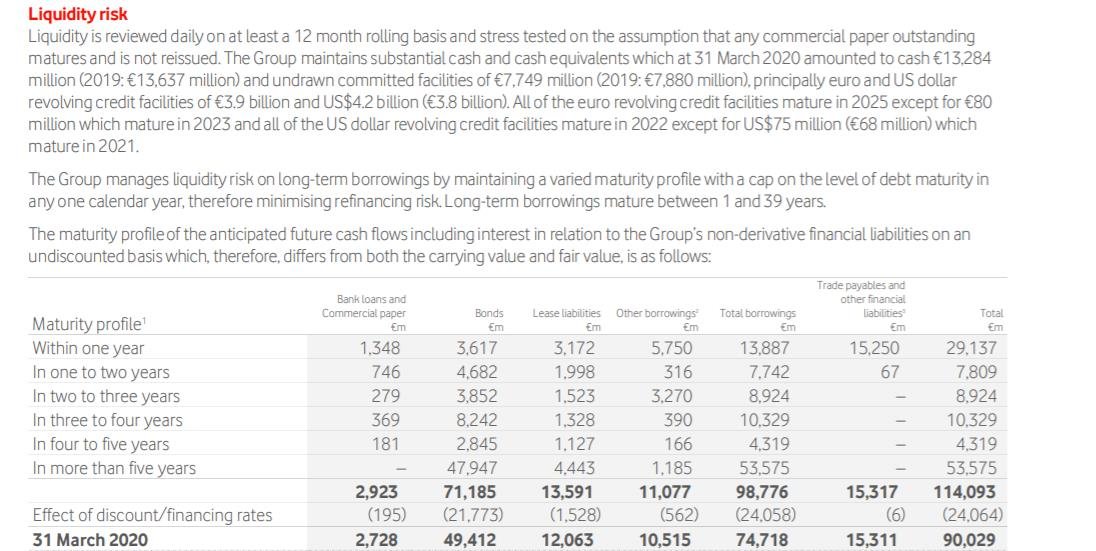
The disclosure explains how liquidity requirements are reviewed.
Annual maturity analysis for each type of financial liability has been provided.
In addition to providing the annual time bands for the first five years in their disclosure, the company reconciled their undiscounted amounts to the balance sheet, which is helpful.
Maturity analysis focuses on shorter time bands in the first year:
As required the disclosure covers contractual undiscounted cash flows. This includes interest.
Examples of better disclosure
The table below summarises the maturity profile of the Group's financial liabilities based on contractual undiscounted payments:
Airtel Africa Plc, Annual Report and Accounts 2020, p181
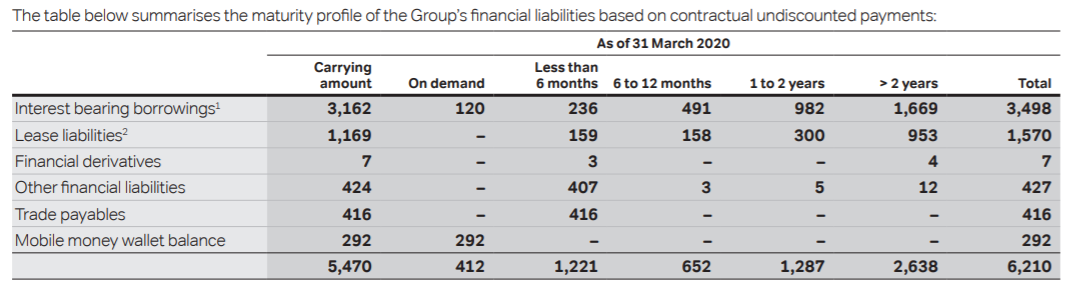
IFRS 7 requires that the maturity analysis should be based on the earliest date on which the company can be required to pay. It is helpful to have a separate time band for the amounts repayable on demand, particularly in the current climate.
The time bands used should be consistent with internal management information.
Dividends and capital management
IAS 1 paragraph 134 requires disclosure of the company's objectives, policies and processes for managing capital, which should include qualitative and quantitative information.
In this environment, we expect companies to explain any changes to their capital management in response to Covid-19, including what the companies manage as capital. This should include an explanation of the dividend policy, in particular:
- where the dividend has been suspended, it is helpful to indicate when the period of suspension is expected to end or the decision revised; and
- where the dividend policy is unchanged, it is helpful to explain how this decision links to the viability assessment.
Examples of better disclosure
'Dividend
To create capacity for BT's value-enhancing investment opportunities, including our strategic intent for an accelerated FTTP build and our extensive transformation and modernisation programme, coupled with the shorter term impact of Covid-19, the Board has decided that it is appropriate to suspend the final dividend for 2019/20 and all dividends for 2020/21. The Board expects to resume dividend payments in 2021/22 at 7.7 pence per share. The Board expects to continue with a progressive dividend policy from this re-based level for future years. The Board continues to expect to declare two dividends per year with the interim dividend being fixed at 30% of the prior year's full year dividend. The Board believes that suspending and re-basing the dividend and then maintaining a progressive dividend policy is the right thing to do for the long-term future of BT and that the headroom generated by this decision is prudent given the Covid-19 pandemic, while the investments will create significant additional value for shareholders.'
BT Group Plc, Annual report 2020, p44
Disclosure explains that dividends have been suspended.
Disclosure explains when the company expects to restore dividend payments.
Disclosure explains the reasons for the dividend suspension.
As announced by the HMT on 19 May 2020, issuers in the CCFF may be required to commit to restraint on their capital distributions and on senior pay. Issuers are required to provide a letter of commitment in relation to this to HMT if:
- an increase in an issuer's CCFF limit, over and above that suggested by the issuer's investment rating, is requested and approved; and/or
-
A CCFF transaction is entered which involved commercial paper maturing on or after 19 May 2021.
-
We would expect the company's dividend policy to explain how this has affected the dividend policy if relevant commercial paper has been sold to the CCFFL and how this might affect the dividend policy if relevant commercial paper were to be purchased by the CCFF in the future.
Examples of better disclosure
'Capital risk
The Board reviews the Group's capital allocation policy annually. The Group's capital allocation framework defines its priorities for uses of cash, underpinned by its principle to maintain a strong balance sheet with solid investment grade credit metrics. The framework has four priorities for the use of cash generated from operations: - re-investment in the business to drive organic growth; - maintaining a progressive dividend policy; • continuing to pursue selective strategic investment; and - to the extent that there is surplus capital to these needs, provide additional returns to shareholders. While the capital allocation policy will remain in place for the long term, as a result of the impact of COVID-19 the Board has reviewed actions to safeguard the business as a temporary modification to the policy.
While funding organic growth remains the Board's first priority, pressure on profit and cash in the short-term requires a reduction in operating and capital expenditure. With a focus on capital retention and sourcing of capital during the current period, the Board has decided to suspend capital returns to shareholders until there is greater visibility on market recovery. The Board has also reviewed the Group's access to funding including sources of debt and equity.'
Burberry Group Plc, Annual Report 2019/20, p249
The disclosure explains how the capital management policy has been amended in the light of Covid-19.
Companies should also ensure sufficient reserves are available when dividends are paid or approved by the shareholders, in addition to making this assessment when they are proposed.
Companies should bear in mind the following key requirements in respect of anticipated distributions:
- Share buy-backs must be supported by distributable reserves;
- CA 2006 s831 net asset test must be met for public companies; and
- Where proposed distributions and share buy-backs cannot be supported by the latest audited accounts, parent company interim accounts must be filed.
Strategic Report
S414C of the Companies Act requires companies to present a strategic report. The strategic report for a quoted company must – among other things – include a fair review of the company's business, a description of the company's business model and its strategy, a description of the principal risks and uncertainties facing the company and information about employees, social and community issues.
Our review of the strategic report was focussed on how companies have considered Covid-19 when preparing the business review, when presenting the principal risk and uncertainty disclosures, and when disclosing how they have fostered relationships with employees, customers, suppliers and others.
Business review
The Companies Act requires the strategic report to explain the way in which the company generates and preserves value, the company's year end position, and how it has developed and performed during the year. The business review should, therefore, include both information on historical performance but also forward looking information explaining the company's strategy and business model. The forward looking information provided in the strategic report is particularly important as it is this information that readers of accounts will focus on to enable them to understand how a company intends to navigate through Covid-19 related challenges.
Impact of Covid-19 on historical performance and year end position
- The impact of Covid-19 on reported results was immaterial for a number of companies sampled, probably due to the UK lockdown starting close to the year end. In these cases, companies focused on explaining the expected effect of Covid-19 on future performance.
- The quality of disclosures describing the impact of Covid-19 on reported performance and position varied for those companies that were materially affected by Covid-19. Most of the companies in our sample explained the operational effect of Covid-19 and how it had affected the results reported in the income statement. Only a small proportion of companies quantified the effect of Covid-19 on their income statement.
- Fewer than a quarter of companies we sampled commented on how Covid-19 had affected their balance sheet position as at the year end with fewer than half of these companies quantifying that impact.
-
None of the companies sampled discussed the effect that Covid- 19 had on their cash flow statement.
-
Helpful narrative disclosures explained how Covid-19 had impacted operations and explained the way in which these changes in operations had affected the company's in year performance and year end financial position.
- The most useful disclosures quantified the impact of Covid-19 using IFRS measures. (We discourage companies from using Covid-19 normalised alternative performance measures and from splitting income and expenses between Covid-19 and non Covid-19 financial statement captions. Please see pages 32-34 for further details).
- We expect the strategic report to comment on the impact of Covid-19 on the cash flow statement as well as the profit and loss account and the statement of financial position.
Examples of better disclosure
'Group revenue decreased 1.9%, largely as a result of lower UK Clothing & Home sales, including an adverse revenue impact of c.£83.5m in March which we largely attribute to Covid-19. Group statutory profit before tax declined 20.2% to £67.2m. This was largely driven by a decline in Clothing & Home operating profit as a result of lower sales. Statutory profit before tax includes an estimated total impact of £264.7m for Covid-19. This comprises a trading impact of £51.9m in March which we largely attribute to the pandemic, in addition to £212.8m of charges in adjusting items which includes the recognition of additional inventory provisions of £157.0m and the impairment of stores and goodwill of £49.2m.'
Marks and Spencer Group Plc, 2020 Annual report, p28
The disclosure explains the impact of Covid-19 on revenue.
The disclosure explains the impact of Covid-19 on profit before tax.
The disclosure states the expected total impact of Covid-19.
The disclosure notes whether the effect seen was as a result of a reduction in trading or write off of balance sheet items.
The disclosure notes the balance sheet impact of Covid-19.
Impact of Covid-19 on strategy and business model
- The impact that Covid-19 is expected to have on a business will be specific to each individual company. Therefore, it is important for businesses to explain clearly how their future strategy and business model may be affected by Covid-19.
All of the companies in our sample indicated that they had reconsidered their strategy in the light of Covid-19. However, the detail included within those disclosures varied significantly across our sample. Some companies clearly explained how Covid-19 had changed their strategy by noting what their new short term focus will be, how they expect that to affect financial performance and position and linking the strategy to principal risks and uncertainties. Other companies simply stated that they had reconsidered their strategy but provided very little further detail to explain the way in which the strategy has been reconsidered.
Examples of better disclosure
'Our strong liquidity position means that we are able to sustain the business throughout this crisis and take advantage of market opportunities as they arise: - Wizz Air's balance sheet is one of the strongest in the industry with €1.5 billion of total cash at the end of March 2020. - Further liquidity has been secured by raising £300 million under the UK Government's COVID Corporate Financing Facility (CCFF) in April 2020. - Immediate cost mitigation measures put in place include the reduction in third-party spending, overhead and discretionary spending as well as non-essential capital expenditure. - We reduced the number of employees by 19 per cent in the short term, in order to adjust the size of the company to the current circumstances. However, longer term it is expected that the workforce will be increased as the industry recovers and Wizz Air resumes its growth trajectory.
We are able to scale up operations quickly thanks to our agile setup: - We can stimulate traffic with low fares due to our ultra-low-cost base. - The majority of our passengers belong to a younger demographic that travels abroad regularly for work and to visit friends and relatives, which are more sustainable sources of traffic than tourism. - We are reviewing our aircraft allocation and will react to the new market reality by taking advantage of opportunities across Europe as other carriers withdraw capacity.'
Wizz Air Holdings Plc, 2020 Annual Report, p12
The disclosure explains the operational changes made in the short term.
The disclosure explains how the company expects to take advantage of future opportunities that may arise in the wake of Covid-19.
We observed the following areas of good practice:
- The strategic report stated clearly what the company's short term strategic focus had become and how that had changed as a result of Covid-19.
- The strategic report clearly explained how the strategy was to be achieved and the post period end operational steps taken to moving that strategy forward.
- The strategy was linked to any principal risks and uncertainties which had been amended or added as a result of Covid-19.
- The strategic report explained how the change in strategy was likely to impact financial performance (or explained why it was inappropriate to provide such guidance).
- The strategic report discussed the way in which longer term strategy could be affected.
- The strategic report explained any opportunities that may present themselves as a result of Covid-19 and how the company may take advantage of presented opportunities.
Examples of better disclosure
'Broadly speaking, in response to this crisis, our planning and actions have focused on preparing the business for five distinct phases, remaining mindful of the need within each phase to ensure readiness for both the next phase and potential reversion to the previous one. We have categorised these five phases as follows: I Pre-lockdown, II Lockdown, III Preparing to emerge, IV Post lockdown, V A new normal...
...III Preparing to emerge
It remains difficult to make precise judgements about how consumers will react as we emerge from lockdown. Over and above managing the business through the pandemic, however, we must endeavour to continue creating value for our shareholders by being well-placed for a recovery in demand. Importantly, all of our stores and nearly all our First Opinion practices have remained open through the crisis, providing some insight into likely future trends. Early indications are that some of the shopping habits that consumers have displayed during lockdown, notably social distancing, channel shift and the preference to purchase goods and services safely and conveniently, may persist post lockdown, thereby impacting the volume of customers we can serve in-store. Preparing for this has meant adapting our working practices and learning new ways to serve our customers across all channels, all the while remaining vigilant across our funding requirements, ongoing measures for cash preservation and prudent allocation of capital.
Retail
Our stores remain open and can respond quickly to changes in footfall. We maintain good availability across all of our product lines, branded and private label, and have extended the number of items we can sell across our full range of consumable and discretionary products. We have introduced further precautionary measures to enhance safe interaction with our customers, including protective masks for all our store colleagues, and implemented training for specific colleagues on the safe delivery of grooming services and contactless sale of pets. Recognising that we may need to maintain some form of social distancing post lockdown, we have successfully piloted a “Call and Deliver-to-Car” service, increased the contactless payment limit from £30 to £45, and made it easier for existing and new customers to sign up to our subscription services online as opposed to in-store. Importantly, the vast majority of our stores are situated on retail parks and, with an average trading space of approximately 6,400 sq ft., are more adaptable to social distancing than smaller, high street formats. Our previous investment in automation, fulfilment and digital capability has given us capacity to process double the pre-COVID-19 level of online orders, both across our UK-wide network of stores, which can be leveraged to meet omni-channel demand, and delivery direct to home. Mindful of the prevailing channel shift to online, which we expect COVID-19 to accelerate, we have been assessing options across our logistics network to ensure that we have a well-invested, fit-for-purpose platform that is capable of managing future growth and driving efficiency benefits.
Vet Group
Across our First Opinion practices, we have implemented training for our vet colleagues to ensure the safe delivery of non-urgent procedures, vaccinations and health checks. Healthcare subscription products, such as flea and worm treatments, can now be delivered direct to home, as well as collected in-practice, and we have accelerated plans to enable remote contact and the performance of remote consults between our Joint Venture Partners and their veterinary customers through an arrangement with “Vet Help Direct".'
Pets at Home Group Plc 2020 Annual Report, extract from pp 16-19
The disclosure states that the group intends to respond to Covid-19 by categorising their business response into five phases.
The disclosure explains the company's priorities during this phase.
The disclosure explains the way in which the company has adapted operationally to meet their priorities.
Principal risks and uncertainties
The strategic report requires companies to describe the principal risks and uncertainties facing a company and how these principal risks are mitigated.
-
Given the company specific nature of Covid-19, we expect companies to consider the specific resources, assets and relationships that are most under threat and the steps being taken to protect them when setting out their principal risks and uncertainties. All the companies within our sample disclosed a new, Covid
-
19 based principal risk with most of the companies sampled also updating their pre-existing risks and uncertainties to take account of the specific impact of Covid-19 on those individual risks. We did not identify companies who had completely refocused their principal risks and uncertainties as a result of Covid-19.
Although all companies in the sample identified Covid-19 as a principal risk, the quality of the disclosures presented was varied. Some companies clearly explained the specific risks they faced as a result of Covid-19, outlined the specific mitigations for each of these risks and linked risks identified to their strategy. Weaker disclosures identified Covid-19 as a risk but did not clearly articulate the specific risk faced by the company, the way in which the specific risk was mitigated and failed to link the risk to strategy.
We observed the following areas of good practice:
- Covid-19 risks identified were company specific, rather than generic, and clearly explained how the risk could impact future financial performance.
- Mitigations identified covered all the Covid-19 specific risks disclosed.
- Risks identified were linked to strategy, business model and key performance indicators.
- The future outlook of the risk was discussed.
- The impact of Covid-19 on the risk profile of pre-existing risks was explained.
- Existing risks were amended to take account of the impact of Covid-19 meaning risks remained focused to the company.
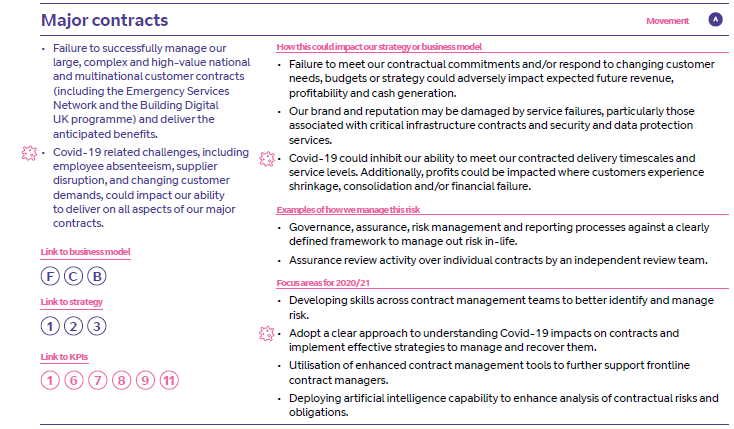
The disclosure clearly shows the principal risks and how they are linked to strategy.
Change in risk profile during the year clearly shows the change in risk attributable to Covid-19.
Companies that are required to comply with the DTR rules must include a description of the principal risks and uncertainties for the remaining six months of the financial year in accordance with DTR 4.2.7. Consequently, we would expect interim management reports to explain the relevant risks and uncertainties that may have changed since their previous annual accounts were published.
Disclosure clearly identifies Covid-19 as a new, emerging risk.
Disclosure notes how the company intends to manage risk.
Pre-existing principal risks have been amended for Covid-19 with amendments identified by a virus symbol.
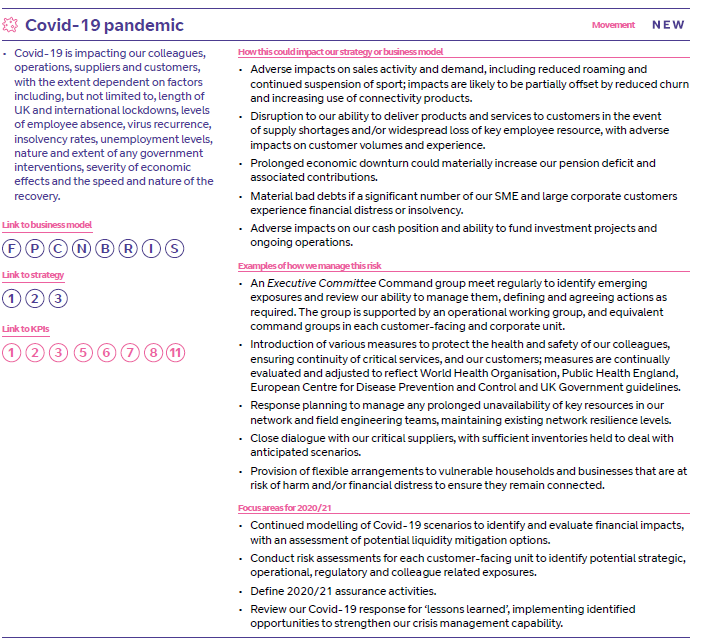
Risk has been linked to strategy, business model and key performance indicators.
Disclosure explains how the risk will be monitored over the next year.
BT Group Plc Annual Report 2020 pp53 and 57
Information on Employee, Supplier and Customer relationships
The protection and retention of staff and the ability of the directors to have fostered business relationships with suppliers, customers and others is likely to be crucial to a company's ability to navigate the challenges arising as a result of Covid-19 and to rebuild when the opportunity arises, particularly since it is these interactions that impact corporate memory.
As a consequence, all stakeholders, including investors, are concerned not only about a company's workforce and how they are being retained and supported but also about how supplier and customer and other relationships have been maintained during the Covid-19 pandemic.
Section 414CZA of the Companies Act requires the strategic report to include a statement which describes how the directors have had regard to the section 172 matters when performing their duty under section
- These matters include how the directors have had regard to employee interests and how the directors have considered the need to foster business relationships with suppliers, customers and others. Consequently we expect the financial statements to include narrative disclosures which explain how relationships with employees, customers, suppliers and others have been maintained during the pandemic.
The most useful employee disclosures explained:
- Whether or not employees had been furloughed, and in cases where employees had been furloughed the number of employees furloughed, the percentage of pay they were receiving and whether or not the company had accessed the government's Coronavirus Job Retention Scheme.
- Whether or not bonuses will be paid and salary reviews conducted as normal.
- How shielding and self isolating employees are remunerated.
- The physical measures (eg PPE) put in place to keep staff, who are unable to work from home, safe.
- The initiatives that had been introduced and offered to employees to help maintain mental health and well being.
- The extent of the workforce that is working from home and the support that had been provided to them to enable them to continue to carry out their work.
Information in respect of Employee relationships
All of the companies in our sample articulated how they had considered the interests of employees when formulating their response to Covid-19.
Most of the companies in the sample explained whether they had placed employees on furlough, with some also explaining how they intended to remunerate employees during the pandemic.
Many of the companies sampled also discussed the changes they had made in order to keep their employees safe. However, the focus of the disclosures presented in this area varied between companies, with some choosing to focus on the physical changes they had made to keep employees safe whilst others focused on how they had tried to maintain employees' mental health and well being during the pandemic.
Examples of better disclosure
'Where possible all our employees are working from home, using enabling technology solutions and working flexibly around their domestic circumstances. For those employees unable to work from home, primarily our factory-based teams, we have implemented both social distancing and elevated health measures, including temperature checking and additional cleaning regimes, to ensure the safety of our people. All employees classified as vulnerable, or with a vulnerable family member, were identified early on and special measures put in place to support and safeguard them. As you would expect we have adopted all government and public health authority guidelines in each of our markets. We have also put additional measures in place to support the health and wellbeing of all our employees in these uncertain times.'
Britvic Plc, 2020 Interim results, p3
Disclosure explains the physical steps the company has taken to ensure the safety of employees unable to work from home.
Examples of better disclosure
'We provide an essential role in keeping the nation's pets happy and healthy, but we have taken significant steps to ensure that this is appropriately balanced with the need to focus on our colleagues' health and wellbeing. You can read the full details of the Group's actions in the CEO statement on page 16, but the pay-related actions taken to date include: - Paying those colleagues undertaking 12 weeks of self-isolation 100% of their average earnings throughout this period. - Furloughing colleagues on a voluntary and non-mandatory basis, and paying them 80% of their normal earnings. We have taken the decision across the Group not to participate in the Government's Job Retention Scheme (JRS) for any of these colleagues. However, we continue to review the position regarding a small proportion of colleagues for whom a prolonged period of shielding may be necessary; predominantly those who are either highly or extremely vulnerable or are carers – and, dependent upon government guidance, may participate in the JRS for these colleagues in future. - Across our Vet Group, our Joint Venture Partners operate independent businesses and are solely responsible for the decisions made in respect of their colleagues. A number of Joint Venture Partners have elected to participate in the JRS. - Paying an additional recognition payment which in total exceeded £1.9m to all those colleagues in our stores whose outstanding commitment meant we could continue to supply the nations' essential pet care needs. - Ensuring all eligible colleagues will still receive their bonuses in respect of FY20 in line with the usual timeline. - Whilst not directly pay related, to further support our colleagues' financial wellbeing through this period, we have added £1m to our colleague hardship fund and relaxed the application criteria to make it possible for colleagues to access these funds should they be experiencing significant financial hardship as a result of the COVID-19 crisis'
Pets at Home Group Plc 2020 Annual Report, pp112-113
The disclosure clearly articulates the remuneration arrangements applying to staff during the pandemic.
Examples of better disclosure
'We quickly mobilised all staff to work from home and cancelled all business travel. No staff were furloughed. - Clear, consistent but personal messages for staff. - Practical support and guidance to aid working from home including early identification and sourcing of equipment, test days to ensure systems worked remotely, cyber security training, ongoing technical support and grants for home equipment. - Mental and physical health prioritised with risk profiling and regular contact to support wellbeing. Social initiatives implemented to combat isolation and boost morale. - Flexibility and staff autonomy promoted and training provided on managing teams remotely with support and guidance from HR. - Succession planning in place. Regular review of workloads.'
Assura Plc, Annual Report and Accounts 2020, p19
The disclosure states that no staff were furloughed.
The disclosure explains how the physical well being of staff has been supported.
The disclosure explains how the mental well being of staff has been supported.
Information on supplier relationships
Fewer than half of the companies in our sample explained how they had supported their suppliers through the pandemic.
When disclosures around changes to supplier relationships were provided, they were often limited and simply explained that suppliers were paid promptly with a small minority of companies noting that they had increased their dialogue with their suppliers as a result of Covid-19.
- We expect supplier payment disclosures to cover the financial and non-financial ways the company has supported the supplier. Disclosures should cover changes to payment terms, any payment arrangements in respect of stock part way through production but not purchased as a result of Covid-19 and should cover any non-financial support offered to the supplier which may include guidance offered or training provided.
Examples of better disclosure
'Our suppliers - We've worked closely with our suppliers and contractors, supporting them to prioritise the health of their teams and to apply best practice guidance for construction and essential building works at this time. - Prompt payment of invoices to aid supplier cash flow. - Support provided to contractors to work safely on site and when visiting premises. Regular contact maintained to identify issues and provide support and aid remobilisation. Remote meetings/inspections. Technology employed to advance schemes'
Assura Plc, Annual Report and Accounts 2020, p19
Disclosure notes the non-financial support offered to suppliers.
Disclosure notes the financial support offered to suppliers.
Information on customer relationships
The majority of companies in our sample explained how they had supported customers in the pandemic.
Disclosures presented were company specific and explained that additional goods and services had been provided to customers for free during the pandemic, or that customers facing financial difficulties as a result of Covid-19 had been offered improved payment terms.
Examples of better disclosure
'We understand that Covid-19 has made day-to-day operations difficult and complex for our customers, and we support the Government's view that no organisation should be left unable to survive as a result. We strongly believe that business has a role to play in delivering assistance. - We have provided support for those customers who are in genuine and immediate financial distress, establishing a support fund to provide up to £80m of rent relief for customers who need our help most to survive. - Around £15m of this fund will support our food & beverage customers, broadly equivalent to three months' rent free. The remaining £65m will be allocated on a case-by-case basis to small and medium sized businesses with a focus on helping those with limited access to other sources of financial assistance. - Non-payment of rent has a serious impact on our business. In order for us to help those customers most in need, we expect those who can afford to pay their rent to do so. Where we are unable to offer assistance from our support fund, we will consider requests to defer rents or a move to monthly rents. - We are responding to the changing environment and investment needs. We're committed to reducing service charge costs, not only in response to the current situation but also through the work started last year on how we run our sites in the most efficient way possible.'
Land Securities Group Plc, Annual Report 2020, p2
Disclosure notes why it is important to provide support.
Disclosure notes the range of financial support offered to customers.
Examples of better disclosure
The safety of our customers is paramount to us. We have executed various social educational digital campaigns explaining best practices during the COVID-19 outbreak, and the importance of being safe. We have also made a number of sites across our businesses accessible free of charge to give students continuous access to quality education. In addition, we have implemented a number of initiatives to support our customers, including zero transaction fees on money transfers, free text messages, extra bonuses on data bundles through Airtel Money subscriptions, and increased availability of home broadband products to support working from home.'
Airtel Africa Plc, Annual Report and Accounts 2020, p9
The disclosure notes the non-financial support offered to customers and the reasons why the support is important.
Disclosure identifies the free services provided to customers and why this is important.
Information on customer relationships
The majority of companies in our sample explained how they had supported customers in the pandemic.
Disclosures presented were company specific and explained that additional goods and services had been provided to customers for free during the pandemic, or that customers facing financial difficulties as a result of Covid-19 had been offered improved payment terms.
Examples of better disclosure
'We understand that Covid-19 has made day-to-day operations difficult and complex for our customers, and we support the Government's view that no organisation should be left unable to survive as a result. We strongly believe that business has a role to play in delivering assistance.
- We have provided support for those customers who are in genuine and immediate financial distress, establishing a support fund to provide up to £80m of rent relief for customers who need our help most to survive.
- Around £15m of this fund will support our food & beverage customers, broadly equivalent to three months' rent free. The remaining £65m will be allocated on a case-by-case basis to small and medium sized businesses with a focus on helping those with limited access to other sources of financial assistance.
- Non-payment of rent has a serious impact on our business. In order for us to help those customers most in need, we expect those who can afford to pay their rent to do so. Where we are unable to offer assistance from our support fund, we will consider requests to defer rents or a move to monthly rents.
- We are responding to the changing environment and investment needs. We're committed to reducing service charge costs, not only in response to the current situation but also through the work started last year on how we run our sites in the most efficient way possible.'
Land Securities Group Plc, Annual Report 2020, p2
Disclosure notes why it is important to provide support.
Disclosure notes the range of financial support offered to customers.
Information on other relationships
All but one of the companies sampled provided disclosures on how they had fostered other relationships during the pandemic with all the companies providing disclosure in this area choosing to focus on how they had helped their communities.
We observed the following areas of good practice in disclosing community interactions:
- Disclosures were company specific.
- Disclosures clearly explained who the company helped, the way in which the company helped and why the company chose to help.
- Amounts donated to worthy causes were quantified.
- Disclosures explained how company resources had been used to support communities.
- Involvement of employees in providing support to communities was disclosed.
Examples of better disclosure
'Alongside our external commitments, many of our employees around the world looked to Burberry for guidance on how they could help the COVID-19 relief efforts. Burberry teams around the world volunteered their time generously, mobilising to help local communities and charities by preparing care packages, delivering meals, stocking food banks and supporting vulnerable neighbours. In a short space of time, The Burberry Foundation also launched a global COVID-19 community appeal, which offered employees a way of supporting emergency response efforts by donating to the community fund. All funds raised by The Burberry Foundation's COVID-19 community fund appeal are supporting emergency response efforts, including the procurement and distribution of personal protective equipment (PPE) and other medical materials, contributions to foodbanks, donations to healthcare charities and additional support for those working to tackle the pandemic.
SUPPORTING MEDICAL AND CARE WORKERS We retooled our trench coat factory in Castleford to manufacture non-surgical gowns for medical and care workers and sourced surgical masks through our global supply chain. By the end of May, we had donated more than 150,000 pieces of personal protective equipment to the UK's National Health Service and healthcare charities, and this number has continued to grow.
PROVIDING RESOURCES FOR OTHER COMPANIES TO HELP WITH PPE PROCUREMENT AND PRODUCTION Burberry engaged with industry and governmental organisations on coordinated responses to the pandemic. In support of the UK Government, we also produced a document, which provided information on adapting operations to procure and/or manufacture PPE. This document was designed to be shared with companies across sectors looking to respond to the COVID-19 pandemic
SUPPORTING FOOD CHARITIES We donated to registered charities, including FareShare, The Trussell Trust and The Felix Project, which are dedicated to tackling food poverty across the UK. With pressure mounting on food supplies, the charities expanded their efforts to help those struggling as a result of the outbreak. This included setting up community produce hubs, delivering food to young people reliant on free school meals and providing more pre-packed food parcels to help foodbanks cope with increased demand. Burberry's donation to The Felix Project funded the delivery of food equating to 495,000 meals across London, going to those who could not access basic nutrition.
SUPPORTING RESEARCH INTO A SOLUTION We helped to fund research undertaken by the University of Oxford into the development of a single-dose vaccine. The university has one of the world's best track records in emergency vaccine development, with past success in fighting Ebola and Middle East Respiratory Syndrome (MERS).
SUPPORTING CREATIVE COMMUNITIES To support creatives, artists and photographers facing greater uncertainty during the COVID-19 pandemic, we have commissioned works to showcase on our Instagram news feed. Riccardo Tisci started this initiative as a way to celebrate and support members of the creative community. Burberry has always believed in the power of craft and creativity. In a twist on our heritage of discovery and exploration, we asked artists to respond to the theme of "Inside Nature."
Burberry Group Plc, Annual Report 2019/20 pp56-58
Disclosure explains how employees have helped in supporting communities.
Disclosure clearly documents how the company's resources have been used in supporting the community.
Alternative performance measures
Alternative performance measures (APMs) have been a focus of our work in recent years and were the subject of a previous thematic review published in
- Whilst the principles around reporting APMs set out in our 2017 thematic review remain relevant, the FRC's Company Guidance 1 was updated in May to provide additional guidance in the current environment.
We expect companies to present APM disclosures that:
- have clear and accurate labelling;
- have an explanation of their relevance and use;
- are reconciled to the closest IFRS measure; and
-
are not given more prominence than the equivalent IFRS measures.
-
Whilst APMs should be presented consistently year-on-year, we note that companies may wish to modify or change their APMs if, because of Covid-19, changes in their operations or business model result in consequential changes to the APMs used to run and monitor the business. In these circumstances, readers should be informed of any such changes and provided with an explanation of why they provide reliable and more relevant information.
- APMs which attempt to provide a measure of 'normalised' or 'pro-forma' results, excluding the estimated effect of the Covid-19 crisis, are likely to be highly subjective and, therefore, unreliable. In addition to the subjectivity arising around which costs to exclude, in most cases Covid-19 is likely to have resulted in reductions in revenues. Any adjustment for lost revenues will also likely be highly subjective and, therefore, unreliable. We do not expect companies to provide these measures; for example, by including them in a 'third-column' income statement presentation or as an adjustment in arriving at 'underlying earnings'. None of the companies in our sample presented such a non-GAAP measure.
Whilst all the companies in our sample used alternative performance measures (APMs) to explain their performance, none of the companies dropped or added APMs as a result of Covid-19.
In two cases, companies presented inventory write downs and impairments as Covid-19 adjusting items. The tax effect was also incorporated into adjusted profit measurement. Such write downs were identified as adjusting on the grounds that they were material and one-off, in accordance with their existing policies.
- In one case, a company categorised the incremental increases attributable to Covid-19 arising on the impairment of non-current assets and credit losses as adjusting items. Companies need a reliable methodology to be able to quantify the incremental component and any such methodology would need be able to be applied both at the reporting date, and on an ongoing basis. However, given the inherent complexities in separating the Covid-19 element from other factors when making such forward looking assessments, we consider it unlikely that such a hypothetical determination would be reliable.
- Companies should be even-handed in their treatment of Covid-19 related gains and losses. In one case, a company also identified, as an adjusting item, a gain related to reversal of accrued costs relating to share-based payments no longer expected to vest. Looking forward, the same principle would also apply to any future reversals of inventory write downs or impairments, which we expect to be classified as adjusting if the earlier charge was so classified.
- The Covid-19 crisis has resulted in some significant market volatility and, in some cases, companies might feel it appropriate to strip out the effect of these movements. In one case, a company removed a material gain arising on a derivative used in a cash flow hedge on the grounds that the related hedge item was not so adjusted. This had the effect of increasing net debt. Whilst we can see the logic of making this adjustment in view of the accounting mismatch, we note that the definition of net debt was not amended and no explanation was given about why this adjustment was necessary.
Presentation of primary statements
Income statement
IAS 1 requires that companies disclose individually material items on the face of the income statement or in the notes to the accounts. IAS 1 also requires companies to present additional line items and sub totals, which are comprised of line items made up of amounts recognised and measured in accordance with IFRS on the face of the income statement, if the presentation of such subtotals and line items aids a user's understanding of the company's financial performance.
Companies will need to consider whether additional items of income and expenditure arising from the Covid-19 crisis should be separately disclosed in accordance with their existing policies for 'exceptional' or similar items.
The materiality of items such as restructuring costs, impairment charges, incremental health and safety costs, and the costs of onerous contracts will need to be considered by each company.
In our sample of annual accounts, one-third of the companies included 'exceptional' or similar items which were specifically highlighted as arising from Covid-19.
Although IAS 34 does not mandate the inclusion of accounting policies within interim accounts if they are consistent with those included in the prior year annual financial statements, in the current environment, it would be helpful to the user for companies to include the accounting policy for 'exceptional' items from their annual accounts.
We observed the following areas of good practice:
- Exceptional or similar items included in a single note or linking them with cross references.
- Exceptional of similar items accompanied by narrative explaining the tax impact.
- The inclusion of items as 'exceptional' or similar items was explained and linked to the company's existing accounting policy for such items and narrative explained that any reversal of the amount recognised would also be recognised as an 'exceptional' or similar item.
As explained in the FRC's Company Guidance, we expect companies to:
- be even-handed in identifying any gains as well as losses;
- not describe amounts as 'non-recurring' or 'one-off' if they are also expected to arise in future periods;
- not disclose costs as exceptional solely because of a reduction in, or elimination of, the related revenue streams due to the Covid-19 crisis; and
- not identify incremental costs as exceptional if they result in incremental revenue that is not also described as exceptional.
Some effects of Covid-19 will be pervasive and hard to quantify. In these circumstances, it is helpful to provide narrative disclosures explaining the nature of the items and the uncertainties around them.
- We discourage companies from splitting discrete items on an arbitrary basis in an attempt to quantify the portion relating to Covid-19 as it is unlikely to provide users with reliable information.
- In our sample, one company in the telecommunications sector, disclosed a material impairment loss in respect of goodwill on the face of the income statement. This presentation was consistent with material impairment losses in prior periods. Whilst there was narrative which explained that the assumptions applied included adjustments to the forecasts as a result of Covid-19, the company did not attempt to separately quantify this or strip it out of the total impairment loss recognised.
- One company in the retail sector included a component of the impairment loss in respect of non-current assets which was attributed to be a result of Covid-19, as an 'exceptional' or similar item. Given the number of factors which need to be incorporated into a value in use calculation, it may be difficult to determine reliably the element which is purely related to the Covid-19 crisis, consequently we would not expect companies to attribute impairment losses in this way.
- One company presented the entire impairment loss of non-current assets as 'exceptional' but disclosed the element of that impairment loss it considered caused by Covid-19 in the notes. As explained above, companies would need a reliable methodology to determine such a split, which we expect would be difficult to apply both at the reporting period end and on an ongoing basis given any such determination would be expected to be hypothetical as if the pandemic had not occurred.
Income statement (continued)
Following the adoption of IFRS 9, IAS 1 was amended to require that the impairment loss arising from applying the expected credit loss model should be presented as a separate line item on the face of the income statement (paragraph 82(ba)).
- For some companies, such a charge may not have been material enough to warrant separate presentation. However, in the current environment we expect to see more companies consider whether the charge should be presented separately on the face of the income statement rather than disclosed in the notes to the accounts.
- One company highlighted an increase in the expected credit losses, which it attributed to Covid-19. As a result, the total charge in respect of the expected credit losses had become material but it was not disclosed on the face of the income statement as required by IAS 1.
- One company, continued to present the expected credit loss charge as a separate line item on the face of the income statement without trying to split out any component of the provision as attributable to Covid-19.
- One company included an increase in the expected credit loss of financial assets as an exceptional item on the basis that the company had not had significant credit losses previously and referred to it as a one-off in nature. However, the company's accounting policy for exceptional items referred to the requirement to be one-off and material. In this instance, it was not clear that the amount was material and, if it had been, then we would have expected it to be disclosed separately on the face of income statement as required by IAS 1 rather than in the notes to the accounts.
Statement of financial position
IAS 1 requires that when a company breaches a covenant on borrowings before the end of the reporting period which results in the liability becoming payable on demand, the liability should be classified as current. This is the case even if the lender agreed after the reporting period to waive the breach.
In the current environment, the financial impact of Covid-19 may cause some companies to either breach covenants or trigger material adverse change clauses. As a consequence, this could result in loan repayment terms changing and some loans becoming repayable on demand, leading to a change in the classification between current and non-current in the statement of financial position.
In the sample of companies selected, none of the companies appeared to have breached their covenants at the end of the period. As such, none of the companies were presenting a change in the classification of their borrowings between current and non-current.
Similarly, none of the companies in our sample of interims appeared to have breached their covenants.
However, we note that the companies selected were all March reporters and so whilst we did not identify companies having to reclassify their borrowings, this might become a more significant issue over the coming months.
- In order to avoid reclassification for a breach of covenants which has occurred on or before the year end, the company's lenders will need to have agreed to provide a period of grace which extends for at least 12 months after the reporting period end, in advance of the end of the company's reporting period.
Expected credit loss provisioning
The IFRS 9 expected credit loss model (ECL) requires the use of reasonable and supportable forward looking probability-weighted information in addition to the historical data. IFRS 9 requires an unbiased expected credit loss provision, neither overly optimistic nor overly pessimistic.
Obtaining reasonable and supportable forward looking information is likely to be challenging in the current environment and may involve a high degree of judgement and estimation uncertainty. We expect companies to explain:
- changes to their credit risk management in response to Covid-19;
- concentration of credit risk;
- how forward looking information was incorporated in the ECL measurement;
- any significant adjustments made by management to the impairment figures and models; and
- key sources of estimation uncertainty.
Examples of better disclosure 'Mitigation * Our Customer Relationship Management processes actively monitor our customer base and performance * We have a robust credit policy and process which defines what level of credit risk we will accept * Our Property Committee reviews customers at risk and agrees the best plan of action, as well as monitoring online sales trends...
Change in year prior to Covid-19 We were already operating in a tough retail environment, with a number of company voluntary arrangements (CVAs) throughout the year, and like-for-like footfall and retail sales declining. We were monitoring our retailers at risk of CVA and looking at more flexible leasing options in retail. The office market had remained resilient through
- We elevated this risk last year to reflect the deterioration in the retail market.
Covid-19 impact: change since Dec-19 The Covid-19 outbreak is a very challenging time for many businesses and, in particular, some of our retail and leisure customers. We are regularly communicating with our customers and are engaged in conversations about how we can support them through this difficult time. We continue to closely monitor the cash collections of rents across the whole portfolio and we have seen a material reduction in cash collections in late March
- This indicates a likely increase in business failures and we are closely monitoring any customers in financial distress. We expect to see greater non-payment of rent as we move through 2020. We have established a support fund to provide up to £80m of rent relief for customers – around £15m of this fund will support our F&B customers and the remaining £65m will be allocated on a case-by-case basis to small
- and medium-sized businesses.'
Land Securities Group Plc, Annual Report 2020, p52
The company explained their usual policies in the Strategic report, which the Financial risk management section usefully cross-refers to.
The Strategic report provides an update on mitigating measures during the year, which are helpfully split into pre
- and post- Covid-19 sections.
Companies in our sample used the simplified approach for trade receivables and contract assets, which requires the recognition of lifetime credit losses upfront.
We observed instances where:
- A significant reduction in receipts from customers was identified as a plausible scenario in the going concern assessment, but it was not clear whether this scenario has been incorporated in the ECL assessment;
- Information required by IFRS 7 was missing in respect of the ECL assessment of material balances other than trade receivables;
- Disclosure about concentrations of credit risk was not provided; and
- Impairment of financial assets was identified as a significant estimate, but no disclosure of sensitivities was provided.
We expect companies with material assets in the scope of the IFRS 9 ECL model to provide sufficient disclosure to enable users to understand the exposure to credit risk and the company's ECL assessment at interims.
- Some companies with significantly disrupted business activities did not comment in their interim accounts on the impact of Covid-19 on their credit risk exposure and ECL provisions. We would expect companies to include such disclosures in their interim accounts.
| Type of asset | IFRS 9 ECL model applies? | IFRS 7 credit risk disclosures apply? |
|---|---|---|
| Assets measured at amortised cost: | ||
| Cash and cash equivalents | √ | √ |
| Trade receivables | √ | √ |
| Loans to associates and JVs, including 'permanent as equity' | √ | √ |
| Other debt instruments | √ | √ |
| Debt instruments at FVOCI | √ | √ |
| Leasing receivables under IFRS 16: | ||
| Net investment in finance lease | √ | √ |
| Operating lease receivables | √ | √ |
| Contract assets under IFRS 15 ' Revenue from contracts with customers.' | √ | √ |
| Loan commitments and financial guarantee contracts not at FVTPL | √ | √ |
As set out in the table opposite, the scope of the IFRS 9 ECL model is quite wide and should not be overlooked.
The company provided a helpful indication of concentration of credit risk.
Although the impairment charge is not material to the accounts, the company helpfully clarified their assessment of the increase in ECL in response to Covid-19. It also disclosed a clear provision matrix in its financial statements.
Elsewhere the company highlighted significant estimation uncertainty regarding the outcome of Covid-19 and its economic impact and clarified that any updates to the ECL provision are not expected to result in a material change in the next 12 months.
The company confirmed that it considered impairment of receivables other than trade receivables, and provided specific detail in respect of an individually material receivable.
Concentrations of credit risk
Companies are required to disclose information in respect of concentrations of credit risk. In the current climate we expect:
- companies with significant credit risk exposure to highly impacted industries (eg, travel and hospitality sectors) to quantify their exposure to these sectors as well as to individual material customers and explain the measures taken in response to the increase in the credit risk.
- companies to identify any contract assets (eg in outsourcing contracts) that have large single exposures and to address such cases in their disclosures.
Examples of better disclosure Trade receivables “The Group has no significant concentrations of credit risk. The trade receivables balance is spread across a large number of different customers with no single debtor representing more than 4% of the total balance due (last year: 5%)...
...At 28 March 2020, management have assessed the expected credit losses for trade receivables. Due to the global financial uncertainty arising from COVID-19, management have increased the expected loss rates for trade receivables based on their judgement as to the impact of COVID-19 on the trade receivables portfolio. In addition, certain individual customers (where there is objective evidence of credit impairment) have been identified as having a significantly elevated credit risk and have been provided for on a specific basis. This has resulted in a charge of £12.3 million for impairment provisions recognised in profit and loss in the year, of which £9.1 million is considered to relate to the impact of COVID-19...'
Receivables excluding trade receivables '...As at 30 March 2019, the expected 12 month credit losses of receivables, other than trade receivables, were negligible and hence there were no impairments of these receivables. At 28 March 2020, management assessed that there was an increased credit risk relating to store rent deposits, as a result of COVID-19, and hence recorded a provision of £2.0 million.
During the year ended 31 March 2013 the Group entered into a retail leasing arrangement in the Republic of Korea. As part of this arrangement, a KRW 27 billion (£19.3 million) 15-year interest-free loan was provided to the landlord. The Group holds a registered mortgage over the leased property for the equivalent value of the loan which acts as collateral. At 28 March 2020, the discounted fair value of the loan is £15.5 million (last year: £15.2 million). The book value of the loan, recorded at amortised cost, is £13.4 million (last year: £13.3 million). Other than this arrangement, the Group does not hold any other collateral as security. Management consider that the security provided by the mortgage is sufficient risk mitigation and hence the credit loss relating to this receivable is not significant. '
Burberry Group Plc, Annual Report 2019/20, p247
Disclosure of financial assets by credit risk rating grades
- IFRS 7 was consequentially amended by IFRS 9, introducing enhanced disclosures in a number of areas, one of which is in relation to credit risk and ECL provisions. IFRS 7 requires disclosure of gross carrying amounts of financial assets by credit risk rating grades. The new disclosures were missing in a number financial statements we reviewed.
Examples of better disclosure 28. FINANCIAL RISK MANAGEMENT (CONTINUED) Credit risk (continued) The expected credit loss allowance for receivables was determined as follows:
| £m | Current £m | Less than 1 month overdue £m | Less than 2 months overdue £m | Less than 3 months overdue £m | Over 3 months overdue £m | Total £m |
|---|---|---|---|---|---|---|
| As at 28 March 2020 | ||||||
| Trade receivables | ||||||
| Expected loss rate % | 7% | 18% | 18% | 18% | 53% | |
| Gross carrying amount trade receivables | 79.5 | 22.9 | 7.1 | 5.2 | 8.8 | 123.5 |
| Loss allowance | (5.5) | (4.1) | (1.2) | (1.0) | (4.7) | (16.5) |
| Lease deposits | ||||||
| Expected loss rate % | 5% | |||||
| Gross carrying amount lease deposits | 40.0 | 40.0 | ||||
| Loss allowance | (2.0) | (2.0) | ||||
| As at 30 March 2019 | ||||||
| Trade receivables | ||||||
| Expected loss rate % | 1% | 4% | 6% | 7% | 64% | |
| Gross carrying amount trade receivables | 102.2 | 12.1 | 4.3 | 1.4 | 4.5 | 124.5 |
| Loss allowance | (1.1) | (0.5) | (0.2) | (0.1) | (2.9) | (4.8) |
Burberry Group Plc, Annual Report 2019/20, p248
The provision matrix clearly illustrates the increase in ECL provision as the length of time amounts are over due also increases.
Loans to associates and joint ventures
Loans to associates and joint ventures also fall into the scope of IFRS 9 ECL requirements, even where such loans are very long term and are considered in substance to form part of the investment in subsidiaries.
- The three-stage impairment model should be applied to loans to joint ventures, associates and intercompany loans in the parent company individual financial statements. Determining whether there has been a significant increase in credit risk, which would result in the recognition of lifetime credit losses, is likely to be challenging in the current environment.
Parent company individual accounts: Intercompany receivables
Parent companies should update their ECL provision for financial assets in their individual accounts at each reporting date. Loans to subsidiaries are often material and impairment losses may affect distributable profits of the parent.
Examples of better disclosure "Trade and other receivables
The trade and other receivables balance comprises of intercompany loans with companies within the Group. These Group companies are assessed at each reporting date as to their ability to repay outstanding balances. The amounts owed by Group companies at 28 March 2020 comprise £445.5 million owed by Burberry Limited (last year: £553.2 million).
The counterparty credit risk of trade and other receivables is reviewed on a regular basis and assessed for impairment as follows:
- At inception the receivable is recorded net of expected 12 month credit losses. If a significant increase in the credit risk occurs during the life time, credit losses are recorded in the profit and loss account and the effective interest is calculated using the gross carrying amount of the asset. If a loss event occurs, the effective interest is calculated using the amortised cost of the asset net of any credit losses. The Company's most significant debtor, Burberry Limited, is the holder of the Burberry brand and the main operating company of the Group. Burberry Limited has cash and cash equivalents of £762.4 million at 28 March 2020 and borrowings of £300.0 million. Based on its liquidity and expected cash generation, the expected 12 months credit loss for Burberry Limited trade and other receivables is not considered to be significant. As a result, no impairment has been recorded for amounts owed by Group companies.'
Burberry Group Plc, Annual Report 2019/20, p267
Disclosure explains how ECLs have been assessed for intercompany receivables.
It was not clear in some cases whether the ECL assessment for material intercompany balances had been performed. Where the company considers that no material ECL provision is required, it is helpful to state this fact and to explain the reasons for this conclusion.
Significant judgements and estimates
Judgements and estimates is an area of reporting which, historically, has given rise to the highest number of questions put to companies. In the current environment, transparency of disclosures in this area is of increased significance, as noted in the FRC's Company Guidance.
Our recent Annual Reviews of Corporate Reporting have recorded that we have seen improvements in the way in which companies have disclosed judgements and estimates; but we acknowledge that Covid-19 presents companies with a considerable new challenge for reporting in this area.
Our current focus is on encouraging companies to provide detailed disclosures of the accounting judgements and sources of estimation uncertainty in respect of their financial statements, as noted in our judgements and estimates thematic review 2 .
However, in providing as much detail as relevant to a user's understanding, companies should avoid boilerplate and provide company specific disclosures.
In the current environment, management may have to exercise judgement in determining whether or not there are material uncertainties that may cast significant doubt upon the company's ability to continue as a going concern. This judgement should be disclosed in accordance with IAS 1 paragraph 122, as explained in an agenda decision set out in the July 2014 IFRIC Update.
IAS 1 paragraph 125 requires the disclosure of key sources of estimation uncertainty that have a significant risk of causing a material adjustment to assets and liabilities within the next financial year.
Reporting during the pandemic, companies may find it difficult to estimate which uncertainties will crystallise or which assumptions will change within 12 months. If the directors consider that a longer period is more relevant in explaining certain risks, companies should tailor their disclosures to their specific circumstances.
- We found it helpful when companies clearly explained which critical judgements and key sources of estimation uncertainty are affected by or have arisen as a result of Covid-19.
- With regard to interim reports, better disclosures were those where companies explained the impact of Covid-19 on their judgements and estimates as reported in their annual accounts, describing the increased level of the existing risks and/or the emergence of new ones.
Examples of better disclosure 'Judgements made in assessing the Impact of Covid-19 on the financial statements We have exercised judgement in evaluating the impact of Covid-19 on the financial statements. A number of areas have been recognised as being potentially affected. These are identified throughout the notes by the following symbol ❗
- The impact on our contract loss provisions...
- Impairment of contract assets...
- One-off charges arising from Covid-19 meeting the criteria for classification as specific items...
- Impact on future cash flows included within our value in use calculations used in impairment assessments...
- Impact on reasonable certainty used in determining the lease term...
- Retirement benefit plans...
- Programme rights assets and commitments affected by postponement or cancellation of events...
- Assumptions within our expected credit losses on trade receivables...
- Impact on hedge effectiveness for any cash flow hedges if cash flows are no longer "highly probable"...
- Contingent liabilities...'
BT Group Plc, Annual Report 2020, p132
A dedicated graphic symbol has been used to identify potentially affected areas throughout the financial statements.
The disclosure separately lists the judgements made in assessing the impact of Covid-19.
Examples of better disclosure 'Critical accounting judgements and estimates ...The key source of estimation uncertainty for the Group, as disclosed in the Group Financial Statements, involves the estimation of site profitability. This has remained a key source of estimation uncertainty during the period, especially given the significant uncertainty around house prices, materials and labour costs arising from the COVID-19 pandemic.'
Countryside Properties Plc, Unaudited results for the half year ended 31 March 2020, p17
Disclosure notes the heightened risk associated with estimating site profitability as a result of Covid-19.
One of the areas in which we have most frequently raised questions in recent years, in relation to estimation uncertainty, has been the disclosure of sensitivity analysis or information about the range of possible outcomes. These disclosures are particularly valuable to investors.
IAS 1 paragraph 129 requires disclosures to be given to help users understand the judgements made about the future and other sources of estimation uncertainty. In the current climate, we think it is of paramount importance that companies provide information regarding sensitivities to changes in assumptions or ranges of outcomes in order to fulfil this requirement, noting that the reasonable possible range for assumptions or outcomes may currently be greater than has historically been the case.
From the outset, it should be recognised that Covid-19 affects companies in numerous, different ways. The table on the right highlights some common examples of Covid-19 related key sources of estimation uncertainty that we observed for our sample of companies.
The main issues identified were:
- Companies explained the effect of Covid-19 on inventory provisioning, but it was not clear why certain sensitivity ranges were chosen and what were the key assumptions on which the sensitivities were based.
- Sensitivities for the discount rates used in value-in-use calculations were only provided for certain key input values, with the commentary stating that there was a risk that those values may increase, thus implying that the values for which sensitivities were provided do not necessarily express the extent of reasonably possible changes.
-
We noted a high number of instances where disclosures around sensitivities or ranges of possible outcomes were incomplete or missing altogether. We expect accounts to include disclosures in this area.
-
We expect companies to explain the reasons for the sensitivities chosen or ranges of outcomes for major sources of estimation uncertainty. Examples of better disclosures in this area are included in the section “Impairment of non-financial assets".
We encourage companies to consider carefully the level of detail for their interim reporting. In the current environment, owing to heightened risks, the users will benefit from additional disclosure of sensitivity analysis or ranges of possible outcomes.
| Examples of key sources of estimation uncertainty | |
|---|---|
| Inventory provisioning | * Covid-19 related restrictions affected companies that hold inventories which are subject to changing consumer demands and seasonal trends. Consequently, companies had to review the recoverability of the cost of inventories resulting in stock write-downs. When assessing recoverability of inventories, companies disclosed that assumptions were applied around the timings for easing of the trade restrictions and the future saleability of items. |
| ECL provision for trade receivables and other financial assets | Only two companies from our sample mentioned ECL provisioning as a key source of estimation uncertainty. In the current climate, we expect companies to consider whether disclosure of estimation uncertainties with regard to ECL provisioning is required. Please refer to the above ECL provisioning section for further details. |
| Impairment of property, plant and equipment, and intangibles | * Companies disclosed significant estimation uncertainty in relation to assumptions used in impairment assessments (eg cash flow projections, long-term growth, discount rate). |
| Post-retirement benefits | Covid-19 had a negative impact on financial markets. Companies whose pension assets include a significant portion of unquoted investments disclosed sources of estimation uncertainty used in valuing these assets (eg market indices, estimated valuations from portfolio investment manager). |
| Valuation of investment properties | * Companies operating in the property business disclosed that due to Covid-19, third party valuers included a "material valuation uncertainty" clause in their reports. This states that valuers can attach less weight to previous market evidence for comparison purposes, and thus a higher degree of caution should be attached to their valuations than would normally be the case. The valuers clarified that this did not mean that the valuations cannot be relied upon. |
A key message of this report is that companies should respond to the current levels of uncertainty with increased disclosure. In doing so, companies should present a consistent story throughout their corporate reporting.
Good corporate reporting links Covid-19 related risk through to the viability statement and going concern assessment. In this context, due consideration is given to significant judgements and estimates, with further disclosure of sensitivity analysis or ranges of possible outcomes for the key sources of estimation uncertainty in respect of measurement of assets and liabilities.
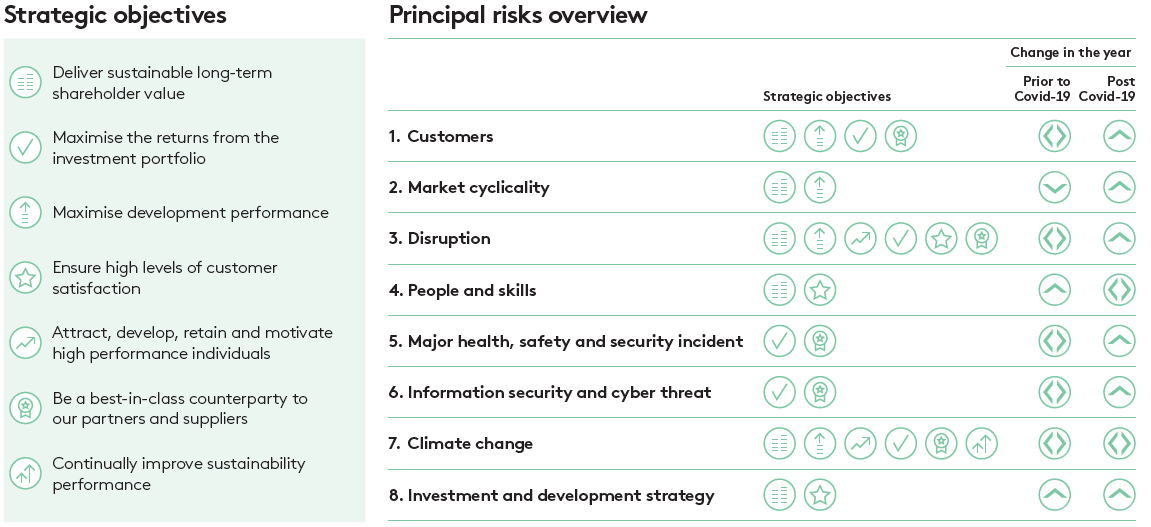
The company explained how Covid-19 affected the base assumptions for the valuation of investments, identified as a key source of estimation uncertainty.
The company linked the key source of estimation uncertainty with risks listed in the strategic report.
The company referred to the Covid-19 base case scenario.
The company explained in greater detail the valuation implications for the TCR aviation sector company for which there is greater uncertainty due to Covid-19, with further information provided in the note.
Examples of better disclosure 'Valuation of investment portfolio ...The uncertainty surrounding the ultimate impact of the Covid-19 pandemic has resulted in significant estimation in respect to the future cash flows for some of the individual portfolio companies. This includes estimation in relation to liquidity and delays to debtor payments; forecast revenue, supply chain, employee and slower growth effects; and the offsetting impact of government and central bank mitigation measures. The discount rates applied to almost all investments have been increased, reflecting increased uncertainty around the duration of stay at home and social distancing policies, the speed of recovery from those policies, future inflation, power prices and oil prices, as well as company specific factors. These uncertainties have also been reflected in the volatility seen in public markets during March and April 2020. The portfolio is diversified by sector, geography and underlying risk exposures. The valuation of each asset has significant estimation in relation to asset specific items. The key risks to the portfolio are discussed in further detail in the Risk report.
The methodology for deriving the fair value of the investment portfolio, including the key estimates and the base case scenario adopted in relation to the Covid-19 pandemic, is set out in the Portfolio valuation methodology section. The base case scenario assumes delays to noncommitted capital expenditure, cost-cutting initiatives and delays to construction activity, new business wins or new orders for a period of between four and nine months from 1 April 2020 followed by a gradual return of activity. Consideration was also given to the impact of stay at home and social distancing policies on the customers of our portfolio companies, including on their viability and access to liquidity...
...In respect of TCR, which operates in the aviation industry, there is a greater level of estimation uncertainty compared to the other portfolio investments. The valuation of TCR, which represents 9% of the total net asset value of the Company, is subject to the estimation uncertainty in respect of the extent and duration of the disruption to air traffic movements caused by Covid-19 and the pace and extent of the eventual recovery. The valuation of TCR is considered to reflect a balanced base case of cash flows and appropriate discount rate. The base case assumes lower revenue for a four-month period as a result of lower ground support equipment utilisation, a reduction in the ability of some customers to service their debts, the cancellation of non-committed capital expenditure and a reduction of operating costs and a modest rate of new contract wins based only on those at an advanced stage. A gradual return of activity is assumed, with no return to pre Covid levels until FY22... '
3i Infrastructure Plc, Annual report and accounts 2020, p117
Fair value measurements
IFRS 13 'Fair value measurement' sets out the framework for fair value measurement for both financial and non-financial assets and liabilities. It requires the disclosure of the significant assumptions, valuation techniques and inputs used to measure the fair value. In particular, where the fair value measurement requires the use of significant unobservable inputs (level 3), more judgement must be exercised in determining fair value and the disclosure requirements are more detailed.
The Covid-19 pandemic has brought much higher levels of uncertainty, impacting fair value measurements for many companies particularly affecting level 3 fair value measurements.
Non-financial assets – Investment properties (Level 3)
Our sample included five real estate companies holding investment properties. All were directly affected by the changes in the current environment, except one company investing in primary care medical centres which was less impacted.
With regard to the valuation of investment properties, we observed the inclusion of "material valuation uncertainty" clauses in the valuation reports of external valuers. In two cases, the auditor included an emphasis of matter paragraph in its report, drawing attention to property valuations.
- Better disclosures listed changes to the assumptions included in the valuation techniques as a result of Covid-19.
- One company disclosed that external valuers reflected a quantified deduction a buyer might expect to allow for the increased risk of customer defaults and non-payment of rent.
-
We observed instances where companies widened reasonably possible changes for key assumptions in their sensitivity analysis in response to increased uncertainty.
-
In their viability statements, some property companies indicated that occupancy rate is one of the key factors impacting their assessments. However, investment property sensitivity disclosures did not include occupancy rate and it was not clear how changes in the occupancy rate would affect the valuation of investment properties.
Examples of better disclosure '...Particular changes in assumptions included:
- the introduction of two rent free months for retail and gastronomy (food and drink) tenants, representing 0.55% of lettable space in the core portfolio;
- the addition of two initial months of void space for all vacant areas and leases with expiry dates until 30 April 2020; and
- additional sensitivity analysis with wider adjustments to the key parameters.
Generally, there were no adjustments to yield assumptions, except in relation to those properties affected by noticeable changes in lease situation since the last valuation as at 30 September 2019...'
Sirius Real Estate Limited, Annual Report and Accounts 2020, p68
The disclosure lists the changes in assumptions for the valuations of investment properties as a result of Covid-19 (discounted cash flow model).
Examples of better disclosure 'The valuer's report for the year ended 31 March 2020 contained a 'material uncertainty' clause due to the disruption to the market at that date caused by Covid-19. The inclusion of this clause indicates that there is substantially more uncertainty than normal and therefore a higher likelihood that the assumptions upon which the external valuer has based its valuations prove to be inaccurate. As a result of this increased uncertainty, sensitivities for more extensive changes in assumptions have been disclosed in the tables on page 134. '
Land Securities Group Plc, Annual Report 2020, p133
The disclosure explains that the company has conducted sensitivity analysis with widened ranges in response to the impact of Covid-19.
The company disclosed sensitivities further in the note increasing the range of changes for the estimated rental value and changes for costs to +/-10%, compared with a +/-5% in the prior year, and 50 bp change in equivalent yield compared with a 25 bp change in the prior year.
IFRS 13 requires detailed disclosure with regard to level 3 fair value measurements, including sensitivity analysis for unobservable inputs relating to level 3 financial assets and financial liabilities. These disclosures are supplemented by disclosure requirements of IAS 1 for sources of estimation uncertainty and related sensitivities or ranges of possible outcomes (IAS 1 paragraphs 125 and 129).
- We expect real estate companies to consider whether there are key assumptions requiring disclosure under both standards – IFRS 13 and IAS 1, as set out in the box above, so that users can understand how the risks posed by Covid-19 have been incorporated into the valuation of investment properties.
Financial assets (Level 3)
Our sample included a small number of companies with Level 3 financial assets, including one investment trust company with significant unquoted investments. In times of increased market uncertainty the valuation of unquoted investments can be particularly challenging.
We observed the following examples of better disclosures:
- Explanation of assumptions used in the valuation method in relation to Covid-19.
- Disclosure of the effects of uncertainty on the discount rate, and consistency with cash flow adjustments.
- Sensitivities disclosed in relation to Covid-19 related assumptions.
Other considerations
In the current climate, it can be challenging to measure the impact of credit risk on the fair value of derivative assets and liabilities, including the company's own credit risk. Furthermore, liquidity risk may increase in distressed markets. In some cases, credit or liquidity risk may become a significant unobservable input and judgement may be required about whether this results in the fair value measurement being categorised as Level 3 rather than Level 1 or 2.
Valuations techniques may change in the light of Covid-19. IFRS 13 paragraph 65 lists circumstances where this may be the case, including when market conditions change. These changes are accounted for as changes in accounting estimate and IFRS 13 requires the disclosure of the change and the reasons for making it (IFRS 13 paragraph 93 (d)).
Examples of better disclosure 'Summary of portfolio investment valuation methodology ...In relation to the Covid-19 pandemic we made the following general assumptions, but these have been adapted for country and company-specific circumstances:
- general stay at home policies/closed borders/major restrictions on travel for four months from 1 April 2020;
- August considered disrupted, but restrictions begin to unwind;
- September/October/November 2020 sees businesses gradually reverting to 'normal' operations but not at normal trading levels which only revert at the end of 2020 and beginning of 2021; and
- banks continue to honour revolving credit facility and other debt facilities.
Although we sought to reflect the effects of Covid-19 principally in the free cash flow forecasts for each investment, we also reviewed discount rates resulting in, for almost all portfolio companies, a higher discount rate than we would have applied without Covid-19. These increases reflect generally increased uncertainty, including around future inflation, power prices and oil prices, as well as company specific factors. The highest increase we have applied is 1%. However, we reduced the discount rate for Infinis, reflecting the evolution of that business towards solar with less peak power price risk than in the previous valuation...
[Note 7 Unquoted investments]...Extending the assumption taken across the portfolio that the stay at home policies/closed borders/major restrictions on travel will last for four months from 1 April 2020 to nine months from 1 April 2020 would reduce the value of the portfolio by £46 million. This calculation has been derived by adjusting the underlying forecast cash flow projections for each investment without any adjustment to the discount rate or macroeconomic assumptions...'
3i Infrastructure Plc, Annual report and accounts 2020, p30 & p126
Disclosure explains the general assumptions used in valuing unquoted investments.
The company mentioned the highest increase in the discount rate applied as a result of Covid-19. This information is also useful to the reader when assessing sensitivity disclosures.
Amongst sensitivities to other key assumptions, the company disclosed sensitivity extending Covid-19 restrictions from 4 to 9 months.
Impairment of non-financial assets
Given the major economic uncertainty caused by Covid-19, many companies will be reviewing their non-current assets for impairment. Our recent thematic review 3 on this topic, which is a useful complement to this section, highlights the importance of comprehensive disclosures in this area. In this thematic, we focus on some of the more significant issues arising from Covid-19.
Indication of impairment
IAS 36 'Impairment of Assets' requires non-financial assets to be tested for impairment when the period-end assessment finds an indication of impairment. In addition, cash generating units (CGUs) containing goodwill and indefinite life intangible assets are required to be tested for impairment at least once every year (IAS 36 paragraphs 9 – 12).
We expect that many companies will consider the Covid-19 pandemic an indicator of impairment because of the adverse effect it has had on their businesses, market capitalisation and the markets in which they operate.
This may require goodwill, indefinite life intangibles and intangibles not yet available for use to be tested outside of their annual cycle.
The effects of the Covid-19 pandemic may also be an indicator of impairment for a company's property plant and equipment, right-of-use assets and other non-financial assets.
Where testing is done at several levels, IAS 36 paragraph 98 sets out the "bottom-up” approach, where assets on a standalone basis are tested first, if there is an indication of impairment, then the CGU to which those assets belong, then the group of CGUs to which goodwill has been allocated.
It is important to note that, should the current conditions improve in future, the impairment losses can be reversed, with the exception of losses recognised for goodwill (IAS 36 paragraphs 109-125).
In our sample of companies, only one company operating in the telecom sector recognised a material impairment loss in relation to goodwill.
Two of the companies from the retail sector had material impairment charges for property, plant and equipment and right-of-use assets owing to store closures and expected future adverse effects.
We also found one instance where impairment losses were recognised for intangible software assets under construction owing to delays in development and the condition for probable generation of future economic benefits no longer being met.
In their interim reporting companies are required to apply the principles of IAS 36. (IAS 34 paragraph 30).
IFRIC 10 prohibits the reversal of an impairment loss recognised in a previous interim period in respect of goodwill. Subsequent to recognition of an impairment loss on goodwill at interim period end, it will not be possible to reverse it at year end. This holds true even when the prospects improve so significantly that, had the company done the goodwill impairment assessment at the period end, the impairment charge recognised in the interim report would been reduced or avoided.
Examples of better disclosure 'Impairment of property plant and equipment and right-of-use assets ..The UK government trade restrictions implemented on 23 March 2020 as a result of the Covid-19 pandemic are considered an impairment trigger and as a result all stores have been tested for impairment.'
Marks and Spencer Group Plc, Annual Report 2020, p147
Disclosure explains the Covid-19 pandemic is a triggering event.
Examples of better disclosure 'Impact of Covid-19 on financial statements at 31 Mar 2020 Management have considered the impact on accounting policies judgements and estimates in light of the impact of Covid-19 restrictions. [...] Impairment reviews of goodwill and intangible assets are ordinarily undertaken by senior management annually. Value in use calculations are performed for each cash-generating unit using cash flow projections and are based on the latest annual financial budgets prepared by senior management and approved by the board of directors. Senior management expectations are formed in line with performance to date and experience, as well as available external market data. Given the unprecedented uncertainty created by Covid-19 management have taken the decision to review all goodwill and intangible assets for impairment at the half year. Please refer to note 9 for the outcome of these considerations.'
Britvic Plc, 2020 Interim report, p21
Disclosure explains how Covid-19 has affected the impairment assessment of assets at the half year.
Most companies in our sample identified the impairment assessment as a key source of estimation uncertainty. They explained that the value-in-use method for calculating the recoverable amount of assets or CGUs requires management to determine appropriate assumptions, mainly in relation to cash flow projections, discount rate and long-term growth rate.
The uncertainties related to Covid-19 make the determination of the key assumptions particularly challenging.
- Better disclosures indicated that budgets and plans used in impairment testing were updated in the light of Covid-19 in order to reflect the estimated impact.
- These were also consistent with the context in which the companies assessed their viability.
- Helpful disclosures with regard to the discount rates explained the reassessment of key inputs, showing the link between the increased risk and Covid-19.
Examples of better disclosure 'Impairment losses ...The COVID-19 outbreak has developed rapidly in early 2020. Many countries have required businesses to limit or suspend operations and implemented travel restrictions and quarantine measures. The measures taken to contain the virus have adversely affected economic activity and disrupted many businesses. As the outbreak continues to progress and evolve, it is extremely challenging to predict the full extent and duration of its impact on Vodafone's businesses and the countries where Vodafone operates. Based on information available as at 31 March 2020, management has made additional adjustments to the five year business plans used in the Group's impairment testing in order to reflect the estimated impact.'
Vodafone Group Plc, Annual Report 2020, p161
Disclosure notes that five year business plans have been adjusted in the light of Covid-19.
When determining the discount rate, care should be taken not to double-count the risk. IAS 36 paragraph 56 states that the discount rate used to measure an asset's value-in-use shall not reflect risks for which the future cash flow estimates have been adjusted.
This company linked the reasonably possible changes to the worst case scenarios used in assessing going concern and longer term viability.
Examples of better disclosure 'Goodwill – Possibility of impairment in the near future ...Following the annual test, the results were revisited in light of the current impact of Covid-19 on the Group's performance. If the same reasonable 'worst case' scenarios considered as part of the Group's assessment of going concern and longer term viability were applied to the value-in-use models for goodwill impairment testing, headroom would be reduced but there would remain significant headroom, such that there is still no reasonable scenario in which impairment would be required, either now or in the coming year.'
Tate & Lyle Plc, Annual Report 2020, p157
In situations of increased uncertainty, such as Covid-19, it may be easier to adjust the cash flows rather than the discount rate for risk. IAS 36 paragraph A7 describes this approach as the "expected cash flow approach” which includes multiple probability weighted scenarios of expected cash flows, as opposed to a single most likely cash flow defined as the "traditional approach". In the current climate, the “expected cash flow approach” can be more effective to measure value-in-use as the risk would already be incorporated into the multiple cash flow scenarios and their weighting, provided the additional cost does not outweigh this benefit.
- We expect companies to provide clear disclosures about how they have incorporated Covid-19 risks into their cash flow projections, discount rates and long-term growth rates.
- Where an “expected cash flow approach” is used, we expect to see the disclosure of the number of scenarios used and their weightings, how the main assumptions used in the downside Covid-19 scenarios differ from the other scenarios and the reasoning behind those.
Most companies in our sample identified the impairment assessment as a key source of estimation uncertainty. They explained that the value-in-use method for calculating the recoverable amount of assets or CGUs requires management to determine appropriate assumptions, mainly in relation to cash flow projections, discount rate and long-term growth rate.
The uncertainties related to Covid-19 make the determination of the key assumptions particularly challenging.
- Better disclosures indicated that budgets and plans used in impairment testing were updated in the light of Covid-19 in order to reflect the estimated impact.
- These were also consistent with the context in which the companies assessed their viability.
- Helpful disclosures with regard to the discount rates explained the reassessment of key inputs, showing the link between the increased risk and Covid-19.
Examples of better disclosure
'Impairment losses ...The COVID-19 outbreak has developed rapidly in early 2020. Many countries have required businesses to limit or suspend operations and implemented travel restrictions and quarantine measures. The measures taken to contain the virus have adversely affected economic activity and disrupted many businesses. As the outbreak continues to progress and evolve, it is extremely challenging to predict the full extent and duration of its impact on Vodafone's businesses and the countries where Vodafone operates. Based on information available as at 31 March 2020, management has made additional adjustments to the five year business plans used in the Group's impairment testing in order to reflect the estimated impact.'
Vodafone Group Plc, Annual Report 2020, p161
Disclosure notes that five year business plans have been adjusted in the light of Covid-19.
When determining the discount rate, care should be taken not to double-count the risk. IAS 36 paragraph 56 states that the discount rate used to measure an asset's value-in-use shall not reflect risks for which the future cash flow estimates have been adjusted.
This company linked the reasonably possible changes to the worst case scenarios used in assessing going concern and longer term viability.
Examples of better disclosure
'Goodwill – Possibility of impairment in the near future ...Following the annual test, the results were revisited in light of the current impact of Covid-19 on the Group's performance. If the same reasonable 'worst case' scenarios considered as part of the Group's assessment of going concern and longer term viability were applied to the value-in-use models for goodwill impairment testing, headroom would be reduced but there would remain significant headroom, such that there is still no reasonable scenario in which impairment would be required, either now or in the coming year.'
Tate & Lyle Plc, Annual Report 2020, p157
In situations of increased uncertainty, such as Covid-19, it may be easier to adjust the cash flows rather than the discount rate for risk. IAS 36 paragraph A7 describes this approach as the “expected cash flow approach” which includes multiple probability weighted scenarios of expected cash flows, as opposed to a single most likely cash flow defined as the “traditional approach”. In the current climate, the “expected cash flow approach” can be more effective to measure value-in-use as the risk would already be incorporated into the multiple cash flow scenarios and their weighting, provided the additional cost does not outweigh this benefit.
- We expect companies to provide clear disclosures about how they have incorporated Covid-19 risks into their cash flow projections, discount rates and long-term growth rates.
- Where an “expected cash flow approach” is used, we expect to see the disclosure of the number of scenarios used and their weightings, how the main assumptions used in the downside Covid-19 scenarios differ from the other scenarios and the reasoning behind those.
Examples of better disclosure
'Discount rate A critical assumption in the impairment assessment is the discount rate... Following the outbreak of COVID-19, there was significant volatility within the financial markets over mid and late March 2020...
...The Group has analysed the level of volatility within country risk premiums by reference to credit default swap rates in the period between 31 December 2019 and 31 March 2020, and the reduction in these rates since that date. The Group has concluded that in determining the discount rate at 31 March 2020, using spot country risk premiums would not give a discount rate that a market participant would expect at the balance sheet date in determining the present value of cash flows over the ten year business plan. Consequently, given this volatility, to determine an appropriate discount rate for the purpose of the 31 March 2020 impairment assessment, consideration has been given to average country risk premiums at December 2019, March 2020 and subsequent to March 2020, which, in the Group's view, better reflects the risks associated with cash flows over ten years and beyond. The rates adopted by management in the 31 March 2020 impairment assessment, taking into account these average country risk premiums, were as follows:
| Assumptions | Nigeria | East Africa | Francophone Africa |
|---|---|---|---|
| Pre tax discount rate | 24.5% | 17.1% | 16.4% |
The table below sets out the March 2020 discount rate for spot country risk premiums and the breakeven discount rate for each group of CGUs.
| Assumptions | Nigeria | East Africa | Francophone Africa |
|---|---|---|---|
| Pre-tax discount rate – spot country risk premiums | 26.8% | 20.0% | 19.4% |
| Pre-tax discount rate – break even | 27.3% | 19.6% | 21.7% |
Given the volatility within financial markets, there is a risk that a prolonged pandemic could lead to increased credit default rates and other inputs into determining the discount rate over a prolonged period. This could lead to discount rates moving higher than the levels seen in March 2020, thus giving rise to a possible impairment in future periods (up to $100m at the above March 2020 rates)...'
Airtel Africa Plc, Annual Report and Accounts 2020, pp159-160
The company explained how they have smoothed out a spike in the country risk premium indicated by the increased volatility in the market conditions present at year-end.
Earlier in the note the country risk premium was described as a key input into the weighted average cost of capital calculation.
The company identified the discount rate as a key source of estimation uncertainty elsewhere in the accounts.
The company disclosed the adopted discount rates for each of its groups of CGUs. This was followed by the disclosure of the available headroom in the note.
The company disclosed the values for the discount rates calculated using the spot country risk premiums as well as on a "break-even" basis, indicating how sensitive the headroom is to their judgement about the adopted method.
Given the higher levels of uncertainty, users are particularly keen to understand how sensitive measurements are to changes in assumptions.
As explained in the "Significant judgements and estimates" section, IAS 1 requires disclosure of estimation uncertainty and associated sensitivities, where changing assumptions would give rise to a material impairment loss in the following year.
In addition, for CGUs with goodwill or indefinite life intangible assets, IAS 36 requires sensitivity disclosures when a reasonably possible change in key assumptions would completely erode headroom. IAS 36 also requires the disclosure of the amount by which the recoverable amount exceeds the carrying value and "base case" values for key assumptions for which sensitivity is given.
- We observed numerous examples where companies widened the reasonably possible changes in key assumptions, factoring in reductions in sales, operating profit, higher increases to the discount rate. The key assumptions for which sensitivities were disclosed were consistent with those identified as sources of significant estimation uncertainty.
- Better disclosures included sensitivity values consistent with the analysis included in the viability statement and going concern assessment.
Examples of better disclosure
'Sensitivity analysis The estimated recoverable amount of the Group's operations in Germany and Italy exceed their carrying values by €6.6 billion and €1.8 billion respectively. If the assumptions used in the impairment review were changed to a greater extent than as presented in the following table, the changes would, in isolation, lead to an impairment loss being recognised for the year ended 31 March 2020.'

Management considered the following reasonably possible changes in the key adjusted EBITDA and long-term growth rate assumptions, leaving all other assumptions unchanged. Due to increased uncertainty following the COVID-19 outbreak, management has widened the range of reasonably possible changes in the key adjusted EBITDA growth rate assumption to plus or minus 5 percentage points (2019: 2 percentage points). The sensitivity analysis presented is prepared on the basis that the reasonably possible change in each key assumption would not have a consequential impact on other assumptions used in the impairment review. The associated impact on the impairment assessment is presented in the table below, with the exception of Vodafone Automotive, where no reasonably possible change in the key assumptions would materially change the impairment charge recognised.
Management believes that no reasonably possible or foreseeable change in the pre-tax adjusted discount rate or projected capital expenditure would cause the difference between the carrying value and recoverable amount for any cash-generating unit to be materially different to the base case disclosed below.'
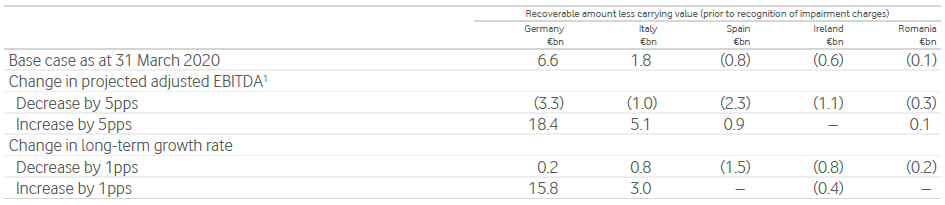
Vodafone Group Plc, Annual Report 2020, p161
Changes to key assumptions that would erode headroom to nil have been disclosed (IAS 36).
The company widened reasonably possible changes in EBITDA growth rate to incorporate Covid-19 uncertainty.
Reasonably possible changes that can cause a material loss in the following year have been disclosed (IAS 1).
The company disclosed sensitivities to the 15% reduction in revenue in year 1 on what was an already Covid-19 adjusted scenario, flexing it even further.
Examples of better disclosure
'...Given the significant uncertainty regarding the impact of COVID-19 on the Group's retail operations and on the global economy, management have considered sensitivities to the impairment charge as a result of changes to the estimate of future revenues achieved by the retail stores. The sensitivities applied are an increase or decrease in revenue of 15% from the estimate used to determine the impairment charge. It is estimated that a 15% decrease/increase in revenue assumptions for the 52 weeks to 27 March 2021, with no change to subsequent forecast revenue growth rate assumptions, would result in a £41.3 million increase / £31.5 million decrease in the impairment charge of retail store assets in the 52 weeks to 28 March 2020.'
Burberry Group Plc, Annual Report 2019/20, p233
Other impairment issues
iIn the light of Covid-19, users will expect interim financial statements to be more detailed than in previous years.
Interim reports from our sample did not provide as many details as we were expecting about impairment testing. We would expect interim accounts to include more details of how Covid-19 has impacted a company's impairment testing.
Write down of inventories
In the current environment, there may be more cases of the net realisable value of inventories being below cost, thus requiring a write-down. This is relevant in the circumstances of excessive inventory and obsolescence, fall in demand, inability to complete work in progress or lower commodity prices.
In our sample we observed two instances of material inventories being written down to net realisable value as a result of trading restrictions.
- As well as considering the requirements of IAS 2 'Inventories' companies should signal to users if there is any greater risk of material adjustment in the following year, in which case it is necessary to disclose estimation uncertainty and related sensitivities or ranges of potential outcomes (IAS 1 paragraphs 125 & 129).
Parent company individual accounts
During the first quarter of 2020, the share price of some companies fell sharply. Where the market capitalisation of the company is lower than the carrying value of its net assets, consideration should be given to whether the parent company's investment is subsidiaries is impaired and, if so, the consequential effect on distributable reserves. This is particularly relevant in cases where the company's share price has not subsequently recovered.
Impairment of intercompany balances may also be an indicator of impairment for investments.
Examples of better disclosure
'Impairment of investments in subsidiary undertaking ...The Company evaluates its investments in subsidiary undertakings annually for any indicators of impairment. The Company considers the relationship between its market capitalisation and the carrying value of its investments, among other factors, when reviewing for indicators of impairment. As at 28 March 2020, the market capitalisation of the Group was significantly below the carrying value of its investment in Marks and Spencer plc, indicating a potential impairment. In addition, the ongoing Covid-19 pandemic and subsequent lockdown has resulted in significant market and business disruption; alongside the underlying economic uncertainty surrounding the Brexit transition, these have led to significant uncertainties regarding trading and the longer-term impact on the business.'
Marks and Spencer Group Plc, Annual Report & Financial Statements 2020, p175
This company listed market capitalisation deficiency amongst the indicators of impairment for investments in subsidiaries.
Exploration and evaluation assets
As a result of Covid-19, many commodity prices (such as oil and base metals) have seen a significant decline. Our sample did not include any companies from extractive industries, but we expect those companies affected by such a decline to consider whether an impairment of their operating assets and exploration and evaluation assets is necessary. Any resulting impairment losses should be measured and disclosed in accordance with IAS 36.
Impairment of intangible assets under construction
Some companies may face estimation uncertainty in valuing intangible work in progress (WIP). If projects are delayed or mothballed to preserve cash, the future economic benefits may reduce, resulting in impairment of WIP.
IAS 38 'Intangible Assets' paragraph 57 lists the following criteria for recognising an intangible asset from development (all should be met):
- The project is technically feasible.
- There is intention to complete the project and ability to use or sell it.
- The project will generate probable future economic benefits.
- Resources are available to complete the project.
- Expenditure is separately identifiable.
Interaction with strategic report
- Companies should address impairment losses and the recoverability of non-financial assets as part of the fair, balanced and comprehensive review of the business required by the Companies Act, section 414C.
Defined benefit pension schemes
IAS 19 'Employee benefits' explains the measurement and disclosure requirements applicable to defined benefit pension schemes. In measuring the value of the defined benefit obligation, management will need to determine not only the current fair value of plan assets but also an appropriate discount rate.
The standard also requires management to disclose, amongst other things, the nature of the minimum funding arrangements in place and details of the expected contributions to the scheme in the next year.
It is likely that Covid-19 will create a series of issues that companies with defined benefit pension schemes may need to consider when preparing their accounts. For instance, companies may find it difficult to determine the current fair value of plan assets categorised as level three financial assets for the purposes of the fair value hierarchy. Companies may also find it difficult to determine the discount rate to use in calculating the defined benefit obligation as a result of the current market volatility.
Companies will also need to disclose changes made to minimum funding payment arrangements and expected annual scheme contributions if, agreements to delay payments to preserve liquidity have been made with the trustees.
Of the companies we reviewed, only four commented on how the measurement of the defined benefit pension scheme had been affected by Covid-19 and none explained whether Covid-19 would impact the payment of any future contributions to the scheme.
- Given the current market conditions, users of accounts will find information helpful if it explains how discount rates have been calculated and how the fair value of level 3 financial instruments has been determined.
- We expect management to describe the changes made to scheme contribution outflows where defined benefit scheme funding arrangements have been made to preserve liquidity.
- We expect any significant judgements or estimates made in determining the discount rate or the fair value of level 3 financial instruments in respect of the defined benefit obligation to be disclosed in accordance with IAS 1.
Examples of better disclosure
'Property investments are valued on the basis of open market value by an independent valuer. The significant assumptions used in the valuation are rental yields and occupancy rates. In light of the negative impact of the Covid-19 pandemic on financial markets, the independent valuers included material uncertainty clauses in respect of £2bn of the UK Property asset valuations. The directors still consider these valuations to be the best estimate of the valuation of the Property investments, but there is a higher degree of uncertainty compared to previous years.'
'Estimated adjustments to the valuation of main unquoted investments Under IAS 19, around £6bn of these unquoted assets have been initially measured using the most recent valuations, adjusted for cash movements between the last valuation date and 31 March 2020. As the latest valuations for these assets precede the negative impact of the Covid-19 pandemic on financial markets, we have applied an estimated adjustment by reference to either market indices or estimated 31 March 2020 valuations provided by the portfolio investment manager. The overall effect of this adjustment has reduced the valuation of illiquid assets by £0.5bn, and is reflected in the final IAS 19 position at 31 March 2020. Whilst intended to capture material market driven asset valuation movements in the period to 31 March 2020, the calculation of this estimated adjustment contains additional uncertainty over that of the formal valuation process for these assets.'
BT Group Plc Annual Report 2020 pp165-166
This disclosure explains how the value of level 3 pensions assets have been calculated in the context of Covid-19 market volatility.
Provisions and onerous contracts
Management's actions in relation to the impact of the Covid-19 crisis should only be accounted for as a provision to the extent that there is a present obligation for which the outflow of economic benefits is probable and can be reliably measured. (IAS 37 'Provisions, contingent liabilities and contingent assets paragraph 14).
We only identified one company in our sample which clearly explained the impact that Covid-19 had on the measurement of provisions. Whilst the example below highlights an onerous contract provision disclosure, we expect similar disclosures to be presented for other provisions that have been recognised as a result of Covid-19.
Management might be considering reducing its workforce as a result of Covid-19 and the steps taken to control it. A provision for redundancies is recognised only when the company has a detailed formal plan for the restructuring and has raised a valid expectation in those affected that it will carry out the restructuring plan.
- In the current environment, we expect management to also give due consideration as to whether contracts have become onerous as a result of the crisis. As part of this assessment, management will need to consider whether contracts with customers have become loss making, and if so, a provision will need to be recognised in accordance with the measurement guidance for onerous contracts contained within IAS 37.
- We expect management to clearly disclose the nature of the obligation and the expected timing of the outflow as well as to disclose any significant judgements or estimates in cases where Covid-19 related provisions have been recognised. Disclosure of any uncertainties about the amount or timing of cash out flows should also be provided.
Explains the increase in the contract loss provision caused as a result of the effect of Covid-19.
Disclosure notes that there are areas of uncertainty when determining the extent of the cash out flow but that individually those uncertainties are unlikely to have a material impact.
Examples of better disclosure
'Included within ‘Other' provisions are contract loss provisions of £10m (2018/19: £25m) relating to the anticipated total losses in respect of certain contracts. Covid-19 has been considered when identifying and measuring contract loss provisions in line with the accounting policy set out in note 5. We identified £7m of contract loss provisions in respect of revenue contracts that are expected to become loss-making as a result of Covid-19 impacts. This increase above our standard contract loss provisioning policies is recorded as a specific item (note 9). It is expected that the majority of contract loss provisions will be utilised in the next few years. Although there is a short period remaining to the finalisation of these contracts, there remains uncertainty as to whether potential future changes to key assumptions made when estimating their future losses could have a significant impact. There is no single change in key variables that could materially affect future expected losses on these contracts, but it is reasonably possible there will be a combination of changes in key variables that could have a material impact. Also included in 'Other' are amounts provided for constructive obligations arising from insurance claims which will be utilised as the obligations are settled.'
BT Group Plc Annual Report 2020 p161
Disclosure explains when the cash outflow is expected to occur.
Adjusting and non-adjusting post balance sheet events
Paragraph 3 of IAS 10 'Events after the reporting period' explains that events occurring between the end of the reporting period and the date when the financial statements are authorised for issue can be categorised as:
- those that provide evidence of conditions that existed at the end of the reporting period (adjusting post balance sheet events); or
- those that are indicative of conditions that arose after the reporting period (non-adjusting post balance sheet events.)
IAS 10, paragraph 8 clarifies that the amounts recognised in financial statements should be amended only for adjusting post balance sheet events.
When preparing accounts, consideration will need to be given as to whether there are any post balance sheets events which provide evidence of conditions existing at the period end which must be reflected in the period end financial statements. This assessment must be made without the benefit of hindsight to ensure assets and liabilities recognised at the period end reflect the conditions as at the period end.
As the Covid-19 pandemic is made up of a series of events, consideration will need to be given to which of these events fall to be classified as adjusting and how these adjusting events should be recorded in the financial statements. This is likely to require continual assessment of the changing circumstances that the company faces and whether they meet the IAS 10 paragraph 3 definition of adjusting events as at their year end.
In the light of this, and as a result of the rapidly evolving nature of the Covid-19 pandemic and timing and extent of support offered to companies to mitigate the impact of the pandemic, it may be difficult to determine whether a post balance sheet event is an adjusting or a non-adjusting event. Determining, whether, or not, a particular fact or circumstance is an adjusting or non-adjusting post balance sheet event may require significant judgement.
- We expect the significant judgement disclosures required by IAS 1 to be presented in cases where management has exercised significant judgement to determine whether a post balance sheet event meets the definition to be classified as adjusting.
IAS 37 contains specific guidance on when certain types of provision should be recognised, both in appendix C and in paragraphs 65 to
- This guidance explains the circumstances that must be met in order for a provision to be recognised.
- We expect management to follow the guidance in IAS 37 to determine whether a post balance sheet event is adjusting or non adjusting in cases where IAS 37 covers the specific event or circumstance that is faced by a company. An example of this would be in respect of redundancy provisions (please see page 50).
Other areas for companies to consider
Whilst not specifically covered in our report, a number of other areas of the financial statements may be affected by Covid-19. Management should consider the impact Covid-19 may have had in these areas when preparing their financial statements.
Revenue from contracts with customers
- Management will need to consider whether Covid-19 will impact the company's ability to fulfil performance obligations within a contract. This may lead to contract modifications, refund or compensation payments or changes in the probability of receipt of variable consideration. Management will also need to consider whether Covid-19 is likely to affect the forecast costs to complete on contracts where revenue is recognised over time using an input basis.
Employee benefits other than defined benefit pension schemes
- Covid-19 may result in companies amending the terms of employee remuneration schemes such as share based payments. We expect management to account for any scheme amendments or curtailments in accordance with the guidance in IFRS 2 ‘Share-based payments' and we expect any such changes to be appropriately described and disclosed.
Government Grants
- The UK government has offered a range of financial support packages to help companies, including government backed financing arrangements, furlough schemes, deferment of VAT payments and, for some sectors, business rates holidays. We expect management to state clearly the support packages they have taken advantage of and to provide an accounting policy to explain how they have been accounted for.
Deferred tax
Deferred tax assets can only be recognised to the extent it is probable there will be future taxable profits.
- We expect companies to review the current impact of Covid-19 on those future taxable profits. In doing so, we expect companies to use assumptions consistent with the viability statement, going concern and impairment assessments.
- We expect management to disclose any significant judgements and estimates made in assessing the recoverability of deferred tax assets.
- Furthermore, in the current environment, decisions made in respect of plans to distribute profits from subsidiaries might change and so consideration will need to be given as to whether deferred tax liabilities need to be recognised in respect of undistributed earnings.
Exploration for and evaluation of mineral resources
- Management will need to consider whether Covid-19 constitutes an impairment indicator triggering the need for an impairment test to be conducted.
Capitalisation of interest
- Management will need to consider whether capitalisation of interest as part of qualifying assets is suspended in cases where there is a suspension in the development of those qualifying assets.
Leases
- Management should consider whether the company's response to Covid-19 triggers the requirements of IFRS 16.20 to reassess the probability of exercising lease extension or termination options, in determining lease term.
- Lessee management will need to consider whether the non-payment of rent constitutes a default event for any other financial instruments held which may cause those financial instruments to become repayable on demand.
In addition, management will need to consider whether, as lessees, they take advantage of the practical expedient introduced as an amendment to IFRS 16 by the International Accounting Standards Board to treat specific rent concessions related to Covid-19 as though they were not lease modifications. While early adoption of this amendment is permitted, reporters are reminded that the amendment may not be applied until EU endorsement has taken place.
Assets (or disposal groups) classified as held for sale
IFRS 5 'Non current assets held for sale and discontinued operations' requires assets (or disposal) groups to be classified as held for sale if it highly probable that the sale will occur within one year of classification.
- Market uncertainties in the current environment as a result of Covid-19 may affect the judgement over whether such a transaction is considered to be highly probable.
- The uncertainty as a result of the current environment may lead to changes in the measurement of assets (or disposal groups) on classification as held for sale.
- We expect companies to clearly explain the judgements made in respect of the classification as well as any areas of estimation uncertainty in measuring the assets (disposal groups) held for sale.
Biological assets and agricultural product fair value
- Determining the value of these assets will involve significantly more estimation uncertainty as a result of the current economic environment. Management should ensure clear disclosure is provided which examines how fair values have been determined.
- Management should also consider whether the level of estimation uncertainty is significant and warrants disclosure in accordance with paragraphs 125 to 129 of IAS 1.
Contingent consideration
IFRS 3 'Business combinations' requires liabilities for contingent consideration to be measured at fair value with changes recognised through the income statement.
- The uncertainty in the current environment will need to be considered when determining the fair value of the contingent consideration liabilities. We expect companies to provide the required disclosures in IFRS 13 in respect of the valuation techniques, inputs used as well as the sensitivity of the valuation to changes in assumptions. Furthermore, IFRS 3 calls for additional disclosures in respect of changes to any previously recognised contingent consideration.
Financial service companies
The Prudential Regulation Authority wrote to CEOs of financial service companies on 26 March providing guidance on IFRS 9, capital requirements and loan covenants. 1 In addition Boards of financial service companies should consider the guidance contained within this letter when preparing their interim and annual financial statements.
Financial service companies should also refer to 'IFRS 9 and Covid-19-Accounting for expected credit losses' 2 issued by the International Accounting Standards Board on 27 March and the information included within the FRC / FCA / PRA joint statement published on 26 March when preparing their interim and annual financial statements.
Next steps
Impact on our future reviews
Whilst we saw many examples of good disclosure, there is scope for improvement. We encourage companies to consider the findings within this report when preparing their disclosures in future annual reports and accounts.
Although the below is not an exhaustive list, we will continue to challenge companies in our routine reviews when we do not see:
- Disclosure clearly explaining the significant judgements and estimates made in accounting for the impact of Covid-19 and the sensitivity of these assumptions to changes. In particular we will challenge companies when IAS 1 paragraph 122 disclosures are not presented in cases where significant judgement has been exercised in determining whether there is a material uncertainty in respect of going concern which should be disclosed.
- Going concern disclosures which clearly explain the company specific facts and circumstances which have led the directors to determine that the company is able to continue to operate as a going concern or otherwise.
- Consistency between the assumptions used in the going concern assessment and other areas of the financial statements.
- The requirements of IAS 1 applied appropriately to exceptional or similar items, with sub-totals comprising only items recognised and measured in accordance with IFRS.
- European Securities and Markets Authority guidelines followed for Alternative performance measures (APMs) presented. In particular, we will challenge companies where we see income and expenses arbitrarily allocated to APMs.
- Interim reports that provide enough information to enable a user to understand the impact that Covid-19 has had on a company's performance, position and future prospects. In particular, we will challenge companies who have not updated their going concern considerations from their previous annual report.
Financial Reporting Council
Information about the Financial Reporting Council can be found at: https://www.frc.org.uk
Follow us on 🐦 Twitter @FRCnews or in Linked
Our purpose The FRC's purpose is to serve the public interest by setting high standards of corporate governance, reporting and audit, and by holding to account those responsible for delivering them.
The FRC does not accept any liability to any party for loss, damage or costs however arising, whether directly or indirectly, whether in contract, tort or otherwise from any action or decision taken (or not taken) as a result of any person relying on or otherwise using this document or arising from any omission from it.
© The Financial Reporting Council Limited 2020 The Financial Reporting Council Limited is a company limited by guarantee. Registered in England number 2486368.
FINANCIAL REPORTING COUNCIL 8TH FLOOR 125 LONDON WALL LONDON EC2Y 5AS
+44 (0)20 7492 2300
www.frc.org.uk
-
https://www.bankofengland.co.uk/-/media/boe/files/prudential-regulation/letter/2020/covid-19-ifrs-9-capital-requirements-and-loan-covenants.pdf ↩↩↩
-
https://cdn.ifrs.org/-/media/feature/supporting-implementation/ifrs-9/ifrs-9-ecl-and-coronavirus.pdf?la=en ↩↩↩
-
https://www.frc.org.uk/getattachment/4daee650-59fe-43b0-904c-ba9abfb12245/CRR-Thematic-Review-Impairment-of-Non-financial-Assets-final.pdf ↩↩