
The content on this page has been converted from PDF to HTML format using an artificial intelligence (AI) tool as part of our ongoing efforts to improve accessibility and usability of our publications. Note:
- No human verification has been conducted of the converted content.
- While we strive for accuracy errors or omissions may exist.
- This content is provided for informational purposes only and should not be relied upon as a definitive or authoritative source.
- For the official and verified version of the publication, refer to the original PDF document.
If you identify any inaccuracies or have concerns about the content, please contact us at [email protected].
FRC Gender Pay Gap 2022/23
Foreword from the Chief Executive Officer
The FRC Diversity and Inclusion strategy is designed to attract and develop a diverse mix of people at all levels of our organisation and to create an inclusive culture where everyone can fulfil their potential. Addressing the gender pay gap is an important part of this strategy.
Since gender pay gap legislation was introduced in 2017, we are pleased to have seen a year-on-year improvement in reducing the gap.
Our latest reporting figures for the year ended 31 March 2022 show strong progress in a further reduction in the mean gender pay gap from 12.4% to 10.7% and I am very pleased to see that the median figure fell from 9.4% to 0%.
Having no difference in the median hourly rate of pay between men and women is a significant achievement and reflects the increased number of women at all levels in our organisation particularly in more senior roles.
I am also pleased to report that there is no median pay gap in the bonus awards made and because two awards were made in the year, and the headcount had grown, the mean bonus pay gap is 3.7% in favour of women.
I am proud that the Executive Committee continues to have a majority female membership. For the purposes of calculating the Gender Pay Gap at the senior level, we only count FRC employees in formal Executive Director positions and myself as Chief Executive Officer. Other members of the Executive Committee are included with reference to the job level that they occupy. Inbound secondees are not included in the calculations.
My ambition is to continue the progress that we have been making to reduce the mean gap. Over the next year I will be working with the Executive Team, the FRC's D&I Committee and the FRC's Women's Network, to consider and take forward further measures to reduce the Gender Pay Gap.
Sir Jon Thompson, Chief Executive
Introduction
The FRC has prepared this report to meet the legal requirement for public bodies to publish their gender pay gap on an annual basis. In 2017, the government introduced legislation that made it a statutory requirement for organisations with employees of 250 or more to report annually on their gender pay gap, and the FRC was reporting voluntarily (when its staff numbered less than the threshold)
The gender pay gap shows the difference in the average pay between all men and women in a workforce.
The gender pay gap is different to equal pay. Equal pay deals with the pay differences between men and women who carry out the same jobs, similar jobs, or work of equal value. It is unlawful to pay people unequally because they are a man or a woman. The FRC supports the fair treatment and reward of all staff irrespective of gender.
This report fulfils our reporting requirements, explains why the pay gap exist and sets out the steps we are taking to reduce the gap.
Headline figures
Base Pay
The Gender Pay Gap figures at 31 March 2022 show that we have eradicated our median pay gap. This is a significant achievement and a reduction from the 27.8% gap we reported in 2018.
Our mean gender pay gap has fallen from 12.4% to 10.7%. A reduction of 1.7% percentage points over the previous year and 55.2% less than 2018 (down 13.2 percentage points from 23.9%) (see figure 1 below).
Figure 1
| Gender Pay Gap | 2018 | 2019 | 2020 | 2021 | 2022 |
|---|---|---|---|---|---|
| Median Pay Gap | 27.8% | 27.3% | 15.9% | 9.4% | 0 |
| Mean Pay Gap | 23.9% | 22.7% | 18.4% | 12.4% | 10.7% |
Bonus Pay Gap
Two performance-related pay awards were made during the year to 31 March 2022. All eligible employees were awarded the same amounts of £900 and £1,100. Eligible employees included all those with qualifying service and performance and had not given or received notice to leave at the time of the award.
There was no difference in the median bonus rate of pay between men and women during the year to 31 March 2022, and when the mean position is calculated for this period, it is 3.7% in favour of women (please see page 7 for more details).
Why do we have a gender pay gap?
It is important to consider the FRC's workforce demographic (full time versus part time), the percentage of males and females in each of the pay quartiles, and the proportion of males and females at each job level in the FRC.
Working Pattern
In the FRC, on 31 March 2022, men made up 49% of the workforce and women made up 51% of the workforce (see figure 3).
Figure 3
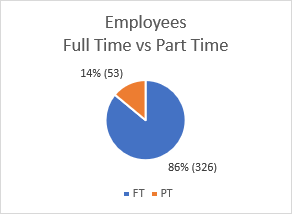
In addition, 86% of the workforce were employed full time and 14% on part time contracts (see figure 4).
Figure 4: Employees Full Time vs Part Time
A pie chart showing that 86% (326) of employees are full time and 14% (53) are part time.
Figure 5: Part time Employees Men vs Women
A pie chart showing that of the part-time employees, 83% (44) are women and 17% (9) are men.
Of the 14% (53) of the workforce on part time contracts, 83% (44) were held by women and 17% (9) were held by men (see figure 5 above).
Pay Quartile data
It is also important to consider the proportion of males and females in each of the four pay quartiles (please see figure 6).
Figure 6
| Female | Male | TOTAL | |||
|---|---|---|---|---|---|
| # | % | # | % | # | |
| Lower Quartile | 60 | 63.1 | 35 | 36.9 | 95 |
| Lower Middle Quartile | 56 | 58.9 | 39 | 41.1 | 95 |
| Upper Middle Quartile | 48 | 50.5 | 47 | 49.5 | 95 |
| Upper Quartile | 45 | 47.8 | 49 | 52.2 | 94 |
| TOTAL | 209 | 170 | 379 |
Figure 6 and 7 (see below) shows that although more than half of women were in the upper pay quartile there were significantly more women in the lower pay quartiles.
Figure 7: Proportion of Men and Women in each pay quartile %
A bar chart showing the proportion of men and women in each pay quartile. - Lower Quartile: 63.1% Women, 36.9% Men - Lower Middle Quartile: 58.9% Women, 41.1% Men - Upper Middle Quartile: 50.5% Women, 49.5% Men - Upper Quartile: 47.8% Women, 52.2% Men
Job Level
Analysis of the workforce demographic by job level also provides an insight as to why we have a gap (see figure 7 above).
Figure 8 – Gender split by Job level at 31 March 2022
A horizontal bar chart showing gender split by job level. The red line represents FRC's gender split (presumably overall, or a target). - Exec Directors: 25% Women, 75% Men - Level 6: 64% Women, 36% Men - Level 5: 48% Women, 52% Men - Level 4: 49% Women, 51% Men - Level 3: 60% Women, 40% Men - Level 2: 53% Women, 47% Men - Level 1: 82% Women, 18% Men
A disproportionate percentage (82%) of females were employed in Level 1 job roles (figure 8). It is also worth noting that a significant number of roles at Level 1 are Personal Executive Assistant (PA) roles.
What is also clear from figure 8 is that, although there is a good representation of women at job level 6, which is positive, men occupy the majority of Executive Director roles although, due to the way the calculations are required to be made, our reporting excludes a female member of the Executive Team who is on secondment to the FRC (and two female members who are not Executive Directors). The important message here is that the majority of the members of the Executive Committee are female.
Bonus Pay Gap at 31 March 2022
During the period of this report, the FRC made two non-consolidated payments of £900 and £1,100 to employees and these payments constitute towards determining our bonus pay gap.
The table below at figure 9 shows that more women than men received an award and when the mean position is calculated, the bonus pay gap is 3.7% in favour of women.
We can also report that there is no difference in the hourly median rate of pay between what men and women received during this reporting period.
Bonus data
Who received bonus pay?
| Gender | Number | % |
|---|---|---|
| Male | 150 | 88.2 |
| Female | 178 | 85.2 |
Any employees without qualifying length of service or performance or serving notice at the time of the award did not qualify to receive bonus pay.
Mean bonus pay data
| Total bonus pay (£) | Mean value (£) | Gap | |
|---|---|---|---|
| Male | 265,800 | 1772 | -3.70% |
| Female | 327,200 | 1838 |
Median bonus pay data
| Total bonus pay (£) | Median Value (£) | Gap | |
|---|---|---|---|
| Male | 265,800 | 2000 | 0% |
| Female | 327,200 | 2000 |
Actions we have taken to reduce the pay gap
Over the last year, we have taken the following actions below to reduce the gender pay gap
- Significant investment in the management and leadership development of women with a greater number of places (61%) on these programmes being occupied by women
- Continued to apply our policies on pay and reward to support the principle of equal pay and gender pay equality
- Addressed the under-representation of women and minority groups through monitoring progress against the Diversity and Inclusion strategy launched in 2021
- Published our Women in Finance (WiF) Charter results which shows that 57% of women are represented on ExCo and 50% of the Senior Leadership Team are women
- Launched a further round of mentoring and reverse mentoring programmes
- Piloted new workshops on career development
- Continued to offer employees hybrid working which enabled greater work flexibility than before the pandemic
- Launched training on inclusive language which is now a part of our Learning and Development curriculum.
Proposed actions to further reduce the pay gap
Although the Gender Pay Gap has reduced significantly since the FRC began reporting in 2018, we will continue to adopt a rigorous approach to applying the FRC's reward policy. In addition to this, we propose to
- Introduce anonymised sifting of candidates as part of the recruitment process
- Continue to invest in the leadership development of women across the whole of the organisation
- Offer women who are members of FRC Diversity Networks the opportunity to shadow a Senior Leadership Team member in 2023