
The content on this page has been converted from PDF to HTML format using an artificial intelligence (AI) tool as part of our ongoing efforts to improve accessibility and usability of our publications. Note:
- No human verification has been conducted of the converted content.
- While we strive for accuracy errors or omissions may exist.
- This content is provided for informational purposes only and should not be relied upon as a definitive or authoritative source.
- For the official and verified version of the publication, refer to the original PDF document.
If you identify any inaccuracies or have concerns about the content, please contact us at [email protected].
Guidance on the Strategic Report (June 2022)
The FRC's purpose is to serve the public interest by setting high standards of corporate governance, reporting and audit and by holding to account those responsible for delivering them. The FRC sets the UK Corporate Governance and Stewardship Codes and UK standards for accounting and actuarial work; monitors and takes action to promote the quality of corporate reporting; and operates independent enforcement arrangements for accountants and actuaries. As the Competent Authority for audit in the UK the FRC sets auditing and ethical standards and monitors and enforces audit quality.
The FRC does not accept any liability to any party for any loss, damage or costs howsoever arising, whether directly or indirectly, whether in contract, tort or otherwise from any action or decision taken (or not taken) as a result of any person relying on or otherwise using this document or arising from any omission from it.
The Financial Reporting Council Limited 2022 The Financial Reporting Council Limited is a company limited by guarantee. Registered in England number
- Registered Office: 8th Floor, 125 London Wall, London EC2Y 5AS
- Summary
- Section 1 Objectives and how to use this Guidance
- Section 2 Scope
- Section 3 The annual report
- Table 1 Document
- Section 4 The strategic report: purpose
- Section 5 The strategic report: materiality
- Section 6 The strategic report: communication principles
- Section 7 The strategic report: content elements
- Section 7A The strategic report: content elements for entities that are not PIEs or are PIEs with 500 or fewer employees
- Signature of the statutory reports and the statement of directors' responsibilities
- Section 7B
- Section 7C
- Section 8
- The strategic report: content elements for the section 172 reporting
- Scope
- Summary of legal requirements
- The purpose of the section 172(1) statement
- Materiality
- Content of the section 172(1) statement
- Issues, factors and stakeholders
- Decision making
- Capital allocation and dividend policy
- Culture
- Website publication of section 172(1) statement
- Section 9
- Appendix I: Glossary
- Appendix II
- Appendix III
- Appendix IV(a)
- Appendix IV(b)
- Basis for Conclusions
- Scope
- The annual report
- The purpose of the annual report
- Placement of information
- The strategic report: purpose
- The strategic report: materiality
- The strategic report: communication principles
- The strategic report: content elements
- Objectives, strategy and business model
- Principal risks and uncertainties
- Environmental, employee, social, community, human rights, anti-corruption and anti-bribery matters
- Employee gender diversity
- Section 172 reporting
- Strategic report with supplementary material
Summary
(i)The Financial Reporting Council's (FRC's) purpose is to serve the public interest by setting high standards of corporate governance, reporting and audit and by holding to account those responsible for delivering them. The FRC believes that encouraging entities1 to prepare a high quality strategic report – which provides shareholders with a holistic and meaningful picture of an entity's business model, strategy, development, performance, position and future prospects – is a key part of achieving this purpose.
(ii)The FRC believes the strategic report should be clear and concise and result in fair, balanced and understandable reporting. The Guidance on the Strategic Report (the Guidance) is therefore intended to encourage preparers to consider how the strategic report fits within the annual report as a whole with a view to improving the overall quality of corporate reporting.
(iii)This Guidance relates to the Companies Act 2006 requirement to prepare a strategic report, which was brought in through the following regulations:
- The Companies Act 2006 (Strategic Report and Directors' Report) Regulations 2013 (SI 2013/1970);
- The Companies, Partnerships and Groups (Accounts and Non-Financial Reporting) Regulations 2016 (SI 2016/1245);
- The Companies (Miscellaneous Reporting) Regulations 2018 (SI 2018/860);
- The Statutory Auditors Regulations 2017 (SI 2017/1164); and
- The Companies (Strategic Report) (Climate-related Financial Disclosure) Regulations 2022 (SI 2022/31).
(iv)It is also relevant to limited liability partnerships (LLPs) that are required to prepare a strategic report in accordance with the Limited Liability Partnerships (Accounts and Audit) (Application of Companies Act 2006) Regulations 2008 (SI 2008/1911), which were amended by The Limited Liability Partnerships (Climate-related Financial Disclosure) Regulations 2022 (SI 2022/46).
Aims of the Guidance
(v)The FRC has developed guidance that aims to be:
- principles-based;
- mindful of recent developments in narrative reporting best practice; and
- aligned with the requirements in the UK Corporate Governance Code.
Overview
(vi)The Guidance serves as a best practice statement and, as such, has persuasive rather than mandatory force. One of its objectives is to set out high-level principles that enable entities to 'tell their story'.
(vii)The Guidance is for directors (or members in the case of an LLP) and is intended to serve as best practice for all entities preparing strategic reports.
The annual report
(viii)The Guidance encourages entities to provide information in annual reports that is relevant to shareholders. With that in mind, the Guidance is framed in the context of the annual report as a whole. In practice, an annual report comprises a number of components. The information contained in each of these components has different objectives that should guide preparers to where disclosures could be located. The aim is to promote cohesiveness and enable related information to be linked together.
(ix)In meeting the needs of shareholders, the information in the annual report may also be of interest to other stakeholders. The annual report should not, however, be seen as a replacement for other forms of reporting addressed to other stakeholders.
(x)Placement is a key theme in the Guidance with a view to providing entities with the building blocks to be innovative in the location of information whilst working within the regulatory framework. The aims are to ensure that important information is prominent and improve the accessibility of information. The Guidance recommends that information that is not relevant for shareholders should be provided outside the annual report where this is permitted by law or regulation.
The strategic report
(xi)The purpose of the strategic report is to provide information for shareholders and help them to assess how the directors have performed their duty under section 172, to promote the success of the company2 and, in doing so, had regard to the matters set out in that section. This includes considering the interests of other stakeholders which will have an impact on the long-term success of the entity.
(xii)The strategic report should reflect the board's view of the company and provide context for the related financial statements.
(xiii)The Guidance recommends that information that is material to shareholders should be included in the strategic report. Immaterial information should be excluded as it can obscure the key messages and impair understandability.
(xiv)The communication principles suggest that strategic reports should have the following characteristics – be fair, balanced and understandable; be concise; have forward-looking orientation; include entity specific information; and link related information in different parts of the annual report. There are also principles which recommend that the structure, presentation and content of the strategic report be reviewed to ensure that information remains relevant to the current period. The communication principles are intended to emphasise that the strategic report is a medium of communication between a company's board and its shareholders.
(xv)The content elements for the strategic report set out in the Guidance are derived from the Companies Act 2006, and include a description of the entity's strategy, objectives and business model. In addition, the strategic report must include an explanation of the main trends and factors affecting the entity; a description of its principal risks and uncertainties; and an analysis of the development and performance of the business; including key performance indicators. Entities must disclose information about the environment, employees, social, community, human rights, and anti-corruption and anti-bribery matters when material. There is also a requirement for certain entities to include climate-related financial disclosures and disclosures on gender diversity.
This edition of the Guidance
(xvi)This edition of the Guidance issued in June 2022 updates the edition of the Guidance issued in June 2018 for the following:
- the changes introduced by The Companies (Strategic Report) (Climate-related Financial Disclosure) Regulations 2022 (SI 2022/31) and The Limited Liability Partnerships (Climate-related Financial Disclosure) Regulations 2022 (SI 2022/46) which require certain entities to make climate-related financial disclosures;
- amendments to The Limited Liability Partnerships (Accounts and Audit) (Application of Companies Act 2006) Regulations 2008 (SI 2008/1911) introduced by The Statutory Auditors Regulations 2017 (SI 2017/1164), which requires a traded LLP or banking LLP to prepare a strategic report;
- amendments to The Large and Medium-Sized Companies and Groups (Accounts and Reports) Regulations 2008 (SI 2008/410) and The Limited Liability Partnerships (Accounts and Audit) (Application of Companies Act 2006) Regulations 2008 (SI 2008/1911), which implement the government's policy on Streamlined Energy and Carbon Reporting (SECR). The SECR amendments were made to the appendices that relate to the directors' report disclosure requirements;
- amendments to the definition of a public interest entity (PIE) to align it with the existing legislation; and
- some minor typographical or presentational corrections.
(xvii)The effective date of the requirements that this Guidance relates to vary. The Guidance is intended to serve as best practice when entities are applying the relevant legal requirements.
Section 1 Objectives and how to use this Guidance
1.1The objectives of the Guidance on the Strategic Report (the Guidance) are to:
- ensure that relevant information that meets the needs of shareholders is presented in the strategic report;
- encourage entities to experiment and be innovative in the drafting of their annual reports, presenting narrative information in a way that enables them to best 'tell their story' while remaining within the regulatory framework; and
- promote greater cohesiveness in the annual report through improved linkage between information within the strategic report and in the rest of the annual report.
1.2This Guidance is structured as follows:
Boxed text in bold type describes the main principles or, in Sections 7, 7A, 7B, 7C and 8, content elements that form the basis of this Guidance. References to legislative or other regulatory requirements are given in the footnotes to this Guidance.
1.3The bold text is followed by further supporting guidance explaining how the main principles and content elements might be applied. The supporting guidance is then supplemented by highlighted text as follows:
Summary of legal requirements
Where the law or regulation underpinning the Guidance requires explanation or highlighting, this information is included in a 'summary of legal requirements'. This information is intended to summarise important aspects of the legal requirements; it is not intended to be a comprehensive analysis of the law.
Example
Where a specific paragraph warrants further application guidance, practical examples are included. These examples are intended to be illustrative only and may not be appropriate for all entities.
Linkage example
One of the main objectives of this Guidance is to encourage the preparation of more cohesive annual reports. The 'linkage examples' illustrate ways in which interdependencies or relationships between strategic report content elements and disclosures placed elsewhere in the annual report might be highlighted or presented. The linkage examples are not intended to be a comprehensive list of all possible linkages in the strategic report, nor are they intended to be a template for the presentation of information.
1.4This Guidance uses the following terms to distinguish between mandatory disclosure requirements and best practice guidance:
- 'Must' is used to refer to mandatory legislative or other regulatory requirements for entities within their scope. Such requirements might be mandatory only when resulting disclosures would be material;
- 'Should' is used throughout this document to refer to guidance and recommended ways of achieving the requirements in legislation; and
- 'Could' is generally used when preparers may wish to consider alternative forms of presentation of information, or when providing examples of disclosures which may be applicable.
1.5Terms defined in the Glossary (Appendix I) are in bold type the first time they appear in each section.
1.6Clarifications of the Act's requirements in respect of the strategic report are provided in a letter from the Department for Business, Innovation and Skills (BIS) (now the Department for Business, Energy & Industrial Strategy (BEIS)) that can be found on the FRC's website at https://www.frc.org.uk/guidance-on-the-strategic-report.
Section 2 Scope
2.1This Guidance is non-mandatory and encourages best practice for all entities3 preparing a strategic report.
2.2The Act sets out different levels of reporting depending on the type of entity.
Summary of legal requirements
Section 414A of the Act requires all companies that are not small4 or micro-entities5 to prepare a strategic report.
For a financial year in which the company is a parent company, and the directors of the company prepare group accounts, the strategic report must be a group strategic report relating to the entities included in the consolidation6.
A detailed analysis of the legal requirements in respect of the strategic report, including information on the application of the statutory requirements to different types of entity, is set out in Appendix II and Appendix IV(a).
Additionally, section 415 of the Act requires all companies that are not micro-entities7 to prepare a directors' report which contains other information specified by the Act and its associated regulations. The extent of disclosure in a directors' report also varies depending on the type of company. An analysis of the legal requirements in respect of the directors' report is set out in Appendix III and Appendix IV(b) (energy and carbon report requirements for LLPs).
Both the strategic report and the directors' report are integral parts of the annual report.
Section 4(1)(a) of The Partnerships (Accounts) Regulations 2008 (SI 2008/569) requires qualifying partnerships to prepare a strategic report. The Limited Liability Partnerships (Accounts and Audit) (Application of Companies Act 2006) Regulations 2008 (SI 2008/1911) also require a traded limited liability partnership (LLP) or banking LLP to prepare a strategic report.8
2.3As noted above, the extent of disclosure that is required for an entity will vary according to the type of entity. As a general principle, this Guidance encourages disclosure of material financial and non-financial information that is necessary for an understanding of the development, performance, position or future prospects of the entity9 in the strategic report, irrespective of whether there is an explicit statutory disclosure requirement.
Example
Section 414C(6) of the Act has the effect of providing an exemption for medium-sized companies from the requirement to disclose non-financial key performance indicators (KPIs). However, where disclosure of non-financial KPIs is the most appropriate method of providing the information necessary for an understanding of the development, performance, position or future prospects of the entity's business, this Guidance recommends their use, even if the company is medium-sized.
2.4This Guidance covers a range of entities that are required to prepare a strategic report and therefore should be applied proportionately. The narrative reporting requirements for quoted and public interest entities (PIEs) with more than 500 employees are more extensive than those for unquoted companies. The content elements in this Guidance identify the legal requirements that apply to different types of entities and have been structured to aid proportionality.
Content elements of the strategic report
2.5Sections 414C Contents of the strategic report, 414CB Contents of non-financial and sustainability information statement and 414CZA Section 172(1) statement of the Act set out the content requirements for the strategic report. Section 414C sets out the overall framework and main principles for the content of the strategic report. The scope of application of sections 414CB and 414CZA are different. The content elements of this Guidance are structured into four sections to ease navigation.
- Section 7A sets out content elements (other than climate-related financial disclosures – see Section 7C) for entities that are not PIEs, and PIEs with 500 or fewer employees (i.e. subject to the requirements in section 414C of the Act).
- Section 7B sets out content elements for entities that are PIEs with more than 500 employees (i.e. subject to some of the requirements in section 414C and within the scope of section 414CB of the Act).
- Section 7C sets out the climate-related financial disclosures in the non-financial and sustainability information statement that apply to PIEs with more than 500 employees and certain entities that are not PIEs.
- Section 8 sets out the content elements for large companies that are required to provide a section 172(1) statement (i.e. within the scope of section 414CZA of the Act).
2.6An entity should either use section 7A or 7B as well as section 7C, when applicable; plus section 8 if it is a large company.
Summary of legal requirements
Entities within the scope of the disclosure requirements introduced by The Companies, Partnerships and Groups (Accounts and Non-financial Reporting) Regulations 2016 (SI 2016/1970) and The Companies (Strategic Report) (Climate-related Financial Disclosure) Regulations 2022 (SI 2022/31)
Section 414CA requires a traded, banking or insurance company (a public interest entity or 'PIE') with more than 500 employees or a parent company in a group headed by that company with more than 500 employees to include a non-financial and sustainability information statement as part of its strategic report.
The requirement to provide a non-financial and sustainability information statement also applies to an AIM company with more than 500 employees; and either a company with a turnover of more than £500 million (high turnover company) or an LLP with a turnover of more than £500 million, which has more than 500 employees. However, these entities are only required to disclose the climate-related financial disclosures set out in section 414CB(2A) or (4B).
If an entity's strategic report is a group strategic report, the non-financial and sustainability information statement must be a group non-financial and sustainability information statement relating to the entities included in the consolidation.10
For a financial year in which the entity is a subsidiary company, and the directors of its parent company prepare a group strategic report, including a group non-financial and sustainability information statement, there is no requirement for the subsidiary to provide a non-financial and sustainability information statement as part of its strategic report.11
Section 414CB sets out the content of the non-financial and sustainability information statement which effectively requires entities within its scope to include additional non-financial information. As many of the disclosures in section 414CB are similar to those required in section 414C for quoted companies, section 414CB(7) of the Act provides exemptions from overlapping disclosure requirements.
Entities within the scope of the disclosure requirements introduced by The Companies (Miscellaneous Reporting) Regulations 2018
Section 414CZA requires all large companies to include a section 172(1) statement as part of their strategic report.
Part 4 of Schedule 7 of The Large and Medium-sized Companies and Groups (Accounts and Reports) Regulations 2008 (SI 2008/410) expands on certain aspects of the section 172(1) statement. These include detailed disclosure requirements relating to engagement with employees which apply to companies with more than 250 UK employees (or a parent company with more than 250 UK employees in a group headed by that company); and the need to foster the company's business relationships with suppliers, customers and others which apply to certain large companies. The requirements are included in Appendices III and IV(b).
Section 3 The annual report
The purpose of the annual report
3.1Although this Guidance is primarily focused on the application of the strategic report requirements, it also addresses the role of the strategic report in the context of the annual report as a whole. This recognises that the strategic report does not exist in isolation.
3.2The purpose of the annual report is to provide shareholders with relevant information that is useful for making resource allocation decisions and assessing the directors' stewardship.
3.3The annual report should provide the information necessary for shareholders to assess the entity's:
- development, performance and position;
- future prospects;
- strategy for achieving its objectives;
- business model;
- governance; and
- directors' remuneration.
3.4In meeting the needs of shareholders, the information in the annual report may also be of interest to other investors (such as debt investors and potential investors) and creditors. Other stakeholders such as customers, employees and members of society more widely may also wish to use information contained within it. The annual report should address issues relevant to these other users where, because of the influence of those issues on the development, performance, position or future prospects of the entity's business, they are also material to shareholders. The annual report should not, however, be seen as a replacement for other forms of reporting addressed to other stakeholders.
3.5The annual report as a whole should be fair, balanced and understandable and should provide the information necessary for shareholders to assess the entity's position and performance, business model and strategy.12
3.6The board of a company that is required to report on how it has applied the 2018 UK Corporate Governance Code (the Code), or to explain when it has not, is required to include a statement in the annual report confirming that the board considers the annual report and accounts to be fair, balanced and understandable.
3.1Although this Guidance is primarily focused on the application of the strategic report requirements, it also addresses the role of the strategic report in the context of the annual report as a whole. This recognises that the strategic report does not exist in isolation.
The purpose of the annual report is to provide shareholders with relevant information that is useful for making resource allocation decisions and assessing the directors' stewardship.
3.3The annual report should provide the information necessary for shareholders to assess the entity's:
- development, performance and position;
- future prospects;
- strategy for achieving its objectives;
- business model;
- governance; and
- directors' remuneration.
3.4In meeting the needs of shareholders, the information in the annual report may also be of interest to other investors (such as debt investors and potential investors) and creditors. Other stakeholders such as customers, employees and members of society more widely may also wish to use information contained within it. The annual report should address issues relevant to these other users where, because of the influence of those issues on the development, performance, position or future prospects of the entity's business, they are also material to shareholders. The annual report should not, however, be seen as a replacement for other forms of reporting addressed to other stakeholders.
The annual report as a whole should be fair, balanced and understandable and should provide the information necessary for shareholders to assess the entity's position and performance, business model and strategy.
3.6The board of a company that is required to report on how it has applied the 2018 UK Corporate Governance Code (the Code), or to explain when it has not, is required to include a statement in the annual report confirming that the board considers the annual report and accounts to be fair, balanced and understandable.
Auditor's responsibilities
3.7The auditor's report is required to state13 whether, based on the work undertaken in the course of the audit, the information in the strategic report, directors' report and corporate governance statement:
- is consistent with the financial statements;
- has been prepared in accordance with applicable legal requirements; and
- contains any material misstatements.
3.8In respect of the financial statements, the auditor's report is required to contain a clear expression of opinion on the financial statements taken as a whole. To form an opinion on the financial statements the auditor concludes as to whether:
- sufficient appropriate audit evidence has been obtained;
- uncorrected misstatements are material, individually or in aggregate;
- the financial statements, including the disclosures, give a true and fair view; and
- the financial statements are prepared, in all material respects, in accordance with the requirements of the applicable financial reporting framework, including the requirements of applicable law.
Placement of information
3.9Table 1 provides an overview of the annual report. It identifies the principal components of an annual report, sets out their different but linked objectives and the main sources of disclosure requirements. The table is intended to help preparers make judgements regarding where information would be best located. Considering these different objectives when drafting each component of the annual report will help ensure that only relevant and focused information is included in them.
3.10Law or regulation defines the components of the annual report, but does not dictate a structure. Similarly, Table 1 is not intended to impose a specific structure or order for the annual report or restrict the directors to including only the components it specifically identifies. Other sections that are not required by law or regulation (e.g. a chair's statement or a chief financial officer's report) may be included in the annual report as a subsection of a mandatory component, or in a separate non-mandatory section, if that is considered the best way of ensuring that the document is both relevant and understandable.
3.11Table 1 is not intended to stifle innovation or experimentation. This Guidance encourages entities to consider and challenge the structure of their annual reports using the flexibility available within the framework.
Table 1 Document
| Document purpose | Component | Component objectives |
|---|---|---|
| • The purpose of the annual report is to provide shareholders with relevant information that is useful for making resource allocation decisions and assessing the directors' stewardship. | Strategic report14 | • To provide information for shareholders and help them to assess how directors have performed their duty under section 172 (duty to promote the success of the company) • To provide context for the related financial statements. • To provide insight into the entity's business model and its main objectives and strategy. • To describe the principal risks the entity faces and how they might affect its future prospects. • To provide relevant non-financial and sustainability information. • To provide an analysis of the entity's past performance. • To provide signposting to show the location of complementary information. |
| Main sources of annual report disclosure requirements for an unquoted UK company17 | • The Act s414C | • The Act s414CB • The Act s414CZA |
| Corporate governance report15 | • To provide information necessary to explain how the composition and organisation of the entity's governance structures supports the achievement of the entity's objectives. | |
| • n/a | ||
| Directors' remuneration report16 | • To set out all elements of the entity's directors' remuneration policy and key factors that were taken into account in setting the policy. • To report on how the directors' remuneration policy has been implemented. • To set out amounts awarded to directors and provide details on the link between the entity's performance and directors' remuneration. |
|
| • n/a | ||
| Financial statements | • To present the entity's financial position, performance and, when required, cash flows in accordance with Generally Accepted Accounting Practice. | |
| • Accounting standards • The Act • SI 2008/41018 |
||
| Directors' report | • To provide other statutory/ regulatory information about the entity. | |
| • SI 2008/410 Schedule 719 • DTR 7.2 |
||
| Main sources of annual report disclosure requirements for a UK company with a premium listing on the London Stock Exchange | • The Act s414C | • The Code, Provision 1 • DTR 4.120 • The Act s414CB • The Act s414CZA |
| • LR 9.8.6(5)-(6)21 | • SI 2008/410 Schedule 8 • The Code Section 5 |
|
| • Accounting standards | • SI 2008/410 Schedule 7 • The Act • DTR 4.1 • DTR 7.2 • SI 2008/410 |
|
| LR 9.8 requires the inclusion of certain specific disclosures in the 'annual report and accounts'. |
3.12The placement of information within the annual report or elsewhere should facilitate the effective communication of that information.
3.13The annual report is a medium of communication between the board and shareholders. Its structure should facilitate that communication while also complying with the Act and other regulatory requirements. In general, information should be placed in the annual report when it is material to shareholders. Information that is provided to meet the needs of other users should be placed elsewhere (e.g. online or in another report), where law or regulation permits. The strategic report could signpost to other related disclosures outside the annual report that are provided for a different purpose or audience.
Placement of information in a component of the annual report
3.14The Act envisages each component of the annual report to be a separately identifiable part of the annual report. Therefore, the strategic report, corporate governance report, directors' remuneration report, financial statements and directors' report should generally include only the content that is necessary to meet the objectives of those components.
3.15It follows from paragraph 3.14 that information that is required to meet the requirements of the strategic report should generally be placed in the strategic report.
Cross-referencing within the annual report
3.16In some instances, it may be helpful to group together similar or related disclosure requirements arising from different legal or regulatory requirements that apply to different components of the annual report. This will reduce duplication and enable linkages to be highlighted and explained clearly in one place.
3.17Where information satisfying a disclosure requirement that applies to the strategic report is presented outside of that component, cross-referencing must be used in order for the disclosure requirement to be met. Cross-references should be clear and specific. Cross-referencing may also be applied to other components of the annual report.
3.18The use of cross-referencing should be limited to when a piece of information would tell the company's story more effectively if it were located in another component of the annual report.
Example
Some accounting standards require the disclosure of large amounts of explanatory detail which may remain unchanged year to year. This information, while material to an understanding of particular items in the financial statements, may be of a nature or volume that would interrupt the flow of information in the components of the annual report (e.g. background information on share-based payment arrangements). The directors might consider locating these disclosures in a separate (audited) 'other financial information' section of the financial statements and linking the disclosures by cross-referencing.
Summary of legal requirements
Section 463 of the Act provides that directors are liable to compensate the company if the company suffers any loss as the result of any untrue or misleading statement in (or any omission from) the strategic report, the directors' remuneration report or the directors' report. The extent of the liability is limited: directors are only liable to the company. Further, directors are only liable to the company if they knew that the statements were untrue or misleading or if they knew that the omission was a dishonest concealment of a material fact. This protection is sometimes known as 'safe harbour'.
Accordingly, provided directors do not issue a deliberately or recklessly untrue or misleading statement or dishonestly conceal a material fact by way of an omission, they will not be liable to compensate the company for any loss incurred by it in reliance on the report. This 'safe harbour' protection applies to the strategic report, the directors' report and the directors' remuneration report.
In order to benefit from this protection, it is generally accepted that directors should ensure that information required in one of the three specified reports is included in those reports, either directly or via a specific cross-reference.
The exact scope and extent of the protection (including whether it extends to information included in a report on a voluntary basis) has not been tested in court and hence the legal position in relation to the inclusion of such information remains uncertain.
Further information on the application of the 'safe harbour' provisions is provided in a letter from BIS (now BEIS) which can be found on the FRC website at https://www.frc.org.uk/guidance-on-the-strategic-report.
Placement of complementary information
3.19Complementary information that is not required to be included in the annual report (i.e. it is voluntary and not necessary for meeting the objectives of that component), but which the directors wish to place in the public domain, should generally be published separately (e.g. on the company website). The directors may, however, sometimes consider it appropriate to include some of this complementary information in the annual report. In such cases, that information could be included either in a separate, non-statutory component of the annual report or in the directors' report.
Signposting
3.20The strategic report should be considered as the top layer of information for shareholders. Some users may require a greater level of detail. In this case, the strategic report can be used to signpost to other complementary information.
3.21Signposting enables shareholders to 'drill down', to detailed complementary information that is related to a matter addressed in a particular component but that is not necessary to effectively communicate the information that is required by law or regulation in respect of that component. This more detailed complementary information should be placed elsewhere in the annual report, or published separately. Signposts to such information should make clear that it does not form part of the component from which it is signposted.
Example
An entity in the extractive industry may include its total proven and probable reserves within the strategic report as one of its non-financial key performance indicators (KPIs). The provision of the disaggregation of these totals is an example of complementary information that is not required to meet the objectives of a strategic report. Some entities may include this complementary information as part of their annual report within a separate, non-statutory component of the annual report.
3.22Paragraphs 3.14 and 3.15 notwithstanding, the components of an annual report should not be drafted independently. It is only through an integrated approach to drafting the annual report that all relevant relationships and interdependencies between items of information disclosed in it will be properly identified and appropriately highlighted through linkages and signposting.
Assurance
3.23The source of disclosure requirements, and their location in the annual report or otherwise, will usually affect the level of assurance to which information is subjected (e.g. audit, review or no formal assurance). It is important that, as a minimum, it is clear which information has been subject to audit and which has not. This is particularly the case where the application of the Guidance set out in this section has resulted in the splitting of disclosure requirements derived from a single legislative or regulatory source or the combination of requirements derived from different sources.
Structure of information within a component
3.24Effective communication of the matters required to be addressed in a component will not usually be achieved through the use of a 'checklist style' approach to drafting. This can result in the structure of the component being driven by the order in which disclosure requirements arise and the presentation of more granular detail in such a way that other important information is obscured.
3.25Each component of the annual report should be structured in a way that allows for a clear narrative flow and cohesiveness in the information that it contains. The ultimate aim of this is to ensure that the component, and the annual report more broadly, is relevant and understandable.
Section 4 The strategic report: purpose
The strategic report should provide shareholders of the company with information that will enable them to assess how the directors have performed their duty to promote the success of the company for the benefit of shareholders as a whole, while having regard to the matters set out in section 172.22
4.2Directors should apply judgement in determining the level of information that is disclosed, which may require the inclusion of information additional to that specifically listed in the Act.
4.3The strategic report has five main content-related objectives:
- to provide insight into the entity's business model and its main strategy and objectives;
- to describe the principal risks the entity faces and how they might affect future prospects;
- to provide relevant non-financial and sustainability information;
- to provide an analysis of the entity's past performance; and
- to provide information to enable shareholders to assess how directors have had regard to stakeholders and other matters when performing their duty under section 172.
4.4The strategic report should provide essential context to the financial statements to support an understanding of developments in the year and the future financial performance and position of the entity.
4.5The strategic report should provide additional explanations of amounts recognised in the financial statements and explain the conditions and events that shaped the information contained in the financial statements. The strategic report should also include information relating to sources of value that have not been recognised in the financial statements and how those sources of value are managed, sustained and developed, for example a highly trained or experienced workforce, natural capital, intellectual property or intangible assets, as these are relevant to an understanding of the entity's development, performance, position or future prospects.
4.6The success of an entity is dependent on its ability to generate and preserve value over the longer term. Entities do not exist in isolation; they need to build and maintain relationships with a range of stakeholders in order to generate and preserve value.
4.7There should be consistency between the strategic report and the information presented in the financial statements.
4.8The strategic report should reflect the collective view of the board.
4.9The strategic report should also provide signposting to show the location of complementary information.
Summary of legal requirements
The purpose of the strategic report is to inform members23 of the company and help them assess how the directors have performed their duty under section 172 of the Act.
The duty of a director, as set out in section 172 of the Act, is to 'act in the way he considers, in good faith, would be most likely to promote the success of the company for the benefit of its members as a whole, and in doing so have regard (amongst other matters) to:
- the likely consequences of any decision in the long term;
- the interests of the company's employees;
- the need to foster the company's business relationships with suppliers, customers and others;
- the impact of the company's operations on the community and the environment;
- the desirability of the company maintaining a reputation for high standards of business conduct; and
- the need to act fairly as between members of the company.'
The disclosure requirements set out in section 414C of the Act, on which the content elements in Section 7, 7A, 7B and 7C of this Guidance are based, are intended to ensure that the strategic report achieves its statutory purpose. These are supplemented by section 414CZA of the Act which requires directors to explain how they have had regard to the matters set out in section 172(1)(a) to (f) (see Section 8 of this Guidance).
Section 5 The strategic report: materiality
Information is material if its omission or misrepresentation could reasonably be expected to influence the economic decisions shareholders take on the basis of the annual report as a whole. Only information that is material in the context of the strategic report should be included within it.
Conversely, the inclusion of immaterial information can obscure key messages and impair the understandability of information provided in the strategic report. Immaterial information should be excluded from the strategic report.
5.2The strategic report and the annual report more broadly should contain information that is material to shareholders, including information that enables shareholders to assess the directors' stewardship. A company's shareholder base may comprise groups with different needs and interests (e.g. retail investors vs. institutional investors) and the needs of all significant shareholder groups, including those who take a long-term view on investment, should be considered when determining whether a matter is material. When determining whether information is material, an entity should consider whether the fact or circumstance would affect the ability of the entity to generate or preserve value over the long term.
5.3Materiality is entity specific based on the nature or magnitude (or both) of the actual or potential effect of the matter to which the information relates in the context of an entity's annual report. It requires directors to apply judgement based on their assessment of the relative importance of the matter to the entity's development, performance, position or future prospects.
5.4Materiality in the context of the strategic report will depend on the nature of the matter and magnitude of its effect, judged in the particular circumstances of the case. However, due to the nature of the information contained in the strategic report, and the purpose it serves:
- qualitative factors will often have a greater influence on the determination of materiality in the context of the strategic report, particularly in relation to non-financial information; and
- the materiality of an item in the financial statements may be based on its magnitude relative to other items included in the financial statements in the year under review but may also be based on the potential effect over the longer term. The potential magnitude of future effects of a matter on the entity's development, performance, position or future prospects should also be considered when determining the materiality of a matter in the context of the strategic report.
5.5When making an assessment of materiality for the strategic report, the board should consider the significance of the matter relative to the entity's business model and strategy. For example, when considering if information on the impact of an entity's activities on the environment is material, the directors should consider the implications for the company's long-term value generation arising from stakeholder, legal or regulatory responses.
5.6The assessment of materiality for the strategic report should be reviewed annually to ensure that the information included in the report continues to be material over time in light of changes in facts and circumstances affecting the entity.
Materiality and the Companies Act
5.7Certain strategic report requirements in the Act include a filter to ensure that neither too little nor too much information is included and serve as a guide to the level of detail that should be provided. The filters that apply are:
- 'principal' for risks and uncertainties;
- 'to the extent necessary for an understanding of' when referring to trends and factors and non-financial information; and
- 'key' for key performance indicators (KPIs).
5.8As materiality is a commonly understood term in financial statements, this Guidance uses the term material in conjunction with principal, key or necessary for an understanding of, to help guide entities in making the judgement about what level of disclosure is needed.
5.9The terms 'key' (e.g. as used in the term 'key performance indicators' (KPIs)) and 'principal' (e.g. as used in the term 'principal risks and uncertainties') refer to facts or circumstances that are (or should be) considered material to an understanding of the development, performance, position or future prospects of the business. These will generally be the performance measures or risks considered by the board.
5.10The number of items disclosed as a result of the requirements to disclose principal risks or KPIs will generally be relatively small; they should not, for example, result in a comprehensive list of all performance measures used within the business or of all risks and uncertainties that may affect the entity.
5.11When considering the application of materiality to non-financial information, entities should, as a first step, consider whether the particular matter is material to the business and then, if it is, determine the appropriate level of information to disclose in relation to that matter. The disclosure requirements for non-financial information in the Act should not be applied as a checklist.
5.12The strategic report should focus on those matters that are material to an understanding of the development, performance, position or future prospects of the business. In the annual report of a parent company, for example, the strategic report should be a consolidated report and should include only those matters that are material in the context of the consolidated group.
5.13The concept of materiality cannot, however, be applied to disclosures that are required by company law or its associated regulations unless explicitly allowed (for example, through the use of the terms ‘to the extent necessary for an understanding of’ or 'principal').
Example
A quoted company must provide the following disclosures in its strategic report irrespective of the directors' view of their materiality or strategic importance: * A description of its strategy and business model (See paragraphs 7.11 and 7.14); and * A breakdown by gender of the number people it employs (see paragraph 7.77).
Directors' report
5.14Unlike the strategic report, most of the requirements for the directors' report are required irrespective of the directors' view of materiality.
Example
A quoted company must, to the extent it is practical to obtain the information, provide the greenhouse gas emission disclosures in its directors' report even if the directors do not consider the information to be material to shareholders. In addition, where it is not practicable to obtain the information, a justification of that fact must be included.24
Disclosure of confidential information
5.15There may be occasions when the directors consider the disclosure of detailed information about impending developments or matters in the course of negotiation would be seriously prejudicial to the interests of the entity. The Act provides an exemption from disclosure of such information; however, the directors should still consider whether there is summarised information that is not seriously prejudicial which should be disclosed.
Summary of legal requirements
Sections 414C(14) and 414CB(9) of the Act clarify that for the purpose of sections 414C and 414CB the disclosure of information about impending developments or matters in the course of negotiation is not necessary if the disclosure would, in the opinion of the directors, be seriously prejudicial to the interests of the company. This is the case even if that information is considered material.
Section 6 The strategic report: communication principles
6.1The following principles provide guidance on how the strategic report should be prepared. They are also relevant in the drafting of the annual report as a whole.
6.2Entities should consider the most effective methods of communicating material information, as well as its placement within the annual report.
The strategic report should be fair,25 balanced26 and understandable.27
6.4The strategic report should address the positive and negative aspects of the entity's development, performance, position and future prospects openly and without bias. The board should seek to ensure that shareholders are not misled as a result of the presentation of, or emphasis given to, information in the strategic report, or by the omission of material information from it.
6.5The strategic report should be written in plain language. The excessive use of jargon should be avoided. Where the use of industry-specific terms is necessary for clear communication, they should be clearly defined and used consistently.
6.6The method of presentation can significantly affect the understandability of information in the strategic report. The most appropriate method of presentation will depend on the nature of the information but may include tabular, graphical or pictorial methods as well as narrative text. A combination of these methods may also sometimes be appropriate.
6.7The board should take into consideration the strategic report when ensuring that the annual report, when taken as a whole, is also fair, balanced and understandable.
The strategic report should be clear and concise yet comprehensive.28
6.9Comprehensiveness reflects the breadth of information that should be included in the strategic report rather than the depth of information. The strategic report does not need to cover all possible matters in detail to be considered comprehensive. It should include the information that is necessary for an understanding of the entity's development, performance, position or future prospects of the entity.
6.10Conciseness is achieved through the efficient communication of all material information.
Where appropriate, information in the strategic report should have a forward-looking orientation.
6.12Information on how a fact or circumstance might affect the entity should be included in the strategic report when it is material to an assessment of the development, performance, position or future prospects of the entity. The provision of this information does not require disclosure of a forecast of future results.
6.13The strategic report should not concentrate solely on a single timeframe. Where relevant to an understanding of the development, performance, position or future prospects of the entity, the strategic report should give due regard to the short-, medium- or long-term implications of the fact or circumstance being described.
6.14Entities should communicate relevant information that enables shareholders to assess the matters that may have an impact on the long-term success of the business.
The strategic report should provide information that is entity specific.
6.16Information on how a particular fact or circumstance might affect, or has affected, the development, performance, position or future prospects of the entity and how it is responding to that fact or circumstance provides insightful information that can be used in the assessment of the entity's future prospects. The inclusion of generic or 'boilerplate' information on its own is of limited use to shareholders.
The strategic report should highlight and explain linkages between pieces of information presented within the strategic report and in the annual report more broadly.
6.18Linkages are relationships or interdependencies between, or the causes and effects of, facts and circumstances disclosed in the annual report.
6.19The Act sets out a list of discrete disclosure requirements which could be met in a series of independent sections in a strategic report. It is often the case, however, that there are relationships and interdependencies between the required pieces of information that, if highlighted and explained, will provide a greater insight into the entity's business.
Linkage example
Separate sections setting out the principal risks and uncertainties and key performance indicators may be individually informative. However, highlighting and explaining linkages between these two elements of the strategic report might provide a deeper insight into how risks might impact on the KPIs in future.
6.20Similarly, there are many examples where separate sources of requirements that apply to different components of the annual report result in the disclosure of related information. While each component of the annual report is independently useful, more valuable insight can be provided if the strategic report highlights and explains linkages between the information disclosed in them.
Linkage example
Providing independent information on an entity's KPIs in the strategic report and the drivers of directors' remuneration in the directors' remuneration report components will be informative. However, highlighting and explaining linkages or differences between these two components of the annual report might provide a deeper insight into the entity's executive incentivisation policies.
6.21The most appropriate method of dealing with these linked requirements will depend on factors such as the nature of the information and any regulatory requirements specific to the disclosures being made. The methods are closely linked to the guidance on the placement of information in the annual report set out in Section 3 and may involve the use of cross-referencing or signposting or combining related disclosures. Where cross-referencing or signposting is used, care should be taken that the nature of the relationship or interdependency is adequately explained, rather than just highlighting its existence.
6.22It is probable that the information related to some disclosure requirements will be relevant to several different parts of the annual report. Where this is the case, directors will need to consider how the linkages between these discrete disclosure requirements can be highlighted and explained in the most efficient and understandable way.
6.23The duplication of information should generally be avoided as it usually leads to unnecessary volumes of disclosure detracting from the understandability and usefulness of the annual report as a whole. This can be achieved by using signposting or cross-referencing. In some cases, it may be necessary to repeat certain pieces of information, although this should be limited to circumstances when this would tell the company's story more effectively.
Example
The directors might consider some information on trends and factors to be relevant to an understanding of an entity's strategy, principal risks and current year performance. The directors might choose to highlight relevant linkages either through: * combining relevant information on trends and factors with the strategy, principal risks and current year performance disclosures; * highlighting linkages between relevant information on trends and factors and different parts of the strategic report dealing with strategy, principal risks and current year performance; or * a combination of some or all of the above.
6.24It would be impracticable to highlight and explain all relationships and interdependencies that exist within the annual report while also ensuring the strategic report is both concise and understandable. In consequence, priority should be given to the relationships and interdependencies that are most relevant to the assessment of development, performance, position and future prospects of the business.
The structure, presentation and content of the strategic report should be reviewed annually to ensure that it continues to meet its purpose and only contains information that is relevant.
6.26Consistent structure, presentation and content will facilitate comparison from year-to-year but the benefits of continuity should not override innovation where this will improve the relevance and understandability of the information presented.
6.27Content that has been brought forward from previous years should be reviewed to ensure that it has continuing relevance. Any information that is no longer necessary in meeting the objectives of the strategic report should be removed.
Section 7 The strategic report: content elements
7.1The Act requires all companies and qualifying partnerships that are not small; all traded LLPs; and all banking LLPs to prepare a strategic report. The content requirements for the report are set out in sections 414C Contents of the strategic report, 414CB Contents of non-financial and sustainability information statement and 414CZA Section 172(1) statement of the Act. The requirements vary depending on the size and type of entity.
7.2Section 414CA applies to public interest entities (PIEs), AIM companies and high turnover companies with more than 500 employees, and sets out the requirement to prepare a non-financial and sustainability information statement. PIEs are entities that are traded, banking or insurance companies. PIEs with more than 500 employees (or, in the case of a parent company, more than 500 employees in the group headed by that company) are required to comply with all the requirements of section 414CB but are exempt from certain parts of section 414C. Section 414CB sets out additional non-financial and sustainability reporting requirements for entities within its scope.
7.3Section 414CB(A1) sets out climate-related financial disclosures for PIEs with more than 500 employees; AIM companies with more than 500 employees; and UK registered companies with a turnover of more than £500m (high turnover companies) which have more than 500 employees. These disclosures are also applicable to LLPs with more than 500 employees and more than £500 million turnover.
7.4Section 414CZA of the Act requires all large companies to report on how directors have had regard to the matters set out in section 172(1)(a) to (f) when performing their duty to promote the success of the company.
Organisation of this guidance
7.5Section 7A contains the legal requirements in section 414C for entities that are not PIEs; and for PIEs with 500 or fewer employees. Certain entities that are not PIEs are also required to make the climate-related financial disclosures set out in Section 7C.
7.6Sections 7B and 7C of this Guidance contain the legal requirements for entities that are PIEs with more than 500 employees and are therefore within the scope of section 414CB of the Act. These entities are also required to comply with the disclosures in Section 7C of this Guidance and some of the disclosure requirements in section 414C of the Act.
7.7Section 7C sets out the climate-related financial disclosures in the non-financial and sustainability information statement that must be disclosed by:
- PIEs with more than 500 employees;
- UK registered companies with securities admitted to the Alternative Investment Market (AIM) with more than 500 employees;
- UK registered companies which are not included in the categories above, which have more than 500 employees and a turnover of more than £500 million; and
- Limited liability partnerships (LLPs) which have more than 500 employees and a turnover of more than £500 million.
7.8In Sections 7A and 7B, some of the disclosure requirements are only applicable to quoted companies. Those requirements which are only applicable to quoted companies are indicated by a 'Q'. Nonetheless, all companies that are required to produce a strategic report are encouraged to apply the relevant sections as best practice.
7.9Section 8 contains the legal requirements for large companies which are required to include a section 172(1) statement in their strategic report.
Section 7A The strategic report: content elements for entities that are not PIEs or are PIEs with 500 or fewer employees
Scope of this Section
7A.1This section of the Guidance applies to:
- medium-sized and large private companies; and
- AIM and quoted companies, traded and banking LLPs that are not PIEs and PIEs that have 500 or fewer employees.
7A.1AThe section sets out the legal requirements that apply to quoted and unquoted companies that are not PIEs or are PIEs with 500 or fewer employees. Some of these entities will also be required to make mandatory climate-related financial disclosures as set out in Section 7C. Legal requirements applicable only to quoted companies are identified by 'Q'. Footnotes identify the source and applicability of each part of the legislation.
Content elements
7A.2The content elements of the strategic report set out in the Act can be analysed into three broad categories: strategic management, business environment and business performance and position:
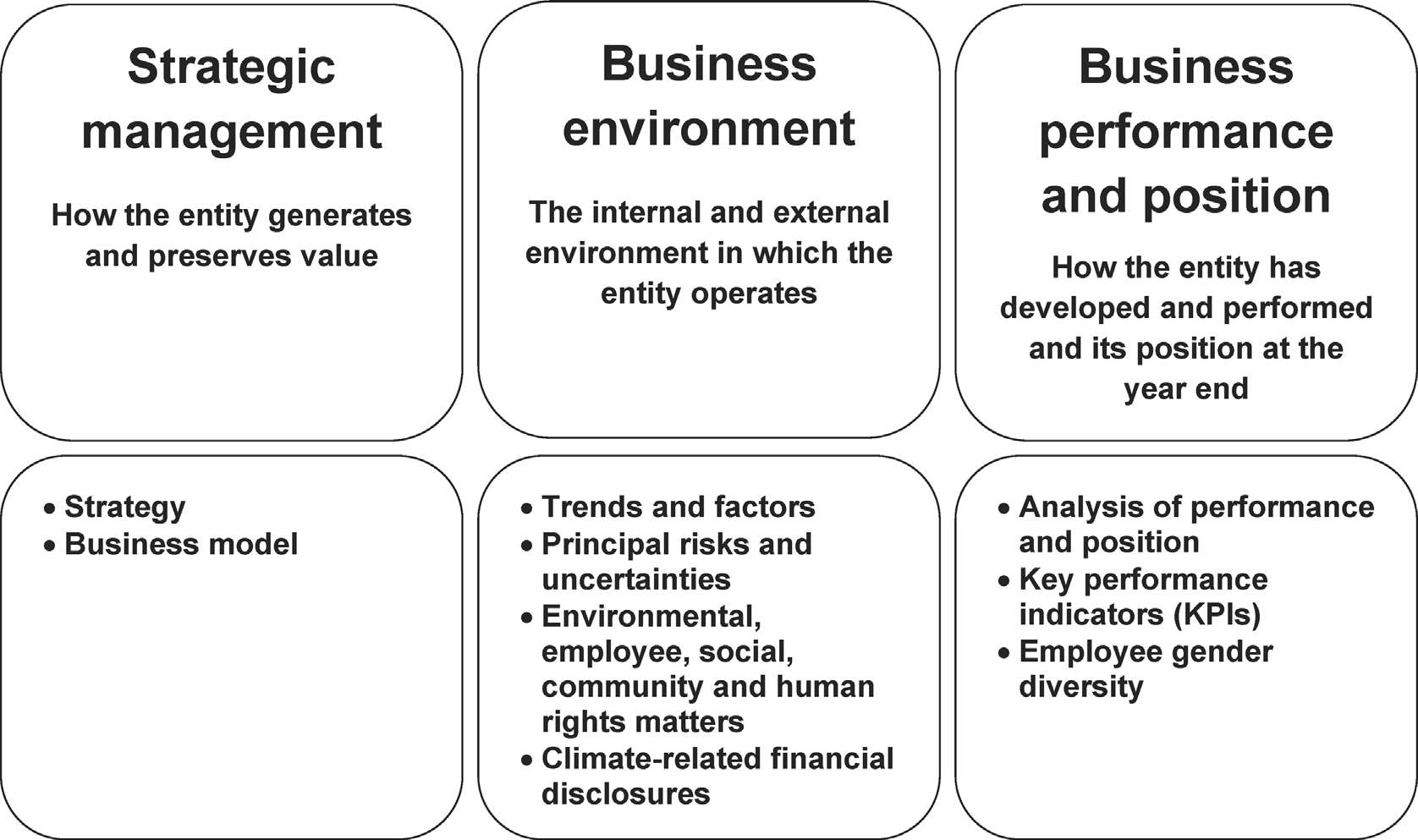
7A.3In addition to the specific disclosure requirements set out in the Act, entities should ensure that the strategic report meets its overall purpose: to provide information to shareholders and help them to assess how the directors have performed their duty under section 172. Section 414CZA of the Act requires large companies to report on how the directors have considered the matters set out in section 172(1) (a section 172(1) statement). Guidance on the application of this requirement is set out in Section 8.
7A.4Traded LLPs and banking LLPs that are not PIEs with more than 500 employees, are subject to a reduced set of strategic report content disclosure requirements which includes a fair review of the LLP's business; and a description of the principal risks and uncertainties facing the LLP.
7A.5The various content elements to be included in the strategic report should not be addressed in isolation; there are numerous relationships and interdependencies between those elements and other disclosures in the annual report which, as noted in paragraph 6.17, should be highlighted and explained in the strategic report. In particular, relevant non-financial and sustainability information should be considered as integral to the strategic report and should be linked, where appropriate, to other content elements. The relevance and strength of the relationships and interdependencies between the content elements will vary according to the facts and circumstances of the entity.
7A.6Where there has been a material change in the facts or circumstances relating to any of the content elements set out below, that fact should be highlighted and explained.
Strategic management
7A.7An entity's purpose, strategy, objectives, and business model are inter-related concepts. Different businesses may use different terms for these concepts and/or may approach them in a different order. The disclosure of an entity's purpose, strategy, objectives and business model should together explain what an entity does and how and why it does it. A description of an entity's values, desired behaviours and culture will help to explain and put its purpose in context.
7A.8An entity's purpose is why it exists. It could encompass generating benefits for members through its economic success whilst having regard to the matters identified in section 172 and, in the broader social context, contributing to inclusive and sustainable growth. The entity's strategy should be informed by what it wants to achieve in the future.
7A.9An entity will usually have a number of formal objectives that it intends to achieve in pursuit of its purpose. The entity will also have developed a strategy that describes the means by which it intends to achieve those objectives. Objectives can be financial or non-financial in nature and may be expressed in quantitative or qualitative terms.
7A.10An entity's culture can help to drive its success. The purpose, strategy and values should be aligned with the entity's culture. 29
7A.11The strategic report must include a description of the entity's strategy.30
7A.12A description of the strategy for achieving an entity's objectives provides insight into its development, performance, position and future prospects. The disclosure of the entity's objectives places the strategy in context and allows shareholders to make an assessment of its appropriateness.
Linkage example
Relating the development and performance of the entity during the year to the strategy that was in place at the time will allow shareholders to assess the directors' actions in pursuit of the entity's objectives, how directors have discharged their duty under section 172 and may be relevant in an assessment of the entity's future prospects.
7A.13Where relevant, linkage to and discussion of key performance indicators (KPIs) should be included in any descriptions given in order to allow an assessment of the entity's progress against its objectives and strategy. Similarly, emphasising the relationship between an entity's principal risks and its ability to meet its objectives may provide relevant information.
7A.14The strategic report must include a description of the entity's business model.31
7A.15The description of the entity's business model should explain how it generates and preserves value over the longer term. The business model should be consistent with the entity's purpose.
7A.16A critical part of understanding an entity's business model is understanding its sources of value, being the key resources and relationships that support the generation and preservation of value. In identifying its key sources of value, an entity should consider both its tangible and intangible assets and also identify those resources and relationships that have not been reflected in the financial statements because they do not meet the accounting definitions of assets or the criteria for recognition as assets. This information may provide insight into how the board manages, sustains and develops these unrecognised assets.
Example
An entity may generate a significant portion of its value from its workforce. The strategic report should explain an entity's key sources of value and the actions that it takes in order to manage, sustain and develop these sources of value. Other sources of value may include: corporate reputation and brand strength; customer base; natural resources; research and development; intellectual capital; licences; patents; copyrights and trademarks; outsourcing relationships; and market position.
7A.17An entity will often create value through its activities at several different parts of its business process. The description of the business model should focus on the parts that are most important to an understanding of the generation and, preservation of value. The risks posed by the impact of an entity's activity, however, may be greatest in other parts of the business process and these areas should also be considered.
Example
An entity operating in the pharmaceuticals sector might have a ready market for an innovative drug; the key to the value creation process is in the development and approval of that drug. In this case, the business model description should give due emphasis to the critical drug development and approval processes.
7A.18The description of the business model should include a high-level understanding of how the entity is structured, the markets in which it operates, and how the entity engages with those markets (e.g. what part of the value chain it operates in, its main products, services, customers and its distribution methods). It should also make clear what makes it different from, or the basis on which it competes with, its peers.
7A.19The description of the entity's major products, services and markets and its competitive position within those markets should reflect the way that the business is managed, as should the segment analysis presented in the financial statements. While the level of aggregation and detail may vary, there should be overall consistency between these two information sets.
7A.20The business model should provide context for other information presented in the strategic report and the annual report more broadly.
Linkage example
Identifying relationships between the business model and other content elements could provide linkage with other relevant information in the strategic report. For instance, it could highlight the principal risks that affect, or strategy that relates to, a specific part of the business model.
Linkage example
For instance, where an entity is reliant on technological innovation, this is likely to be reflected in the disclosed KPIs, the review of the business and the principal risks and uncertainties.
Similarly, where the entity is reliant on a highly trained and engaged workforce, or other stakeholders relationships, this should be apparent in different elements of the strategic report which should set out how the entity manages, measures and nurtures those relationships.
Business environment
7A.21To the extent necessary for an understanding of the development, performance Q or position of the entity's business, the strategic report must include the main trends and factors likely to affect the future development, performance or and position of the entity's business.32
7A.22Trends and factors affecting the business may arise as a result of the external environment in which the entity operates or from internal sources. They may have affected the development, performance or position of the entity in the year under review or may give rise to opportunities or risks that may affect the entity's future prospects. In considering the external trends, it is important that entities consider both the trends in the market in which the entity operates and the trends and factors relating to society more generally. For instance, an entity should consider the risks and opportunities arising from factors such as climate change and the environment, and where material, discuss the effect of these trends on the entity's future business model and strategy.
Example
The environment within which an entity operates, particularly that related to consumer sentiment, can change quickly as a result of a specific incident or media interest. A recent incident or media coverage need not be directly related to the entity, and need not have affected the current year performance, to have the potential to give rise to new risks or opportunities that may have a material effect on its future prospects.
7A.23The strategic report should also cover other significant features of its external environment and how those influence the business. This could include trends in the regulatory, macro-economic environment and changes in societal expectations. The strategic report should set out the directors' analysis of the potential effect on the entity's future development, performance, position or future prospects of the trends or factors identified.
7A.24The discussion of internal trends and factors will vary according to the nature of the business, but could, for example, include the development of new products and services or the benefits expected from capital investment.
7A.25Where practicable and relevant, the trend or factor should be quantified and the source of the evidence underpinning it identified.
Example
An entity may wish to state in its strategic report that the market in which it operates has grown substantially in the past five years. In this case, the strategic report should, where practicable, indicate by how much the market has grown and reference the source of the statistic used.
7A.26Given the influence trends and factors might have on many aspects of the entity's development, performance, position or future prospects, the linkage of this type of information to other areas of the strategic report and the annual report more broadly will be particularly important.
Linkage example
The strategic report might highlight the principal risks or opportunities that arise from, or the strategy that has been adopted as a result of, significant trends and factors identified. It might also highlight how certain trends or factors have affected the development, performance or position of the entity through reference to information in the financial statements.
Linkage example
Increasing focus on sustainability may result in an entity making changes to its business model such as to adapt its investment strategy. Information on these trends should be linked to the entity's strategy and business model explaining the potential effects on the development, performance, position or future prospects of the entity.
7A.27The strategic report must include a description of the principal risks and uncertainties facing the entity 33 and should include an explanation of how they are managed or mitigated.34
7A.28The risks and uncertainties included in the strategic report should be limited to those considered by the entity's management to be material to the development, performance, position or future prospects of the entity. They will generally be matters that the board regularly monitors and discusses because of their likelihood, the magnitude of their potential effect on the entity, or a combination of the two.
7A.29The board should consider the full range of business risks, including both those that are financial in nature and those that are non-financial. Principal risks should be disclosed and described irrespective of whether they result from strategic decisions, operations, organisation or behaviour, or from external factors over which the board may have little or no direct control.
7A.30Principal risks should include, but are not necessarily limited to, those risks that could result in events or circumstances that might threaten the entity's business model, future performance, solvency or liquidity, or result in significant value erosion. In determining which risks are the principal risks, entities should consider the potential impact and probability of the related events or circumstances arising and the timescale over which they may occur. For entities that are required to make climate-related financial disclosures, there may be overlap between those requirements and the disclosures required by this section.
Linkage example
Principal risks may result in threats to solvency and liquidity. An entity could consider the period over which principal risks may crystallise and how these have been taken into account when, where relevant, making a viability statement.35 Where a viability statement uses a timeframe shorter than that over which risks may crystallise, the entity could explain the potential impact of these long-term risks on the entity's viability.
7A.31Where the entity is facing long-term systemic risks which may have a material effect on the entity's ability to generate and preserve value in the long term, the strategic report could explain the potential impact on the entity's strategy and business model if those risks crystallise.
Example
Risks arising from climate change could include the risks and opportunities facing the entity's operations from a transition to a low carbon economy, the physical risks to the entity's operations posed by climate change, for instance direct damage to assets or supply chain disruption, and could also include the risks that the entity's operations contribute to climate change risk. These different types of risk may not be relevant for every entity, but directors should consider each category and report on those that constitute principal risks.
Linkage example
The transition risk related to climate change and associated changes in legislation may cause an entity to make changes to its business model, adapt its products and production processes or alter the markets in which it is engaged. In these situations, the entity's strategy and business model could explain how climate change might influence the entity's business in the future and the potential effects of climate change on the development, performance, position or future prospects of the entity.
7A.32The descriptions of the principal risks and uncertainties facing the entity should be specific so that a shareholder can understand why they are material to the entity. This might include a description of the likelihood of the risk, an indication of the circumstances under which the risk might be most relevant to the entity and its possible effects. An explanation of how the principal risks and uncertainties are managed or mitigated should also be included to enable shareholders to assess the impact on the future prospects of the entity.
Linkage example
Where relevant, the description of the principal risks and uncertainties facing the entity should include linkage to and discussion of the entity's strategy and/or business model. Any linkage to accounting estimates and judgements disclosed in the notes to the financial statements, the going concern statement, trends or factors from the external environment described elsewhere in the strategic report, or any other linked disclosure in the annual report, could also be highlighted and, where relevant, discussed.
Emphasising the relationship between an entity's principal risks and its ability to meet its objectives may provide relevant insight into an entity's risk appetite.
7A.33Significant changes in principal risks such as a change in likelihood, probable timing or possible effect, or the inclusion of new risks, should be highlighted and explained.36
Example
Where the risk profile of an entity has changed, many entities explain whether the individual risks identified have increased, decreased or remained the same severity. The risk mitigation could also show how the entity has responded to the change.
For instance, in recent years, the cyber risk faced by many entities has significantly increased. The risk disclosures could explain the ways in which cyber risk could affect the business, for instance, a cyber attack, loss of sensitive data leading to a lack of customer confidence, a failure of IT systems leading to a failure to operate certain elements of the business etc. The risk mitigation could explain the processes that the entity has put in place to mitigate the increased risk.
7A.34[Not used]
7A.35To the extent necessary for an understanding of the development, performance Q or position of the entity's business, the strategic report must include information about:
- environmental matters (including the impact of the business of the entity on the environment);
- the entity's employees; and
- social, community and human rights issues.,
including information about any policies of the entity in relation to those matters and the effectiveness of those policies.
If the report does not contain information of each kind mentioned in paragraphs (a) to (c), it must state which of those kinds of information it does not contain.37
7A.36Corporate transparency on broader matters is essential to enable shareholders to assess an entity's ability to generate and preserve value over the long term, and to assess the management of risks which may impact the sustainability of the entity's business or may affect society more broadly in ways which are not reflected in an entity's financial statements.
7A.37Information on environmental, employee, social, community and human rights matters should not be considered in isolation but should be integrated throughout the report where appropriate and, in particular, considered when disclosing the entity's strategy and business model, principal risks and uncertainties and KPIs.
7A.38[Not used]
7A.39Disclosures should not be limited to the matters stated in the Act. Entities should consider all the resources and relationships which are necessary for an understanding of the development, performance or position of the entity's business. Such resources and relationships could include customers, suppliers, the entity's pension scheme and intellectual property.
7A.40When determining the appropriate level of information to disclose in the strategic report, entities should consider the following (non-exhaustive) list of factors:
- the extent to which the matter has an effect on an entity's business model, strategy, objectives, purpose, or culture;
- the extent to which the matter has an effect on an entity's tangible assets, intangible assets or other sources of value, such as key stakeholder relationships (including any reputational risks) or other factors that may contribute to the entity's long-term success;
- the extent to which the matter could have an effect on an entity's market share or position in the market;
- the extent to which the matter constitutes a major issue facing the sector in which the entity operates; and
- the potential severity or frequency of impacts on the environment.
7A.41There is overlap between the information required by this section and the reporting requirements of section 172(1) (see Section 8). Entities should consider both requirements when determining appropriate disclosures.
7A.42Disclosures should be entity specific. The questions included below have been provided to help boards consider the types of issues which could be relevant to their business, and to encourage discussion on the types of disclosures that could be appropriate in relation to the specific matters stated in the Act.
Questions for boards to consider * Environmental matters: Is the entity's business model reliant on natural resources such as water, land or minerals? Does the use of these resources result in other secondary impacts on natural resources? What is the entity's impact on the environment? What are the pollution risks from the entity's activities? Will the entity's business be affected by climate change, either as a result of regulation or climate change affecting how the business can operate? What are the effects of an entity's activities on climate change? * Employees: Is the entity's business model dependent on current employees' skills and experience? What is the composition of the workforce? Are there any risks associated with its employment model? How does the entity consider the interests of employees and maintain good employee relationships? What channels of communication are there with employees? Are there different approaches in different part of the world or at different levels of seniority? * Social and community matters: Is the entity's business dependent on relationships with certain communities? Does the entity perform a strategically important role in society – by providing essential or critical services for example? * Respect for human rights: How does the entity's business model ensure protection of human rights? Where are the areas of risk to those rights? How does this vary in the different geographical locations in which the entity operates?
7A.43[Not used]
7A.44[Not used]
7A.45[Not used]
7A.46While the Act refers to employees, the changing nature of the workplace means that not all people who are working for an entity fall within the legal definition of an employee. Entities are encouraged to broaden their disclosures to consider workforce issues more generally, and not just limit information to those persons who have a contract of employment.
7A.47Information should only be included in the strategic report if that information is necessary for an understanding of the development, performance, or position or future prospects of the entity's business. Some stakeholders may require a greater level of detail in certain areas; the strategic report could provide signposting to where this more detailed information is available.
7A.48[Not used]
7A.49The description of the policies relating to the matters should be sufficient to understand the entity's approach to the matters stated. The policies and effectiveness disclosures, together with the information disclosed in respect of paragraph 7A.35 above, should enable shareholders to understand the importance of the matter to the entity and the way in which an entity addresses those matters.
7A.50The description of each policy should be clear, concise and be proportionate to the risks posed and should only be provided where relevant.
7A.51If information which would otherwise be required by the Act in relation to environmental matters, employees, social, community or human rights issues is not relevant to an understanding of the development, performance or position of the entity, this information may be omitted and the fact of the omission stated.
7A.52[Not used]
7A.53[Not used]
7A.54[Not used]
7A.55[Not used]
Linkage example
The way an entity conducts its business in relation to its tax affairs may have an impact on community and social matters in the countries in which it operates. An entity may adopt a strategy of having a transparent tax structure paying a fair rate of tax in each of its major areas of operation which in turn supports those local communities in which it operates.
The execution of this strategy can be seen through the presentation of its effective tax rates in each of its major areas of operation in the period under review.
7A.56Where an entity's business model is dependent on the matters described in paragraph 7A.35, or where there are material risks posed in these areas, an entity may use KPIs to monitor its performance. In such circumstances, the most efficient way of communicating information on the effectiveness of its policies on those matters may be through reference to those measures.
7A.57Where the directors wish to put additional information in the public domain that is not required by legislation, it should be located outside the strategic report, for example in a separate sustainability or corporate social responsibility report which should be located online. Directors may, however, wish to provide a reference to where this complementary information is available.
7A.58The directors may refer to a source of guidance or a voluntary framework that provides advice on how the entity should conduct its business, suggests ways of monitoring or tracking performance, or provides examples of disclosures that might be helpful in communicating information to the entity's stakeholders.
Business performance
7A.59The strategic report must provide a fair, balanced and comprehensive analysis of the development and performance of the business in the financial year and of its position at the end of that year.38
7A.60The strategic report should include a narrative of the development, performance and position of the business in the financial year which is consistent with the information contained in the financial statements.
7A.61The development and performance of the business should be analysed in the context of the strategy applied by the entity during the financial year. Segmentation of the analysis of development, performance or position should be consistent with the segments identified in the financial statements.
7A.62Where necessary for an understanding of the development, performance, position or future prospects of the entity, the analysis should make reference to cash flows during the year and factors that may affect future cash flows. Where appropriate, the strategic report should discuss the entity's current and prospective liquidity and its ability to fund its stated strategy.
7A.63The strategic report should explain the entity's performance during the year in the context of how it has performed relative to prior periods. It could explain performance relative to stated targets and relative to the external environment in which it is operating, in order that shareholders can make an assessment of the future development, performance or position of the business.
7A.64If part of the business has had a material impact on business performance that should be disclosed. Shareholders should be able to distinguish between movements in performance which have resulted from one-off events and movements which are expected to continue. It is also important to identify the impact of acquisitions and disposals on performance in order for shareholders to be able to understand how the existing business has performed and the likely future impact of the acquisition or disposal.
7A.65Where the structure of a group has changed significantly in the period, for instance as a result of a major acquisition or disposal, an entity might choose to use pro-forma figures to explain performance in addition to the statutory figures. Where pro-forma figures are presented, explanations of how those figures have been calculated and their relationship to amounts extracted from the audited statements should also be presented.
7A.66The strategic report must, where appropriate, include references to, and additional explanations of, amounts included in the financial statements.39
7A.67The analysis should complement the financial statements, where relevant providing additional explanations of amounts recognised in the financial statements and the conditions and events that shaped the information contained in them.
Example
The strategic report could, where relevant, include comments on: * any one-off, or significant items affecting the current year results; * the existence and timing of commitments for capital expenditures; * changes in the effective tax rate and the reasons for that change; * material prior year items; * changes in revenue from year to year that result from organic growth, acquisitions, foreign exchange, etc. (a 'revenue bridge'); or * financing arrangements (e.g. changes in net debt or approach to financing of long-term liabilities).
7A.68The analysis in the strategic report must include financial and, where appropriate, non-financial 40 key performance indicators (KPIs), including information relating to environmental and employee matters. 41
7A.69The KPIs used in the analysis should be those that the directors judge are most effective in assessing progress against objectives or strategy, monitoring principal risks, or otherwise utilised to measure the development, performance or position of the business. There should be alignment between the KPIs presented in the strategic report and the key sources of value and risks identified in the business model.
7A.70Non-financial KPIs provide insight into future financial prospects and progress in managing risks and opportunities. They may include, for example, measures related to product quality, customer complaints, environmental matters or employee metrics. Non-financial KPIs may be a mixture of indicators which provide information about what the entity has done in the past and what may happen in the future. They should include matters potentially affecting the long-term sustainability of the entity.
7A.71Where possible, KPIs should reflect the way that the board manages the entity's business. They may be generally accepted measures that are widely used, either within the entity's industry sector or more broadly. However, the comparability of the KPIs should not override the effectiveness of the KPIs for assessing the performance or position of the business.
Linkage example
The use of KPIs that also form part of directors' current or future incentive plans in the analysis of principal risks, strategy and performance will provide a clearer indication of how these matters might affect or have affected executive remuneration.
The relationship between the KPIs disclosed in the strategic report and the measures of performance in the directors' remuneration policy may also provide relevant information.
7A.72Comparatives should be included and the reasons for any significant changes from year to year explained. Consistency in the presentation of KPIs is a desirable quality.
7A.73The entity should provide information that enables shareholders to understand each KPI used in the strategic report. For example, the following information should be identified and explained where relevant:
- its definition and calculation method;
- its purpose;
- the source of underlying data;
- any significant assumptions made; and
- any changes in the calculation method used compared to previous financial years, including significant changes in the underlying accounting policies adopted in the financial statements which might affect the KPI.
7A.74Where a line-item from the financial statements, or a commonly used KPI, has been adjusted for inclusion in the strategic report, the term used for that adjusted measure should be clear and a reconciliation to an appropriate financial statement line-item and explanation of any material adjustments should be provided.
Example
Where an entity uses earnings before interest, tax, depreciation, amortisation (EBITDA) and certain restructuring costs to analyse business performance, the measure could be referred to as ‘EBITDA before restructuring costs' or similar. A reconciliation to an appropriate financial statement line-item and explanation of the adjustment should be provided.
7A.75Similar KPIs should be clearly distinguishable from each other.
Example
An entity may use one earnings per share measure when discussing performance and another when discussing executive remuneration in the directors' remuneration report. The terms adopted to describe each KPI should be unique and used consistently and the differences between the two KPIs clearly identified. Entities could also explain why it is appropriate for the two different measures to be used.
7A.76Financial KPIs can be Alternative Performance measures (APMs) as defined in the European Securities and Markets Authority's (ESMA) Guidelines on Alternative Performance Measures42 which apply to strategic reports amongst other documents.43 Even when not directly applicable, the guidelines set out principles for disclosure for APMs. The Guidelines define an APM as a measure of historical or future performance, financial position, or cash flows, other than a financial measure defined or specified in the applicable financial reporting framework.
7A.77The strategic report should provide a breakdown showing, as at the end of the Q financial year:
- the number of persons of each sex who were directors of the company;
- the number of persons of each sex who were senior managers of the company (other than persons falling within sub-paragraph (a)); and
- the number of persons of each sex who were employees of the company.44
7A.78A 'senior manager' is an employee who has responsibility for planning, directing or controlling the activities of the entity or a strategically significant part of it. In the strategic report of a consolidated group, directors of subsidiary companies that are included in the consolidated financial statements are also considered 'senior managers'.45
7A.79In referring to a 'strategically significant' part of an entity and by including directors of subsidiaries included in the consolidated financial statements, the definition of a 'senior manager' in paragraph 7A.78 is wider than the definition of key management personnel in IAS 24 Related Party Disclosures and FRS 102 The Financial Reporting Standard applicable in the UK and Republic of Ireland.
7A.80An entity might not consider that including all directors of all subsidiaries included in the consolidated financial statements in the statutory definition of 'senior managers' accurately reflects its executive pipeline. This may be the case, for instance, where a subsidiary is insignificant in the context of the group as a whole. In such cases, it may be appropriate to provide an enhanced analysis of the statutory 'senior manager' category. For example:
| Male | Female | |
|---|---|---|
| Directors of the company | X | X |
| Employees in other senior executive positions | X | X |
| Directors of subsidiary companies not included in above | X | X |
| Total senior managers other than directors of the company | X | X |
| Other employees of the group | X | X |
7A.81Where the strategic report includes an enhanced analysis such as that suggested in paragraph 7A.80, a description of how employees included in any non-statutory category have been identified should be provided. Information on other executive pipeline or general employee diversity matters should also be provided where it is necessary to put the diversity statistics into context. While percentages of male and female directors and employees can be informative, numbers must also be provided.
7A.82[Not used]
7A.83[Not used]
7A.84[Not used]
Other content elements
7A.85To the extent that they are matters that are considered to be of strategic importance to the entity, the strategic report should also include information that would otherwise be disclosed in the directors' report.46
7A.86There are a number of directors' report disclosure requirements that are closely related to matters that should be considered for inclusion in the strategic report. Where this information is also necessary for an understanding of the development, performance, position or future prospects if the business, it should be included as part of the strategic report. However, where the information is not necessary for that purpose, these disclosures should be included in the directors' report. In such cases, a signpost enabling shareholders to drill-down to this information should be considered when it is related to matters covered in the strategic report. Appendix III (Appendix IV(b) for LLPs) includes an analysis of directors' report (energy and carbon report for LLPs) disclosure requirements.
7A.87Where information that is required to be disclosed in the directors' report is included in the strategic report, it does not also need to be included in the directors' report. However, where this is the case, the directors' report should cross-reference information that has been included in the strategic report instead of the directors' report.47
Signature of the statutory reports and the statement of directors' responsibilities
Summary of legal requirements
The Act requires the board of directors to approve the strategic report, directors' report and directors' remuneration report, as well as the financial statements. The name of the director or secretary of the company who has signed each report on behalf of the board should be stated on every copy of that report in accordance with section 433 of the Act. The Act does not specify where in each report the name should be located.
Summary of legal requirements
The Act requires the board of directors to approve the strategic report, directors' report and directors' remuneration report, as well as the financial statements. The name of the director or secretary of the company who has signed each report on behalf of the board should be stated on every copy of that report in accordance with section 433 of the Act. The Act does not specify where in each report the name should be located.
Section 7B
The strategic report: content elements for entities that are PIEs with more than 500 employees
Scope of this Section
7B.1This section of the Guidance applies to entities that are PIEs with more than 500 employees. The section sets out the legal requirements that apply to quoted and unquoted companies that fall within the definition of a PIE and have more than 500 employees. PIEs with more than 500 employees are also required to make the climate-related financial disclosures as set out in Section 7C. Legal requirements applicable only to quoted companies are identified by a 'Q'. Footnotes identify the source and applicability of each part of the legislation.
Content elements
7B.2The content elements of the strategic report set out in the Act can be analysed into three broad categories: strategic management, business environment and business performance and position:
7B.3In addition to the specific disclosure requirements set out in the Act, entities should ensure that the strategic report meets its overall purpose: to provide information to shareholders and help them to assess how the directors have performed their duty under section 172. Section 414CZA of the Act requires large companies to report on how the directors have considered the matters set out in section 172(1) (a section 172(1) statement). Guidance on the application of this requirement is set out in Section 8.
7B.4The strategic report must contain a non-financial and sustainability information statement. Guidance on how to satisfy the requirement to produce a non-financial and sustainability information statement is set out in paragraphs 7B.83 and 7B.84. Further content requirements are set out in Section 7C.
Strategic management
7B.5The various content elements to be included in the strategic report should not be addressed in isolation; there are numerous relationships and interdependencies between elements and other disclosures in the annual report which, as noted in paragraph 6.17, should be highlighted and explained in the strategic report. In particular, relevant non-financial and sustainability information should be considered as integral to the strategic report and should be linked, where appropriate, to other content elements. The relevance and strength of the relationships and interdependencies between the content elements will vary according to the facts and circumstances of the entity.
7B.6Where there been a material change in the facts or circumstances relating to any of the content elements set out below, that fact should be highlighted and explained.
7B.7An entity's purpose, strategy, objectives, and business model are inter-related concepts. Different businesses may use different terms for these concepts and/or may approach them in a different order. The disclosure of an entity's purpose, strategy, objectives and business model should together explain what an entity does and how and why it does it. A description of an entity's values, desired behaviours and culture will help to explain and put its purpose in context.
7B.8An entity's purpose is why it exists. It could encompass generating benefits for members through its economic success whilst having regard to the matters identified in section 172 and, in the broader social context, contributing to inclusive and sustainable growth. The entity's strategy should be informed by what it wants to achieve in the future.
7B.9An entity will usually have a number of formal objectives that it intends to achieve in pursuit of its purpose. The entity will also have developed a strategy that describes the means by which it intends to achieve those objectives. Objectives can be financial or non-financial in nature and may be expressed in quantitative or qualitative terms.
7B.10An entity's culture can help to drive its success. The purpose, strategy and values should be aligned with the entity's culture.48
7B.12A description of the strategy for achieving an entity's objectives provides insight into its development, performance, position and future prospects. The disclosure of the entity's objectives places the strategy in context and allows shareholders to make an assessment of its appropriateness.
Linkage example
Relating the development, and performance of the entity during the year to the strategy that was in place at the time will allow shareholders to assess the directors’ actions in pursuit of the entity’s objectives, how directors have discharged their duty under section 172 and may be relevant in an assessment of the entity’s future prospects.
7B.13Where relevant, linkage to and discussion of key performance indicators (KPIs) should be included in any descriptions given in order to allow an assessment of the entity's progress against its objectives and strategy. Similarly, emphasising the relationship between an entity's principal risks and its ability to meet its objectives may provide relevant information.
7B.15The description of the entity's business model should explain how it generates and preserves value over the longer term. The business model should be consistent with the entity's purpose.
7B.16A critical part of understanding an entity's business model is understanding its sources of value, being the key resources and relationships that support the generation and preservation of value. In identifying its key sources of value, an entity should consider both its tangible and intangible assets and also identify those resources and relationships that have not been reflected in the financial statements because they do not meet the accounting definitions of assets or the criteria for recognition as assets. This information may provide insight into how the board manages, sustains and develops these unrecognised assets.
Example
An entity may generate a significant portion of its value from its workforce. The strategic report should explain an entity's key sources of value and the actions that it takes in order to manage, sustain and develop these sources of value. Other sources of value may include: corporate reputation and brand strength; customer base; natural resources; research and development; intellectual capital; licences; patents; copyrights and trademarks; outsourcing relationships; and market position.
7B.17An entity will often create value through its activities at several different parts of its business process. The description of the business model should focus on the parts that are most important to an understanding of the generation and preservation of value. The risks posed by the impact of an entity's activity, however, may be greatest in other parts of the business process and these areas should also be considered.
Example
An entity operating in the pharmaceuticals sector might have a ready market for an innovative drug; the key to the value creation process is in the development and approval of that drug. In this case, the business model description should give due emphasis to the critical drug development and approval processes.
7B.18The description of the business model should include a high-level understanding of how the entity is structured, the markets in which it operates, and how the entity engages with those markets (e.g. what part of the value chain it operates in, its main products, services, customers and its distribution methods). It should also make clear what makes it different from, or the basis on which it competes with, its peers.
7B.19The description of the entity's major products, services and markets and its competitive position within those markets should reflect the way that the business is managed, as should the segment analysis presented in the financial statements. While the level of aggregation and detail may vary, there should be overall consistency between these two information sets.
7B.20The business model should provide context for other information presented in the strategic report and the annual report more broadly.
Linkage example
Identifying relationships between the business model and other content elements could provide linkage with other relevant information in the strategic report. For instance, it could highlight the principal risks that affect, or strategy that relates to, a specific part of the business model.
Linkage example
For instance, where an entity is reliant on technological innovation, this is likely to be reflected in the disclosed KPIs, the review of the business and the principal risks and uncertainties.
Similarly, where the entity is reliant on a highly trained and engaged workforce, or other stakeholder relationships, this should be apparent in different elements of the strategic report which should set out how the entity manages, measures and nurtures those relationships.
Business environment
7B.21It is important that an entity's future development, performance and position are presented in context; to do this entities should provide information about the main trends and factors including both financial and non-financial matters.
7B.22Trends and factors affecting the business may arise as a result of the external environment in which the entity operates or from internal sources. They may have affected the development, performance or position of the entity in the year under review or may give rise to opportunities or risks that may affect the entity's future prospects. In considering the external trends, it is important that entities consider both the trends in the market in which the entity operates and the trends and factors relating to society more generally. For instance, an entity should consider the risks and opportunities arising from factors such as climate change and the environment, and where material, discuss the effect of these trends on the entity's future business model and strategy.
Example
The environment within which an entity operates, particularly that related to consumer sentiment, can change quickly as a result of a specific incident or media interest. A recent incident or media coverage need not be directly related to the entity, and need not have affected the current year performance, to have the potential to give rise to new risks or opportunities that may have a material effect on its future prospects.
7B.23The strategic report should also cover other significant features of its external environment and how those influence the business. This could include trends in the regulatory, macro-economic environment and changes in societal expectations. The strategic report should set out the directors’ analysis of the potential effect of the trends or factors identified on the future development, performance or position or future prospects of the entity.
7B.24The discussion of internal trends and factors will vary according to the nature of the business, but could, for example, include the development of new products and services or the benefits expected from capital investment.
7B.25Where practicable and relevant, the trend or factor should be quantified and the source of the evidence underpinning it identified.
Example
An entity may wish to state in its strategic report that the market in which it operates has grown substantially in the past five years. In this case, the strategic report should, where practicable, indicate by how much the market has grown and reference the source of the statistic used.
7B.26Given the influence trends and factors might have on many aspects of the entity's development, performance, position or future prospects, the linkage of this type of information to other areas of the strategic report and the annual report more broadly will be particularly important.
Linkage example
The strategic report might highlight the principal risks or opportunities that arise from, or the strategy that has been adopted as a result of, significant trends and factors identified. It might also highlight how certain trends or factors have affected the development, performance or position of the entity through reference to information in the financial statements.
Linkage example
Increasing focus on sustainability may result in an entity making changes to its business model such as to adapt its investment strategy. Information on these trends should be linked to the entity's strategy and business model explaining the potential effects on the development, performance, position or future prospects of the entity.
7B.27The strategic report must include a description of the principal risks arising in connection with the entity's operations and, where relevant and proportionate – a description of its business relationships, products and services which are likely to cause adverse impacts in those areas of risk, and a description of how it manages 51 and mitigates 52 the principal risks.
7B.28The risks and uncertainties included in the strategic report should be limited to those considered by the entity's management to be material to the development, performance, position or future prospects of the entity or where the impact of the entity's activity poses a significant risk. They will generally be matters that the board regularly monitor and discuss because of their likelihood, the magnitude of their potential effect on the entity, or a combination of the two.
7B.29The board should consider the full range of business risks, including both those that are financial in nature and those that are non-financial. Principal risks should be disclosed and described irrespective of whether they result from strategic decisions, operations, organisation or behaviour, or from external factors over which the board may have little or no direct control. In relation to climate-related risks, there may be overlap between the disclosures required by this section and the specific climate-related financial disclosures described in Section 7C.
7B.30Principal risks should include, but are not necessarily limited to, those risks that could result in events or circumstances that might threaten the entity's business model, future performance, solvency or liquidity, or result in significant value erosion. In determining which risks are the principal risks, entities should consider the potential impact and probability of the related events or circumstances arising and the timescale over which they may occur.
Linkage example
Principal risks may result in threats to solvency and liquidity. An entity could consider the period over which principal risks may crystallise and how these have been taken into account when, where relevant, making a viability statement.53 Where a viability statement uses a timeframe shorter than that over which risks may crystallise, the entity could explain the potential impact of these long-term risks on the entity's viability.
7B.31Where the entity is facing long-term systemic risks which may have a material effect on the entity's ability to generate and preserve value in the long term, the strategic report could explain the potential impact on the entity's strategy and business model if those risks crystallise.
Example
Risks arising from climate change could include the risks and opportunities facing the entity’s operations from a transition to a low carbon economy, the physical risks to the entity’s operations posed by climate change, for instance direct damage to assets or supply chain disruption, and could also include the risks that the entity’s operations contribute to climate change risk. These different types of risk may not be relevant for every entity, but directors should consider each category and report on those that constitute principal risks.
Linkage example
The transition risk related to climate change and associated changes in legislation may cause an entity to make changes to its business model, adapt its products and production processes or alter the markets in which it is engaged. In these situations, the entity's strategy and business model could explain how climate change might influence the entity's business in the future and the potential effects of climate change on the development, performance, position or future prospects of the entity.
7B.32The descriptions of the principal risks and uncertainties facing the entity should be specific so that a shareholder can understand why they are material to the entity. This might include a description of the likelihood of the risk, an indication of the circumstances under which the risk might be most relevant to the entity and its possible effects. An explanation of how the principal risks and uncertainties are managed or mitigated should also be included to enable shareholders to assess the impact on the future prospects of the entity.
Linkage example
Where relevant, the description of the principal risks and uncertainties facing the entity should include linkage to and discussion of the entity’s strategy and/or business model. Any linkage to accounting estimates and judgements disclosed in the notes to the financial statements, the going concern statement, trends or factors from the external environment described elsewhere in the strategic report, or any other linked disclosure in the annual report, could also be highlighted and, where relevant, discussed.
Emphasising the relationship between an entity’s principal risks and its ability to meet its objectives may provide relevant insight into an entity’s risk appetite.
7B.33Significant changes in principal risks such as a change in likelihood, probable timing or possible effect, or the inclusion of new risks, should be highlighted and explained.54
Example
Where the risk profile of an entity has changed, many entities explain whether the individual risks identified have increased, decreased or remained the same severity. The risk mitigation could also show how the entity has responded to the change.
For instance, in recent years, the cyber risk faced by many entities has significantly increased. The risk disclosures could explain the ways in which cyber risk could affect the business, for instance a cyber attack, loss of sensitive data leading to a lack of customer confidence, a failure of IT systems leading to a failure to operate certain elements of the business etc. The risk mitigation could explain the processes that the entity has put in place to mitigate the increased risk.
7B.34The entity should look beyond its own operations and consider how risks and impacts arising from business relationships, products and services, affect its principal risks. For instance, entities could consider the reputational risk arising from factors such as poor labour practices in their supply chain or purchasing products which have been produced in a manner which has a significant environmental or ecological impact.
Linkage example
An entity may be reliant on the continuity of products from areas of the world where there is political uncertainty. Where such circumstances may disrupt the supply of essential materials and this is a principal risk, or contributes to a principal risk, an entity could describe the business relationship, the products affected and how it manages that risk.
7B.35To the extent necessary for an understanding of the development, performance or position and impact of an entity's activity, the strategic report must include information relating to, as a minimum:
- environmental matters (including the impact of the business of the entity on the environment);
- the entity's employees;
- social matters:
- respect for human rights; and
- anti-corruption and anti-bribery matters.55
To the extent necessary for an understanding of the development, performance or position of the entity's business, the strategic report must include information about community issues.Q56
7B.36Corporate transparency on broader matters is essential to enable shareholders to assess an entity's ability to generate and preserve value over the long term, and to assess the management of risks which may impact the sustainability of the entity's business or may affect society more broadly in ways which are not reflected in an entity's financial statements.
7B.37Information on environmental, employee, social, community, human rights, anti-corruption and anti-bribery matters should not be considered in isolation but should be integrated throughout the report where appropriate and, in particular, considered when disclosing the entity's strategy and business model, principal risks and uncertainties and KPIs.
7B.38Section 414CA(1) of the Act requires an entity to include a non-financial and sustainability information statement as part of its strategic report that includes climate-related financial disclosures and the disclosures set out in section 414CB of the Act. Where entities include these disclosures as part of their strategic report, the requirement can be met by cross-referencing to where the relevant information is included in the strategic report.
7B.39Disclosures should not be limited to the matters stated in the Act. Entities should consider all the resources and relationships which are necessary for an understanding of the development, performance or position of the entity's business. Such resources and relationships could include customers, suppliers, the entity's pension scheme and intellectual property.
7B.40When determining the appropriate level of information to disclose in the strategic report, entities should consider the following (non-exhaustive) list of factors:
- the extent to which the matter has an effect on an entity's business model, strategy, objectives, purpose, or culture;
- the extent to which the matter has an effect on an entity's tangible assets, intangible assets or other sources of value, such as key stakeholder relationships (including any reputational risks) or other factors that may contribute to the entity's long-term success;
- the extent to which the matter could have an effect on an entity's market share or position in the market;
- the extent to which the matter constitutes a major issue facing the sector in which the entity operates; and
- the potential severity or frequency of impacts on society.
7B.41There is overlap between the information required by this section and the reporting requirements of section 172(1) (see Section 8). Entities should consider both requirements when determining appropriate disclosures.
7B.42Disclosures should be entity specific. The questions included below have been provided to help boards consider the types of issues which could be relevant to their business, and to encourage discussion on the types of disclosures that could be appropriate in relation to the specific matters stated in the Act.
Questions for boards to consider
- Environmental matters: Is the entity's business model reliant on natural resources such as water, land or minerals? Does the use of these resources result in other secondary impacts on natural resources? What is the entity's impact on the environment? What are the pollution risks from the entity's activities? Will the entity's business be affected by climate change, either as a result of regulation or climate change affecting how the business can operate? What are the effects of an entity's activities on climate change?
- Employees: Is the entity's business model dependent on current employees’ skills and experience? What is the composition of the workforce? Are there any risks associated with its employment model? How does the entity consider the interests of employees and maintain good employee relationships? What channels of communication are there with employees? Are there different approaches in different part of the world or at different levels of seniority?
- Social and community matters: Is the entity's business dependent on relationships with certain communities? Does the entity perform a strategically important role in society – by providing essential or critical services for example?
- Respect for human rights: How does the entity's business model ensure protection of human rights? Where are the areas of risk to those rights? How does this vary in the different geographical locations in which the entity operates?
- Anti-corruption and anti-bribery: How does the entity's business model ensure adequate regard is given to anti-corruption and anti-bribery requirements? How does the entity's culture ensure that this is effective throughout the organisation? What are the areas of risk to the entity? How does this vary in the different geographical locations in which the entity operates and the different sectors in which it operates?
Impact of activities
7B.43The purpose of the information required by this section of the Act is to enable a user of the annual report to understand the impact of these factors on the business of the entity and the impact of the business of the entity on stakeholders and society. Information should be disclosed in relation to those matters which could affect the long-term success of the entity.
7B.44The impact of an entity's activities is the effect that it has externally. These impacts may pose threats to and provide opportunities for, the success of the entity's business. Impacts may be positive or negative. A board should consider the impact of the entity's business on key stakeholders and report on those aspects when material.
7B.45The impact of an entity's activities should be considered in the context of its business model and its ability to generate and preserve value over the longer term. External matters may pose threats to and provide opportunities for the success of the entity. An entity should also consider whether the threats or opportunities are expected to change in the future; this is of particular relevance when considering trends in the global regulatory environment and trends in societal expectations.
7B.46While the Act refers to employees, the changing nature of the workplace means that not all people who are working for an entity fall within the legal definition of an employee. Entities are encouraged to broaden their disclosures to consider workforce issues more generally, and not just limit information to those persons who have a contract of employment.
7B.47Information should only be included in the strategic report if that information is necessary for an understanding of the development, performance, or position or future prospects of the entity's business. Some stakeholders may require a greater level of detail in certain areas; the strategic report could provide signposting to where this more detailed information is available.
7B.48The strategic report must include a description of the policies pursued by the entity in relation to the matters and any due_diligence processes implemented by the entity in pursuance of those policies.57 It must also include a description of the outcome of those policies.58
If the entity does not pursue policies in relation to one or more of these matters, the strategic report must contain a clear and reasoned explanation for the entity not doing so.59
7B.49When disclosure of the matters is necessary for an understanding of the entity's development, performance and position and the impact of its activity, the strategic report must include a description of the policies that the entity has in place in relation to the matters described.
7B.50The description of each policy should be clear, concise and be proportionate to the risks posed and should only be provided where relevant.
7B.51Where an entity does not have a policy in place in relation to one of the matters, it should state that fact and explain why it is not considered relevant to have a policy.
7B.52The strategic report should include a description of any due diligence processes over material matters that an entity has in place to ensure that its policies relating to these matters are adhered to throughout the group, and, where appropriate, through its supply chain.
7B.53It may be that an entity has a framework for managing a number of risks rather than specific processes relating to each policy area. In this case, the entity could describe its framework, how breaches of policy are identified, the escalation procedures relating to breaches of policy and the outcome of those escalation procedures.
7B.54Any disclosures relating to due diligence processes should be entity specific and informative. Boilerplate disclosures are of limited use.
7B.55Where the outcome of policies is measured by reference to a survey or other external evidence, the strategic report could signpost where this complementary information can be found. Where information is derived from sources external to the entity, the strategic report could signpost these sources.
Example
An entity may have a policy of not using suppliers that employ child labour. The due diligence could be a rolling series of unannounced site visits to suppliers and the outcome of the policy would be stating whether any supplier contracts have been terminated as a result of failures.
Example
Due diligence processes which may be necessary to ensure the entity's anti-bribery and anti-corruption policy is followed may differ from jurisdiction to jurisdiction where the risks of such behaviours vary. Where this is relevant, the information disclosed should be sufficiently specific to enable investors to understand the difference risks posed by different parts of the entity's operations.
Linkage example
The way an entity conducts its business in relation to its tax affairs may have an impact on community and social matters in the countries in which it operates. An entity may adopt a strategy of having a transparent tax structure paying a fair rate of tax in each of its major areas of operation which in turn supports those local communities in which it operates.
The execution of this strategy can be seen through the presentation of its effective tax rates in each of its major areas of operation in the period under review.
7B.56Where an entity's business model is dependent on the matters described in paragraph 7B.35, or where there are material risks posed in these areas, an entity may use KPIs to monitor its performance. In such circumstances, the most efficient way of communicating information on the outcome of its policies on those matters may be through reference to those measures.
7B.57Where the directors wish to put additional information in the public domain that is not required by legislation, it should be located outside the strategic report, for example in a separate sustainability or corporate social responsibility report which should be located online. Directors may, however, wish to provide a reference to where this complementary information is available.
7B.58The directors may refer to a source of guidance or a voluntary framework that provides advice on how the entity should conduct its business, suggests ways of monitoring or tracking performance, or provides examples of disclosures that might be helpful in communicating information to the entity's stakeholders.
Business performance
7B.59The strategic report must provide a fair, balanced and comprehensive analysis of the development and performance of the business in the financial year and of its position at the end of that year.60
7B.60The strategic report should include a narrative of the development, performance and position of the business in the financial year which is consistent with the information contained in the financial statements.
7B.61The development and performance of the business should be analysed in the context of the strategy applied by the entity during the financial year. Segmentation of the analysis of development, performance or position should be consistent with the segments identified in the financial statements.
7B.62Where necessary for an understanding of the development, performance, position or future prospects of the entity, the analysis should make reference to cash flows during the year and factors that may affect future cash flows. Where appropriate, the strategic report should discuss the entity's current and prospective liquidity and its ability to fund its stated strategy.
7B.63The strategic report should explain the entity's performance during the year in the context of how it has performed relative to prior periods. It could explain performance relative to stated targets and relative to the external environment in which it is operating, in order that shareholders can make an assessment of the future development, performance or position of the business.
7B.64If part of the business has had a material impact on business performance that should be disclosed. Shareholders should be able to distinguish between movements in performance which have resulted from one-off events and movements which are expected to continue. It is also important to identify the impact of acquisitions and disposals on performance in order for shareholders to be able to understand how the existing business has performed and the likely future impact of the acquisition or disposal.
7B.65Where the structure of a group has changed significantly in the period, for instance as a result of a major acquisition or disposal, an entity might choose to use pro-forma figures to explain performance in addition to the statutory figures. Where pro-forma figures are presented, explanations of how those figures have been calculated and their relationship to amounts extracted from the audited statements should also be presented.
7B.66The strategic report must, where appropriate, include references to, and additional explanations of, amounts included in the financial statements.61
7B.67The analysis should complement the financial statements, where relevant providing additional explanations of amounts recognised in the financial statements and the conditions and events that shaped the information contained in them.
Example
The strategic report could, where relevant, include comments on: * any one-off, or significant items affecting the current year results; * the existence and timing of commitments for capital expenditures; * changes in the effective tax rate and the reasons for that change; * material prior year items; * changes in revenue from year to year that result from organic growth, acquisitions, foreign exchange, etc. (a ‘revenue bridge'); or * financing arrangements (e.g. changes in net debt, factoring or reverse factoring arrangements, or approach to financing of long-term liabilities).
7B.68The analysis in the strategic report must include financial and non-financial key performance indicators (KPIs).62
7B.69The KPIs used in the analysis should be those that the directors judge are most effective in assessing progress against objectives or strategy, monitoring principal risks, or otherwise utilised to measure the development, performance or position of the business or the impact of its activity. There should be alignment between the KPIs presented in the strategic report and the key sources of value and risks identified in the business model.
7B.70Non-financial KPIs provide insight into future financial prospects and progress in managing risks and opportunities. They may include, for example, measures related to product quality, customer complaints, environmental matters or employee metrics. Non-financial KPIs may be a mixture of indicators which provide information about what the entity has done in the past and what may happen in the future. They should include matters potentially affecting the long-term sustainability of the entity. Entities should also consider disclosing KPIs which measure the impact of the entity's activities.
7B.71Where possible, KPIs should reflect the way that the board manages the entity's business. They may be generally accepted measures that are widely used, either within the entity's industry sector or more broadly. However, the comparability of the KPIs should not override the effectiveness of the KPIs for assessing the performance or position of the business.
Linkage example
The use of KPIs that also form part of directors’ current or future incentive plans in the analysis of principal risks, strategy and performance will provide a clearer indication of how these matters might affect or have affected executive remuneration.
The relationship between the KPIs disclosed in the strategic report and the measures of performance in the directors’ remuneration policy may also provide relevant information.
7B.72Comparatives should be included and the reasons for any significant changes from year to year explained. Consistency in the presentation of KPIs is a desirable quality.
7B.73The entity should provide information that enables shareholders to understand each KPI used in the strategic report. For example, the following information should be identified and explained where relevant:
- its definition and calculation method;
- its purpose;
- the source of underlying data;
- any significant assumptions made; and
- any changes in the calculation method used compared to previous financial years, including significant changes in the underlying accounting policies adopted in the financial statements which might affect the KPI.
7B.74Where a line-item from the financial statements, or a commonly used KPI, has been adjusted for inclusion in the strategic report, the term used for that adjusted measure should be clear and a reconciliation to an appropriate financial statement line-item and explanation of any material adjustments should be provided.
Example
Where an entity uses earnings before interest, tax, depreciation, amortisation (EBITDA) and certain restructuring costs to analyse business performance, the measure could be referred to as ‘EBITDA before restructuring costs’ or similar. A reconciliation to an appropriate financial statement line-item and explanation of the adjustment should be provided.
7B.75Similar KPIs should be clearly distinguishable from each other.
Example
An entity may use one earnings per share measure when discussing performance and another when discussing executive remuneration in the directors’ remuneration report. The terms adopted to describe each KPI should be unique and used consistently and the differences between the two KPIs clearly identified. Entities could also explain why it is appropriate for the two different measures to be used.
7B.76Financial KPIs can be Alternative Performance measures (APMs) as defined in the European Securities and Markets Authority's (ESMA) Guidelines on Alternative Performance Measures63 which apply to strategic reports amongst other documents.64 Even when not directly applicable, the guidelines set out principles for disclosure for APMs. The Guidelines define an APM as a measure of historical or future performance, financial position, or cash flows, other than a financial measure defined or specified in the applicable financial reporting framework.
7B.77The strategic report should provide a breakdown showing, as at the end of the financial year:Q
- the number of persons of each sex who were directors of the company;
- the number of persons of each sex who were senior managers of the company (other than persons falling within sub-paragraph (a)); and
- the number of persons of each sex who were employees of the company.65
7B.78A ‘senior manager’ is an employee who has responsibility for planning, directing or controlling the activities of the entity or a strategically significant part of it. In the strategic report of a consolidated group, directors of subsidiary companies that are included in the consolidated financial statements are also considered ‘senior managers’.66
7B.79In referring to a ‘strategically significant’ part of an entity and by including directors of subsidiaries included in the consolidated financial statements, the definition of a ‘senior manager’ in paragraph 7A.78 is wider than the definition of key management personnel in IAS 24 Related Party Disclosures and FRS 102 The Financial Reporting Standard applicable in the UK and Republic of Ireland.
7B.80An entity might not consider that including all directors of all subsidiaries included in the consolidated financial statements in the statutory definition of ‘senior managers’ accurately reflects its executive pipeline. This may be the case, for instance, where a subsidiary is insignificant in the context of the group as a whole. In such cases, it may be appropriate to provide an enhanced analysis of the statutory ‘senior manager’ category. For example:
| Male | Female | |
|---|---|---|
| Directors of the company | X | X |
| Employees in other senior executive positions | X | X |
| Directors of subsidiary companies not included in above | X | X |
| Total senior managers other than directors of the company | X | X |
| Other employees of the group | X | X |
7B.81Where the strategic report includes an enhanced analysis such as that suggested in paragraph 7B.80, a description of how employees included in any non-statutory category have been identified should be provided. Information on other executive pipeline or general employee diversity matters should also be provided where it is
7B.76 Financial KPIs can be Alternative Performance measures (APMs) as defined in the European Securities and Markets Authority's (ESMA) Guidelines on Alternative Performance Measures63 which apply to strategic reports amongst other documents.64 Even when not directly applicable, the guidelines set out principles for disclosure for APMs. The Guidelines define an APM as a measure of historical or future performance, financial position, or cash flows, other than a financial measure defined or specified in the applicable financial reporting framework.
7B.77 The strategic report should provide a breakdown showing, as at the end of the financial year:
- the number of persons of each sex who were directors of the company;
- the number of persons of each sex who were senior managers of the company (other than persons falling within sub-paragraph (a)); and
- the number of persons of each sex who were employees of the company.65
7B.78 A 'senior manager' is an employee who has responsibility for planning, directing or controlling the activities of the entity or a strategically significant part of it. In the strategic report of a consolidated group, directors of subsidiary companies that are included in the consolidated financial statements are also considered 'senior managers'.66
7B.79 In referring to a 'strategically significant' part of an entity and by including directors of subsidiaries included in the consolidated financial statements, the definition of a 'senior manager' in paragraph 7A.78 is wider than the definition of key management personnel in IAS 24 Related Party Disclosures and FRS 102 The Financial Reporting Standard applicable in the UK and Republic of Ireland.
7B.80 An entity might not consider that including all directors of all subsidiaries included in the consolidated financial statements in the statutory definition of 'senior managers' accurately reflects its executive pipeline. This may be the case, for instance, where a subsidiary is insignificant in the context of the group as a whole. In such cases, it may be appropriate to provide an enhanced analysis of the statutory 'senior manager' category. For example:
| Male | Female | |
|---|---|---|
| Directors of the company | X | X |
| Employees in other senior executive positions | X | X |
| Directors of subsidiary companies not included in above | X | X |
| Total senior managers other than directors of the company | X | X |
| Other employees of the group | X | X |
7B.81 Where the strategic report includes an enhanced analysis such as that suggested in paragraph 7B.80, a description of how employees included in any non-statutory category have been identified should be provided. Information on other executive pipeline or general employee diversity matters should also be provided where it is necessary to put the diversity statistics into context. While percentages of male and female directors and employees can be informative, numbers must also be provided.
7B.82 An entity must include a non-financial and sustainability information statement in its strategic report.67
7B.83 The non-financial and sustainability information statement should contain the following information or include cross references to where such information can be found in the main body of the strategic report. The paragraph references indicate where guidance on each element can be found.
- The entity's business model (paragraph 7B.14);
- Information, to the extent necessary for an understanding of the entity's development, performance and position and impact of its activity, relating to environmental matters, employees, social matters, respect for human rights and anti-corruption and anti-bribery matters (paragraph 7B.35);
- A description of the policies pursued in relation to the matters and any due diligence process implemented in pursuance of those policies (paragraph 7B.48);
- A description of the outcome of those policies (paragraph 7B.48);
- If the entity does not pursue policies in relation to one or more of the matters, a clear and reasoned explanation for the entity's not doing so (paragraph 7B.48);
- A description of the principal risks arising in relation to the matters arising in connection with the entity's operations, and where relevant and proportionate – a description of its business relationships, products and services which are likely to cause adverse impacts in those areas of risk, and a description of how it manages the principal risks (paragraph 7B.27);
- A description of the non-financial key performance indicators relevant to the entity's business (paragraph 7B.68);
- Where appropriate, references to, and additional explanations of, amounts included in the entity's annual accounts (paragraph 7B.66); and
- Climate-related financial disclosures (Section 7C).
7B.84 Entities are encouraged to meet the requirements of the non-financial and sustainability information statement through a title and a series of cross references, so as to maintain the coherence of the strategic report. Entities are discouraged from replicating information located elsewhere in the strategic report in the non-financial and sustainability information statement.
Other content elements
7B.85 To the extent that they are matters that are considered to be of strategic importance to the entity, the strategic report should also include information that would otherwise be disclosed in the directors' report.68
7B.86 There are a number of directors' report disclosure requirements that are closely related to matters that should be considered for inclusion in the strategic report. Where this information is also necessary for an understanding of the development, performance, position or future prospects of the business, it should be included as part of the strategic report. However, where the information is not necessary for that purpose, these disclosures should be included in the directors' report. In such cases, a signpost enabling shareholders to drill-down to this information should be considered when it is related to matters covered in the strategic report. Appendix III and Appendix IV(b) include an analysis of directors' report disclosure (energy and carbon report for LLPs) requirements.
7B.87 Where information that is required to be disclosed in the directors' report is included in the strategic report, it does not also need to be included in the directors' report. However, where this is the case, the directors' report should cross-reference information that has been included in the strategic report instead of the directors' report.69
Signature of the statutory reports and the statement of directors' responsibilities
Signature of the statutory reports and the statement of directors' responsibilities
The Act requires the board of directors to approve the strategic report, directors' report and directors' remuneration report, as well as the financial statements. The name of the director or secretary of the company who has signed each report on behalf of the board should be stated on every copy of that report in accordance with section 433 of the Act. The Act does not specify where in each report the name should be located.
Section 7C
The strategic report: climate-related financial disclosures
Scope of this Section
7C.1 The Act requires certain entities to prepare specific 'climate-related financial disclosures'. The entities in scope are:
- Public Interest Entities (PIEs) with more than 500 employees;
- UK registered companies with securities admitted to the Alternative Investment Market (AIM) with more than 500 employees;
- UK registered companies that are not included in the categories above, which have a turnover of more than £500 million (high turnover companies) and more than 500 employees.
7C.2 In accordance with The Limited Liability Partnerships (Accounts and Audit) (Application of Companies Act 2006) Regulations 2008 (SI 2008/1911), LLPs with more than 500 employees and a turnover of more than £500 million are also required to make these disclosures.
Content elements
7C.3 Section 414CB sets out the details of the climate-related financial disclosures to be made by those entities that are within its scope. The required disclosures are:
- a description of the company's governance arrangements in relation to assessing and managing climate-related risks and opportunities;
- a description of how the company identifies, assesses, and manages climate-related risks and opportunities;
- a description of how processes for identifying, assessing, and managing climate-related risks are integrated into the company's overall risk management process;
- a description of—
- the principal climate-related risks and opportunities arising in connection with the company's operations, and
- the time periods by reference to which those risks and opportunities are assessed;
- a description of the actual and potential impacts of the principal climate-related risks and opportunities on the company's business model and strategy;
- an analysis of the resilience of the company's business model and strategy, taking into consideration different climate-related scenarios;
- a description of the targets used by the company to manage climate-related risks and to realise climate-related opportunities and of performance against those targets; and
- a description of the key performance indicators used to assess progress against targets used to manage climate-related risks and realise climate-related opportunities and of the calculations on which those key performance indicators are based.
7C.4 Guidance in the form of non-binding Q&A to support companies and LLPs in their application of these requirements has been prepared by BEIS and is available on its website through the following link: https://www.gov.uk/government/publications/climate-related-financial-disclosures-for-companies-and-limited-liability-partnerships-llps
Materiality
7C.5 When the directors of a company reasonably believe that, having regard to the nature of the company's business, and the manner in which it is carried on, the whole or a part of a climate-related financial disclosure required by paragraphs 7C.3 (e), (f), (g) or (h) is not necessary for an understanding of the company's business, the directors may omit the whole or (as the case requires) the relevant part of that climate-related financial disclosure.
7C.6 When the directors omit the whole or part of a climate-related financial disclosure in reliance on section 414CB(4A), the non-financial and sustainability information statement must provide a clear and reasoned explanation of the directors' reasonable belief mentioned in paragraph 7C.5.
Section 8
The strategic report: content elements for the section 172 reporting
The requirements are set out in Appendix III.
Where the board considers this information to be of strategic importance, it may be included in the strategic report and incorporated into the directors' report by cross-reference to avoid duplication (see paragraphs 7A.85 and 7B.85 of this Guidance).
Information about impending developments or matters in the course of negotiation may be omitted from these directors' report requirements if the disclosure would, in the opinion of the directors, be seriously prejudicial to the interests of the company. There is no such exemption for disclosures required by section 414CZA.
Scope
8.1 The purpose of the strategic report in the Act is to inform members of the company and help them assess how the directors have performed their duty under section 172. To fulfil this duty, a director must act in the way he considers, in good faith, would be most likely to promote the success of the company for the benefit of shareholders as a whole and in doing so, have regard to a number of broader matters. The director's section 172 duty70 is set out in Section 4 of this Guidance.
8.2 Section 414CZA Section 172(1) statement includes a specific reporting requirement71 in respect of how directors have considered broader matters when performing their duty to promote the success of the company.
8.3 A strategic report for a financial year of a company must include a statement (a "section 172(1) statement") which describes how the directors have had regard to the matters set out in section 172(1) (a) to (f) when performing their duty under section 172.72
8.4 The matters set out in section 172(1) (a) to (f) are:
- the likely consequences of any decision in the long term;
- the interests of the company's employees;
- the need to foster the company's business relationships with suppliers, customers and others;
- the impact of the company's operations on the community and the environment;
- the desirability of the company maintaining a reputation for high standards of business conduct; and
- the need to act fairly between members of the company.
8.5 There will be linkages and overlaps between information contained in the strategic report and that required to be included in the section 172(1) statement. Entities are encouraged to avoid repetition, maintain the cohesion of the narrative contained within the strategic report and incorporate information into the section 172(1) statement by cross-reference where appropriate.
Summary of legal requirements
The directors' report must explain how the directors:
- have engaged with employees, suppliers, customers and others; and
- have had regard to employee interests, the need to foster the company's business relationships with suppliers, customers and others, and the effect of that regard, including on the principal decisions taken by the company during the financial year.
The purpose of the section 172(1) statement
8.10 The section 172 duty is consistent with the principle of enlightened shareholder value; recognising that companies are run for the benefit of shareholders, but that the long-term success of a business is dependent on maintaining relationships with stakeholders and considering the external impact of the entity's activities. The section 172(1) statement should explain how the board has had regard to the broader matters in their actions, behaviours and decisions.
8.11 The information contained in a section 172(1) statement will depend on the individual circumstances of each company, but companies will probably want to include information on some or all of the following:
- The issues, factors and stakeholders the directors consider relevant in complying with section 172(1) (a) to (f) and how they have formed that opinion;
- The main methods the directors have used to engage with stakeholders and understand the issues to which they must have regard; and
- Information on the effect of that regard on the company's decisions and strategies during the financial year.
Materiality
8.12 The section 172(1) statement should focus on matters that are of strategic importance to the company. The level of information disclosed should be consistent with the size and complexity of the business.
Content of the section 172(1) statement
8.13 This section provides guidance to companies to determine the appropriate reporting to meet the requirements of the section 172(1) statement. It is not intended to interpret how the section 172 duty should be met.
Issues, factors and stakeholders
The long term
8.14 The Act requires directors to have regard to the likely consequences of decisions in the long term. The section 172(1) statement could provide information on how the long-term success of the company has been considered in making strategic decisions. This could include considering the interests of other stakeholders, the long-term impact of the entity's activities on the community and environment or other broader matters that may affect company performance over the longer term.
8.15 Identifying the likely consequences of decisions in the long term, and then having regard to those likely consequences, may form part of the risk management process within a company. Companies are encouraged to consider the linkage between the principal risks disclosed in the strategic report and disclosures made in the section 172(1) statement.
Stakeholders
8.16 The description of the company's business model in the strategic report should provide an insight into the key resources and relationships that support the generation and preservation of value in the company. Stakeholder relationships are often a key source of value that help to ensure that an entity's success is sustainable over the longer term. It is important that boards identify their key stakeholders and the importance of those stakeholders to the long-term success of the company.
Example
A company could disclose a stakeholder map, that identifies its key stakeholder relationships showing the dependencies of each part of the business on different groups of stakeholders and the impacts that the business has on each of those groups. This could include the environmental and community resources that the company is dependent on how those resources generate and preserve value.
8.17 Information which helps to explain the benefits created for other stakeholders may sometimes be difficult to measure, but it can provide significant insight. This is a developing area of disclosure and companies are encouraged to innovate and experiment in order to provide useful information.
8.18 The key stakeholder relationships may be those set out in section 172(1), however, companies are encouraged to consider all relevant stakeholders in making the section 172(1) statement. In particular, we encourage companies to consider disclosures regarding their relationships with pension schemes, pensioners and their entire workforce.
8.19 The Act uses the term 'employees' and the directors' report disclosure relating to section 172(1) applies to UK employees only. However, we encourage companies to consider workforce issues more generally and not limit consideration to those persons who have a contract of employment.
8.20 In discharging their section 172 duty to have regard to stakeholder interests, directors need appropriate information to make informed judgements. This information is likely to involve stakeholder engagement, whether through day-to-day business interactions or through any specific process, structures or channels established for engagement.
8.21 The way in which a company engages and communicates with its stakeholders provides insight into the relative importance that it places on those relationships.
Example
The company could describe how it engages with its key stakeholders. This could include the main methods of communication and how the company seeks to understand the key issues affecting those stakeholders. For instance, the Code recommends the following methods for engagement with the workforce — a director appointed from the workforce, a formal workforce advisory panel or a designated non-executive director. There may also be regular surveys of stakeholder groups or impact assessments related to the environment and community.
8.22 A company could explain the outcomes of its engagement with key stakeholders and the impact on the board's decision making.
Decision making
Principal decisions
8.23 The section 172(1) statement could identify the principal decisions taken by the board during the year, how regard was had to the matters set out in section 172(1) when making decisions and the effect of that regard.
8.24 The interests of one group of stakeholders may not always be aligned with the interests of other stakeholders or with the interests of shareholders. Where there are conflicts, or where in the interests of one group have been prioritised over another, the section 172(1) statement could explain how the directors have considered the different interests and the factors taken into account in making that decision.
Example
A board may decide to exit a significant segment of the market in which the entity operates when its activities in that market are no longer profitable. This may have an impact on employees working in those markets or the local community. The strategy may, however, be critical to the long-term success of the company. The section 172 statement could explain how the interests of the employees and the community were taken into account and any actions taken by the board to mitigate the impact on those stakeholders.
8.25 There should be consistency between the principal decisions discussed in the section 172(1) statement and the review of the business contained in the strategic report.
Capital allocation and dividend policy
8.26 For many companies, determining how a company allocates capital may be a principal decision. These capital allocation decisions could include considering working capital requirements, investment, capital expenditure, research and development, capital distribution, and investment in skills and training.
8.27 Part of that capital allocation decision may be the determination of whether to pay a dividend, and, if so, how much to pay.
8.28 On a year-to-year basis, directors will decide how to apply the company's capital allocation and dividend policies given events and circumstances that have arisen during the period. In both the setting of the policy and the application of that policy in any given period, directors are encouraged to consider the interests of the company's shareholders as a whole, while having regard to, for example, the long-term viability of the company, the need for research and development or capital investment and the interests of other stakeholders, such as the pension fund or current employees.
8.29 If the setting and application of the capital allocation and dividend policies are principal decisions, the section 172(1) statement could explain how directors have had regard to the long term and the interests of stakeholders, both in the setting of the capital allocation and dividend policies and then in the application of those policies each year.
Example
The company could explain how its capital allocation and dividend policies have had regard to the matters set out in section 172(1). In particular, the statement could include how directors have had regard to the long-term success of the company and the interests of other stakeholders in determining the dividend level.
The company could include a quantified analysis of allocations of free cash flow, to enable users of the accounts to understand how discretionary resources have been allocated between shareholders, other stakeholders and retained in the company.
Culture
8.30 The board has a role in ensuring that a business is sustainable in the long term. This includes embedding the desired culture. Culture is a combination of the culture of the values, attitudes and behaviours demonstrated by a company in its activities and relations with stakeholders. These stakeholders include shareholders, employees, customers, suppliers, the wider community and the environment. Demonstrating the desired culture may be a way in which the company maintains the desired reputation for high standards of business conduct. The culture of the company may also be important in having regard to the need to act fairly as between members of the company.
Example
The section 172(1) statement could disclose information in relation to the culture that the board has set in order to ensure that decisions taken are in line with the company's values and objectives.
The section 172(1) statement could explain the factors which the board considers are important to the company's reputation for high standards of business conduct and the actions taken during the year to ensure that its reputation is maintained.
Website publication of section 172(1) statement
8.31 The section 172(1) statement must be made available on the company's website. Quoted companies are already required to make their annual report available on their website.73 Unquoted companies, however, are not required to publish their annual report on a website and will need to make arrangements to ensure that the section 172(1) statement is available on a website. This does not need to be the company's own website; it may be a website maintained on behalf of the company (such as the website of a parent company) provided it identifies the company in question.
8.32 Unquoted companies may choose to publish either the section 172(1) statement, the strategic report (containing the section 172(1) statement) or the whole of the annual report on the company website. Unquoted companies will need to ensure that disclosures included by cross-referencing to other parts of the annual report are included within the statement if published on a website without the rest of the annual report. The approach adopted may be dependent on the extent of cross-references to information included in other parts of the annual report.
Section 9
The strategic report with supplementary material
Statutory option to provide strategic report with supplementary material
Summary of legal requirements
Section 426 of the Act allows a company, in certain circumstances, to send its members the strategic report with supplementary material instead of the full annual report. The supplementary material, which is specified in section 426A of the Act, includes information on the audit report issued on the annual accounts and, in the case of a quoted company, limited extracts from the directors' remuneration report. This option replaces the option to send summary financial statements to members instead of the full annual report.
9.1 When this statutory option is taken, the Act requires a complete strategic report, as it appears in the annual report, to be sent to the company's members. Compliance with the law would not be achieved if the members were sent a summarised version of, or selected extracts from, the strategic report that is included in the company's annual report.
9.2 Similarly, disclosures that are included in the strategic report by cross-reference to another part of the annual report must also be sent to members along with the main body of the strategic report in order to comply with the law.
Example
A quoted company has chosen to present the strategic report's quantitative employee gender diversity disclosures alongside the description of the board's policy on diversity, its objectives for implementing the policy and its progress on achieving those objectives. It has included a cross-reference to these quantitative disclosures in the company's strategic report in order for it to meet the requirements of section 414C(8). If the company wishes to take the option to send its members the strategic report and supplementary material instead of the full annual report, it must ensure that the quantitative employee gender diversity disclosures form part of the supplementary material that is sent with the main body of the strategic report.
9.3 The strategic report will often signpost or otherwise refer to complementary information presented elsewhere in the annual report; this signposting will often include a reference to a page number in the full annual report. The directors may wish to consider whether including a clarifying statement in the 'strategic report with supplementary material' is appropriate to draw attention to the fact that this information is not included as part of the document that has been issued.
9.4 Whilst there is no requirement to include any supplementary information other than that specified under section 426A of the Act under this statutory option, a company may include additional extracts from, or summaries of, information contained in the full annual report, if the directors consider it appropriate. The nature and extent of these extracts will vary from company to company and will depend on the information needs of the company's members and the nature and format of the information already included in the strategic report.
Non-statutory summarised business information
9.5 Business information that is tailored to the needs of a specific subset of the company's shareholders can be more easily produced when its form and content is not prescribed in law or regulation. In consequence, a non-statutory approach to sending summarised business information may be considered appropriate. This might particularly be the case where a company's shareholder base contains subsets of investors who have significantly different information needs.
Example
A company's shareholder base may comprise substantial retail and institutional investor subgroups. The directors may find that the shareholders in the retail investor subgroup wish to receive business information that is less detailed than would be appropriate for inclusion in the strategic report within the full annual report. In these circumstances, the directors might consider it appropriate to send non-statutory summarised business information which focusses on the issues that they believe will be of the greatest relevance to the retail investors, rather than to send this subgroup of shareholders the strategic report with supplementary material as described in paragraphs 9.1 to 9.4.
Summary of legal requirements
Section 435 of the Act sets out the requirements in connection with publication of non-statutory accounts. Where a company chooses to send its shareholders non-statutory summarised business information that includes any financial statements, then it must ensure that it complies with the requirements in section 435.
Where this non-statutory approach is taken, shareholders must also be sent one of the statutory reports (i.e. either the strategic report with supplementary material, described in paragraphs 9.1 to 9.4 above, or the full annual report).
Electronic publication of statutory reports
9.6 In certain circumstances, the statutory report required to be sent to shareholders can be sent electronically (e.g. on a CD or DVD, by e-mail or through a link to the company's website) rather than in hard copy form.
Summary of legal requirements
Sections 146 and 147 of the Act set out the requirements in respect of the communication of information by a company to its members. A company may choose to send its annual report to consenting members by electronic means. In order to take advantage of this option, the company must give its members the opportunity to choose to receive their annual report in a hard copy form. This is normally done when a member becomes a shareholder but can be done at any later date. If the consent letter is worded appropriately, the member can be assumed to have consented to electronic delivery if they do not respond. Publication of the annual report on the company's website can also be considered an acceptable form of delivery to consenting members as long as the company's articles permit it and the company has notified the member of its availability and where it can be found.
Appendix I: Glossary
| the Act | The Companies Act 2006. |
| annual report | For the purposes of the Guidance, the annual accounts and reports that members of the company are entitled to receive under section 423 of the Act. |
| Alternative investment market (AIM) | The London Stock Exchange's market for small and medium-size growth companies. |
| banking company | An entity that has permission under Part 4A of the Financial Services and Markets Act 2000 (c8) to accept deposits. Defined in section 1164(2) and (3) of the Act. |
| business model | How the entity generates or preserves value over the longer term.74 |
| complementary information | Complementary information is information that is relevant to shareholders but is not necessary to effectively communicate the information that is required by law or regulation. Complementary information can be more detailed information or additional voluntary information (e.g. a five-year summary or a glossary). |
| components | The distinct reports and other sections that are required to be included in the annual report by law or regulation (e.g. the strategic report, the directors' report, the corporate governance report, the directors' remuneration report and the financial statements). |
| cross-referencing | A means by which an item of information, which has been disclosed in one component of an annual report, can be included as an integral part of another component of the annual report. A cross-reference should specifically identify the nature and location of the information to which it relates in order for the disclosure requirements of a component to be met through the relocated information. A component is not complete without the information to which it cross-references. Cross-referenced information must be located within the annual report. Cross-referencing is different to signposting. |
| the Code | The 2018 UK Corporate Governance Code. |
| directors' report | The report that is required by section 415 of the Act which incorporates the disclosures specified by the Act and its associated regulations. |
| DTR | The Financial Conduct Authority's Disclosure and Transparency Rules. |
| due diligence | The work undertaken to ensure that an entity's policies are being adhered to. |
| high turnover company | A company is a 'high turnover company' in relation to a financial year:
|
| impact | The impact that the entity's operations have on stakeholders and the outside world. |
| insurance company | This Guidance uses the term 'insurance company' to refer to: An authorised insurance company – an entity which has permission under Part 4A of the Financial Services and Markets Act 2000 (c8) to effect or carry out contracts of insurance (section 1165(2) of the Act). A company carrying on insurance market activity as defined in section 316(3) of the Financial Services and Markets Act 2000 (section 1165(7) of the Act). |
| key performance indicators (KPIs) | Quantitative measures used by directors to assess progress against objectives or strategy, track principal risks, or otherwise monitor the development, performance or position of the business. |
| large company | A company that does not qualify as medium-sized under section 465 of the Act or is excluded from being treated as medium-sized under section 467 of the Act. |
| Limited liability partnership (LLP) | A limited liability partnership is a body corporate (with legal personality separate from that of its members) which is formed by being incorporated under the Limited Liability Partnerships Act 2000. |
| LR | The Financial Conduct Authority's Listing Rules. |
| material (in the context of the strategic report) | Information is material if its omission or misrepresentation could reasonably be expected to influence the economic decisions shareholders take on the basis of the annual report as a whole. Only information that is material in the context of the strategic report should be included within it. Conversely, the inclusion of immaterial information can obscure key messages and impair understandability of information provided in the strategic report. In such circumstances, the immaterial information should be excluded from the strategic report. |
| medium-sized company | A company qualifies as medium-sized under section 465 of the Act if it satisfies two or more of the following requirements: Turnover – Not more than £36 million Balance sheet total – Not more than £18 million Number of employees – Not more than 250 A company is excluded from being treated as medium-sized if it is ineligible under section 467 of the Act. |
| non-financial information | Information that provides insight into the broader matters that affect the performance of the entity over the longer term that is relevant to shareholders. |
| non-financial and sustainability information statement | The statement required by section 414CA of the Act that includes non-financial and sustainability information which is part of the strategic report. The Act requires the statement to be separately identifiable but the information can be included in other parts of the strategic report and incorporated into the non-financial and sustainability information statement by cross-reference. |
| objective | A specific aim that the entity wishes to achieve. |
| principal risk | A risk or combination of risks that can seriously affect the performance, future prospects or reputation of the entity. These should include those risks that would threaten its business model, future performance, solvency or liquidity. |
| public interest entity (PIE) | A UK traded, banking or insurance entity. |
| purpose | Why an entity exists. |
| quoted company | A company whose equity share capital has been included in the official list in accordance with the provisions of Part 6 of the Financial Services and Markets Act 2000; or is officially listed in an EEA State; or is admitted to dealing on either the New York Stock Exchange or the exchange known as NASDAQ.75 |
| regulated market | A multilateral system, as defined by article 4 (21) of MiFID II, which brings together or facilitates the bringing together of multiple third party buying and selling interests in financial instruments in a way that results in a contract and which is authorised and functions in accordance with MiFID II. |
| section 172(1) statement | The statement required by section 414CZA of the Act which is part of the strategic report. The Act requires the statement to be separately identifiable but the information can be included in other parts of the strategic report and incorporated in the section 172(1) statement by cross-reference. |
| Term | Definition |
|---|---|
| medium-sized company | A company qualifies as medium-sized under section 465 of the Act if it satisfies two or more of the following requirements: Turnover – Not more than £36 million Balance sheet total – Not more than £18 million Number of employees – Not more than 250 A company is excluded from being treated as medium-sized if it is ineligible under section 467 of the Act. |
| non-financial information | Information that provides insight into the broader matters that affect the performance of the entity over the longer term that is relevant to shareholders. |
| non-financial and sustainability information statement | The statement required by section 414CA of the Act that includes non-financial and sustainability information which is part of the strategic report. The Act requires the statement to be separately identifiable but the information can be included in other parts of the strategic report and incorporated into the non-financial and sustainability information statement by cross-reference. |
| objective | A specific aim that the entity wishes to achieve. |
| principal risk | A risk or combination of risks that can seriously affect the performance, future prospects or reputation of the entity. These should include those risks that would threaten its business model, future performance, solvency or liquidity. |
| public interest entity (PIE) | A UK traded, banking or insurance entity. |
| purpose | Why an entity exists. |
| quoted company | A company whose equity share capital has been included in the official list in accordance with the provisions of Part 6 of the Financial Services and Markets Act 2000; or is officially listed in an EEA State; or is admitted to dealing on either the New York Stock Exchange or the exchange known as NASDAQ.75 |
| regulated market | A multilateral system, as defined by article 4 (21) of MiFID II, which brings together or facilitates the bringing together of multiple third party buying and selling interests in financial instruments in a way that results in a contract and which is authorised and functions in accordance with MiFID II. |
| section 172(1) statement | The statement required by section 414CZA of the Act which is part of the strategic report. The Act requires the statement to be separately identifiable but the information can be included in other parts of the strategic report and incorporated in the section 172(1) statement by cross-reference. |
| signposting | A means by which a shareholder's attention can be drawn to complementary information that is related to a matter disclosed in a component of the annual report. A component must meet its legal and regulatory requirements without reference to signposted information. Signposts should make clear that the complementary information does not form part of the component from which it is signposted. Signposted information may be located either within or separately from the annual report. Signposting is different to cross-referencing. |
| small company | A company qualifies as small under section 382 of the Act if it satisfies two or more of the following requirements: Turnover – Not more than £10.2 million Balance sheet total – Not more than £5.1 million Number of employees – Not more than 50 The small companies regime does not apply if a company is ineligible under section 384 of the Act. |
| strategic report | The report, required by section 414C of the Act, which provides shareholders of the company with the ability to assess how the directors have performed their duty under section 172 (duty to promote the success of the company). |
| strategy | A plan or approach which is intended to help the entity achieve an objective. |
| traded company | A company with transferable securities admitted to trading on a UK regulated market (section 474(1) of the Act) |
Appendix II
The Companies Act 2006 strategic report disclosure requirements
The following table summarises the disclosure requirements of the Act in respect of the strategic report for companies and qualifying partnerships.
Under section 414B of the Act, a company or qualifying partnership is entitled to the small companies exemption in relation to the strategic report for a financial year if:
- it is entitled to prepare accounts for the year in accordance with the small companies regime (section 382); or
- it would be so entitled but for being or having been a member of an ineligible group.
The small companies regime does not apply to a company that: is, or was at any time within the financial year to which the accounts relate, a public company; a company that is an authorised insurance company, a banking company, an e-money issuer, a MiFID investment firm, a UCITS management company; or carries on insurance market activity (section 384(1)).
This table is for information purposes only, please always refer to the relevant source legislation.
| Reference | Requirement | Public Interest Entity (> 500 employees) | Public Interest Entity (< 500 employees) | AIM companies (> 500 employees) | Quoted public company (< 500 employees) | Other public company; including AIM company (< 500 employees) | Large private company (with turnover > £500m and > 500 employees) | Large private company (with turnover < £500m); medium-sized private company and qualifying partnership (other than PIEs with > 500 employees) | Small private company |
|---|---|---|---|---|---|---|---|---|---|
| s414C(1) | The purpose of the strategic report is to inform members of the entity and help them to assess how the directors have performed their duty under s172 (duty to promote the success of the company). | ✓ | ✓ | ✓ | ✓ | ✓ | ✓ | X | X |
| s414C(2)(a) | The strategic report must contain a fair review of the entity's business. | ✓ | ✓ | ✓ | ✓ | ✓ | ✓ | X | X |
| s414C(2)(b) | The strategic report must contain a description of the principal risks and uncertainties facing the entity. | ✓ | ✓ | ✓ | ✓ | ✓ | ✓ | X | X |
| s414CB(2)(d) | The strategic report must include a description of the principal risks relating to the matters mentioned in s414CB(1) arising in connection with the entity's operations and, where relevant and proportionate: (i) a description of its business relationships, products and services which are likely to cause adverse impacts in those areas of risk; and (ii) a description of how it manages the principal risks. |
✓ | ✓ | X | ✓ | X | ✓ | X | X |
| s414C(3) | The review required is a balanced and comprehensive analysis of the development and performance of the entity's business during the financial year, and the position of the entity's business at the end of that year, consistent with the size and complexity of the business. | ✓ | ✓ | ✓ | ✓ | ✓ | ✓ | ✓ | X |
| s414C(4)(a) | The review must, to the extent necessary for an understanding of the development, performance or position of the entity's business, include: (i) analysis using financial key performance indicators; and |
✓ | ✓ | ✓ | ✓ | ✓ | ✓ | ✓ | X |
| s414C(4)(b) | (ii) where appropriate, analysis using other key performance indicators, including information relating to environmental matters and employee matters. | ✓ | ✓ | ✓ | ✓ | ✓ | ✓ | (Large companies only – s414C(6))76 | X |
| s414CB(2)(e) | The strategic report must include a description of the non-financial key performance indicators relevant to the entity's business. | ✓ | ✓ | X | ✓ | X | ✓ | X | X |
| s414C(7)(a) | The strategic report must, to the extent necessary for an understanding of the development, performance or position of the entity's business, include the main trends and factors likely to affect future development, performance and position. | ✓ | (quoted companies only) | X | ✓ | X | ✓ | X | X |
| s414C(7)(b) | The strategic report must, to the extent necessary for an understanding of the development, performance or position of the entity's business, include information about: (i) environmental matters (including the impact of the entity's business on the environment); (ii) the entity's employees; and |
✓ | (except as it relates to community issues quoted companies only)77 | X | ✓ | X | ✓ | X | X |
| (iii) social, community and human rights issues, including information about any policies of the entity in relation to those matters and the effectiveness of those policies. If the report does not contain information of each kind mentioned in s414C(7)(b)(i), (ii) or (iii), it must state which of those kinds of information it does not contain. |
✓ | X | X | ✓ | X | ✓ | X | X | |
| s414CB(A1) | The non-financial and sustainability information statement must contain the climate-related financial disclosures of the entity, namely: (a) a description of the entity's governance arrangements in relation to assessing and managing climate-related risks and opportunities; (b) a description of how the entity identifies, assesses, and manages climate-related risks and opportunities; |
||||||||
| (c) a description of how processes for identifying, assessing, and managing climate-related risks are integrated into the entity's overall risk management process; (d) a description of— (i) the principal climate-related risks and opportunities arising in connection with the entity's operations, and (ii) the time periods by reference to which those risks and opportunities are assessed; (e) a description of the actual and potential impacts of the principal climate-related risks and opportunities on the entity's business model and strategy; (f) an analysis of the resilience of the entity's business model and strategy, taking into consideration different climate-related scenarios; |
✓ | ✓ | ✓ | ✓ | ✓ | ✓ | X | X | |
| (g) a description of the targets used by the entity to manage climate-related risks and to realise climate-related opportunities and of performance against those targets; and (h) a description of the key performance indicators used to assess progress against targets used to manage climate-related risks and realise climate-related opportunities and of the calculations on which those key performance indicators are based. |
✓ | ✓ | ✓ | ✓ | ✓ | ✓ | X | X | |
| s414CB(4A) & (4B) | Where the directors of an entity reasonably believe that, having regard to the nature of the company's business, and the manner in which it is carried on, the whole or a part of a climate-related financial disclosure required by subsection (2A)(e), (f), (g) or (h) is not necessary for an understanding of the entity's business, the directors may omit the whole or (as the case requires) the relevant part of that climate-related financial disclosure. Where this discretion is exercised, the non-financial and sustainability information statement must provide a clear and reasoned explanation of the directors' reasonable belief that forms the basis of any non-disclosure. |
✓ | ✓ | X | X | X | ✓ | X | X |
| s414CB(1) | The strategic report must contain information, to the extent necessary for an understanding of the entity's development, performance and position and the impact of its activity, relating to, as a minimum: (a) environmental matters (including the impact of the entity's business on the environment); (b) the entity's employees; (c) social matters; (d) respect for human rights; and (e) anti-corruption and anti-bribery matters. |
✓ | ✓ | X | ✓ | X | ✓ | X | X |
| s414C(8)(a) | The strategic report must include a description of the entity's strategy. | ✓ | ✓ | X | ✓ | X | ✓ | X | X |
| s414C(8)(b) | The strategic report must include a description of the entity's business model. | ✓ | (quoted companies only) | X | ✓ | X | ✓ | X | X |
| s414CB(2)(a) | The strategic report must include a brief description of the entity's business model. | ✓ | (quoted companies only) | X | ✓ | X | ✓ | X | X |
| s414CB(2)(b) | The strategic report must include a description of the policies pursued by the entity in relation to the matters mentioned in s414CB(1) and any due diligence processes implemented by the entity in pursuance of those policies. | ✓ | ✓ | X | ✓ | X | ✓ | X | X |
| s414CB(2)(c) | The strategic report must include a description of the outcome of those policies. | ✓ | ✓ | X | ✓ | X | ✓ | X | X |
| s414CB(4) | If the entity does not pursue policies in relation to one or more of the matters mentioned in s414CB(1), the strategic report must include a clear and reasoned explanation for not doing so. | ✓ | ✓ | X | ✓ | X | ✓ | X | X |
| s414C(8)(c), (9) & (10) | The strategic report must include a breakdown showing at the end of the financial year: (i) the number of persons of each sex who were directors of the [parent] entity; (ii) the number of persons of each sex who were senior managers of the entity (other than persons falling within sub-paragraph (i)) [or who were directors of undertakings included in the consolidation]; and (iii) the number of persons of each sex who were employees of the entity. |
✓ | (quoted companies only) | X | ✓ | X | ✓ | X | X |
| s414C(11) | A senior manager is an employee of the entity who has responsibility for planning, directing or controlling the activities of the entity, or a strategically significant part of the entity. | ✓ | ✓ | ✓ | ✓ | ✓ | ✓ | X | X |
| The strategic report may also contain such matters otherwise required by regulations made under s416(4) to be disclosed in the directors' report that the directors consider are of strategic importance to the entity. | ✓ | ✓ | X | ✓ | X | ✓ | X | X | |
| s414C(12) | The report must, where appropriate, include references to, and additional explanations of, amounts included in the entity's annual accounts. | ✓ | (so far as relating to sections 414C(4)(b), (7), (8)(b) and (12))76 | X | ✓ | X | ✓ | X | X |
| s414CB(5) | The strategic report must, where appropriate, include references to, and additional explanations of, amounts included in the entity's annual accounts. | ✓ | ✓ | X | ✓ | X | ✓ | X | X |
| s414A(4) | A group strategic report may, where appropriate, give greater emphasis to the matters that are significant to the undertakings included in the consolidation, when taken as a whole. | ✓ | ✓ | X | ✓ | X | ✓ | X | X |
| s414C(13) | With the exception of the disclosures required by s414C(8), in relation to a group strategic report s414C has effect as if the references to the entity were references to the undertakings included in the consolidation. | ✓ | ✓ | X | ✓ | X | ✓ | X | X |
| s414CB(8) | In relation to a group non-financial and sustainability information statement, this section [414CB Contents of non-financial and sustainability information statement] has effect as if the references to the entity were references to the undertakings included in the consolidation. | ✓ | ✓ | X | ✓ | X | ✓ | X | X |
| s414C(14) | Nothing in s414C requires the disclosure of information about impending developments or matters in the course of negotiation if the disclosure would, in the opinion of the directors, be seriously prejudicial to the interests of the entity. | ✓ | ✓ | ✓ | ✓ | ✓ | ✓ | X | X |
| s414CB(9) | Nothing in this section [414CB Contents of non-financial and sustainability information statement] requires the disclosure of information about impending developments or matters in the course of negotiation if the disclosure would, in the opinion of the directors, be seriously prejudicial to the commercial interests of the entity, provided that the non-disclosure does not prevent a fair and balanced understanding of the entity's development, performance or position or the impact of the company's activity. | ✓ | ✓ | X | ✓ | X | ✓ | X | X |
| s414D(1) | The strategic report must be approved by the board and signed on behalf of the board by a director or the secretary of the entity. | ✓ | ✓ | ✓ | ✓ | ✓ | ✓ | X | X |
| s414CB(6) | If information required by subsections (1) to (5) [of section 414CB Contents of non-financial and sustainability information statement] to be included in the [non-financial and sustainability information] statement is published by the company by means of a national, EU-based or international reporting framework, the statement must specify the framework or frameworks used, instead of including that information. | ✓ | X | X | X | X | ✓ | X | X |
| s414CB(7) | If a non-financial and sustainability information statement complies with subsections (1) to (6) [of section 414CB Contents of non-financial and sustainability information statement], the strategic report of which it is a part is to be treated as complying with the requirements in: (a) section 414C(4)(b); (b) section 414C(7), except as it relates to community issues; (c) section 414C(8)(b); and (d) section 414C(12) so far as relating to the provisions mentioned in paragraphs (a) to (c). |
✓ | X | X | X | X | ✓ | X | X |
| Reference | Requirement | Public Interest Entity (> 500 employees) | Public Interest Entity (< 500 employees) | AIM companies (< 500 employees) | Quoted public company; including AIM company (< 500 employees) | Other public company; including AIM company (< 500 employees) | Large private company (with turnover > £500m and > 500 employees) | Large private company (with turnover < £500m); medium-sized private company and qualifying partnership (other than PIEs with >500 employees) | Small private company |
|---|---|---|---|---|---|---|---|---|---|
| s414CZA(1) | A strategic report for a financial year of an entity must include a statement (a "section 172(1) statement") which describes how the directors have had regard to the matters set out in section 172(1)(a) to (f) when performing their duty under section 172. | ✓ | ✓ | ✓ | ✓ | ✓ (Large companies only - s414CZA(2)) |
X |
Appendix III
The Companies Act 2006 directors' report disclosure requirements
The following tables summarise the disclosure requirements of the Act and its associated regulations in respect of the directors' report. This table is for information purposes only, please always refer to the relevant source legislation.
| Companies Act 2006 reference | Requirement | Quoted public company | Other public company including AIM that is 'large' in size | Other public company including AIM that is not 'large' in size | Large private company | Medium-sized private company | Small private company |
|---|---|---|---|---|---|---|---|
| s236 | Statement of the existence, at any time during the financial year to which a directors' report relates or when the directors' report is approved, of qualifying indemnity provisions (whether made by the company or otherwise) for the benefit of one or more directors of the company or directors of an associated company. | ✓ | ✓ | ✓ | ✓ | ✓ | X |
| s416(1) | The names of the persons who, at any time during the financial year, were directors of the company. | ✓ | ✓ | ✓ | ✓ | ✓ | ✓ |
| s416(3) | The amount (if any) that the directors recommend should be paid by way of a dividend. | ✓ | ✓ | ✓ | (Except those that would be small if not in an ineligible group – s415A) | (Except those that would be small if not in an ineligible group – s415A) | X |
| s418(2) | A statement to the effect that, in the case of each of the persons who are directors at the time the report is approved, (a) so far as the director is aware, there is no relevant audit information of which the company's auditor is unaware, and (b) he has taken all the steps that he ought to have taken as a director in order to make himself aware of any relevant audit information and to establish that the company's auditor is aware of that information. | ✓ | ✓ | ✓ | ✓ | ✓ | (If audited) |
| s419(1) | Approval by the board of directors and signature on behalf of the board by a director or the secretary of the company. | ✓ | ✓ | ✓ | ✓ | ✓ | ✓ |
| s419(2) | If in preparing the report advantage is taken of the small companies' exemption, the directors' report must contain a statement to that effect in a prominent position above the signature. | X | X | X | (Except those that would be small if not in an ineligible group – s415A) | (Except those that would be small if not in an ineligible group – s415A) | ✓ |
| Regulations reference | Requirement | Quoted public company | Other public company including AIM that is 'large' in size | Other public company including AIM that is not 'large' in size | Large private company | Medium-sized private company | Small private company |
| :-------------------------- | :------------ | :---------------------- | :---------------------------------------------------------- | :------------------------------------------------------------- | :---------------------- | :----------------------------- | :---------------------- |
| Sch 7.1A | Identification of the information for which the company has chosen, in accordance with s414C(11) of the Companies Act, to set out in the company's strategic report which would otherwise be required by Schedule 7 of the 'Large and Medium-sized Companies and Groups (Accounts and Reports) Regulations 2008' to be contained in the directors' report. | ✓ | ✓ | ✓ | ✓ | ✓ | X |
| Regulations reference | Requirement | Quoted public company | Other public company including AIM that is 'large' in size | Other public company including AIM that is not 'large' in size | Large private company | Medium-sized private company | Small private company |
|---|---|---|---|---|---|---|---|
| Sch 7.3(2) & 4(1) Sch 5.2(2-3) & 3(1) |
Information on political donations made or political expenditure incurred by the company or its subsidiaries, if in excess of £2,000 in aggregate. | ✓ | ✓ (Other than wholly owned subsidiaries of UK-incorporated companies) |
✓ (Other than wholly owned subsidiaries of UK-incorporated companies) |
✓ (Other than wholly owned subsidiaries of UK-incorporated companies) |
✓ (Other than wholly owned subsidiaries of UK-incorporated companies) |
✓ (Other than wholly owned subsidiaries of UK-incorporated companies) |
| Sch 7.6(1)(a) | Unless the information is not material for an assessment of the assets, liabilities, financial position and profit or loss of the company (and any subsidiaries included in its consolidation), an indication of financial risk management objectives and policies, including the policy for hedging each major type of forecasted transaction for which hedge accounting is used. | ✓ | ✓ | ✓ | ✓ | ✓ | X |
| Sch 7.6(1)(b) | Unless the information is not material for an assessment of the assets, liabilities, financial position and profit or loss of the company (and any subsidiaries included in its consolidation), an indication of exposure to price risk, credit risk, liquidity risk and cash flow risk. | ✓ | ✓ | ✓ | ✓ | ✓ | X |
| Sch 7.7(1)(a) | Details of any important events affecting the company (and any subsidiaries included in its consolidation) since the end of the financial year. | ✓ | ✓ | ✓ | ✓ | ✓ | X |
| Sch 7.7(1)(b) | An indication of likely future developments in the business of the company (and any subsidiaries included in its consolidation). | ✓ | ✓ | ✓ | ✓ | ✓ | X |
| Sch 7.7(1)(c) | An indication of activities (if any) of the company (and any subsidiaries included in its consolidation) in the field of research and development. | ✓ | ✓ | ✓ | ✓ | ✓ | X |
| Sch 7.7(1)(d) | Unless the company is an unlimited company, an indication of the existence of branches (as defined in s1046(3) of the Companies Act 2006) of the company outside the United Kingdom. | ✓ | ✓ | ✓ | ✓ | ✓ | X |
| Sch 7(8)-(9) | Information on the acquisition of own shares. | ✓ | ✓ | ✓ | ✓ | ✓ | X |
| Sch 7.10(3) Sch 5.5(3) |
A statement describing the company's policy regarding the hiring, continuing employment and training, career development and promotion of disabled persons. | ✓ (Where the weekly average number of employees exceeds 250) |
✓ (Where the weekly average number of employees exceeds 250) |
✓ (Where the weekly average number of employees exceeds 250) |
✓ (Where the weekly average number of employees exceeds 250) |
✓ (Where the weekly average number of employees exceeds 250) |
X |
| Sch 7.11(1) | The directors' report for a financial year must contain a statement: (a) describing the action that has been taken during the financial year to introduce, maintain or develop arrangements aimed at: (i) providing employees systematically with information on matters of concern to them as employees; (ii) consulting employees or their representatives on a regular basis so that the views of employees can be taken into account in making decisions which are likely to affect their interests; (iii) encouraging the involvement of employees in the company's performance through an employees' share scheme or by some other means; (iv) achieving a common awareness on the part of all employees of the financial and economic factors affecting the performance of the company. |
✓ (Where the monthly average number of UK-based employees exceeds 250)79 |
✓ (Where the monthly average number of UK-based employees exceeds 250)79 |
✓ (Where the monthly average number of UK-based employees exceeds 250)79 |
✓ (Where the monthly average number of UK-based employees exceeds 250)79 |
✓ (Where the monthly average number of UK-based employees exceeds 250)79 |
✓ (Where the monthly average number of UK-based employees exceeds 250)79 |
| (b) summarising: (i) how the directors have engaged with employees; and (ii) how the directors have had regard to employee interests, and the effect of that regard, including on the principal decisions taken by the company during the financial year. |
✓ (large companies only - Sch 7.11C) |
✓ (large companies only - Sch 7.11C) |
✓ (large companies only - Sch 7.11C) |
✓ (large companies only - Sch 7.11C) |
✓ (large companies only - Sch 7.11C) |
X | |
| Sch 7.11(2) | Nothing in sub-paragraph (1)(b) requires the disclosure of information about impending developments or matters in the course of negotiation if the disclosure would, in the opinion of the directors, be seriously prejudicial to the interests of the company. | ✓ | ✓ | ✓ | ✓ | ✓ | X |
| Sch 7.11B(1) | The directors' report for the financial year must contain a statement summarising how the directors have had regard to the need to foster the company's business relationships with suppliers, customers and others, and the effect of that regard, including on the principal decisions taken by the company during the financial year. | ✓ (large companies only - Sch 7.11C) |
✓ (large companies only - Sch 7.11C) |
✓ (large companies only - Sch 7.11C) |
✓ (large companies only - Sch 7.11C) |
✓ (large companies only - Sch 7.11C) |
X |
| Sch 7.11B(2) | Nothing in sub-paragraph (1) requires the disclosure of information about impending developments or matters in the course of negotiation if the disclosure would, in the opinion of the directors, be seriously prejudicial to the interests of the company. | ✓ | ✓ | ✓ | ✓ | ✓ | X |
| Sch 7.13(2) & 14 | Detailed information, including any necessary explanatory material with regard to that information, on matters including: (a) the structure of the company's capital (including securities not admitted to trading on a regulated market); (b) any restrictions on the transfer of securities in the company; (c) persons with a significant direct or indirect holding of securities in the company; (d) persons who hold securities carrying special rights with regard to control of the company; (e) voting rights of shares in employee share schemes; (f) restrictions on voting rights; (g) agreements between holders of securities that are known to the company and may result in restrictions on the transfer of securities or on voting rights; (h) any rules that the company has about the appointment and replacement of directors, or the amendment of the company's articles of association; (i) the powers of the company's directors, including in particular any powers in relation to the issuing or buying back by the company of its shares; (j) significant agreements to which the company is a party that take effect after, or terminate upon, a change of control of the company following a takeover bid, and the effects of any such agreements; (k) any agreements between the company and its directors or employees providing for compensation for loss of office or employment (whether through resignation, purported redundancy or otherwise) that occurs because of a takeover bid, unless disclosure of the agreement would be seriously prejudicial to the company and the company is not under any other obligation to disclose it. |
✓ (Company quoted on an EU-regulated market only) |
X | X | X | X | X |
| Sch 7.15(2), (3), (3B) & (18) | To the extent it is practical for the company to obtain the information, the annual quantity of emissions in tonnes of carbon dioxide equivalent from activities for which that company is responsible including:80 (a) the combustion of fuel; and (b) the operation of any facility. To the extent practical for the company to obtain the information, the report must also state the annual amount of emissions in tonnes of carbon dioxide equivalent resulting from the purchase of electricity, heat, steam or cooling by the company for its own use. For all these disclosures, the report must state what proportion of the figures reported relate to emissions in the United Kingdom and offshore area. Comparatives must be given after the first year of the application of this requirement. |
✓ | ✓ | ✓ | ✓ | ✓ | X |
| Sch 7.15(3A), (3C) & (18) | 81 To the extent that it is practical for the company to obtain the information, the figure, in kWh, which is the aggregate of: (a) the annual quantity of energy consumed from activities for which the company is responsible, including: • the combustion of fuel; and • the operation of any facility; and (b) the annual quantity of energy consumed resulting from the purchase of electricity by the company for its own use. For these disclosures, the report must state what proportion of the figures reported relate to emissions in the United Kingdom and offshore area. Comparatives must be given after the first year of the application of this requirement. |
X | X | X | X | X | X |
| Sch 7.15(3D) | 81 Where practical for the company to obtain the information, a description of the principal measures taken by the company during the year, if any, for the purpose of increasing the company's energy efficiency. | ✓ | X | X | X | X | X |
| Sch 7.15(4) | A statement of what information in Sch 7.15(2) to (3D), Sch 7.16 & Sch 7.17 is not disclosed and why, if it is not practical for the company to obtain some or all of that information. | ✓ | ✓ | ✓ | ✓ | ✓ | X |
| Sch 7.16 | To the extent practical, the methodologies used to calculate the information disclosed under Sch 7.15(2), (3) & (3A). | ✓ | X | X | X | X | X |
| Sch 7.17 & 18 | To the extent practical, at least one ratio which expresses the company's annual emissions in relation to a quantifiable factor associated with the company's activities. Comparatives must be given after the first year of the application of this requirement. |
✓ | ✓ | ✓ | ✓ | ✓ | X |
| Sch 7.19 | The period for which the company is reporting the information required by Sch 7.15(2) if it is different to the period in respect of which the directors' report is prepared. (The period for which the directors' report is reporting the information required by paragraph 15(3) and (3A) must be the same as the period for which it is reporting the information required by paragraph 15(2)). |
✓ | ✓ | ✓ | ✓ | ✓ | X |
| Sch 7A.20D(1), (2), (5) & 20H | 81 To the extent that it is practical for the company to obtain the information, the annual quantity of emissions in tonnes of carbon dioxide equivalent from activities for which that company is responsible including: (a) the combustion of gas; and (b) the operation of fuel for the purpose of transport. To the extent that it is practical for the company to obtain the information, the report must also state the annual quantity of emissions in tonnes of carbon dioxide equivalent resulting from the purchase of electricity by the company for its own use, including for the purpose of transport.. For all these disclosures, if the company is an offshore undertaking, it may exclude emissions and energy consumed outside the United Kingdom and offshore area; in any other case, it may exclude emissions and energy consumed outside the United Kingdom. Comparatives must be given after the first year of the application of this requirement. |
X | X | X | X | X | X |
| Sch 7A.20D(3), (5) & 20H | 81 To the extent that it is practical for the company to obtain the information, a figure, in kWh, which is the aggregate of: (a) the annual quantity of energy consumed from activities for which the company is responsible involving: (i) the combustion of gas; or (ii) the consumption of fuel for the purpose of transport; and (b) the annual quantity of energy consumed resulting from the purchase of electricity by the company for its own use, including for the purpose of transport. For these disclosures, if the company is an offshore undertaking, it may exclude emissions and energy consumed outside the United Kingdom and offshore area; in any other case, it may exclude emissions and energy consumed outside the United Kingdom. Comparatives must be given after the first year of the application of this requirement. |
X | X | X | X | X | X |
| Sch 7A.20D(4) | 81 Where practical for the company to obtain the information, a description of the principal measures taken by the company during the year, if any, for the purpose of increasing the company's energy efficiency. | ✓ | X | X | X | X | X |
| Sch 7A.20D(6) | A statement of what information in Sch 7A.20D (1),(2),(3),(4); 20F & 20G is not disclosed and why, if it is not practical for the company to obtain some or all of that information. | ✓ | ✓ | ✓ | ✓ | ✓ | X |
| Sch 7A.20F | To the extent practical, the methodologies used to calculate the information disclosed under paragraph 20D(1), (2) and (3). | ✓ | X | X | X | X | X |
| Sch 7A 20G | To the extent practical, at least one ratio which expresses the company's annual emissions in relation to a quantifiable factor associated with the company's activities. | ✓ | ✓ | ✓ | ✓ | ✓ | X |
| Sch 7A.201 & 20J | The period for which the company is reporting the information required by paragraph 20D(1) if it is different to the period in respect of which the directors' report is prepared. (The period for which the directors' report is reporting the information required by paragraph 20D(2) and (3) must be the same as the period for which it is reporting the information required by paragraph 20D(1)). |
✓ | ✓ | ✓ | ✓ | ✓ | X |
Appendix IV(a)
The Companies Act 2006 strategic report disclosure requirements as they apply to LLPs
The following table summarises the disclosure requirements of the Act as they apply in respect of the strategic report for LLPs. This table is for information purposes only, please always refer to the relevant source legislation.
| Reference | Requirement | Public Interest Entity | Traded LLP and Banking LLP (with > 500 employees and a turnover of more than £500m) | LLP that is not a Traded or Banking LLP (with > 500 employees and a turnover of more than £500m) | Traded LLP and Banking LLP (with < 500 employees and a turnover of less than £500m) |
|---|---|---|---|---|---|
| s414C(1) | The purpose of the strategic report is to inform members of the company and help them to assess how the directors have performed their duty under s172 (duty to promote the success of the company). | ✓ | ✓ | ✓ | ✓ |
| s414C(2)(a) | The strategic report must contain a fair review of the entity's business. | ✓ | ✓ | ✓ | ✓ |
| s414C(2)(b) | The strategic report must contain a description of the principal risks and uncertainties facing the company. | ✓ | ✓ | ✓ | ✓ |
| s414CB(2)(d) | The strategic report must include a description of the principal risks relating to the matters mentioned in s414CB(1) arising in connection with the company's operations and, where relevant and proportionate: (i) a description of its business relationships, products and services which are likely to cause adverse impacts in those areas of risk; and (ii) a description of how it manages the principal risks. |
X | X | X | X |
| s414C(3) | The review required is a balanced and comprehensive analysis of the development and performance of the entity's business during the financial year, and the position of the company's business at the end of that year, consistent with the size and complexity of the business. | ✓ | ✓ | ✓ | ✓ |
| s414C(4)(a) | The review must, to the extent necessary for an understanding of the development, performance or position of the entity's business, include: (i) analysis using financial key performance indicators; and |
✓ | ✓ | ✓ | ✓ |
| s414C(4)(b) | (ii) where appropriate, analysis using other key performance indicators, including information relating to environmental matters and employee matters. | 82 | ✓ | ✓ | ✓ |
| s414CB(2)(e) | The strategic report must include a description of the non-financial key performance indicators relevant to the company's business. | ✓ | X | X | X |
| s414C(7)(a) | The strategic report must, to the extent necessary for an understanding of the development, performance or position of the company's business, include the main trends and factors likely to affect future development, performance and position. | ✓ | ✓ | ✓ | ✓ |
| s414C(7)(b) | The strategic report must, to the extent necessary for an understanding of the development, performance or position of the company's business, include information about: (i) environmental matters (including the impact of the company's business on the environment); (ii) the company's employees; and (iii) social, community and human rights issues, including information about any policies of the company in relation to those matters and the effectiveness of those policies. If the report does not contain information of each kind mentioned in s414C(7)(b)(i), (ii) or (iii), it must state which of those kinds of information it does not contain. |
82 (except as it relates to community issues - quoted public companies only) |
X | X | X |
| s414CB(A1) | The non-financial and sustainability information statement must contain the climate-related financial disclosures of the company, namely: (a) a description of the company's governance arrangements in relation to assessing and managing climate-related risks and opportunities; (b) a description of how the company identifies, assesses, and manages climate-related risks and opportunities; (c) a description of how processes for identifying, assessing and managing climate-related risks are integrated into the company's overall risk management process; (d) a description of— (i) the principal climate-related risks and opportunities arising in connection with the company's operations, and (ii) the time periods by reference to which those risks and opportunities are assessed; (e) a description of the actual and potential impacts of the principal climate-related risks and opportunities on the company's business model and strategy; (f) an analysis of the resilience of the company's business model and strategy, taking into consideration different climate-related scenarios; (g) a description of the targets used by the company to manage climate-related risks and to realise climate-related opportunities and of performance against those targets; and (h) a description of the key performance indicators used to assess progress against targets used to manage climate-related risks and realise climate-related opportunities and of the calculations on which those key performance indicators are based. |
✓ | X | X | X |
| s414CB(4A) & (4B) | Where the directors of a company reasonably believe that, having regard to the nature of the company's business, and the manner in which it is carried on, the whole or a part of a climate-related financial disclosure required by subsection (2A)(e), (f), (g) or (h) is not necessary for an understanding of the company's business, the directors may omit the whole or (as the case requires) the relevant part of that climate-related financial disclosure. Where this discretion is exercised, the non-financial and sustainability information statement must provide a clear and reasoned explanation of the directors' reasonable belief that forms the basis of any non-disclosure. |
✓ | X | X | X |
| s414CB(1) | The strategic report must contain information, to the extent necessary for an understanding of the company's development, performance and position and the impact of its activity, relating to, as a minimum: (a) environmental matters (including the impact of the company's business on the environment); (b) the company's employees; (c) social matters; (d) respect for human rights; and (e) anti-corruption and anti-bribery matters. |
✓ | ✓ | ✓ | ✓ |
| s414C(8)(a) | The strategic report must include a description of the company's strategy. | ✓ (quoted public companies only) |
X | X | X |
| s414C(8)(b) | The strategic report must include a description of the company's business model. | 82 | X | X | X |
|:----------|:------------|:-----------------------|:--------------------------------------------------------------------------------------|:-------------------------------------------------------------------------------------|:-------------------------------------------------------------------------------------|
| s414CB(4A) & (4B) | Where the directors of a company reasonably believe that, having regard to the nature of the company's business, and the manner in which it is carried on, the whole or a part of a climate-related financial disclosure required by subsection (2A)(e), (f), (g) or (h) is not necessary for an understanding of the company's business, the directors may omit the whole or (as the case requires) the relevant part of that climate-related financial disclosure.
Where this discretion is exercised, the non-financial and sustainability information statement must provide a clear and reasoned explanation of the directors' reasonable belief that forms the basis of any non-disclosure. | ✓ | ✓ | X | X |
| s414CB(1) | The strategic report must contain information, to the extent necessary for an understanding of the company's development, performance and position and the impact of its activity, relating to, as a minimum:
- environmental matters (including the impact of the company's business on the environment);
- the company's employees;
- social matters;
- respect for human rights; and
- anti-corruption and anti-bribery matters.
(quoted public companies only) | X | X | X | | s414C(8)(b) | The strategic report must include a description of the company's business model. | ✓82 | X | X | X | | s414CB(2)(a) | The strategic report must include a brief description of the company's business model. | ✓ | X | X | X | | s414CB(2)(b) | The strategic report must include a description of the policies pursued by the company in relation to the matters mentioned in s414CB(1) and any due diligence processes implemented by the company in pursuance of those policies. | ✓ | X | X | X | | s414CB(2)(c) | The strategic report must include a description of the outcome of those policies. | ✓ | X | X | X | | s414CB(4) | If the company does not pursue policies in relation to one or more of the matters mentioned in s414CB(1), the strategic report must include a clear and reasoned explanation for not doing so. | ✓ | X | X | X | | s414C(8)(c), (9) & (10) | The strategic report must include a breakdown showing at the end of the financial year:
- the number of persons of each sex who were directors of the [parent] company;
- the number of persons of each sex who were senior managers of the company (other than persons falling within sub-paragraph (i)) [or who were directors of undertakings included in the consolidation]; and
- the number of persons of each sex who were employees of the company.
- A senior manager is an employee of the company who has responsibility for planning, directing or controlling the activities of the company, or a strategically significant part of the company.
(quoted public companies only) | X | X | X | | s414C(11) | The strategic report may also contain such matters otherwise required by regulations made under s416(4) to be disclosed in the directors' report that the directors consider are of strategic importance to the company. | ✓ | X | X | X | | s414C(12) | The report must, where appropriate, include references to, and additional explanations of, amounts included in the entity's annual accounts. | ✓82
(so far as relating to sections 414C(4)(b), (7), (8)(b) and (12)) | ✓ | X | X | | s414CB(5) | The strategic report must, where appropriate, include references to, and additional explanations of, amounts included in the company's annual accounts. | ✓ | X | X | X | | s414A(4) s414C(13) | A group strategic report may, where appropriate, give greater emphasis to the matters that are significant to the undertakings included in the consolidation, when taken as a whole.
With the exception of the disclosures required by s414C(8), in relation to a group strategic report s414C has effect as if the references to the company were references to the undertakings included in the consolidation. | ✓ | ✓ | X | X | | s414CB(8) | In relation to a group non-financial and sustainability information statement, this section [414CB Contents of non-financial and sustainability information statement] has effect as if the references to the company were references to the undertakings included in the consolidation. | ✓ | X | X | X | | s414C(14) | Nothing in s414C requires the disclosure of information about impending developments or matters in the course of negotiation if the disclosure would, in the opinion of the directors, be seriously prejudicial to the interests of the entity. | ✓ | X | X | X | | s414CB(9) | Nothing in this section [414CB Contents of non-financial and sustainability information statement] requires the disclosure of information about impending developments or matters in the course of negotiation if the disclosure would, in the opinion of the directors, be seriously prejudicial to the commercial interests of the company, provided that the non-disclosure does not prevent a fair and balanced understanding of the company's development, performance or position or the impact of the company's activity. | ✓ | X | X | X | | s414D(1) | The strategic report must be approved by the board and signed on behalf of the board by a director or the secretary of the company. | ✓ | ✓
(approved by the members and signed by a designated member) | ✓
(approved by the members and signed by a designated member) | X | | s414CB(6) | If information required by subsections (1) to (5) [of section 414CB Contents of non-financial and sustainability information statement] to be included in the [non-financial and sustainability information] statement is published by the company by means of a national, EU-based or international reporting framework, the statement must specify the framework or frameworks used, instead of including that information. | ✓ | X | X | X | | s414CB(7) | If a non-financial and sustainability information statement complies with subsections (1) to (6) [of section 414CB Contents of non-financial and sustainability information statement], the strategic report of which it is part is to be treated as complying with the requirements in:
- section 414C(4)(b);
- section 414C(7), except as it relates to community issues;
- section 414C(8)(b); and
- section 414C(12) so far as relating to the provisions mentioned in paragraphs (a) to (c).
Appendix IV(b)
The Companies Act 2006 energy and carbon report disclosure requirements for large LLPs
The following tables summarise the disclosure requirements of the Act and its associated regulations in respect of the energy and carbon report requirements that apply to large LLPs. This table is for information purposes only, please always refer to the relevant source legislation.
| Companies Act 2006 reference | Requirement | Large LLP |
|---|---|---|
| Sch 7A.20D(1), (2), (5) & 20H | † To the extent it is practical for the LLP to obtain the information, the annual quantity of emissions in tonnes of carbon dioxide equivalent from activities for which that LLP is responsible including:
For all these disclosures, if the LLP is an offshore undertaking, it may exclude emissions and energy consumed outside the United Kingdom and offshore area; in any other case, it may exclude emissions and energy consumed outside the United Kingdom. Comparatives must be given after the first year of the application of this requirement. |
✓ |
| Sch 7A.20D(3), (5) & 20H | † To the extent it is practical for the LLP to obtain the information, a figure, in kWh, which is the aggregate of:
Comparatives must be given after the first year of the application of this requirement. |
✓ |
| Sch 7A.20D(4) | † Where practical for the LLP to obtain the information, a description of the principal measures taken by the company during the year, if any, for the purpose of increasing the company's energy efficiency. | ✓ |
| Sch 7A.20D(6) | A statement of what information in Sch 7A.20D(1), (2), (3), (4); 20F & 20G is not disclosed and why, if it is not practical for the LLP to obtain some or all of that information. | ✓ |
| Sch 7A.20F | To the extent practical, the methodologies used to calculate the information disclosed under paragraph 20D(1), (2) and (3). | ✓ |
| Sch 7A.20G | To the extent practical, at least one ratio which expresses the company's annual emissions in relation to a quantifiable factor associated with the company's activities. | ✓ |
| Sch 7A.20I & 20J | The period for which the company is reporting the information required by paragraph 20D(1) if it is different to the period in respect of which the energy and carbon report is prepared. (The period for which the energy and carbon report is reporting the information required by paragraph 20D(2) and (3) must be the same as the period for which it is reporting the information required by paragraph 20D(1)). |
✓ |
| s416(1) | Unless exempt, the members of a large LLP must prepare an 'energy and carbon report' for each financial year of the LLP which includes:
|
✓ |
| Sch 7A.20D(1),(2), (5) & 20H84 | † To the extent it is practical for the LLP to obtain the information, the annual quantity of emissions in tonnes of carbon dioxide equivalent from activities for which that LLP is responsible including:
For all these disclosures, if the LLP is an offshore undertaking, it may exclude emissions and energy consumed outside the United Kingdom and offshore area; in any other case, it may exclude emissions and energy consumed outside the United Kingdom. Comparatives must be given after the first year of the application of this requirement. |
✓ |
| Sch 7A.20D(3), (5) & 20H83 | † To the extent it is practical for the LLP to obtain the information, a figure, in kWh, which is the aggregate of:
Comparatives must be given after the first year of the application of this requirement. |
✓ |
| Sch 7A.20D(4)83 | † Where practical for the LLP to obtain the information, a description of the principal measures taken by the LLP during the year, if any, for the purpose of increasing the LLP's energy efficiency. | ✓ |
| Sch 7A.20D(6) 83 | A statement of what information in Sch 7A.20D(1),(2),(3),(4); 20F & 20G is not disclosed and why, if it is not practical for the LLP to obtain some or all of that information. | ✓ |
| Sch 7A.20F83 | To the extent practical, the methodologies used to calculate the information disclosed under paragraph 20D(1), (2) and (3). | ✓ |
| Sch 7A.20G83 | To the extent practical, at least one ratio which expresses the LLP's annual emissions in relation to a quantifiable factor associated with the LLP's activities. | ✓ |
| Sch 7A.20I & 20J83 | The period for which the LLP is reporting the information required by paragraph 20D(1) if it is different to the period in respect of which the energy and carbon report is prepared. (The period for which the energy and carbon report is reporting the information required by paragraph 20D(2) and (3) must be the same as the period for which it is reporting the information required by paragraph 20D(1)). |
✓ |
Basis for Conclusions
Guidance on the Strategic Report
This Basis for Conclusions accompanies, but is not part of, the Guidance on the Strategic Report and summarises the main issues that have been considered by the Financial Reporting Council (FRC) in developing the Guidance.
Feedback from Exposure Drafts has been considered in the development of the Guidance. Detailed feedback statements to all consultations are available on the FRC website. Table 1 at the end of this Basis for Conclusions sets out the relevant Exposure Drafts along with the corresponding publications in which those consultations were finalised.
Development of the Guidance
1. The Department for Business, Innovation and Skills (BIS) (now the Department for Business, Energy and Industrial Strategy (BEIS)) asked the FRC to develop non-mandatory guidance on the application of the strategic report requirements introduced into the Act by The Companies Act 2006 (Strategic Report and Directors' Report) Regulations 2013 (SI 2013/1970) (the Regulations).
2. The Guidance on the Strategic Report (the Guidance) was first issued in August 2014 and replaced the Accounting Standards Board's Reporting Statement: Operating and Financial Review (RS). The Guidance draws on, but was not bound by, the guidance set out in the RS.
3. In July 2018, the Guidance was updated to reflect the new requirements introduced into the Act by The Companies, Partnerships and Groups (Accounts and Non-Financial Reporting) Regulations 2016 (SI 2016/1245) (the NFR Regulations) and The Companies (Miscellaneous Reporting) Regulations 2018 (SI 2018/860) which included legislative requirements on reporting on section 172. The FRC received positive feedback from stakeholders that the 2014 Guidance was a helpful document, therefore no fundamental review of the Guidance was undertaken as part of the 2018 update. The 2018 update focused on:
- incorporating the new requirements introduced by the NFR Regulations and the section 172 reporting legislation;
- strengthening the link between section 172 and the strategic report; and
- reflecting changes in practice and other developments which had occurred since the 2014 Guidance was published.
4. The UK implementation of the EU Non-Financial Reporting Directive (NFRD) resulted in two sets of similar legal requirements in the strategic report, with some key differences, applying to different types of entity. This created additional complexity in the reporting framework.
5. In 2022, amendments were made to the Guidance to reflect the changes introduced by The Companies (Strategic Report) (Climate-related Financial Disclosure) Regulations 2022 (SI 2022/31); and The Limited Liability Partnerships (Climate-related Financial Disclosure) Regulations 2022 (SI 2022/46) which introduced mandatory climate-related financial disclosures for certain entities including public interest entities, large private companies and LLPs. These disclosures should be made in the non-financial information statement, now renamed the 'non-financial and sustainability information statement' to recognise its expanded scope. LLPs that do not prepare a strategic report can make the disclosures in the Energy and Carbon Report which forms part of their annual report.
6. The 2022 revision also:
- reflected the amendments to The Limited Liability Partnerships (Accounts and Audit) (Application of Companies Act 2006) Regulations 2008 (SI 2008/1911) introduced by The Statutory Auditors Regulations 2017 (SI 2017/1164), which require a traded LLP or banking LLP to prepare a strategic report; and
- revised the definition of a public interest entity (PIE) to align it to the existing definition in the legislation.
7. The amendments to the Guidance relating to the climate-related financial disclosures and the NFR Regulations were drafted within the existing legislative framework for the strategic report. In developing the NFR amendments in particular, the FRC carefully considered the interpretation of the EU and UK legislative provisions and applied the following principles:
- The purpose of the annual report and accounts, under the Act, is to report to members of the company. The purpose of the strategic report, as set out in section 414C(1) of the Act, is to inform members of the company and help them assess how the directors have performed their duty under section 172 of the Act. Therefore, the information in the strategic report is primarily for shareholders. However, in meeting the needs of shareholders, the information is also likely to be useful to other stakeholders.
- Non-financial information should only be disclosed when it is necessary for an understanding of the entity's development, performance and position and the impact of its activity.
- The non-financial and sustainability information statement is part of the strategic report and the new requirements should be read within that broader context.
- It follows therefore, for example, that the assessment of principal risks relating to non-financial matters should form part of the overall review of principal risks to the business as whole.
8. The FRC encourages integration of non-financial and sustainability matters within the strategic report. However, the legislation requires that the climate-related financial disclosures and the disclosures required by the Non-Financial Reporting Directive (NFRD) be included in a separate identifiable statement. The Guidance reflects this requirement, while also noting that the information can be included in the statement by cross-referencing to other parts of the strategic report.
9. In developing the 2018 Guidance, the FRC was mindful of developments in 'integrated reporting'. In contrast to an integrated report, the strategic report is required as part of the annual report in the UK, with its purpose and content largely determined by legislation. This fact notwithstanding, the International Integrated Reporting Framework and the Guidance on the Strategic Report encourage similar qualitative characteristics and content. At the time of review of the Guidance in 2018, it was also broadly consistent with the guidance in the International Accounting Standards Board's (IASB)'s IFRS Practice Statement Management Commentary and the European Commission's 'Guidelines on non-financial reporting'.
Objectives
10. One of the FRC's objectives is to set high quality corporate reporting standards and to provide clear and effective guidance. The objectives of the Guidance are to ensure that strategic reports (and annual reports more generally):
- are focused on the needs of shareholders;
- tell a cohesive story of the business; and
- make full use of the flexibility that exists within the regulatory framework.
Scope
11. The FRC saw the introduction of the strategic report as an opportunity to make the annual report a more cohesive document; this could only be achieved by setting the strategic report in the context of the annual report as a whole. Therefore the scope of the Guidance goes beyond just the strategic report, and emphasises linkages between the strategic report and other parts of the annual report.
12. A number of respondents to the 2013 Exposure Draft expressed a concern that the Guidance was principally aimed at quoted companies. They noted that the majority of entities preparing a strategic report would not be quoted companies and, as such, would not be required by law to provide three of the eight content elements (drawn from section 414C of the Companies Act 2006). They also noted that relatively few entities preparing a strategic report would be within the scope of the Code from which the term "fair, balanced and understandable" has been drawn.
13. The Guidance is intended to illustrate and promote best practice for all entities. It would not be best practice for an unquoted company to prepare a strategic report which omitted, for example, information on a material non-financial matter, simply because there was no explicit legal/regulatory requirement to address such matters. Similarly, it would not be best practice if an unquoted company prepared a strategic report which was not fair, balanced and understandable.
14. Respondents to the 2017 Exposure Draft commented that the scope of the legislative requirements for different types of entities needed to be clearer within the Guidance particularly in light of the different scoping requirements in the NFR Regulations. The FRC amended the Guidance to note that it encourages best practice but this should be applied proportionately. The scope section of the Guidance explains how the content elements apply to different types of entity.
15. Section 7 is in three parts: Section 7A sets out legal requirements and Guidance applicable to medium and large companies that are not PIEs with more than 500 employees; Section 7B sets out legal requirements and Guidance for PIEs with more than 500 employees; and Section 7C sets out the climate-related financial disclosures that apply to PIEs with more than 500 employees and certain entities that are not PIEs. Within each section, the requirements that apply to quoted companies only are highlighted with an icon. The FRC notes that the different categories of entity set out in the Act are not mutually exclusive, therefore it is not possible to structure the Guidance simply on the basis of whether a company is quoted or unquoted.
16. The FRC also notes that Appendices I, III, IV(a) and IV(b) of the Guidance on the Strategic Report explain the application of the strategic report and directors' report (energy and carbon report for LLPs) disclosure requirements to different types of entity. In addition, where the requirements are drawn from the Act, its regulations or the Code, the source of the content elements and communication principles are set out in footnotes.
The annual report
17. To set the Guidance in context, it is necessary to understand the purpose of the annual report and its intended audience.
The purpose of the annual report
18. In order to ensure that the annual report is relevant, concise and understandable, it is essential for there to be clarity around both its purpose and primary audience. Therefore, in line with the Act, the annual report should be primarily for shareholders.
19. Section 414C(1) of the Act states that the legal addressees of the strategic report are the members of the company. In consequence, paragraph 3.2 acknowledges that the strategic report provides information to meet their needs (members are referred to in the Guidance as the 'shareholders'). However, the FRC believes that the needs of a wider investor group, other than just current shareholders, should be borne in mind when the annual report is being drafted; preparers should also consider the needs of other investors (including debt investors) and potential investors.
20. Paragraph 3.4 acknowledges the fact that information in the annual report may also be of interest to users other than investors. However, the annual report should not seek to address the needs of these other stakeholders, unless that information is also material to shareholders. The Guidance makes clear that the annual report should not be seen as a replacement for other forms of reporting addressed to other stakeholders. Information that is more specialised or detailed than is necessary to meet the requirements of law or regulation can be provided elsewhere and signposted from the annual report.
Placement of information
21. Table 1 in the Guidance clarifies the objectives of each component of the annual report. By clarifying the objectives of each of these components, preparers are better able to make judgements regarding where and how information should be presented.
22. In developing the objectives set out in Table 1 of the Guidance, in 2018 the FRC built on concepts that had already been developed by the FRC or the IASB. Therefore, the purpose of the annual report is as set out in the FRC's 2009 Discussion Paper Louder than Words and is consistent with the IASB's objective of financial reporting as set out in its Conceptual Framework for Financial Reporting.
23. The objectives for the directors' remuneration section were based on Directors' Pay: Consultation on revised remuneration reporting regulations issued by BIS (now BEIS) in June 2012.
24. A risk associated with a graphical representation of an annual report, or indeed any systematic description of the components and purpose of an annual report, is that it implies a desired or preferred structure for all annual reports. This was not the FRC's intention. The FRC believes that it is important that an annual report is drafted and structured in such a way that, as well as being compliant with all the relevant laws and regulations, it is fair, balanced and understandable. Entities are encouraged to consider and challenge the 'traditional' structure of the annual report with an objective of organising information so as to improve its understandability and accessibility.
25. During the development of the 2018 Guidance, respondents noted that Table 1 in the Guidance did not include a chair's statement. Similarly, it did not include the audit committee report or nomination committee report as separate components. Other respondents thought that the table should include the financial highlights, a chief executive officer's report, or a sustainability report, all of which are commonly found in annual reports in practice.
26. The FRC noted that the table was intended to show the minimum requirements for reports set out in law and regulation, and that the inclusion of these other items might result in a greater risk that entities would see it as being more structurally prescriptive than was intended. The FRC had, however, introduced a reference to the three sections of the corporate governance component specifically mentioned in the Code along with an acknowledgement that the corporate governance component is usually presented as a separate part of the annual report and included in the directors' report by cross-reference.
27. The 2013 Exposure Draft proposed the introduction of the concept of 'core and supplementary', which was intended to ensure that the most important information was given prominence over other, more detailed information. Respondents requested more clarity around the meaning of the terms 'core' and 'supplementary', the interaction of those terms with the Guidance on materiality, and the consistency of the concept with shareholder focus adopted in the Guidance.
28. The 'core and supplementary' concept was intended to promote effective communication between the company's directors and its shareholders. The FRC concluded that it would be difficult to develop a precise definition of these terms as the types of information that would be 'core' or 'supplementary' will vary according to the specific facts and circumstances of an entity. Therefore, the terms 'core' and 'supplementary' were removed from Section 3 and replaced with guidance that is intended to emphasise the need for effective communication.
29. For the avoidance of doubt, when information is not material for shareholders, it should be excluded from the annual report, except when law or regulation requires disclosure regardless of materiality.
30. The FRC would like to encourage a flexible approach for placement of information in the annual report and its components. The most appropriate structure for effective communication is a matter of judgement based on the company's facts and circumstances and the directors' assessment of the needs of its shareholders. Directors may consider that there may be more detailed, complementary information that is not required to be disclosed in the strategic report by law or regulation but would be useful for other users. Where the directors judge that the level of detail would inhibit the effective communication of the most important matters that affect the company, they might conclude that the most appropriate way of communicating that information is outside the annual report (e.g. online).
31. It was noted that there may be instances when law or regulation requires disclosure regardless of materiality. When this is the case, this type of information could be positioned in a different location within the annual report, for example in the directors' report which could be located at the back of the annual report, so that it does not detract from the effective communication of the information that the directors consider to be most relevant to shareholders.
32. One challenge the recommendations in Section 3 pose is to ensure that there is clarity regarding the information that is and is not subject to audit. The FRC notes that preparers need to take particular care if they elect to cross-reference to or signpost information that may be subject to different levels of assurance or no assurance at all.
The strategic report: purpose
33. The purpose of the strategic report is to inform members of the company and to help them assess how the directors have performed their duty under section 172 of the Act.
34. During the course of the development of the Guidance, the FRC was made aware of a commonly held misconception that the strategic report would be an additional higher-level summary of information contained within the annual report; that it would contain only 'strategically important' information which may be of a different level of materiality or importance to the information formerly included in the business review. However, the purpose and required content of the strategic report, as it is described in the Act, does not differ significantly from that of the business review which it replaced.
35. The five content-related objectives of the strategic report as set out in paragraph 4.3 ensure that the purpose of the strategic report, as defined by the Act, is met. In meeting these objectives, the strategic report will contribute to the overall objectives of the annual report which are to provide information that is useful for making resource allocation decisions and for assessing management's stewardship.
36. The fourth objective of the strategic report (see paragraph 4.9) reflects the importance that the FRC attaches to the view that one role of the strategic report is to be an aid to navigation around the myriad of corporate information that is available about an entity. The FRC believes that signposting from the strategic report should facilitate 'drill-down' to further detail elsewhere in the annual report and beyond.
37. As part of the 2018 update, Section 4 The strategic report: purpose was amended to refer to section 172 and to recognise that disclosure of information additional to that prescribed by the Act may be necessary to ensure that the strategic report meets its overall purpose.
38. In recent years there has been growing concern that entities are focused too much on short-term profits, to the potential detriment of long-term success. The amendments to the 2018 Guidance were to encourage entities to focus on and disclose the factors which are important to long-term value generation, and to recognise the importance of considering the interests of and maintaining relationships with key stakeholders as part of this.
39. The FRC recognises the growing divergence between sources of value in an entity and the assets which are recognised on an entity's balance sheet. The strategic report should provide a narrative of how an entity generates value, with particular focus, where necessary, on those sources of value which are not recognised assets in the balance sheet.
The strategic report: materiality
40. The FRC believes that the application of the concept of materiality is a key issue for the strategic report. The inclusion in the strategic report of narrative information that is not material to shareholders, and is not otherwise required by law or regulation, is considered a key driver of 'clutter.' In addressing the issue of materiality in a separate section, as well as embedding references within other sections, the Guidance reinforces the importance of the application of materiality in the context of the strategic report.
41. While the amendments introduced into the Act in 2013 represented only a relatively modest change to the pre-existing legal requirements, the FRC hoped that they might act as a catalyst for entities to revisit their policies and practices with a view to preparing relevant and focused annual reports. The section on materiality provides guidance on the level of detail that should be included in the strategic report.
42. Respondents who commented on the Exposure Drafts were generally supportive of the approach taken to the application of materiality. Some respondents to the 2013 Exposure Draft suggested that the proposed concept of materiality was too narrow. Some respondents were of the view that the role of the strategic report is to report on the matters outlined in section 172 and that the application of materiality should go beyond the needs of shareholders. At the time, BIS (now BEIS) confirmed to the FRC that the concept of materiality as set out in the Guidance is consistent with the Act.
43. Several respondents also requested additional guidance on the application of the concept of materiality in the strategic report, with some respondents suggesting the inclusion of material taken from UK GAAP, IFRSs and auditing standards. While sympathetic to the call for greater guidance on the application of materiality in the context of the strategic report, amendments to the Guidance were limited to the clarification of a relatively small number of specific application points raised by the respondents.
44. The materiality principle in the Guidance is based on accounting standards and is a concept that is well understood. Since the Guidance was published in 2014, the IASB has revised its definition of materiality which includes the addition of the phrase 'reasonably be expected to.' This was reflected in the 2018 Guidance.
45. The FRC also considered that it was important to emphasise the importance of qualitative as well as quantitative factors in assessing materiality for the purpose of including information in the strategic report, particularly in respect of non-financial and sustainability information.
46. The FRC believes that it is important to provide clarity on the terms used in the Act which are similar in concept to materiality. Entities should apply these terms as a filter to determine the appropriate level of information that is needed for the specific disclosures in the Act.
The strategic report: communication principles
47. The communication principles were drafted to provide guidance on qualitative characteristics that are specific to the strategic report, but it was noted that they would also be relevant in the drafting of the annual report as a whole. The qualities described in this part of the Guidance were generally those which were highlighted as desirable by investors, however in some cases, the qualities also had a legal or regulatory source.
48. The Code requires the annual report as a whole to be fair, balanced and understandable. Whilst the Act requires the strategic report to be both fair and balanced, there is no similarly direct requirement for it also to be understandable. The FRC considers that the strategic report section must have those same characteristics as the annual report as a whole and therefore must also be understandable.
49. A reference to 'comprehensive' was included in paragraph 6.8 because it is an explicit requirement of the Act. Its inclusion does not conflict with the recommendation that the strategic report should also be concise as the FRC has interpreted 'comprehensive' to be a function of the breadth rather than depth of information. The depth of information on any subject should be a function of materiality, which is considered in Section 5 of the Guidance.
50. The Guidance makes reference to 'short-, medium- and long-term' to indicate that the strategic report should not concentrate solely on a single timeframe (e.g. it should not just consider the short term). Information in the strategic report should not necessarily be categorised or organised in this way, although the timescale associated with a particular fact or circumstance may be relevant information to disclose.
51. Effective linkage enhances the usefulness of individual pieces of information in an annual report and increases their relevance to investors. The FRC considers that 'linkage' is a key quality for investors.
52. During the development of the Guidance, the FRC considered the inclusion of a communication principle recommending that the structure and presentation of the strategic report should remain consistent from year to year unless a change represented an improvement of the communication of the information contained in the strategic report. Although consistency from year to year was a quality that investors desired, the FRC concluded that an over-emphasis on consistency might inhibit the more general communication improvements that are seen as a priority.
53. As a result of comments from respondents, a communication principle was added in the 2018 revision that recommends an annual review of the content of disclosures in the strategic report. This annual review process will ensure that the information remains relevant for the current year.
54. Minor amendments were made to this section in 2018 to reflect the increased focus on the long-term success of the entity.
The strategic report: content elements
55. The content elements in the Guidance closely follow the legal requirements. These bold content elements are supplemented with supporting detail that describe the nature of information that the FRC believes should be considered for disclosure in respect of each requirement.
56. There are a limited number of examples where the bold content elements differ more substantively from the requirements of the Act in order to provide emphasis to particular aspects of a requirement or to strongly encourage the disclosure of certain additional information. The principal substantive differences between the bold content elements and the requirements of the Act are as follows:
- Paragraph 7A.27 – The description of how principal risks are managed is not a statutory requirement for entities that are not PIEs with more than 500 employees. The description of mitigation of principal risks is a not statutory requirement but is a bold content element.
- Paragraph 7A.86 – The description of the directors' report requirements that have been presented in the strategic report is a statutory requirement but not a bold content element.
57. The FRC wished to provide some guidance on how information might be presented in the strategic report without being too prescriptive regarding its structure or content. It sought to achieve this by highlighting examples of the way in which the content elements might be combined or interact with each other; these examples were set out in the 'linkage example' boxes within the Guidance.
58. As a result of the 2018 and 2022 amendments to the Guidance, the FRC split the content elements into four sections:
- Section 7A includes content elements for entities that are not PIEs with more than 500 employees. The content elements are substantially unchanged from those in the 2014 Guidance;
- Section 7B was added which includes content elements for entities that are PIEs with more than 500 employees and therefore within the scope of the NFR Regulations. There is some overlap of the content of those regulations with the pre-existing strategic report requirements for quoted companies so many companies may have already been providing the required disclosures. The guidance in respect of the overlapping requirements mirrors that in Section 7A which covers entities that are not PIEs with more than 500 employees. The NFR Regulations provide exemptions, for those entities within its scope, from the overlapping requirements in section 414C so entities using this section do not also need to refer to Section 7A;
- Section 7C sets out the climate-related financial disclosures which apply to PIEs with more than 500 employees and certain entities that are not PIEs;
- Section 8 sets out the content elements relating to the section 172(1) statement.
59. There are some differences in wording of the requirements in the NFR Regulations in Section 7B compared to Section 7A which entities should consider. These are included in detail in Appendix II and Appendix IV(a).
60. The FRC considered different methods for structuring the content in Sections 7 and 8. The strategic report requirements in the Act are complex and different disclosures apply to different types of entity. In addition, the categories used in the Act are not mutually
- The companies that are within the scope of Section 7B that are large companies will also need to provide the content in Section 8.
Objectives, strategy and business model
61. Provision 1 of the Code describes a business model as 'the basis on which the company generates or preserves value over the longer term'. The definition used in the Guidance is consistent with the Code.
62. During the development of the Guidance, preparers and investors indicated that it was important that the description of the business model explained how the entity differs from its competitors. It is important for investors to understand how the value generated by the business activities was captured and converted into financial benefits. This quality of a business model description was added into the content element guidance.
63. It was acknowledged that different businesses use different terms for objectives, strategy and business model. In addition, distinguishing between these concepts is challenging and reaching a consensus on how they should be differentiated is difficult, as they are inextricably linked. However, despite some respondents suggesting that these concepts be approached as a single requirement, the FRC concluded that the approach proposed in the 2013 Exposure Draft be retained where concepts were defined and described separately. In reaching this decision, it was noted that stakeholders believed this would be an area that would be difficult to apply and further guidance would be helpful. The Act treats strategy and business model as separate concepts.
64. Although the Act, and this Guidance, deals first with strategy and then with the business model, entities could apply a different order to these concepts when presenting this information in their annual report. Other definitions or terminology can be used in the strategic report.
65. As part of the 2018 amendments to the Guidance, the FRC introduced the concept of the purpose of an entity to encourage entities to put discussions relating to objectives, business model and strategy into context.
66. The amendments place greater emphasis on value in the business model with a view to encouraging entities to consider the broader sources of value that contribute to the long-term success of the business. These could include intangible assets and relationships with key stakeholders.
Principal risks and uncertainties
67. The definition of a principal risk, and the language used in the Guidance, was developed taking into account the FRC's review of its guidance on risks and going concern arising from the Sharman Inquiry. 85
68. Taking decisions on how a company should approach the principal risks it faces is a fundamental role of a director. Information on how the principal risks are managed is therefore important to shareholders when making resource allocation decisions and assessing management's stewardship. Consequently, it was concluded that such information should be included in the strategic report. Where a company has a non-UK listing (e.g. on the New York Stock Exchange or NASDAQ), directors will need to consider the regulatory requirements in those jurisdictions before including this information in their overseas filings.
69. The 2018 amendments enhanced the Guidance on risk reporting, particularly relating to non-financial matters. The FRC was mindful at that time of the Task Force for Climate Related Financial Disclosures recommendations and, for those entities not subject to the mandatory climate-related financial disclosures, encourages entities to consider climate-related risks as part of their assessment of principal risks and reporting on these matters when material.
Environmental, employee, social, community, human rights, anti-corruption and anti-bribery matters
70. As part of the 2018 amendments, the FRC decided to enhance the Guidance in respect of reporting on broader environmental, employee, social, community, human rights, anti-corruption and anti-bribery matters. This was in part driven by the NFR Regulations but also to reflect the increasing interest by investors in this area.
71. The FRC believes that it is important for this information to be considered in the broader context of the entity's business model and that this information should be linked to other disclosures in the strategic report.
72. The Guidance was expanded to include the factors that boards should consider in relation to the broader matters.
73. Section 7B covers content for entities within the scope of the NFR Regulations. It includes additional guidance on anti-corruption and anti-bribery matters, due diligence and impact of activities which were new requirements for PIEs with more than 500 employees.
74. A number of respondents requested the inclusion of explicit references to third-party guidance that deals with specific aspects of non-financial reporting.
75. While the FRC acknowledged that directors may wish to refer to other third-party guidance when developing and monitoring the entity's policies in respect of non-financial matters or when drafting disclosures for inclusion in the annual report, it did not believe it to be practicable or desirable to identify specific sources of third-party guidance in the Guidance. Instead, the FRC took the approach of providing more general guidance.
Employee gender diversity
76. The main issues identified by respondents in respect of the employee gender diversity disclosures arose from the practical consequences of the definition of a 'senior manager' used in the Act. In particular, they highlighted the potentially onerous task of undertaking a gender analysis of subsidiary directors in very large groups and the lack of differentiation between directors of strategically significant and less important subsidiaries.
77. As the definition of 'senior manager' is defined in law, the Guidance clarified the statutory meaning of the term in order to prevent its misinterpretation. Some respondents expressed concern that applying the statutory definition could lead to a misleading disclosure. To address this, the Guidance included an example of an additional voluntary analysis that might be used to further illustrate the gender mix of the entity's senior executive pipeline.
Section 172 reporting
78. The guidance on section 172 reporting is based on the legislative requirement and incorporates key aspects of the BEIS Frequently Asked Questions relating to The Companies (Miscellaneous Reporting) Regulations 2018 (SI 2018/860). The FRC considers this to be a developing area of reporting and the Guidance includes some broad principles for reporting relating to the long-term success of the business, principal decisions of the board and stakeholder engagement.
79. The Guidance also encourages entities to consider in the context of their section 172 reporting whether disclosures relating to capital allocation, dividend policy and value generation would be informative.
Strategic report with supplementary material
80. A large number of respondents to the 2013 Exposure Draft noted that it did not include guidance on the replacement of the summary financial statements with the strategic report (along with some specified supplementary material). Respondents highlighted some practical questions such as:
- Whether sending a summarised strategic report instead of the full strategic report contained in the annual report was appropriate?
- How the guidance on the placement of information in the annual report interacted with the new requirements?
- What is the appropriate level of formal financial information that should be included (voluntarily) in the supplementary information?
81. As part of the 2018 amendments, a new section in the Guidance was inserted to address those questions.
Table 1
Exposure drafts and consultations
The feedback from the following FRC exposure drafts and consultations has been considered in the development of the Guidance on the Strategic Report.
| Consultation | Date of issue | Finalised as | Date of issue |
|---|---|---|---|
| Exposure draft Guidance on the Strategic Report | Aug 2013 | Guidance on the Strategic Report | June 2014 |
| Exposure draft Draft amendments to the Guidance on the Strategic Report - Non-financial reporting | Aug 2017 | Guidance on the Strategic Report | July 2018 |
| N/A N/A | N/A | Guidance on the Strategic Report | June 2022 |
Financial Reporting Council 8th Floor 125 London Wall London EC2Y 5AS
+44 (0)20 7492 2300
www.frc.org.uk
-
This Guidance uses the broader term 'entity' unless the term 'company' is more appropriate in a specific context. ↩
-
Section 172 of the Companies Act 2006. ↩
-
This Guidance uses the broader term 'entity' unless the term 'company' is more appropriate in a specific context. ↩
-
Section 414B of the Act. A company or qualifying partnership is entitled to the small companies' exemption in relation to the strategic report for the financial year if - (a) it is entitled to prepare accounts for the year in accordance with the small companies' regime (section 381), or (b) it would be so entitled but for being or having been a member of an ineligible group. The small companies regime does not apply to any company that is, or was at any time within the financial year to which the accounts related a public company, a company that is an authorised insurance company, a banking company, an e-money issuer, a MiFID investment firm or a UCITS management company, carries on insurance market activity (section 384(1)) or is a scheme funder of a Master Trust scheme. ↩
-
Section 384A of the Act. ↩
-
Section 414A(3) of the Act. ↩
-
Section 415(1A) of the Act. ↩
-
In the case of a medium-sized or large company, The Large and Medium-sized Companies and Groups (Accounts and Reports) Regulations 2008 (SI 2008/410). In the case of small companies, The Small Companies and Groups (Accounts and Directors' Reports) Regulations 2008 (SI 2008/409). ↩
-
This Guidance uses the broader description 'development, performance, position or future prospects of the entity' rather than the description 'development, performance or position of the company's business' contained in the Act, unless the latter is more appropriate in a specific context. ↩
-
Section 414CA(2) of the Act. ↩
-
Section 414CA(7) of the Act. ↩
-
The Code, Provision 27. ↩
-
International Standard on Auditing (UK) 720 – (Revised November 2019) paragraph A53-4. ↩
-
The objectives of the strategic report are considered more fully in Section 4. ↩
-
The corporate governance report is often included as a component of the directors' report by cross-reference. ↩
-
Separate guidance on the disclosures to be included in the directors' remuneration report has been published by the GC100 and Investor Group: https://uk.practicallaw.thomsonreuters.com/w-021-3888?transitionType=Default&contextData=%28sc.Default%29. ↩
-
Small companies are not required to prepare a strategic report, corporate governance report or directors' remuneration report. Those companies should refer to The Small Companies and Groups (Accounts and Directors' Report) Regulations 2008 (SI 2008/409) in respect of the legal requirements for the financial statements and directors' report. ↩
-
The Large and Medium-sized Companies and Groups (Accounts and Reports) Regulations 2008 (SI 2008/410). ↩
-
This includes a requirement for certain large private companies to include a statement of its corporate governance arrangements. Companies could use the Wates Corporate Governance Principles for Large Private Companies to meet this requirement. ↩
-
DTR 4.1 refers only to a 'management report' which will usually comprise the strategic report and directors' report. ↩
-
LR 9.8.6(5)-(6) requires all this information to be included in the annual report without specifying the location. ↩
-
Section 414C(1) of the Act. ↩
-
The Act refers to 'members' of the company, however this guidance uses the broader term 'shareholders' unless the term 'members' is more appropriate in a specific context. ↩
-
Large and Medium-sized Companies and Groups (Accounts and Reports) Regulations 2008 (SI 2008/410) Schedule 7, part 7. ↩
-
Section 414C(2)(a) of the Act. ↩
-
Section 414C(3) of the Act. ↩
-
The Code, Provision 27. ↩
-
Section 414C(3) of the Act. ↩
-
The Code, Principle B. ↩
-
Section 414C(8)(a) of the Act and the Code, Provision 1. The legal requirement only applies to quoted companies. ↩
-
Section 414C(8)(b) of the Act and the Code, Provision 1. The legal requirement only applies to quoted companies. ↩
-
Section 414C(7) of the Act. This section applies to quoted companies. ↩
-
Section 414C(2)(b) of the Act. ↩
-
It is considered best practice to explain how principal risks are managed or mitigated. Provision 28 of the Code reflects this. ↩
-
A viability statement is only required for those companies that apply the Code. ↩
-
Further information on risk management can be found in the FRC's Guidance on Risk Management, Internal Control and Related Financial and Business Reporting for Code companies and Guidance on the Going Concern Basis of Accounting and Reporting on Solvency and Liquidity Risks for non-Code companies. ↩
-
Section 414C(7)(b) of the Act. This applies to quoted companies only. ↩
-
Section 414C(2)(a) and (3) of the Act. ↩
-
Section 414C(12) of the Act. ↩
-
Section 414C(4)(b) of the Act. This requirement does not apply to medium-sized entities. ↩
-
Section 414C(4) of the Act. ↩
-
These guidelines are available at https://www.esma.europa.eu/sites/default/files/library/2015/10/2015-esma-1415en.pdf. ↩
-
These only apply to issuers with securities admitted to trading on a regulated market. ↩
-
Section 414C(8)(c) of the Act. This applies to quoted companies only. ↩
-
Section 414C(9) & (10) of the Act. ↩
-
Section 414C(11) of the Act. ↩
-
The Large and Medium-sized Companies and Groups (Reports and Accounts) Regulations 2008 (SI 2008/410) Schedule 7, Part 1(1A). ↩
-
The Code, Principle B. ↩
-
Section 414C(8)(a) of the Act and the Code, Provision 1. The legal requirement applies to quoted companies only. ↩
-
Section 414CB(2)(a) and the Code, Provision 1. ↩
-
Section 414CB(2)(d) of the Act and the Code, Provision 28. ↩
-
It is considered best practice to explain how principal risks are mitigated. The Code Provision 28 reflects this. ↩
-
A viability statement is only required for those companies that apply the Code. ↩
-
Further information on risk management can be found in the FRC's Guidance on Risk Management, Internal Control and Related Financial and Business Reporting for Code companies and Guidance on the Going Concern Basis of Accounting and Reporting on Solvency and Liquidity Risks for non-Code companies. ↩
-
Section 414CB(1) of the Act. ↩
-
Section 414C(7)(b)(iii). This applies to quoted companies only. ↩
-
Section 414CB(2)(b) of the Act. ↩
-
Section 414CB(2)(c) of the Act. ↩
-
Section 414CB(4) of the Act. ↩
-
Section 414C(2)(a) and (3) of the Act. ↩
-
Section 414C(12) of the Act and section 414CB(5) of the Act. ↩
-
Section 414C(4) and section 414CB(2)(e) of the Act. ↩
-
These guidelines are available at https://www.esma.europa.eu/sites/default/files/library/2015/10/2015-esma-1415en.pdf. ↩↩
-
These only apply to issuers with securities admitted to trading on a regulated market. ↩↩
-
Section 414C(8)(c) of the Act. This section applies to quoted companies only. ↩↩
-
Section 414CA(1) of the Act. ↩
-
Section 414C(11) of the Act. ↩
-
The Large and Medium-sized Companies and Groups (Reports and Accounts) Regulations 2008 (SI 2008/410) ↩
-
Guidance on the application of the section 172 duty is provided by the GC100 and is available at https://uk.practicallaw.thomsonreuters.com. ↩
-
This requirement is applicable for financial years beginning on or after 1 January 2019. ↩
-
Section 414CZA of the Act. The requirements of the Act should be read in conjunction with the Department for Business, Energy & Industrial Strategy's 'Corporate Governance - The Companies (Miscellaneous Reporting) Regulations 2018 – Q&A' that are available at https://www.gov.uk/government/publications/corporate-governance-new-reporting-regulations. ↩
-
Section 430 of the Act. ↩
-
The Code, Provision 1 ↩
-
Under s414CB(7), if the strategic report complies with s414CB(1) to (6), the strategic report of which it is a part is to be treated as complying with the equivalent strategic report requirements in s414C(4)(b), (7), (8)(b) and (12). ↩↩
-
(except as it relates to community issues quoted companies only) ↩
-
In the case of a medium-sized or large company, Schedule 7 of the 'Large and Medium-sized Companies and Groups (Accounts and Reports) Regulations 2008'. In the case of small companies, Schedule 5 of the 'Small Companies and Groups (Accounts and Directors' Reports) Regulations 2008'. ↩
-
In the case of a parent company, this should be determined by reference to the number of employees in the group. ↩↩↩↩↩↩
-
Separate guidance on the application of the greenhouse gas (GHG) emissions disclosure requirements has been published by BEIS and the Department for Environment Food & Rural Affairs (DEFRA). ↩
-
Entities are not required to make these disclosures if:
(a) the company consumed 40,000 kWh of energy or less during the period in respect of which the directors' report is prepared and the report states that the information is not disclosed for that reason; or
(b) the disclosure would, in the opinion of the directors, be seriously prejudicial to the interests of the company, and the report states that the information is not disclosed for that reason. ↩↩↩↩↩ -
Under s414CB(7), if the strategic report complies with s414CB(1) to (6), the strategic report of which it is a part is to be treated as complying with the equivalent strategic report requirements in s414C(4)(b), (7), (8)(b) and (12). ↩↩↩↩↩
-
Parts 5A, 12B, Sections 415(1) & 416 (1) of The Limited Liability Partnerships (Accounts and Audit) (Application of Companies Act 2006) Regulations 2008 (SI 2008/1911). ↩
-
As modified by The Limited Liability Partnerships (Accounts and Audit) (Application of Companies Act 2006) Regulations 2008 (SI 2008/1911). ↩
-
<https: directors="" the-sharman-inquiry="" www.frc.org.uk=""></https:> ↩