
The content on this page has been converted from PDF to HTML format using an artificial intelligence (AI) tool as part of our ongoing efforts to improve accessibility and usability of our publications. Note:
- No human verification has been conducted of the converted content.
- While we strive for accuracy errors or omissions may exist.
- This content is provided for informational purposes only and should not be relied upon as a definitive or authoritative source.
- For the official and verified version of the publication, refer to the original PDF document.
If you identify any inaccuracies or have concerns about the content, please contact us at [email protected].
Lab Project Report: Business model disclosure
- Quick read
- Project introduction
- The scope of the project report
- Good business model disclosure
- Importance of the business model
- Development of business model disclosure
- Level of detail
- EMIS Group plc Annual Report and Accounts 2015 p8-9
- Redesigning diabetes care with the patient at the centre
- More than one business model
- Attributes of good business model disclosure
- Elements included in the Guidance on the Strategic Report
- Other attributes of good business model disclosure identified by investors
- Summary of elements desired by investors in business model disclosure
- Presentation of business model disclosure
- Appendix A: Vodafone Group Plc 2015, a good example
- Appendix B: Deltex Medical Group plc, responding to investor input
- Lab project reports
Quick read
Quick questions for companies on their business model disclosure
- Is your business model disclosure comprehensive, covering all elements investors find useful that are relevant to your business?
- Does your disclosure include business models of all your significant businesses?
- Are the key drivers of your business model(s) clear?
- Does your business model disclosure link well to other areas of the strategic report and is it consistent with other disclosures?
- Does the business model graphic improve the understandability of the business model for those outside your organisation?
Business model reporting
Investors are unanimous that business model information is fundamental to their analysis and understanding of a company and its performance, position and prospects, both at the initial investment stage and for their ongoing monitoring and stewardship responsibilities. Potentially business model disclosure is even more important for companies not well covered by analysts (smaller quoted, AIM (Alternative Investment Market) and other companies). It provides context to all other information in the annual report.
There are a number of advantages to companies for providing comprehensive business model disclosure that meets investor needs, including:
- making the company's clear and comprehensive definition of their business model the primary source of business model information for investors, thereby avoiding the risk that others less close to the business develop their own definition of the business model;
- demonstrating the board's clear understanding of their business and its key drivers engenders investor trust; and
- developing and sharing the business model definition can strengthen alignment of understanding within the company.
Practice by companies is varied, with business model disclosures ranging from very high level to quite detailed, and covering different information sets. This variation is partially a reflection of some companies not understanding the importance of their business model disclosure to investors. Investors are concerned when companies fail to articulate their business model well, and comment that many annual report business model disclosures do not yet fully meet their needs.
Attributes of good business model disclosure
Figure 1 summarises key information that investors told the Lab they are looking for companies to provide in their business model disclosures (consistent with the elements in the FRC's Guidance on the Strategic Report). The most desired information is in the centre, through to that information (mostly representing further detail on the information in the centre) desired by a smaller number of investors in the outer rings.
Figure 1: Hierarchy of business model attributes
Most Investors want the company to include:
- What it does and where it sits in the value chain
- Key divisions and their contribution, and legal structure
- Key markets and market segments
- Its competitive advantage
- Key inputs (assets and liabilities, relationships and resources) and how they are maintained / enhanced
- Key revenue and profit drivers
- Value created for other stakeholders that supports economic value generation
- Statistics to indicate relative importance of elements
Many Investors also want:
- Direct threats
- Market share
Some Investors also want:
- Culture and values
- SWOT analysis
- Purpose
- Investment plans
- How the business model is likely to evolve
- Cash flow
- Capital and Assets allocated to business
- ROE, ROCE, Or ROA*
* ROE = Return on Equity; ROCE = Return on Capital Employed; ROA = Return on Assets
Investors need more detail than is currently provided by most companies. Investors ask companies to assume the reader knows nothing about the company and provide disclosure that stands alone in describing the business model - something as fundamental as stating what the company does is often omitted from the disclosure as it is described elsewhere in the annual report or is assumed knowledge.
Presentation of business model disclosure
In particular, investors find disclosures are often lacking information that answers questions such as:
- What are the key revenue and profit drivers and how do profits convert to cash?
- Are there any key asset and liability items that support the business model?
- What is the competitive advantage?
Many companies express concern that disclosure of their competitive advantage is commercially sensitive and could jeopardise the company's prospects. However, investors believe companies can balance commercial sensitivity with providing sufficient disclosure to enable them to understand what differentiates the company. They are not looking for the 'secret recipe' to be published.
Investors note improvement is needed in linkage and consistency between the business model and other information in the annual report. Investors believe that natural linkage can be achieved if the key drivers of the business are clearly articulated in the business model disclosure.
Figure 2: Linkage - business model at the heart of the annual report
Annual Report – Disclosures consistent with business model
- Business model Explain key elements and drivers
- Strategy Key driver maintenance or development
- Principal risks & viability In relation to key drivers
- KPIs Measure success of key drivers and outcomes
- Remuneration & dividend policy Linked to KPIs/results
Where a company operates more than one distinct business model, investors believe each significant business model should be disclosed, together with the rationale for having the different businesses within one company.
Vodafone Group Plc's 2015 disclosure, included in Appendix A, is considered by investors to demonstrate many of the attributes they are looking for, and is therefore considered to be a good reporting example.
An adaptation of the business model disclosure of Deltex Medical Group plc (an AIM company), taking account of this report's findings and direct feedback obtained from investors during this project is included in Appendix B.
"We take reporting seriously and want to communicate the relevant information to investors, but we don't know what they are looking for in the business model.” Company
"The business model is more important than the management – a good business model can survive bad management." Investor
"Transparency in the business model disclosure gives confidence in management so we give them the benefit of doubt when issues arise or when voting." Investor
Project introduction
Project initiation
Although the term 'business model' did not come into use in relation to corporate reporting until around the late 1990's (driven by the new technology company business models), companies in the UK have been disclosing aspects of their business model for a long time. Since 2013, the UK Strategic Report Regulations require the disclosure of business models by quoted companies.
This project was first proposed by companies who wanted to understand information on business models that is useful to investors and how that information is being used. This initial interest was given further support by the responses to the Lab's online stakeholder survey conducted in summer 2014. The survey highlighted that for all Lab stakeholders (companies, investors and advisors), business model reporting, principal risk reporting and viability reporting are seen as challenging areas and therefore high on their agenda for Lab projects.
Consequently, a series of projects was announced by the Lab in summer 2015 to cover business model, principal risk, and viability reporting. This Business model reporting project was initiated as the first in the series because establishing views on good business model reporting is considered to provide a foundation on which risk and viability reporting can then be developed. This sequential approach also allows market practice to develop in relation to new requirements on risk and viability reporting.
An improving trend
Companies have been improving business model reporting over time. Black Sun's "Complete 100" research demonstrates some of the development in the reporting of business models. In 2009, only 42 companies mention 'business model' in their annual report, and only 12 of those disclosures were classified as 'detailed' or 'very detailed'. In 2015, by contrast, all companies use the term 'business model', with 70 of their disclosures being rated 'detailed' or 'very detailed'.
While practice has been improving, companies and investors believe there is significant room for further improvement.
The regulatory context
The UK Strategic Report Regulations, applicable for periods ending on or after 30 September 2013, introduced a requirement for quoted companies to disclose their business model. This brought a requirement to disclose the business model into law for the first time, having been required under the UK Corporate Governance Code since 2010 (on a 'comply or explain' basis), and is seen as having codified common market practice.
The new EU Directive on Disclosure of Non-Financial and Diversity Information, expected to come into effect for reporting years commencing on or after 1 January 2017, will also introduce the requirement for companies across Europe, within the scope of the Directive, to disclose their business models. Companies across the EU may find this Lab report helpful as they consider their disclosures.
No definition of business model is provided in either the UK regulations or the EU Directive, and no commonly agreed definition currently exists in academic research or business literature. In practice, discussions on business model often drift into strategy, with the lines between them blurred.
At the request of the then Department for Business, Innovation and Skills (BIS), the FRC published non-mandatory Guidance on the Strategic Report in June 2014 which recommends the following information be described in the business model disclosure:
- how the entity generates or preserves value over the longer term;
- how the entity captures that value;
- what the entity does and why it does it;
- what makes the entity different from, or the basis on which it competes with, its peers;
- high level understanding of how the entity is structured;
- high level understanding of the markets in which it operates and how it engages with those markets; and
- broad understanding of the nature of the relationships, resources and other inputs that are necessary for the success of the business.
The scope of the project report
This report examines the views of company and investor participants on the key attributes of business model reporting, the value and use of business model reporting, together with illustrative examples of reporting favoured by investors.
In this report we use the following definitions commonly articulated by the project participants:
- Business model - what the company does, how it does it, and how it creates economic value now;
- Strategy - where the company is going and how it is going to get there. It may involve changes to, or emphasis of, aspects of the business model.
Views were obtained through a combination of face to face interviews and round tables, from representatives of 19 companies and 38 members of the investment community. Companies range in size from AIM to FTSE 100. Investment community participants include retail investors, buy-side and sell-side analysts, fund managers, fixed income investors, and credit rating agency representatives. See the Participants and process section for further details.
It is expected that the findings of this report will be of interest to all quoted companies, and to AIM and other companies who decide to voluntarily disclose their business model, as best practice.
"This ought to be one of the most valuable pages in an annual report, but I don't think it is currently." Investor
"A lot of the business model disclosures are fairly generic and don't tell me much about that particular company." Investor
Good business model disclosure
Importance of the business model
Investors use business model information in their initial investment appraisal process, but also for monitoring the investee company's performance and fulfilling their own stewardship responsibilities.
Most institutional investors believe they usually have access to sufficient business model information for them to complete their analysis of the company. However, they piece it together through a variety of sources. In addition to the annual report, they rely on:
- discussions with management;
- company presentations;
- in-house sector specialists;
- sell-side analyst reports; and
- prospectuses, if available.
Most investors indicate that discussions with management, including questioning or challenging them on aspects of the business model, are currently key to their understanding of a company's business model. This presents a challenge for retail and smaller investors who may not be able to meet management. For all investors to have equal access to information, investors note that companies should include information required to understand the business model in the annual report disclosure.
Companies have been developing their disclosure, but most acknowledge there is more to do. In the early stages of this project, many companies were not convinced that investors use the business model disclosures included in the annual report. Some companies feel that business model disclosure is only a compliance exercise. They:
- believe investors know their business model;
- think they receive no questions from investors on their business model; and
- consider that they prepare the disclosure solely for inclusion in the annual report.
Investors are unanimous that business model information is fundamental to their analysis and understanding of a company and its prospects. It provides context and understanding to the other information in the annual report. Investors often ask questions to improve their understanding of the business model, particularly in an initial meeting, but either introduce them as strategy, or do not introduce them at all. As a result, companies may not immediately recognise when business model related questions are asked.
The board and management's unwillingness or inability to clearly articulate their business model raises concerns for investors about the quality of management, to the extent that some will not invest, while others will limit the capital they invest. Investors often compare business models (directly or indirectly) and form views on the quality and sustainability of the business model.
Business model disclosures of investee companies are also used to: confirm that the company is applying the business model the investors think they are; identify any changes; and refer to before meeting companies. Investors compare management's description of the business model with their analysis of what the company does and how it is generating economic value.
Although AIM companies are exempt from the requirement to disclose their business model, some AIM company representatives and many members of the investment community believe it is as important, if not even more important, for them to do so voluntarily than for quoted companies. The main reasons for believing business model reporting is potentially more important for AIM (and also smaller main market quoted and other) companies are that they are not as well known, and not covered by analysts to the same extent as larger quoted companies.
Lab comment
From the Lab's discussions with companies, investors and advisors, the following are perceived to be the benefits to companies of good business model disclosure:
- making the company's clear and comprehensive definition of their business model the primary source of business model information for investors, thereby avoiding the risk that others less close to the business develop their own definition of the business model;
- demonstrating the board's clear understanding of their business and its key drivers engenders investor trust; and
- developing and sharing the business model definition can strengthen alignment of understanding within the company.
"We never receive any questions on our business model from investors, so this feels like a regulatory exercise." Company
"Business model information is fundamental to our analysis of a company." Investor
"If management are unable or unwilling to clearly articulate their business model I won't invest." Investor
Development of business model disclosure
Companies develop their business model disclosures in a number of ways. The team with primary responsibility for the disclosure varies. For company participants in the project, business model disclosure is the responsibility of either Finance, Communications, Company Secretariat, or Investor Relations.
Some companies obtain input from across the organisation to develop their disclosure, while for others it is primarily written by one or two individuals. For some, external consultants are involved in developing the disclosure.
The level of board and senior executive engagement in business model disclosure also differs. Many companies indicate limited involvement and challenge from the board and senior management, while others note significant input and challenge. Ultimately the board are responsible for the annual report, including the business model disclosure.
Companies express advantages to their respective approaches. Those who develop their disclosure by a cross-organisation committee, note that obtaining many views and determining an agreed way to communicate their business model can lead to common understanding within the company. While those who have one or two individuals write the disclosure say it helps them to focus the disclosure and write it in 'one voice'.
Many investors comment that business model disclosures currently seem to be written by external consultants or investor relations teams. They point to marketing language and high level aspirational statements as symptoms of this; they would prefer a cohesive and clear factual narrative. They also note that the disclosure is less coherent when written by committee, and does not link well with other aspects of the annual report. Many investors expect the disclosure would be more insightful if the CEO were to be involved in, and have overall responsibility for, its drafting.
Level of detail
Many companies believe the disclosure should be relatively high level to provide an overview of the business model. However, there are varying levels of detail shown by companies in their disclosure, with the length ranging from less than one page to numerous pages.
Investors want more detail than most companies are currently providing, although they note that this should not lengthen the disclosure significantly. Instead, investors want companies to better use the space currently taken by the disclosure, to provide relevant factual information.
While many investors think the disclosure should be one to three pages in length, most like Vodafone's 2015 disclosure which is four pages in length (see Appendix A). Investors conclude that the disclosure length will depend on the complexity of the business, and should provide relevant factual information, without being constrained to a couple of pages.
"I'm disappointed that audit committees only challenge the numbers and not the quality and appropriateness of communication." Investor
"It's not about disclosing more in length, it's about disclosing what is material to your company." Investor
"The first one we did took about 6 months and we had so many different views within the company, it was like trying to herd cats.” Company
EMIS Group plc ("EMIS") case study
EMIS is an AIM company providing software and IT services to the healthcare sector. The company has evolved from a closely held company to one with a wider shareholder base.
The company believes in continual improvement of its annual report. Over the past few years it has sought to provide an annual report that goes beyond compliance. EMIS wanted to make a step change in their strategic report to communicate better with both current, and potential new, investors.
The process of improvement was led by the Company Secretary, who had primary responsibility for preparation of the annual report, with the authority and encouragement from the Audit Committee and Executives to make changes. Engagement in the process was obtained from the company's board, design agency and main investors, obtaining feedback on past reports, and reflecting on best practice.
Even though AIM companies are exempt from publishing their business model, EMIS thinks it is an important disclosure for their current and potential investors. The company took an incremental approach to evolve their business model disclosure over three annual reports (2013 to 2015) to try to clearly express the key opportunity that the business represents to investors. The key elements of the 2015 business model disclosure were identified and agreed by discussion at the Board Strategy Day. The company found participation in this Lab project helpful as it gave added insight into investor views and the opportunity to learn from other companies.
“As someone who had not heard of the company, I thought the business model was informative" Investor
EMIS Group plc Annual Report and Accounts 2015 p8-9
Business model Facilitating improved clinical outcomes and efficiency through connected technology services.
Our key inputs
- Innovative connected technology services
- Highly skilled people
- Trusted brand
- Strong relationships and strategically aligned with government, partners and the markets we serve
- Strong revenue visibility
- Responsible leadership
- Strong culture of caring for both patients and customers
What we do
- Support the constantly evolving landscape of healthcare through well-implemented dynamic innovative software and services
- Listen to customers and citizens and deliver what they need
- Deliver on our connected product strategy to facilitate the use of clinical information
- Maximise the return on our resources by joining them up and making them super-efficient
- Ensure that information is available where it's needed, when it's needed
- P12 Strategy
How we generate revenue
Through providing:
- Software licences
- Software maintenance and support
- Hosting services
- Hardware installation, maintenance and support
- Training, consultancy and implementation
- Other support services, including screening services
- P26 Financial review
How we add value
- Join up healthcare through innovative IT to give better access to information and so better, faster and cheaper patient care
- Deliver planned returns to customers, clinicians, citizens, investors and other stakeholders
- Ensure that healthcare maximises the benefits that can be attained through clinically focussed, innovative software
- Strong cash generation through recurring revenues
- Retain and grow market share
- We are used in every major healthcare setting directly supporting patients and clinicians to provide safe and efficient care
Why customers choose us
- We are clinically focused
- We are pioneering
- We are joining up healthcare
- We care about what we do
- We assist in providing better patient care
- We are their trusted supplier
- P11 Case study - Community Pharmacy
- P19 Case studies - Secondary & Specialist Care
Lab comment
EMIS Group plc evolved its business model disclosure to that shown on the left. It presents boxes grouping relevant information in easy to assimilate bullets with clear headings.
A case study illustrating the business model is included to provide further colour for investors.
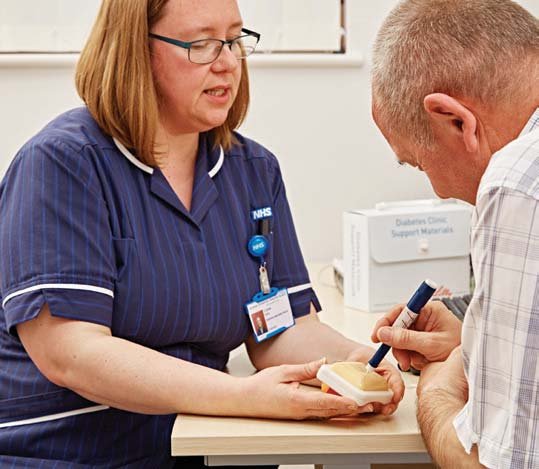
Redesigning diabetes care with the patient at the centre
Diabetes is one of the big health challenges faced by the city of Liverpool, in common with a lot of areas across the UK.
"Designing the service around the clinical need of our patients has been key," explained Kate Warriner, Healthy Liverpool digital care and innovation programme lead and iLinks managerial lead. As part of the Healthy Liverpool vision, healthcare teams across the region are working together to ensure that care of diabetic patients is proactive, tailored and provided locally in the community. Technology from EMIS Health is helping to turn the service redesign into reality.
A convenient service for patients Patients whose conditions can be managed by regular appointments are being seen in any of six local clinics across the city. Clinicians use EMIS Web to view up to date medical records from everyone involved in the patient's care. "When a patient comes to their appointment, clinicians have everything they need in front of them," explains Jan Fennell-Rutherford, Liverpool diabetes partnership operational manager, Liverpool CCG.
"There's no reason for anything to be missed, so it can reduce errors or delays in care. The clinicians love it. They can make better clinical decisions because they can see the impact of every aspect of the patient's care plan, rather than just their own.
"Patients give us positive feedback about how convenient their appointments are now. For a patient living in Speke for example, it used to be a 40 minute bus ride to the nearest hospital, with often a wait to be seen once they were there. Now patients can visit a clinic local to home or work. It gives them the flexibility to fit their appointments into their lives.
Focusing on self-care "We use these appointments to look at self-care and self-management of the patient's diabetes. Improvements to lifestyles and wellbeing can often lead to a reduction in medication. We can catch any issues early, preventing patients from needing acute hospital care.
Better care for the 'super six' Diabetics in the city who need more care continue with hospital appointments to manage their health - those who fall under the 'super six' categories of diabetes, where the condition has the potential to be more complex, for example if they are pregnant, under 24 or diabetic foot care patients.
The initiative is having a positive impact for these patients too. "By concentrating the acute services on the serious cases, everyone is receiving the level of care that's appropriate to their condition. For example patients on an insulin pump should be seen four times per year; previously they were only being seen twice. Under the new initiative, we can see them four times per year and pick up any issues much earlier."
Future plans It doesn't stop there. "We'll be looking at improvements to services providing care to patients with other long term conditions, such as respiratory illnesses, building on our experience of redesigning the diabetes service," said Kate. "More services will be provided to patients out of hospital and in the community using joined-up technology from EMIS Web - it means a more convenient service for patients, provided by clinicians who have all the information they need."
More than one business model
Many companies contain more than one division or business line, each operating different business models. Most investors think companies should provide comprehensive business model disclosures on each significant business line, together with the rationale for keeping the different businesses in one company or group.
For highly diverse groups, this could result in very lengthy disclosure. Companies may want to consider providing higher level disclosure on each significant business model in the annual report, with a link to the corporate website for detail on each of the significant business models.
However, a few investors prefer, where possible, that only one group business model is presented with the key drivers for the group. This may be possible when there are only two or three divisions, as demonstrated in the first page of the Vodafone 2015 excerpt included in Appendix A.
Lab comment
BP plc presents its group business model along with high level business models for each division in the divisional reporting sections of the strategic report.
Most investors like this approach, but are looking for detail on each significant business model.
BP plc Annual Report and Form 20F 2015 p28, p34
Upstream
Our strategy is to have a balanced portfolio across the world's key basins, working safely and reliably while maintaining a focus on capital discipline and quality execution to deliver value.
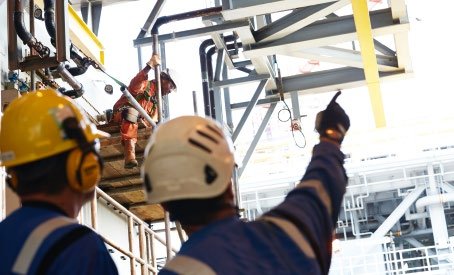
Operators work on board the floating production, storage and offloading vessel in the Plutão, Saturno, Vénus and Marte fields in Angola.
Our business model and strategy The Upstream segment is responsible for our activities in oil and natural gas exploration, field development and production, as well as midstream transportation, storage and processing. We also market and trade natural gas, including liquefied natural gas, power and natural gas liquids. In 2015 our activities took place in 25 countries. With the exception of our US Lower 48 onshore business, we deliver our exploration, development and production activities through five global technical and operating functions:
- The exploration function is responsible for renewing our resource base through access, exploration and appraisal, while the reservoir development function is responsible for the stewardship of our resource portfolio over the life of each field.
- The global wells organization and the global projects organization are responsible for the safe, reliable and compliant execution of wells (drilling and completions) and major projects*.
- The global operations organization is responsible for safe, reliable and compliant operations, including upstream production assets and midstream transportation and processing activities.
We optimize and integrate the delivery of these activities across 12 regions, with support provided by global functions in specialist areas of expertise: technology, finance, procurement and supply chain, human resources and information technology. The US Lower 48 began operating as a separate onshore business in 2015. Technologies such as seismic imaging, enhanced oil recovery and big data analytics support our upstream strategy by helping us gain new access, increase recovery and reserves and improve production efficiency. See Our distinctive capabilities on page 16. We actively manage our portfolio and place increasing emphasis on accessing, developing and producing from fields able to provide the greatest value (including those with the potential to make the highest contribution to our operating cash flow). We sell assets that we believe have more value to others. This allows us to focus our leadership, technical resources and organizational capability on developing the resources we believe are likely to add the most value to our portfolio. Our strategy is to have a balanced portfolio of material, enduring positions in the world's key hydrocarbon basins; to employ capital and execute projects and other activities efficiently; and to operate safely and reliably in every basin to deliver increasing value.
Our strategy is enabled by:
- A continued focus on safety, reliability and the systematic management of risk.
- Prioritizing value over volume, and a continuous focus on executional excellence, managing costs and business delivery.
- Maintaining disciplined investment in a balanced portfolio of opportunities, in deep water, gas value chains, giant fields and unconventionals.
- Delivering competitive operating cash growth through improvements in efficiency and reliability - for both operations and capital investment.
- Strong relationships built on trust, mutual advantage and deep knowledge of the basins where we operate.
Our performance summary For upstream safety performance see page 44.
- We achieved an upstream BP-operated plant reliability of 95%.
- We started up three major upstream projects.
- Our exploration function gained access to new potential resources covering almost 8,000km² in four countries.
- Our divestments generated $0.8 billion in proceeds in 2015.
Upstream profitability (\$ billion) RC profit before interest and tax Underlying RC profit before interest and tax
A line chart showing Upstream profitability from 2011 to 2015. In 2011, RC profit was 26.4, Underlying RC profit was 16.7. In 2012, RC profit was 25.2, Underlying RC profit was 18.3. In 2013, RC profit was 22.5, Underlying RC profit was 15.2. In 2014, RC profit was 19.4, Underlying RC profit was 8.9. In 2015, RC profit was -0.9, Underlying RC profit was 1.2.
See Financial performance on page 29 for an explanation of the main factors influencing upstream profit.
Outlook for 2016 We expect underlying production to be broadly flat with 2015. The actual reported outcome will depend on the exact timing of project start-ups, divestments, OPEC quotas and entitlement impacts in our production-sharing agreements. Capital investment is expected to decrease, largely reflecting our commitment to continued capital discipline and the rephasing and refocusing of our activities and major projects where appropriate in response to the current business environment. We will continue to manage our costs down using all levers available to us. These include continuing and expanding the simplification and efficiency efforts started in 2014, continuing to drive deflation into our third-party spend, influencing spend in our non-operated assets, and bringing headcount down to a level that reflects the size of our operations and the current environment. Oil prices continue to be challenging in the near term.
Downstream
We continued to improve our personal and process safety and delivered strong operations and marketing performance, contributing to record replacement cost profit before interest and tax.

The Cherry Point refinery processes crude oil sourced from Alaska, mid-continent US and Canada and has a capacity of 234,000 barrels per day.
Our business model and strategy The Downstream segment has global manufacturing and marketing operations. It is the product and service-led arm of BP, made up of three businesses:
- Fuels - includes refineries, fuels marketing and convenience retail businesses, together with global oil supply and trading activities that make up our fuels value chains (FVCs). We sell refined petroleum products including gasoline, diesel and aviation fuel.
- Lubricants - manufactures and markets lubricants and related products and services globally, adding value through brand, technology and relationships, such as collaboration with original equipment manufacturing partners.
- Petrochemicals - manufactures, sells and distributes products, that are produced mainly using proprietary BP technology, and are then used by others to make essential consumer products such as paint, plastic bottles and textiles. We also license our technologies to third parties.
We aim to run safe and reliable operations across all our businesses, supported by leading brands and technologies, to deliver high-quality products and services that meet our customers' needs.
Our strategy focuses on a quality portfolio that aims to lead the industry, as measured by net income per barrel, with improving returns and growing operating cash flow. Our five strategic priorities are:
- Safe and reliable operations - this remains our first priority and we continue to drive improvement in personal and process safety performance.
- Advantaged manufacturing - we continue to build a top-quartile refining business by having a competitively advantaged portfolio underpinned by operational excellence that helps to reduce exposure to margin volatility. In petrochemicals we seek to sustainably improve earnings potential and make the business more resilient to a bottom of cycle environment through portfolio repositioning, improved operational performance and efficiency benefits.
- Fuels and lubricants marketing - we invest in higher-returning businesses with reliable cash flows and growth potential.
- Portfolio quality - we maintain our focus on quality by high-grading of assets combined with capital discipline.
- Simplification and efficiency - we are embedding a culture of simplification and efficiency to support performance improvement and make our businesses even more competitive.
Disciplined execution of our strategy is helping improve our underlying performance and create a more resilient business that is better able to withstand external environmental impacts. This is with the aim of ensuring Downstream remains a reliable source of cash flow for BP.
Our performance summary For Downstream safety performance see page 45.
- We have delivered record replacement cost profit before interest and tax and pre-tax returns this year, demonstrating that we are creating a more resilient Downstream business.
- We delivered strong availability and operational performance across our refining portfolio and year-on-year improvement in utilization.
- We commenced the European launch of our BP fuels with ACTIVE technology in Spain, which are designed to remove dirt and protect car engines.
- We announced the agreement to restructure our German refining joint operation with Rosneft.
- We halted operations at Bulwer refinery in Australia.
- In Air BP we completed the integration of Statoil Fuel and Retail's aviation business which added more than 70 airports to our global network.
- In our lubricants business we launched Castrol's Nexcel, an innovative automotive oil-change technology.
- We completed start-up of the Zhuhai 3 plant in China - the world's largest single train purified terephthalic acid (PTA) unit.
- Our simplification and efficiency programmes contributed to material progress in lowering cash costs. These programmes include right-sizing the Downstream organization, implementing site-by-site improvement plans to deliver manufacturing efficiency in refining and petrochemicals, and focusing on third-party costs.
Downstream profitability (\$ billion) RC profit before interest and tax Underlying RC profit before interest and tax*
A line chart showing Downstream profitability from 2011 to 2015. In 2011, RC profit was 6.0, Underlying RC profit was 5.5. In 2012, RC profit was 6.5, Underlying RC profit was 4.4. In 2013, RC profit was 3.6, Underlying RC profit was 2.9. In 2014, RC profit was 3.7, Underlying RC profit was 2.9. In 2015, RC profit was 7.1, Underlying RC profit was -7.5.
See Financial performance on page 35 for the main factors influencing downstream profit.
Outlook for 2016 We anticipate a weaker refining environment. We expect the financial impact of refinery turnarounds to be higher than 2015 as a result of increased turnaround activity.
Attributes of good business model disclosure
Linkage
Investors believe that linkage and flow within the annual report is an important element required to produce a high quality report; a belief that companies also hold. Currently many companies link the business model to other parts of the annual report through page referencing, while others try to achieve linkage through repeating certain headings in different sections. Investors believe this is not adequate.
Investors believe clear disclosure of the key elements and drivers of the business model provides a basis for reporting on a company's strategy, as they expect the company to have set strategy in relation to maintaining and developing those key elements. The risks to the business model drivers and their related strategy should be clearly identifiable in the principal risk disclosures, and viability reporting should reflect the business model, strategy and related risks. In turn, those key areas of strategy should be measured by relevant KPIs, and remuneration policies should be driven by the same KPIs. Investors believe that this should result in an obvious and natural linkage through the strategic report, but note that this is not currently achieved by companies. EY's publication Annual Reporting in 2015: evolving communication in a changing world, indicates that only 12% of companies link through from strategy to KPIs, risks and remuneration.
The business model disclosure also provides a grounding to which other information can be related and linked. For instance, capital requirements of the business model can be linked to the capital management disclosures of a company. Some investors consider it is important to disclose the capital requirements of each significant business model. Similarly, reference can be made to dividend policy disclosures as one of the main methods of sharing the economic value generated with investors.
In addition, most investors refer to other areas of the annual report for consistency in their understanding of the business model. Key areas in addition to the strategic report linkage mentioned above are:
- segmental reporting – how do the reported segments relate to the business model(s)?
- main Income Statement items - do they correlate well with the description of drivers of profitability indicated in the business model description?
- key Balance Sheet items - is the composition of the balance sheet in line with expectations from the business model description?
- accounting policies – e.g. does the revenue recognition policy gel with business model disclosure?
- cash flow statement - do cash flow disclosures support assertions of a highly cash generative business model and conversion of profits to cash?
- employee numbers and cost disclosure - does the business model explain how human resources are employed?
Figure 2: Linkage - business model at the heart of the annual report
Annual Report – Disclosures consistent with business model
- Business model Explain key elements and drivers
- Strategy Key driver maintenance or development
- Principal risks & viability In relation to key drivers
- KPIs Measure success of key drivers and outcomes
- Remuneration & dividend policy Linked to KPIs/results
Elements included in the Guidance on the Strategic Report
In general, investors and companies support the disclosure elements (included as sub-headings below) called for in the FRC's Guidance on the Strategic Report), with many companies commenting positively about the usefulness of the Guidance. Investors identify the key information / attributes desired in each element below.
What the entity does and why it does it
Key disclosure:
- Clearly describe the activities of the company – what does it do?
- Where is the company positioned in the value chain?
Other potential disclosure:
- What is the societal purpose of the company?
Investors ask companies to assume that the reader of the disclosure knows nothing about the company. The starting point is to clearly articulate what the company does and its position in the value chain at the beginning of the business model disclosure. This is often omitted by companies as it is stated in other areas of the annual report or considered obvious. However, investors often read discrete sections of the annual report. Therefore, each section needs to be able to communicate key messages. A balance needs to be found between including detail on an aspect of disclosure and referencing to other sections for more detail on the aspect, if it is most appropriate for the detail to be in another section.
easyJet plc Annual Report and Accounts 2015 p6
WHAT WE DO
WE ARE A LOW-COST EUROPEAN POINT-TO-POINT SHORT-HAUL AIRLINE
We use our cost advantage and number one and number two network positions in strong markets to deliver point-to-point low fares and operational efficiency, with our people making the difference by offering friendly service for our customers.
Lab comment
Many investors like easyJet plc's clear disclosure of what the company does.
Some investors like companies to explain their purpose, which some do at the moment. However, investors stress that a company's purpose is not to create shareholder value - they view creating shareholder value as an outcome.
The following examples demonstrate different approaches by companies to disclosing and defining their 'purpose' within their business model disclosures.
BT Group plc Annual Report 2015 p29
To use the power of communications to make a better world
easyJet plc Annual Report and Accounts 2015 p6
OUR CAUSE
To make travel easy and affordable.
EMIS Group plc Annual Report and Accounts 2015 p8
Facilitating improved clinical outcomes and efficiency through connected technology services.
Vodafone Group Plc Annual Report 2015 p10
Beyond financial value – towards a sustainable business
Our core business is founded on a powerful social good: we help millions of customers communicate, share, create, learn and grow, and the rapid expansion of our networks is having a profound impact on the way people manage their daily lives.
BP plc Annual Report and Form 20-F 2015 p12
By supplying energy, we support economic development and help to improve quality of life for millions of people.
How the entity generates value and preserves it over the longer term
Key disclosure:
- How does the company generate economic value – what are the key revenue and profit drivers and how are they monetised?
- Are there any key assets and liabilities that support value generation and how are they maintained or enhanced?
Other potential disclosure:
- Does the company generate value for other stakeholders which is also key to generating economic value?
Investors are primarily interested in understanding how companies generate economic value. They want to understand key revenue and profit drivers, including a sense of the relative contribution of each business to the result. It is also important for investors to understand how the value generated is monetised. Key dependencies for the generation of economic value, such as obtaining and maintaining regulatory licences (e.g. drugs, spectrum licences, intellectual property, etc.), should be clearly disclosed in the business model. Often such elements are helpful to (if not dependencies for) the ongoing generation of value.
Investors also expect the disclosure to highlight any key assets and liabilities that support economic value generation. For instance, they expect the disclosure to clearly describe any intangible assets (on or off balance sheet) that are an essential element of the business model. Further, the related research and development or maintenance spend is also important as investors want to understand how essential assets are maintained or enhanced. Similarly, if property is an essential element of the business model, investors expect the disclosure to indicate whether it is leased or owned due to the impact on the financial statements, future cash flows, and ability to exit properties if necessary.
Aberdeen Asset Management plc Annual Report and Accounts 2015 p18
How we generate value
We charge fees based on levels of AuM and they are expressed as basis points ("bps"). Fees depend on the capability, amount of money managed and the channel, therefore the product mix has an impact on levels of revenue growth.
We aim to grow AuM organically and through selective acquisitions, where we seek to ensure we pay a competitive price for new business and teams. The Group has a strong track record in effectively integrating new capabilities.
While there will be a natural turnover of money managed, and we expect a level of outflows from existing clients, we aim to retain as much AuM as possible with a long term focus on investment management and meeting clients' needs. AuM may also increase and decrease due to market movements.
When revenues grow, our cash flows grow. We use cash generated to ensure we have a strong capital base. Thereafter, we look to increase shareholder value through strategic acquisitions, dividends and other returns to shareholders.
Note: AuM is Assets under Management
Lab comment
Many investors like that Aberdeen Asset Management plc gives prominence to how they generate economic value by highlighting it in a box within the business model disclosure, with some believing it provides clarity on fees and the importance of AuM.
A few investors believe that disclosing Return on Equity, Return on Capital Employed or Return on Assets (ROE / ROCE or ROA respectively) statistics improves their understanding of value generated. Their view is that the company's use of such statistics demonstrates they are focused on generating value above the cost of capital.
Aggreko plc Annual Report and Accounts 2015 p14-15
Why our customers choose Aggreko
| Rental Solutions | Power Solutions |
|---|---|
| We operate in developed markets and provide solutions for, and rent our equipment to, customers who either operate it themselves or contract us to provide a full turn-key solution; we retain responsibility for servicing and maintaining it. We provide a multi-product offering with power adjacencies, such as temperature control, oil-free air and loadbanks across a diverse sector base. Contracts tend to be short term and transactional in nature. | We operate in emerging markets serving both Utility and Industrial customers. Initial contracts in our Industrial business are on average around three months and around one year in our Utility business and are often complex in nature. For Utility customers we act as a power producer, installing and operating modular, mobile power plants; we charge both for providing the generating capacity, and for the electricity we produce. |
| Our Industrial customers are across key sectors such as Oil & Gas, Petrochemical & Refining and Mining. Here, we develop solutions for and rent our equipment to customers who then operate it for themselves. |
| Revenue | Trading margin | ROCE | Revenue¹ excluding pass-through fuel | Trading¹ margin | ROCE | ||
|---|---|---|---|---|---|---|---|
| £618m | 16% | 16% | £883m | 19% | 15% |
Our business units are supported by a shared fleet, a global footprint and logistics
| Fleet | Power | Chillers | Oil-free air | Ancillaries |
|---|---|---|---|---|
| 9,818MW | 1,126MW | 588CFM | £97m | |
| £889m assets² | £51m assets² | £12m assets² | assets² | |
| Maintain and service | 204 sales and service centres worldwide operating a hub and spoke model |
1 Excluding pass-through fuel 2 Net asset value
Lab comment
Aggreko plc effectively use statistics to illustrate the contribution of each division, including disclosing the ROCE of each.
ARM Holdings plc Annual Report 2015: Strategic Report p24
How we create value for our Partners
ARM employs engineers to develop advanced processors, physical IP, tools and software that we mainly license to companies developing chips for consumer electronics and enterprise equipment. We continue to invest in R&D programmes, hiring more engineers and investing in productivity tools as future generations of technology become increasingly complex.
It is more cost-effective for our Partners to license the technology from us. The design of a processor or a library of physical IP requires a large amount of R&D investment and expertise. In addition, the creation and development of an ecosystem of software and tools companies that support ARM's technology and its licensees would be difficult to reproduce.
With ARM designing the technology once and licensing many times, ARM is able to cover its own R&D costs and also reduce the cost for each semiconductor company. ARM's Partners are then able to invest in the complementary technologies that go into a System-on-Chip. This leads to more choice in digital electronics for OEMs and consumers.
Lab comment
ARM Holdings plc clearly sets out the value proposition for their customers (termed Partners).
What makes the entity different from, or the basis on which it competes with, its peers
Key disclosure:
- What differentiates the company from, or how does it compete with, its peers? What is the company's competitive advantage?
Explanation of how the business model differs, or how the entity competes, is key information investors are looking for, but is not currently well disclosed by most companies. Many companies believe such information to be commercially sensitive. Where the information is considered sensitive, nearly all investors believe companies can disclose their competitive advantage to a level of detail that enables it to be understood, without enabling others to replicate it. Investors further note that competitive advantage is very much about a company's capabilities and not so much about the commercial secrets.
"We can't disclose our competitive strength, it's commercially sensitive." Company
"Commercial sensitivity is a nonsense, no competitor worth the name doesn't know exactly where their rivals are placing themselves, so why can't companies tell their shareholders what makes them different -- commercial sensitivity is a red herring." Investor
Lab comment
Ashmore Group plc clearly sets out what they believe their competitive advantage is in their business model disclosure.
Ashmore Group plc Annual Report and Accounts 2015 p2
SPECIALIST EMERGING MARKETS FOCUS
Ashmore's key competitive advantage The Group has more than two decades' experience of investing solely in Emerging Markets.
The Emerging Markets are growing rapidly as economic, political and social developments support rising productivity and lead to GDP per capita convergence with Developed Markets. Ashmore is well positioned to capitalise on these growth trends and to translate them into value for investors, shareholders, and the communities in which it invests.
- Ashmore has established a long track record of investing in Emerging Markets, beginning in 1987 for equities and 1992 for fixed income
- The Group's focus derives from an early recognition that Emerging Markets would become the engine room of global economic growth
- Today, the Emerging Markets account for more than 50% of global GDP, and structural developments underpin this share rising further
- The diversity and inefficiencies of the asset class provide significant investment opportunities, but also require specialist, active fund management skills to navigate market cycles
High level understanding of how the entity is structured
Key disclosure:
- What are the key divisions / segments and their relevant contribution to the company? What is the legal structure?
An understanding of the entity's structure is prerequisite information for investors. Disclosure of what each of the divisions / segments do, together with relevant statistics to indicate size and importance to the business model, is desired by investors in the business model disclosure. The Vodafone example, included in Appendix A, identifies two divisions - mobile and fixed.
As noted above, many entities actually operate a number of distinct business models. If the divisional / segmental structure does not match the separate business model disclosures, it would be helpful to investors if the disclosure indicates how business models are grouped into divisions and segments.
Some investors find it helpful if the capital / asset allocation, cash flow and investment plans for the significant businesses are provided, to enable them to understand the investment in each business.
Investors are also looking for a high level understanding of the legal structure of the company / group. Some companies include this information in their business model, however most include it elsewhere in the annual report. Investors are happy for this information to be cross-referenced if it is best included elsewhere in the annual report.
High level understanding of the markets in which it operates and how it engages with those markets
Key disclosure:
- What are the company's key markets and market segments?
- Are there any key customers?
- Is there a market concentration risk?
Other potential disclosure:
- What market share is held by the company and where is the statistic sourced?
To enable them to make an assessment of the current market potential and risk exposure, investors need to know the key markets in which the business operates, together with any key customers. Details of any market concentration risk are also of interest. For some investors, details of the company's market share (together with the source of any statistic provided) further enables the assessment.
Extract 13: easyJet plc Annual Report and Accounts 2015 p7
WHERE WE DO IT
INTRA-EUROPEAN SHORT-HAUL NETWORK
Network focused on primary airports serving significant catchment areas.
A map of Europe highlighting easyJet's network, with circles indicating airports to which easyJet flies.
Lab comment
easyJet plc disclose their markets by showing the airports they fly to on a map in their business model disclosure.
Broad understanding of the nature of the relationships, resources and other inputs that are necessary for the success of the business
Key disclosure:
- What are the key relationships and resources required for the business model to succeed?
- How are the key relationships and resources being maintained and enhanced?
Other potential disclosure:
- Is the company's culture a business model driver? If so, how is it maintained, embedded and replicated?
By disclosing the key relationships and resources (or indicating those that are key when more than only the key relationships and resources are disclosed) required for the business model, investors can better understand the significant drivers of the business.
But investors require more than just a list of key inputs; they need to know how the company maintains and enhances those key relationships and resources. For instance, if employees are considered to be one of the key inputs, how much is invested in their development and what are staff retention rates?
Similarly, some investors are interested in how the company's values and culture support the business model, but a list of corporate values is not considered helpful. How culture and values can be maintained and replicated is particularly relevant when new businesses are started or acquired.
Lab comment
ARM Holdings plc clearly set out the key inputs to their business, described as "What we need to execute our business model”. The description is entity specific, informative and supported by relevant statistics. This part of the disclosure flows to a description of "How we create value for our Partners", which is included on p14 of this report.
ARM Holdings plc Annual Report 2015: Strategic Report p24
What we need to execute our business model
- People and expertise We are committed to hiring and developing some of the most innovative and imaginative engineers who, together with supporting teams, can develop and deploy ARM's next generation products and services. 3,975 Full time employees
- R&D investment In 2015, we invested £215 million in R&D (normalised) to broaden and extend our product portfolio, and another £74 million was invested in acquisitions to accelerate product development and create new revenue streams for adjacent markets £215m Invested in research and development (normalised)
- Technology collaboration ARM works closely with other companies in the semiconductor industry to share knowledge, align roadmaps and to develop compatible technologies We have built and invested in this unique ecosystem to ensure our mutual customers continue to build more effective products. This helps ensure that ARM's technologies are suitable for chips going into future consumer electronics and enterprise equipment 9,000 Engineers and industry experts attended ARM's annual technology conferences and symposia
- Supply chain In 2015, ARM spent about £150 million on goods and services essential to our business operations. These were mainly costs related to essential business travel, property management, legal and accounting fees, and IT support and services £150m Spent with suppliers
- Strong financials ARM had normalised cash generation of £361 million last year. A proportion of this cash is used to fund our business operations to ensure we invest to secure future profits and long-term value for shareholders £361m Normalised net cash generated
Corporate culture and the business model
In July 2016, the FRC published Corporate culture and the role of boards, which highlights the role culture plays in protecting and delivering value.
The report defines corporate culture as "a combination of the values, attitudes and behaviours manifested by a company in its operations and relations with its stakeholders."
It urges companies to consider the relationship between their desired culture, their business model, their corporate strategy and their corporate decision making process.
The report also highlights that investors gain a good deal of insight into the culture of a company through its articulation of its business model and the attitude to employees.
Other attributes of good business model disclosure identified by investors
Statistics
All investors believe that the use of statistics in business model disclosures can greatly improve the communication value of the disclosure. Statistics can effectively demonstrate the size, importance, and or significance of elements of the business model. Companies do this in a variety of ways, including:
- placing statistics next to relevant information; and
- providing tables and charts summarising relevant statistics.
Most investors prefer the disclosure of corresponding prior year statistics to be included for comparison. However, some investors believe three to five years of statistics are needed to highlight any trends in recent history.
A few investors highlight the importance of statistics to assist in understanding the business model. They state that ideally the disclosure would include a table with the following information for each significant business line (i.e. more granular than current segmental reporting for most groups), with five years of information for each statistic:
- name of business line;
- one sentence description of what it does;
- capital allocated;
- balance sheet assets allocated;
- revenue; and
- profit / margin.
Additional statistics relevant for each sector should also be included.
A small number of investors indicate that inclusion in the business model of cash flow and investment plans for each of the significant business lines would also provide valuable insight into the relevance of each, and how that may evolve.
A number of the reporting excerpts in this report demonstrate effective use of statistics.
Threats to the business model
Some investors believe disclosure of significant impending direct threats to the business model (i.e. more granular than current principal risk reporting) is helpful in understanding how the business model is responding. Examples provided by these investors include: concentration risk (e.g. customers or suppliers); the impact of the removal of mobile roaming charges in the EU on telecommunication company business models; and sensitivity to currency risk where costs and revenues are not in the same currency. Many investors also believe it is pertinent for energy and resource companies to disclose the likely impact of decarbonisation to their business models.
However, investors do not believe it is appropriate to include all environmental risks in the business model, or that such disclosures are relevant to the business models of the majority of companies. Where relevant to the company's operations, investors think such high level risks are best discussed in the principal risk section of the strategic report and/or as part of scenario planning in the Viability Statement.
Some investors also suggest that the inclusion of a SWOT (strengths, weaknesses, opportunities and threats) analysis would improve the quality of business model disclosures. These investors consider that a balanced SWOT analysis by the company of each business model may be very helpful, and a welcome addition to similar analyses often provided by sell side analysts.
"It would be refreshing to hear management's view of the weaknesses and threats to the business model and how they manage them or why they believe they are acceptable." Investor
"Sometimes the core message gets lost because the statement is too comprehensive, with something for everyone but nothing of value for anyone." Investor
"If climate change or other threats are becoming a real constraint on the business model then they should be disclosed in the business model. If they are a future risk then they should be included in the risk section." Investor
How the business model is likely to evolve
A small number of investors would value disclosure on the company's view of how the business model is likely to evolve in the near future (three to five years). This is expected to take account of the business model changes arising from threats and resulting from the successful implementation of the current strategy. Such disclosure could also support viability reporting.
However, the majority of investors think such disclosure would be excessive, and do not expect to see such disclosure very often.
International Integrated Reporting Council (IIRC) framework
The UK's reporting framework allows companies a significant amount of flexibility to their approach to their annual report, enabling them to communicate their story to investors.
The IIRC's reporting framework, known as the International <ir> Framework, can be adopted voluntarily in the UK and includes guidance for reporting on business models. The International <ir> Framework describes an organisation's business model as "...its system of transforming inputs, through its business activities, into outputs and outcomes that aims to fulfil the organisation's strategic purposes and create value over the short, medium and long term" and calls for disclosure in the business model of the key:
- inputs in relation to the six 'Capitals' (financial, manufactured, intellectual, human, social and relationship, and natural);
- business activities;
- outputs, and
- outcomes.
While the information to be included in business model disclosure under the International <ir> Framework is very similar to that under the Guidance on the Strategic Report, it encourages companies to think broadly about the inputs, outputs and outcomes of the business model and introduces its own language. Some investors consider the International <ir> Framework to be helpful as it provides a structured approach for companies to develop and present their business model disclosure.
However, some other investors believe it is not helpful to have an additional set of guidance, with its own language, provided by the IIRC. Additionally, some note that the way in which companies have implemented the International <ir> Framework is not helpful as they cover too much information, at a high level, without indicating which information is the most significant. For example, all 'Capitals' are commented on, but there is a lack of detail provided, and a lack of clarity as to which are most important to the business model. The <ir> Framework requires only those capitals that are material to the creation of value to be reported.
While some investors are not aware of the International <ir> Reporting Framework, those investors familiar with both the FRC and IIRC frameworks are of the view that company disclosures should cover the same information, making clear the key drivers of the business model, under either framework when applied correctly.
This is consistent with the expectations of the FRC and IIRC, both of which have stated that "Reports that follow the Guidance [on the strategic report] should result in reporting that is consistent with the International <ir> Framework."
Summary of elements desired by investors in business model disclosure
This graphic summarises the elements of disclosure desired by investors to be included in business model disclosure, identified on the previous pages. Key elements are included in the centre, with other potential elements (mostly representing further detail on the information in the centre) included in the outer rings.
Figure 1: Hierarchy of business model attributes
Most Investors want the company to include:
- What it does and where it sits in the value chain
- Key divisions and their contribution, and legal structure
- Key markets and market segments
- Its competitive advantage
- Key inputs (assets and liabilities, relationships and resources) and how they are maintained / enhanced
- Key revenue and profit drivers
- Value created for other stakeholders that supports economic value generation
- Statistics to indicate relative importance of elements
Many Investors also want:
- Direct threats
- Market share
Some Investors also want:
- Culture and values
- SWOT analysis
- Purpose
- Investment plans
- How the business model is likely to evolve
- Cash flow
- Capital and Assets allocated to business
- ROE, ROCE, Or ROA*
* ROE = Return on Equity ROCE = Return on Capital Employed ROA = Return on Assets
Presentation of business model disclosure
Location
Nearly all investors believe the appropriate location for the business model disclosure is towards the front of the strategic report, with many believing it should be the first item, as it provides context and understanding for the other narrative and financial information included in the Annual Report.
A small number of investors consider that each company should determine the best location for the information in the strategic report to enable them to tell their story cohesively.
Language
Similar to our findings in previous projects, investors want business model disclosures to be written in plain, clear, concise and factual language.
Many investors comment that current disclosures often include promotional and aspirational language and statements, which they do not find helpful. Investors note that if such language / paragraphs are removed and disclosures improved in line with attributes of good disclosure identified in this report, they do not expect any significant increase in length of disclosure.
Communication approach
Most investors believe business model information is best communicated through a combination of narrative and infographics, tables and charts. Infographics, tables and charts help readers to assimilate information by breaking up text and, when done well, can be more effective and efficient at communicating information. Investors also note that an effective infographic summarising the business model is one that can be easily recalled when reading other areas of the annual report.
A small number of investors believe that narrative disclosure alone is the most effective way of communicating the business model, and efficient in terms of space. They note that for the vast majority of business model disclosures, the infographic is not helpful and distracts from useful business model disclosure.
This would suggest that companies communicate most effectively to a wide investor audience by including a detailed narrative along with any infographic used. Consideration should be given to whether a graphic depiction achieves greater impact and understandability than narrative alone (for instance, in depicting relationships or relative importance of elements).
Double page spreads
Many business model disclosures are presented as double page spreads which are designed to communicate the business model information most effectively when the two pages are viewed at the same time. In particular, large graphics are often presented over the two pages.
The Lab's project report Digital Present published in May 2015 highlights that many investors read digital versions of annual reports on screen and that double page spreads may not always work on screen. The report suggested companies could overcome this by designing their annual reports for the screen, i.e. designing it in landscape instead of portrait, or in blocks of information that fit on a screen.
"Don't just make assertions, say how you do it." Investor
"Graphics done well are helpful to make it come to life." Investor
Consistency of disclosure
As noted above, many companies are making significant changes to their business model disclosure each year, in an effort to improve the disclosure. While investors appreciate the improvements, they need to check the disclosure carefully to ascertain whether the underlying business model, or only the disclosure, has changed.
Some investors note that the articulation of the business model is often clearer and more detailed in company investor day slide packs, or for some companies, on the corporate website. Investors would like companies to develop one high quality disclosure and use it consistently across the different reporting channels, which will give the investment community confidence that the disclosed business model is the real business model.
Some investors believe companies could use digital capabilities to better present their business model on the corporate website, in a manner that is easy to access and assimilate.
Changes to the business model
Once the disclosure has been developed to clearly explain the business model at a level of detail that meets investor needs, investors expect that companies will only make further changes to the disclosure to reflect any changes in elements of the defined business model disclosure.
Such changes should be clearly identified, with any known upcoming changes also flagged. Investors want companies to clearly identify and explain, including the rationale for, any changes that have been made to the business model(s). This may be best achieved by presenting both the business model pre and post change for significant business lines where significant changes have been made. Investors believe they need to understand the business models in operation throughout the year, to enable them to understand and interpret the results correctly.
Similarly, investors expect any upcoming changes will be highlighted in advance as it is important information for their investment decision and their on-going assessment of their investment.
"There is often a disconnect between the capital markets day information and the annual report information." Investor
"If the business model disclosure is done as desired by investors there should not be much change year on year." Investor
"I want to see the business model in the annual report used elsewhere by the company - I want it to be something they use and believe in." Investor
"Business model disclosure may be even more important when things aren't going well and business model is being tweaked - often the first time we know things are not going well is when the company issues a profit warning and changes the business model." Investor
Appendix A: Vodafone Group Plc 2015, a good example
BP at a glance
BP delivers energy products and services to people around the world.
Through our two main operating segments, Upstream and Downstream, we find, develop and produce essential sources of energy, turning them into products that people need. We also buy and sell at each stage of the hydrocarbon value chain. In renewable energy, our activities are focused on biofuels and onshore wind.
We also have a 19.75% shareholding in Rosneft, that we report as a separate segment.
Business model: For more information on our business model see page 12.
Our group key performance indicators (KPIs) are shown on page 20. Some financial KPIs are not recognized GAAP measures, but are provided for investors because they are closely tracked by management to evaluate BP's operating performance and to make financial, strategic and operating decisions.
Group BP p.l.c. is the parent company of the BP group of companies. Our worldwide headquarters is in London. See KPIs page 20.
| $(6.5)bn$ | $5.9bn$ |
|---|---|
| loss attributable to BP shareholders 2014: $3.8bn$ profit | underlying replacement cost profit* 2014: $12.1bn$ |
| 21.6% | $19.1bn$ |
| gearing (net debt ratio)★ 2014: 16.7% | operating cash flow* 2014: $32.8bn$ |
| 20 | 3.3 |
| tier 1 process safety events* 2014: 28 | million barrels of oil equivalent per day 2014: 3.2mmboe/d |
* See footnote a on page 15.
A complex diagram illustrating BP's business model from 'Finding' to 'Marketing' and 'Generating renewable energy', showing key statistics and divisional breakdowns for Upstream and Downstream.
Finding oil and gas First, we acquire exploration rights, then we search for hydrocarbons beneath the earth's surface.
Developing and extracting oil and gas Once we have found hydrocarbons, we work to bring them to the surface.
Transporting and trading oil and gas We move hydrocarbons using pipelines, ships, trucks and trains and use our trading capability to capture value across the supply chain.
Manufacturing fuels and products We refine, process and blend hydrocarbons to make fuels, lubricants and petrochemicals.
Marketing fuels and products We supply our customers with fuel for transportation, energy for heat and light, lubricants to keep engines moving and the petrochemicals required to make a variety of everyday items.
International oil and gas markets
Upstream Our Upstream segment manages exploration, development and production activities. * $(0.9)bn replacement cost loss before interest and tax 2014: $8.9bn profit * 2.3 million barrels of oil equivalent per day 2014: 2.1mmboe/d * 3 upstream major project* start-ups 2014: 7 major projects * $1.2bn underlying replacement cost profit before interest and tax 2014: $15.2bn * 8,000km² new exploration access 2014: 47,000km² * * Excludes BP's share of Rosneft. See Rosneft on page 38.
Downstream Our Downstream segment operates hydrocarbon value chains covering three main businesses - fuels, lubricants and petrochemicals. * $7.1bn replacement cost profit before interest and tax 2014: $3.7bn * 1.7 million barrels of oil refined per day 2014: 1.7mmb/d * 42% of our lubricants sales were premium grades 2014: 41% * $7.5bn underlying replacement cost profit before interest and tax 2014: $4.4bn * 14.8 million tonnes of petrochemicals produced in the year 2014: 14.0mmte
Renewables Generating renewable energy We operate a biofuels business in Brazil and an onshore wind business in the US. * 795 million litres of ethanol equivalent produced at our three mills in Brazil 2014: 542 million litres * 4,424 gigawatt hours of electricity generated at our 16 US wind farms 2014: 4,617GWh
Operating capital employed* * 1. Fuels $29.2bn * 2. Lubricants $1.3bn * 3. Petrochemicals $4.4bn * Defined on page 256.
See page 218.
Lab comment
BP plc include the above infographic in their 'BP at a glance', which is referenced from the business model disclosure. The infographic is liked and well recognised by investors as providing a good introduction to what the company does, and how the activities are split into divisions. Investors also value the use of statistics which provide context to the company and its divisions. Investors value that the infographic has been used by the company for four years with minimal changes. The split of the business in the graphic into Upstream and Downstream is supported by disclosure of aspects of each business model in the divisional narrative section (see excerpts included on page 10).
Lab comment
Investors comment favourably on Vodafone Group Plc's 2015 business model disclosure, being their most favoured disclosure of those discussed in the project. While investors believe there is still room for improvement, they believe Vodafone's disclosure is well presented and demonstrates the following attributes they associate with good disclosure:
What they do
- Plain language
- Charts, tables and graphics
- Markets and segments
- Customers
- Detailed narrative
- Revenue and cash flow
- Appropriate statistics
- Investment plans
- Assets supporting value generation
- Division contribution
- Competitive advantage
- Societal purpose
- Key inputs
Our business model
A complex diagram outlining Vodafone's business model, including 'What we offer', 'Where we operate', and supporting details.
What we offer We provide a wide range of services including voice, messaging and data across mobile and fixed networks.
-
The services we provide Group service revenue 2015¹
- Other²: 4%
- Fixed: 20%
- Mobile: 76% Total: €38.5bn
- 283,000 base station sites across our markets
- 1.2tn minutes of voice calls carried last year
- 290bn text messages sent and received last year
- 982PB data sent across our mobile network last year
-
Mobile Mobile services We provide a range of mobile services to our customers, enabling them to call, text, access the internet, stream music and watch videos wherever they are at home, on the move or even abroad with our roaming services.
- Mobile customers (million) and active data users (%) A bar chart showing mobile customers and active data users from 2013-2015. Mobile customers: 407.3 (2013), 430.8 (2014), 445.8 (2015) Active data users: 30% (2013), 40% (2014), 50% (2015)
- Mobile network population coverage A bar chart showing population coverage by technology (2G, 3G, 4G) across Europe and AMAP. Europe 3G/4G: 94%, Europe 2G: 100% AMAP 3G: 82%, AMAP 2G: 97% Our mobile assets We provide these services through our network of over 283,000 base station sites providing near nationwide voice coverage and extensive data coverage across Europe and extensive coverage across our AMAP region. Note: ³Excludes India.
-
Fixed Fixed services We provide a range of fixed services in most of our major markets including voice, broadband and TV services to consumers and a wider range of services to our enterprise customers, including Cloud and Hosting and IP-VPN. We are also one of the world's largest carrier services business, providing voice and data services to other operators using our network of cable and fibre assets across the world.
- Fixed broadband customers A bar chart showing fixed broadband customers (million) from 2013-2015. 6.9 (2013), 9.2 (2014), 12.0 (2015) Our fixed line assets We provide these services through a combination of owned and leased copper, cable and fibre assets. Our focus is on next-generation networks (fibre or cable) and we cover 28 million homes with our own infrastructure and 50 million homes including wholesale arrangements. We have over nine million TV customers across six markets.
- High-speed broadband coverage 50 million households passed with cable or fibre across Europe (owned or leased)
Where we operate Our business is split across two geographic regions - Europe, and Africa, Middle East and Asia Pacific ('AMAP'), which includes our emerging markets.
-
Our reach and scale Group revenue 2015
- Europe: 66%
- AMAP: 32%
- Other¹: 2% Total: £42.2bn A map of Europe, Africa, Middle East, and Asia Pacific highlighting Vodafone's markets.
- Our markets: 24 countries where mobile services are provided, 17 where fixed services are provided.
- Joint ventures: Australia and Kenya, total 26 markets, part-own Indus Towers in India.
- Partner markets: 55 markets with partnership agreements.
-
Our main markets
- Germany €8.5bn revenue 30.9m mobile customers (33% mobile market share) 20% fixed market shares
- UK £6.4bn revenue 18.4m mobile customers (24% mobile market share) 4% fixed market share
- Italy £4.6bn revenue 25.2m mobile customers (32% mobile market share) 6% fixed market share
- Spain €3.7bn revenue 14.2m mobile customers (30% mobile market share) 11% fixed market share
- Vodacom Group £4.3bn revenue 68.5m mobile customers (53% mobile market share)
- India £4.3bn revenue 183.8m mobile customers (23% mobile market share)
Notes: ¹ Excludes £3.7 billion of other revenue that mainly relates to the sale of equipment. ² Other service revenue includes revenue from mobile virtual network operators ('MVNOs) and from our partner markets. ³ Vodafone estimates for the quarter ended 31 March 2015. ⁴ Source: Telecom Regulatory Authority of India, December 2014.
Our business model
How we make money
We invest in superior telecommunications networks so that we can sustain high levels of cash generation, reward shareholders and reinvest in the business - thus creating a virtuous circle of investment, revenue, strong cash conversion and reinvestment.

Spectrum, network and IT infrastructure We use our spectrum licences to provide the radio frequencies needed to deliver communications services. We combine our base station sites and our expertise in network management to transmit signals for mobile services. Through our fixed broadband assets (cable, fibre and copper) and wholesale agreements with other operators, we provide broadband, voice and TV services. Our IT estate provides our data centres, customer relationship capability, customer billing services and online resources.
Revenue The majority of our revenue comes from selling mobile voice, text and data. Mobile users pay either monthly via fixed term contracts (typically up to two years in length) or prepay by topping up their airtime in advance of usage. Enterprise customers are typically on contracts that last between two to three years. Over 90% of our mobile customers are individual consumers and the rest are enterprise customers. A growing share of mobile revenue arises from monthly fees rather than metered access, which is much more vulnerable to competitive and economic pressures.
Fixed customers typically pay via one to two year contracts, and as a result fixed revenue streams are more stable than mobile.
Cash flow Our track record of converting revenue into cash flow is strong-with some £11.2 billion generated over the last three years. We achieve this by operating efficient networks where we seek to minimise costs, thus supporting our gross margin.
We also have strong local market share positions - as we are typically the first or second largest mobile operator in each of our markets with a share of more than 20%. This provides in-market scale efficiencies to support our EBITDA margin, which in turn provides healthy cash flow.
Reinvestment Our cash flow helps us to maintain a high level of investment to give our customers a superior network experience, which over time should enable us to secure a premium positioning in most of our markets. We also continue to participate in spectrum auctions to secure a strong portfolio of spectrum.
Over the last three years we have committed £21 billion in capital investment in networks, IT and distribution, a further £4 billion on the renewal and acquisition of spectrum and £13 billion on acquiring new fixed line businesses.
Shareholder returns The cash generated from operations allows us to sustain generous shareholder returns while also investing in the future prosperity of the business.
In the 2014 calendar year we were the fifth largest dividend payer in the FTSE 100. Over the last three years we have returned almost £13 billion to shareholders, in the form of ordinary dividends, excluding share buy backs and the Verizon Wireless Return of Value. In addition we have increased the dividend per share every year for more than 15 years.
Beyond financial value – towards a sustainable business
Our core business is founded on a powerful social good: we help millions of customers communicate, share, create, learn and grow, and the rapid expansion of our networks is having a profound impact on the way people manage their daily lives.
Everyone we deal with, from our customers, shareholders, partners and suppliers, to our employees, regulators and NGOs, rightly expect everyone at Vodafone to act responsibly and with integrity at all times. The beliefs, aspirations and concerns of this diverse range of stakeholders consequently shape our performance and success, influencing the way we make decisions.
We know that financial results alone are not enough: the societies and communities within which we operate want companies to focus on enhancing lives and livelihoods and overlooking that expectation would risk undermining our prospects for long-term value creation.
How we set ourselves apart
We aim to differentiate ourselves from our competitors by offering a leading network, leveraging the benefits of our large scale, global reach and international brand; by our leading position in enterprise; and by training and developing the best people.
Network quality We aim to have the best mobile network in each of our markets, combined with competitive fixed networks in our main markets. This means giving our customers broad coverage, a reliable connection, and increasing speeds and data capacity.
- Key differentiators:
- We are one of the world's largest mobile operators with 283,000 base station sites
- We have the best or co-best mobile data networks in 16 out of 20 markets¹
- We have a leading holding of spectrum in most of our key markets
- We own the largest cable companies in Germany and Spain
- Project Spring, our £19 billion investment programme, aims to strengthen further our network and service differentiation
Service design The mobile services we provide are carefully designed to meet the needs of targeted customer segments. For example, SIM-only plans which do not include a handset for customers focused on value, shared data plans for families, and bundles including generous data allowances, content, roaming, cloud storage and internet security for those wanting worry-free solutions. We can also design bespoke solutions to meet the needs of our business customers, whatever their size.
The majority of our fixed revenue is from home and office broadband solutions, including TV and calls over a landline. The remainder arises from carrying other operators' international traffic across sub-sea cable systems.
Key differentiators: * We are typically either number one or number two in mobile enterprise in most of our markets * We have a comprehensive portfolio of total communication services including mobile, fixed, Cloud and Hosting, and M2M business solutions
Branding and marketing We communicate our services to customers through clear and effective branding and marketing. The strength of our brand is a major driver of purchasing decisions for consumers and enterprise customers alike. For example, in only 30 months, Vodafone Red, our globally branded pricing plan (providing bundles of unlimited voice, text and generous data allowances) has over 20 million customers.
Key differentiators: * Vodafone is the UK's most valuable brand with an attributed worth of US$27 billion²
Sales We sell our mobile services through a variety of distribution channels. Our shops comprise exclusive branded stores, distribution partners and third party retailers. Our branded stores enable customers to test our products and services before they buy, obtain advice from sales advisors, and top-up their price plans. Online channels, whether accessed through a mobile device or PC, are becoming much more important and we are upgrading our IT estate to meet this growing demand. Branded channels (including online and telesales) account for around 60% of new consumer contract customers and around 90% of contract renewals in Europe. Third party channels account for around 40% of acquisitions.
Our large corporate customers are served by a direct sales team; small and medium-sized companies are managed through a network of around 2,000 indirect partners, and sole traders are serviced via our retail stores and telesales capabilities.
The transition towards unified communications is changing how we reach customers and our fixed line businesses use door-to-door selling and more telesales than our other services.
Our mobile money service M-Pesa, enables users to top up their airtime as well as providing access to financial services. Read more about M-Pesa on pages 26 and 30.
Key differentiators: * We have over 16,000 exclusive branded shops across the globe * In India, we supplement our branded stores with 1.8 million small-scale outlets for top-ups, significantly more than our nearest competitor * In our established M-Pesa markets of Kenya and Tanzania we are the market leaders for mobile money services
Customer service We have over 17,000 employees dedicated to providing customer service, supported by contractors and third parties. All call centres are available 24 hours a day, seven days a week in all our European markets, and this is now being rolled out across our remaining markets outside Europe. In an increasingly digital age we also offer live webchat capability, and self-care, either via a handset, tablet or laptop, to enable customers to self-diagnose and resolve their own queries.
Key differentiators: * We are both a multinational and a multicultural company, and our diverse workforce helps us better understand and meet the needs of our customers * We employ people from over 130 countries, with 24 nationalities among our Senior Leadership Team. For more information on our people see page 28
Notes: ¹ P3 communications. ² 2015 Brand Finance Global 500.
Appendix B: Deltex Medical Group plc, responding to investor input
Lab comment
Deltex Medical Group plc is an AIM company and therefore exempt from the requirement to disclose their business model. However, the company included the business model disclosure on the left in their 2014 annual report. One investor participant in the Lab project comments positively on the simplicity of the disclosure and thinks it conveys much of the core business model information desired by investors. The company volunteered to update their disclosure in light of the findings of the Lab project (now published in this report), and taking into account direct feedback they received on their disclosure at a project round table. The updated disclosure represents an attempt to present the desired attributes and information desired by investors that are relevant to the company. The updated disclosure is presented on the next page. It does not necessarily represent future annual report disclosure.
Group's business model
Deltex Medical generates revenues from the sale of single patient disposable probes, from the sale of monitors and from providing maintenance and support services. The Group operates a direct sales force in the UK, USA and Spain. In Canada, the Group has entered into an agreement with its previous distributor to accelerate development within this territory of ODM through a jointly owned subsidiary of which the Group owns 51% of the shares. In all other territories, the Group sells to distributors. The Group continues to invest carefully to ensure that it maximises the opportunity from acceleration of the adoption rate of the Group's products, whilst carefully managing its cash resources.
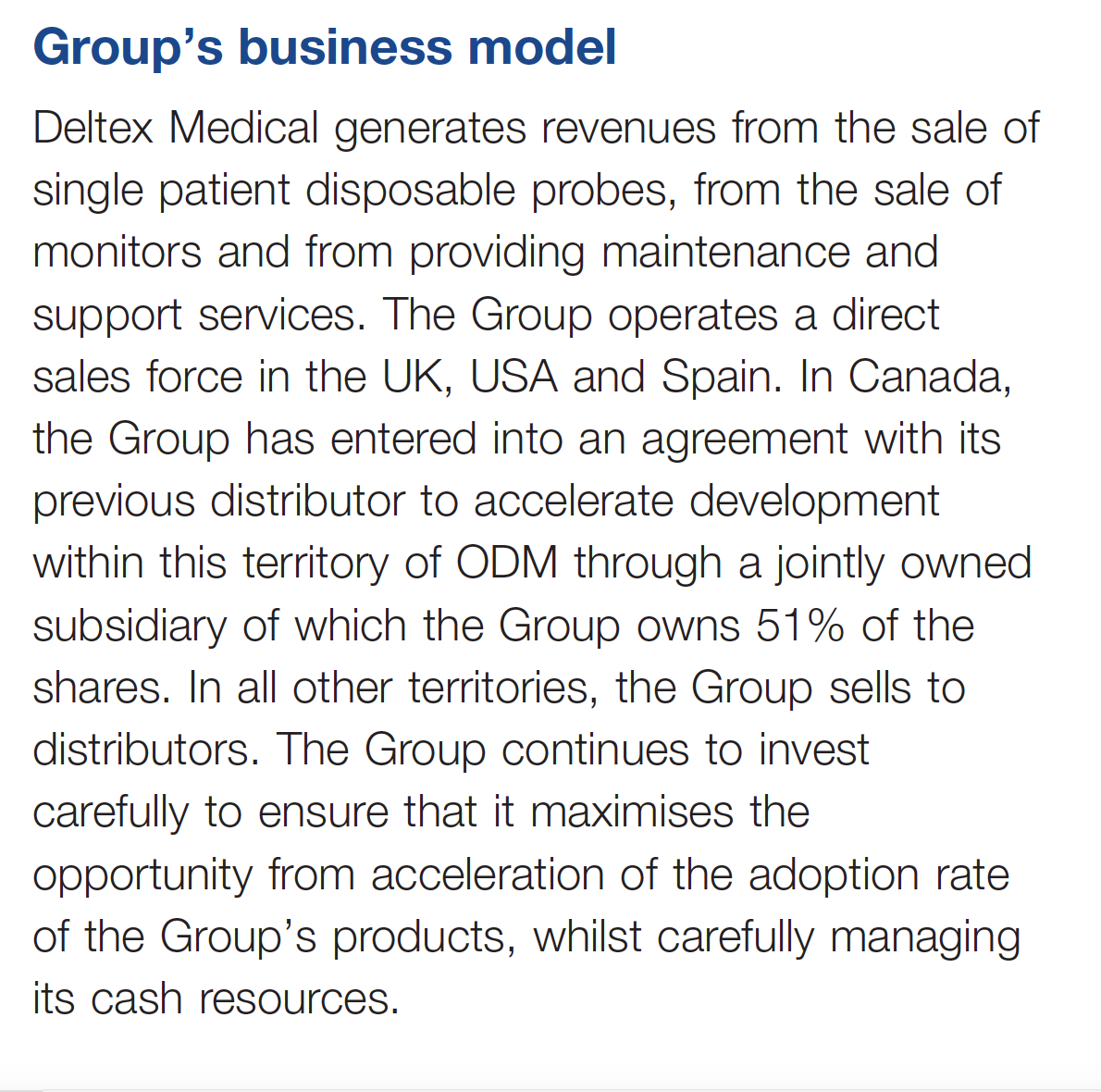
Business model
What we do?
Deltex Medical exploits its proprietary technology to develop, design, manufacture and market medical equipment that deploys low frequency ultrasound to visualise and measure blood flows in the central circulation. Doing this enables anaesthetists to optimise blood flows in patients undergoing surgery and in critical care. Robust clinical evidence shows that, if central blood flow is optimised, the risk of complications is reduced contributing to both more complete, faster recoveries for patients and lower costs of care for the healthcare provider. This outcome is achieved through the use of the company's technology, Oesophageal Doppler Monitoring (ODM) which is the gold standard in the provision of such care. There is no other intra-operative fluid management (IOFM) technology which enables the anaesthetist to optimally manage their patient's blood flow during surgery either as precisely or as rapidly as with ODM and no other technology has been able to generate an equivalent evidence base of either patient or economic benefit.
What we sell?
Our technology comprises two main components. The patient monitor and a single use disposable probe which is placed in the oesophagus in a simple, minimally invasive process. Together they provide the anaesthetist with real time information concerning the flow of blood around the body from deep inside the central circulation. If the flow of blood around the body is compromised, which occurs commonly during surgery, then the amount of oxygen delivered to tissues is reduced, increasing the risk of serious harm to major organs. Periods of poor blood supply to organs including the gut, kidneys and liver increase the risk of developing a complication which requires additional treatment and often leads to an increase in the time spent in the hospital and a long term shortened life expectancy. For the healthcare provider, complications from surgery lead to additional costs that need to be met both immediately and over the longer term. The use of our technology reduces these risks and the costs associated with them.
How do we make money?
Our sales proposition to customers comprises both a capital purchase (the monitor) and a revenue purchase (the disposable probe). Due to the often protracted procurement times for capital items, we frequently need to place our monitors in hospitals, which can lead to the faster adoption of our technology into their practice and, therefore, a quicker consumption of revenue generating probes. There are over 3,200 monitors installed worldwide. The more probes that are used, the more revenue we generate. All of our equipment is designed and manufactured in the UK giving us good control over both product quality and profit margins.
Our gross margin earned in markets where we sell direct, namely the UK, USA, Canada and Spain, is higher than in those markets (over 30 countries) that we sell via distributors. Our gross margin earned on probes is typically over 75% in the UK, around 85% in the USA and 55% to 60% in our distributor led business.
Who are our customers?
In the UK, our key customer is the UK National Health Service (NHS). The NHS decided to adopt our technology "at pace and scale" following the 2011 National Institute for Health and Care Excellence ("NICE") recommendation of our CardioQ-ODM products for over 800,000 patients a year undergoing higher risk surgery in NHS hospitals. However, due to the fragmented nature of the NHS and its difficulties to adopt innovative technologies, our sales efforts are now focused on those individual NHS Hospitals that are prepared to support individual anaesthetists or groups of anaesthetists who choose to deliver the clinical benefits to patients of intra-operative fluid management using ODM.
In the USA, recognition of the importance of modern 'Enhanced Recovery' approaches to surgery is growing at a hospital level as it becomes recognised that improving the quality of care provided to patients leads to better patient outcomes, lower costs of care and higher profits for the hospital care providers. Our focus in the USA has been to identify major hospitals that wish to implement evidence-based intra-operative fluid management, often as part of an enhanced recovery programme initiative, and partner with them to help them to achieve their objectives. We define these hospitals as 'Platform Programme Accounts'. These accounts generally have the potential to consume at least 100 probes per month as the use of ODM spreads across surgical disciplines. The programme typically involves one area of surgery which adopts ODM into its protocols, measuring the changes in desired outcomes that are defined at the start of the project. This evidence is then used to develop similar protocols for use in other surgical procedures with the goal that ODM becomes the routine technology of choice in all of the operating rooms in that hospital. Our US market development plan, launched in 2013, was to have 30 such hospitals by US Labor Day 2016. At that date we had 27 such accounts, with a similar number of further accounts in the pipeline.
In our distributor led markets, our main focus is to work with those countries that have recognised the benefits of IOFM and/or enhanced recovery protocols and have a desire to implement these programmes nationally. This process usually starts with establishing contact with local Key Opinion Leaders in the countries who have the ability to implement at both hospitals and health-care systems' level. This requires support from Deltex Medical, as although we work closely with local distributors, they usually do not have the knowledge or background to drive these change programmes.
What is our goal?
Our goal is to see the adoption of ODM as the standard of care for all patients undergoing high-risk surgery. This we believe will be achieved through anaesthetists understanding the clinical benefits of fluid management.
The global market opportunity for haemodynamic monitoring equipment, of which a large proportion relates to disposables, is expected to reach US$1.11 billion by 2019 at a CAGR of 4.5% during the forecast period.
The Group with its 'Gold Standard' ODM technology is well placed to grow through wider acceptance of the fact that too much or too little fluid given to patients intra-operatively can cause harm and, therefore, it is important to get the amount of fluid given 'just right' for each and every patient. This can only be achieved through use of ODM.
Probe Volumes
A line chart showing probe volumes from 2011 to 2015 for UK, USA, RoW, and Total. Total volumes increased from below 40,000 in 2011 to above 80,000 in 2015.
Probe revenues £'000
A line chart showing probe revenues from 2011 to 2015 for UK, USA, RoW, and Total. Total revenues increased from below £4,000,000 in 2011 to above £6,000,000 in 2015.
Lab project reports
The Lab's project reports provide practical suggestions on reporting from our work with the corporate and investment communities.
Each of the following reports suggests reporting that is focused on meeting the needs of the investment community for consideration by companies.
Thematic:
- Disclosure of dividends – policy and practice
- Corporate reporting in a Digital World - Digital Present
- Towards Clear & Concise Reporting
Governance:
- Reporting of Audit Committees
- A single figure for remuneration
- Reporting of pay and performance
Financial Reporting:
- Accounting Policies and integration of related financial information
- Debt terms and maturity tables
- Net debt reconciliations
- Operating and investing cash flows
- Presentation of market risks disclosures
Case Studies:
- William Hill plc - accounting policies
Reports and information about the Lab can be found at:
https://www.frc.org.uk/Lab
Follow us on Twitter or Linked in
The FRC is responsible for promoting high quality corporate governance and reporting to foster investment. We set the UK Corporate Governance and Stewardship Codes as well as UK standards for accounting, auditing and actuarial work. We represent UK interests in international standard-setting. We also monitor and take action to the quality of corporate reporting and auditing. We operate independent disciplinary arrangements for accountants and actuaries; and oversee the regulatory activities of the accountancy and actuarial professional bodies.
The FRC does not accept any liability to any party for any loss, damage or costs howsoever arising, whether directly or indirectly, whether in contract, tort or otherwise from any action or decision taken (or not taken) as a result of any person relying on or otherwise using this document or arising from any omission from it.
© The Financial Reporting Council Limited 2016
The Financial Reporting Council Limited is a company limited by guarantee.
Financial Reporting Council 8th Floor, 125 London Wall London EC2Y 5AS www.frc.org.uk
-
MarketandMarkets - Hemodynamic Monitoring System Market – Analysis and Global Forecast to 2019</ir></ir></ir></ir></ir></ir></ir></ir> ↩