
The content on this page has been converted from PDF to HTML format using an artificial intelligence (AI) tool as part of our ongoing efforts to improve accessibility and usability of our publications. Note:
- No human verification has been conducted of the converted content.
- While we strive for accuracy errors or omissions may exist.
- This content is provided for informational purposes only and should not be relied upon as a definitive or authoritative source.
- For the official and verified version of the publication, refer to the original PDF document.
If you identify any inaccuracies or have concerns about the content, please contact us at [email protected].
FRC Gender Pay Gap 2018/19
Gender Pay Gap
This is the third year for gender pay gap reporting in the UK. These ground-breaking regulations came into effect in 2017, when it became statutory for all employers with 250 employees or more to publish data relating to the pay of men and women in their organisations. This reporting requirement is part of the Government's plans to reduce the UK's gender pay gap which is currently 17.3% (based on median pay) nationally (source: ONS).
For the Public Sector, the specific statistics relating to UK employee pay are set out in the Equality Act 2010 (Specific Duties and Public Authorities) Regulations 2017 and, under normal circumstances, must be published by 31 March annually every year. Due to the Coronavirus outbreak, the Government Equalities Office (GEO) and the Equality and Human Rights Commission (EHRC) have suspended enforcement of the gender pay gap deadlines for this reporting year (2019/20) in recognition of the fact that employers across the country are facing unprecedented uncertainty and pressure. Whilst the decision means there will be no expectation on employers to report their data, the FRC had already completed most of the work involved and we have decided to continue with our plans to publish our data.
FRC'S COMMITMENT TO GENDER PAY GAP REPORTING
While the regulations apply to those employers with over 250 employees and the FRC was not in scope for data relating to March 2019, we believe that it is vital that we fully participate in the reporting. We think that by publishing this information we can play an important role in demonstrating our commitment to diversity and inclusion for all our people and leading by example for those we regulate and within the financial services sector. That is why in 2018 we became signatories to the HMT Women in Finance Charter. Alongside this we are also piloting ethnicity pay reporting.
The Independent Review of the Financial Reporting Council into the future of the FRC recommended the creation of a new body (the Audit, Reporting and Governance Authority). The Review underlines the importance of diversity and inclusion to how the new body will meet its responsibilities and remit going forward and this has been important to the FRC as an employer, a regulator, a BEIS partner organisation and Public Body.
The updated UK Corporate Governance Code promotes effective decision-making and company performance through encouraging diversity in the boardroom. Board evaluations should consider diversity more regularly and this should be reflected in succession planning. The Code also requires clear reporting on remuneration and its linkage to long-term company performance.
Like many other employers we continue to have a gender pay gap at the FRC, however the gender pay gap calculations and supporting guidance have helped us focus our efforts and develop our Diversity and Inclusion Strategy and Action Plan. This has been produced with the help and guidance of our Diversity and Inclusion Committee – an employee led group.
WHAT IS THE GENDER PAY GAP?
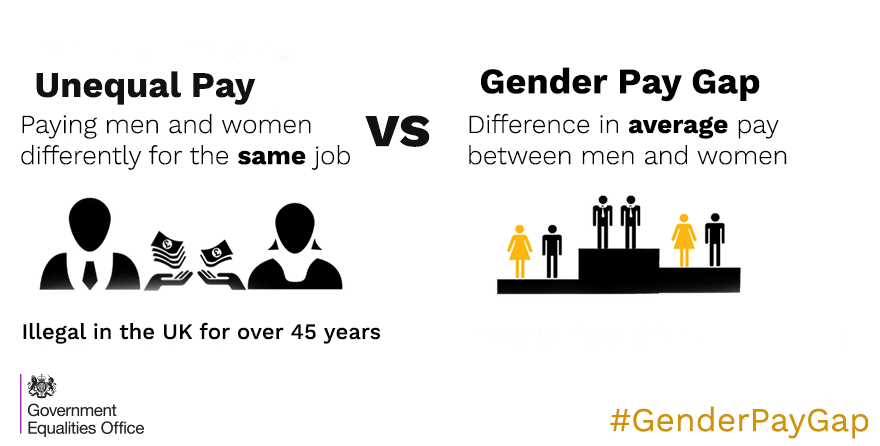
The gender pay gap shows the difference in the average hourly pay (mean and median) between men and women in a workforce and is calculated as the difference between the average hourly pay of men and women as a proportion of average hourly pay of men.
The Gender Pay Gap is sometimes confused with Equal Pay. In the UK we have had Equal Pay legislation for 50 years. This makes it unlawful for an employer to pay individuals differently for performing the same or similar work, or work of equal value and performing to the same standard.
The gender pay gap reflects the distribution and relative proportions of men and women across an organisation. It does not take into consideration any differences in the role that male and female employees perform or their seniority.
THE GENDER PAY GAP RESULTS AT THE FRC
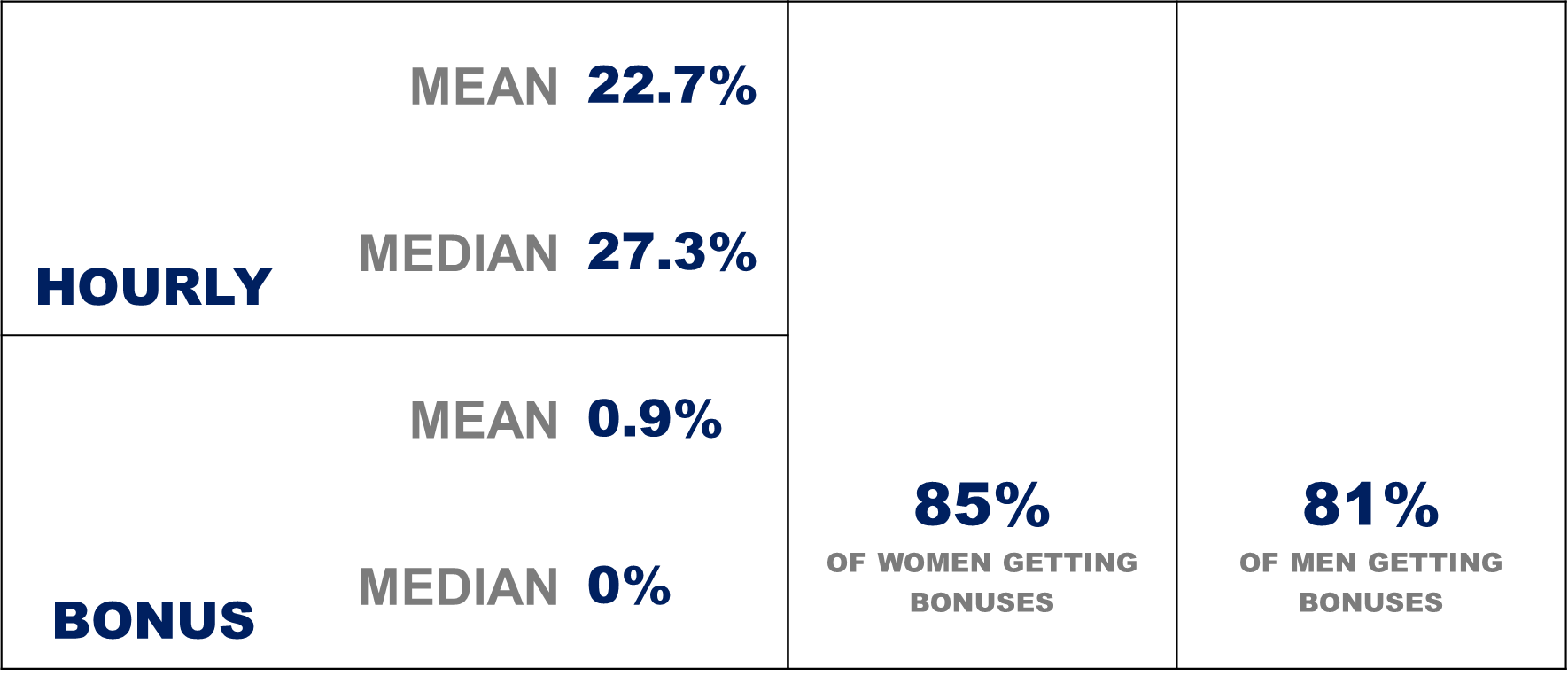
We have observed changes in our gender pay gap from last year. There has been a slight reduction in our mean gender pay gap which to 22.7% (from 23.9% in 2018) and our median pay gap has also decreased to 27.3% (from 27.8% in 2018).
WHY WE HAVE A GENDER PAY GAP
The Gender Pay Gap
Like the majority of organisations in the UK the FRC has a gender pay gap. Relatively larger gender pay gaps are prevalent in certain sectors such as financial services, the sector against which we benchmark ourselves in terms of skills and experience required for jobs at the FRC.
The gender pay gap regulations and guidance have been very helpful and have enabled us to identify the drivers behind the figures. We have:
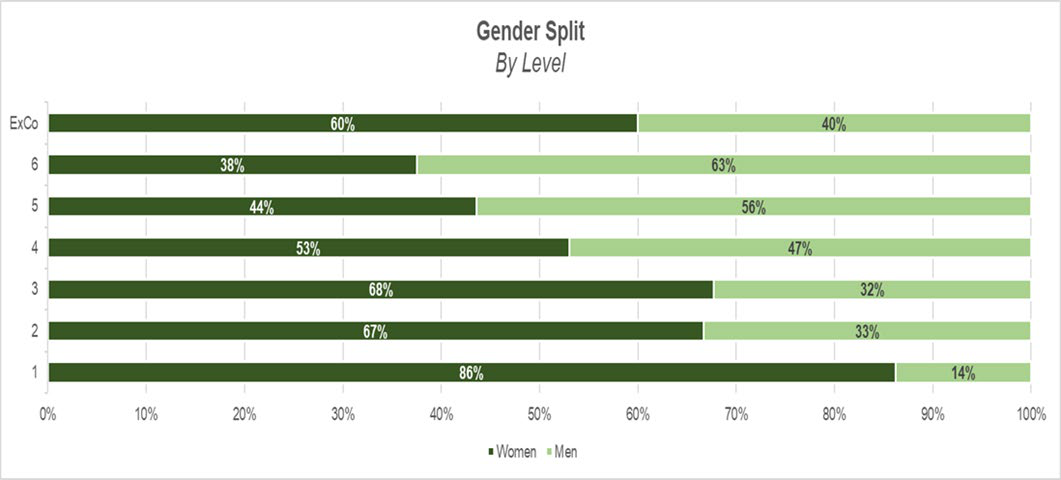
- a higher proportion of men in more senior, higher paid roles;
- a higher proportion of women in more junior, lower paid roles;
- recruited significant numbers of experienced people from the audit profession which is male dominated at the more senior levels
Though there have been small reductions in our mean and median pay gaps, we continue to consider carefully how we take our remuneration decisions and we believe this, alongside other actions we are taking (see below), will continue to see the gap narrow over a period of time. In 2018 we reviewed our bonus arrangements and decided to withdraw the previous schemes and introduce a more modest recognition scheme that rewards specific instances of good performance in line with our corporate values. It is pleasing to see that the new scheme has been largely gender neutral.
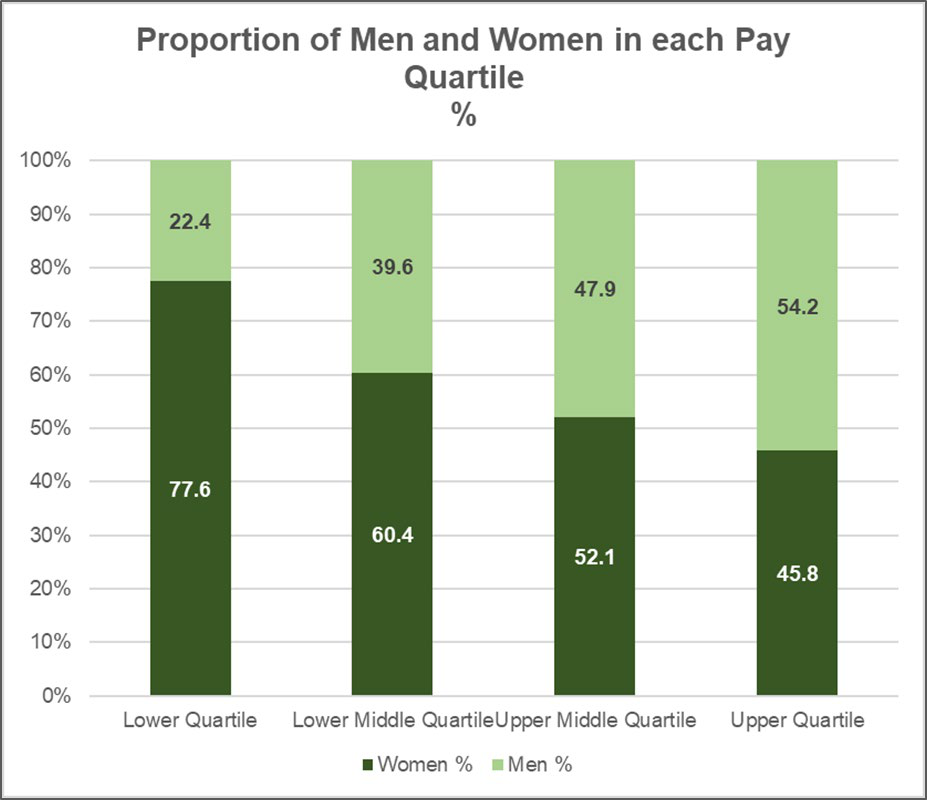
On overall pay, we believe the gap is due mainly to the vast majority of our more junior roles being held by women (pay bands 1 and 2) and this will take time to address. However, in the lower pay quartile, we now have 77.6% women compared to 87.5% in the previous year, small but significant progress. We will be closely monitoring and tracking these numbers over the course of the next reporting period and, in particular, when we take remuneration, recruitment, development and promotion decisions.
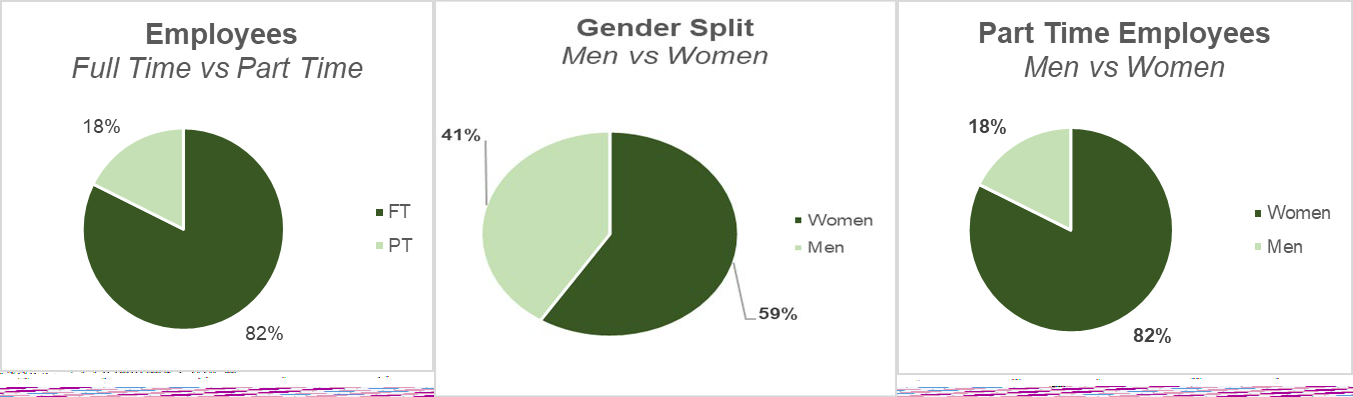
We are pleased to see as part of our commitment to flexible working that we now have more men working part time (18% in 2019 up from 14% in 2018 ) as we believe that helps to tackle the wider societal barriers and challenges to men and women being seen to be equal in society and the work place.
FRC Demographics
ACTION THE FRC IS TAKING TO CLOSE OUR GENDER PAY GAP
Since we published our gender pay gap figures last year we have produced a Diversity and Inclusion Strategy and Action Plan. This has been developed in partnership with our Diversity and Inclusion Committee and People Forum. In producing the action plan we have taken into account the guidance produced by the Government Equalities Office and Behavioural Insights Team on the evidence-based actions that will help employers close the gender pay gap.
We have prioritised the actions in our Diversity and Inclusion Action Plan and we are monitoring and tracking these on a quarterly basis. Following our analysis of this year's gender pay gap figures we will be revising the plan and looking to take further targeted action.
We have taken the following actions:
- Involved our employee-led Diversity and Inclusion Committee in the development and prioritisation of the gender pay gap measures and to champion change.
- Appointed a Board Director and Executive Committee member to sponsor and drive forward progress on diversity and inclusion.
- Completed the first phase of our review of recruitment and promotion practices; our job vacancies and ads are placed on a much wider range of job boards; we use structured, competency-based interviews for recruitment and promotion and diverse interview panels; using diversity and inclusion proformas to track the diversity of candidates and the outcomes.
- Delivered unconscious bias training across the organisation for all employees including our Board members and new joiners.
- Published our Women in Finance Charter targets (our Board was 20% women in March 2018 and was 31% in March 2019). As at 31 March 2020 33% of our Board members are women, which is in line with our target. During 2020, with a number of Board members coming to the end of their tenure, we will be undertaking a major recruitment programme for Board positions with a significant focus on the diversity of candidates. In March 2019 our Executive Committee was 60% women. Recent changes, including a reduction in the number of roles on the Executive Committee have resulted in this reducing to 25% in March 2020, though this may well change as we complete planned recruitment processes for Executive Committee posts that are becoming vacant.
- Relaunched our mentoring and reverse-mentoring programmes.
- Promoted flexible working and home working to all and encouraged men to take this and Shared Parental leave (18% of FRC employees work part-time).
- We are also conducting an ethnicity pay pilot in line with the recent consultation issued by BEIS and a review of the leadership and development programme which we support.
We have also taken steps to promote social mobility and ran the second year of our work experience programme with support from Speakers for Schools, an organisation which works with students from less advantaged backgrounds. We also made a submission to the Social Mobility Foundation's Social Mobility Employer Index and received valuable feedback to help us focus on those actions where we can make most progress. We are signatories to Disability Confident.
We also have a well-established diversity calendar in place which allows us to mark and celebrate the wide range of dates and events that are important to FRC employees.