
The content on this page has been converted from PDF to HTML format using an artificial intelligence (AI) tool as part of our ongoing efforts to improve accessibility and usability of our publications. Note:
- No human verification has been conducted of the converted content.
- While we strive for accuracy errors or omissions may exist.
- This content is provided for informational purposes only and should not be relied upon as a definitive or authoritative source.
- For the official and verified version of the publication, refer to the original PDF document.
If you identify any inaccuracies or have concerns about the content, please contact us at [email protected].
Memorandum of Understanding between the FRC and the Institute and Faculty of Actuaries
MEMORANDUM OF UNDERSTANDING BETWEEN THE FINANCIAL REPORTING COUNCIL AND THE INSTITUTE AND FACULTY OF ACTUARIES IN RELATION TO OVERSIGHT AND TECHNICAL ACTUARIAL STANDARDS
INTRODUCTION
Following the Morris Review of the Actuarial Profession, published in March 2005, HM Treasury asked the Financial Reporting Council to take on responsibility for independent oversight of the UK Actuarial Profession and the independent setting of technical actuarial standards.
This Memorandum of Understanding outlines the respective responsibilities of the Financial Reporting Council ("the FRC") and the Institute and Faculty of Actuaries ("the Institute and Faculty").
Through these arrangements, the FRC and the Institute and Faculty seek to promote high quality actuarial practice and the integrity, competence and transparency of the actuarial profession - to the benefit of all those who rely on actuarial advice or who are affected by actuarial advice. These arrangements also support mutual efforts to enhance public respect for, and confidence in, the Institute and Faculty and its members.
The FRC sets technical actuarial standards, the scope of the application of which is published on the FRC web site and will be kept up to date. It also oversees the regulatory activities of the Institute and Faculty.
The Institute and Faculty has the primary responsibility for the regulation1 of its members acting in their professional capacity.
THE FRC
The FRC is the United Kingdom's independent regulator responsible for promoting high quality corporate governance and reporting to to foster investment. The FRC publishes an annual Plan & Budget setting out its work programme, expenditure and funding.
The FRC's responsibilities relate to oversight of the Institute and Faculty and the independent setting of technical actuarial standards. The FRC delivers these responsibilities as follows:
- The FRC sets the technical actuarial standards that apply within its scope and authority (the terms of which are published), in consultation with the Institute and Faculty and other interests.
- The FRC has established an Actuarial Council ("the Council") to provide it with advice on technical actuarial standards and other relevant matters. The Council comprises "practitioners" (practising members of the actuarial profession) and "users" of actuarial information and other stakeholders.
- The FRC notifies the Institute and Faculty of any planned changes to its standards. The FRC takes full responsibility for all technical actuarial standards and other materials which it issues, and takes full responsibility for ensuring that these are kept up to date as necessary, including as a result of legislative or regulatory change.
- The FRC oversees the way in which the Institute and Faculty exercises regulation of its members acting in their professional capacity. The FRC undertakes an annual programme of work to discharge its oversight responsibilities, established in consultation with the Institute and Faculty, and may initiate additional action if necessary.
- The FRC operates an investigation and discipline scheme in relation to matters involving members of the Institute and Faculty which raise or appear to raise important issues affecting the public interest in the UK.
- The FRC may include ethical requirements in its technical actuarial standards, or set its own ethical standards, where:-
- it is acting with the agreement of the Institute and Faculty; or
- the FRC reasonably concludes that the Institute and Faculty's existing and proposed ethical standards will not adequately address the public interest, or any aspect thereof, in the United Kingdom. Before proceeding upon the basis of this paragraph, the FRC will notify the Institute and Faculty of its reasons and give the Institute and Faculty a reasonable opportunity to address the concern (including, for example, through proposed changes to its standards) and to make representations.
THE INSTITUTE AND FACULTY
The Institute and Faculty is incorporated by Royal Charter which states that its objectives shall be, in the public interest, to advance all matters relevant to actuarial science and its application and to regulate and promote the actuarial profession.
The Institute and Faculty has the primary responsibility for the regulation of its members acting in their professional capacity.
The Institute and Faculty is committed to:
- Publicising the standards issued by the FRC in accordance with this Memorandum of Understanding and requiring those members to whom the standards are intended to apply to observe them. The terms on which the Institute and Faculty imposes this requirement are set out in Annex A to this agreement. The FRC and the Institute and Faculty will maintain appropriate communication arrangements by which the FRC will notify the Institute and Faculty of any changes to its standards, and in turn, the Institute and Faculty will bring these changes to the attention of its members. The Institute and Faculty will provide appropriate support for any reasonable arrangements that the FRC may establish for dealing with interpretation of standards and with urgent issues.;
- Responding to the recommendations of the FRC in relation to the Institute and Faculty's responsibilities for regulating its members, either by implementing them within a reasonable period, or giving reasons in writing for not doing so, on the basis that these reasons will be published; and
- Co-operating with the FRC to facilitate, and assist with, the discharge of the FRC's responsibilities by, amongst other things, sharing relevant information, early notification of current and proposed developments in the Institute and Faculty's activities relating to the regulation of its members, and the identification of cases, issues and areas which it believes may warrant or benefit from regulatory action by the FRC.
The Institute and Faculty may, with the agreement of the FRC, issue non-mandatory technical guidance for its members. The FRC may require the Institute and Faculty to demonstrate that the technical guidance will support its members' compliance with FRC standards.
INVESTIGATION AND DISCIPLINE IN PUBLIC INTEREST CASES
There is a separate agreement between the FRC and the Institute and Faculty in relation to arrangements for investigation and discipline in public interest cases. The Institute and Faculty will remain responsible for disciplinary cases which do not raise matters affecting the public interest.
COMMUNICATION AND MUTUAL SUPPORT
The FRC and the Institute and Faculty maintain arrangements to co-operate, consult and notify each other on issues relevant to their respective responsibilities.
THE TERMS OF THIS UNDERSTANDING
These arrangements will continue by mutual consent.
Either party may withdraw its consent, but as a matter of practicality and courtesy to the other party, 6 months' notice of the termination of this arrangement will be given prior to any termination. Any revisions can be suggested at any time and will be effective by mutual consent.
The Institute and Faculty will work with the FRC as appropriate in liaising with the Government in relation to any legislative changes which may be proposed with regard to the FRC's actuarial functions.
This Memorandum of Understanding replaces the previous version dated 2 July 2012 with effect from 23 July 2014.
Approved by the Board of the FRC on 2 July 2014
And signed by
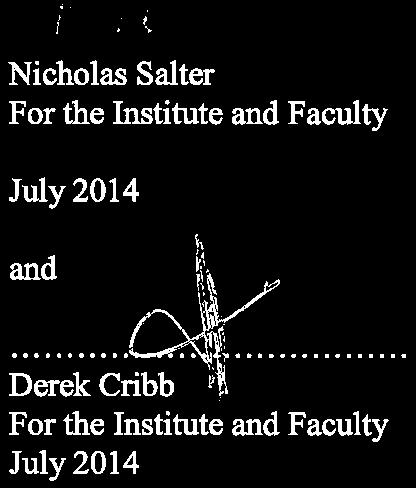
Nicholas Salter For the Institute and Faculty July 2014
and
Derek Cribb For the Institute and Faculty July 2014
Annex A
The Institute and Faculty has made express provision in terms of Rule 1.6 of its Disciplinary Scheme, such that failure by its members to comply with FRC standards may be taken into account for the purposes of disciplinary proceedings instigated in terms of that Scheme. Rule 1.6 is set out below
Definition of misconduct in the disciplinary scheme of the Institute and Faculty
Misconduct means any conduct by a Member, whether committed in the United Kingdom or elsewhere, in the course of carrying out professional duties or otherwise, constituting failure by that Member to comply with the standards of behaviour, integrity, competence or professional judgement which other Members or the public might reasonably expect of a Member having regard to the Bye-laws of the Institute and Faculty of Actuaries and/or to any code, standards, advice, guidance, memorandum or statement on professional conduct, practice or duties which may be given and published by the Institute and Faculty of Actuaries and/or, for so long as there is a relevant Memorandum of Understanding in force, by the FRC (including by the former Board for Actuarial Standards) in terms thereof, and to all other relevant circumstances.
-
Primarily setting ethical standards; administering the education system and continuing professional development scheme; administering disciplinary procedures; and such monitoring of compliance with professional standards as is undertaken by the Institute and Faculty. ↩