
The content on this page has been converted from PDF to HTML format using an artificial intelligence (AI) tool as part of our ongoing efforts to improve accessibility and usability of our publications. Note:
- No human verification has been conducted of the converted content.
- While we strive for accuracy errors or omissions may exist.
- This content is provided for informational purposes only and should not be relied upon as a definitive or authoritative source.
- For the official and verified version of the publication, refer to the original PDF document.
If you identify any inaccuracies or have concerns about the content, please contact us at [email protected].
Competition in the audit market - A policy paper (2022)
Executive Summary
- There is a widespread desire for a stronger, healthier UK audit market. Many of our stakeholders are concerned about the functioning of the market, including the limited choice of audit firm and lack of effective competition.
- The Government has made clear its intention for us to act in this area. In the Government Response to the consultation on strengthening the UK's audit, corporate reporting and corporate governance systems (May 2022), it set out its plans for the FRC to become the Audit, Reporting and Governance Authority (ARGA), with a competition objective and powers to act to improve competition and choice in the audit market.
- In our position paper (July 2022), we set out how we would support the proposals in the Government Response as we transition to become ARGA. This included our intention to publish details on our work relating to competition.
- It is important to recognise that there is a package of proposals to improve competition; this is not simply about implementing one measure. We intend this paper to support an ongoing dialogue with our stakeholders.
Our approach to competition in the audit market
- Our approach to competition is based on the outcomes we are seeking – we want an audit market that consistently delivers high quality audits and is resilient.
- A well-functioning audit market would involve competition and regulation combining to ensure the right incentives and behaviours on both the demand and supply sides of the market to drive up audit quality and improve resilience.
- Our approach focuses on all the competition-related proposals set out in the Government Response. It is important to consider how all these measures interact as a package and combine to drive good competition outcomes.
- Our approach is about promoting competition to drive higher audit quality and improve resilience. We do not want competition that drives down prices at the expense of quality. A more resilient market which offers greater diversity and choice must prioritise audit quality if it is to maintain public confidence.
- Our focus is not just on competition in the FTSE 350 part of the audit market but in the whole audit market.
- It will take time to improve competition in the audit market and it will require new powers to deliver the measures proposed by the Government. It will be important that ARGA reports periodically on the effectiveness of the measures proposed in the Government Response, and where appropriate to consider alternatives.
Introduction
1This policy paper gives an overview of the Financial Reporting Council (FRC)'s approach to competition in the audit market. It also covers recent developments with competition in the audit market and the FRC's current competition policy work.
2We have produced this paper in light of the publication of the Government Response to the consultation on strengthening the UK's audit, corporate reporting and corporate governance systems (May 2022). The paper follows on from the FRC's position paper (July 2022), which set how we will support the Government's reforms as we transition into the Audit, Reporting and Governance Authority (ARGA).
3Our position paper gave details on a key piece of our competition policy work in support of the Government's reforms – the development of a minimum standard for Audit Committees. The position paper also set out that, linked to this, we would publish a paper setting out our approach in respect of the Government's reforms relating to competition more broadly, and the work we are doing ahead of legislation.
4Prior to the Government's reforms, we have been focused on the functioning of the audit market through our role as the competent authority for audit in the UK. We have also made clear our commitment to improving competition in our three year plan for 2022-25. One of our strategic objectives is to 'create a more resilient audit market through greater competition and choice.'
5This paper, therefore, builds on our existing focus, and work relating to the audit market, and provides more information on our competition policy specifically.
6The paper mainly concerns work led by the competition policy team in the FRC's Regulatory Standards Division but there is work across the FRC to improve the functioning of the audit market. Within the Regulatory Standards Division, there is work on audit policy and setting auditing standards. The Supervision Division leads on audit quality reviews, supervising audit firms, and conducting work on cross-market issues relating to audit quality and resilience, including the implementation of operational separation on a voluntary basis in the largest audit firms. The Enforcement Division conducts investigations and brings enforcement action to drive improvements in the market.
7The remainder of this policy paper is in three parts, covering:
- Our approach to competition in the audit market;
- Recent developments with competition in the audit market; and
- Our current work on competition in the audit market.
1. Our approach to competition in the audit market
8Competition – the process of rivalry between firms – can, when it is effective, deliver benefits including in the form of higher quality, more market capacity and resilience, and more choice. Many sector regulators focus on competition in the markets they regulate and seek to ensure these markets are delivering desirable outcomes.
A well-functioning audit market
9Central to the FRC's approach to competition are the outcomes we are seeking from the audit market. For us, a well-functioning audit market is one that consistently delivers high quality audit 1 and is resilient 2 .
10In more detail, a well-functioning audit market would be a market in which competition and regulation combine to ensure the right incentives and behaviours on both the demand and supply sides to drive up audit quality and improve market resilience, through a variety of mechanisms.
- Selection and oversight of auditors (by Audit Committees) would ensure that competition would be focused on quality, and that firms win more business if they deliver good quality audits and lose business if they do not.
- There would be enough opportunities to compete, and there would be sufficient choice of viable competitors (audit firms) over the long term, without undue barriers to entry and expansion, to drive up quality through competition, and ensure resilience.
- Within firms, individual auditors' personal success would depend on whether they deliver high-quality audits, and audit practices as a whole would be focused on the success of audit, building on past relevant reforms.
- Regulation would provide an external check on quality, setting standards, increasing transparency and addressing sub-standard performance both by firms and by individuals. This would support competition on quality because buyers (eg Audit Committees) would have better information on which to choose their auditor.
Seven competition-related measures in the Government Response
11The outcomes we are seeking from a well-functioning audit market underpin the competition proposals set out in the Government Response. In brief, these proposals will provide for ARGA to have:
- An operational objective for competition – 'to promote effective competition in the market for statutory audit';
- Concurrent competition powers with the Competition and Markets Authority (CMA) to carry out market studies and to make market investigation references (MIRs) (and to accept undertakings in lieu of an MIR) 3 ;
- Powers to monitor competition and wider developments in the audit market;
- Powers to introduce minimum requirements (standards) for Audit Committees to ensure the selection and oversight of external auditors is focused on quality;
- Powers to implement managed shared audit for UK registered FTSE 350 companies to improve choice in the audit market (the Government also intends to make powers available for a market share cap);
- Powers relating to operational separation of audit and non-audit practices in the largest audit firms to ensure firms are fully focused on audit quality; and
- Powers to monitor the health of audit firms and take action in the event of a large audit firm failure to help ensure a resilient market.
A broad approach that takes account of the whole audit market
12Our approach to competition is wider in focus than just one proposal. Much attention has been given to market opening but increasing choice is only one element of a well-functioning audit market. All the Government's proposed measures will be necessary to improve competition and the functioning of the audit market. Other measures may also be required in future, depending on how the market develops.
13Our approach to competition is also broader in focus than the audits of the UK's largest listed companies (the FTSE 350 audit market). Our remit covers the PIE 4 audit market as a whole.
The proposed competition objective for ARGA applies to the market for statutory audit, and it is proposed that ARGA will become systems leader for the external audits of local authorities. We therefore want the entire market for audit to consistently deliver high quality audits and be resilient; the whole market – not just the FTSE 350 audit market – should be well-functioning.
14In having such a broad focus, we are mindful that different parts of the market will function differently. Some of the concerns about the FTSE 350 audit market such as limited choice of firm may not apply, or apply to the same extent, in other parts of the market. The local audit market for England has a significantly different structure to the PIE audit market, and recent developments with new suppliers in that market may generate useful learnings. Our approach to competition takes account of such differences across the market.
15In seeking a well-functioning audit market, we are not interested in promoting competition for competition's sake. We want competition that drives higher audit quality and market resilience. We do not want to see competition that drives down audit prices if this is at the expense of audit quality. We will need to balance the proposed operational objectives for audit quality and competition for ARGA, and be flexible in our approach. We may need to pursue some measures that are primarily focused on improving competition so as to deliver higher audit quality in the longer term. Our approach will be guided by our overall aim to promote effective competition in order to drive higher audit quality and market resilience.
The timescales for realising a well-functioning audit market
16In our approach to competition, we are also mindful that it may take time to realise significant change in the UK audit market, especially in respect of the FTSE 350 audit market. Large audit firms operate internationally, and their focus will vary in line with wider developments. For example, some audit firms may now be increasingly focused on growing their business to provide more assurance on sustainability reporting. Audit firms' global networks are an important feature of the audit market.
17In 2019, the CMA concluded that the FTSE 350 audit market 'exhibits a number of deep-seated problems: audit committees are only a partial solution to the problem that companies select their own auditors; high concentration among four big audit firms, resulting in limited choice and a market that is not resilient; audits being carried out by firms whose main business is not in audit.' 5 The CMA found there were no simple answers to these problems. While the CMA concluded there should be five, six or even seven firms auditing the largest companies in the UK, it found the existing FTSE 350 audit market structure is heavily entrenched, so this will not be easy to achieve, and it would take time – perhaps some considerable time – to realise a well-functioning audit market.
2. Recent developments with competition in the audit market
18Our approach and work on competition is informed by what is happening in the audit market, especially in the FTSE 350 and wider PIE audit markets.
19In recent years, we have published an annual update on the audit market in our Developments in Audit publications. We provide a similar update below, providing information on audit fees, market shares, switching, and firms' income from audit and non-audit services in 2021.
20This is a brief snapshot of some key indicators relating to market dynamics and competition, and more information on the audit market is available in our Key Facts and Trends in the Accountancy Profession publications (KFAT).
Audit fees
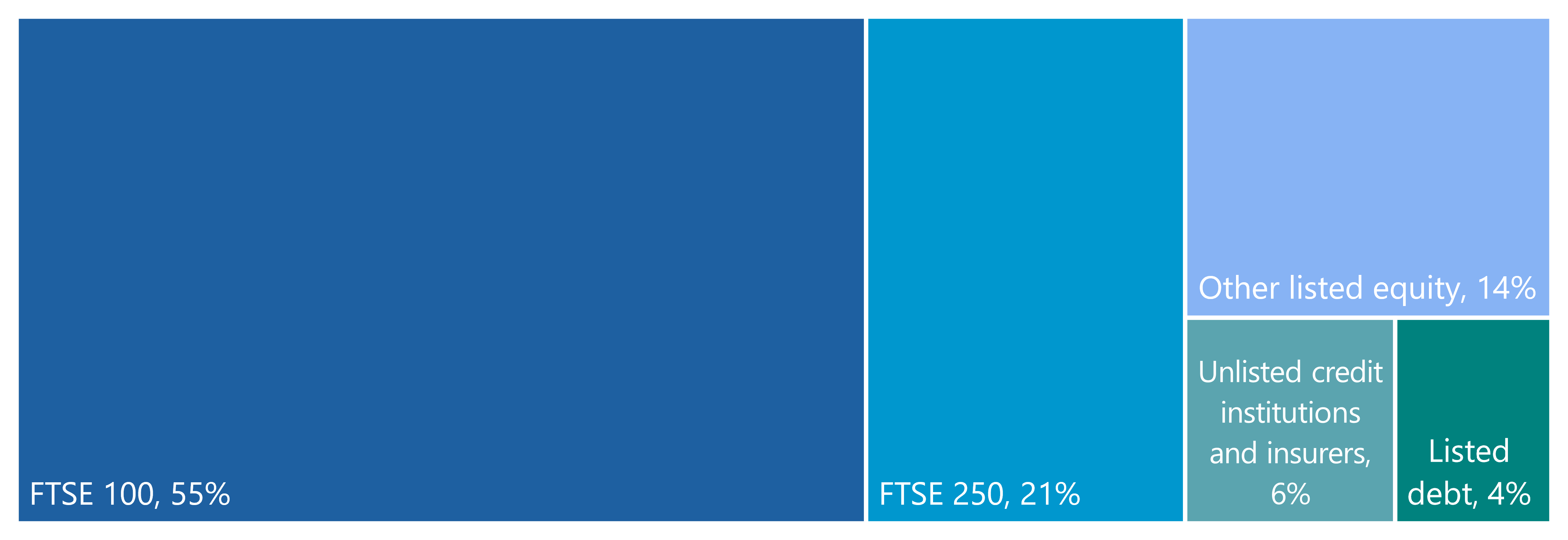
21UK audit firms earned £1.0bn in PIE audit fees in 2021, an increase of 12% on 2020. 6 FTSE 350 audits are only around a quarter of all PIE audits, but they account for around three quarters of total PIE audit fees. Figure 1 below shows the proportion of audit fees by type of PIE in 2021. 7
Figure 1. Proportion of UK PIE audit fees by type of PIE in 2021
Audit market shares
22There remains high concentration in the audit market. In 2021, the Big Four audit firms (Deloitte, EY, KPMG, and PwC) earned 92% of PIE audit fees compared with 96% in 2020. 8 In 2021, the Big Four earned 98% of FTSE 350 audit fees. 9 Excluding the FTSE 350, the Big Four earned over 70% of all other PIE audit fees. 10 Figure 2 below shows the proportion of PIE audit fees earned by each audit firm in 2020 and 2021. 11
Figure 2. Audit firms' share of PIE audit fees in 2020 and 2021
A bar chart showing the proportion of PIE audit fees earned by different audit firms in 2020 and 2021.
| Firm Category | Firm | 2020 % | 2021 % |
|---|---|---|---|
| Big Four | PwC | 31% | 29% |
| Big Four | Deloitte | 26% | 24% |
| Big Four | KPMG | 23% | 22% |
| Big Four | EY | 16% | 17% |
| Challengers | BDO | 3% | 2% |
| Challengers | Mazars | 2% | 1% |
| Challengers | RSM | 0% | 1% |
| Challengers | All others | 1% | 1% |
23Over thirty firms have been active at any one time in the PIE market in recent years, with a small number of firms entering and exiting the market. However, most of these firms supply only a few audits. In 2021, only 14 of the 37 firms active in the PIE market supplied more than 10 PIE audits. 12
24The numbers of firms auditing different types of PIEs have remained broadly similar over recent years, although there has been an increase in the number of firms auditing FTSE 250 companies (from six firms in 2018 to nine in 2021). Only the Big Four audited FTSE 100 companies over this period. Figure 3 below shows the number of firms 13 auditing different types of PIEs between 2018 and 2021. 14
Figure 3. Number of audit firms supplying each type of PIE audit (2018 - 2021)
A bar chart showing the number of audit firms supplying each type of PIE audit from 2018 to 2021, broken down by FTSE 100, FTSE 250, Listed Debt, Other Listed Equity, and Unlisted credit institutions and insurers.
| Type of PIE Audit | 2018 | 2019 | 2020 | 2021 |
|---|---|---|---|---|
| FTSE 100 | 4 | 4 | 4 | 4 |
| FTSE 250 | 6 | 8 | 8 | 9 |
| Listed Debt | 19 | 20 | 22 | 18 |
| Other Listed Equity | 25 | 24 | 24 | 29 |
| Unlisted credit institutions and insurers | 19 | 18 | 16 | 16 |
Switching in the FTSE 350 audit market
25Some FTSE 350 companies have switched from a Big Four to a non-Big Four audit firm in recent years, but the numbers remain low. In 2021, of the 22 FTSE 350 companies that changed auditor, four switched from a Big Four firm to a challenger firm. Figure 4 below shows switching in the FTSE 350 audit market over the last five years. 15
Figure 4. Number of FTSE 350 companies switching auditor by type of switch (2017 - 2021)
A bar chart showing the number of FTSE 350 companies switching auditor by type of switch from 2017 to 2021, categorized into: Switches from Big Four to Big Four, Switches from Big Four to non-Big Four, Switches from non-Big Four to Big Four, and Switches from non-Big Four to non-Big Four.
| Year | Switches from Big Four to Big Four | Switches from Big Four to non-Big Four | Switches from non-Big Four to Big Four | Switches from non-Big Four to non-Big Four |
|---|---|---|---|---|
| 2017 | 37 | 0 | 0 | 0 |
| 2018 | 23 | 0 | 0 | 0 |
| 2019 | 24 | 4 | 0 | 0 |
| 2020 | 18 | 6 | 0 | 0 |
| 2021 | 16 | 6 | 0 | 0 |
Audit firms' income from audit and non-audit services
26Audit firms continue to earn a greater proportion of their income from non-audit services than from audit. There are differences between firms: the proportion of income from audit is largest at BDO, at 38% in 2021, and smallest at Deloitte, at 15% in 2021. Between 2016 and 2021, BDO and Mazars' income from audit increased by five and seven percentage points respectively. Figure 5 below shows the proportion of income from audit and non-audit services in 2016 and 2021 for the largest audit firms. 16
Figure 5. Proportion of large audit firms' income from audit and non-audit in 2016 and 2021
A stacked bar chart showing the proportion of income from audit, income from non-audit work to audited entities, and income from non-audit clients for several large audit firms in 2016 and 2021.
| Firm | Year | Income from audit (%) | Income from non-audit work to audited entities (%) | Income from non-audit clients (%) |
|---|---|---|---|---|
| BDO | 2016 | 33 | 12 | 55 |
| 2021 | 38 | 15 | 47 | |
| Mazars | 2016 | 23 | 11 | 66 |
| 2021 | 30 | 11 | 59 | |
| KPMG | 2016 | 28 | 14 | 58 |
| 2021 | 27 | 13 | 60 | |
| RSM | 2016 | 28 | 11 | 61 |
| 2021 | 27 | 12 | 61 | |
| Grant Thornton | 2016 | 28 | 11 | 61 |
| 2021 | 25 | 13 | 62 | |
| PwC | 2016 | 25 | 10 | 65 |
| 2021 | 23 | 10 | 67 | |
| EY | 2016 | 24 | 12 | 64 |
| 2021 | 20 | 11 | 69 | |
| Deloitte | 2016 | 17 | 10 | 73 |
| 2021 | 15 | 9 | 76 |
Summary
27The brief snapshot above gives some insights into recent developments with competition in the FTSE 350 and wider PIE audit market, but it does not tell the whole story. The indicators above do not show if the audit market is delivering all the outcomes we seek, and if the market is consistently delivering high quality audits and is resilient.
28Wider FRC work and publications provide further information on what is happening in the audit market. For example, our Audit Quality Review (AQR) results in July 2022 showed some improvements in audit quality at the largest audit firms but that consistent, long-term improvement in audit quality is still required across the market.
29We are also aware of other possible issues in the audit market. For example, some concerns have been expressed that large audit firms may be de-risking (dropping more challenging audits) and some companies may be struggling to find an auditor during audit tender processes. Such issues may suggest a market that is not well-functioning, and we are monitoring such developments. We plan to set up an audit market monitoring function, and we may also publish further information and analysis on such issues in the market, together with a call to action for relevant stakeholders.
30In broad terms, the recent developments in the audit market suggest no significant improvements with competition in the audit market since the CMA's audit market study in 2018/19. Some FTSE350 companies have switched to hiring non-Big Four firms in recent years but in relatively low numbers; this is not yet a sustained trend. There remains high concentration among four audit firms, resulting in limited choice and ongoing concerns about resilience.
31Improving competition in the audit market will require a range of actions. The route to increasing choice will require challenger firms to continue developing their capacity and capability to deliver high quality audits, and for these firms to have greater opportunity to deliver more audit work, especially for FTSE 350 companies. Alongside greater choice, there will need to be a sufficient focus on audit quality by all market participants, on both the demand and supply sides. These developments, combined with regulation and regulatory activities, should ensure a well-functioning audit market that consistently delivers high quality audits and is resilient.
3. Our work on competition in the audit market
32Given our approach to competition, and recent developments in the audit market, our competition policy work has different elements.
33We continue to work closely with BEIS on the legislation required for the competition policy measures but we are also seeking to advance all these proposals ahead of the creation of ARGA, where possible in the context of our existing powers and other priorities and work. While we can pursue non-legislative activities, this does not replace the need for legislation; it is vital that ARGA is created with the necessary powers to implement all the competition policy measures.
34We want to act now to help improve competition and realise all the elements of a well-functioning audit market. We want to ensure the right incentives and behaviours on both the demand and supply sides of the market to drive up audit quality and improve resilience.
35In broad terms, this means our competition policy work includes:
- Undertaking research and analysis that helps develop a richer understanding of the audit market and helps us identify suitable non-legislative actions and activities to achieve a well-functioning market;
- Stakeholder engagement to help promote effective competition, identify possible non-legislative actions/activities and encourage voluntary actions by market participants;
- Devising and implementing suitable non-legislative actions and activities, working closely with staff across the FRC whose work affects the audit market; and
- Monitoring progress and developments with competition, and greater communications about competition.
36In more detail, this means we are pursuing the activities set out below to help progress the specific competition policy measures in the Government Response.
Promoting effective competition and monitoring competition
37We are developing a framework for ARGA's proposed competition objective that will help guide our approach to realizing this objective alongside ARGA's proposed operational objective for audit quality. We have recently commissioned some external research on the relationship between competition and innovation in the audit market, which will help inform our thinking. We are developing our competition resource and working to embed consideration of competition across the FRC.
38We are devising our approach to undertaking market studies, in line with the proposal for us to have concurrent competition powers with the CMA for market studies under the Enterprise Act 2002. We have liaised closely with other sector regulators that have concurrent competition powers to understand how they keep their markets under review and monitor competition effectively. We will continue to liaise closely with them, and with the CMA, to develop our approach. We are also seeking to apply the approach on issues that are arising now. For example, we have begun some informal research on the market for the assurance of sustainability reporting to understand any potential implications for the supply of statutory audits, especially to FTSE 350 companies. We have begun exploring issues in the local audit market.
39We will continue to monitor competition and engage with stakeholders on relevant developments across the whole audit market. We are also developing details of measures of success for competition, building on our definition of a well-functioning audit market and the specific measures proposed by the Government. We will continue to report on competition, in line with the Government's proposal for ARGA to monitor competition and wider market developments.
Selection and oversight of auditors focused on quality – standard for Audit Committees
40As set out in the FRC position paper, we are now developing minimum requirements for Audit Committees to be introduced initially on a comply or explain basis. In early November 2022, we issued a draft Standard for consultation. 17 Subject to the consultation outcomes, we are intending to make the Standard available for Audit Committees for 2023 financial year ends.
41More broadly, we are continuing to engage with Audit Committees on their approach to audit quality and related issues. We are currently undertaking some external research with Audit Committees Chairs on sustainability reporting including exploring their approach to obtaining assurance on this reporting.
Sufficient choice of firm - market opening measures
42In recent months, we have been exploring with some FTSE 350 audit market participants – Audit Committee Chairs and some audit firms – the scope to involve challenger firms in future audits. This work is helping to inform the development of market opening measures, and has evolved into an issue to explore further in the audit sandbox.
43The FRC's audit sandbox is focused on the interpretation and application of policy. It assists with the implementation of new or revised requirements in auditing and ethical standards, and how policy can drive enhanced audit quality, innovation, and competition within the marketplace. The sandbox provides a safe regulatory space to allow for stakeholder and regulator dialogue on audit and competition policy related issues, and we anticipate using it in future to explore other competition policy issues.
44We have commissioned some external research on firm entry, expansion and exit in the wider PIE and non-PIE markets. This research is focused on engaging with smaller audit firms and other potential suppliers of audit who were not covered by the CMA's audit market study given its focus on the FTSE 350 audit market. The research should generate insights into smaller firms' appetite for entry and expansion in the PIE market, taking into account the Government's proposal for changing the PIE definition.
45An important aspect of market opening is non-Big Four audit firms growing their capacity and capability to deliver more audits, especially more complex audits. The extent to which such firms may want, or need, to grow varies. The FRC's Supervision Division is delivering activities relating to audit firms' wider development, including engaging with smaller firms that may be seeking to enter and expand in the PIE market.
Audit firms focused on audit quality – operational separation
46The Supervision Division's Audit Market Supervision (AMS) team continues to work closely with the largest audit firms to implement operational separation of their audit and non-audit practices on a voluntary basis. The aim of the separation is to ensure that the audit practices are focused above all on audit quality and the public interest and do not allow the "client service" aspects of the wider firm's culture to affect the quality of audit work. We are also seeking to ensure that audit remains an attractive and reputable profession, that is valued both within and outside the audit firms.
Greater audit market resilience
47The AMS team continues to monitor audit firm and market wide resilience. It seeks to identify any risks to the resilience of an individual firm (and thus the market), whether these risks arise from within the firms' audit practices or the wider multi-disciplinary firm.
Next steps, including opportunity to comment
48This policy paper provides an overview of our approach to competition, recent relevant developments in the audit market, and our current competition policy work, to support an ongoing dialogue with our stakeholders.
49As indicated above, our work on competition is varied and it is likely to evolve with developments in the audit market and the Government's plans for reforms. We expect to publish further information on our competition policy in future, including updates on the extent of competition in the audit market.
50We welcome feedback on this paper to inform our ongoing work. Please provide any responses by email to [email protected] by 28 February 2023.
Financial Reporting Council December 2022

Financial Reporting Council 8th Floor 125 London Wall London EC2Y 5AS +44 (0)20 7492 2300
www.frc.org.uk
Follow us on Twitter @FRCnews or Linked in
Footnotes
-
For the FRC's definition of high quality audit, see Developments in Audit 2021, p.21 ↩
-
A resilient audit market would have sufficient choice of audit firms and audit firms that are financially sound and focused on quality ↩
-
Market studies are a tool that can address competition problems. They are examinations into the causes of why markets may not be working well, and may lead to a range of outcomes. Market study outcomes can include: a clean bill of health for the market; actions which improve information for consumers; encouraging businesses in the market to self-regulate; making recommendations to the Government to change regulations or public policy; and making a market investigation reference to the CMA or accepting an undertaking in lieu of such a reference. Market investigations are detailed examinations by the CMA into whether there is an adverse effect on competition in the market(s) referred and, if so, what remedial action may be appropriate. ↩
-
Public interest entities (PIEs) are currently defined in the Statutory Audit Directive, implemented before the UK left the EU, as: entities whose transferable securities are admitted to trading on a regulated market; credit institutions; or insurance undertakings. ↩
-
CMA statutory audit market study summary final report, April 2019, p.2 ↩
-
Source: KFAT 2022 Report and firms' transparency reports. Note: This figure represents the income of UK firms only; it does not include fees earned by non-UK network firms. ↩
-
Source: 2021 AQR Inspection Scope Survey. Notes: 1. Audit Fees from Audited Entities were provided by audit firms in the AQR Inspection Scope Survey. However, these fees were not provided on a UK-firm-only basis, and therefore the AQR Inspection Scope Survey shows a higher total value of PIE audit fees than KFAT. Proportions may change slightly in future years when data allows a calculation to be done on a UK-firm-only basis. 2. 'Other listed equity' refers to companies with an equity listing on a regulated market that are not constituents of the FTSE 350. 'Listed debt' refers to companies with a debt listing on a regulated market. Where PIEs that belong to 'unlisted credit institutions and insurers' or 'listed debt' are the subsidiary of a listed PIE parent, the fees relating to the audit of these subsidiaries are already included in the group fees reported for the PIEs in the listed equity categories, and therefore we exclude these fees from the 'unlisted credit institutions and insurers' and 'listed debt' categories. ↩
-
Source: KFAT 2022 Report and firms' transparency reports. ↩
-
Source: Audit Analytics. For data availability reasons, this is calculated at the network level; therefore, a figure calculated on a UK-firm-only basis may be slightly different. ↩
-
This is an estimate derived from the Big Four's overall PIE market share (at UK firm level) and their FTSE 350 share (at network level), based on the estimated FTSE 350 proportion of total PIE fees. ↩
-
Source: KFAT 2022 Report and firms' transparency reports. ↩
-
Source: 2021 AQR Inspection Scope Survey. ↩
-
Firms that belong to the same network are counted as one. ↩
-
Source: AQR Inspection Scope Surveys 2018-2021. ↩
-
Source: Auditor data from Audit Analytics' Auditor Changes Database; FTSE 350 constituents as of 30 June 2022. ↩
-
Source: KFAT 2022 and 2017 reports. Firms in the chart are ordered by the share of their income from audit in 2021, from largest to smallest. ↩
-
For more details of the consultation, see: https://www.frc.org.uk/auditors/audit-assurance/audit-committees ↩