
The content on this page has been converted from PDF to HTML format using an artificial intelligence (AI) tool as part of our ongoing efforts to improve accessibility and usability of our publications. Note:
- No human verification has been conducted of the converted content.
- While we strive for accuracy errors or omissions may exist.
- This content is provided for informational purposes only and should not be relied upon as a definitive or authoritative source.
- For the official and verified version of the publication, refer to the original PDF document.
If you identify any inaccuracies or have concerns about the content, please contact us at [email protected].
FRC Lab Report: Net Zero Disclosures - Summary
Summary of findings
As part of global efforts to combat climate change, companies are increasingly making commitments to reduce greenhouse gas (GHG) emissions. Targets to reach net zero or carbon neutrality are a subset of these. Investors and other stakeholders want to understand these commitments, and companies' abilities to deliver against targets.
However, as noted in the FRC's Environmental, Social and Governance (ESG) statement of intent, reporting is too often aspirational and high level. It frequently fails to provide users with sufficient information. Investors also continue to call for better information in financial statements, including connecting net zero targets to relevant disclosures. This was one of the five areas for improvement highlighted in the FRC's Corporate Reporting Review's (CRR) thematic review on the Task Force on Climate-Related Financial Disclosures (TCFD).
To understand net zero disclosures further, the Lab spoke with investors, companies and other stakeholders.
In particular, we sought to understand:
- how investors use disclosures on net zero or other GHG reduction commitments;
- investor perspectives on current reporting, including good practice and areas for improvement; and
- reporting challenges and successes for companies with these types of commitments.
Investors' use of net zero disclosures
During the project, we heard from investors who use disclosures on net zero for a range of reasons:
- understanding corporate alignment with own investment values
- comparing companies and their strategies and plans
- assessing the credibility of plans and performance against commitments
- understanding and comparing the GHG footprint of portfolios
- understanding governance and assessing management incentives
- making decisions, such as whether to invest, divest, or provide financing
The full report is designed to be of use to reporting teams as they prepare disclosures on net zero and other GHG emission reduction commitments.
Each section of the report explores investor needs (being those investors we spoke to for the project), highlights issues, interesting practice and practical questions for preparers to consider. The report also briefly explores company processes and provides tips from companies we spoke to for the project.
The full report is supported by a separate detailed example bank providing a number of practical examples of current good practice to help companies improve their disclosures.
The following pages summarise the three elements that investors want to understand about net zero commitments.
Net zero vs carbon neutral
One thing frequently noted by investors was confusion on terms, such as 'net zero' or 'carbon neutral' used to describe commitments to reduce GHG emissions.
The United Nations Framework Convention on Climate Change has developed a detailed lexicon to understand the various terms used, but at a high level, the differences are typically explained as:
Net zero: when a company first reduces all its GHG emissions as much as possible, and only then offsets the remaining residual emissions with removals.
Carbon neutral: when a company's CO2 emissions are fully balanced by a combination of CO2 reductions and/or offset by removals without necessarily reducing any of its GHG emissions.
Other terms, such as 'science-based' or 'Paris-aligned' are also regularly used. When labelling their commitment, it is important for companies to use language that clearly and consistently describes their approach, and not confuse users by using inappropriate terminology.
During our discussions with investors and companies, we identified three elements that investors want to understand from disclosures:
Commitments: The level of ambition, scope, nature and timing of the commitment, and what is included and excluded.
Impacts: How the commitment impacts strategy and business model, including information on transition plans, assumptions, uncertainties, and risks and opportunities.
Performance: How performance is being measured in the short, medium, and long term. How high-quality data and accountability will be ensured, and actions management is taking in response to changes.
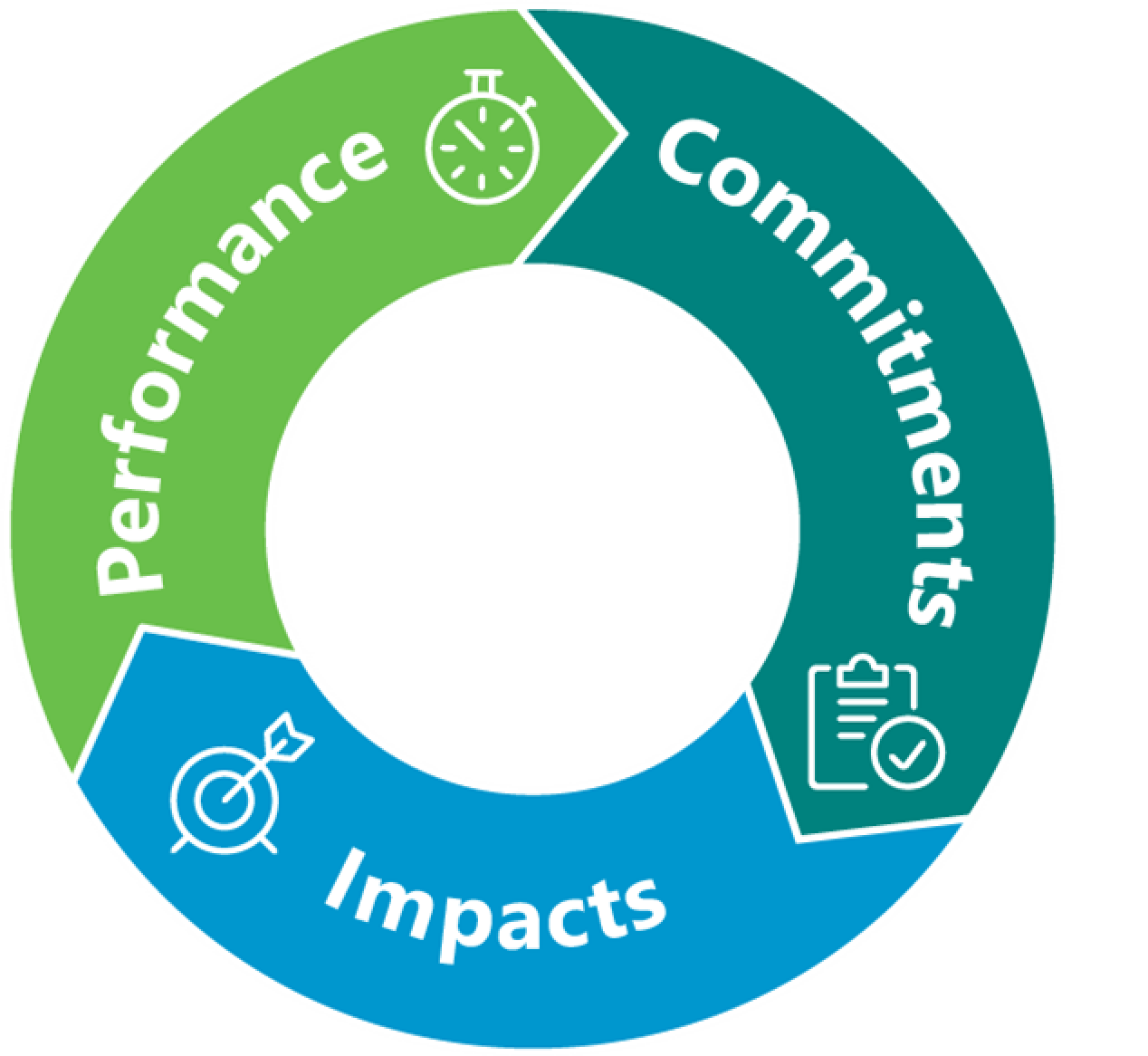
These elements are part of an iterative reporting process, where company and investor understanding is developing and evolving.
As companies develop definitions and estimate impacts, this improves their understanding of what is important for them to measure. In turn, as they improve processes and data, it helps them refine the scope of their commitments, and potentially increase the ambition of their aims.
The report highlights investor needs at each stage and identifies questions and disclosures to consider based on whether these were:
- Foundational – providing a basic understanding of the commitment, including high-level targets, timelines and impacts; or
- Advanced - providing updates on progress, refinements of goals, and more detailed information on impact and accountability.
Companies may find it helpful to begin preparing more advanced elements despite being at an earlier stage in their process.
The information we highlight throughout this report may not be relevant to all cases and companies should consider what is material to them when drafting disclosures. We would also note these foundational elements are not intended to represent minimum compliance with existing disclosure frameworks, and advanced elements may be needed to do so.
Elements to consider when preparing net zero disclosures
Commitments
Foundational:
- Clearly define the commitment for users:
- the types of GHGs included
- the scopes of emissions included
- the type of reductions committed to (absolute and/or intensity)
- what the boundaries of the commitment are and if these differ from the financial statements
- the timelines for the commitment
- any plans to use offsets, including the extent and nature of the offsets
- Provide information on any exclusions or limitations to the commitment
Advanced:
- Consider whether the commitment will be updated, for example, a new approach or a more ambitious target
Impacts
Foundational:
- Set out the strategy to achieving net zero, including how it may impact on the business model and start to consider transition planning
- Frame the risks and opportunities of the commitment to the business in a balanced way
- Provide estimates of potential future costs, where relevant on capital expenditure (capex), research and development (R&D), and other green operating expenditure
- Explain uncertainties and assumptions to reaching the commitment, in a manner consistent with financial statements and that links to issues such as resilience and viability
Advanced:
- Provide updated views on impact and financing requirements
- Develop and disclose transition plans
- Consider what quantitative estimates or additional scenario analysis may be helpful for users
Performance
Foundational:
- Set out the frameworks and methodologies used for setting targets and measuring progress
- Detail the targets that have been set, including for the short, medium, and long term
- Set out progress to date, and if this is or is not in line with expectations
- Provide an understanding of the expected trajectory for the future
- Explain how management measures performance, including relevant metrics
- Provide details on governance and monitoring, including any links to remuneration
Advanced:
- Provide information on leading performance indicators
- Consider whether any external assurance would be appropriate, and where obtained, whether to disclose this

Financial Reporting Council 8th Floor 125 London Wall London EC2Y 5AS +44 (0)20 7492 230 www.frc.org.uk
Follow us on Twitter@FRCnews or Linked in