
The content on this page has been converted from PDF to HTML format using an artificial intelligence (AI) tool as part of our ongoing efforts to improve accessibility and usability of our publications. Note:
- No human verification has been conducted of the converted content.
- While we strive for accuracy errors or omissions may exist.
- This content is provided for informational purposes only and should not be relied upon as a definitive or authoritative source.
- For the official and verified version of the publication, refer to the original PDF document.
If you identify any inaccuracies or have concerns about the content, please contact us at [email protected].
Improving the Quality of Comply or Explain Reporting
Introduction
This document is intended to help companies improve transparency when reporting against the 2018 UK Corporate Governance Code and advise them on how to achieve good quality explanations when departing from the Code. In November 2020 the FRC published our Review of Corporate Governance Reporting. We found that 'tick-box compliance' continues to be preferred over high quality reporting of good governance practice. Our analysis, of a random sample of 100 companies, found that too many companies strive to declare strict compliance with the Code. Such a formulaic approach leads to boilerplate language, and ineffective reporting that lacks substance and information about governance outcomes.
The FCA's Listing Rules require companies to include on their annual reports:
- a statement of how the company has applied the Principles set out in the UK Corporate Governance Code, in a manner that would enable shareholders to evaluate how the principles have been applied.
- a statement as to whether the listed company has: a. complied throughout the accounting period with all relevant provisions set out in the UK Corporate Governance Code; or b. not complied throughout the accounting period with all relevant provisions set out in the UK Corporate Governance Code and if so, setting out: i. those provisions, if any it has not complied with; ii. in the case of provisions whose requirements are of a continuing nature, the period within which, if any, it did not comply with some or all of those provisions; and iii. the company's reasons for non-compliance.
Companies and shareholders should not favour strict compliance over effective governance and transparency.
The Code offers flexibility through its 'comply or explain' approach, which is designed to encourage companies to develop governance processes and practices that are the most suitable for their particular circumstances and to report them in a meaningful way. We found from our review that companies seem hesitant to disclose departures from the Provisions of the Code, with some annual reports lacking clarity or transparency in this respect. The FRC encourages companies to embrace the flexibility offered by the Code, consider their circumstances carefully and choose what is best for them, while clearly explaining any departures from the Code. Companies and shareholders should not favour strict compliance over effective governance and transparency.
Sometimes a departure from the Code is unavoidable: for example, if a director resigns without advance notice, leaving the board with less than half of the board made up of independent NEDs. Companies should use the flexibility offered by the Code to adjust their governance to their changing circumstances in both the short and long term.
1. Short-term: a departure from a Provision where compliance has either been achieved by the end of the reporting period; or a plan is disclosed to come back into compliance, but that has not yet been implemented by the end of the reporting period.
2. Long-term: a departure from a Provision during the relevant period with no plan disclosed to come back into compliance in the near future.
Whichever type of departure, companies should ensure transparency in their communications, including the annual report.
1. Companies should offer clarity about the Provisions of the Code that they have departed from by making it easy for a reader to find this in their annual reports.
Annual reports should make it easy for a reader to find out how the company has applied the Principles of the Code and to clearly understand if a company has fully complied with all the Provisions and if not, the Provisions they have not complied with along with the explanation. Companies should:
- State in the compliance statement whether the company has:
- fully complied with all elements of the Provisions of the Code; or
- has departed from any of the Provisions of the Code citing any Provisions that they have not complied with and state where in the report the explanation can be found.
The two examples below are excerpts from governance statements that note departures from the Code, but do not clearly state which Provisions or where the explanations can be found, and therefore do not provide sufficient clarity:
"Other than where expressly stated below, throughout the financial year ended 31 December 2019, the company complied in full with all relevant provisions of the Code."
"The Board is committed to the highest standards of corporate governance and, except as set out below, the Board has complied with and intends to continue to comply with the requirements of the UK Corporate Governance Code."
We expect companies to make departures clear by naming the Provision(s) in the compliance statement, for example:
"Throughout the financial year ended 31 December 2019, the company fully complied with all the provisions of the Code, except for provision 9 and we have provided a full explanation."
- Companies should provide the explanation for non-compliance in one of the following ways:
- As part of the compliance statement (particularly when the company has only departed from one or two Provisions); or
- Signpost to another page/section of the annual report, where the reader can easily find the explanation.
Any departure from the Code should be made clear in the Compliance Statement.
2. Companies should report any departure from any Provision of the Code.
One of the most concerning findings from our review was that many companies were not transparent about their compliance with the Code. Several companies in our sample, including some that claimed full compliance with the Code, on further investigation had not acknowledged departure from one or more Provisions of the Code.
It is very important that companies are transparent, so that investors and wider stakeholders can assess a company's approach to governance. We have observed that companies report non-compliance in two ways:
- acknowledge departures from the Code and offer a full and comprehensive explanation (see what constitutes a full explanation below);
- acknowledge a departure from the Code but offer an incomplete or no explanation.
FRC Financial Reporting Council
In line with the Listing Rule and the Code's requirements, the FRC expects companies to 1. clearly acknowledge any departures from the Code; and 2. provide full and comprehensive explanations.
There were some departures from Provisions of the Code for which we noted a particular lack of transparency:
Provision 5 - stakeholders' interests and workforce engagement
To claim compliance with this Provision, companies should comply with both its elements:
- Stakeholders' interests and matters set out in section 172(1) of the Companies Act 2006. Companies are required to describe in the annual report how their key stakeholders' interests and matters set out in section 172 of the Companies Act have been considered in board discussions and decision-making. If a company does not provide a description as required by Provision 5, it is not complying with it.
To comply with this Provision, companies need to give clear and specific examples of how they have considered in their board discussions and decision-making the interests of the key stakeholders of the company and section 172 matters.
Many companies in our sample explain what the interests of different stakeholders are. However, they do not describe how these were taken into account in board discussions and decision-making and what was the outcome. Companies do not need to replicate the section 172 statement but offer consistency with it in terms of the governance of decision-making.
- Workforce engagement
In addition to the above, to comply with Provision 5, companies should engage with the workforce using one of the engagement methods prescribed by this Provision, or a combination of them:
- a director appointed from the workforce
- a formal workforce advisory panel
- a designated non-executive director
Companies can also report compliance with this element of this Provision if they have not chosen one of the methods above but have implemented alternative arrangements. Such alternative arrangements need to be fully explained, including addressing why they are considered effective.
An alternative approach to workforce engagement is in compliance with the Code, but the effectiveness of the approach should be explained
Provision 19 - chair tenure
In our review, we found instances where companies did not acknowledge departure from Provision 19 despite the chair being a member of the board for longer than nine years. This included a company whose chair had been on the board for over 20 years.
Companies could declare compliance with this Provision if the chair has been on the board for no more than nine years. We support departures from the Code when it is to facilitate effective succession planning or the development of a diverse board, but such cases should still be acknowledged as a departure from the Code and accompanied by an effective explanation.
Provision 38 - executive pensions aligned with the workforce
The majority of the companies in our sample had not aligned some or all of their executive pensions with those of the workforce for all directors. As a new requirement of the Code, it was expected that it would be difficult for some companies to comply with this Provision immediately due to contractual obligations. Many companies whose executive pensions were not aligned with those of the workforce did not provide a timeline for when or if at all this will happen.
Companies could declare compliance with this Provision if all executive pension contributions are in line with those of the workforce. This would also be the case when executive pension contributions are less than those of the workforce. In those cases where not all executive pension contributions are in line, companies should provide an explanation, which should include a timeline for alignment for all directors.
Provision 36 - post-employment shareholding
There were a few companies in our sample that did not have a post-employment shareholding requirement. We were pleased to see that some of them explained that this would be reviewed when a new remuneration policy is introduced. However, in such circumstances a departure from the Code should have been reported. It is clear from the wording of Provision 36 that companies “should develop a formal policy for post-employment shareholding requirements encompassing both unvested and vested shares". Therefore, unless such a policy is in place, companies are not in compliance with Provision 36. It is not enough to state that the vesting and post-vesting periods apply after the departure of the directors from the company. The company report should reference the policy that requires directors to hold their shares post-employment in addition to the vesting period.
Provisions 23, 26 and 41 - describing the work of the nomination, audit and remuneration committees
These three Provisions require companies to describe the work of their three committees in the annual report by reporting on all the points in each Provision.
To comply with Provision 23, companies need to describe the work of their nomination committees, in terms of the four elements of this Provision:
- the process used in relation to appointments, its approach to succession planning and how both support developing a diverse pipeline;
- how the board evaluation has been conducted, the nature and extent of an external evaluator's contact with the board and individual directors, the outcomes and actions taken, and how it has or will influence board composition;
- the policy on diversity and inclusion, its objectives and linkage to company strategy, how it has been implemented and progress on achieving the objectives; and the gender balance of those in the senior management and their direct reports.
To comply with Provision 26, all the five elements of this Provision need to be effectively explained; and the same goes for the seven elements of Provision 41.
We have seen companies that do not cover some of these points but still claim compliance. For example, some companies do not describe what engagement with workforce has taken place to explain how executive remuneration aligns with wider company pay policy, but do not disclose non-compliance with Provision 41. If a company has not undertaken any specific engagement of this nature, then it is not possible to claim compliance with this Provision.
Explanation of each of the points in these Provisions should be meaningful. For example, our review found a lack of explanations on the strategic rationale for executive directors' remuneration policies, structures and any performance metrics. It is not enough to state that the strategic rationale is to align executive remuneration to the interests of the company or the shareholders. Companies need to explain how the remuneration practice supports company strategy and performance, for example how it supports the achievement of Key Performance Indicators.
Provisions 40 and 41 - engagement with shareholders and workforce
Provision 40 states that companies "should be transparent and promote effective engagement with shareholders and the workforce". Provision 41 requires companies to provide a description of the engagement that has taken place with shareholders and the workforce. If a company has not engaged with shareholders or the workforce in relation to remuneration, it is not compliant with Provision 40, nor 41.
“Effective engagement” is more than reporting that the company has sought the workforce’s views on remuneration via surveys. Engagement should be two-sided. It should describe the method of engagement, the parties involved, what explanation was given to the workforce as to how executive remuneration aligns with wider company pay policy and the views of the workforce on it.
Moreover, it is not sufficient to state that there has been engagement with shareholders; there needs to be an explanation of what impact, if any, this engagement has had on remuneration policy.
Effective engagement involves two-way dialogue.
3. Clear and meaningful explanations for departures from the Code.
Explanations are key to the 'comply or explain' nature of the Code. A full and meaningful explanation for non-compliance should show that an alternative arrangement is more appropriate and beneficial in upholding high standards of governance. We encourage companies to write full and meaningful explanations, as this will offer investors and other stakeholders the opportunity to consider whether the quality of explanation achieves effective governance of the company even though there is a departure from the Code. It also demonstrates confidence that the company is taking governance seriously.
We were disappointed with the quality of the explanations provided by companies for non-compliance with the Provisions of the Code and struggled to find robust explanations. Our sample identified 74 cases of non-compliance with the Code, but we found only four explanations that we considered high quality and offered an insight into the companies' approach to good governance. The majority of explanations were inadequate, and in one instance, not given at all.
A good explanation should demonstrate that departure is justified given the company's specific circumstances. It should:
- Set the context and background. Companies should name the Provision that they have not complied with. They should then explain the circumstances, and as required by the Listing Rules, state the reasons why they are not complying or are unable to comply.
- Give a convincing rationale for the approach being taken. Companies should set out the alternative arrangement that they have chosen and state the reason(s) why they have chosen it. This should be easy and straightforward if departure from the Code is unavoidable, such as in the example mentioned above, a director resigning without advance notice, thus leaving the board with less than half of the board made up of independent NEDs.
We expect companies to provide a more comprehensive and detailed explanation when non-compliance is indefinite. For example, if the company decides to keep the chair in their position for longer than nine years, a strong rationale should be provided, with clear reasons why this is important, and the criteria used to evaluate it.
- Consider any risks and describe any mitigating actions. Companies should consider whether departing from the Code and following an alternative approach contains any risks. They should state if there are any actual risks (if any) arising from this approach. If the directors consider that there is no or negligible risk, companies should state any potential risks that might arise in the future. They should then explain any actions that they have taken or will be taking to mitigate such risks. For example, the loss of independent directors could reduce challenge to board decision-making and leave effective control of the company with a small number of individuals.
- Set out when the company intends to comply (timescales). A good explanation should indicate whether departure is limited in time or is indefinite. When companies have not complied with a Provision only for part of the accounting year, they should clearly specify the time that they were unable to do so. When departure is limited in time, but it extends beyond the full accounting year, a good explanation would give an estimate of when the company plans to comply with the Provision and the steps it is taking to assure compliance.
When departure is indefinite, companies should state this and explain whether there could be any future factors or circumstances that would give them a reason to review or change their alternative approach.
Companies that have explained that their departure is indefinite must continue to explain each year and not rely on a previous year's explanation.
- Explanations should be understandable and persuasive. Considering all the above elements, companies should ensure that their explanation is understandable and persuasive. It should be written in plain language that is easy to understand and leaves no room for ambiguity. It should provide enough level of detail so that investors and stakeholders fully understand and evaluate why the company has not complied with a Provision and what the chosen alternative entails.
It would still be for companies to make judgements about the extent to which each of the five criteria they need to address after considering their particular circumstances. Nonetheless, we expect companies to address all the criteria.
Explanations are key to the 'comply or explain' nature of the Code.
It is always beneficial to consult with shareholders and it is a good addition to an explanation to state that shareholders are supportive of the departure. However, this is not sufficient without setting out the points we list as necessary for a good explanation. Companies are still required to provide full and effective explanations.
Example of a good explanation - Rolls-Royce, non-compliance with Provision 32:
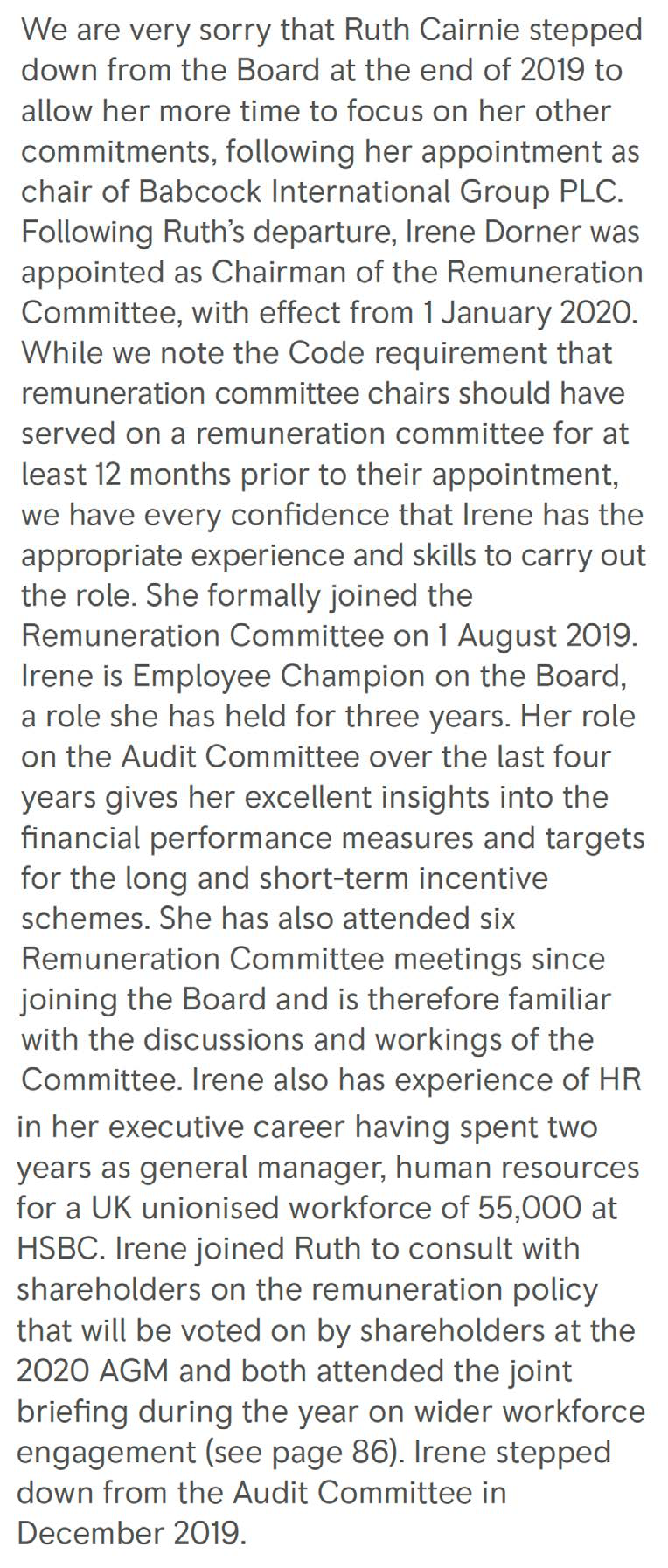
They set the background and explain the reason for non-compliance.
The timescale is clear.
They give a convincing rationale of the approach taken, by explaining the alternative approach and why that is effective.
They consider any risks and describe their mitigating actions.
The explanation is understandable and persuasive.
Appendix A demonstrates how a company can improve its explanation for departure from Provision 9. This Provision had the highest non-compliance rate from the companies in our sample; however, none of those companies provided a good explanation.
Summary
For companies to offer an honest appraisal of their governance, they should offer transparency in terms of both their application of the principles and reporting against the Provisions. This can only be effective if the report avoids boilerplate language and individual companies apply the code to their individual circumstances, which will require companies to offer a full and honest explanation, which should be welcomed by investors, service providers, regulators and wider stakeholders.
When a company departs from a Provision of the Code, the annual report should clearly demonstrate:
- The action taken by the company: What Provision it has departed from and what alternative approach it has chosen.
and
- The outcome: How is that alternative approach more efficient and appropriate than that prescribed by the Code, and how is it helping the company to achieve good governance?
Appendix A – Explanation for non-compliance with Provision 9
Provision 9 of the Code had the highest non-compliance rate from the companies in our sample, with 16 companies declaring non-compliance with it. None of those 16 companies gave a satisfying explanation. The examples below are excerpts from annual reports of explanations for departure from Provision 9.
"The Board confirms that it fully complied with the Code as at 31 December 2019, with the exception of the independence of the Board Chair upon appointment which was fully explained and justified at the time of appointment.”
"On listing, the Board unanimously supported, and continues to support, my appointment as Chairman to retain my skills and experience and ensure continuity of service for customers and commercial partners."
"The Non-Executive Directors have determined that [the Chair] continues to lead the Board effectively."
For non-compliance with this Provision, we would expect to see fuller explanations that include the following:
- Set the background. Explain why the chair was not independent when they were first appointed on the board.
- Give a convincing rationale for the approach being taken. We saw no convincing rationales in the explanations provided by companies for non-compliance with this Provision. It is not enough to simply state that the NEDs have determined that the chair continues to lead the board effectively. The rationale should include the reasons why retaining the chair is beneficial for the company and its stakeholders, including the skills, experience and any other factors considered. It should also cover the reasons why a new independent chair may not offer the same or better skillset than the current chair, bearing in mind that Principle F of the Code states that “...they should demonstrate objective judgement throughout their tenure” and Principle K states that “Consideration should be given to the length of service of the board as a whole and membership regularly refreshed”.
- Consider any risks and describe any mitigating actions. Companies should consider the risks of having a non-independent chair, for example the impact on board effectiveness or board dynamics, and the actions that the board has taken to mitigate this.
- Set out when the company intends to comply (timescales). State whether the company has plans in place to comply with this departure, for example explaining the process for succession planning; or explain the reasons for the chair remaining in post without setting a timeframe for a replacement.
- The explanation should be understandable and persuasive. The reasons why the chair is not independent should be genuine and it should be visible that it is the right approach to take. A good explanation should provide a convincing argument that shows that, on balance, the benefits of retaining a non-independent chair outweigh the benefits of appointing a new independent chair.
Financial Reporting Council
8th Floor 125 London Wall London EC2Y 5AS
+44 (0)20 7492 2300 www.frc.org.uk