
The content on this page has been converted from PDF to HTML format using an artificial intelligence (AI) tool as part of our ongoing efforts to improve accessibility and usability of our publications. Note:
- No human verification has been conducted of the converted content.
- While we strive for accuracy errors or omissions may exist.
- This content is provided for informational purposes only and should not be relied upon as a definitive or authoritative source.
- For the official and verified version of the publication, refer to the original PDF document.
If you identify any inaccuracies or have concerns about the content, please contact us at [email protected].
FRC Gender Pay Gap 2019/20
Foreword from the Chief Executive Officer
Addressing the gender pay gap is an important part of our Diversity and Inclusion strategy so that the FRC can continue to attract and develop a diverse mix of people at all levels of the FRC and create an inclusive culture where everyone can fulfil their potential.
Over the past three years, we have taken concerted action to tackle the gender pay gap and this report demonstrates the progress we've made and are continuing to make in closing this gap.
At the 31 March 2020 we have seen the gender pay gap reduce by 11.4% from 27.3% to 15.9% (median figure) and the mean pay gap has also reduced by 4.3% from 22.7% to 18.4%.
Since the 31 March 2020, we have rerun the data and seen a further median reduction from 15.9% to 4.6% and a further mean (average) reduction from 18.4% to 11.5%. Over three years, this equates to a median percentage reduction of 23.2% and a mean reduction of 12.4%.
This substantial reduction in our gender pay gap reflects the increased number women at all of levels in our organisation. Women are now in the majority at every job level of the FRC except among the four Executive Directors where only one is a woman. In addition, our approach to pay and reward which places much tighter control on the setting of starting and promotion salaries and since 2018 we use a job levelling framework which maps job level to key responsibilities, to ensure consistency of approach for all employees.
Eliminating the gender pay gap further is something that myself, the Board and our Executive Committee are committed to, and to do this, it's important to know why the gap exists. At the FRC the gender pay gap is caused by a disproportionate percentage of females in the lower pay quartile and specifically in job level 1 roles where 93% are women and at job level 2, 60% are women.
Over the course of the new financial year, I hope to build on the progress to date and that's why this we will review the design of job roles at our most junior level to see what can be done to support the career progression of people at that level. We will also explore what we can do to continue to support staff with caring responsibilities and continue to invest in the leadership development of women across the whole of the FRC to ensure that so that our workforce represents the society we serve at every job level in the FRC.
Sir Jon Thompson, Chief Executive
Introduction
The FRC has prepared this report as part of the legal requirement for public bodies to publish their gender pay gap on an annual basis. In 2017, the government introduced legislation that made it a statutory requirement for organisations with employees of 250 or more to report annually on their gender pay gap. Though the FRC was not required to report at that time because the number of employees was below the threshold of 250 employees, we decided to publish our information as a demonstration our long-standing commitment to diversity and inclusion for all our people and to lead by example.
These statutory regulations underpin the Public Sector Equality Duty (PSED) and require relevant organisations to publish their gender pay gap by 30 March annually for the prior 31 March. This includes the mean and median gender pay gaps; the mean and median gender bonus gaps; the proportion of men and women who received bonuses; and the proportions of men and women employees in each pay quartile.
The gender pay gap shows the difference in the average pay between all men and women in a workforce. If a workforce has a particularly high gender pay gap, this can indicate there may be several issues to deal with, and the individual calculations may help to identify what those issues are.
The gender pay gap is different to equal pay. Equal pay deals with the pay differences between men and women who carry out the same jobs, similar jobs, or work of equal value. It is unlawful to pay people unequally because they are a man or a woman. The FRC supports the fair treatment and reward of all staff irrespective of gender.
This report fulfils our reporting requirements, explains why we have a gap and shows the steps we are taking to reduce the gap.
2020 Headline figures
The headline 2020 Gender Pay Gap figures at the 31 March 2020 show a median gender pay gap of 15.9% and a mean gender pay gap of 18.4%. This equates to a 11.4% reduction in the median pay gap from 27.3% and a 4.3% mean (average) pay gap reduction from 22.7% since 31 March 2019.
Closing the gap: progress since 31 March 2020
We undertake regular reviews to assess progress made on reducing our gender pay gap and the most recent review (31 January 2021) shows that since the 31 March 2020 snapshot date for reporting, the gap has further reduced to 4.6% (median) and 11.5% (mean).
This significant reduction in the gender pay gap, reflects further the advancement of women at the FRC being in the majority of most grades apart from the four members of ExCo, the impact of FRC's new approach to pay and reward which was introduced in 2018 (i.e. a more structured approach to the setting of starting and promotional salaries and to the annual pay awards), the introduction of a new job levelling framework which maps job level to responsibilities and a significant increase (57%) in women at our senior management job level (job Level 6).1
| Gender Pay Gap | 2018 | 2019 | 2020 | (Jan 2021) Not published |
|---|---|---|---|---|
| Median Pay Gap | 27.8% | 27.3% | 15.9% | 4.6% |
| Mean Pay Gap | 23.9% | 22.7% | 18.4% | 11.5% |
Bonus Pay Gap
During the period of this report, the only payments that counted towards the bonus pay gap in the FRC were payments made under the Values in Practice (VIP) recognition scheme. The proportion and percentage of employees that received a VIP payment is broadly similar and the bonus pay gap is 15.4% (mean) and 33.3% (median).
| Bonus Pay Gap | 2018 | 2019 | 2020 |
|---|---|---|---|
| Median Bonus Pay Gap | 21.3% | 0% | 33.3% |
| Mean Bonus Pay Gap | 38.1% | 0.9% | 15.4% |
| % of women getting a bonus | 71.8% | 81% | 65.5% |
| % of men getting a bonus | 76.5% | 85% | 86.7% |
Why do we have a gender pay gap?
In answering this question, it is important to consider FRC's workforce demographic (full time versus part time), the percentage of males and females in each of the pay quartiles, and the proportion of males and females at each job level in the FRC.
Working Pattern
In the FRC at 31 March 2020, 41% of the workforce were male and 59% were female (see figure 3).
Figure 3 Gender Split Men vs Women:
A pie chart illustrating the gender split of the workforce. 41% of the workforce is male, and 59% is female.
In addition to this, 83% of the workforce are full time with 17% of the workforce employed on part time contracts (see figure 4).
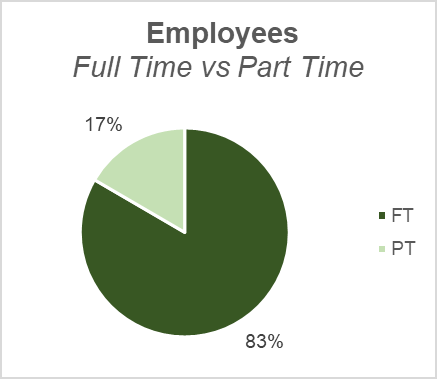
Of this 17% of the workforce on part time contracts, females accounted for 88% which is an increase of 5% in female part time workers since the previous year.
Pay Quartile data
In further understanding why there is a gender pay gap, it is important to consider the proportion of males and females in each of the four pay quartiles (please see figure 5).
Figure 5 Proportion of Men and Women in each Pay Quartile:
A bar chart showing the percentage of men and women in each of the four pay quartiles: * Lower Quartile: Women 76.7%, Men 23.3% * Lower Middle Quartile: Women 54.3%, Men 45.7% * Upper Middle Quartile: Women 62.7%, Men 37.3% * Upper Quartile: Women 43.3%, Men 56.7%
Figure 5 shows that although 62.7% of females working in the FRC are in the upper middle quarter which is positive, there is a higher percentage of females in the lower pay quartile and a higher percentage of males in the upper pay quartile. This could be as a result of higher number of females working part time but further analysis will be required in the coming year to establish this.
Job Level
Analysis of the workforce demographic by job level also provides an insight as to why we have a gap (see figure 6 below).
Figure 6 – Gender split by Job level at 30 March 2020:
A bar chart depicting the gender split by job level as of 30 March 2020, with a red line indicating the FRC's overall gender split (not specified in the chart's legend, but visually appears to be 50% for ExCo and then varying for other levels based on proportion shown). * ExCo: 50% Women, 50% Men * Level 6: 33% Women, 67% Men * Level 5: 56% Women, 44% Men * Level 4: 51% Women, 49% Men * Level 3: 63% Women, 37% Men * Level 2: 60% Women, 40% Men * Level 1: 93% Women, 7% Men
You will see from figure 6, that a disproportionate percentage (93%) of females are employed in L1 job roles. Most job roles at L1 are Personal Executive Assistant (PA) roles (see also proposed actions below).
Whilst in March 2020, a higher number of men were in Level 6 roles, we have made real progress during the course of 2020 and, as at 31 January 2021, the proportion of women at that level has now increased to 70% (see figure 9).
At figure 7 below, it is also interesting to consider the hourly rate of pay by job level (the minus figures in figure 8 indicates where males are paid more by hour than females). The figure for the Executive Committee (5 people in total) is heavily impacted by the fact that we currently have fewer women (one out of 5) and our CEO is male.
| Job Level | Female | Male |
|---|---|---|
| 1 | 19.75 | 11.45 |
| 2 | 18.22 | 16.77 |
| 3 | 33.91 | 31.83 |
| 4 | 49.76 | 51.00 |
| 5 | 63.12 | 66.16 |
| 6 | 92.12 | 86.34 |
| ExCo | 113.40 | 175.84 |
| Job Level | Gender Pay Gap |
|---|---|
| 1 | 72.5% |
| 2 | 8.7% |
| 3 | 6.5% |
| 4 | -2.4% |
| 5 | -4.6% |
| 6 | 6.7% |
| ExCo | -35.5% |
| Job Level | Gender Pay Gap |
|---|---|
| 1 | 36.4% |
| 2 | 7.3% |
| 3 | 8.5% |
| 4 | -0.1% |
| 5 | 4.2% |
| 6 | 5.7% |
| ExCo | -5.6% |
Figure 9 – Gender split by job level at 31 January 2021:
A bar chart illustrating the gender split by job level as of 31 January 2021. * ExCo: 25% Women, 75% Men * Level 6: 70% Women, 30% Men * Level 5: 49% Women, 51% Men * Level 4: 52% Women, 48% Men * Level 3: 58% Women, 42% Men * Level 2: 62% Women, 38% Men * Level 1: 91% Women, 9% Men
Bonus Pay Gap at 31 March 2020
In the early part of 2020, we took a decision, in the light of the pandemic and the economic conditions in the UK, to pause payments under our VIP recognition scheme. This meant that we did not make any awards in the 4th quarter of the annual cycle of awards and it is difficult to know whether, had these awards been made, what impact this would have had on the bonus gap calculation, as the VIP scheme that was introduced in 2019 had previously been gender neutral. Given that no payments will have been made in the year ending March 2021, we will not have a bonus pay gap at the next snapshot date for reporting i.e. 31 March 2021 and during 2021 we will be reviewing whether to resume or replace this scheme.
Actions we have taken to reduce the pay gap
Over the last year, we have taken the following actions below to reduce the gender pay gap
- Further embedded FRC's pay and reward strategy and policy
- Refreshed our strategy on D&I which continues a focus on gender equality
- Published our Women in Finance (WiF) Charter results which shows an increase in the percentage of women in senior leadership (level 6) & board roles
- Relaunched our mentoring and reverse mentoring programmes
- Updated our policy on flexible working so that all staff can request up to 2 days per week working at home
- Developed a new policy on recruitment, re-enforcing FRC's commitment to diverse interview panels
- Launched career conversation training for line managers
- Rolled out diversity training e.g. unconscious bias and active bystander training
- D&I is routinely covered at corporate induction sessions
- Developed recruitment skills training with a strong focus on ensuring Equality, Diversity, and Inclusion
Proposed actions to further reduce the pay gap
Although the Gender Pay Gap has reduced significantly since 31 March 2020, we will continue to adopt a strict approach to enforcing the FRC's reward policy. In addition to this, we propose to carry out the following actions
- Review the job design of L1 roles and career progression opportunities for this group.
- Continue to support those with caring responsibilities at the FRC and explore whether there are further initiatives that we can take to ensure that barriers to progression are minimised.
- Continue to invest in the leadership development of women across the whole of the FRC.
-
57% increase relates to the period from 31 March 2020 to 31 January 2021 ↩